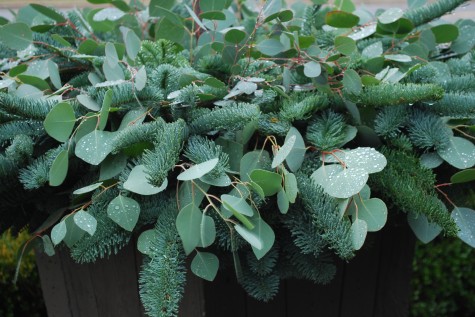
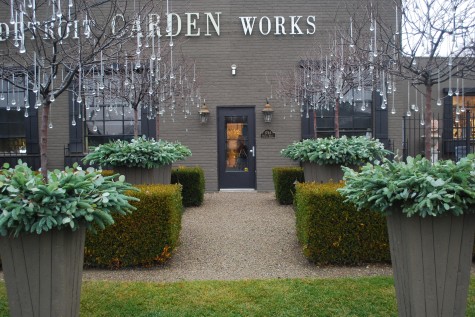
 The raindrop pots got their topdressing yesterday. I decided a mix of noble fir and fresh silver dollar eucalyptus would be just the thing to set off all that glass. The eucalyptus wavers in the slightest breeze-just like that glass. The color is bright-not a bad choice for weather which is predominately overcast. A little morning rain gave everything a fresh look.
 Eucalyptus stems are wiry, but slight. Sandwiching them between the stiff layers of the fir gives them some much needed support. Up close, the red stems repeat the red/brown crabapple trunks-this a visual bonus. The network of stems need to resist the weight of the snow that is sure to come. Much like arranging a vase of flowers, we cross stems over one another. Under the green, a woody nest.
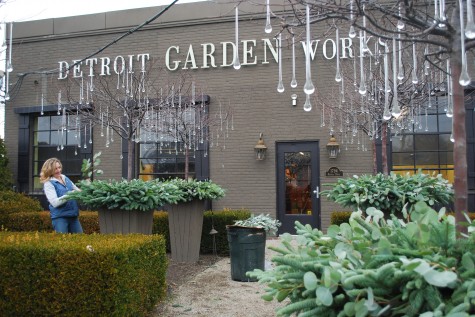
 Pam made quick work of this phase; the fact that she is a great gardener endows her work with a natural and graceful feeling. The greens were stuffed slightly wider that the dripline established by the glass. The dry foam form into which all of these greens are stuffed are bricks that have been glued together, and wired with concrete wire. We have only to come by some sunlight to get some sparkle going on.
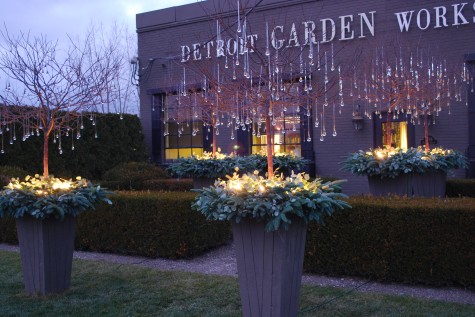 Rob decided to light the pots with strings of clear c-9 bulbs. We set them well into the foliage; the green cords are not a good look. This warm light is in contrast to all the attendant blue, makes much of the warm brown of the trunks, and the olive orange winter color of the boxwood.
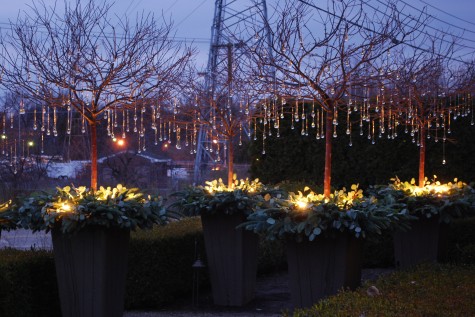 Late in the day, the drops start picking up light from the bottom. The eucalyptus discs repeat the round shapes of the drops.
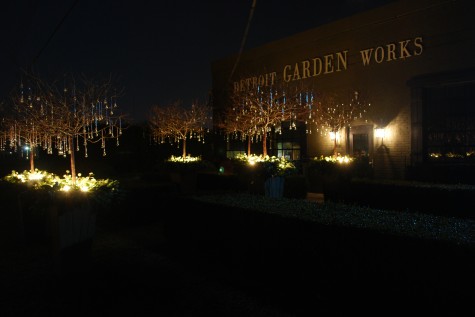
By 6pm, the party is just getting started.
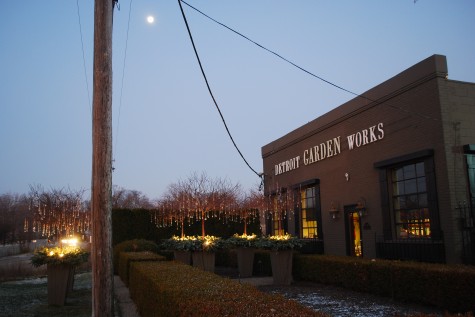
At 7am this morning, I see our full moon has a little company on the ground. Clear skies are forecast for today-I can’t wait.
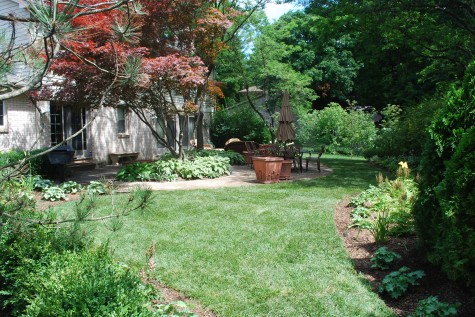 We spent over a week tearing apart a thirty year old landscape for this client. They had decided that though their kids were grown and gone, they would stay, and renovate both the inside and out of their family home. They had not ever spent much time outdoors; a very small back yard with no privacy from neighboring terrraces and play structures kept them indoors. New screening, and an enlarged gravel addition to their terrace opened the door to a new living space for them. The finishing touch-a collection of Italian style, English made concrete planters.
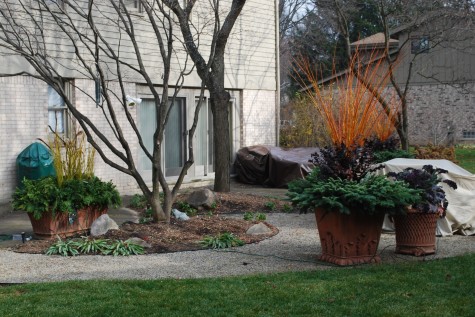 Their children are all coming home for Thanksgiving; they asked if I could dress the pots in their winter coats in time. They are very excited at the prospect of their kids seeing how their home has been transformed in the past 3 months, and the landscape is part of that. Four of the five pots on the rear terrace would be planted for winter. As they have little in the way of outdoor lighting in the back, we installed lights in every pot. The electrician just installed outdoor plugs for them yesterday, in time for the holiday gathering.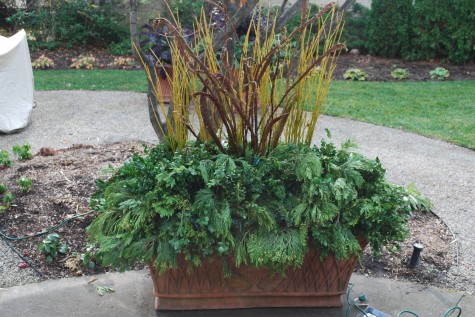
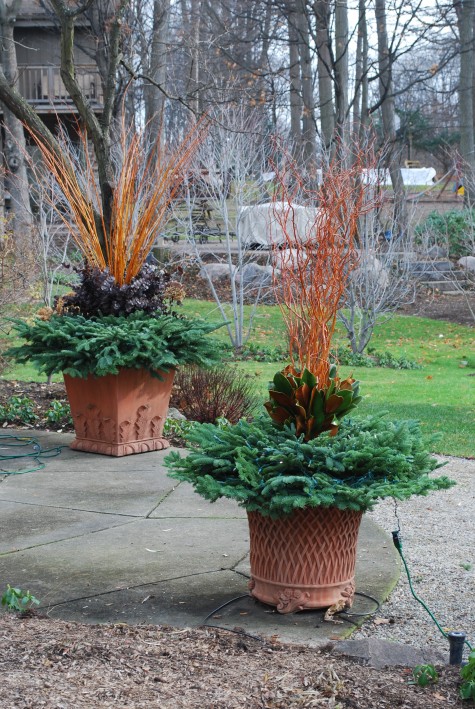
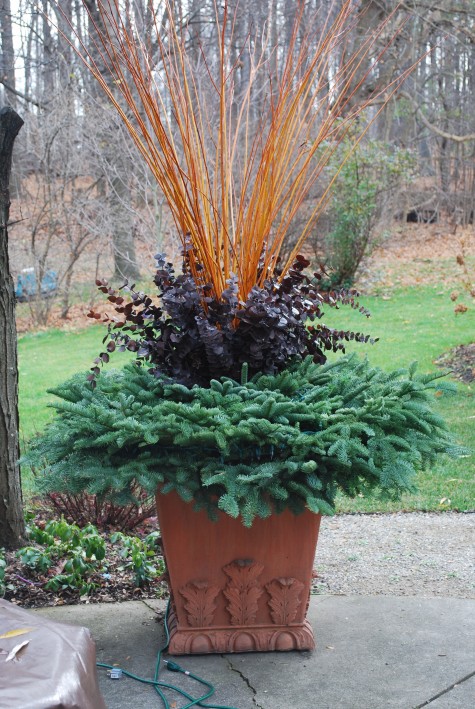 Preserved and dyed eucalyptus provdes a leafy texture much like the magnolia. The chocolate brown color is surprisingly lightfast outdoors. The container looks dreesed for the weather; the colors perfect for the Thanksgiving holiday will go on looking good as winter settles in.
 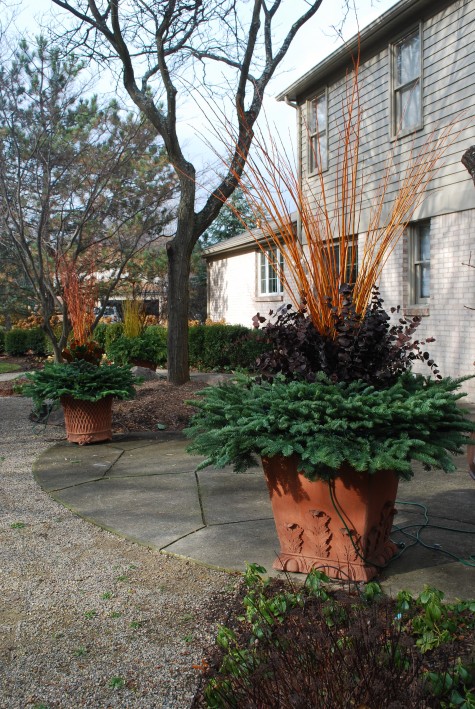 The pots are positioned to provide good views of the outdoors from the inside. I will move pots from a summer location to a winter one, if need be. I spend a lot more time looking at my garden in the winter from indoors; I am outdoors as much as possible in the summer. These pots can help alleviate that cooped up feeling invariably creeps up on any northern gardener.
 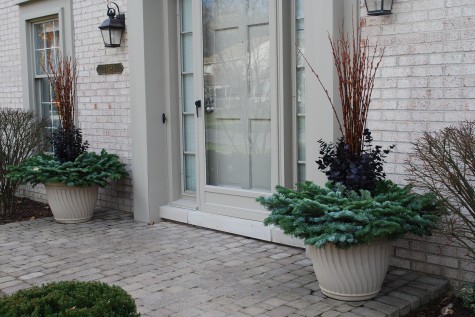 After the rear terrace pots were installed, they called-could I please do three more. Though they plan to replace these front door pots in the spring, they are not the center of attention here. Red bud pussy willow and dark purple eucalyptus make a formal and quietly beautiful statement at the door. My landscape crews construct and install all of this work; they do such a beautiful job. Clients who have winter pots done for the first time are surprised at what a difference they make. I hear about how nice it feels to have something beautiful to look at outdoors at this time.
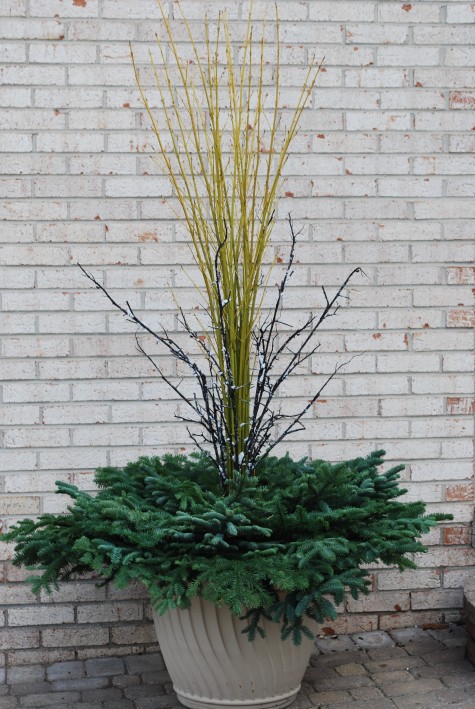 The side door has the same pot as the front, but a different treatment. As variety is a very precious commodity this time of year, I avoid repeating the same materials everywhere. These snow branches are all plastic; they look just as good up close, as they do in this picture. I try to include a third, mid-level element in all the winter pots; just sticks and greens is a little too spare for my taste.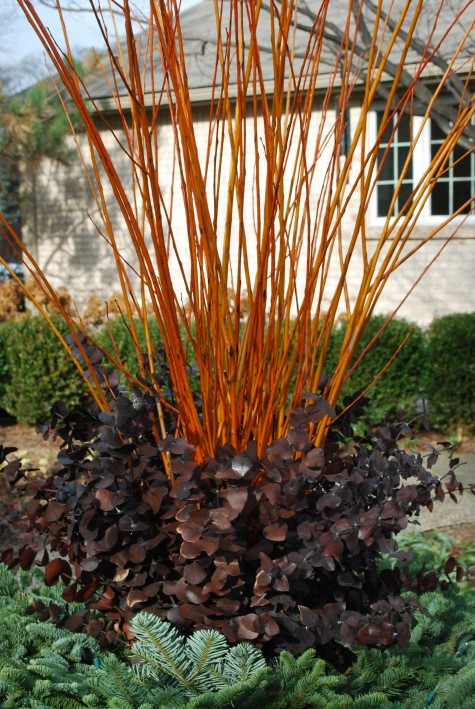
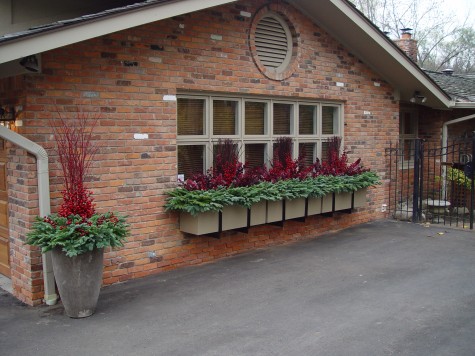 I do have a memory of getting into my Mom’s rouge pot in an idle moment. Those bright red perfectly circular spots of red I applied to my face made her laugh. I was terribly offended, as I thought I looked beautifully dolled up. All these years later I still like how a little rouge can doll things up; this is never more the case than in a garden gone wintry. Red twig dogwood and preserved and dyed eucalyptus can enliven a winter garden like nothing else does. I am not a fan of red tulips, or red dahlias; the red flowers and the green foliage is a little too much excitement for me. But the excitement generated by rouge red, in a garden gone grey, brown and black ,warms me up.
 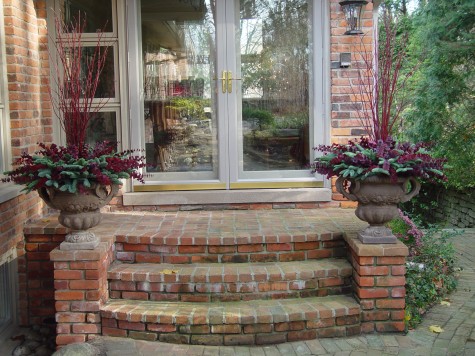 Dark red eucalyptus and red twig paired with the blue needled noble fir is a dramatic color combination. Very dark colors are best in small spaces viewed up close, or places backed up by a lighter color. The lighter orange/brown brick of this entrance makes that dark red read loud and clear. The big round leaves of the eucalyptus are a great foil to any needled evergreen branches.
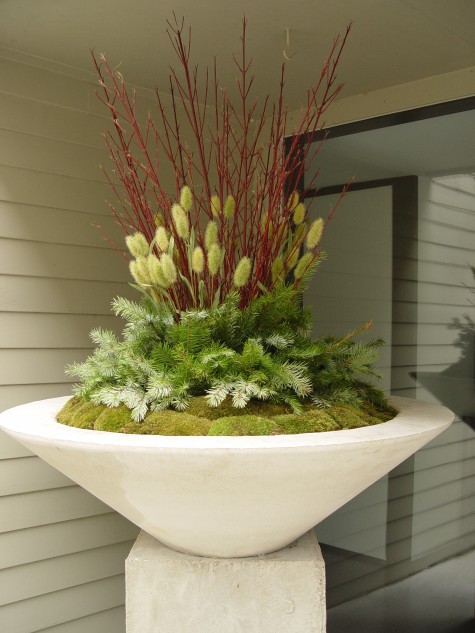 Bright red is all the more electric paired with a light green element. As no plant in the landscape has this form or color right now, I have no problem adding in artificial stems. Sometimes people ask how I could stand anything in a pot that wasn’t natural or real; it’s easy. Gardens make people feel good; if an artificial stem helps make an arrangement a little better and the winter a little more tolerable, I am all for it. This contemporary arrangement is all the more contemporary given the obviously faux detail.
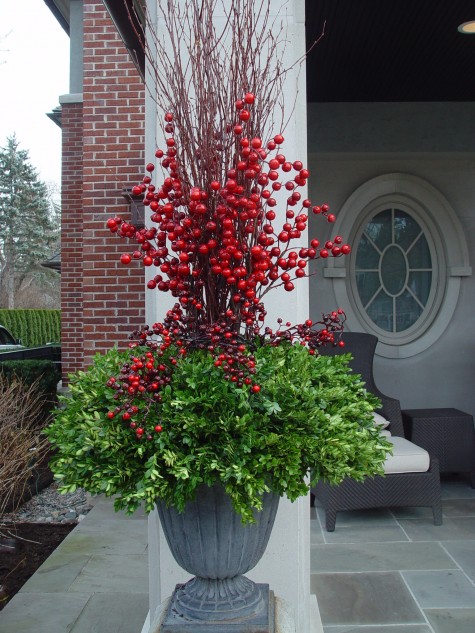 I am a fan of many shrubs and trees that sport berries in the fall and winter. However, they have a short lifespan, cut and in a container. The berries of Ilex Verticillata, or what we call Michigan holly, are spectacular but fragile. The berries in these urns will look great all winter, and can be removed the beginning of March. The boxwood might need a little floral dye sprayed on it by then, but I like keeping the pots intact until April sometime.
 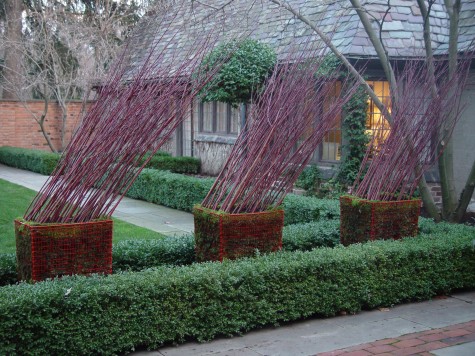 This wired and windswept winter display was entirely inspired by the floral arrangements of Jeff Leatham. His floral arrangements for the Four Seasons Hotel Paris, the George V often feature flowers set in vases at startling angles. This out of vertical placement attracts attention instantly. Each one of these dogwood stems were wired individually so the form would be kept intact whatever the weather.
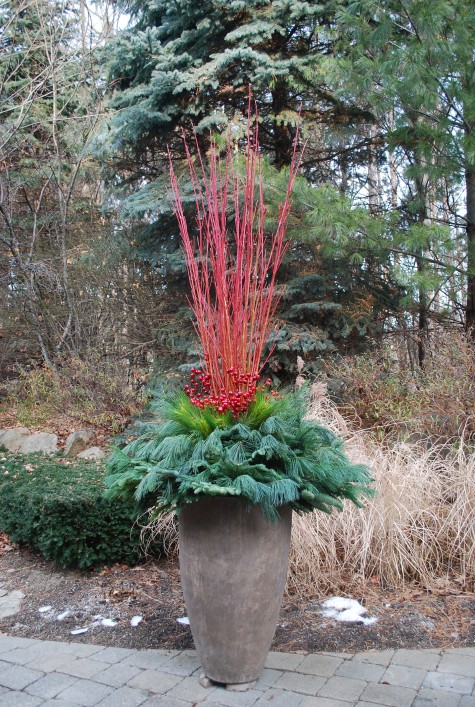 Cardinal redtwig is a relatively new cultivar that shines. It stands out so beautifully in front of the drab woodland background. We are sure to elevate the pot off the terrace surface, so water does not collect and freeze around the base.
 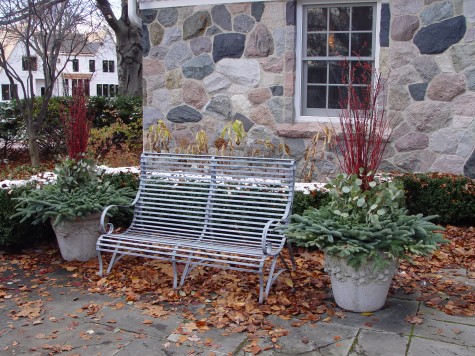 I have good success using fresh silver dollar eucalyptus outdoors. As it dries, the color does become more subtly taupe-blue, but the big leaves are an invaluable texture. The littleleaf euc tends to dry much faster and not to good end; I am not sure why. Eucalyptus pods dry blue, and hold their color well.
 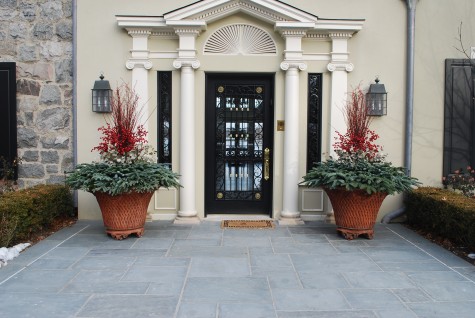 This pair of pots welcomes anyone who comes to visit. They make a very strong reference to my client’s love for their garden, from a long ways away.
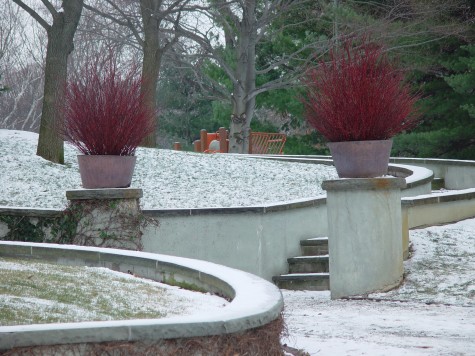 Likewise, this redtwig massed in copper pots, framing the view to a beautiful beech. Placed at least 75 feet from the road, they make a clear statement to passers by.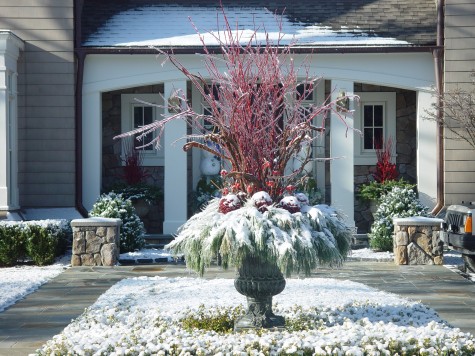
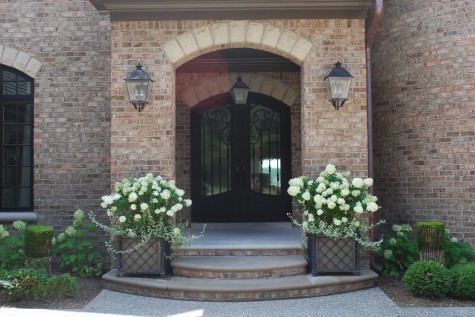 When I first opened Detroit Garden Works in 1996, my only clients were my landscape clients; they were all so great about supporting my new venture. Fourteen years later, the shop has clients of its own, many of whom are not aware that I offer a full range of landscape services from design through installation. This client shopped the store this past spring, and invested in this pair of English lattice work boxes. Rob referred her to me; planting advice and installation comes from the landscape company. I have a concern that anyone who purchases containers from me gets coached such that their experience with the gardening part of their ownership is a good one. A beautiful pot does not necessarily imply a beautiful planting; I arranged to meet with her.
 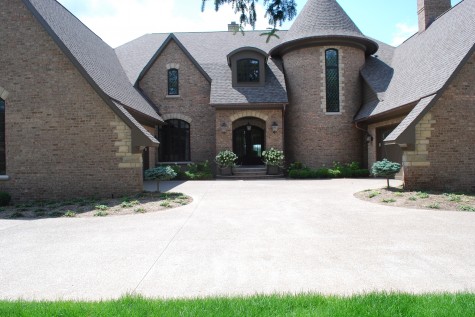 She told me she liked hydrangeas, simple plantings, and white, so we planted her new boxes with limelight hydrangea and lots of variegated licorice; they looked great. I accompanied the crew on the delivery, as she had several possible placements in mind. Once placed, I could see her landscape was struggling with what I call a distribution challenge. Her lakefront home had little flat land upon which to build a house, and a pair of garages necessitating a large drivecourt. What little land she had left over from all this hardscape dropped precipitously on each side. Properties where the hard surfaces dominate make it tough to design a landscape that can hold its own.
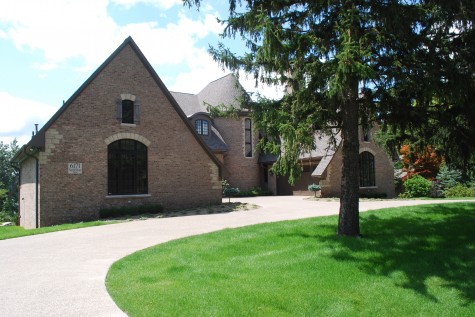 Uncertain about what to do, she had planted hydrangeas on either side of the front door, and groundcover in the narrow strips of land between the drivecourt and driveway. The house wanted for a more robust green companionship, but had little room to make that happen.
 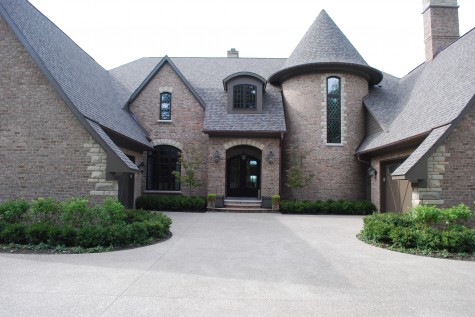 Her love of simple arrangements worked in her favor. In a very small space, using one plant in big numbers adds impact. I persuaded her to move the hydrangeas to outside the drivecourt; their eventual height would put them up over the ground floor entrance window near the front door in a not pretty way. Two beds planted solidly with the tall growing Green Mountain boxwood were punctuated with a pair of Venus dogwood. This airy growing large flowered dogwood would get some green into the airspace.
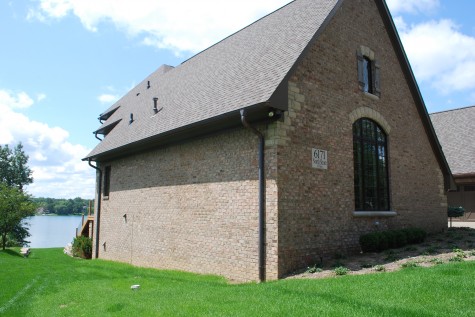 This wall was the first view of the house driving up the street; it needed a strong landscape element that would feature something about that wall other than its sheer size. The land dropping away at the corner of the house was awkward visually.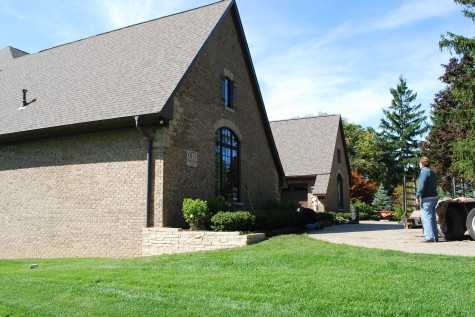
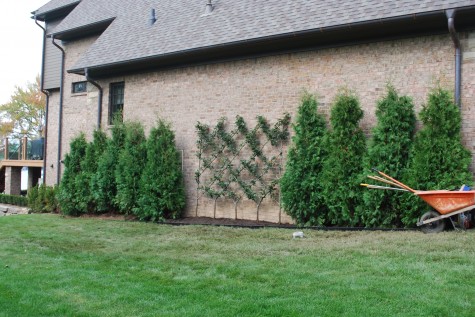 Five sections of Belgian fence, a style of espaliered trees, read in sharp green relief against the massive brick wall. The arborvitae will be pruned flat on both the top and the sides, as they grow in. We can grow both high on this wall. Once the boathouse is finished, we plan to plant a corresponding but free-standing run of arborvitae and Belgian fence on the lot line opposite the wall. These two plantings will frame the view to the lake, as in allee.
 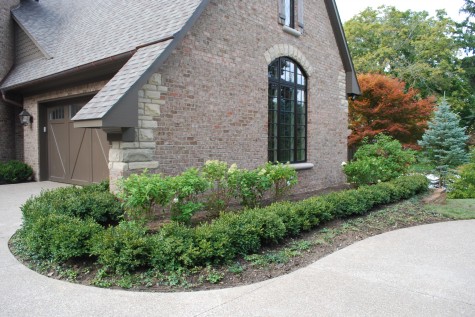 The limelight hydrangeas will grow fast, and billow out around the foundation of the house. As my client did want some flowers in front, we decided to construct window boxes that would sit at grade. Flowers at eye level would make them a more prominent part of the landscape.
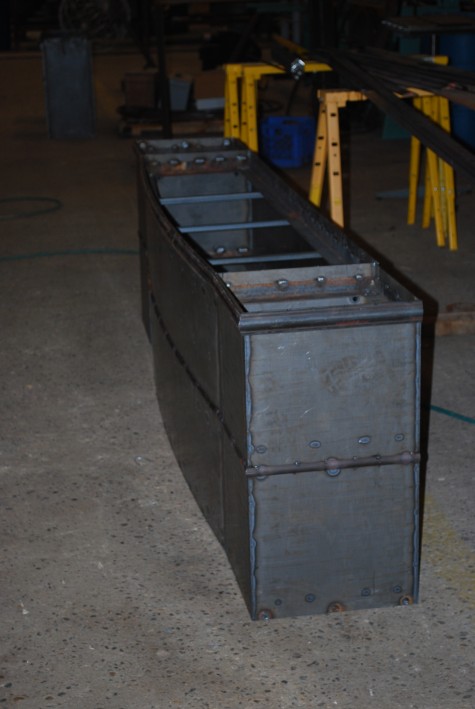 The opportunity and ability to construct garden ornament for a specific place gives me lots of options as a designer I would not otherwise have. These boxes were made specific to a length and height for her windows. These raw steel boxes would be galvanized, and acid washed, producing a virtually maintenance free finish reminiscent of the color of lead.