Constructing The Centerpiece

No matter what season is in question, a centerpiece in a container planting can organize the planting, and enrich the visual experience.  Fall in my zone means a limited selection of plants grow at a vastly reduced rate.  My summer pots have nicotiana mutabilis topping 6 feet now-none of my fall plants will grow like this.  I have no objection to creating a centerpiece in a fall pot from natural materials that have already grown up, and been harvested.  A case of really beautiful bittersweet arrived a few days ago-I could not wait to use it in some fall container plantings. 
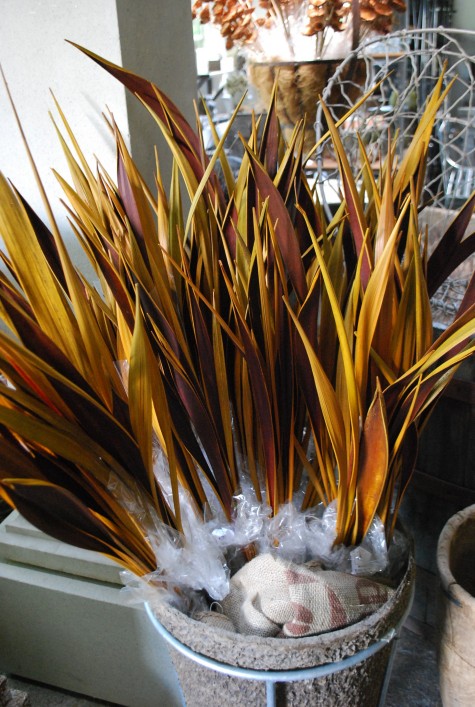
Other natural materials are from places far from my home.  Bahia spears-I have not the faintest idea what plant produced these stems.  They are stiff and woody; these chocolate and gold stems look just like fall.  Dried natural materials are an element that can spice up a fall planting. I love each and every one of my living plants, but the ability to create a shape from natural materials, and integrate that into a planting is great fun-try it!      
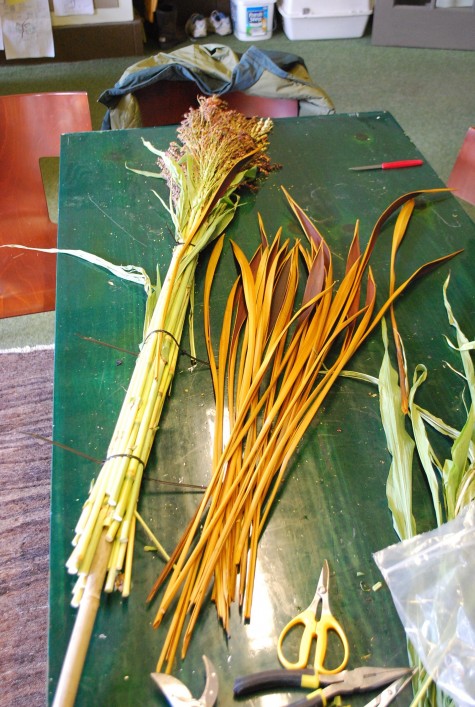
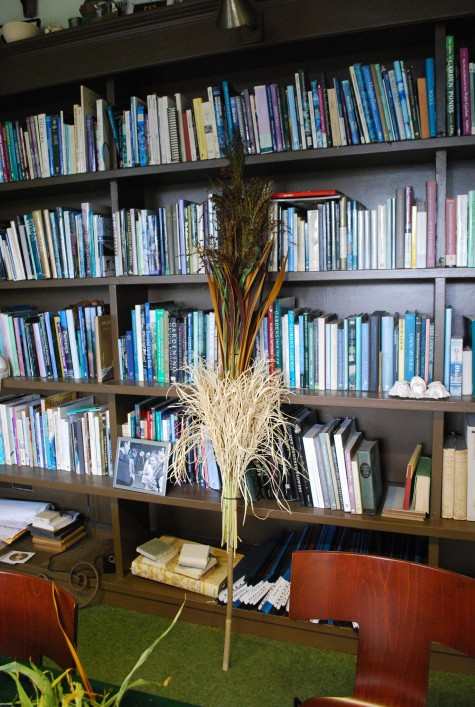
The base of this centerpiece-a pair of broomcorn shocks.  Broomcorn-yes, this plant has been widely grown for for brooms.  This means the stalks are stiff and weather impervious.  The seed heads come in a range of colors from cream to red to black.  I zip tie several bunches around a stout bamboo stake.  That stake will keep my centerpiece straight up and down, no matter the weather.  Zip ties-love them.  They hold the heaviest centerpiece together.  I use lots of them, in the early stages of construction.This centerpiece is ready; there are three layers- all zip tied to a stake.  The lower tier-10 faux grass stems.  Fault me if you will for the fake statement, but anything that pleases my eye is ok.  The long portion of this stake will be set way down into to soil of a pot.  This stake is an anchor, and a rudder.  A centerpiece gone out of level is not a good look.  The centerpieces need to stand up straight.  The beauty of any design depends on what your eye can believe.  This centerpiece has a ways to go, before I would call it finished.    
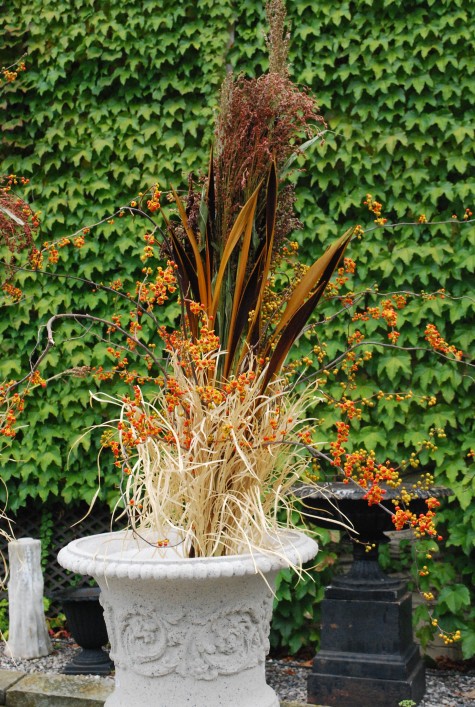
This three tiered centerpiece gets some air from the bittersweet vine sections, and a welcome shot of fall color. I cut the stems on an extreme angle, and work them under the zip tie.  These wild and curving stems will start to loosen up that strictly zip tied affair.  I use lots of zip ties in the construction of a centerpiece, as it will need to travel to the job.  Should you be constructing a fall centerpiece for a treasured pair of pots-go large, go tall-be loose. The ties you do not really need once the entire container is finished can be cut off, for a looser yet effect. 
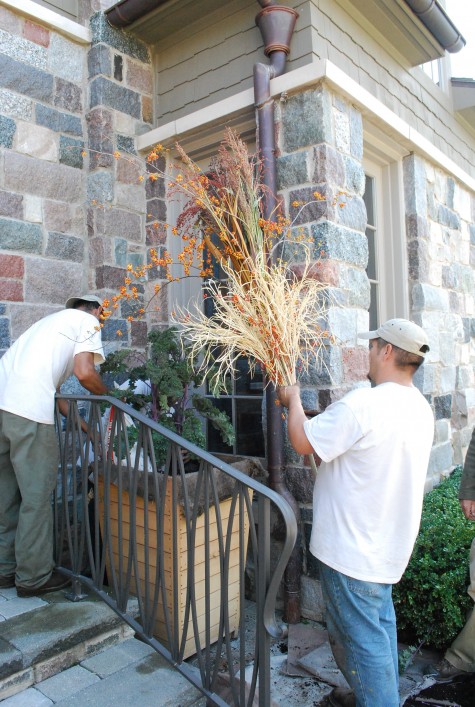
My centerpiece made the trip to the job without any damage.  It is very heavy, but easy to handle.  My crews handle anything I send their way with aplomb.  The fabric you see draped over the edge of a pot keeps the pot from getting dirty on the rim.  The tarp on the ground is there for the same reason.  A little care keeps the cleanup part fast and easy.  The Redbor kale are the center plants.  These we plant first, so its easy to tell exactly where the centerpiece goes.  Getting the centerpiece in the center is as important as making sure it is perfectly upright.         
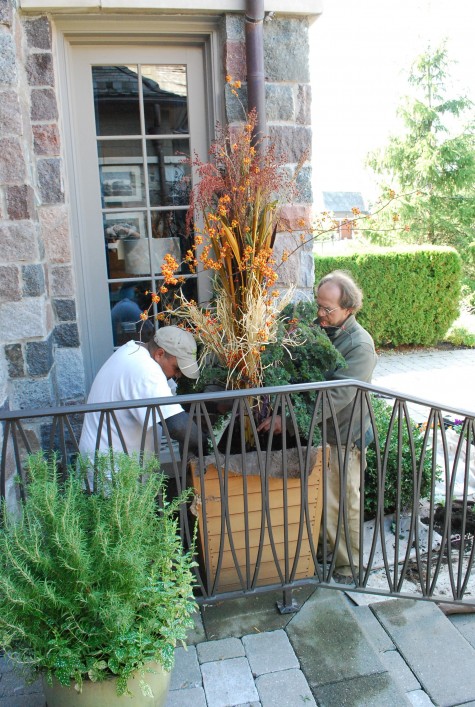
Levelling the centerpiece takes some time-and at least four hands.  Once that centerpiece is set, level, and solid, we tweak.  The top most zip tie-we cut that off.  We move this element up, we move that element down.  We deconstruct what we constructed. This is the most important part.  A centerpiece has to be strong and securely made.  But how it gets loosened up is what creates a very natural look.   
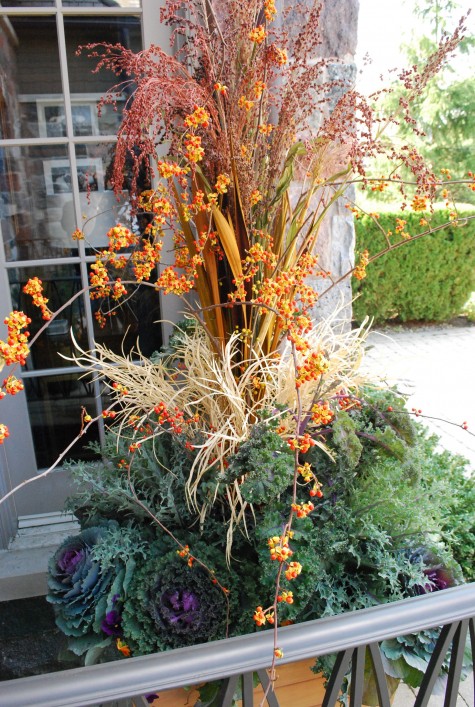
All of the elements of the centerpiece gets adjusted after it is installed.  I try to integrate it with the living material in such a way that it all looks lively, and of a piece.
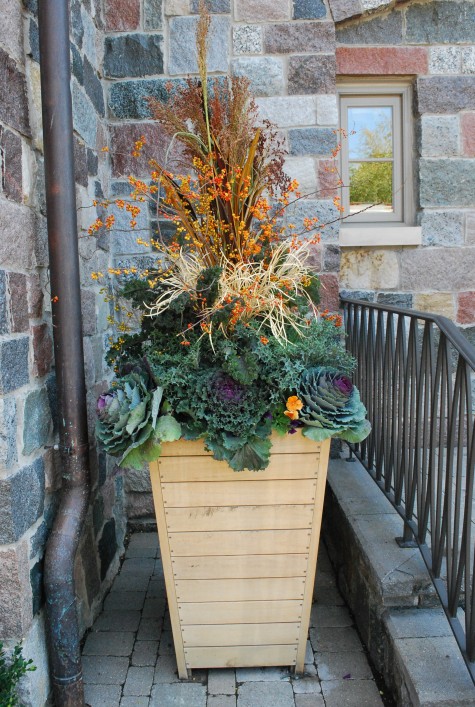
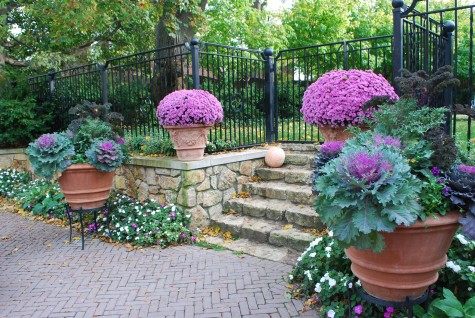
Fall  plantings are all about some cabbages, some mums, some late representing grasses, the pansies-those plants that tolerate cold temperatures.  But fall container plantings are greatly about that gardener that has a mind to represent fall in a way they think is beautiful.    
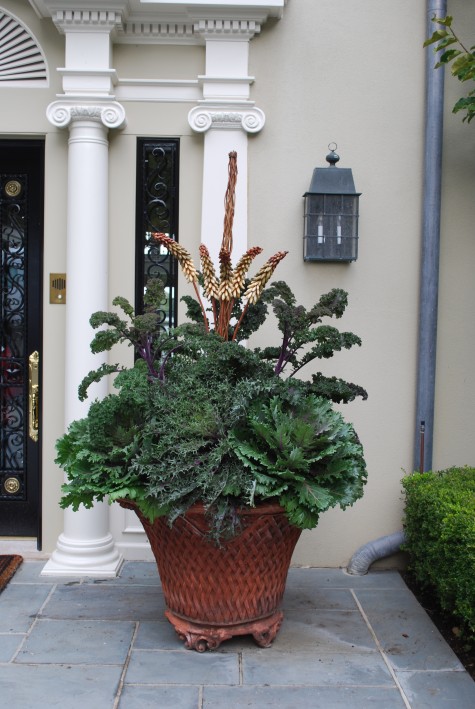
What is in your yard, drying, now?  Sounds like a centerpiece to be, to me.
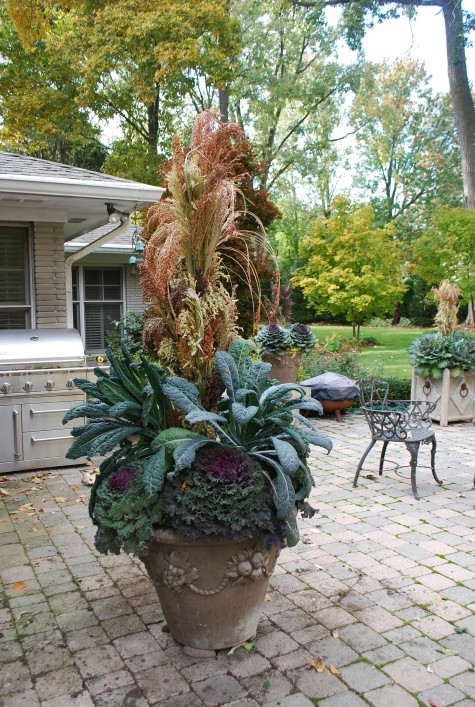
If your yard is light on materials that might work in a container, your local nursery or famer’s market is bound to have something. There are lots of possibilities for fall pots- make the most of having a choice.  Your fall pots have lots of possibilities.  Make much of the fall plants that tolerate the cold.  Make more of putting it all together.
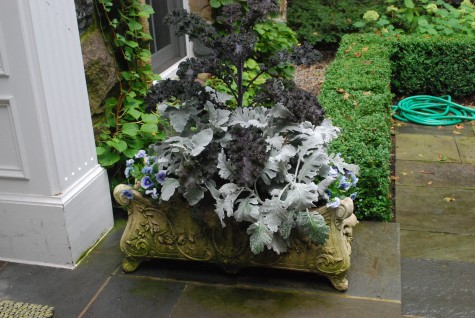
Fabulous For Fall


I think my summer may be over.  Though Buck and I are still cruising the garden every night, we have broken out the fleeces, and jackets.  As loathe as I am to give up my summer, the fall season has its charms.  I had best get ready to be charmed-the fall is here.  I am so happy that my local nurseries have seen to supplying replacement plants for those tired spots in my containers.  The petunias are fading fast, and the leaves of the coleus have thinned, and lost color.  Luckily lots of plants are very tolerant of cold-and they are ready to step in wherever you have gaps.

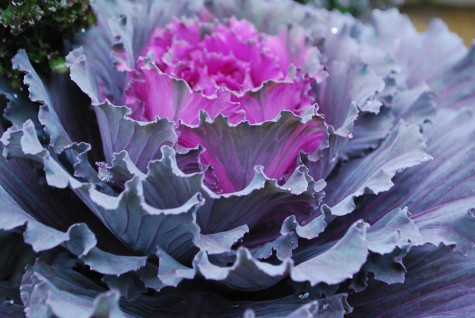
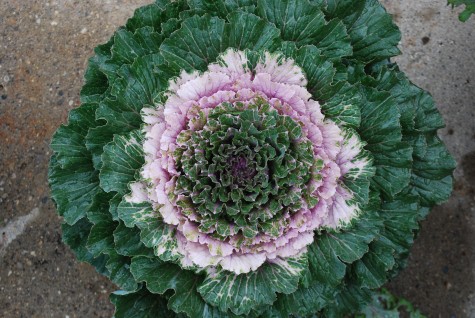
My favorites are the ornamental kale and cabbages.  Available in white, pink, or red, they do not begin to color up until the night temperatures drop.  Cabbage have the big wavy leaves; kale leaves are frilly and lacy.  Both do well and grow until there is a truly hard frost.  An ornamental cabbage grown in a one gallon pot has a huge rosette of leaves, and a relatively small rootball. 

 Just a few of these plants go a very long way.  I love how tolerant they are of a deep planting-I set them at whatever level I want in a container.  I tip the faces forward, so I can see into those rosettes.  They do not mind in the least the back side of their rootball set above grade.  The color and texture is moody and jewel-like-perfect for fall.  Their very thick leaves are very weather resistant -at least that is my theory. 

Persian Queen geraniums that have been in containers over the summer will go on representing well into the fall.  Given that their chartreuse leaves are their big attraction, fewer fall flowers matters not.  Other summer container plants that do well through the fall-vinca maculatum is one of the best.  These long trailing plants are not in the least bit fazed by cold.  Nicotianas can revive and soldier on with the advent of cold weather.  My nicotiana mutabilis is sending out new shoots, and growing like crazy right now. 

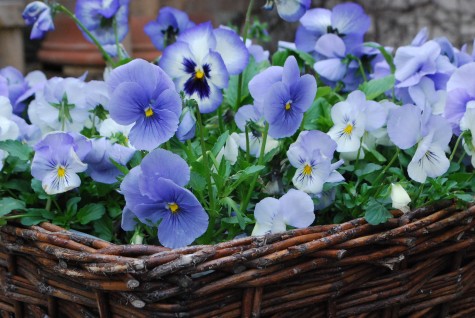
If you need your container plantings to thrive on through the fall, choose carefully in the spring.  Impatiens of any sort, and coleus will collapse into a heap of mush given a short string of cold nights.  Tropical plants need to be brought in ahead of any really cold nights.  Trailing verbena is amazingly cold tolerant, as are nasturtiums, dahlias, and ornamental grasses.  But in the event that your containers are full of plants that have little love for cold, you still have choices.   Pansies reappear in the fall-they really do thrive in cooler weather.  The Clear Sky series is actually quite perennial.  Plant them in early fall-they will reward you all fall, and on into the spring to come.Their cheery faces look great in fall containers-try a few.

For years I rolled my eyes whenever I saw a sign for fall mums.  They have a form completely unlike garden chrysanthemums-they are trimmed to within an inch of their lives until it is time for them to set buds.  Mum balls, I call them.  Garden grown mums have a much more natural appearance.  Why I ever had the need to make a comparison, I do not know.  Mums grown for fall planting are just that-fall plants for containers.  I love the giant balls that have been perfectly trimmed all summer.  Thinking of planting on in a pot now?  Pick a plant that is budded up-no flowers.  Once those budded plants are in your containers, you have all fall to watch them develop, and bloom.

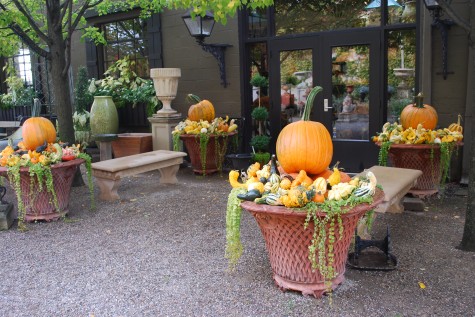
Gourds, pumpkins and the like-I am starting to see those shapes and colors at market.  Fall colors are like no other.  A pot full of gourds with sme left over creeping jenny from the summer is a good look.  It will be late Novemeber before I start my winter plantings-that is two months from now.  Too long to have nothing to look at near the front door. 


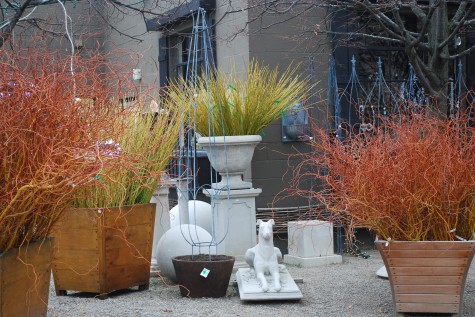
Bare branches-I have no objection to them in fall pots.  Every shrub and tree reveals a beautiful branch structure, once the leaves fall.  The structure of a garden is never more clear.  Subtract the flowers and the leaves-a gardener is faced with the bones.  I design with the bones in mind. Bare bones-I like that look.  There are enough cold tolerant plants, gourds, pumpkins and squash- and enough bones to make a festival of fall.

Black Leaves

Plants with leaves a color other than green-exotic.  I have never counted the numbers of plant species in my yard, but every one of them has green leaves. In my green world, a red/black or purple/black leaved plant would most surely be exotic. That exotic quality attracts attention. The numbers of urban properties featuring a Bloodgood Japanese maple somewhere in the landscape is an indication of the attraction of black.  Central to the color composition of these four containers of mine several years ago pivoted around purple oxalis triangularis and purple threadleaf alternanthera.  The purple black oxalis in the center pair of rectangular planters has the best black color of any black leaved plant I know.  It is not muddy.  The black/red alternanthera is not bad either.  But critical to the appearance of that black has to do with the choice of company.  Gartenmeister fuchsia has black/green leaves.  Variegated licorice provides startling contrast. These plantings are all about good company.

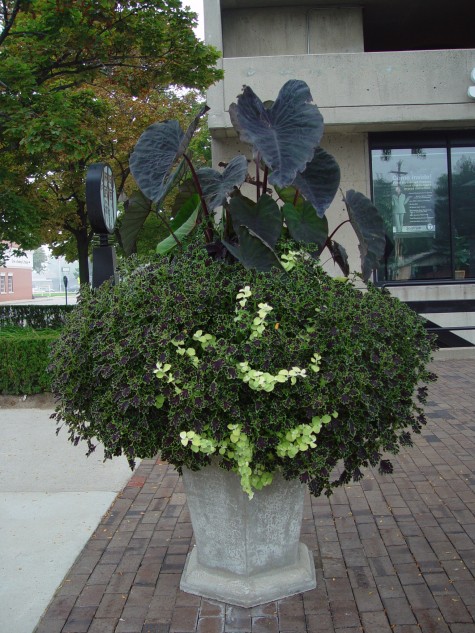
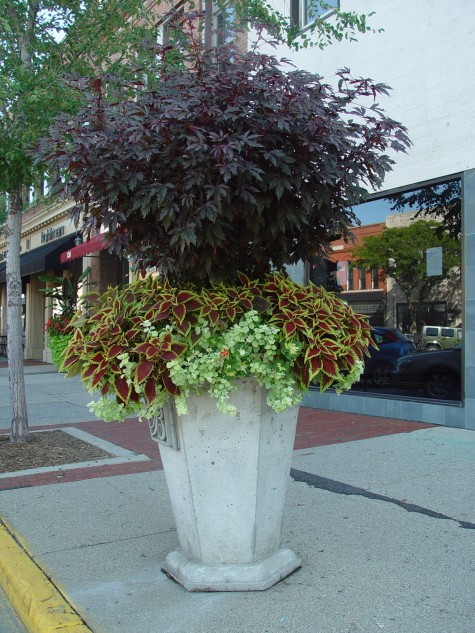
Black calocasia has plenty going for it.  The very large wavy leaves are a standout.  Its willingness to grow is only limited by the size of the container in which it is grown.  For me, the difficulty is finding suitable companion plants.  As a general rule, once I start a container planting with other than green leaves, I need the companionship of some other than green-leaved cast members to make the entire picture work.  Inky fingers coleus is a favorite. The black leaves are outlined in the most outrageously electric kelly green.  In this container, the color black is the dominant element.  The contrast of leaf size is swell.  A small dash of lime licorice, which in this instance reads as green tinged yellow, is just enough to keep all that big black from looking gloomy.

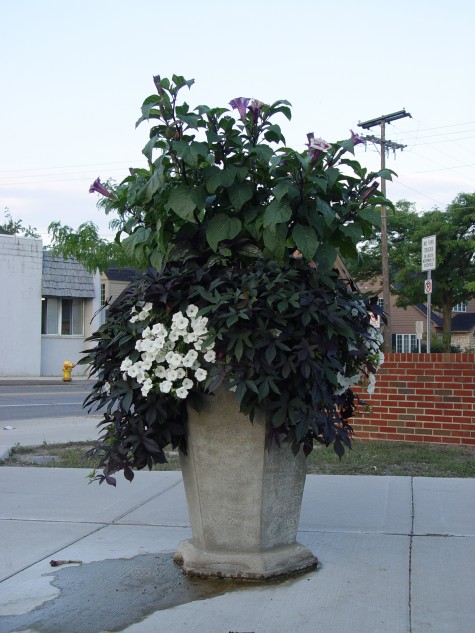
Black sweet potato vine is a beautiful color and texture, provided you plan for the cascade. This is a good ratio of plant to pot.  Pots completely smothered in black sweet potato vine have that Cousin It look.   In this planting, I knew the green leaves of the white petunias would never be a part of the big picture.  Petunias bloom so heavily one can ignore the size, shape and color of the foliage.  The double, or hose in hose datura has green foliage, but it is very dark green.  Moody, this planting.  Moving off moody, it has balance.  Black can be dominant, or fade away.  Container plantings are all about partnerships, relationships.  Like any other partnership or relationship, things can be difficult.  Most of what I do as a gardener is weed, and mediate. 


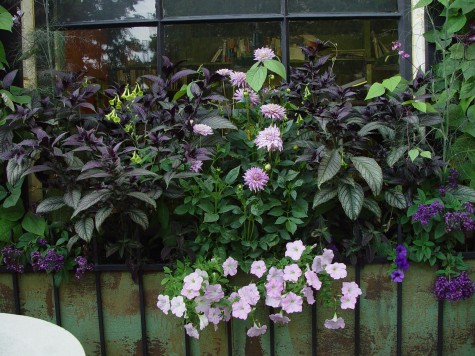
The leaves of Persian Shield are a color complex of purple, green and black. A dark foliaged dahlia harmonizes.  The lavender flowers contrast in such a way to assign depth to this discussion of black. 

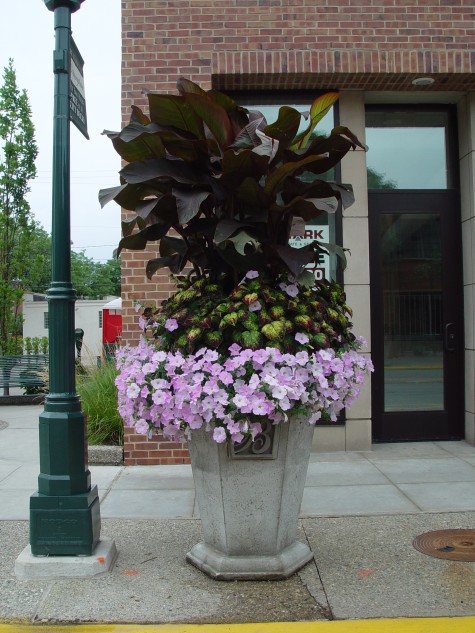
The canna Australia is a better black than Calocasia black.  I attribute this to the substance of the leaf.  Calocasia leaves are very thin; they transmit light.  That transmitted light dirties the color.  Canna leaves are very thick; these leaves are emphatically black.  Opaque-not transluscent.  The representation of color is strong and dramatic.  The edges of the leaves of the coleus Arizona Sunset repeat that wine red black in a different texture and dimension.  The Misty Lilac wave petunia skirt lights up the night life going on above.

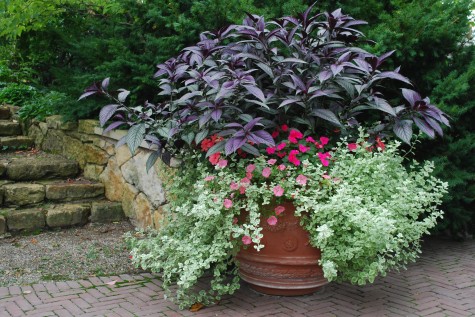
This planting of Persian Shield, pink New Guineas, peach petunias, and variegated licorice is from my yard a few years ago.  The variegated licorice picks up the cool green of the Persian shield.  A little intermediary peach petunia action and some hot pink New Guinea flowers feature the iridescent quality of those featured black leaves.  

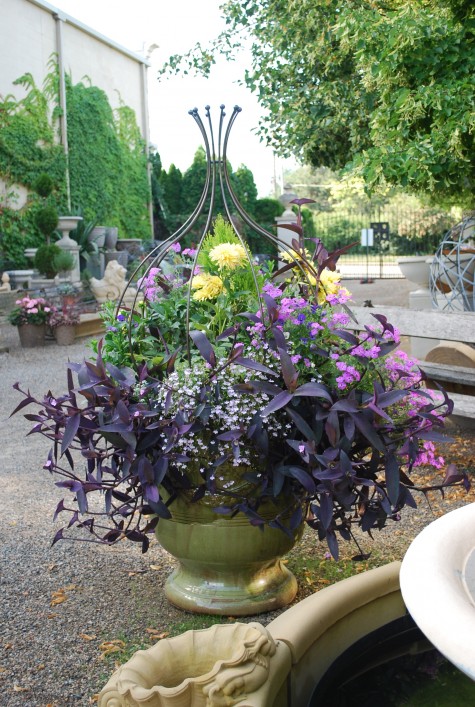
Moses in the Cradle is a common name for a black variegated Wandering Jew-I think.  I have always known this plant to be a tradescantia, but some literature indicates otherwise.  That said, this black foliaged trailing tropical is amazingly tolerant of cold, sun, shade,-whatever weather comes its way.  Planted in early spring with Italian cypress, yellow dahlias, annual phlox, this planter still looks good in August.  Imagine this planter without that frothy skirt of Moses-boring at best.  On the outs, at worst. 


Hibiscus Red Shield is a red/black foliaged plant that will grow to astonshing proportions over the course of one season.  Not surprisingly, the flowers are insignificant.  Note that I underplanted it with a red coleus with lime edges, and lime licorice.  Green leaves underneath would have put out the fire.  Mix the variegated plants with more variegated plants.  Should you decide to go for black, chose your chorus accordingly.

Loud And Clear

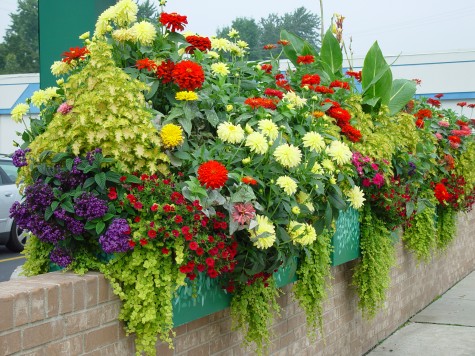
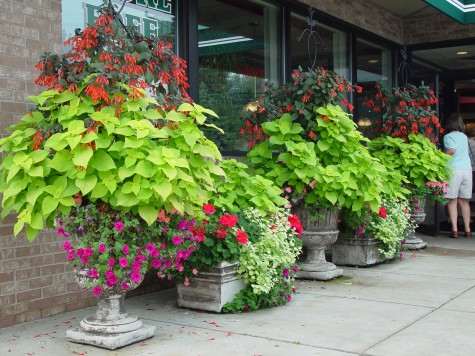
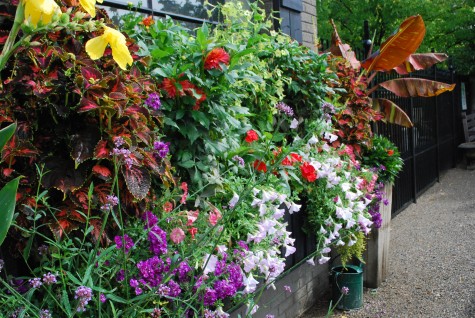
Airy and wispy container plantings are not for everyone.  Furthermore, there are some places that they simply don’t work.  These planter boxes sit on the wall enclosing a parking lot of a restaurant only a median away from a busy four-lane road.  The speed limit is 45mph; the noise is deafening.  In the 2.5 seconds it takes to zip past this wall, there is an impression that will register with even the most garden-deaf driver.  The combination of colors is ebullient, enthusiastic, splashy-friendly.  The boxes are overflowing; the plants all look healthy.  My client takes great care of them-just like she takes care of her restaurant. That message is loud and clear.              


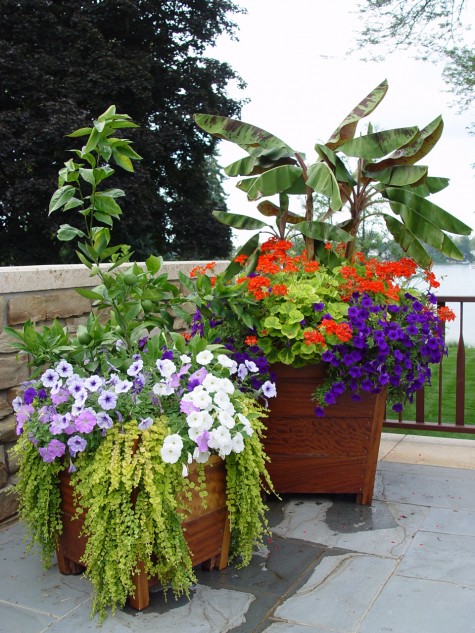
These large Belgian boxes are visual stoppers at the corner of this terrace.  They ask for a robust planting.  Plants with large leaves and substantial size go a long way to capture the eye.  Bananas, calocasias, alocasias, cannas, farfugium, tibouchina grandiflora-there is a long list of tropicals that can easily handle holding down the fort. Vigorously growing plants in bright colors will chime in.  The smaller planting of a lemon tree, and a pastel mix of petunias, though robust,  would be lost without the big backup.       

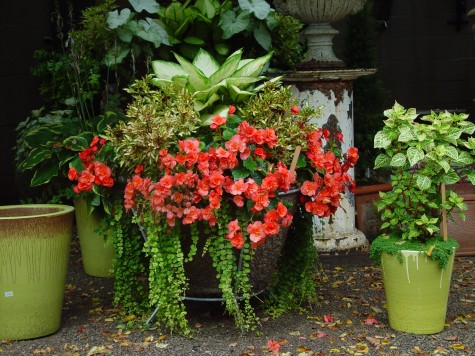
A solidly robust planting has much to do with the choice of plants.  The three plants comprising this pot have grown together in a shape that is dense and low overall. Just try to get by it without looking.  Chartreuse makes every other color pop all the more; creeping jenny is a vigorous perennial that loves some shade, and will grow in a bog. There is nothing subtle or airy about this planting-this is by design.   

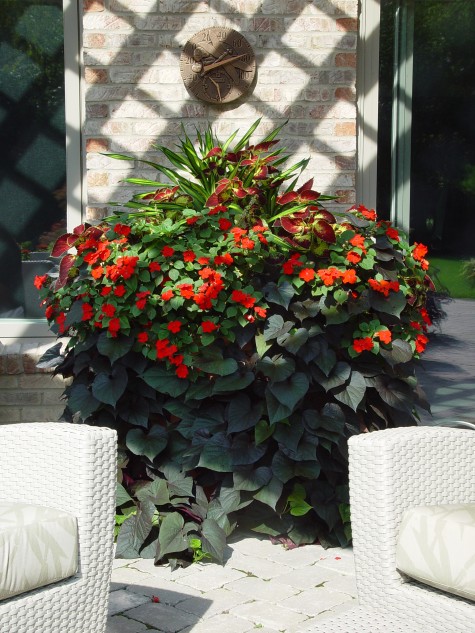
I can say the same for this pot.  It has grown so vigorously that the pot is no longer part of the composition.  Black and red; red and green-these color combinations are dramatic.  The contrast with the off white wicker furniture is all the more dramatic.  This modern furniture is very chunky and overscaled. These two chairs have some planted company that is even larger, and more chunky. The topknot comprised of a dwarf yellow variegated dracaena and a coleus-that look is in no way planned.  Just natural.  

Gartenmeister fuchsia is an upright variety that handles hot weather like a pro. It can grow to a substantial size, and can easily be wintered over.  However, the dark foliage and small tubular dark orange flowers are rather subdued.  A tutu of lime green coleus turns up the heat.  The red geraniums,magenta petunias and lime licorice don’t hurt. This fuchsia is naturally very airy growing; its woody shoots grow every which way. The colues masks all of those wild hairs; these plants grew together densely in a cone shape.  

Big growing plants are accompanied by lot of leaves.  The leaves of the trailing verbena and petunias are barely visible in this picture, but there is no mistaking the coleus and dahlia leaves.  My office is dark, given this window box planting.  Any container design warrants some study.  Do I need this planting to block an untoward view?  Do I want a container to stand out, or integrate into the large landscape? Right now is a very good time to be looking over your container designs; I take notes.    

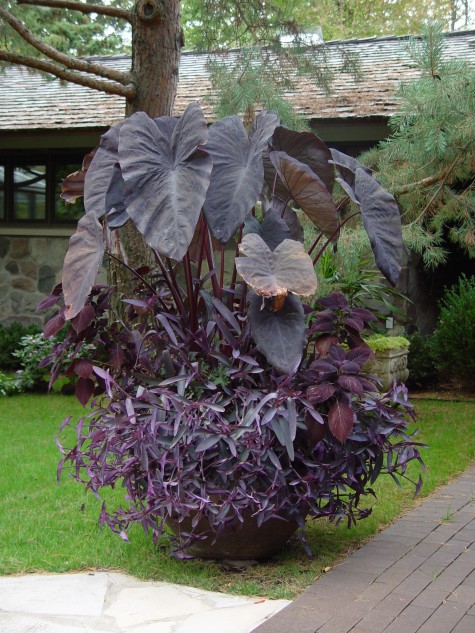
A very large terra cotta pot with a purple chocolate glaze is home to this monochromatic planting. Black calocasia, a purple black leaved coleus, and moses in the cradle, makes a sizeable statement about volume and texture.  Calocasia ia a very obliging tropical, in that it will grow as big as the container into which it is planted.  This planting is the better part of 8 feet tall.  This discussion of texture anf form-loud and clear.

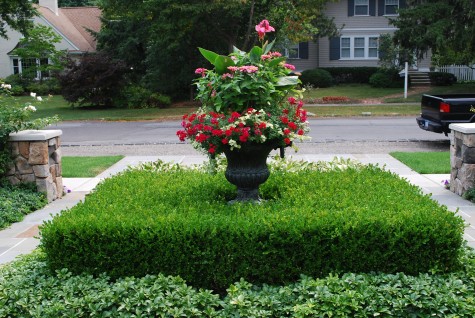
Cannas and zinnias-they both are big growing and leafy.  A skirt of trailing geraniums and lime licorice add lots of color at the base.  A neighbor standing behind this pot on the sidewalk would not be seen.  Sometimes a blocky and solid planting can organize a space-in this case, it presides over a densely growing square of boxwood.  Solid, dense and visually clear-this is how I would describe this spot in the landscape.

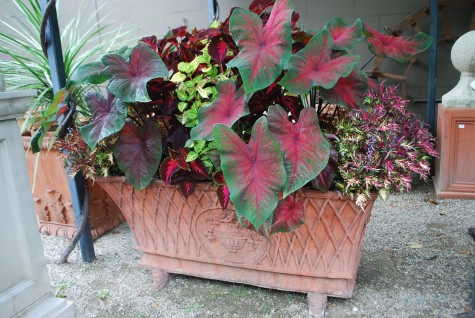
Large leaved caladiums depend on their size and shape to make a statement.  I like how lush a well grown plant looks.  I am leaning towards planting a lot of them next year.  Loud and clear is much about vigor.  I would much rather work to keep a growing fool of a plant in line, than every day have to convince a prima donna of a plant to choose life.  This is a personal preference. Even the subtle and wispy growing plants that I favor are strong growers.  

But back to loud and clear.  On that list of plants that can deliver that for you-big growers, dense growers, robust growers, large leaved plants, large growing plants, brilliantly colored flowers.  Brilliantly colored leaves; leaves with great shape and texture.    It is up to you to put them all together in a way that enchants your eye.