Airy


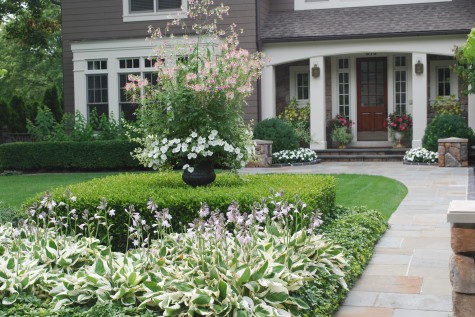
I greatly admire any expression that is airy, artless, graceful, breezy, unstudied, beautifully accidental or subtle- underwrought.  What do I admire this?  I greatly admire that which is the most difficult for me to achieve with a planting.  Luckily, I have help from the plant kingdom.  I have never loved the look of hosta flowers.  Sometimes I go so far as to cut them off before they bloom-reckless, I know.  But in a sunny spot, the grey/lavender of these flowers is beautiful.  The stalks going this way and that-artless.  Both nicotiana mutabilis and dward cleome have wispy flowers that flutter in the slightest breeze.  Anchored with  a solidly blooming base of petunias, this planting is a meadow in a pot.  This planting had a lot of help from nature. 
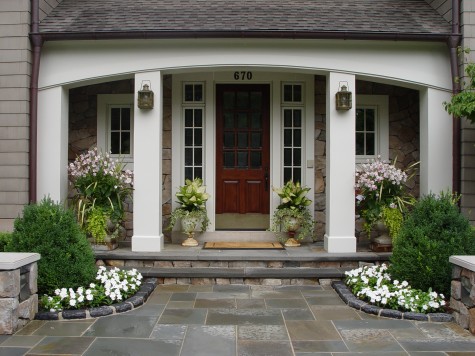
The pale pink nicotiana in the outside pots on this porch-who knew how pretty they would be with a pair of white dieffenbachia.  A few spiky leaves of green New Zealand flax unexpectedly echo that dieffenbachia color.  The variegated ivy is a casual and airy compliment to those stiff paddle shaped leaves.  This planting was better than I thought it could be.  I credit the plants for that.
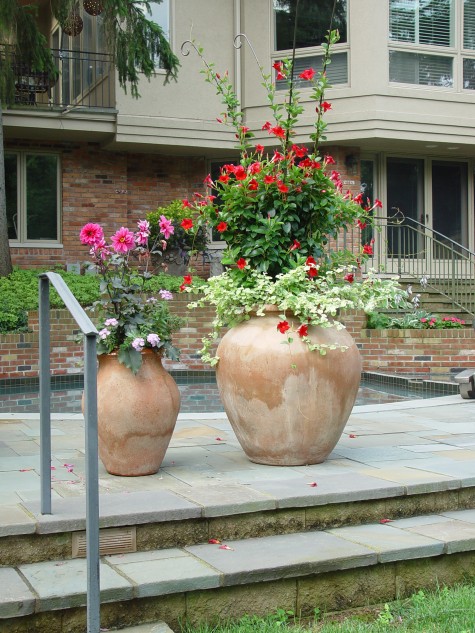
Mandevillea is one of my favorite summer plants.  Vining plants have a way of growing that sets a planting free.  They will grab any airborn support.  Lacking support, they will vine down and out.  Variegated licorice has stiff stems-but they grow every which way.  I call it the cowlick plant.  It provides some stiff horizontal support to the mandevillea vines that wander.  Some of the red mandevillea flowers appear to be floating, do they not?
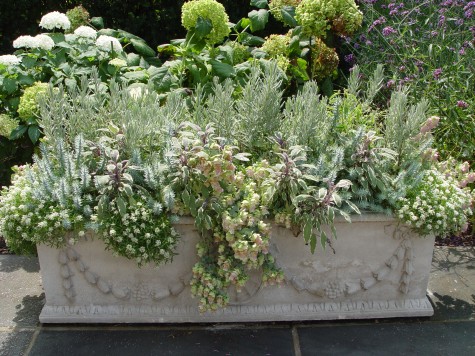

Plants with subtly colored flowers and foliage have that airy look, no matter their habit.  Succulents and herbs tolerate close planting, as long as I am careful not to overwater.  Closely planted plants make a community of one, as long as I do not interfere too much.  Plants left to weave in and out of each other make their own statement.  This staement is infinitely more interesting and beautiful than anything I could engineer.  
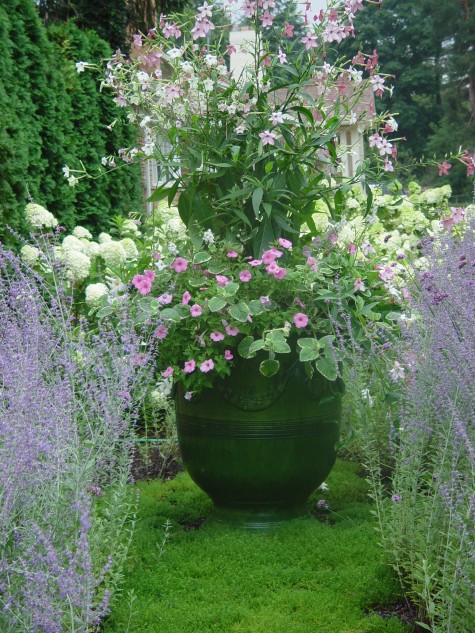
Pots placed on porches, pillars, pedestals and promenades make a studied design statement before they are planted.  A pot set in a garden bed comes out of the gate with an entirely different attitude.  This entirely formal French pot from the Poterie Madeleine has a planting that reflects the garden.        
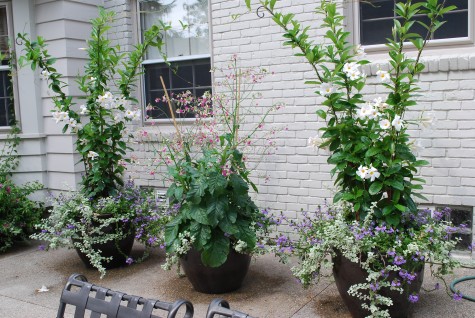
Some clients like that wispy, artless look.  They like subtle colors.  They like the air as much as they like the flowers.  Small flowers nurture that airy look.  How hard is it to make a dahlia look graceful?  You know the problem. 
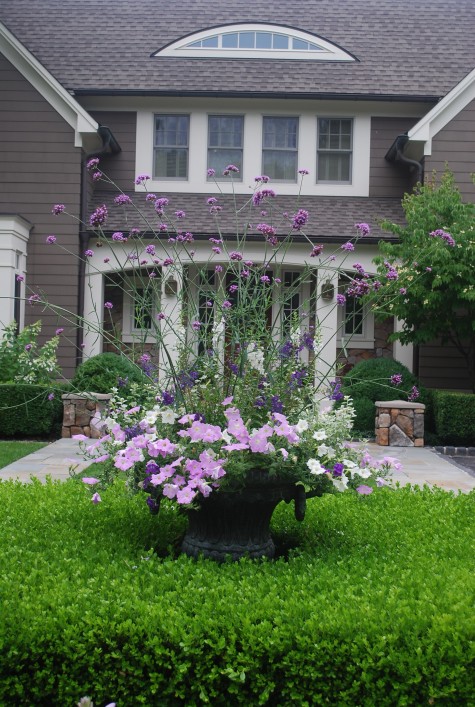
Verbena bonariensis wrote the book on airy, breezy and cloudlike.  I plant it every chance I get.  In containers, it can loosen up the most formal of landscapes.  It can define the airspace above an urn.  It needs very little in the way of staking.    
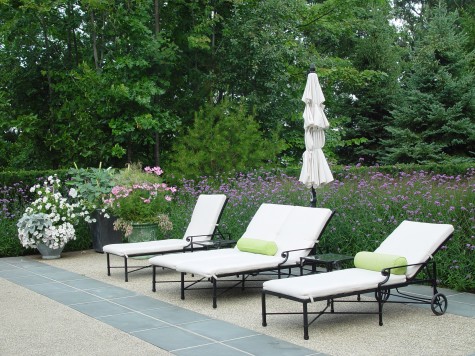
Verbena bonariensis in the ground-stellar.  Imagine this space planted with impatiens-ho hum.  This clean and crisp terrace furniture is all the more striking given the contrasting cloud of verbena in the background. 
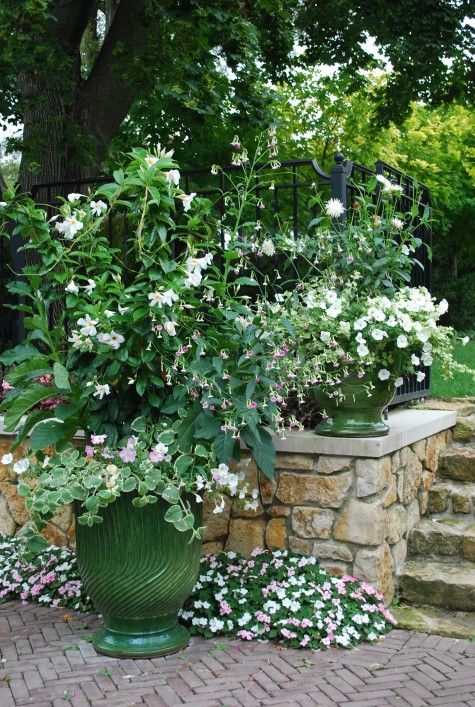
Gardeners may think what they have to work with is the soil.  But in fact, they also have an airspace just asking for some attention.   
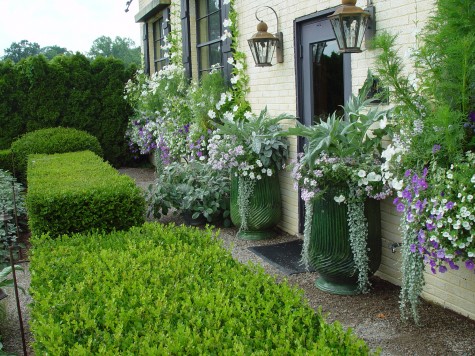
What overflows, what moves in the slightest breeze, what grows in out and around-this is a look I treasure.  Loose and lovely.
Peak Season


The containers on my deck have grown like crazy in the past month-we are  approaching peak season.  The weather has been perfect; most days have been sunny.  Even so,  we have had night temperatures lately in the 60’s.  There are signs of summer’s end, as much as there are signs of summer’s peak. Though I could easily do with this weather a few more months, September 1st is just 2 weeks away.  Once labor day comes, our summer is in decline.  The nights are colder; it seems like less heat and energy comes from the sun.     Annual plants grow and bloom with one end in mind; they need to set seed, before they are done in by frost.  This is an exhausting task. All the while my container plants are putting on size and blooming great, there are signs of stress.  The mildew I have struggled to avoid on my dahlias-it has claimed a few stalks.  The fancy leaved geraniums pictured above are so rootbound I have to soak them every day.  The Japanese beetles have discovered my canna flowers.  The coleus despises the cooler night temperatures.        

The mildew seems to be spreading to my petunias, for heavens sake.  And the aphids on my licorice-this is a first for me.  Do all of my containers grow to perfection-not even close.  Just close enough to provide me with a lot of pleasure, looking after and at them.  There are a few things I do to make the best of the last leg of the summer.  I do feed my pots with liquid fertilizer regularly.  Geraniums like lots of feed-ferns, not so much.  Each one of my containers has a lot of plants in them, or plants that have grown large. I soak my pots with water, and then soak them with feed.  Liquid feed is like a shot of B-12; I avoid the next watering as long as I can, so the plants benefit before a watering washes it all away.  I am sure to flush my pots through between waterings, to prevent a build up of salts that can become toxic.   

  Most of my containers have grown skirts by now.  When I water, I lift the plants up so I can see the soil.  I water the surface of the soil-not the plant leaves.  There is no sense encouraging mildew to spread. I soak them thoroughly, and then let them get quite dry. The rectangles on my north wall only get water twice a week.  Overwatering begonias in hot weather is asking for rot.  Caladiums will hang their heads when they need water.  I snap off the old leaves out that get too tall, and threaten to engulf my chartreuse Janet Craig dracaenas. 

Growing plants in containers is a live and learn proposition.  As in-this rainbow coleus is a very big grower.  This means there are big sections of stalks between sets of leaves.  This makes it tough to get a good shape from the plant in a container.  These Italian terra cotta urns look like they have top hats-funny, this.  This variety would make a great hedge in the ground.

I know Milo is pretty handsome, but the message here is about keeping things clean.  I remove dead or diseased foliage.  I sometimes thin plants to improve air circulation. And I pick up what falls on the ground.  I leave no debris.  What I would gladly let decompose in my garden I don’t think is good for my containers.  My big Norway maple is raining disease ridden leaves; I pick them up, and throw they away.  Fungus can live over the winter.  Sometimes clean gardening practices is your only defence.      

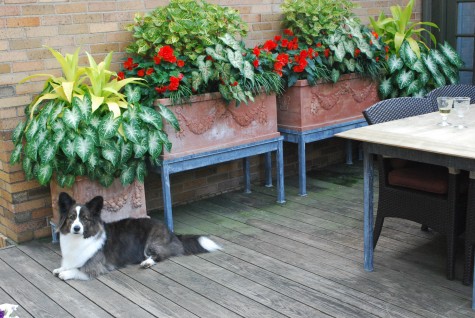
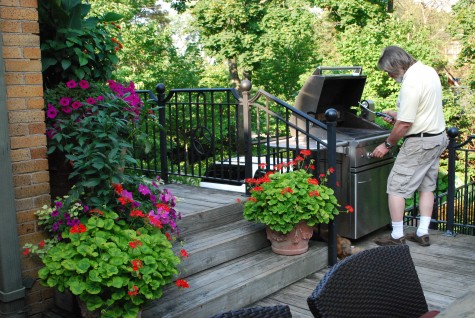
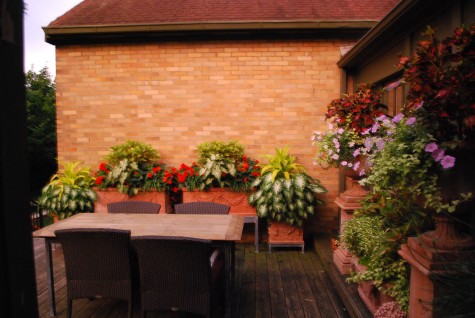
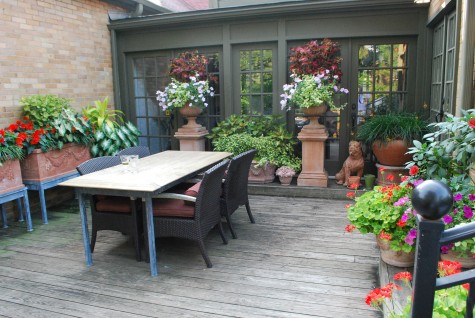
My terrace is my version of a kitchen garden.   Buck cooks here, and I look after the pots.  My small bi-level deck has 14 containers.  It is a rare evening that there is not something to putter over-I like this.  I only get into trouble when I let them go too long.  Consistent attention is much better than an occasional look.  Hauling the containers here from the basement, filling them with soil, and planting-that’s real work. The work now is not that tough, and at some time during the process I plain start to feel better.  

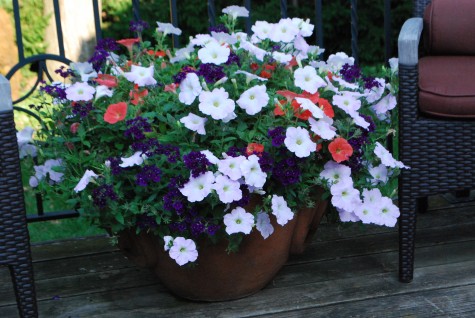
The jumble pot of petunias and trailing verbena has been great, and still looks great-even on the inside.  I have been very careful to pick up the plant mass hanging over the edge, and deal directly with the soil.  I have kept this on the very dry side-a strategy that seems to be working.     

I only had one shot left on my camera before the battery died the other morning.  The pink light at dawn-wow. My little garden is anything but perfect, but at moments like this, I am very glad to have it.

A Good Grass Day


Not every day do I need to look at a drift of hellebores blooming, or a yellow magnolia in  its glory. I don’t always require a succession of perennials, blooming.  Some days are just much simpler than that.  My grass gets cut on Fridays.  Some Fridays I barely notice. Some weeks the weather has been wet, and the cut is ragged and too long.  Some weeks there is no rain, and the grass looks flat out parched rather than mowed.

I do not entertain that much.  In early summer, almost never; I am too tired after working all day.  July of this year was so brutally hot, I was only outside long enough to soak my pots.  Our very hot weather has moved on to some other part of the world; we have had regular rain.  We have begun having friends to dinner in the garden again. 

On those nights, I am glad for the delphiniums, the roses and asparagus representing, the lush stands of ferns, the fountain jets making their music, the boxwood trimmed just so, the balmy temperatures- This is any gardener’s idea of  first class entertainment.  I like my garden to entertain my company; that they have a good time gives me pleasure.  All of the visual punch I can muster makes a garden a visual getaway for dinner guests. 

But there are those nights when I come home with a less vigorous agenda in mind, and perhaps more in need of nothing more demanding than that closely and simply cropped plane of green grass.  Not every day calls for a party with some plant or another popping or holding forth.

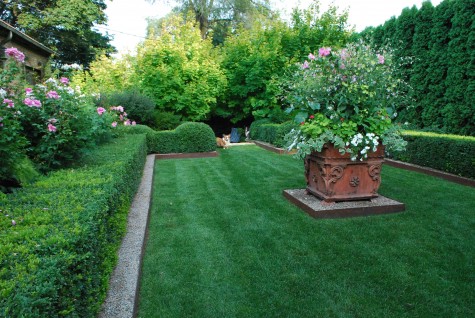
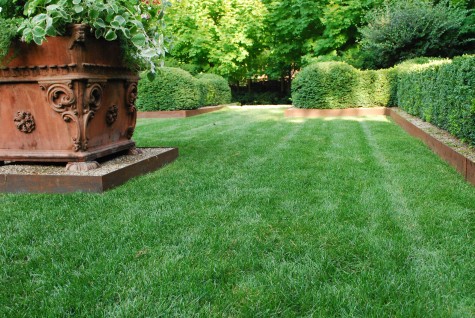
My grass is one of my favorite perennials.  By no means do I have acres of it-a few small green grass sheets is more like it.  It endures the corgis, the drought, the heat and the cold with aplomb.  As for care, I water when it needs it; it gets cut once a week.  You can tell from this picture that we have had rain.  There is no substitute for water from the sky.     

As for my experience of the garden, a lush lawn still perfumy from the mowing is a  pleasure of a quiet sort.  When the grass is green good, and neatly cut, everything else in the garden looks better.  The grass is the lowest, and quietest place in my garden.   It is a shock and sound absorber. Properly watered grass gives underfoot. 

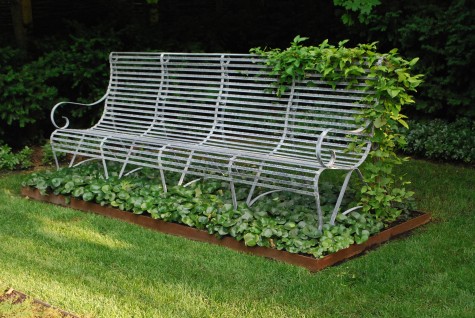
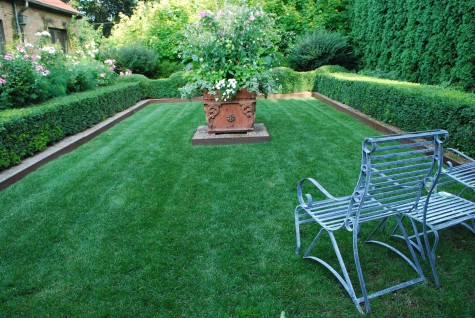
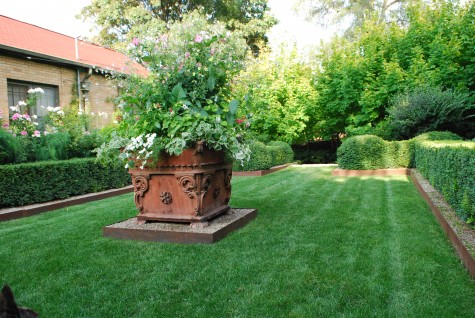
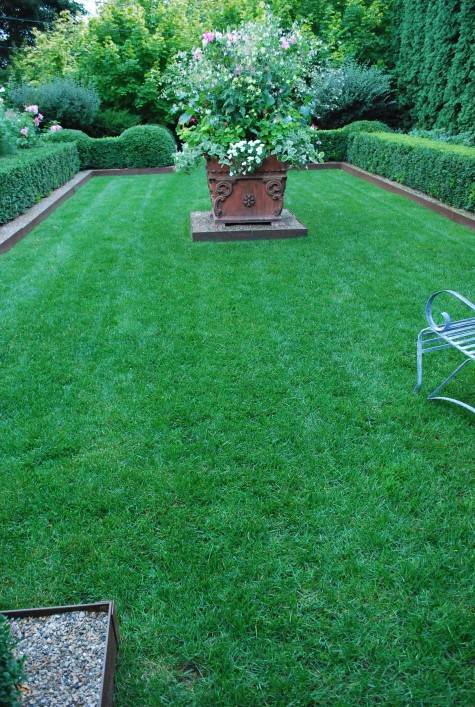
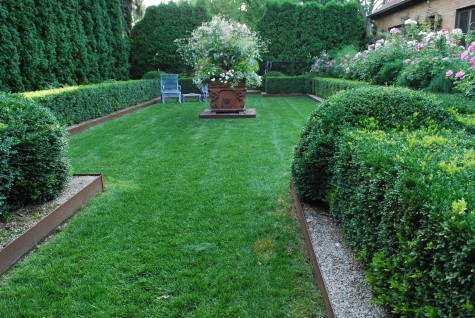
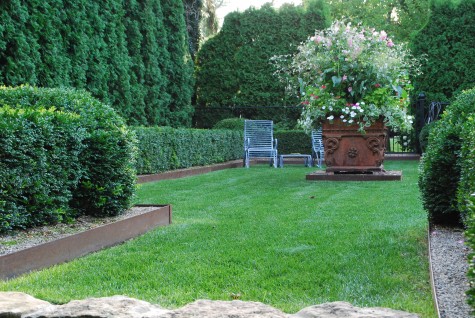
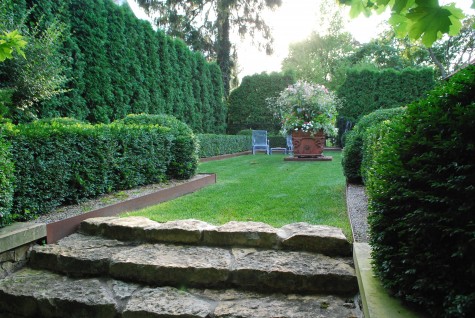
Lowering the lawn plane 8 inches, and retaining the soil with steel edging was my way of making that grass plane an important visual element of the landscape.  This grass is not what was left over after the landscape beds were made-it is a feature.  Any plant or element in a garden gets visual importance from how it is handled.  Long ago when I had acres, I featured the grass plane by how and where I mowed.   

My grass is not what I would call lawn.  It has weeds, bald spots, piddle burn, corgi claw marks-all the usual scars.  This does not bother me in the least.  Neatly cut and green is all I need. 

The corgis have an especially good view of the grass; their legs are barely 8 inches long.  My lower level garden permits a corgi-eye view of the lawn plane of the upper level.  This is just one of the reasons how a change of level in a garden can delight the eye.     

 Some days the simple garden pleasures are enough.

The Front Yard

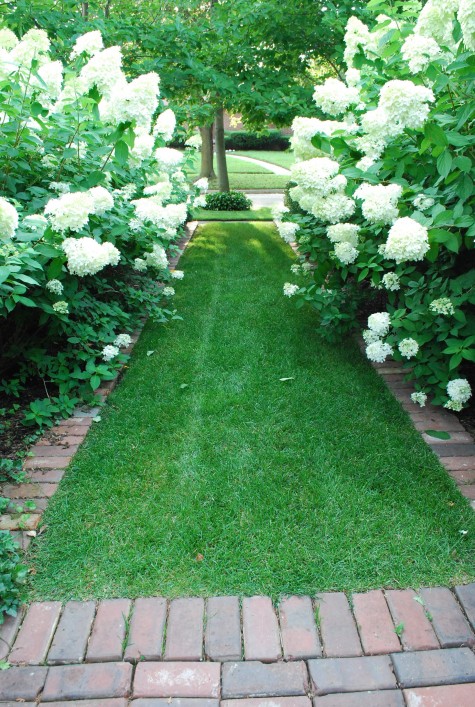
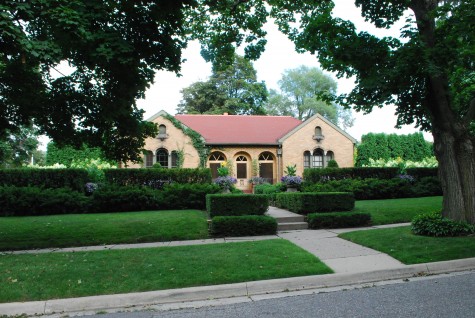
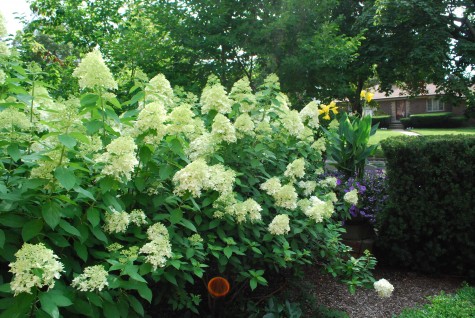
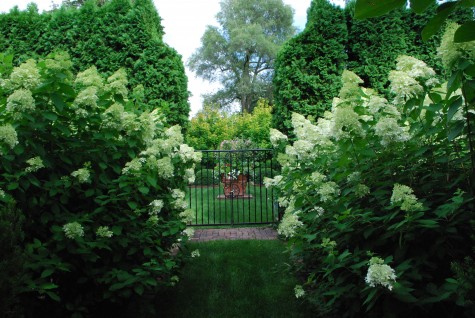
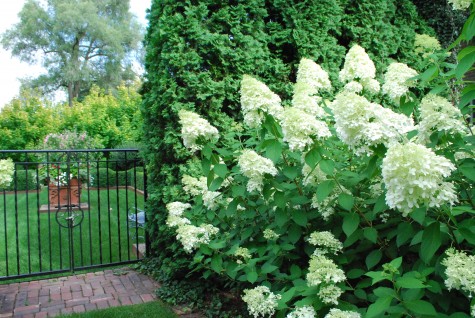
Whew-what a busy week last week.  A project that needs my hands on attention was punctuated with three landscape design presentations.  I did work both days of this weekend, as today I am scheduled for jury duty.  This is a first for me; I have no idea what to expect.  Except that I am committed to three days, at the least.  But last night before dinner I was able to take some pictures of the front yard.  The Limelight hydrangeas are finally coming into bloom.   

It seems like they are really late this year.  I have been fretting about them-the water, that is.  My drip irrigation watered both my big yews, and the hydrangeas.  For a month, neither got any water, until I could split them up.  What was the thought anyway-yews and hydrangeas on the same watering schedule?

The heat has suited my annual plants just fine.  The trick has been to check the water two times a day, instead of just once.  Some of those 96 degree days meant that water was evaporating out of these relatively small pots at an alarming rate.  The abutilons suffered some singed edges on their leaves, but they seem to be coping just fine.
I will leave you with the rest of my pictures from last night.  I am sure I will be able to get back to writing fairly soon.