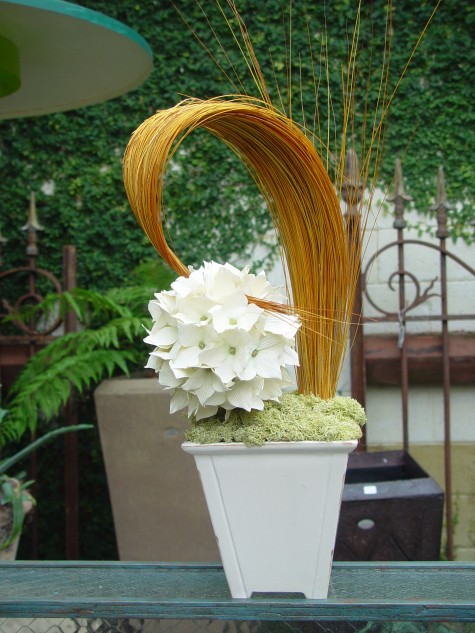
 The last two nights the temperatures have been in the high forties and low fifties. Great. I am on the deck last night- in my fleece-having a glass of wine, and contemplating the end of summer. My plants in my pots have gone from gorgeous to grumpy. What to do? The topiary sculptures I make from natural materials in the fall and winter help me face the 6 months we have coming up in Michigan when the garden is dormant. The sculptures are set in dry florist’s foam-I use the John Henry brand. This sculpture, made from a dyed and preserved grass, preserved reindeer moss, and paper dogwood flowers, helps me to bring the beauty of the garden indoors.
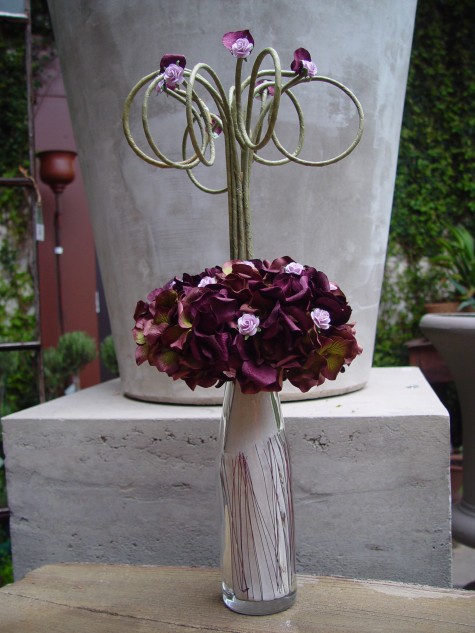 Glass can make great containers for sculptures. This vase by the Parisian artist Vanessa Mittrani is filled with white sand to give it weight. I seal the sand in the vase with a giant blob of hot melt glue, and wedge the foam in the top. Paper hydrangeas, mini-roses, and paper covered wire make for a sassy little something that reminds me of the garden. The purple paper hydrangeas bring out the purple/rust color of the wire in the glass.
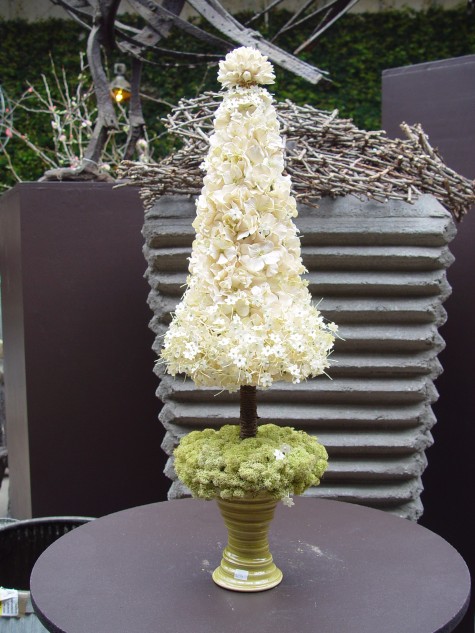 I consider paper a natural material, since it comes from trees. This combination of paper hydrangea petals, and diminuitive paper daisies describe a classic topiary cone shape. The flowery pompom at the top is constructed from individual dried bleached seed pods.
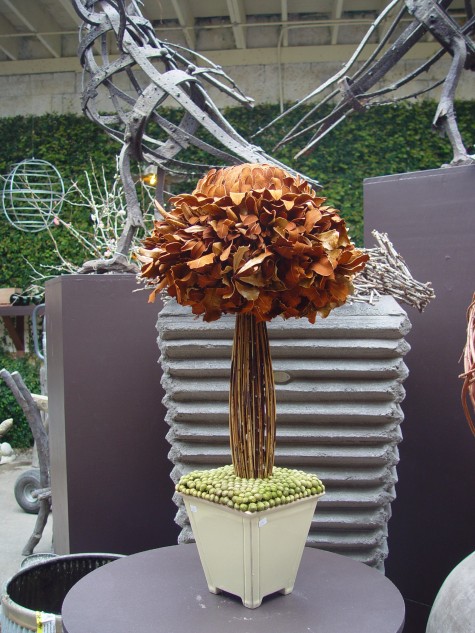 Integrifolia is a plant native to Australia, and probably other places as well. The leaves hold tight to the stems for a long time; they also take dye beautifully. This topiary began with individual leaves glued to a spherical form in a pattern reminiscent of an artichoke. As I worked towards the bottom, I reversed the curve on the individual leaves for more volume. The very bottom of the sphere is stuck with short branches just a few inches in length. Preserved reeds bowing out from a twig trunck make for a stem; the base is covered in preserved green seedheads.
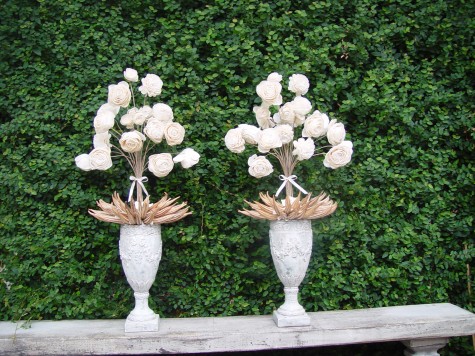 Paper roses on paper covered wires are a delicate contrast to the heft of dried okra pods.
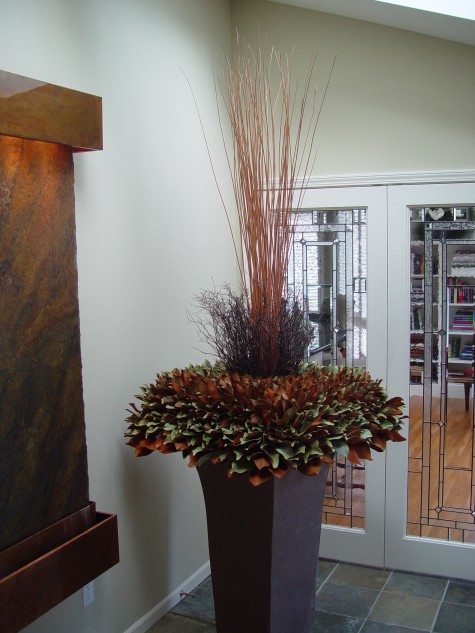 This very large scale sculpture has twigs and short birch branches for a centerpiece; the collar was constructed of fresh southern magnolia leaves. Magnolia dries beautifully, and lasts a long time.
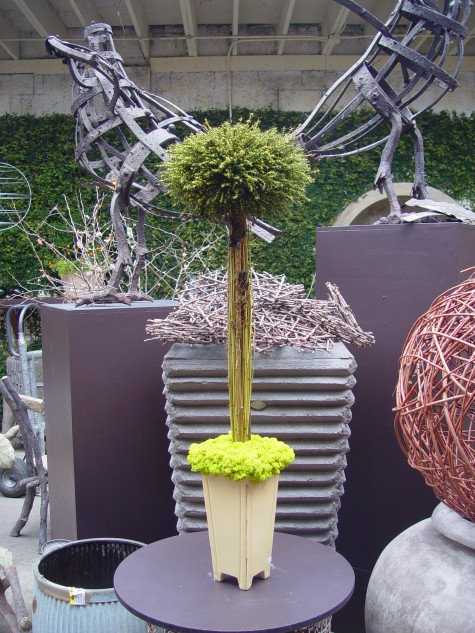 The science of preserving natural materials has become quite sophisticated. I for one would never have a house plant. I am happy for the season where I am not a plant caretaker. An object like this demands nothing from me; I just look. The reindeer moss in a color they call spring green is my idea of good color.
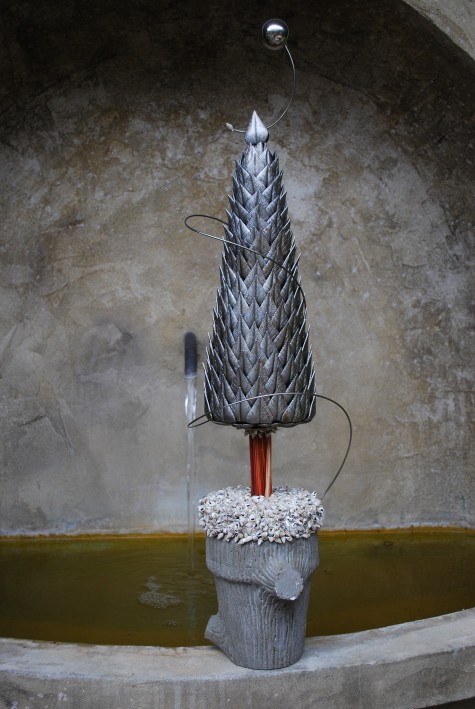 These steel leaves are by no means a natural material, but they describe one. The base was buttered with ceramic tile mastic, and embedded with tiny shells. The stainless steel wire is difficult to handle; I usually have to get help from a second pair of hands to glue it in.
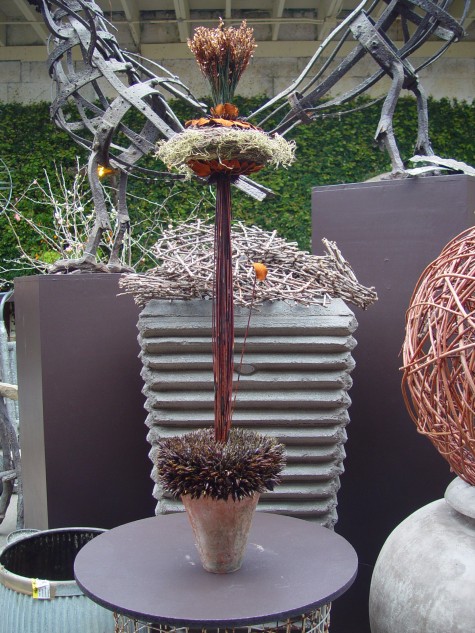 This whimsical topairy makes use of two bird’s nests made of various natural materials, sandwiched together. I buy these long stems covered with hundreds of chocolate seeds. After taking the seeds from the stem, I glued the individual seeds onto this base.
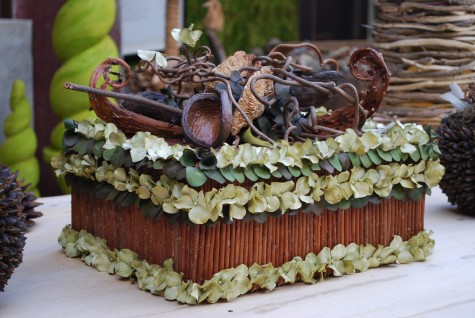 I call this a presentation box. The box itself is a photo box meant to hold 8 x 10 photographs. Should the box never have anything in it, it will still be fun to look at.
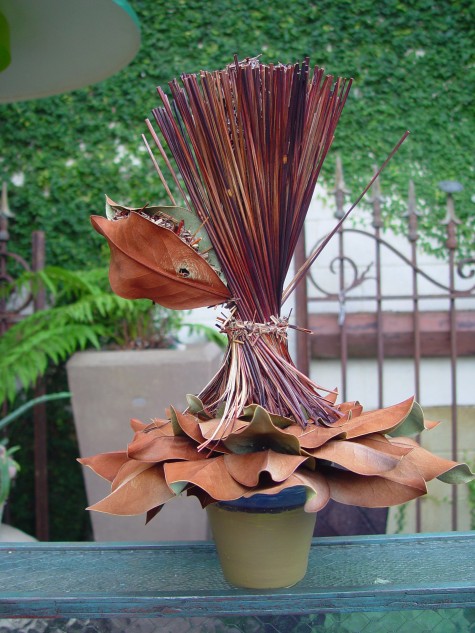
My landscape superintendent gave me a book on crop circles. I am embarassed to say I had never heard of them. This sculpture I made was motivated by my excitement about those circles. I stuffed the pocket created by gluing two magnolia leaves together with all manner of dried snippets from the garden. I scratched my own version of a crop circle into the magnolia leaf around a hole in the leaf. Today I will cut some limelight hydrangeas pinking in the cool weather to dry. Okay, its September in Michigan.
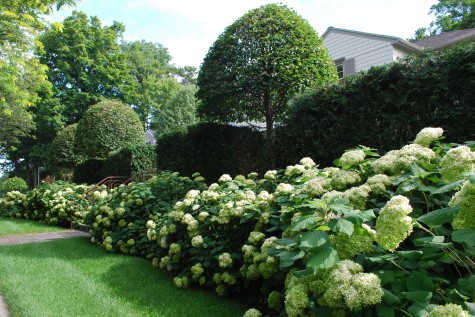
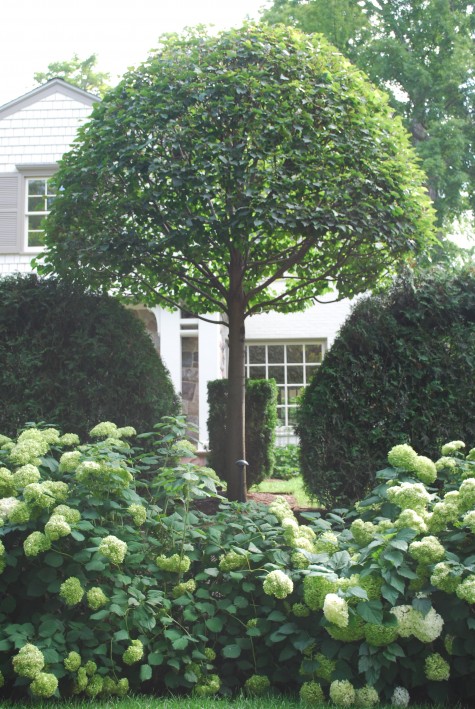
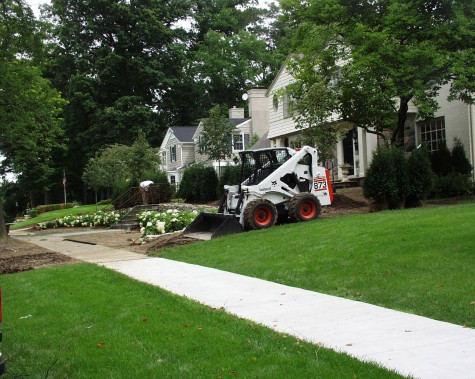 Yesterday I discussed all the grading and stonework that was necessary for this project; what a relief it was to finally be putting plants in the ground! The neighborhood association belatedly decided this wall needed to be screened by plants. They apparently did not permit walls in front yards. So I planted a slew of Annabelle hydrangeas; my clients have a great view of the wall in the winter.
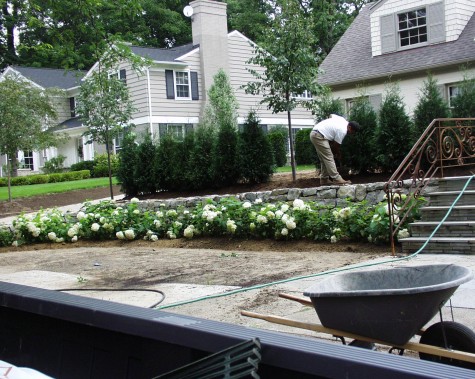 The upper level we did screen from the street. Houses that sit high afford little in the way of privacy. I interspersed five little leaf lindens in a hedgerow of techny arborvitae. The techny’s are dense, and slow growing. They also tolerate some shade, although the plan was to keep the lindens pruned.
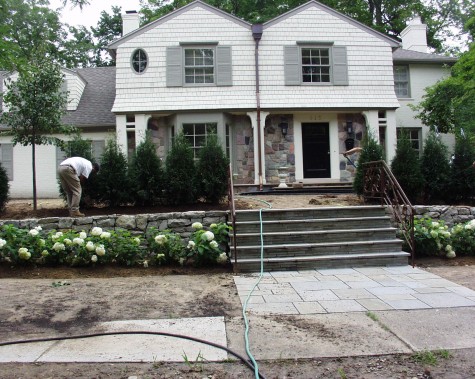 Lindens belong to that group of trees that do not mind shaping. I have seen old ones not much taller than 15 feet, with densely foliated heads. My lindens at my store are boxed; they have been pruned into rectangular shapes. They are a hedge high above ground. They greatly soften the appearance of the building-originally a machine shop built in the 1940’s. These lindens I wanted to keep in scale with the house.
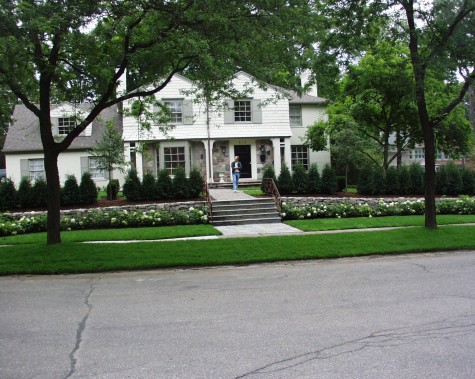 The house seems to sit lower than it once did. Though the front door of the house is off center, the landscape balances the space. The granite walled portion of the facade reads as a centerpiece, of which the front door is a part. The landscape making much of the bluestone staircase centers the view.
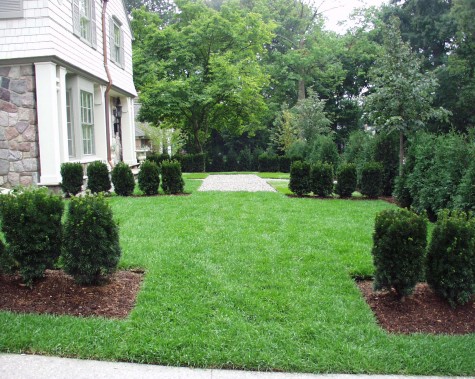 There were two issues driving the design of the upper level. How could the sidewalk gracefully turn towards the front door? The walk from the street now empties into a large rectangle of gravel; its color and size makes it read as the dominant element. The taxus viridis, naturally a very columnar yew, is planted in rows perpendicular to the house. This distracts the eye from the fact that the property in the background is dropping downhill. The techny arborvitae at the end are actually much taller than the yews-but everything reads about the same height. In time, the yews could be topped level with the horizon, thus minimizing the slope down to the west.
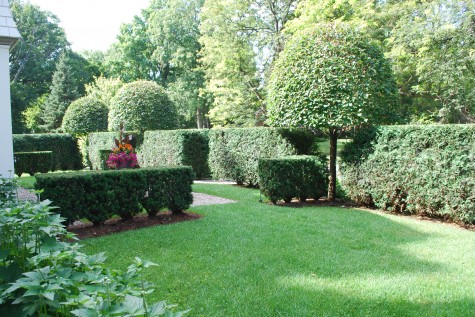 Eight years later, the landscape has begun to grow in. This front courtyard is private, and simple.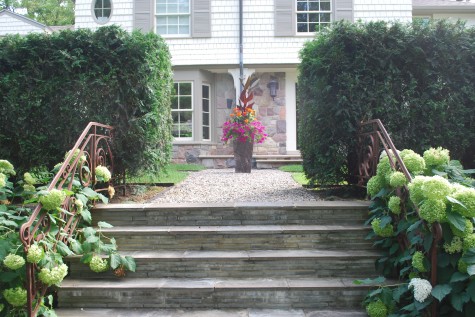
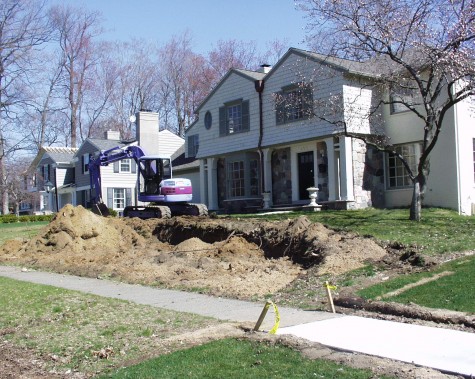 I am so sorry I did not take a picture of this house before I put an excavator in the ground. Perched high above the street, a narrow concrete staircase sans rails made the journey to the front door a challenge. While this arrangement did keep away all but the most persistent visitors, the landscape was neither beautiful nor useful. This is a leave- me- alone lansdscape, is it not? My clients were interested in something very different.
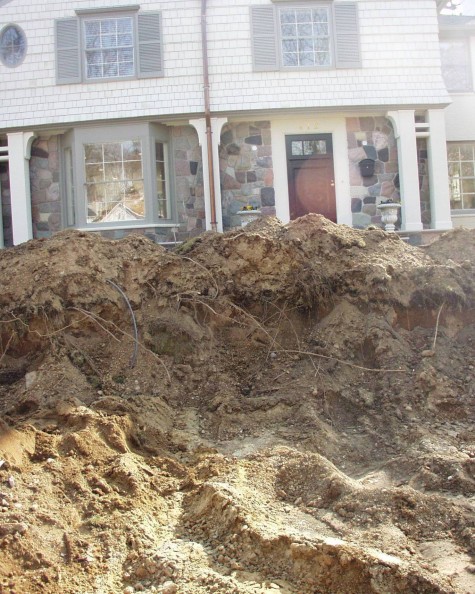 Some problems cannot be solved with a shovel. An excavator made relatively fast work of cutting into the steep slope, in preparation for a wall which would divide the steep slope into two terraces, with a staircase and landing transition.
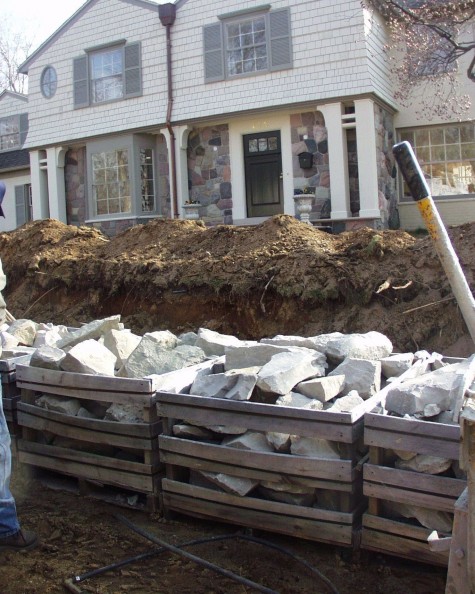 We built what I call a rubble wall. Stones of varying shapes and thicknesses are fit together to make a graceful and tightly fitted wall. This takes a person with great skill, and a great feeling for stone. My stone mason has been at this sort of thing a long time, and not incidentally, he has a gift. I would not have entrusted the job to anyone else.
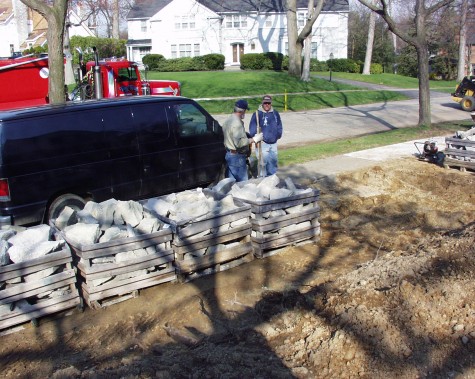 Boxes of stone were delivered via a semi truck. Each lot was uncrated, sorted, and looked over, before any actual work begun. This material would not do for stairs. The staircase needed to be made of a flat stone, for easy climbing. The finished grade of the staircase would set the grades for the adjacent walls.
 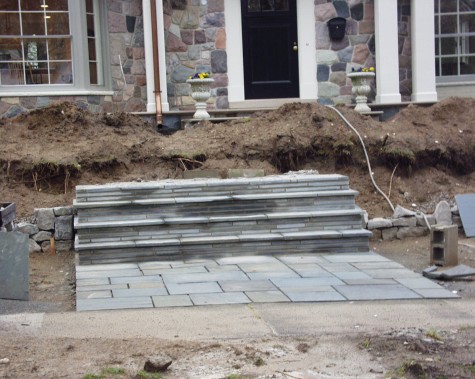 The bluestone landing matched the grade of the existing sidewalk; it is very important to be sure that walkways and stairs be set exactly as people expect they are set. Not everyone watches their feet when they walk. These stairs are set exactly level with the horizon; how they appear in this picture to be crooked explains how land actually sloped away in every direction.
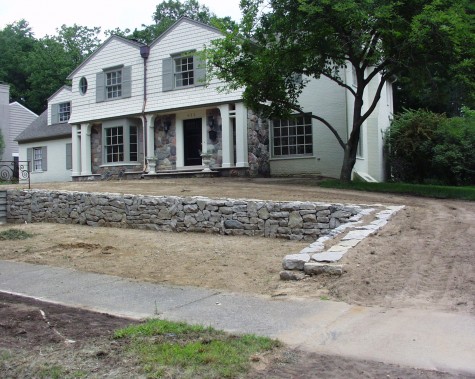 I was not about to ditch a lovely old magnolia in the front yard, so the finished grade had to respect the grade of that tree. No tree likes soil piled up against its trunk; changing the grade of an existing tree more than 4 or 6 inches is likely to kill it. One course of stone set at and into the grade of the upper terrace gives the illusion that the wall has great thickness and heft.
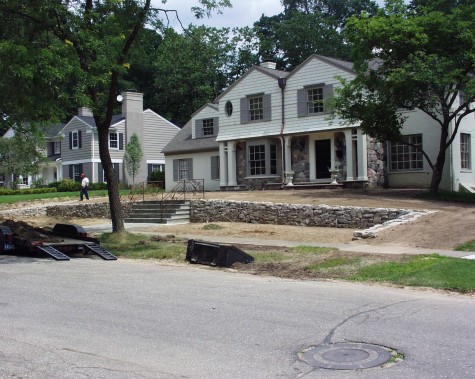 The wall slopes gracefully from the center staircase to the edges of the property. The return, or short arms of the wall, permitted me to maintain the grade to the neighboring property without interruption. A pair of antique iron railings I had acquired were retrofitted to work with the staircase. They are as lovely as they are functional.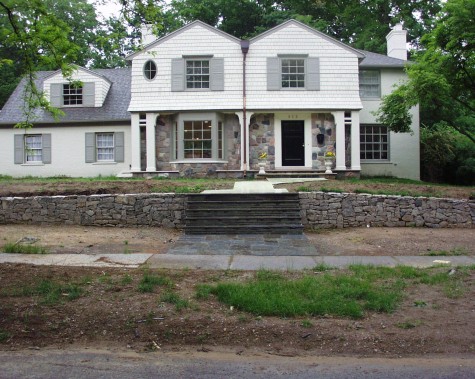
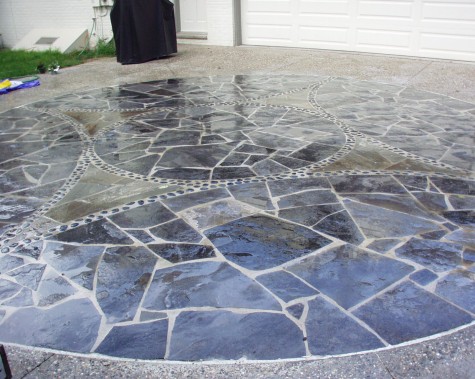
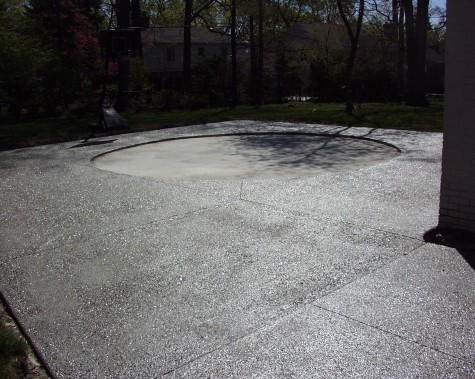 Not surprisingly the existing driveway was set to a grade which no longer existed. A new concrete aggregate driveway culminated in a parking area at the back of the house. There is no hiding a space like this, so I designed a stone medallion for the center. What one can’t get rid of needs a little special attention.