The Schematic Plan

What I call a schematic plan is another way of saying master plan.  A guide for the development of a landscape.  Clients who have an interest in a plan that they can work towards and implement over time always interest me.  A landscape of note implies a long term committment-gardeners willing to go that route will not only enjoy the process, but will find so much satisfaction in watching something grow.  It takes lots of time to regrade a property, reimagine the space, plant, and arrange for care.  This timeline does not even include the plants that die, and the changes that result from experience, or a change in taste.  Anyone who buys a ticket for the long term process that a really good landscape requires I admire.    
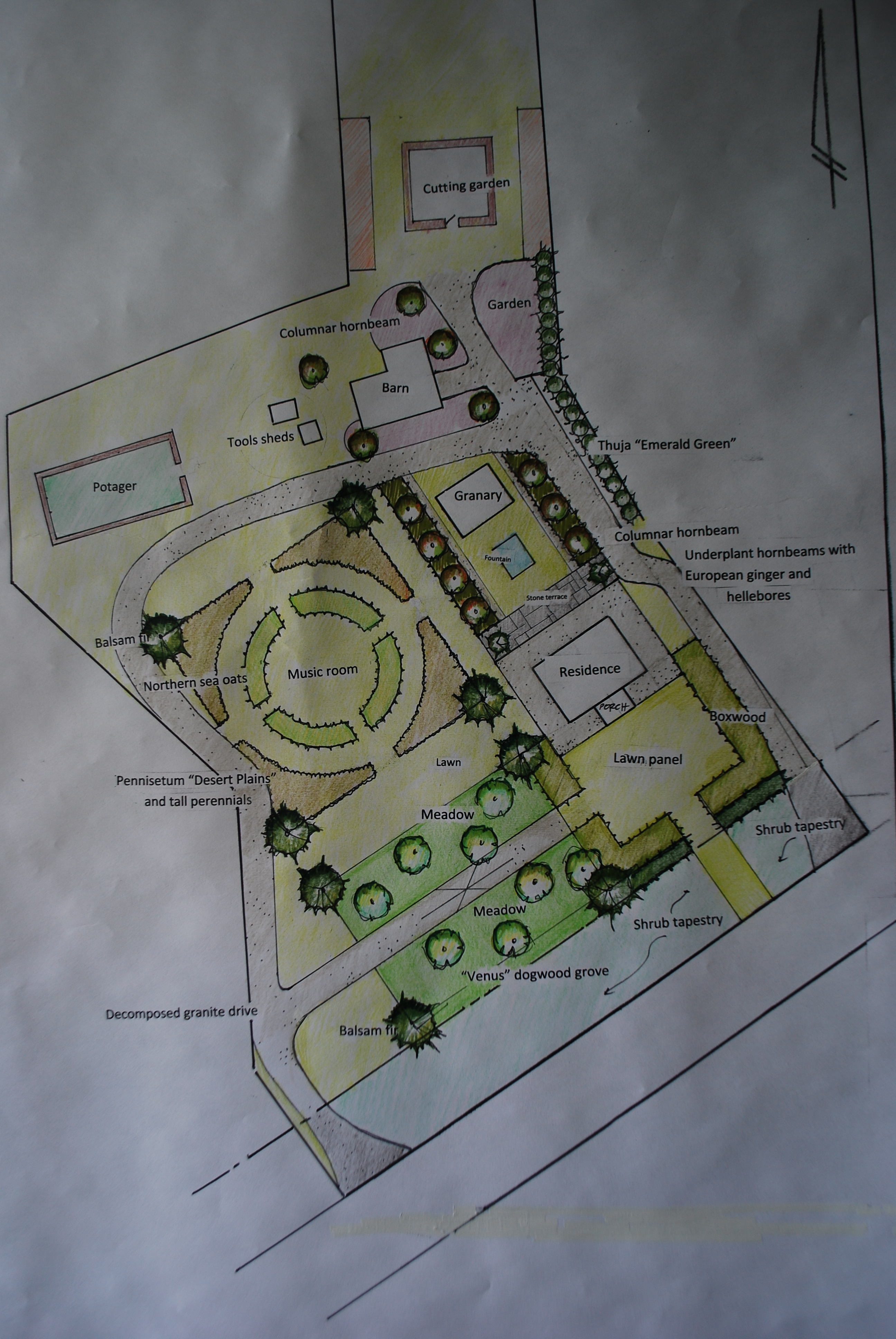
 A master plan is a schematic drawing noted for its broad strokes-not its details.  The vegetable garden will be there.  Friends will park here.  Parties could be staged in this garden.  Great views of the landscape from inside could be described by this, or that.  The rear yard will feature a particular shape-the particular plants are to be determined.  How does the landscape address movement?  The driveway needs to be this width, and accomodate this turning radius,  and needs to gracefully address vehicular traffic.   A big scheme is just that-a big fluid wish list with an attempt made to broadly define use and beauty.  There will be places to sit, garden spaces-spaces to view from afar. This master plan features a wide swath of decomposed granite all around a 19th century stone farmhouse.  There are plans for a conservatory style kitchen across the back of the house.  My clients are indicating they want to move ahead with the landscape.  This masterplan gives wide berth to additions that are planned for the house.  The additions will take vastly less time than the landscape.  I advised them that given the length of time it will take to create a landscape, the best time for them to begin construction is right now.         

columnar trees

My clients purchased a very large farm- a property that features 2 barns, 2 outbuildings, and a granary.  A granary?  A beautiful wood structure whose purpose was to store grain is a feature. My plan is to move that granary, currently set above ground on concrete blocks, directly and squarely opposite the rear of  their home.  The broad gesture?  This old stone farmhouse came with the outbuildings that make for a working farm.  Though it is unlikely that they will ever grow grain, and have a need to store it, the granary is a great place to stage a summer dinner party.  The house and the granary will become substantial bookends for a simple fountain garden.   
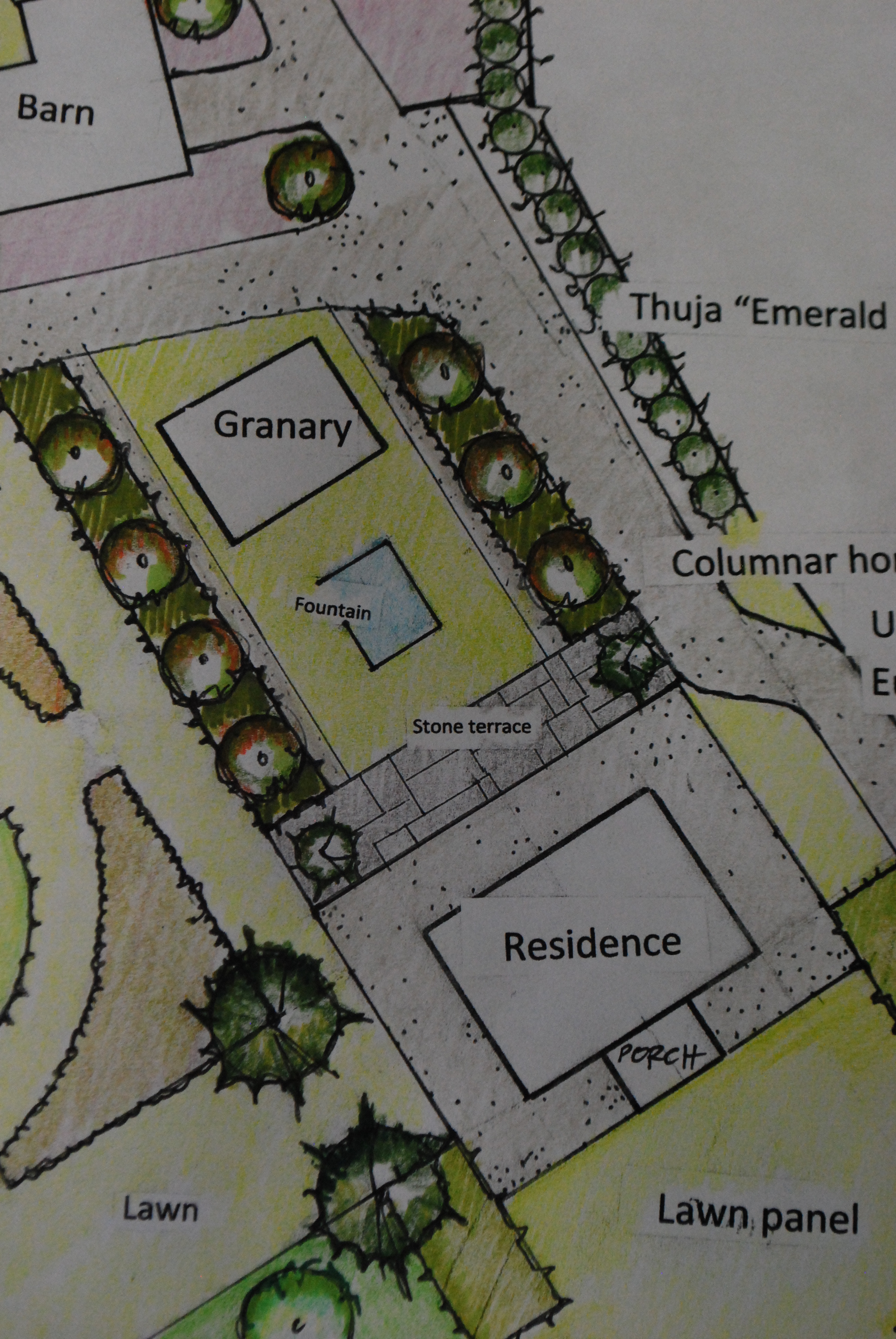
On either side of that fountain, there is a plan for an allee of columnar hornbeams, underplanted with European ginger and hellebores.  It would be a great spot for snowdrops and white crocus-or white Spanish bluebells.  This list may change, or be added to, or completely rethought- over time. The hornbeams will be planted equidistant from each other in this garden.  Once the allee crosses the gravel drive, the spacing between the trees gets wider, less regular.  Though they will be planted in a much less formal area, they will still maintain the site line established by the formal allee.
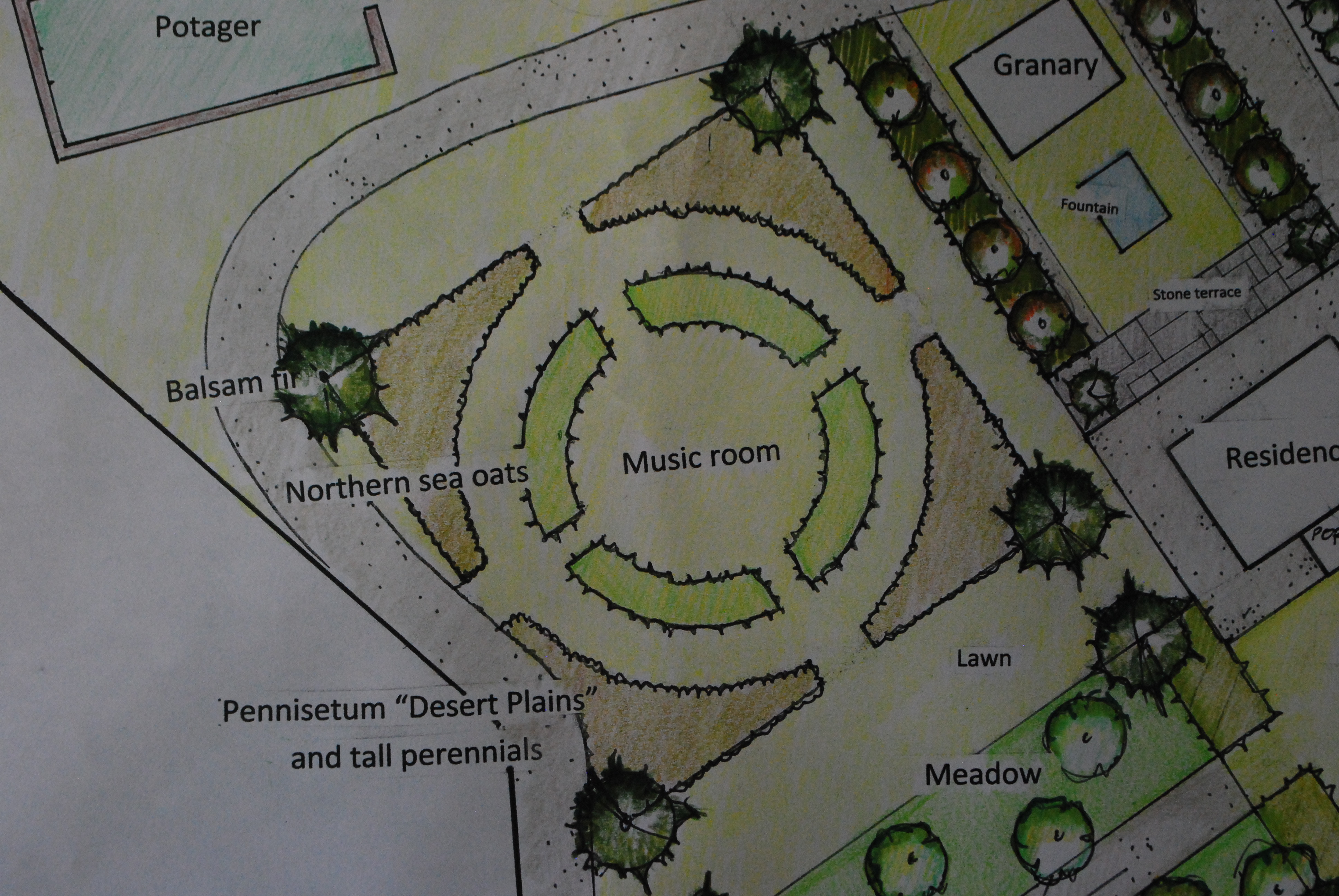
My clients have a particular interest in music and theatre.  They like nothing better than a summer concert staged outdoors.  The shape of the gardens adjacent to this round grass space that I call the music room make reference to their neeed for a space for such events.  The grasses are an informal material used in a more formal way.  The heights of the plants specified will provide some enclosure and privacy.  Viewed from the fountain pool, the northern sea oats will provide a contrasting and shimmering backdrop to the more formal and static hornbeam garden.  Viewed from the vegetable garden, it will look like a field of grain.  A reference to the agricultural history of the property will make those beds more visually believable, given that the setting is rural.  But those beds could be a collection of shrubs or small growing evergreens.  They could be a perennial mix that peaks during the summer months. They could be planted with roses.  A scheme needs to come first.  The details can come later.
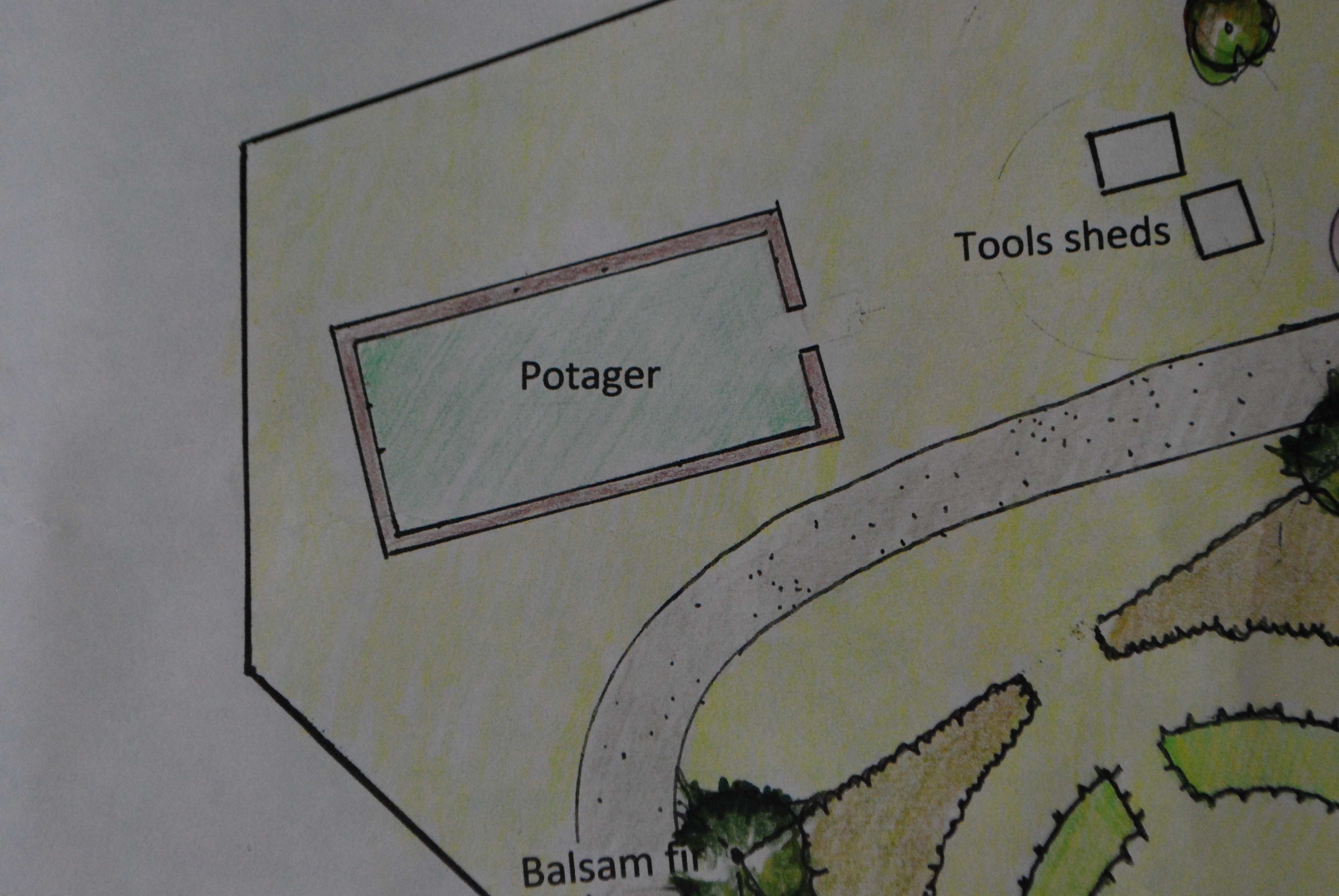
I have labelled the vegetable garden a potager, as one of my clients is French.  The details of this garden will be provded by him.  I feel certain it will have a distinctly French feeling.  The garden footprint is exactly the size and location of a very old barn original to the farm, which needs to come down.  It is deteriorated such that to restore it would take resources my clients prefer to put elsewhere.  Hopefully someone will be interested in the salvage of all of the old beams and timbers.  The lower portion of the barn walls will be left standing, providing a fence for the garden.  Their property is host to lots of wild beings.  The floor of the barn has always been dirt.  With some work and lots of compost, it will be a great place to grow vegetables.
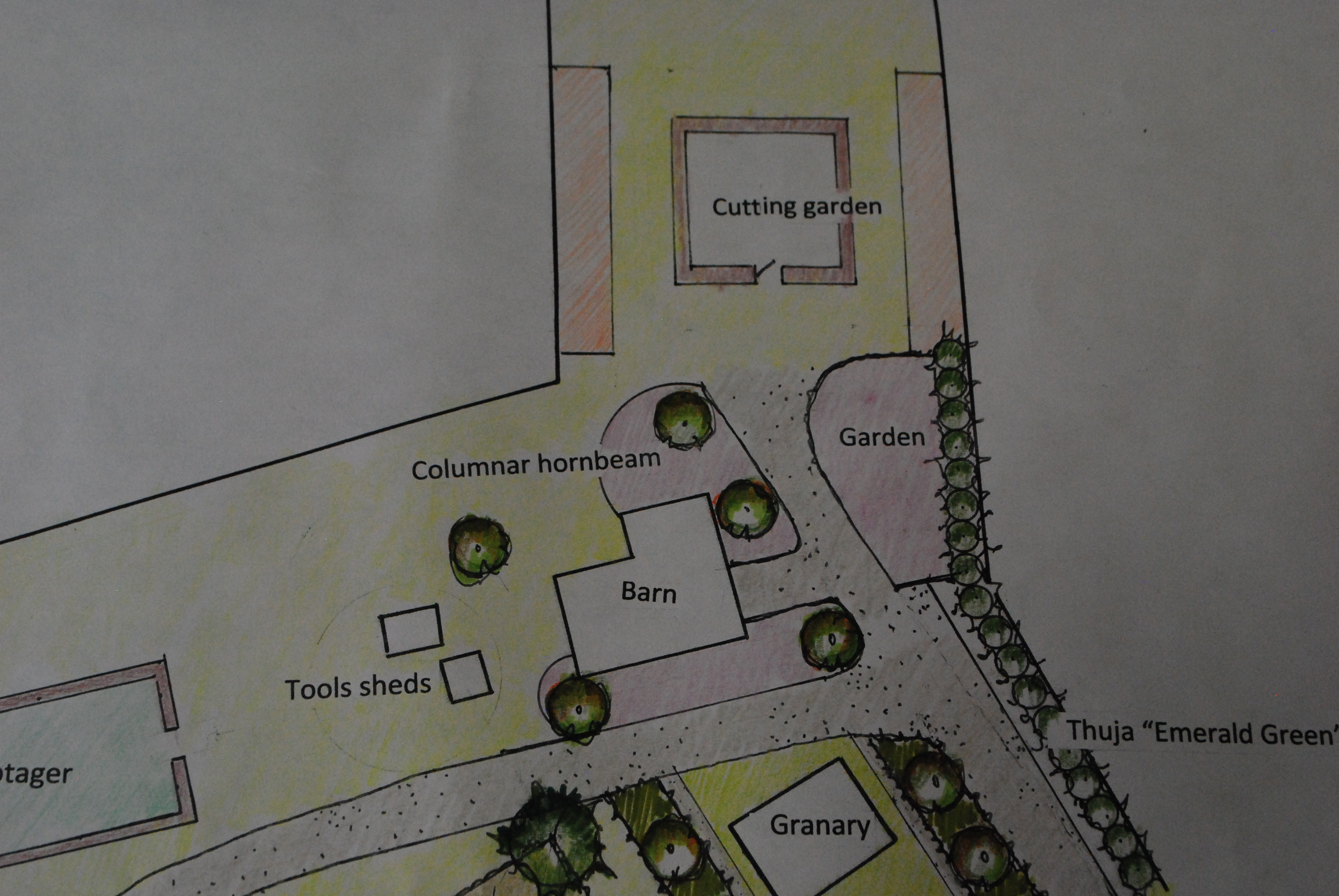
The other barn is in excellent condition.  It holds tools, and soil.  In the winter, the boxwoods in pots are stored here.  The barn gardens are actually quite beautiful and well developed.  There is no need to replace them.  The major changes will be about the perimeter shapes of those gardens. A hedge of arborvitae on the lot line will screen the house next door from view. A fenced cutting garden on the dog leg part of the property will be framed by a pair of pumpkin growing gardens. Two gardens devboted to growing pumpkins-how I envy them this.

The gravel driveway design is fairly close to what is existing now.  A major change will involve the addition of a drive which goes to the front door. On either side of that drive, a meadow planted with a grove of Venus dogwoods.  This meadow is a grass meadow.  A low growing low maintenance grass seed will be sown, and cut but once a year.  We have had very good luck with this particular seed mix, on unirrigated shady slopes, and in sunnier but relatively infertile ground.  The movement of all of the grasses will be a considerable contrast to the primary formality of the landscape.  
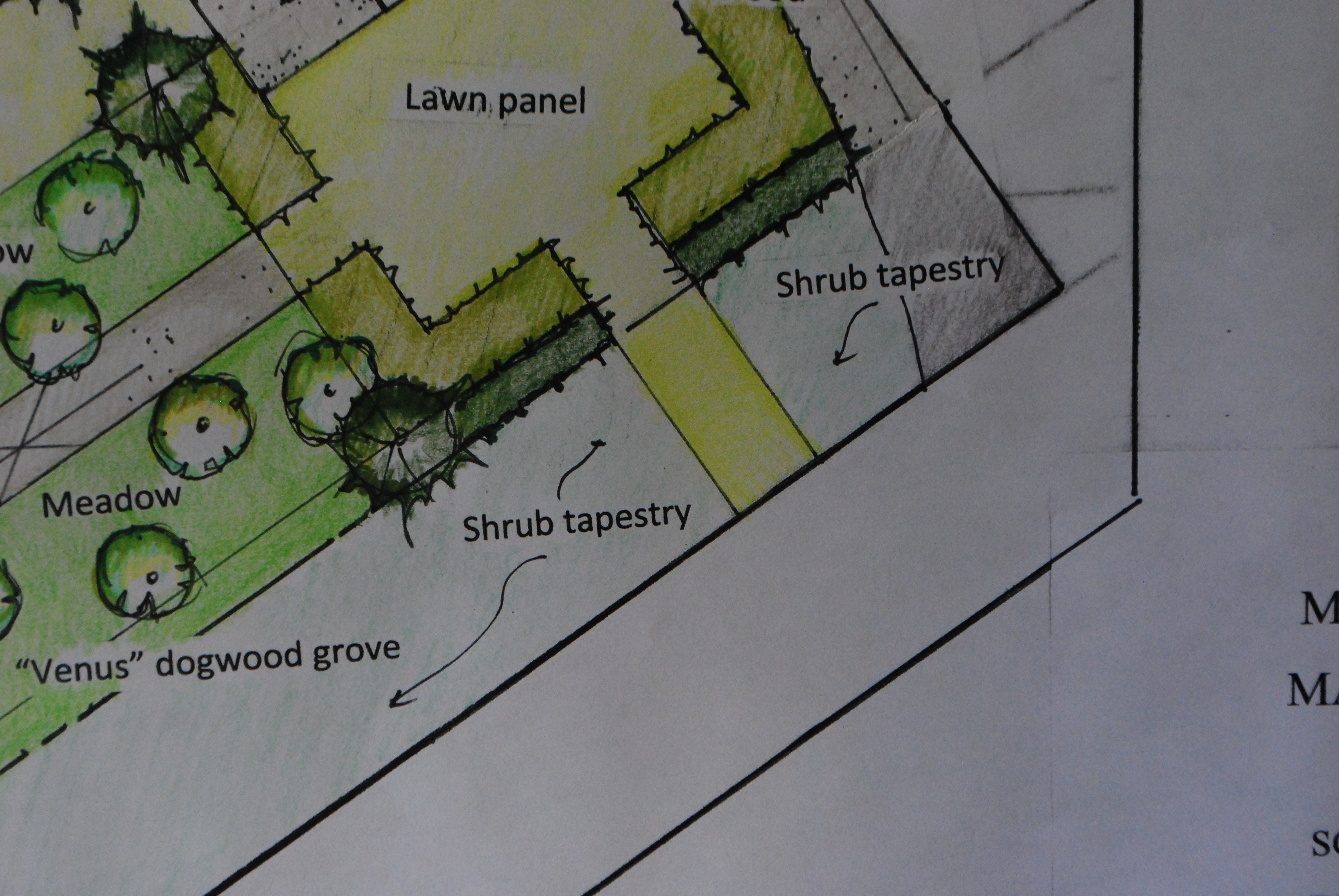
In the front, the distance between the hedge of Moonii yews and the road is 35 feet, but that footage is a steep slope, culminating in a drainage ditch.  The center of this slope will be the same short growing grass as the meadow.  This will permit a long view out, to the state lands across the road, from the front porch.  Shrubs will be planted into the slope where needed-lilacs, old fashioned spirea, viburnum, sumac, beauty bush-whatever seems right for a free for all mix.  Lucky the gardener that has enough land for a free for all. 
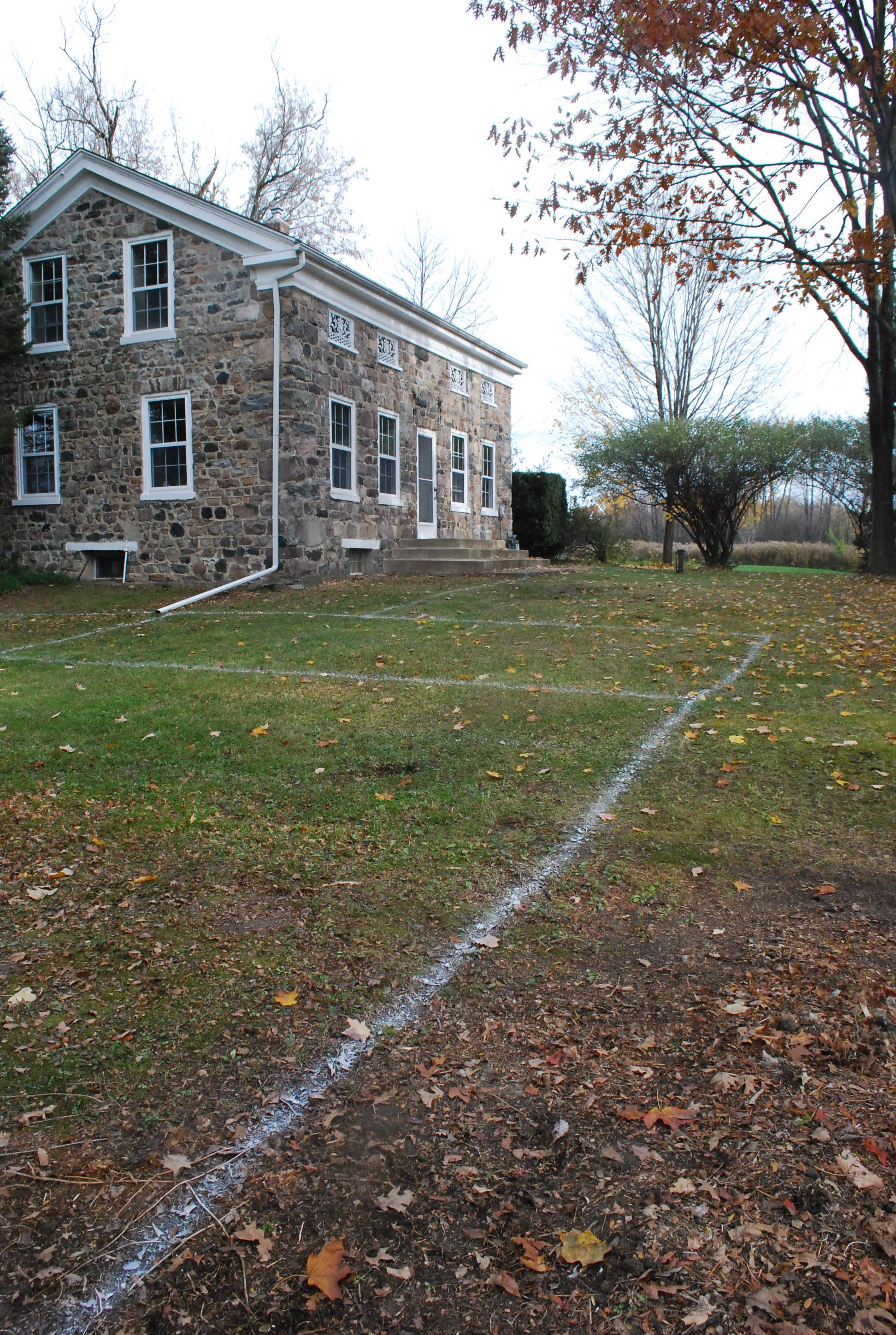
Of course the first step is to lay out the schematic plan, and see how it looks on the ground, full sized.  A lot of the preliminary tree work has already been done.  My clients seem to think the schem suits their property, their taste, and the history of the farm.  I am so pleased that this project is underway.   
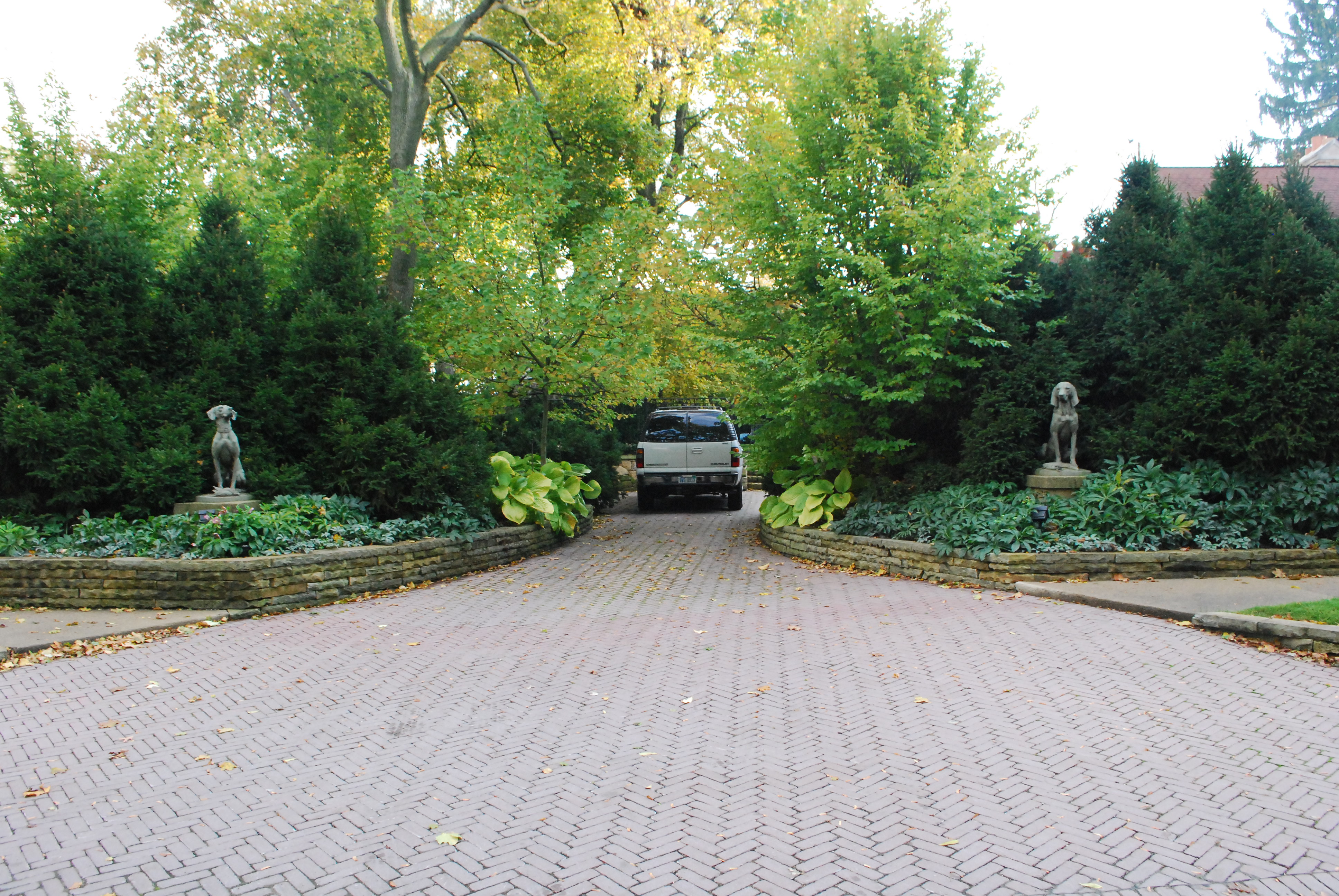


Lighting The Side Yard

I really don’t have a back yard.  My property occupies a corner.  A front, on two sides-that is a corner lot.  I am sure that lack of a private back yard influenced the original design and configuration of my driveway.  Made of brick, (I have replaced the deteriorating original brick with concrete brick) it is incredibly wide at the street. (picture those 1930’s Packards turning in)  The drive narrows like an hourglass to a little over 8 feet wide, half way up.  That narrow gap was an effort to provide a little privacy to the side yard.  After 16 years of twice daily practice, I am able to get my Suburban out 99% of the time, without scraping the wheels on the retaining walls. 
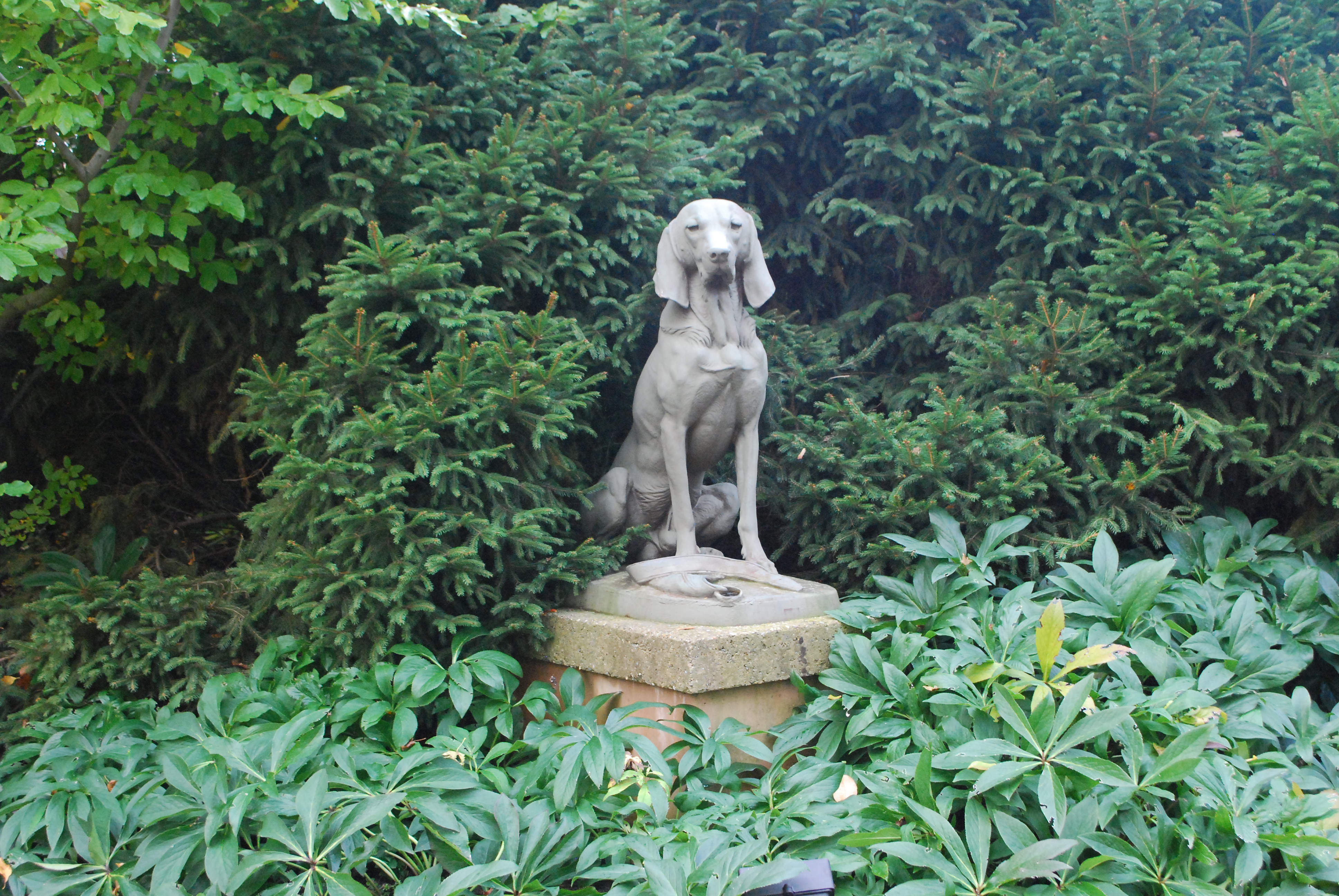
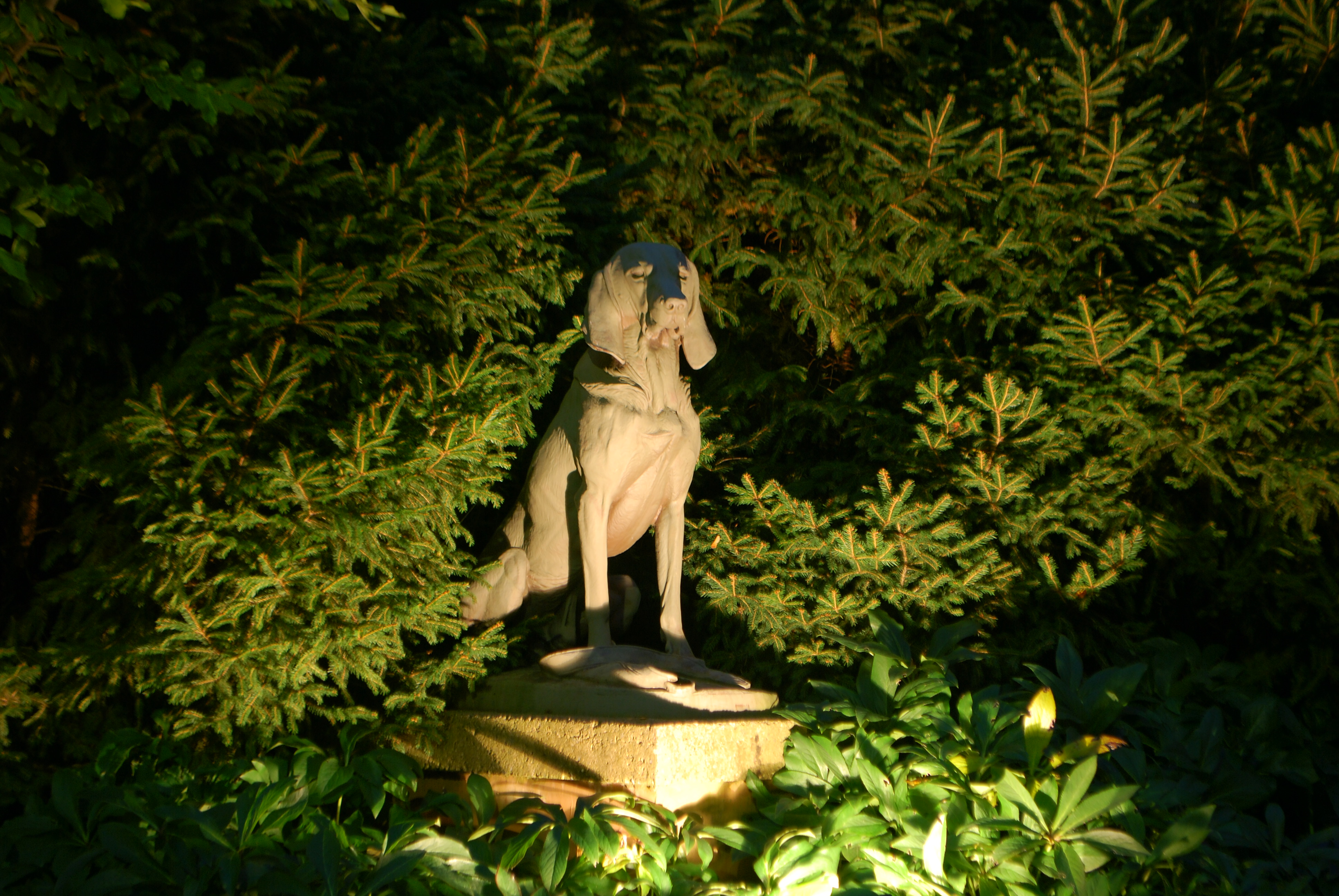
A pair of cast iron bloodhounds on concrete pedestals are awash in decent sized and fairly mature beds of hellebores-a favorite perennial. I look forward to seeing this every day-coming and going.  This makes it a natural candidate for some landscape lighting of the celebratory type.  I will soon be coming home after dark, and I don’t want to give up the view of my dogs.   

This first pass- the light is too close, and too hot.  The intense light creates shadows that make the dog look threatening. That is not my intention.  The idea is that I get a welcome home.  The winter season would be bearable, but for the gray and the dark.     

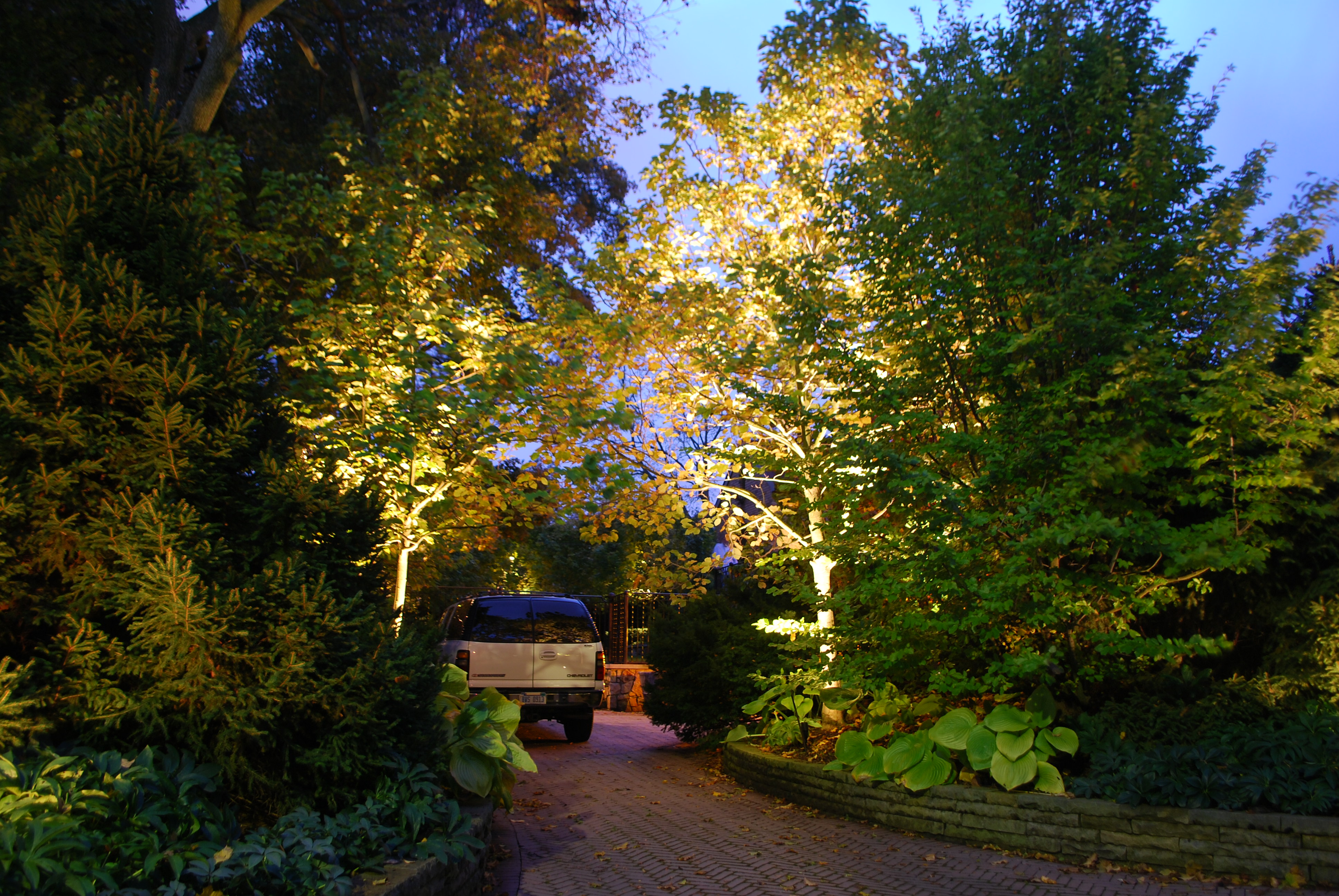
A pair of Galaxy magnolias are planted in the narrowest part of the drive.  They have been there long enough to make a green arbor of magnolia branches overhead.  That narrow spot is the darkest spot on my property.  A big stand of dark green Picea Mucrunulatum and taxus densiformis make this moment in my landscape feel like a black hole in the winter.   

I don’t mind some stronger light here.  It helps me to get through the driveway isthmus without incident.  OInce the magnolias have dropped their leaves, the light be be much more subtle.  This landscape lighting helps me navigate. 

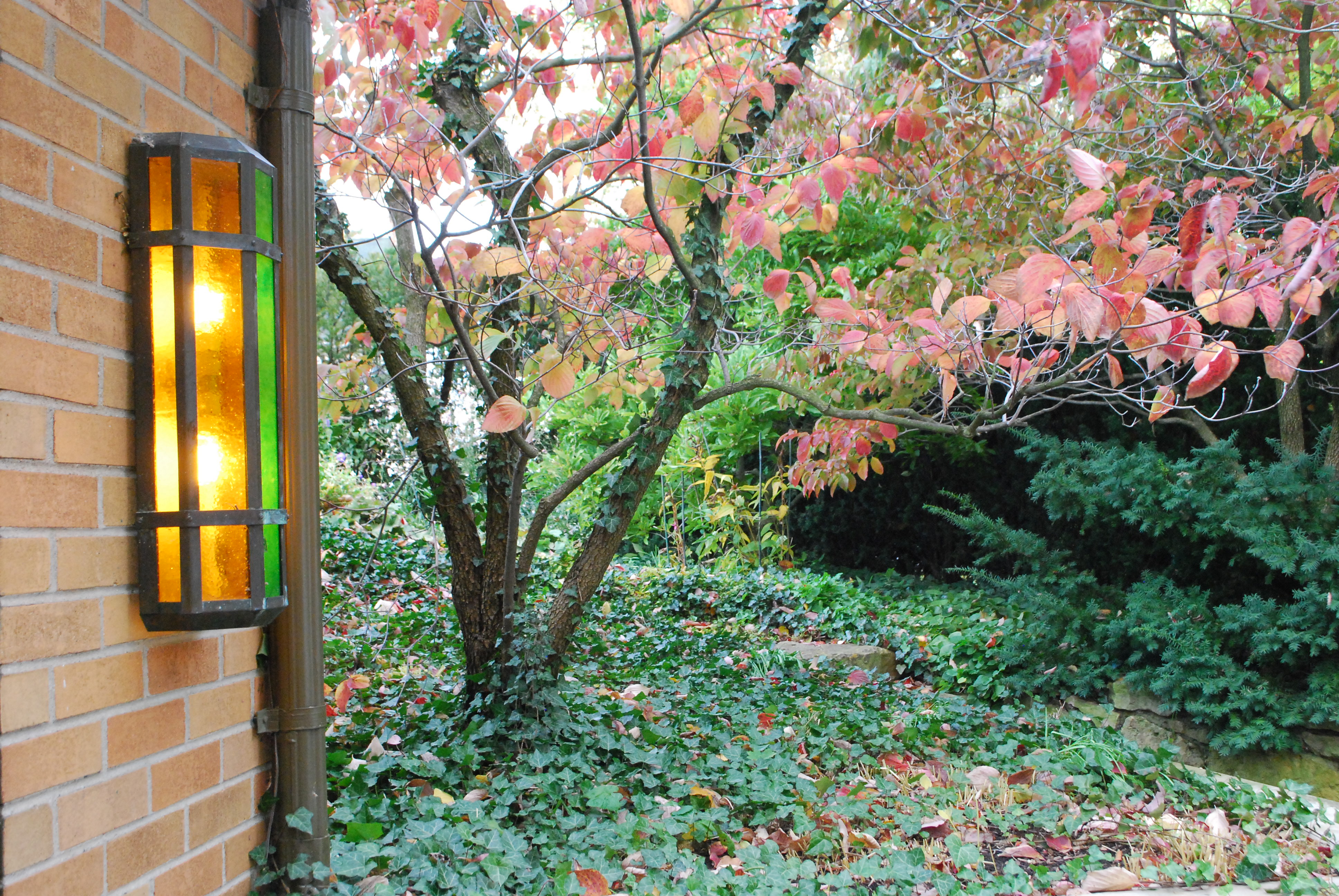
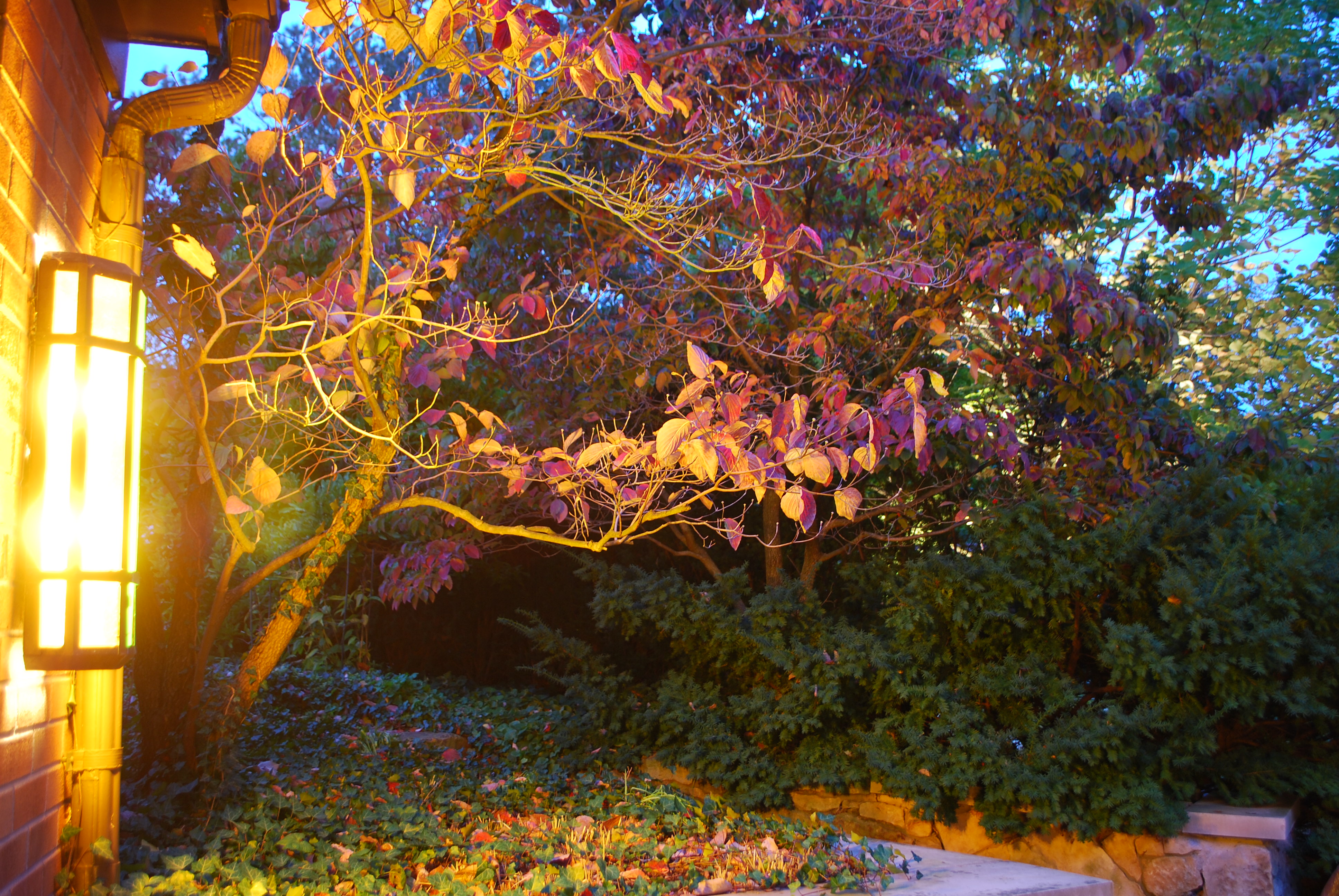
A friend found these Arts and Crafts style vintage light fixtures for me-they are perfect on either side of the garage.  They are always on.  Summer and winter.  Day and night.  I never tire of seeing them.  Early on a spring morning, or late on a summer day, they let me know they are there.  

Once the skies go dark, they help light my way.  Good landscape lighting is as much about function as beauty.  Though no light could ever possibly be as beautiful, in all of its variations, as natural light, the invention of electricity did indeed change the landscape. 
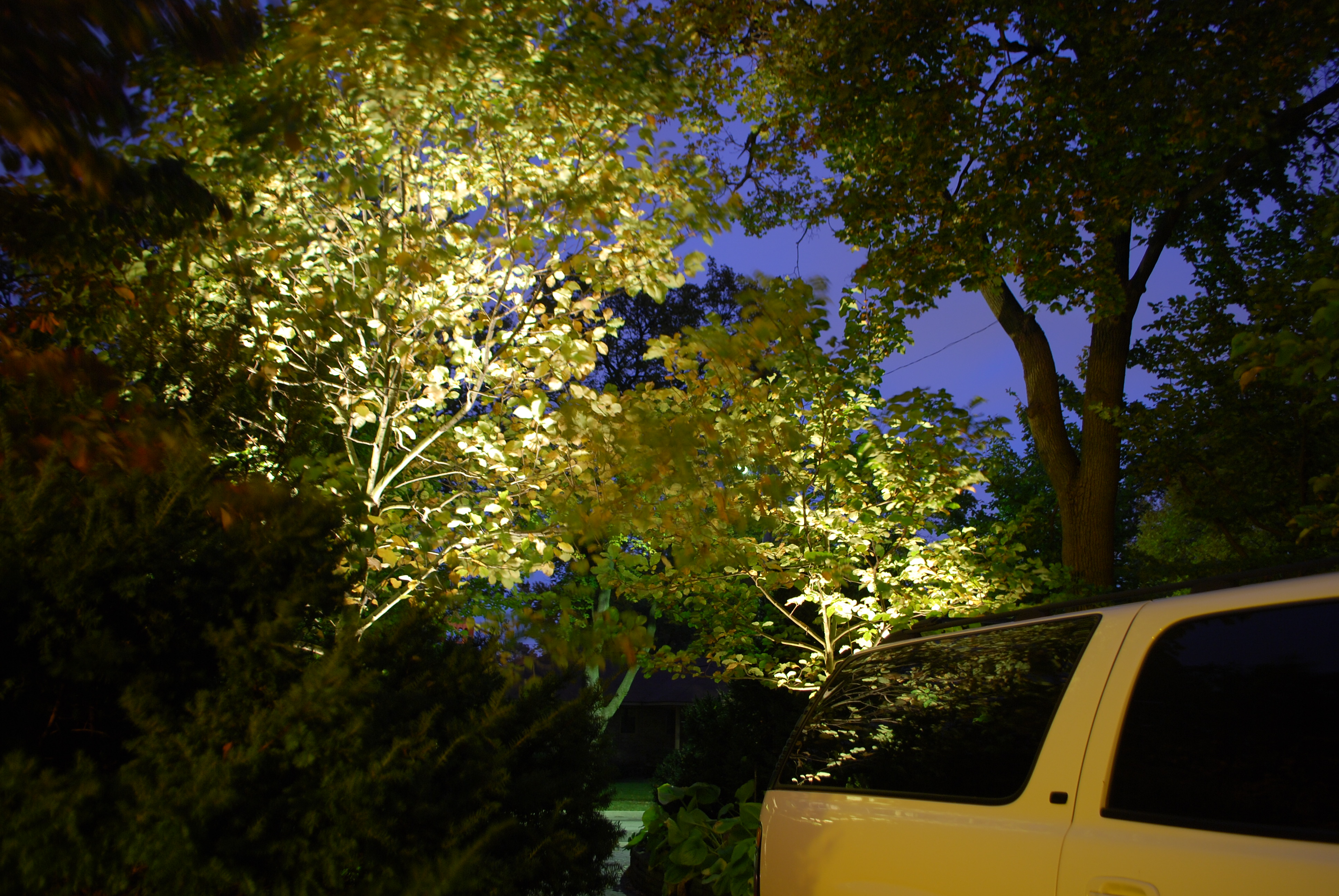
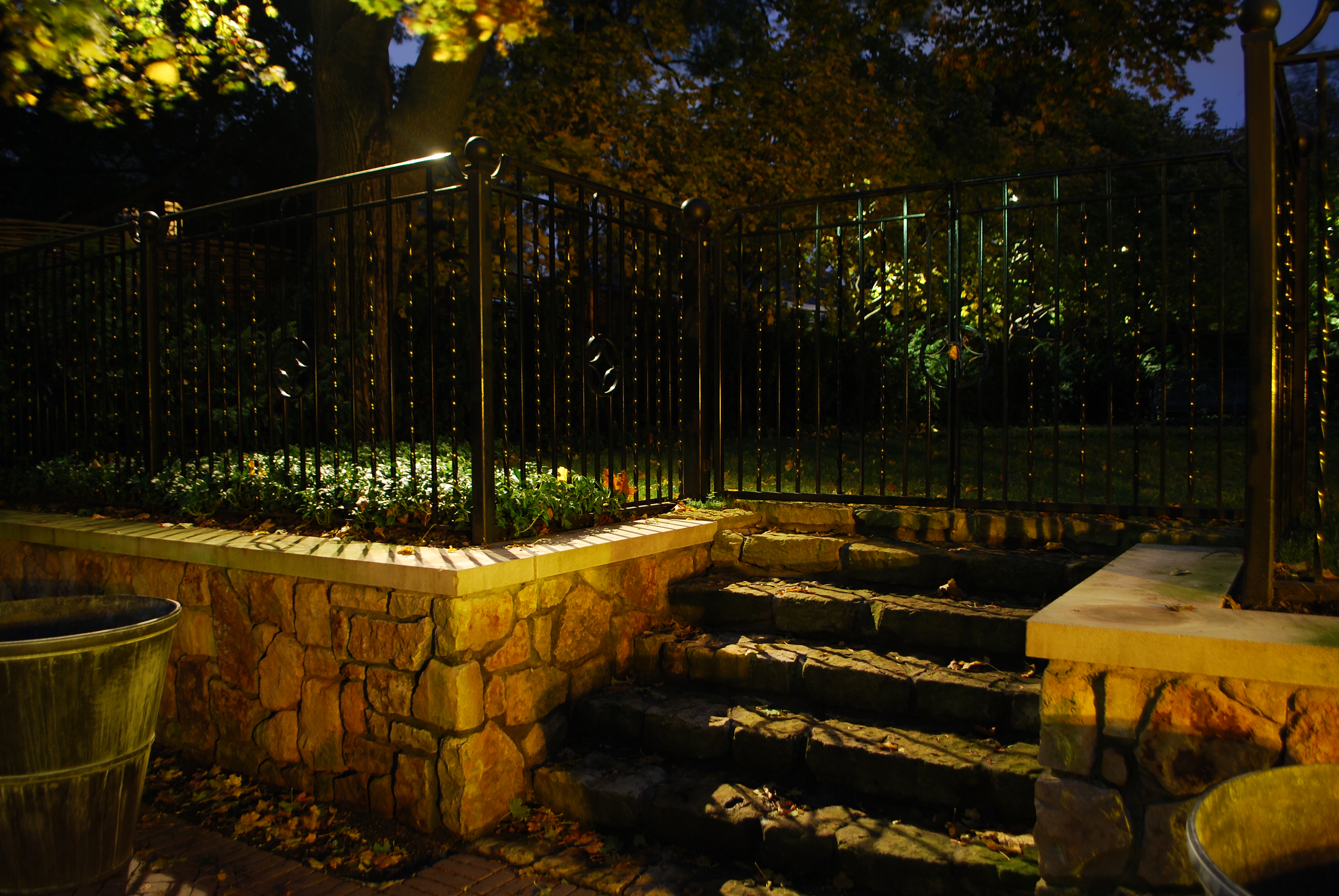
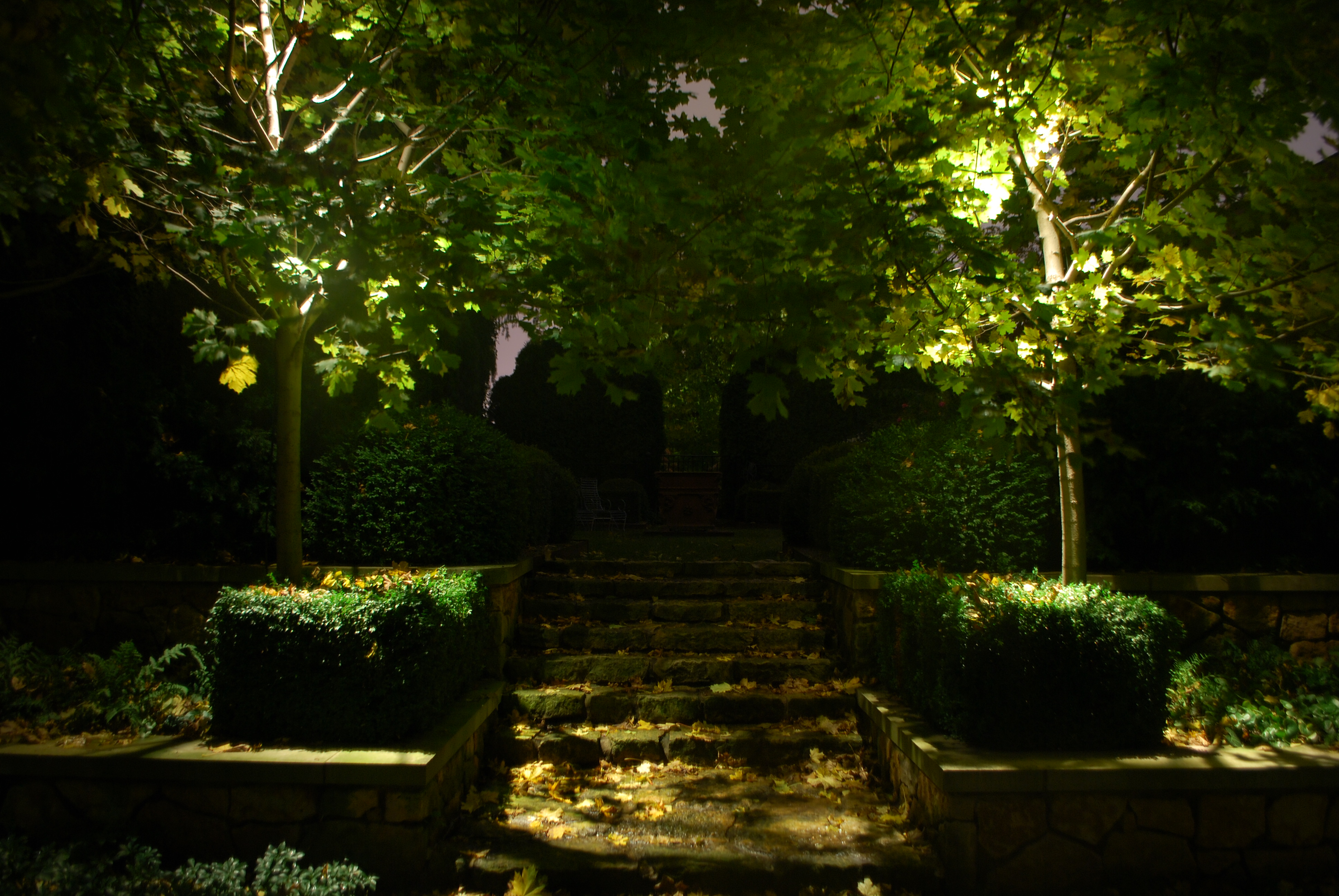
A flight of stone stairs begin at the driveway, and end in the upper level fountain garden.  My giant old Norway maple is a benign host to 3 spotlights that light up the drive where I park, and those stairs.  This light from above illuminates my path to the garage door, and to the upper garden, should I decide to go that route.  This lighting is not so much about a favorite landscape feature as it is about safe passage. 

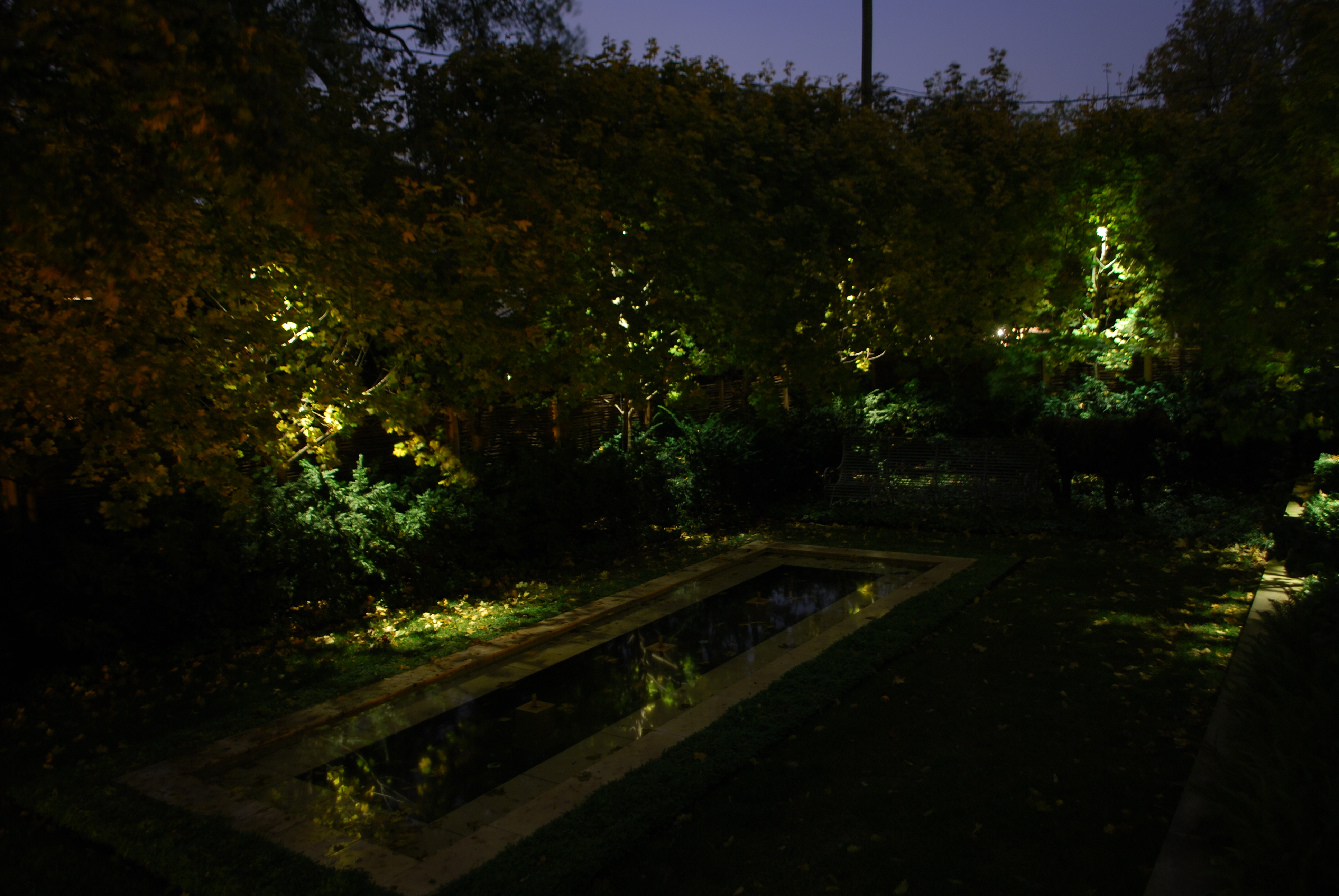
Buck shut the fountain down yesterday.  It is clogged with leaves, and the weather is too chilly to linger here.  This is my most unfavorite day of the gardening year.  Water in a garden is enchanting.  serene.  sparkly and lively.  I hate having to give it up.  Next weekend he will drain the water from the fountain.  I have always disliked the coming of the end for this garden. 

Lighting from high in the Princeton Gold maples makes it easy for me to keep track of the Corgis after work.  The lighting also transforms this garden into another garden particular to the season.  My bedroom has a window that looks out on the fountain.  All winter long I keep the shade half up, and the window slightly open.  The lighting will allow me to enjoy this part of my garden, no matter the weather.

I do have a flight of stairs to the rose garden.  The stone is rough, and uneven.  For months after my knee replacement, Buck helped me walk up these stairs.  My new knee now-perfect.  But I would not walk up there stairs in the dark. 

Buck and I usually have dinner late-7:30-sometimes 8:30.  I take the Corgis out for a final constitutional, after dinner.  Milling around in the complete and utter dark with them-not my idea of a swell time.  I love these downlights in my maples.  Lighting a landscape might help provide more of what you need from a great garden than what is apparent on a summer day.  My idea?  Light, whether it be from the sky, or the end result of an electrical connection, is an important element of landscape design.  The landscape at night-a different sort landscape experience.    


Lighting The Landscape

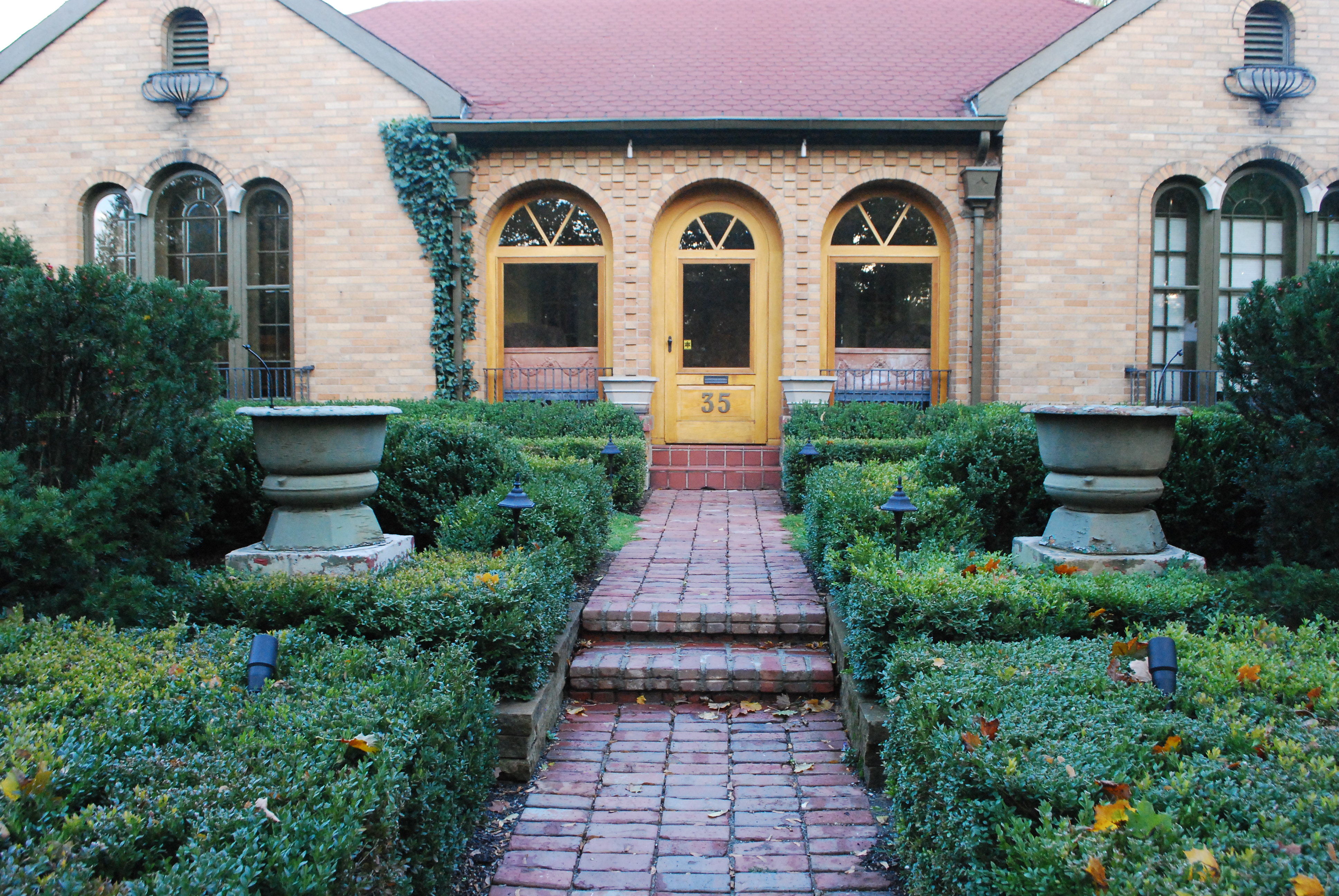
The landscape lighting I have at home was confined to some path lights along my front walk-nothing else.  The path lights had all but disappeared into the boxwood, given how much it has grown since those lights were installed.  In the summer, it is easy to see and navigate the steps coming up to the front door.  Once the days get shorter and the weather cold, I am not out here.  But every time we have company in the late fall or winter, I worry that someone will trip and fall.  Last winter, two older dinner guests fell into the boxwood.  They thought it was hilarious-I was mortified.  It was time to call a lighting person.  Lighting the landscape serves multiple purposes.  It helps provide for safe passage, it provides security, and it can add another dimension to the late fall and winter garden. 


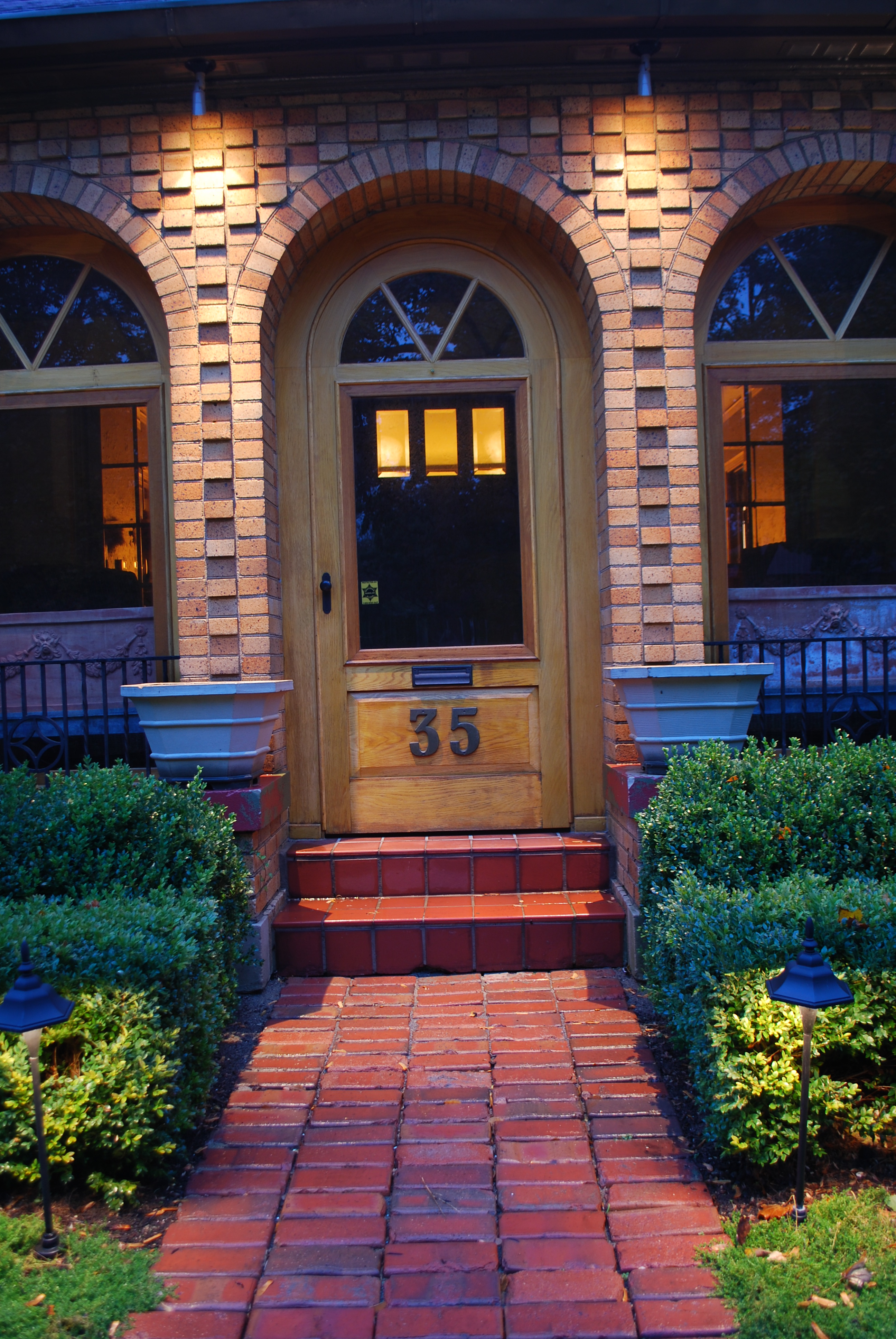
My front porch is enclosed; their are 4 porch lights on the inside.  This is not much help to someone walking up the steps to the front door.  The glare from the inside light made the porch steps and front door even darker.  My first request-a pair of small spot lights mounted on the underhang which would illuminate the door.  That warm light from these two small fixtures does a good job of saying “we are expecting you”.  Second on my list-the path lights buried in the boxwood.

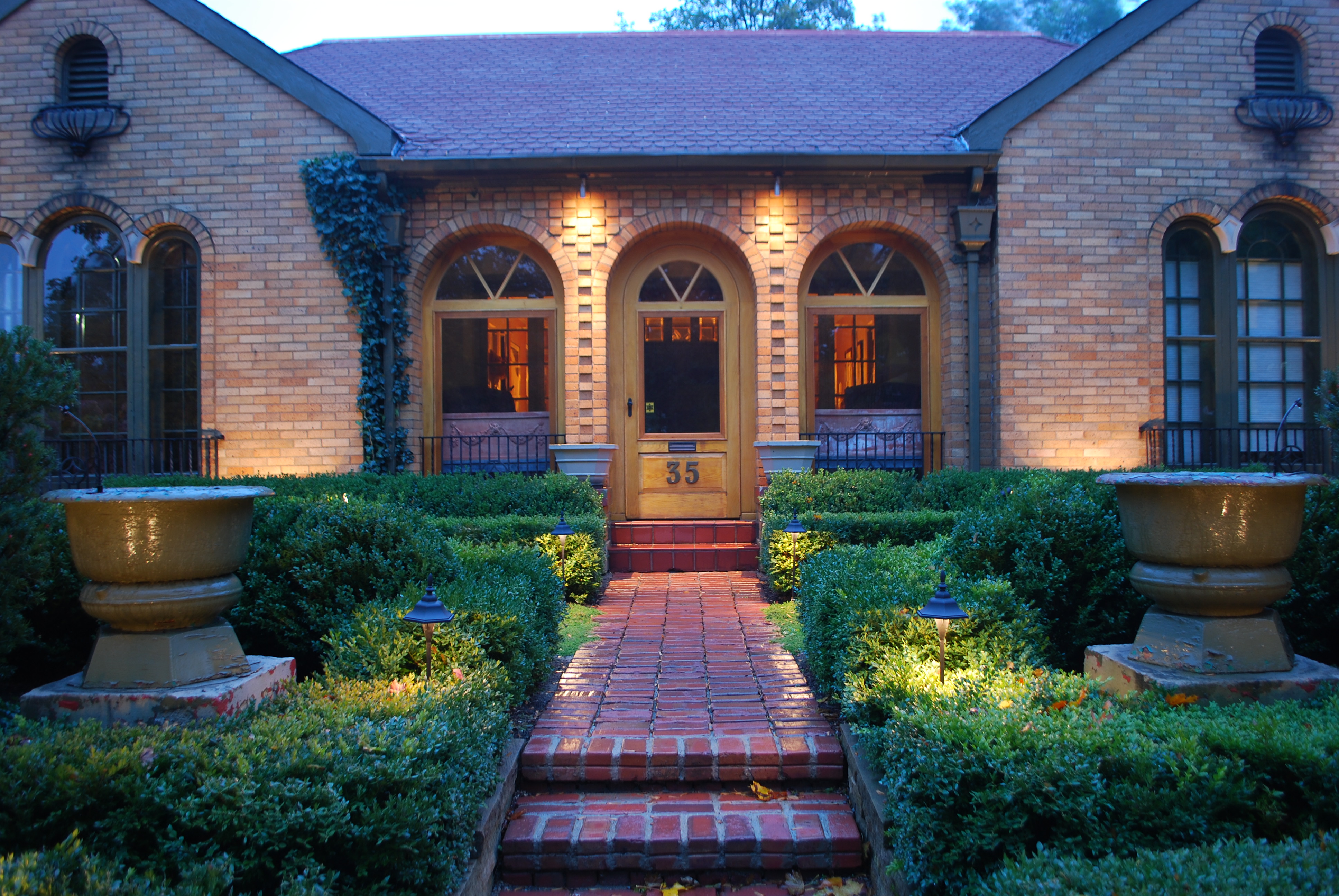
Path lights direct the light down and to the side.  Light shining into the eyes of someone walking up would make the trip even more difficult.  The metal hats direct the light where it needs to be.  Once the new risers were installed, the front walk was illuminated such that anyone could walk up comfortably and confidently. 

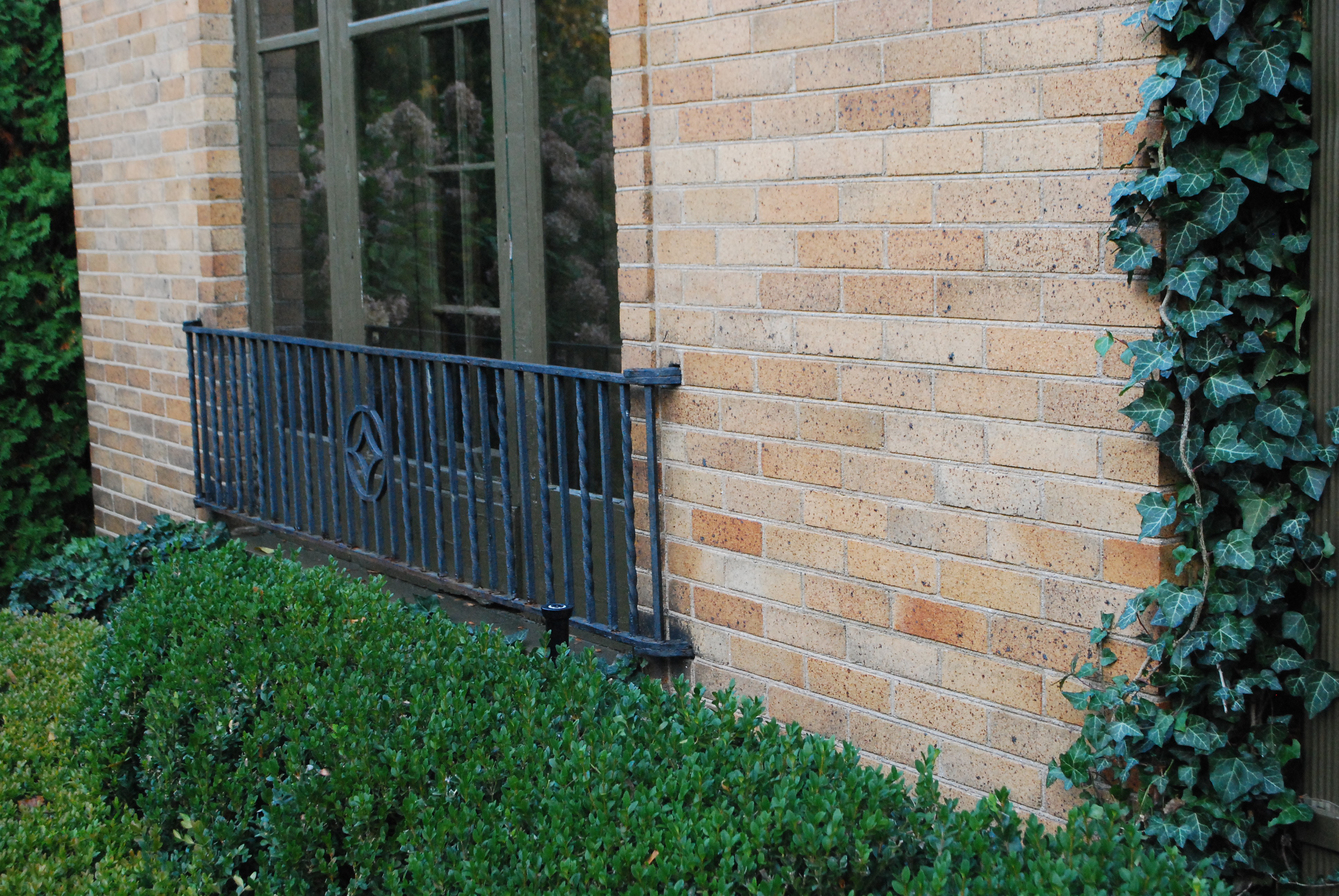
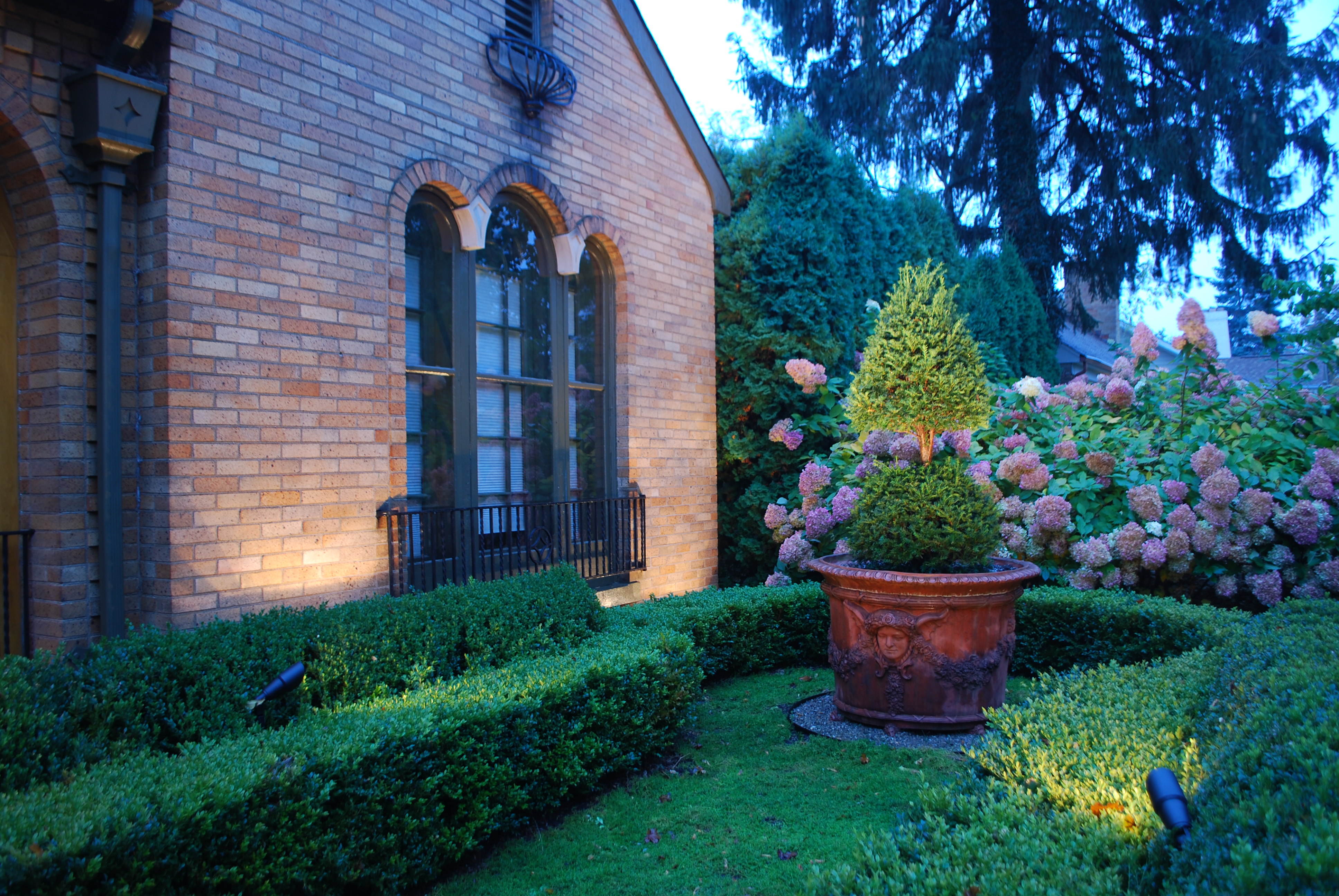
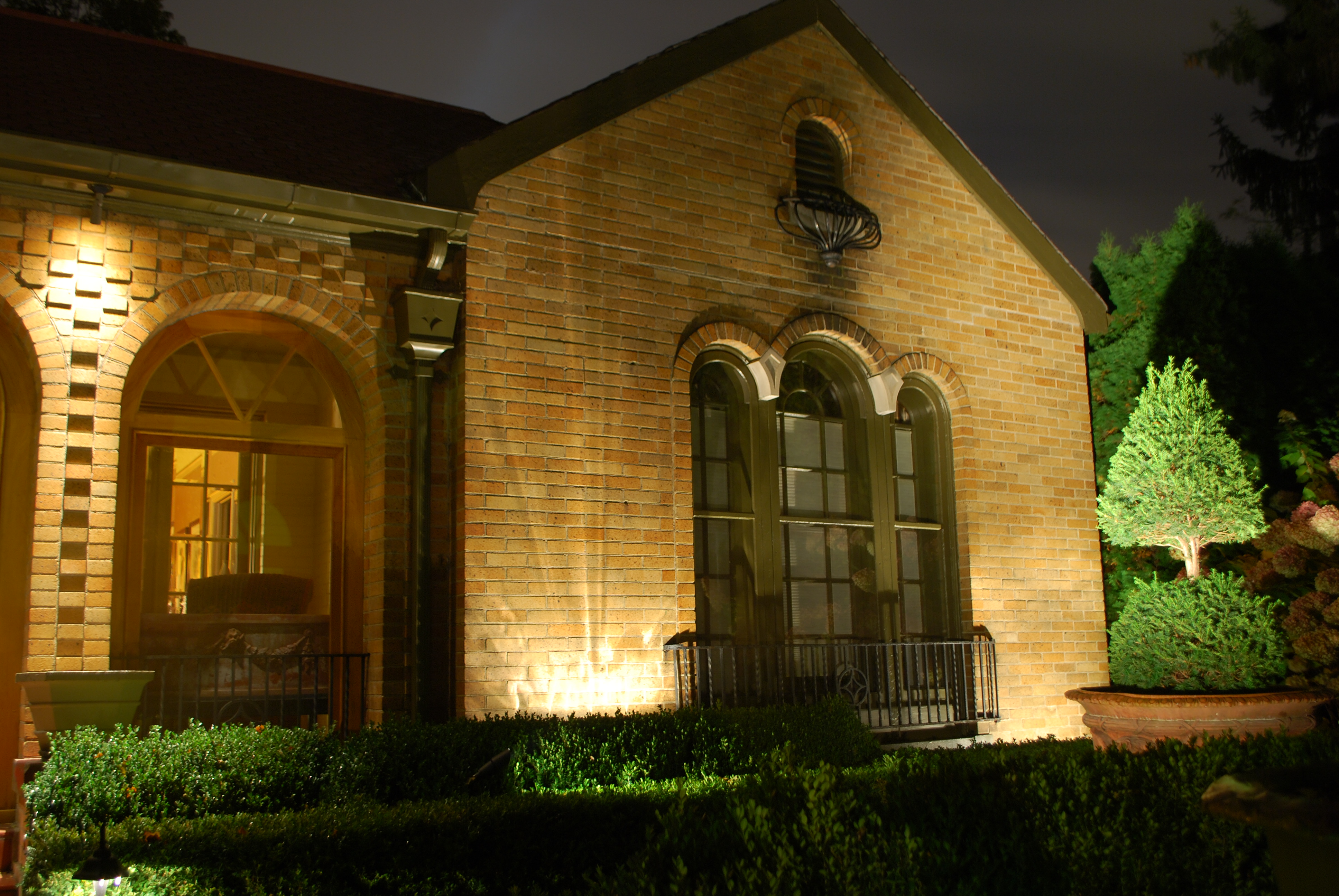
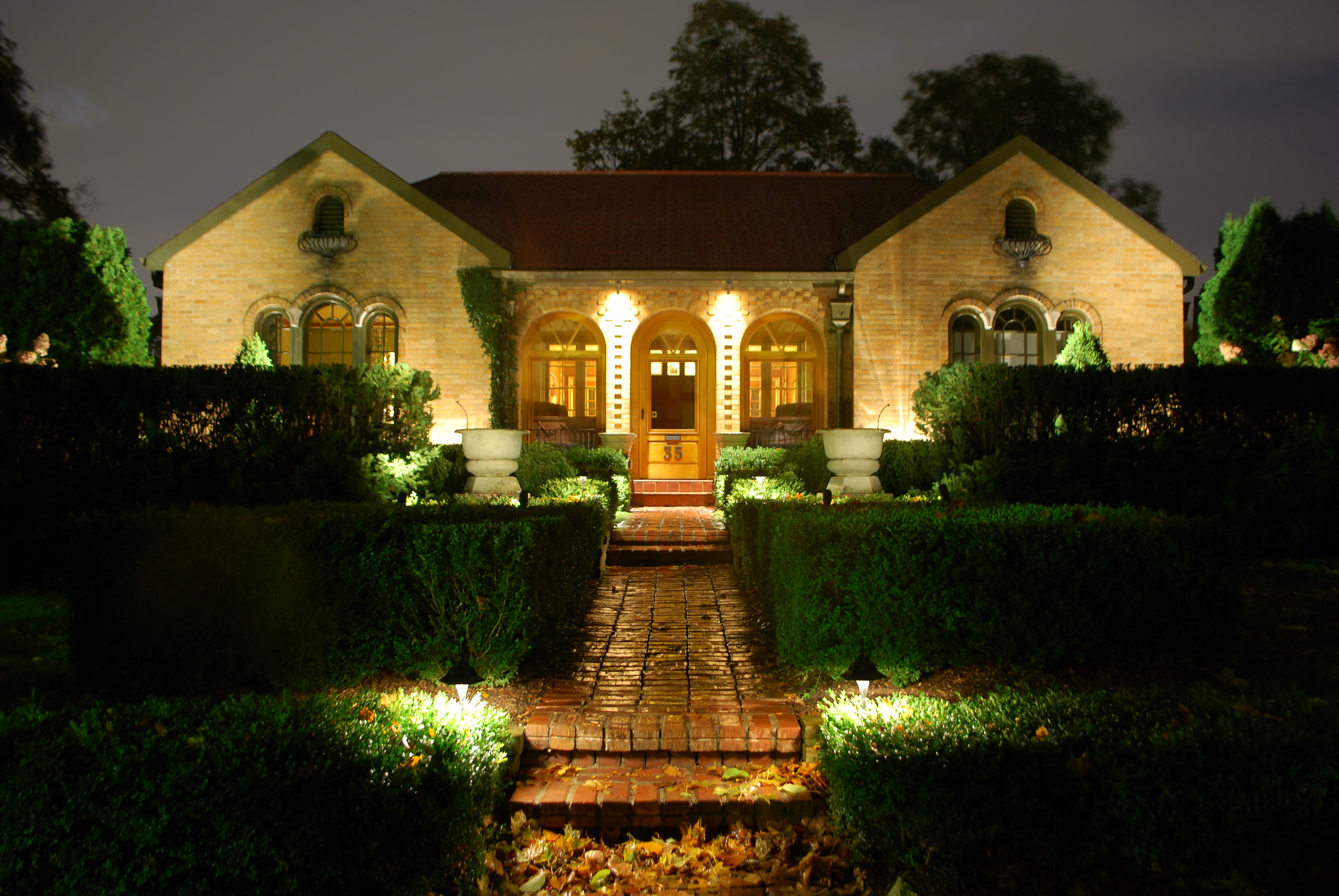
The lighting designer suggested lighting the walls of the front of the house.  That fire brick from the 1930’s is lovely.  Washing the walls with light at night features that architectural detail, and the relationship of the house to the landscape.  These wider fixtures illuminate a wider area than a spot light, or path light. 

Placing the fixture in the right spot can be tricky.  The fixtures in my landscape are strictly utilitarian.  They are only as big as they need to be, and they are black.  I did not want to see them during the day.  Not only do they need to be hidden from the daytime view, they need to be the right distance and angle from the wall so as to wash the wall with light.  A wall drenched with light might be a good idea for a commercial building or a theatre production, but can easily overwhelm a residential landscape. 

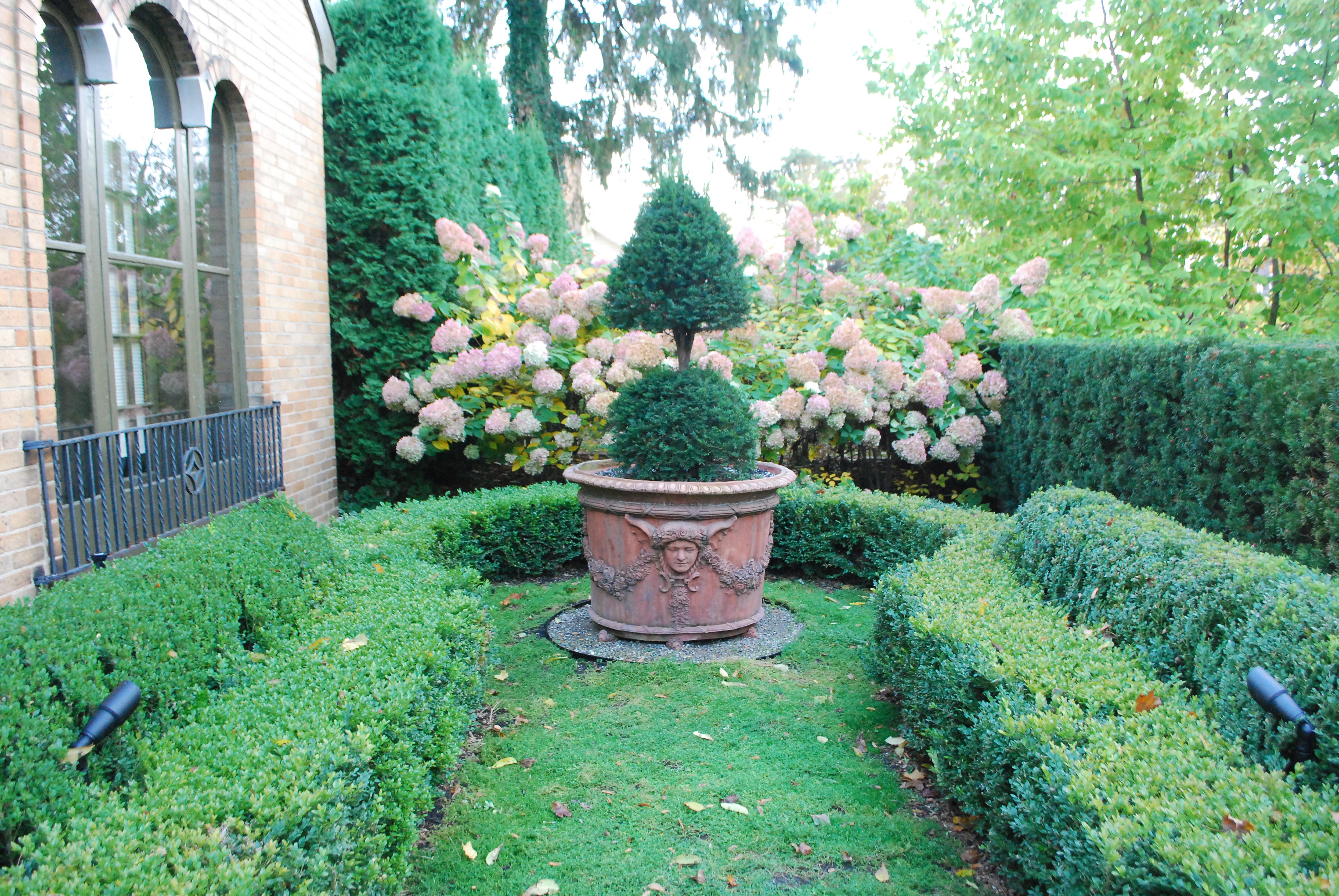
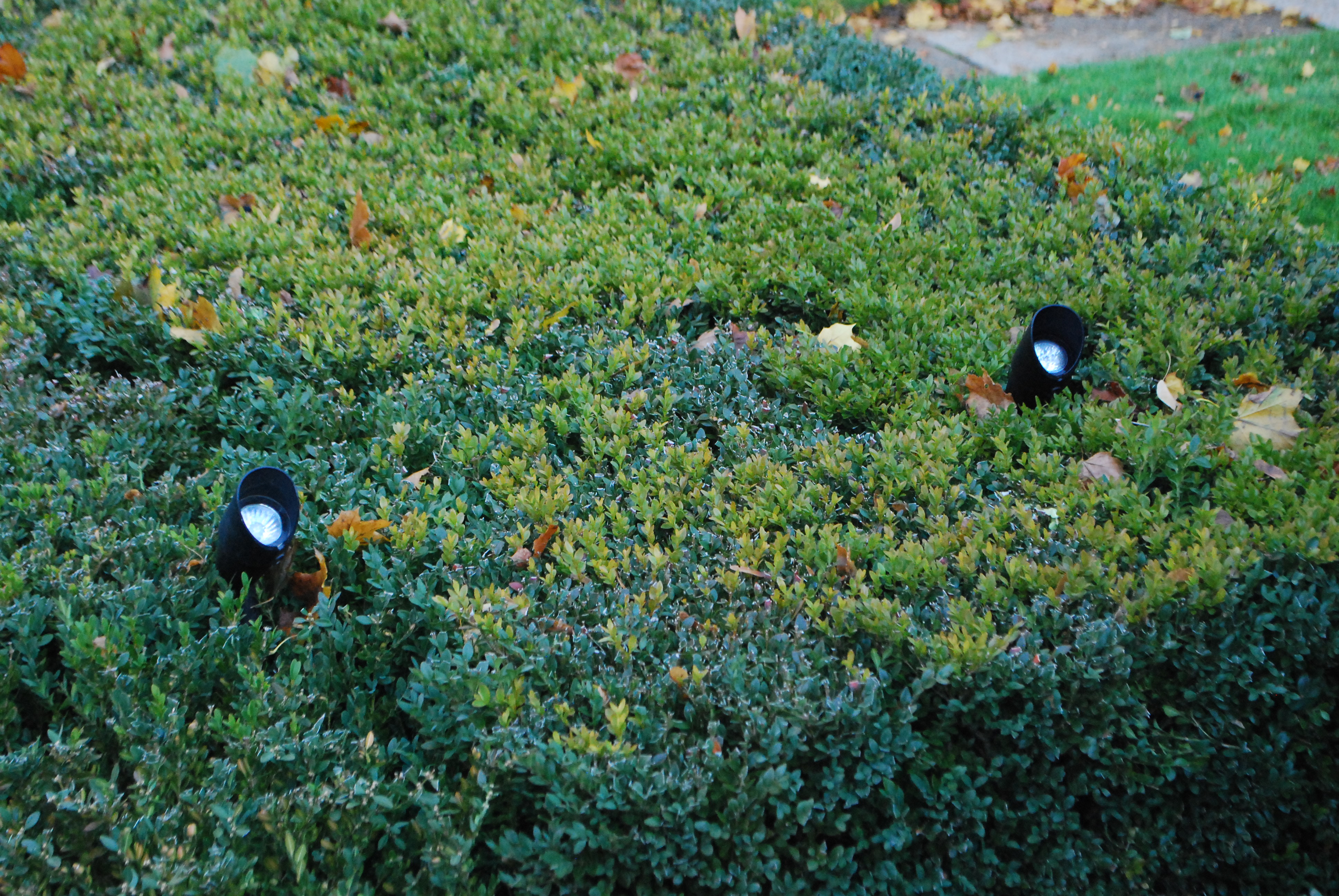
I have a container planted with a yew topiary at each end of the house; they  I did want to softly light them.  A pair of fixtures can be seen at the bottom of this picture.  As the fixture needed to be disguised in the boxwood, I needed two lights in order to get the light to cover the pot evenly. 

The light on the right brushes the boxwood a little too harshly.  The bottom of the pot has no light.  For obvious reasons, a landscape contractor has to do the work of the installation during the day.  This makes it very important to contract with someone who is willing to look at the job at night, and make any necessary changes. 

The original path lights on risers solved the issue of lighting the walk.  Though I do not have very many people coming to my front door, how this looks at night is attractive and warm.  The best antidote I know of for the winter blues is some light. 

I also have 4 pots which face the street.  They are perfectly visible in the summer, but I fill them with twigs, greens, and other materials of the season for the winter.  Though I put lights in my pots, an evenly applied landscape light on the face will permit those pots to be seen all winter.  Given that it is dark here by 5pm in the winter, that lighting will be much appreciated.  Though I am not out there in the winter, I drive by my house every day on my way to the driveway.

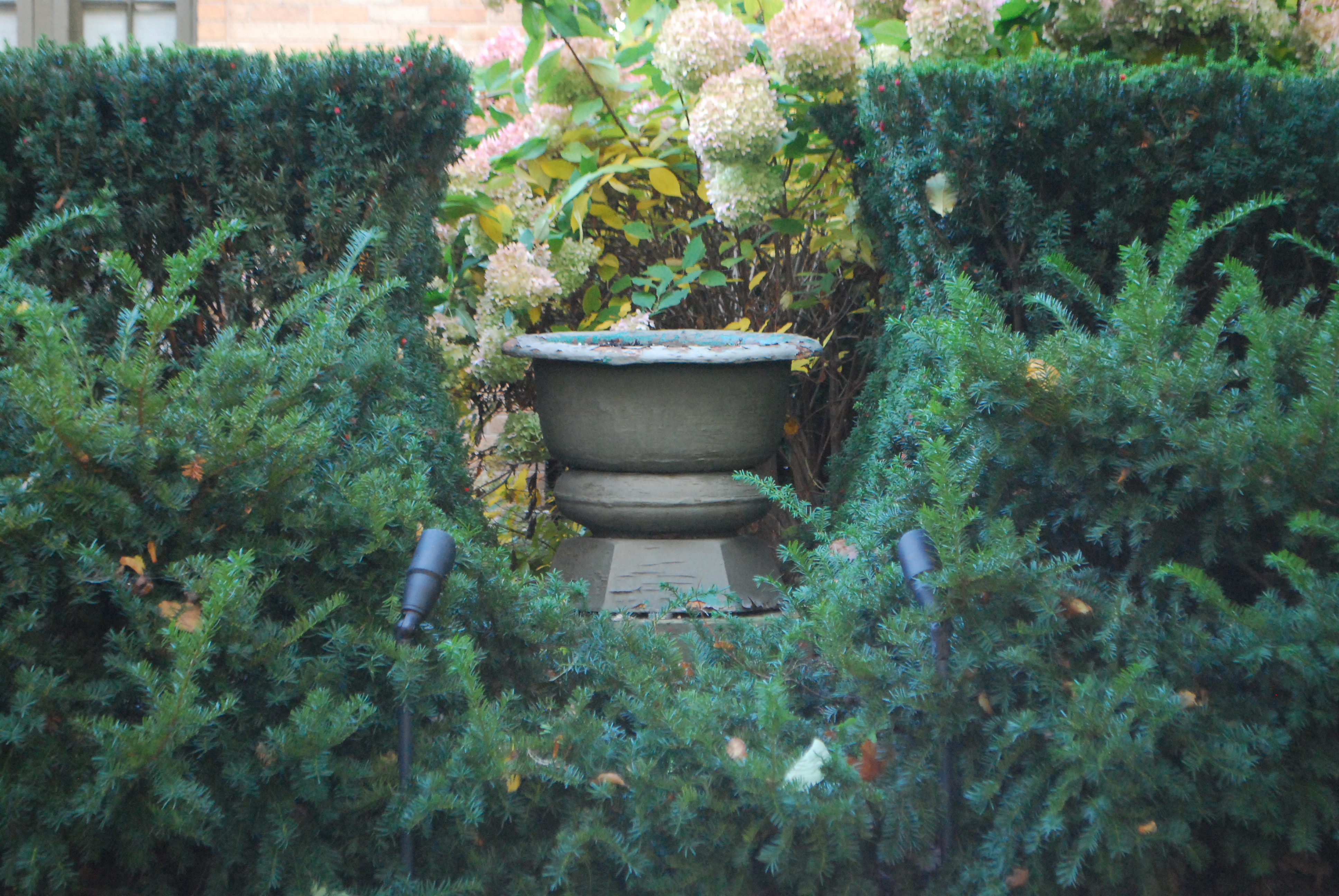
For some years I have been pruning the yew hedge on the street side of the pots so the entire pot and planting could be seen, top to bottom.  This pair of spotlights are unobtrusive during the day, but will be very effective at night.

On the first go around, it seemed to me that the lights were too close to the pots, and the wattage too high.  This look might be great around the holidays, when too much light is enough to make you smile, but for an average gloomy winter day, it is too bright.  We have since moved the lights further away, and dialed down the wattage.

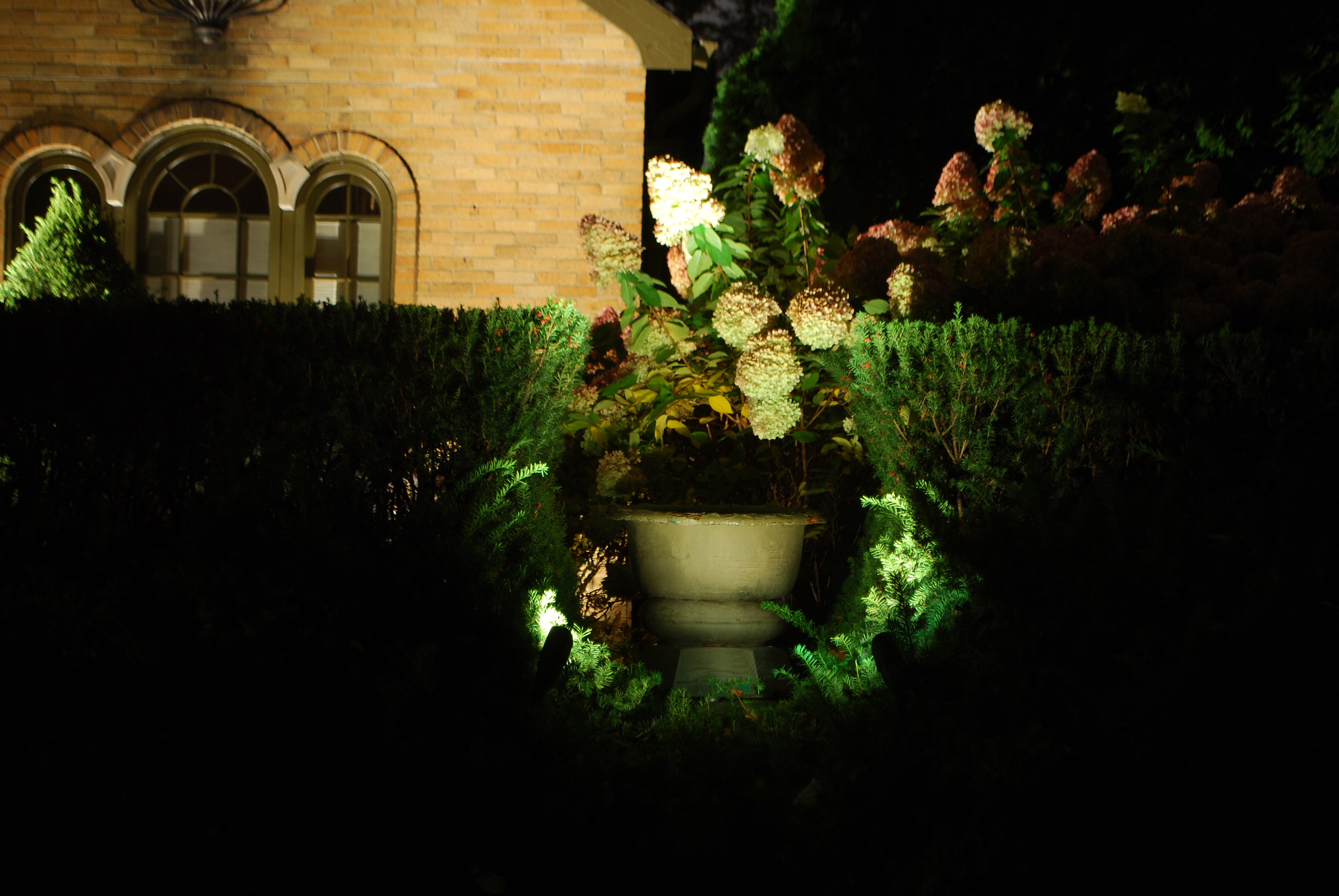
The light is too strong here too.  There should not be any light pattern on the wall; the light itself should be dim, and even.  The light on the topiary is so strong that the color is washed out.

From this picture I have been able to make changes.  The front porch lights will stay as they are-strong in a downward direction.  The path lights do the job they need to do, in the same downward direction.  The lighting on the walls and pots-much too strong.  A lighting scheme needs as much simplicity as a good landscape scheme.  Subtle and useful lighting takes time and patience to achieve, but I think I am going to be happy with the results.


Buck’s Charisse Box

I am so very pleased that one of our Branch boxes is featured in an article written by Marian McEvoy in this weekend’s Wall Street Journal.  Even though I have already written about it on the Detroit Garden Works facebook page, there is a story behind the design, development and fabrication of a container for a garden that might be of interest.      

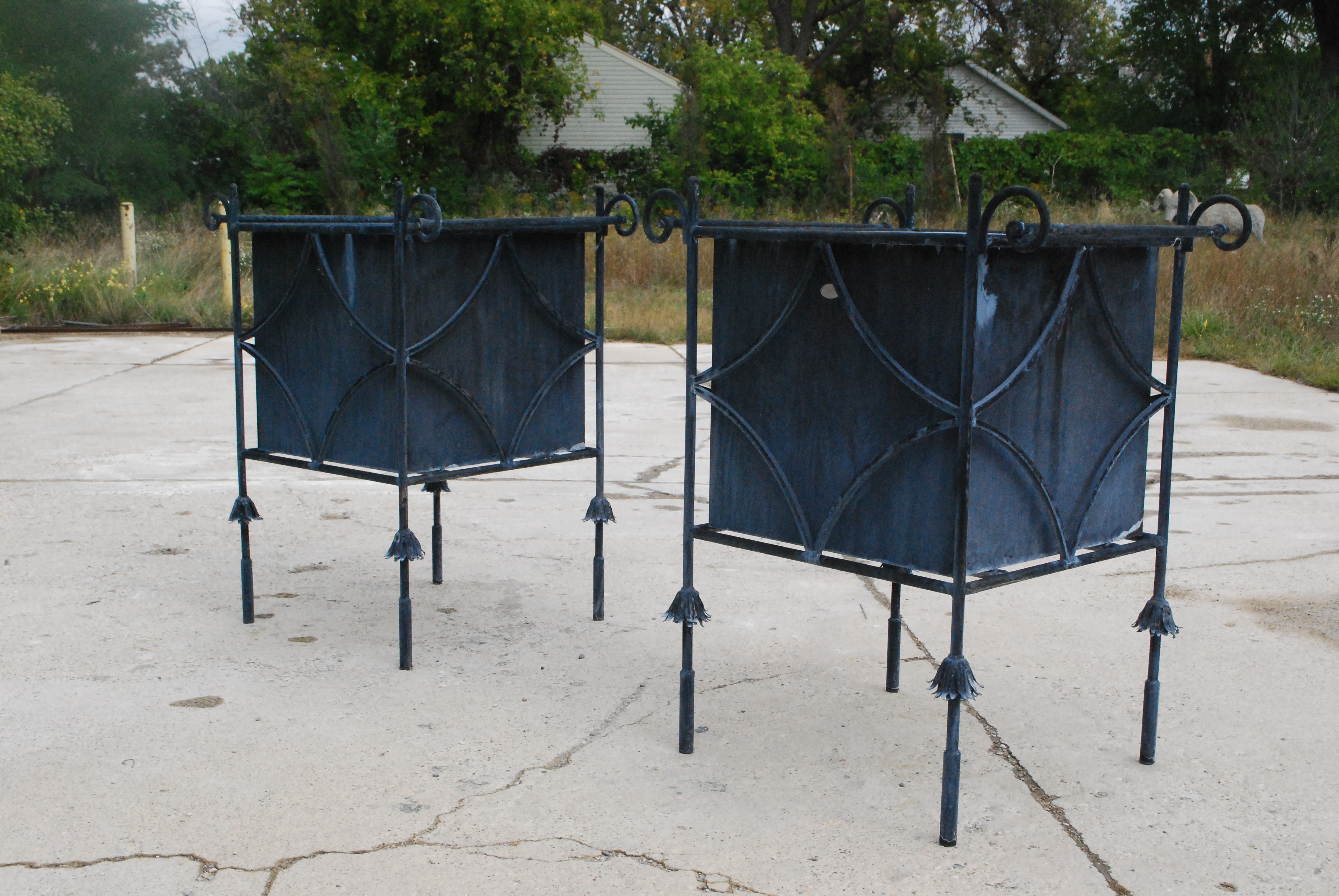
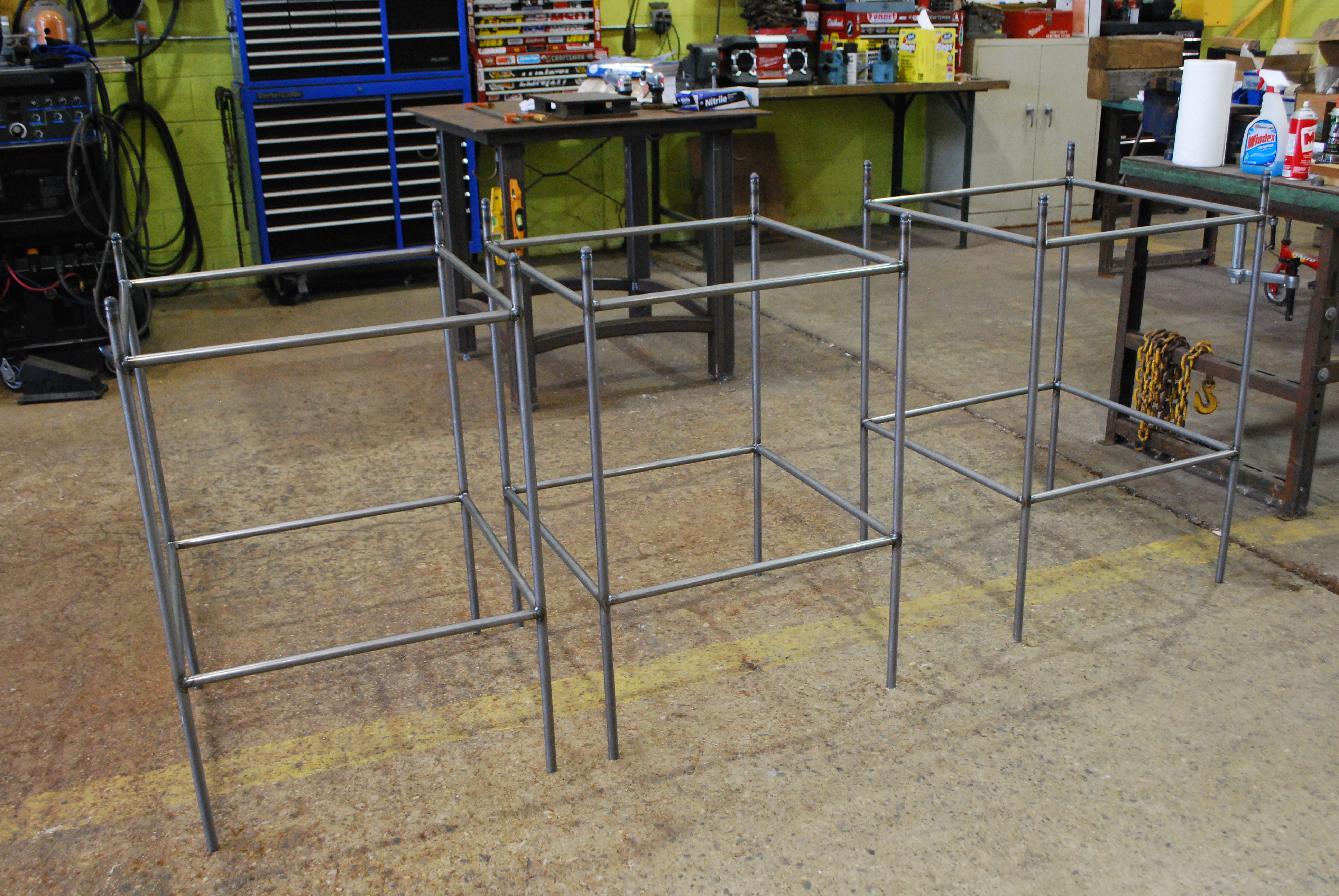
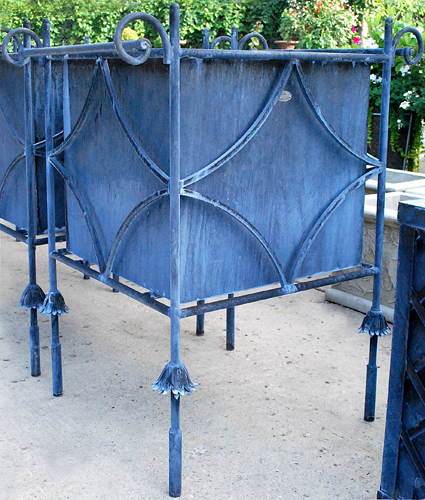
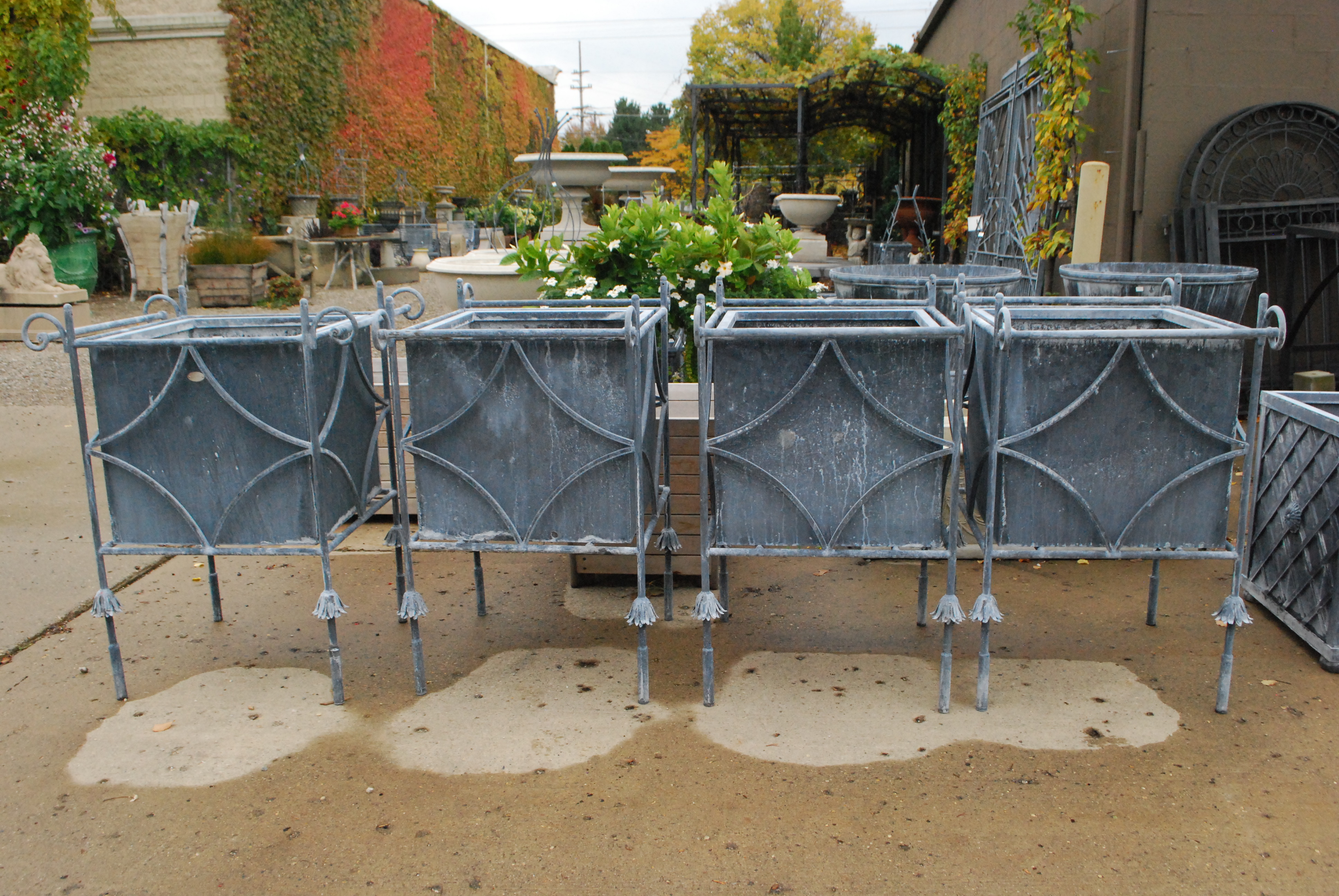
First off you need a building-a studio.  That studio needs tools both big and little.  A few five ton bridge cranes have turned out to be very helpful.  But most of all you need people who can turn an idea into an object. I have always wanted to design and fabricate beautiful containers and ornament for the garden.  A container that can withstand any climate or season, from the salt air in Florida to the heat in Texas and the cold in Minnesota, is a container that can provide many years of service.  Given that lead, that classic material for garden ornament, sculptures and containers has become incredibly costly, steel with a finish that brings the color of lead to mind seemed like a good idea.  The Charisse box is not so easy to fabricate.  The frame and handles are made of both tubular and solid round lengths of steel.  Welding one section to another requires a lot of cutting and precise fitting.  Sal, Dan and Buck fabricate for Branch, but these were Buck’s to make.    

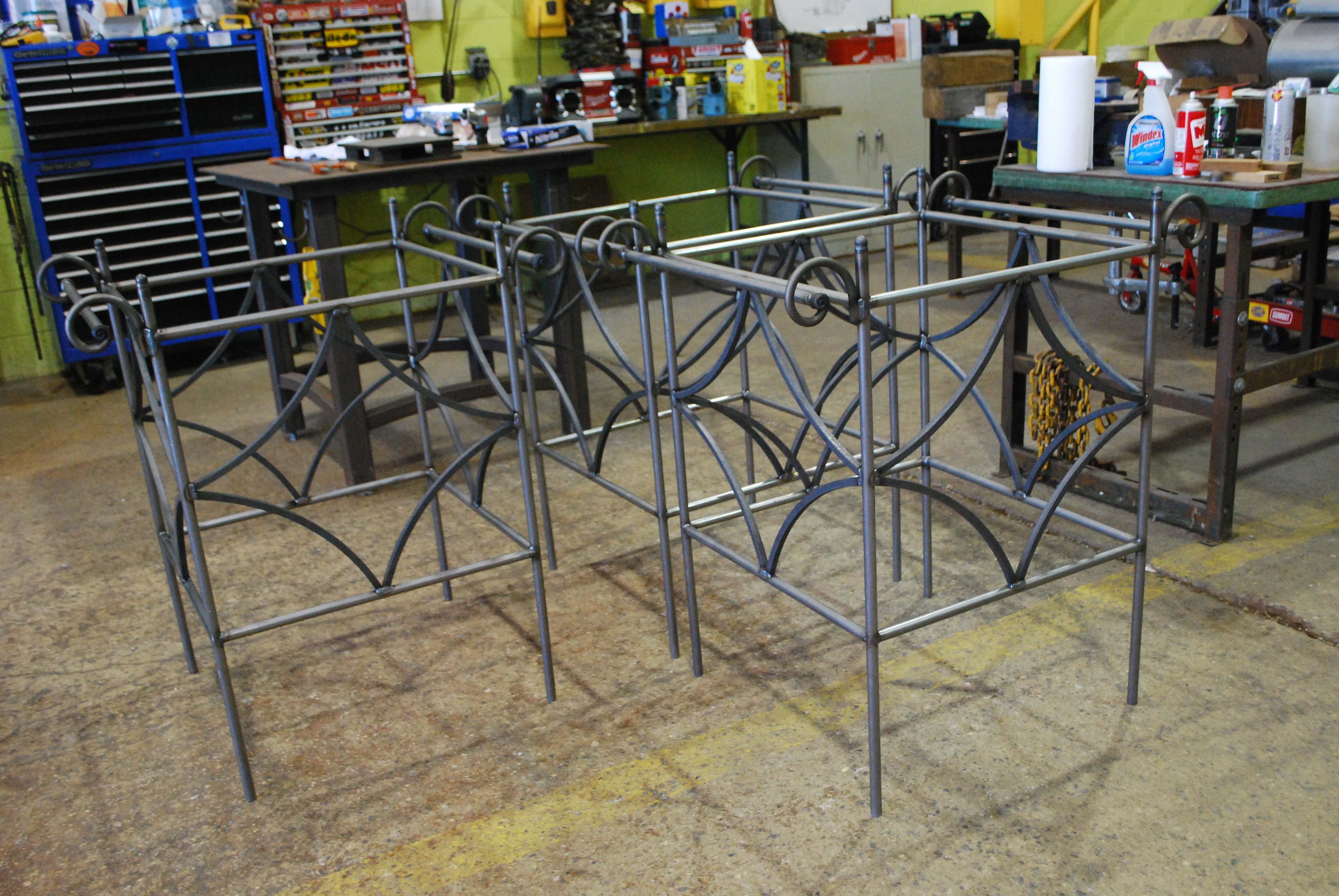
Each box is assembled from a lot of pieces that need to be cut fairly close to perfect.  Mistakes in the length and angles of a piece, times many pieces, can add up to a box that bears no resemblance to square. The only square stock in the frame is a diamond, welded from curved lengths of steel.  Buck’s other boxes have a simple and solid design.  I was interested in making one box that was a more graceful.  Making steel look graceful is not so easy. 

It took quite some time just to get the frame together, square and true.  Since the original Charisse boxes were made in 2005, changes have been made.  Though Buck does multiple CAD drawings for everything he builds, the finished box tells the tale.  Certain dimensions have been altered.  It takes more time than I ever thought it would to get the size and proportion of a box just where it should be     

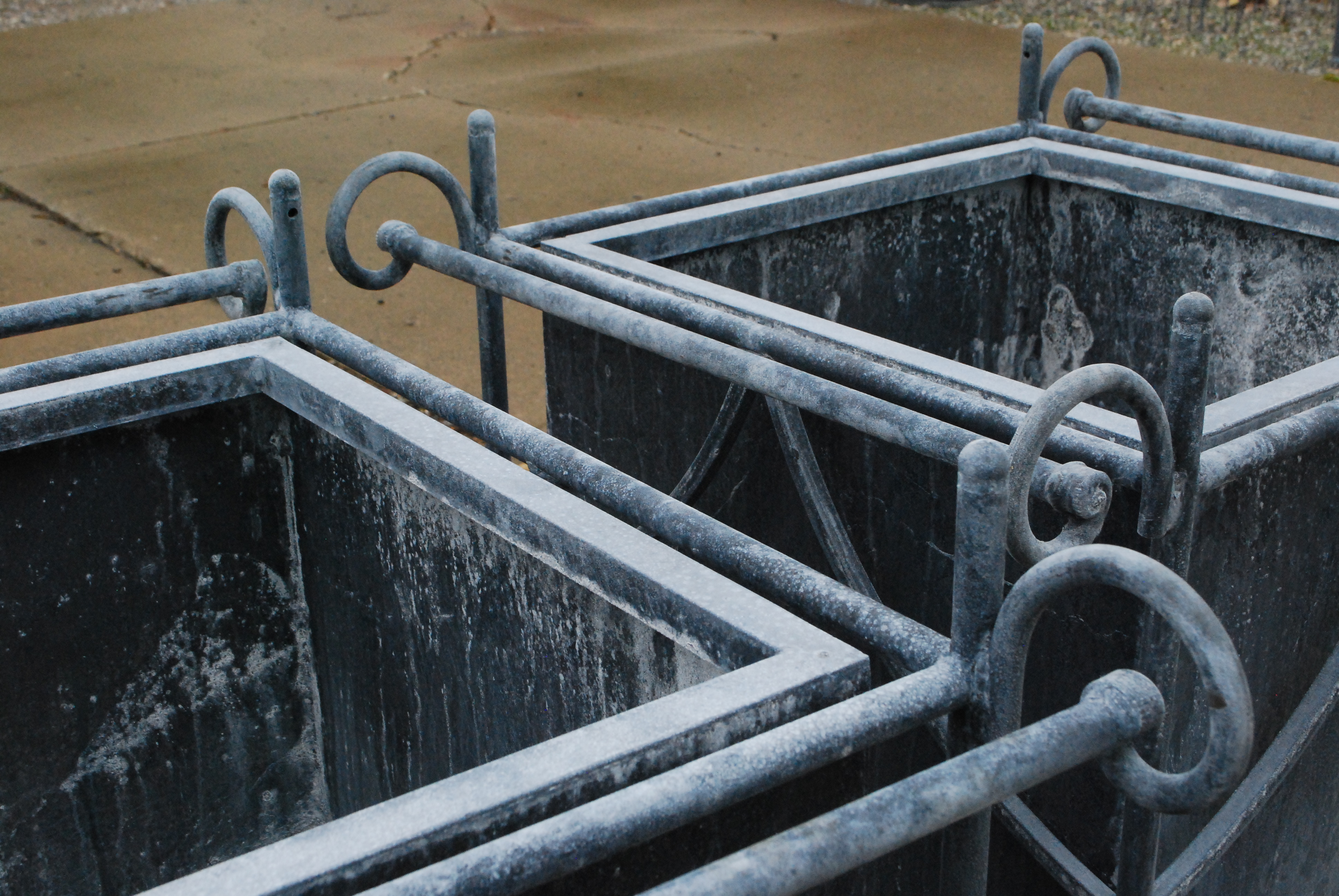
The scrolled steel handles and diamonds came next.  The tops of the tubular steel has small steel shperes welding to them as a finishing touch.  Steel straps are welded to the bottom of the frame, to hold the steel box that would slip inside the frame.

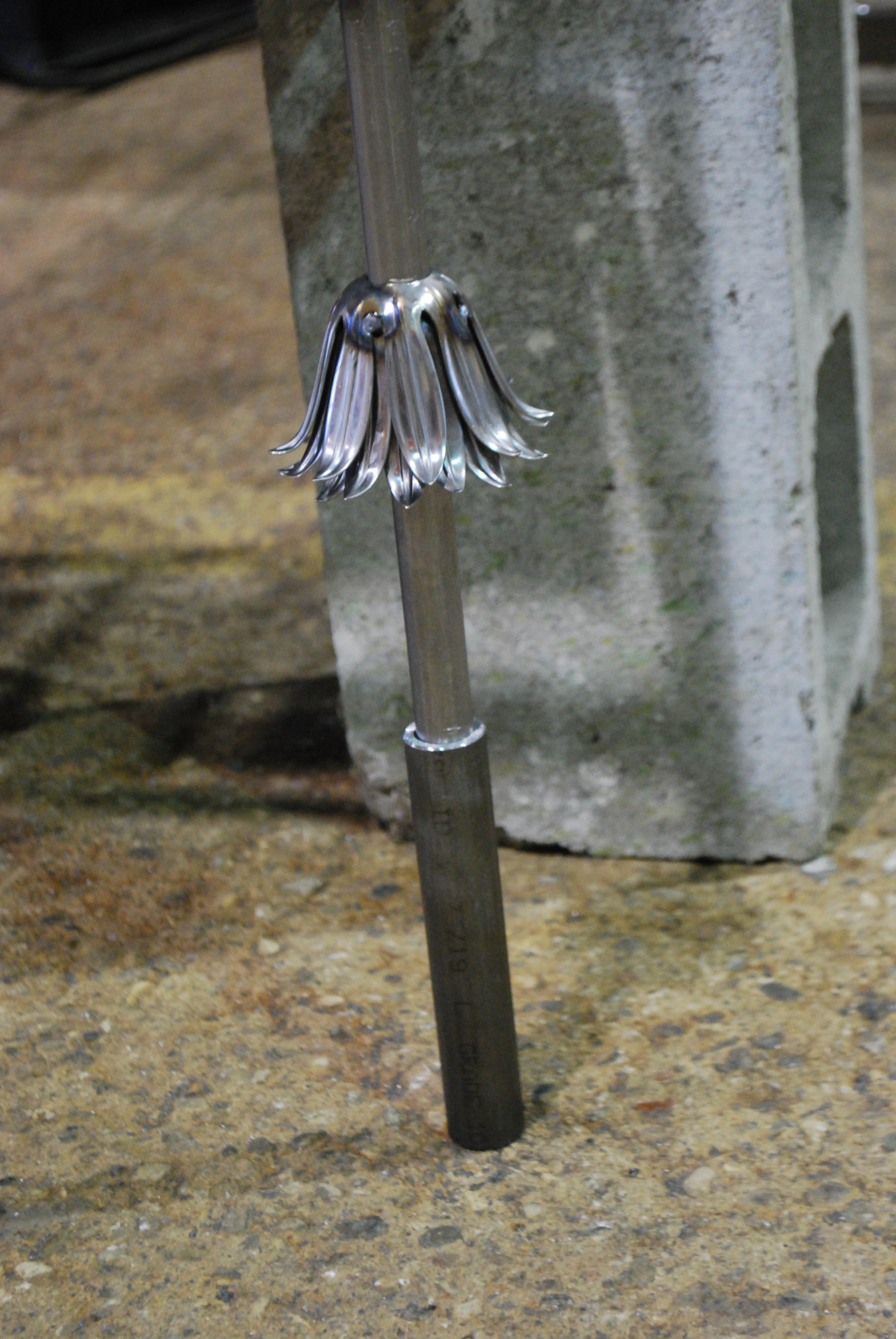
The legs have an inverted flower detail.  Each leg has several of them welded together, for strength.

The bottom of the leg has a sleeve of thicker and larger steel, for stability.  This is a very heavy box, supported by very slender legs. 

There are plenty of details, and lots of curves. 

handle detail

snail scroll handles

the Branch Studio tag

The article is a very interesting and well written discussion of containers in the garden, and garden containers that will withstand fall and winter weather.  Containers filled with plants in the landscape in all of the seasons sounds appealing.  Something in the landscape to look at besides snow on the ground and gray skies is a good plan.  That Buck’s Charisse box would be on her list of beautiful and weather-worthy containers -all of us are really thrilled about that.  

WSJ.com – Hot Pots For the Chilly Lot