Rural France: The Gates And The Doors

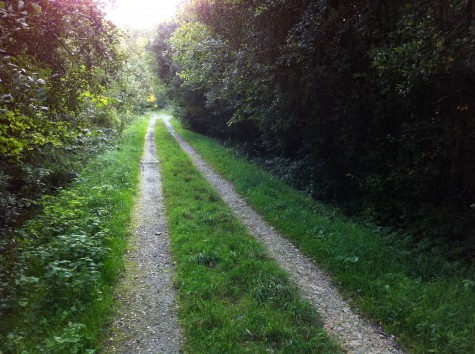
rural French road

This week is all about the garden-French style.  Our first container stuffed full of glazed French terra cotta has been unloaded.  Our second container sailed through customs, and will be delivered Friday morning.  Though we represent the garden as expressed in many countries and periods, our spring will equally celebrate French garden style. Our first container of artisanal French glazed garden pots makes a big move in that direction.  The second container is chock full of French garden ornament both antique and vintage, most of which Rob sourced from small local antique markets.  When I say local, I mean to invoke the rural French two-track pictured above.  To describe Rob as a buyer is a bit of a disservice.  He is an afficianado of garden culture wherever that might take him.        
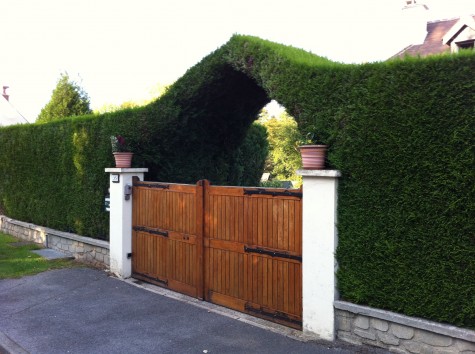
Dealers in French garden antiques and vintage ornament appreciate this.  His respect is sincere, and his efforts to be educated about another place-considerable.  He is incredibly observant and tuned into what he sees.  All of these pictures are from his trip to France last September, most of them from rural areas.  The garden is very much a part of French culture.  Like many other places, the roots of the garden are agricultural.  The production of olives and olive oil, lavender, cheese and bread have very much influenced the landscapes.  But the French manage to go on to represent the most utilitarian garden features with great style.   
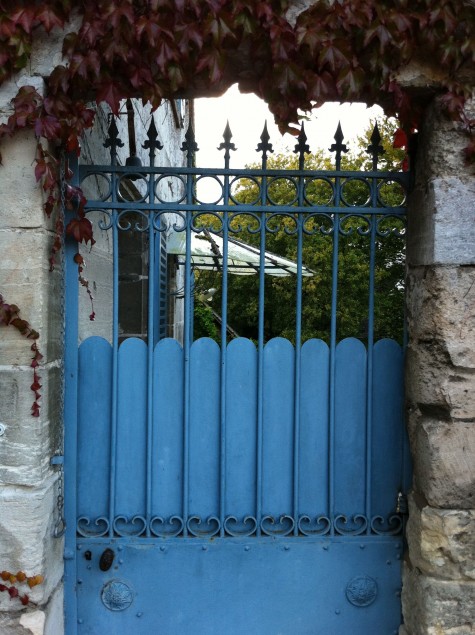
French garden gate

Much has been written and photographed about the grand and formal gardens in France.  The photographs of Michael Kenna are especially extraordinary. But rural France-the buildings, the roads, the landscapes, the gardens, the farms-there is much to be learned about how French people celebrate their relationship with nature. 
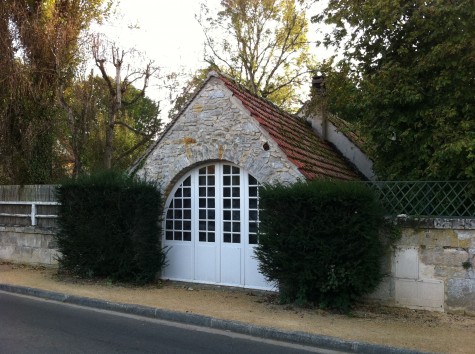
Every picture he takes is a visual representation of his impression and interest.  I am quite sure he was enchanted by this carriage house entry, the white entry doors, the stone walls, the shingles, the lattice iron work on one side only, the robust and unpruned yews, the gravel surface.  This is well designed, but not overly precious.
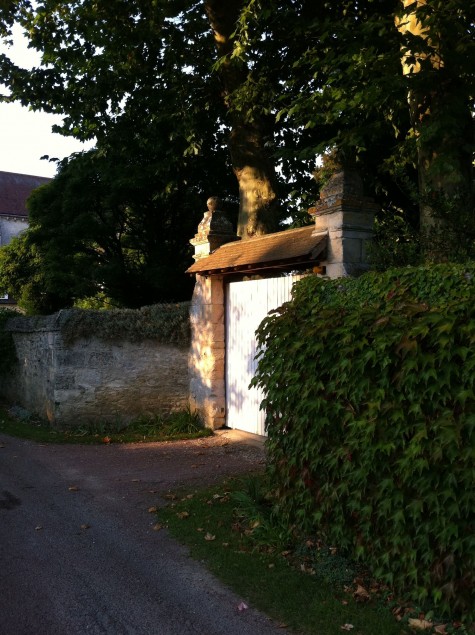
gated garden

 Many of the walled gardens featured ivy of one type or another.  This garden gate features massive walls and gate piers with elaborate stone caps.  The shallow shingle roof and tall wood gates make for a friendly statement about privacy.  The vines on the walls are asymmetrical-they have been left to their own devices. 
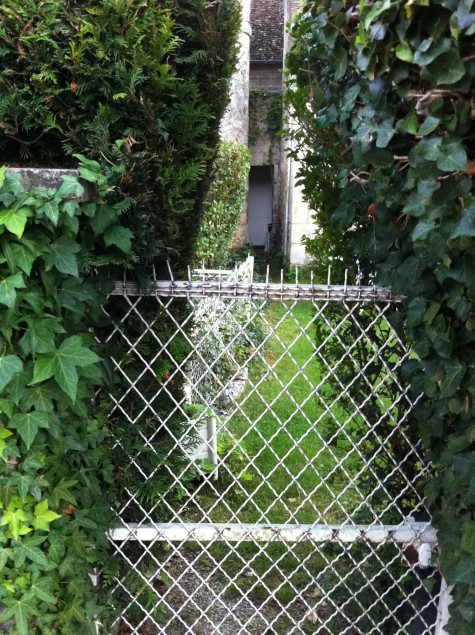
This crimped wire gate based on diamonds is quite tall and narrow.  How the wire emerges from the top of the gate, is charmingly unfinished.
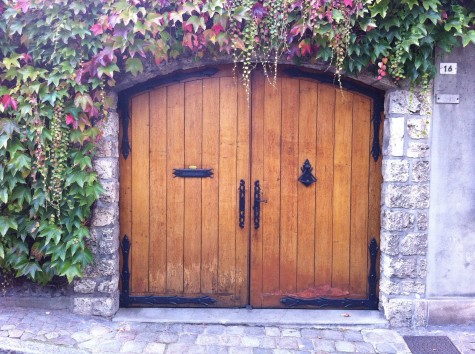

The boston ivy swept over one side of these pair of gates is lovely.  I am sure the ornament on the right gate is an iron door knocker.  On the left? The iron work on the doors is strikingly organic in design.
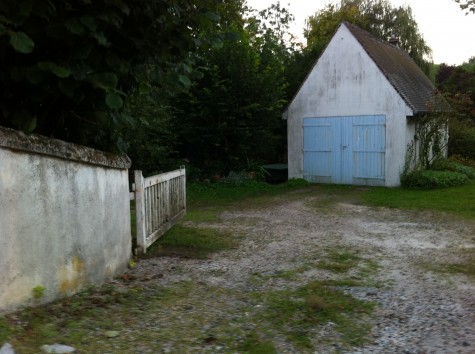
Many of the places he visited, the garden outbuildings and walls were utilitarian. The low and massive wood gate is more about invitation, than closure.  They are working buildings.  The color of these barn doors is a variation on what I call French blue. I find it very hard to make blue work in a landscape, but here the color seems so the color seems so perfectly right.   
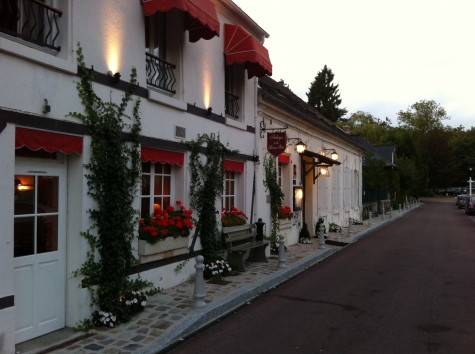
I was so struck by the proximity of the road, to the buildings. In our country, we have very wide roads, turn lanes, and curbs.  Our buildings by zoning law are only allowed to be built far off the road.  This photograph-all about intimacy.  The traffic bollards-useful, and beautiful.  The road and the building-close.         
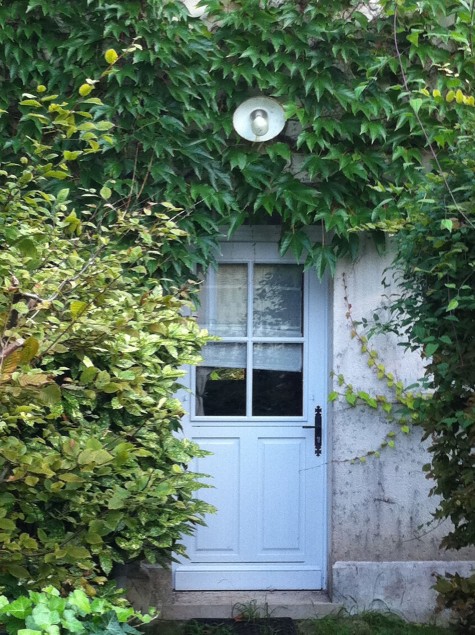

It would take some discipline for me to live with this front door landscape, but I am very sure I would be the better for the experience.  Knowing what needs editing, and what doesn’t may be more of a gift than a skill.
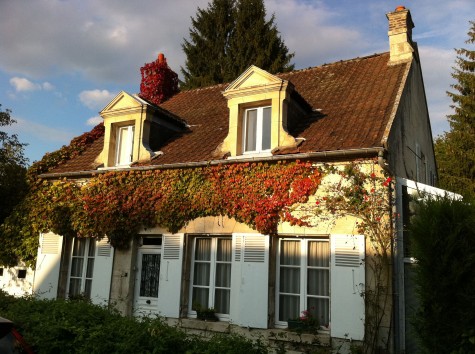
Rob visited places in rural France I am unlikely to ever visit.  How he travels the backroads and the small French villages means I have a better understanding of French garden culture.  And a better idea of how to cultivate a garden.
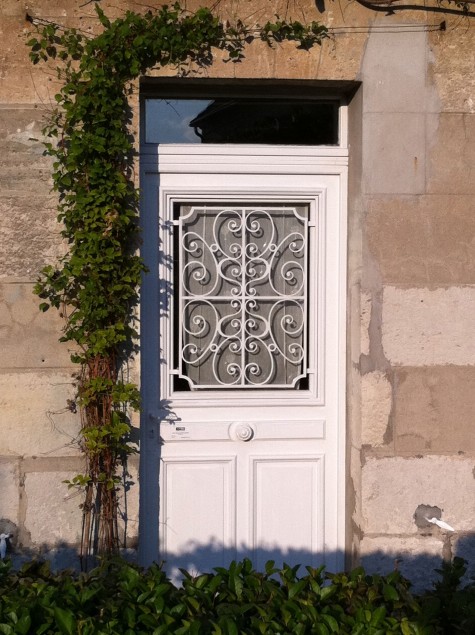
This French door with an iron grille drenched in sunlight-beautiful.  The vine swagging over the door isn’t bad either.
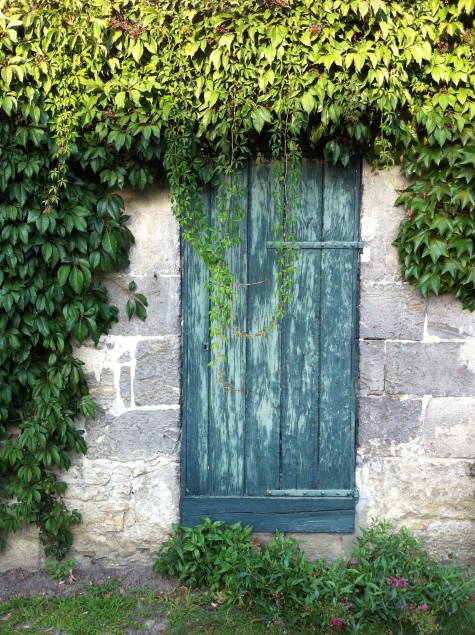
This simple weathered wood front door, and its attending boston ivy-just as beautiful.
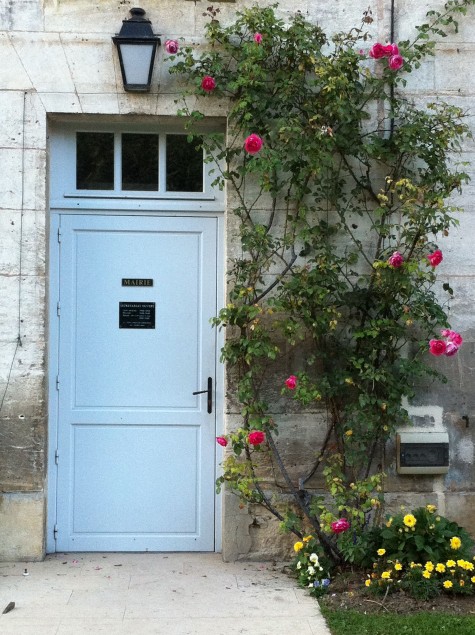
 A blue front door, casually attended by a climbing rose on the right side-this is as much about living and breathing as it is about gardening.
Sunday Opinion: Apple-icious

I will admit to more than a little long standing prejudice against Apple.  Years ago, I tried diligently to get Rob interested in the computer.  How about a PC, I asked.  Unlike my project specific large slotted screwdriver, or my trowel, a computer enables a person to engage in a universe of activities only limited by one’s ability to ask questions or research.  I really felt he needed to make use of that technology.  Nonetheless, every effort at persuading him to learn to use a computer fell on deaf ears, until he visited the Apple store.  A conversion took place.  He let me know soon after that he would learn to use a computer, provided I would provide him with a Mac.  It is no mystery why the Mac appealed to him.  Every aspect of its physical design and built-in functionality is spare and simple-gorgeous. How like him to want a computer that not only worked beautifully, but whose visual story, history, and technical achievement engaged and enchanted him.  It exasperated me that my offer to set him up with a computer came with a highly qualified yes.  What could possibly be so wonderful about this particular computer, beyond its obvious good looks?  

I should preface any further remarks with my own story about coming to terms with the computer.  I barely knew Buck-he was the architect and project manager for a new house for which I did the landscape design in 2004.  He sent an email to the office over the holidays about an interest in an antique English fountain for the above mentioned project.  My assistant was off for the holidays.  Necessity pushed my invention. I opened a beer, and started tinkering with Monica’s computer. I was alarmed the entire time that I would break something.  After all, I barely knew how to turn the thing on.  I sent Buck an email with lots of information regarding that antique fountain.  The back story?  I typed his email address incorrectly, it was after the holidays that Monica scooped up my effort, and got it sent where it needed to go.  But that day, I was pleased with myself.  I had begun to learn something new.

I ordered a computer for myself straight away.  A Dell PC.  I am sure for some time I was a poster child for how to hit the back button, or start over.  It was years before I learned to cut and paste, or produce a word document.  I am still learning.  In 2000, I bought a computer for my Mom.  She had worked with the first computer at Wayne State University in the 1950’s.  That computer was the size of a grocery store.  She had a big black phone reciever at home that sat face down into a black box.  That was her line to that giant computer.  None of us dared touch it.  Years later, I knew she would love to have one of her own.  She was a scientist-surely she could master it.  Neither one of us knew enough to go on, and hook that computer up to the internet.  She used it to play solitare, and edit her photographs.  Though I thoroughly regret that she did not live to see me use a computer, I know my ability to learn to use one came from her.

So back to Rob, and his request for a Mac.  Though the price shocked the daylights out of me, I bought one for him.  Somewhere I have a photograph of a special Apple IT tech installing that Mac, and Rob standing by with that deer in the headlights look on his face. Much has changed since that day.  That Mac has renabled him to keep up with dozens of suppliers in multiple countries.  He plans trips  to other places via his computer, and downloads driving maps of those countries onto his Garmin.  He takes maps of his routes from Google earth with him.  He wastes little time travelling.  This gives him more time to shop efficiently.  The pictures he takes with his iPhone are astonishly good and sharp.  He communicates with clients, via those pictures.  That is the bare beginning of what that phone can do, given an expert operator.  I could swear he pointed his phone at a color, and read on his screen a name and formula.  Is this possible?   This year, I bought him a state of the art Mac with a screen the size of Texas. He searches, maps, coordinates,  studies, inquires.  Should you like the music in the shop, credit Rob and his Mac.  His computer skills have left me in his dust. 

Upon returning from a trip to California, Rob gave me with a coffee mug from Apple – he wanted to visit the company in person.  I was dubious-he was the one with the love for Apple technology, not me.  But a seed had been tossed on the dirt.  All it would need was some water.  My road trip the first 2 weeks of January made me think an iPad might be just the thing for me.  How so?  The Apple technology is portably planet wide.  I like the possibilities this implies.  An iPad is a very small object densely packed with opportunity. It would have been at home in the car, in hotel rooms, at market.  How genial.  It is an infinitely large shopping bag in which to store all kinds of ideas, notes, pictures, intellectual paraphenalia and bits of this or that.  An iPhone-all of a sudden I had to have one.  For the camera of course.  My camera is not always moment-ready.  It is a heavy and bulky thing to haul around, waiting for a moment to make itself known.  I also do not mind having the weather, and the compass instantly available on a small screen.  I am sure there is much more to come that I cannot begin to anticipate.  It has a serviceable phone.  I had no problem with the purchase part.  Meg spent 5 hours helping me get everything set up and teaching me the rudimentary moves.  Many thanks, Meg.  The very best part?  You do not need a fork, or a trowel, or a shovel to dig into it.  A finger will do.  How perfectly splendid is this?

I am fairly sure I am preaching to the choir about how great an Apple can be.  They have been around a long time-I see lots of them.  They don’t make much, but what they do make is extraordinary.  I will admit I was intimidated.  Rob’s Mac has that inscrutable quality about it.  Do I cling to my religion?  Oh yes.  I was sure I would have trouble.  However, the basics of both of my new tools have actually been fairly easy to master.  The finer points-they will no doubt take time.  What this will all come to, I have no idea.  Anyone who has seen a deleted email on an iPhone sucked into the garbage can-lid up, lid down, or heard the airplane whoosh of an email being sent understands that a mechanical device that appeals to and functions via the senses is an experience of technology like no other.  


Seeing The Light

Lighting the landscape is not my forte.  Everyone does a better job of it than I.  Fortunately for me, the light lingers in the summer.  All it takes for Buck to abandon the yard is the warning buzz from one mosquito-he is through with the garden once it gets dark.  When I am working the landscape season, I am up between 4:30 and 5 am.  This means I am often in bed by dark.  Landscape lighting is not a big priority for me. I am happy with the daily dose of natural light, the sun and shade created by plants.  I do have landscape lighting on the driveway-this for safety and security.  Landscape light subtly washes the front of the house.  I like how it looks when I drive by on my way to work before dawn.  But the winter landscape asks for more light.   If it isn’t dark out, it is dark grey out.         

 Though I go out every night after work with the dogs, I am not out there long.  Given how mild our winter has been, I am out with them longer than usual-but a half hour at most.  By that time, it is dark, or well on its way to being dark. The evergreens in my garden would be beautiful from inside, if lit for the winter season.  I do have 2 containers on the drive ablaze with light.  Rob fixes them for me in December-I keep those pots lit until well into March.  They are beautifully cheery.  I have a cut Christmas tree strung with enough gold and white lights to softly illuminate the entire side garden-I run those lights all winter too.   

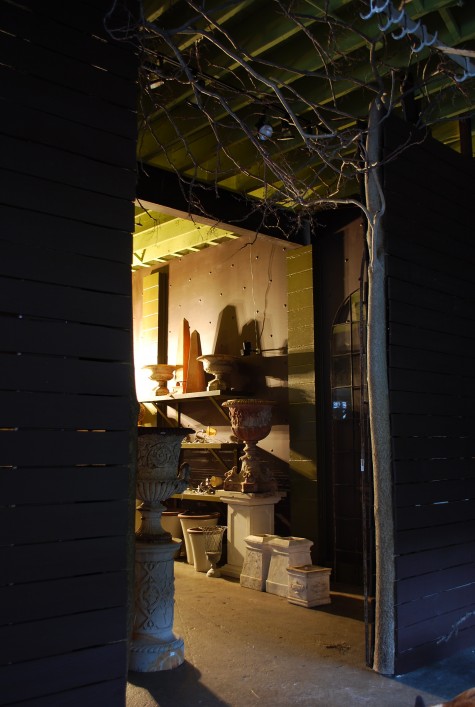
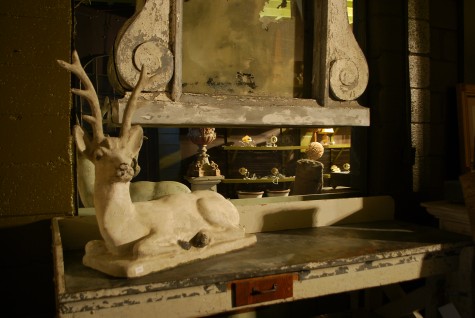
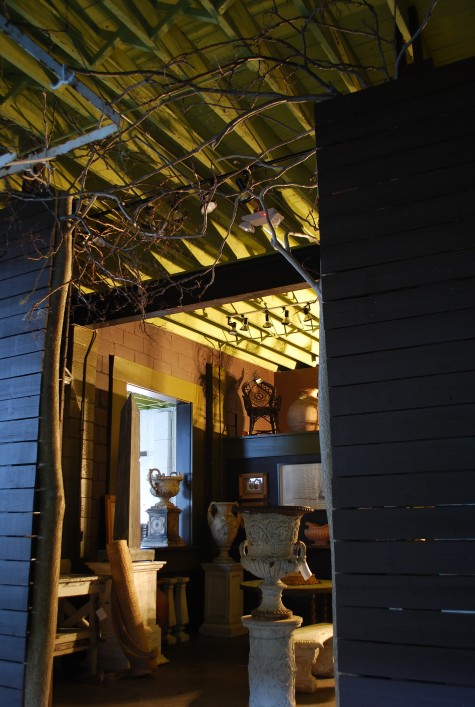
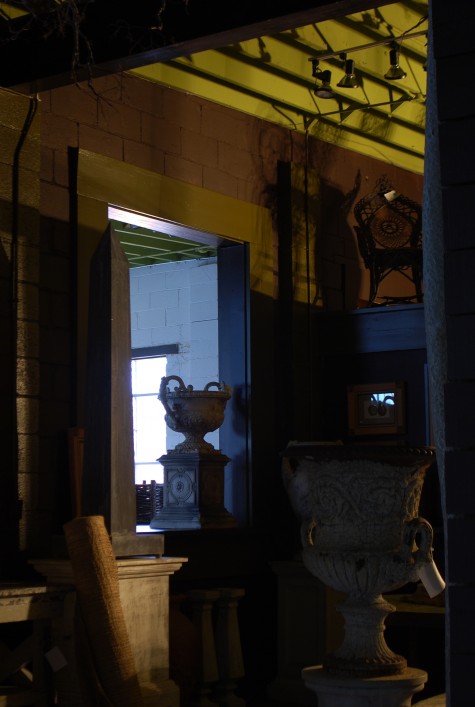
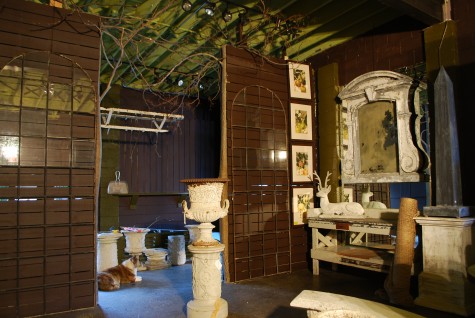
The process of cleaning and painting the walls of several rooms in the shop has put lighting on my mind again. Landscape spaces are notable for lots of reasons, just one of which is their lack of a ceiling, or roof.  Natural light falls illuminates every landscape space-unless one chooses to plant a tree, or build a pavilion, pergola, poolhouse or other cover.  These rooms in the shop have little in the way of natural light.  The shop ceilings range from 12 to 18 feet tall- this part helps to make a description of how an object might look in a large outdoor space.    Rob cannot, and does not try to light the space as if the sun were shining.  He lights objects.  I am seeing that a lighted object in a dark room pops; every detail reads clearly and dramatically.   

Good landscape lighting can features a specimen tree, or illuminate a walk. One of the great pleasures of a shaded spot is that clearing with its pool of light on the ground.  An object or painting that is spot lighted garners attention.  A dimly lit corner is cozy. Oblique lighting casts long shadows in an interior space.  Whether indoors or out, the mix of dark and light is visually exciting.        

I know that skillful lighting can so enhance the experience of a landscape.  But the experience of these dark interior spaces has unexpectedly provoked a lot more thought about light as a design element.  Were you to ask me what is of utmost importance to me at the shop, I would of course say an experience of great service rendered in a personal and knowledgeable way comes first.  We meet people,  learn their names, we take and file pictures, we remember the kids, the events, and the gardens that go with those names.  A passion for gardening always comes with a name and an individual set of circumstances.  The vetting, purchase, and availability of beautiful objects would be second-whether that object is a fine antique or a fine looking fiber pot matters not.  Great design is great design.  Providing a beautiful and thought provoking experience-this would be next.    

The shop does have some natural light, via our greenhouse roof, and a small skylight.  How we arrange and display things in the shop revolves around creating relationships between shapes, sizes, styles, textures, and color.  That arrangement is not finished until it is lighted.        

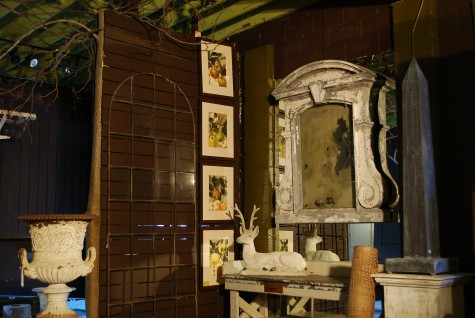
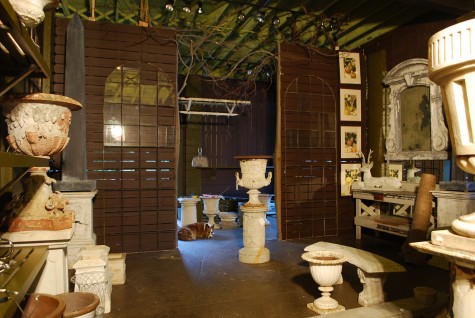
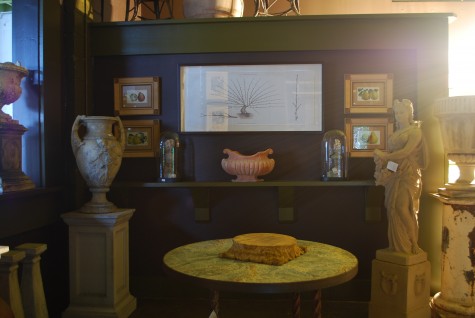
I am experiencing my own shop in a different way right now, given some choices about paint.  None of the spaces pictured are finished.  They have some major elements set, and await the arrival of our purchases for spring.  Once the room is arranged, Rob will light them.  We will be another month, getting there.  But in the meantime, I am looking at my own dimly lit winter garden as an opportunity to experiment with creating a better winter landscape experience.    

A little less gloom, and a little more glow sounds good.

Level

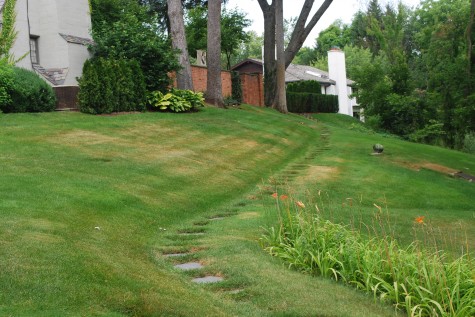
The winter is a perfect time to discuss what goes into a coherent landscape plan.  If you have a mind to make some changes, plan now.  Draw now.  Search for the right clematis now.  Read the seed catalogues now. Be ready, when the season turns. A hard and thoughtful look at a landscape now is perfect-most of all that is visible now are the bones.  A good landscape begins with great bones.  No matter what style of gardening appeals to you, the bones tell the entire story in a simple and spare way.  In a way, your landscape is a narrative you imagine, write, and bring to life.  My first look at a landscape design revolves around the shape of the land into and onto which that landscape will be built. Why this picture?  The path across a steep slope is set on a wee bit of level ground.  Getting from here to over there is easy.  That path leads the eye to believe there is something ahead worth visiting.

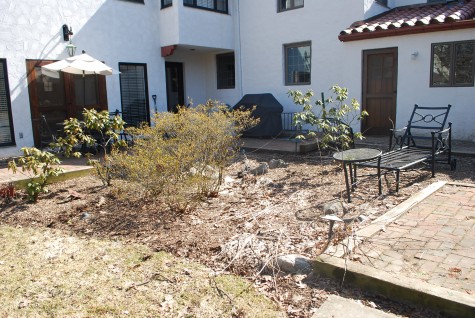
This house is set high off the existing ground.  Old brick walks contained by pressure treated lumber make the transition from the house to the yard in a very awkward and fussy way.  There are small bits of level-nothing of a size that would permit company.  The lounge is set in a barked bed, and slants down from head to toe.   

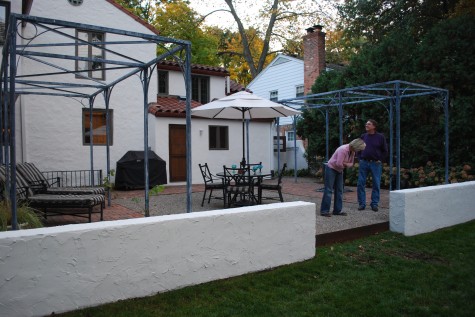
A new landscape sets the brick wings, and a gravel inner terrace at one step out of the back door. All three areas set at the same grade creates a flat surface large enough for people to congregate. This makes carrying a tray of burgers outside to the grill easy and manageable.  We prolonged the big step down into the yard until the last moment-post terrace. A riser of 1/4 inch thick steel retains the gravel, while a pair of stucco walls are set at a height convenient for sitting.    

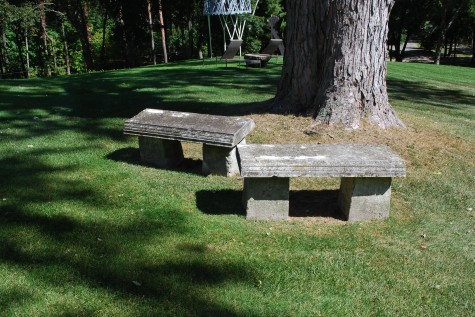
Level ground is friendly to people.  1 person, or a group of people makes no difference.  People are comfortable on the level ground in a landscape.  Would you choose to sit on this left bench, given the choice?  Looks dicey, doesn’t it?  It looks for all the world ready to pitch forward and fall over.  The right bench-solid, sturdy, and inviting.  It is set level with the horizon.  Worrying about one’s footing is not my choice for a garden activity.  

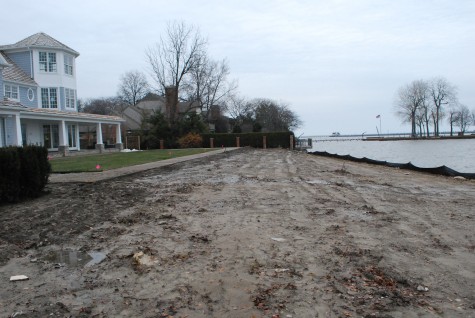
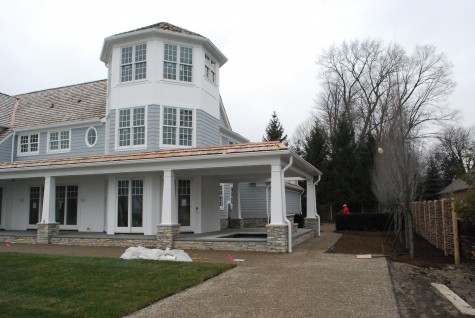
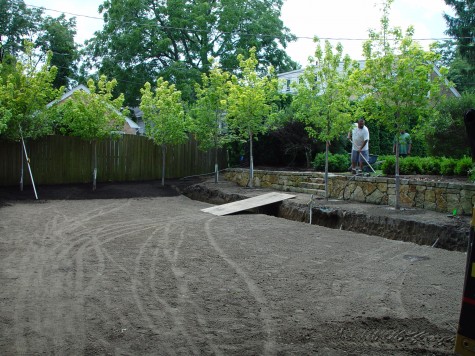
This new house and landscape has been in progress for about 6 months. The fall rain was relentless.  But this picture makes clear that the lawn panel framed with gravel is a level space.  Many of yards of soil were involved in creating this level place.   The land drops to the water’s edge past that panel. The level lawn panel-easy on the eyes and the legs.    The slope to the water-a journey.     

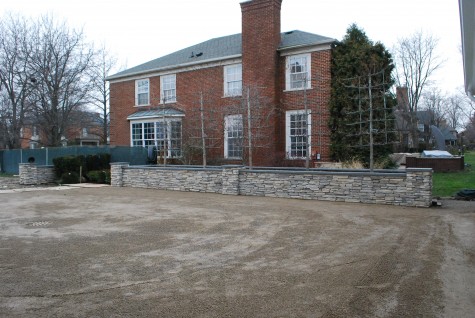
The level lawn panel  made for a drop off to the property line.  My idea here-every place that I would expect traffic, gathering, use and community needs to be level.  The lower slopes got drains, for the columnar maples.  My idea here-one step out of the house, and one step off of the house terrace to the yard makes for a simple experience of the landscape.

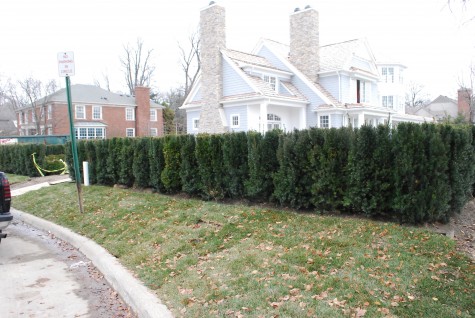
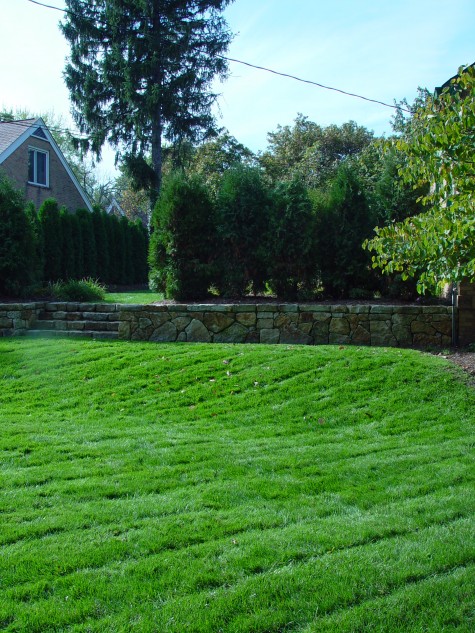
This level idea carried across the width of the back of the house meant a significant drop to the street.  Not all spaces need to be level, least of all this one.  The yew hedges set considerably above the street grade provide my client with lots of privacy.  The big idea here? The ground can be sculpted and shaped.  Up or down. Flat or hilly.  This property had been a field for 20 years, so the property could be graded all of a piece with relative ease.  

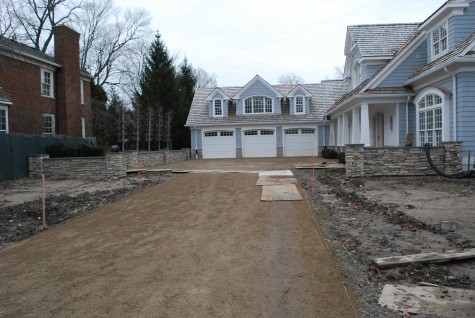
The decomposed granite drivecourt is level with the entrance to the garages.  Level to the eye, that is.  A drivecourt needs to drain, to the center of that court.    It furthermore needs to drain to the street.  Not everything is apparent to the eye-most landscape companies use transits to determine the rate and the extent of fall to make sure water does not collect.  Water sitting on a driveway or terrace is a nuisance in a rain storm, and can be treacherous if it freezes. 

This drivecourt looks flat.  The drop to a center drain is very subtle indeed. A slight drop to drain away water is about the science, not the view.   

 My property came with a giant drop in the side yard. One year I sprung for a single retaining wall to make that slope easier to negotiate.  

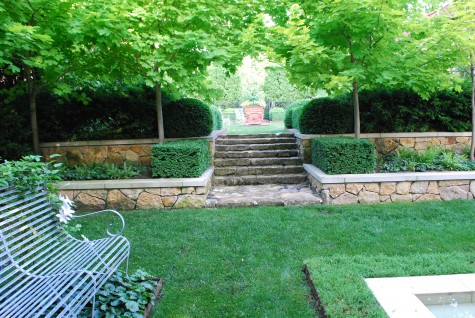
The next year, a reworking of the ground for a second level terrace. A generous landing and stairs with deep treads makes it easy for me to get from one place to the other.


Now I have a well defined lower level flat space, an upper level flat space, and a staircase that gets me from one place to the other.  Level I like.