Structure In The Landscape


Structure can refer to anything that gets physically and tangibly built.  Familiar structures are houses, bridges, amphitheatres, pergolas, and bus stop shelters.  This may be just me talking, and not the dictionary, but structures imply strength and durability.  An igloo is a structure that is very durable and liveable in the appropriate climate.  A pergola can be variously built to support a clematis vine, or a wisteria.  Structures of stone, as in the pyramids in Egypt, have existed for many centuries.  A classical cathedral in Europe has a physical structure in the form of flying buttresses that permits great height and lots of glass.  A bridge enables overhead foot or vehicular traffic.  Structure might refer to an armature inside a sculpture. This waterbridge built in Magdeburd Germany in 2003  (photo from Twisted Sifter, April 2011) is a spectacular example of  structure.


Structure can also refer to those things that have a different sort of physical presence.  A well written paragraph has a structure, as does a haiku, or a limerick.  A classical opera has a structure which might better be described as a form, or an organization of certain elements.  Paintings are structured by their edges, no matter what shape those edges take.  The composition of a painting has a structure that may vary greatly.  A 16th century religious painting may have plenty in common with a painting by Picasso, but their structures have distinct differences. 


 Baseball and scrabble both have rules which structure how the games are played.  Physically exhausting games such as hockey are structured very differently than chess.  Imagine a game (this implies a structure) or sport (this emphatically implies structure) with no structure.  One person might show up with a bat in a neighbor’s basement-then what? That person would need to create a structure based on the physical limitations of the space and his solitary tool, and create a game.  Alternately, 50 people might show up in snowmobile suits, swim trunks, shoulder pads and helmets, with bikes or  decks of cards in a parking lot, or on a mountain top.  Then what?  The game would be created, rules would be established.  Teams would be chosen, or every person for themselves would compete against a goal, or a standard.  Or perhaps everyone would read from their favorite book-to what end would have to be decided. 
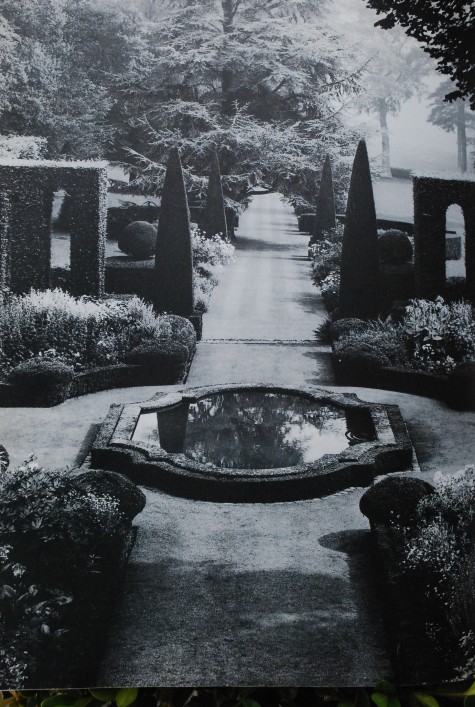
 

This is a long way of saying that great landscapes and gardens benefit from some structure.  This does not mean they need to be formal, or traditional, or boring.  It means there is a deliberate arrangement of each element. The relationship of one element to the next is deliberate.  As in organized.  Organized spaces are pleasurably easy to follow, both visually, and physically.  A path leading to an abrupt dead end with no visual prize is frustrating.  A landscape that suggests certain relationships is intriguing, satisfying. 
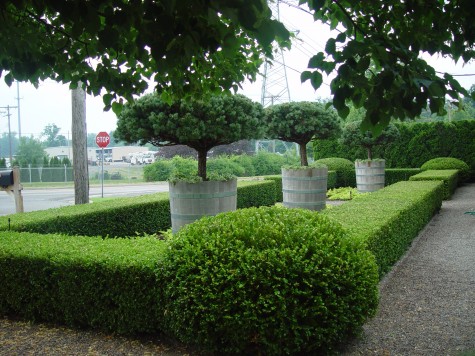
 evergreens in the landscape

Visual organization comes in lots of different forms.  Evergreens planted in shapes or lines provide structure that is evident in every season.  This boxwood parterre/sculpture provides a framework for seasonal plantings. Were nothing else planted, the landscape would still read.  In all of the seasons.
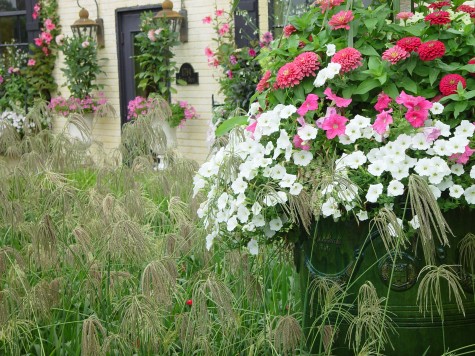
containers in the garden

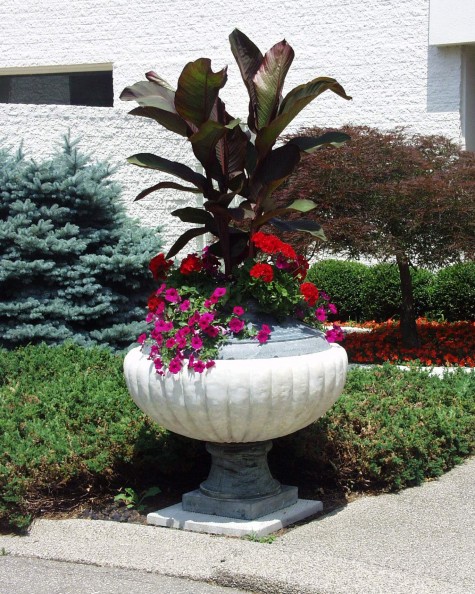
A large pot set in a meadow can organize, or focus the eye.  The edges of a meadow might provide it with structure.  Very architectural plants can provide structure.  In wild places, species will colonize areas that provide them with optimal conditions.  Every aspect of nature, beginning with the arrangement of molecules and ending with the arrangement of the solar systems is about structure. 
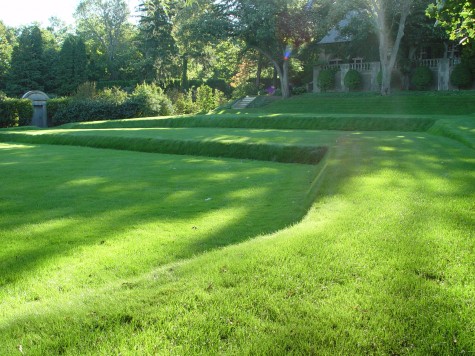
Grass can comprise those spaces left over once garden or landscape beds are cut.  Or they can have a powerfully purposeful shape.  In this case, the lawn covers sculpted soil.  The amphitheatre organizes a large space, and provides direction as to where to walk, or where to hold a concert.  The structure of this lawn makes it makes friendly to people.
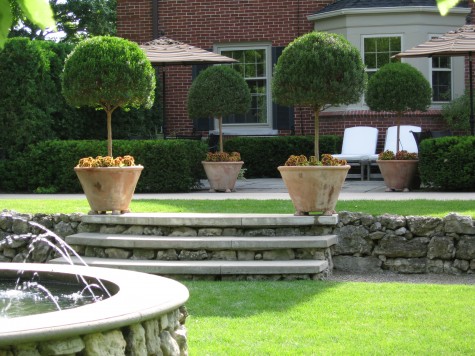
myrtle topiaries

These four matching Italian pots and myrtle topiaries visually mark the walkway from the house to the side garden. As that walk crosses over the driveway, it is a good idea to provide some structure-as in  “slow down before you cross-check out these topiaries while you are waiting.”
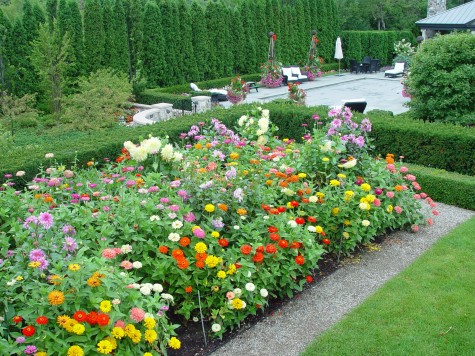
parterre garden

This cutting garden is enclosed by a stepped hedge of yews and boxwoods.  During those parts of the year when this ground lies fallow, the garden will still have a shape, and some enclosure.  It will still compell the eye.
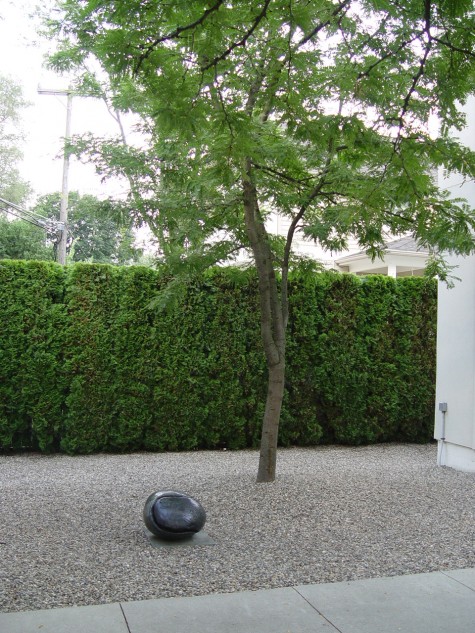
 This contemporary garden is very structured.  A wall of green in the form of Thuja Nigra, a single tree and a sculpture make for a very minimal, but visually satisfying landscape.  Imagine the sculpture without the green wall behind it-I am guessing it would be barely visible against the visual noise from the houses down the street.  Imagine the sculpture without the tree-lonely and disconnected.  Imagine the tree and the arborvitae hedge without the sculpture-sleepy.  The relationship and placement of each element is deliberate, structured.  This structure makes the experience of the landscape an interesting one.
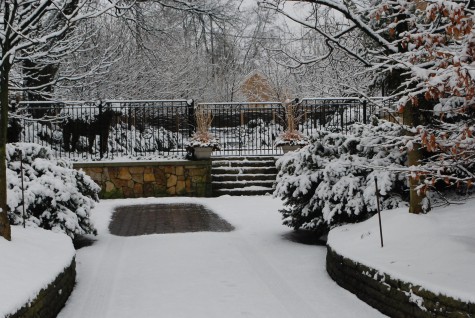
The Most Daunting Day Of The Year

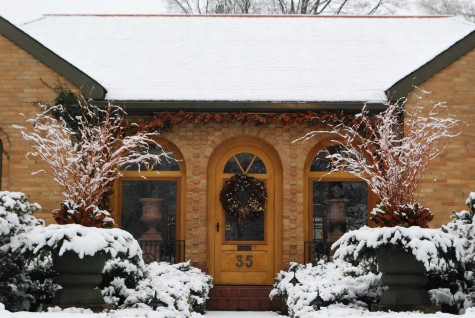
Was this the most daunting day of my gardening year?  Absolutely not.  A landscape dusted with fresh snow can be lovely.  As much as I dislike the garden going to sleep, fresh snow on a landscape that has structure from evergreens, the trunks of trees and the branches of deciduous shrubs is beautiful.  This snow in late February was just about the only snow we had all winter. 

When the snow stopped falling, I was enchanted.  The wet snow stuck to everything.  I realized that I had so missed the snow this winter.  Anyone who lives in my area likes the change of the seasons. Our late fall season persisted all winter long.  I hated the sameness of it.  The worst of the winter for me?  The every day grey skies.

The spring season is just about the best.  Every blade of grass, all the new growth on the shrubs and trees-fresh.  Spring green.  Spring never lasts quite long enough to suit me. But more than likely the fact that it comes but once a year has something to do with its appeal. 

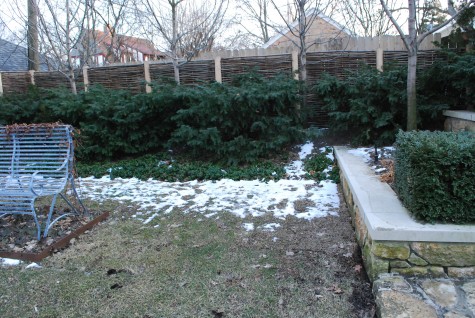
See this-this is the most daunting day of the year. The residue of a single late snow still persists in the shadiest parts of the garden.  The grass is matted down, and an unappetising shade of tan.  Every place that Milo digs in when he takes off is a muddy blotch of a divot.  But for my evergreens-desolate. 

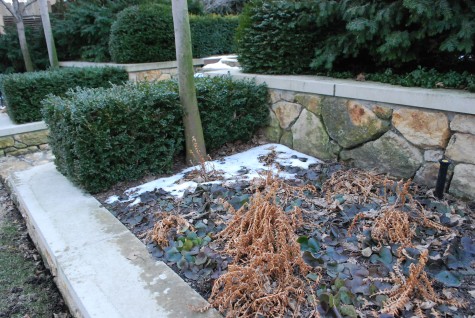
The beech ferns-I never cut them back in the fall.  I am sure leaving the dead fronds over the crowns helps them winter the winter better. This is probably nonsense, but I believe it nonetheless.  The european ginger has a purplish hue, and is plastered to the ground much like the grass.  There is not one thing to be done about this-but to endure it, and hope for March to pass. 

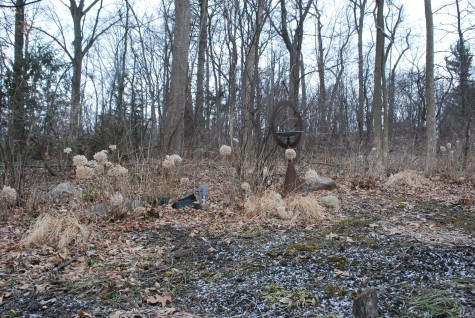
This garden belonging to a client looks like anything but a garden.  On March 10, it looked like bare dirt with a hint of white frost, the dead remains of some tufts of ornamental grasses, a few shreds of some Annabelle hydrangea heads, and a birdbath that looks like its lifeline has been disconnected.  A plug in the garden is exposed, a little trash has blown in-there are sticks and branches down from the high winds we had a week ago.  It is hard to believe anything grew here.  This is a daunting day.  

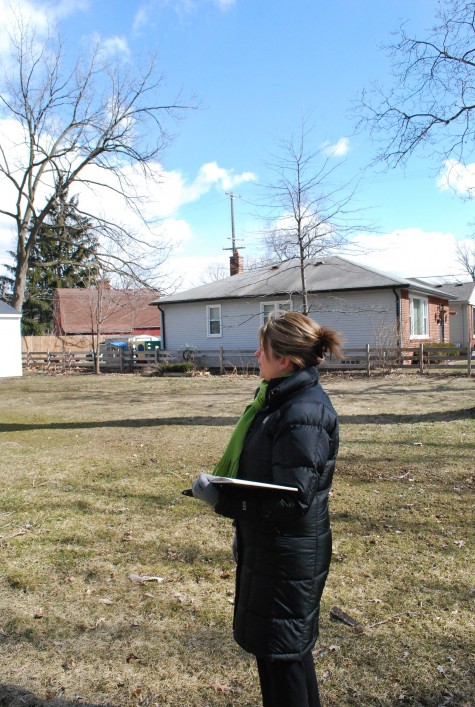
I have started to make landscape calls.  Clients invariably apologize for the state of their garden, but I remind them that this is March.  The last of the winter.  I like looking now-the most daunting moment is also the simplest moment.  Lots of issues are made clear.  Just when I think it couldn’t possibly look worst, the weather will break in favor of spring.  Gardening people like JB, pictured above, know that now is the best time to review, and plan.  The smallest spring project thoughtfully undertaken now will grow faster than you think.  Sooner than you think, there can and will be fewer daunting days in your garden.  It is good to get outside now, and take a look around-even if you must wear a winter coat.   

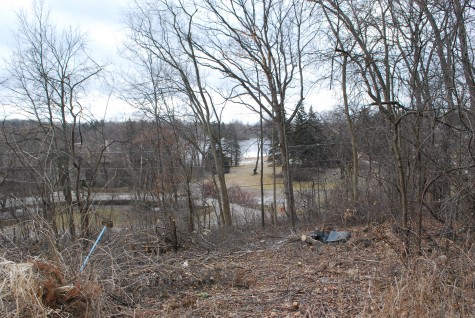
This client lost 60 trees to the emerald ash borer over the past 2 years.  Very daunting, this.  But enough trees came down such that the lake across the street is now visible.  My clients are liking that they have a glimmer of a view of water from their hilltop property.  The disaster of the loss of many trees presents them with a great opportunity.  The mess of broken branches and debris can be cleaned up.  The view out can be framed.   The site line going over the hill could be a river of chionodoxa in the spring, and a groundcover all summer and winter.  Shrubs with a loose wild habit could edge the remaining trees.  Under the best of circumstances, landscapes evolve.  Some plants grow too vigorously.  Others succumb to any number of ills.  Things change.  There is work for every gardener to do every spring-is this not a very good thing?    

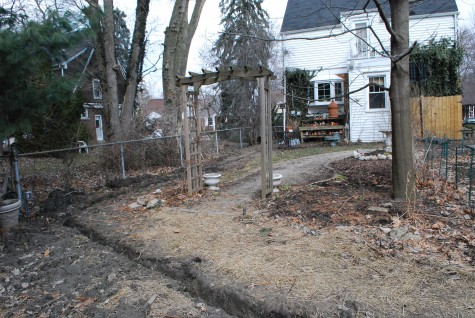
This garden lost part of its reason for being.  A nearby garage was torn down, and replaced in another location.  The curve in the path that once went around the garage makes no sense now.  The trench for the power lines to the new garage will be filled in within days, but the effect of the loss of a major structural element makes the garden seem disconnected-adrift. I will take this opportunity to discuss with her how it is important that gardens have structure that frame and suggest that garden, during the winter season. Never sell short the ability of the human eye and heart to imagine.  Imagining the parameters of this garden as it stands is difficult, not impossible.  Strongly suggesting the possibilities, the locus of a summer garden,  is what makes a winter garden work.    

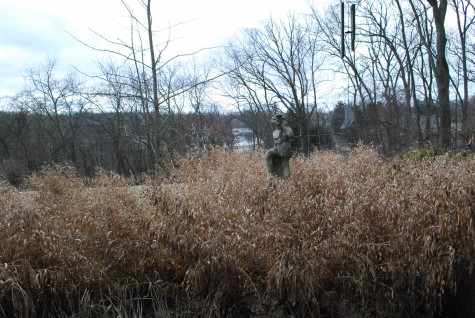
You can barely see the lake in this picture.  I am standing very near the house.  Given that there had never been a long view, this sculpture set in an ocean of northern sea oats was not only the near view-it was the only view.  On this most daunting day of the year, we are discussing how this may be different, beautiful in a way it never was. Clearly something needs to change here.  My advice?  A daunting day is a call for the old blood to turn over.  Wring your hands if you must, but I find a lot of looking, and a little reverie, goes a long way towards turning that most daunting day aside.

Lily’s Pots


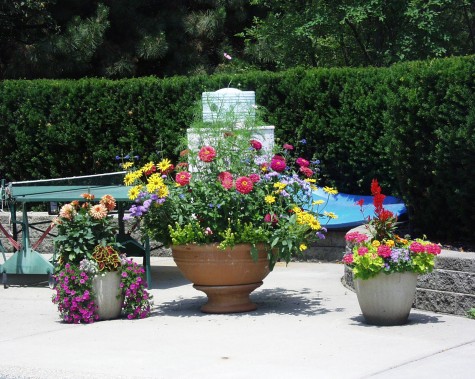
Next week I will be giving a talk to 50 members of a local garden club.  I am happy to speak to any group free of charge, provided they come to me.  It is an easy matter for me to show pictures from my computer, or from a book in my library.  My closet is a collection of the garden gear I like the best.  I can put a container planting together, and discuss those issues which influence my choices.  I can talk about the history and care of great garden ornament. I am equally at home with ideas about how to repurpose apple crates, iron headboards, galvanized livestock watering troughs  and old fishing tackle boxes. I can speak to what anyone should expect from a landscape designer, or an irrigation contractor.  When I am in my element, I have lots of physical examples to choose from.  I am too old to take my shop talk on the road.

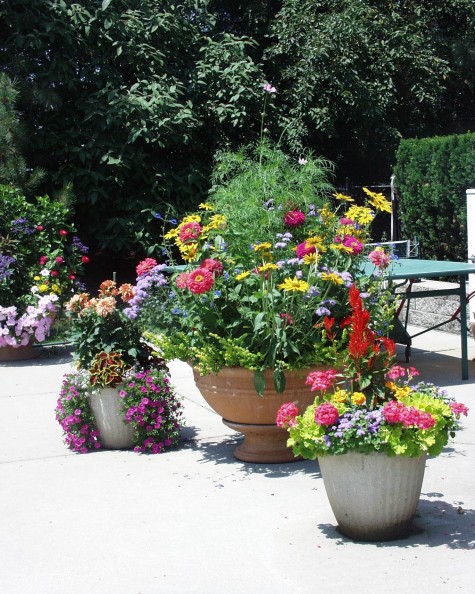
This garden club is leaving the topic up to me.  No doubt I will choose a topic that is timely.  Early spring perennials no garden should be without.  Spring container plantings.  Designing a landscape project for the spring.  But no matter the group, no matter the time of year, some questions I see over and over again.  I am not especially creative-how can my garden pots be more beautiful?  What is the secret of growing good container plantings?   Given this topic, I refer to Lily. I am quite sure I have written about her before. She likes me to plant every color and form under the sun-the more the better.  It matters not what I throw at her, her mature pots would make a grown gardener weep.  She has an unerring instinct about how to make plants grow.     

Everything thrives for her.  She could pick up a yucca plant that had been in the trash at the side of the road for weeks, and grow it on to prize winning proportions.  She has a soft spot for dramatic plantings-this I oblige.  But once I have planted, she is in charge.  She does take charge. 

She understands perfectly that annual plants form roots that are very shallow.  Unlike the deep rooted grasses, or baptisia you have tried to dig out and divide.  Everything that goes on in a container or ground planted annual garden happens in the first 8 to 10 inches below ground.  Annual plants only want to set seed before the end of the season, they will bloom and set seed at the expense of a substantial root system.  Only long term plants grow deep.    

This means that top 8 inches of soil needs to be loaded with organic material, and watered regularly.  There are those times when people ask me why my containers grow up lush;  I simply say I water regularly.  I water when the plants need water.  I don’t skip, or put off the watering to another time.  Regular watering is critical to success with plants.

I make sure that the soil that goes into containers is loaded with organic material.  This helps the soil to retain moisture evenly. Organic material leavens soil, so air is a substantial part of the underground party.  Notice I say soil.  I do not plant in peat based soil mixes. 

Peat based soil mixes are easy to carry out to the car, but they are sterile.  Prefessional growers plant in sterile soil mix.  They cannot afford disease to infect a crop upon which their livlihood depends.  But once a soilless mix dries out, it takes lots of work to rewet.  A cursory watering of a container planting in soiless mix means the surface gets a little moisture, and the roots are dry as dust.

If you are a hit, hit and miss waterer, plant in soil.  Potting soil.  A 40 pound bag of potting soil is not that much-get that high school kid at your local nursery to load your trunk with all of the bags that you need, and get help unloading those bags at home.  This effort will be worth it.  Real soil will buy you some time in August, when you are at a high school softball game rather than home watering your pots.  There is no harm mixing some peat, or composted manure into your soil-every effort you make to enrich your soil will pay off many times over. 

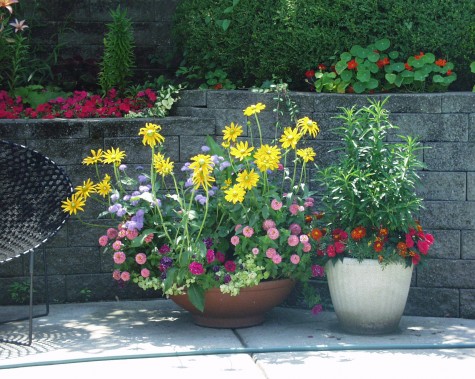
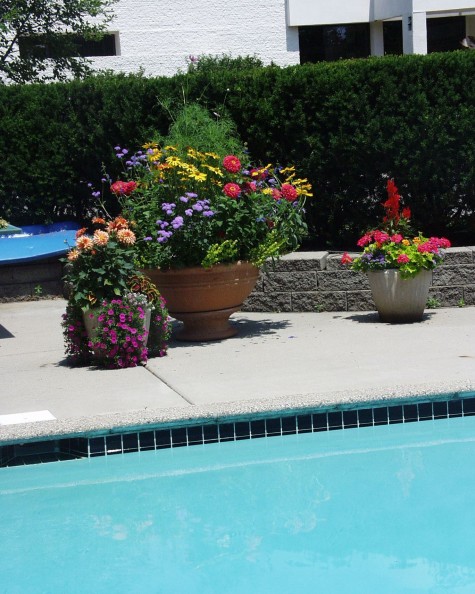
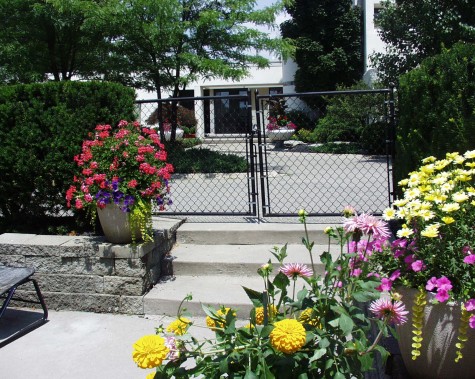
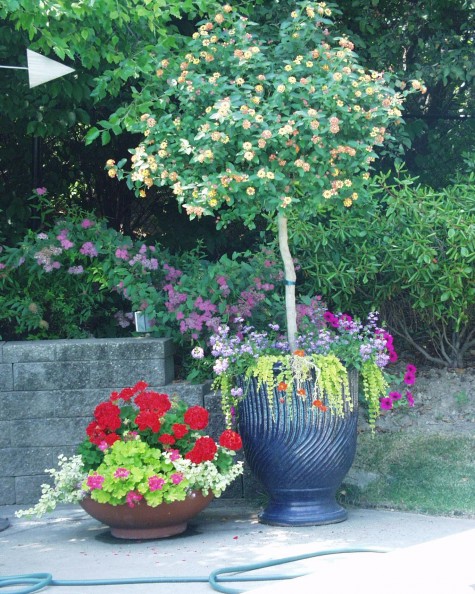
Lily’s pots always look well grown.  You see the hose on the ground in the foreground-she knows how to use it.  The time it takes for her to water, dead head, and clean up her pots is time she is willing to give.  Don’t have the time?  Hedge your bets.  Plant succulents.  Plant fewer pots.  Group the pots that need water close together.  Invest in a hose that is lightweight.  Have a good irrigation contractor install automatic irrigation in your pots.  (automatic irrigation really means you have a little more time before you do a personal check-automatic irrigation cannot replace you!)  


 There is not a gardener anywhere that does not enjoy the results of a beautiful garden.  A great pot.  A great moment.  My secrets are anything but monumental.  Let no container lack for water. 

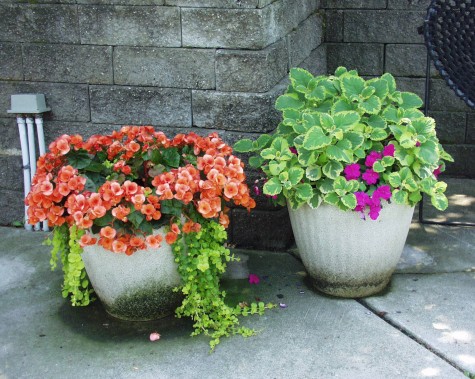
It matters not whether the style and color of these containers appeal to you. If one boxwood in a pot satisfies your idea of beautiful, the rules are the same as what applies to Lily’s pots. Or the landscape at Longwood Gardens.  Or my garden.  Or your shade garden.  Or the roses at Janet’s.  Or the pots on Michigan Avenue in Chicago.  What matters is that hand that gets put to seeing that the plants thrive.

My topic for the garden club next Monday?  You are able.  And since you are able, you should.  Plant it, Detroit.

Through The Lens Part 3

I heard from Bob Stefko a little while ago-he checked out Dirt Simple for the first time. He liked the snapshots I took of him working-I like that. He did admit that the cold made this shoot a real challenge. Funny how this made me feel better.  After a 12 hour day on Saturday, he and I were back to work at 6:30 Sunday morning.  By 8:30 am we had a little sun.  This meant he had to work fast.  Too much glaringly bright light can wash the color and detail right out of a photograph. This means I take pictures of the landscape on overcast days.  For him, it just means more work.


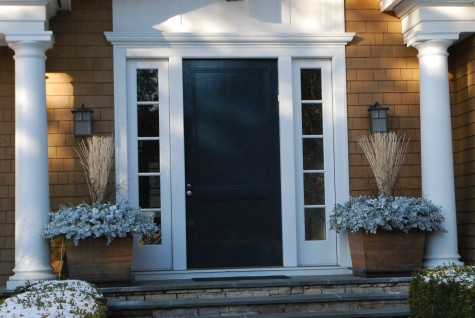
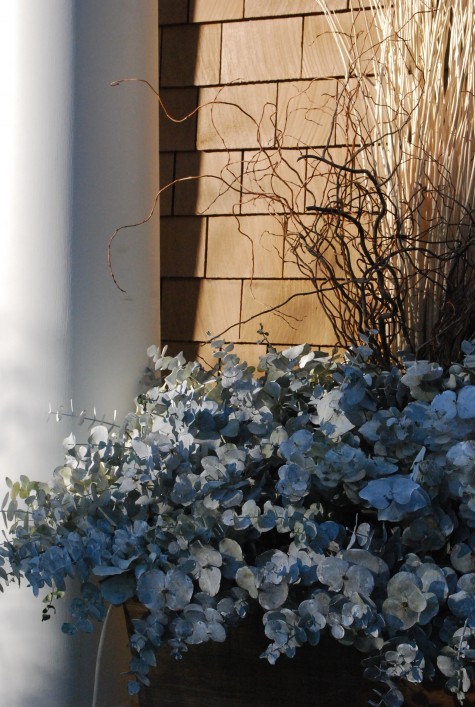
These winter pots feature whitewashed eucalyptus and natural sticks bleached to a plae cream color.  The colors are great with the tawny shingle siding, and the dark blue grey door.  The wood boxes are handsome.  The architect found them-I do not know the maker.  But I do know I like them.  The textures and colors of all of the building materials are so striking. 

The winter pots feature a subtle third element-some curly willow.  These curvy twigs are a great foil to the solid mass of eucalyptus, and the uniformly cut cream sticks.  They make for another layer of interest that is not so apparent until you are closer to the door.

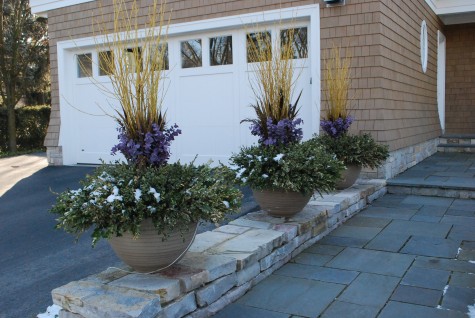
Three handmade English stoneware pots sit on a short wall that separates the driveway from the bluestone walk to the side door.  My pictures from this side, the west side, reveals what happens when I shoot into the morning sun.  The color goes dull, and the shadows really dark.

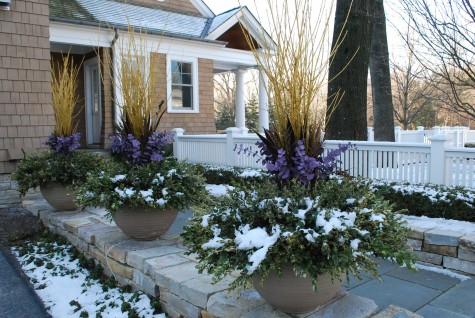
From the east side, with the sun behind me, the yellow twig dogwood, dark brown bahia spears and lavender eucalyptus look sparkly-richly colored.  The mix of boxwood, and yellow variegated boxwood looks as green as green can be, though these stems have been cut for at least 4 months.   

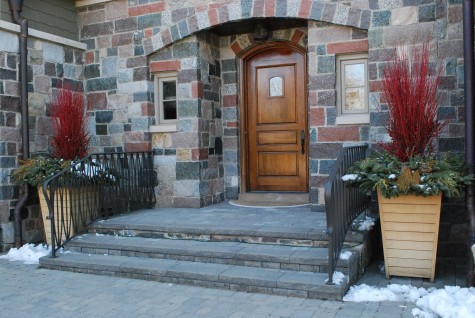
The red twig dogwood, and Michigan holly stems at this front door are just as richly colored.  Our key to insuring that the Michigan holly holds its berries throught the winter-Vaporguard.  This spray is considerably better than Wiltpruf at limiting transpiration.  With the moisture sealed in the berries, they stay plump, and hold on.  Bob had a challenge photographing these pots.  Tucked between a wall, and the step railing, the range of views was narrow.  I will be interested to see how he interpreted this space visually.   This house has very beautiful stone on the outside-the red makes much of this.

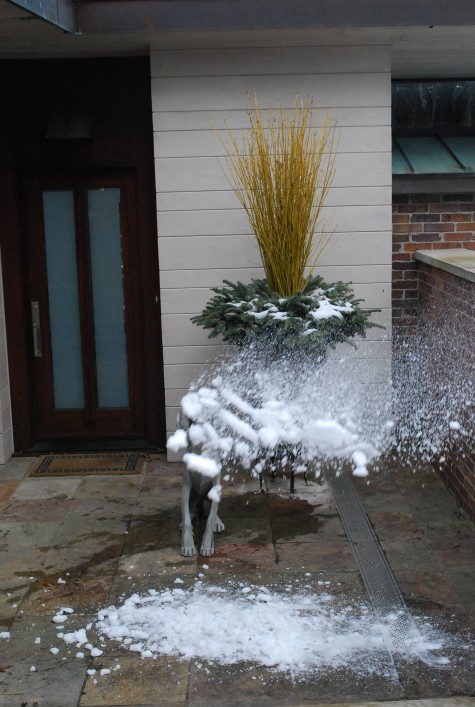
What?  You see snow in mid air here, yes.  How so?  The winter container had thawed some, putting a puddle on the terrace.  You can see that dark spot without any problem.  Bob wanted the entire terrace surface either all wet, or all dry.  We had few options for drying, but we had snow.  We shovelled snow onto the terrace, and swept it around until the entire surface was uniformly wet. 

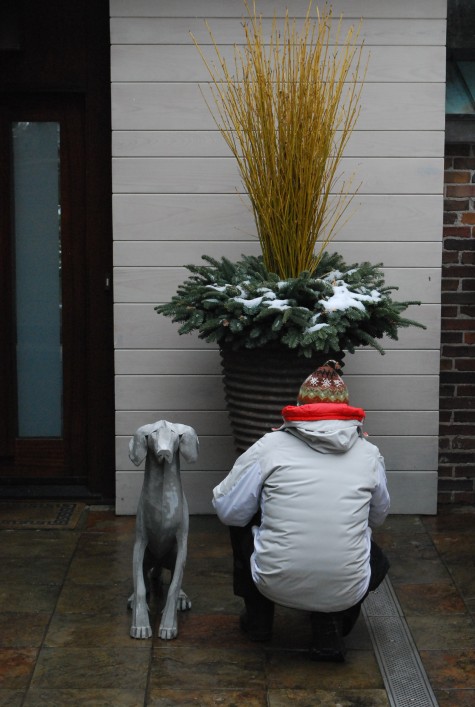
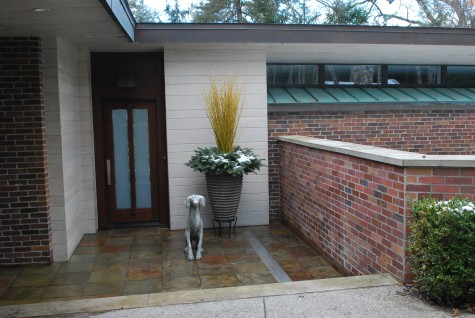
This mid century modern house designed by Harold Turner, a master builder for Frank Lloyd Wright, is  a gem of a house.  My client-better than any gem.  He insists on utterly simple and sculptural, whether inside or out.  I did bring this sculpture of a concrete hound, thinking it might add a certain something to the photograph.  The photograph would not have much detail of the architecture-nor any detail of this client, and his passions.  This is my favorite snapshot of the shoot.  Man/photographer, man/owner, container, and dog. 

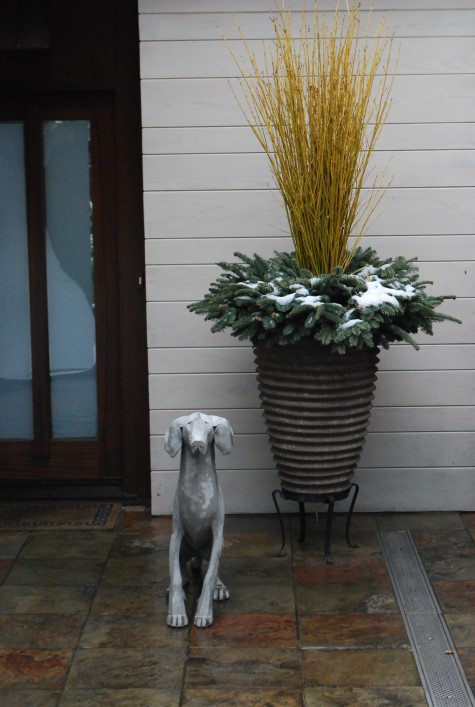
The tiles in this small entry terrace looked great, soaking wet.  The hound seemed like he belonged there.  The pot is a contemporary Italian terra cotta pot from Francesca del Re.  The clay body is loaded with minerals such, and fired at such high temperatures  that these pots are fine outdoors over our winters.  The iron stand is plain-the big idea here is to feature the sculptural aspect of the pot.  A substantial centerpiece of yellow twig dogwood is faced down with a thick and wide noble fir base.  This arrangement features the container.  That hound-he does add a certain something to this scene, does he not?

As we were packing up, my client appeared. He tells me, if this stray dog does not have a home, I will speak for him.  I was delighted to oblige. We left the hound on the terrace, just as Bob photographed it.  Irving offered a tour of the house to our photographer Bob-what a treat.  He has a particular interest in mid century modern architecture.  He got the cook’s tour.  This part of the shoot was not choreographed, or anticipated.  Every client that participated in this shoot was enthusiastic, and accomodating.  Irving-he lives with the idea that he should speak up and out.  No one says welcome better than he does.   I like that idea of his. I like that a great sculpture of a hound got a great home. 

Sunday at 1pm the shoot was done.  What an experience!  Many thanks Bob-it was my pleasure to meet, and work with you.