Deborah Silver is an accomplished and experienced landscape and garden designer whose firm first opened its doors in 1986.
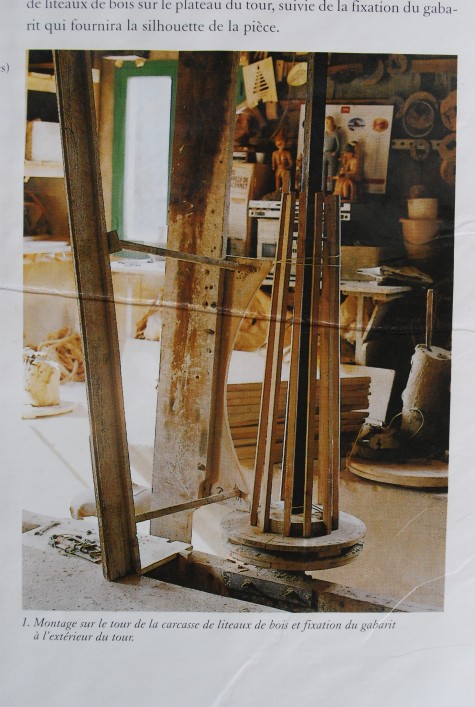 What I know about making terra cotta pots wouldn’t fill a teacup, but I have pictures. These first four are from a book Rob bought for me in France 15 years ago. “Terres Vernissees” by Christine Lahaussois and Beatrice Pannequin is an overview of the art of French glazed ceramics dating back to the 16th century. This method of making large pots with wood armatures wrapped in rope is a centuries old technique. The form begins with a series of wood verticals that describe the height of the piece, and the diameter of the top and the bottom.
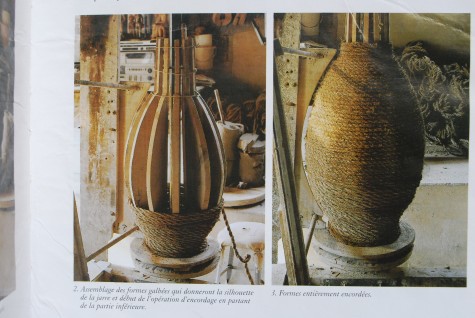 Multiple wood ribs that describe the overall shape of the pot are fixed to the central verticals. Keep in mind that the pots are made top side down. Heavy rope is carefully wrapped around the wood ribs. The ribs and the rope create a template for the finished shape of the pot. Wet clay is very heavy, and very sticky. To throw a pot of great size takes multiple passes. Only so much of the finished height of the pot can be done before the pot needs to rest, and the clay become leather hard. Then the next layer can be added. A giant pot thrown on a wheel all at once would collapse under its own weight. It is much more efficient to press the sticky clay into the rope. The form keep the clay from succumbing to gravity.
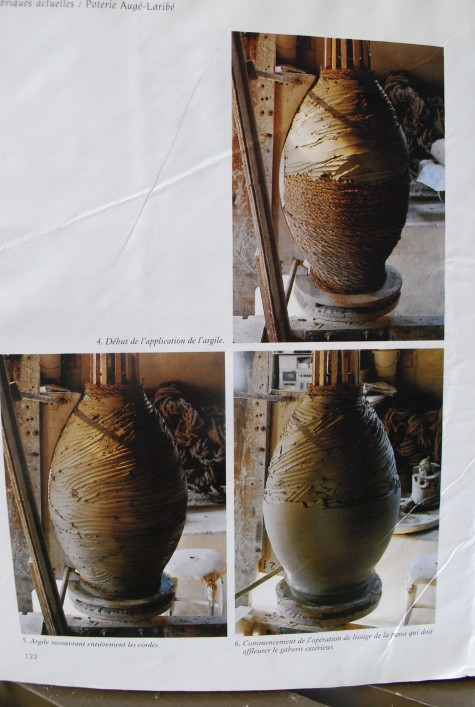 These pictures detail how the wet clay is pressed into the rope covered form. The texture you see here-the finger marks of the person making this pot. The evidence of the human hand-this is what these pots are all about. These large pots have been made this way for centuries in France. I think it is of utmost importance that this history be known, and appreciated. I appreciate modern technology, and the important news of the moment, but there is more out there. When I plant a beautiful handmade pot, the planting is as much about the the history of the making, and the maker of the pot, as it is about the plants.
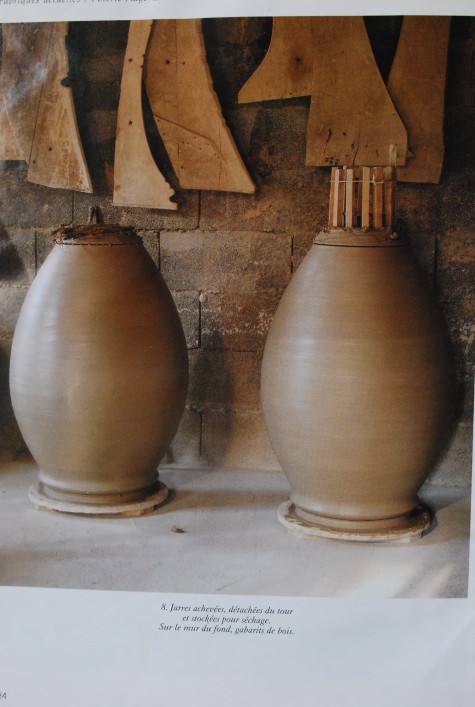 Once the wet clay is pressed into the ropes, the wheel turns, and the surface is smoothed. The wood form is collapsed once the clay becomes leather hard. The clay is cut, and the form removed. The rope? The rope is removed before the pot is fired, saved, and used again.
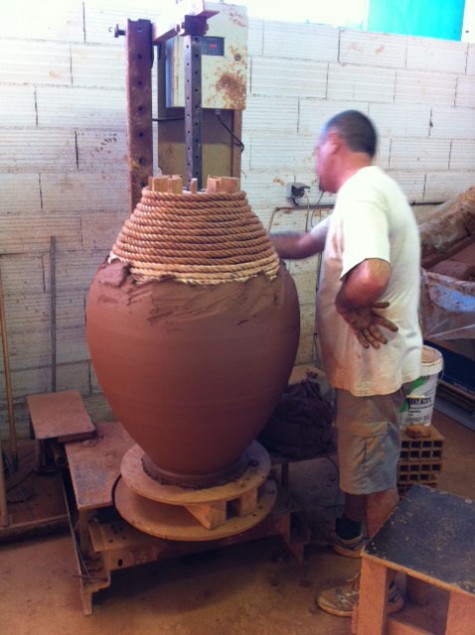
Rob took this picture 2 days ago. That the construction of the giant vases has not changed for several centuries-this is very important to me. How so? The handmade French pots that will come to the shop in 2 months will have been made by a person, whose hand, skill and judgment will enchant me. The history is long, the commitmment-just as long. People who make extraordinary things-I value them. I do what I can to support this industry, and am always sorry when I see a poterie close. The making of the pots is an art I would like to see endure.
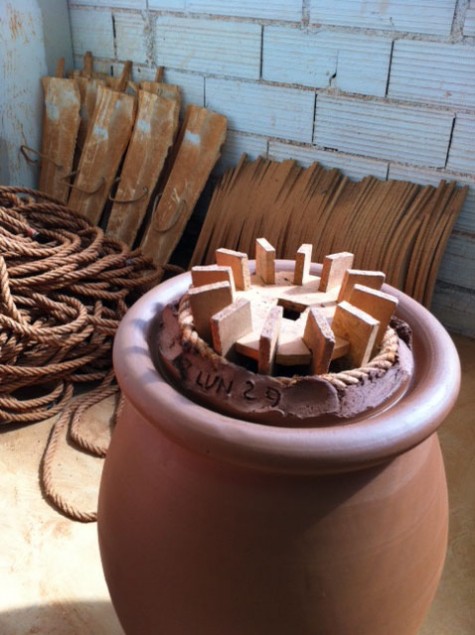 The finished pots in my shop do not tell this story. Yes, they have beautiful shapes and graceful curves. They are heavy, solid-very well made. With proper care, they will last better than a lifetime. But the story of how they are made makes for a story any passionate gardener would want to hear.
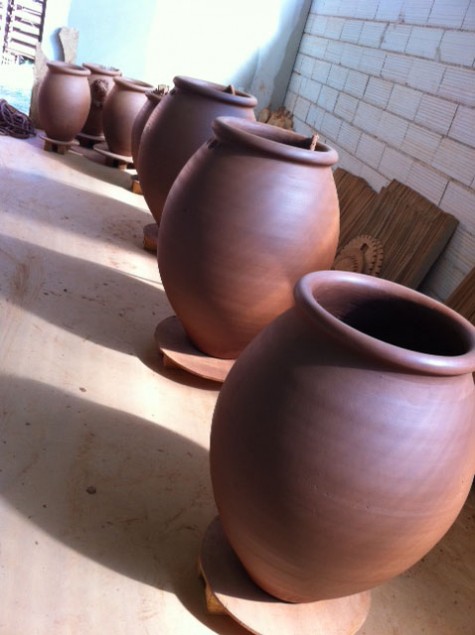 The finished pots-they need to rest.
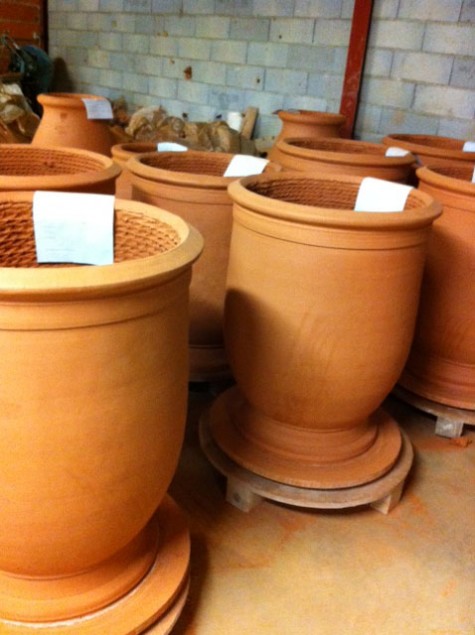 Once they dry, the pots will be fired. The rope is removed, but the pattern of that rope will be fired and live forever in the interior of the pot. The interior of the pot is every bit as beautiful as the exterior surface. These pots are ready to be planted.
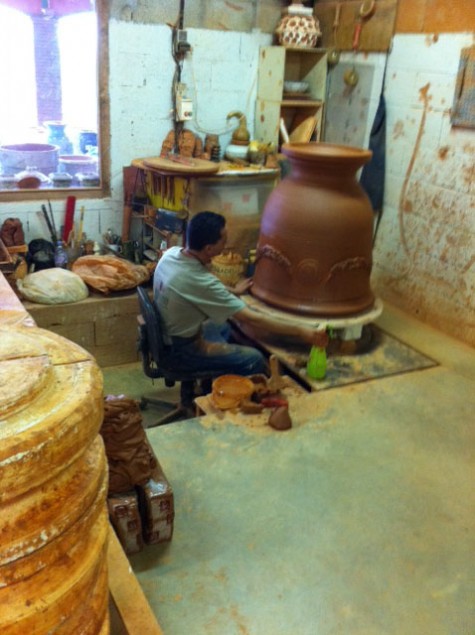 Some of the pots get decoration. Once the clay is leather hard, a potter will work hard to create and affix that garland, that medallion to the body of the pot.
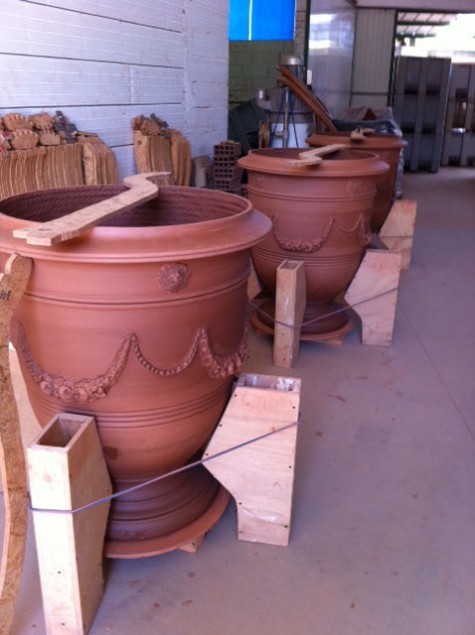 Giant pots drying have supports. These supports are not so fancy, just useful. Simply useful. Gravity can drag down wet clay. These not so fancy supports keeps the wet clay aloft.
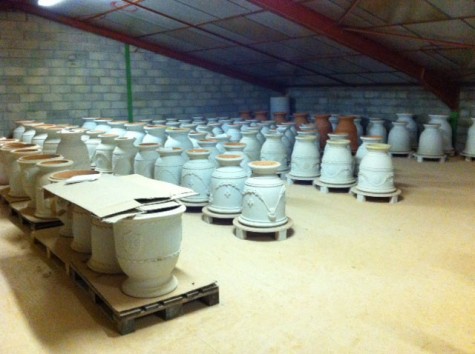 The attic is a perfect drying room. Imagine that every handmade French pot gets hauled to the attic to dry. There are a lot of steps, and a lot of hands that come together to make these pots. When they are thoroughly dry, they will be fired. From these hands to yours-Rob does this part.
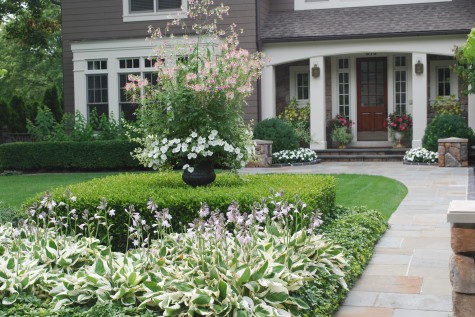
I greatly admire any expression that is airy, artless, graceful, breezy, unstudied, beautifully accidental or subtle- underwrought. What do I admire this? I greatly admire that which is the most difficult for me to achieve with a planting. Luckily, I have help from the plant kingdom. I have never loved the look of hosta flowers. Sometimes I go so far as to cut them off before they bloom-reckless, I know. But in a sunny spot, the grey/lavender of these flowers is beautiful. The stalks going this way and that-artless. Both nicotiana mutabilis and dward cleome have wispy flowers that flutter in the slightest breeze. Anchored with a solidly blooming base of petunias, this planting is a meadow in a pot. This planting had a lot of help from nature.
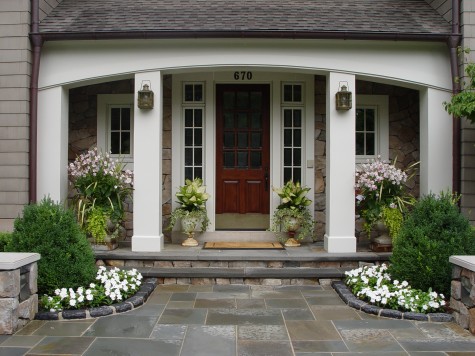
The pale pink nicotiana in the outside pots on this porch-who knew how pretty they would be with a pair of white dieffenbachia. A few spiky leaves of green New Zealand flax unexpectedly echo that dieffenbachia color. The variegated ivy is a casual and airy compliment to those stiff paddle shaped leaves. This planting was better than I thought it could be. I credit the plants for that.
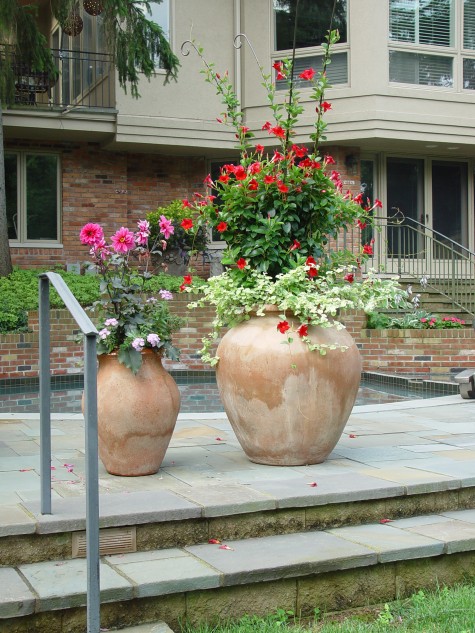 Mandevillea is one of my favorite summer plants. Vining plants have a way of growing that sets a planting free. They will grab any airborn support. Lacking support, they will vine down and out. Variegated licorice has stiff stems-but they grow every which way. I call it the cowlick plant. It provides some stiff horizontal support to the mandevillea vines that wander. Some of the red mandevillea flowers appear to be floating, do they not?
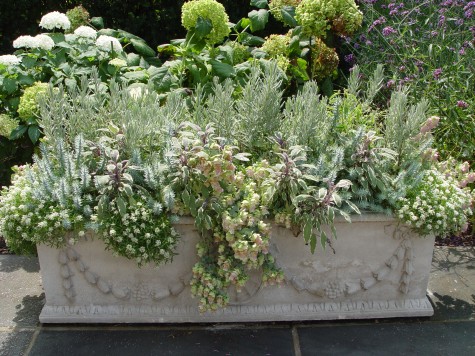
Plants with subtly colored flowers and foliage have that airy look, no matter their habit. Succulents and herbs tolerate close planting, as long as I am careful not to overwater. Closely planted plants make a community of one, as long as I do not interfere too much. Plants left to weave in and out of each other make their own statement. This staement is infinitely more interesting and beautiful than anything I could engineer.
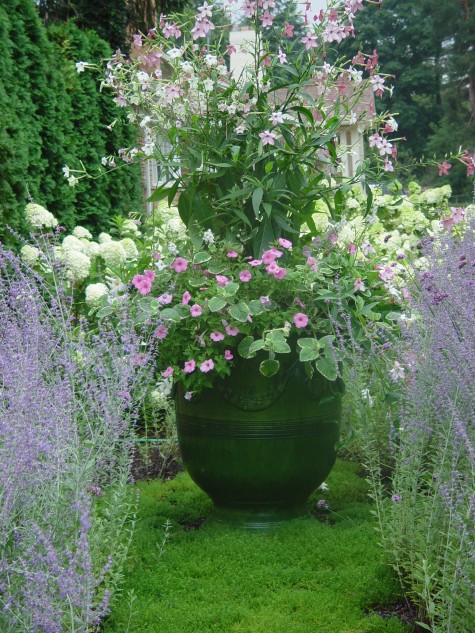 Pots placed on porches, pillars, pedestals and promenades make a studied design statement before they are planted. A pot set in a garden bed comes out of the gate with an entirely different attitude. This entirely formal French pot from the Poterie Madeleine has a planting that reflects the garden.
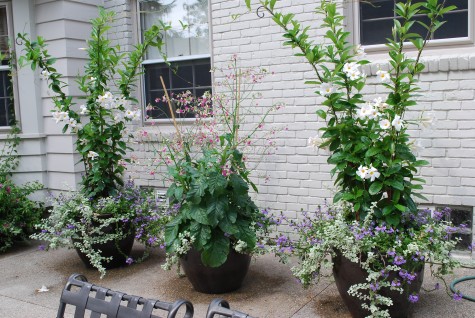 Some clients like that wispy, artless look. They like subtle colors. They like the air as much as they like the flowers. Small flowers nurture that airy look. How hard is it to make a dahlia look graceful? You know the problem.
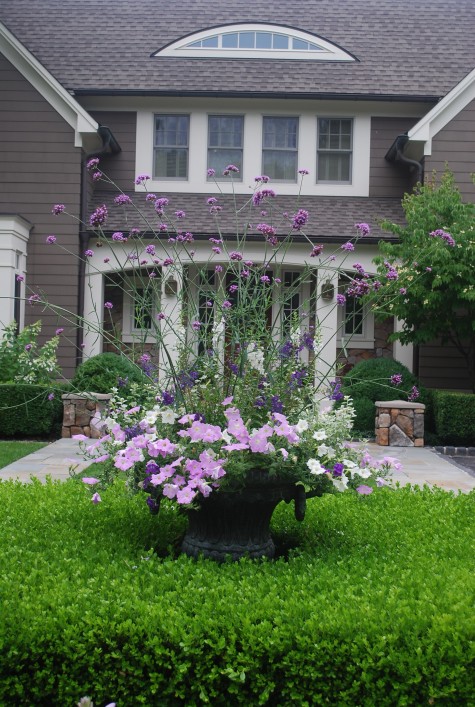 Verbena bonariensis wrote the book on airy, breezy and cloudlike. I plant it every chance I get. In containers, it can loosen up the most formal of landscapes. It can define the airspace above an urn. It needs very little in the way of staking.
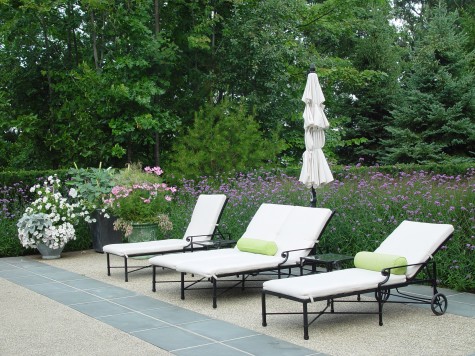 Verbena bonariensis in the ground-stellar. Imagine this space planted with impatiens-ho hum. This clean and crisp terrace furniture is all the more striking given the contrasting cloud of verbena in the background.
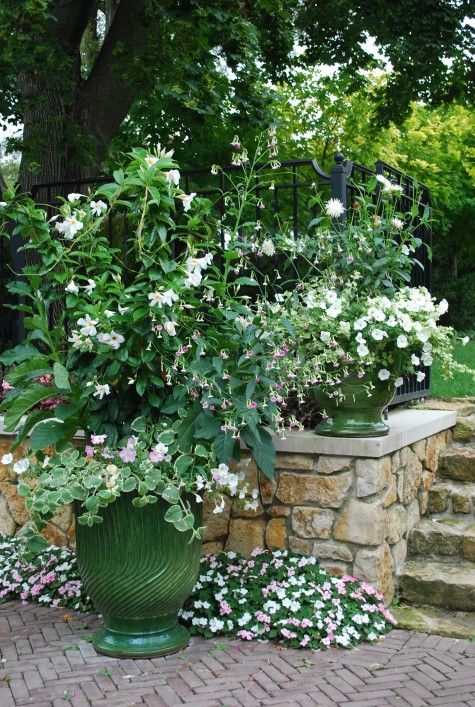 Gardeners may think what they have to work with is the soil. But in fact, they also have an airspace just asking for some attention.
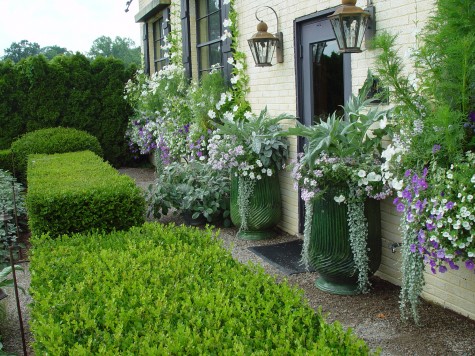 What overflows, what moves in the slightest breeze, what grows in out and around-this is a look I treasure. Loose and lovely.
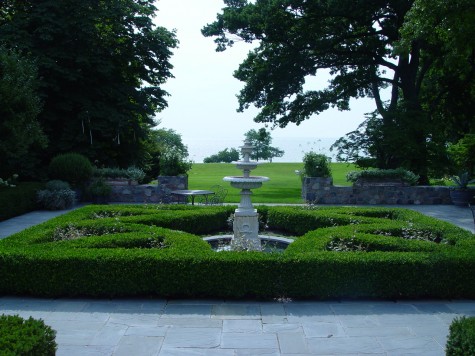 I placed this 19th century American cast iron fountain in a client’s existing terrace pool 6 years ago. Last fall, she was ready for a change. A rectangular pool much larger than the original circular pool was installed, and a steel surround was built to finish that new pool. The overgrown boxwood was removed, and additional stone was added to the terrace.
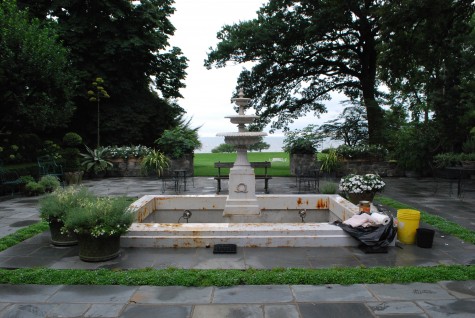
A picture frame opening was left in the stone, and planted this spring with isotoma fluvialitis. The steel surround was painted in much the same color as the original fountain. The surface of the steel was only primed in patches, so the surround would rust in the same manner as the fountain. The design of the surround was taken literally from the lower part of the base of the fountain. More recently, she decided that the color of the fountain and surround was too light; she wanted to tone down the color of both pieces.
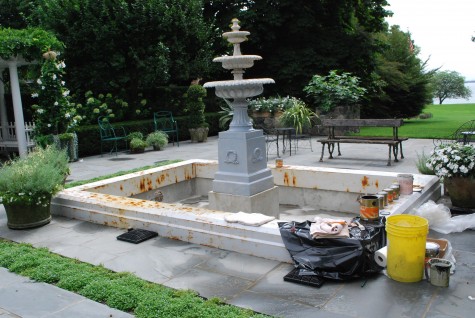 Working with color outdoors is challenging. But I knew I would be developing the finish in stages. A pale blue gray would be applied first. Though this is a pastel color, it is distinctively blue. Successive coats would reduce that blue to a trace.
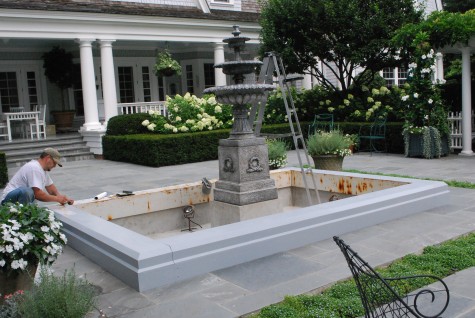 A darker brown-black coat was applied over the blue, to tone it down. The pool surround got its first coat of blue gray. Like the blue, this very dark color applied to the fountain would eventually be barely visible.
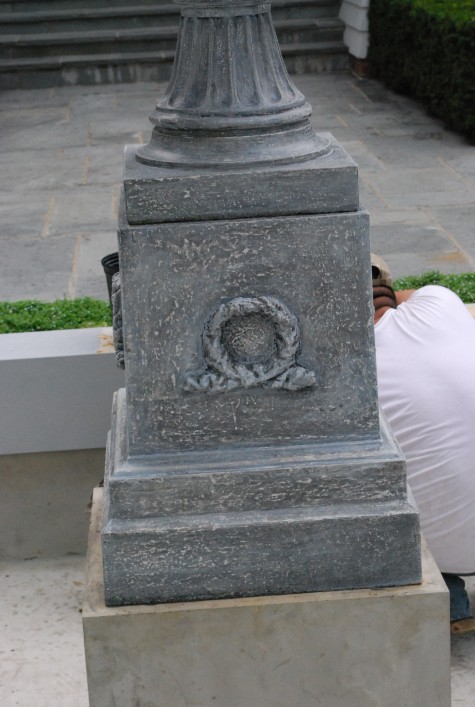 I sanded the entire surface of the fountain at this point, to bring some of the blue back up, remove some of the black, and expose some of the cream-white of the original color. Working on the color with the fountain in place is necessary. It is much too difficult to imagine an entire environment, and how light affects the surface. Needless to say, I spent a lot of time on a ladder.
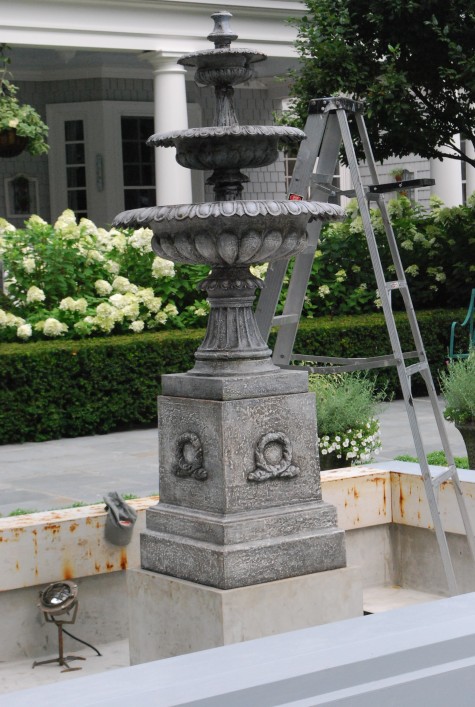 The sanded version has a lot of contrast-more contrast than what I wanted. The intent of the finish color is that it will reflect the predominant colors on the terrace, without standing out. All of the furniture and containers on this terrace are of subtle and restrained color. Much of that color is a result of age and exposure to the elements. To replicate an aged finish is by no means easy, and my experience creating them is limited. On my side-I had the time to let the finish develop.
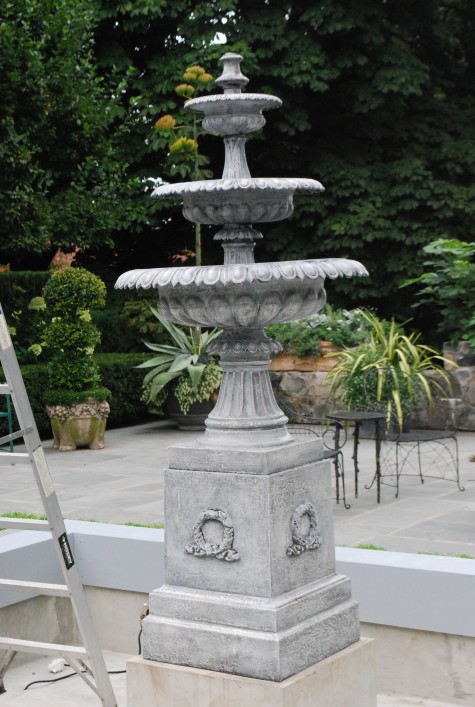 The sanding brought color contrast to the surface. The gray wash which came next toned that contrast down. I liked the close relationship between all of the colors, but I knew I needed a gray that was a little darker, and less blue for the finish coat.
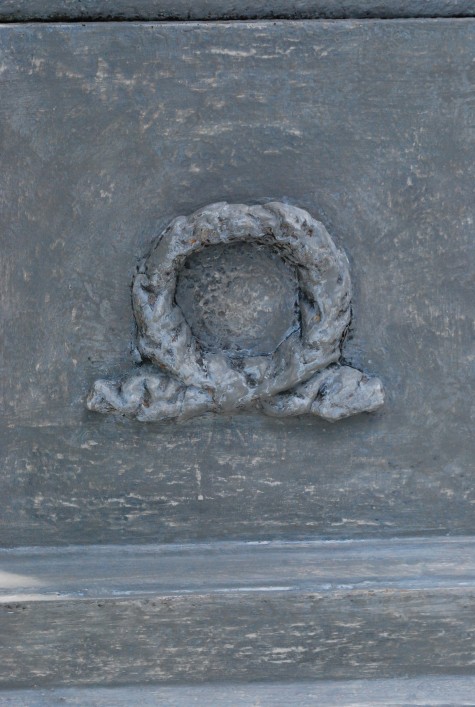 Over the gray wash, a darker, gray/brown wash. At this stage, I was wiping off as much paint as I put on. Though the fountain pool would prevent anyone from being this close to the surface of the fountain, It was my intent that the color be best described as gently faded.
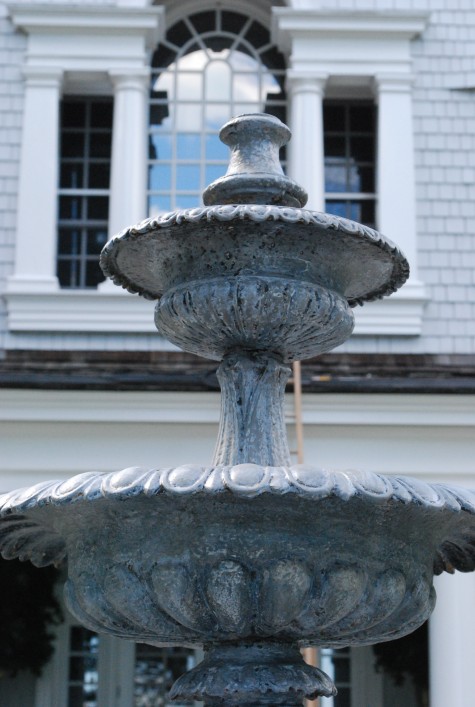
Every color layer is represented, to greater, or lesser extent. The final coat of gray is dark enough to make the fountain sculpture blend gracefully with the rest of the terrace. Subtle does not have to mean sleepy; up close, there is plenty of visual interplay between all of the colors.
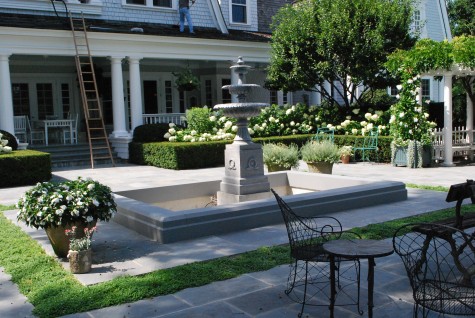 This afternoon, the concrete interior of the fountain is to be painted black. This will make the surface of the water reflective of what is going on in the sky. It will also change the feeling and appearance of the color on the fountain. In a perfect world, the fountain sculpture color will need no adjusting. If it does, I’ll be ready. The finish color on the surround will be much influenced by the black interior. I hope to finish that part of the painting this afternoon.
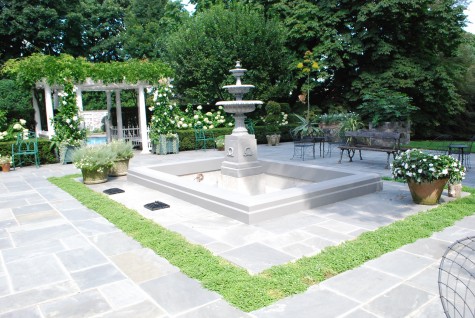 By early next week, I hope to be able to fill the pool with water. The final step? The water plants.
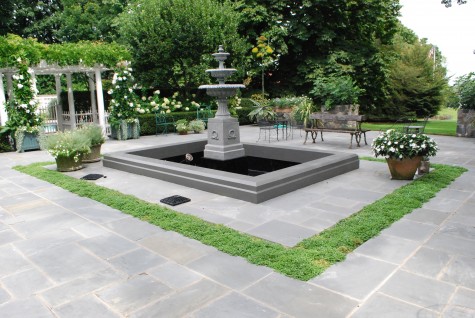
Late afternoon update-the interior of the concrete pool is painted, and the surround is one shade darker. What a huge difference the black makes; the fountain looks darker to my eye. It must be that no more light is being reflected onto the fountain via the pale gray concrete. I am thinking a lighter gray wash over the dark surround color is all I need to do to finish.