The Schematic Plan

What I call a schematic plan is another way of saying master plan.  A guide for the development of a landscape.  Clients who have an interest in a plan that they can work towards and implement over time always interest me.  A landscape of note implies a long term committment-gardeners willing to go that route will not only enjoy the process, but will find so much satisfaction in watching something grow.  It takes lots of time to regrade a property, reimagine the space, plant, and arrange for care.  This timeline does not even include the plants that die, and the changes that result from experience, or a change in taste.  Anyone who buys a ticket for the long term process that a really good landscape requires I admire.    
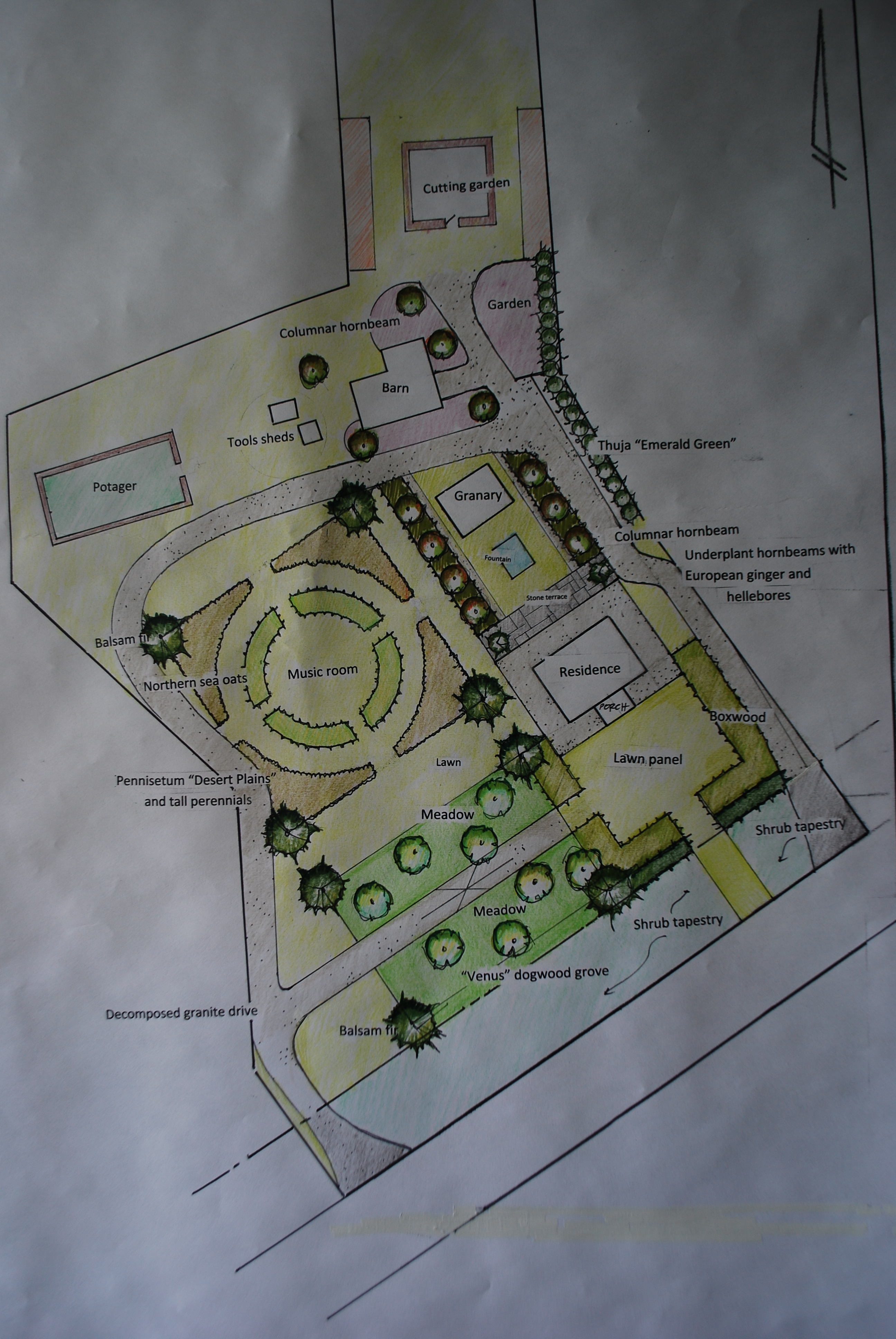
 A master plan is a schematic drawing noted for its broad strokes-not its details.  The vegetable garden will be there.  Friends will park here.  Parties could be staged in this garden.  Great views of the landscape from inside could be described by this, or that.  The rear yard will feature a particular shape-the particular plants are to be determined.  How does the landscape address movement?  The driveway needs to be this width, and accomodate this turning radius,  and needs to gracefully address vehicular traffic.   A big scheme is just that-a big fluid wish list with an attempt made to broadly define use and beauty.  There will be places to sit, garden spaces-spaces to view from afar. This master plan features a wide swath of decomposed granite all around a 19th century stone farmhouse.  There are plans for a conservatory style kitchen across the back of the house.  My clients are indicating they want to move ahead with the landscape.  This masterplan gives wide berth to additions that are planned for the house.  The additions will take vastly less time than the landscape.  I advised them that given the length of time it will take to create a landscape, the best time for them to begin construction is right now.         

columnar trees

My clients purchased a very large farm- a property that features 2 barns, 2 outbuildings, and a granary.  A granary?  A beautiful wood structure whose purpose was to store grain is a feature. My plan is to move that granary, currently set above ground on concrete blocks, directly and squarely opposite the rear of  their home.  The broad gesture?  This old stone farmhouse came with the outbuildings that make for a working farm.  Though it is unlikely that they will ever grow grain, and have a need to store it, the granary is a great place to stage a summer dinner party.  The house and the granary will become substantial bookends for a simple fountain garden.   
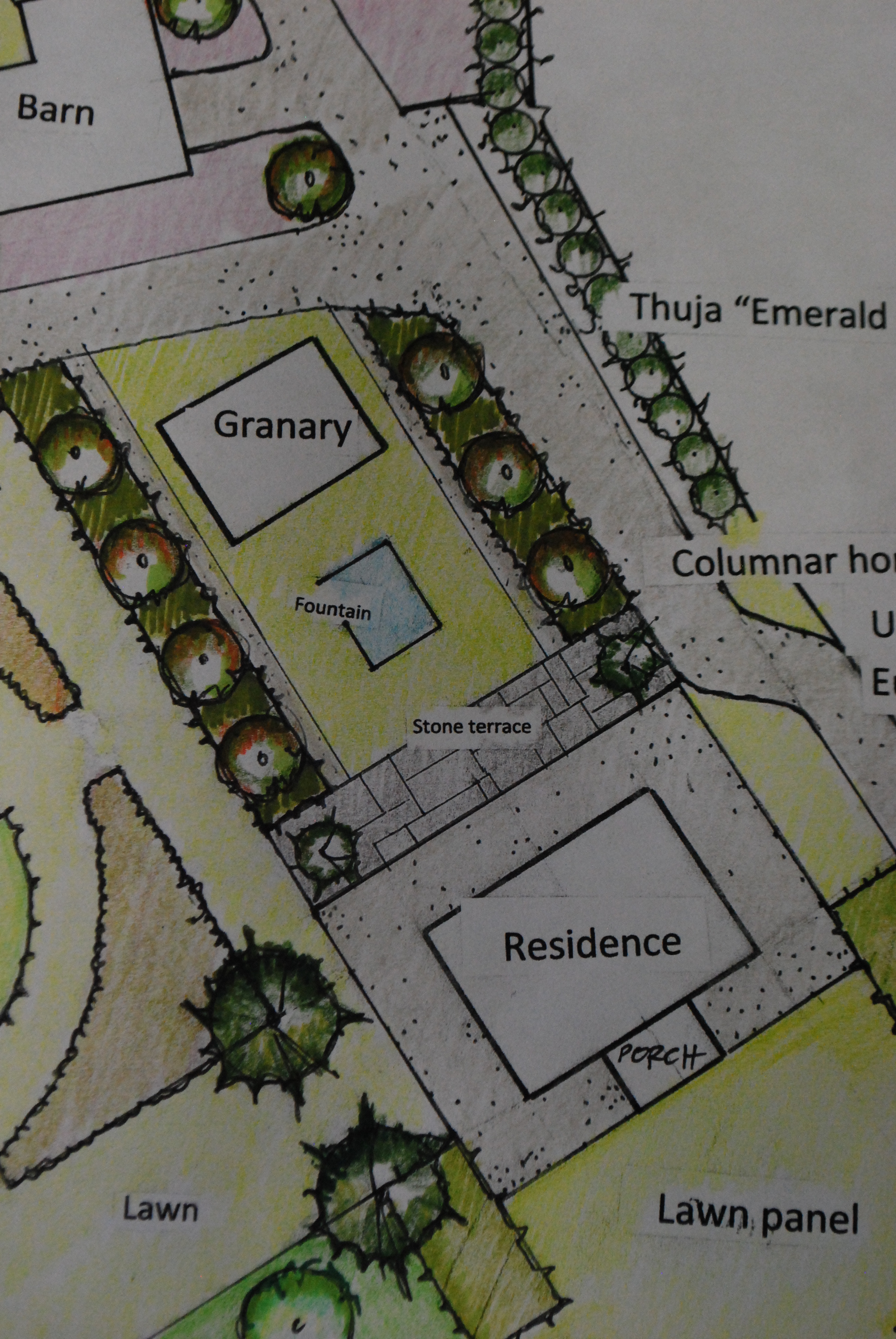
On either side of that fountain, there is a plan for an allee of columnar hornbeams, underplanted with European ginger and hellebores.  It would be a great spot for snowdrops and white crocus-or white Spanish bluebells.  This list may change, or be added to, or completely rethought- over time. The hornbeams will be planted equidistant from each other in this garden.  Once the allee crosses the gravel drive, the spacing between the trees gets wider, less regular.  Though they will be planted in a much less formal area, they will still maintain the site line established by the formal allee.
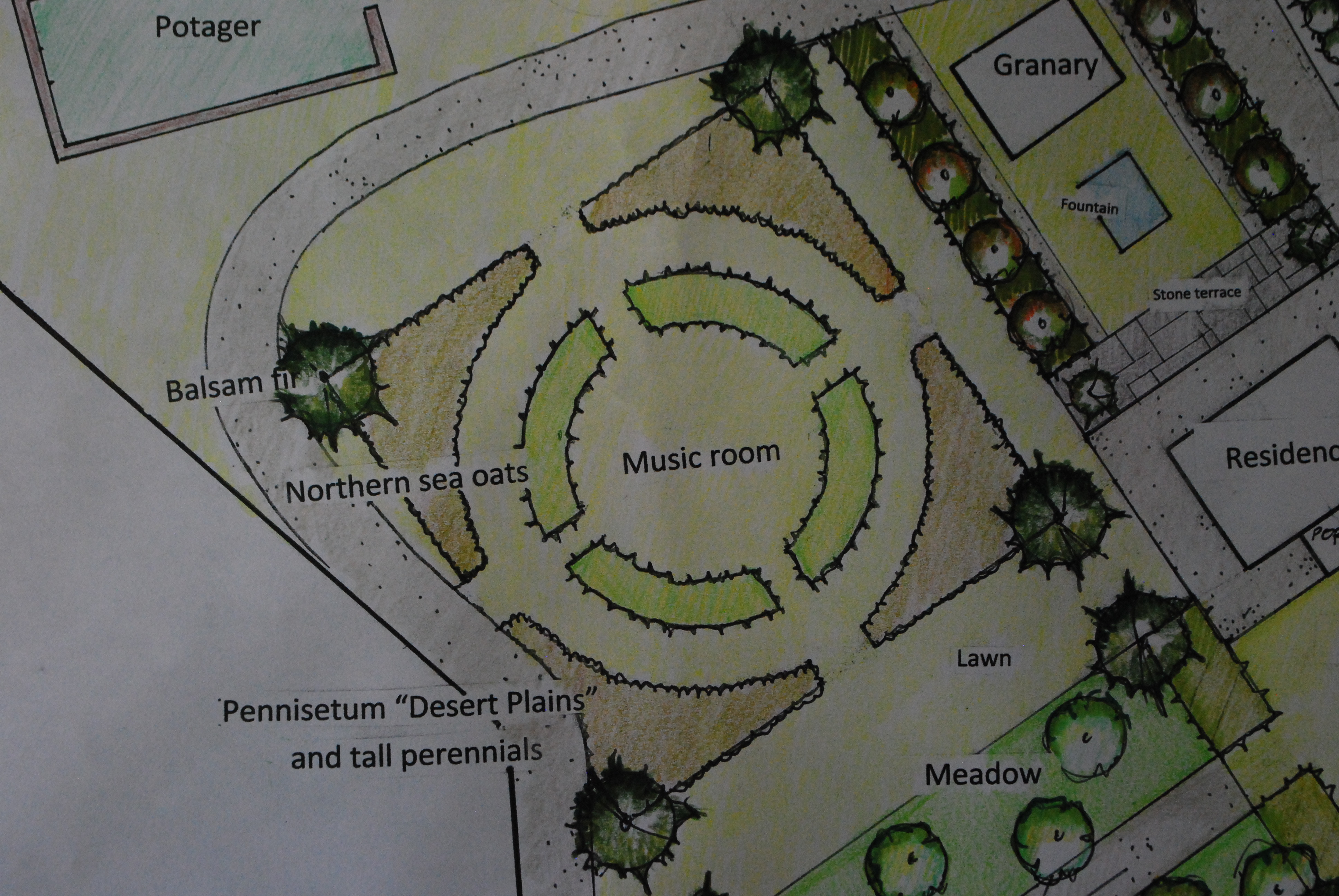
My clients have a particular interest in music and theatre.  They like nothing better than a summer concert staged outdoors.  The shape of the gardens adjacent to this round grass space that I call the music room make reference to their neeed for a space for such events.  The grasses are an informal material used in a more formal way.  The heights of the plants specified will provide some enclosure and privacy.  Viewed from the fountain pool, the northern sea oats will provide a contrasting and shimmering backdrop to the more formal and static hornbeam garden.  Viewed from the vegetable garden, it will look like a field of grain.  A reference to the agricultural history of the property will make those beds more visually believable, given that the setting is rural.  But those beds could be a collection of shrubs or small growing evergreens.  They could be a perennial mix that peaks during the summer months. They could be planted with roses.  A scheme needs to come first.  The details can come later.
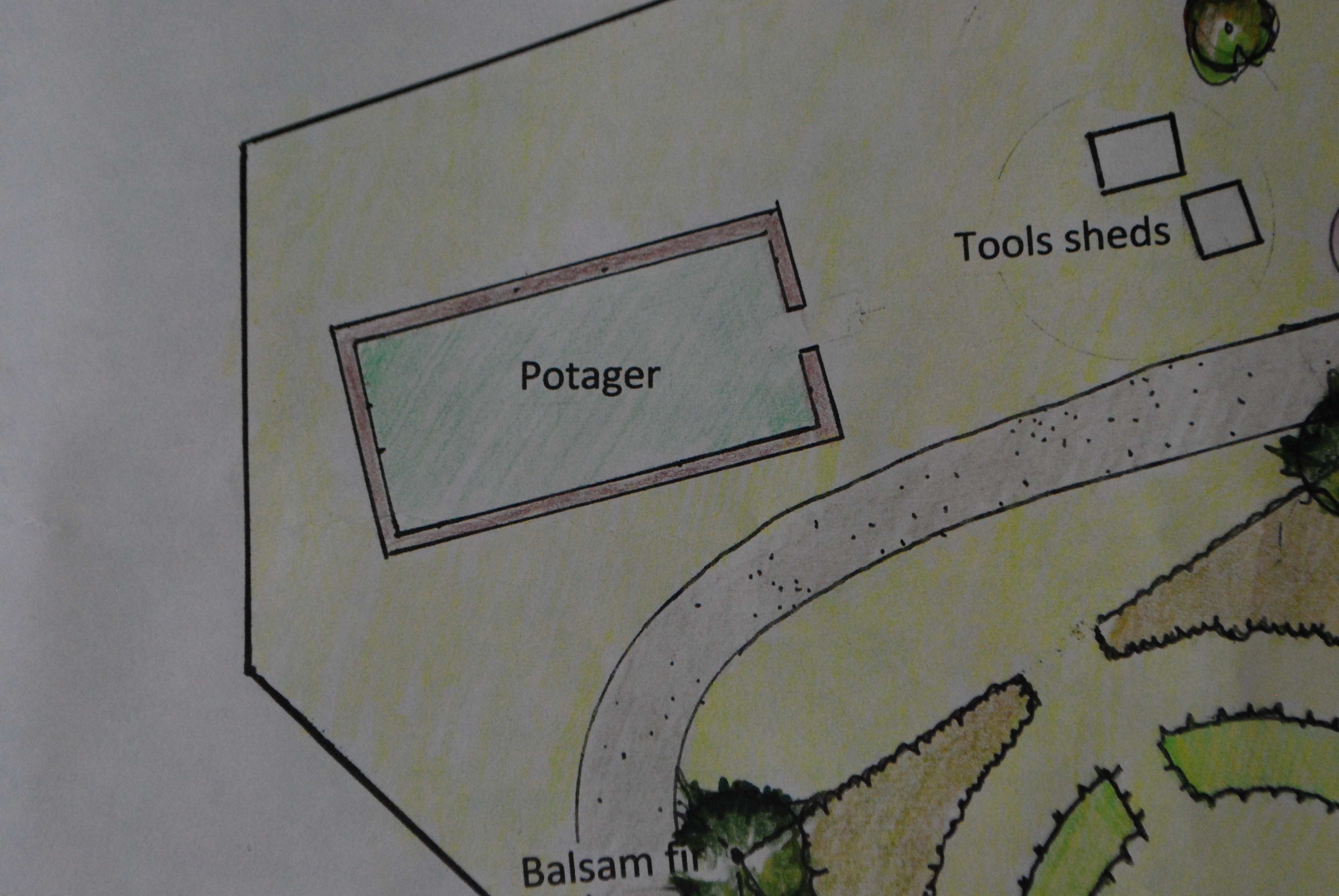
I have labelled the vegetable garden a potager, as one of my clients is French.  The details of this garden will be provded by him.  I feel certain it will have a distinctly French feeling.  The garden footprint is exactly the size and location of a very old barn original to the farm, which needs to come down.  It is deteriorated such that to restore it would take resources my clients prefer to put elsewhere.  Hopefully someone will be interested in the salvage of all of the old beams and timbers.  The lower portion of the barn walls will be left standing, providing a fence for the garden.  Their property is host to lots of wild beings.  The floor of the barn has always been dirt.  With some work and lots of compost, it will be a great place to grow vegetables.
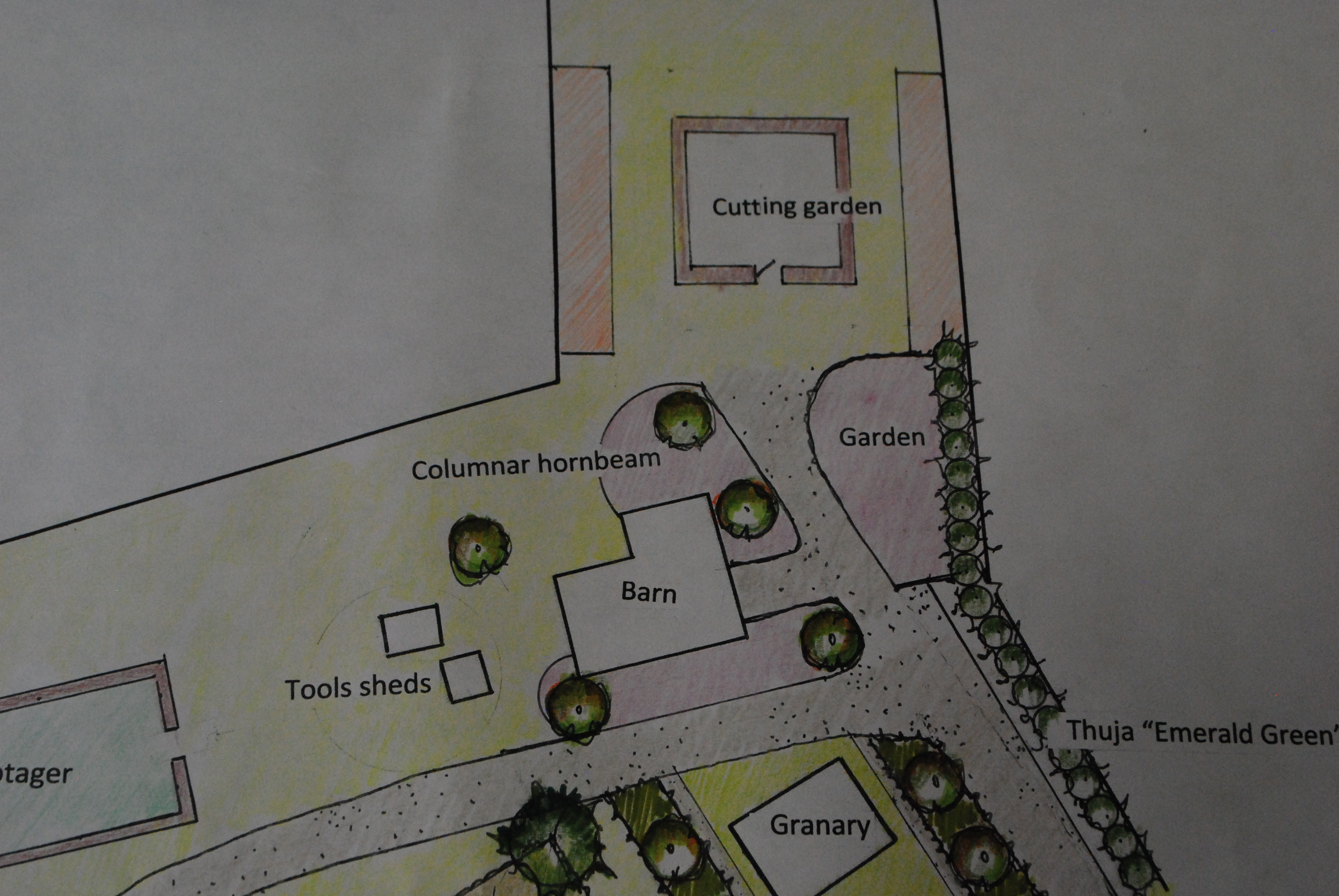
The other barn is in excellent condition.  It holds tools, and soil.  In the winter, the boxwoods in pots are stored here.  The barn gardens are actually quite beautiful and well developed.  There is no need to replace them.  The major changes will be about the perimeter shapes of those gardens. A hedge of arborvitae on the lot line will screen the house next door from view. A fenced cutting garden on the dog leg part of the property will be framed by a pair of pumpkin growing gardens. Two gardens devboted to growing pumpkins-how I envy them this.

The gravel driveway design is fairly close to what is existing now.  A major change will involve the addition of a drive which goes to the front door. On either side of that drive, a meadow planted with a grove of Venus dogwoods.  This meadow is a grass meadow.  A low growing low maintenance grass seed will be sown, and cut but once a year.  We have had very good luck with this particular seed mix, on unirrigated shady slopes, and in sunnier but relatively infertile ground.  The movement of all of the grasses will be a considerable contrast to the primary formality of the landscape.  
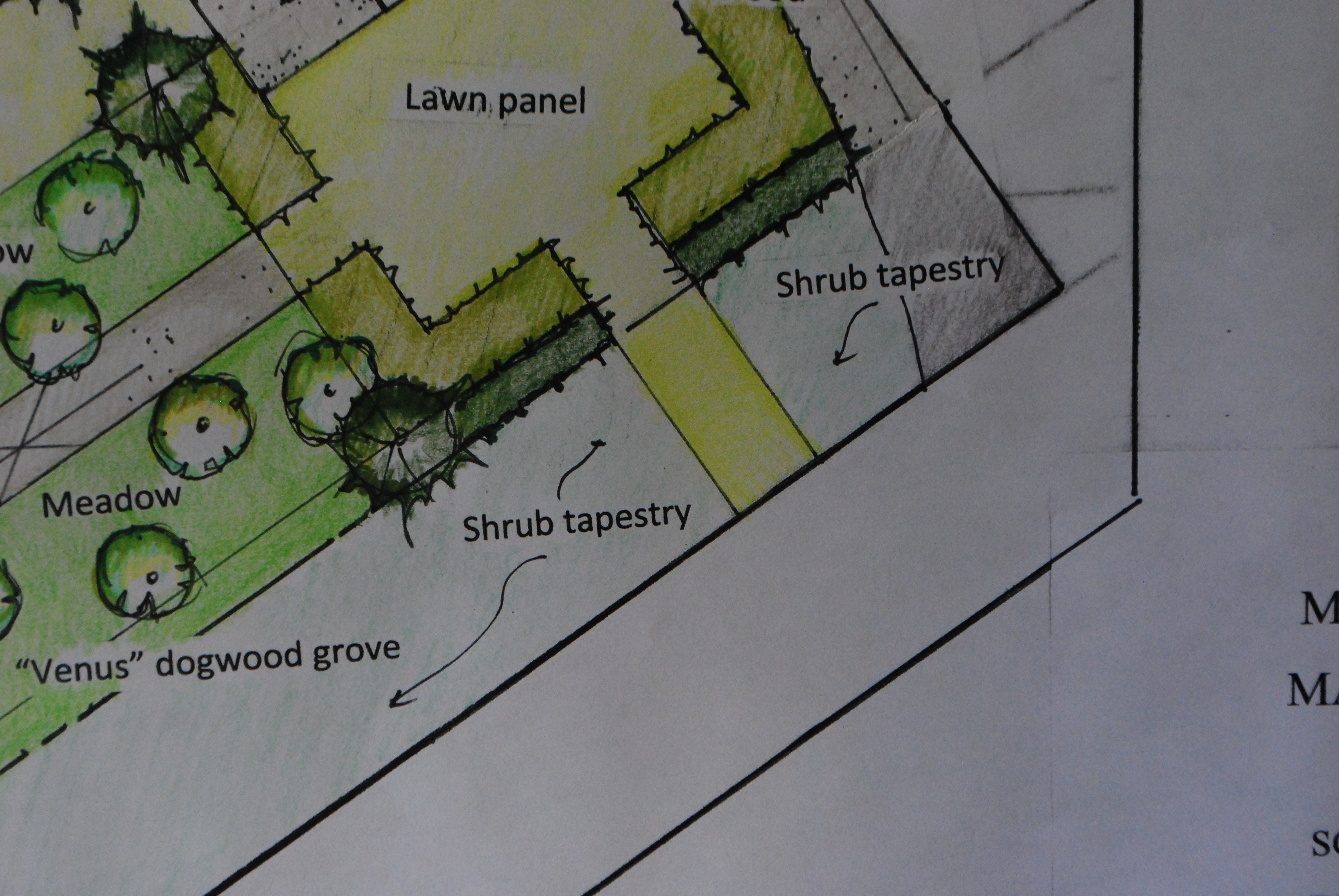
In the front, the distance between the hedge of Moonii yews and the road is 35 feet, but that footage is a steep slope, culminating in a drainage ditch.  The center of this slope will be the same short growing grass as the meadow.  This will permit a long view out, to the state lands across the road, from the front porch.  Shrubs will be planted into the slope where needed-lilacs, old fashioned spirea, viburnum, sumac, beauty bush-whatever seems right for a free for all mix.  Lucky the gardener that has enough land for a free for all. 
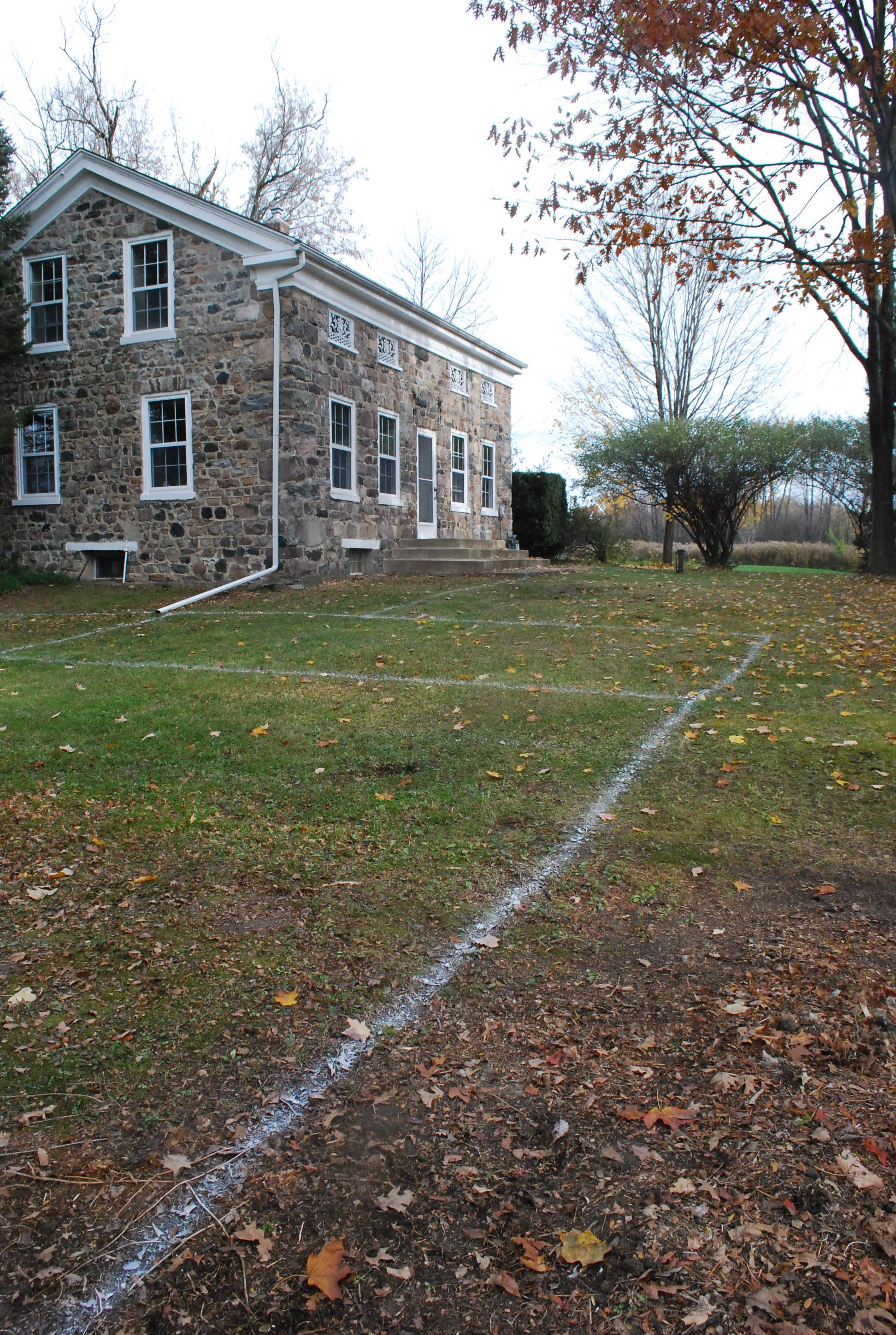
Of course the first step is to lay out the schematic plan, and see how it looks on the ground, full sized.  A lot of the preliminary tree work has already been done.  My clients seem to think the schem suits their property, their taste, and the history of the farm.  I am so pleased that this project is underway.   


Lighting The Side Yard

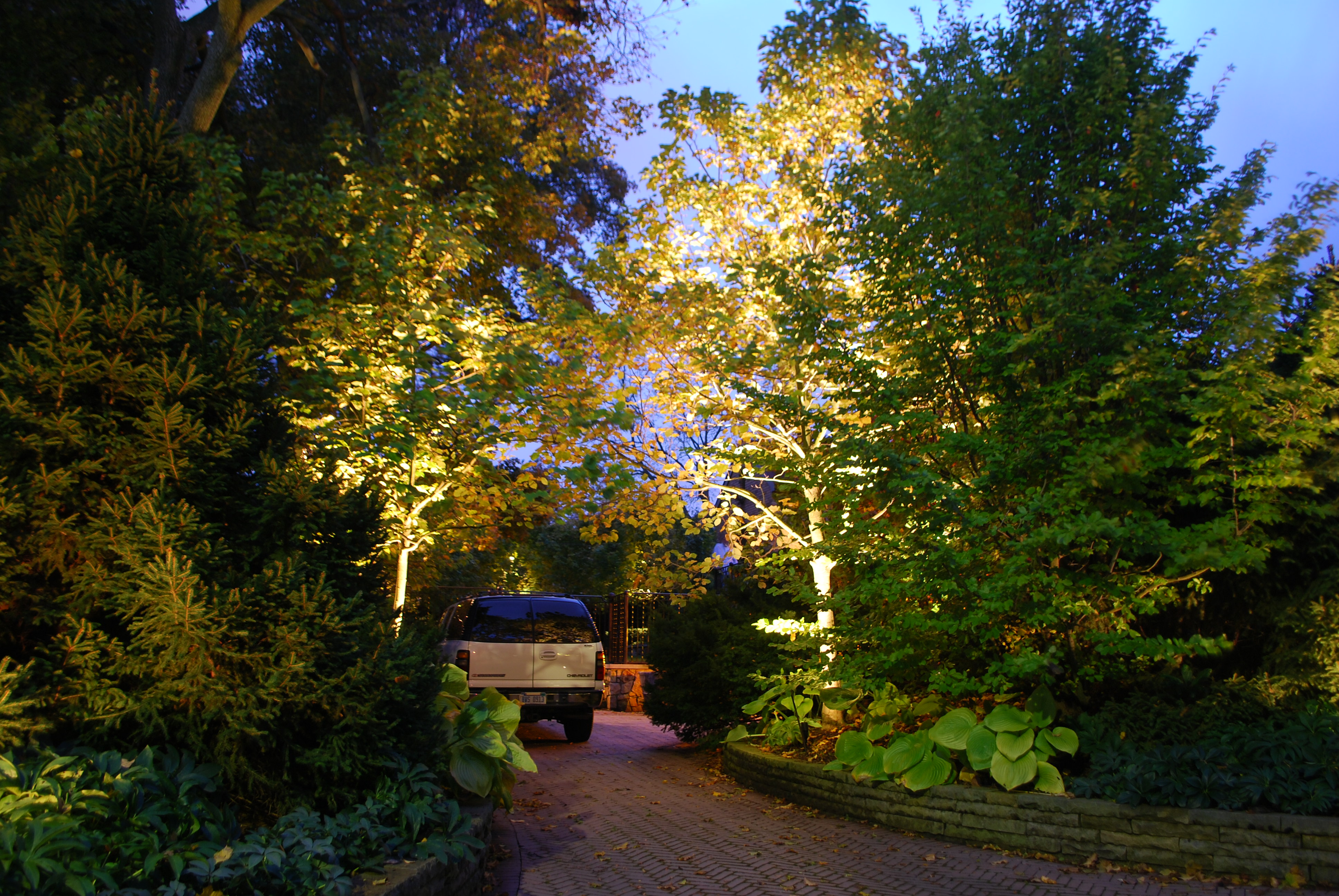
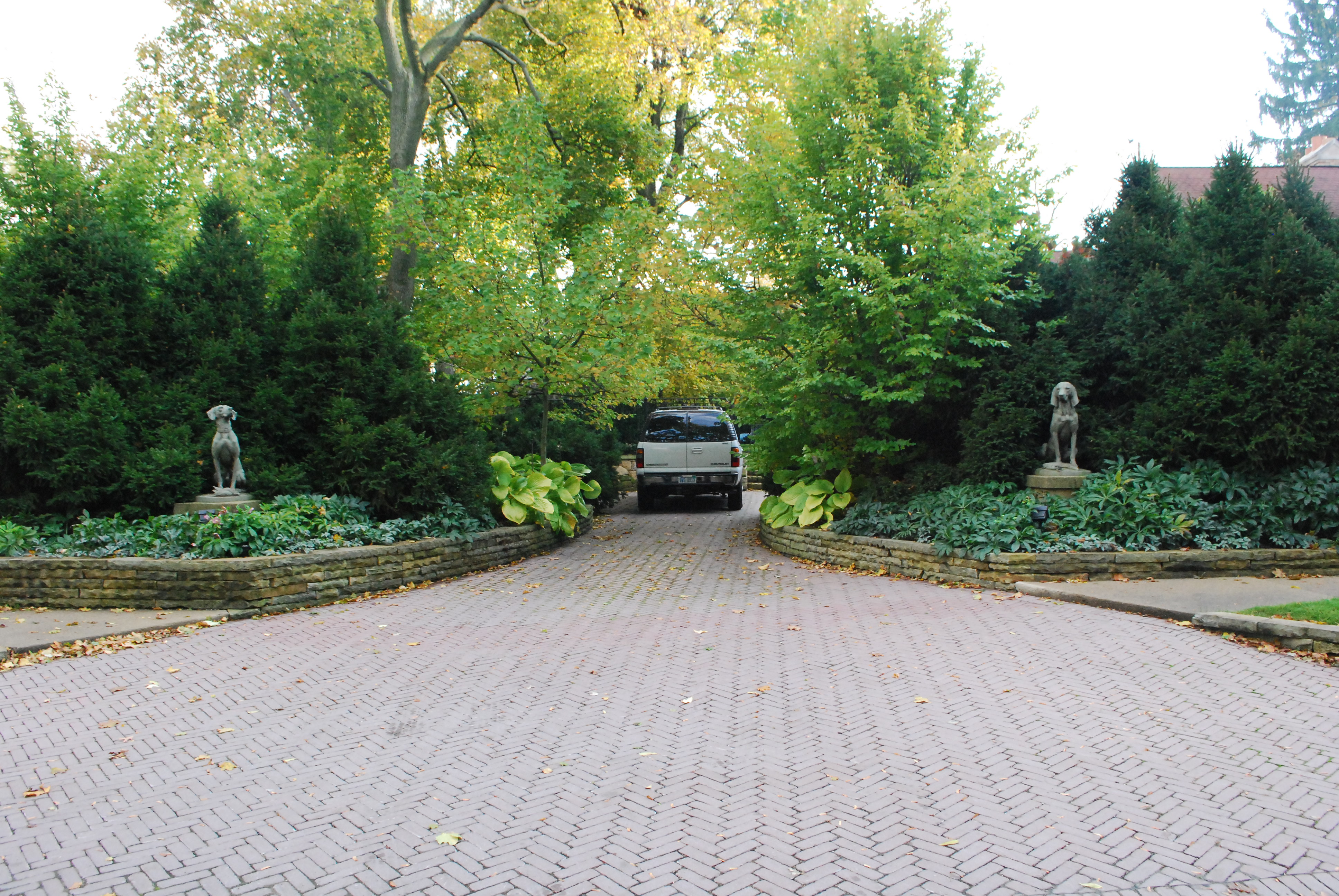
I really don’t have a back yard.  My property occupies a corner.  A front, on two sides-that is a corner lot.  I am sure that lack of a private back yard influenced the original design and configuration of my driveway.  Made of brick, (I have replaced the deteriorating original brick with concrete brick) it is incredibly wide at the street. (picture those 1930’s Packards turning in)  The drive narrows like an hourglass to a little over 8 feet wide, half way up.  That narrow gap was an effort to provide a little privacy to the side yard.  After 16 years of twice daily practice, I am able to get my Suburban out 99% of the time, without scraping the wheels on the retaining walls. 

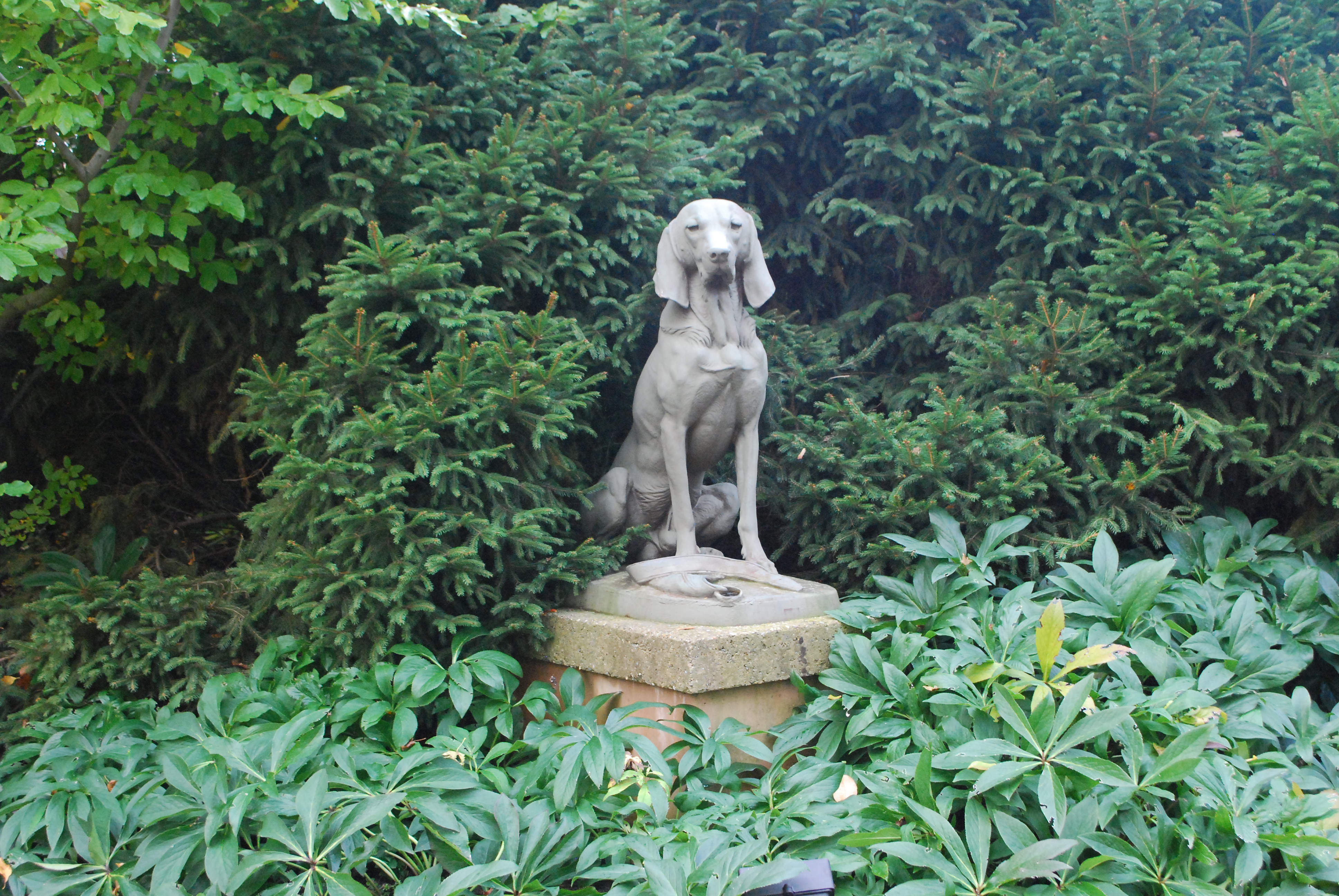
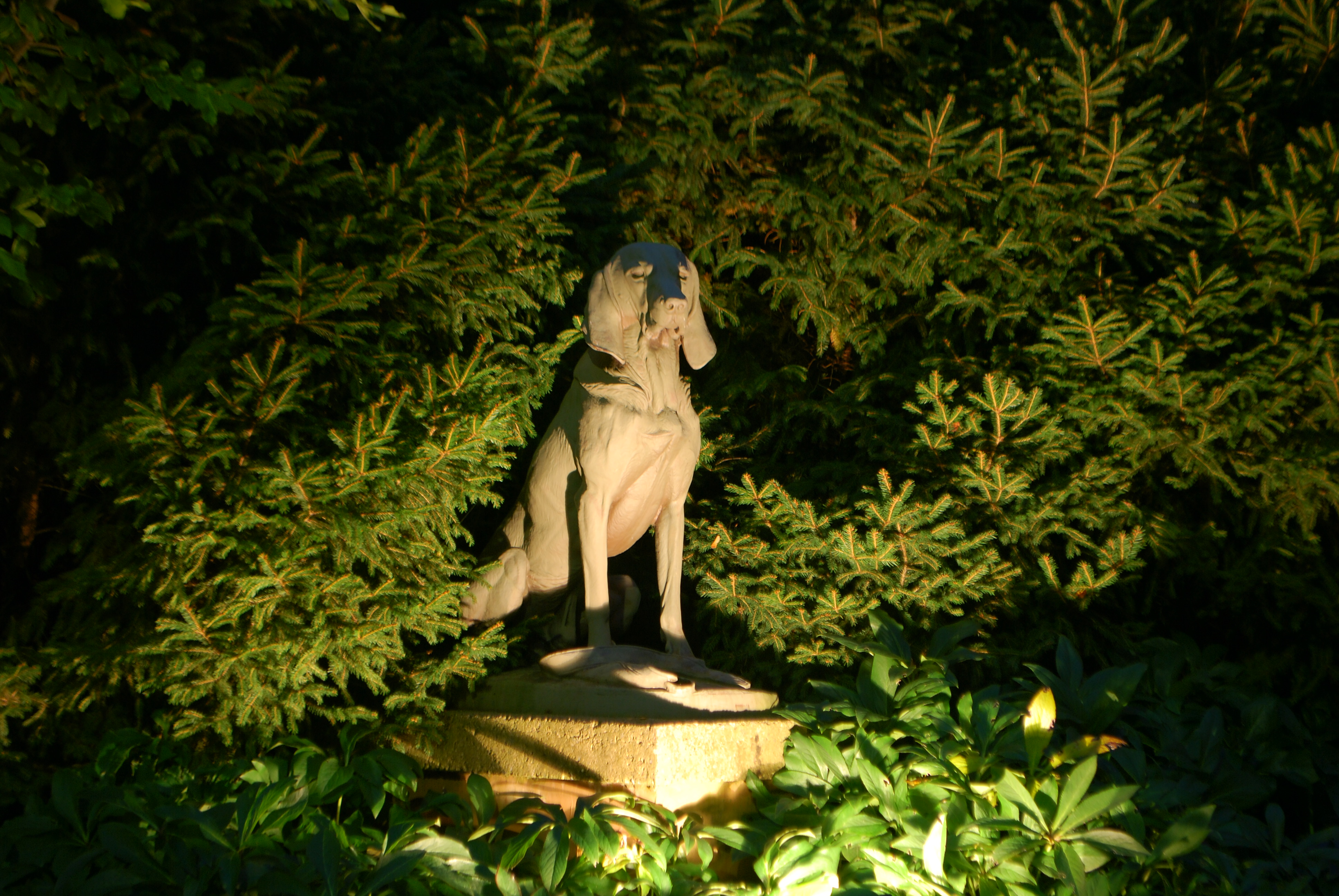
A pair of cast iron bloodhounds on concrete pedestals are awash in decent sized and fairly mature beds of hellebores-a favorite perennial. I look forward to seeing this every day-coming and going.  This makes it a natural candidate for some landscape lighting of the celebratory type.  I will soon be coming home after dark, and I don’t want to give up the view of my dogs.   

This first pass- the light is too close, and too hot.  The intense light creates shadows that make the dog look threatening. That is not my intention.  The idea is that I get a welcome home.  The winter season would be bearable, but for the gray and the dark.     

A pair of Galaxy magnolias are planted in the narrowest part of the drive.  They have been there long enough to make a green arbor of magnolia branches overhead.  That narrow spot is the darkest spot on my property.  A big stand of dark green Picea Mucrunulatum and taxus densiformis make this moment in my landscape feel like a black hole in the winter.   

I don’t mind some stronger light here.  It helps me to get through the driveway isthmus without incident.  OInce the magnolias have dropped their leaves, the light be be much more subtle.  This landscape lighting helps me navigate. 

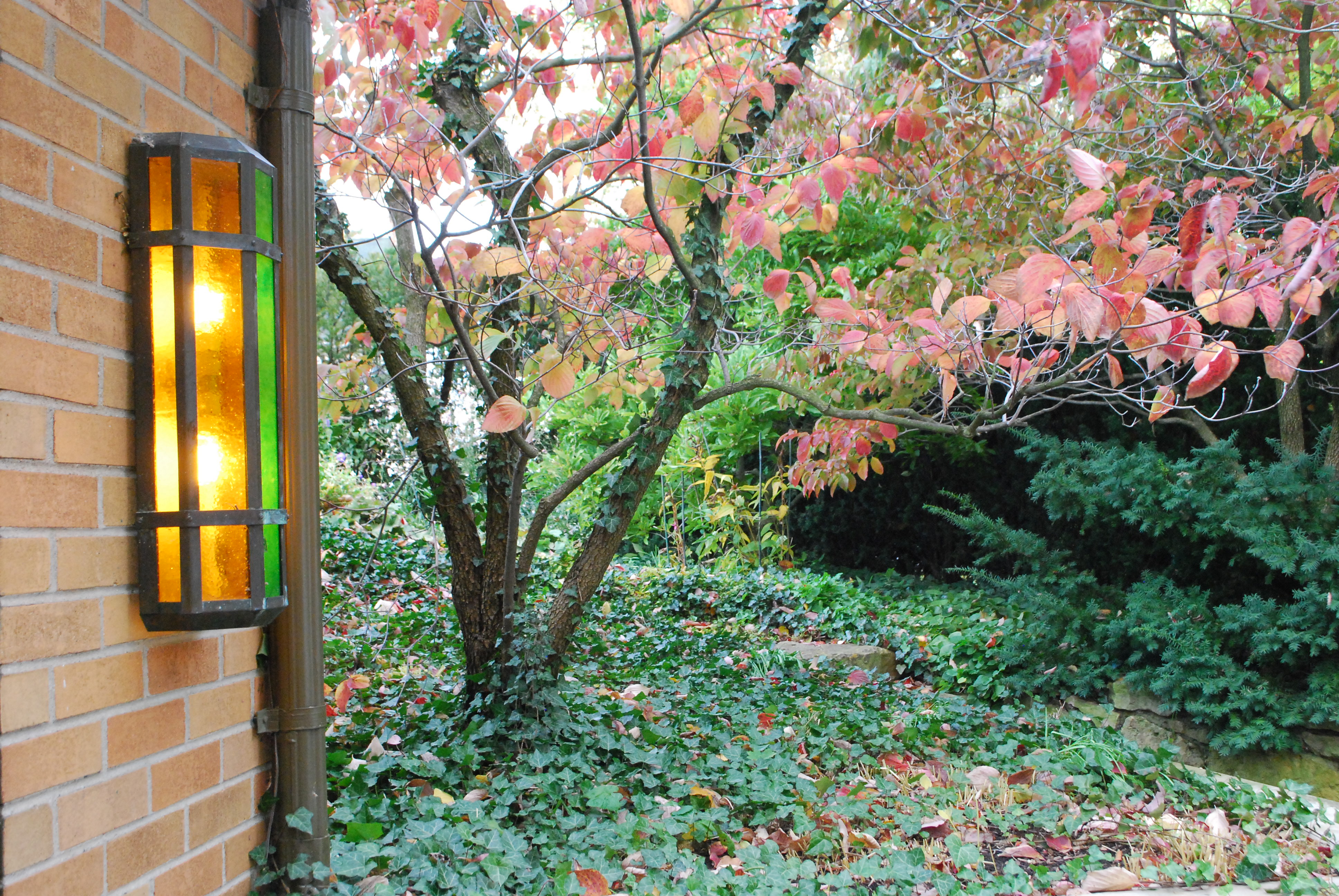
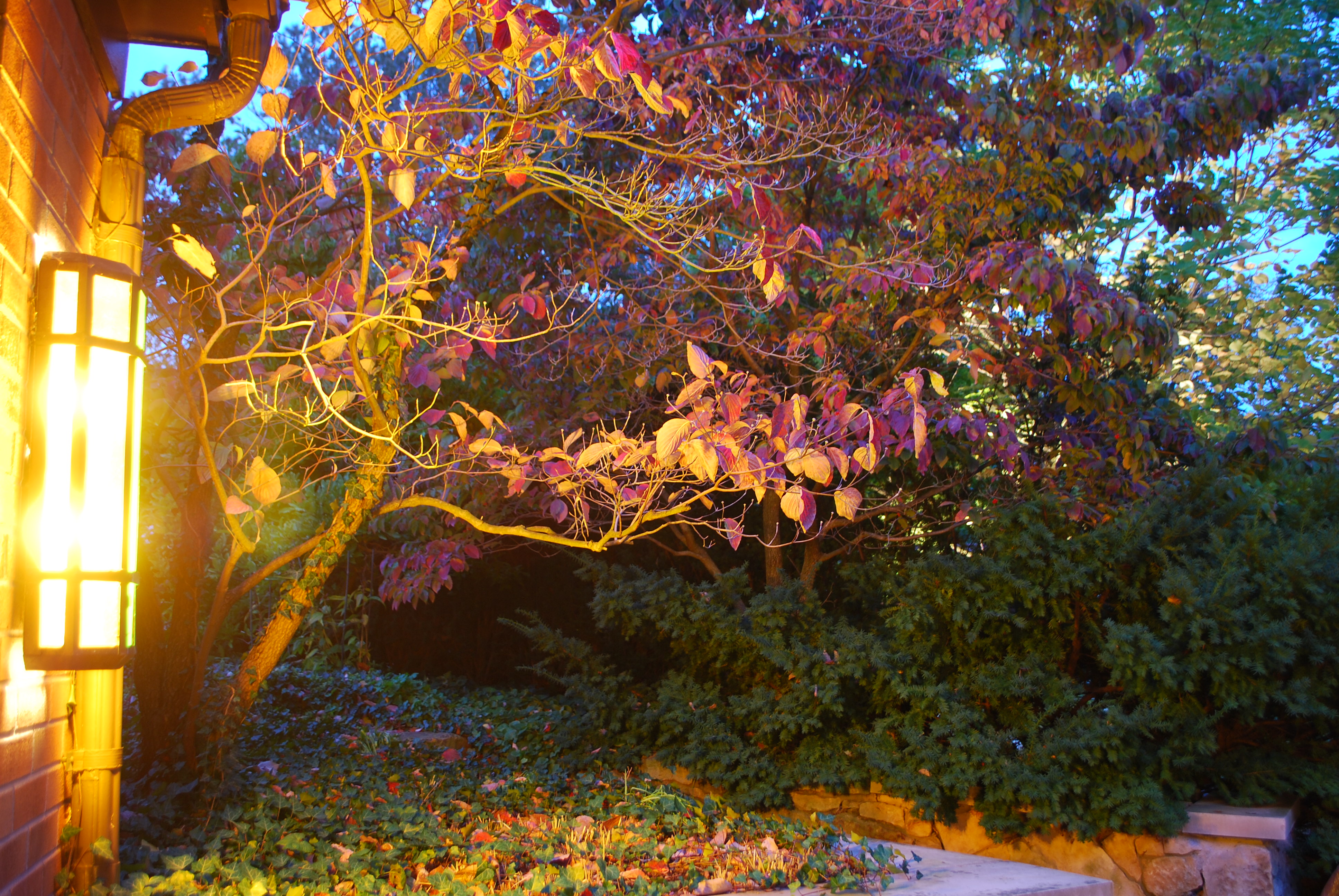
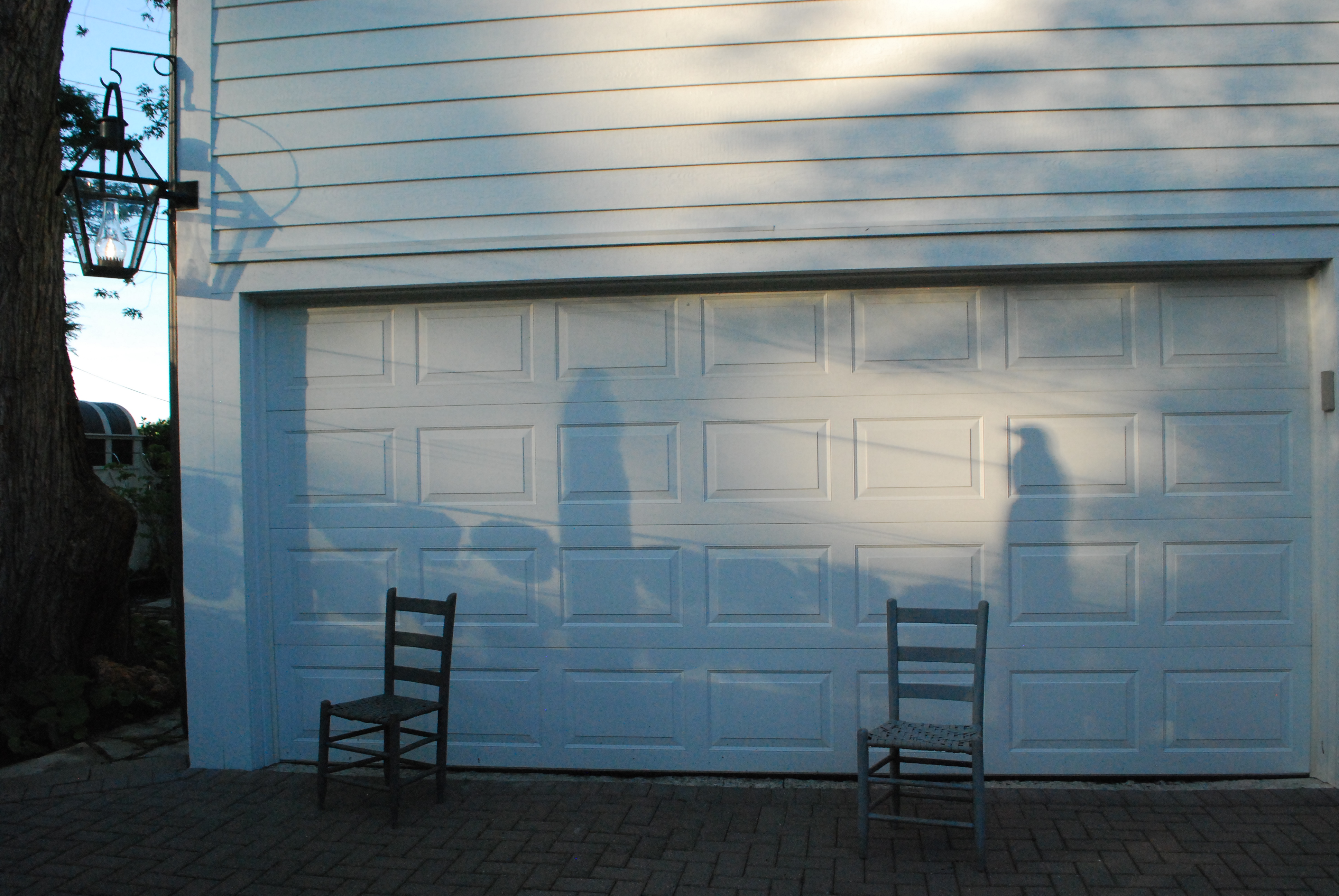
A friend found these Arts and Crafts style vintage light fixtures for me-they are perfect on either side of the garage.  They are always on.  Summer and winter.  Day and night.  I never tire of seeing them.  Early on a spring morning, or late on a summer day, they let me know they are there.  

Once the skies go dark, they help light my way.  Good landscape lighting is as much about function as beauty.  Though no light could ever possibly be as beautiful, in all of its variations, as natural light, the invention of electricity did indeed change the landscape. 
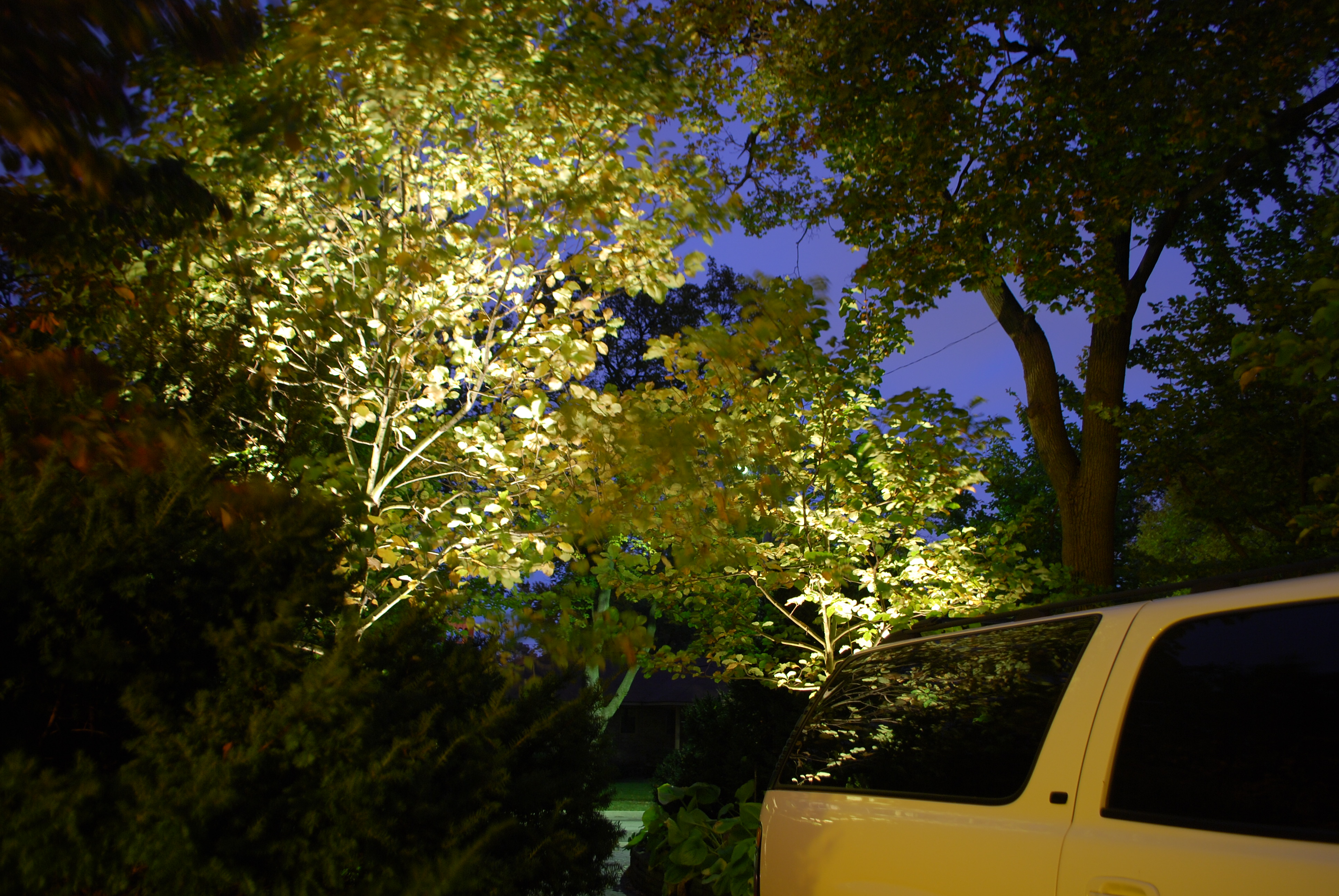
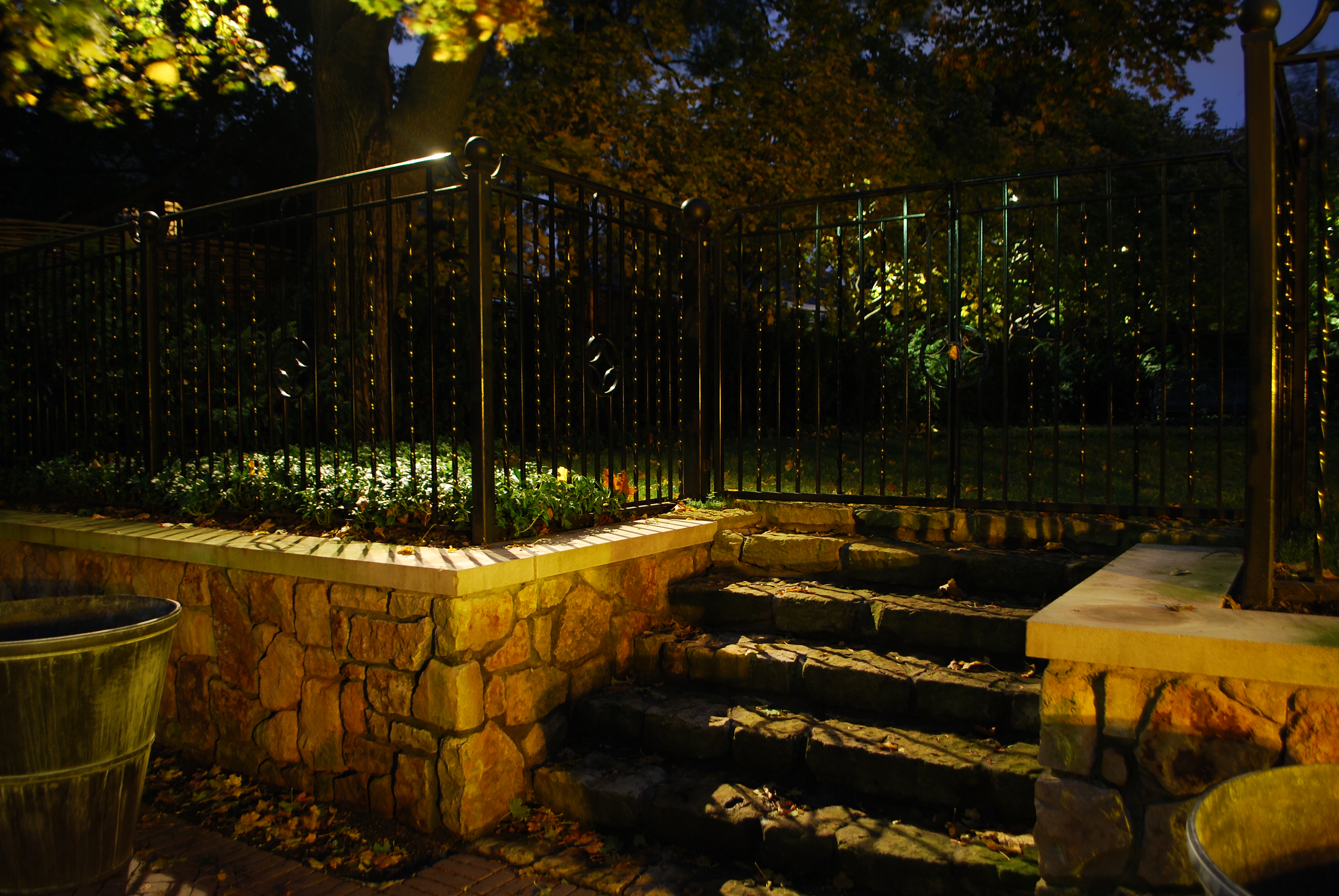
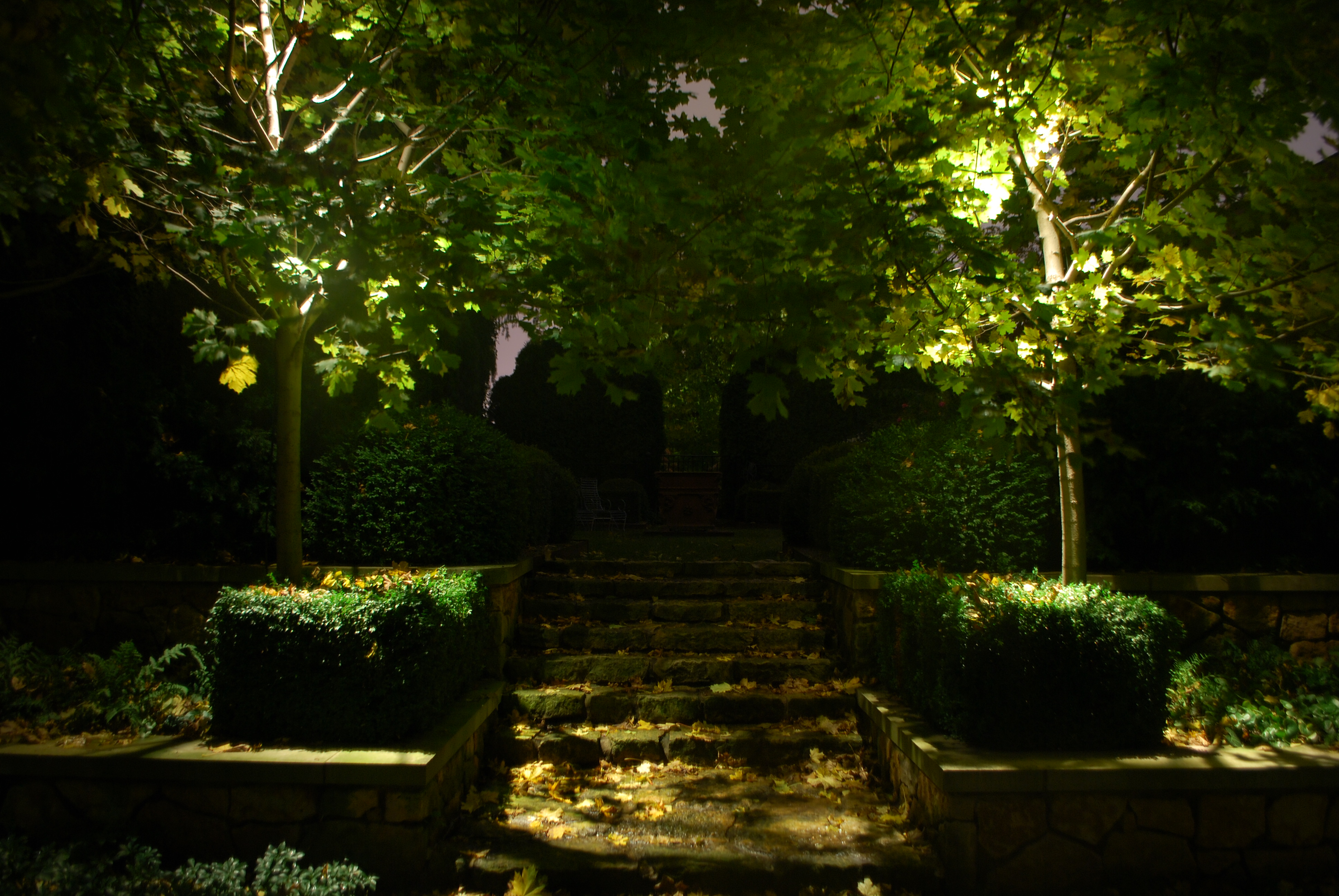
A flight of stone stairs begin at the driveway, and end in the upper level fountain garden.  My giant old Norway maple is a benign host to 3 spotlights that light up the drive where I park, and those stairs.  This light from above illuminates my path to the garage door, and to the upper garden, should I decide to go that route.  This lighting is not so much about a favorite landscape feature as it is about safe passage. 

Buck shut the fountain down yesterday.  It is clogged with leaves, and the weather is too chilly to linger here.  This is my most unfavorite day of the gardening year.  Water in a garden is enchanting.  serene.  sparkly and lively.  I hate having to give it up.  Next weekend he will drain the water from the fountain.  I have always disliked the coming of the end for this garden. 

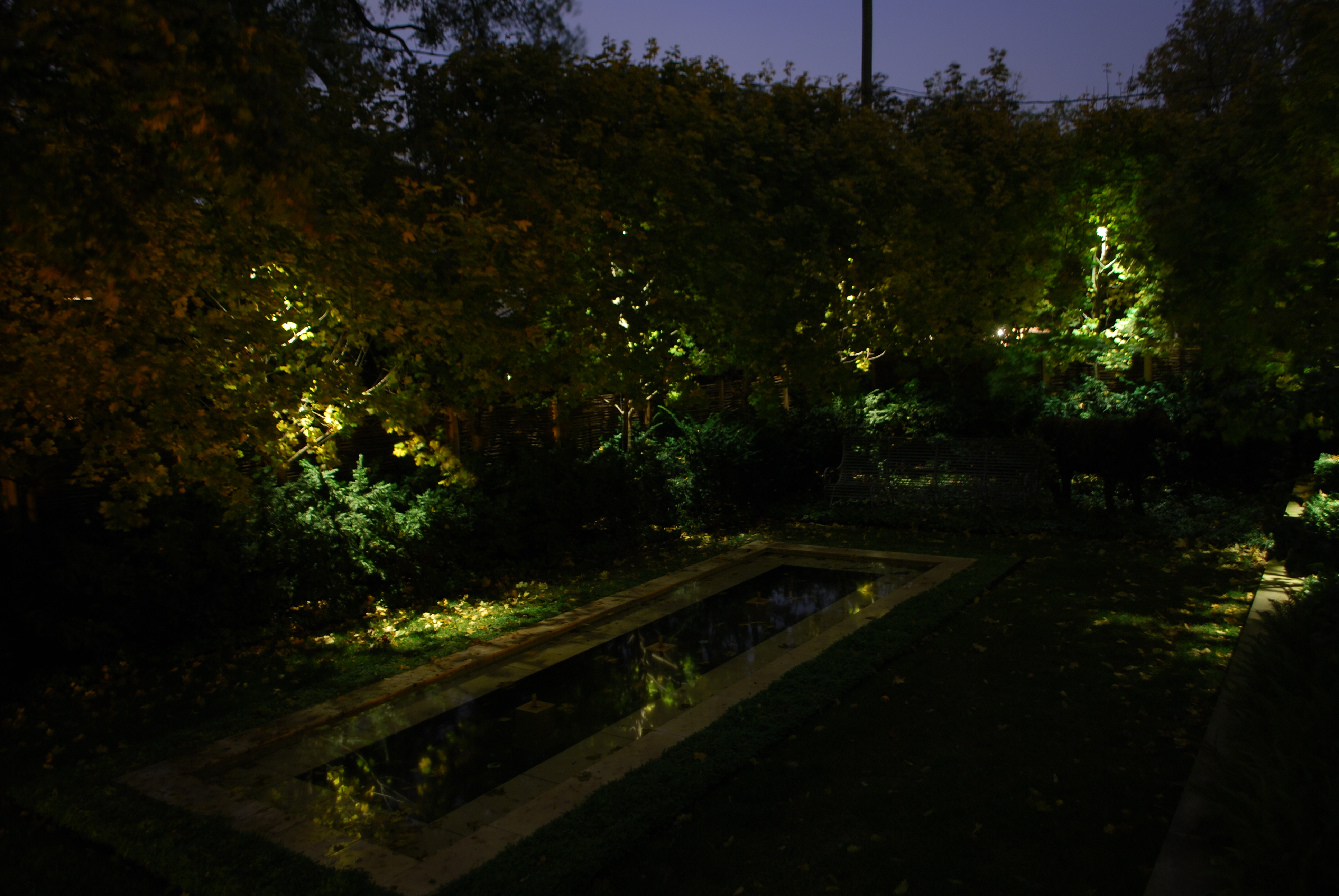
Lighting from high in the Princeton Gold maples makes it easy for me to keep track of the Corgis after work.  The lighting also transforms this garden into another garden particular to the season.  My bedroom has a window that looks out on the fountain.  All winter long I keep the shade half up, and the window slightly open.  The lighting will allow me to enjoy this part of my garden, no matter the weather.

I do have a flight of stairs to the rose garden.  The stone is rough, and uneven.  For months after my knee replacement, Buck helped me walk up these stairs.  My new knee now-perfect.  But I would not walk up there stairs in the dark. 

Buck and I usually have dinner late-7:30-sometimes 8:30.  I take the Corgis out for a final constitutional, after dinner.  Milling around in the complete and utter dark with them-not my idea of a swell time.  I love these downlights in my maples.  Lighting a landscape might help provide more of what you need from a great garden than what is apparent on a summer day.  My idea?  Light, whether it be from the sky, or the end result of an electrical connection, is an important element of landscape design.  The landscape at night-a different sort landscape experience.    


Garden Designer’s Roundtable: The Details

When I first met Buck, he was head of technical design at Rossetti Architects.  Though his usual gig involved sports stadiums and office buildings, he had designed, and was project managing a very large and involved residential project-some 5 years in the building.  I had occasion to meet him, as I was responsible for the design and installation of the landscape.   

I was also involved in the design of the conservatory, which was built by Tanglewood. There were a number of garden elements and ornament that got built over the course of three years.  What I learned from Buck is that careful attention to the details makes the difference between an acceptable project, and a project that turns heads.

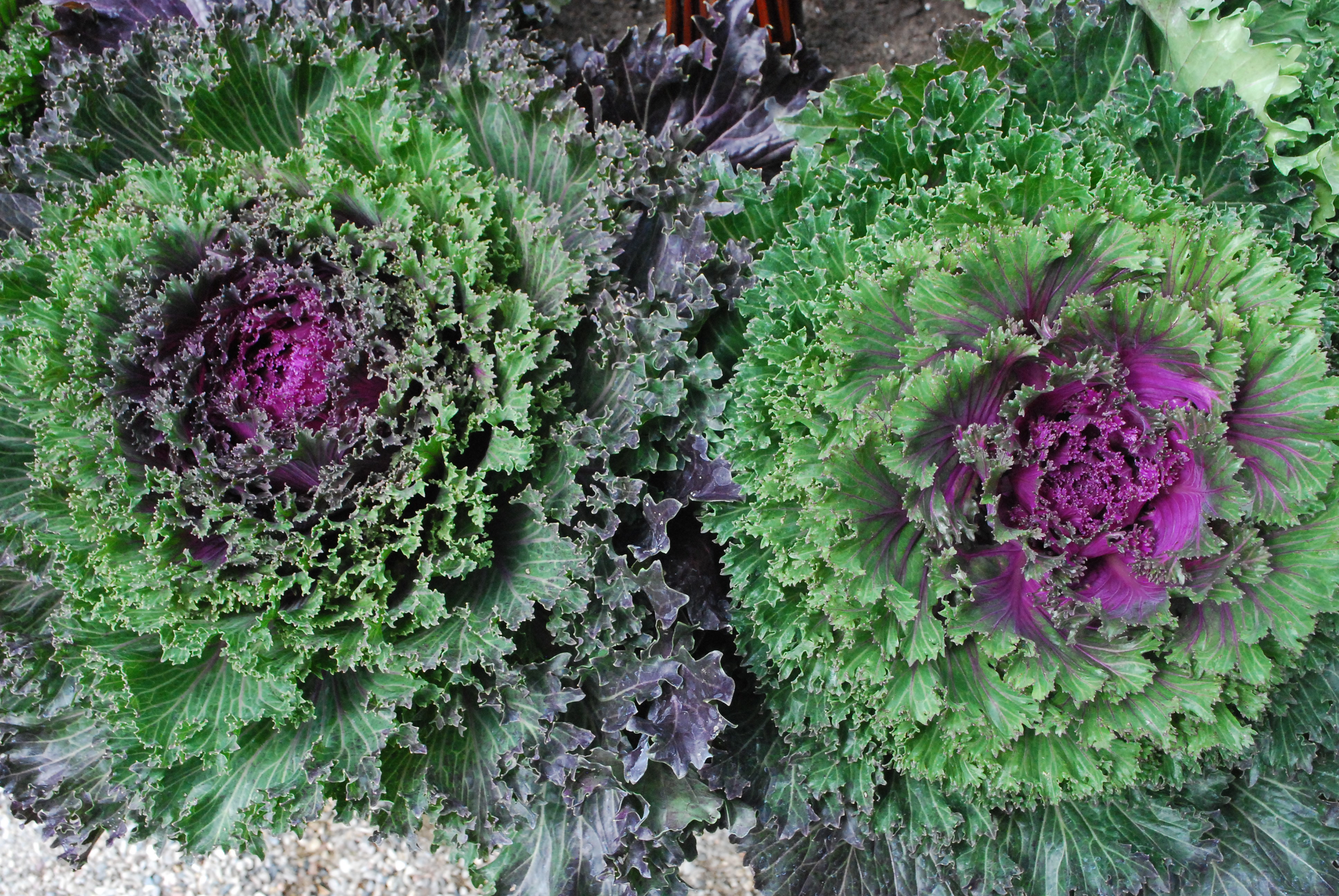
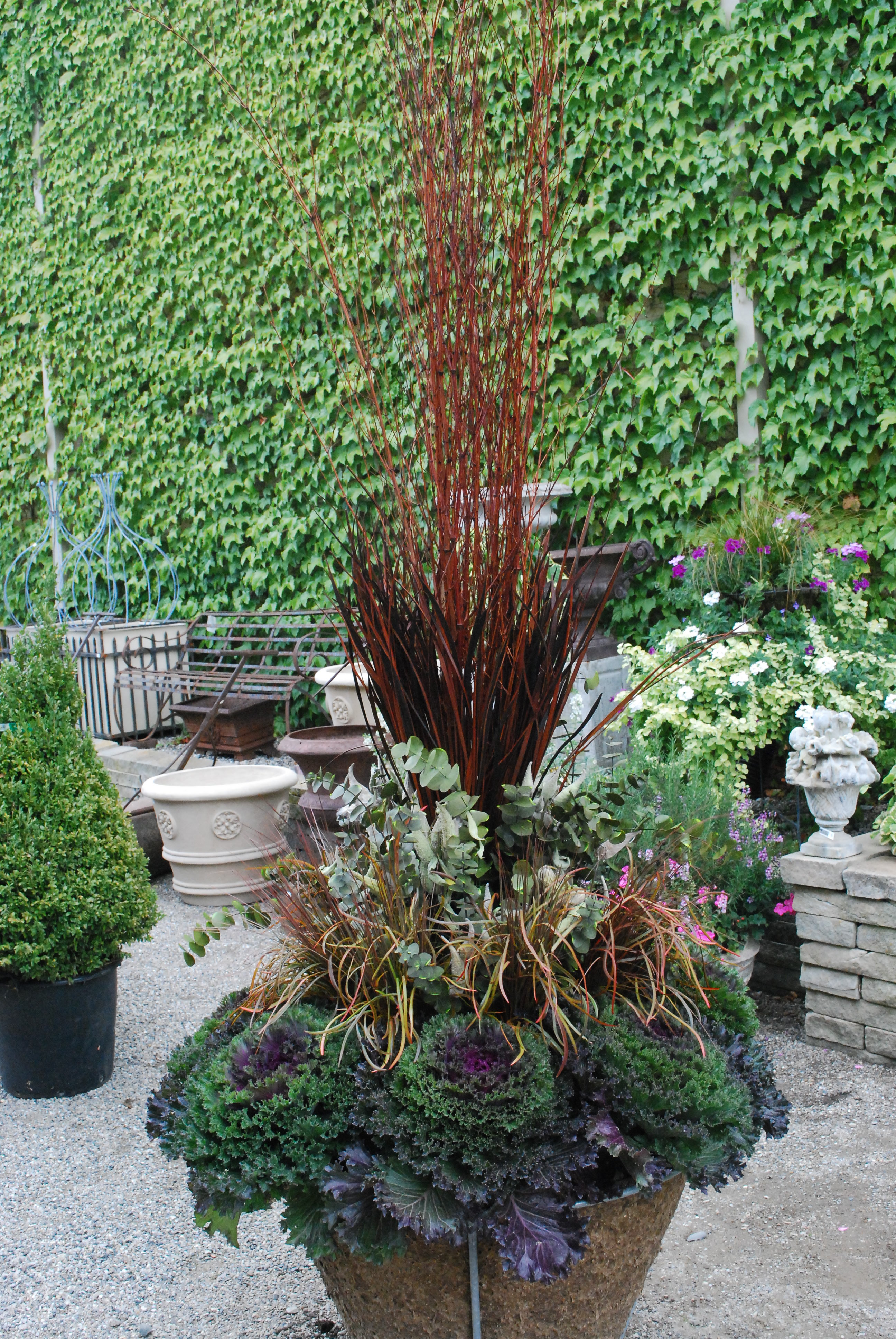
Most every day I would get an email from him-do you have a drawing for this detail?  I did more drawing for him those three years than I have done before or since.  But what I really learned from him-the devil is in the details.    In designing this fall arrangement, I began with a great plant.  Kale “Glamour Red” is the first All America plant selection in 78 years- the first new kale introduction since 1932.  This is a detail that suggests this is a plant worth planting.  Sometimes construction details can tell whether an idea will work, or not.  I like my fall pots to look lush and sumptuous-after all, this is the season we associate with the harvest.  The construction of a strong and sturdy fall container involves much more than the planting.     

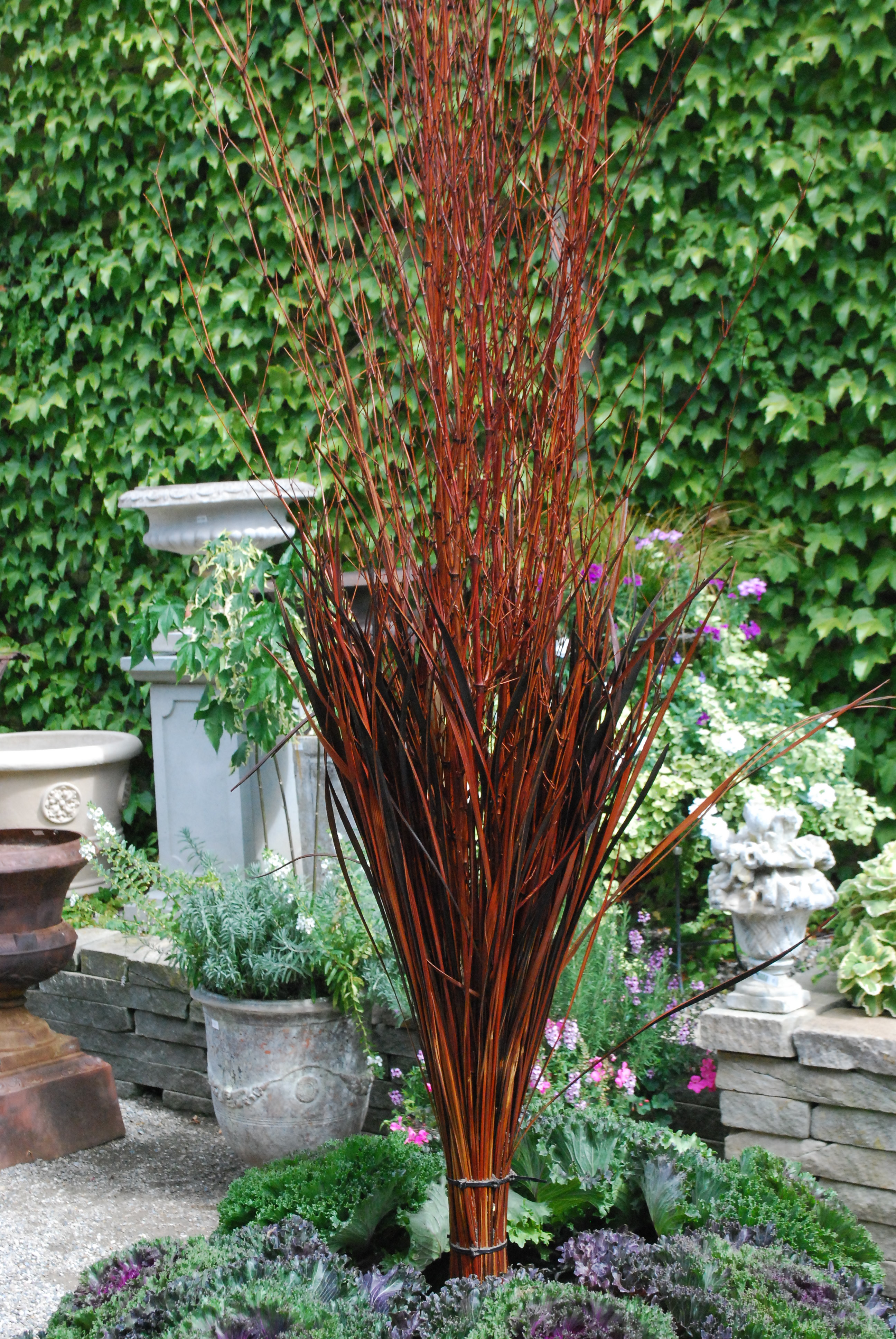
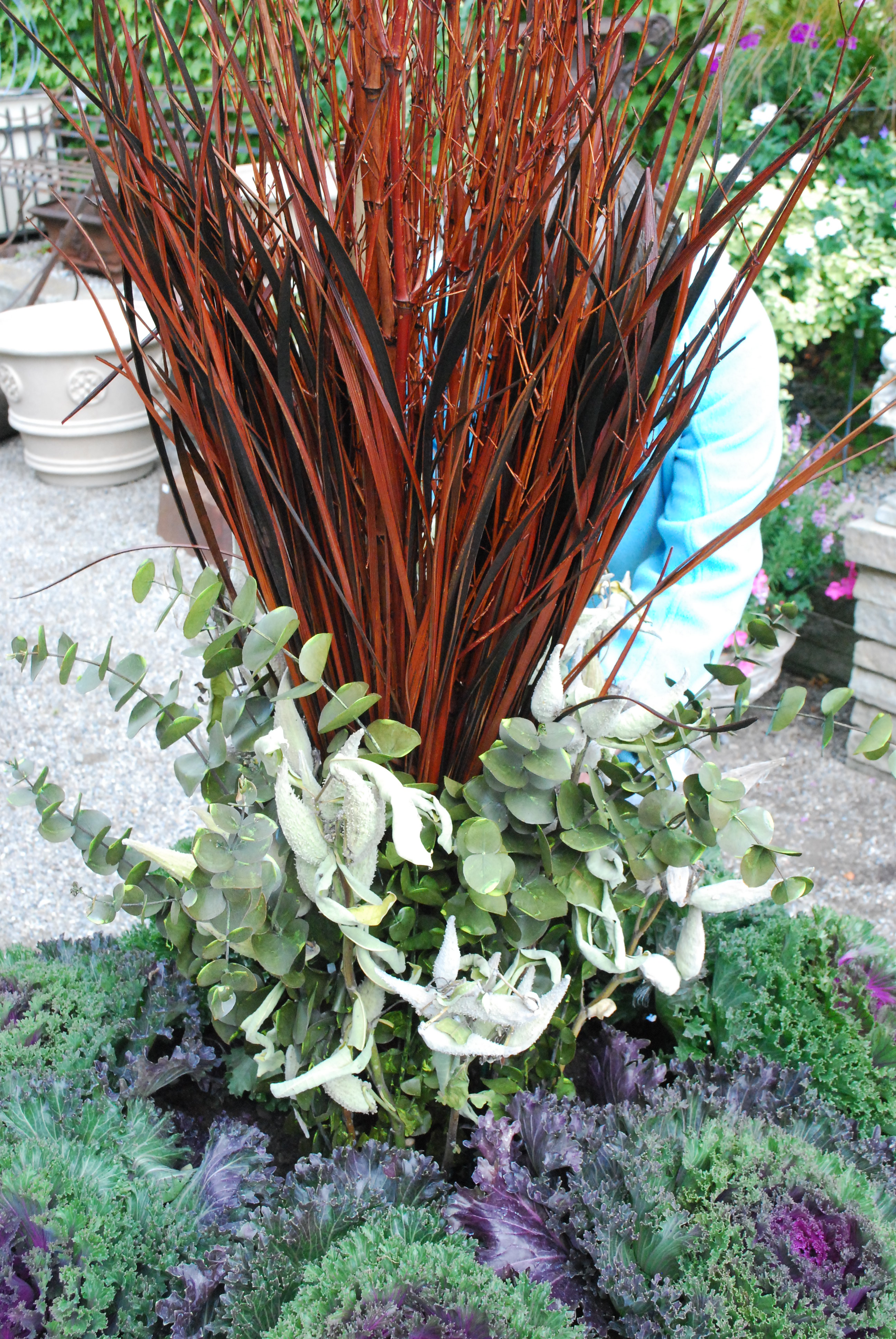
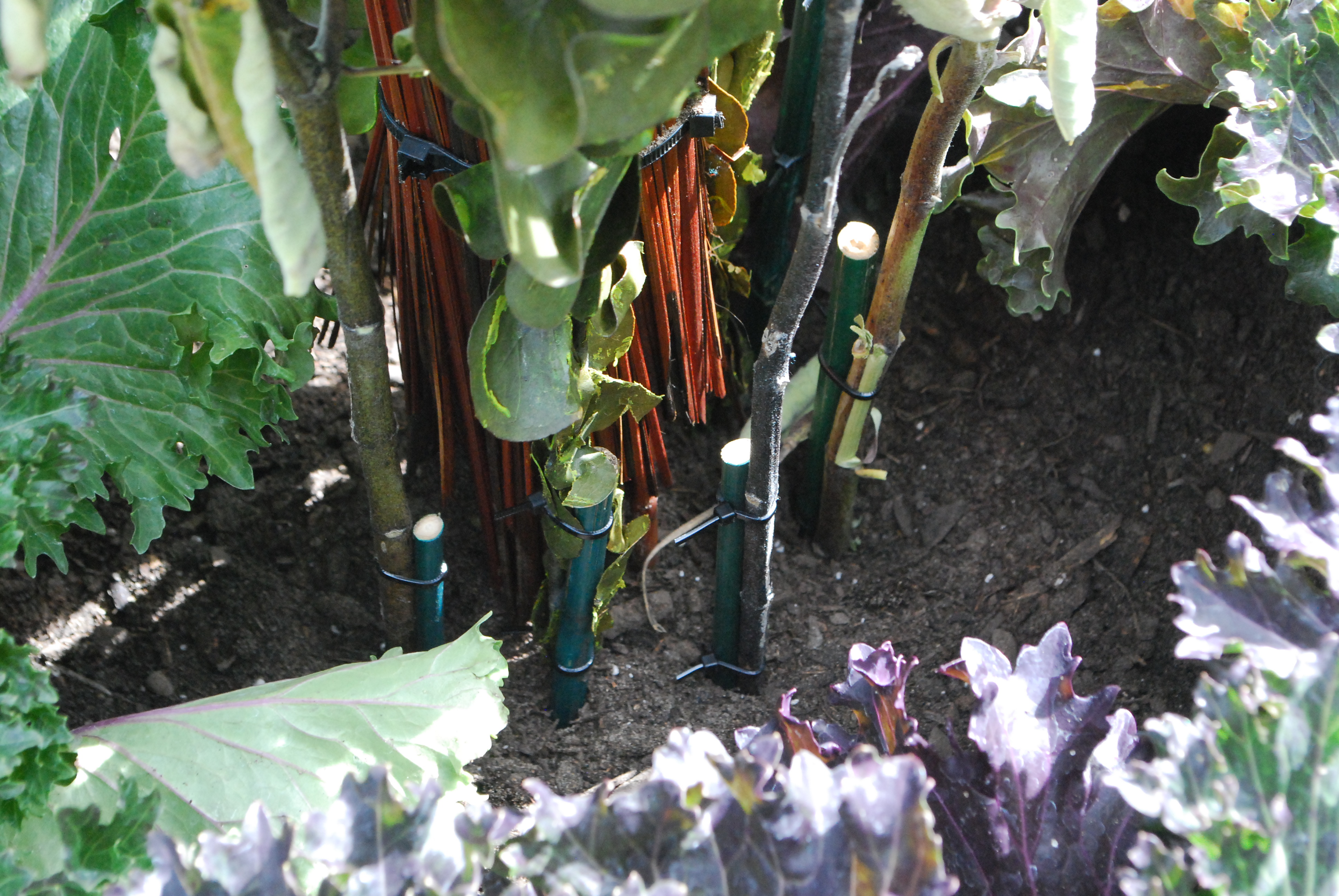
We may assemble a centerpiece of twigs and dried seed pods. That centerpiece gets zip tied together over a stout bamboo stake.  A fall container centerpiece listing out of vertical detracts from the overall effect.  Our bamboo stakes go way down into a container.  The soil around that centerpiece gets compacted-with a mallet.  Straight up and down-a detail that makes for a good result. We spotted a clump of green milkweed pods on the side of the road-they would make a great addition to this container arrangement. 

A centerpiece may need lots of elements-especially if you are going for that sumptuous look.  I like fall pots with loads of visual detail.   Dried or preserved materials surrounding that centerpiece need a construction detail that enables you to place them wherever they look good.  And most of all, a detail that helps them to stay put throughout the season.  

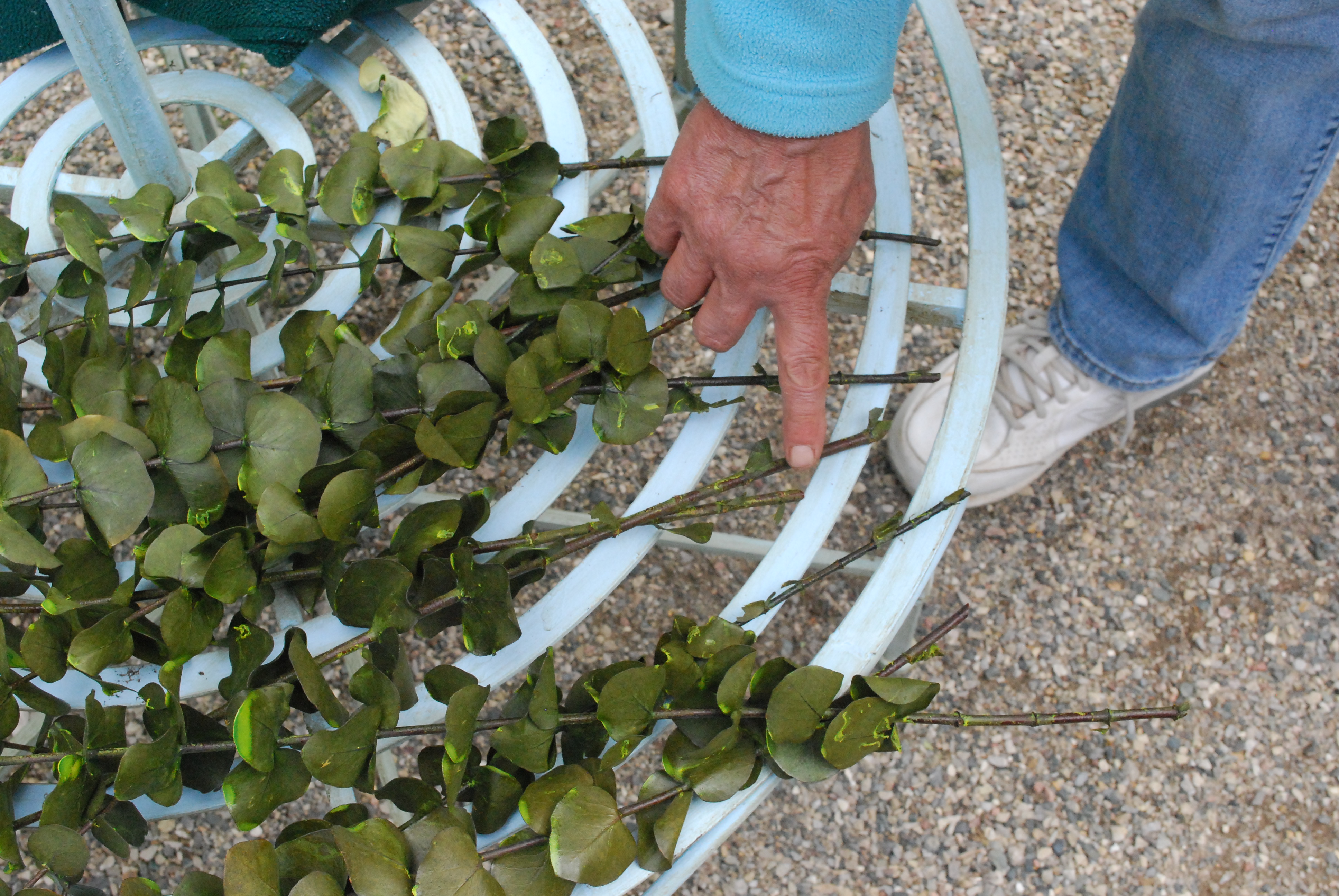
The eucalyptus and butterfly weed seed pods-we attached each stem to a bamboo stake with a pair of zip ties.  Natural materials are beautiful, but their stems do not have near the strength of a stake.  Attaching natural stems to bamboo stakes is time consuming-but this construction detail makes the end result look more natural, and last longer.  The frilly cabbage leaves cover the working part of the arrangement.

Preserved eucalyptus does have very strong stems.  Should I strip off the lower leaves, I have a stem that I can stick into the the soil, at the angle that seems best.  A detail worth noting here- preserved eucalyptus will keep its shape and color a very long time-even outdoors.  The variety of colors and textures available can add so much to a fall arrangement.

Faux fall grasses-I will confess that I buy them and have them available.  The palette of plants that thrive in cool fall temperatures is somewhat limited.  Adding roadside weeds, pumpkins and gourds, preserved materials, dried sticks and seed pods, and even plastic grass stems in a fall pot is much like adding a little jewelry to a black dress.     

I looked over this fall planting a number of times.  I kept coming back to it.  Is this the best I could do?  The best always involves attention to the details.  Finally, I decided the faux grass seemed a little to heavy.  A container planting should never drag the eye down. It did give a sense of warmth and drama to the arrangement, but would something else be better? 

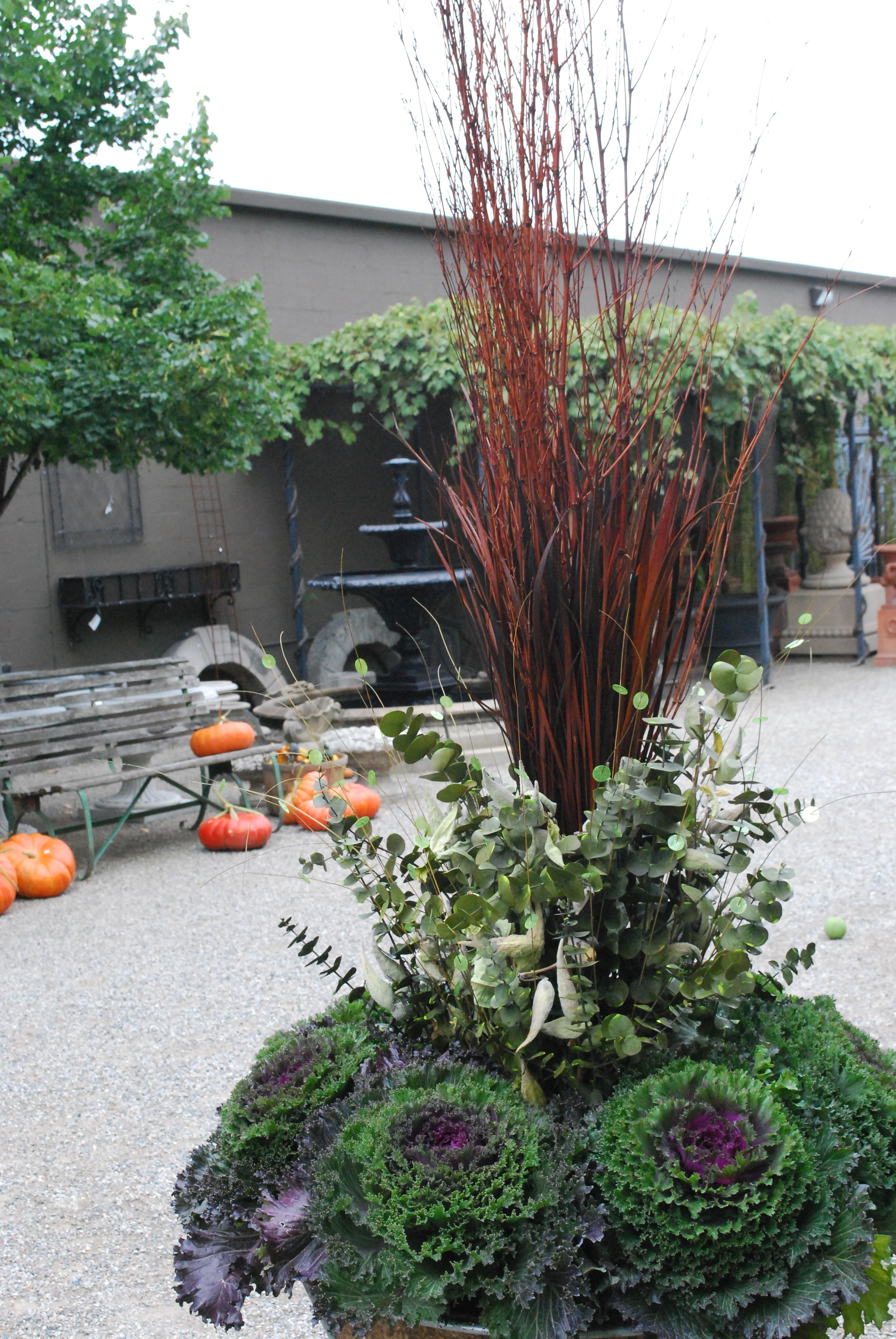
Individual stems of ting with capiz shell circles-not a choice that would instantly come to mind.  But why not try it?  The stems have the grace and texture of grass.  The whole arrangement looks looser, more airy.  The green of the capiz shell discs brings out that luscious green in the kale. 

Any move made by a gardener is all about the details.  Personal details.  This gesture, or that-very personal.  The little details can transform an idea into a party.  From a distance, the overall impression is generous in scale and harmonious in color.

At this point in the making of a fall arrangement, a single detail added or subtracted can dramatically change the visual effect of the whole.  A detailed construction means the pot will look good throught the fall.  A visual detail says much about what you personally think is good looking.


I am sure that the other member of the Garden Designers Roundtable have interesting and individual ideas about the role that detail plays in good design-check them out! 


Susan Cohan : Miss Rumphius’ Rules : Chatham, NJ

Lesley Hegarty & Robert Webber : Hegarty Webber Partnership : Bristol, UK

Debbie Roberts : A Garden of Possibilities : Stamford, CT

Christina Salwitz : Personal Garden Coach : Renton, WA

Scott Hokunson : Blue Heron Landscapes : Granby, CT

Rebecca Sweet : Gossip In The Garden : Los Altos, CA


One Man’s Garden

galvanized wire bracket

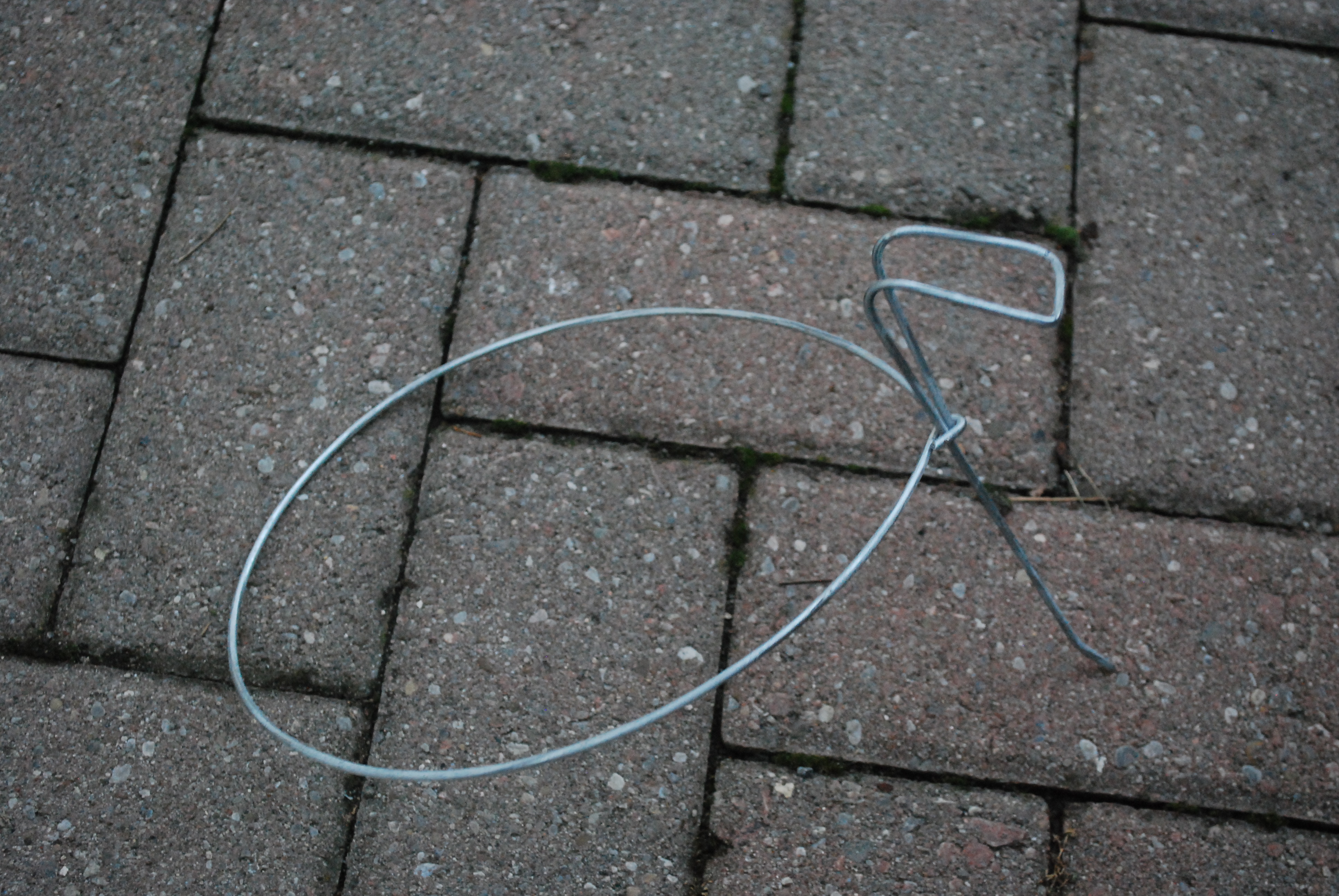
We had dinner over the weekend a the home of a good friend.  Barry Harrison is a design principal with Art-Harrison, a interior design studio well known in my area.  In addition to their interior design practice, they manufacture a line of fine furniture.  Each piece is meticulously hand crafted and carved from fine hardwoods.  Interested to read more?  www.artharrison.net.    Barry is a highly skilled designer, cabinetmaker and wood carver, as evidenced in his own garden.  Years ago Barry spent some time at Ford Motor Company-he could draw an entire headlight assembly for a owner’s manual-free hand.  Think this part through-a freehand drawing of a headlight assembly?  His talents are extraordinary.  As much a designer as he is an artist, one part of Barry’s garden began with this simple part-a galvanized steel hook that would hold clay pots.

Barry lives in an urban neighborhood on a very small piece of property.  Every gesture he makes has to work-there is no room really for unresolved design.  This corner of his driveway is just a few feet from the garage doors, meaning he visits this spot every day, both going and coming.  The distance from the edge of his drive to the lot line at this back corner is 12 inches at best.  There was no option for screening plants in such a small space, but there was an option for a screen. 

cedar fence posts

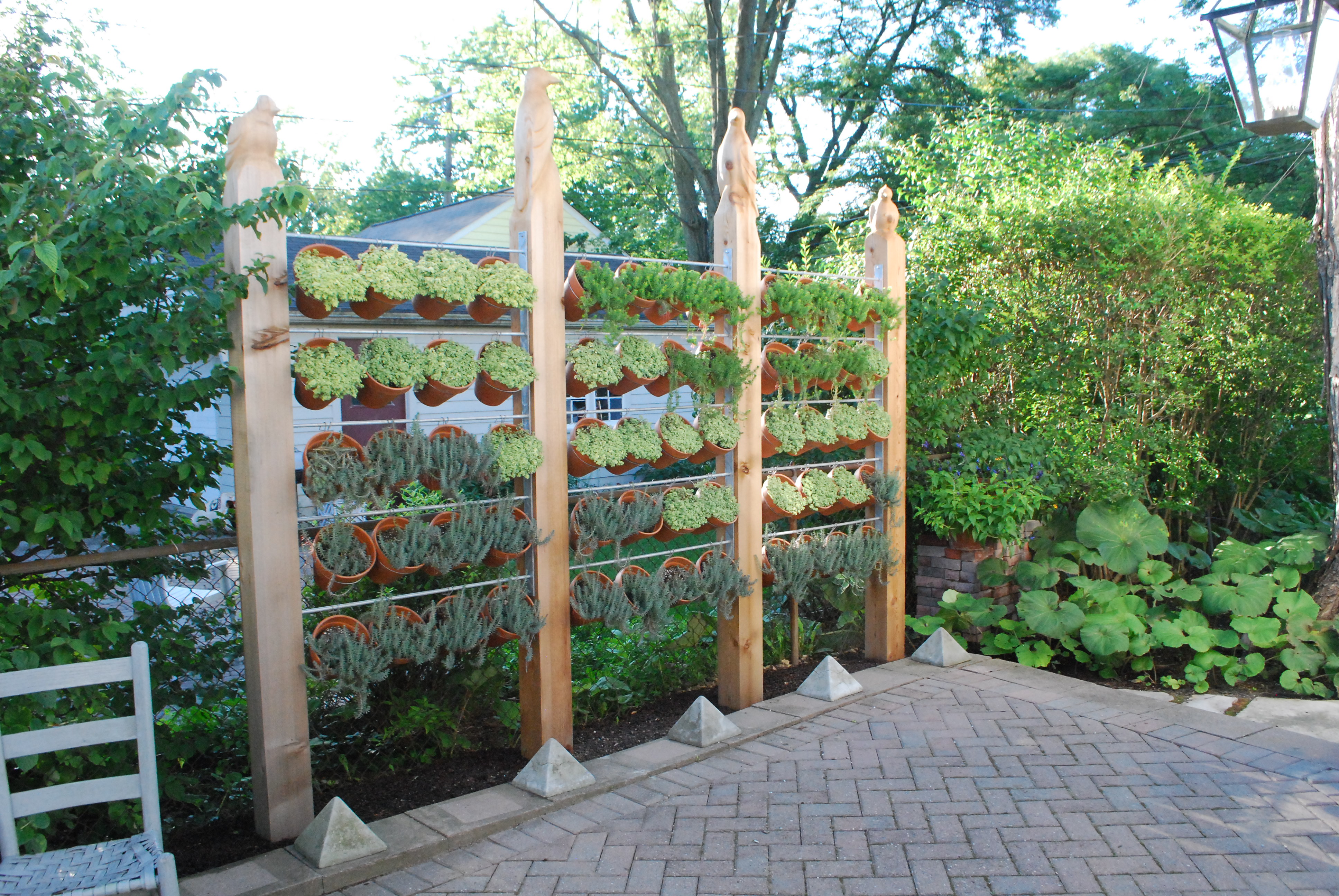
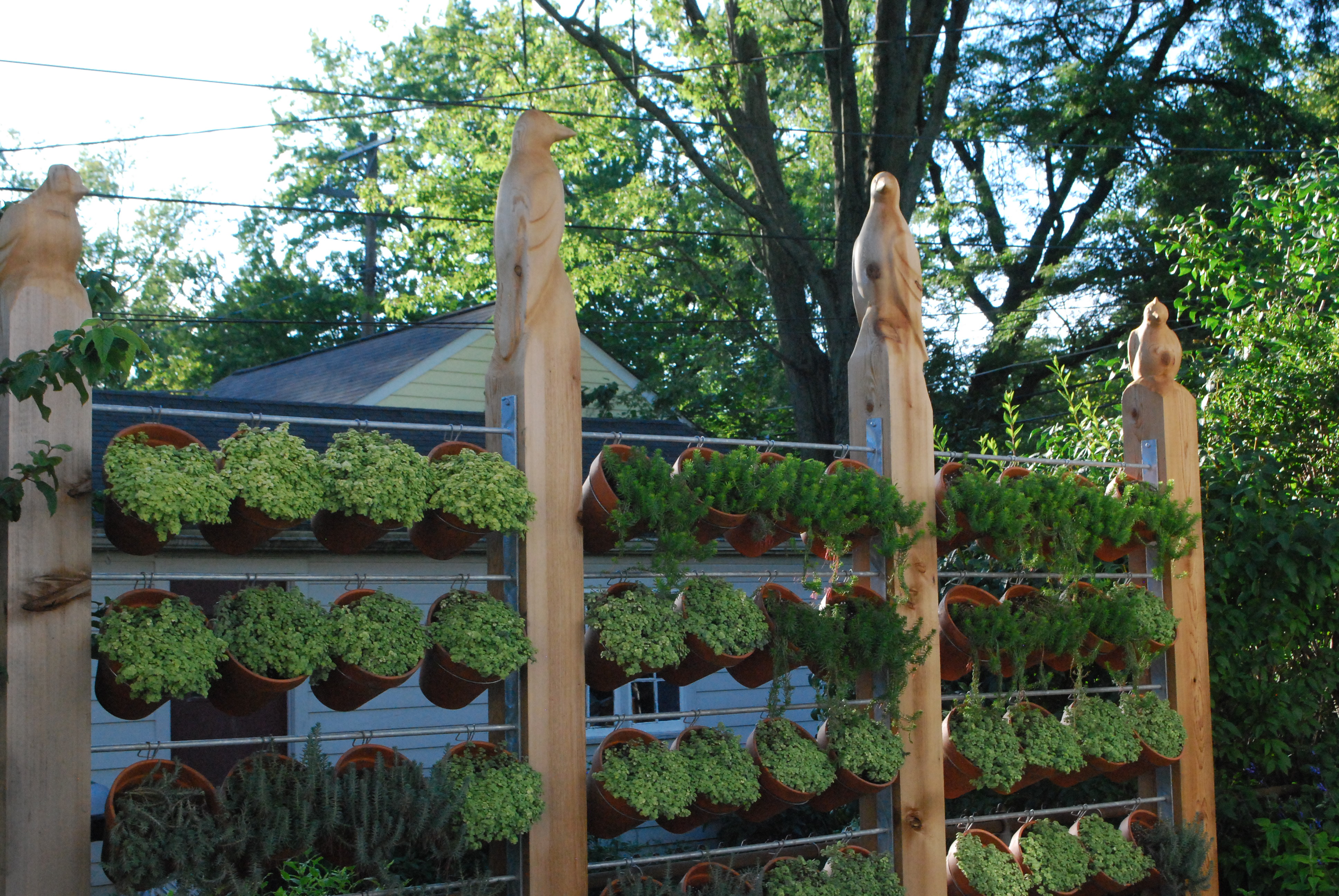
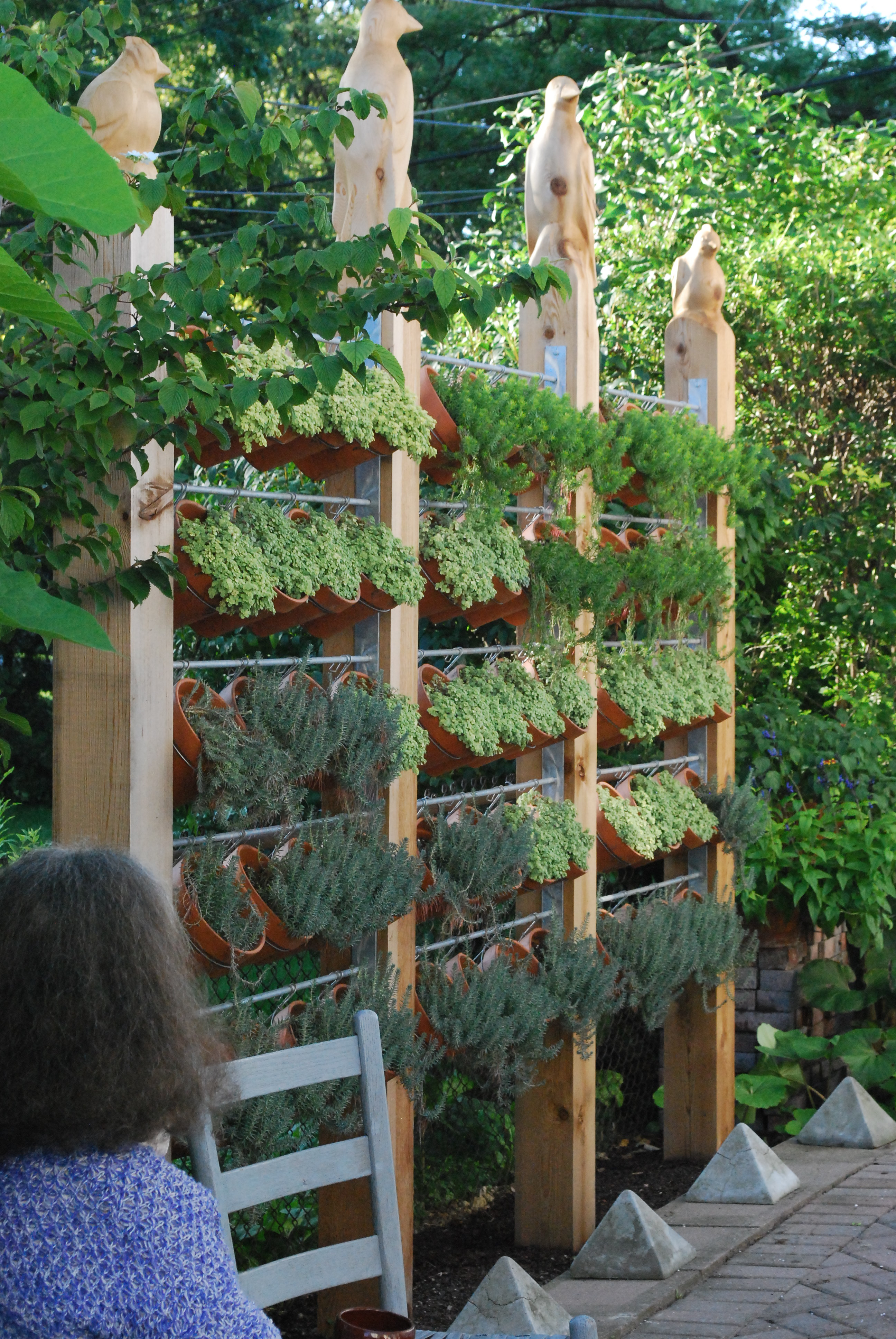
This ingenious green screen began with four cedar posts, the tops of which he carved into a pair of guinea hens, and a pair of ravens.  There was enough space to sink the posts deep into the ground.  He engineered a series of galvanized metal plates and rods, which would hold the galvanized hooks shown the the previous picture.  

The terra cotta pots were planted with succulents, and hung on the galvanized steel rods.  The watering takes some time and attention, but the plants seem to be doing just fine.  He’ll store the pots in his garage, or bury them in leaves for the winter.  I admire this inventive and low tech screening that is also so great looking.  The plants seem to be perfectly happy-spilling out of the downside of each pot.   

His succulent wall is beautifully engineered-and beautiful to look at.  Once he waters the top row, the drain water serves to water the row below, and perhaps the row below that.  Given that the screen is only 6 feet tall, it can easily be handwatered.  The succulents are not asking for much.  


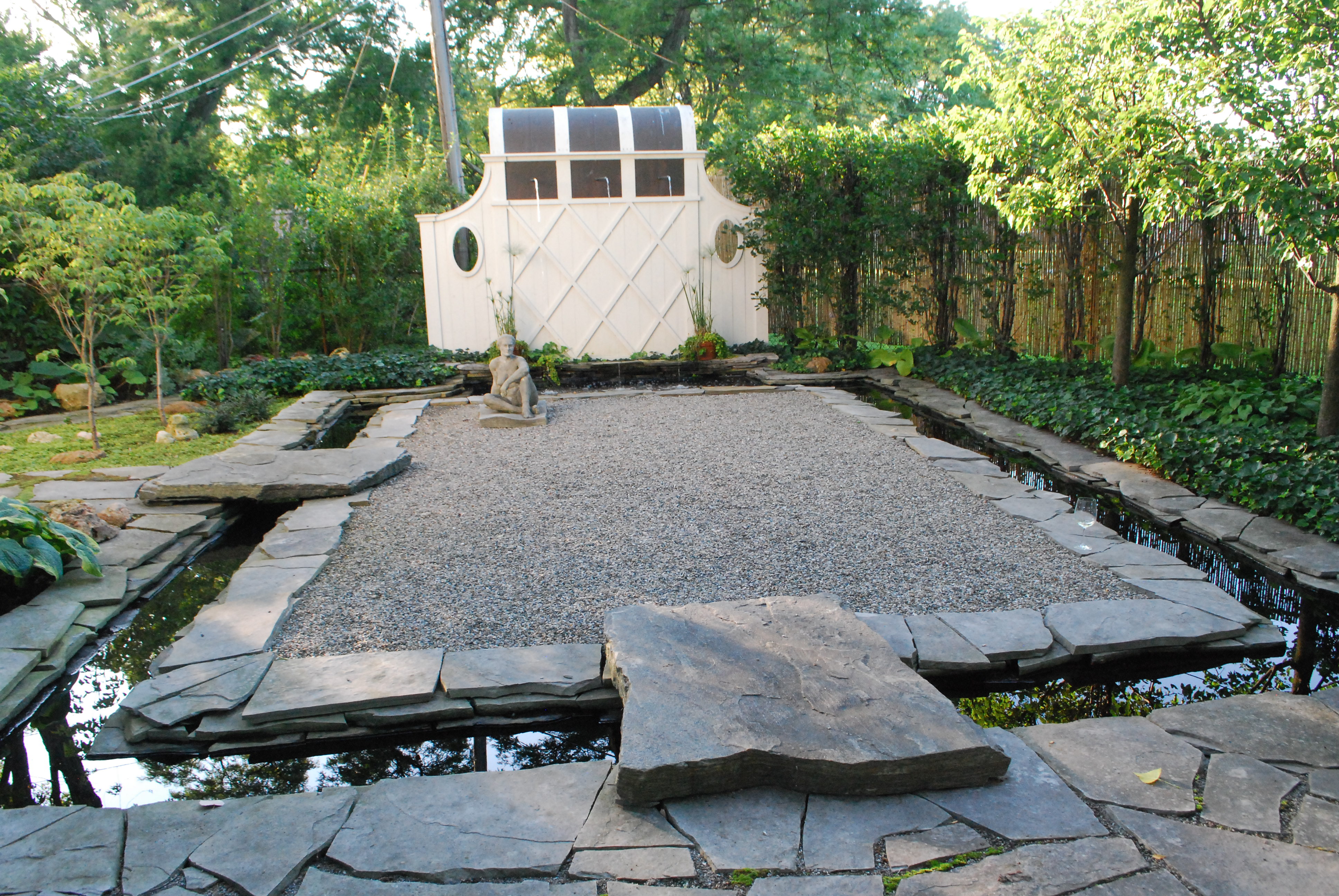
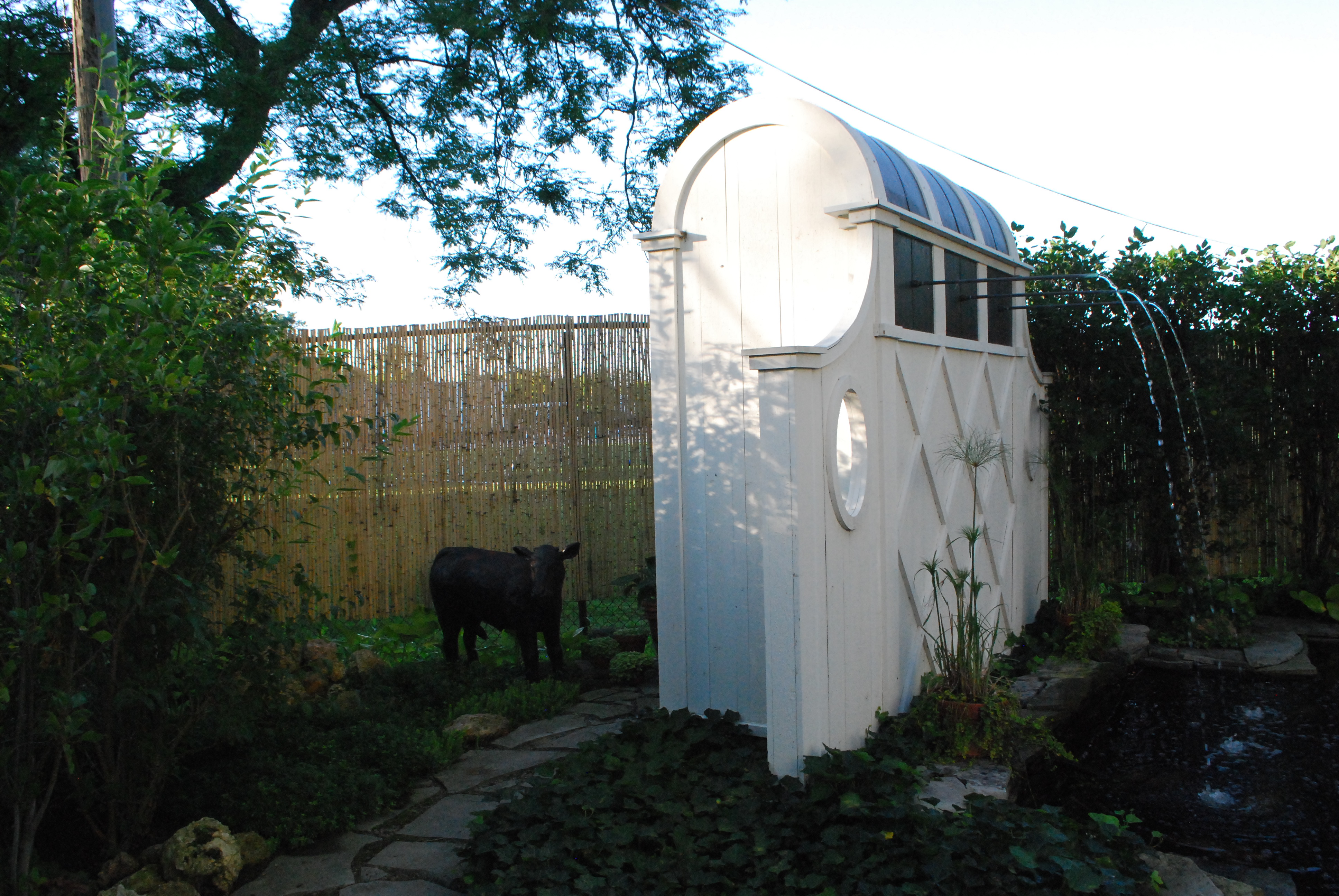
The rear yard is dominated by a gravel terrace, completely surrounded by water.  Though the width of the water is slight, the pool is 24 inches deep on 3 sides, and 36 inches deep at the far end.  This water depth, and the ability to swim in long runs, around and around, keep his koi happy.  Youy would never know that a city park was just the other side of the bamboo screening.  The structure at the far end of the pool serves a dual purpose.  From this side, the wood and copper fountain with copper jets does a great job of aerating the water for the fish.  This large, architecturally striking feature organizes every other element of the landscape.

garden sculpture

A single stone sculpture on the gravel terrace keeps a small space from looking cluttered. Easy maintenance perennials such as baltic ivy, petasites, angelina, creeping jenny and ferns makes the garden easy to look after.  The koi?  Barry has a 220 acre farm in Kentucky-the koi he raises there are cared for by his parents, and shipped to dealers and koi afficianados all over the country.

garden fountains

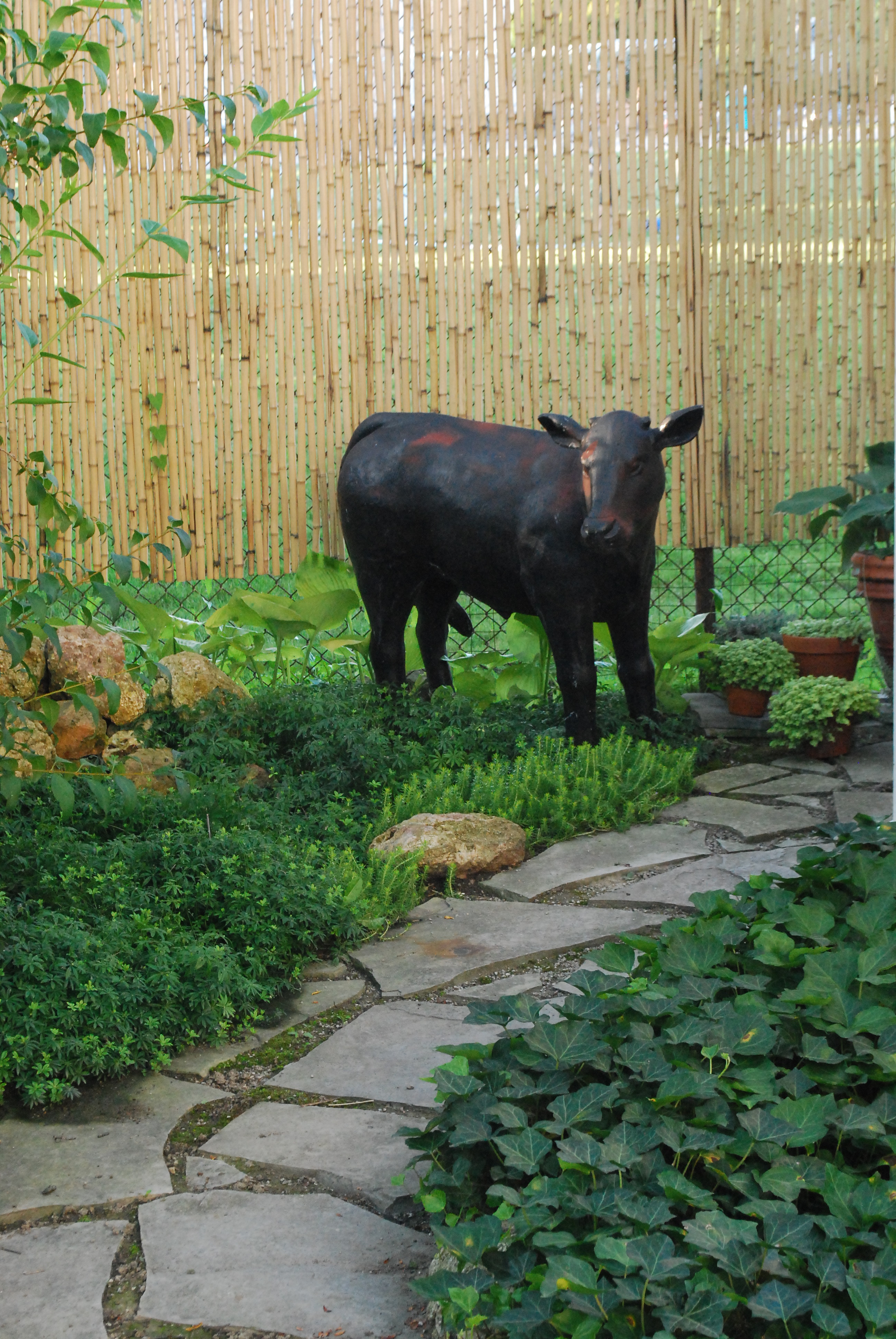
The fountain recirculates the water in the pool.  The placement of this feature on an angle to the corner of the property creates a small niche garden which features a series of pots, and some of Barry’s geode collection.  But the star of the show, at the end of a stone path-a cast iron cow. 

Even the smallest space in a garden can make a big impact.  An inveterate collector of vintage and antique objects, I am sure he spoke for this sculpture without hesitation.  This vignette is almost all of the way to another space-the garden shed.

gardenshed

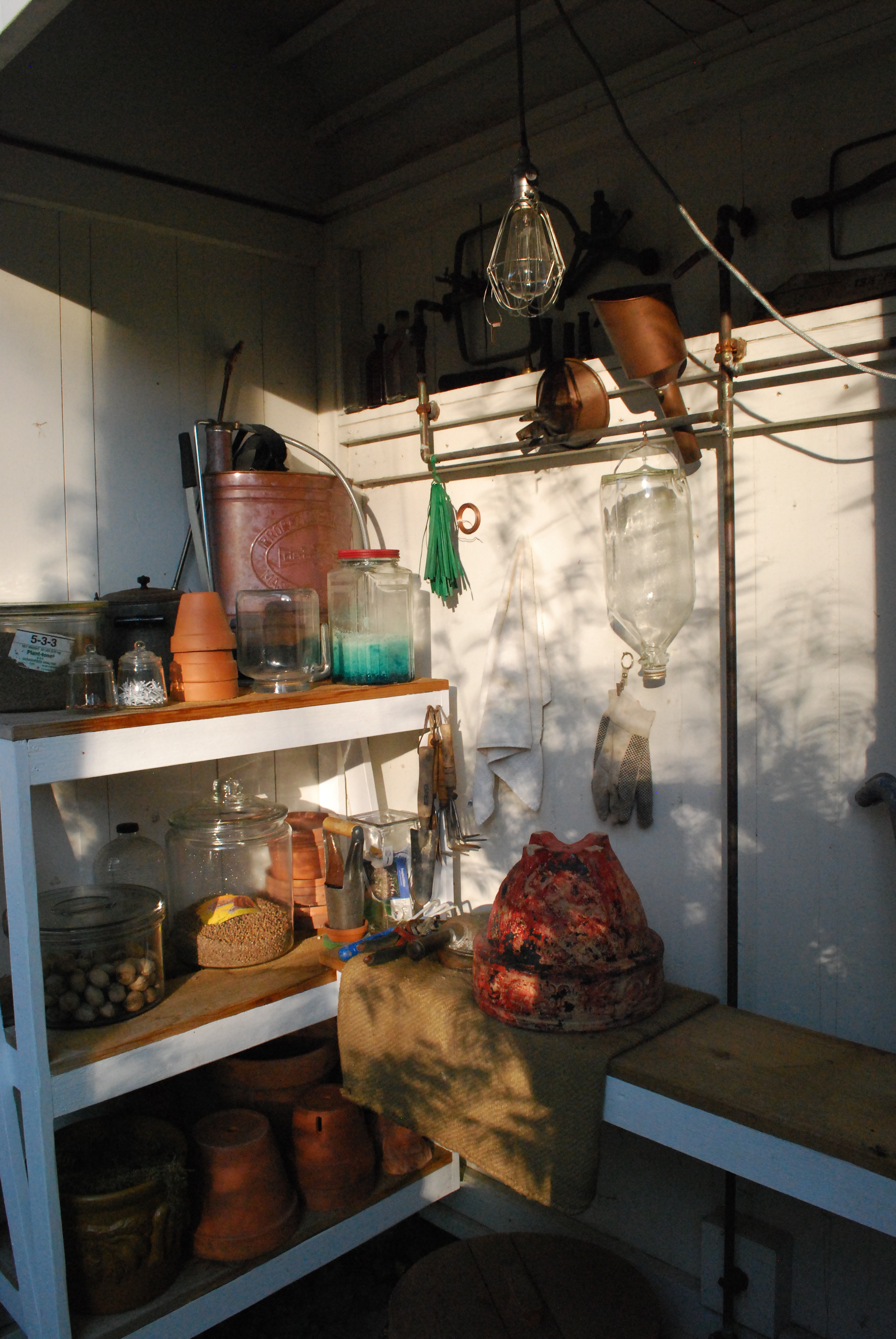
Barry’s  fountain doubles as a garden shed, which holds most of his tools, pots and soil, in addition to the filtration system and fountain assembly.  This very utilitarian space is completely hidden from every vantage point in the rear yard landscape.   

screening an air conditioner

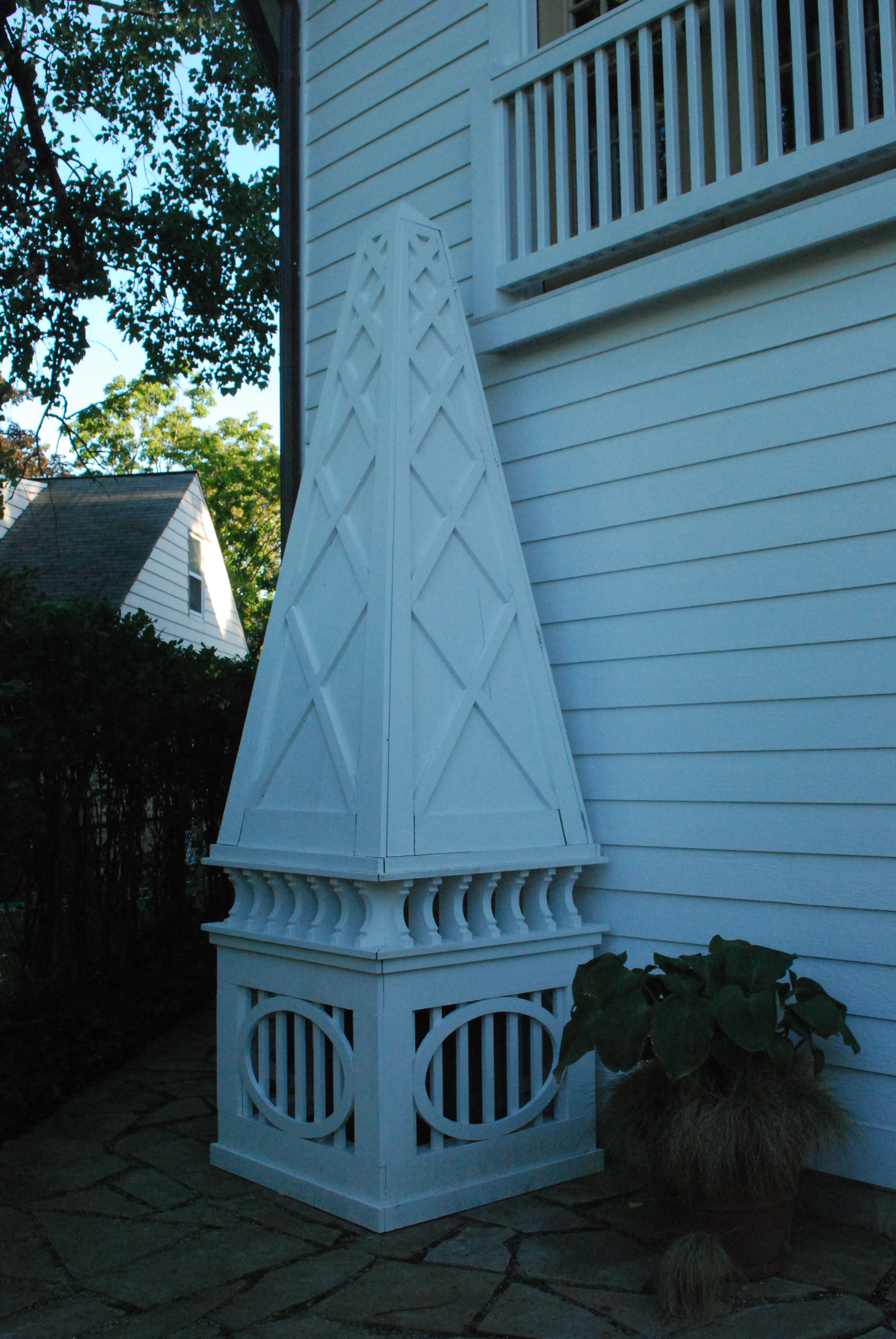
At the opposite end of the garden-the air conditioner.  The air conditioner is under this painted wood obelisk, yes.  One panel is hinged, and folds down, making service a snap. In the top of the obelisk-long handled gardening tools. 

The view out of the back yard-another view of that succulent wall.

evergreens in containers

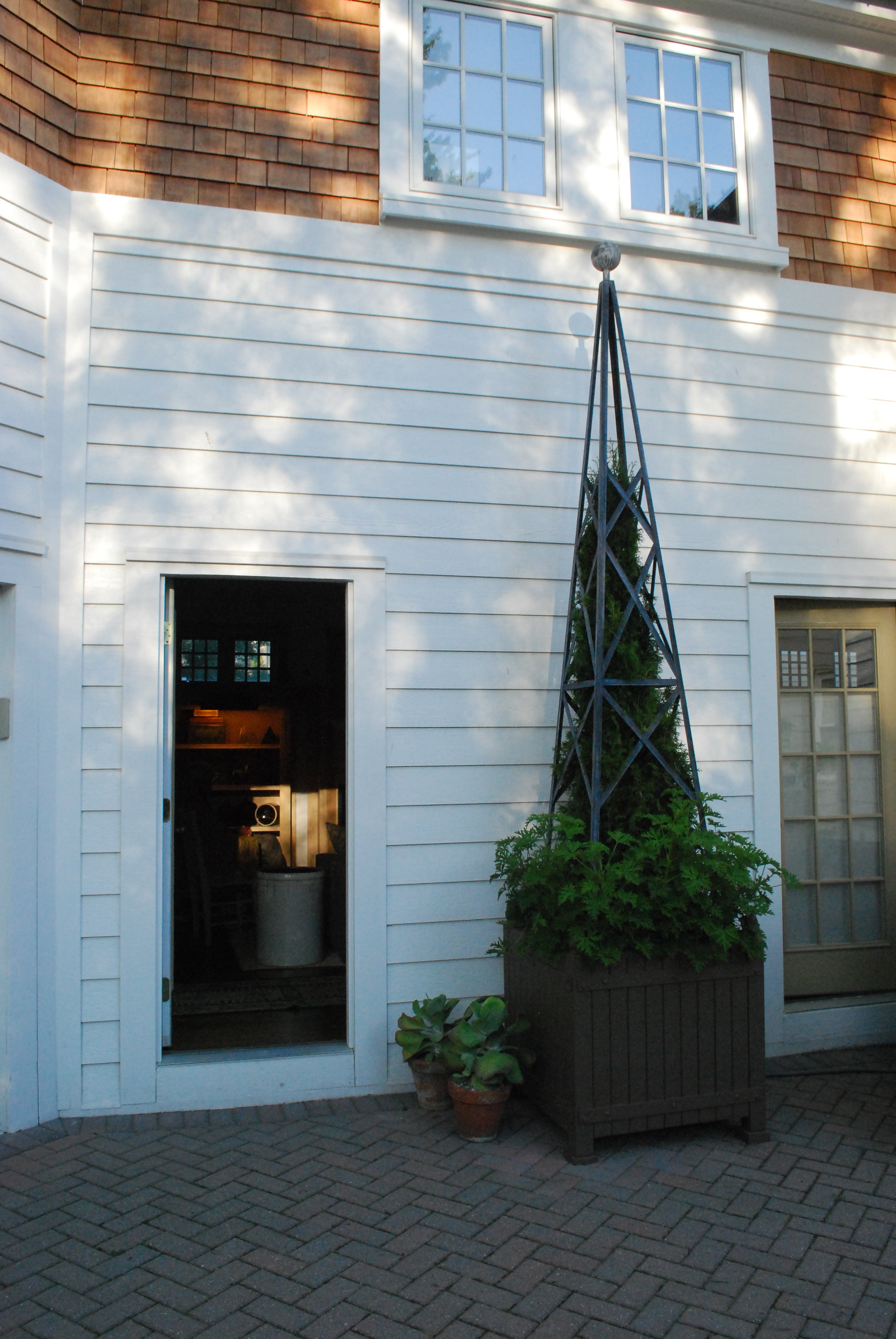
The house and garage meet at an angle in the back, near a pair of doors.  A giant painted oak box with a steel tuteur is the only nod to the garden in a fairly large paved space.  Only Barry would think to faux shrink wrap an arborvitae in plastic, and place the steel tower over it.  Not one branch got broken when the pot was planted.  At some point, the plant will grow through the steel, and be trimmed flat.  Clearly he is fond of making a few big gestures on his small property, rather than lots of little ones.   

There are as many great ideas for a beautiful garden here as I have seen on on properties many times this size.  Unlike a property which is defined by its boundaries, it’s hard to tell where unlimited creativity and imagination of this caliber might decide to go next.