At A Glance: The Peony Garden


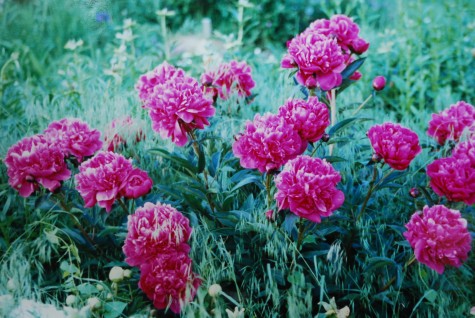
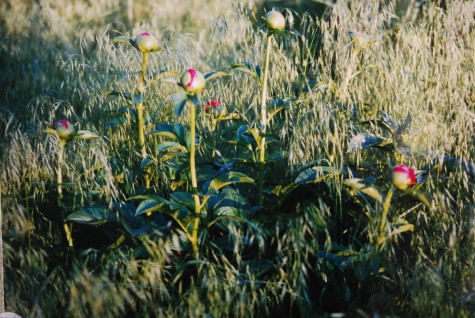
A trip to the American Peony Society yearly meeting and exhibition in Mansfield Ohio in the 1980’s-I cam home knowing I had to grow peonies.  I also knew I would have a very tough time choosing which of a few I would grow.  So I grew them like crops, in long grass-infested rows.  I have no idea where this grass came from, nor do I know what grass it is.  Do you?  They did amazingly well with this less than ideal care.  Peonies are very persistent and long lived.  By the time I sold that first garden property, the patch probably had 400 peonies in it.   
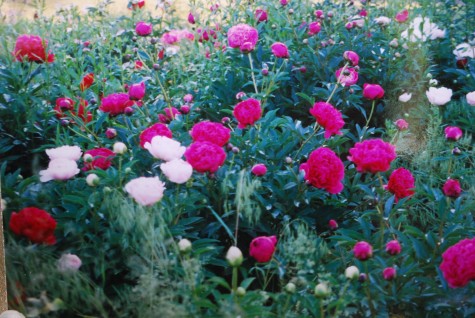

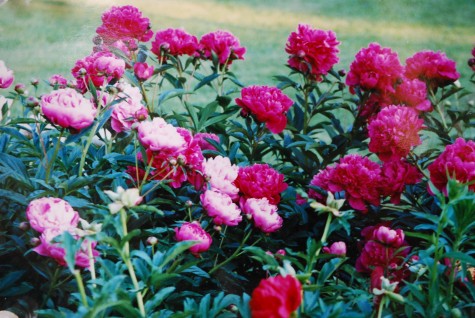
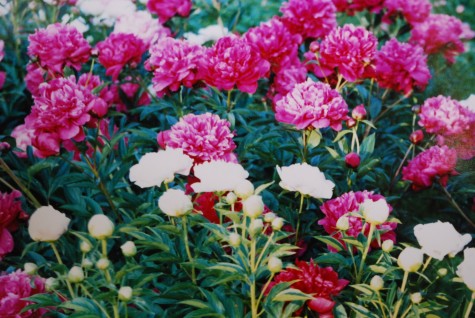
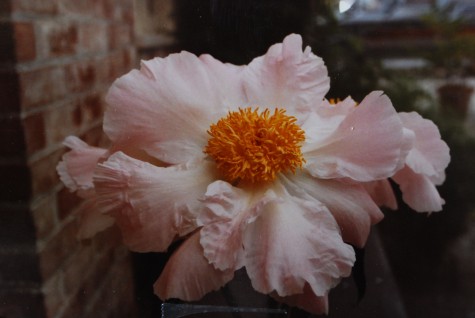
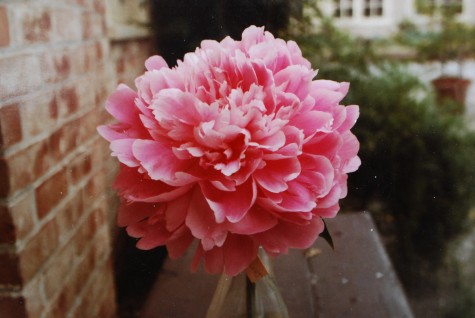
paeonia lactiflora hybrids
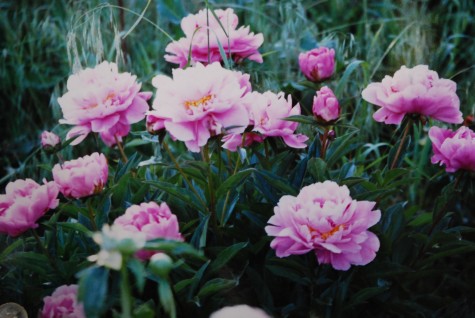
peony Raspberry Sundae

Japanese peony Do Tell, and double cerise pink peony Kansas
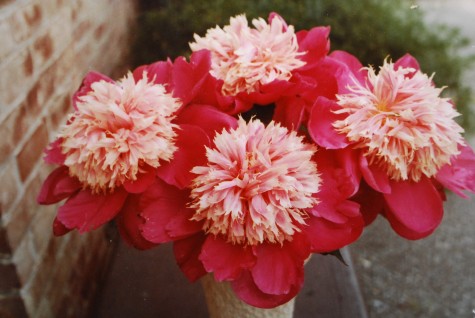
Japanese peony Whitecap

peony patch

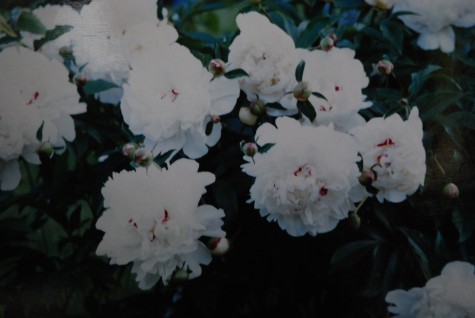
peony Festiva Maxima

peony Pink Dawn

peony Princess Margaret

peony Kansas


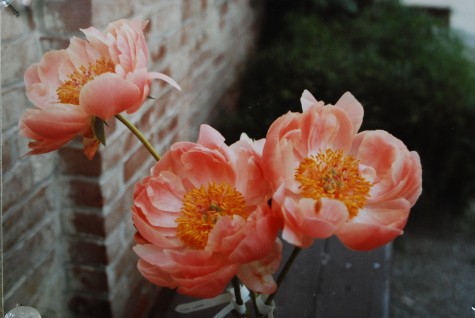
peony Coral Charm
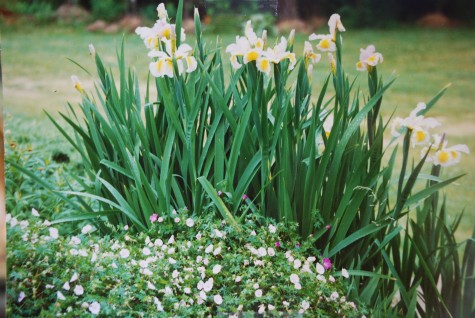
My First Garden


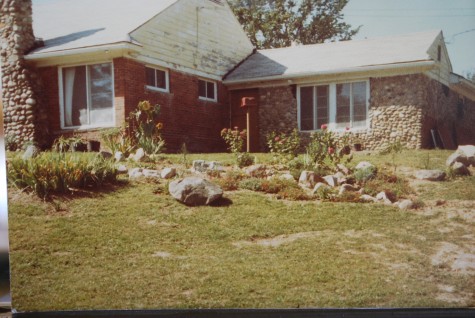
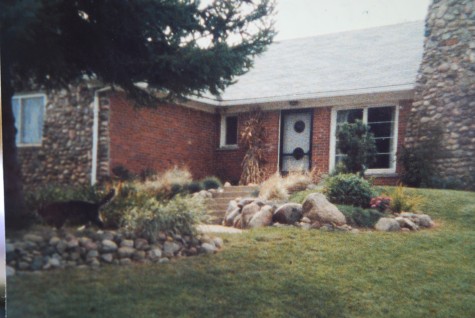
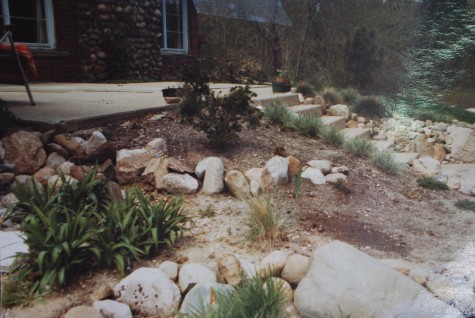
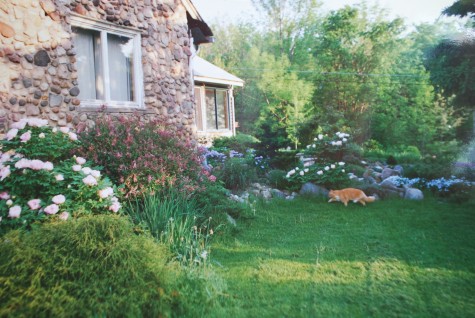
When I took my Mom to see this house I had bought-she cried.  She was aghast.  Then she was mad-eventually she was just plain scared.  I was 30 years old-I had sold my little house in Ferndale at a profit of 7000.00-and bought this decaying uncared for wreck of a dwelling for the princely sum of 60,000.00.  I say princely, as I was blithely unconcerned about what it would take to make it liveable.  All I could see was the land-almost 5 acres.  I barely glanced at the house.  Too bad I no longer have the picture that showed a drive-in garage below grade. The furnace in a dirt hole under the house.  The garage had stacked, unmortared concrete block for columns, and roof from interior plywood.  Needless to say, I was unable to obtain any reasonable homeowner’s insurance; I had to go into a high risk very expensive insurance pool.  I did hire an excavating company to tear down the garage, and bring in fill.  The hill you see above-fill dirt.  The rocks-I persuaded a neighbor with a 1927 Ford tractor to haul rocks up that slope.  My idea-a rock garden.  Why not? 

My first house ever in Ferndale did not have a garden.  I had been making my living in my late twenties, such as it was, in fine arts.  A grant from the National Endowment for the Arts awarded me a grant to teach, and have a studio, in the Ferndale school district- in an artist in residence program.  I had to live in Ferndale, so my grandmother fronted me the down payment money for a house-5000.00.  I did pay her back, by the way.  My 15,000.00 a year salary/stipend was lots more than I was accustomed to.  All of my exposure to gardening, via my Mom, was only barely beginning to surface in an adult way. Gardening is a solitary pursuit.  Not so social.  Once I turned thirty, things changed.   The house in Ferndale-I had no garden.  But  I did have a huge collection of bearded iris.  This second house I bought for the property, as I was determined to garden.   I was 31.     

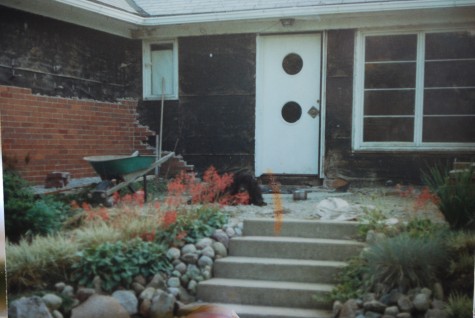
The house had lots of problems.  The brick was falling off.  It was heated with oil-filling the tank took 600.00-at 65 degrees, that oil lasted for 10 days in January.  Out of money, I turned the thermostat down to 45.   My first March in the house,  the hole under the house housing the furnace flooded-the furnace was ruined.  The place falling down around me, all I thought to do was plant.  I piled on the clothes, and lived without any heat.  The red heuchera you see here-an Alan Bloom introduction.  This is my memory of this time-more about the future, than the present.  The house you see here-a shambles.  The inside was just as bad; it smelled terrible.  I was young, and had a particular vision.  I lived through it.       

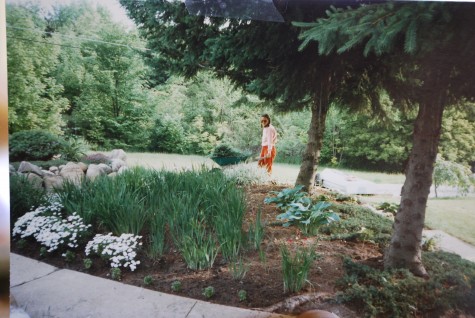
I had lots of energy-the kind that borders on and crosses over into obsession.  Politely put, I was so passionate about growing plants I could barely sleep. Composition was an idea I brought to bear in a painting.  My efforts at composing my garden ran into trouble.  I knew next to nothing about growing plants.  To this day I still say, if you want to learn how to garden, start gardening.  Put something in the ground, nurture it.  See how you like it-where you have placed it.  You will grow up eventually, if you keep at it.   I hauled no end of soil, rock, and plants around.  These Siberian iris planted in the shade of some old spruce-a beginner’s mistake.  I would learn plenty by virtue of what prospered, and what languished.  What was going on in this bed-not much, besides a collection of plants.  Every gardener has to start somewhere-there is no shame in that.  I got my feet wet. 

A few years passed.  Every spare dollar I had went to plants, and more plants.  My cat Babyhead was in his glory outdoors-much like I was.  Most of my first gardening choices were perennials.  Later I would add dwarf Hinoki cypress, and other shrubs/evergreens that seemed interesting.   

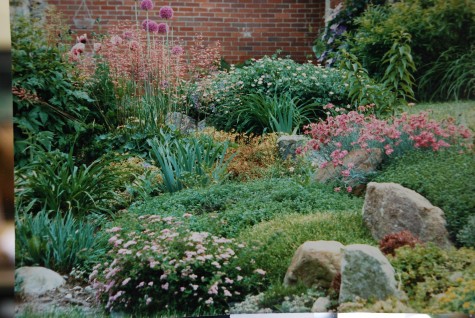
The rock garden-I planted into that noxious fill dirt- thymes, dianthus, antennaria, saponaria, dwarf spirea, calamintha, iris pumila-iris; how I loved them. 

Iris-how I better loved them.  This stand of spuria iris still looks good to me.  Though I loved the bearded iris, I grew as many types and species as I could.  Louisiana iris.  Japanese iris.  Siberian iris.  I grew species iris native to Turkey under hats that would keep the late summer rain off of them.  Nuts I was-for iris.    


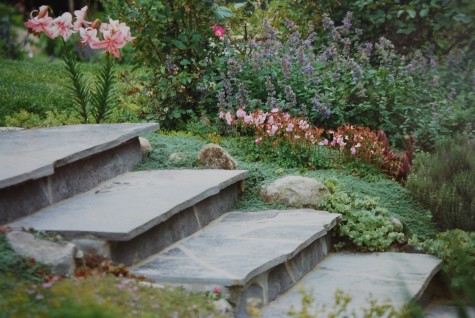
The concrete steps out the front door eventually got a bluestone cladding. I had no idea how to do this-I just went ahead and did it.  My first garden-the encrusted saxifrages, the martagon lilies, the paeonia tenuifolia, the clematis Sho-Un, the iris species, the peonies-I had a mind to grow plants.  Just like you.

Italian Terra Cotta

These three words-Italian terra cotta-are more than enough to get my attention, and make my heart pound.  Terra cotte-translated literally from the Italian-fired earth.  Pots fashioned from fired earth-what could be better?  What better container in which to grow a plant?  Containers from clay-what could possibly be more basic and natural?  The clay pot is a gardening icon.  I have stacks of them in my garage-I would wager that you do too.  On occasion, a client will fill their trunk with unneeded clay pots, and bring them to me.  Who could bear to throw one away?  Crusty with age and use-all the better.  I have yet to have a client insist on a brand new clay pot, if all I have in a size they need is a used pot.  Used and vintage plain terra cotta pots provide just as good a home for a plant as a new one.    

Italian terra cotta has been a part of my gardening life as long as I can remember.  The machine made clay pots of my twenties were no nonsense sturdy and functional.  Though the clay is fired, it is porous.  The clay will wick moisture away from the roots of a plant.  This can be helpful if you are a heavy waterer.  If you don’t always get to watering whern you should, a glazed or other moisture conserving pot might be a better choice.  That porousity also means that the container breathes; air is essential to proper root development.   Machine made terra cotta will break if dropped, or left out over a Michigan winter.  There are two critical factors that influence the durability of a clay pot.  The quality of the clay is crucial.  The best terra cotta pots on the planet come from Impruneta in Italy; the local clay is superior in quality.  The other factor-the temperature and duration of the cooking. Fine handmade Italian terra cotta is fired upwards of 1700 degrees.  The purpose of a long firing is a maturation process by which the pots are “soaked” with heat.      

Machine made terra cotta has its place.  They are available in an astonishing range of sizes and shapes.  It is important to properly size a pot.  Underpotting a plant leaves no root for root development.  Overpotting a plant can result in the soil staying too wet for too long.  Azalea pots and bulb pans are low and wide; this shape is specifically designed for shallow rooted plants that do well in less soil rather than more.  Long toms (a reference to tomatoes) and rose pots are tall; they accomodate the long root runs of these types of plants.  In any event, a classic clay pot is basic to anyone who grows plants.  A handmade Italian terra cotta pot-an object of great beauty and durability.     


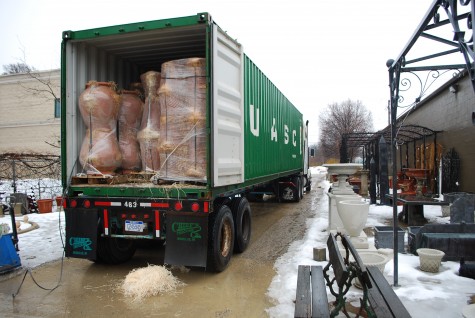
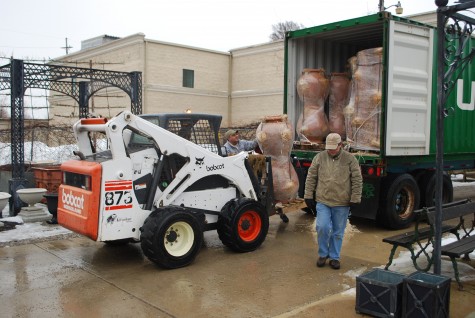
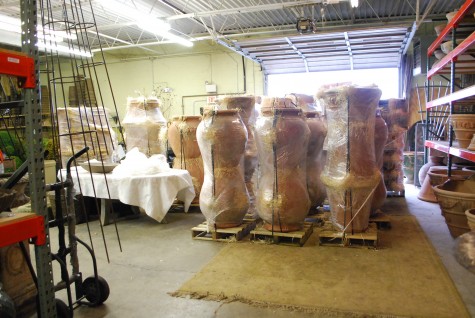
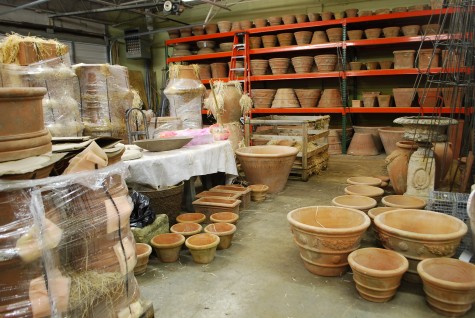
Delivered yeserday, an entire container of handmade Italian pots.  The container is 40 feet long, by 10′ wide and 10′ tall.  There were a whomping lot of pots on that truck.  Why so many?  Having a container delivered empty to the pottery means the packing costs are less; they pack and protect their pots quickly and expertly.  Of the entire lot of hundreds of pots, one was broken.  But the big issue is the volume.  When we buy lots of pots direct from the manufacturer, we get a better price per pot.  This helps make a handmade Italian terra cotta pot more affordable. 

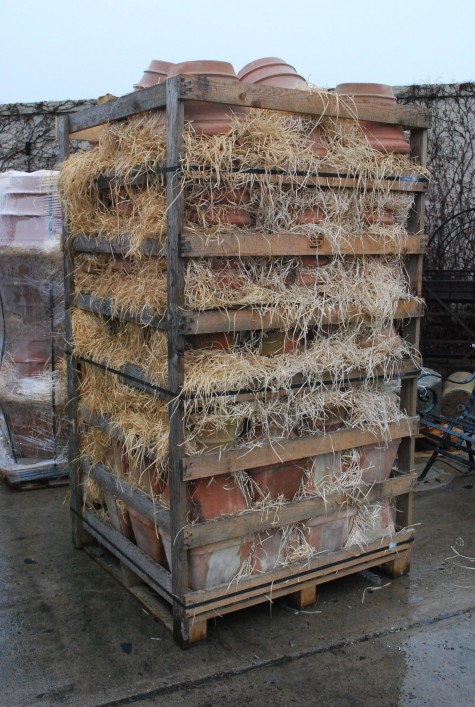
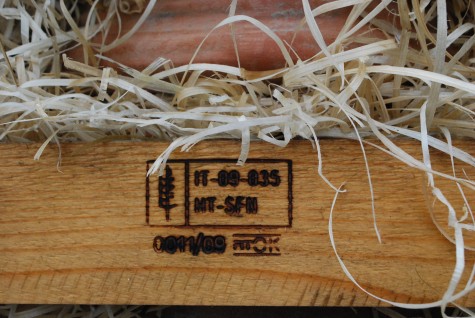
Any wood that comes from overseas has to be heat treated, so no pathogens come along with the pots.  Even the pallet wood is cooked.  Likewise the excelsior-the pots are protected with wood shavings when they are stacked, and anywhere the steel strapping material touches a clay surface.     

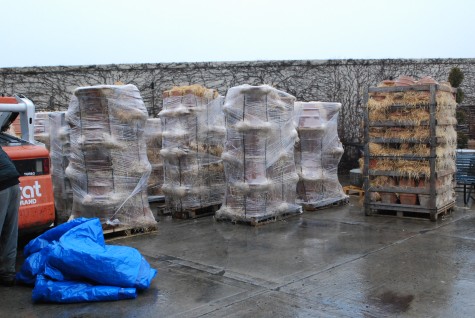
Each pallet is then shrink wrapped.  I imagine the trip across the ocean on a boat can get dicey in bad weather.  The durability of these pots helps make shipping them easier.  Should you thump a terra pot, it should ring with almost a metallic sound.  This tells you it is a high fire pot.  Pots that thud when thumped-low fire.   

This is an embarrassment of riches in terra cotta pots, but it means someone who needs four matching, or 8 matching might find something they like.  The soft orange color will beautifully compliment a planting.  Their rugged good looks you will have for a very long time, given proper care.  My own pots, but for 3 large English made concrete pots in the classical Italian style, are impruneta terra cotta.  A beautiful clay pot is tough to beat.  The first pallet of pots I bought 15 years ago was Italian terra cotta-I still remember what a thrill it was to unpack those 14 pots.  They were very expensive, as is anything you bring over from Europe, a little at a time.  But every one of them found a home, and many of them I am still planting for those clients. 


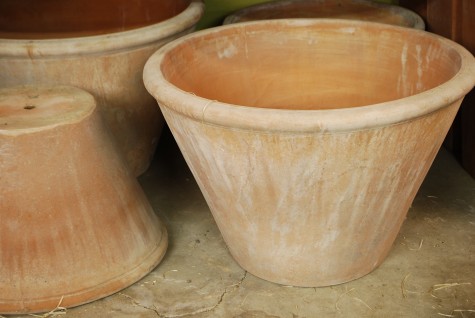
You may be wondering what about this pot enthralls me so much.  It is not just the simple beauty of the form, the soft color and subtle surface.  

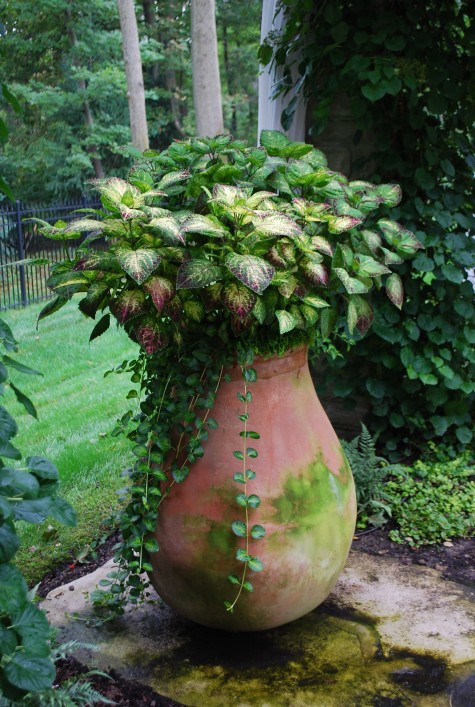
A beautifully planted Italian terra cotta pot can mean this for a garden.

Planting In March


I know I made much this past week about planting a more beautifully designed hanging basket.  The challenge was such, I have the troubled dreams to prove it.  All of the notes I made this past summer inexplicably disappeared.  The lesson here-any idea, phrase, phone number, concept or design that you really need-write it down, and insure its safekeeping.  Notes and notebooks, scrapbooks, file folders, magazine clippings-all of these are a good idea.  Some ideas occur way ahead of their time.  Keeping them written down, visually documented, and readily available is the best backup to insure that what is close to you heart gets a hearing when the time is right.  Well, the time isn’t really right yet, but I was ready anyway. 


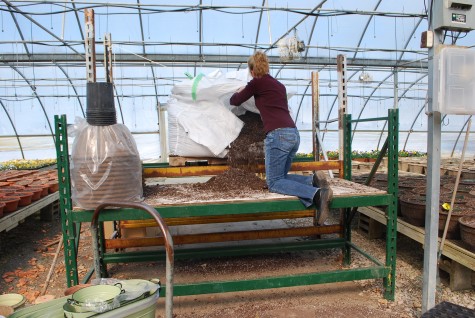
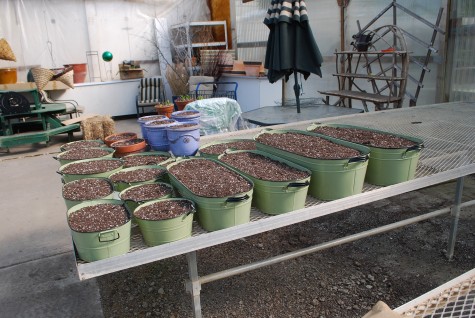
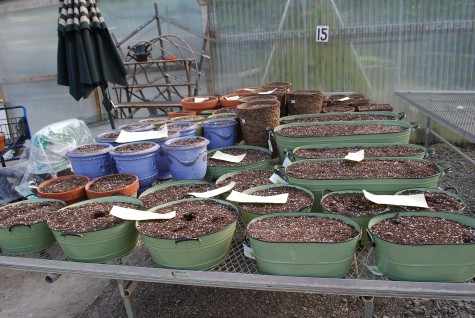
I wanted to be past the dreams stage.  It was time to put my show on the road. I drove out to Bogie Lake Greenhouse yesterday with Pam, and some containers in tow.  I had an idea to plant some 50 containers for spring, in addition to the hanging baskets of my dreams.  Ambitious, yes.  But the big fact of the matter is, as Coach John Wooden once said, “It’s what you learn after you know it all that counts.”  My big ideas got a dressing down.  I am used to planting at the shop; I have already sorted through everything that Mark has available, and have at hand the plants that strike my fancy.  This is a highly edited version of his greenhouse.  Many of them are in color by the time I get them-I rarely buy plants from a list-I buy what I see, and like. Pam got right to work-she had all of the containers filled in no time.  I was cruising the greenhouse with Mark, when reality began to sink in.    

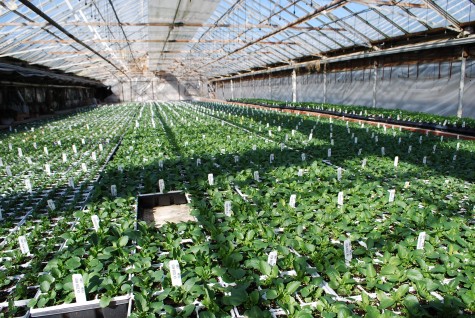
Spring plants in mid March are  tiny green blobs-a few roots, and not much leaf to speak of on top.  I faced an ocean of violas and pansies-all green.  They are just where they need to be, perfectly timed-to be perfect in a month.  I don’t know about you, but  great color combinations in spring pots can be tough to achieve.  The blues, lavenders, violets and red violets in pansies don’t always go together.  Red violet pansies look great with red ornamental kale-dark purple pansies go blah.  It became apparent that I would need to rely on my memory of color, my memory of the colors in the various mixes-or the notes that I could not find.  If I was thinking I would have mature plants in  color from which I could design-I thought wrong.

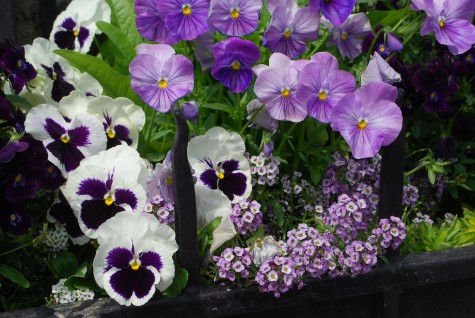
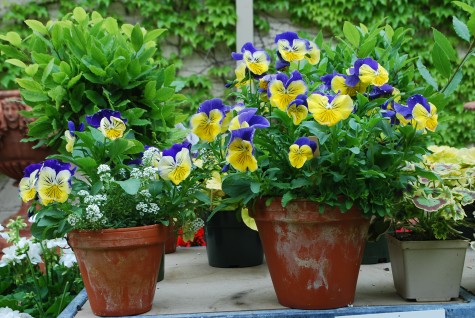
You can see from this picture that all of the purple in question has a decidedly red-violet cast.  Do I know the names of these pansy and viola cultivars-no.  Even when I did manage to match a cultivar name to a picture in a seed catalogue, I did not feel one bit better.  Color pictures in a catalogue may give a feeling for a color-or not.   

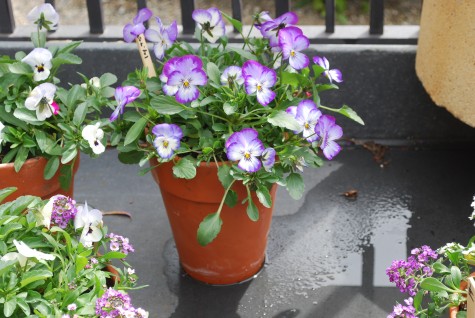
The purple is this bicolor pansy is not at all red violet.  It has a heliotrope blue cast, to my eye.  Red-violet alyssum in this pot would make me wince.  Citron alyssum, which has a decidedly cream yellow cast, would have worked better than the white alyssum you see here.   

So I did what I could-all of the schemes came from my head and memory. Pam planted pairs of pots with a variety of spring annuals including pansies, violas, phlox, angelina, osterospermums and so on-and we’ll find out later if I can design in the dark.  I didn’t even approach the hanging basket planting project-I see I have to plan them on paper.  The time to plan combinations is at the height of the season-when color, texture and mature size is all right there to be seen.   


I have new resolve to photograph all of the flower cultivars I like to use-from the start of the season to the close.  I will have then a catalogue of my own making, so I can plant green, if need me.  We’ll see how far I get with that.

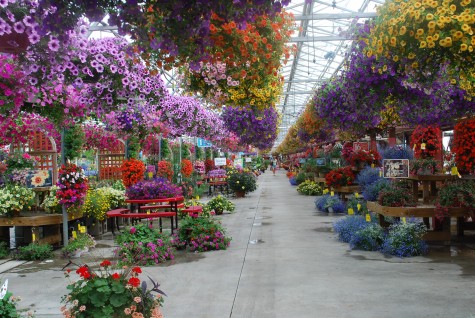
Though these baskets are lush and well-grown, I have something different in mind.  To that end, I’ll spend some time planning, before I plant.