Stirring

 
This past November, I planted a slew of spring flowering bulbs in containers.  My crumbly compost based soil came from the most mature of Steve’s compost hills.  Friable, this soil.  I knew my bulbs would be happy.  True bulbs are extraordinary, in that they house the leaves and flowers intact, and ready to grow, in an embryonic state.  An entire blooming plant exists inside, ready to grow when the conditions are right.  Wow.  Though I have been curious, I have never had the heart to slice a tulip bulb in half to see what was inside-it always seemed like such a waste of a life.  So I believe what I read about this.  
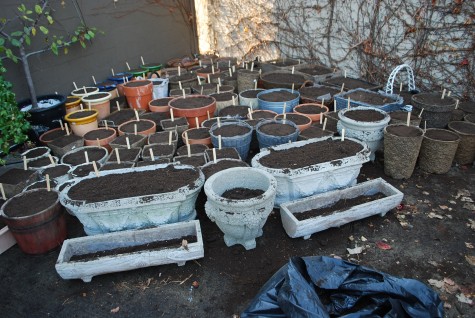

My bulbs were planted in November; they need time to root before the ground freezes hard.  Planting them too late can be a problem, should winter arrive unexpectedly early.  I have been told that bulbs do not freeze hard through and through when planted in the ground.  Should they freeze too hard, they will rot when they thaw.  I find this hard to believe, as we routinely have frost that penetrates the ground of a depth of 42 inches, but perhaps a solid freeze is different than deeply penetrating frost.  This means container planted bulbs need some winter protection, as their roots are actually above ground.  But should they be wintered in too warm a location, they will not get the chilling they need. 
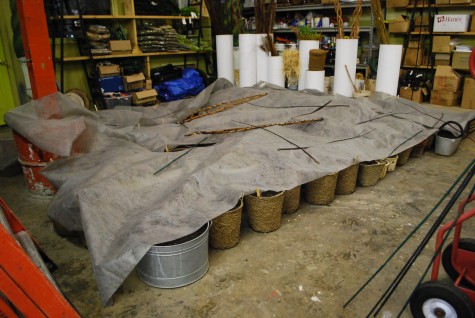
We moved the pots into the garage in late December; I did worry I had left them outside too long.  The shop garage is much larger than a car garage, so space was available.  We placed them as close to the adjacent heated space as possible, although we only heat that space to 45 degrees in January and February.  Bulbs require a period of chilling.  Cold temperatures induce a biochemical response that triggers the growth of that embryonic flower.  Gardeners in frost free zones have a tough time growing bulbs unless they provide a proper chilling period. A refrigerator dedicated to chilling bulbs-I love that idea.
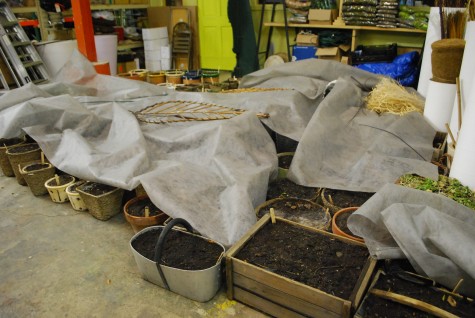
Different bulbs have different requirements for chilling.  Tulips need 14-20 weeks.  Chionodoxa need 15.  Once a bulb has experienced the cold it needs, it can take 2-3 weeks from breaking ground to bloom.  My bulbs in containers-I am not forcing them.  By this I mean I am not engineering a chilling time that would allow me to have flowers ahead of the normal spring season.  I like them to bloom at exactly the same time as they would were they planted in the ground.  I just like the idea of bulbs blooming in boxes, or terra cotta pots.  I can move them around, or group them on my front porch.  I could use a pot of tulips as a centerpiece, or a gift for a friend who is under the weather.   
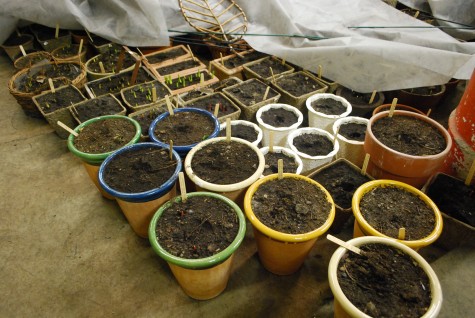
I do not heat my garage space; the extremely cold temperatures we had in February made me worry that the bulbs had frozen too hard.  I checked a few pots by knocking the root ball out of some pots-they all seemed well rooted and fine.  I cannot account for why this completely unheated space works.  Though it is unheated, it probably is not nearly as cold as the out of doors.  Perhaps geothermal heat plays a part in keeping the bulb pots just warm enough.  No matter the science, I am seeing my bulbs beginning to break ground.  You may wonder why I have covered my pots with landscape fabric, as well you should.  Our resident cat, MCat, loves nothing better than digging into the dirt, or sharpening his claws on the trunks of old boxwood topairies we store here over the winter.   
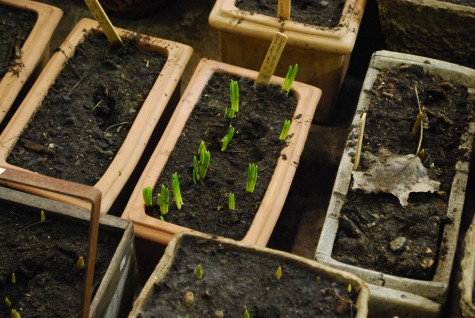
The landscape fabric and some low tech readily available weights keeps him out of these pots.  Like countless other people, we accomodate the local wildlife.  As you can see, the bulbs are stirring.  I know that many plants go dormant in response to a season that cannot support growth.  I know that low temperatures slow the chemical activity in plants as a survival strategy. But I cannot decide if these bulbs have been truly dormant.  I think there has been a small fire burning here, all winter.   
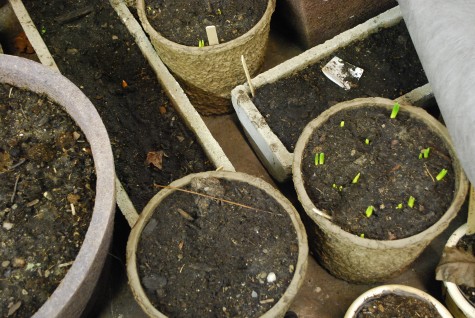

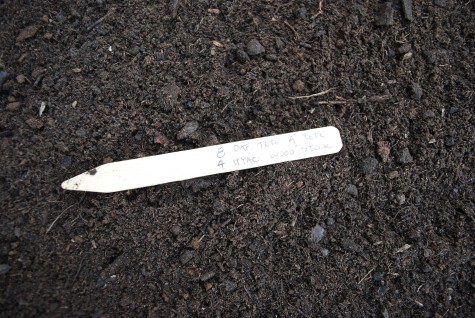
These pictures of pots of dirts with an occasional green or red shoot hardly seem exciting at first glance-you are right about that.  But what is happening below the surface, and barely poking through the surface means spring is not far off-I find that incredibly exciting.
Naming Names


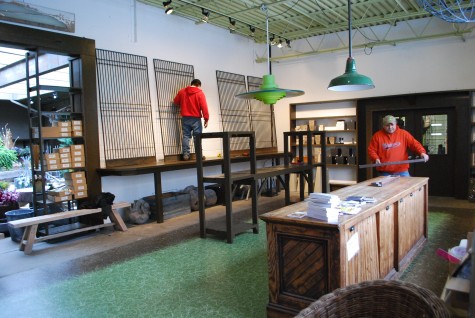
The very best part of the beginning of March?  It is 12 months until it will be the end of February again.  This I like.  Though I have been cooped up inside like lots of other gardeners, I have an interior landscape project of my own invention to occupy some of my jail time.  I truly do enjoy dismantling the entire shop, and putting it back together in some completely different form.  There are many givens, and few variables in my landscape at home.  The shop landscape has lots of new and some old elements.  I can rearrange everything.  The first order of business?  Clean, and repaint.  A change of color in any room can fuel a fresh start.    

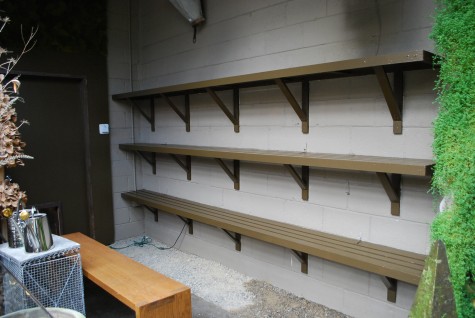
Of course this means moving everything you own out of the way.  This picture is ample evidence of what happens when an organizing idea is not in place.  A random collection of objects is visually disquieting.  Clash was a great band, but clash is not such a great concept for a space.  How do I pick and choose, move, add and rebuild?  First up,  I name my spaces.  In much the same way as the garden of my dreams will have a nuttery, a pond, a wildflower garden, a kitchen garden, a knot garden, the meadow walk, a corgi run, hellebore heaven, and a dining terrace-I name names.  In my house, I have a reliquary (for my cherished relics) a corgi lounge (featuring a giant couch that holds the four of us) and a dressing room.  The names fuel the arrangements.    

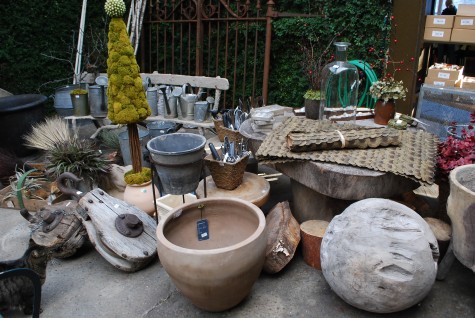
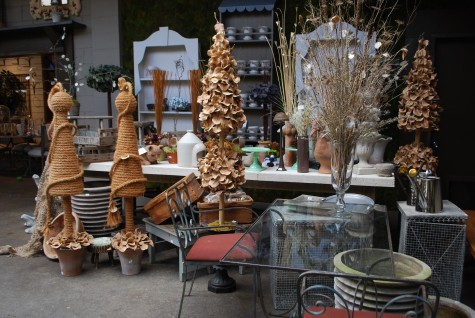
Our greenhouse space has had lots of names over the years.  But this spring season, bootcamp for gardeners.  Back to basics simple handmade Italian terra cotta.  Good tools.  Materials as in moss, pot feet, vintage trugs and galvanized steel sinks.  Plainly functional objects and vintage materials have a beauty all their own-how can I arrange them to make this naming  visual?  Once a space gets a name, it is easier to see what belongs-and what needs to be moved somewhere else.      

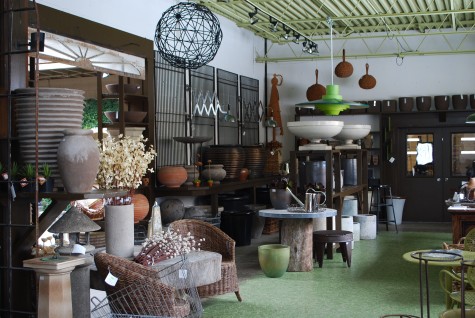
Our front room got a newly painted floor-decidedly more modern than traditional.  A pair of light fixtures-one vintage industrial, and one mid century modern.  The ceiling, painted steel,  is much like the carport my parents had in the fifties;  this part of the building was built in 1947.   What name for the space comes to mind?  The modern garden?  Whatever words I might choose, the naming is a decision that can energize a design. 

This room was easy to furnish.  Every object I looked at either seemed right for the space, or seemed wrong.  I paid no attention to the provenance, or history of an object.  I pay attention to their visual aura.  The three vintage dock bumpers hung in the airspace at the rear of this room-no one would ever characterize them as modern, or contemporary.  But their simple shape and texture, their relationship to the steel sphere in the foreground makes them appropriate for this space. 

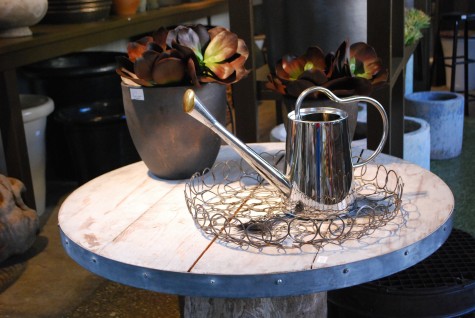
A stump based table with a plank top captured in galvanized metal-I could see this in a modern garden.  A stainless steel watering can-harmonic.  A tray of welded metal  circles echoes and repeats the bronzy glaze and rounded form of a simple pot.  This arrangement of objects makes a cohesive visual statement.   

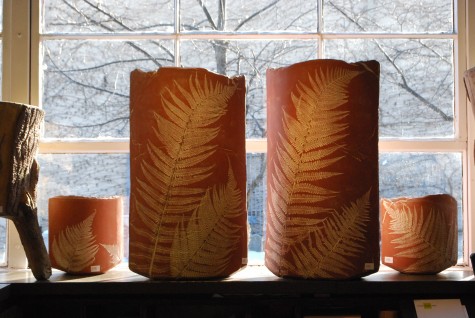
What could be more traditional, or more historic than the footprint of a fern? These contemporary English garden pots are of a shape and detail that describes a fern in a decidedly contemporary language.  The shape and the top edges of these pots-edgy.  How would I plant these?  I need more time with them.  Though they would seem out of place in my garden, I greatly admire them.  They will find a name and a place, I have no doubt.  A spot in the all things modern room-perfect. 

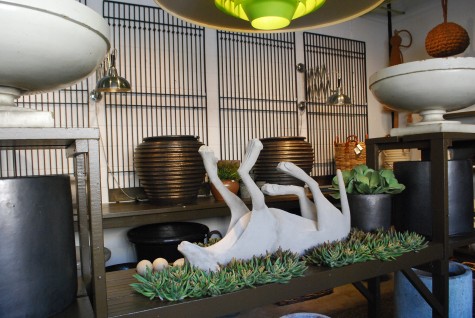
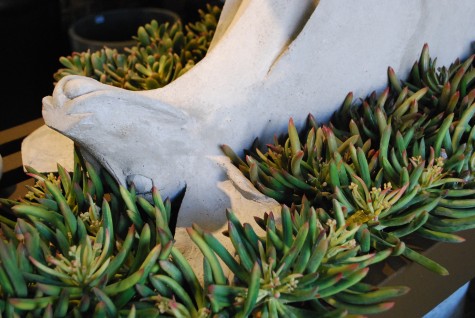
I have a new pack of dogs on the way. Troy, who sculpts these for me, is an old school grower and naturalist.  But his vision of the energy and beauty of a dog is so simple and spare, his sculptures warrant a place in this room. 


Her name is Annie.  Give names to places, spaces, and gardens.  You will know what to do next.

Sunday Opinion: Plants In The Air

I have never been a fan of plants in the air.  By this I mean hanging baskets of plants.  God knows plenty of people like them- the glass airspace of all of my local nurseries are awash in them come spring.  Some baskets go home and get transplanted into a container, or in the ground.  Fine.  But not all get a thoughful or beautiful placement.  In my own neighborhood, I see the occasional 10″ diameter hanging basket plopped without further ado into 8″ diameter pots.  Picture this-a pot, with a glaringly white plastic hat and purple petunias on top.  Some of the baskets are not set level-picture a white plastic hat, askew, atop a container. Some white plastic baskets are hung from their hangers so close to a porch overhang I cannot imagine how they will get light, much less be watered.  In my opinion, none of these options are a good look.

I understand the economics of a 10″ white plastic basket.  They do not occupy precious greenhouse floor space.   Small trailing plants have the luxury to grow vigorously in a generous airborne soil space-a bigger plant fetches a better price.  People anxious to get a leg up on a short northern season will pay more for a plant with a growing history; pregrown, as it were. Greenhouse growers, they like the plastic, and the white color-as well they should.  Plastic is lightweight, and readily handled.  By this I mean filled with soil, planted, and hung up.  Any growing operation involves lots of steps, lots of care, lots of time and lots of hands.  As efficiently as a growing operation can be handled matters much to the bottom line.  My line of work has put me in contact with countless growers and nurseries.  It matters little whether you are growing 1 gallon perennials, 5 gallon shrubs, hanging baskets of annuals, vegetables or trees-growing professionally is a staggeringly labor intensive and risky vocation.  What if the weather does not cooperate?  What if the drought kills your rhododendron seedlings?  What if the buying public passes by every basket of million bells you have grown?  That white plastic hanging basket of annuals in the spring greenhouse airspace is engineered to provide a grower with optimum conditions to grow a large crop. White plastic reflects light.  This means any given basket will need water on a manageable schedule.  The basket can be easily gotten down for a customer.  The plants get the best light available.  Every greenhouse grower deals with all of the issues of any restaurant chef, times 10.  A chef gets to pitch what is out of date.  A grower furthermore spends lots of time dealing with aging material.  I only regret the baskets do not come with an explanatory note.  The container in which this plant has been grown was selected in the interest of efficient growing only.

  The hundred of white plastic planted bowls that we know as hanging baskets are held aloft via an adaptation of the coathanger; this utilitarian part pains me.  A coathanger belongs in a closet, does it not?  This is just the beginning of my discontent.  Plants root in the earth, and the earth is at grade-right?  Containers have a point of connection to the ground plane. Hanging baskets-what is the good idea behind plants in the air?  I have a tough time answering this question reasonably-but that is based on many years of instinctive prejudice against them.  Plants in airborn dirt-something seems wrong about this to me. 

Any instinctive prejudice-I have time in late February to reflect.  The snow is still piled miles high in Michigan; I have time to review my assumptions about gardening. Those weather people are predicting our two days of thaw will be followed by 2 inches of snow.  This prediction makes me want to weep.  It is almost the 1st of March-can the winter not make a move to let go?   In a calmer moment, I would suggest there are those activities that can make the winter prison time go faster.  In a perfect world, every gardener would examine their prejudices, and move off of them.  In the interest of bringing a little fresh thought to some of my own cold and stale toast, and in the interest of amusing myself, I am rethinking my ideas about hanging baskets.  Why so, this February 26th?

My grower has called my hand.  He is planting his hanging baskets for spring this week.  He has invited me to come over, and get my hands dirty.  He has made it clear.  “So Deborah, if the hanging baskets available in my greenhouse in the spring are not to your taste, what would you plant?  What is your idea?  If you had to have some hanging baskets in your garden this year, what would be planted in them?  Consider this a formal invitation.”  It would be very unsporting of me to refuse, would it not?   

This coming Friday I will be designing and planting hanging baskets.  I am rather looking forward to it.

The Border

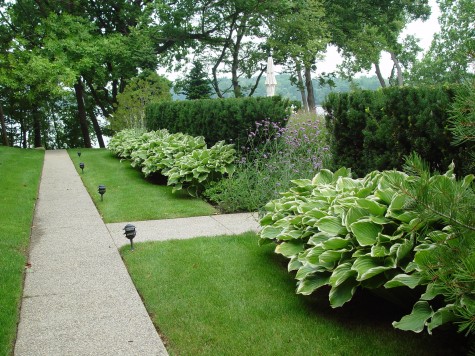
I have been painting the border of painted concrete floor in the shop the past few days; the word “border” is on my mind. The language of the garden-a special language that crosses over national boundaries and may span centuries.  To whit-a verge refers to an edge in the garden, deeply cut with an edging spade.  A verge also refers to the shoulder of a road.  This is primarily a British term.  I greatly admire British gardens and gardeners; I equally like their use of language.  When I am edging a bed, the idea that I am creating a verge lends great dignity and creates excitement about what amounts to plain hard work.  I know how to amuse myself, when I am working.  A well cut verge is not so unlike a precipice that you could fall into, and break an ankle.  A passionately cut and serious edge on a bed.  Sharp clean edges make for a beautiful presentation. I fancy the grass border pictured above on this walk qualifies as a shoulder of a modest road-a grass verge.  The grass also forms a border for a luxuriant bed of variegated Krossa Regal hosta.  This plant is so textural and lyrical in appearance, a quiet setting would seem to display it to best advantage.  In this case, a border of grass.

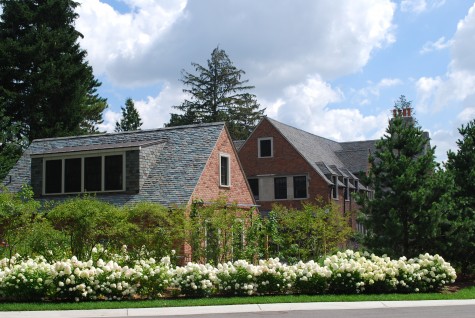
This hedge of limelight hydrangea, bordering a hedge of lilac, itself bordered by grass, borders a road.  A border? A border is a line or a mass that visually indicates a boundary.  This border of three plants in three heights forms a boundary.  It screens a private garden from a public thoroughfare. This landscape border is on the verge of spilling over onto the roadway.  OK, I have a very active imagination.   

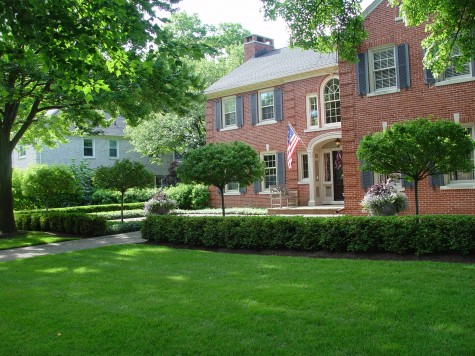
This boxwood, punctuated by crabapple standards creates a border which separates the public presentation of the landscape from private garden.  There is no reason why the landscape which faces the street need be an entirely public landscape.  This border creates a boundary.  Should you drive by, you are visually privy to what exists planted on the streetside of the boxwood.  Should you be an invited guest, you are also privy to what is planted on the house side of the border.  I like the idea of making friends especially welcome with a landscape experience all their own.    

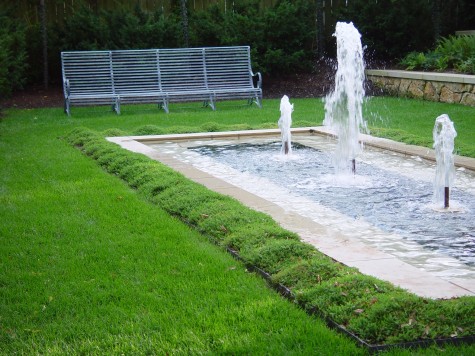
My fountain brings me great pleasure.  A concrete affair faced in Valders stone, it needs a border that separates it from the grass.  Grass clippings in the pool-not good.  A border of herniaria replicates the look of the grass, but needs no mowing.  The Valders stone is a border which protects the herniaria from the chlorine in the fountain.  Some borders are about visual definition; some borders are about protection. 

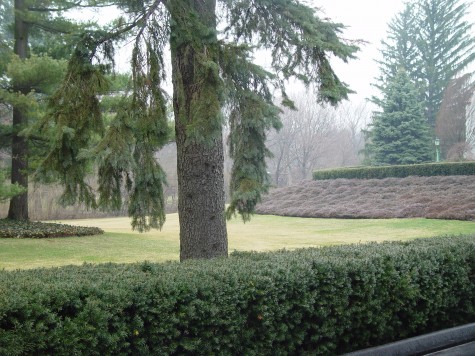
This formally clipped yew hedge is a border clearly delineating this driveway. This is a dicey move in our zone; road salt can severely damage yews.  Should you be thinking of bordering your drive with an evergreen, look at your salt habit.  The junipers planted on this slope, so beautiful in their winter color, a spectacularly generous border bewtwen the lawn plane, and the driveway plane.  This simple border tells you everything you need to know about the elevation of the house. 

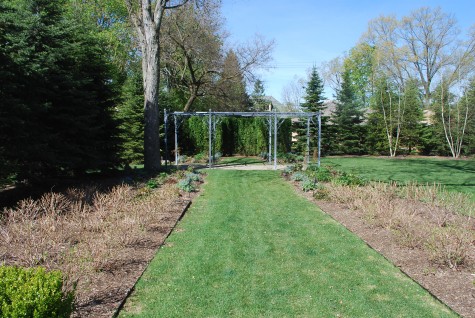
Perennial borders-no one does them better than the Brits.  My zone 4to5 makes me reluctant to invest too much in a perennial border.  I had lots of space here-so half of it went to a hydrangea border.  The hydrangeas, rugged and dependable.   Given the design of the border, the lawn reads as a road, a generous path to somewhere.  In this case, a pergola.  Yet to come, a focal point at the end of this grass verge which would encourage travel.  I think one of the most important elements of landscape design involves how to encourage people to travel through, and experience that landscape.  


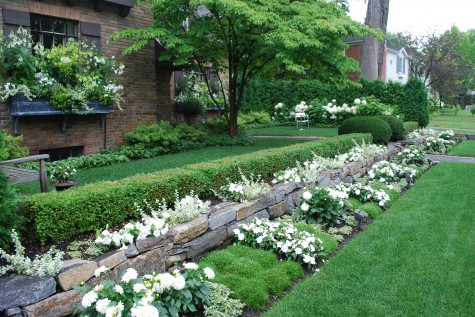
This low and so beautifully constructed wall is a border, a retaining wall, between one level and the next.  A change of grade asks for a boundary.  A change of grade requires steps.  I like to signal that one level is ending, and another level is to come.  I like moves in a landscape that are clear and easy to read.  Clear and confident moves are beautiful to my eye.    A crisp verge-how I love this.