Back To The Future

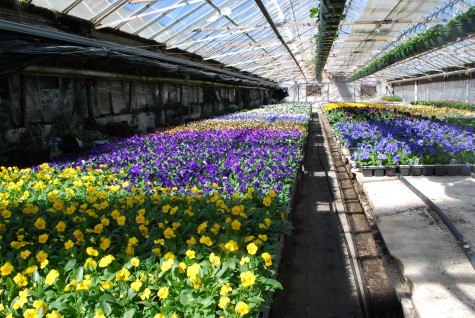
Our weather is being momumentally reluctant to shift into spring.  Yes, I still have snow and ice in my yard.  But  there are a few signs of spring afoot.  Bogie Lake Greenhouse transported me back to the future; the pansy house is bursting with spring color.  They are plenty big enough to go outside, pending some warmer night temperatures.  I do so associate pansies and violas with spring.  I do not mind violets in the lawn.  I like Johnny Jump Ups almost anywhere.  Plants that self sow can be a nuisance, but these plants are charming.  I know of no other flower which is commonly referred to as having a face. This refers to the prominent dark blotch on the petals of some varieties. This house is the closest thing I have to spring right now.  
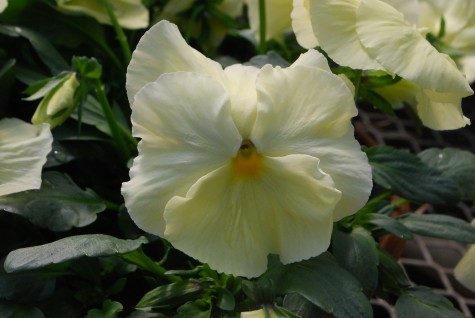
The clear sky series of pansies have no face, but I treasure them nonetheless.  They also are particularly hardy in my zone.  The tolerate a fall planting over tulips or other spring bulbs, and come back fairly reliably.  This faceless pansy does have a name-primrose.  Perfect. 
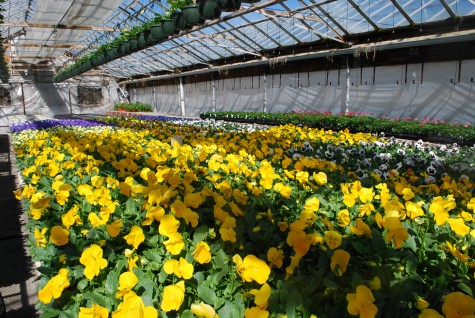
Clear sky yellow pansies are plainly visible from a long ways away.  This intense yellow makes it a perfect companion to other colors.  Yellow and primrose and dark purple make for a lively mix.  I like mixes for home plantings-they seem so much more personal.  In contemporary gardens, I like one idea, expressing confidently in a beautiful shape or sweep.  For a mix that reads evenly, use at least 3 colors.
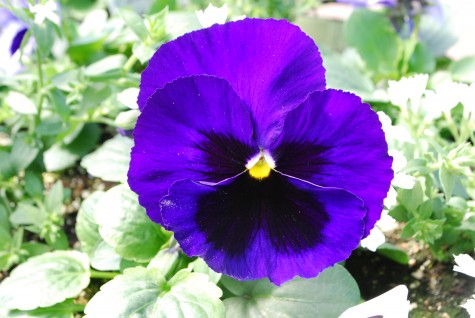
This pansy is a member of a mix; the seed produces a range of colors that are related.  My knowledge of plant breeding is nothing to speak of, but I do understand the concept of selection.  Breeding for a specific characteristic means selecting those plants that most closely resemble the ideal, and breeding on.  I may select certain colors from a mix to further refine an idea or a look.   
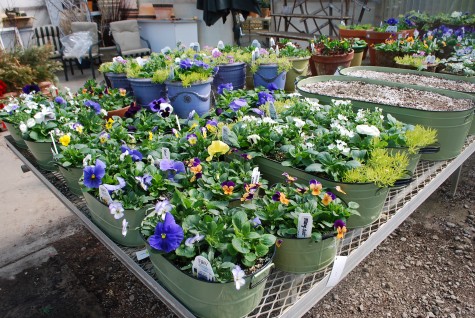
Mark kindly allocated some bench space to some spring pots of mine.  The selection of the plant material proved daunting, as nothing was in bloom.  I have firmly resolved to take notes on varieties and combintions I like when the plants are in bloom.  But a good deal of the fun of the planting-besides getting one’s hands in the dirt-is arranging for beautiful color.  However, planting containers with green plants has advantages.  A focus on the contrast of texture, mass and shape can make for spring containers all the more beautiful. 
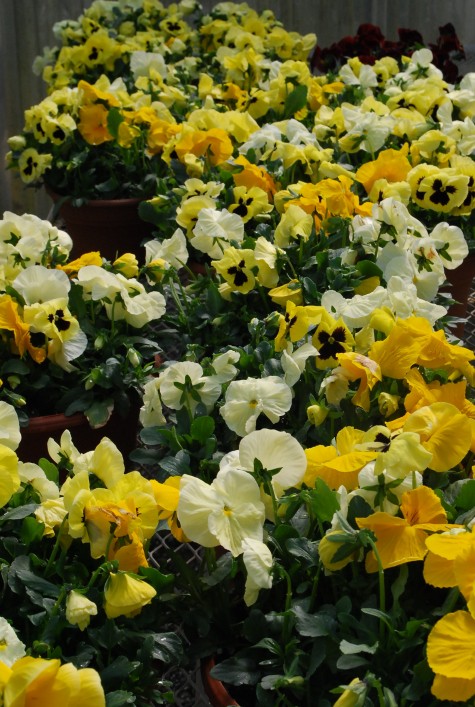
All of the contrast here is about color.  The plants are all pansies that have the same habit of growth, the same leaves, and the same flower shape. 
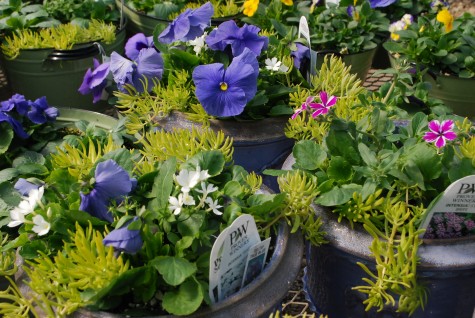

There are plenty of plants that tolerate our cool spring.  One of my favorites is phlox intensia-annual phlox.  Pictured here is the white, and the pink bicolor.  There is a lovely lavender variety as well.  It has a lax habit of growth that can be supported by the stiff growth of parsley, angelina, or pansies.  It will still be growing strong later in the summer.  I am thinking I will start planting out this next Monday, April 4.  Bring on the lettuce, the parsley, the fennel, the pansies, violas and osteos-the list is long enough to keep me really busy.  Hopefully there will be every opportunity to do something new, break all the rules, and go out on a limb.  There usually is.
Susanne’s Roses


My post earlier today featured the best that there is going on outside here-that best is not so great.  It is still winter where I live.   So I went back into that stack of old pictures and projects looking for something a little less chilly and off-putting.  This landscape and garden I worked on intensively between 1986 and 1994.  A client with a beautiful house on a small piece of land-I cannot remember how we met.  But I do remember that she decided that a garden, and a great garden at that, was just what she wanted.  Though she was always clear about what she liked, she had not so much knowledge.  I not only designed and planted for her-I taught.  She wanted to know everything I knew about wildflowers, perennials, meadows-and most of all, roses.  I had a history with roses, fostered by Al Goldner.  A highly regarded landscape designer with a degree in floriculture-he put up with a young employee (that would be me) who insisted to him in 1985 that tea roses were overbred, disease prone, and marginally hardy prima donnas.  He had the confidence to allow me to order roses of my own choosing for Goldner-Walsh.  I knew he was giving me just enough rope to hang myself.

I placed an order for roses with Hortico in Canada.  I bought antique roses. Climbers.  Rugosas.  Species roses.  And a line of English roses-the David Austin roses. Everything and anything that was not a tea rose.  I vividly remember the day I pulled a company pickup truck full of bareroot roses up to the Canadian/American customs booth-of course they pulled me over.  Who knew I needed a phytosanitary certificate?  I spent hours on a bench next to a man in handcuffs-it was terrifying.  Eventually they let me go.  This was some years before Wayside Gardens began offering David Austin roses.  I potted up just short of a thousand roses, and brought them on.  I learned plenty about them, just taking care of them.  Though I was by no means a rosarian, I had a client who wanted any and all of them.  Susanne.    

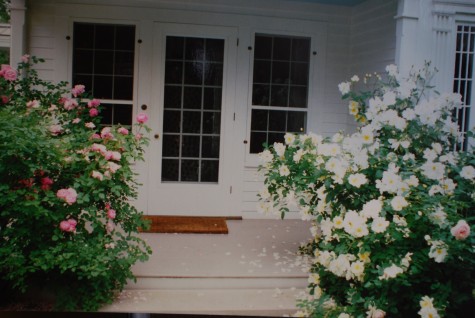
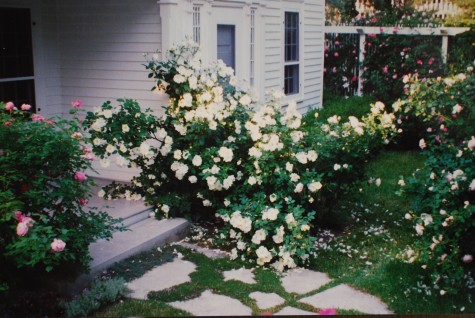
There are those people you meet.  In the course of business.  In the neighborhood.  In the grocery check out line.  They encourage you to be better than you ever thought you could be.  This perfectly describes Susanne.  She lit a fire under me the likes of which happens only rarely.  Some days I would come to plant, armed with hellebore species I had stood on my head to obtain-and she would still be in bed.  I would march right upstairs (I had the run of the house by then) and roust her out.  Years later, her front porch was dwarfed by mature David Austin roses-Mary Rose to the left here, and Heritage, on the right. 

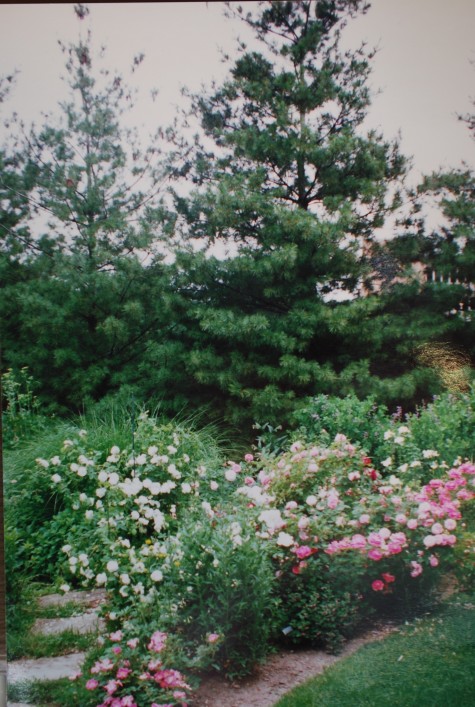
Her rear yard had about 15 feet of flat ground, before the earth dropped precipitously to the Rouge River.  That 15 feet of space-stuffed with roses.  They were lush.  She was lush.  My gardening life had an operatic quality to it, thanks to her.  Her entire property smelled of roses.  We grew roses with perennials.  We grew roses with asparagus, and grasses. We grew roses wherever we could. The we part was important there-the two of us gardened as if we only had 10 minutes to live.

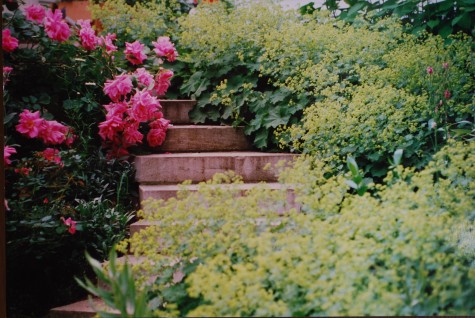
Every walkway, every staircase-redolent with the blossoms, the smell, and the habit of roses.  Not one of them was a tea rose.  I could go over the names and the classifications, but that is not my idea here.  Though we also planted no end of unusual perennials, wildflowers, grasses, trees, espaliers and shrubs, the organizing metaphor of this landscape-for the love of the rose.    

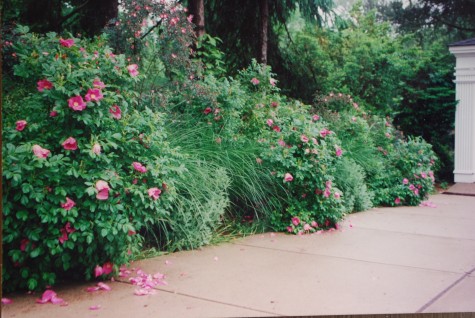
The driveway garden-a mix of Rosa Rugosa Scabrosa, rosa glauca (formerly rosa rubrifolia) miscanthus gracillimus, and artemesia.  Petals on the drive-how I loved this. 

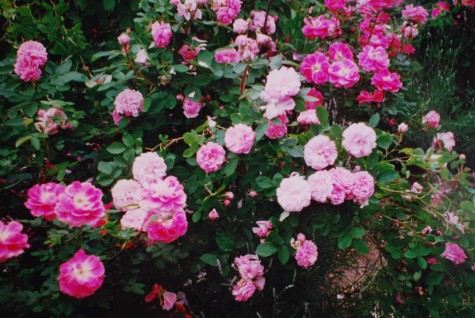
It has been so long ago that I designed and planted this garden, I cannot perfectly recall specific varieties from these old 35mm pictures.  But I do know my knowledge of roses burgeoned.  Susanne wanted to know everything she could about them-from me.  We both learned.

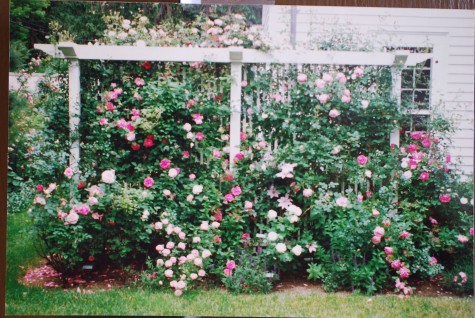
Her architect in Chicago built this rose arbor for her-I planted it.  This picture does little justice to that day some years later when I took this photograph.  Her passion-that’s what I see here.  I forget everything routinely-but I remember this day as if it were yesterday.   


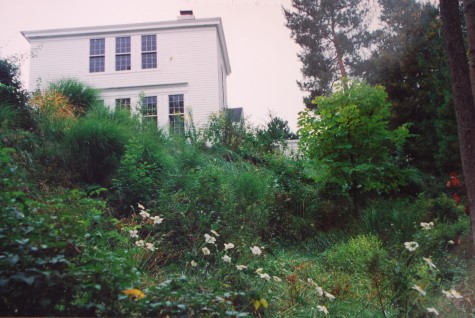
Her home sat on a very small piece of level ground.  The back yard dropped off precipitously to the Rouge River.  I gardened this entire steep slope-species and wild roses, grasses.  Perennials.  Weeds.  The anchoring trees-yellow woods-Cledrastis. This garden on a steep slope about did me in-but it was wildly beautiful.  


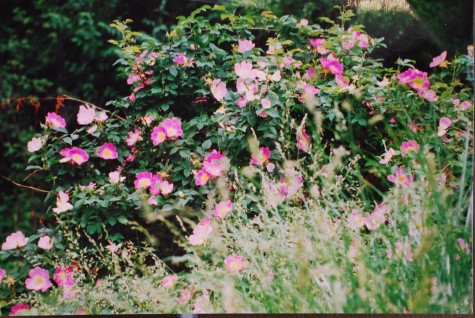
All over that slope-Rosa Complicata. How lucky I was to have met Susanne.  This garden changed my my life.

The Brush Fence


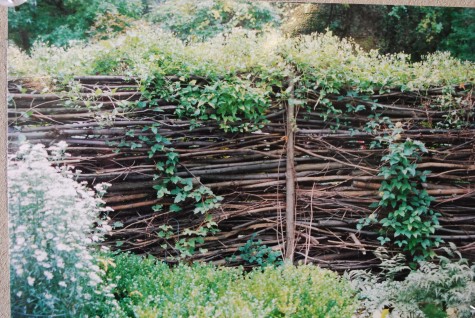
You would laugh if you could see all of the boxes of 35mm pictures that are littering my drawing studio right now.  No matter whatever possessed me to get them down off the shelf, and go through them, I am in that sore tooth phase-I cannot leave them alone.  Thus the posts about my first garden.  Apparently more is to come from those pictures; some projects I still like.  I have a little time to write about them-this March is shaping up to be a winter month, not a transition from winter to spring month. This picture of a brush fence I built many years ago strikes a current chord.  I have had a container of English terra cotta and antiques stuck in England for 6 weeks-over a round of chestnut fencing that US customs does not like.  Chestnut fencing is very common in England-chestnut slats and wire make for a rough and cottage ready, simple fencing that comes in  rolls.  There are panels, and gates, to go with. Chestnut fencing may be a fixture in England, but customs is not happy that I wish to import it to the US.  Why is this?  Standard fumigation techniques have been outlawed, with no substitute put in place.  Suffice it to say that this has been very difficult.  They are worried the fencing has bugs and I want to make available gardening materials from England.  We finally got the fencing heat treated; the container should be in my hands by April 4.   
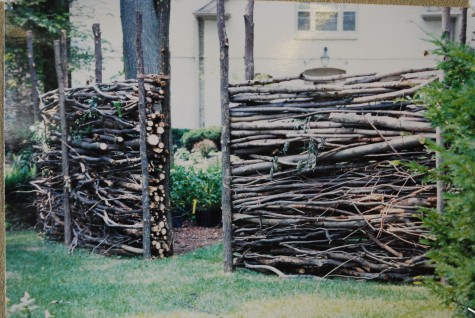
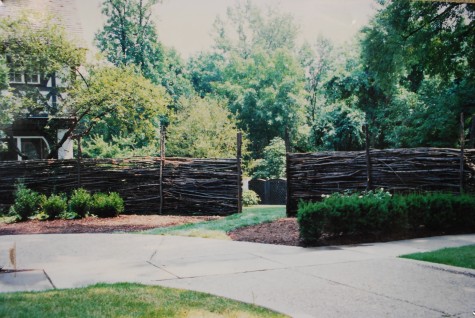
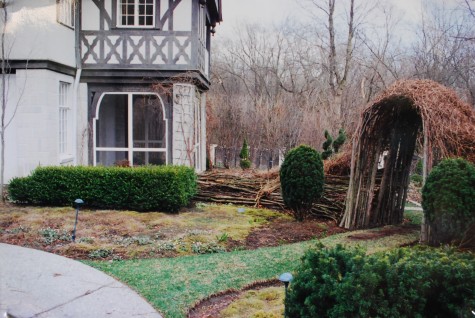
This client lived on a corner. Corner properties have no back yard.  This means no clearly defined front and public space, and back, or private space.  This 1920’s tudor style house made its own architectural demands. My idea-a rough brush fence would define the front landscape, separate from the side and rear.  I still love this fence, though it is long gone.  Thick maple branch posts set at intervals capture good size and very long branches-laid in between; all of the branches were courtesy of Westside Forestry.  The big idea here-a fence can be built from what is due to be discarded.  The bottom branches were laid in between parallel sets of maple poles.  The poles were then wired together with concrete wire to keep them parallel, and the next layer of brush would be laid.  Very low tech.    

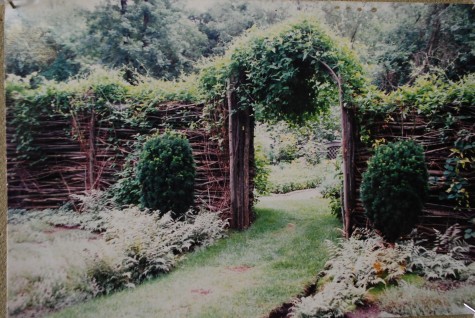
 Once the fence was in place, of course I planted sweet autumn clematis.  What better plant to grow over, and soften this structure.  The front gardens got laid out and planted.  Yews trimmed in oval shapes were set square in generous swoops of Japanese painted ferns marked the arbor entrance to the side garden.   

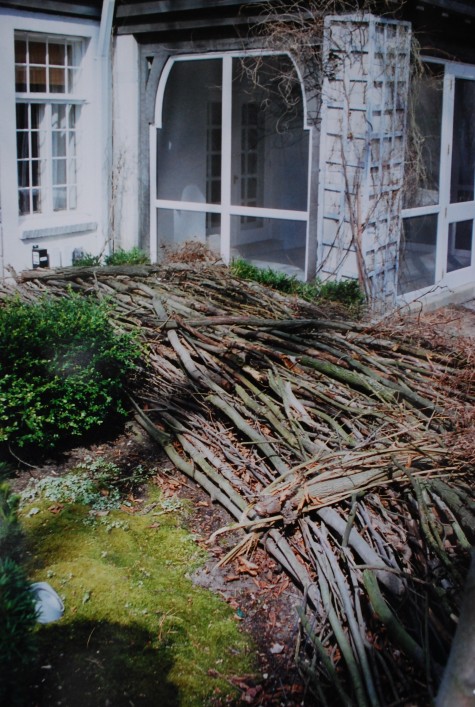
Large flowered clematis hybrids were planted at the base of the brush fence, which eventually was frosted with a single plant of sweet autumn clematis. Trained to grow sideways on the top of the fence, it added considerable height to the fence.   One late winter night, a straight line wind took the fence down.  Looking at this picture today, I remember my shock.   The maple posts snapped.  They were not one bit rotted-that same wind took half of the roof off my building and deposited it in the street.    


Always in a garden-there is trouble.  Plants that do not survive the winter.  Plants that do not survive terrible storms.  Too much water; not enough water.  Plants that do not survive with no reasonable explanation.   Trouble-every garden sees plenty of this. This trouble-terrible.  The timing could not have been better though-it was very early spring.  Nothing else in the garden was damaged.         

 The broken brush fence exposed what I had thought to keep private for my clients.  This turn of events-not much to my liking.  As it turned out, it was a fairly simple matter to repair.    

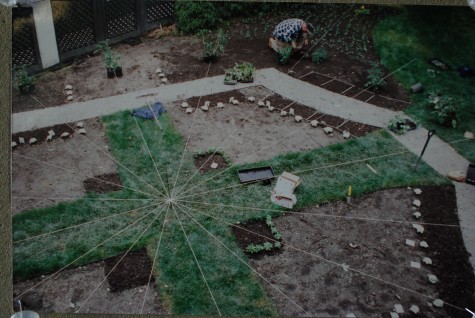
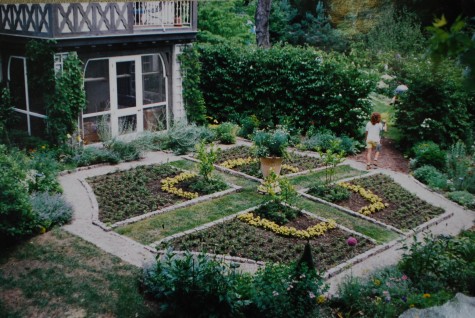
In the side yard, off the sun porch,  a formal herb garden had been under construction.  We were able to go ahead and plant, once spring came.   

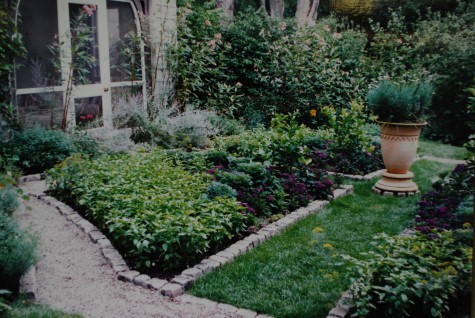
A very small formal garden sited off a side porch-this is how it looked, only seconds after it was first planted.  The brush fence that made this space private-we put that fence back up, better than ever.  This sheltered garden was devoted primarily to herbs. The tall hedge you see on the right of this picture-Cornus Kousa.  It was planted in a curve opposite to the curve of brush fence. These features made the side garden very private.  


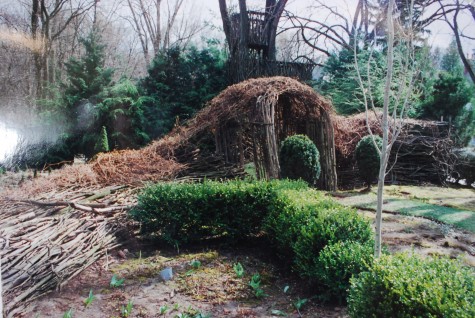
The herbs, notably basil, had good company.  Heliotrope.  Perovskia.  Marguerite daisies. Granite cobbles, and decomposed granite.  The entrance from the street-a recently rebuilt brush fence.  This garden exists only in these pictures now-the client went on to reconfigure the entire landscape.  Every garden I work in is different than it was 20 years ago-nothing in a garden stands still.

Sunday Opinion: Collecting Plants

Buck and I were out to dinner the other night with friends.  The rather spirited and hotly debated topic of discussion-collecting.  From the dictionary, a collection is a group of objects to be seen, studied, or kept together.  That group could be as little as 2; anyone who owns more than one sports car, garbage disposal or vintage fountain pen is a collector in my book.  Could one not get by with just one of each of these things? If you own one or none of something, you aren’t collecting, you’re just living.  Some collections are entirely utilitarian.  Dress shirts and sports coats, juice glasses, socks, garden books and steak knives-these objects in numbers serve a purpose. A clothes closet, a cutlery drawer, a bookshelf-these are means by which a collection is kept together for ease of use.  Seeds harvested by a grower ia a collection that will be studied; the tomato seeds will be kept with other tomato seeds-maybe they will be tested for viability.  Once the seeds of a given variety are packaged for sale, they may be displayed in a garden center next to packages of other varieties of tomato seeds.  This kind of collection gets studied by the individual gardener.  The gardener that buys seed for twenty different types of tomatoes-that person we might call an afficianado, or connoisseur, chef de cuisine, farmer, or a gardener that particularly values fresh and homegrown food.

Buck is a collector.  He has a collection of vintage accordions-maybe 38, maybe 52.  Many of them he has taken apart, cleaned, and restored.  I am not sure how many he has, as all but 2 are packed away, stored in their cases.  This is a group of objects meant to be seen.  What about displaying 4 of them in every room of the house?  This does not sound good.  They should be kept together-but how?  Displaying a collection is an art in itself. He also collects vintage movie projectors, slide wire potentiometers and other antique instruments used to precisely measure voltage.  Every square inch of the walls of his den are lined with them.  A pair of movie projectors from the 1940’s taller than I, sit on the floor face to face, and occupy one entire wall.  Though not the usual room decor, this loosely related series of machines all from a particular period make a very strong visual statement.  My interests could not be further from this, but I like collections created by an individual, rather than by committee or consensus.

A few years ago, I got him going collecting vintage composition dolls, doll heads, and doll parts.  I always bring a little something back to him if I am travelling-a trip shopping to the Roundtop Antique show in Texas would be no different.  Booth after booth stocked with every imaginable collectible object were set up in giant fields.  An elderly lady had a booth that was entirely devoted to vintage dolls.  She had countless glass jars full of doll parts. Many of these dolls had seen what Buck would call 1000 miles of bad road-dragged through the dirt, left outdoors, an arm missing.   One doll head-a composition head with bleached straw like hair, half of which was gone,  and alarmingly blue and fixed glass eyes – this would be perfect for Buck.  Compelling, and a little scary-he likes this.  But I walked away, thinking I might find something better.  Of course I didn’t-nor could I find my way back to her booth.  I thought about that head on and off all the way home; all I could do was tell him about it. A month or so later, a box of doll heads arrived.  Soon they were arriving every day. He did an installation of quite a few of his collection on a wall-they look great.

Our dinner companions-they are good friends, and avid plant collectors.  He was interested to know what Buck had to say about displaying collections.  He waded right in where I would be reluctant to tread.  When I go out to dinner with friends, I act like a friend.  But Buck doesn’t design gardens-his involvement is strictly on the looking end.  His take- a collection gains visual strength when it is arranged, grouped in a way that makes visual sense. As he is not a horticulturist, he sees overall shapes, colors and arrangements, not rare cultivars, or unusual specimens.  It is one thing to garden with such ability that all of your plants perform and thrive.  It is another thing all together to make them read visually.  I have few clients who garden with such a range of plants even close to theirs.  Conifers of all kinds, rare shrubs and trees,  wildflowers, perennials of every description, tropical plants, roses, bulbs, dahlias-you get the idea .  Their passion is for plants.  I have no problem spotting a small start of a rare jack in the pulpit, or an unusually variegated Japanese maple-but Buck can’t see that.

Making sense of a collection visually means that you enjoy it just as much from a distance as you do up close.  Once my collection of peonies got to 25 cultivars, I knew I had to arrange them in some way.  I could have spread them out, planting a few in each of many perennial areas.  I instead chose to line them out in rows, like crops.  From a distance, the green rows were orderly, and made a big statement.  This arrangement made caring for them easier.  When they were in bloom, the mass of flowers was beautiful.  When I collect one type of plant in depth, I like to keep them together.  I like hedges of peonies, better than individual bursts of peonies.  In my little south side rose garden, I did not plant one climbing rose.  I planted the entire wall with a collection of climbing roses.  I planted a collection of roses of only 3 varieties, that I thought would make a pleasing mass and interesting color contrast.

 When I collect plants that are related by some organizing characteristic-such as dwarf conifers, meadow perennials, rock garden plants, bog plants-a collection such as this is broad, rather than deep.  I would tend to arrange these related plants together, such that the overall shape of the collection makes as big an impact as a mass of one plant.  Naming gardens and spaces helps to make clear what goes in that broadly concieved garden, and what would be lost, or just doesn’t belong there.  I like plant collections that are arranged such that I see what made the garden maker collect them to begin with.  If you are unable to edit your collecting, I am sympathetic. I do not do a very good job of this either.  But I have a very small garden-my limits are clearly defined.  A large piece of property-I would be out of control.   One of the reasons I enjoy gardening for a living is the access I have to garden and plant collections other than my own.