Styling A Container


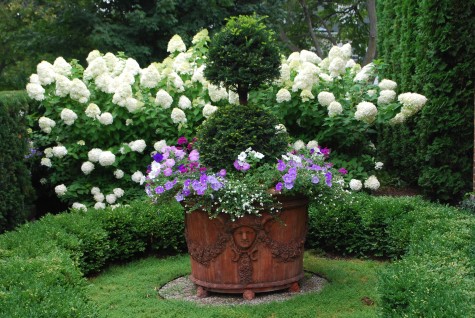
What do I mean by this-styling a container?  I could take 5 plants, and plant them in 5 identical containers in such a way that the end results would feature 5 different looks.  The style of planting you like informs how you arrange and choose numbers of plants in a container. 
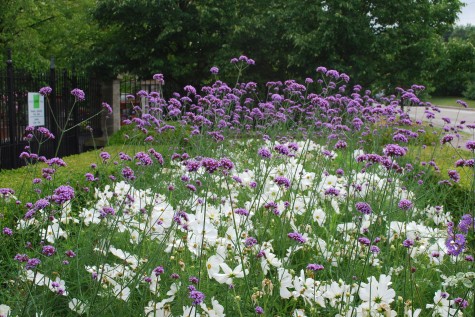
Let’s pick 5 plants.  Verbena bonariensis-a very tall verbena with small knobby flowers that are emphatically lavender.  Nicotiana alata lime-a rangy and tall flowering tobacco whose flowers are the most divine shade of green.  A Gallery – meaning fairly short-  dahlia in a peachy orange.  Heliotrope “Marine”-a short growing, dark purple flowered and very fragrant heliotrope.  Plant number 5-lime licorice. This felted leaf foliage plant known as Helicrysum has a horizontal and spiky habit of growth .  You’ll have to bear with the pictures that do not match the text-I have never planted a container with these five plants.  My main idea is to speak to the idea of style.

Suppose you have a very formal and symmetrical, very classically inspired home.  Given that you like that formal house, you might style you containers in a very formal manner.Verbena bonariensis is formal in the sense that it grows straight up in a V shape, and never goes over in a bad wind.  Want to contain it, and feature it as a centerpiece in a formally styled pots? 
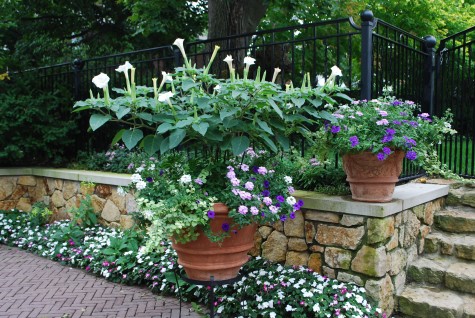
Gather up all of the arms once they grow tall, and tie them with a raffia bow.  That bow should be symmetrical, mind you. The above picture features datura-and not verbena, but the idea is the same.  This datura has had all of the lower leaves removed-it has a more topiary, rather than shrubby look.  Each arm is staked, to further give it an upright appearance.  For our imaginary container, plant the lime nicotiana all around this centerpiece of verbena.  As nicotiana tends to grown grow wild, scoop up those branchas at a lower level than the verbena, and discreetly stake and tie them just below the flower stalks.  Keep the lower leaves removed. Alternate the peach dahlias and heliotrope.  You may need two heliotrope for every dahlia-so the volumes are equal.  Lime licorice all around the edge of the pot will provide a uniform petticoat upon which the rest of the composition will rest.  Trim off any branch which dips below the horizon.
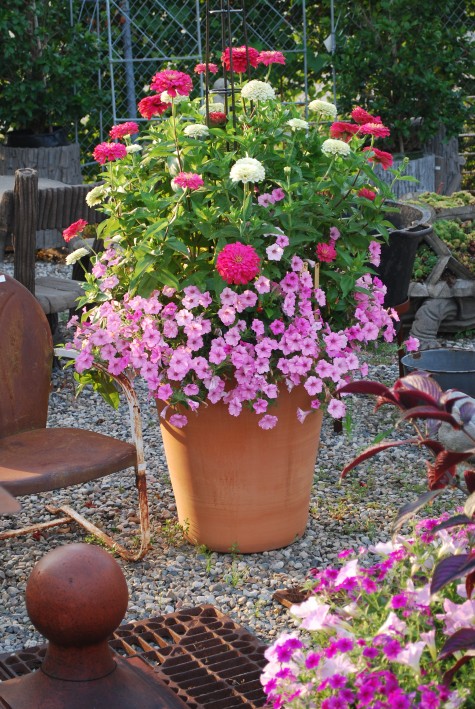
Regularly pinch any wild branches to produce a uniform thicket of licorice-trim to an end that resembles a tutu.  Every plant has a habit of growth. If you want your containers to have a little attitude, you must supply that yourself. This is to say that you are somewhat in charge of how things grow. Even this container of zinnias and petunias can be trimmed into a more formal shape without any loss of bloom.  If this is your style of planting, a little maintenance will go a long way.
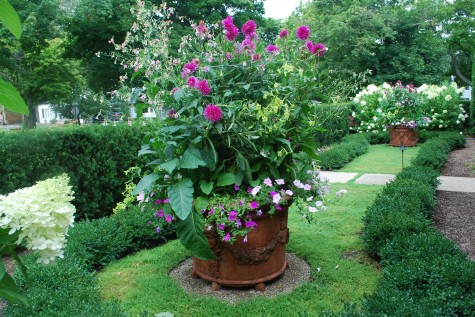
If lush and profuse in the English style is your idea of a great look, I would pack your container with the verbena,  nicotiana, and dahlias mixed-but I would switch to a tall lax growing dahlia that you discreetly support with a tuteur.  The rod steel plant climber is this pot has competely disappeared from view.  Stake as little as possible.  Keep every asymetrically growing unexpected leaf that you can.  The lime licorice, if it is happy, will weave itself in and out of every other plant you have in a natural way.   The heliotrope will have to get leggy and rangy to keep up, and it may finally disappear in the jungle of other plants.  How an English-style cottage garden planting changes over the course of the season is part of its charm.  The big idea here-plant big plants, and enjoy how they relate to one another with a minimum of interference.  Bug-chewed leaves are welcome here.
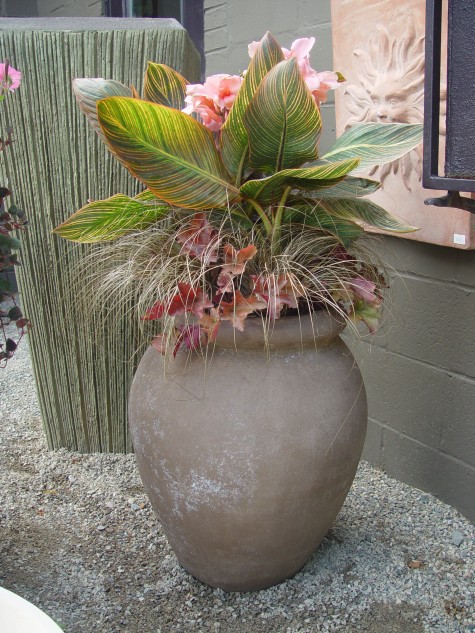
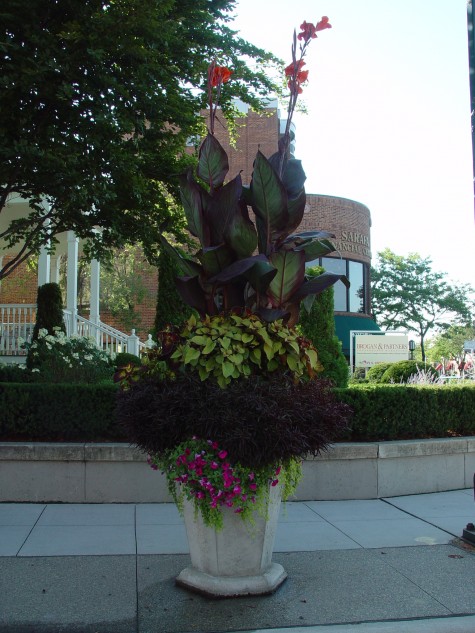
If a container planting which is more architectural is your style, you need to ditch both the verbena and the nicotiana.  Neither one of them are particularly architectural plants-they are wispy, and move in the breeze.  Opt instead for a centerpiece plant with bold leaves and habit of growth, and key everything else to enhance that idea.  The peach dahlias would color compliment this dward striped-leaf canna pictured above in much the same way that the heuchera does.  The toffee colored grass is an unusual color, and sets off the canna leaves in a dramatic way.  There are only 3 plants here, instead of five-modern and contemporary style plantings ask for a restricted palette.
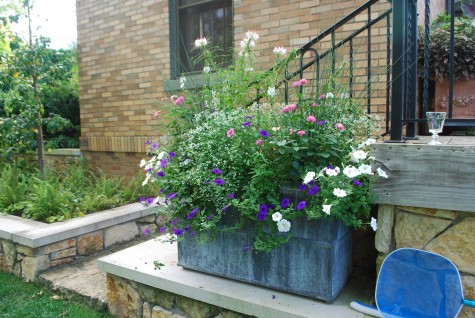
If very loose and meadow like is a style you appreciate, take all five plants, and plant them randomly, but in very different numbers.  10 verbena, three lime nicotiana, one dahlia, and equal numbers of heliotrope and lime licorice mixed will result in a random and casual, road-side weed like planting.  This planting with dwarf cleome, juncus white angelonia, euphorbia and petunias features a little bit of everything in a wispy way.  All of the leaves are small; all of the flowers are small and subtle. Euphorbia diamond frost does a great job of obscuring foliage, and imparting an airy and natural look to any container.  Were I to plant in this style, I would choose the euphorbia over the heliotrope. 
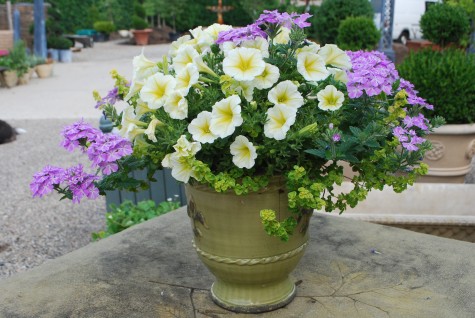
 Small containers can have just as much style as big ones.  I particularly like this table top pot-yellow potunias, lavender star verbena, and gold marjoram.  It has a great natural shape, interesting color, and relaxed styling, does it not?
Dark And Dramatic

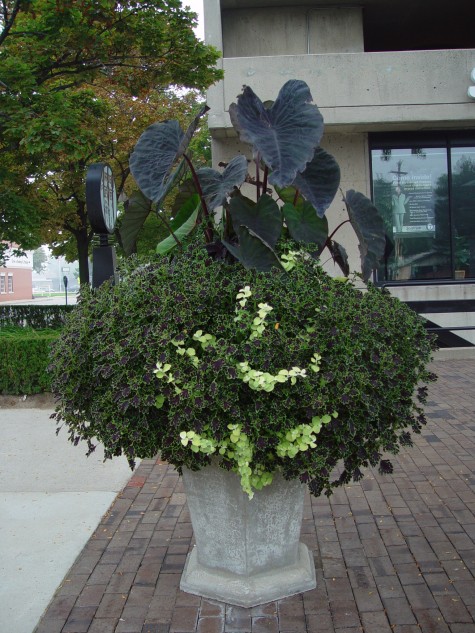
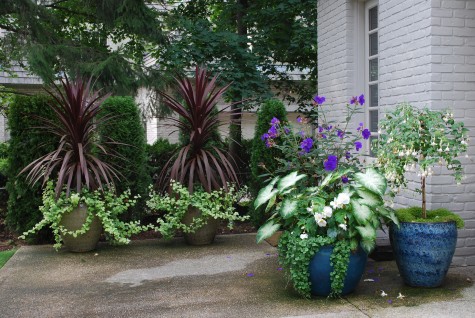
What makes dark leaved plants so irresistable?  Their relative rarity attracts the eye in an instant.  Of all of the thousands of green leaved plants in my garden, I have no plants with “other than green” leaves.  Were I to plant a red-leaved plant there, it would attract attention.  A red-leaved Japanese maple stands out from the crowd by virtue of its color alone-never mind that it is a tree with many virtues.  Red leaves can create excitement in a visually sleepy place; the color is unexpected.  Though I would not be inclined to indroduce red leaved plants into my landscape, I like them in containers.  These old red leaved spikes provide a dramatic accent to this grouping of pots.  The choice of lime licorice as an underplanting reflects my general rule-if I use dark leaved plants in a container, I stay away from green leaved companion plants.      

Once I make the decision to feature a plant with dark foliage, the supporting cast plants need be friendly to that color.  Lime licorice verges on yellow; inky fingers coleus has a deep purple ground, with just a hint of bright green on the edges.  Medium green and medium red make mud together.  I like sharp, crisp, delicate and dramtic color-no mud.  Big black foliage needs more black foliage to make a dramatic color statement.  The rim of bright green on this Inky Fingers coleus describes its small texture-it brings all of the color to life.  Medium green foliage in this container-thud.    

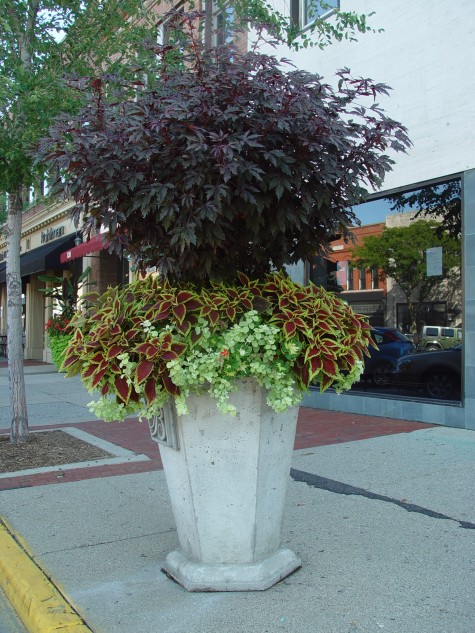
This red/black foliaged hibiscus is a very strong grower.  It can easily attain 6 feet in a single season.  The red and lime bicolor coleus and lime licorice light up that dark color from below.  I have thought on occasion to pair it with the big ruffly leaved farfugium; the contrast in texture would be great.  The red and green color combination I am reluctant to try.  Want an other than green foliaged scheme?  Follow through with every move you make.

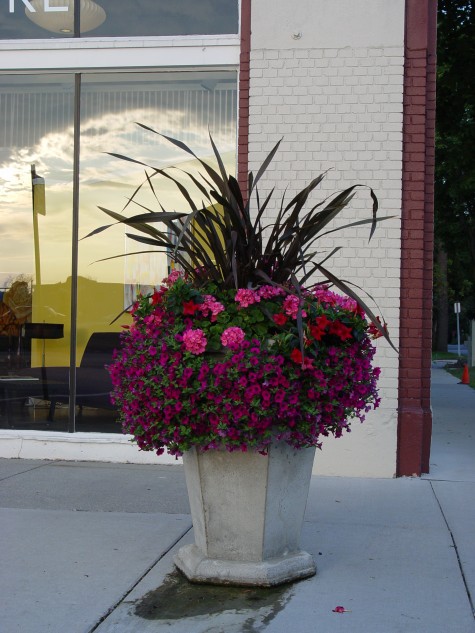
I did make an exception in this case.  The strap leaved New Zealand flax, or phormium, is black leaved; perhaps there is a hint of brown.  The large, bright flower heads of the peach geraniums attract the eye; its great leaves fade away into the distance.  The violet petunias are so covered with blooms that the green foliage is scarcely visible.  This planting is dark and dramatic.

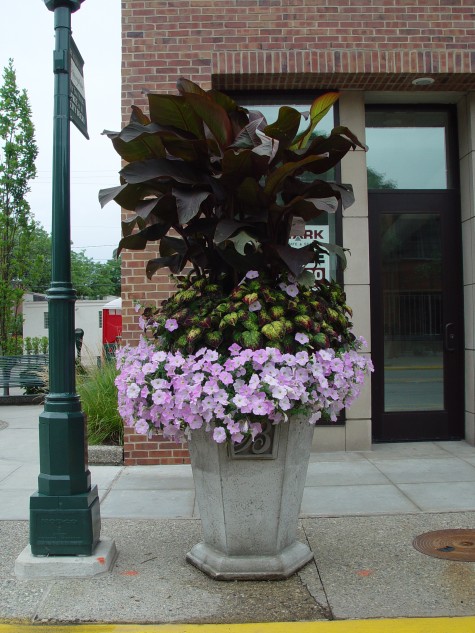
This large and black leaved canna is a boldly sensational plant.  It has great stature, texture, and mass-there is no missing it.  The red violet and lime yellow coleus Arizona Sunset repeats that dark foliage color in a different hue, and leavens it with lime.  The delicate and pale lavender petunias are a sharp contrast-all of that lavender brings out the purple in the canna leaves.  The flowers have all but obliterated any view of its green foliage.  

This centers of these canna leaves appear green when the sun shines through them. This made it fine for me to plant an olive green coleus with a red violet obverse next to it.  The red thread leaved alternanthera appears to darken as it matures-a large mass of red leaves traps light, rather than reflecting it.  The pink petunias and creeping jenny define the lower edge of the alternanthera mass.  Very dark foliage benefits from some lighter company-any other color than medium green, please.

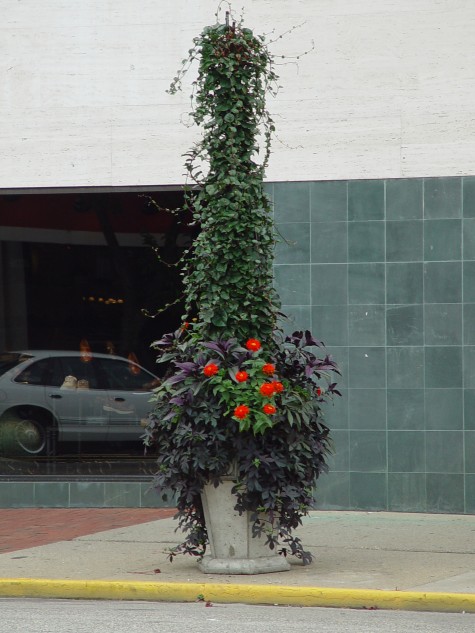
Malabar spinach has very dark green leaves which are red violet on the reverse side.  The stems and knobby flowers are also dark red violet.  Though I love how it climbs to great heights in just one season, I also value that dark foliage.  Persian Shield and black sweet potato vine mirror that color quite well.  This pot was dark up 12 feet into the sky, and just as dark, down to the ground.  This made me think a big button of green-foliaged Red Sun zinnias would work.  

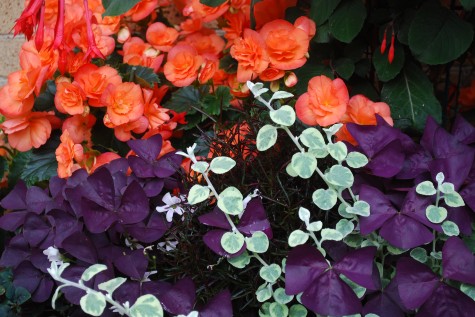
The very dark purple oxalis triangularis is one of my favorite plants.  That rich dark red violet leaf-so beautiful.  I especially like it with Solenia orange begonia.  Very little of the green leaves of the begonia are visible-this is a study in orange and dark red violet.  The varigated licorice is not your garden variety green-it looks as fresh as the description mint green suggests. The big idea here-should you choose to include dark foliaged plants in your landscape, garden, or containers, pay even more attention to the color you put with them.

In The Mood For Moss

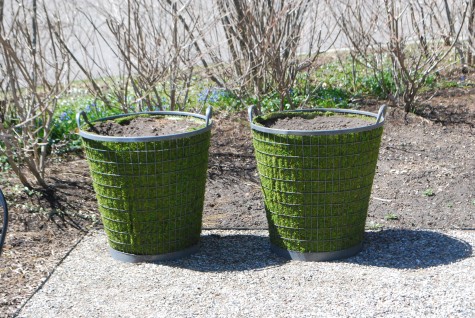
One wall of my shop is completely covered in moss.  Dried and preserved moss, that is. Mood moss is sold by the case; the rounded clumps come with a wiry and fibrous backing which are the individual stems and roots.  I cut the brown backs flat, and fit and hot melt glue the pieces on sheets of foamcore board. I leave a two inch border unmossed all around the 4 edges of the board.  After I stapled all of the sheets to the wall, I covered the seams with solid pieces of moss that cover where one board meets another.  This makes the moss field look continuous.  This moss makes for a highly textural surface.  When the color of the moss fades, as it always does with exposure to light, I spray it with moss dye, which is most likely a glorified food coloring.Mossing a container involves a wholly different process. Moss can be used to line a wire container, as its fibrous stems and roots are densely interwoven.  It permitts the passage of water while it contains soil.  It is a very attractive material-what gardener does not have a soft spot for moss?  I once caught Buck in the nick of time, just as he was set to broom all the moss off of a low retaining wall in the drive.  It did take a little time to explain the beauty of this plant, but now he treasures our living colonies of moss as much as I do.  Florist’s moss comes in flat sheets-or hides” as Rob calls them.  They lay obligingly flat against the surface being lined.  These moss baskets show nothing of the wire liner; this particular moss is fitted tightly to the outside surface of the basket, rather than the inside surface.  More on that later.   

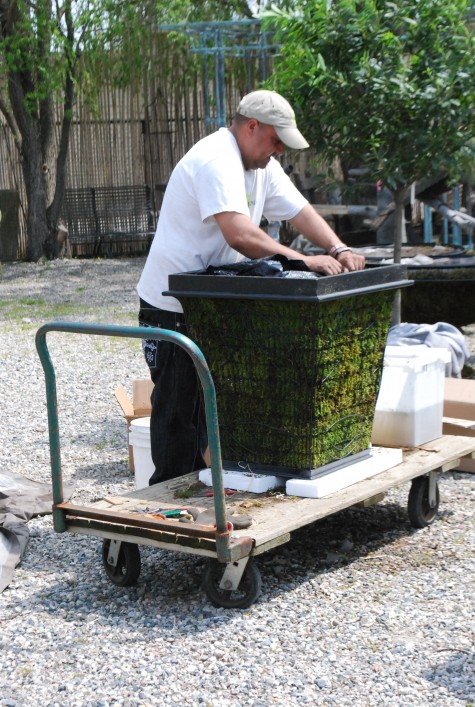
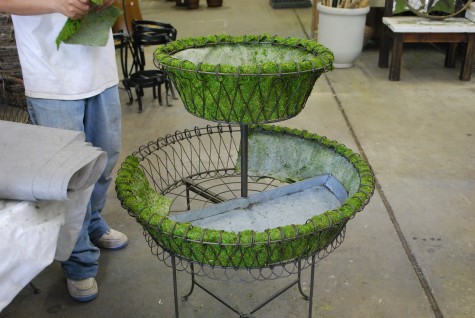
Mossing a very large object, such as this wirework pedestal, involves a filler material.  To stuff this entire volume with moss would involve many many cases at great expense.  Instead, we turn the pedestal up side down, and place a sturdy plastic trash bag filed with bark that fills the center of the space.  The florist’s moss is soaked until is is pliable and can be easily shaped.  It is then stuffed into a small space between the bag of bark, and the outside wire shell.  The moss is pushed down, and into that wire.  This insures that when the pedestal is turned right side up, gravity will cause the moss to fall back onto each individual wire, securing it in place.  Gravity plays a big part in any sucessful mossing project. 

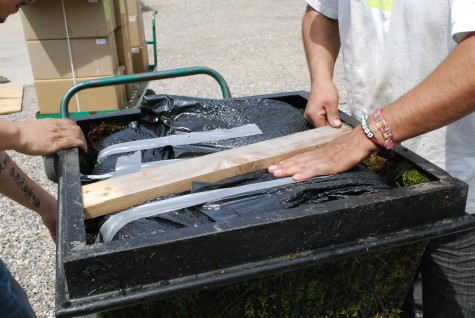
Once the thick outside layer of moss is wedged into place by the bagged bark, and gravity, the bag is sealed with duct tape.  Wood 1 by 2 inch lumber is wedged under the angle iron comprising the bottom of the pedestal.  This is an anti-gravity measure.  Ideally, all of the airspace inside is either moss or bark.  Gravity will act on any open pockets, producing that dreaded condition known as “topiary erosion”.  This is why I rarely use moss in a horizontal spot in a container.  The weight of wet soil, and the action of gravity will tend to perforate the moss-it is only a short time thereafter when the soil breaks through.     

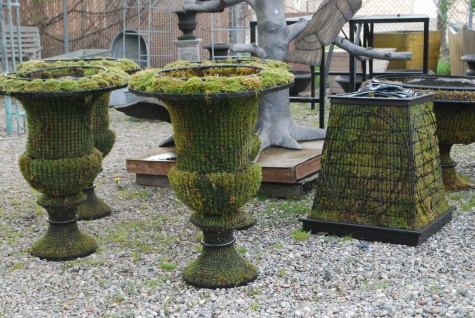
The process of mossing an urn or container is a two step process.  4 or 5 inches of densely packed and overlapping pieces of moss are pressed into the wall of the container.  Then the drainage material, and 4 inches of soil are added-this keeps the moss in place.  We work our way to the top of the urn-some moss, and then some soil to hold it in place.  There is little pressure on the moss in the sides of a container, as the weight of the soil and the action of gravity is always in the vertical dimension.

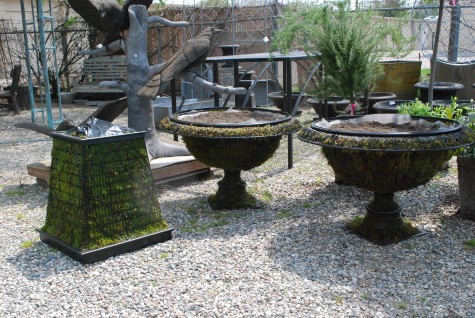
The bottoms of these urns are packed solid with moss, as the space is too small to handle both soil and moss.  The bagged bark in the pedestal helps make the pedestal heavy.  A large wire pedestal and urn has to be sited in a place where winds are less likely to blow them over.

Always, there is new technology.  One of my favorite new products-rolls of florist’s moss with a plastic netted backing.  I suspect the moss is ground up, mixed with a binder, and sprayed onto the netting.  This is a very civilized and easy to handle mossing material.  I moss baskets and containers in much the same way as I might wallpaper a wall.  There is very little waste.  The netting makes the moss very strong, and unlikely to rupture.  Smooth and symmentrical containers can be mossed in minutes with this material. 

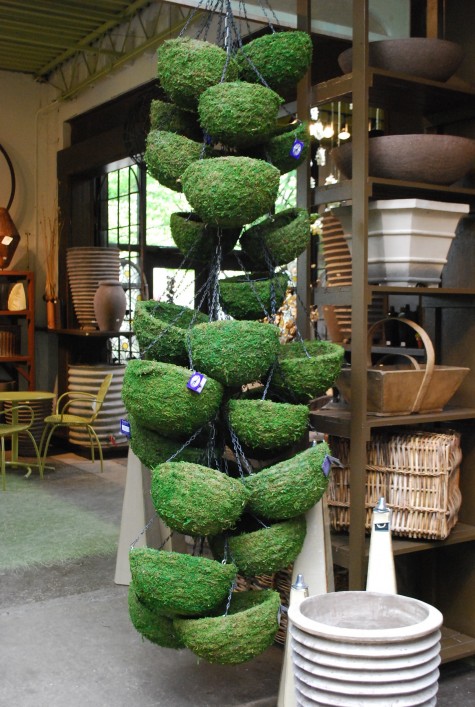
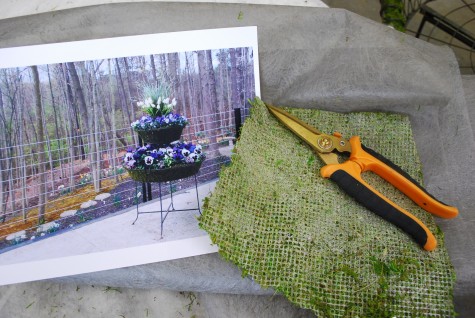
There is no need to fit, soak, or overlap this material, nor do you need to build up each layer a few inches at a time.  It molds easily to the surface you are mossing.  It can be cut, and the corners easily folded inward.  We cut the strips for this plant stand a few inches long, so the top edge could be rolled, and form fitted to the rolled edge at the top of each tier.

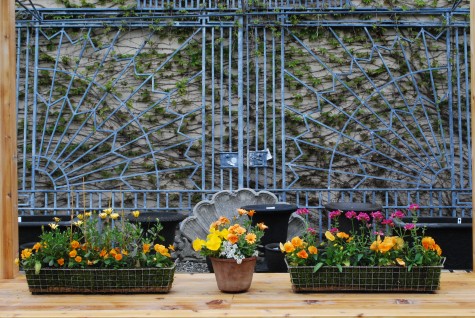
Small, geometrically shaped galvanized wire containers can be mossed and planted very quickly.  The smaller the container, the more difficult it is to handle and fit natural sheet moss.  I find this netted composite moss retains its mossy color really well.

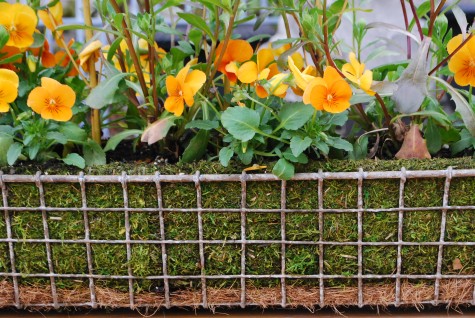
The bottom of this container has a layer of natural coir, cut to snuggly the fit the bottom. The coir is very dense and strong, and will keep the soil where it belongs.  


This pair of mossed galvanized buckets look very handsome-even before they have plants.  The structure of the wire is cleanly and clearly visible.

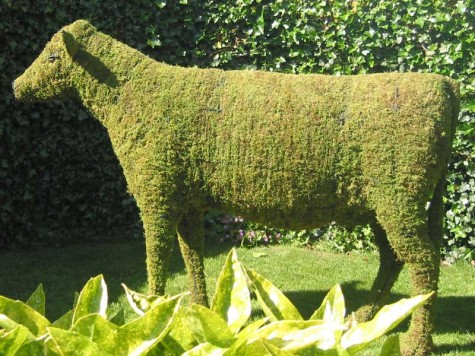
This moss cow was a birthday gift from Rob a number of years ago.   This spring, I took it apart, and re-mossed some sections, and repaired others.  It is the only sculpture in my garden.  Lady Miss Bunny-is she not beautiful?

Treated To The Tulips

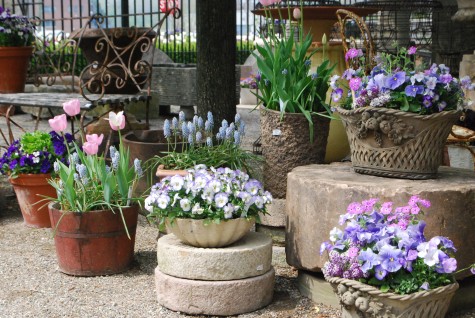
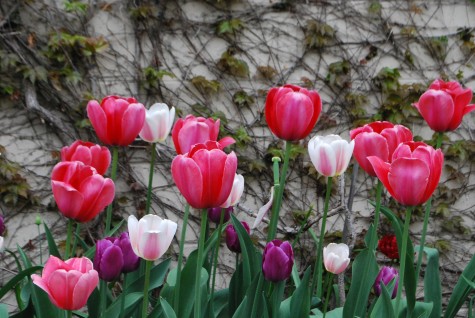
All of the cold tolerant spring flowers have their charms.  The pansies and violas come in every attitude from dainty and demure to bold and sassy.  The pale powder blue grape hyacinth pictured above, muscari Valerie Finnis, is a vigorous grower whose flowers last a long time.  Phlox intensia will last even longer; I have had it thrive an entire season.  But there is nothing quite like being treated to the tulips.  The pale pink variety pictured-Pink Diamond. 

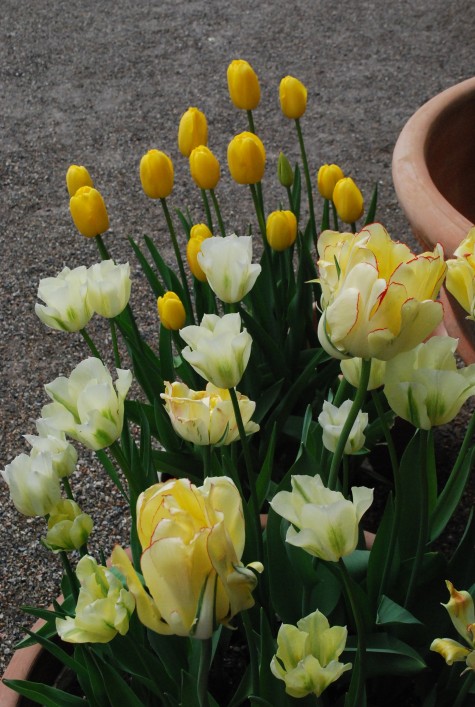
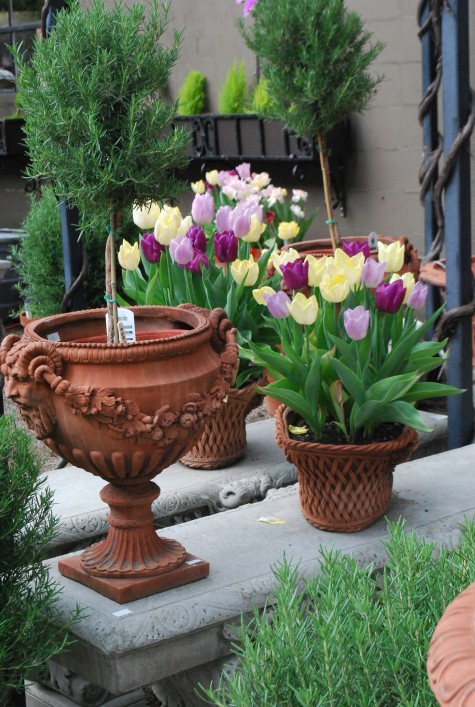
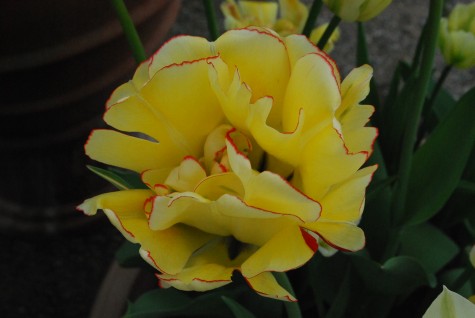
Their forms and colors are many.  Their big simple shapes can make a big visual statement from just a few bulbs.  Bulbs wintered in the garage in fiber pots make great centerpieces for spring containers.  From the moment that the leaves emerge from the soil, to bloom is about three weeks.  The thick strappy leaves are just about as beautiful as the flowers.  The formation of seed pods, and the dying back of the foliage takes another month.  The entire process is beautiful to watch.   Pictured above, the multi-petalled Darwin hybrid Akebono, Spring Green, and the butter yellow Roi du Midi. 

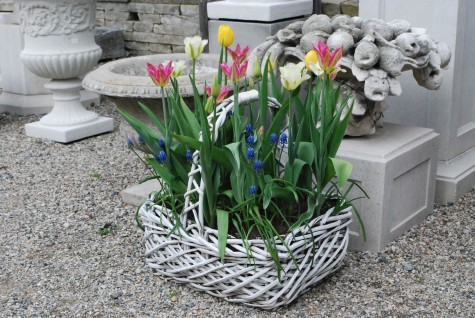
I do have a soft spot for viridiflora tulips.  The white petals of the variety Spring Green are streaked with green.   The pink and green variety in this basket is called Virichic. Green and pink chic, indeed.  They bloom fashionably late in the spring, and their spiky shape is striking.  

Though the color of Princely Mix is very sweet, their staying power is considerable.  These compact clumps have been in bloom for better than 3 weeks.  Their short height makes them perfect for small containers; they are also likely to weather the worst of the spring rain and wind without damage.    

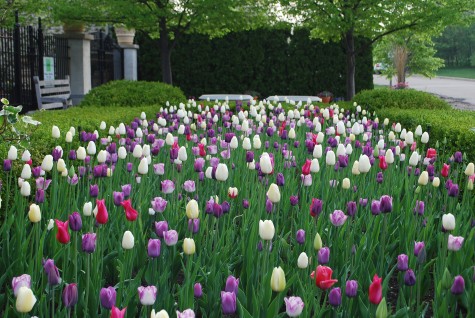
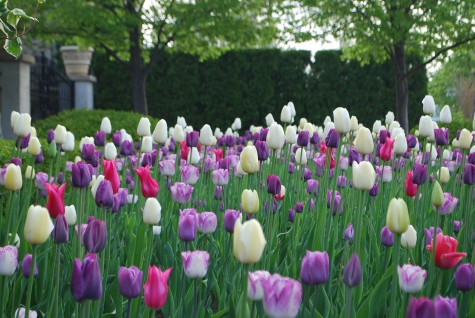
Choosing a mix of tulips for the big garden at the shop is great fun.  What I like the best about a mix is the possibility of great variation in height.  This gives you color at every level.  Violet Beauty-18″ tall.  The white tulip edged in violet is called Shirley; it grows 22″ tall.  The random hot pink lily flowered tulip Mariette also grows 22 inches tall, but its rarer appearance in the mix makes it seem different from all of the other tulips.  At 24″ tall, Cum Laude is the tallest of the purple tulips.  The white single late tulips Maureen grows to 28 inches.     

What would I do differently, if I had the chance?  That is a question I am always asking.  In this case, I would add a short white tulip.  Pale colors do a great job of highlighting darker ones.  So, 2 different heights of white tulips, 2 purples, one whte and purple bicolor,and the odd tulip out-a little hot pink seasoning here and there.  Most flowers are beautiful in their own right, but how they are arranged can make them look all the more lovely. The tulips fields in the Netherlands in bloom-show stopping in a different way.  Tulips being farmed have a much different appearance than tulips in a garden.

In this mix, flower size was equally as important as height.  Every plant has characteristics worth considering when a design is taking shape.  For example, it is easy to extend your tulip season greatly by choosing tulips from different classes.  The species tulips bloom a month earlier than the single late tulips.  I like the idea of  having a spring that goes on for three months, in one form or another.  


The Darwin hybrid tulip Akebono is a new one to me.  No doubt I will  have this again in bigger numbers.  I like to try a small amount of lots of bulbs-there is nothing better than seeing them bloom in person.  Choosing tulips can be tough.  They get planted as small papery brown spheres that give no hint as to what will come the following spring.  For that reason alone, I try to photograph all the tulips-so I have a record of what they can be.  Pictures of bulbs in catalogues can be notoriously misleading.   Photographic record keeping is an easy way to better inform your design.  This tulip with a  simply shaped, pale yellow firned and a spring green companion-that could be gorgeous.  Paired with red, orange, and hot pink tulips-visually electric. All by itself-just plain stunning.  If you are nearby, stop up for a look.  It is peak tulip treat week.