Planting Window Boxes

A window box is just about my most favorite container to plant.  They represents the best of all possible worlds.  The planting area is larger than most containers; I like having lots of space to plant.  This means lots of possibilities.  Window boxes come without any of the headache of planting large areas in ground.  My ground holds water too long.  Standing up to plant is a treat.  Having planted all manner of plants in the ground the past 30 years, I like having a big body of soil, and a raft of plants, at eye level.  The year I broke my leg, this feature was especially appreciated.
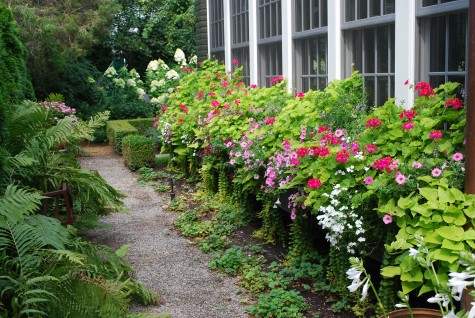
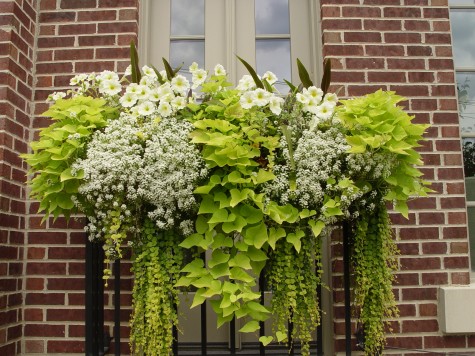
These boxes we built and mounted on the exterior wall of a sun porch.  The view from inside is swell. The Persian Queen geraniums, petunias, sweet potato vine and what all else is in these boxes can be easily appreciated at eye level.   
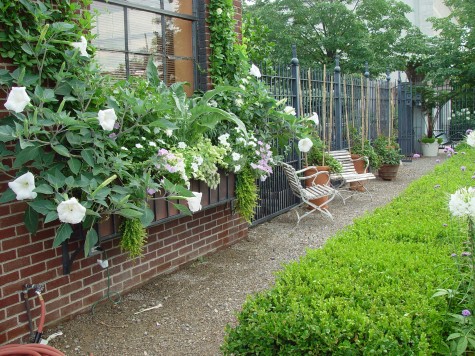
Many of the boxes I plant, I have constructed. My main complaint with commercially available windowboxes is that they are not correctly sized to their companion, the window.  They are often too narrow, too shallow, and too short-perfect for UPS shipping regulations, but not so great for your garden. A window box needs to be generously sized; a big soil mass will hold water long enough for you take a breather once in a while from your watering chores.  If your idea is to have a back row of plants, a middle row, and a front finishing row, the box needs to be 12 inches wide.  I like 16 inches deep-lots of soil and drainage material.   I like even better a box which is longer that the window in question.  Ths permits tall plants on the outside edges that do not obscure your view out.  My shop boxes are sized this way.  I had room this particular season for datura, cardoons, and cup and saucer vines growing on the walls.     
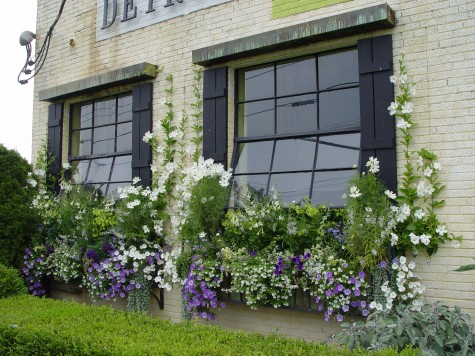
One year I grew white mandevillea on wires on either side of the windows.  OK, I was not much looking out of my windows at this point in the summer.  But the view is entirely in your control-maybe your boxes need to be mounted to the wall lower that you think.  Think about the mature height of the flowers-where do you want that to be? I like my boxes on the wild side-the Sonata white cosmos and lime nicotiana grow large.  My boxes are plenty large enough to handle them .  
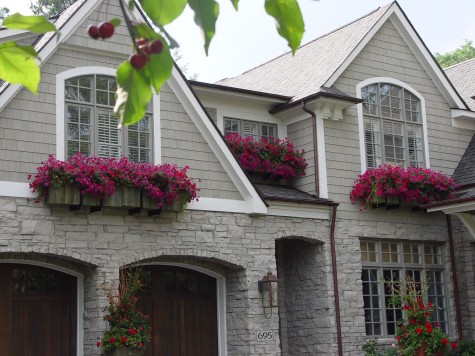

Second story window boxes have a very European flavor.  I am sure you have seen those pictures of window boxes stuffed with trailing geraniums on homes and businesses in Switzerland, or the window boxes on the shop walls in London.  The planting of window boxes dates back to Roman times, when wall hung boxes were used to grow herbs.  The first gardens were of course devoted to growing things to eat.  Later, gardens were also devoted to ornamental plants.-I can think of nothing else that will dress a window better for summer than a box stuffed with flowers. 
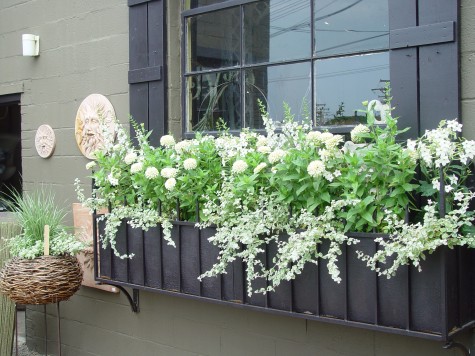
The generous size of a windowbox means you can explore a planting idea in greater depth. Should you be interested in exploring color relationships, you have the opportunity to introduce various shade variations on a theme.   If your point of view tends to the contemporary, a box full of one favorite architectural might be just the thing.  Should a cottage style garden interest you, a big box will permit you to go wild to your heart’s content.
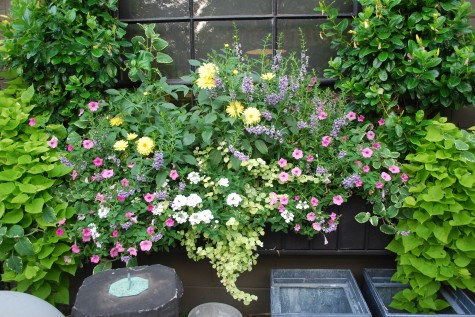
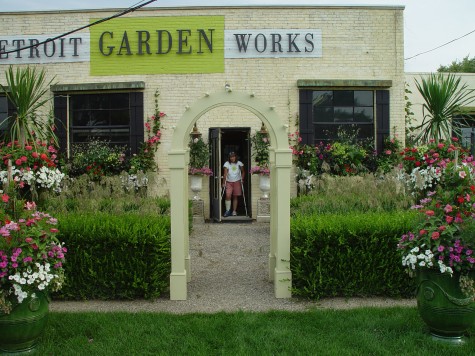
Most annual plants are happy in a big box.  The soil is good, the drainage is even better.  The plants are easy to groom and dead head.  The landscape at the shop-trees in the ground, and a decomposed granite covered ground plane.  The only flowers I have are from the 7 window boxes, and containers that I plant.  The overall impression is of a profusely flowering garden. 
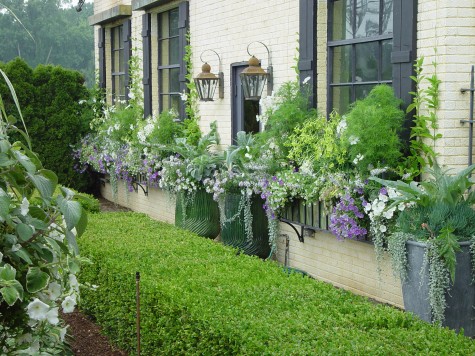
The boxes put the flowers above the level of the boxwood hedge; it is easy to see them.  The 11 boxes on the roof can be seen from blocks away.  Granted that your taste in gardens may not run to this level of exuberance, but I see part of my job as encouraging people to take up gardening.  And that one’s choices of plant material and combinations are many.  
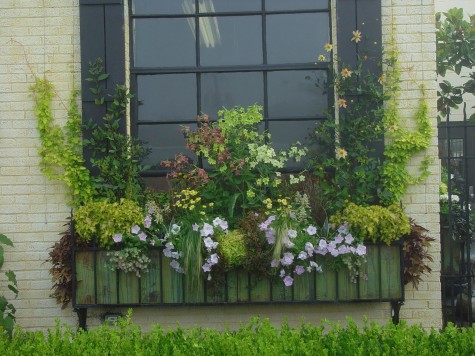
This lime, brown and lavender box had a moody feedling to it-I still like it.  I cannot remember the name of the copper flowered nicotiana, but it was beautiful.  The color of brown sweet potato vine looks great with other colors besides lime-I like it with orange, yellow, and cerise justg as well. 
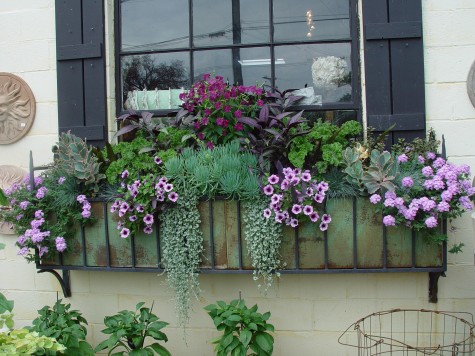

The first year that Perfume Purple nicotiana came out, I was entranced with the color.  This box was composed around that one plant.  That red-purple color is very unusual-I shoopped all over for plants that might compliment that color. The red markings on the Persian Shield was much the color of the nicotiana. The lavender star verbena and petunia of unknown name did a good job of repeating that color as a pastel version.  The blue-green succulent I recently learned is a senecio, and a blue-foliaged kalanchoe (??)  seemed like a good foil.  What will I do in the boxes this year?  Don’t know yet.
Green Schemes

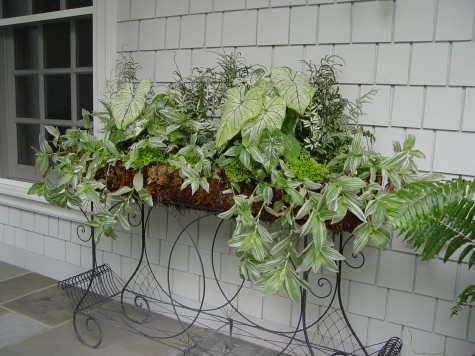
Containers planted with an all green color scheme can be very beautiful.  Eliminating color as an element in container design means that other elements, such as texture, mass, form, scale, and proportion, become very much more important.  The frosty white Victorian parlor ferns in this planter are a lacy contrast to the big leaves of the white caladiums.  The languid and lax habit of the tradescantia fl. Variegata contrasts to the tight soil skimming habit of the lime green club moss, known as selaginella.  Overall, the planting is loose, and airy-just like the container.  The container itself is such an important element of the overall composition. 

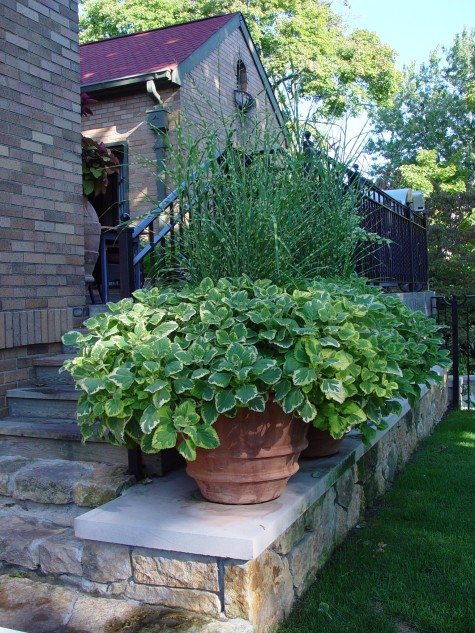
I planted this pair of Italian pots with 2 gallon size zebra grasses, and finished up all around with lime variegated plectranthus.  The colors in one plant mirror the colors of the other-so all of the visual interest is the contrast of the tall narrow grass blades, and the thick felted trailing leaves of the plectranthus.  I pinched the plectranthus, which is related to coleus, all summer long.  This made for an overall shape that was widely horizontal.  The tall grass, in contrast to the very wide plectranthus-a certain visual contrast that satisfied my eye.  The glimpse I still see of the pot at the bottom is just enough to complete the picture.  The planting does a good job of describing what the planter looks like, though you cannot see so much of it. This is a very simple planting which to my eye is very visually engaging.     

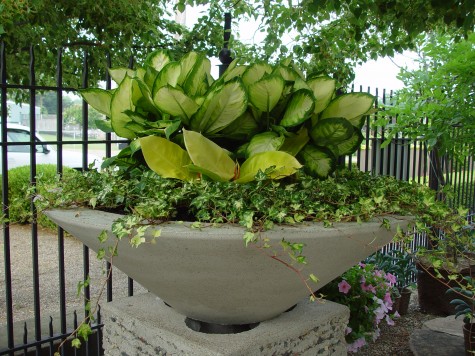
Big leaves-do you not love them? This severely contemporary v-shaped limestone  planter benefits from a planting of the paddle-leaved tropical plant dieffenbachia.  The pale yellow green leaves can dramatically lighten a very shady spot.  The yellow variegated ivy once established, I kept trimmed to the inside edge of the stone, as the container itself makes such a strong statement.  The overall shape of the planting seems pleasing to me.  This planting greatly complements the container.      

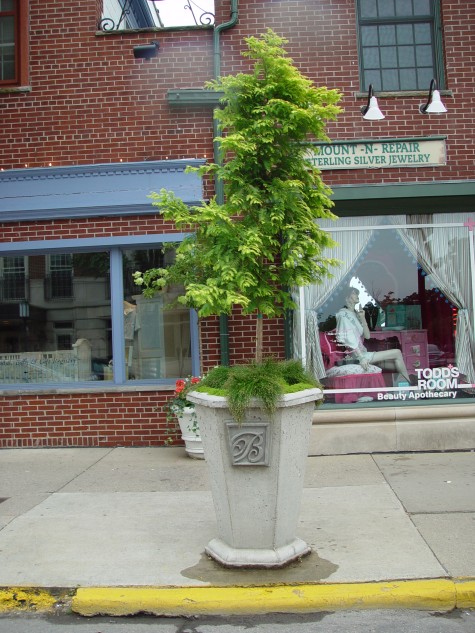
This planter located on a city street got planted with a lime green version of dawn redwood-a lime green version of Metasequoia.  Small trees can be great in containers; they can be planted in the ground at the end of the summer season.  The  fiber optic grass and Scotch moss are just about the same shade of green.  This planting is simply about texture, and plant habit.  The relationship of one plant to another is enough to keep me gardening.   

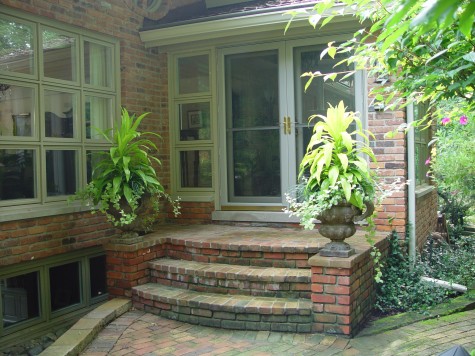
The lime green dracaena Jenny Craig is another great tropical plant suitable for containers in shady places. The strappy leaves cascade like water from a fountain.  The variegated licorice petticoat pictured above provides some width that helps to balance the composition.  The detail of the urns is still visible.  I spend a lot of time picking and choosing what of a container gets hidden by draping plants-and what stays exposed.   

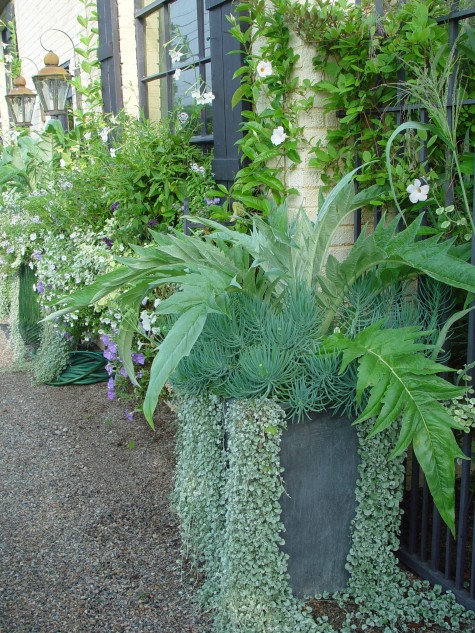
This cardoon is a very architecturally striking plant.  The leaves have a prehistoric, slightly menacing look about them. They have an aura which is so strong-they have the visual power to organize a space. The blue green succulent planted at its base-I have no idea what this is called-sorry.  My eyes and my instincts just told me they would work in this container.  These succulents do a great job of softening the look of the cardoon-even though the foliage is stiff, and needle-like. The silver falls dichondra drapes down the corners of this lead container, and puddles on the ground-a languid, and gorgeous contrast to those stiff cardoon leaves.  In general, it is easier to achieve a balanced compostion with three elements, as opposed to two. A container with one or two elements will need thoughtful work on the shaping as it grows, to keep the arrangement visually interesting.  A single well cared for topiary plant in a pot would be a good example of this kind of grooming.  

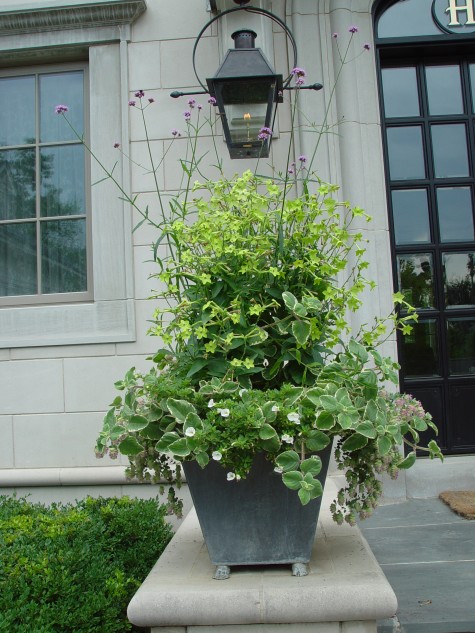
The lime green flowering nicotiana alata is one of my favorite flowers.  Green flowers-not so ordinary, but eminently satisfying.  The tuft of verbena bonariensis at the top loosens up the entire planting.  The wide outer border planting of white million bells, green and white plectranthus, and Kent Beauty showy oregano, softens the top edge of the container, and balances the height of the nicotiana and verbena.    

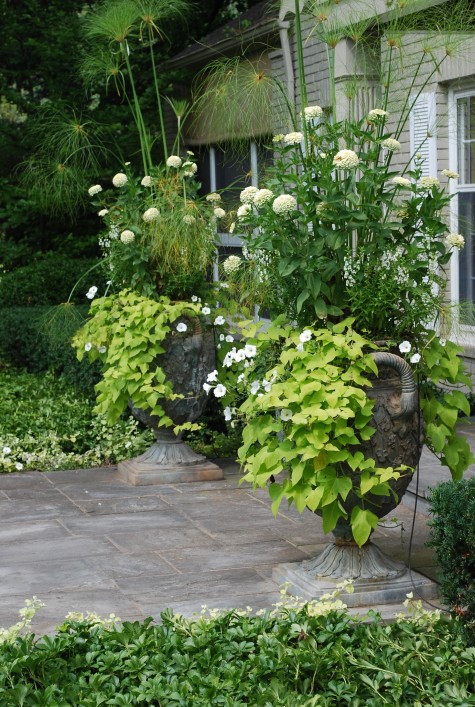
These bronze containers are very intricate, and beautiful.  Given that they flank a front door, I plant them tall.  The King Tut papyrus provide great height.  The tall white zinnias read mostly green.  The lime sweet potato vine- they speak strongly to lush. A planting of white mini petunias add some froth where some width is needed.    


Any predominately green composition gets attention from me on lots of  levels.  I cannot really explain this-except to say that great color enchants, and distracts me.  No doubt beautiful color gets my attention.  But when I design, I imagine every element in black and white.  Composing containers in green and white is like looking at the natural world in black and white.  Black and white-this teaches me plenty.

What Goes In The Ground

I have two diverse groups of flowering plants that get my attention.  There are perennial flowering plants, and seasonal plants.  The perennial plants stay with me year after year-given the best of all possible worlds.  In reality, perennial plants have short bloom times, need lots of work dividing and deadheading, they get diseases, they fade away-but we still call them perennials.  A perennial only promises one thing-they may be so kind as to overwinter in some form or another.  Perennial are  by no means maintenance free, much less absolutely and undeniably perennial.  In my opinion, perennial is a noun I would never use to describe garden plants.  That which I least expect to thrive, thrives.  Things die, routinely, every day, unexpectedly.  The minute I congratulate myself on the perfect plant for a specific spot-all hell breaks loose. I have been proven wrong so many times-it is not funny.

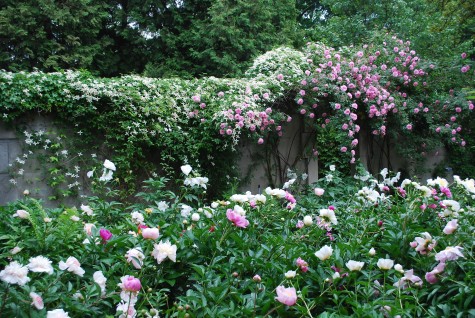
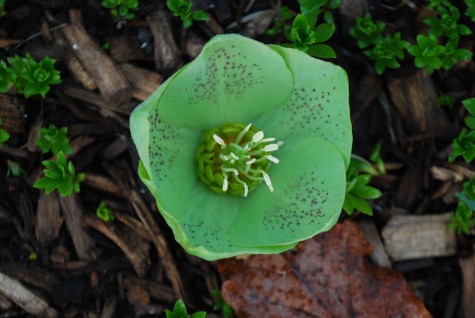
 In my opinion, only a very few perennials are really rugged enough to thrive over a period of years. At the top of my list-peonies.  Properly sited and planted, they could easily live a century or better. Next up- asparagus; I regularly see vacant land with rows of asparagus intact.  I can imagine the house and farm, given the truly perennial expression of the asparagus. What comes next?  I suppose I could put hemerocallis on this list-though they require division every 7 years or so.  Hellebores live from year to year without much attention; I have never divided, deadheaded, or treated them for illness.  Wild flowers thrive on a lack of attention-provided that they are perfectly sited.  All of the perennial plants that come after this-save the groundcovers-pachysandra, vinca, and baltic ivy-fairly persistent, and fairly demanding.

Other perennials are quite up front about what they demand. Bear in mind, any plant that clearly exhibits a need for tending-times that tending by 3.  Roses top the list-a well grown collection in my zone is a feat.  Bearded iris-so beautiful and so labor intensive.  Delphiniums-multiply the bearded iris factor by 3.  I have little need to go on about those perennial plants whose need for attention is perennial-I am sure you have met them.  A good bit of the trouble has to do with less than optimal soil and water, less than ideal watering, and less than perfect attention.  Were I to retire, the first thing I would do is plant perennial gardens, and live in them all summer long. 

The seasonal plants-they make no bones about their ephemeral nature.  They open the season reluctantly-they like warm soil.   When the season closes, they perish.  They grow fast, try their best to set seed, shine for months on end-and vanish with the first hard frost.  There are those gardeners that dig and store their dahlias and cannas.  There are those that move their marginal plants into their garage for the winter, and park their cars outside. Anyone who takes gardening seriously has their obsessed habits-this extends to trying to keep plants alive from year to year that hate the cold. 

I am an advocate of planting seasonal flowers, as I think they return to me in kind. They willingly bloom for months.  This means their bloom time is not 10 days or two weeks-it is months.  That I have to plant them every year-I willingly make that concession.  Every day of my short summer season-I like a party going on.  That I have to replant every year-fine.  This means I have the chance to ditch my failures, and design anew.  I like the design part of gardening every bit as much as the physical work of it.

No tropical flower makes my heart pound like the flowers of plants native and perennial plants hardy in my zone.  I am greatly enamoured of flowers that have that modest and strikingly natural beauty that I might characterize as residents of my home garden.  My natural environment has a beauty that no tropical plant could ever surpass.  What might be better than a green flowered hellebore?  But there are very few flowers I would turn away.  A top 10 list leaves too many interesting possibilities out.  Given my very small yard, it is a relief that some plants do not persist. 

This said, annual and tropical plants in the ground for the summer season-I love them.  The color-I would not do without it.  Annual plants in the ground-be prepared for lots of expense, and even more work.  But most plants have a very strong will to live, and flower, provided they have the right encouragement to do so. 

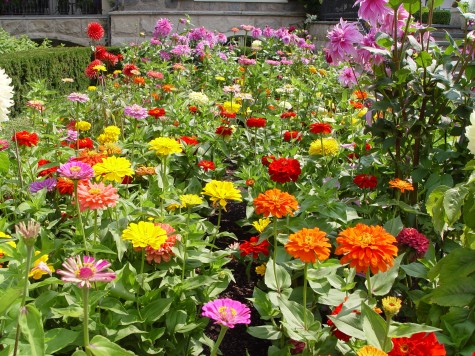
Most plants require a soil that drains readily.  Tropical plants enjoy a soil engorged with all the best that great compost can deliver.  They like that great draining and astonishingly fertile soil to be warm.   Land in my zone tends to be very heavy clay soil with poor drainage.  The soil warms slowly in the spring.  My advice-plant in early June.  Anywhere you intend to plant seasonal plants in ground-work the soil.  Provide for air.  Poufy, well draining soil-your seasonal plants will  thrive in this. Plant for spring, so you don’t plant for summer too early. If you water with automatic irrigation, choose your plant species carefully.  Impatiens handles overhead and over generous watering fairly well.  Zinnias have no use for it-once established, I water them well at the ground level, and let them go dry before I water again.


Above all, experiment.  How improbable is it that zonal geraniums would thrive along side New Guinea impatiens, in full sun, with overhead irrigation?  You will never know what works unless you you try.  Planting 4″ pots of annuals may give you a headstart, but lots of annuals are easy to grow from seed.  If the expense of planting flowers that only live one season is not an investment you wish to make, there is the option of learning how to grow.  

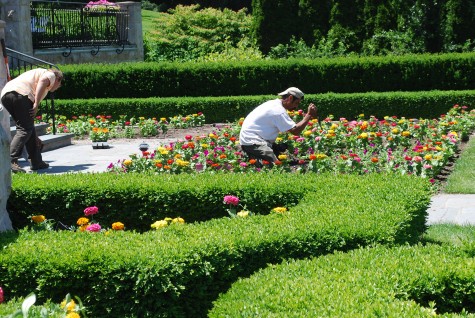
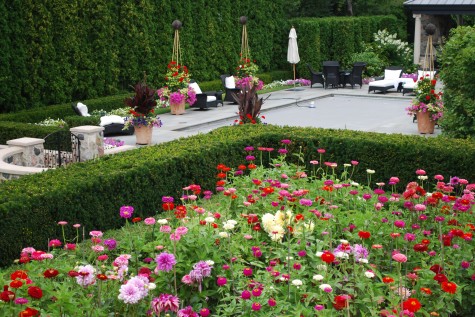
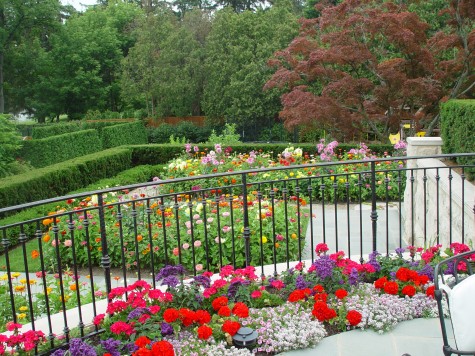
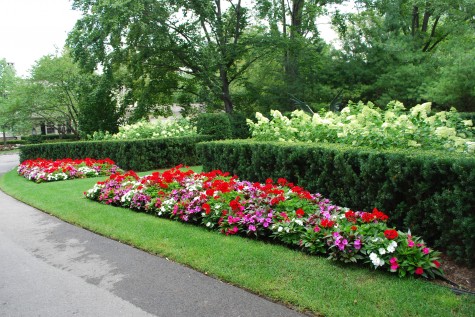
In ground spaces too small for a perennial collection  are perfect for a mixed annual garden.  All summer long there will be a reason to visit and enjoy.

Planting Great Containers


Every great pot starts with some rocking good science.  A container needs to be sized to comfortably hold the plants you want to grow when they are full grown. Rhubarb planted in a 10 inch pot-not a good look.  Nor is it a workable idea. Every container needs lots of drainage material; I usually plant large containers with 2/3 drainage material and 1/3 soil.  Very small containers I might fill to the top with soil, with a small piece of landscape fabric over the drain hole.  The ability to maintain even moisture is essential to the health of the plants.  Good soil holds water.  My soil mix is a custom blend of compost, topsoil and sand-I do not grow plants in soilless mixes.  Growers mix is designed for professional growers who require a weed, pest, and disease-free medium.  It takes a skilled hand to properly water and feed any plant grown in peat based plant mixes-every grower has their own formula. For a gardener, the best part about them is how easy the bags are to pick up and carry.  Ease of soil transport is not a factor in planting great containers.  I like to grow plants in soil.  real soil.  I like all the organisms, the micronutrients-I like living soil, not sterile plant mix.
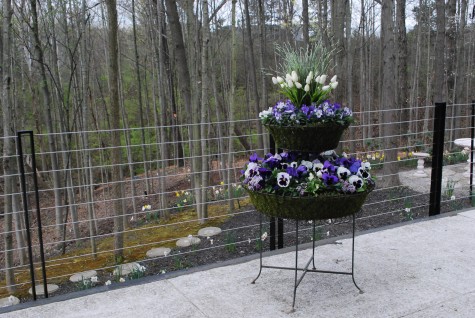
The next issue-where will they go?  Pots flanking a formal front porch may ask for the same plants that you use on your terrace-but how you use those plants is about inspired design.  Great containers have everything to do with good design.  This traditionally styled two tiered wirework plant stand is a completely unexpected choice for a contemporary concrete deck/terrace featuring a stainless steel braided wire railing.  That juxtaposition of the round and delicate wirework with this minimal fencing is a visual surprise.  As for the planting, imagine this planter without its topknot of faux tulips and grass.  You get this-dull.  The additional height breaks the horizontal line of the fence-this makes for great rhythm.  The planting at the same height as the rail-static. The idea that stops short, comes up short. That tulip and grass hat-very sassy.  This single planter holds its own, in front of that somber forest of hundreds of tree trunks.  The big-faced pansies are in the larger bottom tier, and the diminuitive violas in the top; the size of flowers themselves should be proportional to the size of the container.  The restricted plant palette has a contemporary feeling; the mix of colors has a more personal feeling without getting too frou-frou.  I like this planter, how and where it is placed, and how it is planted, relative to this forest dominated landscape.    

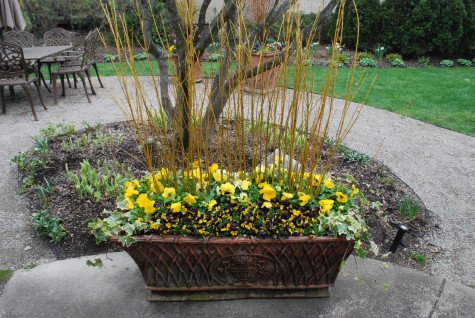
Sometimes the shape of a planter will suggest how the plants should be used.  Pale yellow pansies in the center back, and bright yellow pansies on the edges highlight the color and form of the violas in the front.  Light colors do a great job of bringing dark colors placed in front of them to life.  The yellow twig dogwood placed in a row, rather than a bunch , celebrates the shape of the container.  The ivy at the corners-a yellow variegated variety that repeats the yellow of the flowers.  Plants that would thrive in this lighting situation go on to work together well.  This look-a thoughtful and put together look.

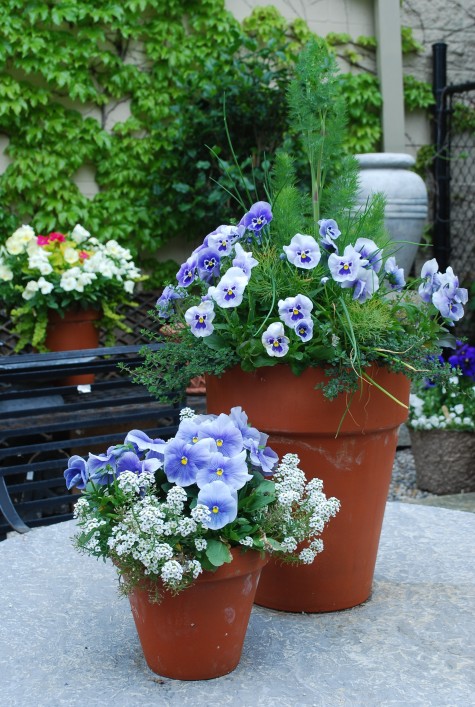
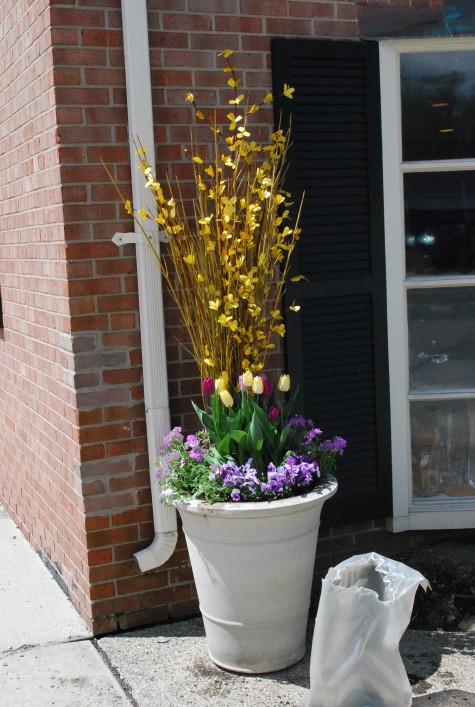
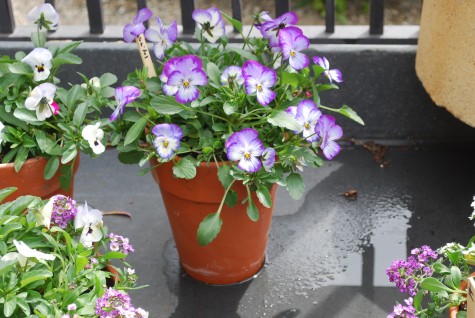
Pots in commercial settings need to read well from the street.  I would not want anyone passing my shop to not get a good look.   This can mean generous height, and compelling color.  Subtle works much better up close to the eye.  In this case, a bunch of yellow twig dogwood has been augmented with faux yellow flower stems made from bleached and dyed palm leaves.  Forsythia is common in my spring landscape; passing by in a car, this centerpiece is entirely believable.  More striking than real forsythia, this centerpiece will provide great scale and visual punch throughout the spring.  A pot of tulips in the center can be switched out for fresh when the flowers fade; annual phlox intensia and violas will grow and do well on into early summer.  The red violet, lavender and pale yellow tulip mix is from John Sheepers-they call it the Princely mix.  The color combination is really lovely.  Small pots for a tabletop ask for one thing, well grown.  Small pots have to be placed close to eye level to be appreciated, so  I plant small pots with plants that are easy to grow to perfection.  This pot of violas seems happy-no yellow leaves, no dead flower heads.  It looks good, up close.

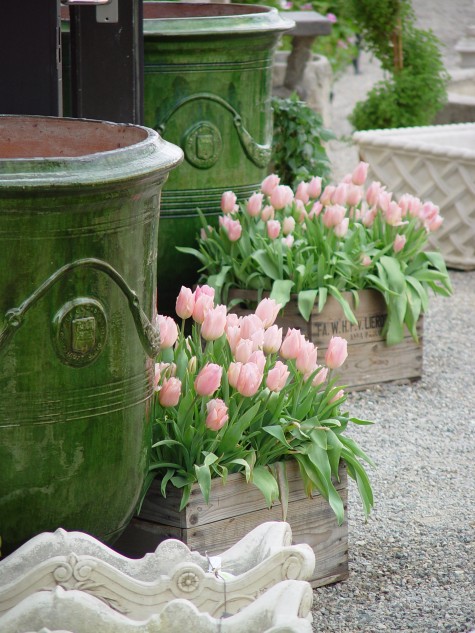
In terms of container design, it does not matter whether you are planting a vintage bulb crate from the Netherlands, or a fine pair of antique urns-the container is as much a part of the planting as the plants themselves.  These tulips were planted low, so the lower foliage would not obscure the beautiful surface and vintage lettering on the crate.  The boxes on the roof of my shop-they were constructed of sheet metal, and reinforced on the inside with pressure treated limber.  They are a vehicle for the plants that make my summer roof garden.  These rectangular boxes hold soil, and support plant life.  They are not in any way beautiful.  They are serviceable.  Every space demands a little something different.  At my office front door-I want beautiful containers, well designed, and thoughtfully planted.  On the roof, I want to make but one point.  Anyone who looks at what is growing  on the roof-I want them to see that garden.  A beautiful garden.   

Planting in the ground- a second cousin twice removed from planting in containers.  Big spaces on the ground plane ask for a different approach than containers.  Soil and seasonal flowers, above ground, in containers, could not be more different than seasonal flowers planted into the ground.  More tomorrow-I promise.