Garden Designer’s Roundtable: Take The Tour

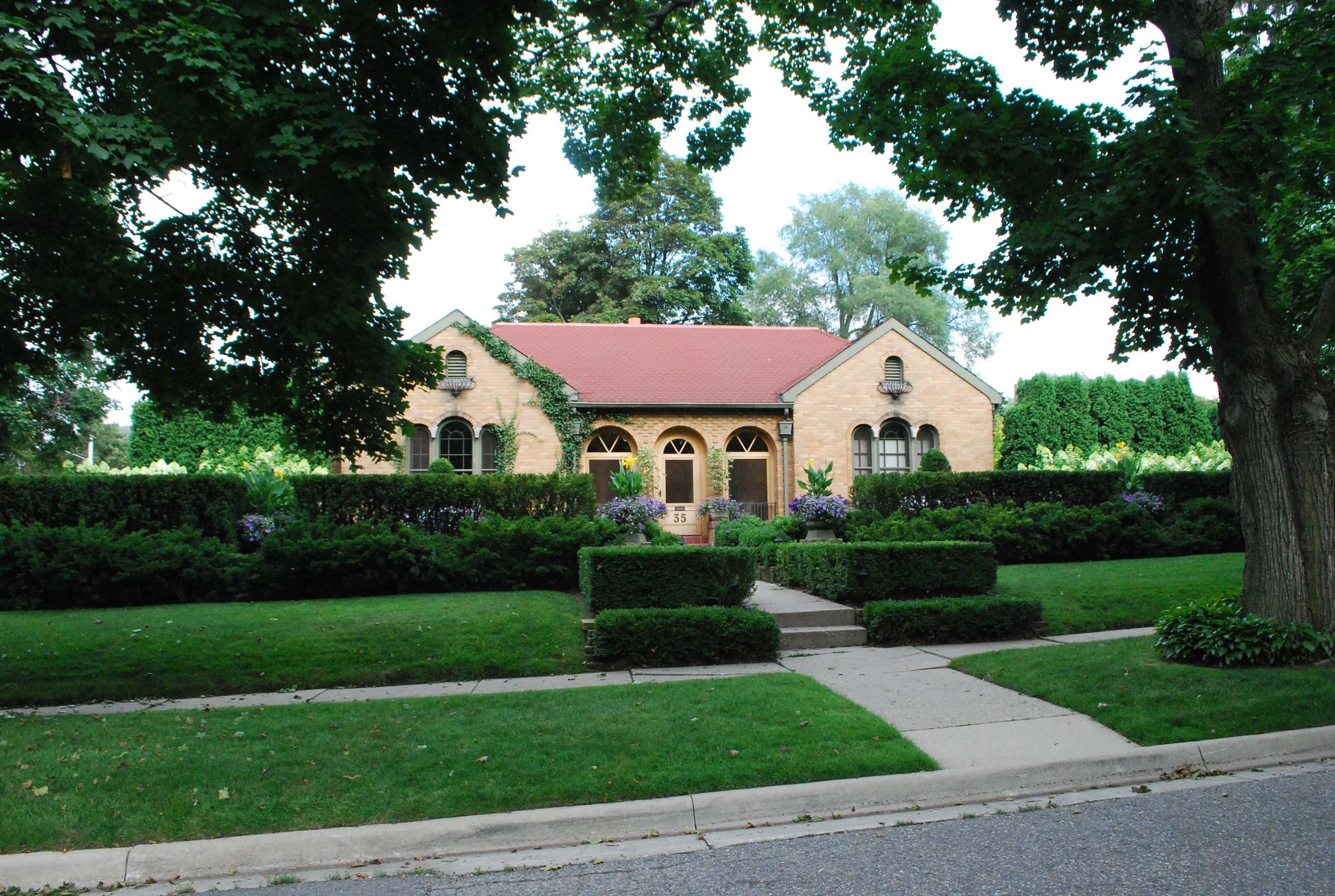
This is my first time posting as a member of the Garden Designer’s Roundtable.  Every month, a group of landscape and garden designers from all over the US and Britain post on a single, mutually agreed upon topic.  This month-a discussion of our own personal gardens.  I live in an urban neighborhood first established in the 1920’s.  My 1930 house is a curious amalgamation of both Arts and Crafts, and Mediterranean style architecture.   

There are 8 steps up from the street to the front door.  Every change in elevation in the front is marked by yew or boxwood hedges.  I like evergreens in the landscape, but I am especially fond of them in my own garden.  My landscape was designed to give me what I want most when I come home from work.  A little peace, a big dose of quiet, and not so much work.  After designing and planting all day, I want to come home and enjoy being outdoors with Buck and the corgis. 
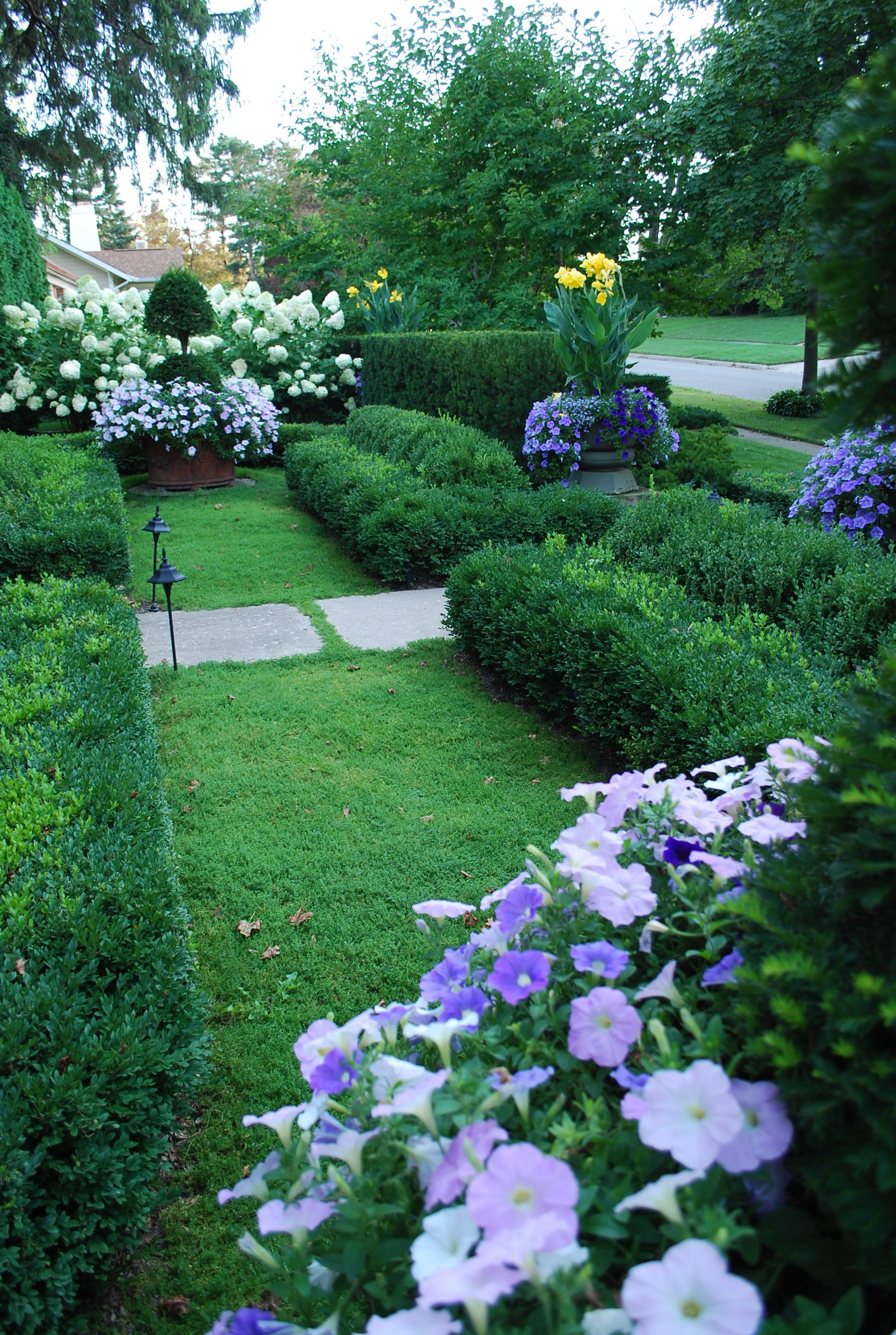
I will confess that I have a weakness for containers-I do have quite a few.  Watering and deadheading my pots is a pleasure I look forward to at the end of the day.  The groundcover underneath these containers-herniaria.  Getting a lawn mower to this upper level would be a nuisance.  The yew topiaries have survived their third winter in these big concrete pots.  These containers look fine even in the winter-a season my zone is noted for.  Empty pots in the winter have such a forlorn look.
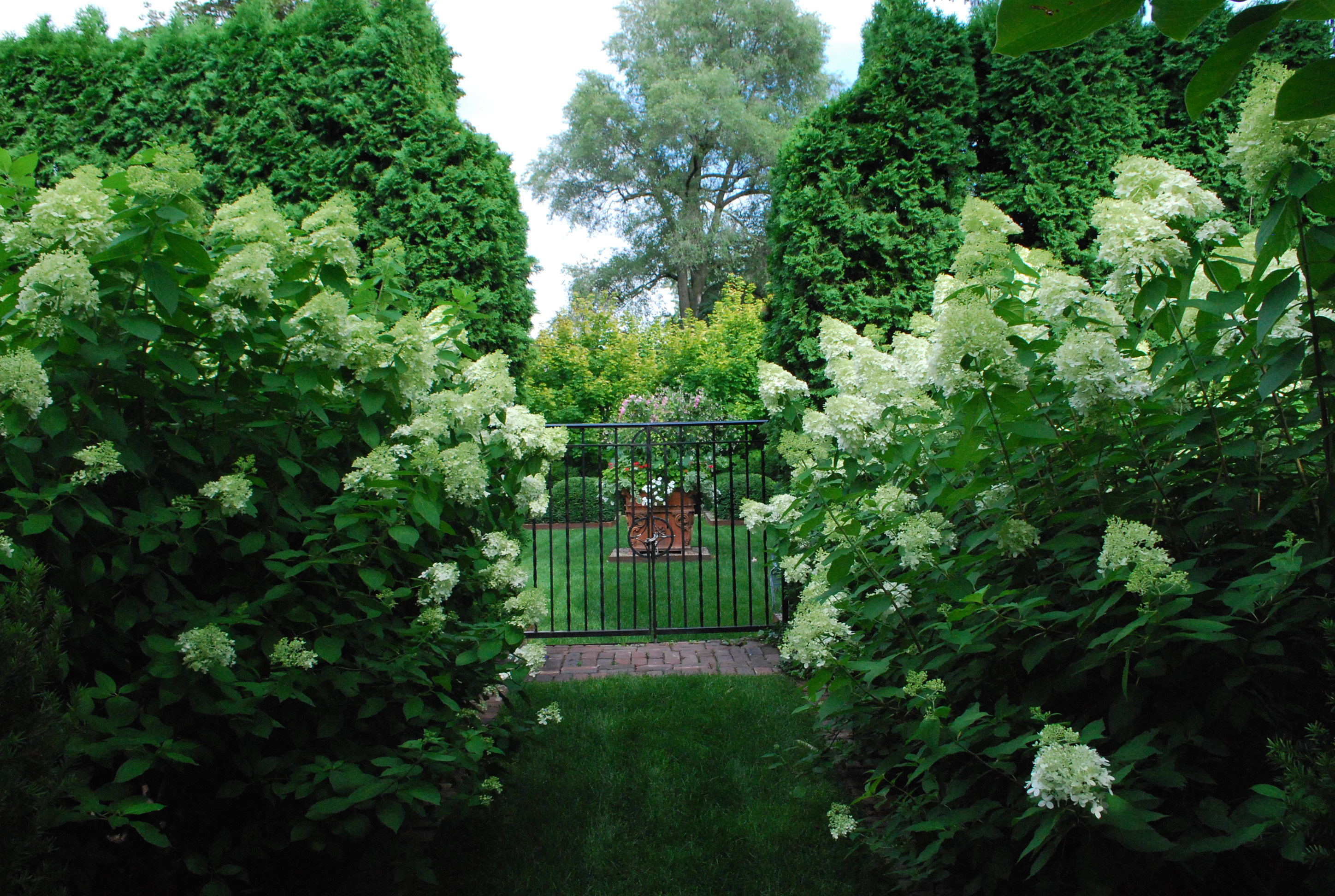
On either side of the house, on the house side of the tallest yew hedge, are blocks of limelight hydrangeas.  They start blooming in late July, and entertain my gardening eye until late in the fall.  As long as they get a spring pruning and some regular water, they deliver a lot more than they demand.
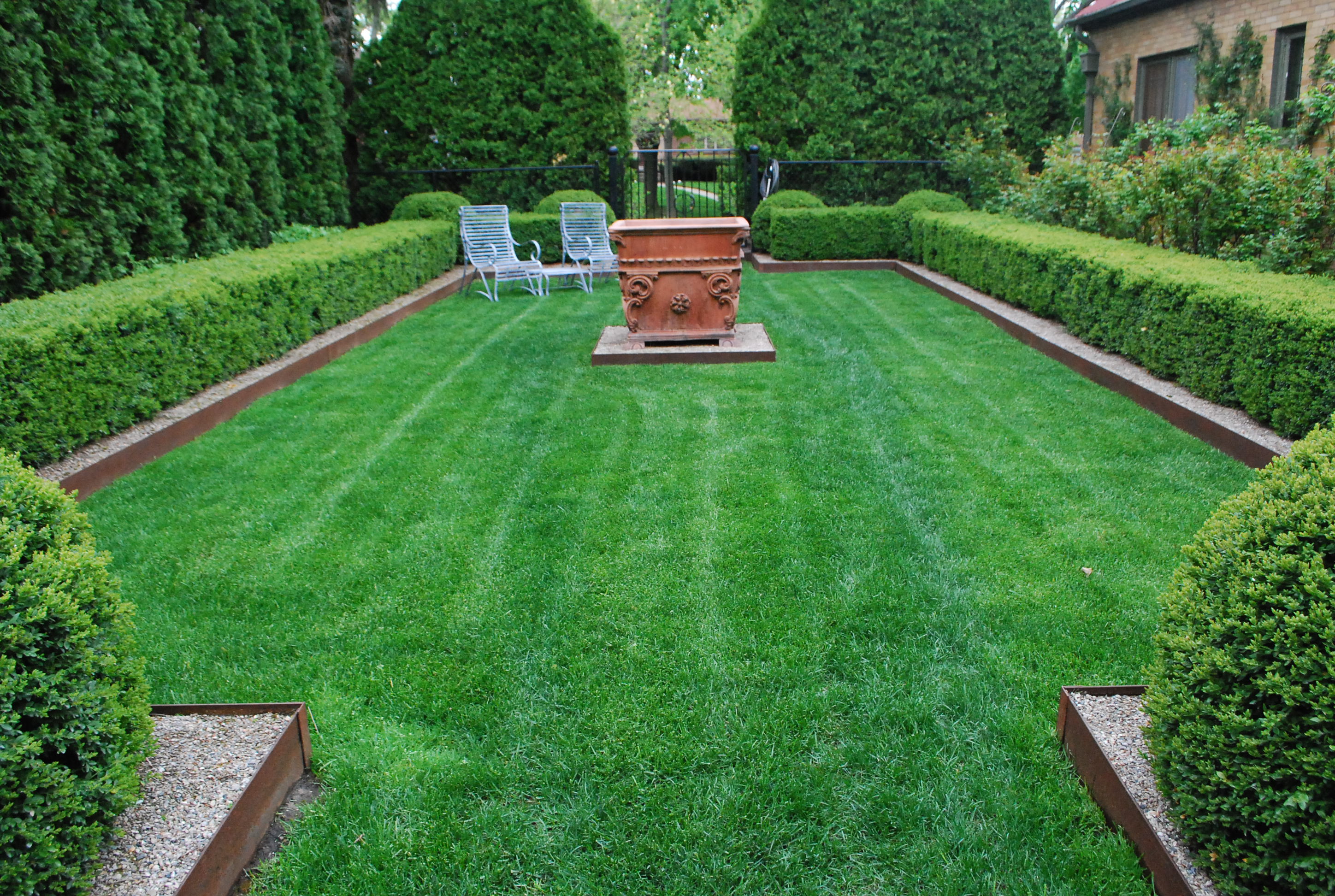
Inside the gate, my south side garden.  There is a place for Buck and I to sit, and grass for the corgis.  Sinking the lawn panel 8 inches, and retaining the original grade with steel provides a little visual interest to a landscape that is very plain.  The boxwood and arborvitae provide a sense of privacy and enclosure.  This space is neat and organized-unlike my desk and work life.
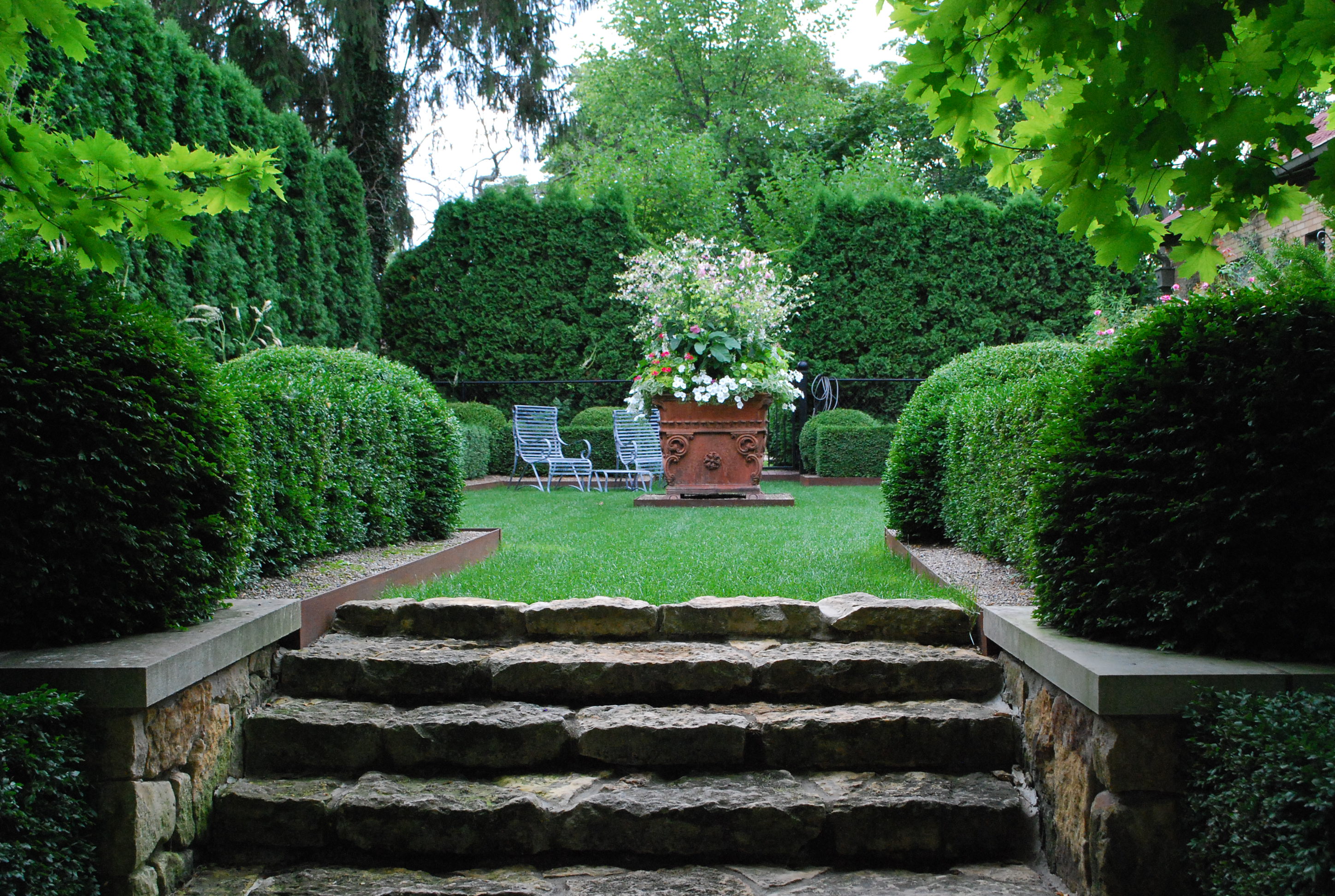
annual container planting

I plant this giant concrete square for the summer.  A very large pot in a small space not only organizes the space, it enables me to have a version of a garden that I am able to look after.  I want to come home to something that looks good to me, and takes just a bit of care. 
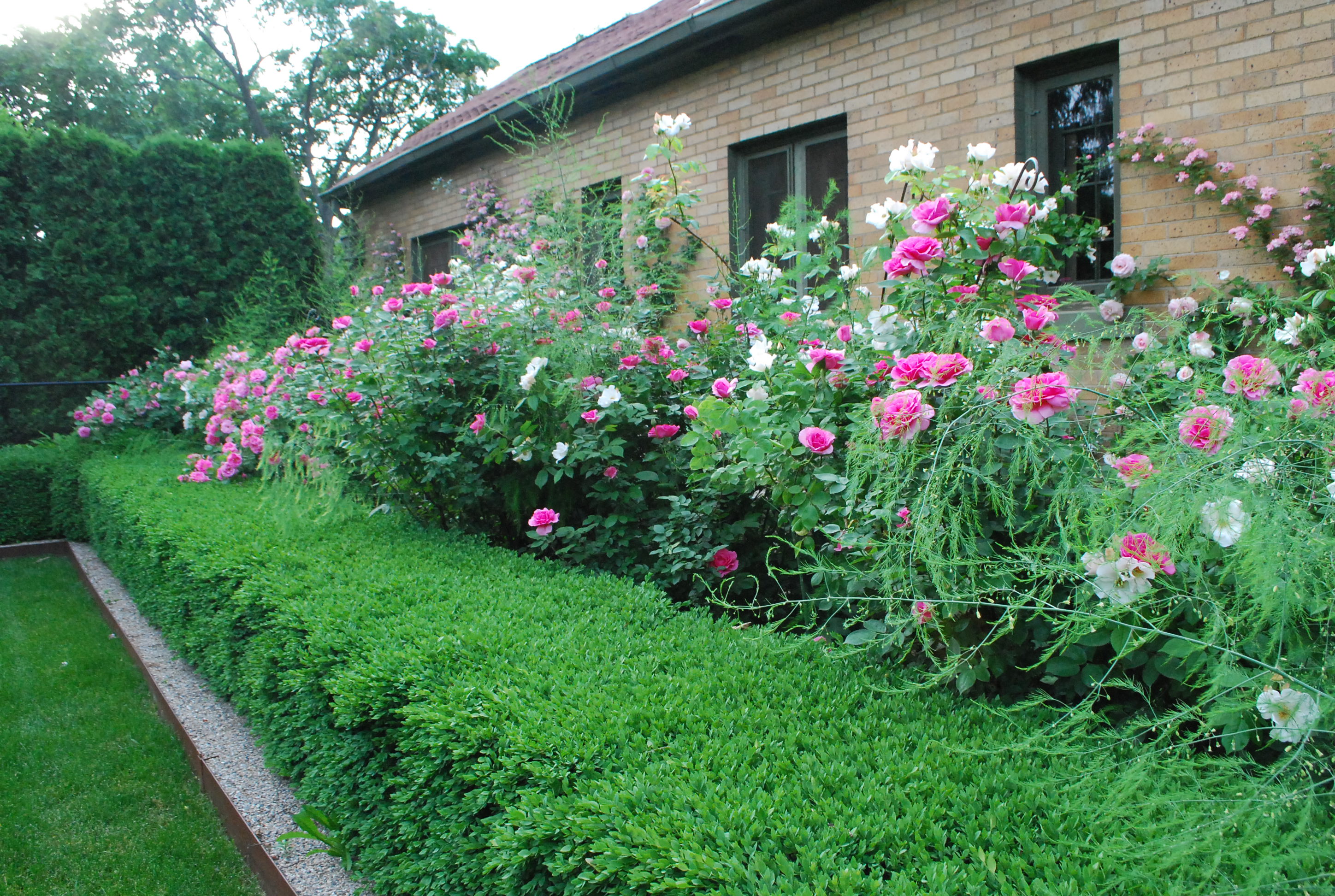
In June there are a few roses on the south side.  Carefree Beauty, Sally Holmes, and Earthsong are all strong performing low maintenance roses.  On the wall, the dwarf climber Jeannie LeJoie, and the large flowered climber Eden.  For a few weeks there is enough glory to satisfy me.  There is some Boltonia, hardy hibiscus, and white Japanese anemone for later season color.  I planted some asparagus between the roses.  This year I did not pick any.  The roses are getting large, and starting to crowd them out.
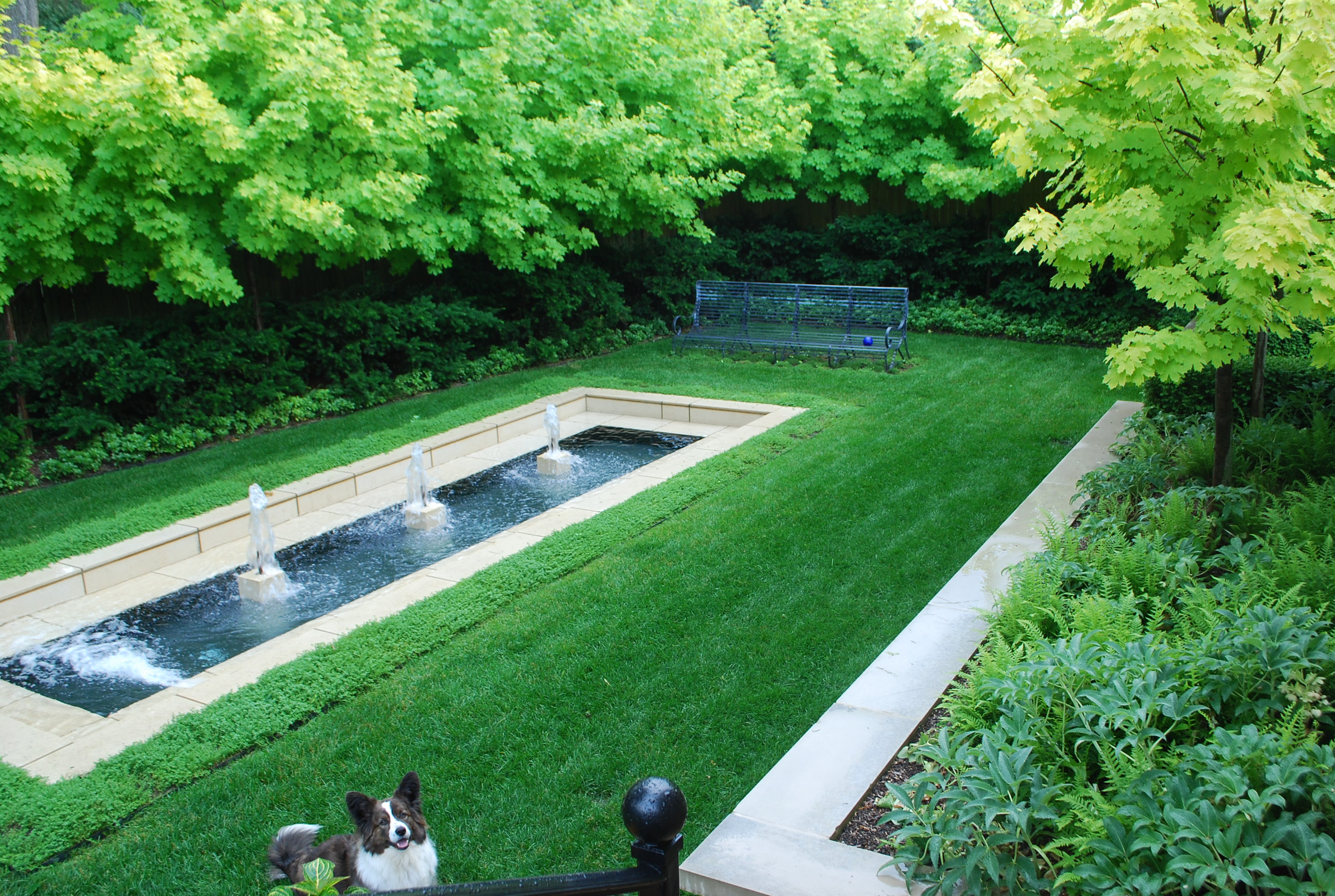
At the bottom of the rose garden steps is a fountain garden.  The pool is 26 feet long, and 9 feet wide.  The sound from the jets is lovely.  I can hear it from the deck where we have dinner outside, and all of the rooms on the back of the house.  Princeton Gold maples, yews and pachysandra are planted on the perimeter.  Around the pool-herniaria. 
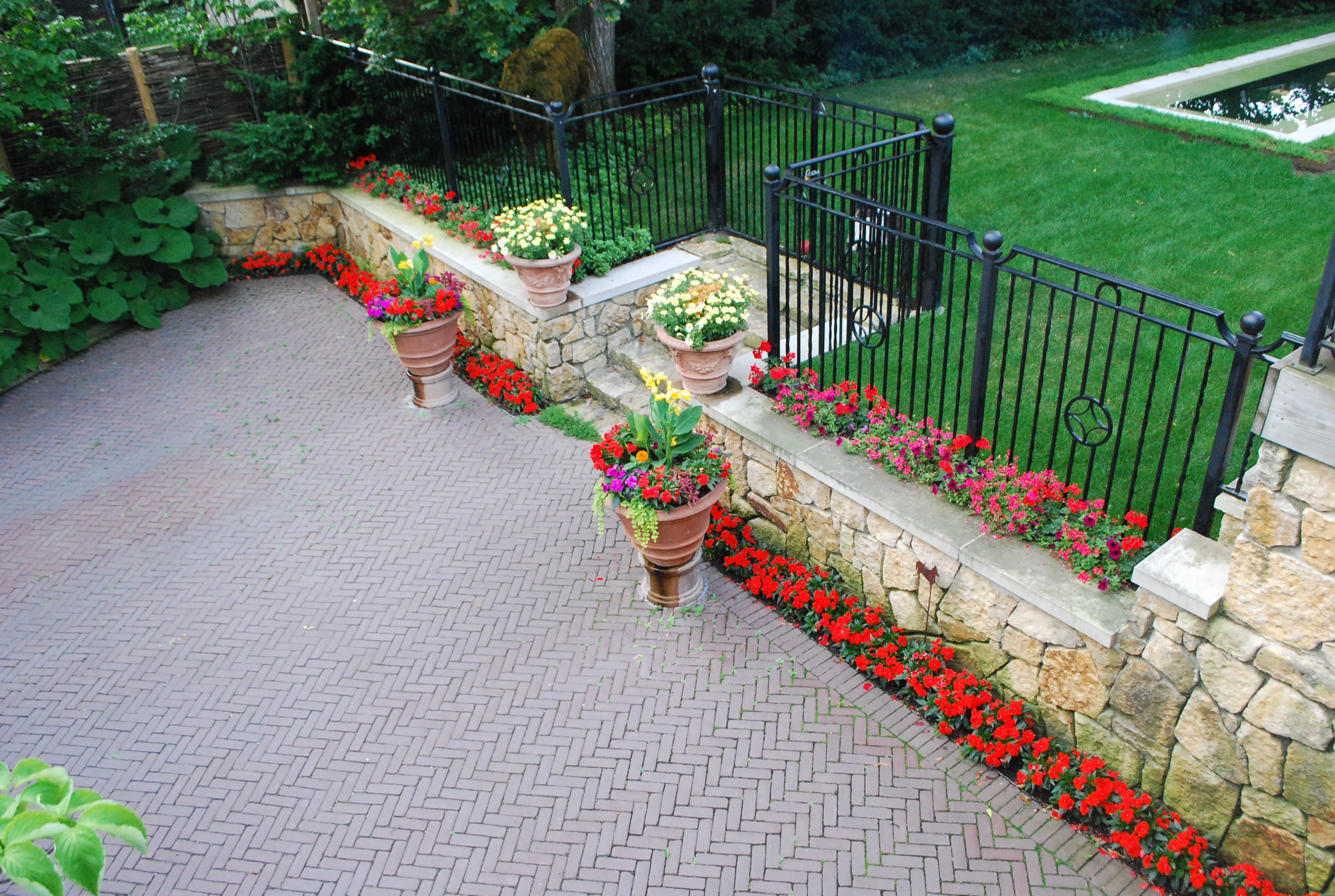
annual gardens

It is 5 steps down from the fountain garden to the driveway.  My car is usually parked here.  I like driving up to the pots, and the color from the narrow strips of annuals.  The butterburrs on the left are difficult to keep under control, but I have help from a local nursery that comes for them, and pots them up for sale.  Sometimes I buy them back, if I have a good spot for them in a client’s yard.
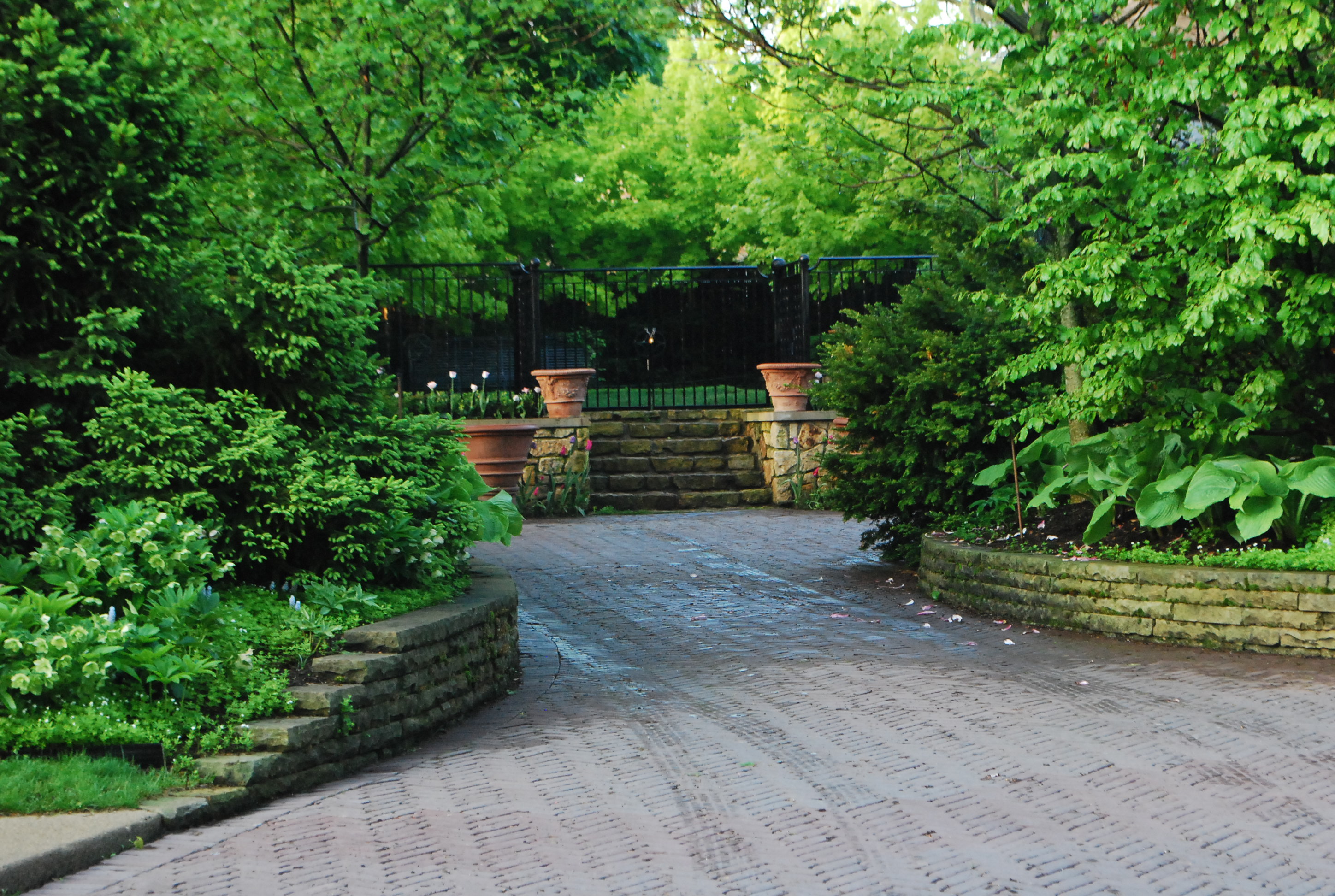
I will be planting my pots the first week of June or so, after I have the planting for clients a little further along.  The bottleneck in the drive makes that drivecourt a little more private, and a little more inviting.

container gardening

I do have lots of pots on the deck, all of them terra cotta.  I think they look great with my house. I spend at least an hour out here every night, puttering, while Buck cooks. 
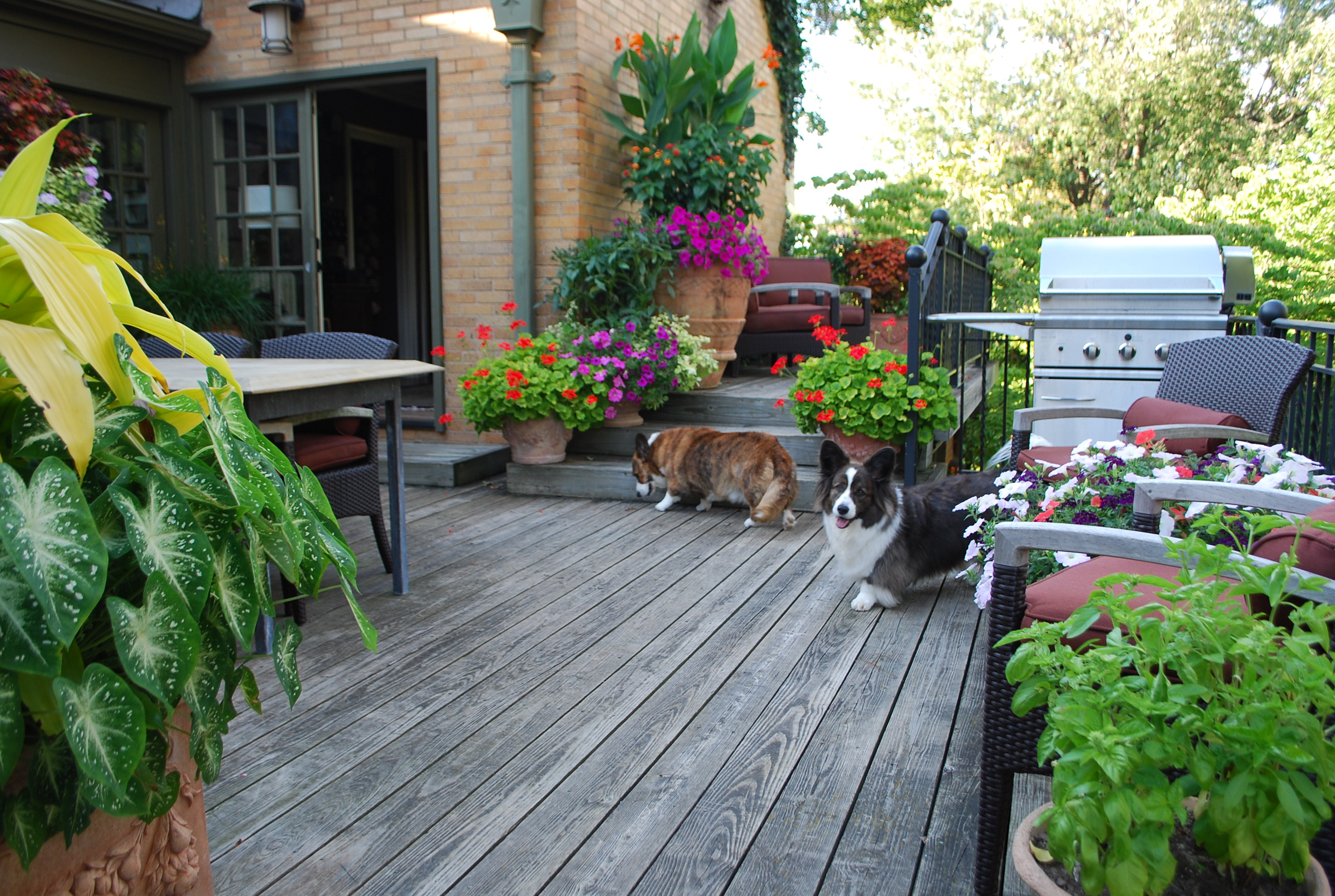
The room where I write is just inside the open door pictured above.  We have that door open all summer long.  The corgis like going in and out.  They are happy outdoors if I am inside writing-as long as that door is open.  One nice feature of city living-we never have mosquitos until after dark.   
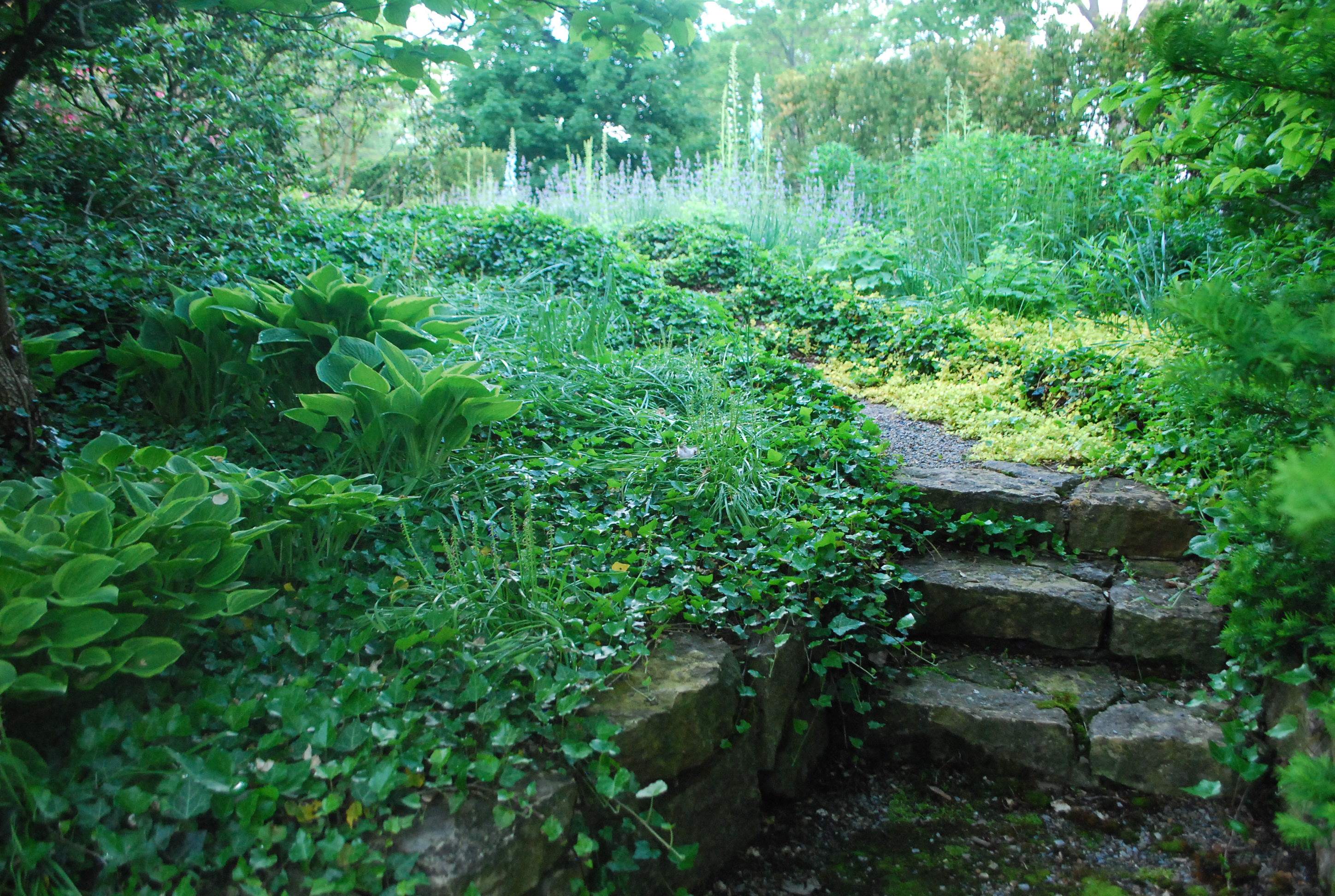
On the north side, I have a little garden of sorts.  A few dogwoods, rhododendron and azaleas are original to the landscape.  Last year I tore out an overgrown block of ornamental grass, and planted a small perennial garden.  A much smaller version of what I had when I was in my 30’s.  It is a little wild, and not so neatly kept.  I like this change of pace from the rest of the landscape.  My garden gives me a lot of pleasure and privacy.  It has a quiet atmosphere-perfect for me.  The rest of my family likes it too.

Interested in the home gardens of the other members of the Garden Designer’s Roundtable?  Check them all out!

Susan Morrison : Blue Planet Garden Blog : East Bay, CA

Rebecca Sweet : Gossip In The Garden : Los Altos, CA

Pam Penick : Digging : Austin, TX

Mary Gallagher Gray : Black Walnut Dispatch : Washington, D.C.

Jocelyn Chilvers : The Art Garden : Denver, CO

Deborah Silver : Dirt Simple : Detroit, MI

Debbie Roberts : A Garden of Possibilities : Stamford, CT
Christina Salwitz : Personal Garden Coach : Renton, WA

Andrew Keys : Garden Smackdown : Boston, MA

Which Ones?

planted tin cans
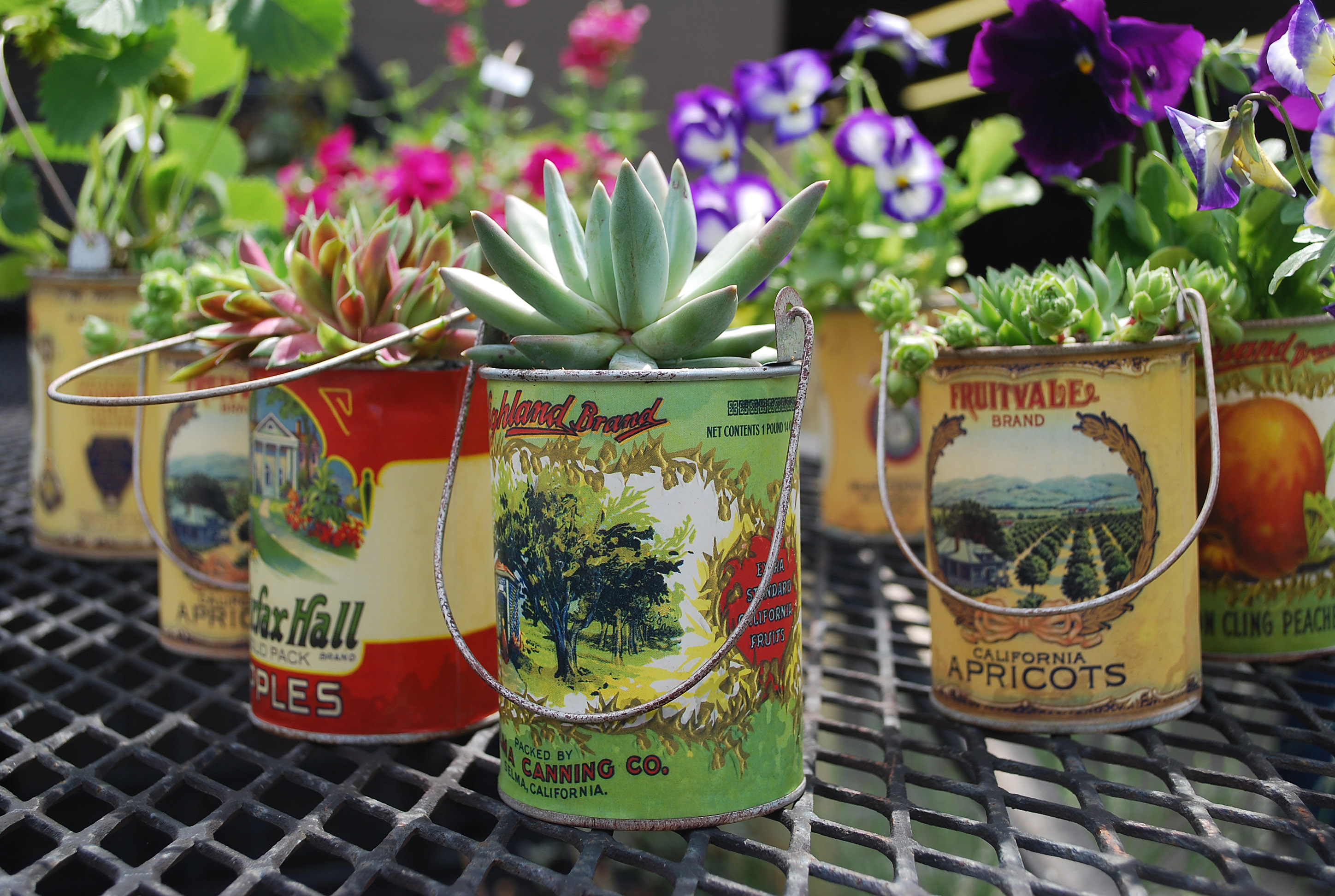
It is just about time to plant containers.  Last night’s overnight temperature of 41 degrees proves that it is still spring in Michigan, but every gardener in my zone is busy planning for their summer season. More than any other time of year, gardeners who have decided they want new or more pots are popping the question-which ones?  Which pots will be the best for me?  These reproduction vintage tin cans are great-in the right place, and with the right material.  They would need to be on a table top to be seen.  Given that each one holds about 6 ounces of dirt, what gets planted in them will need to love to be dry.  My first question is always-where do you want pots?  And then, what do you want to grow?

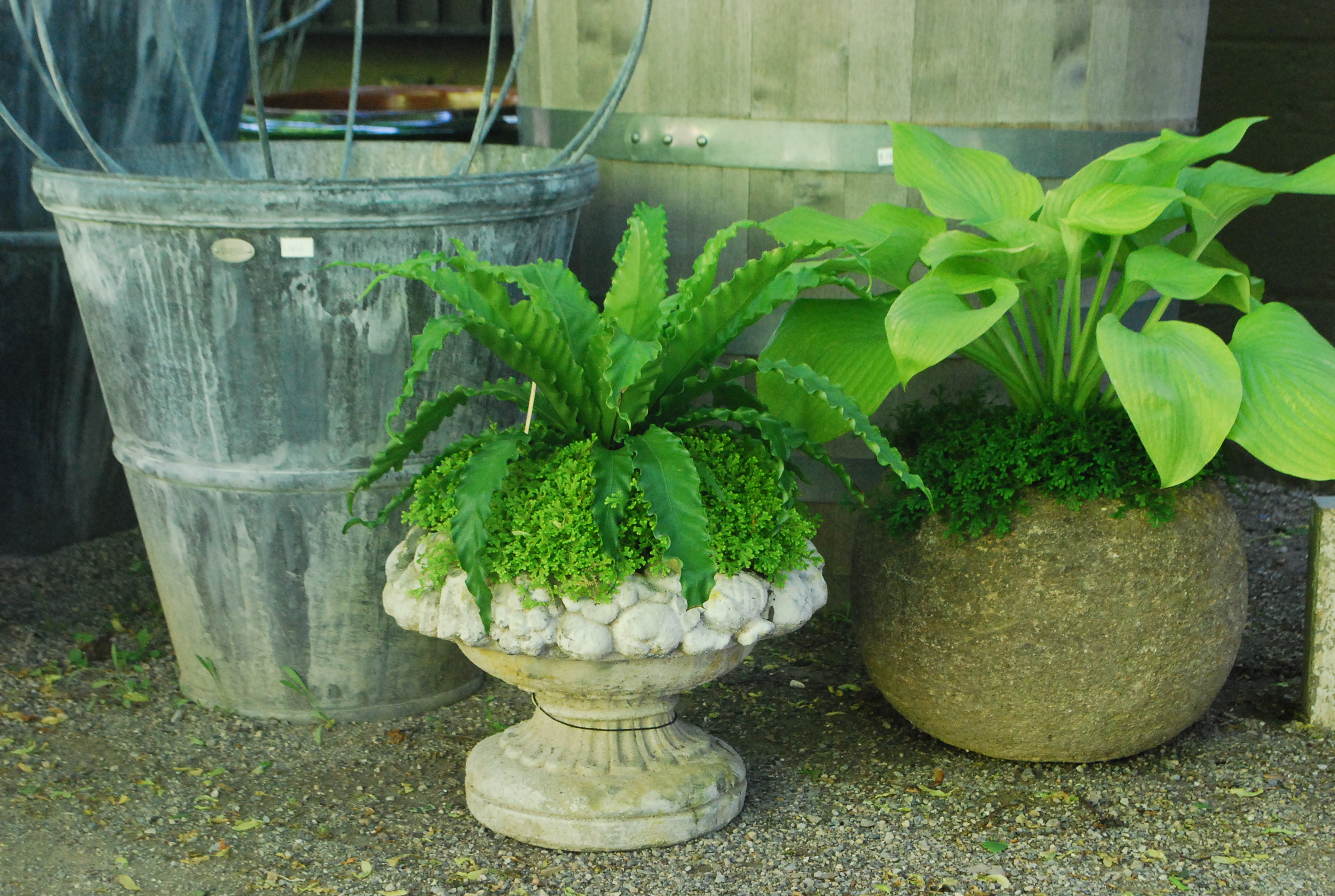
Small scale pots, such as the ones pictured above,  can be placed on the ground at a front door, or on a terrace, provided they have a little grown up company.  This may mean they get paired with larger pots, or sit on top of a pillar of similar scale.   Small pots on their own can look lost.    Small pots also benefit from a simple and strong planting, rather than a fussy one.  Stone and concrete pots, with proper care,  will last a lifetime.  They shrug off the worst that the winter has to dish out.  Natural stone has one important leg up on concrete-the little crooks and crannies are friendly to mosses and lichens.  Who wouldn’t welcome a community of lichens on their pots?


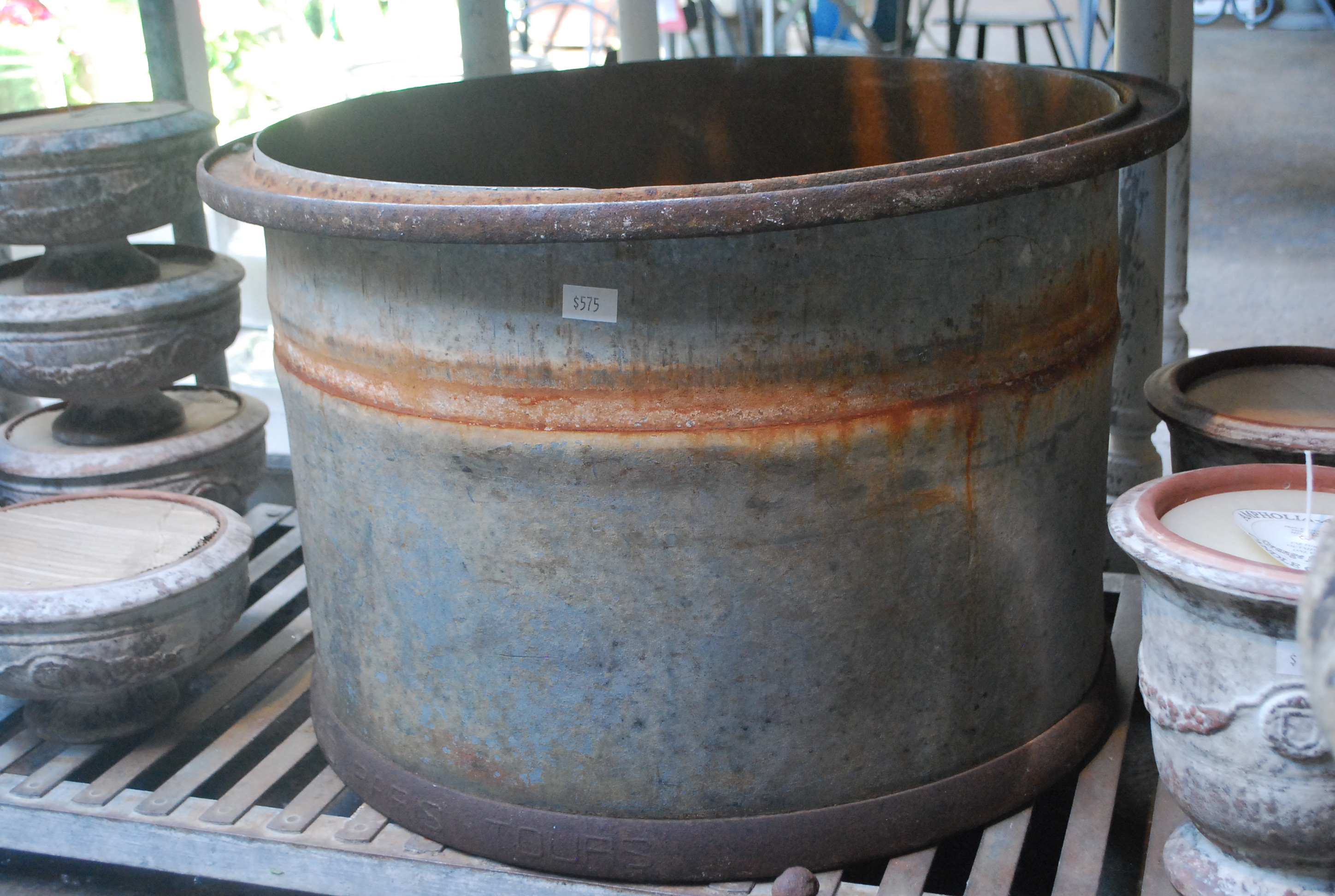
This galvanized metal container is a fabulous vintage piece that Rob found in England.  A brand new galvanized horse trough from a local feed store can do just as good a job providing a home for a collection of cottage style flowers as this English tub.   But the aged surface, the rim and bottom detail of this tub adds a whole other dimension to the idea of growing plants in containers.  The container has a beauty all its own-planted or not.  Where is it a good to plant galvanized horse troughs?  In a vegetable, cutting, or cottage style garden.  At the front door of a vintage Arts and Crafts style house, I would go with this vintage English piece.   Put special containers in important places.

Chicago figs

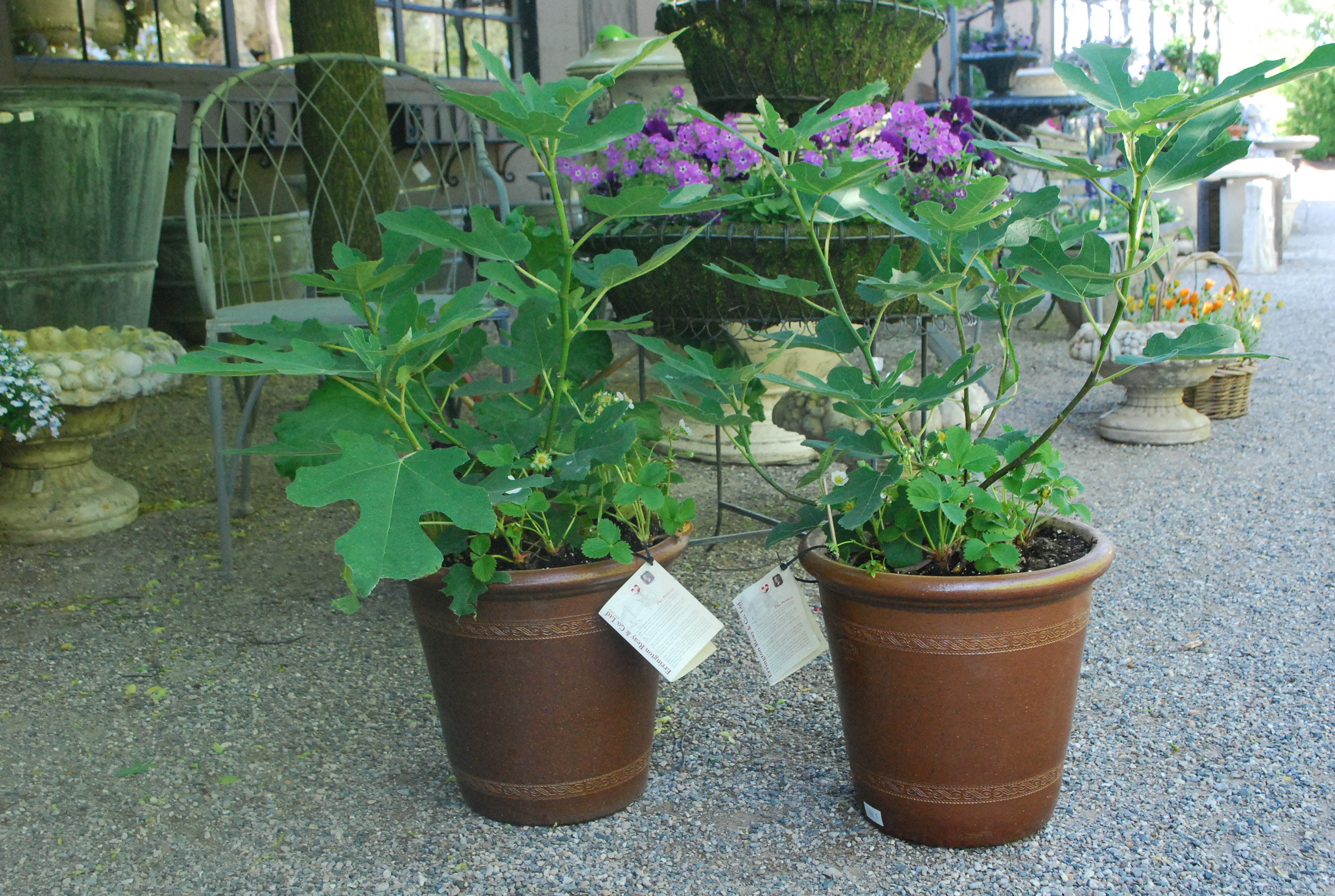
 English stoneware pots have a very distinctive style and surface.  There is something very comforting and sturdy about them.  Rob says they remind him of baked goods.  Like the English galvanized round, they would look great with an Arts and Crafts house-or an informal area of a more formal English style home.  They are appropriately planted with a shrubby fig, and some strawberries.  These pots will always be comfortable planted with herbs, rosemary, or marguerites.  With formal plantings, they might fall a little short.   Which pots?  Pick pots that look like they belong to you, and belong to your garden, before you decide to purchase.


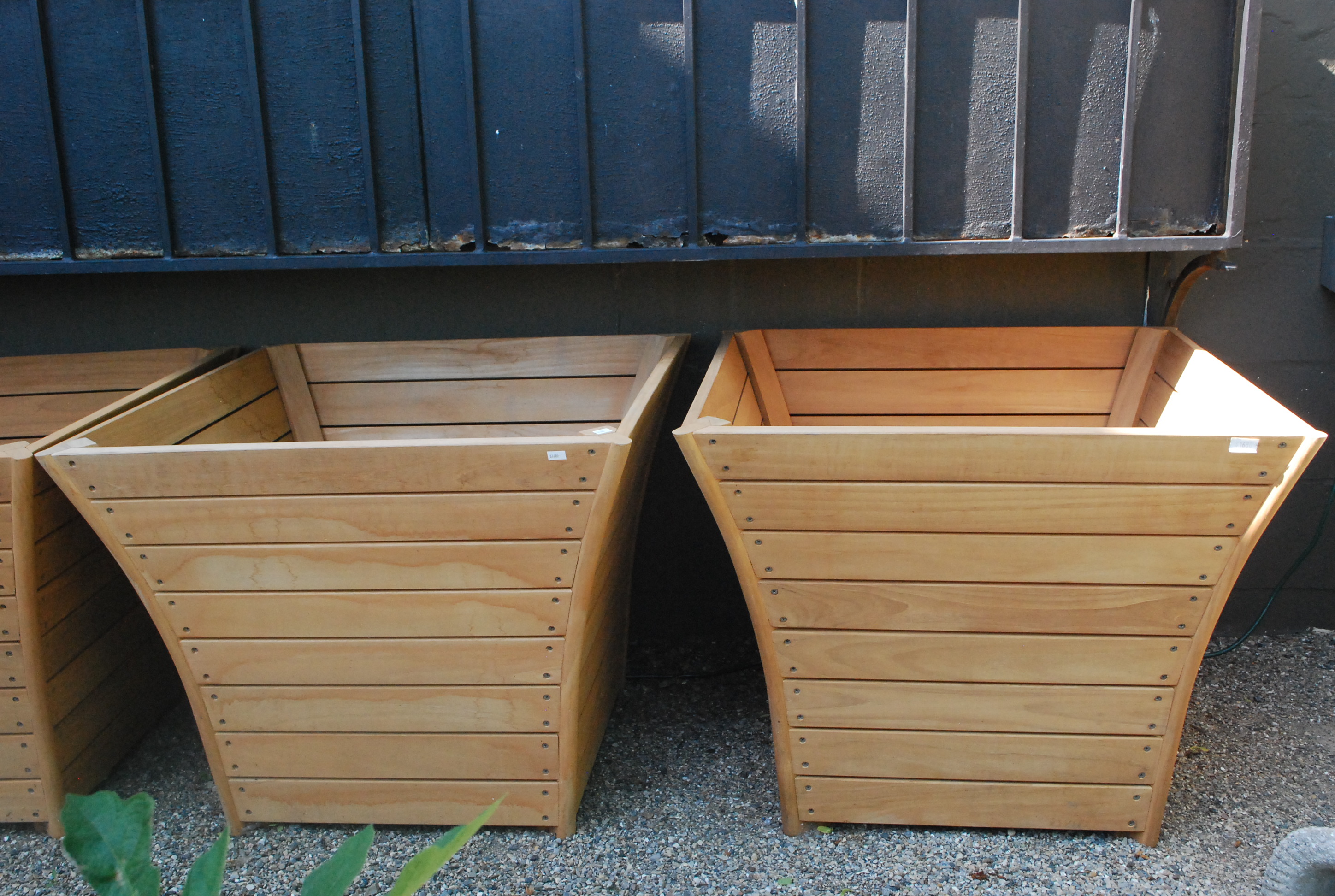
I still remember a visit some 18 years ago to a very contemporary home, the terrace of which featured two very traditional, very Smith and Hawkins style,  teak benches.  My thought- surely contemporary garden furnishings were available to gardeners whose taste ran to the more modern?  Back then, not so much.  Rob shopped originally for contemporary pots in Belgium.   Belgium and Michigan have very similar climates, so the simple shapes work well in a variety of settings.  Many more local companies now feature modern containers.  If contemporary is an architectural stylre that appeals to you, pass by those iron urns and those ornate Italian terra cotta pots.  There is something better for you, out there.  Should the idea of wood pots appeal to you, consider the ongoing maintenance.  Wood does weather, which means it will deteriorate without regular care.  Soil should never come in direct contact with wood.   We recommend waterproofing the inside of the containers with Waterlox.  We go even further-a sheet metal liner will keep moisture well away from the wood.


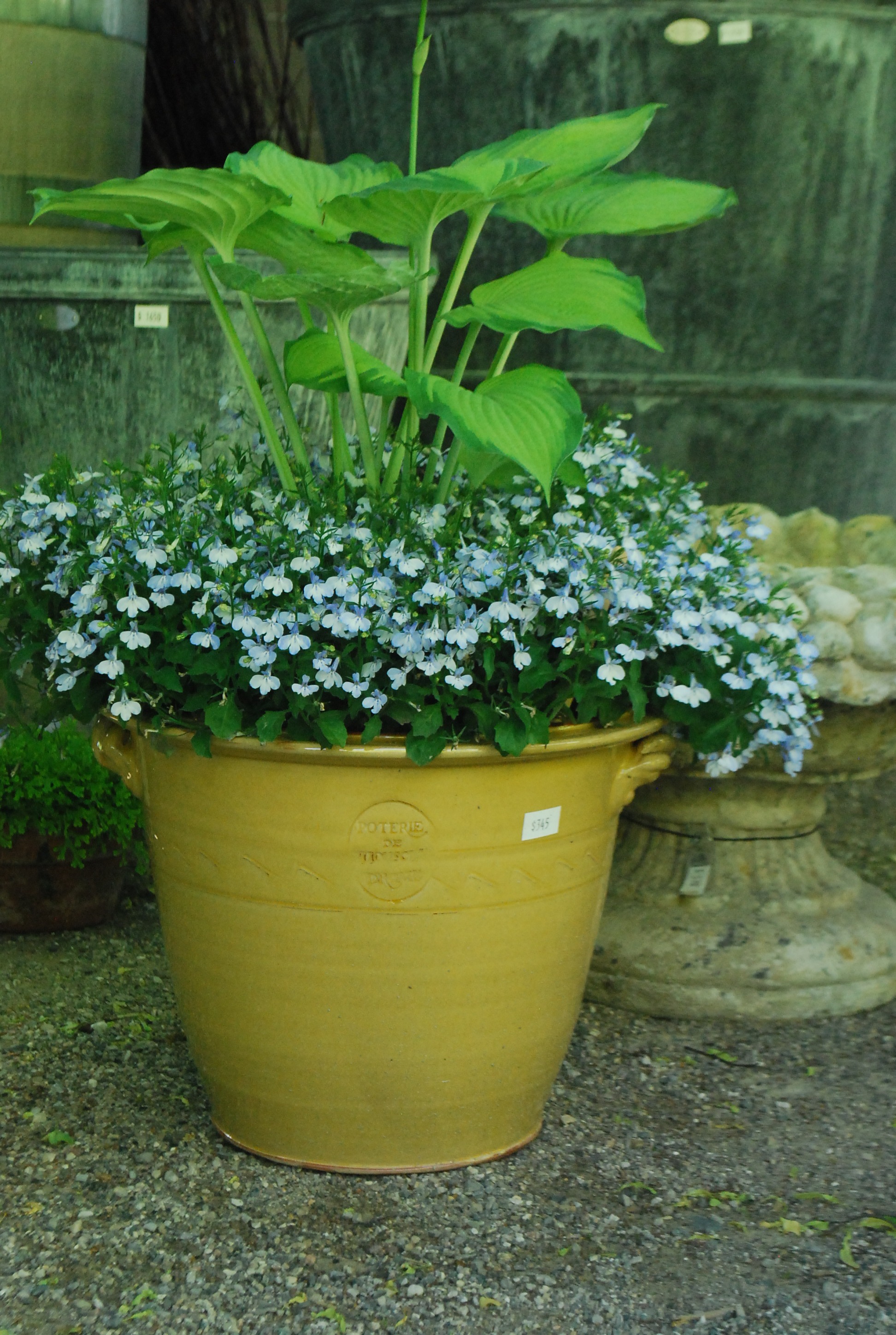
Glazed containers add an element of color to a planting that can be very pleasing.  Even the smallest glazed container will attract attention, by virtue of that unexpected color.  This planting in a yellow glazed French pot-vivacious, yes?  A dash of color from a single small container might be just the thing to revitalize a grouping of pots.


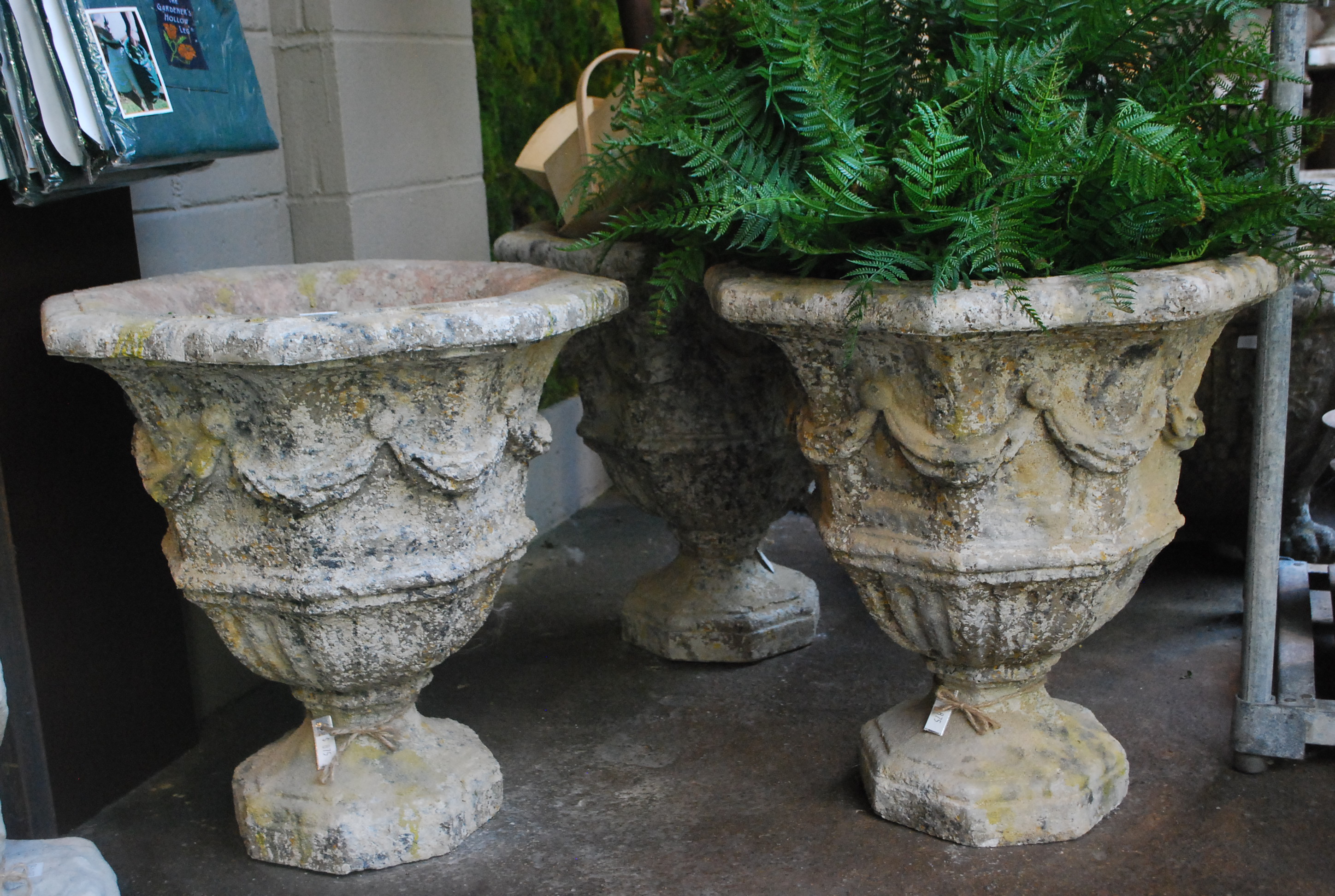
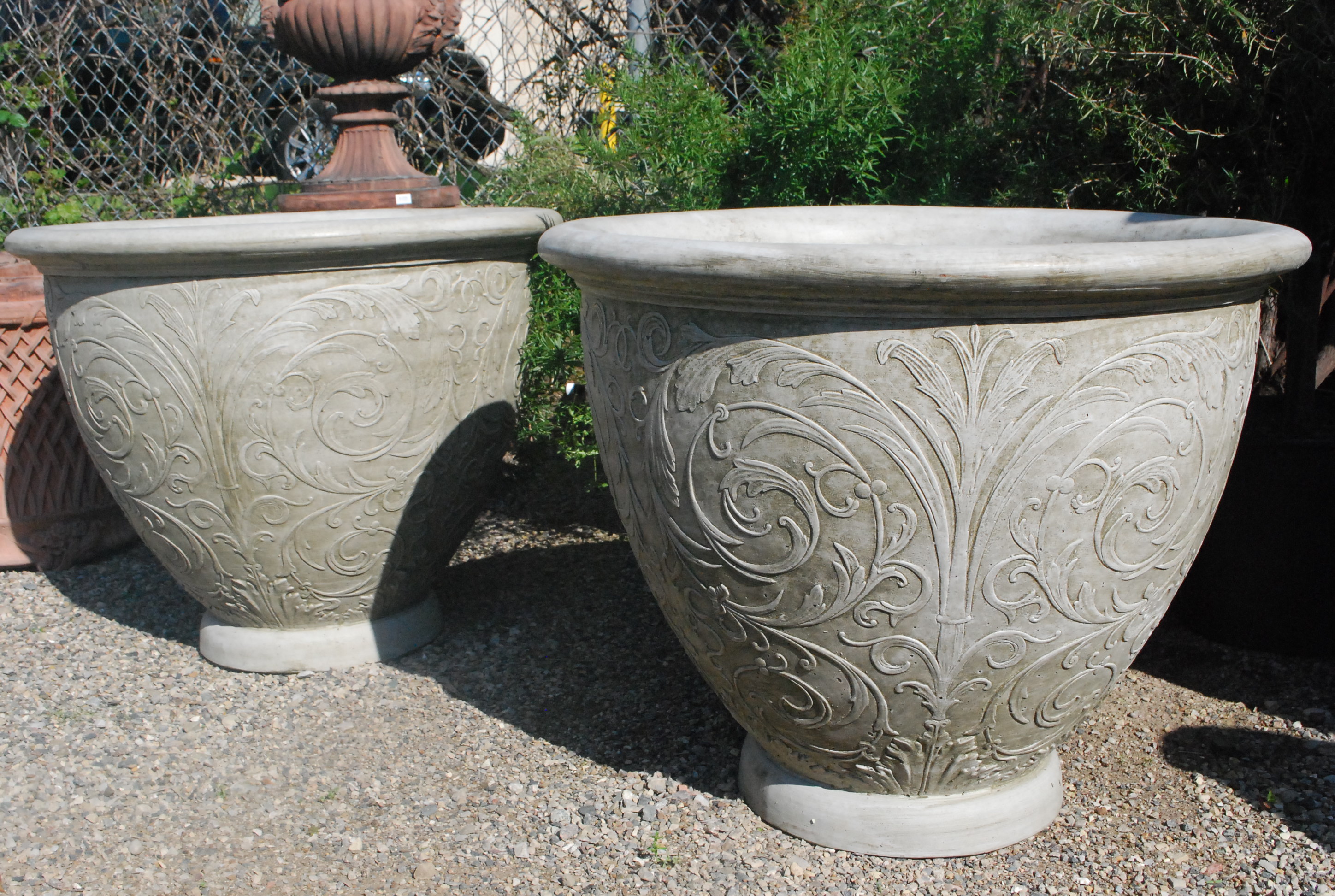
Concrete pots that are mass produced in molds have that distinctly impersonal and too universal look.  A garden is a very personal expression-is it not?  If concrete is your material of choice, look for pots with distinctive finishes.  These classic but rustic urns are French made.  Their highly textured surfaces are beautiful.


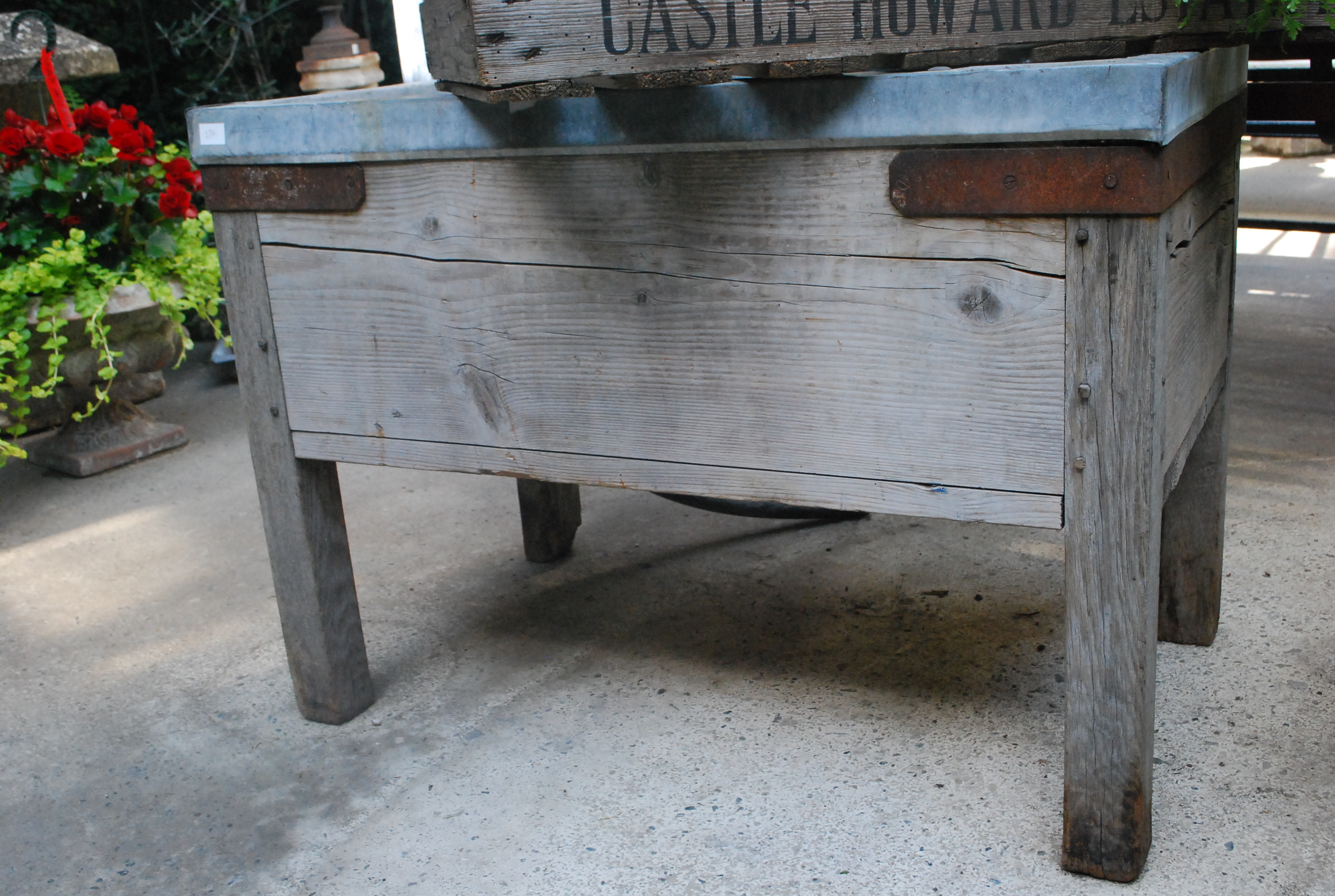
Wood boxes make great containers.  They are at home in a variety of settings-from the ultra contemporary to the farm garden.  This vintage wood box has an integral zinc liner.  I could see it planted solid with lavender, or dahlias.  I could see it with at least 10 other planting schemes.  If you have a different idea for your containers every year, choose pots that roll with the moment.  Some containers can move from informal to glamourous to modern-given a certain planting.  Should you be an adventurous container planter, choose pots that will adapt to your current inclination.

English made concrete

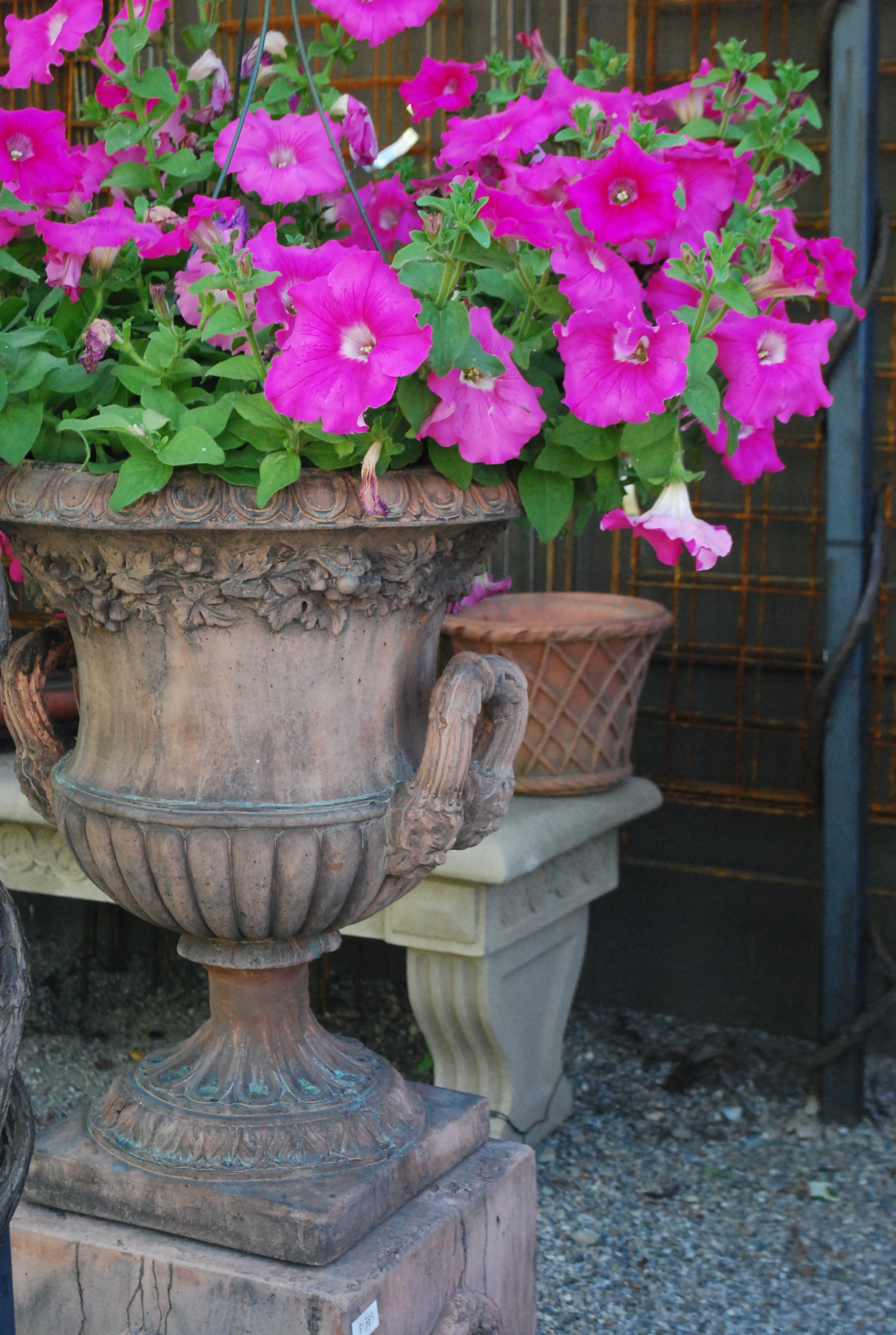
Beautifully ornate urns-buy them with the idea that you will plant such that the shape and detail is not lost.  If containers that drip with all manner of trailing plants is your thing, simple pots are the order of the day.  I have always wanted to try this- planting a pair of aluminum garbage cans with holes drilled in the bottom could be great.  Given a big emphasis on trailing plants.  Are you game?  reproduction Frank Lloyd Wright urns

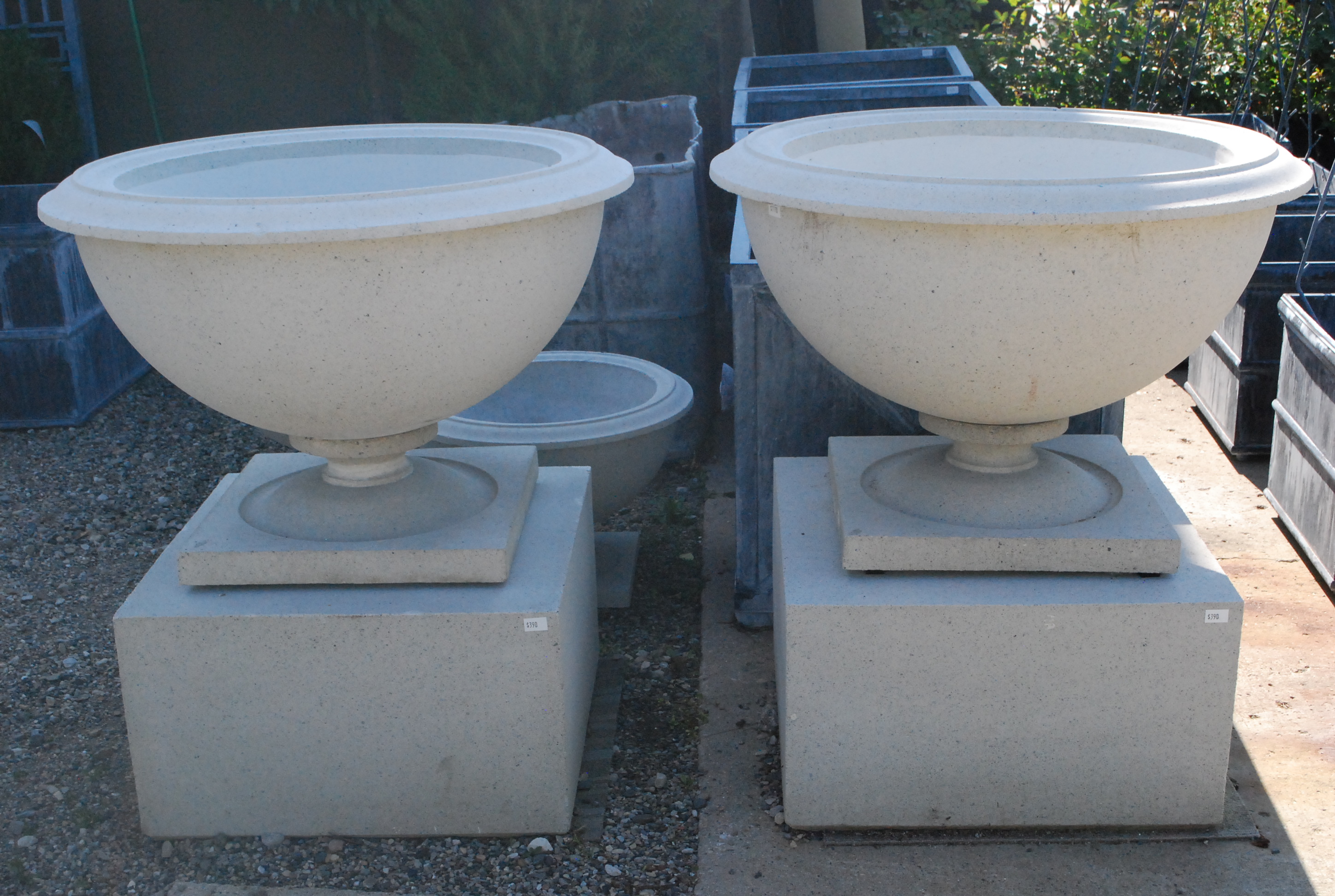
These simple footed urns are a reproduction of a Frank Lloyd Wright classic original.  It comes in three sizes, from Nichols Brothers Stoneworks-we are a dealer for them.  I like the massive bowl elevated off the ground by a properly proportioned foot.  These pots are big enough to hold a whole summer garden.  If you are a fan of green, and evergreen, in your landscape, these pots will enable a contrasting boatload of flowers.  They will also distinctively represent a mass planting of rosemary.  These pots are an easy pick-so versatile.

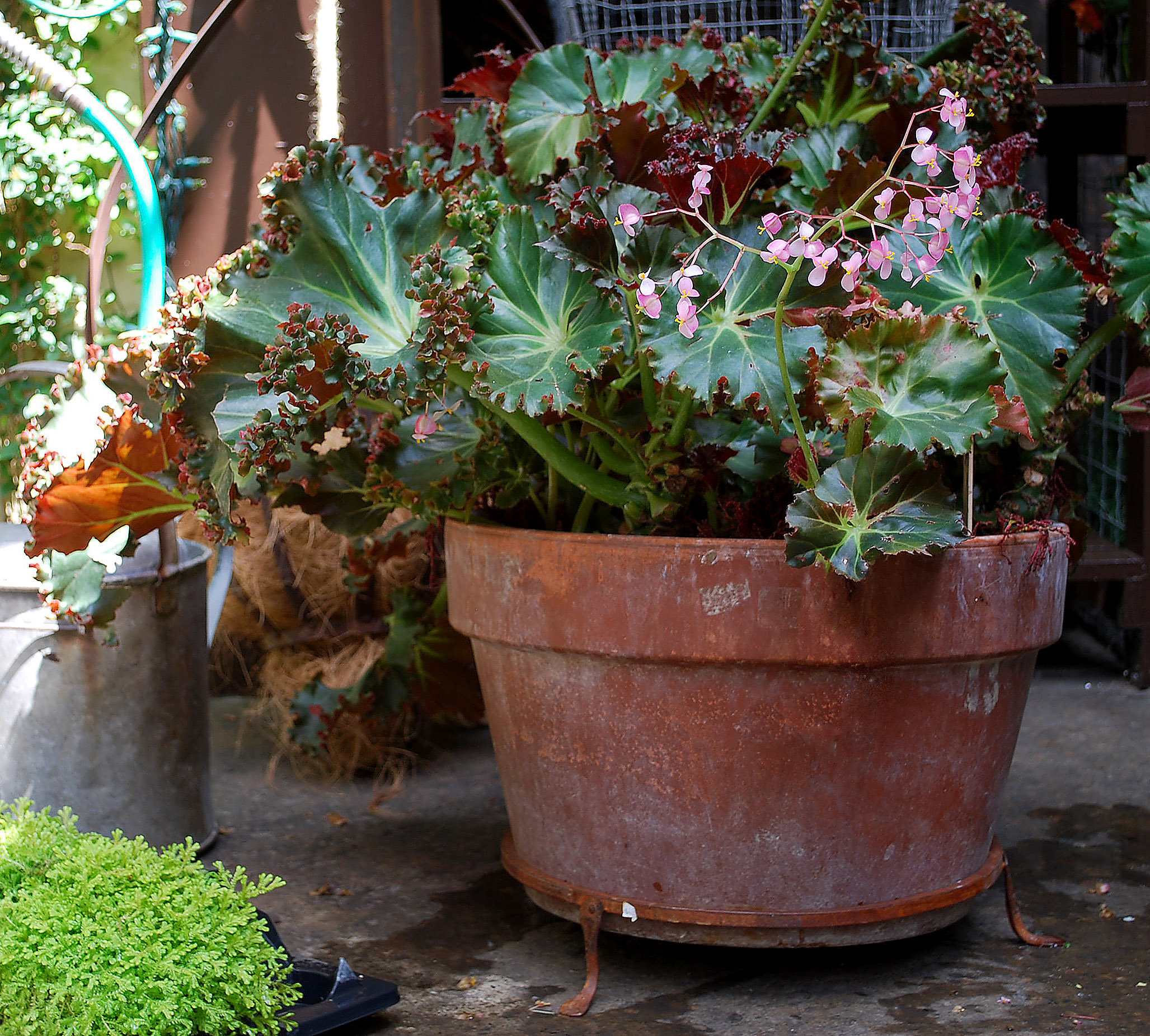
If your garage or shed is full of machine made Italian terra cotta you have had for ages, cast a fresh eye on them.  Old terra cotta pots have a great surface.  Lifting them off the ground in a small rusted steel stand will give them an entirely new look.  Fired earth is always a great choice for pots.  Maybe you do not need new pots.  Rethinking the placement and display of your old pots might make you realize you already own the ones that are perfect.

American made concrete pots

New concrete can be a visually a tough material.  But new concrete with a beautiful pattern, and subtle finish could provide just what you need.  Looking for new pots?  Consider the shape, the style, and proportion.  Consider your taste in plants.  Get professional help if you can.  An investment in new pots only makes sense if they give you better than the look you want.  Consider the detail, the finish, the architectural style, the location, the placement.  Will you see your pots from the street, or sitting down on the terrace to have dinner?  Find a place to get your questions answered in a way you trust.  Are you in my area? Rob buys for the shop, and he has a big love for well chosen containers, and great plantings.  He is just about the best I know in the “which ones” department.To contact Rob-email   rob@detroitgardenworks.com.  Introduce yourself. Pictures are a big plus.  He is really great-you’ll see.

A Vase Full Of Flowers

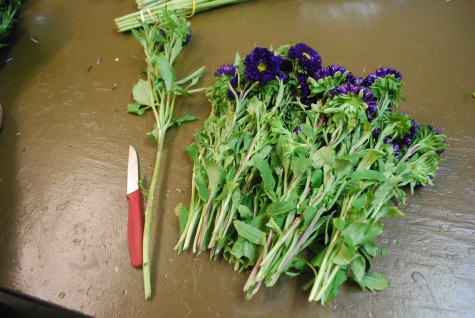
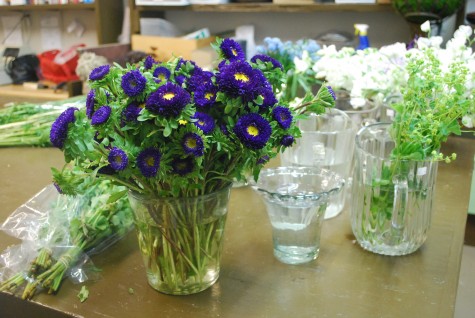
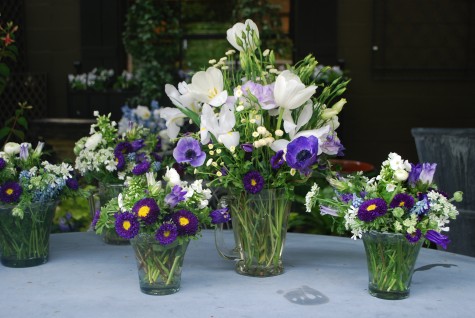
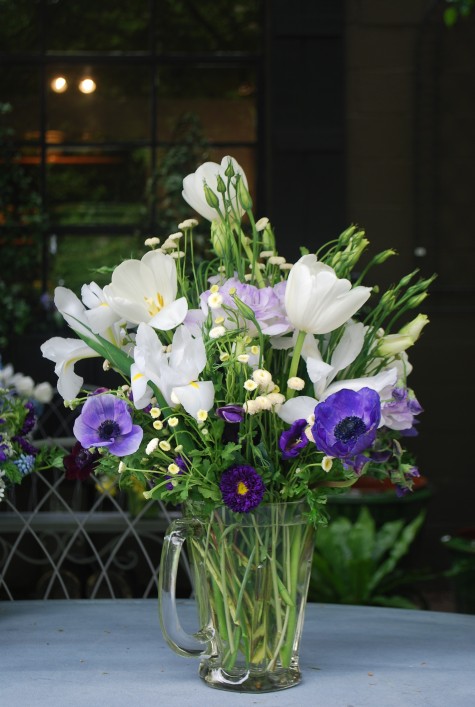
I would imagine that there are lots of gifts, in the form of cut flower arrangements, exchanging hands today.  Though a vase full of flowers is a traditional Mother’s Day gift, it is a thoughtful and appropriate choice.  In the interest of keeping those fresh cuts fresh as long as possible, I take the time to condition them.  These Matsumoto asters have very long, tough, and woody stems.  I cut them down to the approximate length I well need, and then strip off any foliage that might be below the water line.    

I do like cut flower arrangements that are more about the flowers than the foliage, but there are other good reasons to remove most of it.  any leaves below water will immediately begine to deteriorate.  Bacteria proliferate under such circumstances.  Eventually it will interfere with the stem’s ability to take up water.  That uptake is essential to a vase of flowers that lasts. A flower flush with water will stay fresh longer.

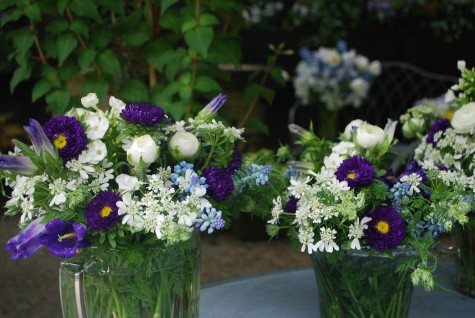
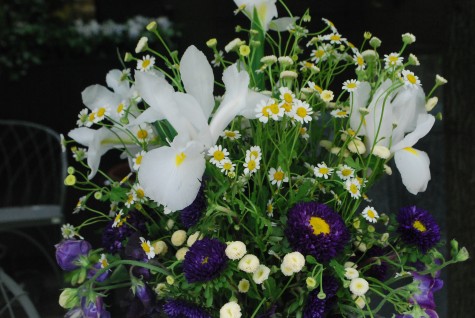
The cut flowers I buy from a wholesale flower house may be local, or they may come from a long ways away.  Though modern transportation means that a cut flower spends as little time as possible in a box, there is an immediate need to get them a drink of water.  After stripping the low foliage, I recut every stem on a slant.  This maximizes the stem surface that can absorb water.  The asters, ranunculus, and grape hyacinths in these arrangements have a naturally good shelf life.  The purple campanula, white phlox, and orlaya (this is the Queen Anne’s lace like flower)  need 24 hours of conditioning-meaning immersion deep lukewarm water in a cool spot- before they are arranged.  

Dutch iris are fleeting in a vase under the best of circumstances, so I buy them in tight bud.  Making sure the flowers you buy are fresh to begin with is important.  If you are buying flowers from a grocery store, find out what day their fresh flowers come in.  Check for any browning.  Whether you are picking tomatoes or fresh flowers, the same rules apply.  Even if those buds of iris are not showing color, once the stems absorb water they will pop overnight.  Roses in tight bud, showing no color, may never open. 

Ranunculus have an amazing long vase life.  They are readily available in the spring season.  Buying cut flowers that are in season means they are readily available at a reasonable price.  Long stemmed red roses available at Valentine’s Day in February are hot house grown, or shipped into my area from California, or South America-an out of season luxury. 

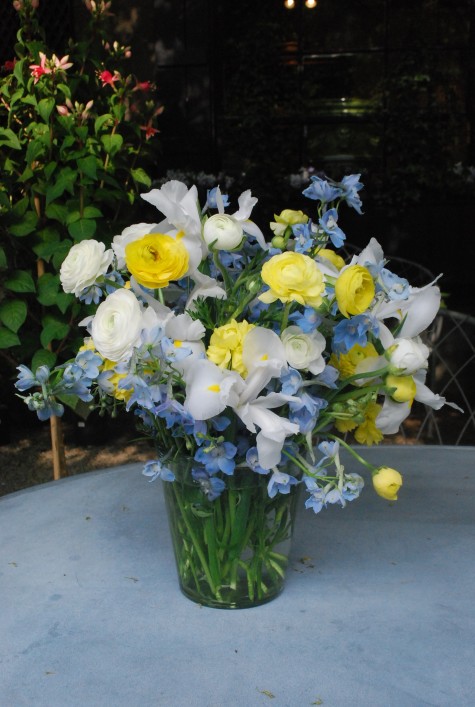
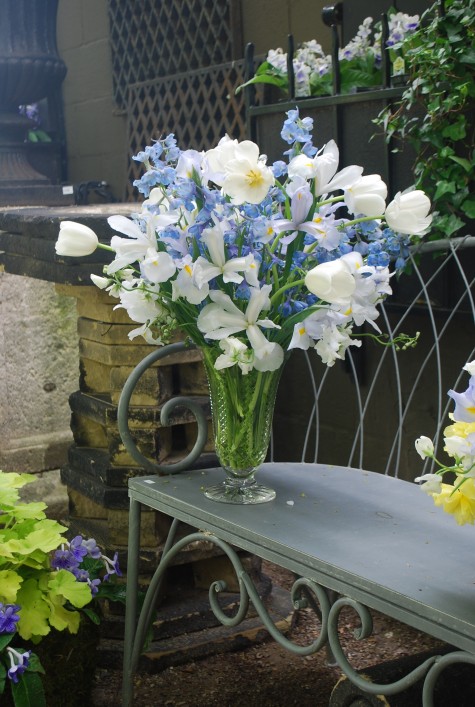
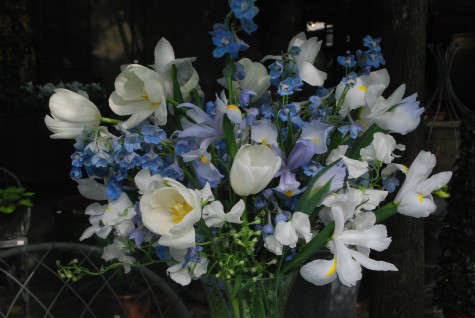
The giant long stemmed Pacific hybrid blue delphiniums are indeed a sight to behold, but they are difficult and awkward to arrange.  The shorter growing belladonna delphinium is every bit as beautiful a blue, and much more graceful in a vase. The delphiniums were arranged in this vase first.  The larger flowered tulips and iris came next.  The dashes of white sweet peas-last.  Trumpet shaped vases help give a cut flower arrangement a graceful overall appearance.  Cylinders can be tough.  Every flower wants to be upright. 

 Tulips are long lasting in a vase too.  But as their stems tend to be wobbly, they like a little existing structure to lean up against.  I try to condition tulips with plenty of natural light.  They look to the light.  I like them to be upright while they are taking up water that first day out of the box.  The flower heads are heavy, and the stems slight- inevitably the stems will swoop.  Conditioning will make them much easier to arrange. 

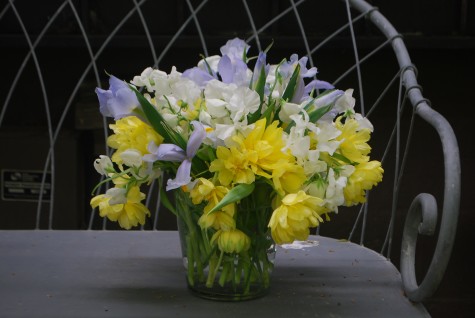
The Dutch iris are very stiff and set, once they open.  I like to pair them with other flowers that have a more relaxed habit in the vase.  Multiflowered double yellow tulips and sweet peas loosen things up a little.  This arrangement went to a Mom with great grandchildren.  Pastel flowers are easier to see that dark colored ones.  A bouquet of fragrant flowers adds a whole other dimension to the enjoyment of those flowers.

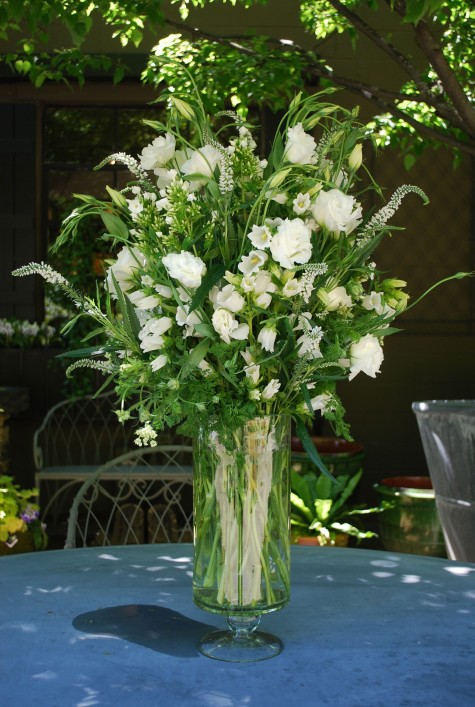
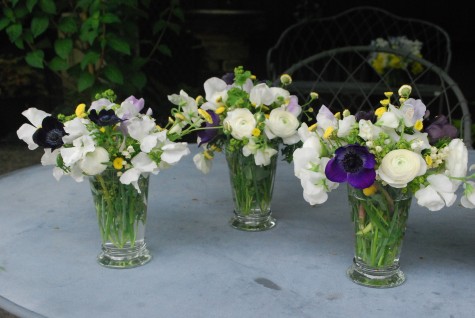
A mix of all white flowers is always a beautiful choice.  Veronica, lisianthis, phlox, campanula and orlaya in a vase suggests the profusion of the garden.  For a thoroughly modern Mom, a vase full of one kind of flower may be more appealing. 

I like mixed flowers in a vase for one practical reason.  If the campanula wilts and fades, it can be removed.  Clean water, and a little fluffing means the arrangement it there to enjoy for a few more days. 

There are those circumstances when arranging flowers in oasis, or floral foam is a necessity.  But flowers arranged in water that is kept fresh will last.  All of those green stems in clean water is a pretty look.

A smaller scale arrangement will be easier to handle.  Recutting the stems every other day, and clean water will help with their longevity.  If you buy cut flowers that routinely come with buds-such as lisianthus and ranunculus, making those buds part of the arrangement becomes part of the charm. 

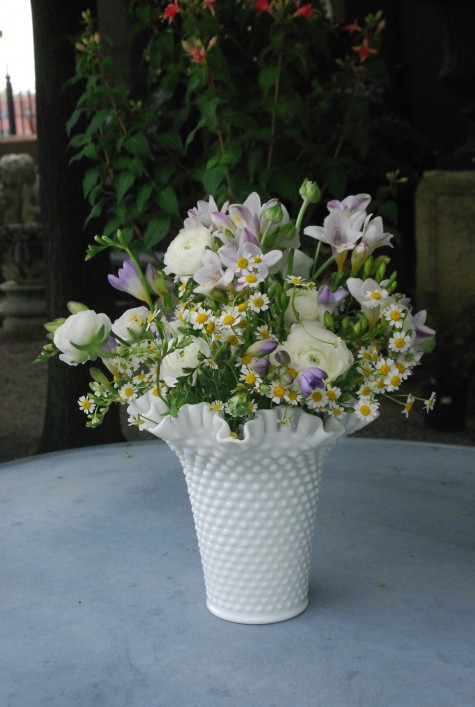
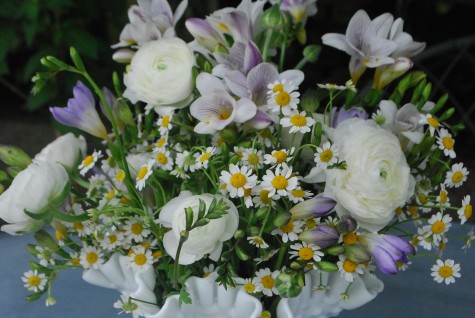
The lavender and purple veined freesia in this vase-wonderfully fragrant.  The feverfew-very garden like.  The ranunculus-like little peonies. 


Cut flowers from the garden make lovely arrangements, but I have little in bloom right now.  What’s available in my yard and maybe yours right now-lily of the valley. Given that they are usually in bloom on Mother’s Day might be just enough of a good reason to grow them.   


The Details

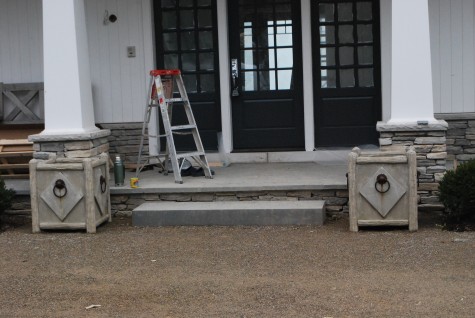
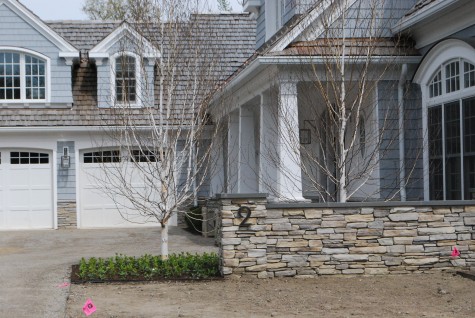
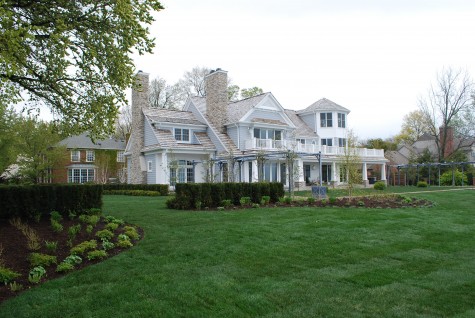
As I have written before, my job for a client is best described as a conceptual plan.  A schematic plan.  A few broad strokes, an idea.  All of the details, which make a landscape project, are all about a relationship.  The strength of a designer/client relationship makes all the difference in the world.  My client was discerning, committed, articulate-a joy to work with.  These rustic concrete planters with iron rings-she thought they were prefect for the front door.   

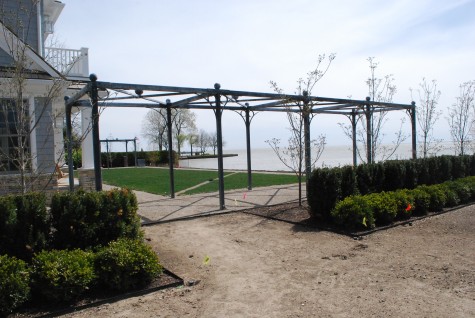
garden pergola

She wrote me once that she dreamed regularly about what this garden would look like.  That’s when I started sending her the landscape/garden installation news, regularly.  She was decisive-but she was open to suggestions.  She took a lot of time with me.  I took an equal amount of time with her.  All of the details of this project have everything to do with her taste.   

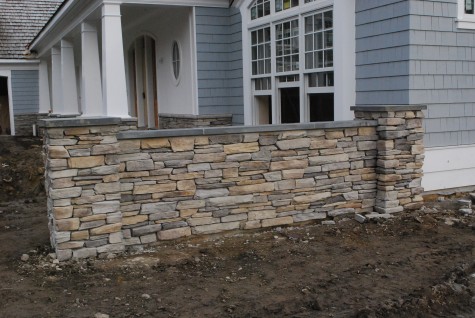
stone walls

She made me want to be the best I could possibly be.  My landscape design practice has been graced with clients like this.  She asked me to design this landscape as if it were mine.  I had never been asked that before, but I did just that.  But I have Harriet to thank for all of the details that emerged along the way.  This is her house and garden-not mine. 

white barked birch
She made time to work through the details.  These Himalayan white barked birch-especially for her.  Birches are a favorite tree. The details of my plan are all about what she likes. 

espalier trees

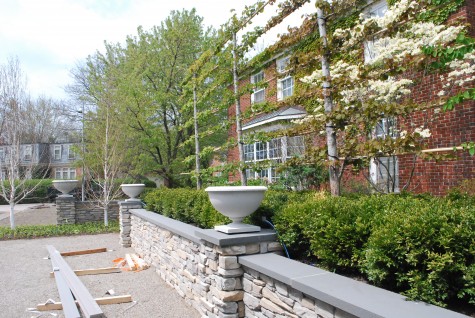
stone planter box with espaliered katsuras.  Frank Lloyd Wright reproduction stone urns.

steel pots

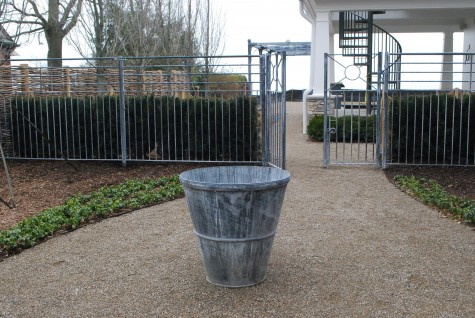
Steel fence and tapered steel Hudson pot


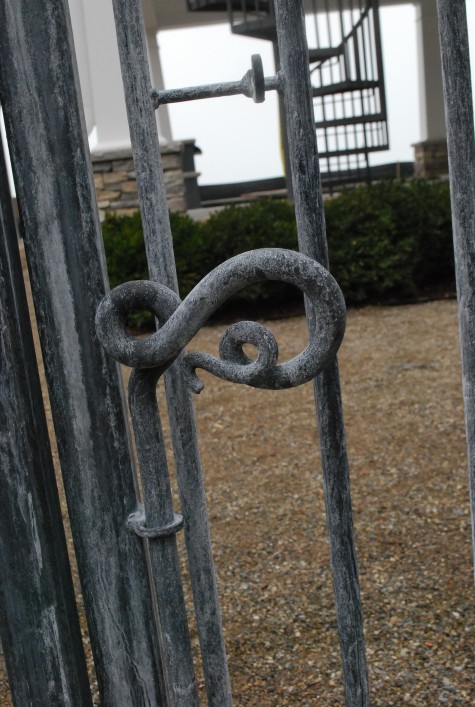
gate cane bolt detail

garden gates

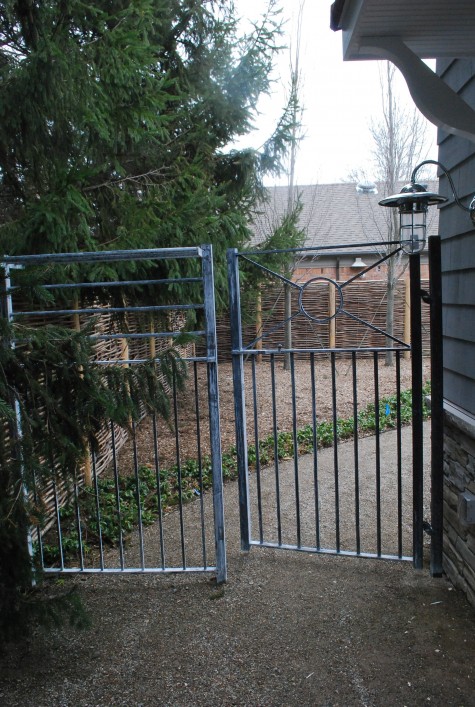
side gate

steel fencing

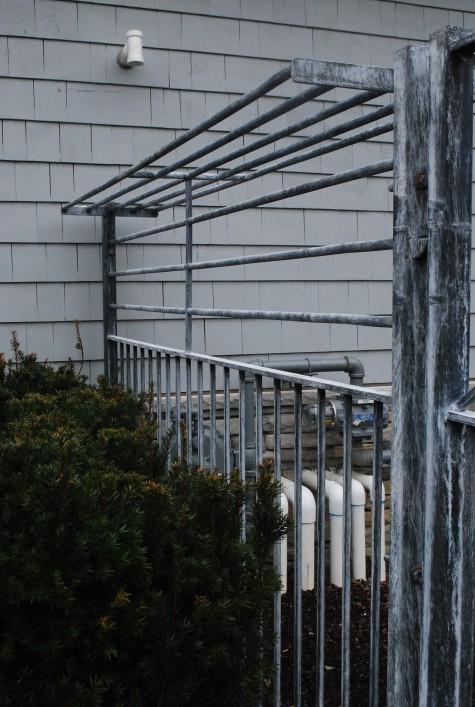
steel fence with shelf

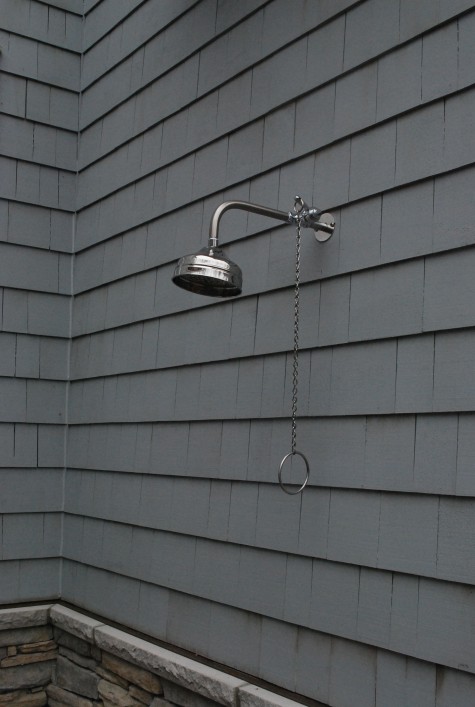
outdoor shower

outdoor shower

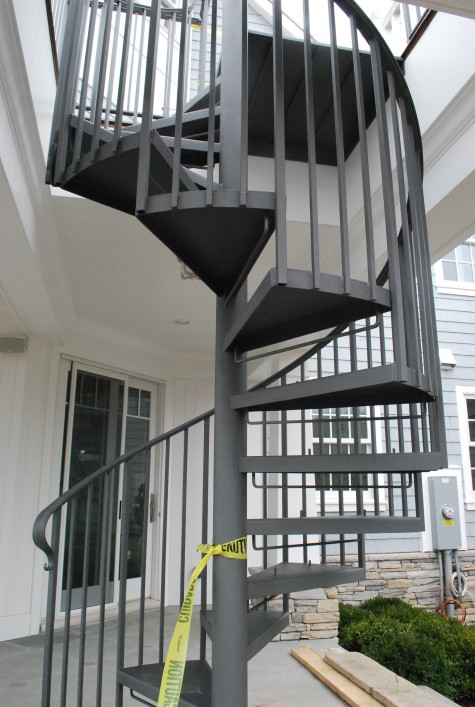
exterior spiral staircase

circular staircase from the first floor terrace to the second floor balcony

bluestone paving

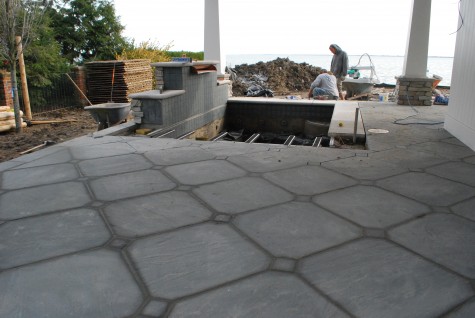
stone terrace in bluestone squares and dots set on the 45

hot tubs

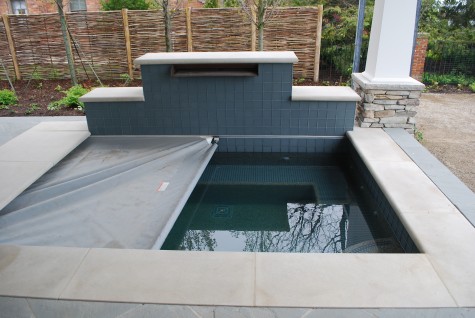
 Spa featuring blue grey glass tiles, and copper waterfall

hot tubs

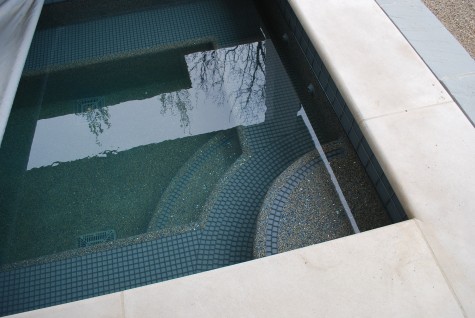
spa detail

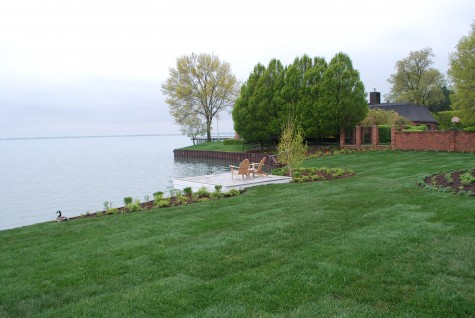
 deck/dock cantilevered over the water

 The house is beautiful.  The landscape-my best effort.  I could not be more pleased about the relationship, the process, the finish.  She influenced and brought to bear every personal detail.   All my thanks,  Harriet.  I could not have begun to do this project without her.  Our relationship is on a certain kind of common ground.  That ground will be an organizing metaphor for the future of this landscape.  I expect to hear about this landscape again from her-soon.