Archives for 2010

Sunday Opinion: Cheap Tricks

Mow the grass to perfection.  This will make your landscape look well cared for, even if the garden has gotten away from you, and fungus is running rampant in everything from the maples to the sweet woodriff.  

The sweet woodriff might need a little more room-cut the bed 6 inches bigger.  If it has spread into a spot where it is not so happy, move the edge back.  Mind your edges in general.  Compositions, beds, properties, views, walkways-they all have edges.  The effort you put to good edges, as in deep verges, edger strip, brick edges, stone walls-all of this will result in less maintenance, and a better look that costs nothing more than your attention and your timely intervention.

Maintenance is key to a beautiful garden, so do not buy plants on impulse.  Read the literature, visit any trial garden within driving distance, decide if a plant meets your aesthetic or practical criteria for inclusion in your garden-before you plant.  If it does not, there will lots of extra maintenance trying to get it to deliver, or work visually.  I do not mind hard work.  What I mind is hard work to no good end.  Nine times out of ten, I own my own troubles. I try to think before I buy. 

Buy plants on impulse. Your impulse comes from you and you alone; your unique point of view is what fuels the success of your garden efforts.  Having something the way you want it is fun. Make everything you love work together, as in move things around until they are in just the right spot.  You are after all the President and CEO of your garden.  Exercise your executive power, and then your executive shovel.

Shovel out those ideas you believe to be true without having looked at them with a cool eye. Take photographs of everything you do, and look at the pictures. Your relationship to your garden is emotionally charged.  Step back-get that dispassionate lens looking at what you have trouble seeing clearly.  Cell phone cameras-fine.  You need to see the big picture-not the details.

The details could not be more important. Stake those things you know will go over. Water when you need to, even when you don’t feel like it. Deadhead, divide, weed, grow from seed. Be good natured about the fact that the work will never be finished. The difference between a successful garden project and a so so garden project has everything to do with an energy that starts out big, stays big, and finishes bigger.

 Big, broadly conceived moves will draw, engage, and delight the eye.  Express your design clearly. Should you need to write an explanatory outline of your intent and post it at the entrance to the garden-go back to square one. Figure out how to make that garden look like what you intend.  Arrange plants and spaces coherently.  What do you have going on in the air space?  What is going on underground?  Are your social surfaces level? 

Level headed-there are those times when it is a good idea.  I pay my bills, pass by the potato chips in the grocery, and get a yearly checkup.  There are times when this mind set applies to overseeing the garden.  If you plant a tree, will you hand water it until it has rooted in?  If you add a perennial bed, will you mulch weed and water until it fills in?  Plant only what you will look after faithfully.  Make a plan to get where you want to be, one step at a time.  Plan.

Plan and re-revise your plans every season.  A great landscape and garden takes many years. The years that represent hat time is equal to the time it takes you to mature as a gardener.  Take the time.

Time is not on your side.  Make a move-now.  Plant a tree or 3. Redo.  Hire a professional.  It is ok to ask how hiring someone could possibly be a cheap trick. If you buy and plant and don’t get a garden you love, a good professional could save you lots of time and money.  Expose yourself to places that can inspire you.  Beautiful gardens both public and private, books, a garden club or association, a local garden center may have something that enchants you.

What enchants you?  This is the cheapest trick of all, sorting out what seriously interests you from what mildly amuses you.  Take the time to understand what matters to you about the garden.  This might be a complicated topic, but the more you think about what you love and need from your landscape is like is two aspirin and a beer for your design headache.  Any knowledge is a good thing, and it can be had for nothing more than your effort to obtain it.  An inspired landscape and garden of your own will energize and enchant you. 

I like to talk to people who visit my shop. I am in an out of the way location, so I know people come for a reason. They will tell me why the came, or what they are looking for, should I ask.  So many tell me they come here to be inspired, to get ideas, to feel better, to add or change something in their garden. They happily complain that there are too many beautiful choices. They may tell me that something they see makes them change their mind about what they thought they wanted. I like hearing this.  I intend that anyone who comes here gets visual access to my ideas about gardening, beautiful ornament, and design. The store display gardens, how we choose and arrange what we buy, our willingness to talk things over, coach and care-how we put it all together, makes for an experience.  Take advantage of anything or anyone out there that strikes a chord.  

  People do hire me to design and install landscapes and gardens for them-thanks heavens they do.  People who shop at Detroit Garden Works have kept me in business for going on 15 years; I so appreciate this. It is my idea to keep working, keep evolving.  Lots of people have a hand in this-thank you all very much.   We are in the thick of redoing the shop for the fall, and the upcoming winter season. We have a few tricks up our sleeves. Given what lies ahead for gardens and gardeners alike, we are running a special on enchantment this fall-you’ll see.
At A Glance: The Super-Nova Stage

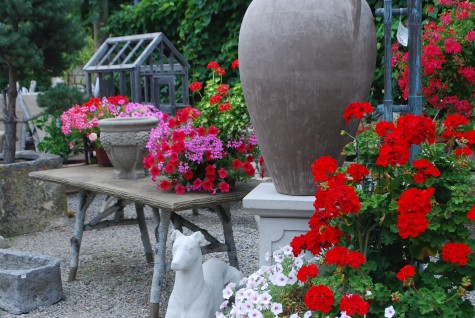
Does it not seem like the colors of all the annual flowers intensify with their first brush with cooler weather? 

Fall Is For Planting

Our fall plantings have begun in earnest this week; very cool night temperatures are a sure sign that fall is underway. My boston ivy wall has three distinctly dark red streaks in evidence in an ocean of green. More to follow on that story.   A maple down the street is emphatically turning color. Speaking of emphatic, I like to plant big plants in the fall.  The cool soil means that growth will be slow, especially in an exposed location.  Scale is so important in any seasonal planting; in a good year, we have two months of fall.  Start big; make yourself happy.   Fall plantings do several things for the gardening psyche.  When summer plantings get to looking like they are infected and going down from the cold, a fall planting can be robust and cheery.  Fall pots can stretch and test your ingenuity, as the palette of suitable plants is vastly less than one’s spring choices. The cool weather means all of us are more energetic, enterprising, and tuned in. The mix-much like a cool jazz inprovization.  

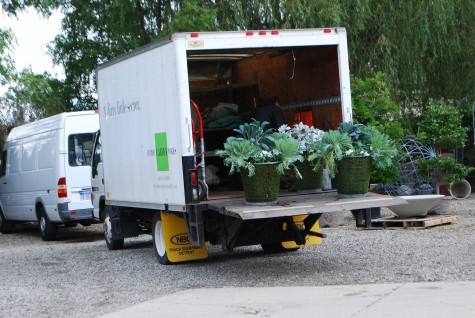
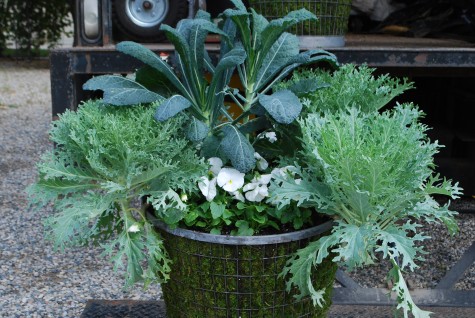
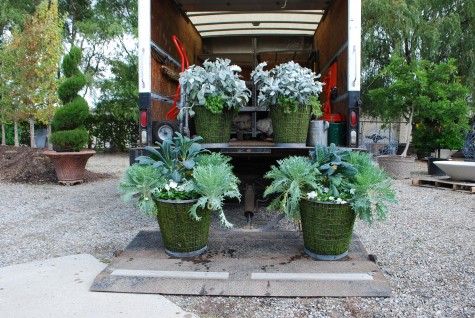
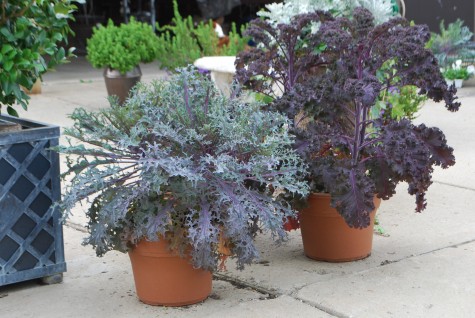
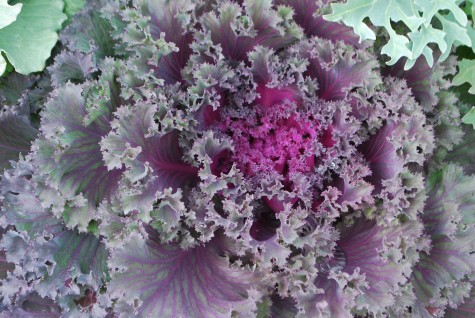
Ornamental kale can be found in large sizes, and shrugs off the cold.  The color only gets better as the temperatures decline. The tuscan kale I have had in the shop pots all summer will go on until very late in the fall.  Good deal. If you are new to a planting that will span our fall,  galvanized steel and steel wire buckets make great fall planters.  They are relatively inexpensive, and they have that bushel basket look about them.  Who can resist a bushel basket of apples, or a quarter bushel of new potatoes?   These wire containers are particularly attractive; the moss sides makes this planting green from top to bottom. How the kale spills abundantly over the edge speaks to the time of the harvest. Lush in a different way than spring.  A lush finish-the harvest ripening, maturing-the best part of the summer season. 

I think there is a gene that makes it a snap for some gardeners to expertly moss a basket.  Others of us struggle with this job-me included. At Detroit Garden Works, we now use a florist’s moss mounted on a netted backing.  This makes mossing very quick, and easy. This moss comes in a roll; drape the basket, and fill.  Fill any number of  bushel baskets with kales, pansies, twigs, grasses-whatever seems to be maturing in your garden or available at your farmer’s market.   My most favorite stems of this season-the maturing pods of asclepias tuberosa-butterfly weed.  Those pods-so beautiful.  

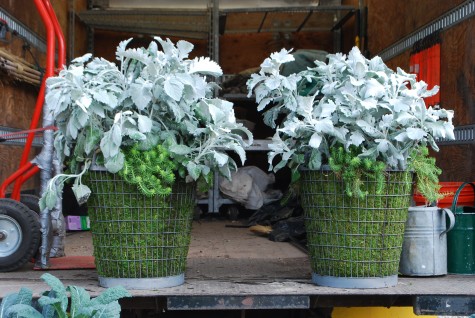
Cirrus dusty miller has large felted silver leaves with great substance.  They tolerate the cold well.  The serrated dusty miller does just as well in fall pots, but looks better paired with cabbages, or bergenia.  Dusty miller takes a long time to grow-should you be interested in cirrus, talk to your greenhouse grower now.  This big leaved dusty miller deserves more attention.  The drapy Angelina stays green all winter; it is a consummate professional of a plant.  Whatever grows and stays green over my winter gets my attention.

Ornamental cabbages and kales can be had of considerable size; I like my fall pots stuffed to overflowing.   Buy big.  Stuff as many plants as you can manage into your pots.  The fall is fleeting-do not be late to the concert.
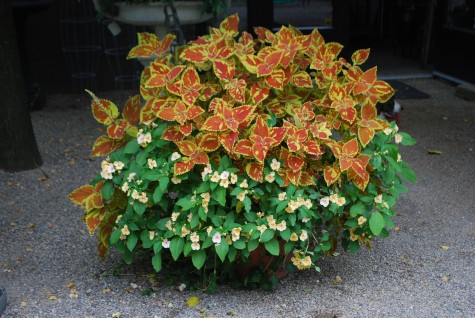
I do not mind the passing of the geraniums, the verbena, the impatiens and the coleus. To everything there is a season, yes?  I am focused now on fall.  What will I do? 

<
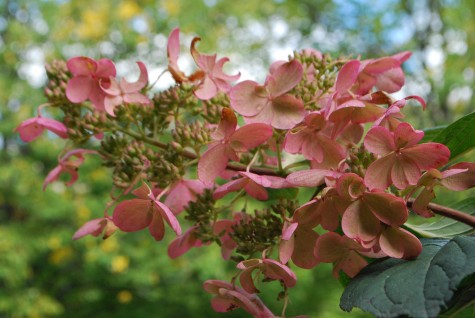
The hydrangea flowers are pinking from the cold-enjoy this. In much the same way that you reluctantly let go of spring and move into summer-celebrate the fall.  Change is in the air.  What is not to love about this season?  I would advise-wake up and get ready.

If You Must

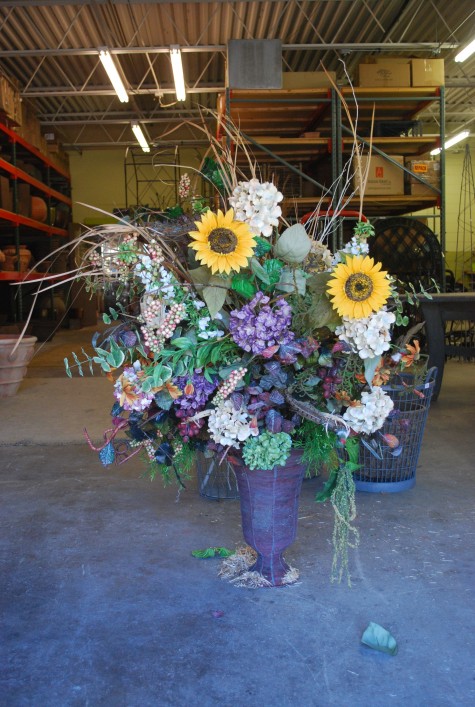
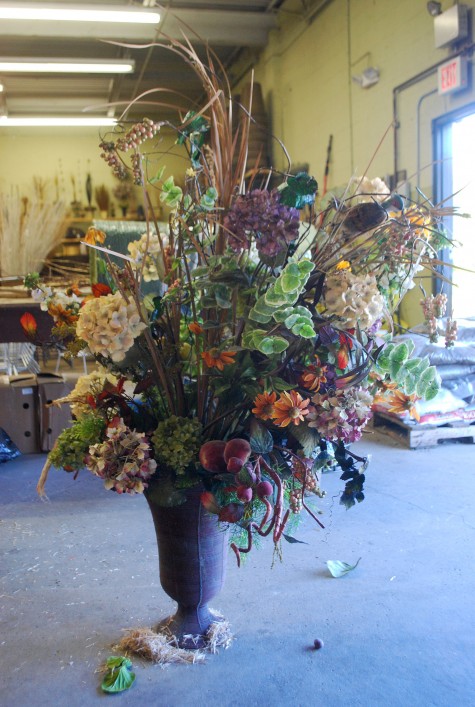
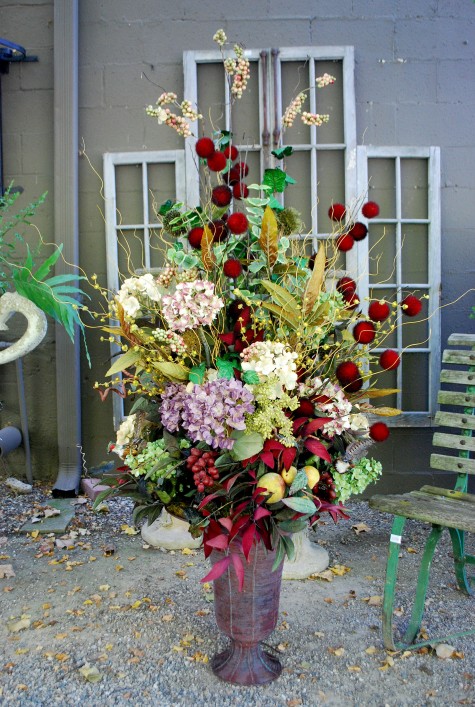
My first choice of a giant arrangement of flowers and greens is first and foremost about fresh.  I would guess most gardeners would agree with this point of view.  But a big statement in fresh flowers is ephemeral, and incredibly expensive.  A garden that could supply 100 stems of fresh flowers every week-this would be a very large garden.  The time it takes to arrange fresh flowers and keep them looking fresh is considerable. I am happy when Buck just buys me a dozen roses at the grocery.  Fake roses can be fine too, provided they are arranged with style and wit.  This artificial arrangement came to my door just two days ago. 

I have not one problem in the world with artificial flowers and greens.  They are designed by real people, and manufactured by real people who take their jobs seriously.  They are purchased and taken home by real people whose pleasure in the natural world is self evident.  If you cannot do fresh flowers, if you have a spot in your heart and home asking for some evidence of the natural world -if you must go with the faux, I have some ideas.   

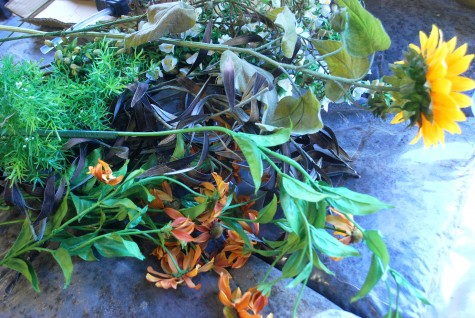
No kidding-this is the flip side of the arrangement in need of an overhaul whose front side is my opening photograph.  It looks to have one of everything imaginable. No artificial arrangement benefits from a kitchen sink approach.  What goes in your kitchen sink is about discards.  What goes in your arrangement is about choices.  Choose a few materials that really appeal to you.  Choose a few materials that make a strong statement about volume, color, texture, contrast and mass-as you do not have the fresh card to play.   

I regularly arrange flowers for weddings and events.  I have a gardener’s point of view that governs how and what I put together.   Those natural materials do the lion’s share of the work.  I can bunch 3, 10, or 100 cut stems.  Any three stems fresh cut, any fresh cut fistful of flowers, or truckful of fresh flowers is guaranteed to please.  No matter how badly you arrange them, fresh flowers always look beautiful.      

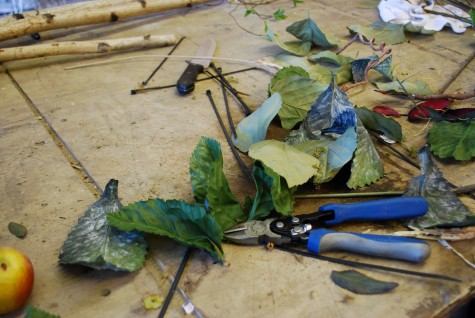
An artificial arrangement is about a visual feast of a completely different sort.  The fake flowers and stems available today are incredibly good.  However the leaves are incredibly bad-they are a manufacturing afterthought.  Loose all the fake leaves, and arrange each stem so that its given star gets good play, and contrasts in color, texture and volume with its neighbor. 

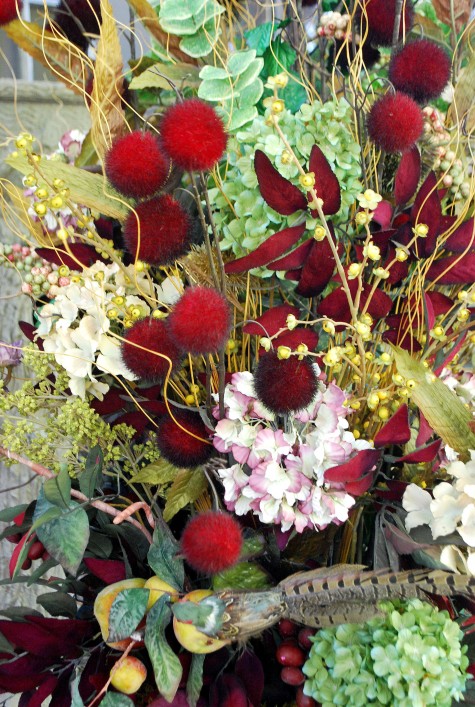
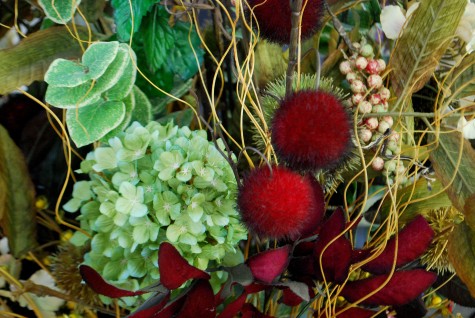
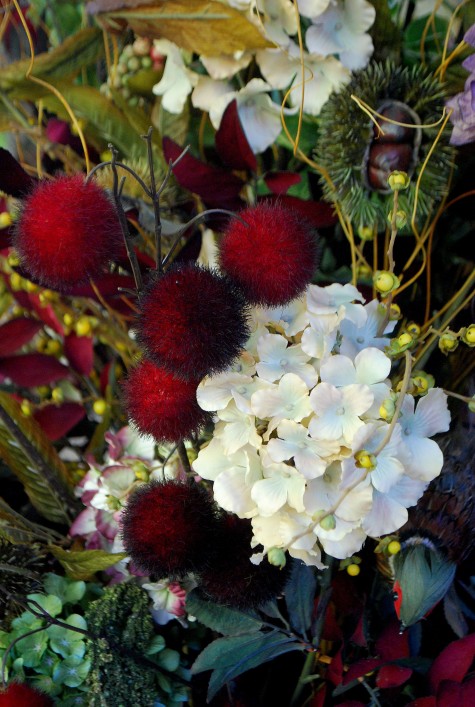
Rob saw fit to purchase box after box of artificial stems featuring red fuzzy balls. Their color and texture-more than interesting.  My client’s arrangement-I took it apart.   I washed, or otherwise cleaned every stem that I thought might be relevant.  I clipped off every offending fake leaf.  I planned to cover every plastic stem with some shape of interest.   

The group that I would call gardeners needs a very big tent-should they all plan to meet.  Gardening takes many forms, most of which interests me. What interested me here was providing my client with an updated look.   


An artificial arrangement need not be dusty looking or poorly planned. You have no obligation to use a stem as it comes out of the box.  Figure out what part you like the best.  Discard the worst, take apart the rest, and decide what overall shape pleases you.  Arrange each element so it looks like you were having fun.