Archives for 2010

The Tree Lawn

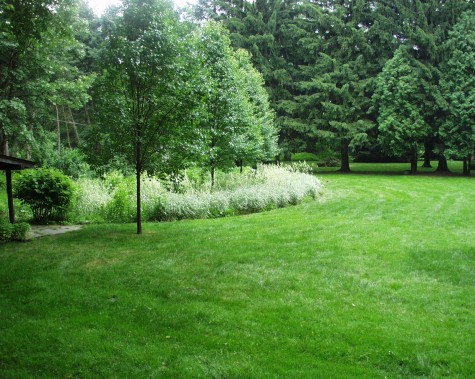
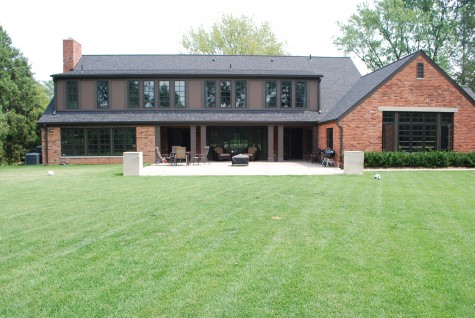
You do not have to be a gardener to enjoy and appreciate a park.  A simple landscape with trees and grass is a place to meet, to read, to relax, to while away a few hours, to appreciate the natural world.  The ultimate tree lawn-a golf course.  Though I doubt any serious golfer would admit to loving the land forms, lawn and trees better than the sound of his club striking a ball true and square, there is no doubt that golf courses are beautifully maintained parks. This client is fortunate enough to own a large piece of property in a densely populated urban area.  I landscaped it as a park-lots of lawn, and trees.  The sweep of meadow-not so unlike a golf course rough. 
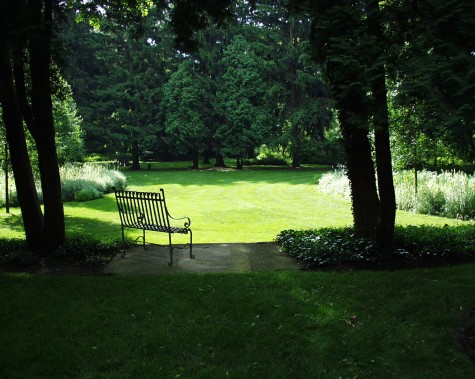
Our country is blessed with an embarrassment of riches in land. From sea to shining sea describes no other place on earth but ours.  Though I live in a gritty city, I have places to go where I can partake of big spaces.      
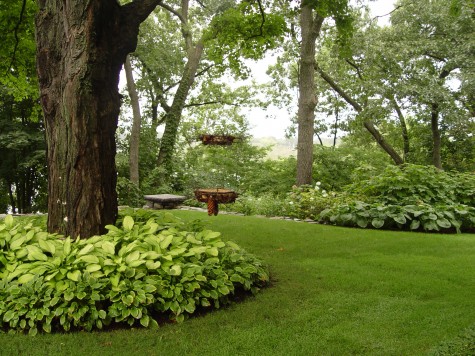
Mature trees-mature people treasure them, as well they should.  A giant maple on my property draws water away from what is planted underneath, and drops debris every day into my fountain.  Would I ever consider doing without it?-not a chance.  The shade in this client’s garden requires a buffer between the tree trunk and the lawn-Gold Standard and Gold drop hosta light up that trunk with a chartruese skirt.     
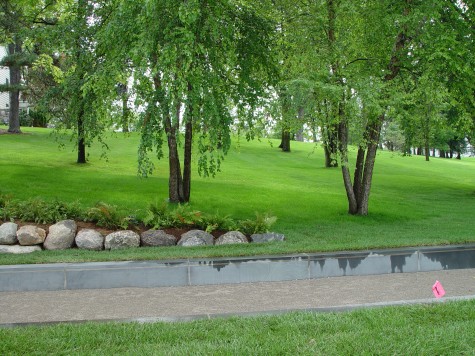
An open tree lawn asks for but one thing-the lawn right up to, and fringing the trunk of the tree.  So natural, and so beautiful. This arrangement of grass and trunk says “park”.  Many suburban landscapes feature round rings of bark around the trees.  Americans are a practical lot-the lawn crew armed and eminently dangerous with a string trimmer can quickly kill a tree.  That bark ring speaks and shrieks to “landscape”., and convenience. I will admit I have hosta around the trunks of the maples in my right of way at home; they came with the house, and I rather like the look.  But my urban garden is anything but a park.  
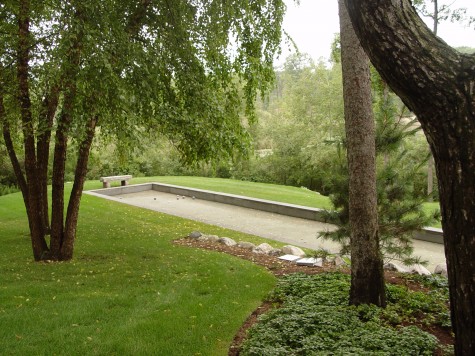
Though few gardeners have large properties, there are very good ideas that can inform the landscape design of a small patch of land.  A tree set in lawn up to its trunk speaks strongly to peace and reverie. A tree trunk in dense shade, plant as much ground cover as you can muster.  Be simple about it. Save your intricate or tricky moves for sunny spaces.  Sweep those bed lines, and breathe.    
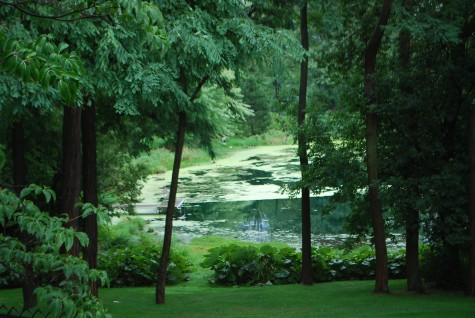
 Look at your garden at all times of the day.  Early, and late.  Make much of the long views.  Should your long view be but 15 feet-so be it.  Mulch your beds to conserve moisture-do not mulch defensively.  Breathe.  Making a decision to leave something be can have as much impact as that which you touch.
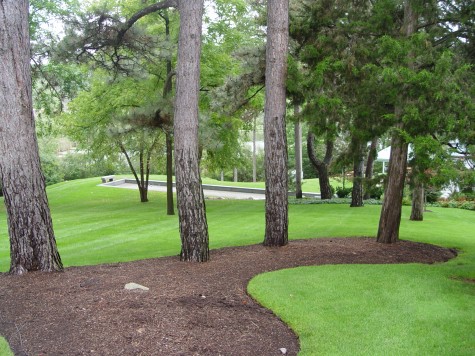

I am a landscape designer first up, and through and through.  I am biased-no doubt. I look at every move I make with my hands- with my eyes.  The hands and the eyes need to speak in concert.  No matter how big or little your garden, no matter how little or how much you choose to do, your garden will speak back to you-should you be listening.  A great landscape has eveything to do with the length and breadth of one’s listening.
In Process

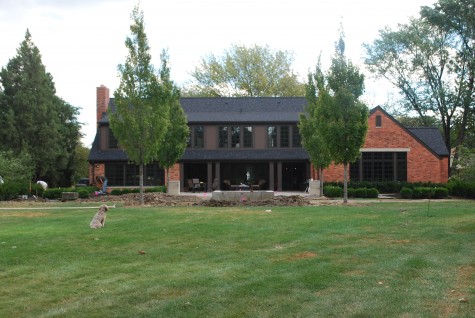
I am hoping you remember my post from not long ago about a young but very articulate client whose parents rank right up there on my list of “ten people I cannot do without”. I will amend that statement.  Cathy and Dick rank right up there with my most favorite clients, but kid Rich is getting my attention.  This rear yard, post a big house renovation, has been laying in wait.  Sue is so over the laying in wait phase-Rich is lucky to have her.  Thank you Sue, for getting Rich to get moving.  We got going with the landscape a little more than two weeks ago.  

Four Bowhall maples were planted first off.  Trees of this size require planting via a tree moving truck as big as a garbage truck.  The rootballs were 120″-10 feet-in diameter.  A house bereft of any plant of scale asks for a little something big.  Given the prized views to the golf course, columnar trees seemed like a good idea. 

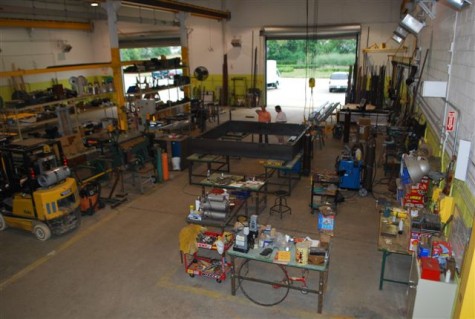
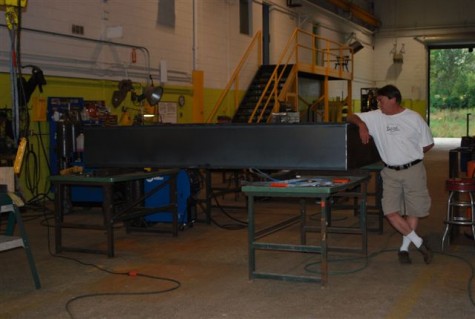
A fountain figures prominently in the design.  A 10′ by 10′ fountain, 18″ above ground would feature a galvanized and acid washed steel surround, and a likewise contemporary steel vase skimming the surface of the water, and spouting.  This picture of Buck’s shop, and the fountain surround was shot from the mezzanine level at the Branch studio.    The surround in question was ready for a trip to the galvanizing plant.   


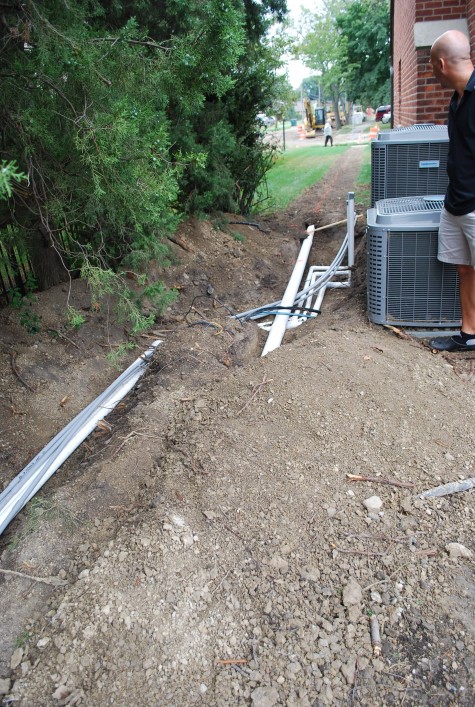
A complicated landscape installation involves the coordination of a lot of contractors from different disciplines. GP Enterprises would install the drainage first up, and then the big trees.  We would install the landscape.  Concurrent to our work, Gillette Pools would begin the installation of the fountain.  The irrigation work-a whole other issue we hope will get done today.   

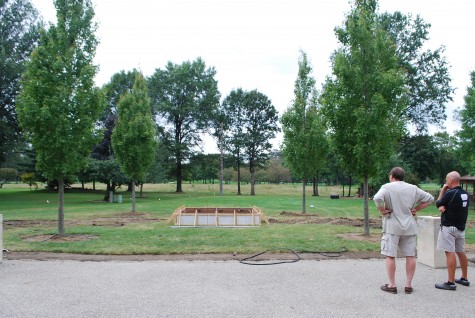
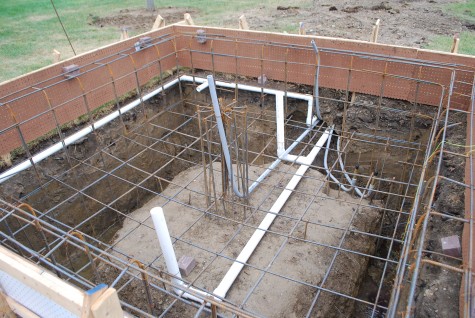
Nothing gets done in the blink of an eye-just ask my client.  Each phase has its issues that need sorting out.  Careful and thoughtful sorting out.  Who needs a poorly planned installation to be evident at the finish?  No one.  The forms for the fountain seem like the work of a boy scout project, but they are anything but.

Wes Gillette has been installing fountains, spas, and pools for a good many years.  His work I can rely on.  I know this fountain will be reinforced with steel, level, and true.  Exactly what was drawn on the plan.  I can expect that he will coordinate with Buck on the installation of the steel surround, and fountain vase.

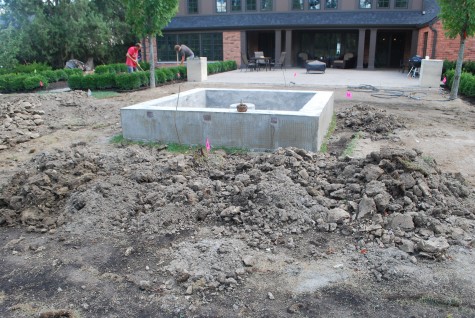
This fountain goes the extra 50 miles, thanks to Wes.  The water will be filtered and cleaned, just like a spa or swimming pool.  Though they were not interested in a swimming pool or spa, they greatly liked the idea of a fountain that would be people friendly.  The 8′ by 8′ water surface will have a fountain vase 4′ in diameter, and an overall depth of 23″.  I can see friends, kids, and family in the water.


Though the forms pictured may seem slight, the finished concrete work is solid.  This fountain will need its surround, its coping set at seat height, its pumps installed, its fountain vase levelled and fastened securely.  Every part of this fountain will need to be level.  My conversation over the Labor Day weekend with Buck-mostly about how to set and fasten that fountain vase level.

More Hounds

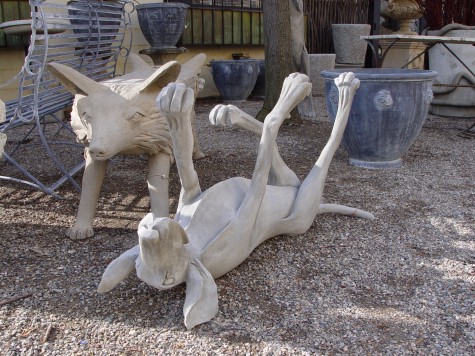
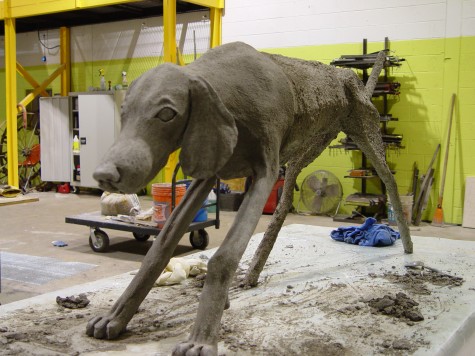
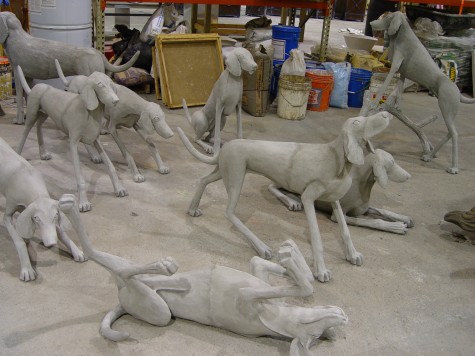
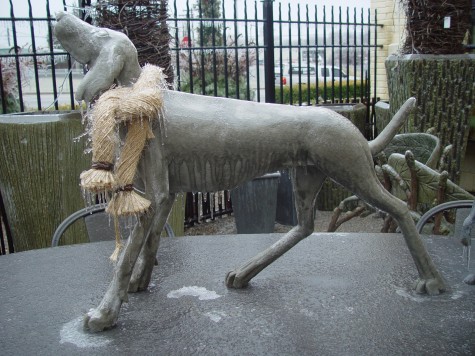
I am very pleased that Troy is in the process of creating his third collection of hand sculpted concrete hounds for the Branch Studio, as all but one of the original 18 dogs have been sold.  Detroit Garden Works gets inquiries about them regularly-no wonder. His sculptures accurately represent the forms of the hounds, but what is extraordinary about them is how they capture the soul and being of of a hound.  He grew up in a rural Michigan community in a family that hunted, gardened, fished, and grew a lot of their own food.  He was a naturalist, farmer, fruit grower, plantsman and gardener before he ever turned to sculpture.  His understanding of the natural world is evident in all of his work.             

His Annie is a Cattahoula Leopard cur-one of the oldest North American mongrel breeds.  Bred in Loiusiana to hunt wild boar, they are also known as Catahoula hog dogs.  Fiercely dog-like, smart, energetic and unruly, Annie is much more like a wolf than a poodle.  That barely civilized soul of hers you can see loud and clear in Troy’s sculptures. 

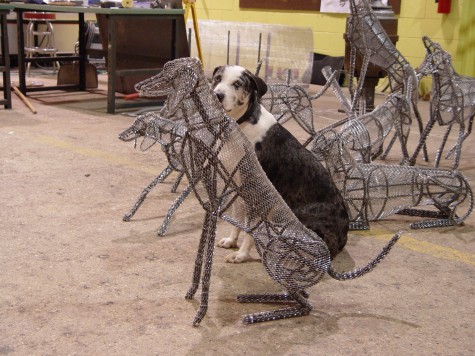
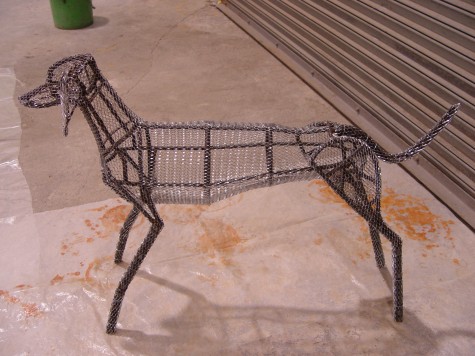
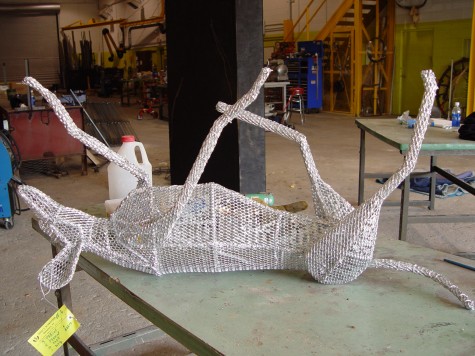
The sculptures begin with the a steel rebar armature that gets covered with a heavy duty wire mesh. The armature is designed and built to give the concrete strength, not describe the finished shape. But even at this stage, it is easy to see that the finished sculpture will have energy and grace.  

The frame is hot dip galvanized, to keep the steel from rusting once it is coated with cement.  Steel and cement in contact with one another is an unfriendly affair.  Cement absorbs water; steel in contact with water rusts. The galvanizing process helps keep the two materials away from each other. 

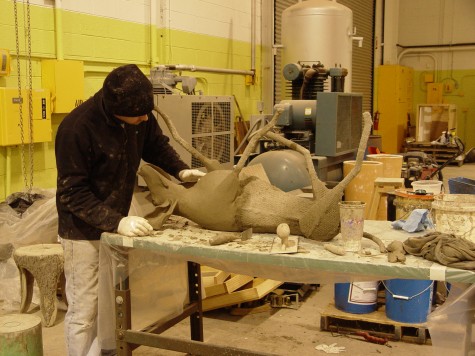
The entire form is packed solid with cement; this is a time consuming and tedious affair.  Once the form has cured, a layer of mortar is applied, and hand carved.  This is a simple description of a process which requires a considerable knowledge of how mortar can be worked before it sets up.  I have watched him work an entire day when all the mortar would do is fall off the concrete. Or another day when nothing was to his liking; he would chip it all off the next day.

Should the mortar set up faster than you can sculpt it-troublesome. A clear understanding of how the materials work allows him to concentrate on what makes these dogs sculpture.  To the last they have energy, attitude, rhythm, tension-life.   

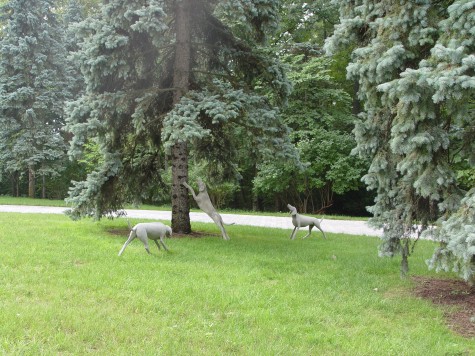
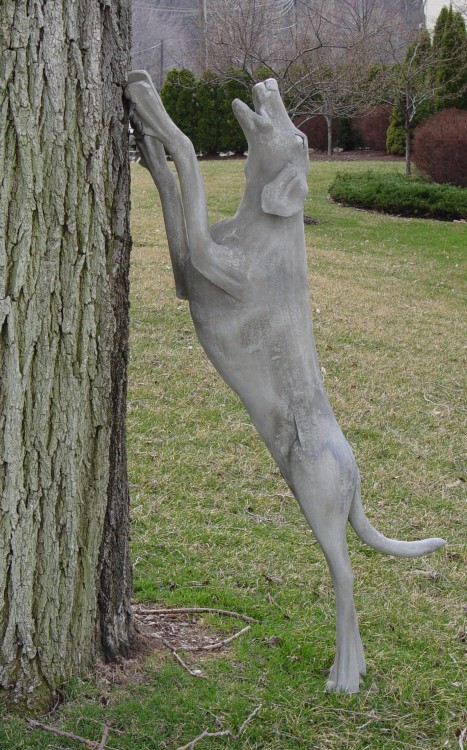
Each dog would have a whole lot of one thing going on.  His sleeping dogs would be sleeping deeply, oblivious to all else.  His howling dogs would keep on howling, or howl louder. His playing dogs had nothing else on their mind except play.They were all engaged in some singular hound activity.  Whether sleeping, playing or barking at the moon,  I knew they would really come to life outdoors.

Though I really like all kinds of sculpture in a garden, I am particularly fond of these.  They are of a scale and grace that makes them as natural as they are striking.  Imagine this moment in the landscape without the hounds-sleepy.  Garden sculpture that does not necessarily engage, energize or require a landscape does not appeal to me as much. The dogs look great from a distance, as they are very simple and direct expression of the artist’s view of the living world.  Don’t ask me what I mean by this, but these dogs are as witty as they are wily. I doubt my garden will ever have a 19th century limestone sculpture of the huntress Diana, a steel sculpture done by Richard Sera, or a Deborah Butterfield horse, but it could have this dog. I could move it to a different spot every year. I am guessing that before long the dog would have a name. 


When Annie would visit, no surface outdoors was too high off the ground for her,  or off limits to her. You could not help but admire all that energy and zest for the out of doors.  See what I mean?

Sunday Opinion: September

I woke up this morning and it was September. The floors in the house were cold; it is 49 degrees. Naturally, I think I smell the beginning of an end.  I see a blustery wind broke a giant branch off one of my daturas.  7 flowers and 3 times that many buds went down with it, for pete’s sake.  I notice for the first time that my garden looks like it is slowing down. My giant coleus ball by the kitchen door has that deflated look about it. Would I put off September for another 30 days if I could?  Though summer’s end is not my idea of a cause for great celebration, it is probably time-so no; I am ready for September. Time to stop looking at that garden- its time to do something about those things that need to be divided, moved, pitched, or added to.  September is a great month to work in a garden.  Cooler temperatures and more regular rain is a friendly environment in which to plant.  Though the air temperatures are cooling, the soil is still warm, and cools off slowly.  The roots of plants continue to grow until the ground freezes.  In my zone, that date is 4 months away. 

I do not really garden in the summer.  I maintain what’s there.  I pollarded the lilacs, dead headed the roses, and wired up the panic grass after a big wind.  I water, and as I am watering, I look at it, and enjoy it.  I also sit in it, entertain, contemplate, and live in my garden.  The season is changing.  September is break out the fork and spade month. I think fall is the best time to plant.  Spring in Michigan is  unpredictable, inconsistent, and can be amazingly inhospitable.  My local nurseries seem to have a good supply of great looking plants in the fall-I think I might do some planting.

 I have several perennial gardens that need renovation. I planted them for clients 10 years ago or better.  Trees nearby have grown and are casting shade; the too crowded daylilies are not blooming as profusely as they should.  Civilized patches of black eyed susans have distressingly burgeoned into oceans of black eyed susans.  Some things they really like are not all that long lived, and need to be replanted.  Is there a spot for more peonies? The kousa dogwood that has never looked good-September is a good time to make changes.

Should you plant new perennials in the fall, they most likely will look like two year olds next spring.  They will look identical to perennials you planted last spring. If you are late to the party, redemption can yet be yours. I like to have new perennials in the ground by the end of September, so there is time for some rooting to take place.  Nothing is so discouraging as seeing your perennials with their crowns heaved up out of the ground in the spring.It is a lot of work to buy a plant, bring it home, dig a hole, and plant.  It only makes sense to optimize your chances of success.  If you are like me, dead plants make you very crabby.    

I went out to Wiegand’s Nursery this afternoon.  The parking lot was full of people loading all manner of plants into their vehicles.  I saw perennials, evergreens, houseplants and shrubs being jammed into trunks and back seats.  I saw two kids in the back seat of a car-they both had flats on pansies on their lap.  Never mind that look of distaste I could see from 10 feet away-they might decide to garden once they grow up.  Some young people were engaging in a heated discussion about something garden related-great.  All of these people had the right idea.  They know they have September to dig up, divide, rearrange, replace a dead tree, cut a new bed-act on their ideas. 

My Mom took me to the American Peony Society Convention at the Kingwood Center in Ohio  for my 30th birthday-that would have been 1980.  It was my idea of the best 30th birthday present I could imagine. She obliged, and we had the best time.  I have a scrapbook of photographs she took.  There are a few of me, and one of her-all the rest are of peonies.  Each photograph is labelled with the cultivar name, and class.  I still refer to it, many years later.  I have no memory of where we stayed, what we wore, or what we ate.  But I do remember that I was by at least 20 years the youngest attendee.  Many growers and exhibitors made a point of telling me they were so happy to see a young person intensely interested in peonies.  I so much better understand their concern today than I did 30 years ago.  Anyone who loves plants wants to see that they continue to be grown by the next generation.  I had that same feeling today- seeing so many people younger than I, buying plants in celebration of the September gardening season.