The Schematic Plan

What I call a schematic plan is another way of saying master plan.  A guide for the development of a landscape.  Clients who have an interest in a plan that they can work towards and implement over time always interest me.  A landscape of note implies a long term committment-gardeners willing to go that route will not only enjoy the process, but will find so much satisfaction in watching something grow.  It takes lots of time to regrade a property, reimagine the space, plant, and arrange for care.  This timeline does not even include the plants that die, and the changes that result from experience, or a change in taste.  Anyone who buys a ticket for the long term process that a really good landscape requires I admire.    
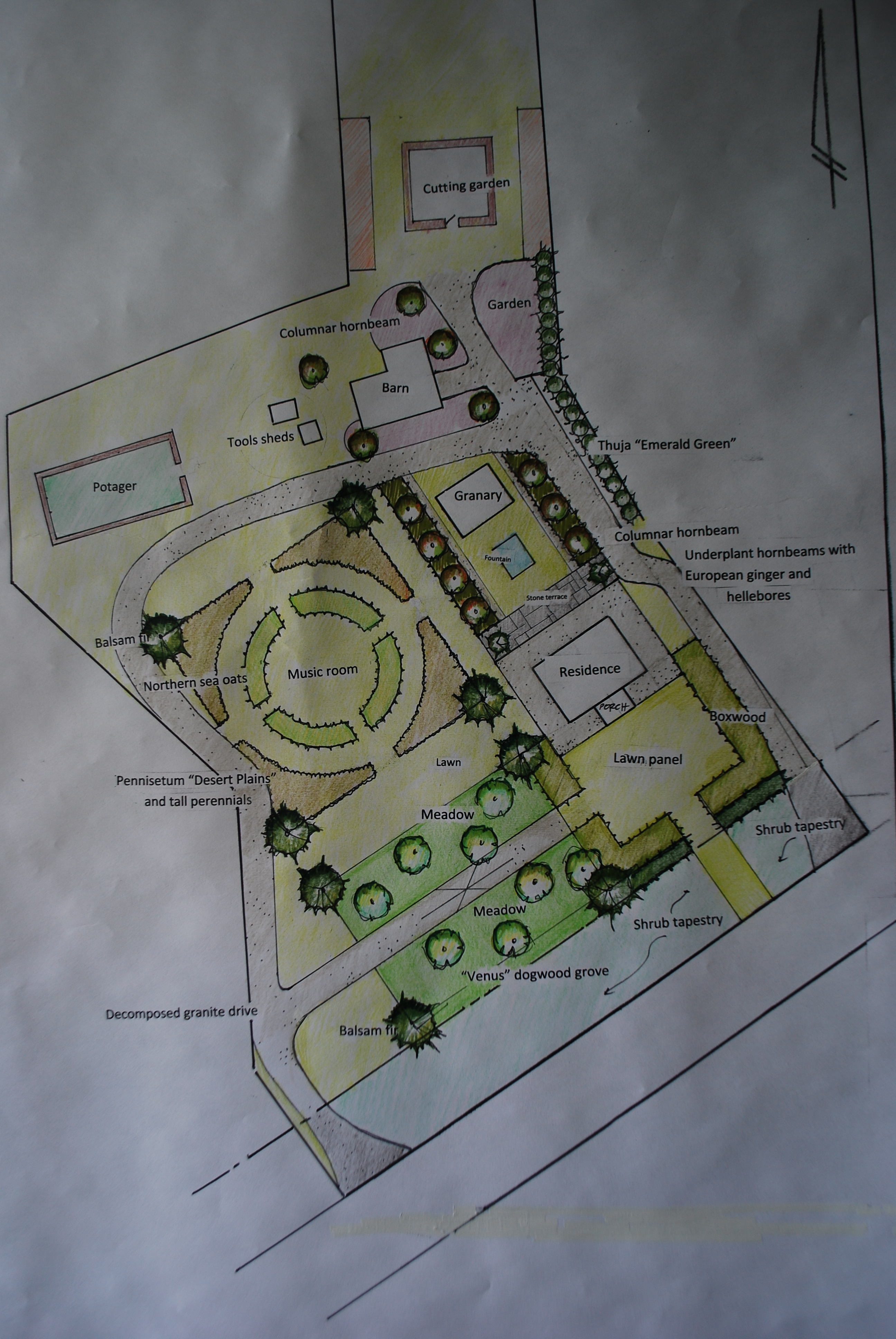
 A master plan is a schematic drawing noted for its broad strokes-not its details.  The vegetable garden will be there.  Friends will park here.  Parties could be staged in this garden.  Great views of the landscape from inside could be described by this, or that.  The rear yard will feature a particular shape-the particular plants are to be determined.  How does the landscape address movement?  The driveway needs to be this width, and accomodate this turning radius,  and needs to gracefully address vehicular traffic.   A big scheme is just that-a big fluid wish list with an attempt made to broadly define use and beauty.  There will be places to sit, garden spaces-spaces to view from afar. This master plan features a wide swath of decomposed granite all around a 19th century stone farmhouse.  There are plans for a conservatory style kitchen across the back of the house.  My clients are indicating they want to move ahead with the landscape.  This masterplan gives wide berth to additions that are planned for the house.  The additions will take vastly less time than the landscape.  I advised them that given the length of time it will take to create a landscape, the best time for them to begin construction is right now.         

columnar trees

My clients purchased a very large farm- a property that features 2 barns, 2 outbuildings, and a granary.  A granary?  A beautiful wood structure whose purpose was to store grain is a feature. My plan is to move that granary, currently set above ground on concrete blocks, directly and squarely opposite the rear of  their home.  The broad gesture?  This old stone farmhouse came with the outbuildings that make for a working farm.  Though it is unlikely that they will ever grow grain, and have a need to store it, the granary is a great place to stage a summer dinner party.  The house and the granary will become substantial bookends for a simple fountain garden.   
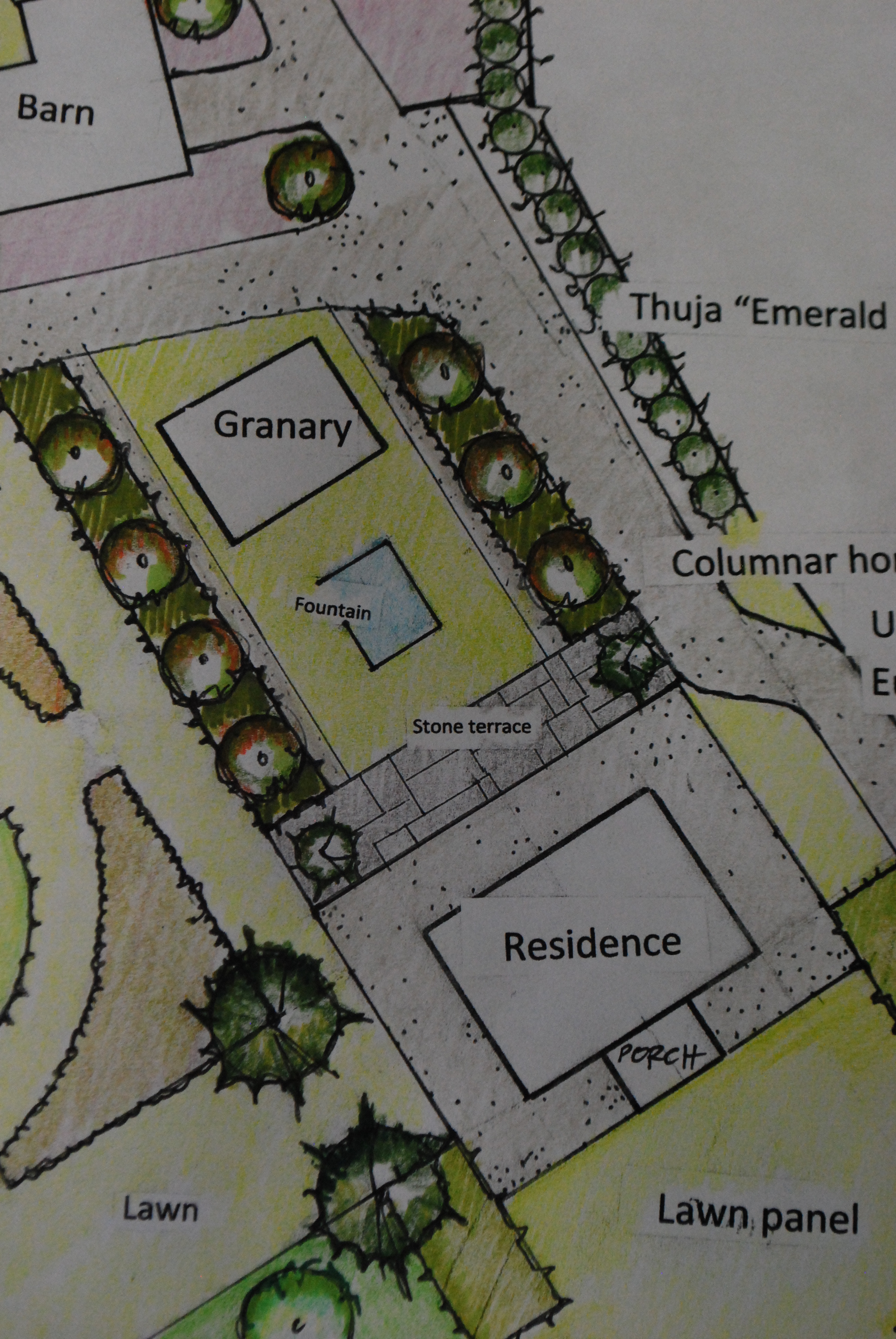
On either side of that fountain, there is a plan for an allee of columnar hornbeams, underplanted with European ginger and hellebores.  It would be a great spot for snowdrops and white crocus-or white Spanish bluebells.  This list may change, or be added to, or completely rethought- over time. The hornbeams will be planted equidistant from each other in this garden.  Once the allee crosses the gravel drive, the spacing between the trees gets wider, less regular.  Though they will be planted in a much less formal area, they will still maintain the site line established by the formal allee.
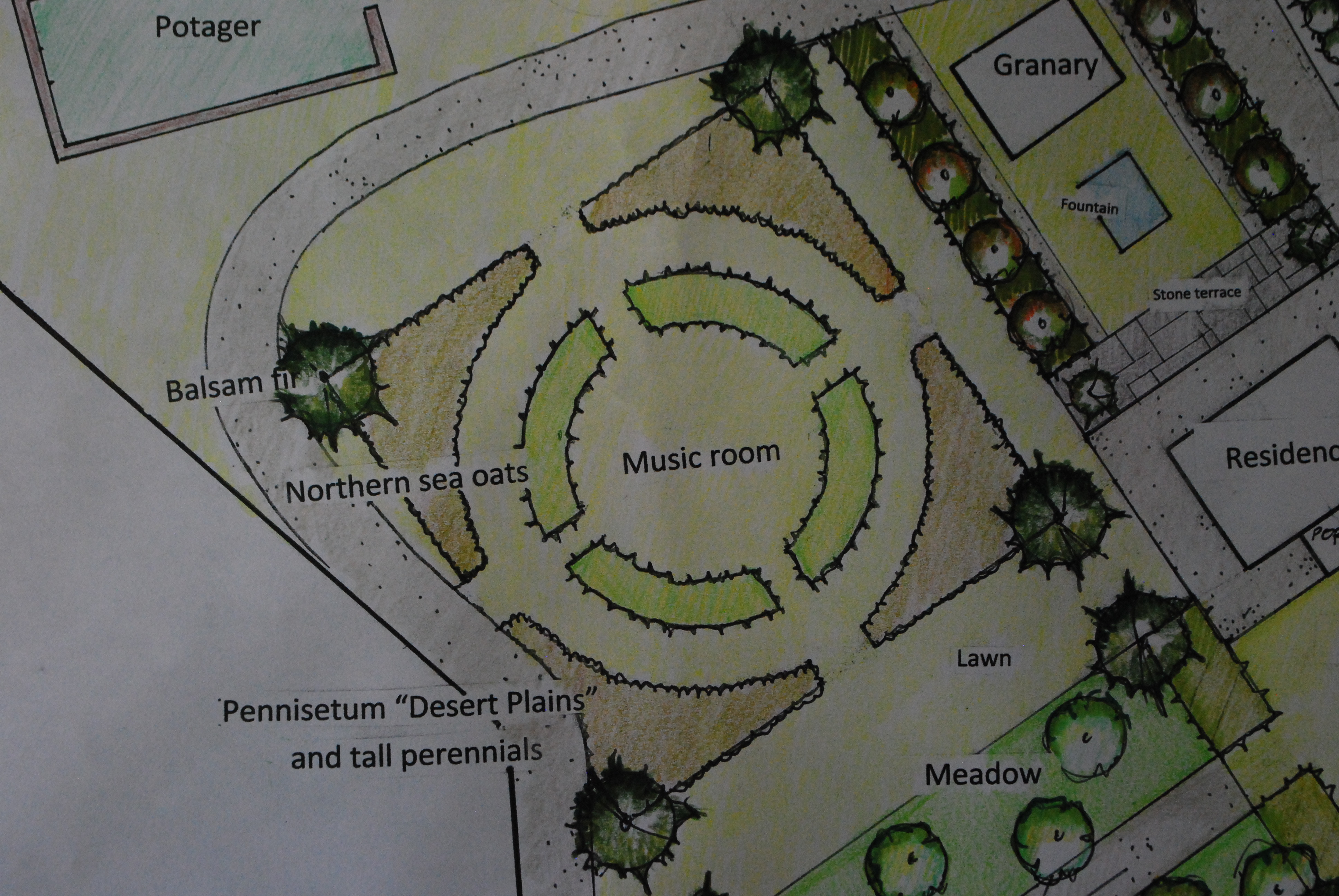
My clients have a particular interest in music and theatre.  They like nothing better than a summer concert staged outdoors.  The shape of the gardens adjacent to this round grass space that I call the music room make reference to their neeed for a space for such events.  The grasses are an informal material used in a more formal way.  The heights of the plants specified will provide some enclosure and privacy.  Viewed from the fountain pool, the northern sea oats will provide a contrasting and shimmering backdrop to the more formal and static hornbeam garden.  Viewed from the vegetable garden, it will look like a field of grain.  A reference to the agricultural history of the property will make those beds more visually believable, given that the setting is rural.  But those beds could be a collection of shrubs or small growing evergreens.  They could be a perennial mix that peaks during the summer months. They could be planted with roses.  A scheme needs to come first.  The details can come later.
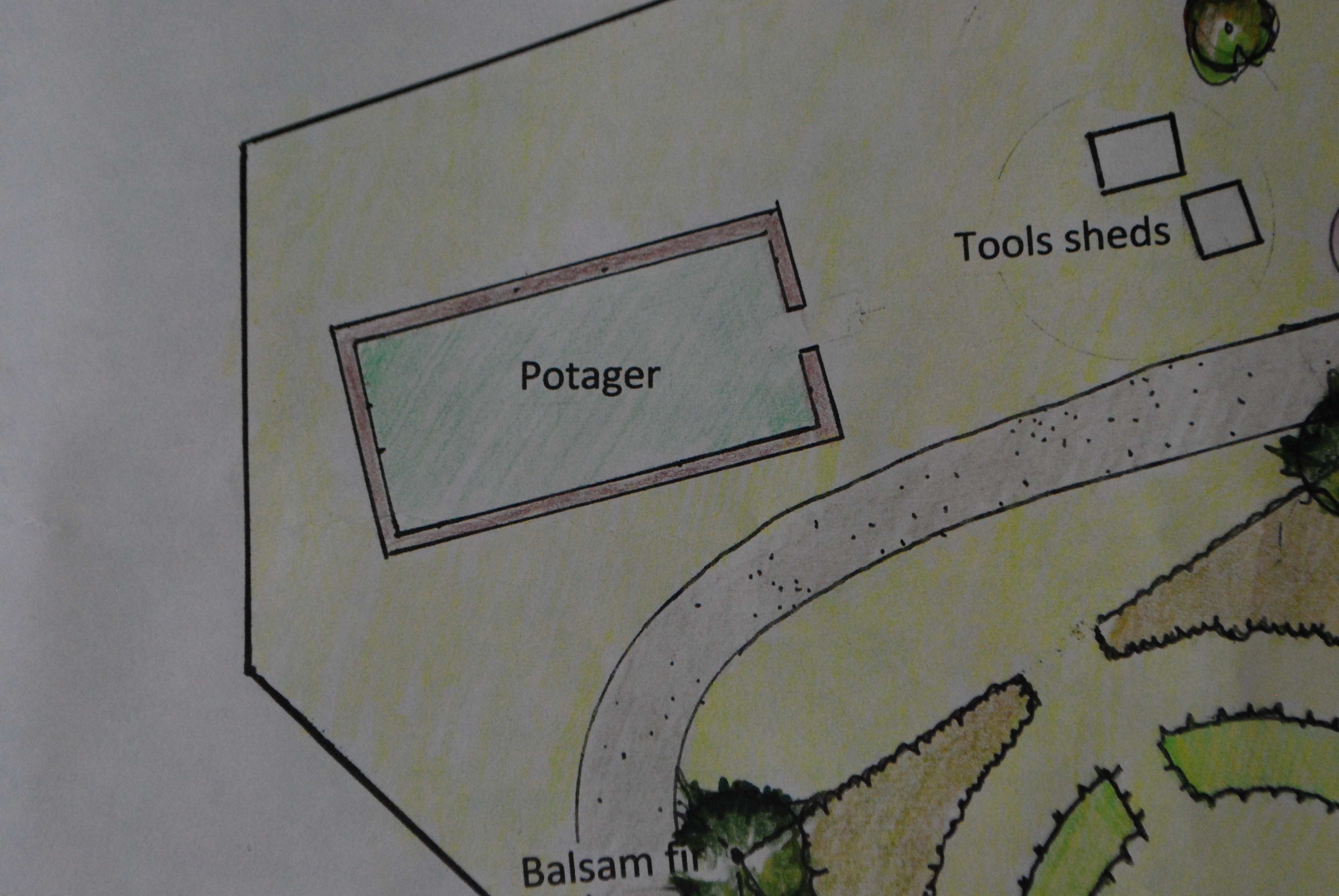
I have labelled the vegetable garden a potager, as one of my clients is French.  The details of this garden will be provded by him.  I feel certain it will have a distinctly French feeling.  The garden footprint is exactly the size and location of a very old barn original to the farm, which needs to come down.  It is deteriorated such that to restore it would take resources my clients prefer to put elsewhere.  Hopefully someone will be interested in the salvage of all of the old beams and timbers.  The lower portion of the barn walls will be left standing, providing a fence for the garden.  Their property is host to lots of wild beings.  The floor of the barn has always been dirt.  With some work and lots of compost, it will be a great place to grow vegetables.
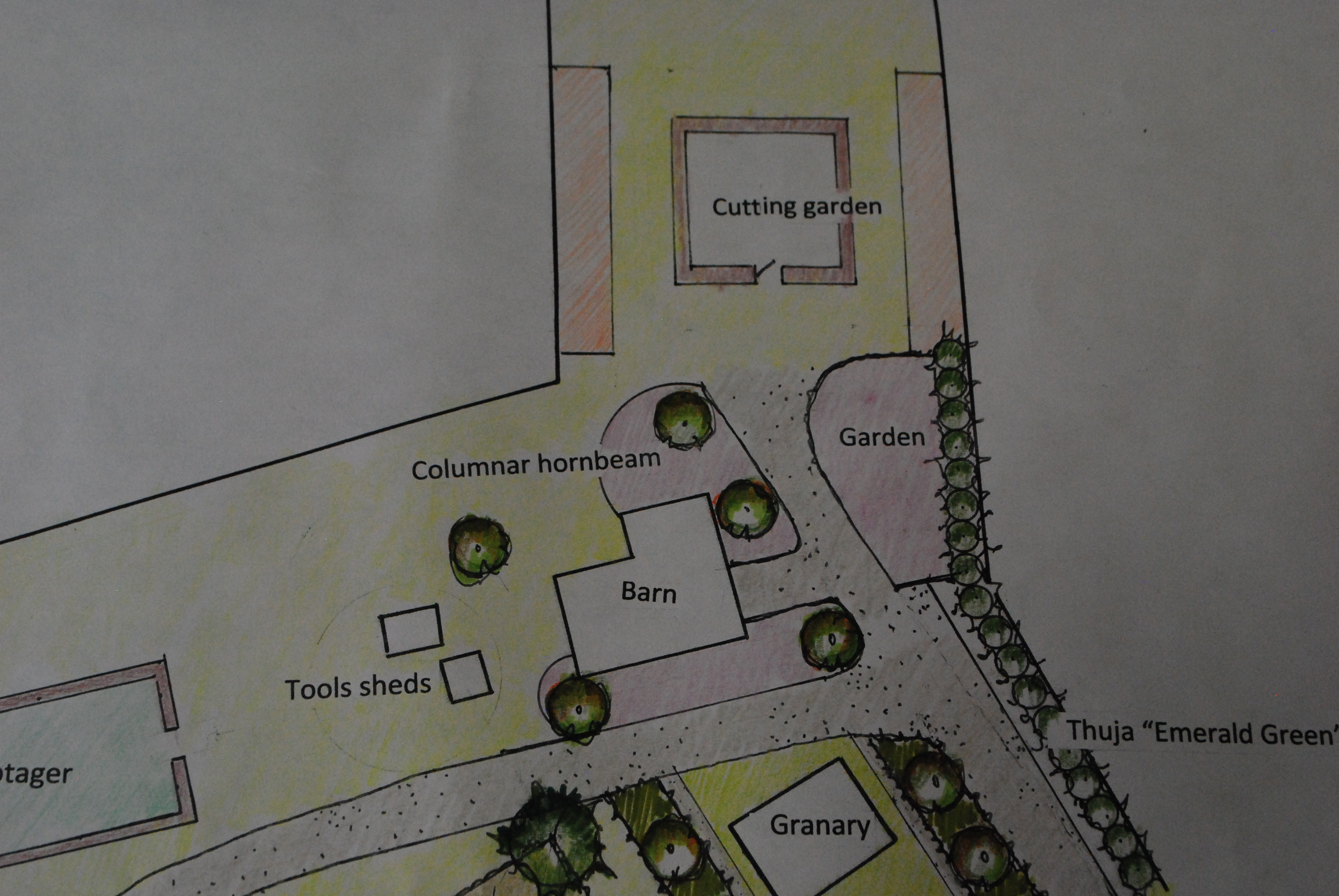
The other barn is in excellent condition.  It holds tools, and soil.  In the winter, the boxwoods in pots are stored here.  The barn gardens are actually quite beautiful and well developed.  There is no need to replace them.  The major changes will be about the perimeter shapes of those gardens. A hedge of arborvitae on the lot line will screen the house next door from view. A fenced cutting garden on the dog leg part of the property will be framed by a pair of pumpkin growing gardens. Two gardens devboted to growing pumpkins-how I envy them this.

The gravel driveway design is fairly close to what is existing now.  A major change will involve the addition of a drive which goes to the front door. On either side of that drive, a meadow planted with a grove of Venus dogwoods.  This meadow is a grass meadow.  A low growing low maintenance grass seed will be sown, and cut but once a year.  We have had very good luck with this particular seed mix, on unirrigated shady slopes, and in sunnier but relatively infertile ground.  The movement of all of the grasses will be a considerable contrast to the primary formality of the landscape.  
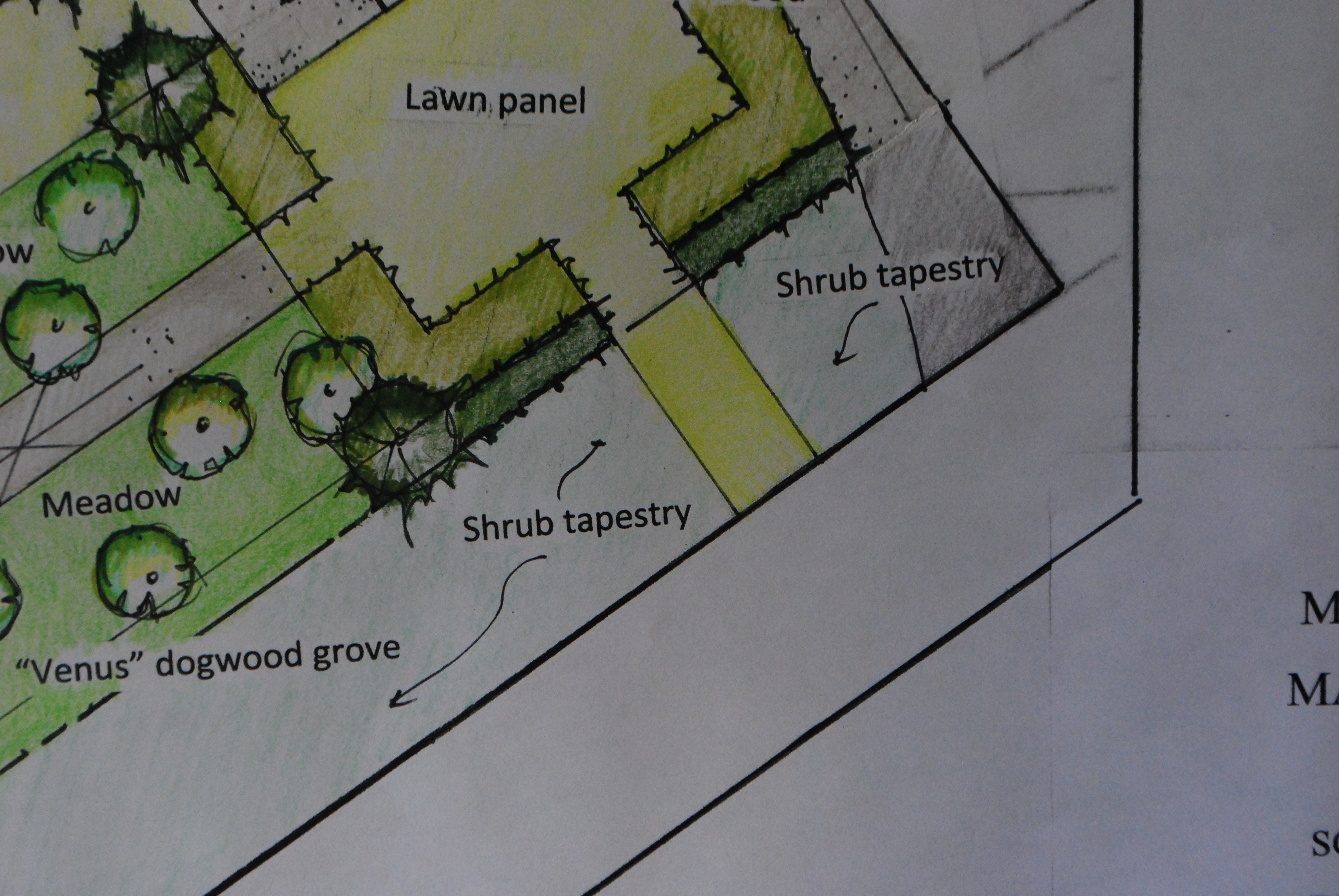
In the front, the distance between the hedge of Moonii yews and the road is 35 feet, but that footage is a steep slope, culminating in a drainage ditch.  The center of this slope will be the same short growing grass as the meadow.  This will permit a long view out, to the state lands across the road, from the front porch.  Shrubs will be planted into the slope where needed-lilacs, old fashioned spirea, viburnum, sumac, beauty bush-whatever seems right for a free for all mix.  Lucky the gardener that has enough land for a free for all. 
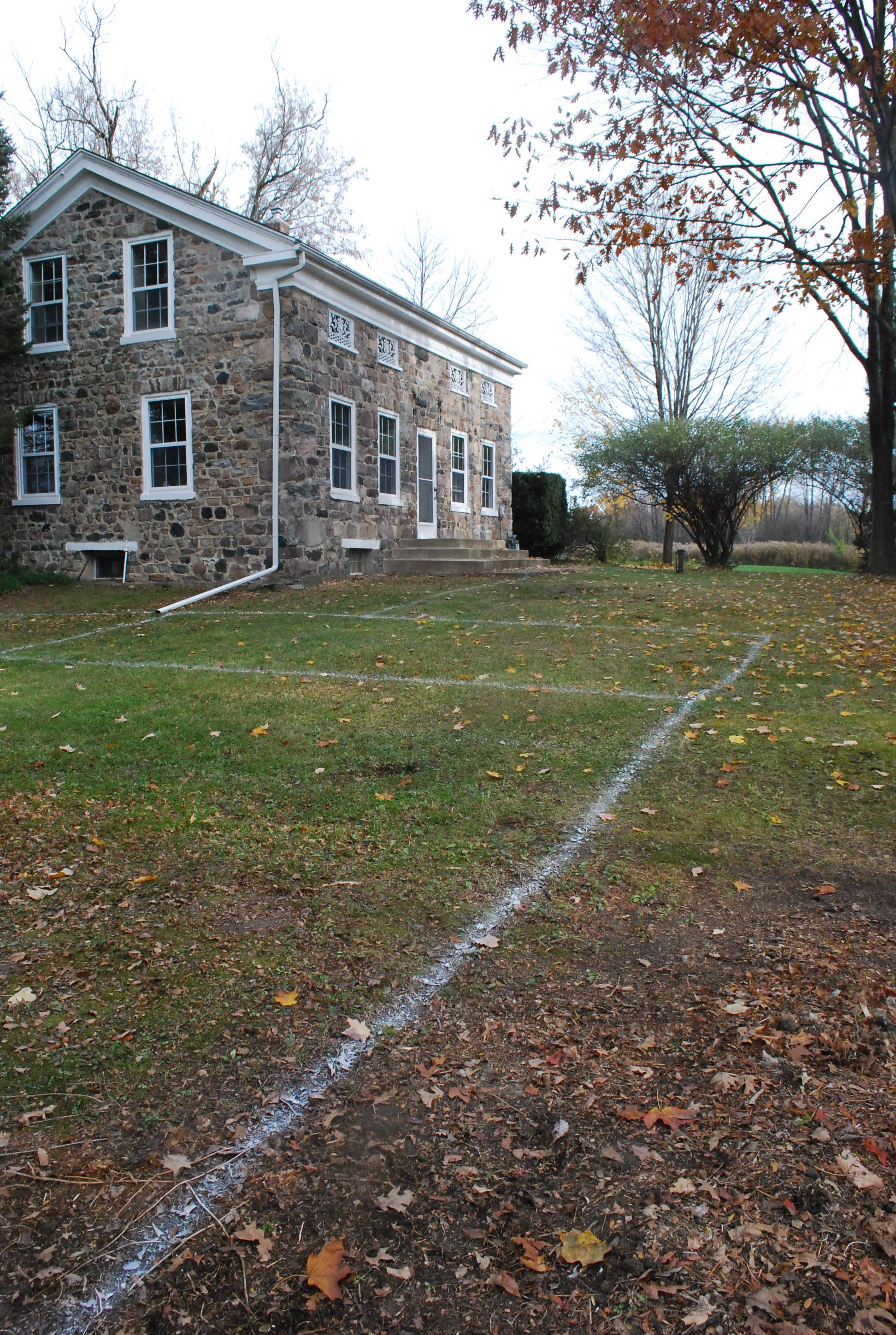
Of course the first step is to lay out the schematic plan, and see how it looks on the ground, full sized.  A lot of the preliminary tree work has already been done.  My clients seem to think the schem suits their property, their taste, and the history of the farm.  I am so pleased that this project is underway.   


Breaking Ground


Theodore Roethke is one of America’s most respected poets.  He was born in Saginaw, Michigan in 1908, to German immigrant parents-Otto Roethke and Helen Heubner.  His parents were market gardeners, and owned and operated 25 acres of greenhouses with Theodore’s uncle.  Much of his childhood was spent in those greenhouses.  His second book, “The Lost Son”, contains several of what are known as his greenhouse poems. 

Images and metaphors derived from the natural world are much a part of his writing.  Long before I ever had the conscious idea to design gardens, I treasured his work. I studied early twentieth century poetry in some detail in college.  For whatever reason, many of the lines from his poems have stayed with me.

One phrase I have always liked- “The time comes when the vague life of the mouth no longer suffices…”  I am taking this phrase completely out of the contextural meaning of the poem, but it perfectly expresses that moment when the time for the designing, the discussion, the redesigning, and the additional discussion, comes to an end.  Enough decisions have been made in order for a project to proceed.   

A landscape plan is just so many marks on a page-a drawing.  That drawing has only two dimensions.  It does not really describe the sculpture that will be.  But drawings are critical in a project such as this.  Preceeding the landscape, a pool and poolhouse will be built.  Though my drawing described the physical location, shape and size of the pool, and the location of the poolhouse, that drawing needed lots of details-what materials would be used?  What would the poolhouse look like?  What features would be incorporated?  How many months of the year did the client foresee using it?  Building a pool and poolhouse is a complicated and considerable undertaking, but even the smallest landscape project needs to be thought through.

The integral spa on axis with the rear terrace was agreed upon, but the client wanted a slightly longer and slightly narrower pool.  The architect took my idea for a pair of poolhouses linked by a conservatory structure, and designed the poolhouse.  The general contractor decided with the client how the interior space would be handled.  He needed the poolhouse to be longer, so as to have inside space for the pool equipment.  He favored solar panels to warm the poolhouse early and late in the season.  I integrated these and every other good idea into what became the final landscape plan.  Ideas are one thing.  Building a project requires ideas that work. 


The pool contractor sorted out all of the many details needed to build the pool.  The depths of the water, the steps, the filtration system.  The general contractor oversees the entire project, so construction goes smoothly, and things happen in the right order.  This GC is very low key, and equally good at problem solving-just the person to handle a project like this. 

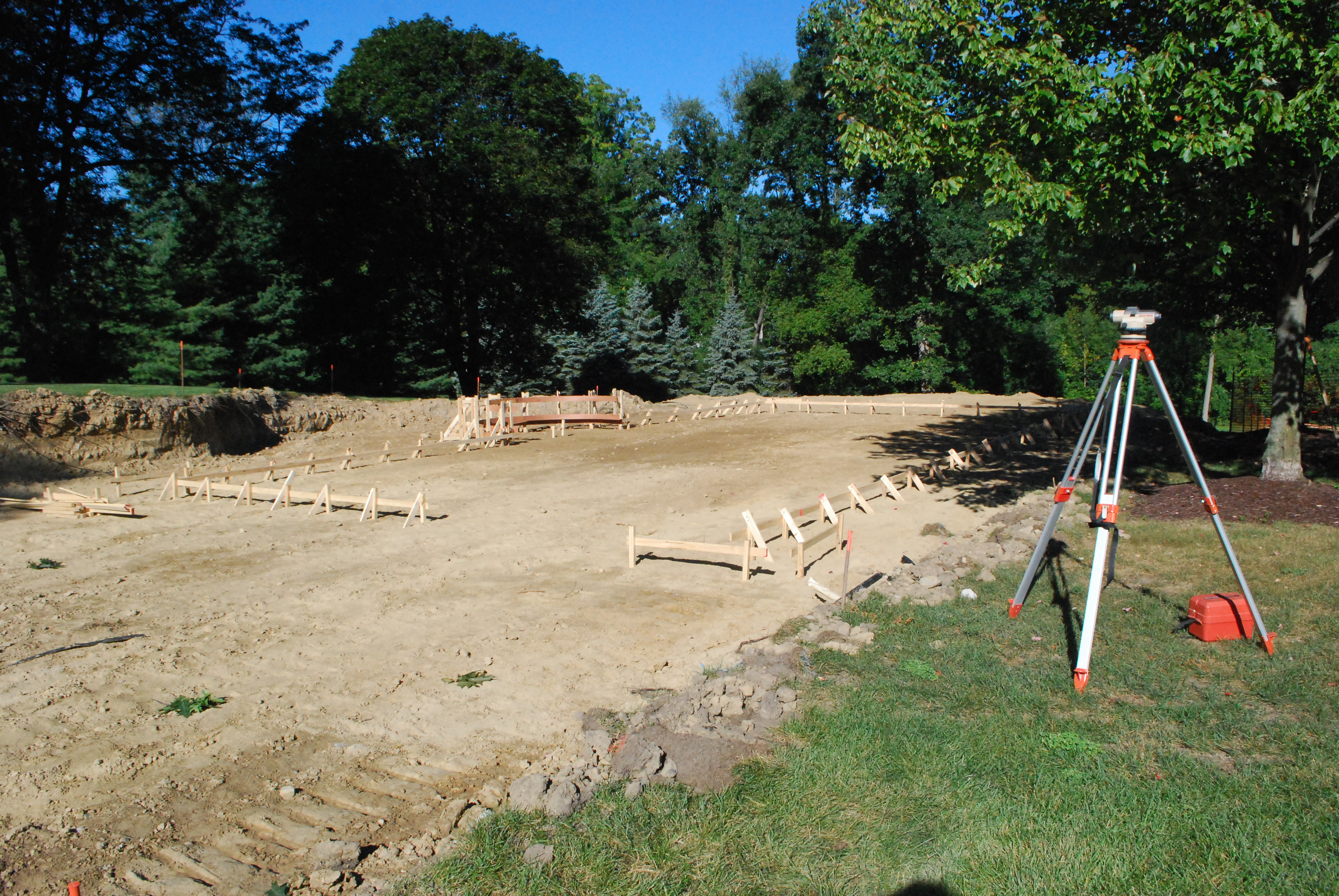
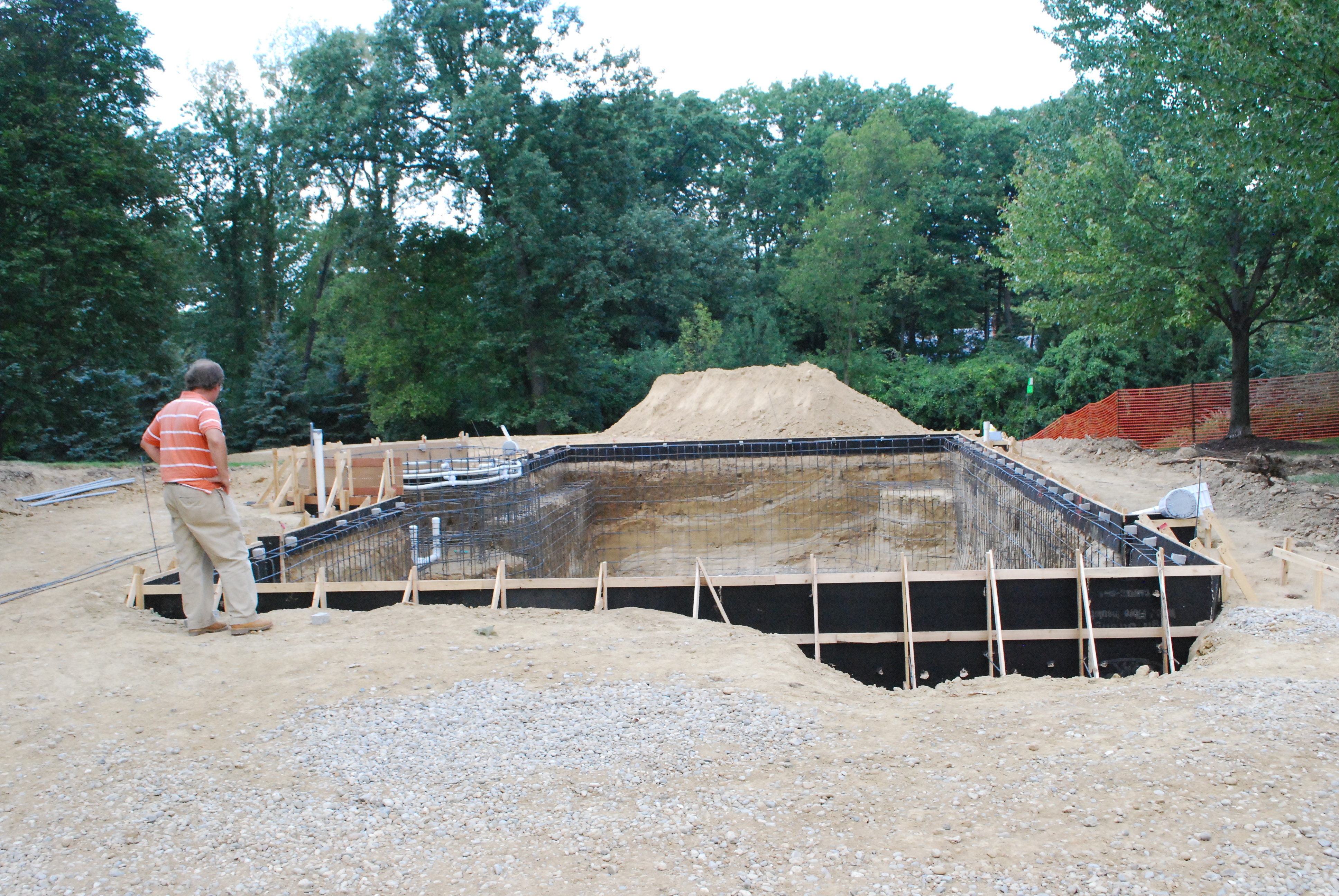
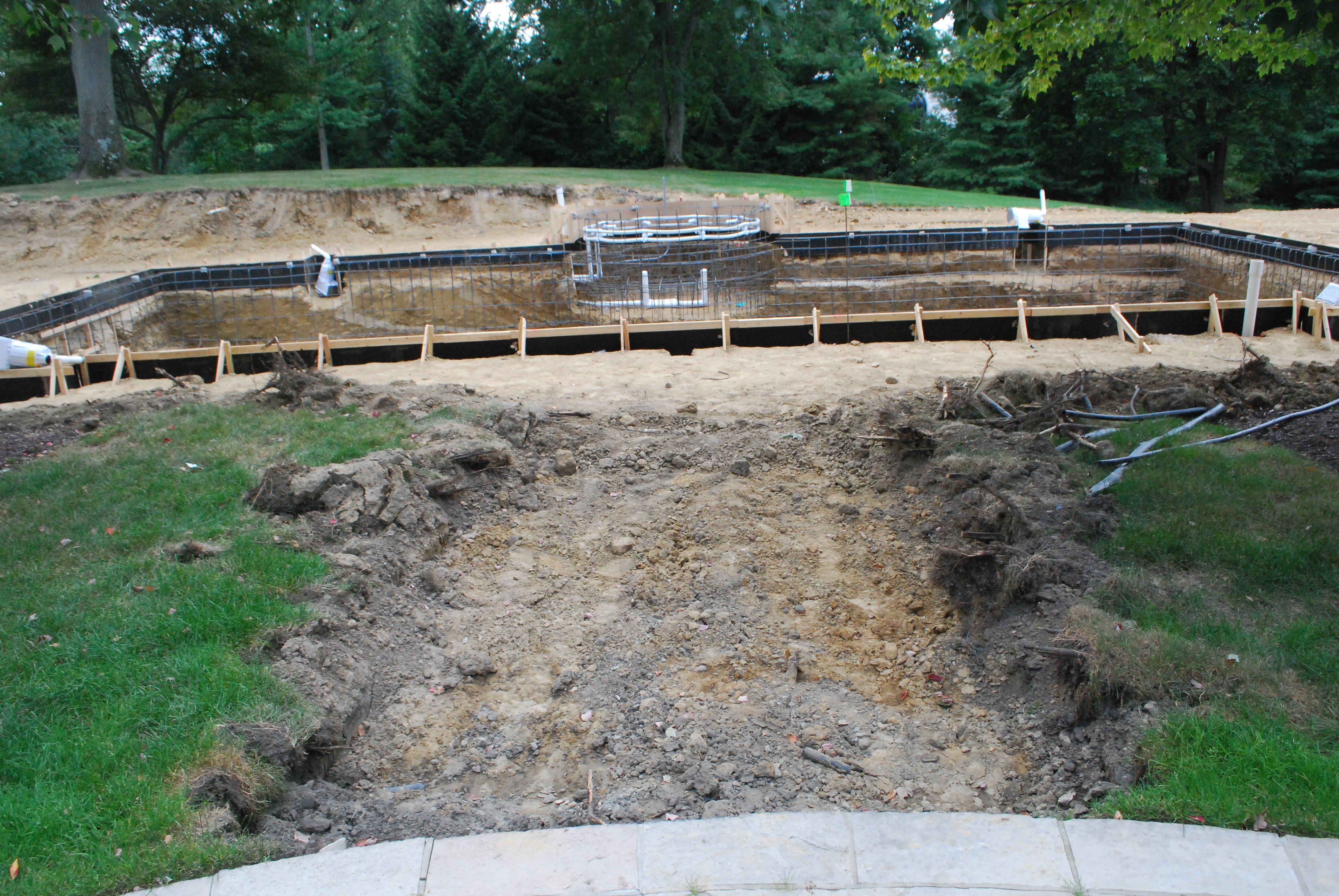
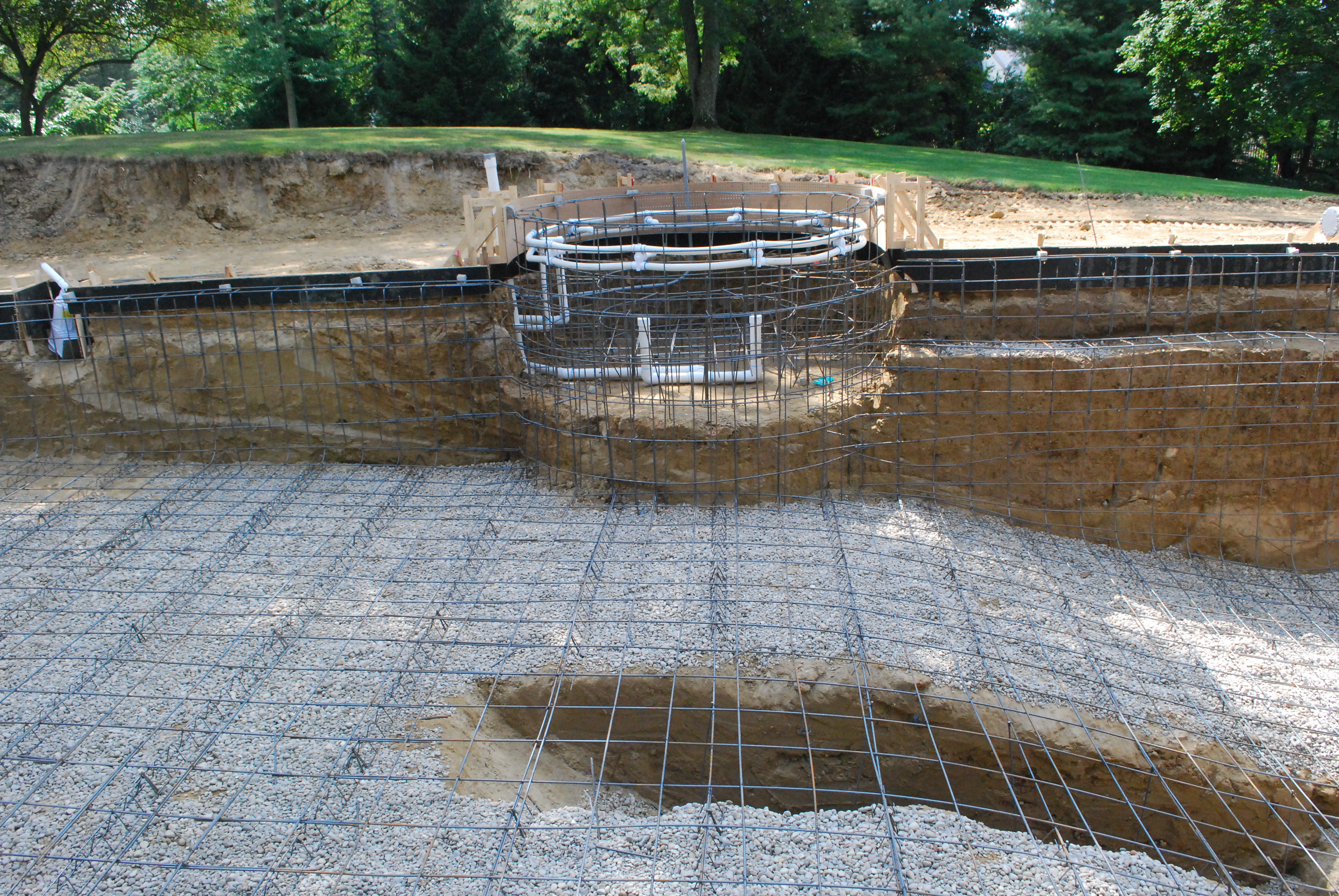
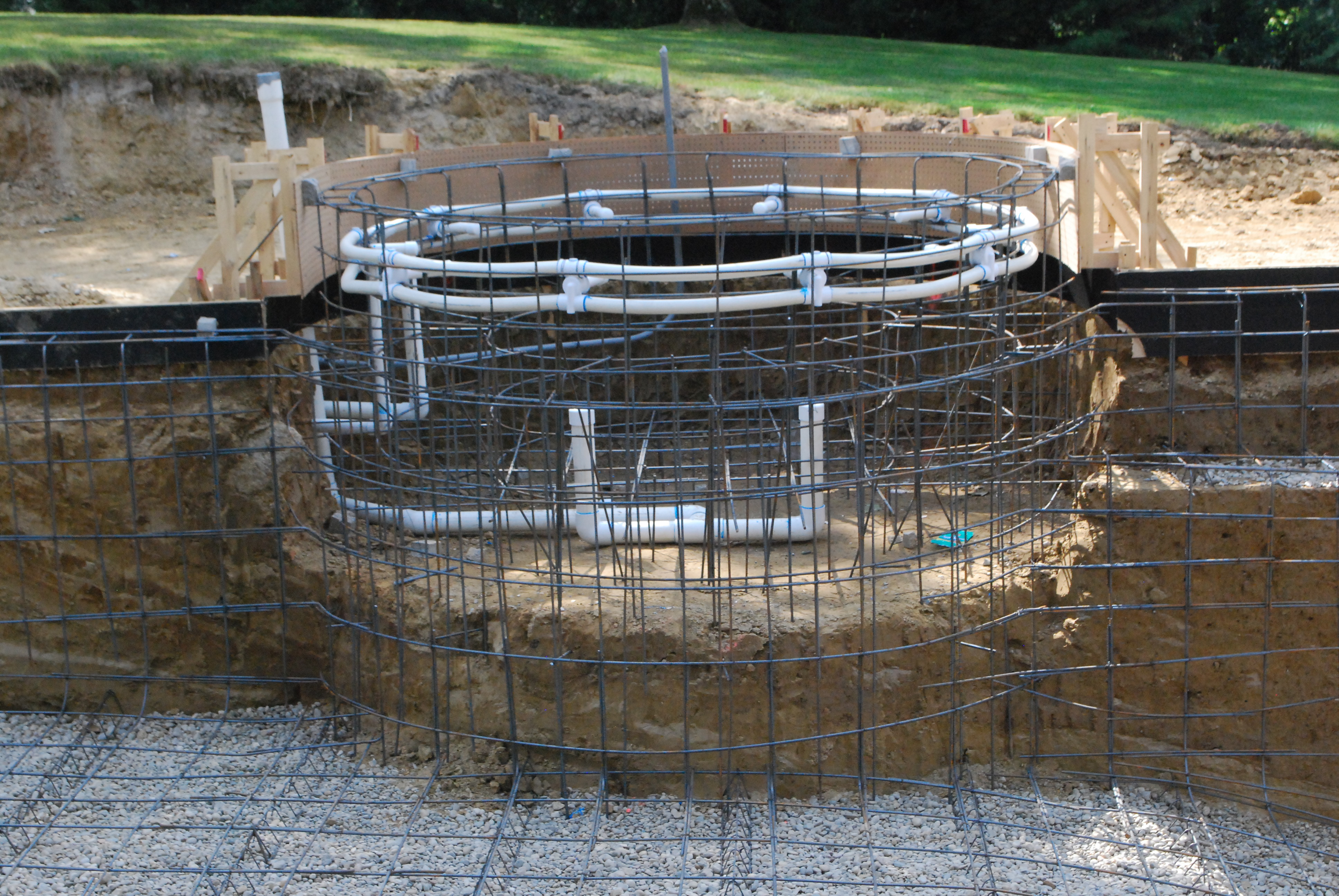
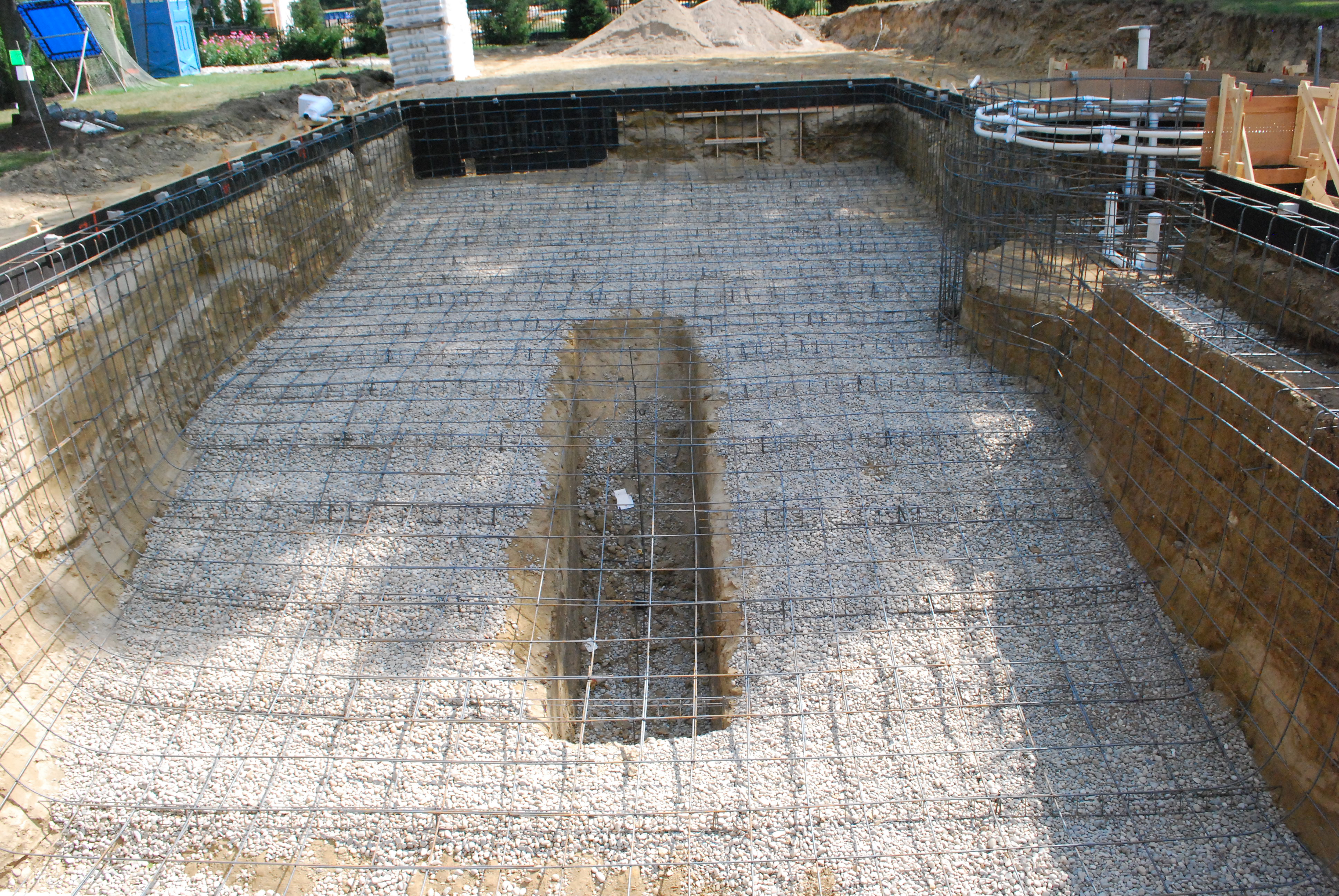
Once a coherent design emerged from the client and all of the design and build people, finish plans were drawn, and submitted for review to the planning board. Once the permit was issued, the pool was dug, and lined with a steel mesh that would reinforce the concrete.  The giant and deep hole you see here, encompassing the steep change of depth of the pool, will be filled with concrete.  This will stabilize the entire underwater structure. A pool needs to stay put.  Any action from the frost that might heave the pool upwards, and crack it-every effort is taken to avoid that. 

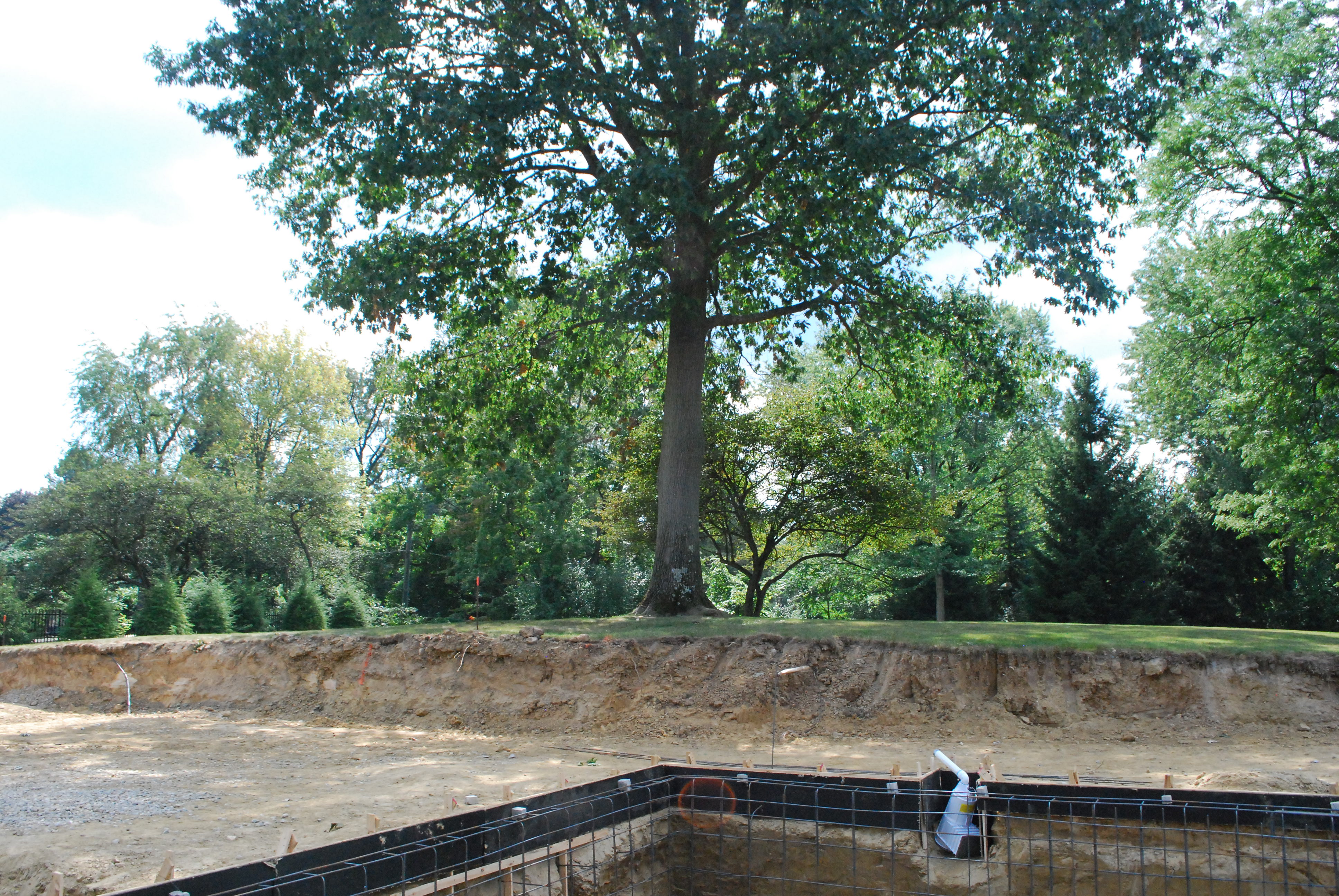
Of primary concern in the initial design-a gorgeous oak of considerable stature.  My clients love this tree.  The pool was sited to avoid any damage to it.  I was relieved to see no roots exposed in the excavation necessary to provide level ground for the pool.  This oak sits on a hill that slopes dramatically down to the house.  Eventually, a stone retaining wall between 3 and 4 feet tall will be built to hold the soil on the oak side.  The pool and surround will be built at the grade of an existing rear terrace.  A drainage plan for both the ground and the wall-a subject of much discussion and planning.  

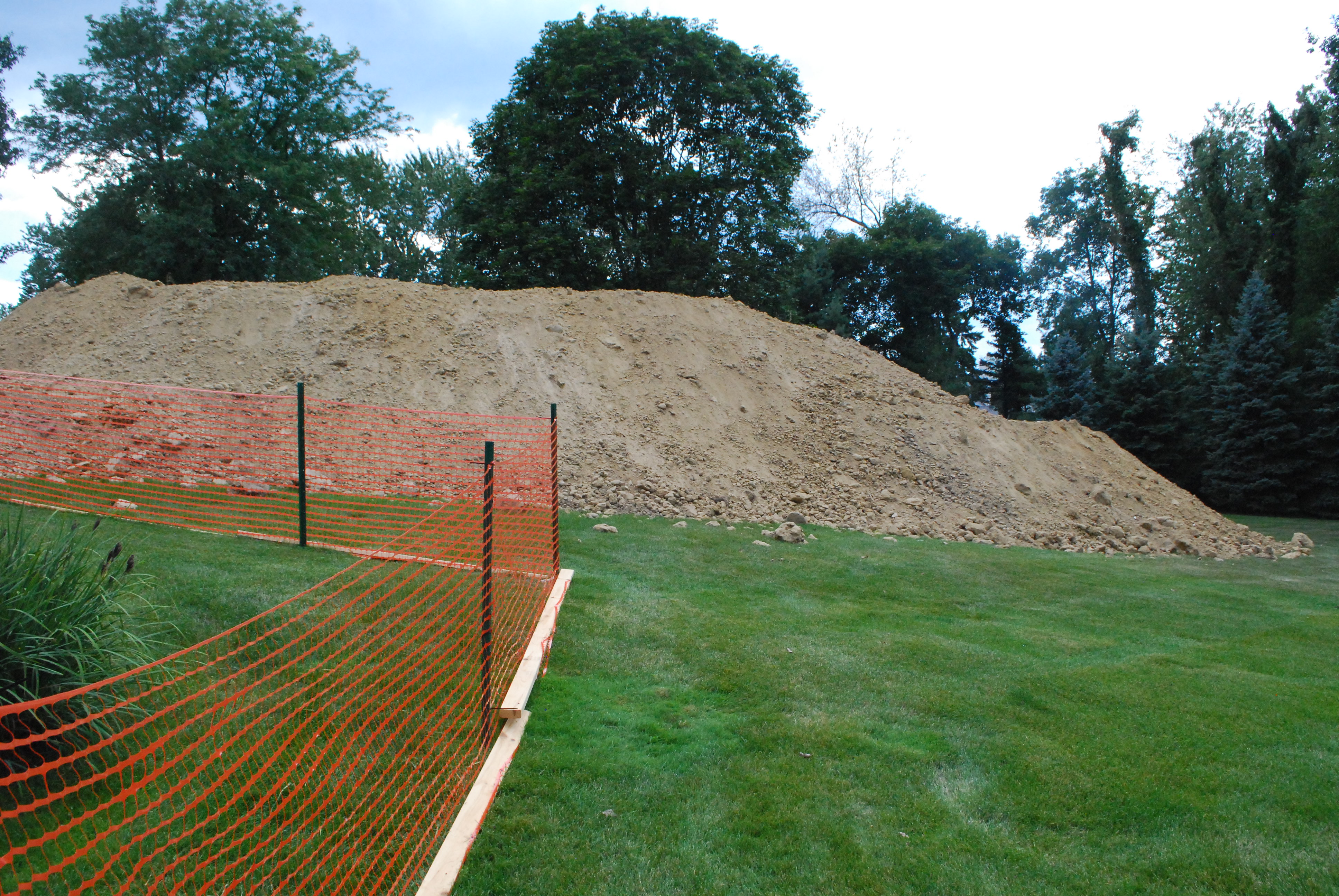
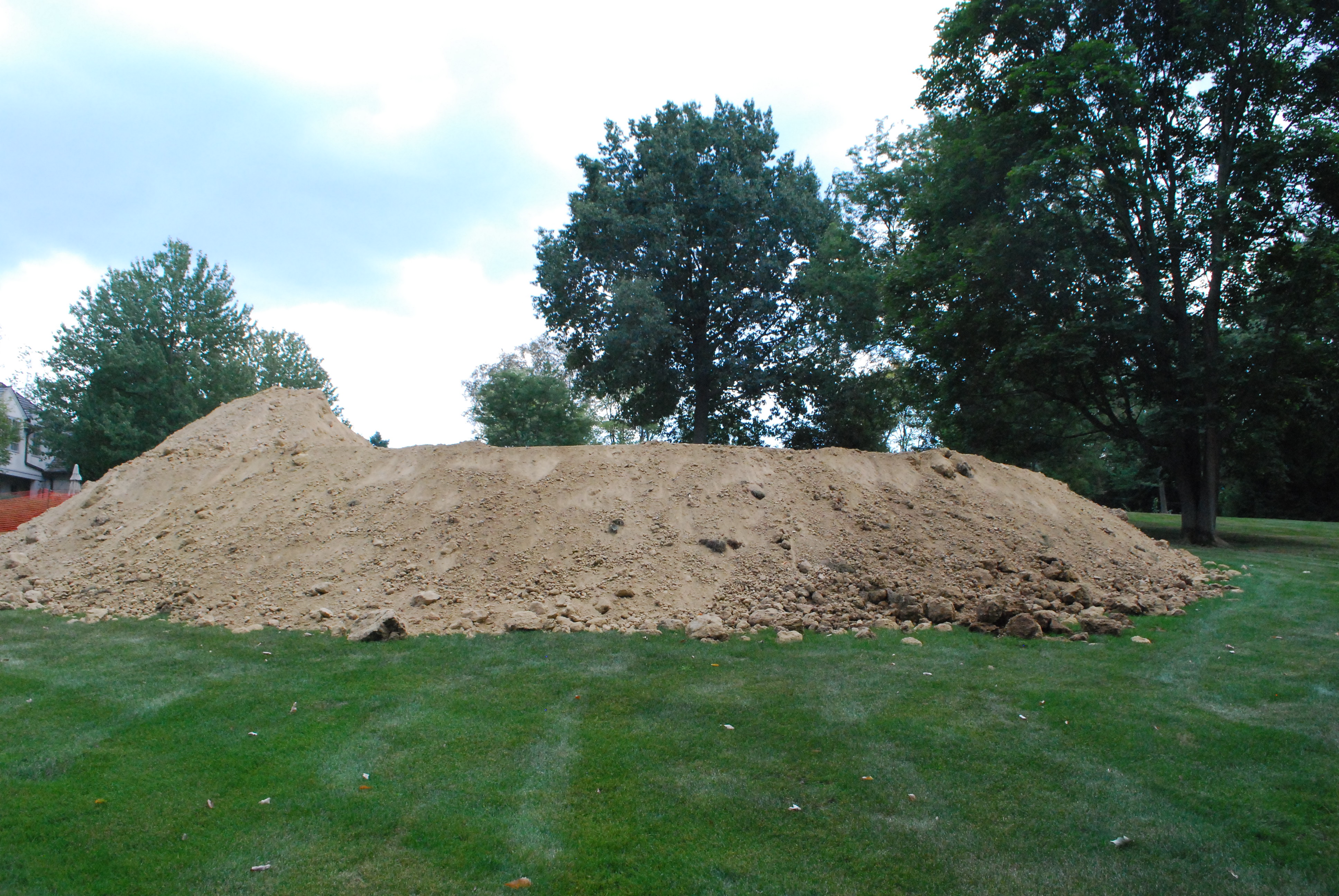
A decision was made to integrate the soil unearthed from the excavation of the pool into the existing property.  Hauling away soil is a time consuming and expensive process.    This is a large property, and I have ideas about where this soil can go.  The drainage work, and grading of this soil is part of the landscape project. 

No one could like a gigantic pile of dirt awaiting a sculptural disposition better than I.  I have walked the property at least 5 times, imagining what might be come of it.  I am inclined to leave most of it on this north end of the pool.  The natural grade of the land at the north end of what will be a pool slopes down precipitously.   A large area of level ground there would be ground they can use, enjoy, and garden.  More than likely I will be able to stablilize the soil with a gradual slope down.  Perhaps we will need some retaining on the east side.

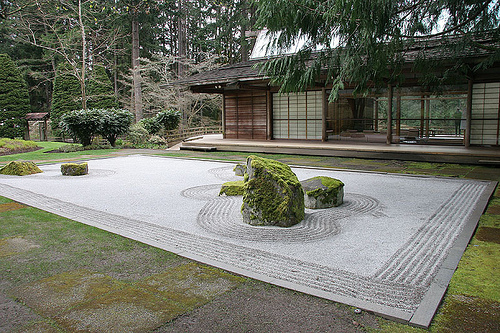
As for Thoedore Roethke,  I was thinking about him the past Friday.  He died in 1963 at the age of 55, at the home of a friend on Baimbridge Island in Washington- a heart attack while he was in the pool.   That pool was subsequently filled in, and today is the rock and sand Zen garden at the Bloedel Reserve.  No where is there any mention of Mr. Roethke, but I would imagine he would approve of a garden in this spot.  There does indeed come a time when the vague life of the mouth no longer suffices.  We broke ground.


Breaking Some Eggs

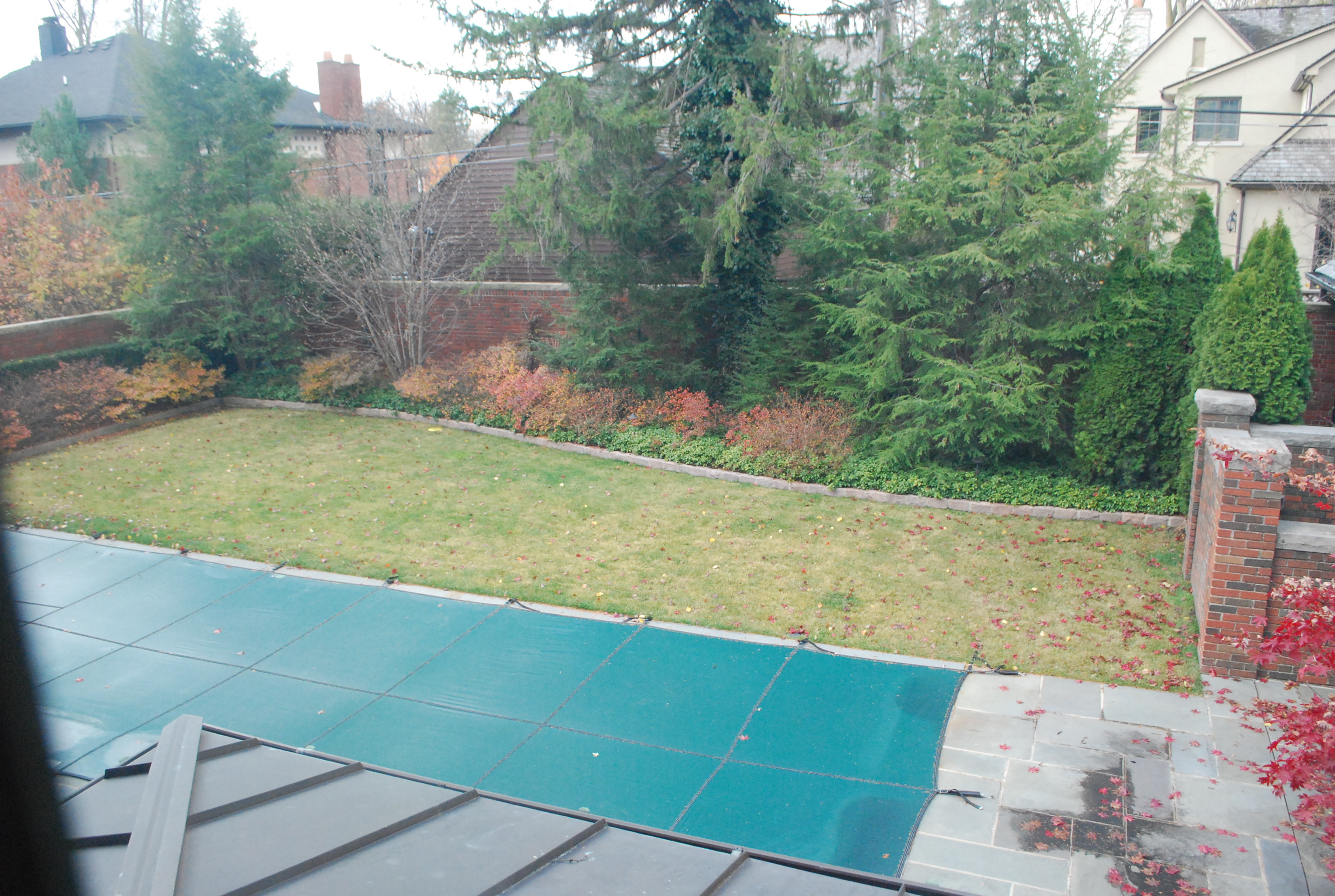
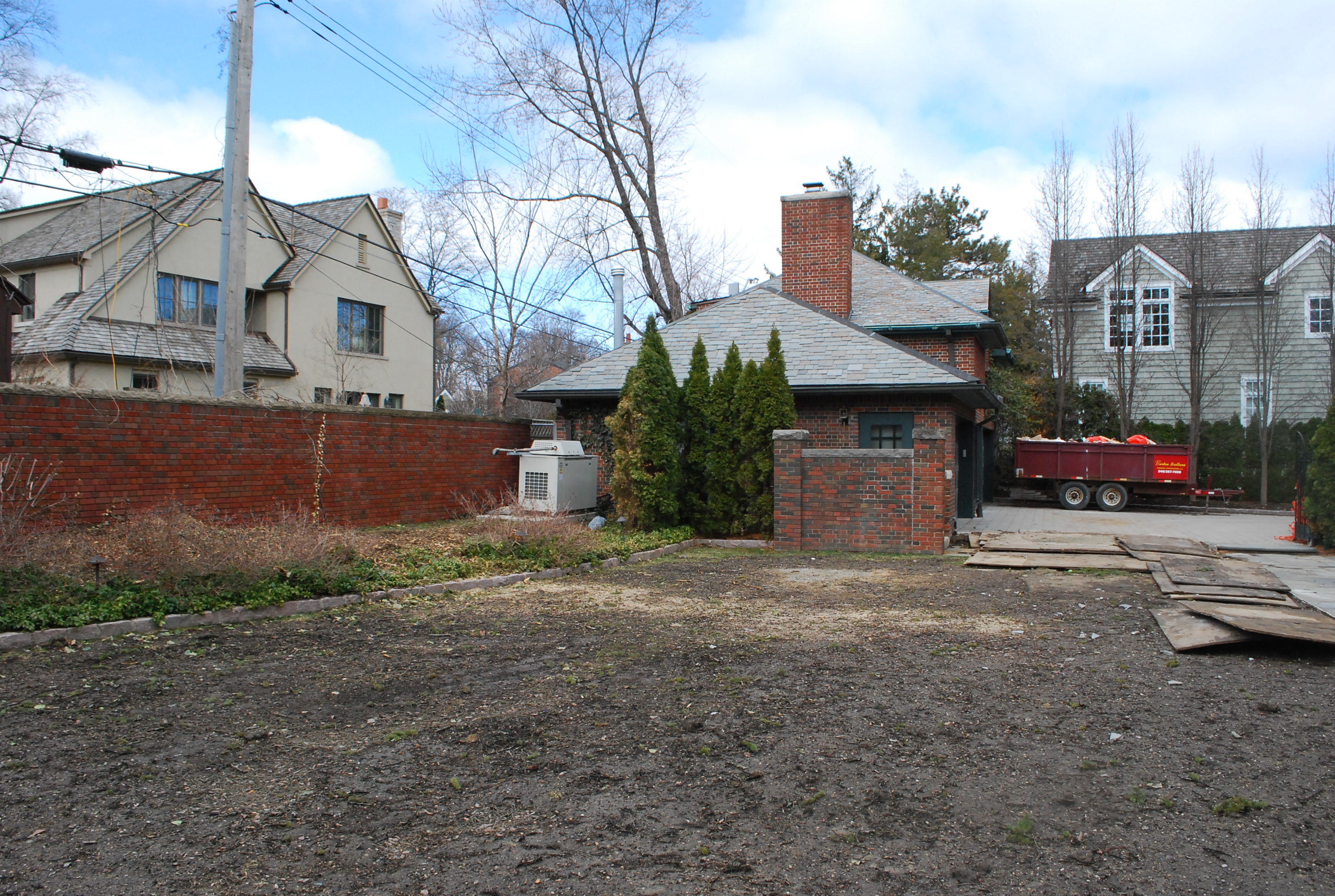
An old client with a new house-it happens on occasion. As I have lived in the same house for going on 18 years, I did not envy them this change. The old house and the new house are quite similar in size-not so the property.  They exchanged a very large, expansive, and private property for a city sized lot.  The back yard was very small; most of the space was taken up by a lap pool.  I knew we would have to break a few eggs before this landscape would pass muster.    


A really beautiful and old multitrunked magnolia was moved to the front yard.  We ditched a number of spireas, and a group of old and diseased evergreens.  The iron fence between the drive and the yard was removed, and stored.  At this point, the proximity of their house to others in the neighborhood became painfully obvious.  How could we arrange some privacy?  Privacy in an urban neighborhood is a relative thing.  Buck and I were privy to the music played graduation party given by our neighbors for their daughter.  We enjoyed that, but we also treasure our visual privacy.  

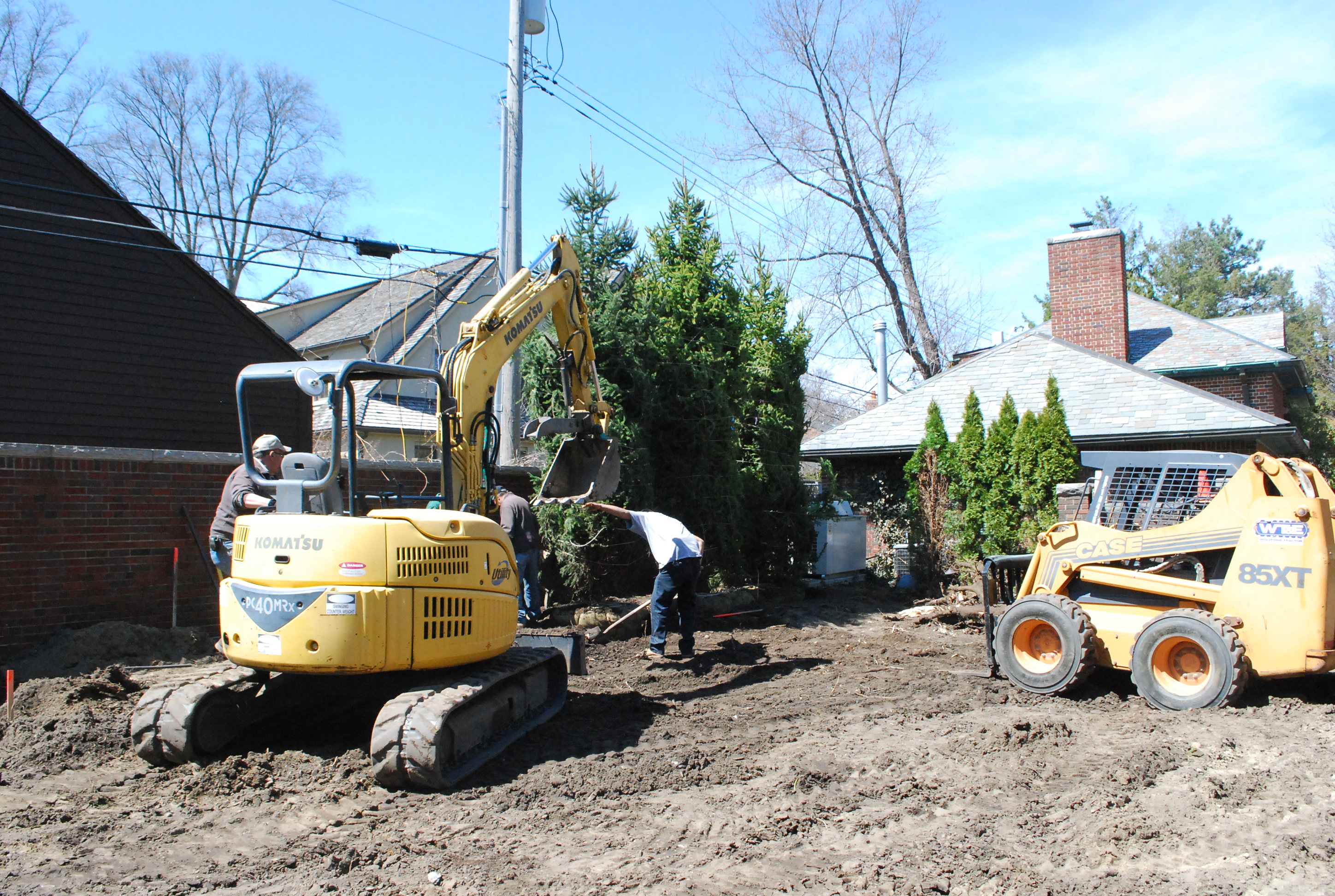
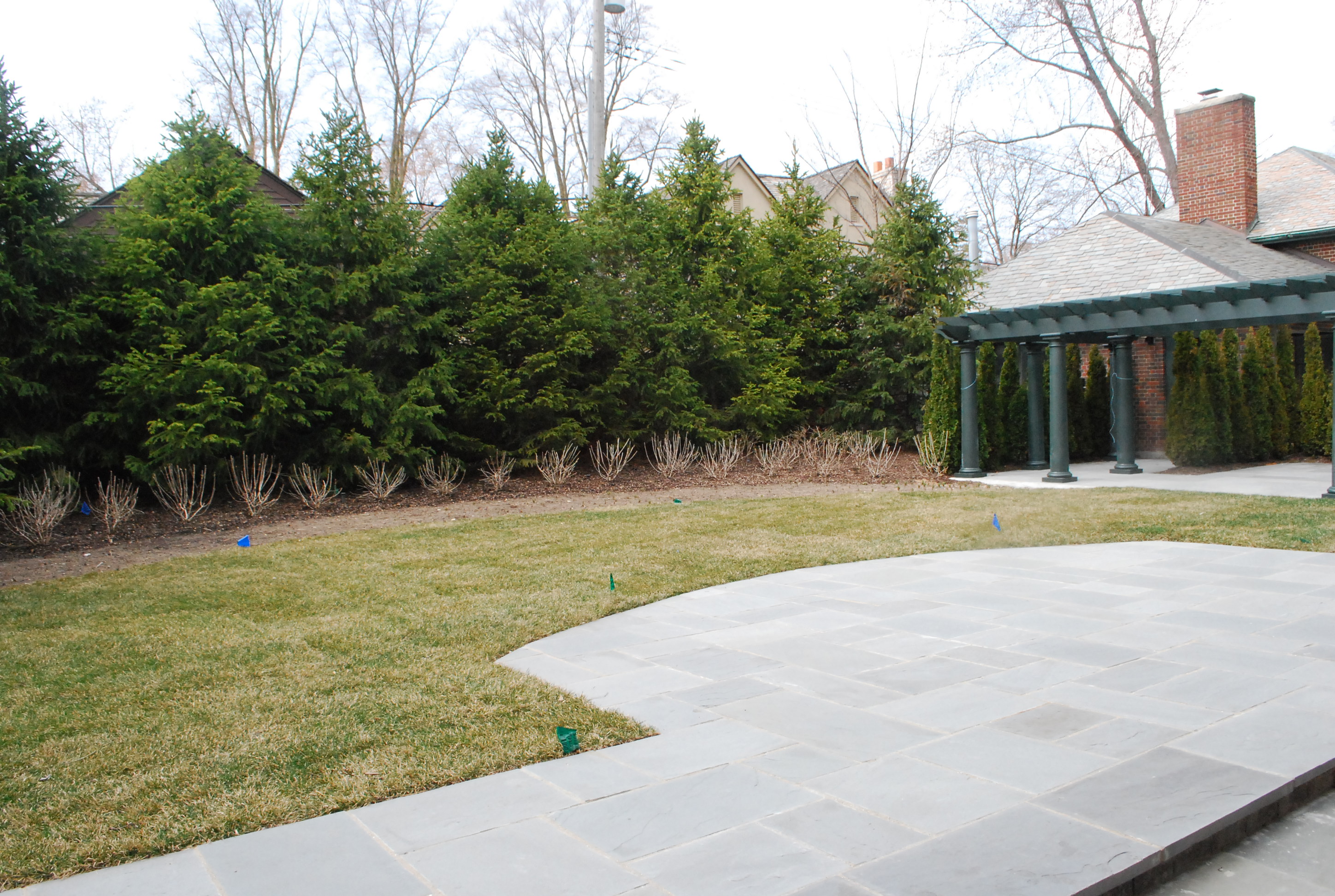
The lap pool was dug out; the hole was back filled.  We planted spruce along the back lot line, as we were able to secure trees with considerable height. Given that there was no room to maneuver a full sized tree spade, each tree was dug with a spade, balled and burlapped, then driven in and planted with the help of an excavator.

Those trees did a lot to screen the neighboring houses from view.  There was precious little space left over with which to design, but the walkway from the detached garage to the house would be a well used thoroughfare.  The walkway to the far library porch-equally important.   

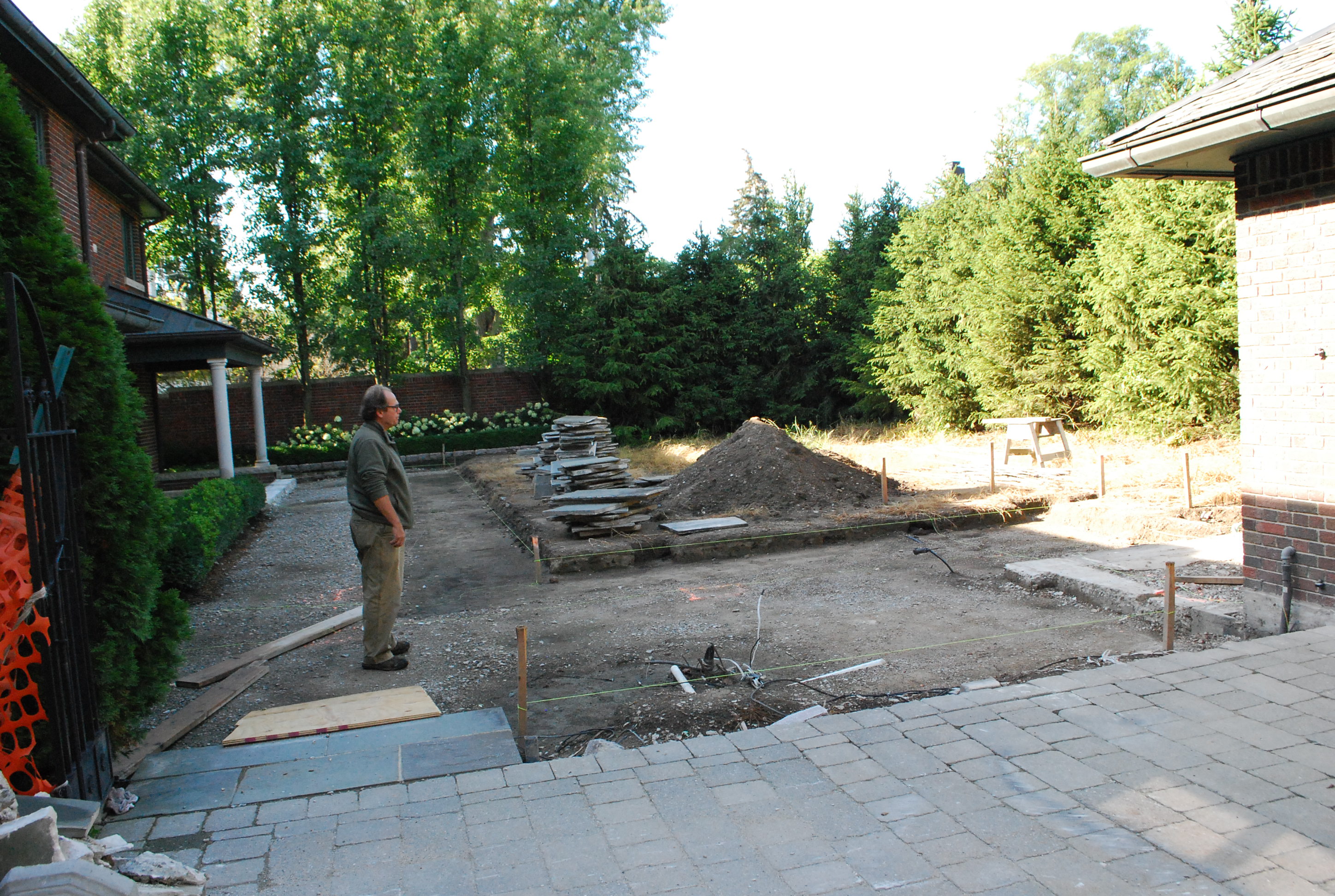
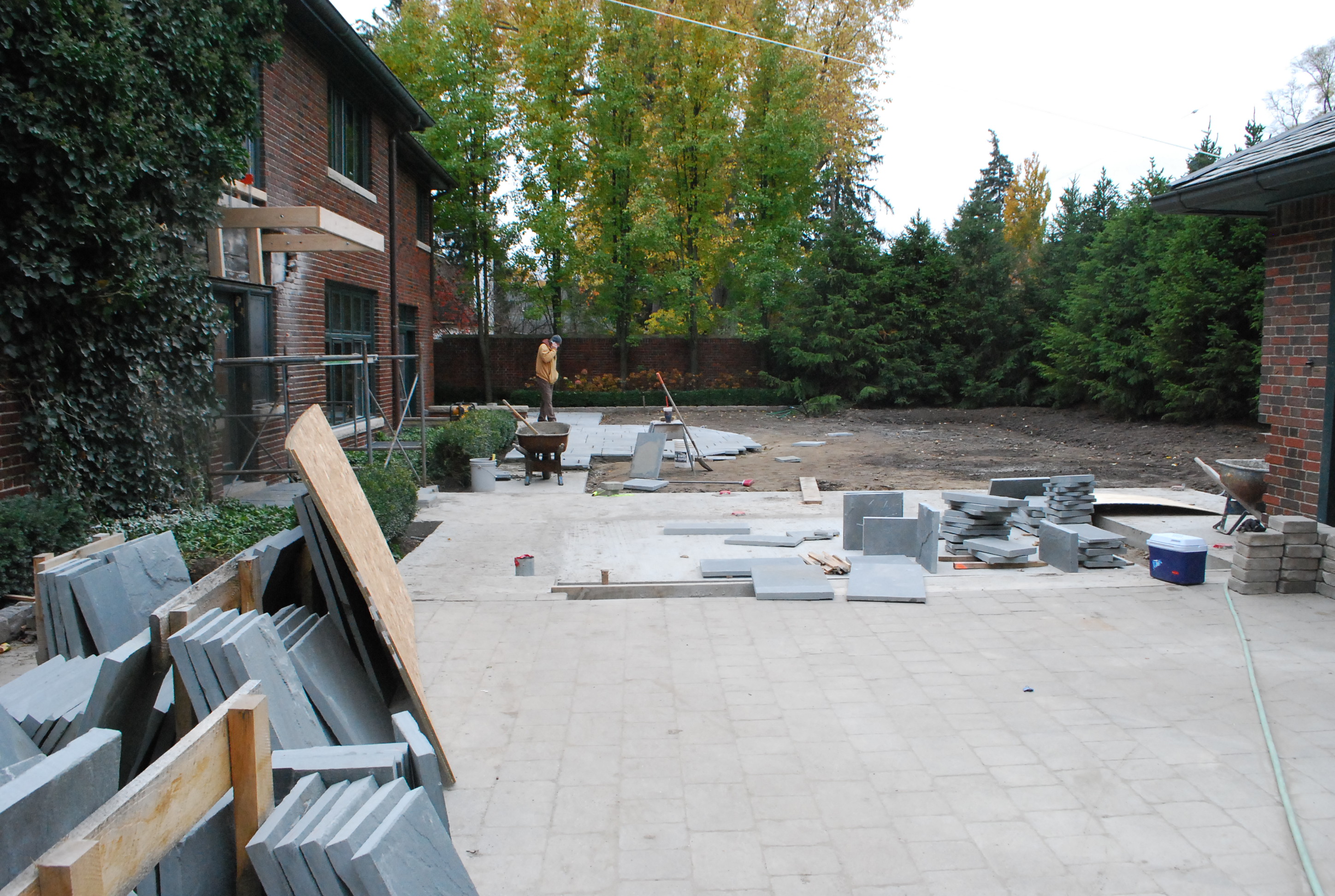
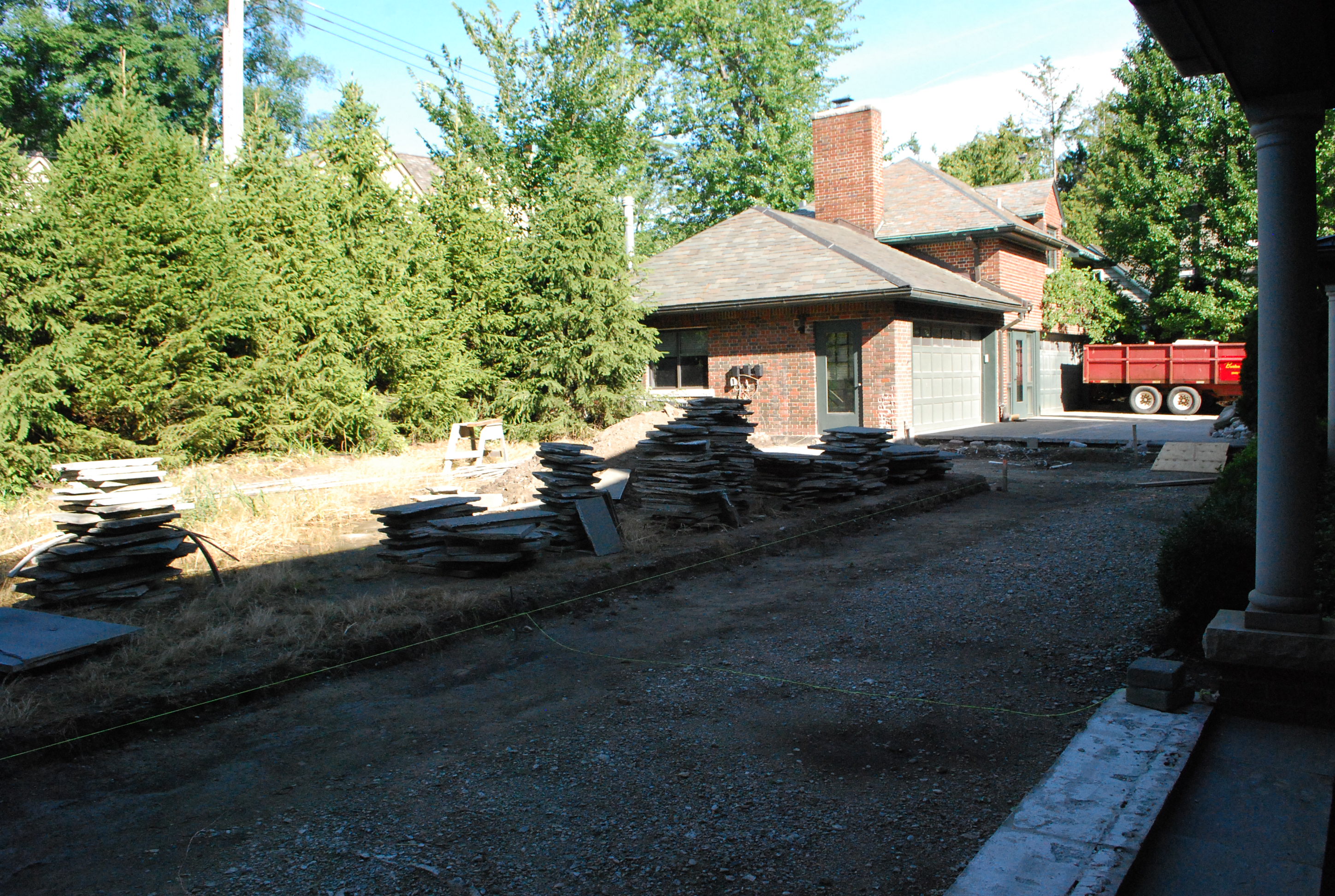
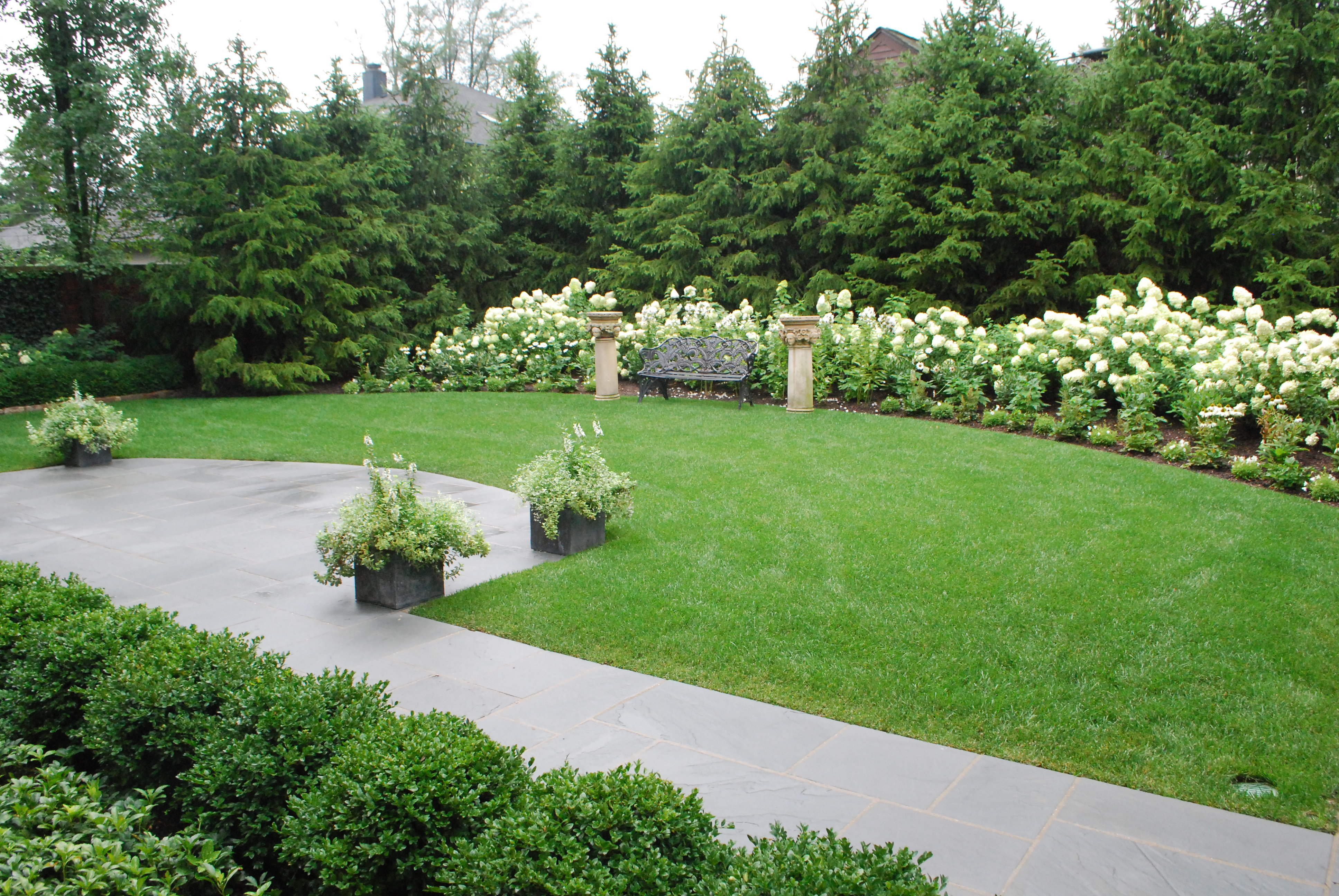
The stonework took a lot of time.  The walkway to the sunken library terrace bumped out midway across the rear of the house.  This radiused terrace would provide a stopping point should there be a party or event.  No matter how small a yard, good and graceful circulation is important.

It seemed just about forever that this project was on hold, awaiting the completion of the stonework.   

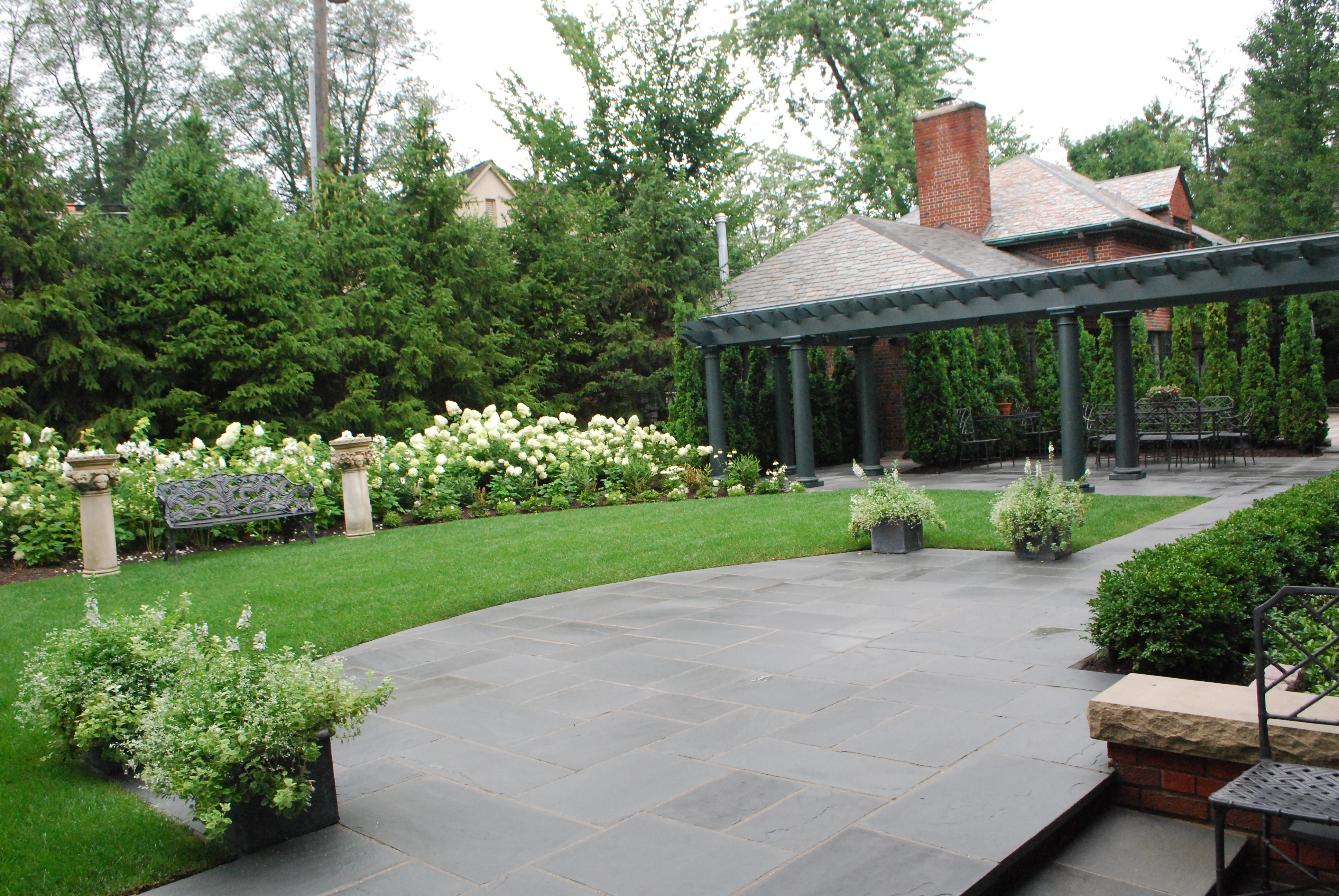
Once the stonework was complete, we created a landscape bed in exactly the same radius as the leading edge of the terrace.  We planted a hedge of limelight hydrangeas-a favorite of this client.  A housewarming gift of 500 white tulips got planted in a space which would eventually be a collection of white flowering perennials. 

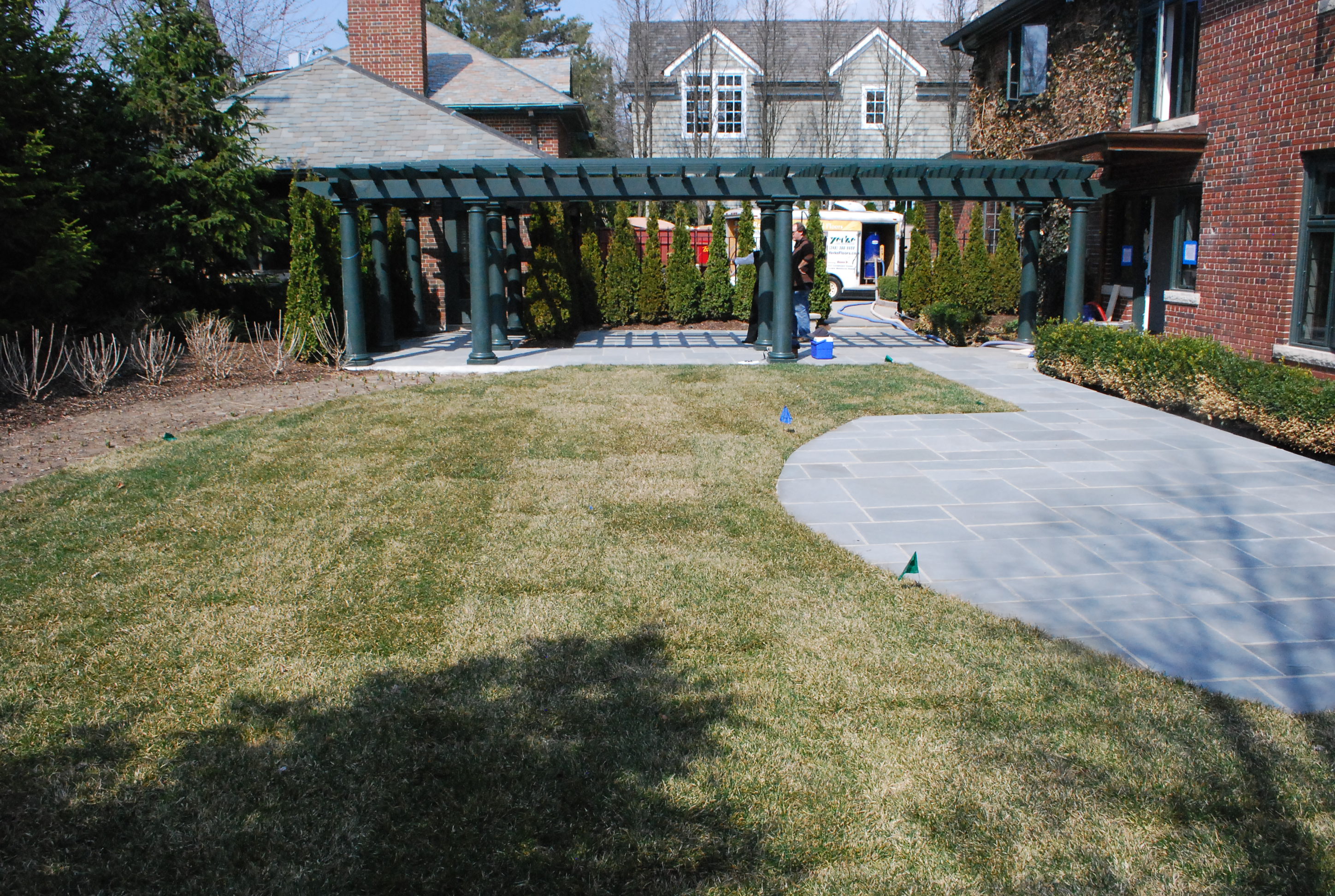
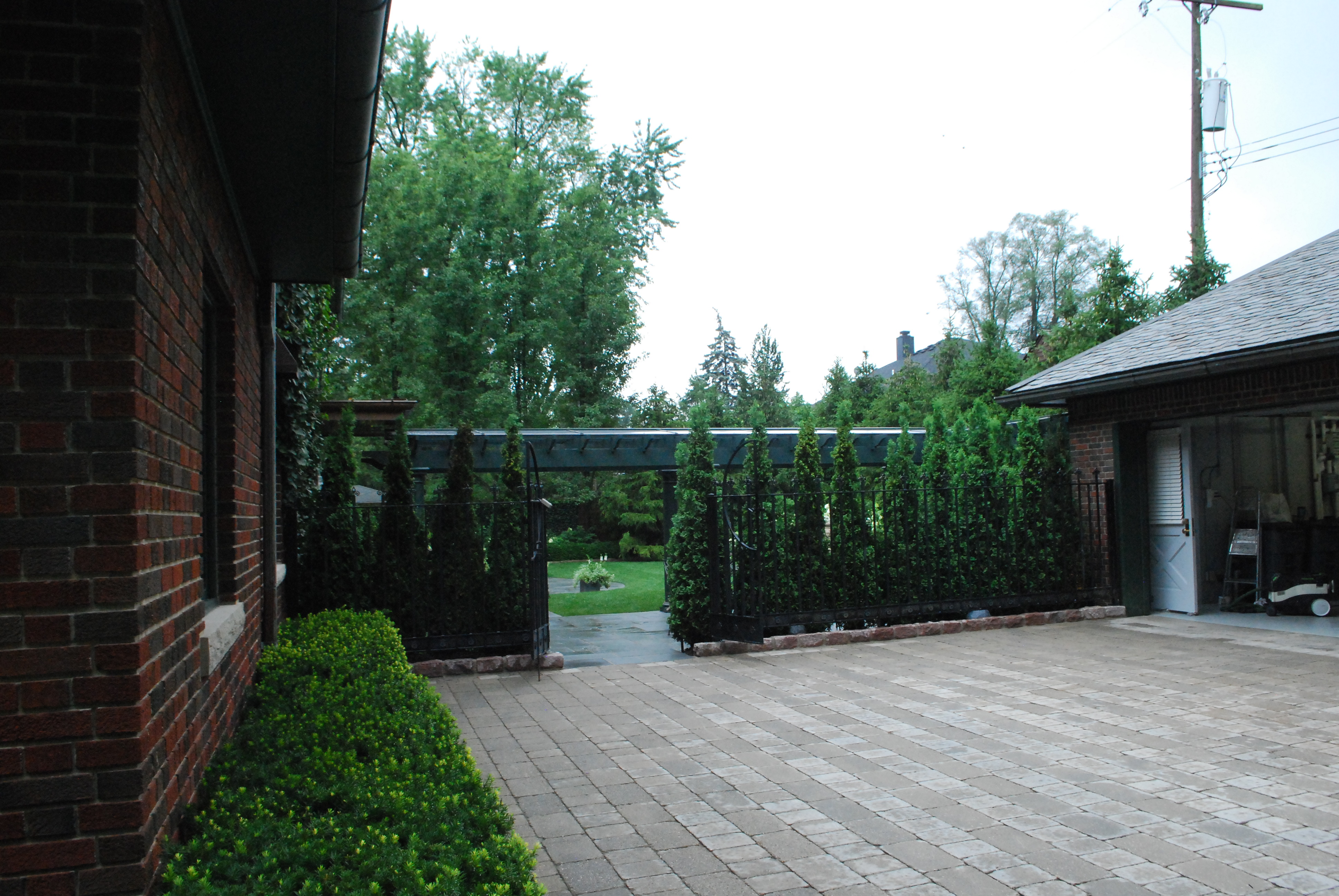
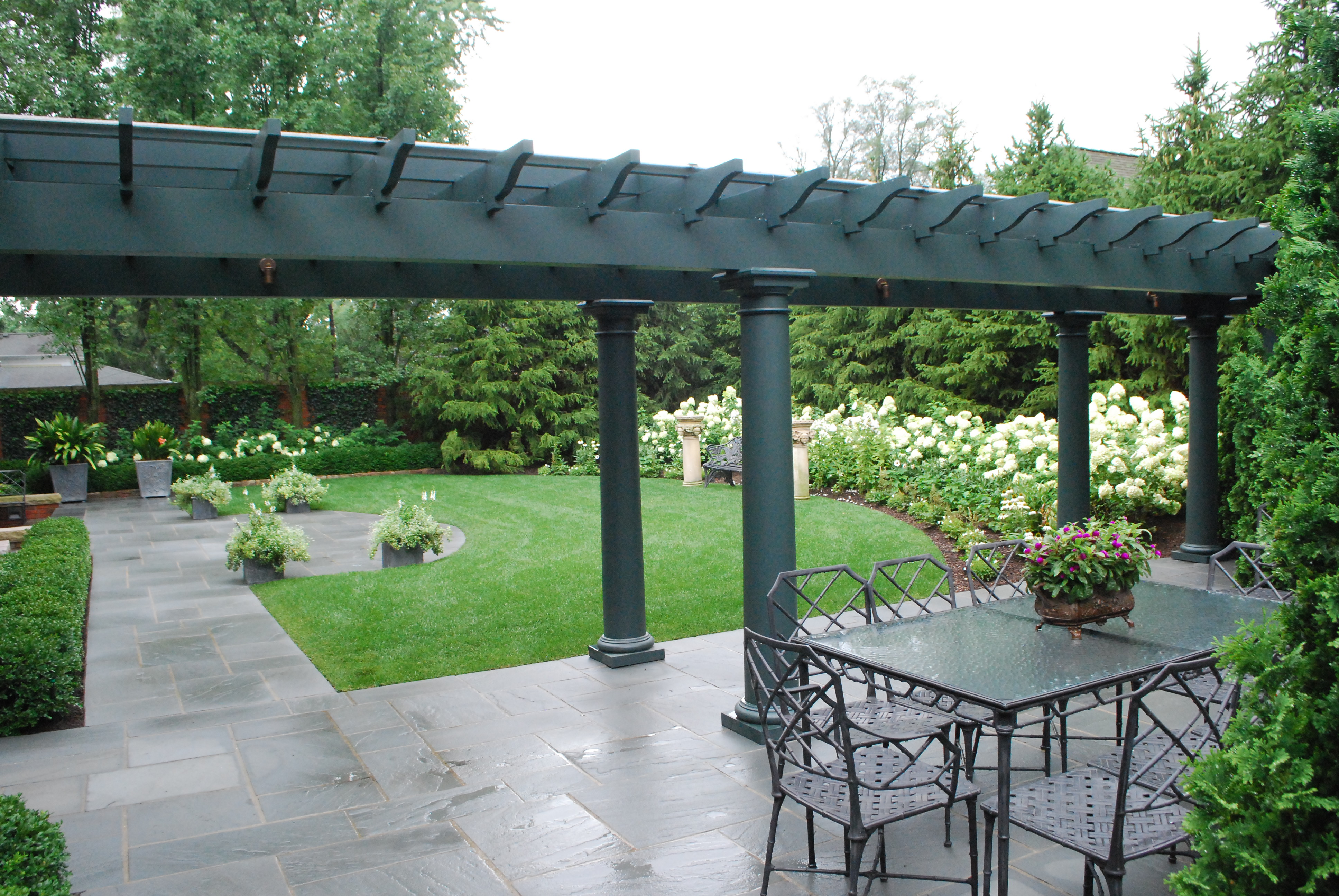
Great care was taken by the architect on this project to design a pergola which would connect the garage with the main house.  The main function of that pergola-to provide cover in that walk from the garage to the house in inclement weather.  My input-a clear polycarbonate roof.  No need for them to feel they were walking through a tunnel.  The pergola design got worked out.   DeGroot Spire arborvitae were planted as a green wall between the driveway, and the back yard.  They will tolerate the small space given to them, and will eventually be able to be pruned formally across the top. 

The original iron fence and gates have been reinstalled.  Today, there is no hint of what it took to transform this space.   

Small spaces are very hard to design, as every square foot counts.  There is no room for an unresolved issue or tentative solution.  Every element has to work, with every other element.  What you see here is the result of a client, an architect, the excavator who removed the pool, a stone mason, an electrician, a pergola construction company, the large tree moving and planting company, the air conditioning and generator people, the painters, and our landscape company-working together to produce a credible landscape project.     

There is no hint now of any broken eggs.  All of the discussions, revisions, and re-revisions are in the past.   

Of course there will be ongoing issues.  But there will also be ongoing pleasures.   

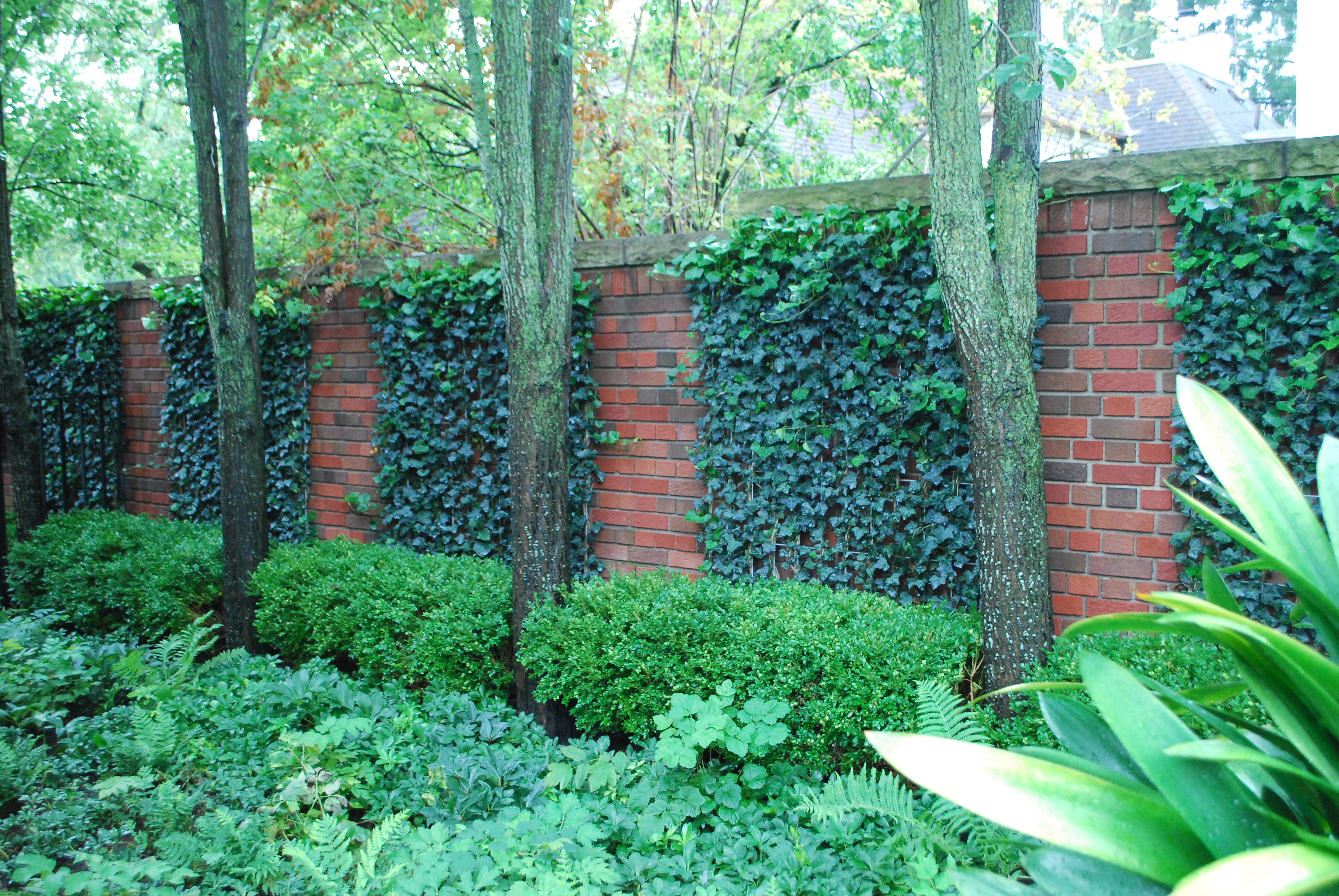
This brick wall to the west-my client had no love for the look of it.  She likes green.  Happily we were able to plant ivy grown on galvanized steel screens.  They are taking hold, and will cover this brick wall in no time. 


I am very pleased that this landscape renovation, which started late in 2010, is finally finished.  Big changes in a landscape take lots of time.  Change lives on a diet of time and more time.  I try to remember this.

Boxed In?

landscape design

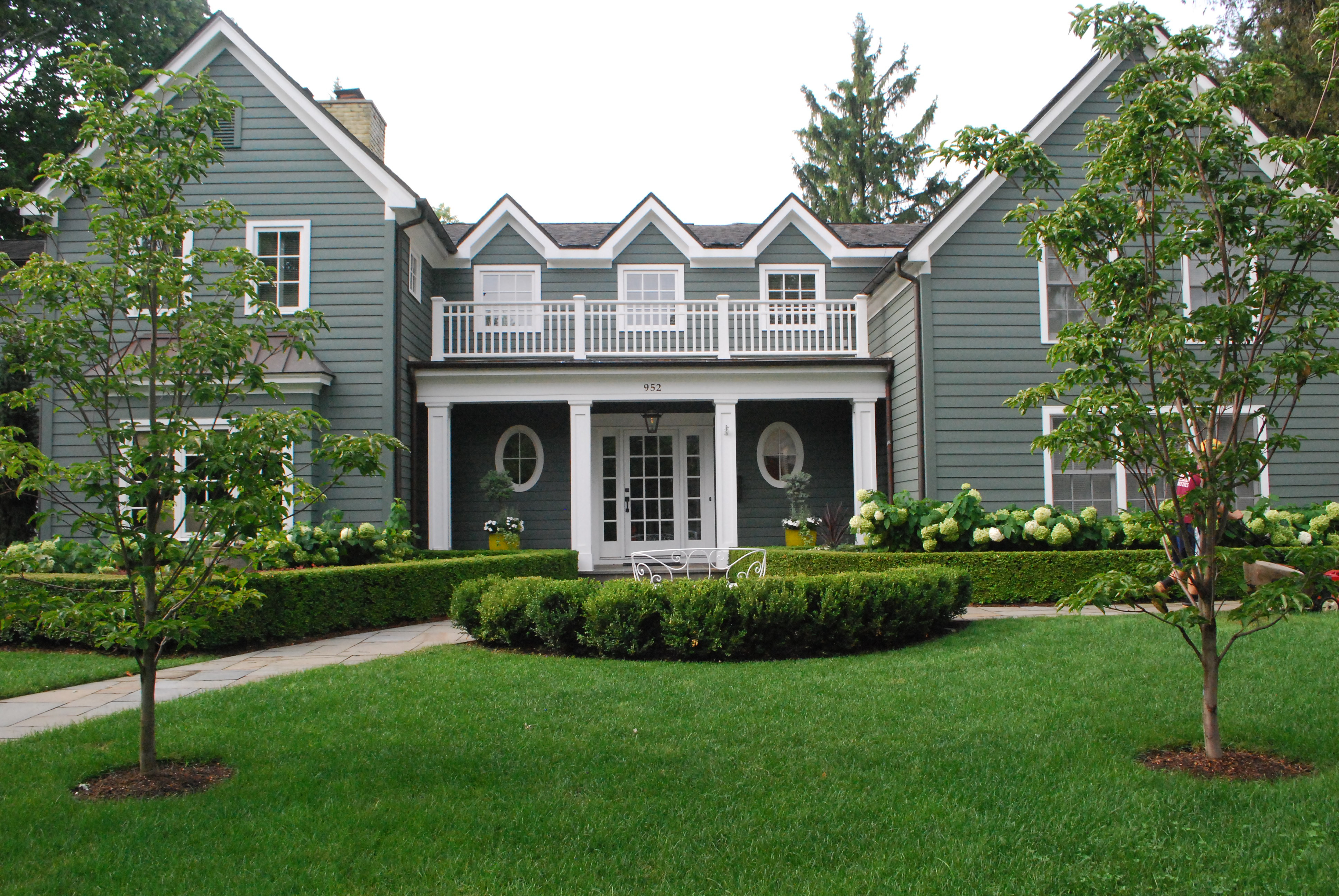
A rectangle is an easily recognizable 4-sided shape.  Like circles, ovals, triangles, and parallelograms, they define or outline a geometric shape.  This lovely home could be easily be sketched on a piece of paper by connecting a series of rectangles, triangles, squares and ovals.  Every one of these basic shapes is created by the lines that enclose, or define it. A linear representation of the front door would look like a series of squares put together in such a way as to create a rectangle.  This photograph, is its most basic incarnation, is a rectangle.  The composition of the photograph is determined in large part by its 4 edges.  Shade trees and evergreens are often described by the shape they most represent, as in “broadly pryamidal”, or “oval”. A two-dimensional shape expressed in three dimensions has its own vocabulary.  A circle in the third dimension is a sphere.  A cylinder is constructed from two circles and a rectangle.  A rectangle in 3 dimensions is a box.  A box may vary in dimension, but for design purposes, a box is a box.          

French wirework bench

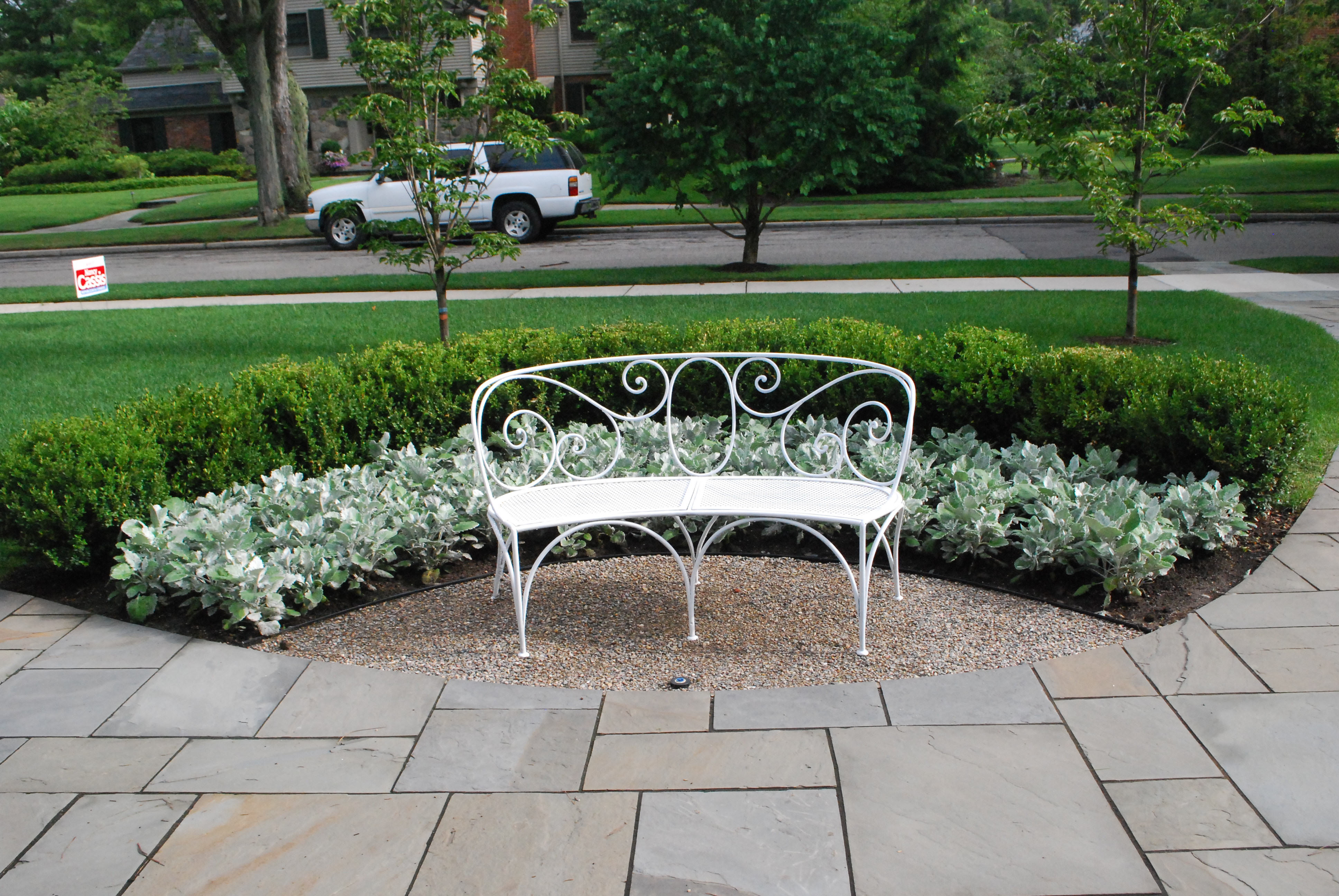
Any landscape is confined by  the edges of the property.  A property may be a rectangle or a triangle, or a combination of many shapes.  But in every case, a property has limits.  What is visually available to your property is confined only by what you cannot see, but those places where you can plant have been drawn on a piece of paper known as its legal description. There is no need for a legal description of a property to dictate a landscape design.   Most urban properties have ties to a slew of rectangles.  That could be a street or city sidewalk. A driveway.  A hedge of arborvitae planted by a neighbor.  If you visualize what is within your design reach on your property, more than likely it is a box-and a fairly plain box at that.  This property has a very beautifully done, asymmetrically curving bluestone walk.  In renovating the landscape, I admired how that curving feature both countered and complimented all of the existing rectangular shapes.  A pair of trees, a curve of boxwood, a curved French wirework bench sitting on a gravel double sided crescent, all respond to that generous and fabulous sweep of stone.  
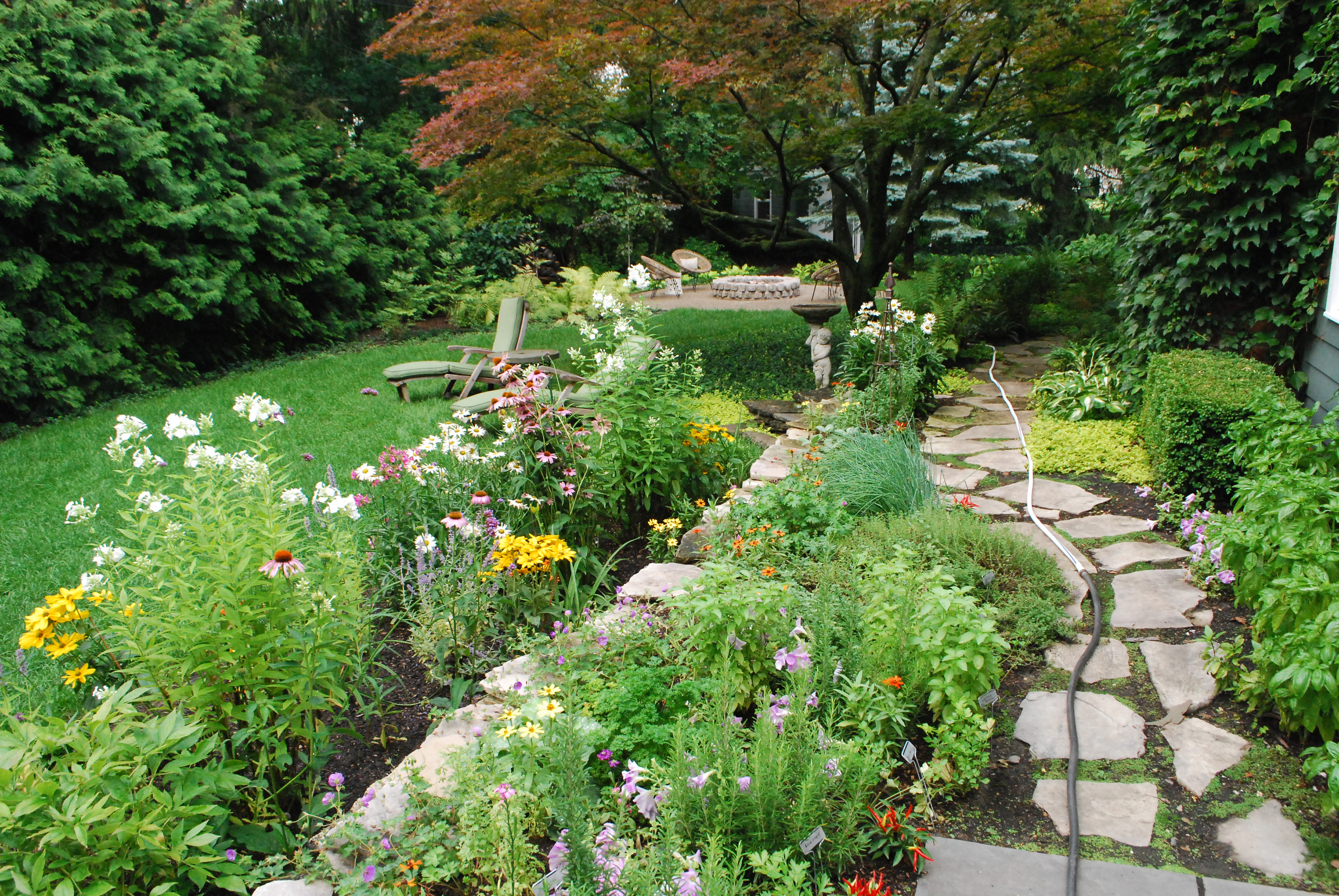
bluestone walkway

We installed a stone walk to the back yard very close to, and parallel to the garage.  This side yard is primarily an efficient means to get from the front to the back.  But the addition of the arbor to the foreground pots and bench helps to slows the eye.  The parallel bed of ivy to the right curves and crosses over the path in the far ground.  This creates a sense of anticipation for what might come next-just around the corner. 

raised stone firepit

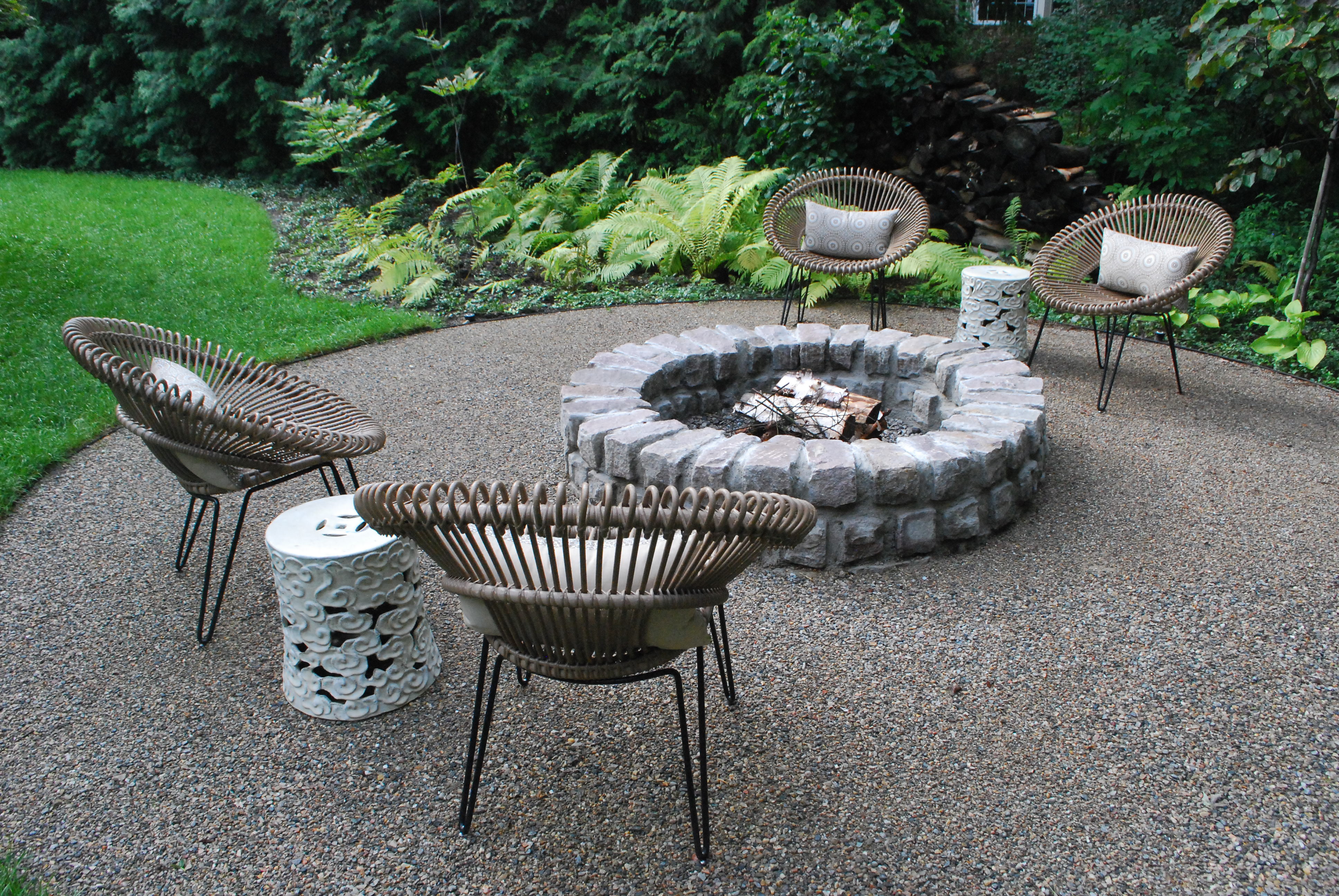
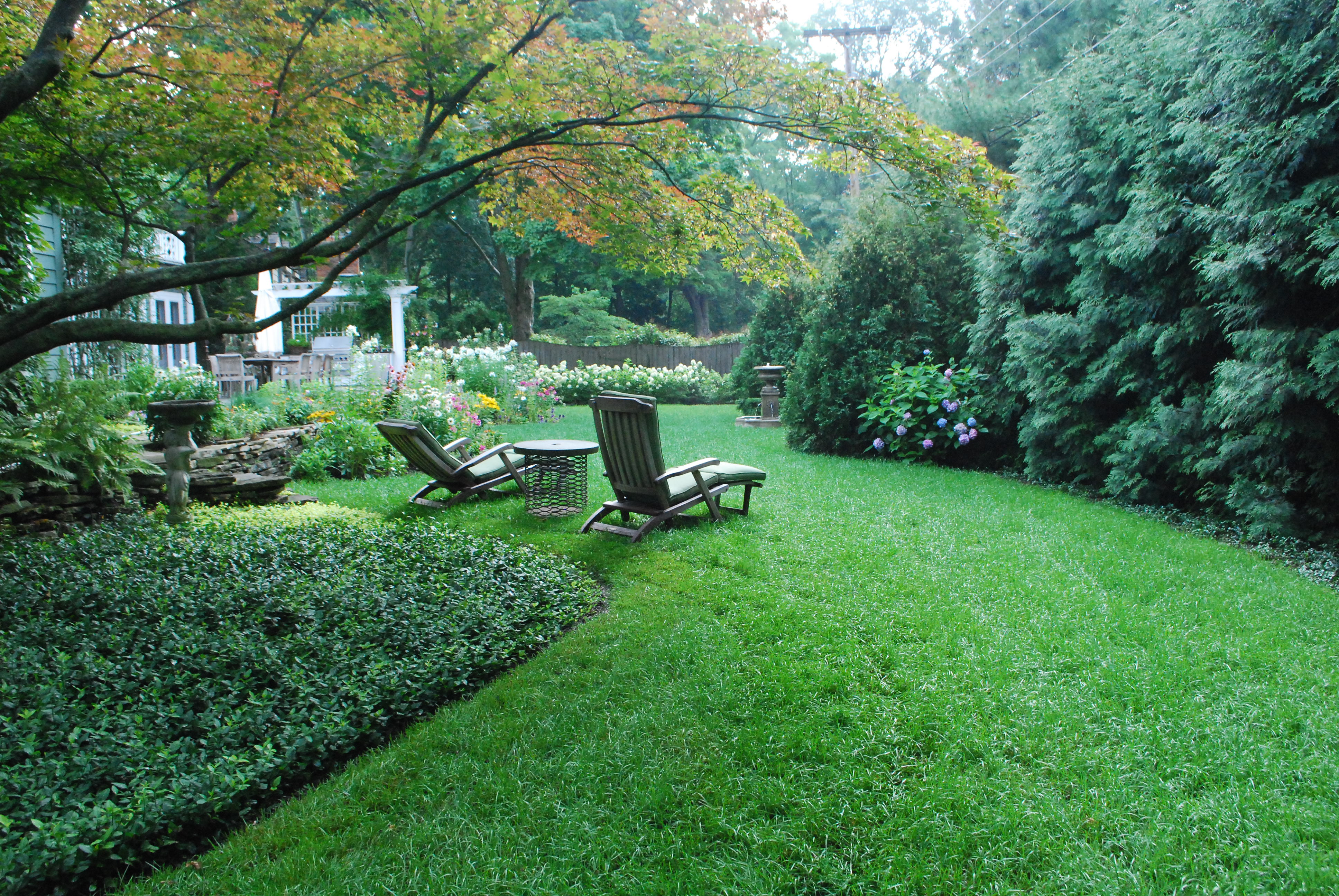
The rear property is very shallow, and long.  It is most definitely a box.  We had the idea to outwit that box.  The circular firepit in the foreground is a strong visual stopper.  It also strongly serves as a gesture that challenges the idea of a box.   The  narrow lawn that swings around the firepit terrace, widens,  and curves back to the left behind a midground seating area directs the eye around the space.  That curve is repeated on the right side; a privacy hedge of arborvitae is planted in a shallowly curving line.  This rectangular space has been scribed with curving beds that do not reveal the landscape all at once. 

granite block firepit

A landscape that encourages the eye to focus on a particular feature slows down the pace of discovery.  There is time to see and take in the relationship between the gravel terrace, the firepit fashioned from old granite setts, the cylindrical side tables and the circular contemporary chairs. 

curved garden beds

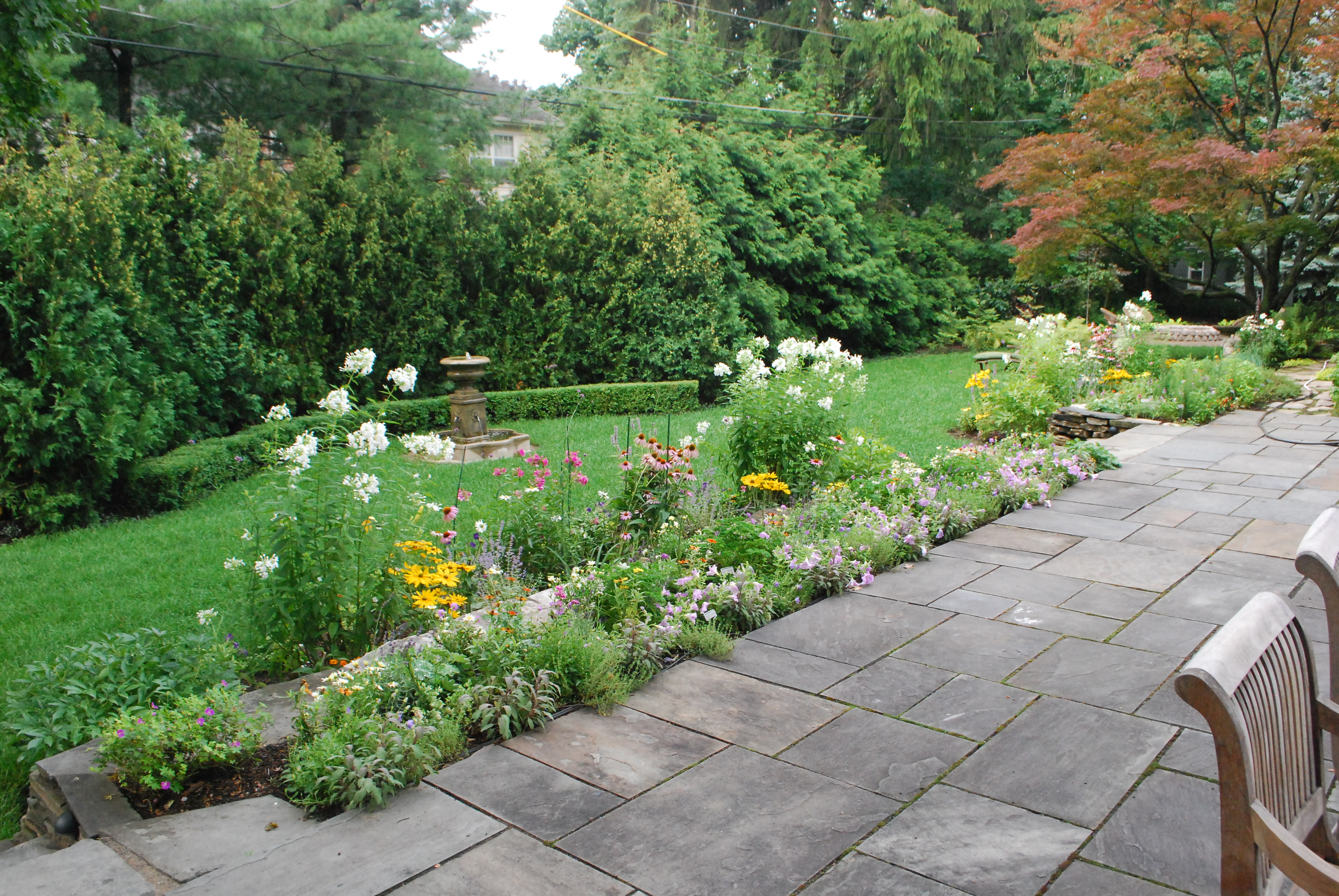
The wide grass path veers to the left, directing attention to a perennial garden, and terrace.  A fountain set in the lawn is somewhat visible at this point.  The curving lines, and furniture provide lots of interest to the midground space.

perennial gardens

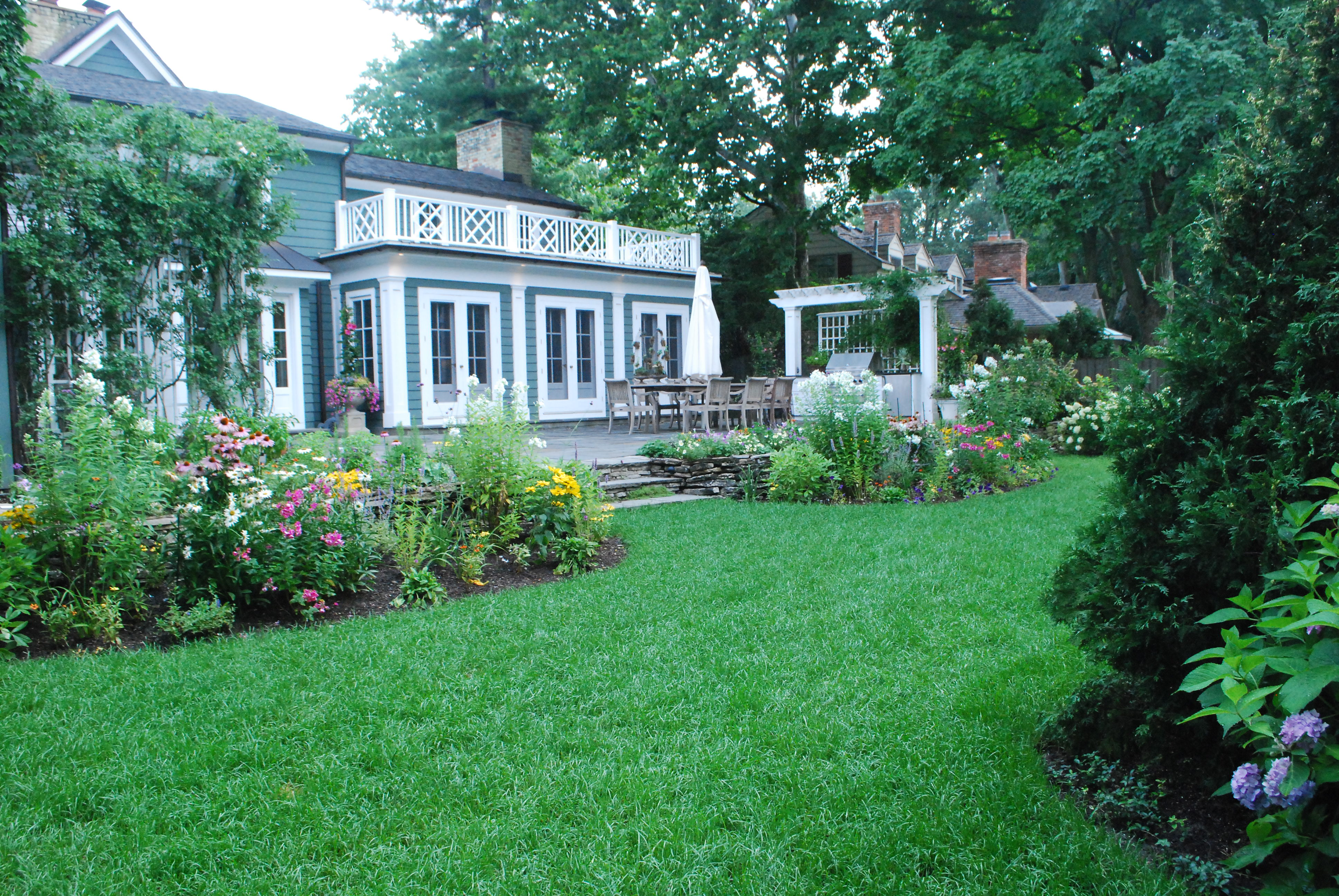
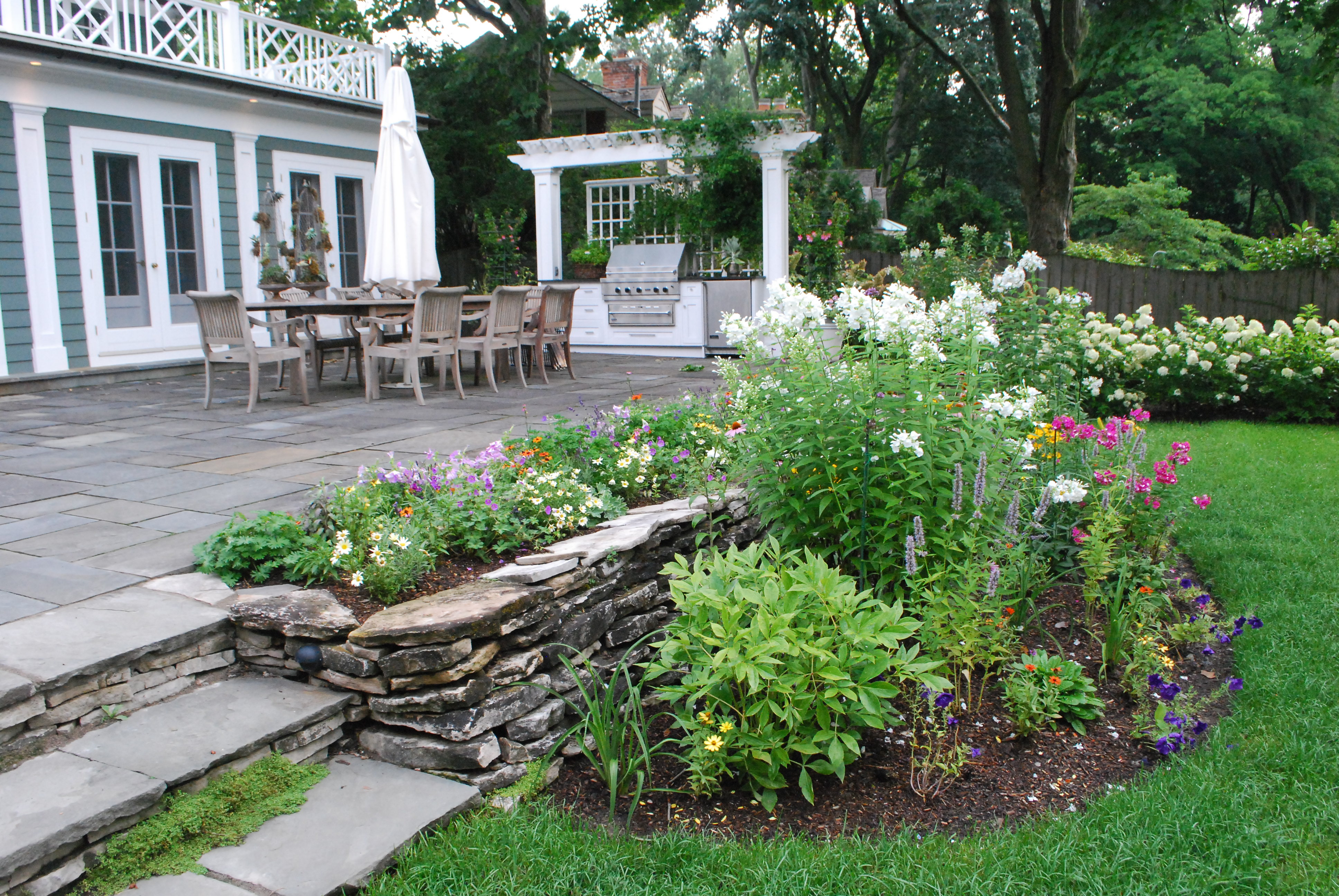
A large terrace is three steps up from the grade of the lawn.  The lawn formerly ran right up to its stone retaining wall.  The addition of the curved beds in lawn not only directs the eye to the steps, but they soften the large rectangular stone terrace.

terraced landscape beds

One area of the terrace is simply furnished with a dining table and outdoor kitchen.  The white painted pergola and trellis  give the grill plenty of garden oriented company.  This arrangement was solely the work of my client.  She has a great eye, and is a pleasure to work with.   

wood pergola

A pergola at the opposite end provides a beautiful transition from the terrace to an interior sun porch.  A climbing New Dawn rose has gracefully draped itself over the pergola roof.  Climbing plants rescue pergolas from their inherently boxy shape.  A small scalloped bistro table and pair of chairs placed in the shade provided by the rose is a beautiful touch-again from my client. This part of the landscape is not apparent until you turn the corner, and are right up to it.    

garden terrace

The fountain at one time had a home on the terrace.  Moving it to the lawn plane, and curving a hedge of arborvitae behind it makes this narrowest part of the box seem spacious.  There is actually very little space between the leading edge of the terrace and the lot line.  The round fountain, and the accompanying curved landscape minimize that boxed in feeling.

garden views

The change of level in the rear yard gifted it with lots of built in interest.  Though a space can be severely rectangular, that is not to say that the floor has to be flat.  Layers of evergreens, or sculpted soil can focus attention on what is inside a space, rather than what defines, or confines it.  Sometimes I will design from the center out to the edges of a boxy flat space, rather than from the edges out. 

gravel driveway

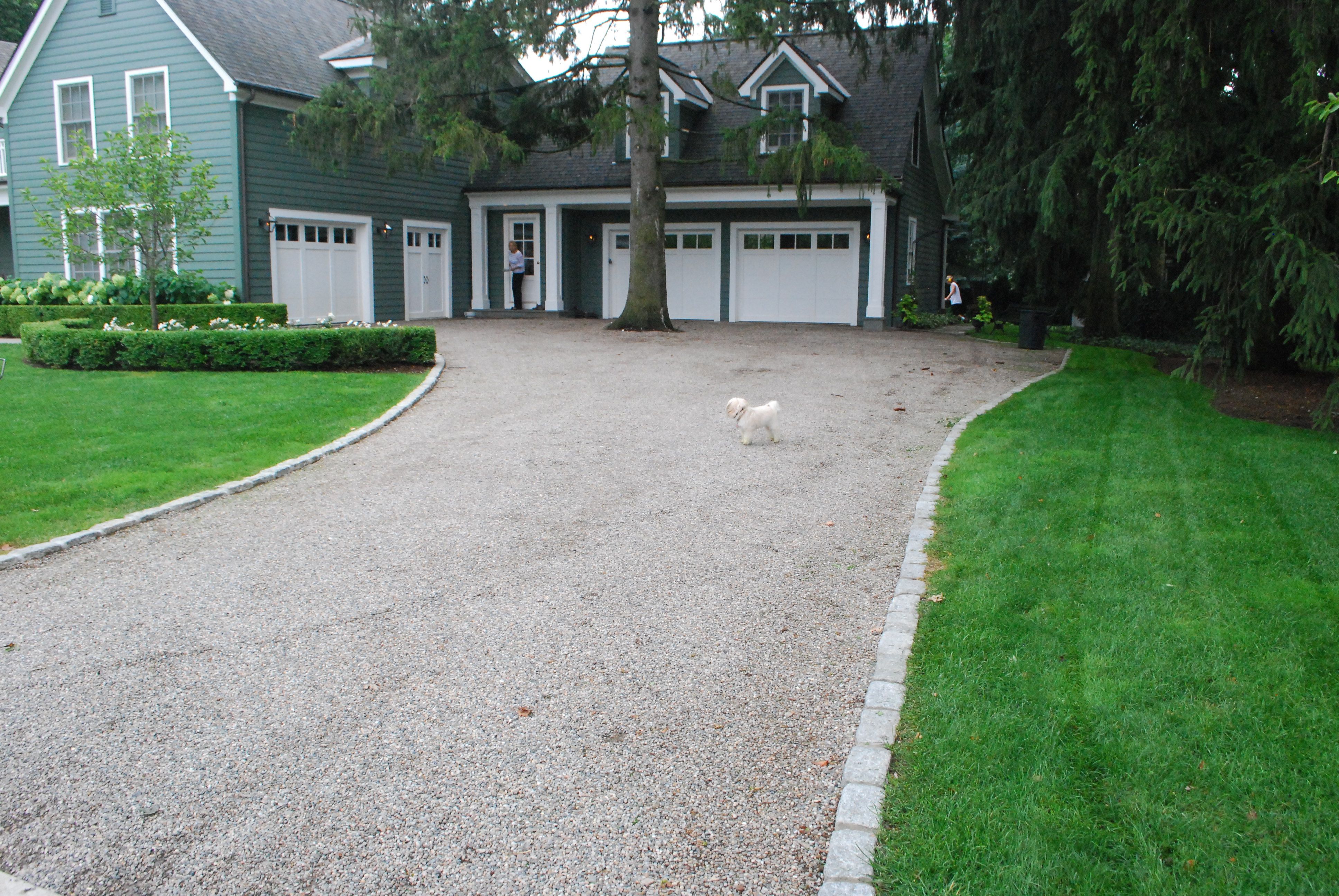
The very first work I did for this client years ago involved suggesting that her that a old spruce could be left intact the middle of her gravel drive.  Yes, they are able to drive around it, and into the left bay of the garage.  That spruce makes so much out of a small rectilinear drivecourt, as do the curving edges of the approach.  The quite serviceable driveway is an interesting feature of the landscape.  Out of the box, that is.