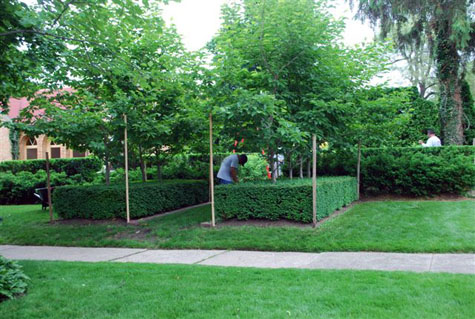
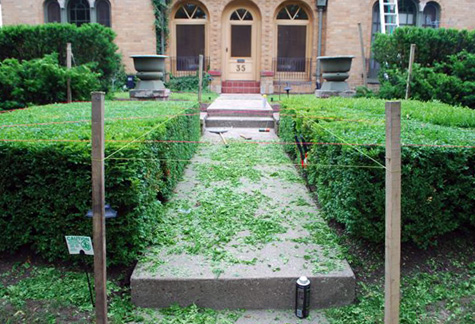
 The ability to prune with true precision is as much about a gift, as it is about the science. The big science concept has to do with being able to establish a line level with the horizon, or perfectly horizontal-and its complementary-those lines exactly perpendicular to the horizon-or vertical. Mindy’s crew sets lots of vertical markers-the stakes in this pictures. They use a level to set those stakes exactly vertical.
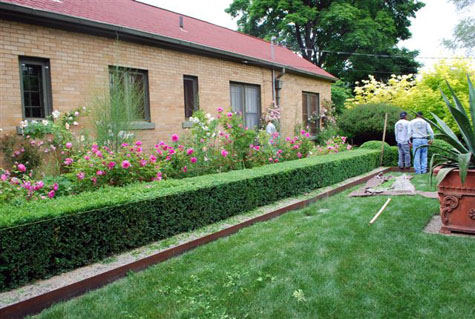 The horizontal plane is determined with a set of lines, or strings. There will be strings everywhere, side to side. But there is plenty of gift involved here too. I perfectly understand the math, but I cannot do this how they do it. Every cut is made with giant, long handled shears-by hand. The clip clip takes 7 people, an entire day; its a slow but sure process that I enjoy watching. Even the sound of the clip clip takes my blood pressure down at least 10 points.
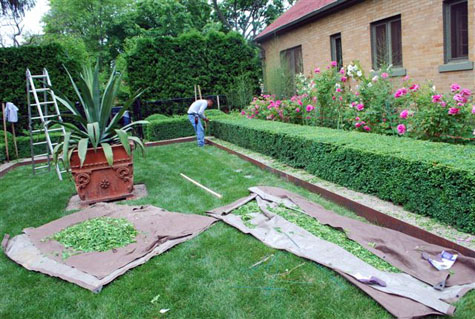 Shape, mass, and volume are very important design elements in landscape. This landscape is entirely geared to the shape, and level of the lawn plane. Every other element has been established, based on that plane. The importance of the lawn plane is accentuated by the wide, overscaled steel edger strip. Where beds and lawn are on the same plane, the edger is invisible; its function is to keep grass out of the planting beds. In this case, the edging is a design element, clearly indicating a change of level. This very geometric change of level provides lots of interest in a very small space. The boxwood pruned into long precise rectangles is a great foil to the sprawling shapes of the roses and perennials.
 Pruning level with the horizon requires attention to a form that may not exist in the space. The land into which this landscape is planted falls from north to south, and it falls from east to west. To give you an idea of how much drop there is from the south to the north, I measured the height of my Hicks yews. On the southern most end, they are four feet tall, give or take. At the east end of the north side, they are nine feet tall; this is a lot of drop. It was many years, growing those north end yews tall enough to prune. This boxwood is pruned level with the horizon. Pruning with the lay of the land produces an entirely different effect. Level with the horizon gives a landscape a formal and serene aura. As in, on even keel, or level-headed. As my work life is as I have described a big fluid situation, I like the even keel feeling when I am in my garden. This is a choice any gardener makes when designing. What do you want from your space?
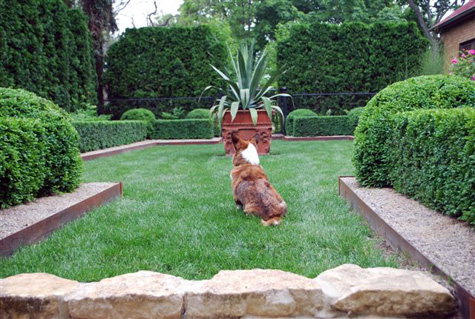 This is my idea of a good place to be.
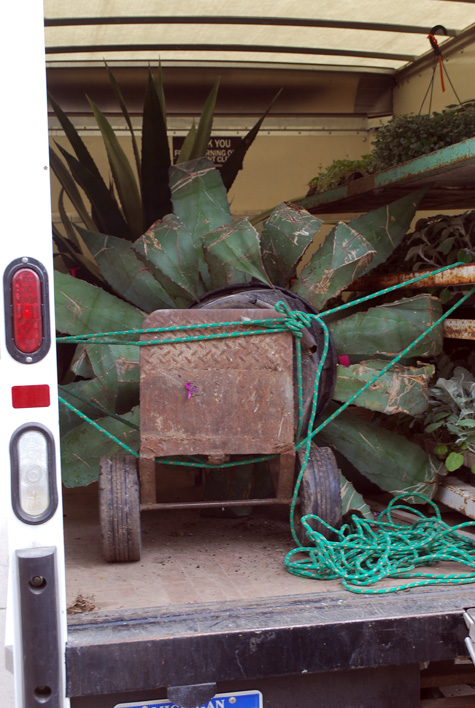 I am the reluctant and sole owner of this giant agave. Armed with vicious thorns and weighing plenty, it is an incredible ordeal bringing it out of the greenhouse-never mind trying to decide where to summer it. Mark does a great job of wintering all my clients tender plants, but this one makes him grumble.
 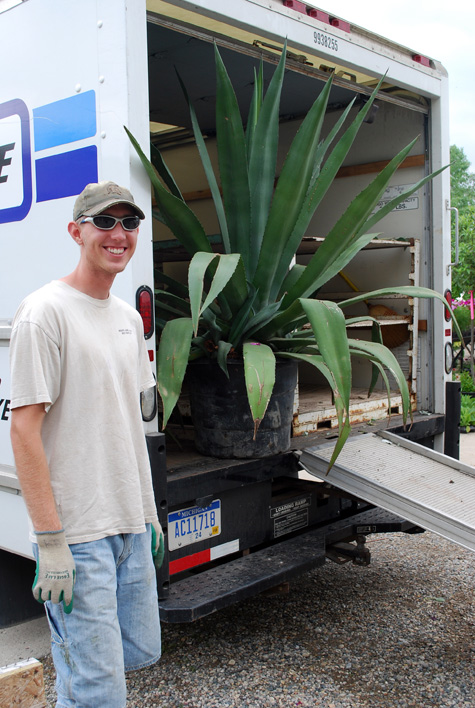 Mark’s staff person, the other Mark, is smiling here, but please notice the sunglasses, and the heavy duty gloves. This plant is like trying to handle a blue heron that has its leg caught in a rock (that’s another story for another time) or some other similar disaster. At this moment, no one is thinking about how beautiful it is-only how deadly it can be.
 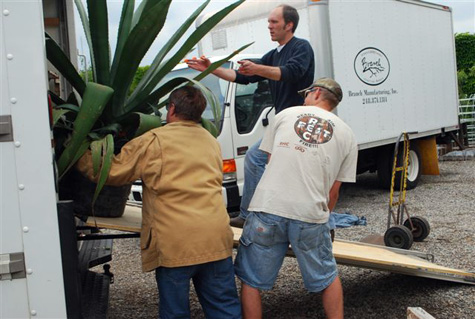 Mark shows up with a long sleeve canvas carhart jacket-never mind that it is 78 degrees. Rob is poised as if an unexpected left jab may be coming his way.
 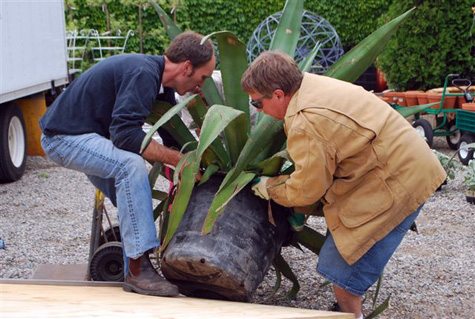 Finally these three slide it down the ramp, and off the truck. It sat for a week in the middle of the driveway, marooned. I finally said to my landscape superintendent Steve that it might be good to heave the thing in the dumpster, and be rid of it. Steve, who is predictably unpredictable, was indignant that I could even think of chucking an old plant as beautiful as this one. The “beautiful” part of his jolt of a statement set me thinking in a different direction. If I did indeed think it was beautiful, then where would I put it?
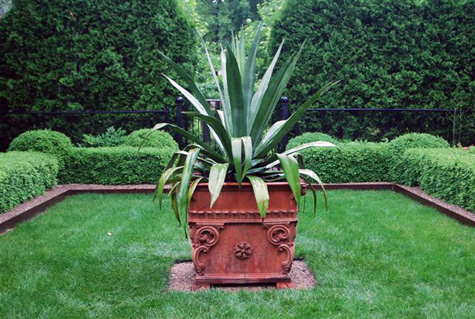
 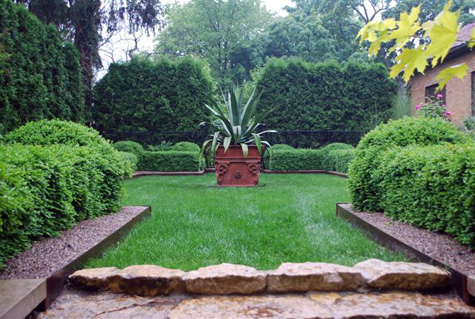 I asked Steve to haul it home for me. I did not dare go to photograph that planting scene; sometimes Steve is better left alone. The tuscan rectangle, whose planting scheme had been bedevilling me for weeks-the perfect place for a giant, homeless, but very beautiful agave. Do these two not look made for each other? The big design issue here is about the seeing. Seeing the beauty in a plant or an idea can inspire lots of good. This massive and unwieldy pain of a plant is now the star of its own show. A lot of plants, clients, schemes, garden arrangements and ornament are loaded on my design bus. All of these things need the right seat on that bus, on any particular trip, to shine. This is an issue which is mine to successfully solve.
  Edward de Bono put it much than I ever could. “We may need to solve problems not by removing the cause, but by designing the way forward even if the cause remains in place.”
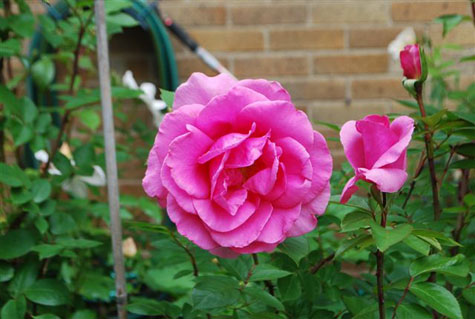 June 15th my roses are usually in full flush-anyone who loves and grows roses waits all year for this moment . These haughty queens of the garden do deliver. The smell is divine, the colors breathtaking-and their shapes are gorgeous. Carefree Beauty, looking good.
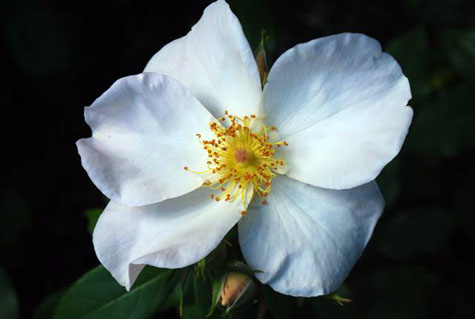 Sally Holmes, as graceful and lovely as any rose could be. It looks English bred, does it not?
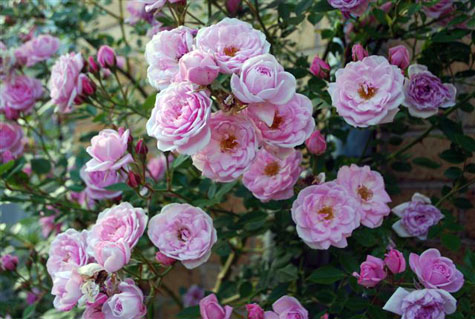 Jeanne LeJoie, the miniature climber, is covered with a thousand pink extra double buttons-from top to bottom. How it thrives is part of its charm.
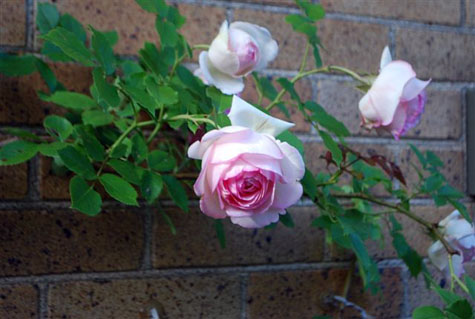 The big flowered Eden, with a classic double rose shape, is irresistable.
 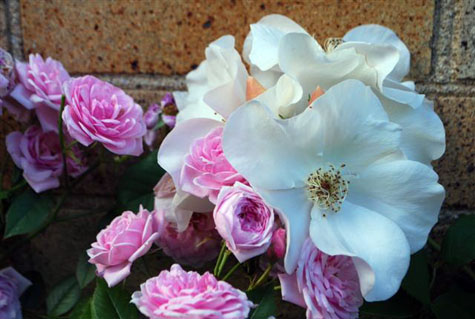 These roses all seem to live together companionably-in form and color. I like the idea of companionable. My garden is too small for this standoffish plant and that sulky one. Today the only thing on my mind are the roses.