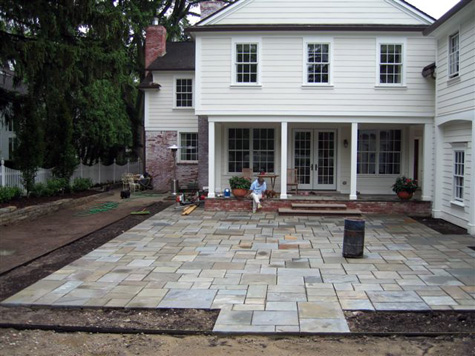
Good design is about a whole host of things-but money isn’t one of them. Martha Stewart has built an empire teaching how to take an idea, strip away all the Chanel materials that the cool given idea is all dressed up in, and explain the idea for what it is. Once there is understanding of a concept, it can be rebuilt with a different kind of dress-a recycled dress, a dress from JCPenny, or a dress from a thrift shop. Or from materials in the back of your garage; wonder of wonders, a homemade dress. I greatly admire her for this-it is no mean accomplishment. She teaches-this is my idea of an extremely important job. She has made a life making good design accessible to lots of people in all kinds of neighborhoods, states, regions, and countries. She is able to take an idea, and break it down such that it makes sense to a very broad range of people. This is a rare gift.
Any gardener can understand the fancy dress idea. We have all seen landscapes installed in our neighborhoods in airless, gooey, and certainly not improved clay soil- topdressed with some good looking black earth that makes everything look like it is planted in the most fabulously plant friendly soil on the planet. We’ve all seen new plants dropped into pots for a special event the day before. We’ve also seen the urban property with an allee of trees as if it were a 80 acre estate expecting a visit from Louis the Fourteenth. Topdressing is a concept every gardener understands-for good, or for ill.
A case in point; for years Rob would build his bamboo stake/galvanized wire tomato cages for clients. He would position the 4 bamboo stakes outward from the rootball of the tomato, and wrap from stake to adjoining stake hoops of galvanized wire from the Depot. His hoops had no kinks. The hoop-swoops were wide at the top, and tight at the bottom-perfect for that indeterminate tomato growing taller, and wider at the top, by the day. At some point, he was despairing of the long lineup of his hand-fashioned hoops for which he had requests. So we designed an acid washed steel tomato cage-in a perfectly widening sequence 0f hoops, and had them built. They cost two hundred and umpteen dollars-but anyone can come in, buy one, and load it in their trunk. For the person who does not have the idea to spend the umpteen dollars for our formal version of his hand worked tomato cage, I apologize that we are not a teacher the caliber of Martha Stewart. But we can try to teach how to create the bamboo stake-wire cage-just ask.
Understand that I had my own Martha Stewart moment-like countless other people. I built a croquembouche exactly to her specifications-but my attempt to create the ultra thin sugar hair that was due to go over that tower of profiteroles like a cloud, only coated my entire kitchen-top to bottom- with a congealed sugar mess. I thought for two days afterwards I would just have to move-then I cleaned for another two days. The lesson here-don’t be deterred by an unsuccessful first attempt. Make another.
A garden I truly admire has a formal, and short grass path to a very handsome and overscaled gate. This path is edged on each side with a very long, very thin rectangle of steel edger strip, infilled with fine gravel. It is a detail which is incredibly beautiful. It marks the path so elegantly. This detail says, this way to the rose garden-welcome. But that steel rectangle some 9 feet long by 6 inches wide-who knows what that dress cost- could be reproduced with a single length of 4″ by 6″ pressure treated lumber, set on its wide edge. This would be a dress of a different sort, but you would still catch your breath, seeing it. Another gardener would interpret these long spare path edges with hens and chicks contained with aluminum edger. Yet another gardener would dig a dirt ditch 6 inches wide, and call it a day.
If you need design help, figure out who can teach you.


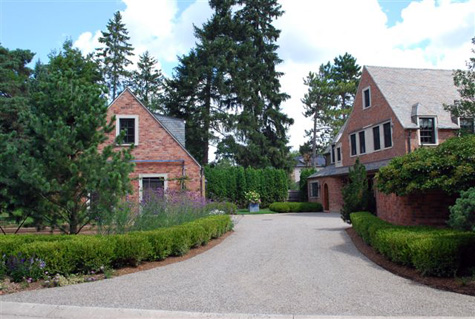 There are some landscape materials I cannot get enough of. Decomposed granite is a material comprised of pieces of granite 3/8ths of an inch across, and smaller. The smaller pieces are known as “fines”. The fines sift down in between the 3/8 inch pieces, and interlock the decomposed granite. This makes for a surface that delivers that beautiful sound with every step that says garden, dead ahead. Decomposed granite looks like sand when it is delivered. I have taken plenty of panic stricken phone calls from clients. But once it is laid down, graded, compacted and washed, it is a surface that won’t give no matter how high those heels are. I have no love for asphalt as a surface; does it not seem like a symbol of all those places we have paved over without cause? Concrete is a great material, as long as it is used with architecture that asks for it. Concrete aggregate is beautiful for modern or contemporary landscapes-I hate to see it used by a client who really wanted gravel, but was too afraid. My mentor and dear friend Al Goldner, told me once his only regret as a designer was that he was not bold enough; be bold!
 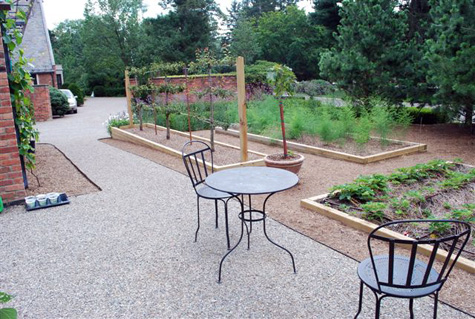 Decomposed granite, properly installed, makes for a driveway impervious to tire marks. In this landscape, the driveway flowed seamlessly into paths for a vegetable and cutting garden.
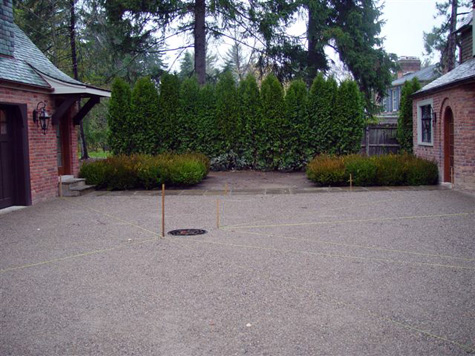 A driveway of decomposed granite requires an expert installation. GP Enterprises does these drives for me. They are so careful to install with a careful eye to grade and drainage. They compact the granite with the same machinery that compacts asphalt.
 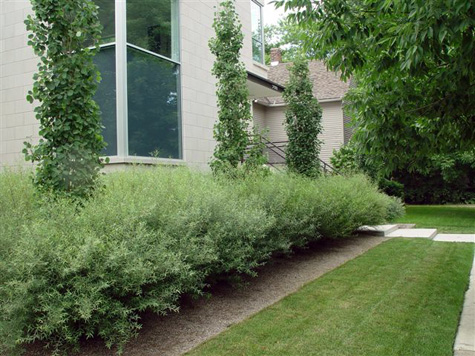 Decomposed granite makes a great mulch for comtemporary landscapes. This landscape did not ask for mulch-that granite completed a thought.
 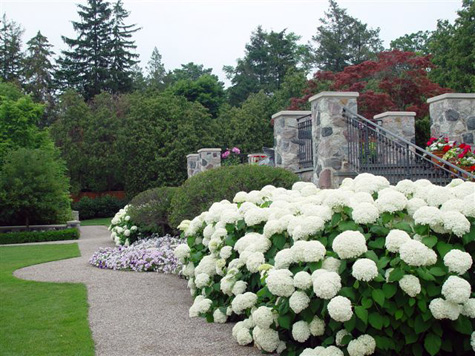 Decomposed granite can finish a formal planting, as well as a contemporary one. It is clean, fresh, and crisp. It is easy to make shapes, and moves; it does a great job of giving the eye a place to rest.
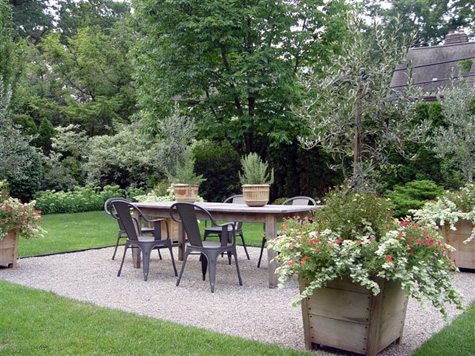 I have done many a terrace in decomposed granite. It is a clean surface, not so demanding of attention as stone. This garden makes much of the pots and the furniture-the granite is a quietly beautiful surface. It is the color of nature, a texture that celebrates all that is set on it.
 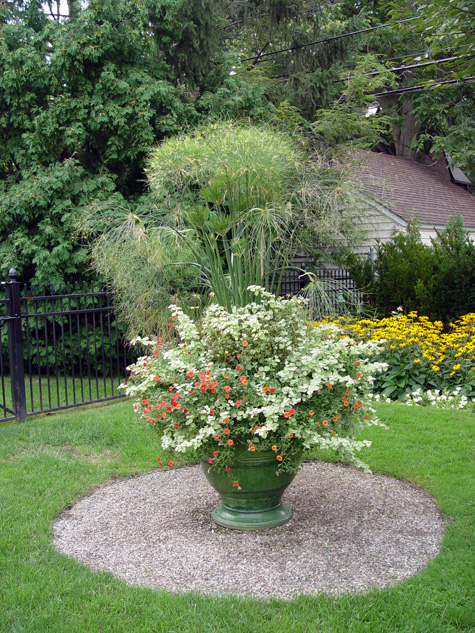 This material is useful for more than driveways and paths. Some plantings need a special space of their own.
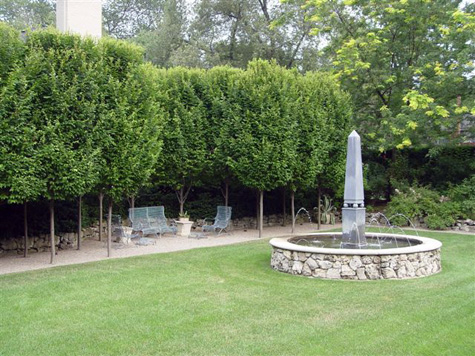 Wherever people may be in a landscape, I wonder if this surface will play a part. The granite did a great job of featuring the stone from the 1920’s original to this garden.
 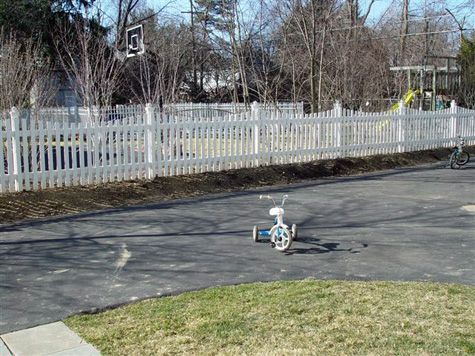 I am dealt plenty, when I am asked to design for a client. Although the immediate concept of flat ground seems simple, the solutions can be time consuming and messy. This property was extreme in its high grade- a fence included- on the lot lines. This home-in a ditch.
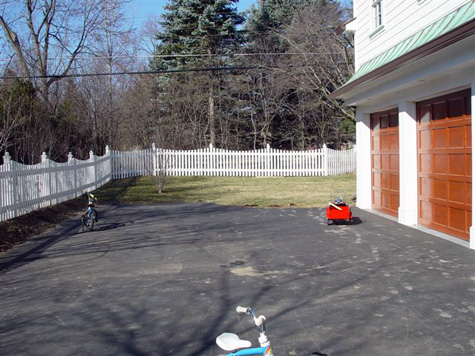 Can you see-how this client’s land is high at its edges, draining to the house? There was always soil and bark on the drive after a rain. And water standing next to the foundation, and in the garage. Sometimes it seems to me that a house is set too low in the ground; this house was a good candidate for a landscape that would improve many conditions-as water is not good for a house. Slopes are great for sledding or skiing, but not so great for living in. Flat gound makes for sociable spaces. I myself have no interest in juggling a glass of wine, and an appetizer on a hill. I like level. Or As close to level as I can get, and still have drainage. Steeply sloping sites are tough to negotiate, and tough to plant. If you have a space you wish only to view-plant that hill. If you plan to live in that space, terrace it.
 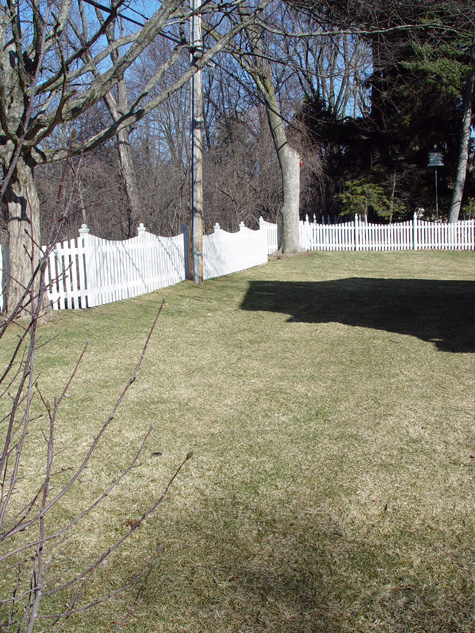 This clients fence was set a good 40 inches above the grade of their house. Water rushed down and covered a terrace that was too small for company anyway. I proposed that they tear the entire space to pieces, and put it back together in such a way that would make their outdoor living and entertaining a breeze.
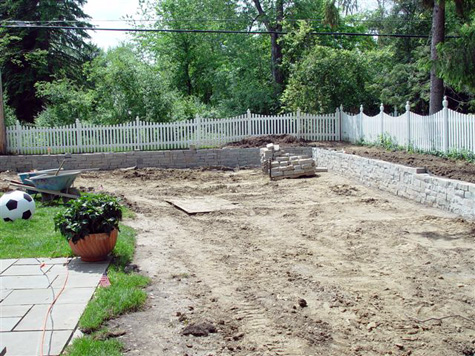 We got to work building retaining walls some seven feet off the lot line, and flattening the land near the house. Of course we had to install drainage to handle the water that deluged their property from the adjacent houses. A transformation of this scale is big messy work-they were fine with it.
 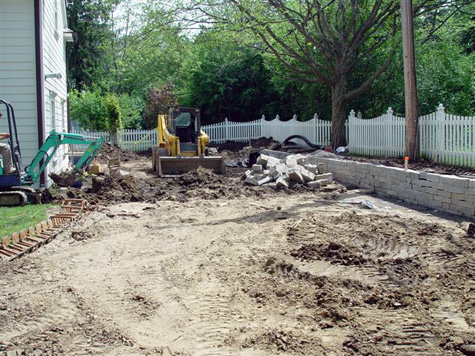 So many machines, so much stone for the retaining walls, so much mess.
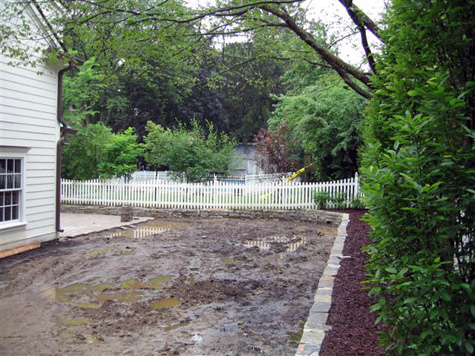 Heavy rains interrupted our work. No drains were in place yet. Looking at all this water, I did explain to my client how they could see all the water on their property, as a layer of grass no longer covered it up. We did a series of drains that took water to the street, and away from the back yard. Its about as much fun to spend money installing drainage as replacing a furnace-only more expensive. But in this case, the threat of water damage to the house was considerable, and this expense necessary-even if they never went outdoors.
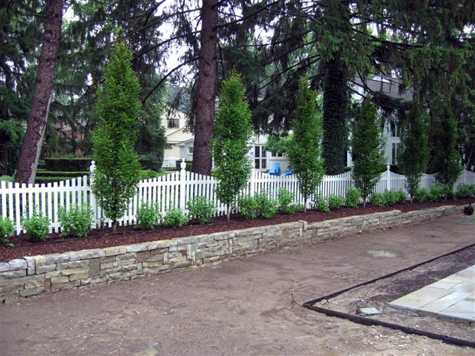 This upper level terrace-we planted with columnar carpinus, and Limelight hydrangeas. This simple planting gave them privacy in a lively way. A terrace double the size of the original made sure that any amount of entertaining they had a mind to do would be handled adequately by the landscape. This project was a big fluid mess for better than 3 weeks. The outcome-level.