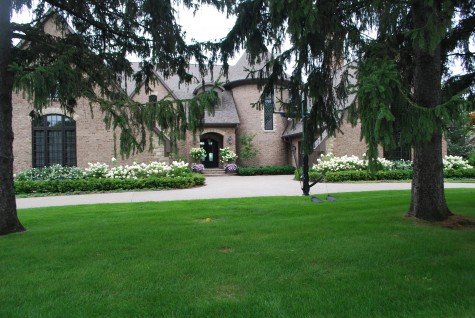
A Belated Sunday Opinion: Digging Holes

After having spent what seems like weeks sitting at my drafting table designing and drawing, I am thinking there is a lot to be said for just digging some holes.  Designing takes imagination, concentration, foresight, more mathematics than what you might think-and patience.  It requires a considerable expenditure of a certain kind of energy.  Sometimes it feels like I am straining my eyes, trying to see in the dark.  Or staring at something for so long I can’t see anything anymore.  I squirm, doodle, and daydream.  The whole business is exhausting, though the only thing in motion is my pencil.   

The drawing is usually in two phases.  Idle marks indicating where people might congregate, walk or park help to suggest a scheme.  I go through plastic erasers by the dozen.  I draw straight lines with a scale, as I need always to be conscious of how many feet it is from here to there.  I can tell in a moment whether I have space for lilacs, or just enough for a threesome of espaliered pears.  But what drives the pencil is an imaginary trip up the drive or front walk, through the garden to the back door, out again onto the terrace, back across the front yard, and out.  There are as many possible permutations to the route of this trip as there are hybrid daylilies.  It is like planning a trip to a city you have never visited-except that the city is not there yet.  Decisions get made, for better or for worse.  The drawing takes a more serious turn.  Lines start describing spaces that have volume.  Spaces without purposeful shapes will read on a drawing just like they read in the landscape-like leftovers.  That little piece of leftover land floating between the fence and a tree is better resolved on paper than after the fact. 

A finished drawing is as much about communicating the idea of the design, as a roadmap for an installation. Looking at a landscape design drawn on a piece of paper is a contradiction in terms.  Only the birds and the people in the planes flying overhead will ever see the landscape from this point of view.  Landscapes are sculptures teeming with the byproducts of all kinds of life-trees, flowers and falling leaves, insects, air conditioners, woodchucks, broken branches,skateboards, overgrown yews, trashcans, the neighbors-none of this shows in the drawing on a page.  But for the drawing to work, all of these possibilities and eventualities have to be taken into consideration.  Some serendipity in a garden can be charming and refreshing, but there is an equal chance it might be irritating.  Poorly planned landscapes, faulty horticulture, can openers that don’t work, shoes that are not the right size-irritating.

I understand completely the urge to visit the nursery, buy some plants, place the plants here and there, and dig holes.  There is something satisfying about stomping on the shovel, digging up the dirt, planting and watering a good looking plant.  It involves the expenditure of energy of a different sort-simple, physcial, uncomplicated by thought. Sometimes it is good not to overthink one’s moves.  After all, anything can be moved, provided one comes to one’s senses in time.
At A Glance: Previous Ensembles

 19952005


2006

2007

2004

2003


2010

Making Interesting Conversation

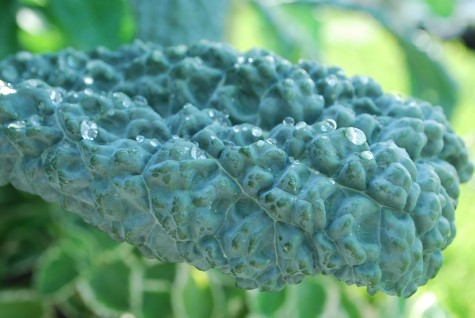
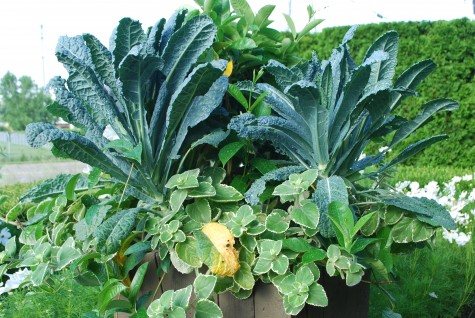
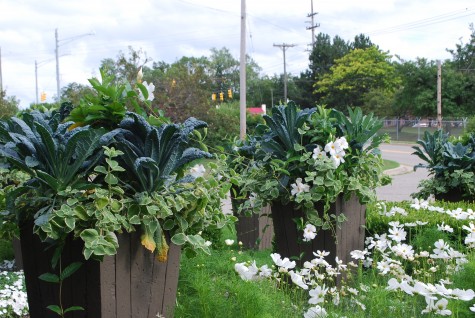
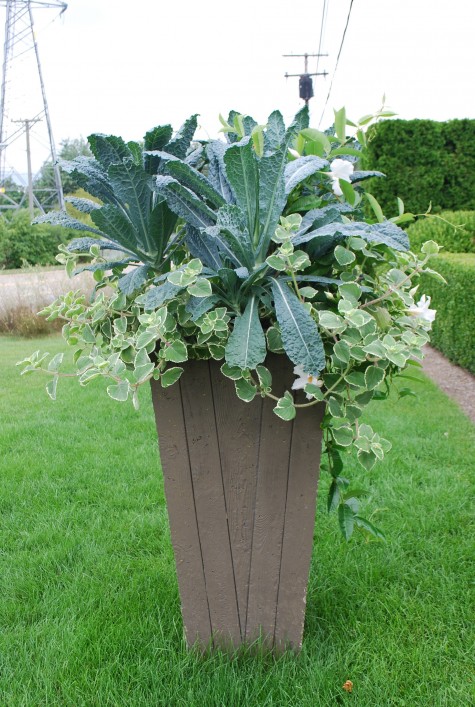
The big blue tuscan kale I know as Nero di Toscano is a favorite plant.  The giant blistered blue-green leaves have that vaguely prehistoric look to them.  The common name, dinosaur kale, aptly describes this massive growing, highly textured plant. As with any member of the brassica family, they are beloved by chewing insects.  It is a rare cabbage or kale whose leaves do not bear holes and chomp marks.    

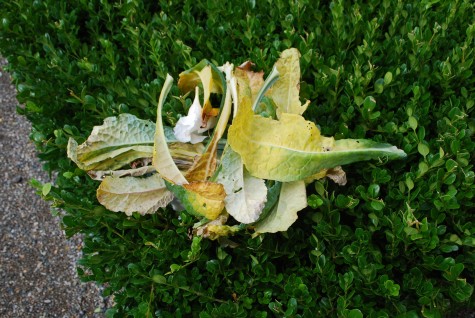
The lower leaves mature in a spectacularly unattractive way. Some ornamental cabbages are grown for the cut flower trade; a long thick stem will have a tuft of brightly colored or white leaves sitting on top.  All plants have characteristics that are less than desirable.  Annabelle hydrangeas are weak stemmed, and flop over the minute they are in full bloom.  The roses get blackspot; post-bloom maturing foliage on daylilies is nasty looking.  Designing with plants is much about pairing them with other plants that minimize those faults.  I would not give up growing kale over their legs.  

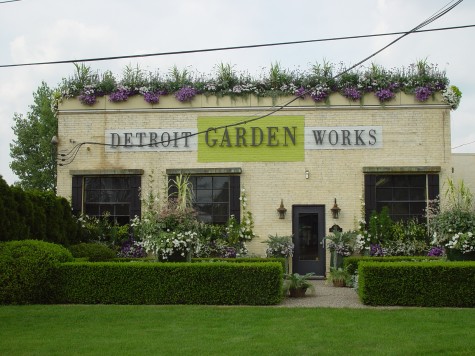
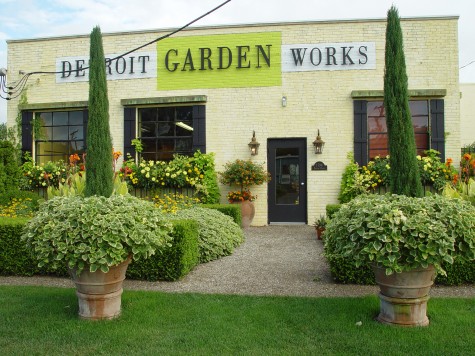
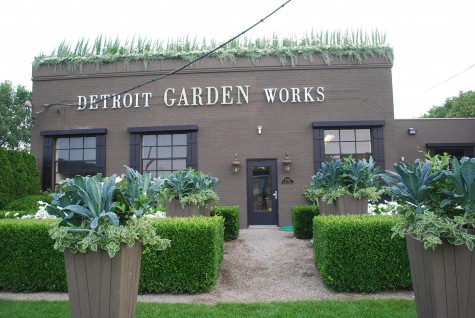
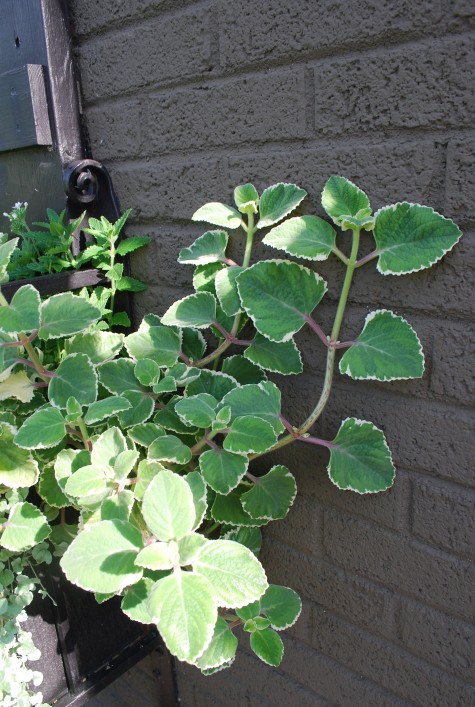
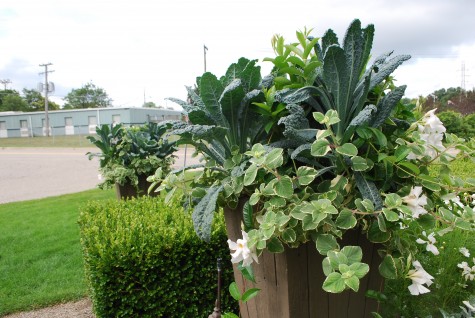
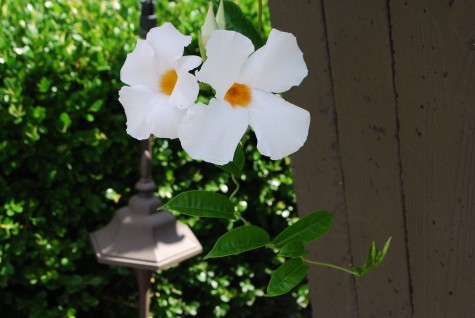
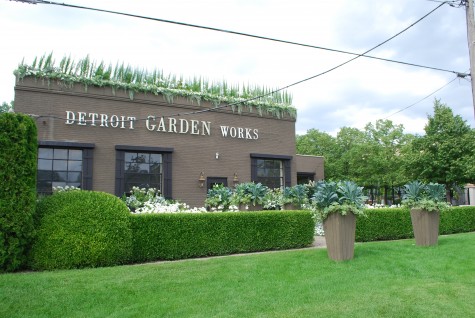
I planted the pots in front of the shop this year with the aforementioned kale, green and white variegated plectranthus, and sun parasol white mandevillea.  I thought the three planted together would make for some interesting conversation.  This plectranthus is lax growing.  The thick stems will droop under their own weight.  They grow vigorously-in this case, they are growing vigorously around the kale that are loosing their lower leaves.  Their trailing habit makes them the perfect cover-up for those awkwardly leggy and stiff growing kale. 

Related to coleus, they do respond to pinching back, but once the weather gets hot, they grow with huge stem spaces between the leaves.  This puts them on the verge of becoming a vining plant.  This does however take time.  They are great for a gardener that likes to watch things grow.  These pots in their infancy were not all that great looking.  I avoided looking at them all together for the first month after they were planted. 

These concrete pots are quite tall, and have a smaller planting area that what I would like.  Though they have a graceful presence as an object, it is not easy to grow something in them large enough to balance all that pot height.  I think this planting is my best shot ever at getting a finished proportion that is right.  We have had such a warm and rainy growing season this year that the pots are already rootbound. Maintaining these another few months will be a challenge. I need more horizontal volume from that plectranthus-judicious pinching back is in order. 

The third party at the table, the white mandevillea, is a tropical vine that doens’t begin to get going until the weather gets really hot.  This plant did not perform particularly well last summer, as the weather stayed cool.  The Sun Parasol series is known for its glossy and disease resistant foliage. The red cultivar is particularly heavy blooming. My experience with other varieties, such as Alice de Pont-spider mites and mildew rule the day.  No thank you.  Though this plant is a vine, I decided to grow it as a trailer, and let the chips fall where they might.  One never knows what a plant will do, left to its own devices.   

Early on, I was worried this might have been a mistake. The pots looked ungainly, underscaled, and ill-defined.  But plants seek the sun, and live companionably with other plants.  Most of the plants on this earth manage to live and prosper without much help from people.  The three plants in these pots share one characterisitc-they are all vigorous growers.  The battle they do for light and water is creating the overall shape you see.  They share the light and water as they are fairly equally matched. The large mandevillea flowers help cover the leggy kale as much as the plectrathus does.  The mandevillea gets support from the stiff stems of the plectranthus. 

These tall pots are finally beginning to look like something.  The combination is to my eye more interesting than any of the individual plants.  Growing mandevillea as a trailer, and plectranthus as a climber and a kale for some other purpose than braising is what makes gardening so interesting.  Whenever I visit a garden or a landscape, a good deal of what I see is that conversation between the gardener and the natural world.  Is there an interesting conversation going on?  Is one of the involved parties talking too much, or not enough? 

 I am hoping these containers are a little better than half-way to being good.  Should they never get really good-fine.  There will be something about the experiment that will help make me a more interesting gardener.

A New Outfit

If I had to do without a clothes closet, I probably could. A big box would probably hold it all. I have five choices of a dressy outfit, most of which date back at least 15 years.  I wear a Land’s End super pima cotton collared golf shirt to work every day-I have 10 in an assortment of colors.  My work clothes are comfortable and serviceable-Plain Jane, to say the least.   When they get to that ratty and dilapidated stage, Buck gently suggests that I might want to consider a new look.

 My work boots are old and comfortable.  My sneakers get replaced twice a year-they curl up and get uncomfortable from being soaking wet so often.  What a nuisance to replace something I am more than comfortable with; I do so, reluctantly.  I have 3 pairs of dress shoes.  A pair of hot pink cowboy boots with light pink toes are available, should I feel like going all out. The thought of adding to this wardrobe, or changing it out althogether, fills me with dread. I am not really great with  change.

I am always convinced I have no time to add or make changes to my appearance.  Regularly I am in the ladies room at work with a dull pair of scissors chopping at my bangs-I am sure I have no time to go see Suzette.  Never mind that she and her group at Salon Suzette cuts and styles expertly, and reasonably. Never mind how great I feel when she cuts my hair-the new do makes me ridiculously happy.  No, I persist in hacking my bangs with dull scissors, producing a result that would remind you of my second grade picture. What is my idea? 

Professional styling is not such a bad thing. But should you be reluctant to give over any design to a third party, hear this. I am  incredibly persistent in preserving my status quo.  I would bend over backwards to keep everything the same.  What so exasperates me with clients, I see myself doing.  This is what has encouraged me to spend a lot of time explaining and teaching.  All of that time spent is of benefit as much to me, as to others.  I have to be prepared-should I advise, teach, explain, or design. I sort through and verbalize my design process-hopefully to good end.  Change is disruptive, irritating, and expensive-I try to make it sound like fun.  Are you able to make your landscape renovation seem like fun?  If not, ask for help.

Hanging on to what was once historically gorgeous might be admirable.  Statistically speaking, there is an equal chance that the hanging on to what once was might be as much a product of a dislike of change as an interest in historic preservation.   I chide myself over this very issue.  Am I preserving those landscape gestures that I did 2 years ago, or 14 years ago, because I should, or because I am reluctant to make a change?

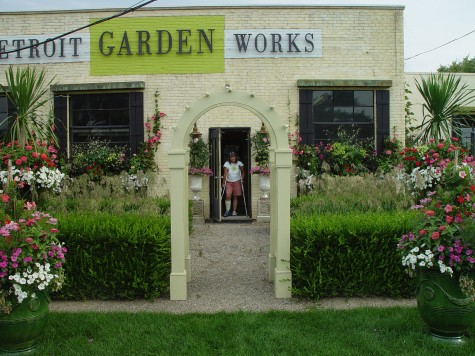
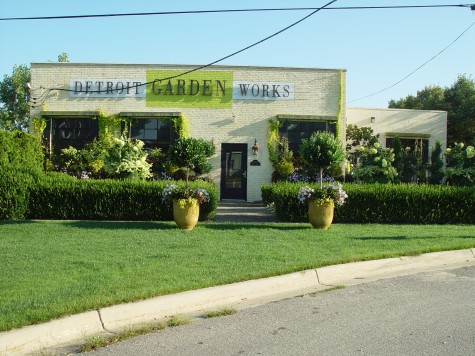
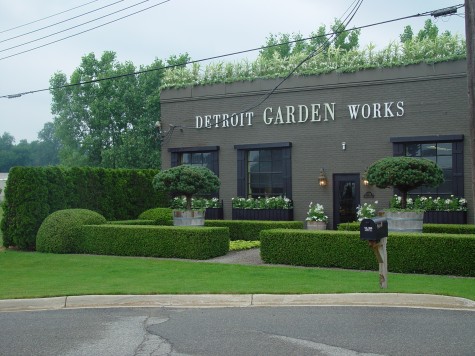
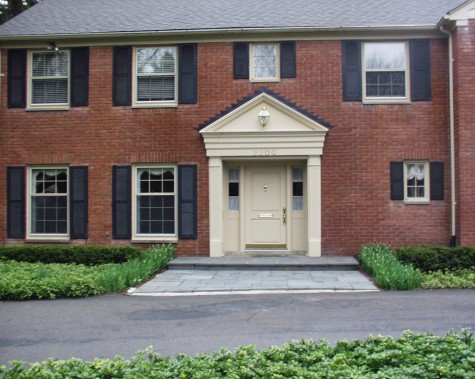
Good design is not about money.  A master plan design-it is good, or bad, or mediocre. Do not associate your money with your design-this is a bad move.  How you choose to implement that design is up to you.  Plant sizes, yearly projects-you are in charge of what you devote to a project at any given time.  Nine years separated these two photographs.  The blink of an eye, actually.  But the bits added or amended over the years can add up to a lot.  The new shoes I buy are never better than the first day I own them.  A new landscape gesture, no matter how small, done properly, only gets better with time.   

I bought my house in 1996. I never saw the horrific color of the trim, or that ghastly color visited upon the only 4 urns that the GM foundry ever made.  I saw something a camera could never record.  I was sleepy about renovating the landscape until the day I was fifty.  I realized that if I did not get going, I would die, never having had a landscape and garden of my own choice and doing.  I got going.    


Fourteen years has made a big difference.  Did I have untold money to put to the new outfit-of course not.  I did one major and one minor project a year-for years on end. This is my life and passion-of course I would do 2 projects a year. I still have the original design for the property-mostly in shreds from my years referring and reconfiguring. If a beautiful landscape is swirling around in that cauldron that is your life, one gesture a year, however small, can make can make for a dramatic change, given a decade or more.    

People with vision and determination build new houses.  I could never take that on.  Too many decisions, a too fluid situation, a project in which the end is ill-defined-this is not a good place for me.  I am much too resolution oriented to build a house.  I have plenty of clients who build beautiful houses.  I understand that when it comes time to dress the house in an appropriate landscape, people are not only tired of the construction, they have had every dollar wrung out of them.   


The insult of the construction will fade. Lots of new house landscapes are more about obtaining an occupancy permit, than a landscape that works beautifully.  The interest in a new outfit comes sooner, or later.  The house I bought has a new outfit, some 14 years in the making.  You do not see the years, just the change.  The one tree you plant today, per your master plan, will delight you in 14 years.  The 3 hydrangeas you plant tomorrow, on you way to a hedge of 30, will encourage you to keep going.

My advice? Master plan your landscape and garden-whether you do it yourself, or get help.  Then buy and plant the landscape equivalent of a new pair of shoes.  Every year.  I recommend this.