A Modern Landscape


I am sure every city in every state in this nation has those larger than life, extraordinarily talented people who produced design that endures.  My city has many examples of residences conceived and built by Harold Turner. This master builder, responsible for the construction of many buildings of Frank Lloyd Wright, went on to build a number of residences in my city whose beauty still shines so many decades later.  I am not an architectural historian, nor am I well versed in the life of Harold Turner, but I knew my client had purchased a home of architectural and historical significance.  My part of this-study that building, the grades, the views,  the spaces-and make a move in concert.            
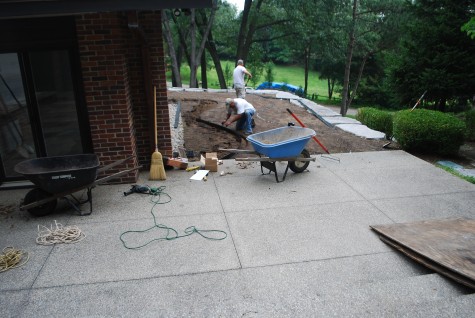
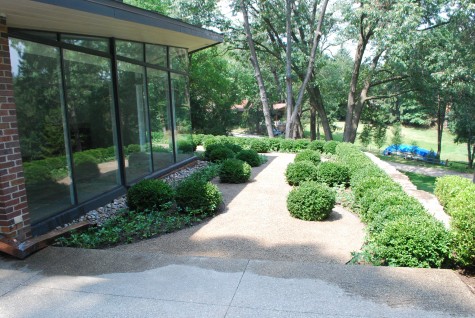
The living room of the house faces the rear of the property.  Floor to ceiling windows ask for the outside to work seamlessly with the inside, and provide year round interesting views. A wide open L shape, each wing of which is some 30 feet by 14 feet,  describes on the ground plane a pair intersecting glass walls.  Terraces at either ends of the wings suggests a landscape which permits leisurely travel from one end to the other. 
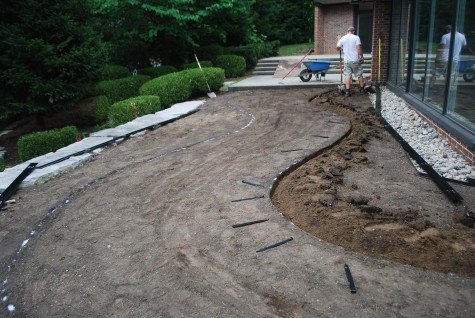
The strict geometry of this rear profile of this Turner house filled my head with curves.  How so?  The glass prow is so strong, why would I interpret or dilute that gesture?  Repeating the geometry he established for the house-what need would there be?  It seemed to me that a simple but sculptural landscape that made much of the view the design of the house made possible was in order.  
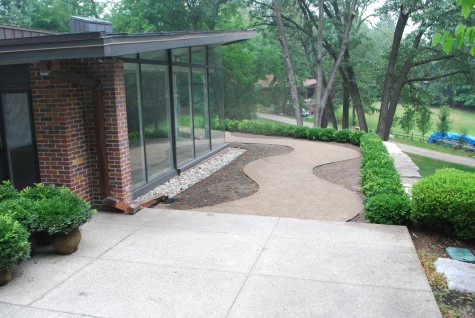
This landscape plane was entirely grass when I first came to visit. A default design.  This space had no need of a mower-it had need of a landscape of interest that would look good in any given season.  The journey from the library side of this house, to the master bedroom side of this house-it seemed to me that a path would figure large in the landscape design. The stone retaining wall casually stacked and irregular in shape seemed out of keeping with the palette of materials established by the house.  An initial hedge of Green Velvet boxwood screens that stone from view, and encloses the space.   
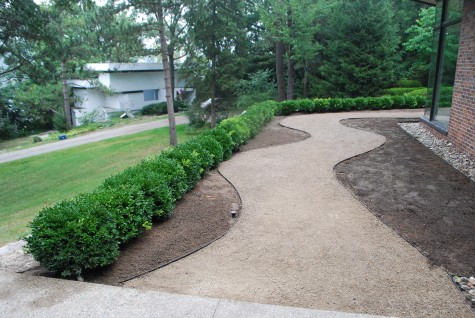
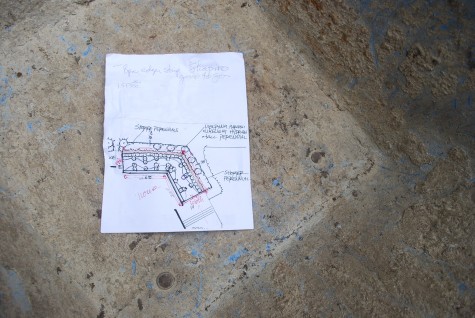
Decomposed granite is a favorite material of mine.  I mulch plants, I build driveways, I compose entire landscapes around that material that brings the parks in Paris to mind.  A walkway all about generous curves seemed a good companion for this house. My client does like to entertain; the wide walk makes for places for guests to visit, and good circulation.  The granite is a quietly versatile material that echoes the surface of the existing concrete aggregate.  Used in conjunction with steel or aluminum edging, it can cleanly outline interesting shapes.
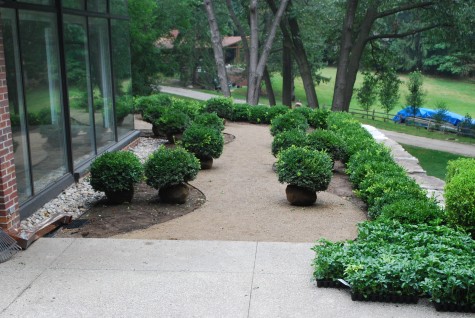

There is always the danger that a small space will become a corridor to somewhere else-a visual racetrack, if you will.  Planting another series of boxwood, set perpendicular to the house and boxwood hedge, will slow down the traffic.  Unlike the boxwood in the hedge, these plants are placed in the bed, and in the gravel individually.  Individually placed plants read as individual sculptural elements.   
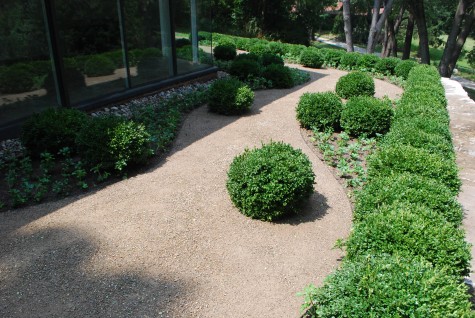
Seven sets of three plants each are placed such that the gravel walk space opens and closes.  Pachysandra fills the empty spaces in the beds; when grown in, their mass will reinforce the pattern of the walk.     
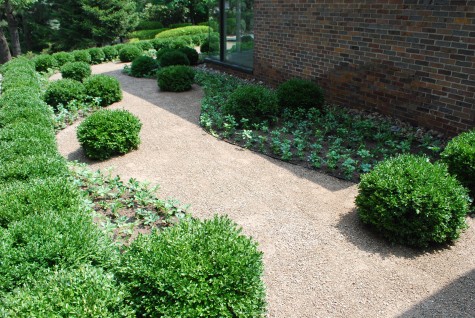
There will be decisions to be made about the pruning.  The hedge could be boxed-the individual boxwoods pruned as spheres. Or vice versa.  The boxwoods set in gravel could alternately be pruned as squares and spheres.  The distinction that is drawn between the inidivdual plants and the hedging plants will be an important part of how the landscape reads visually.  We will see what direction my client is inclined to take.  Beyond this decision, the maintenance will be minimal. 
Weathering The Heat And Drought

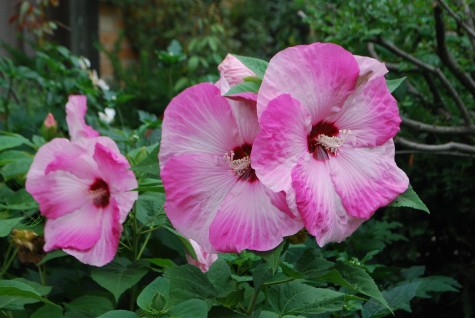
A garden suffering from mid August heat and drought prostration is not a pretty sight. The street trees in my neighborhood are shedding green leaves like crazy-in an effort to conserve whatever little water there is stored inside.  Fewer leaves means less evaporation.  This might be akin to that white knuckle moment in the movies when the plane that is out of gas 25 miles from the English coast jettisons its fuel tanks, hoping a lighter plane might glide a few miles further towards land.  The weather is keeping me stubbornly on the business end of a hose every day.   My giant hardy hibiscus-who knows how a flower of this size, with such ultra thin petals manages to stay looking this fresh.  Perhaps the fact that each flower is open scarcely more than a day might be a factor.  Plants that withstand great heat and need little water may be an appropriate landscape move in hot climates, but one never knows what to expect in Michigan.  This makes smart watering a garden issue worth discussing. 

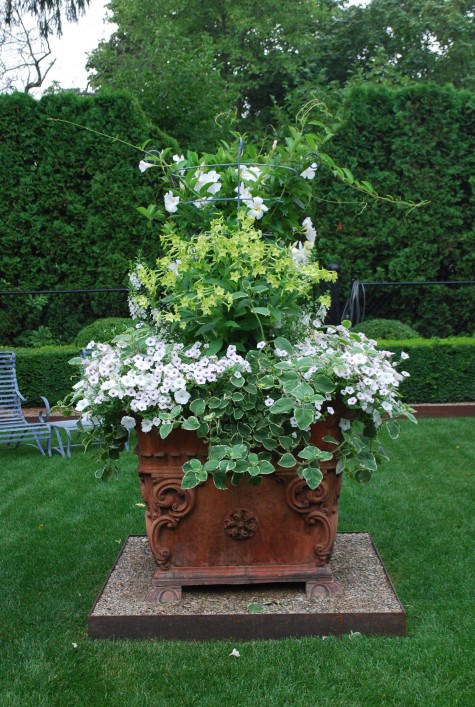
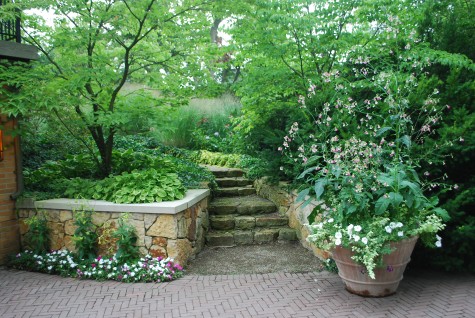
This concrete container is large enough to hold two full grown gardeners with ease.  This means it holds a whomping lot of drainage material and soil.  A huge soil mass means less frequent watering is needed.  I have been worried about the nicotiana in this pot; they are not so fond of very hot and dry weather. The large mass of soil in this pot means it stays evenly moist; this pot is more likely to handle my neglect until I can get to it with a hose.  Even and steady moisture means the planting weathers the dry hot spells with ease.  Small pots with little soil mass can become a watering headache in this kind of weather. If you have your pots on a sunny terrace, multiply the effects of the heat by 2 or 4.  Paving absorbs heat, and reflects light back up at you-and the plants in your pots.  Plan for giant pots in the sun-your smaller pots in the shade.  Pots set in the lawn are easier to look after.


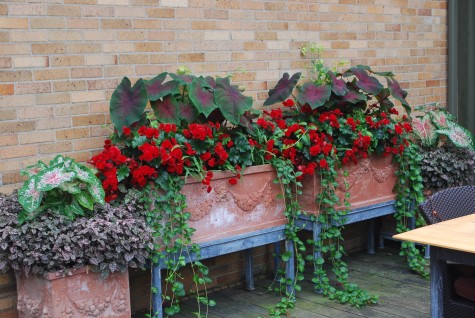
Shade has a huge impact on a plant’s need for water. Direct sun accelerates the rate of evaporation from soil and leaves.  The shady spots in my yard always feel cooler.  The soil in these Italian terra cotta boxes is much cooler to the touch than the pots not 3 feet away-in full sun. They need much less frequent watering. The exposure to full sun should likewise influence the location of a terrace, should you be thinking of building one.  If you expect to spent time relaxing, or having dinner on your terrace, the position of the sun during those hours you are most likely to use it should figure prominently in determining a location.  If your terrace is in full sun late in the day, you will need a pergola, or an umbrella.  Gardens, landscapes, pots and people in sunny locations will need special attention during a prolonged hot and dry spell.

Woody plant material is much better equipped to handle extreme weather than any annual plant. This yew topiary has an extensive root system; the individual needles transpire at a much slower rate than a ligularia leaf.  Planted in a container large enough to put a substantial soil mass all around that rootball, the petunias and bacopa planted on the edges tolerate the less frequent watering appropriate to the yew.  Pairing plants with similar requirements for water simplifies the watering process.  

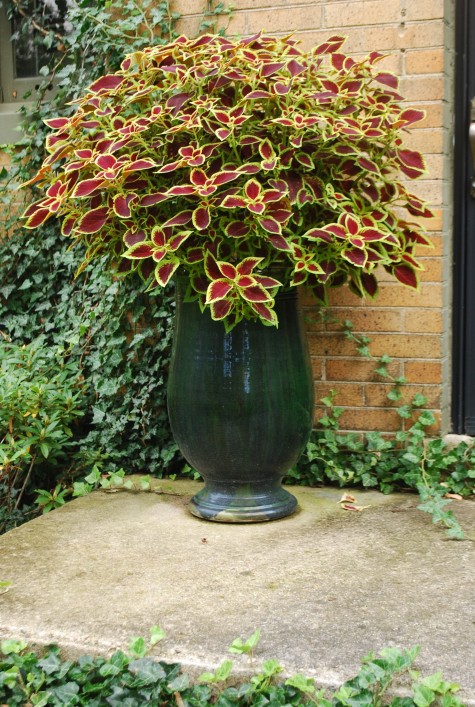
Some clients are reluctant to plant in shady locations; they tell me the choices for shade are few, and the few that do work make them yawn.  Nothing could be further from the truth. This large sphere of coleus is striking; at the kitchen door, in 1/2 day shade, I only have to water every 2 or 3 days.  Coleus offers more consistent top to bottom color than most flowering plants I know-whether they be annual or perennial. Their leaves may wilt in the heat, but their stems are juicy.  Like begonias, the stems store water.  They survive hot weather just fine.


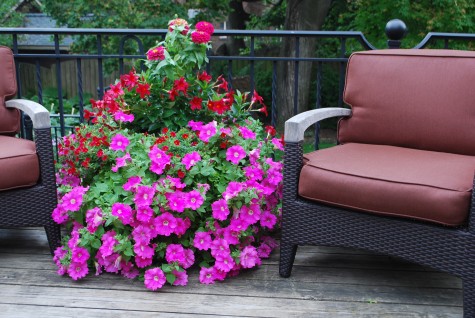
Always my plan is to design and grow my plants so they insulate the surface of the soil from the late summer sun and heat.  Though heavily rooted containers will demand more thorough soakings, nothing dries out faster than one lonely plant bereft of company-whether that company be mulch, or the leaves of other plants.  Every plant in this container has their own place, but they overlap one another enough to provide a little shelter from the weather.  If you garden in terra cotta pots, you know that water evaporated through that clay from within at a much faster rate than a pot of some synthetic, non-breathing material.  The petunias that cover the terra cotta here is slowing that evaporation rate.    

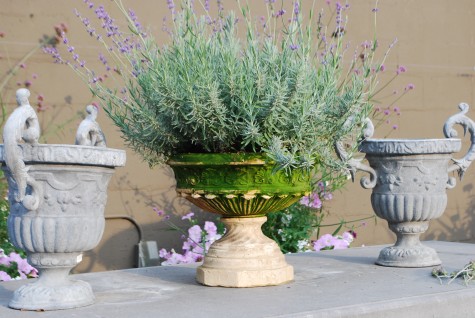
This small urn, placed on a Belgian bluestone table in full sun, is planted with the right plant; lavender is obviously heat resistant.  The silver foliage reflects light rather than absorbing it.  The needle leaves transpire at a lower rate.  Lavender can also tolerate drought like conditions once established.  In my zone, they die from too much water in the summer, and soil that is poorly drained and stubbornly saturated over the winter.  I never plant them as a hedge, as sooner or later, one will succumb to the reality of an environment which is not so well suited to them.  In pots, kept on the dry side, they shine.  That is not to say this pot does not get frequent water.  The moss on the pot,dependent on regular water, is thriving; the lavender, dependent on perfect drainage, is thriving too. 


My shady spots are thriving right now, in spite of a long run of dry and hot weather. My hot spot plantings look good as well.  Planning ahead to manage a weather situation you may or may not face-this is an important part of good design.

The Gardener’s Guild

Guilds date back thousands of years.  Originally they were associations of craftpeople-metal workers, stone carvers, textile weavers- and the like.  Groups organized around an interest and practice of a certain art or craft make perfect sense. The exchange of knowledge and experience of an individual in a group setting an activity most people take part in regularly.  The PTA, the AMA, the Michigan Bar Association-these are giant guilds with complicated agendas.  The Independent Garden Center association is a guild which meets in Chicago every year; I am on my way there next week.   

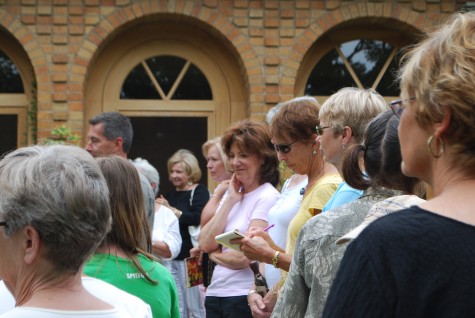
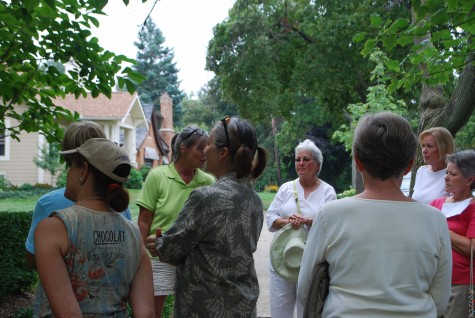
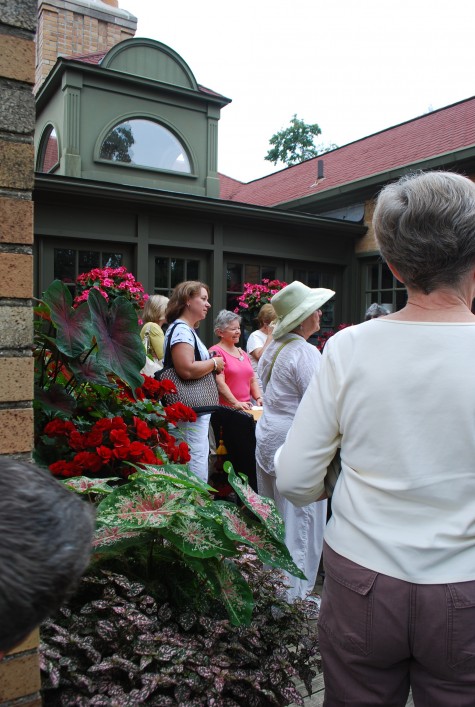
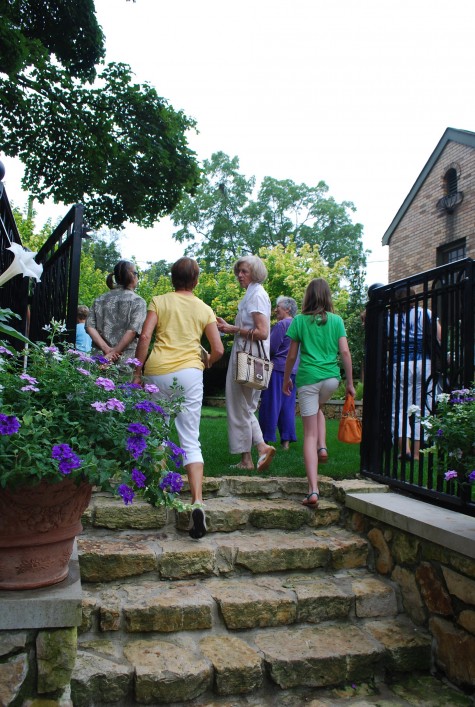
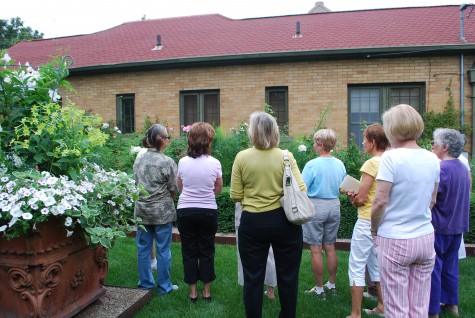
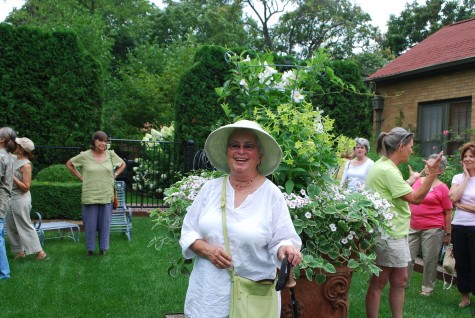
That’s me, in the lime green shirt-hosting a meeting of the Gardener’s Guild-in my garden.  I have been speaking to various groups on various topics for the better part of twenty years now.  I think I am a decent horticulturist, a committed gardener, and a good designer-but there are plenty better at all of these topics than I. What I do think I best have to contribute is that I am willing to present a cohesive discussion of how I came to garden, what influences me, how I make choices, where I think my landscape might be headed.     

I have a voice, and should you ask me to use it-I will.  The Gardener’s Guild is an interesting and attentive group.  All of them dig in the dirt, and drag hoses.  They work their gardens.  For this reason, I like being a member of their guild for a day.  In general, I am not so keen to meet around a conference table and talk about plants.  Part of what I so like about gardening for myself is when I am alone with it-the sound of the cicadas, the weeds I spot in the gravel when I am watering, the panic grass waving in front of the sentinel yews, the sight of the corgis blasting through the boxwood. I am not so group oriented.  

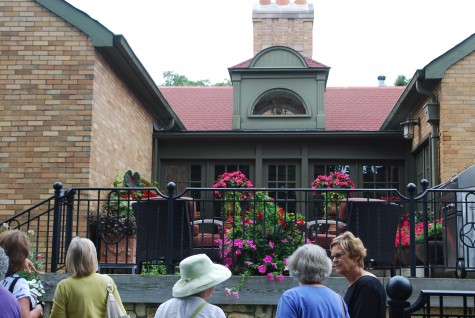
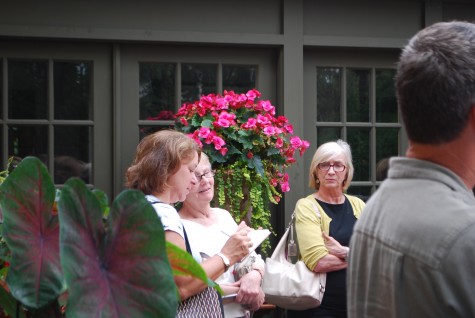
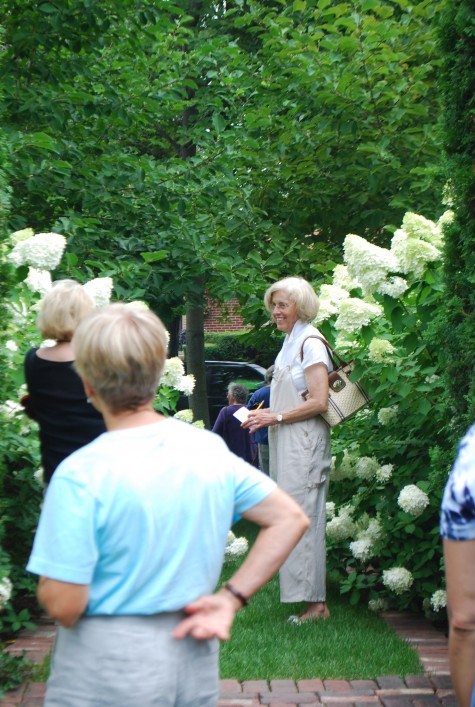
Lauren Hanson took all of these photographs. She worked for me in the shop for 3 years; a better job for her husband took her to Texas last November.  A trip home to visit her family included a visit with me.  I can see in these photographs that she misses our guild. How she composed these photographs makes me feel good-the guild  gave her something that changed and endowed how she looks at design.  This photograph-all about the interaction of people and plants. Never mind how I garden on my own-she recorded an exchange-a guild meeting.

When I say I like this group, I really mean that I value their focus and attention. They asked questions about every plant, every design move-they followed my discussion.  I saw more than a few notes being taken.  Not that I think I have anything to say that warrants recording-no one knows better than me that the gardening world does not revolve around me. But I like when a meeting is convened where I am the speaker, that all of the attending parties take it seriously. Should you be serious, I have no end of time to talk gardening with you. 

This occasion made for more than I expected in return.  Almost every Guild member in attendance made it their business to talk to me individually.  Though I do not belong to any guild, each and every exchange with this group had something interesting going on. 

This group of dedicated gardeners?  Truth be told, I think they are vastly more interesting than my landscape and garden.  My property was this day filled with voices-all different, all compelling.  Each individual with a story to tell, a pertinent question to ask, made me think.  No gorgeous landscape lives on beyond the patient and committed attention of the gardener in charge.   

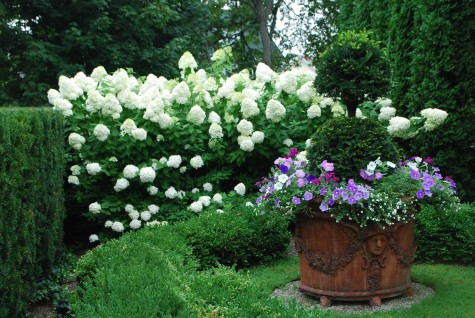
Star, in her linen overalls, looks better than great against my Limelight hydrangeas. She is as serious and committed gardener as I have ever met.  This was her first visit to my garden; she seemed pleased.  Members of a guild-they are all different.  All individual.  But all after the same thing-a great garden.

Many thanks, all of you members of the Gardener’s Guild.  The two hours we spent together yesterday-loved it.

Towards A Better Arrangement

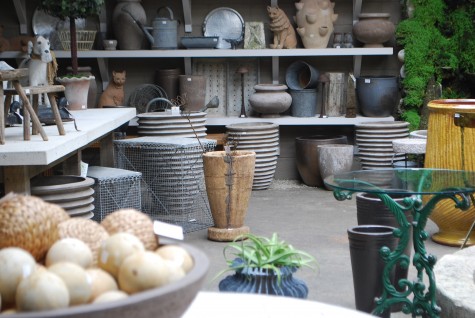
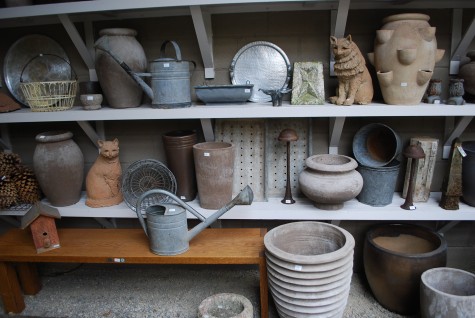
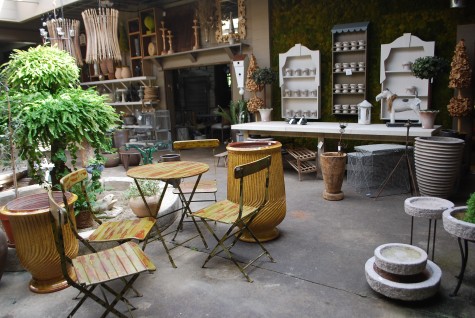
My last post ended with this picture; lots has happened with this space in the past two days.  I am standing in the entrance to my glass/greenhouse space; the camera frames what I see from the doorway.  I have tried to arrange everything such that the view of the back wall is framed by objects in the mid ground space.  This makes for an invitation to enter the space, and explore.  I have combined objects with a vintage, and contemporary feeling on the shelves; I like how they work together.  A shelf has height and depth-I try to take advantage of both.  Some objects are parallel to the back wall, some objects come forward in the space.  The cats and dog are great in this space; they make eye contact, and say hello. Three objects-the glass bistro table with the painted green iron base, the yellow Anduze pot, and the contemporary carved wood vase-attract the eye, as they are much different than the predominant color scheme.  It’s only natural that your eye would focus on that which is different. Moving from one of these objects to another constitutes engagement.  If you can move a viewer to interact with a space, they will take the time to see what you have going on there.  If the spaces are confusing and disorganized, a viewer will opt out, see little, pass by.   

Objects that contrast but still harmonize in shape, size and color make good companions.  Always with a vignette I am making a suggestion about what I think would look good together.  At the very least, a well organized space can help another person to organize their thoughts about what does not appeal to them.  Some are gifted with the ability to see in spite of chaos.  I think this quality helps to make Rob the buyer that he is.  He can spot the one item in a mountain of stuff that has the potential to endow a garden. He has the ability to focus on an object and not be disturbed or distracted by its environment.    

Shelves are rigid and confined structures, but that does not mean that what goes on them needs to be visually confined.  Up and down, in and out, what is an unexpected, what is repeated-all of this goes towards engaging the eye.  The little primitive wood birdhouse clearly needs a better spot-it looks lost, does it not?  The oak bench needs enough of its top available to see, and to test out. 

Really special objects ask for a place for the eye to stop and rest. These balsa wood decoys of mud hens date back to the early 20th century-the dealer thought they came from the Maumee Valley of Ohio. Though diminiutive in size, and somber in color, they are quite beautiful sculptures.  They deserve a thorough look and see, so I placed them to reflect how I feel about them.    

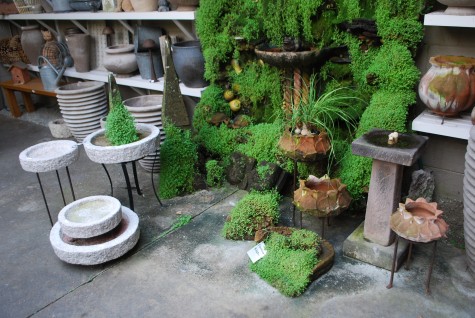
Our wall fountain, encrusted with shells, baby tears and moss attracts a lot of attention.  I like for people to be able to walk right up to it.  A collection of pots that readily moss up, and granite bird baths of various sizes make sense in this context.  The old English stone birdbath stands out, as it is so different in period and shape.  Any small subtle object benefits from a placement that draws attention to it.

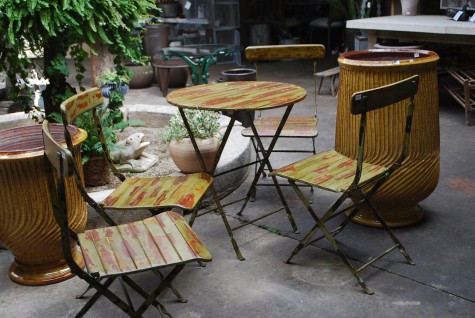
The wood bistro set with matching chairs gets a big boost from the yellow French strie pots. The colors of both harmonize in a very strong way.  There is a visual reference between the slat stripes and the clay stripes, that is more subtle than the color relationship, but it is pleasing.  Sometimes a client will say they are inspired by something.  I would say if an object and its placement triggers some response, for good or for ill,  the vignette is working.  I am never bothered by anyone saying they do not like something.  I am much more bothered by an arrangement people ignore, or walk by.

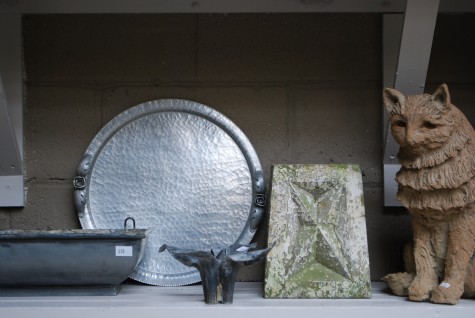
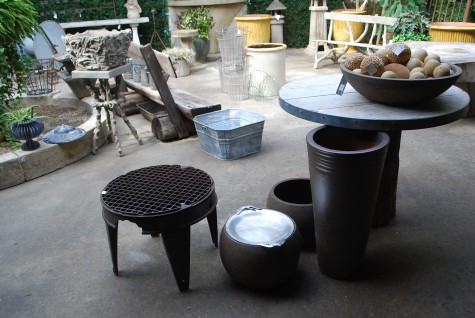
I have moved the washing machine base table away from the wood topped tree trunk table, but kept them associated.  The blue galvanized wash bucket across the way echoes the pale blue wash of the big table top, and its galvanized metal edge.  A vintage aluminum tray puts a grey metal object on both sides of the aisle.  That shiny object draws attention to a group of objects that are dark. The volumes and shapes are simple and friendly to one another.  Any objects I would hesitate to put together in my own yard, I would not put together here. 

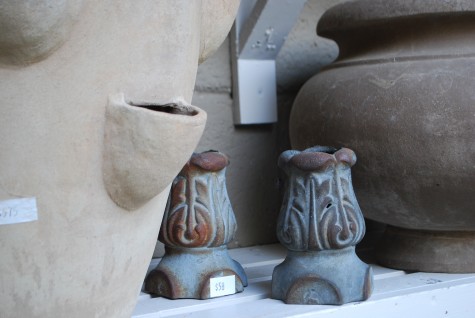
As much as I love the shapes that plants create in a landscape, I love the shapes of all manner of objects.  I try to display each-from the smallest to the largest-in a way that communicates my interest in good design. There are so many beautiful things that would not work or be appropriate in my garden, but taking care with their placement is a sign of appreciation for the object, its maker, its history, and its use.    


Things are looking better already.