Order In The Court, Please.

Everywhere I look in my shop, there are signs of dissolution, depression and disrepair-the late summer doldrums have set in.  August in Michigan is glaringly hot and dry-nothing much on deck but that sun that is so hot- promising to soon go low, and signal the fall.  Great.  The perennial garden is every unhappy shade of yellow, accented by some purple bits. Time to pick up, dust everything off, and remake.  Every space in the shop decimated by early summer sales worries my eye.  How’s that?  I can try to explain.  In this picture, I see 9 containers whose relationship to each other is unclear.  This looks to me like a person was comparing containers of the same shape in different materials, in an effort to sort out what they liked.  I think I am looking at the remains of their discussion.              
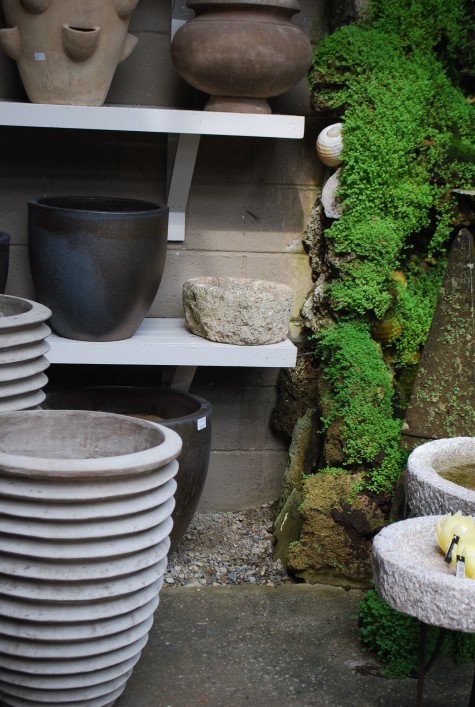
What we have going on here I call a gaposis.  This word of my own invention refers to those places that have gaps-something is missing.  The stone mini-cistern is not so friendly to the shape of the brown glazed pot next to it.  The empty floor space suggests that which held this visual space together is no longer there.  Any gardener who has ever lost a tree understands this look.  Spaces-terraces, landscapes, cities, communities-  are best organized around that element or group of elements that sets a mood.  If you do not have any mood-making going on, it may be time to rearrange. 
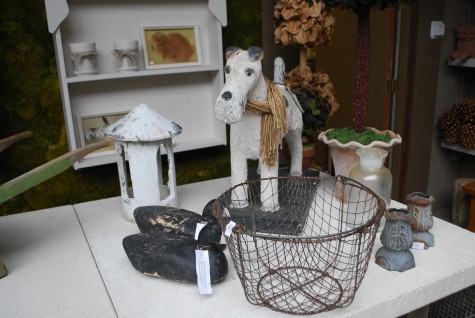
This small space has so much going on that nothing is going on.  It is difficult to make sense of the space-what was the intention here?  I am sure there was no intent; I am thinking these things are new to the shop, and waiting for a home.  People respond strongly to the overall look of a space.  Since we are as much interested in design as we are in garden ornament, our intentions are important.  Landscapes with a strong idea that is intentionally expressed are visually successful. 
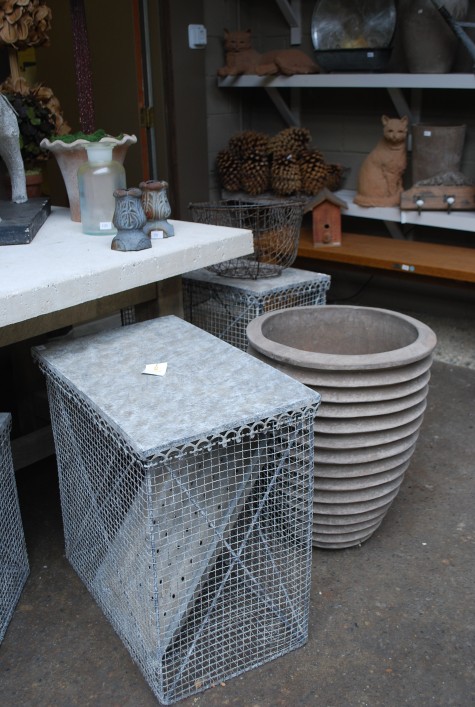
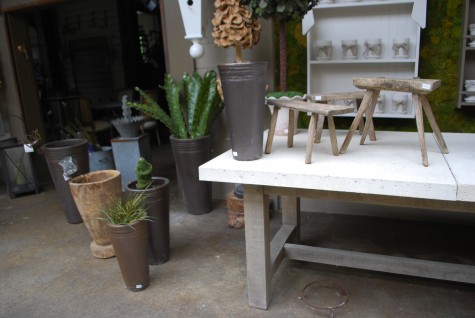
This concrete table with a Belgian oak base is very good looking.  Three objects tucked underneath its top obstruct one’s view of the table legs.  The wirework boxes look stored, not displayed.  That every object is the same height-that height that fits neatly under the table top-is visually sleepy.  I like objects arranged at different heights, and in different planes.  A row of matching arborvitae that describes one plane in a space is asking for what comes next.  The relationship of one plant to another, or one object to another, is often more important than the individual elements.  There really is no such thing as a boring plant, or object-only boring placements.  
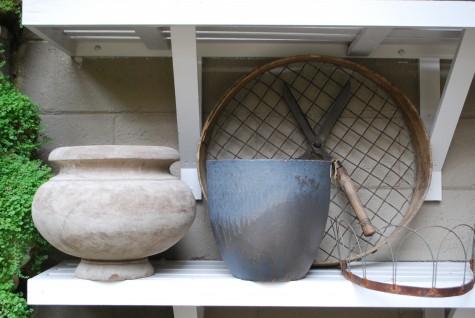
Varying the heights and sizes of objects in a shop is very important. Anything that cannot be clearly seen will be ignored.  In the landscape, a view to something beautiful needs framing, not blocking.  It is not always so easy to figure out what goes together in a lively and fresh way. I may move something around 10 times, and finally give up-hoping inspiration might strike at some other time.  I greatly admire those people who dress shop windows in an exciting way.  When I see an interesting plant, my very next thought is where that plant might be placed to good advantage.
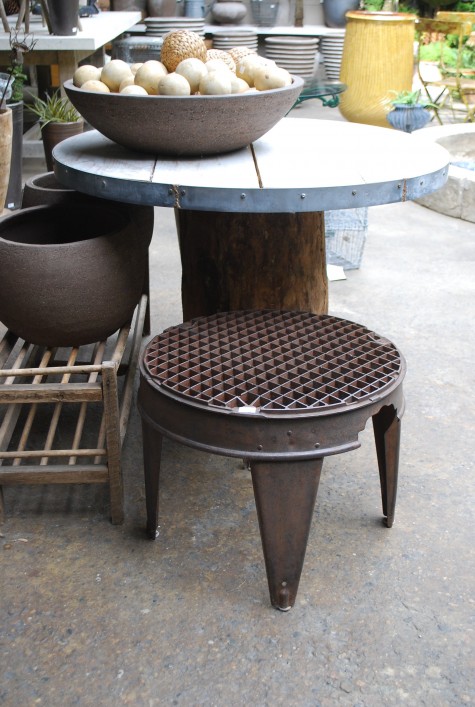
Both of these tables are very handsome in their own right.  Each needs its place to shine.  I would be very confident having both, but I would separate them such that my eye would move from one to the other. How strong elements are placed in a composition makes for movement and rhythm.  As for the old English shoe rack pictured above-it was never meant to hold big heavy pots-physically, or visually.  I find that once you use an object for the sole purpose of displaying another object, you diminish its visual stature.  Any designer in charge controls the volume and pace of a composition.  While one Japanese maple may be singular and visually stellar, rows or blocks of them become something else entirely-a crop.  Picking the best maple from a block-tougher than you might think.   One of my most favorite gardens was accidental in this regard.  I had such a love for peonies and more peonies,  I lined them out in rows, just to get them in the ground.  This desperation placement diminished the importance of the specific variety in favor of an overall look that enchanted me.         
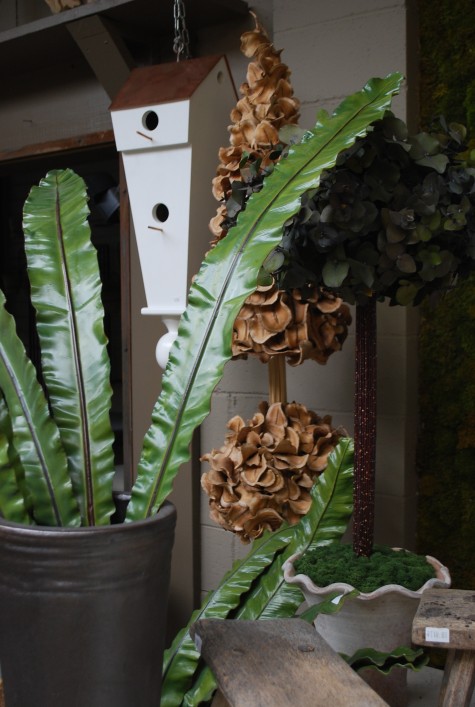
Texture is a very important element in design. There is plenty of texture action going on here, but the result is muddled.  Layering one plant against another, or one object against another is loads of fun.  I have moved around more plants more than I would care to admit-just to get that arrangement which suits me.  This arrangement I would try to simplify-it just needs more air space.  That is my point of view speaking.  Another person might find this densely occupied space just perfect. Congestion is not for me. Differing points of view makes for very different outcomes.  This is precisely why I like OPG’s- other people’s gardens are great fun to see.   
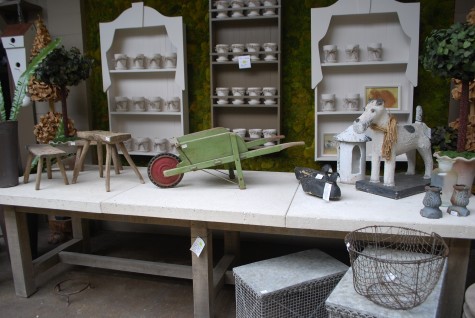

I imagine there is some gardener somewhere that has a vintage child’s wheelbarrow as a centerpiece on their dining table, but I worry this placement does not do justice to this one.  No doubt I will need to drag it all over to find just the right spot.  
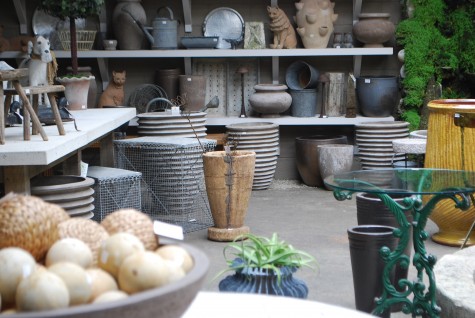

The end of the spring/early summer session in the shop means there will be some time involved in recreating a mood.  I was well on my way when I took this picture; more to come.
Patina

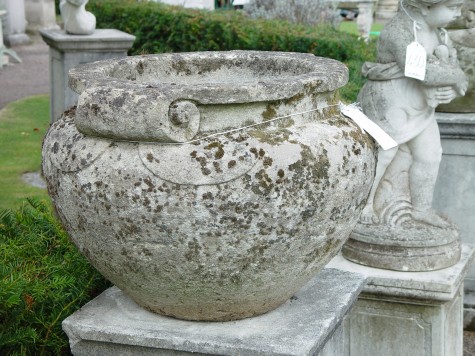
The word patina refers to an oxide that forms on a metal surface. Metals react with oxygen in ways that change their surface.  The most dramatically obvious patina is rust.  Iron and steel exposed to weather will rust; a patina of iron oxide will form on its surface, eventually corroding that surface.  The shiny orange brown color of new copper will turn turquoise/green and brown with exposure to the weather. Bronze and lead both acquire patina, with time. How surfaces behave, withstand weather, or deteriorate outdoors is topic of much concern to people who either manufacture or collect garden ornament. But in regard to objects used or displayed outdoors, patina can more broadly refer to any material whose surface has been altered by age and exposure to the elements. This English antique stone urn has a surface that clearly has aged.  The stone has become pitted and worn; these open stone pores have provided a foothold for colonies of lichens. Able to withstand extended periods of time with no water, lichens spring back to life after a rain sufficient such that the stone absorbs water. This weathered quality of the surface of this pot, surely much different than its new surface, is what I call beautiful patina. 

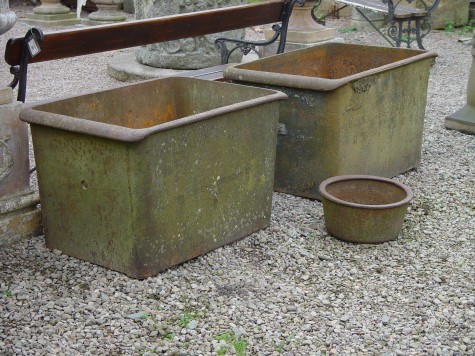
The surface of these old iron cisterns probably bears little resemblance to their surface when the new iron was first cast.   The hot rolled, pickled and oiled steel that Buck uses to create boxes and pots is all about a resistance to any patina.  When hot rolled steel comes out of the rollers, structural steel shapes are sprayed with a chemical that forms what is called millscale; this dirty, crusty surface coating makes the steel look dark grey. Plate steel or coiled steel plate is pickled; this chemical bath is designed to delay the formation of rust. A spray of oil over the pickled steel further protects it.  Suffice it to say that welding steel is a very dirty business.  These cisterns have acquired a patina of both rust and moss; a surface that stays moist is an ideal home for moss.  The color of this aged surface is subtly beautiful.   

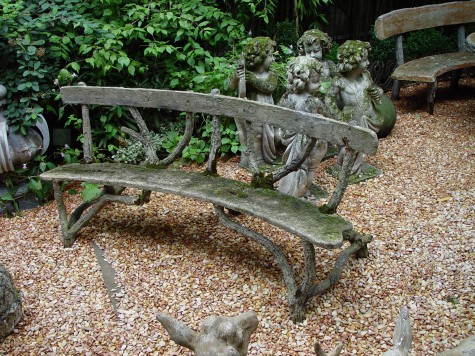
Concrete is a very porous material. Comprised of portland cement, sand, and aggregate rock, its surface weathers dramatically, given enough time.  The antique faux bois bench is probably 80 years old; its surface tells that story. The Italian stone putti in the background are carved from stone native to Vincenza, Italy.  This stone is exceptionally porous when new, and ever more porous as it ages.  The colonies of moss that have taken hold on these sculptures tell that story.    

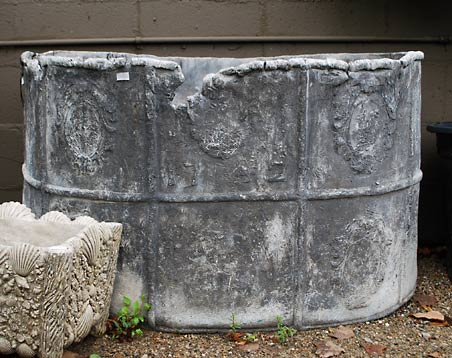
Lead is a classic material for garden ornament.  At one time it was considerably less expensive to produce ornament in lead, as opposed to stone or marble. It is completely durable,  impervious to any number of century’s worth of weather; this makes it ideal for placement outdoors.  Its soft and somber grey color is handsome in a garden.   The densest of all metals, lead is is also very soft.  A large urn will collapse on its own socle or foot, given sufficient time for gravity to do its job. I could make a mark in a lead surface with my fingernail; old lead has a decidedly graphic patina.  Old lead will develop a white patina in spots; very old lead may be quite pale in color.

  
This lead cistern, arguably several hundred years old, evidences every day of that history, yet it still does the job for which it was made.  It hold water.

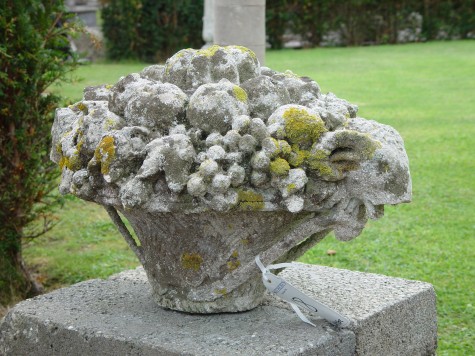
The patterns and shapes of this stone basket of fruit are blurred with age. I am sure that at one time, every grape and apple was precisely rendered.  I do not miss that stage, long past.  I like objects with a history, that tell a story of another garden at an earlier time.  The oldest object in my garden is no more than 70 years old. I like when my new things settle in, and begin to look like they belong.  

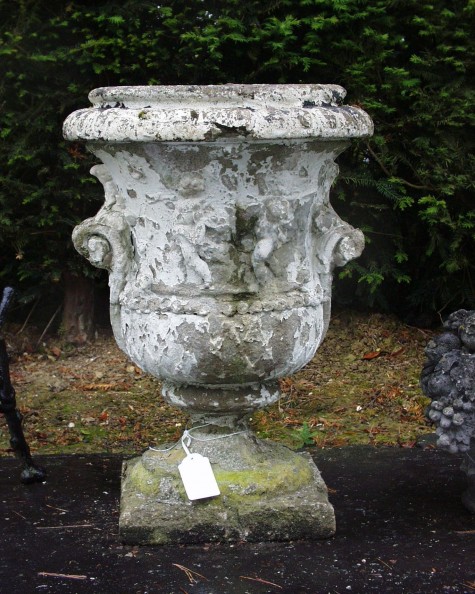
This antique English stone urn was at one time painted.  Who knows the story of the gouge in the rim, or the circumstances by which the surface has shed paint and stone so dramatically.  Garden antiques in perfect condition are rare.  By the same token, garden antiques in deteriorated condition have a character that cannot be reproduced.. Like a garden, there is no substitute for age on a garden ornament. 

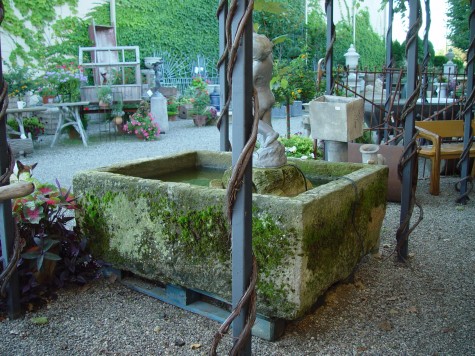
This antique English cistern was rough hewn from a solid piece of Cotswold stone at least several hundred years ago.  The suface is populated with more than a few species of plants.  The stone absorbs the water it contains, keeping all those plants on the surface happy and healthy.  I am happy to report it has a new home now with a gardener who appreciates its age and patina.   


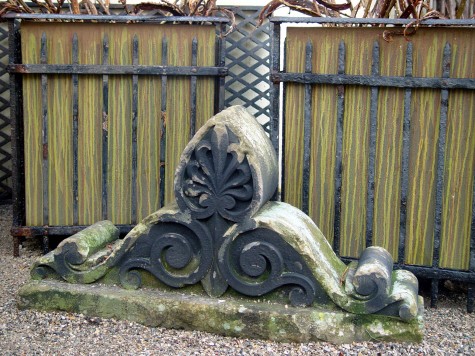
I know little of the hstory of this stone pediment, save that it is of English origin. The black patina which covers much of ther stone dates it to the Industrial Revolution-a time when the residue from burning coal patinated many architectural stone pieces.  This aged surface is visually striking.  Fragments such as this make a clear and compelling statement about time and nature.

Photographing The Garden

A camera is one tool a gardener should not be without.  You will not remember what your garden looked like on June 2, when it is the following March and you are trying to put a plan together for the new season.  No matter how simple the device, a camera provides a valuable record of that which is by definition ephemeral.  No landscape has a pause button.  It is always changing. Some things I do differently every year. I want to remember what was. I am not a photographer; I take snapshots of projects under construction.  I try to photograph all the annual plantings-although this year I am way behind getting that done.    

I do believe that gardens are never wonderful every day, day after day, but they do have their moments.  Ursula Buchan’s book “The English Garden” is chock full of the most amazing photographs of gardens at their perfect moment.  I don’t always know when one might present itself, so I drag my camera everywhere.  The camera is a monocular machine, and records nothing of my emotional investment in my garden.  There are times when it can see better than I. It helps me to see what I may be missing, or figure out what I do or so not like.  If you are like me, it takes a while to sort out what you would want to do again, and what you might not want to repeat.      

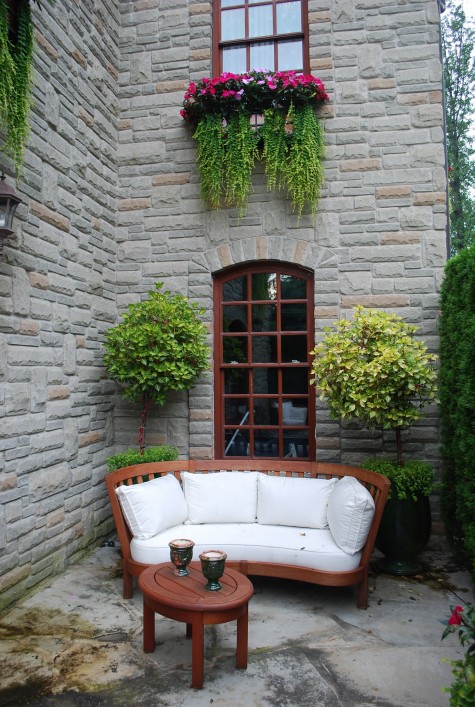
These two irisine topiaries are very different shades of green.  One gets a little more sun than the other.  How plants grow is very much dependent on their siting.  Growing perfectly matched pairs of plants even under conditions you would think were identical is difficult. If you go back to my previous picture, you will see what I mean.  Uniformity of growth is an important issue to hybridizers for exactly this reason. These are the kinds of things that occur to me when I look at my pictures.  

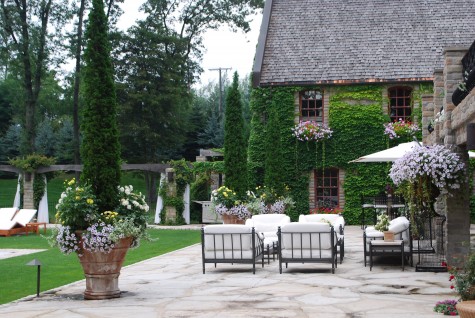
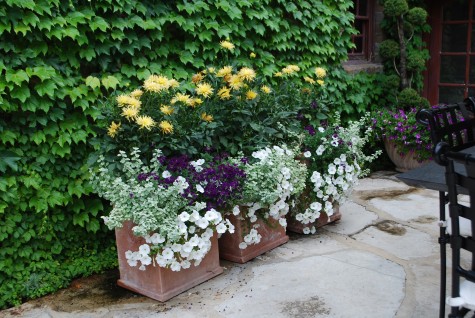
Color in a garden is delightful.  Light colors read well and stand out against the dark greens that dominate the landscape.  Pale yellow, lavender and white is a subtly elegant combination, and is repeated in these containers in different ways.  It is hard to do any photographing on a sunny day.  If you are an accomplished photographer, you will know what to do to get your camera lens to squint-this is a skill I do not have  An overcast day will permit pictures in which the color is saturated, as the light is even all over.   

Window boxes that are up high benefit from a simple planting, as you see a mass from a distance, not individual plants.  Vinca maculatum makes a great trailer.  They grow very long; their chartreuse variegated leaves are large and interesting. When I look through the lens of my camera, I see things in a different way.  As a picture has four edges, it can help force me to compose.  There is something interesting going on at every level on or against this very tall wall. I have a picture of that. 

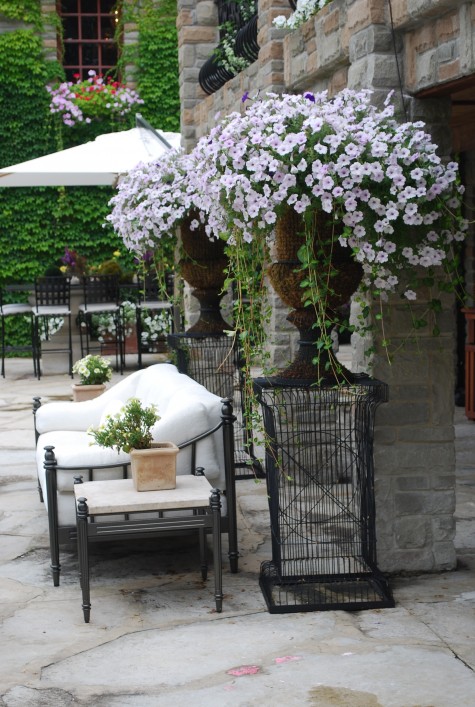
This wirework urn was planted with a single 10 inch basket of mini-petunias.  The plant is obviously happy with this location, and the amount of water is it getting.  I am also certain they are getting a regular feeding.  The vinca will reach the ground in another few weeks. I would plant petunias here again.

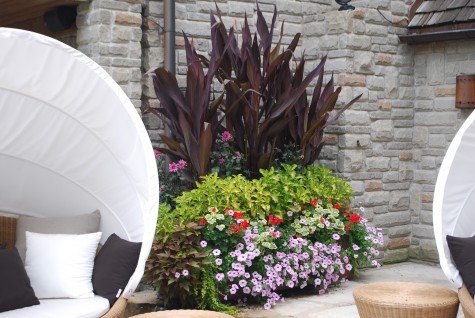
This iron cistern placed in a corner reds on its own, as it is isolated from the main terrace.  I have planted darker versions of the yellow and lavender.  On a whim, I added some orange bullseye geraniums.  Not everything needs to match.  The dark foliaged cannas look great with the stone and the trim on the house-this was not at all in my mind when I planted.  I have my camera to thank for bringing this to my attention. 

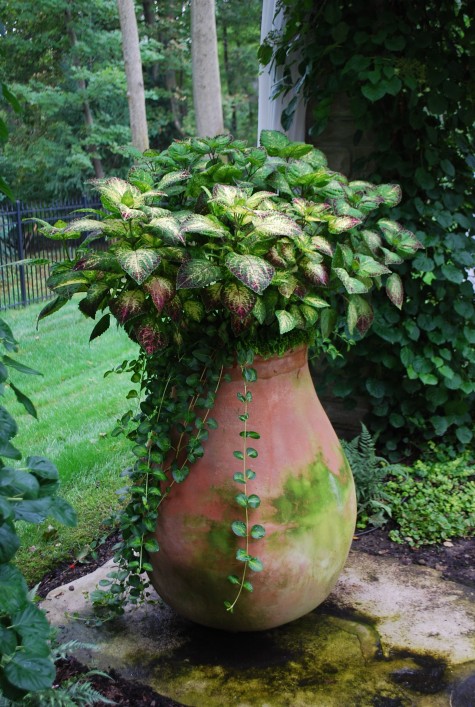
The planting in this Italian olive jar is pleasing in its overall shape, and growing robustly.  Set in a very shady pot, who knew the moss growing on the side of the pot would play such a big roll in the planting.   

Dahlias have dramatic flowers, but they come with with a lot of green leaves.  This picture suggests to me that maybe dahlias are better planted low, where the tops of the plants are the main view.  Or perhaps they need a plant will grow up in front of all that green without jeapordizing the health of the dahlia.  The flowers look like they are floating.  I have time before next season to figure out what would work better.  All of my snapshots will be a big help.

A Michigan Gardener

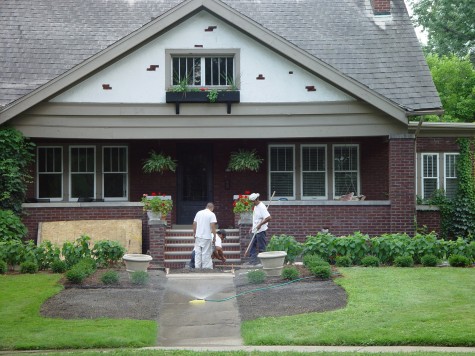
I have been gardening long enough to now have clients who are the children of clients.  I like this.  One such Bebe child belongs to one of my most favorite clients.  Cathy loves her landscape, and her garden, and she has put all of her effort and care behind that for as many years as I have known her.  Her son seems to have inherited all of this passion from her.  Though his favorite place to be is on the golf course, or horsing around with his kids, he is very keen about the out of doors.  Rich and Sue’s first house-a bungalow with not much of anything going on outdoors save some mature pines.  We got a plan together, including some concrete work, and installed the landscape.  Notice how the ground drops awkwardly to the sidewalk-we would fix this.

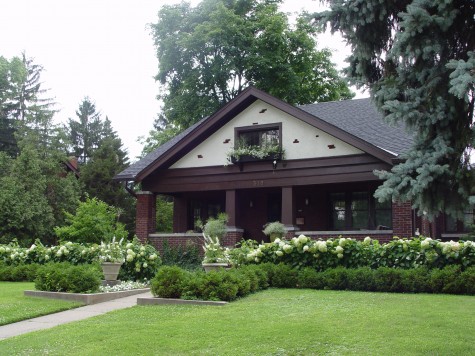
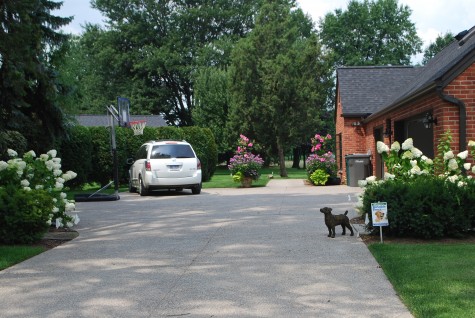
Some years later, the real gardening story is apparent.  The day I walk away from an installation, my clients are armed with as much as I can give them about looking after what they have. But it is instantly apparent which clients fall, and fall hard, for their landscape. Check it out- the plants have grown, and are healthy.  The pots look beautiful-and most astonishing, the Annabelle hydrangeas are standing upright.  Two years into his stewardship of a substantial hedge of Annabelles, a terrible storm knocked them all to the ground-just as they had come into full bloom.  Rich was beside himself.  He had to have called four times about what to do to restore them to their former glory.  He was genuinely devastated by a storm laying waste to his landscape.  Being young, smart and exceedingly sassy, he was sure he could wave a wand, and get those belles back on their feet.   I would get off the phone, having listened to his latest restoration scheme, and burst out laughing.  A client more obsessed than me-rare.  I will admit when I went to see what he had done, I was impressed.  Believe me, those hydrangeas ever after that disaster in 2006  had the staking mechanism in place the first day of spring-I am talking March 1.

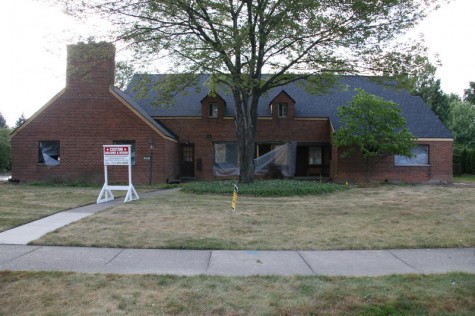
Years later, there is a new house.  Like the old one, there was precious little in the way of landscaping, and even less that he liked.  Before I could even protest, he had taken things down, and shovelled other things out.  A lengthy renovation of the house ensued, but I knew I would get a call sooner or later.  In 2008, he was ready for a plan.  I find the house very interesting architecturally; note the pair of entrance doors in the front.  The landscape design would feature that pair of front doors.

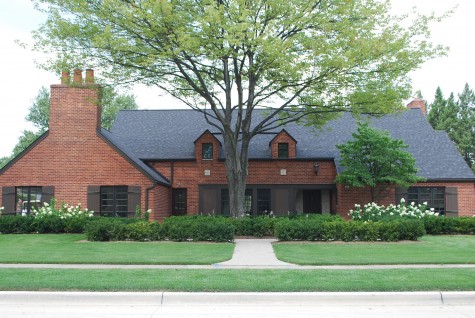
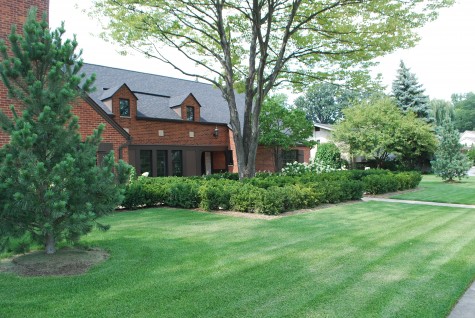
The view from the street tells little.  This I like.  A landscape plan that details an unusual entrance landscape not seen until a visitor is close to the door-the best of all possible worlds. Be friendly to friends.  Posit an elegant statement from the street.  Urban landscapes ask for public and private spaces both.  The house looks beautiful from the street.  The walk to the front door splits into two walks, and goes around the old maple which dominates the landscape.  Once you are inside the yew hedge; a guest can choose which door they want.    

Three days ago I had an appointment with Rich and Sue-about the rear yard landscape.  I could tell he was gunning for me.  The front yard looked superb.  The grass was cut and edged. There were no weeds anywhere.  The symmetrically placed pinus flexilis “Vanderwolf’s” in the lawn are thriving.  Not visible in this picture are a slew of Sum and Substance hostas planted at the base of the maple. My visit a year ago-there was still a weedfest going on under that tree. My threat to revoke his license to garden in the state of Michigan apparently worked.  

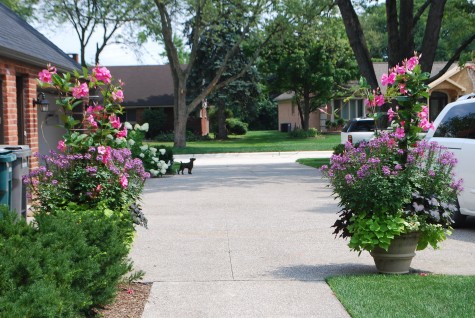
This Michigan gardener can annoy me beyond all belief.  If I tell him the sun will be coming up tomorrow morning, he will want a substantive explanation in support of my theory.  He asks more questions than I have time left in my life to answer.  But how could any gardener be miffed for long, once they laid eyes on this container planting?  This mandevillea, prone to spider mites, and fungus, can be the devil to grow.  But there it is, gorgeous and very well grown.  His Spirit Violetta dwarf cleome are the best I have seen anywhere this year-and that includes the plants in my pots at home.   Can you not tell he knows all this?    

They brought this pair of stone Italian vases with them from the old house to the new.  There is no problem spotting them from the road.  This is the first year he has not blown in unannounced on a May Sunday afternoon with Sue, Violet and Rich III in tow, wanting not one scheme for his pots, but multiple schemes from which to choose, a mini-dissertation on the merits of each scheme-and the plants to go with.  When this past June came, I knew he did not need me anymore.  Rich, your pots are really swell.      

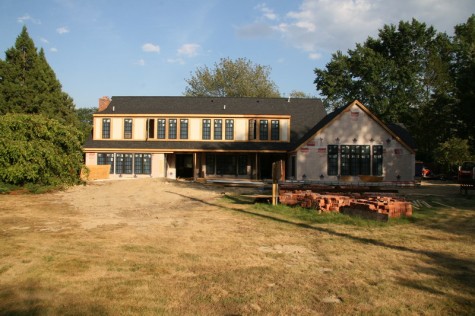
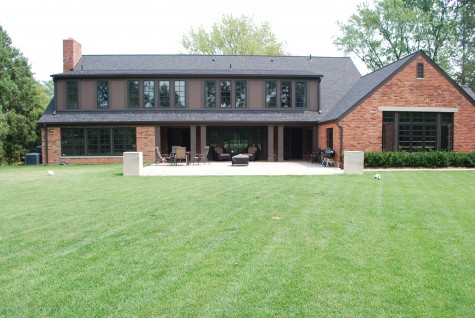
The largest part of the house renovation was in the back. Not in this picture-the view from all those new windows to the golf course.  He would be seconds from the links, and sublimely happy about it.   

We three have been kicking around the landscape plan for a year now. This rear terrace faces west, and Sue is very clear she has had enough of the blaring sun from which there is no relief.  She tells me the kids cooked eggs on the concrete aggregate terrace surface on a 98 degree say this summer. After sitting at the table for 1/2 hour, I believed her. Not obstructing the views to the golf course both upstairs and down have been the subject of much discussion, but I could tell even Rich was getting tired of the design and development phase.  So the plan is to go ahead with the landscape and see if it provides the shade they need.  If it does not, we have a plan Aplus in the works.  I will keep you posted.