Sweet Verbena


Sweet plants-you know what I mean.  No landscape can be structured around them.  Unless you are up close, you might not notice them.  Should you have a cottage garden, your best view of your sweet plants are when you cut and place them in a vintage milk bottle on the table. Sweet plants are lax growing, weedy-gorgeously natural.  Some sweet plants are so sweet, they do not last cut more than a few hours.  The British version of Country Living magazine-I treasure every issue.  The Brits grow every sweet plant successfully in their mild climate-how I so envy them their endless varieites of snowdrops, the auricula primroses, the frittilarias, the columbines, the Noisette roses,  the belladonna and bellamosa delphiniums-all of those sweet plants who would black out and fall to the ground weeping in my midwestern garden.  But we have a few plants available that can satisfy a midwestern gardener’s sweet tooth.  
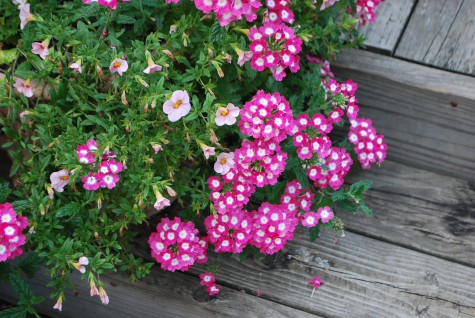

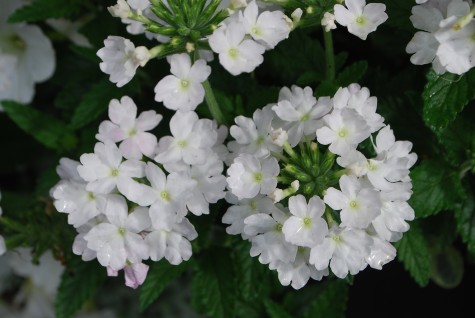
Trailing verbena-sweet.  For years I avoided growing them.  Prone to mildew and every other fungal disases affecting plants-who has time for this?  Recent breeding has vastly improved the disease resistance of this class of annual plants.  I gave them a second look.  My garden will never ever remotely resemble a beautifully graceful English garden.  Can you hear me sigh?  The trailing verbenas are a plant group I would recommend-should a little dose of sweet suit you. They endow my garden with a little bit of that English country garden I so love. 
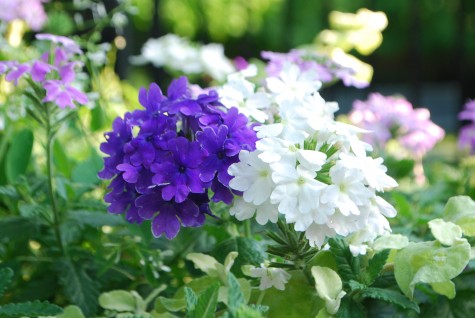
They come in a wide range of colors.  White, lavender, lavender star, purple, royal purple-the list is long.  The Lanai series is my favorite-these cultivars are amazingly disease resistant, heavy blooming, and long lived.  My trailing verbenas last long into the fall, given proper culture. 
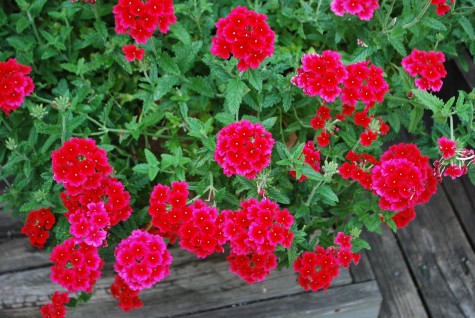
This cherry red verbena-new to me.  I have no name to pass on.  It is more upright than most.  I am only able to water my pots once a day-when I get home.  Should it be 95 degrees all day, they may wilt down, but this verbena does not expire. The sweet chery verbena has a will of iron to survive.  Sweet plants with a formidable will to live-keep them.
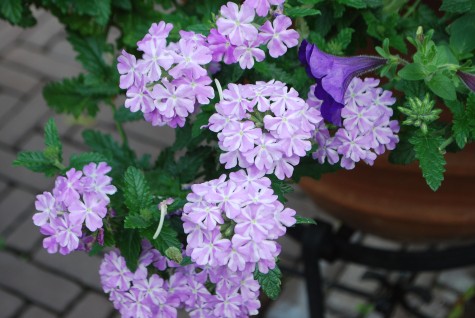
Lanai verbena lavender star is my favorite trailing verbena.  The white and lavender star mix in the blooms makes for a very showy addition to any container planting.  I have had them performing as late as October-no kidding.  I have been so bold as to plant trailing verbenas in ground-they do great. Should you commit to these plants-be advised.  They need to have their dead flower heads removed regularly.  Maybe daily.  Should you be a once a week gardener, please disregard my enchantment with verbena.  If you keep up with the deaheading, thiese plants will reward your garden.
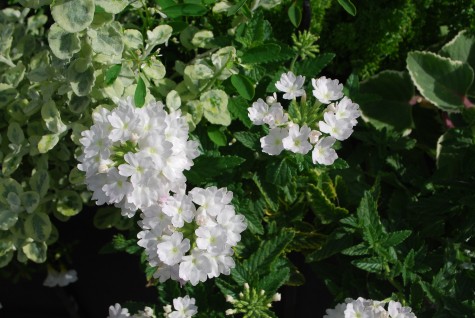
Sweet plants cozy up to other plants in their neighborhood. They never mean to imply they are the star of the show.  They wrote the book on what it means to be a member of a community. Sweet and unassuming they are.  But I love how they grow vigorously, and horizontally, and bloom heavily.  They weave in and out of whatever else is in their neighborhood. So sweet, and so persistent.  They take on, and grow up in concert with, any number of neighbors.   This I like about them.   
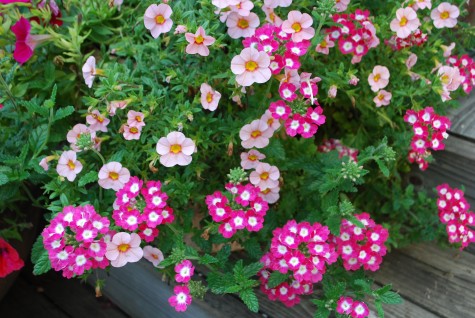

New trailing verbena varieties-this bicolor version is an example.  I have no opinion about it-I am trying it for the first time this season.  Successful gardening is much about trying plants that are new to you.  Some you will give a berth in your garden.  I watch and assess everything that goes into the ground in my garden.  Given my small space, why shouldn’t I?  The sweet plants-they will not carry me to the other side.  But when they are good, they are very very good. Have some gardening room for some sweet? 
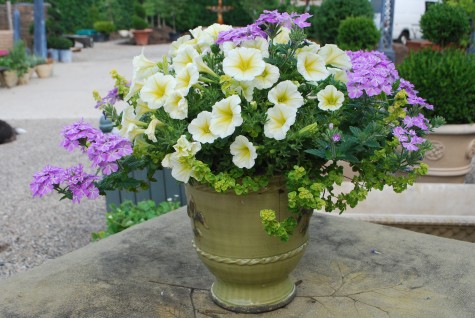
Plant them-those sweet verbenas.
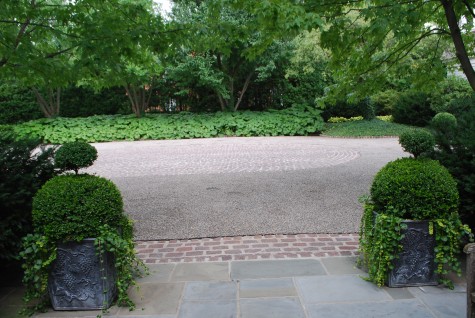
So Green, So Serene


It is an unusual client that opts for a green garden.  I doubt I have the discipline this requires-though the front of the shop is grey, green and white this year.  Truth be told, I love flowers.  All manner of flowers, all shapes, all sizes.  Little flowers-fine. Subtle flowers-I see.  Daisies-no matter that I see them everywhere, I love them.  The flowers that grace my summer-I love them one and all.   Giant flowers-what fun. Blooms-I am besotted by them.  But a green garden does have that aura of  serenity about it.

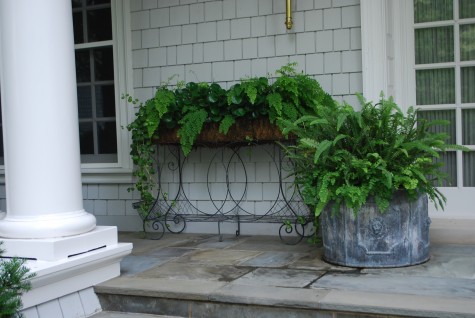
Serene does not necessarily mean sleepy. The infinite variation in color, shape, texture and mass of green plants is astonishing.  Green plants of singular form populate this planet such that one could plant any number of green schemes and never repeat oneself. These containers with ferns and pepperomia are lush growing, content on this porch.   

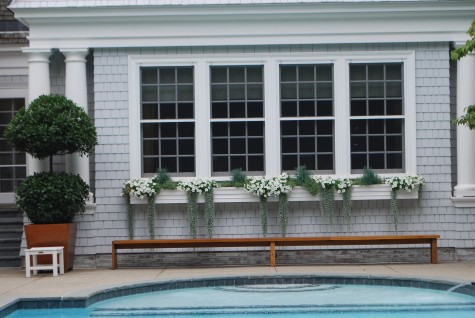
An old bay tree in a varnished Belgian box provides solid company to a long narrow window box. 

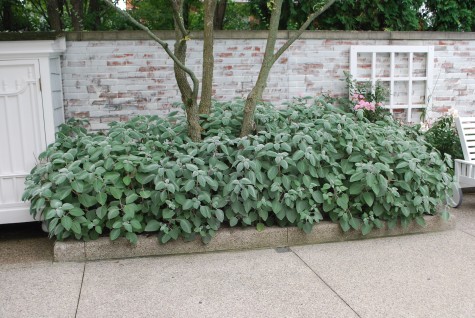
Plectranthus Silver Shield makes a swell, densely growing summer ground cover in a small space.  The thick felted grey green leaves are quite handsome.  That frosty green color persists in the sunniest and hottest spots you have, and is easy on the eyes. Its billowing habit of growth is very attractive.

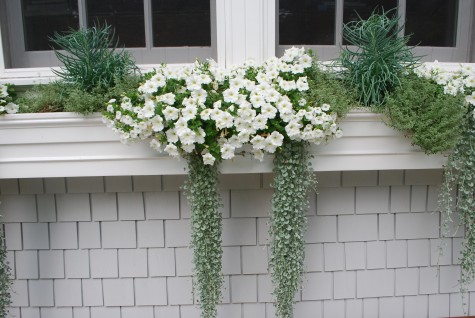
The plants in the window box look like bunting casually draping over the window box rail.  Those needled succulents are quite blue-green, and look great with the dichondra.  There is no brass band blaring here, just a plant string quartet quietly playing a simple melody. 


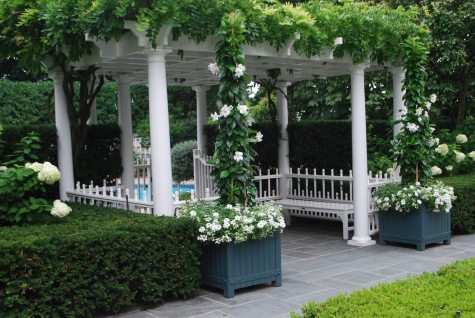
This white pergola with its wisteria roof is beautiful; there is no need to introduce a competitve element.  The mandevillea in the the boxes repeats the vining of the wisteria; the white flowers echo the white wood of the pergola.  Getting a planting to sit down and blend in seamlessly with all and any other garden elements makes for a serene space.  When plants talk too much, bicker, or compete with one another, the space will take a much more lively turn.  Deciding how high you like the volume outdoors can help you decide what and how to plant.   

Green spaces have an added attraction;  most shades and textures of green look great together.  When you use materials that are all the same color, it encourages you to see the differences.  What textures compliment or enhance each other? Big leaves look great with little leaves.  Shiny leaves look great with hairy leaves.  I am surprised I do not see more groundcover plantings that mix vinca and baltic ivy.  The contrast of leaf size and texture is subtle, and interesting.  

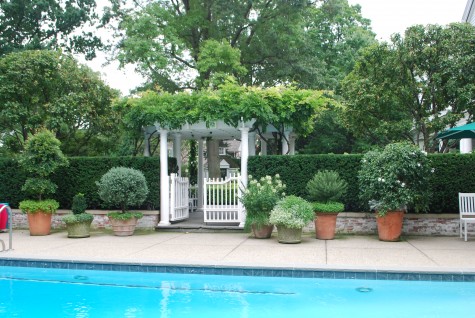
Topiary plants are a natural in a  green garden.  Many plants can be trained to grow in formally or informally clipped shapes.  The common denominator to all-the hand of the gardener, clipping and training towards an overall shape.  The effect of these groupings of pots is restful.  The formally pruned yews make a beautifully dark green backdrop for this collection of topiary. 


Lovely.

A Second Look At Hydrangeas


A reader left a comment yesterday about my post about Limelight hydrangeas.  Nursery catalogues did not have that much information about hydrangeas.  The gardener’s lament-we all know that tune.  Though I spent my late twenties falling asleep with the White Flower Farm catalogue under my nose, nurseries who sell plant material by mail do not trial plants.  They decide what they want to sell, and they make much of the good characteristics of those plants, and perhaps ignore or gloss over the problems with those plants.  Books record the one day that is a perfect moment-this bears no resemblance to what it is to grow a real garden.  Perfect moments do not come along all that often.  

I do not blame nursery catalogues one bit.  They are in the business of generating excitement about their plant offerings, and selling them. Gardeners are naturally interested in new plant introductions-so many nurseries feature them.  Other nurseries have invested acres of growing space to a variety; they are not so keen to move on to something new when they have fields of last year’s cultivar yet unsold. A nursery catalogue is a list of available plants-nothing more, nothing less.


Hybridizing and bringing a plant to market is a costly and very time consuming endeavor.  Growers routinely put their time and money on the line, believing the plants they have to offer will deliver what gardeners want.  Make no mistake-I planted more than my fair share of Annabelle hydrangeas.  I fretted and fumed about the weak stems-I caged, tied up, and otherwise tried to remedy what is a fundamental fault in the growth habit of the shrub.  The most beautiful planting of Annabelles I have ever seen was in a bed raised 4 feet off the ground.  The cascading flowers at eye level was enchanting.  The unknown designer knew this plant, and planted accordingly.

I no longer plant Annabelle hydrangeas-the maintenance is considerable. I find the Limelights to be the most reliable, easiest of culture, and most adaptable of any of the white hydrangeas.  They make beginners look good.  They deliver under difficult circumstances.  One is good, 30 are spectacular.  I was able to convince one forward thinking client to replace her Annabelles with Limelights.  I admire gardeners that are able to cut their losses, and move on. 

Pruning hydrangeas is a very important business.  Once you have provided them with a compost enriched soil, regular water, and a fair amount of sun, you have options that influence how they perform.  Hydrangeas pruned short on top, whose side branches are left long, will bloom from top to bottom.  Hydrangeas that bloom on top of woody legs have not been pruned, or not pruned properly. If you like your hydrangeas 4′-5′ tall come the end of July, prune them in the spring down to 18″-24″.  Don’t be shy-they grow like mad.  If you like them tall and bushy, prune lightly.  Prune only in the spring-when you see the buds swelling.  I see landscape companies saw hydrangeas down to ground level-this is much too hard.  Do not count on basal growth-leave buds above ground to grow.
No nursery catalogue will go into this detail-why should they?   I only have detail to report, as I have grown lots of plants in lots of different gardens, for many years.  There is no substitute for trying plants out yourself-unless you have trial gardens near you.  Universities with gardens often trial, or test plants.  You can visit, see what goes on, and make your own assessment. When Alan Armitage favors a plant, I take a good look.  His trial gardens, and his writings,  are known nation wide.

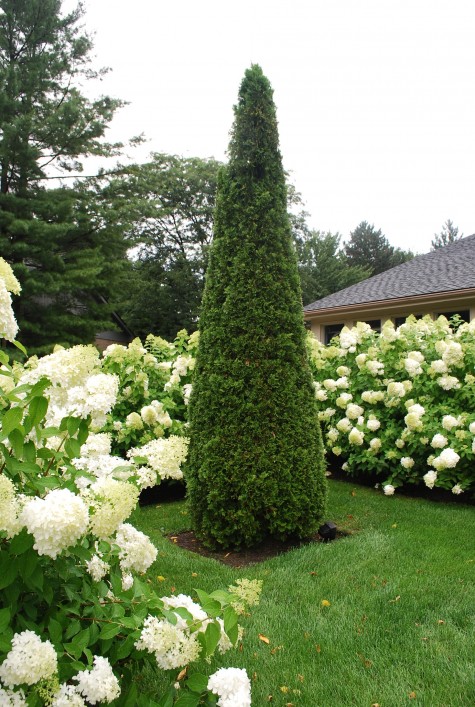
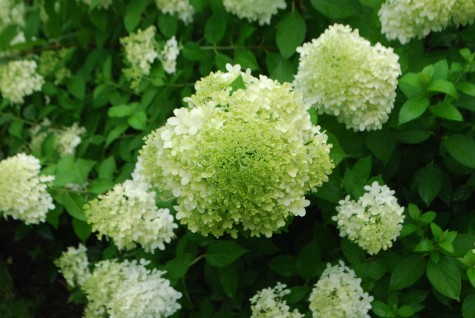
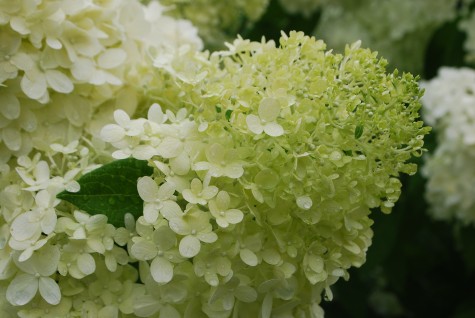
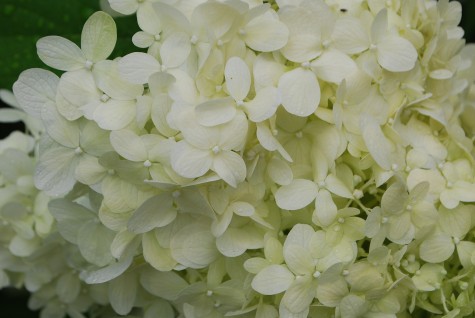
Limelight hydrangeas have cone shaped flowers with a decidedly lime tinge. As I am more enchanted with profusion than color or shape in hydrangeas, I side with the plant that delivers beautifully wherever I might plant it.  Should I have a burning need for pink or blue hydrangeas, I would plant the best hybrid available to me, in the best possible spot, and keep my grimy fingers crossed. I would try more than once, before I gave up.  


Every gardener needs to sort out what matters to them.  I like plants that willingly reward my eye.  They need not be rare or new.  I like plants that grow enthusiastically-that enthusiasm I find beautiful.  How does any gardener assess what might grow beautifully for them?  Try things.  One person who works on my crew bought two incredibly expensive orange echinacea on a trip he took to a nursery to get plants for a job for me.  I can tell looking at them-they will not be hardy.  Maybe 6 generations down the line there will be hardy orange echinacea.  Do I fault him for his hope-absolutely not.  Gardeners need to try whatever moves them, and not be discouraged when all does not go as planned.  Fall down, get up, go on-gardeners know how to do this.    


Welcome to gardening.

Heavenly Hydrangeas

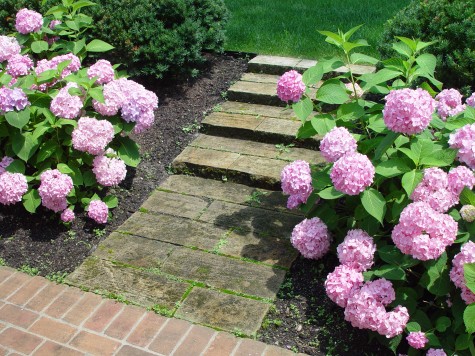
What is it about hydrangeas that makes them such a magnet for gardeners?  No doubt they are one of the showiest shrubs hardy in my zone.  They are fairly easy to care for, providing you stay away from marginally hardy varieties.  They grow fast, have big, clean, and very green foliage.  The massive flower heads speak to summer.  What could be better?  The plant hybridizing industry has focused on producing more reliably blooming “other than white” hydrangeas for the nursery trade geared to produce in cooler climates.  This “All Summer Beauty” hydrangea is more reliably blooming than its predecessors.   

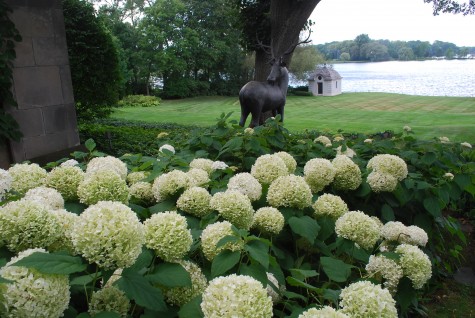
The Annabelle hydrangea has been the mainstay of the summer shrub garden as long as I can remember, though I no longer plant it. Weak stems and overly large flower heads make the shrub a challenge to keep off the ground.  Given heavy rains and mid summer stormy weather, you are likely to wake up with those flowering spheres face down in the mud.  Should you have them, cage or otherwise securely stake at least 40″ tall out of the ground-in the spring.  Othereise, you will be chasing some stop the flopping solution that looks awkward and unnatural.   

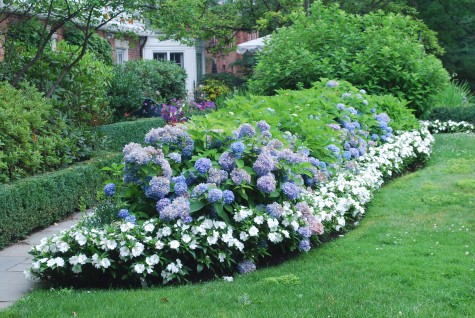
This garden no doubt is the one place for 100 miles perfectly suited for Nikko Blue hydrangeas.  Once out of the nursery pot, and in the ground, they are generally known to be stingy with the flowers.  Blue hydrangeas-what midwestern gardener does not long for this plant to perform for them?  I am sure many more get sold, than deliver and please.  As no one grows hydrangeas for their shape and foliage, choose a cultivar known to reliably produce flowers in abundance in your zone. 

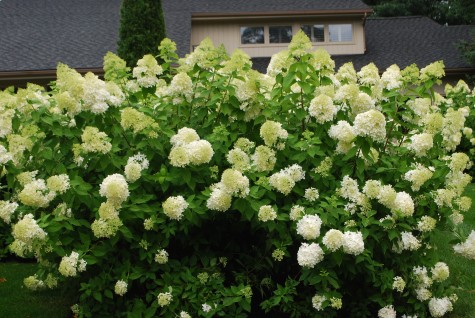
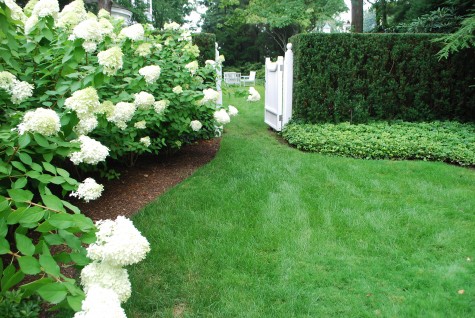
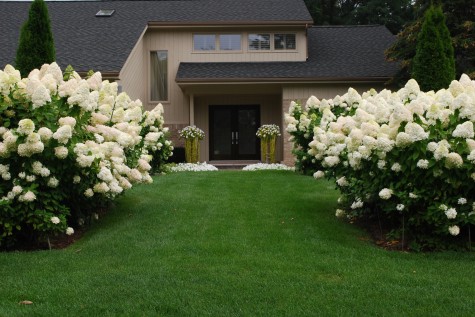
Flowers in abundance-perhaps this is what makes hydrangeas so attractive in a landscape.  I favor the Dutch hybrid-known as Limelight.  They are sturdy growers-there is never any need for staking.  Their hydrangea paniculata parentage is responsible for the cone shaped flowers that open green, mature white, and pink with age. The straight species hydrangea paniculata is a very wide and very tall grower.  The flowers are many, but modest, open and subtle in appearance. A hedge of panuiculata 8 feet wide by 40 feet long might make a show.  Limelight produces densely showy flower heads from a vigorous and adaptable shrub-the best of all worlds, should you be talking hydrangeas. 

Densely blooming and showy-see what I mean?  They do not ask for much-this part I am especially fond of.  They handle full sun, given sufficient water, with aplomb.  They will willingly survive part shade, and bloom better than most hydrangeas starved for sun. They grow fast.  They are fine with a serious spring pruning.  I have Limelights I prune down to within 14″ of grade-where it is my idea to keep them in the 4′-5′ tall range.   

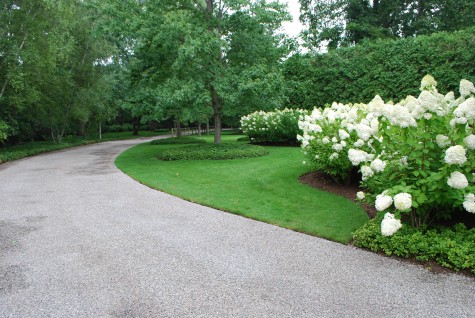
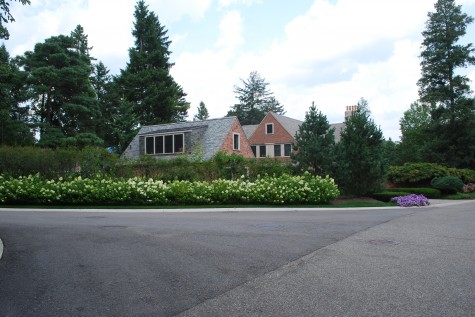
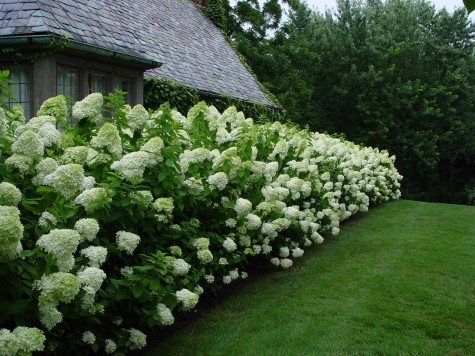
Given a space of sufficient size, a hedge of hydrangeas provide no end of a robust visual reference to summer, lots of flowers for bouquets, screening, material for dried arrangements.  What garden shrub do you know of that delivers on this scale, and to this extent?   

Should you be thinking you might plant some limelights, I would make the following suggestions.  Locate them in as much sun as you can muster.  Do not space them any closer than 30″ on center-36″-42″ on center will fill in in no time.  They like regular moisture.  Whatever you have done to enrich your soil with compost, the hydrangeas will appreciate.  Given how fast they grow, a 3 gallon plant will catch up to a five gallon plant in no time at all.  If you plant smaller plants, be sure they get regular water to the rootball.  Potted hydrangeas become rootbound in the blink of an eye.  Lacking the water they need, the foliage will burn and drop-this is not a good look.


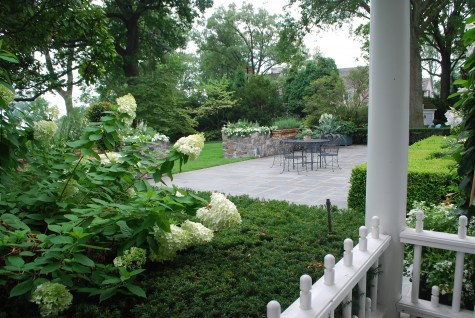
My landscape features 2 large blocks of Limelight hydrangeas-25 plants in each block. They are about 7 feet tall, and just coming into bloom.  In full bloom, they are glorious. In late bloom, they are beautifully moody-green, white, and white speckled with rose pink.  The show goes on for a number of months.  The limelights are just now coming on-I am ready.