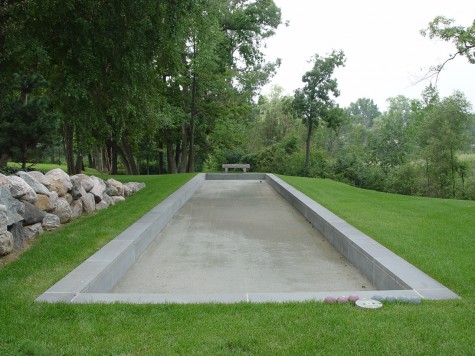
Sit Wherever You Like

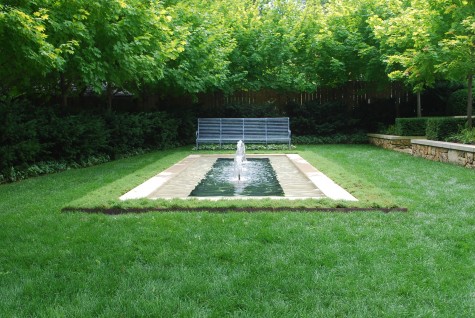
The garden bench at the far end of this bocce court is a simple three piece affair made from 10 inch thick slabs of Canadian granite.  It took more than a few men to haul it to this spot, and set it up.  Short of an earthquake, it will probably still be sitting quietly in this spot 100 years from now. A courtside bench is a utilitarian gesture-nonetheless, I like the look of it here.  Though I don’t often sit in the garden, I like having that opportunity.     
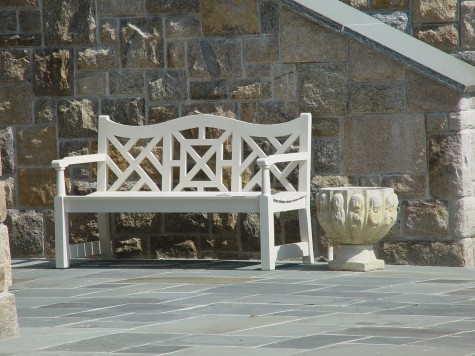
This classic English Chippendale style painted bench lightens the look of a massive stone wall. The curved seat makes it comfortable for longer than a moment.  This picture was taken on a sunny, very early spring day; I remember the warmth radiating from the stone made it a very comfortable place to sit.  Garden benches do a great job of providing a place to enjoy a moment outdoors. 
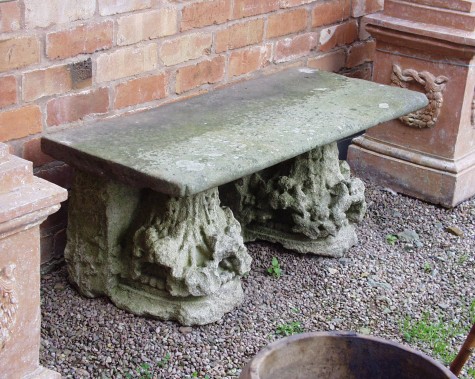
Very old age has blurred the detail of the carved limestone legs and feet of this English bench.  The feet remind me of a Clydesdale draft horse; this bench has a very strong and sturdy look.  Though the legs are massive, the bench is short.  It has a charmingly eccentric appearance that could make a shady spot in a garden seem more like an enchanted forest.    
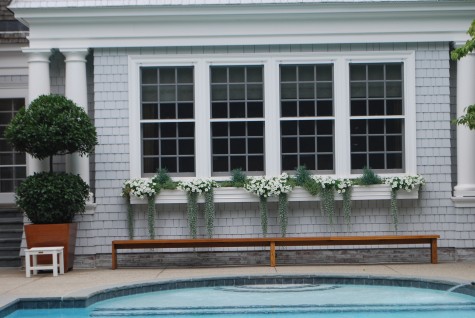
The long and low oak bench was made specifically for this spot on a pool deck next to a Belgian oak box.  Both pieces are finished with marine varnish that is redone every few years.  The warm golden brown color is a beautiful contrast to the white, greys and blues that dominate. 
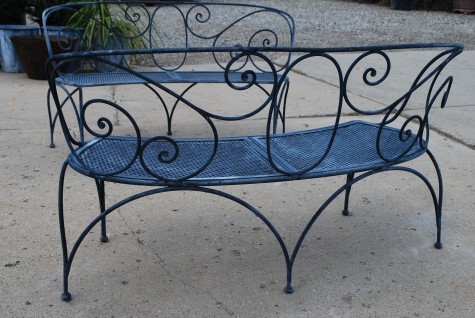
These galvanized and acid washed steel benches are reproductions of an antique French bench.  The original bench was painted white; the paint is worn through and the steel has rusted in a number of places.  Though the style and size of both are identical, the difference in finish makes them look entirely different.  It is interesting how a color or a finish can change the identity of any object.   
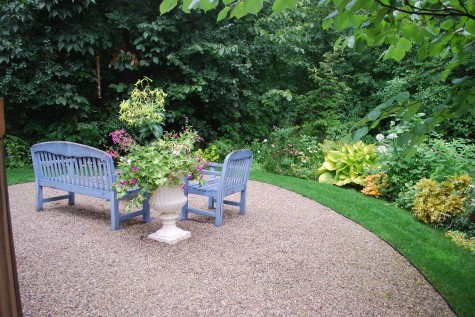
This country style bench is painted a beautiful French blue. A sitting area facing the garden-the person who owns this bench gives away what he considers the important view, by how he has placed the furniture.  It is not so usual to walk into a space, and see the back of a bench.  He clearly is interested in a front row seat in his garden. 
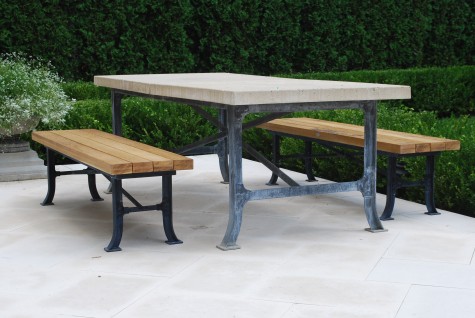

These oak and steel benches were made to match an existing Belgian table with a concrete top. Benches at a dining table are friendly-people can sit elbow to elbow.  This white oak will weather to a soft medium grey.   
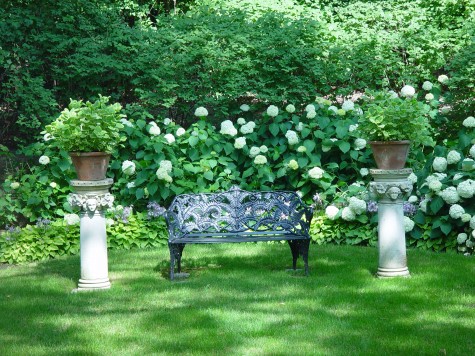
This grand Victorian cast iron bench with stylised fern leaves is flanked by a pair of antique English limestone pedestals.  Very formal and elegant, it compliments a formally designed shaded garden.  Cast iron in a garden will need to be repainted once in a while; the combination of iron , oxygen and water invariably result in rust. This seems like a fairly minor amount of maintenance for a garden ornament as lovely as this.    
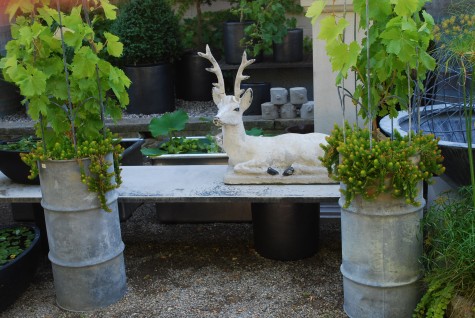

This bench, home to a resting French concrete deer, puts a pair of cylindrical planters in contact with an old composite science lab table top.  No one said a place to sit in a garden has to be fancy, it just has to seat you in a style that pleases your eye.  There’s nothing quite like sitting out in the garden.
Making Everything Work

There is a stage in the design and development of any project where it seems like a good idea to take the lines, shapes and descriptive words off the page of a drawing, and see what those lines look like-standing up. This idea is on my mind, as I saw a scale model today of a house a client will build this coming spring.  Even the elevation changes of the property were represented by stacked sheets of thin balsa wood, cut into the curves that represent the actual existing grade. Given how pleased I was to see this 3-D representation, I  can appreciate how a client may need something from me that transforms lines on a page into volumes and shapes.   What will this look like-a completely legitimate question. It is simply human nature to want a window that reveals what is to come before we get there.


Smaller projects do not have a budget that includes the time it takes to build a scale model.  Frankly, few projects call for that.  Any client who does not mind my sharpee marker sketches drawn against a panoramic view of their house and property gets virtually the same thing as a model-just a rough version. I am not interested in the elegance and polish of a presentation-I am interested in understanding. But certain issues cannot be dealt with on paper, or with a model.  An outdoor space could not be less like a drawing on a page.  A real space can shred a drawing and demand what never crossed your mind. 

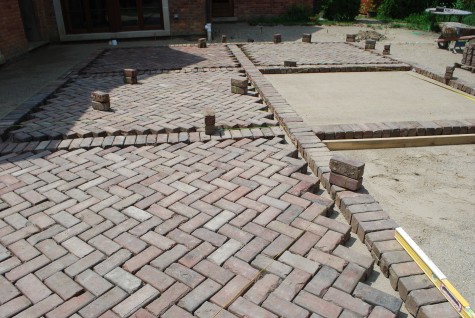
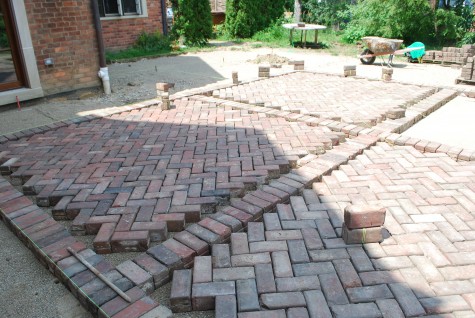
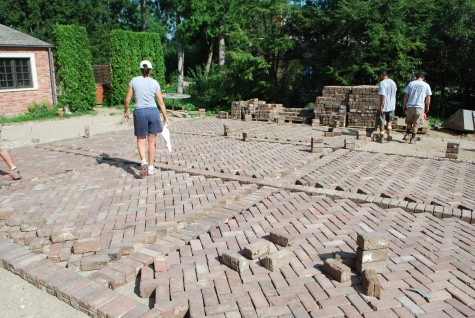
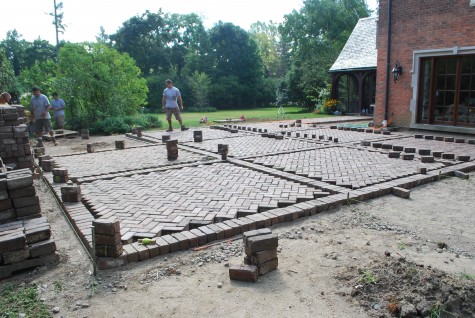
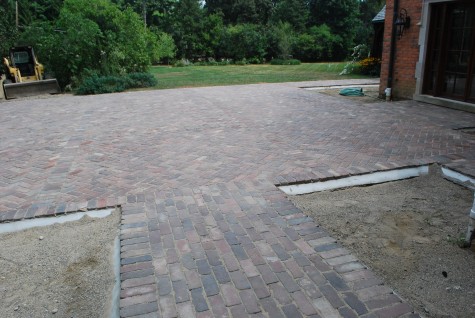
These old street paver bricks made in Ohio circa 1920 are anything but uniform.  Laying brick in a herringbone pattern requires great skill and planning, so the pattern does not drift.  Albaugh Masonry is known for their ability to beautifully handle a difficult installation-but these irregular bricks were proving next to impossible.  This kind of trouble you might anticipate on paper, but reality is all about standing in a space, trying to make everything work.

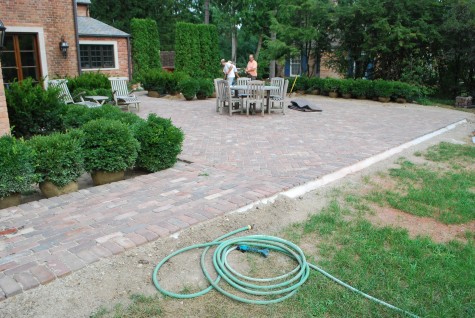
My cliennt-she is committed gardener.  She stood in this space for days, plan in hand,  working with Albaugh  to work things out. Understanding between a designer, a client and a tradesperson makes for a great outcome.  The suggestion from Albaugh that the terrace be configured in 9 smaller herringbone blocks of equal size, separated by a soldier course, was a good one.  They felt they could keep the herringbone dead on given this design.  God knows they tried to get those hand made bricks to work out every direction over 900 square feet. Who knows how many times this group sorted and resorted these old bricks, in order to get a surface that was true and square.   

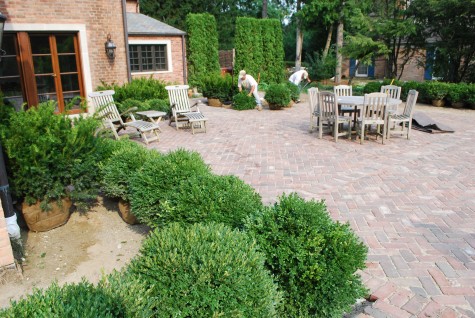
The late day sun slanted across the terrace reveals the beauty of the brick-and the installation.  As this home was built in the 1920’s, this final choice of a terrace material makes a great run at convincing a viewer that it had always been there.  Choosing materials on this basis has been of interest to this client in every phase of the landscape renovation.  Many plants original to the house were kept, or heeled in until a spot could be made for them.  Any passionate gardener understands what a whomping lot of work this is.   

Changes made on site have a way of turning the rest of the world up side down.  There is a part of me that so admires the math.  Change a floorplan or terrace so much as 6 inches, the entire space is affected.  My love of the math aside, making everything work is my idea of successful design.   

We began the landscape installation today.  How everyone involved would make everything work was the order of the day.  That moment when an installation begins is the most intense work for the lot of us.  A client, a masonry contractor, an irrigation specialist, a designer, a landscape company-there are lots of voices that need to tune up, and figure out how to be in harmony with one another.     

The art of communication-in my opinion, the most difficult art.  Paintings, sculpture, crafts, decorative arts-they are all about the vision of a particular and singular artist.  Landscape design is all about a successful and fluid relationship between a client, designer, and tradesperson. I thrive on this.

Late Summer

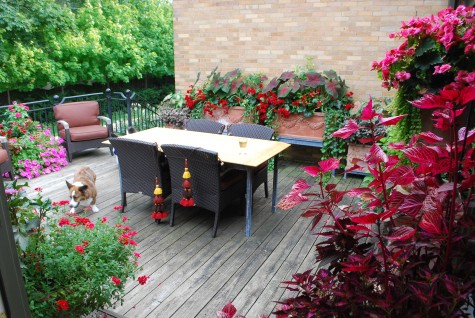
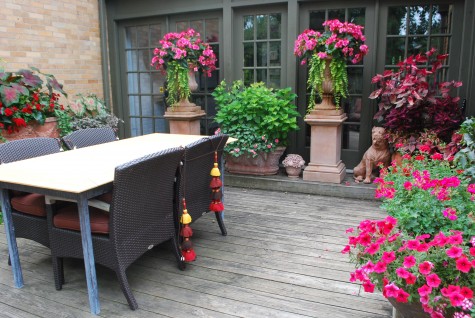
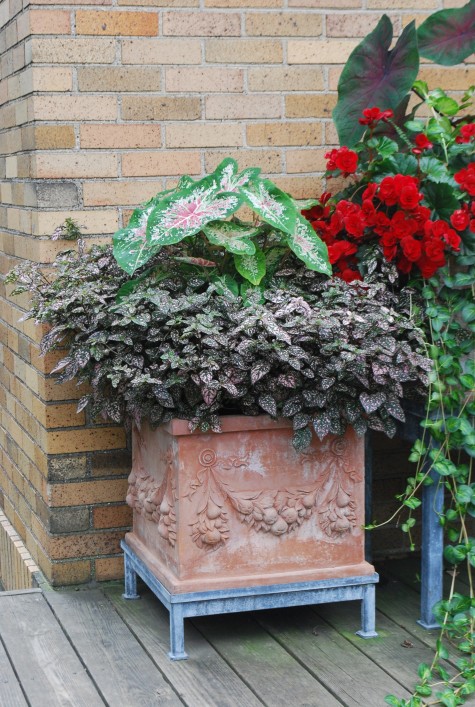
The view out onto my terrace right now is lush and loud.  really loud. I like to plant this group of containers with a different color scheme every year.  This year’s  pink and red spectrum runs the gamut from light to dark, from moody to electric. But the overall effect is definitely on the rowdy side.  Sometimes you just have to get certain things out of your system by giving them a try.  Having never planted anything red at home before, I scratched the itch.  The Mital Italian terra cotta rectangles are on a north wall , so they demand a planting that is shade tolerant.  The red caladiums provide a lot of a rich red/green mix in the leaves- which I like. The tropical ferns and the vinca maculatum are essential to the look.  The red solenia begonias are brilliantly red.  Since red and green are opposite one another on the color wheel, the combination makes for a lot of visual action.  Had I the chance to do it over again, I would plant lime irisine in the back; that very tall lime green with carmine veins would make the caladium red read more dramatically.  The big empty wall behind those pots-wouldn’t you think I could sort that out?

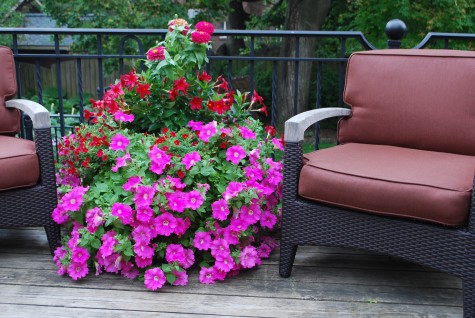
There is nothing particularly fancy in this pot-red mandevillea, cherry sun zinnias, cherry million bells and giant pink petunias.  What is of interest is the vigor with which this planting has grown.  These plants like being neighbors, and they like this pot size and location.  Everything observed in the garden will come in handy the next time around.  Where’s my journal?

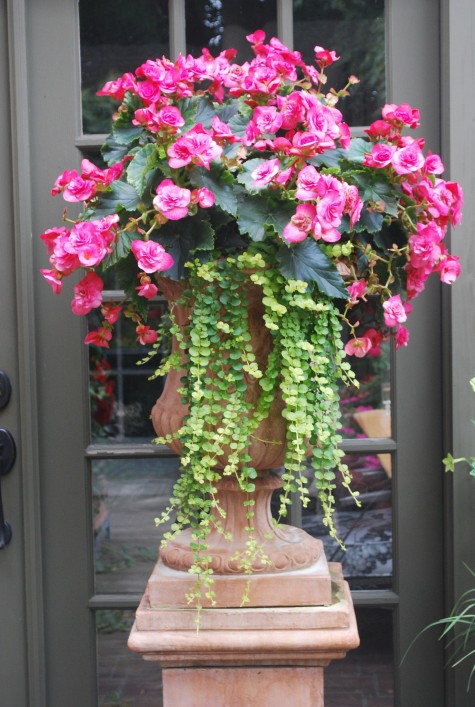
My pink begonias have suffered some from sun burn.  This has never been the case with the apricot or orange solenias.  It made me study the sun on this wall more carefully.  It turns out there is a lot more light here than what I thought; what I assumed was an eastern exposure is actually south easterly.  How I could have planted these pots 14 times for part sun and done ok is a testament to every plant’s will to live; they suffer me kindly. The red irisine has tried its best to grow luxuriantly, but the top leaves bleached from the sun during our long run of hot sunny weather.  I am hoping for a better fall. 

You can spot the sunburn on the pink solenia begonia in this picture. That orange solenia shrugs off the hot sun is called varietal variation.  This series of begonias is the easiest of all to grow, in my opinion. The pink apparently needs more protection from direct sun. I am sure there will be no pink begonias here in 2011; I am a quick learner.  I don’t mind trying to grow things that are tough to cultivate, but I have to balance that interest aginst how much time I actually have to put to any aspect of my garden.    


Though the botanical name is not part of my vocabulary, I do like polka dot plants. Available in white, pink, and rose, they remind me of a choir.  A big and coherent voice generated from a cast of thousands. They thrive on pinching; they thicken up, and represent.  This moody pink and green foliage plant compliments this rose pink and green caladium better than I could have hoped for.    

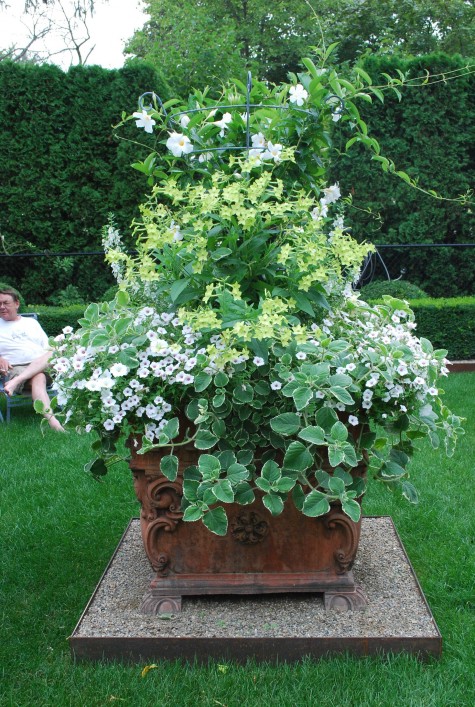
Last year this English concrete square of classical Italian design was home to a homeless ancient agave.  That agave went to a client this spring; I was on my own with a planting scheme.  Though I planted a white mandevillea, white angelonia, lime nicotiana alata, gobs of silverberry mini petunias and variegated plectranthus, I worried that the planting would never grow up into and spill over this massive pot.  It may be mid August, but I like what I am looking at now.   

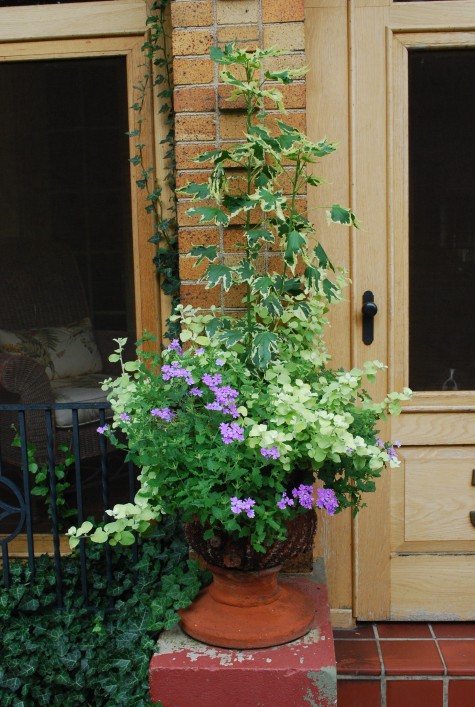
I have never had pots on the limestone pillars integral to my front door.  My idea to move these antique English terra cotta log pots to the front, from the rear deck-capricious.  I so love the look of these pots here-but keeping water on them given a merciless exposure to western sun has been a challenge.  This variegated abutilon is great looking-I plan to have plenty of them for spring.  The verbena and lime licorice tolerate a hot spot.  How these small pots dry out has been a lot of trouble-worthwhile trouble.

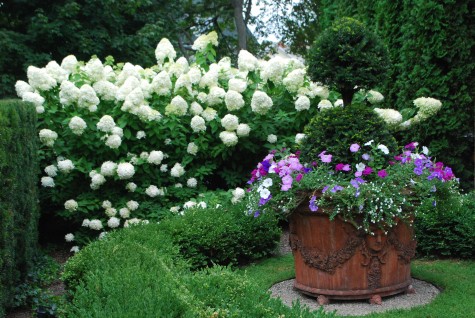
I am so happy with my English concrete pots fabricated in the classical color and style reminiscent of Italy. This is my third season with them-and I think my most successful planting.  Taxus topiaries-I had never seen them before a visit to Mori Nurseries last year.  These double ball yew topiaries rule the garden just outside my front door.  They seem quite happy in these enormous pots-the soil moisture is steady.  The generous skirt of mixed petunias, cerise pink verbena and white bacopa-a perfect foil to that seriously dark green form.  I am delighted.      


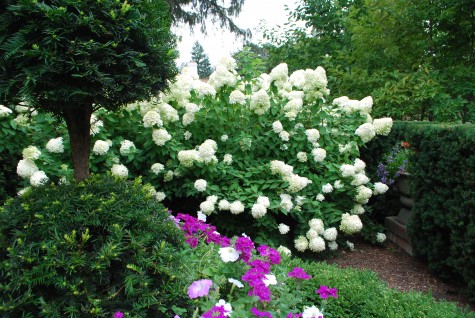
My late summer garden views-I like them.

A Secret Garden

Who knows how many times my Mom read The Secret Garden to me.  Once I learned to read on my own, I doubled up my exposure to this well known children’s tale.  Though I was taken in by the relationship that was forged in the privacy of a beautiful garden, I was more fascinated by the garden itself.  Walled off from the world, quiet, serene-the possibility of a completely private world all of one’s own imagination and invention enchanted me.  I have clients who live in old neighborhoods in close proximity to other families. Those neighborhoods are in transition now.   Old modestly sized homes are being torn down in favor of much larger homes.  

I have a client in just such a situation.  The lot behind her has been summarily clear cut; a large home is in the works. All the the old trees on the lot line that screened her from that neighbor are gone.  An old and deteriorated home next door has been sold, and is scheduled to be razed.  A new home, no doubt bigger and taller than homes original to the neighborhood has her feeling under siege. On the garden tour this July she commented to me that though I live in an old neighborhood with small lots and many large two-story homes, my yard is completely private.  She had an interest in staying ahead of the construction that would loom over her on two sides of her property for the at least two years.    

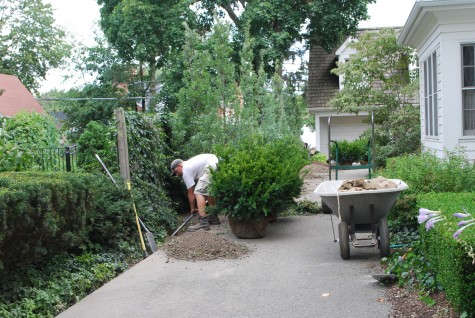
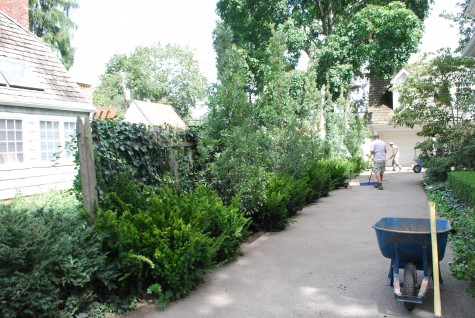
Lots in her community are small; the parcels reflect a time and place long past. She was willing to reduce the width of her driveway to less than 9 feet, if it meant that she could plant screening in anticipation of a new house next door. I understand this need.  I like my neighbors, but I like my private garden more.  I have no need or inclination to be privy to what my neighbors are up to.  Most importantly, I want the sanctuary that a landscape can provide.  We saw cut a strip out her asphalt driveway so we had room to plant.     

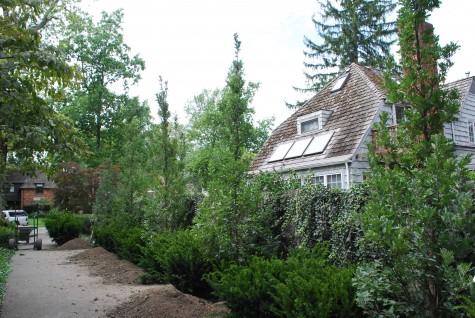
Arborvitae as a screening material in a right space has its limitations. When very tall, they fall prey to ice storm damage.  They grow wider than one would like.  Like many evergreens, they are much narrower at the top than the bottom.  If you need screening up high, a layered planting works well.  Deciduous trees provide great screening of a neighboring second floor.  A columnar tree takes up relatively little room on the ground plane.  Carpinus, gingko, tulip tree, beech, amelanchier,-there are plenty of choices.  Planting an amiable evergreen between the columnar trees gives you an evergreen screen occupying the first five feet out of the ground-excellent.  Driving up the drive, or walking down the drive for the mail, there is privacy.  

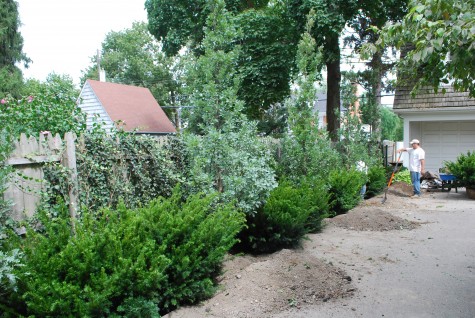
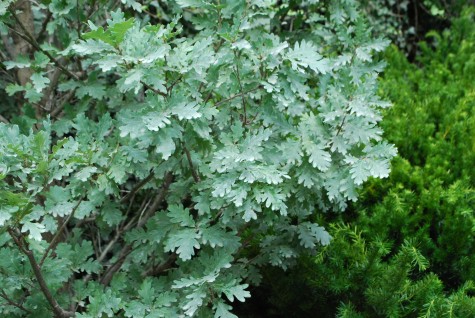
This columnar English oak hybrid, Crimson Spires, has densely growing blue green leaves, and a decidedly columnar habit.  This cultivar of English oak is stubbornly hardy-never mind its good looks.  In two years these trees will be branching out such that my client will get the gist of her secret garden.  Within 8 years whatever goes on next door will not be part of her landscape.   

On the lower level, we have another issue to address. The neighbors wood fence is old and quite deteriorated. What will be when that fence is replaced, or not replaced?  The densiformis yews will make how the new neighbors will handle their landscape their issue, and not hers. 

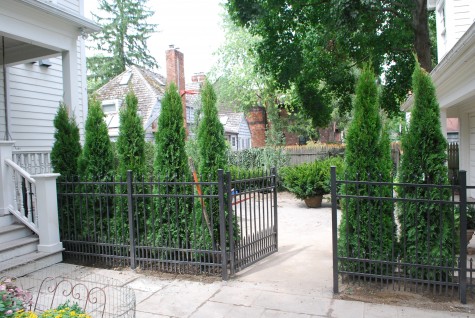
We planted a secondary screen which will add another layer of privacy to the back yard.  The arborvitae “Emerald Green” has a beautiful deep green color year round, and grows quite dense.  I will recommend that this hedge be maintained at the height of the gutter on the garage.  This will make the maintenance of the hedge more manageable.  It will also make the rear yard garden entirely private from this side. 


We will see if the narrower drive is easily negotiable. If it proves to be too narrow, there is an option to add a little more drive on the house side.  The views out from the windows on this side of the house will be green.