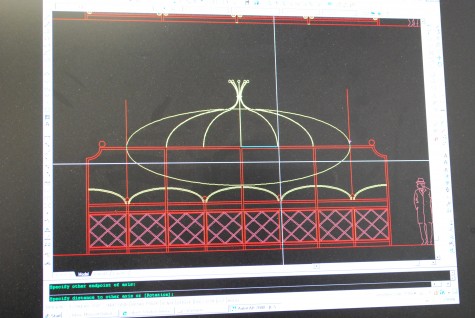
 I have a big love for formally conceived and planted landscapes. Nature does wild, asymmetrical and completely unexpected far better than I could ever hope to. A client with whom I have been in negotiations for three years regarding her irrigation system flooding and killing her plants finally came around this spring. “I see that the trees in the parks do just fine, though no automatic irrigation is in place.” A client who is observing nature at work-what could be better? I like to observe nature at work, and create spaces for people based on those observations. Though I have a big love for the intersection of horizontal and vertical lines, I am the first to admire spaces with beautiful curves. This design of mine for a steel pergola is organized around the elliptical shape you see in the drawing above. Should it ever be built, the bottom part of the ellipse will be implied, not represented. Beautifully curved landscape beds imply circular shapes, though all of that circle may not be represented.
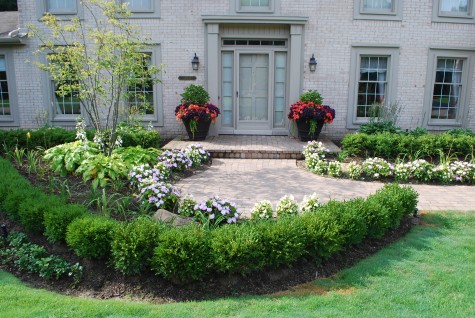
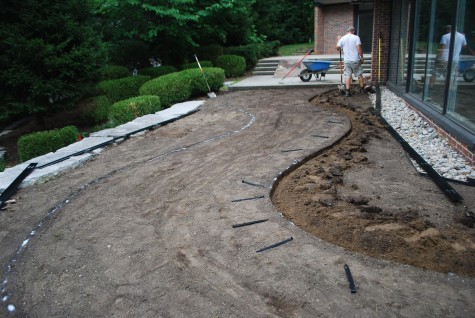 A recent project was all about compound, curving shapes. I generate these shapes by hand; I spray dots on the ground to start. Should you be generating curved beds, I would recommend the following. A curved bed needs to be curved from start to finish. Once even a small portion of a curve goes flat, it looses impact. Some have luck dragging a hose-this method has never worked for me. For large curves, a stake set on a proper radius, with a string attached can generate the portion of a circle you need.
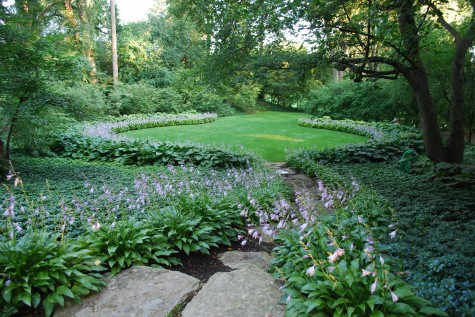 Though this lawn panel appears elliptical from this angle, it is clearly circular when you are in the space. Finding the center of the space took some trial and error, but I was finally able to wrap the string around my landscape paint, stretch it tight against the centering stake, and dot it in. Circular shapes, and circular sculptures or spheres are visually very strong and stable. Several cultivars of hosta fringe the lawn panel. The relationship between this very geometric garden and the naturally planted surrounding landscape provides visual interest.
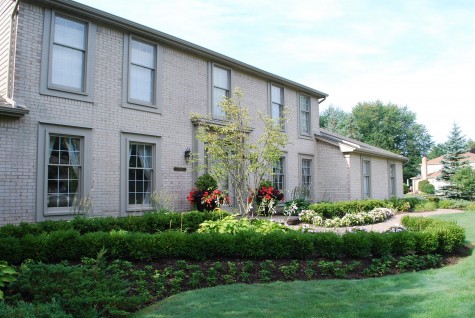
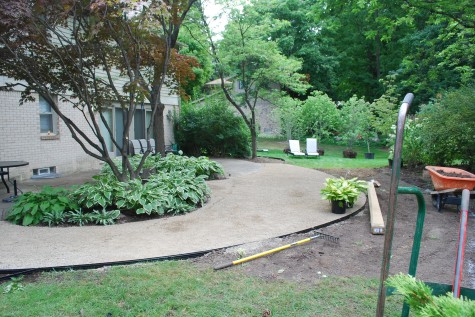 Big swooping curves can relieve the feeling that a space is small and stuffy. The placement of this house on its property means a very large front and public space, and a small back yard. The addition of a curved granite terrace makes the rear yard feel bigger, more airy. I know there are those gardeners who edge their beds by hand, but I am not good enough to hand generate a good curve with an edging spade; I invariably go off. An investment in some edger strip pays off in the long run by keeping lawn out of a bed or terrace.
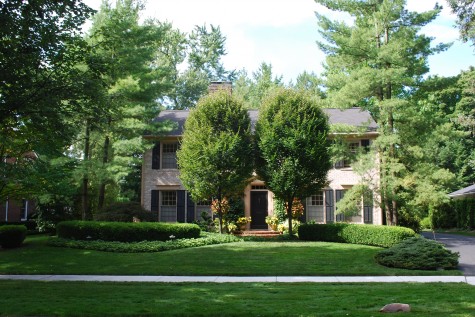
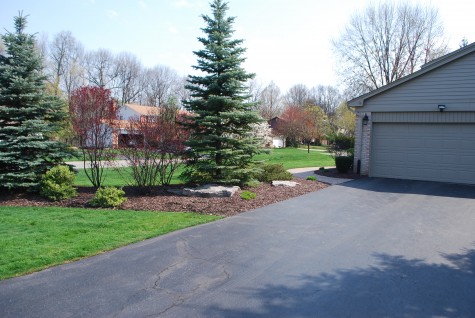
For curves to read well, they should be simple and large. The best way to assess if your curved beds have the impact you are after is to look at those spaces left over when you are done with your curve work. Whether they be the lawn, a pathway, or the property line, those spaces should look graceful too. Any bed needs to work in conjunction with what is not the bed in order to be visually striking.
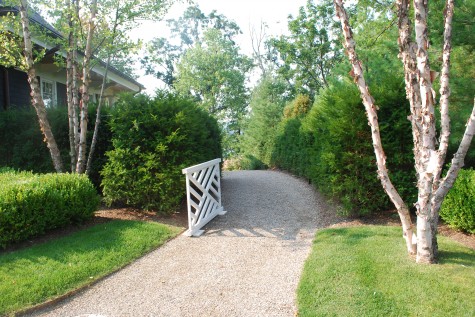 Curves provide opportunities to screen views, or provide a sense of anticipation about what will come next. This gravel path reveals little of what is to come, as it both curves and drops out of view from outside the gate. Transitional spaces such as this one are very important in giving a landscape a sense of continuity as you move through it. Even the smallest yard cannot be properly experienced all at once.
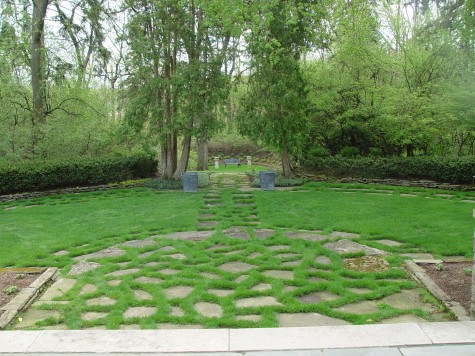 This old flight of stairs and lawn terrace were designed on a very large radius. All of the attendent plant material was planted in concert with this shape. In the distance, a circular garden whose center of interest is an antique garden bench flanked by a pair of Georgian pedestals. This is a very formal but understated design based on the circle.
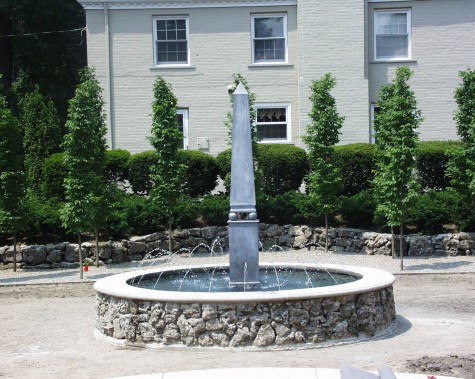 This circular fountain is the dominant element of the landscape under construction here. Curving the retaining wall in the background away from the fountain is a response to the importance of that fountain. Any gesture that gets repeated emphasizes the importance of that gesture.
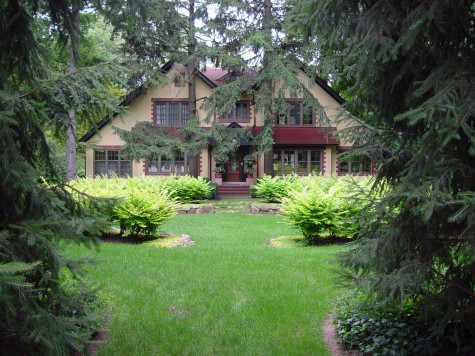
Though the view in to this landscape presents a formally constructed sunken garden in a circular shape, the choice of plant material keeps that formality from seeming out of place with the style of the house. Gold vicary privet is a plant one saw routinely in suburban landscapes 50 years ago. It was usually planted as an accent plant, given its astonishly bright leaf color. In this application, the vicary gives weight to a curved shape located in a space shaded by the surrounding mature spruce. Choosing the shapes of places in a landscape ahead of choosing the plants-a good idea.