I have great admiration for the skills of others. The degree of my admiration increases exponentially if the skill in question is beyond my ability. I marvel at the fact that Buck cooks, restores vintage motorcycles, and fixes all manner of broken things. He can take an idea for a stadium, a bridge or an obelisk, and produce drawings one could build from. He has incredible patience with me, when I design, though he has no patience for those who would design things that cannot be built-including me. He builds models with wood 1/32 of an inch thick; he will spot any detail not accounted for. He is very skilled at that human activity known as “determining the order of events”. Should I ever be so lucky in my lifetime to acquire 100 skills, none of the aforementioned will be on that list. Perhaps even more fortunate is that I do not need to be skilled at everything. Presumably this is why we have partnerships, organizations, companies, teams, universities, hospitals, communities and Google. Groups of people lend their particular skills to a problem, or issue, or effort.
Though my skills are very different than Buck’s, there is something our respective skills share. We apply our ability to observe to whatever might interest us. I do subscribe to the notion that people learn skills based on their interests. And that most people come with the power of observation, standard. However, the fact that I am able to spot a plant that needs water from a block away does not fund an ability to observe that one of my tires is low, or that my socks that don’t match. Socks that don’t match come under the heading of harmless eccentricity, but a tire gone flat miles from home is a nuisance. A college age employee I had working at the store this summer would routinely leave power tools outside on rainy nights, and walk past plant tags dropped in the driveway until he was asked to pick them up. Being asked to pick this up did not extend to picking up that, unasked. He had to have walked by a fountain he was filling gone to overflowing at least 10 times before he went home one day. The next morning I spotted from 150 feet away the glimmering surface of the lake that had been created at the rear of my property; I was not amused. I was never able to teach him to be more observant, as he had no interest in what was there to observe.
However, my gardening clients both from the store, and the landscape business, are very committed to their landscapes and gardens; were it otherwise, I doubt I would know them. I field lots of questions, many of which have to do with plant culture. What is wrong with my lindens, my petunias, my roses? Though I am by no means an expert diagnostician in regards to plant problems, I am able to observe the symptoms, should I have a mind to. There are the little things. “You know my method. It is founded upon the observation of trifles”; this from Sherlock Holmes to Doctor Watson. If the inner leaves on your lindens are going brown and dropping, look up premature leaf drop in your source of choice. Sources can’t see, but they can help you interpret what you see. You’ll read that when trees are stressed from lack of water, they will shed interior leaves in order to conserve moisture for new leaves. A drought stricken tree will shed all of its leaves to preserve moisture in the branches. Most trees can endure shedding all of their leaves out of season a number of times, before they die. If the dining table under your lindens is coated in a sticky residue, look up into the tree. Then research sticky residue on tree leaves-or some other more succinct and apt phrase. If there is something crawling on your plants (be sure you are looking with glasses adequate to the task of observing very small things), then looking up tiny spiders on my dahlias might get you an answer.
There are those issues which are too big to see. I have a row of trees at home; the three closest to a giant maple are several feet shorter than the others. I didn’t figure out the cause until I stopped looking at the three, and concentrated on the appearance of the whole row. Those furthest from the thirsty roots of the big maples were doing fine. I successfully located a leak in my reflecting pool once I saw the herniaria surrounding it had one distinctively off color yellow patch of an equally distinct size. I did not see this, until I had emptied all 1500 gallons of water from it, and searched the pool joints with a magnifying glass. A linden at my store has a trunk which I notice has gone from round to flat-what does this mean? A plant with yellowing shriveling leaves might just as easily be too dry as too wet; put a finger in the soil-what does that tell you? Your plants can’t tell you where it hurts; you have to look; when you are sure you have seen, then interpret.
Every gardener understands that it is infinitely easier and better for the health of a plant to squish a few bugs than battle an infestation. A hose trickling water on a newly planted tree is a small thoughtful gesture; bringing back that tree from the dead, not likely. I have nothing remotely resembling the power of life and death, but I do have a keen ability to observe. I keep that in good shape with frequent use, and practice.
I asked Buck to do some drawings for me for two fire bowls I designed, sold to clients, obtained deposits, and contracted for. However, I did not observe the manufacturers drawing properly. It has a manual ignition, underneath, and on the side of the bowl. As my design calls for the firebowl to be dropped into a round stone column, tall enough and wide enough to sit on-just like a rimmed sink in a countertop, how will my clients fire the thing up? Buck gently pointed out I had buried the manual ignition in a stone wall. Would they not prefer a remote ignition system? My order of events is out of order. The time to see this detail is before the client decides you have a good thing in mind for them, and posts a deposit. Hear me sighing? Though I am a designer with a strong visual bent, I too forget to observe what I should. This is a skill that needs frequent practice to keep sharp. It is also a skill that will save you time money and grief, keeping that beloved garden of yours looking good.
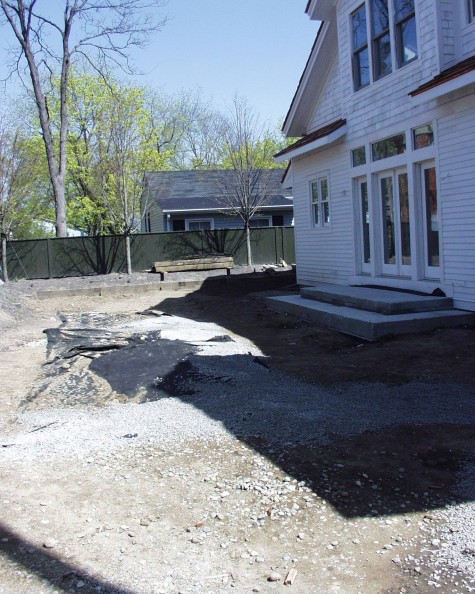
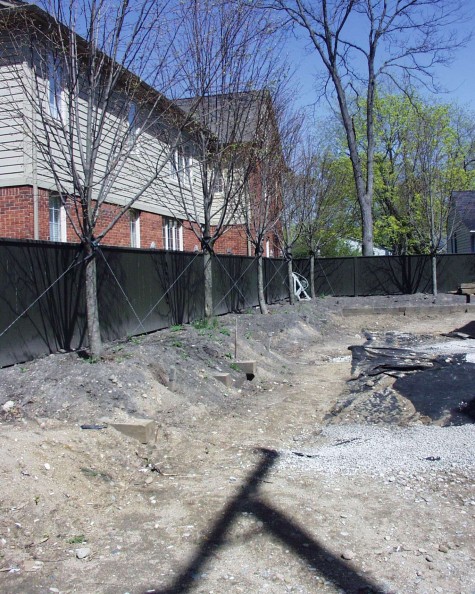 A retaining wall of pressure treated lumber was installed near the lot line; the lindens were planted some sixteen inches above grade. A six foot high wood fence, painted “disappearing green”, would provide complete screening at the tree level. My clients are very fond of the buildings in New Harmony, Indiana. All of the later additions and modifications to the original architecture have been painted “disappearing green”-a color which recedes from view such that it is easy to see the original architectural intent of the buildings. I would describe the color as a dark muddy green brown. With the trees and fence in place, the screening would be a dominant element of the garden, but occupy a very small space. I lowered the ground plane as much as I could without endangering the drainage of the loqwer level. The trees instantly gained 18 inches in height; this placement put the lower branches of the lindens just above the top of the fence. This is what I would call engineering one’s screening.
 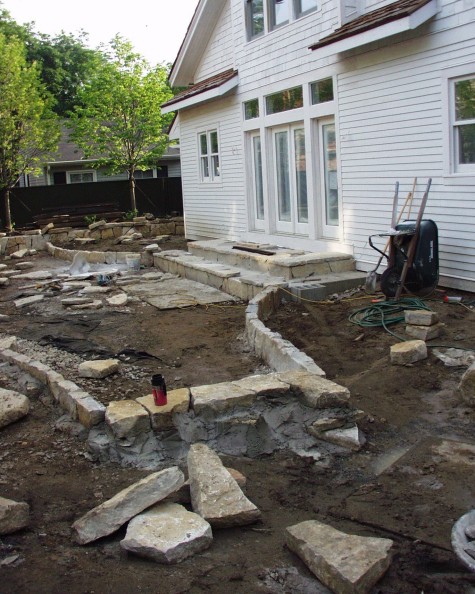 Of course that sixteen inches of soil was not going to stay put without some retaining on the front edge as well. My clients chose a rustic stone for the tree planter box walls, and the retaining for the garden beds. You see stone laid out everywhere on the site; the stone mason needs to pick and choose which stones fit together so the mortar joints are small and unobtrusive. It would be three steps up into the house; I made them deep and wide-easy to navigate. It was most important to them to have a private garden; they were willing to deal with the up and down.
 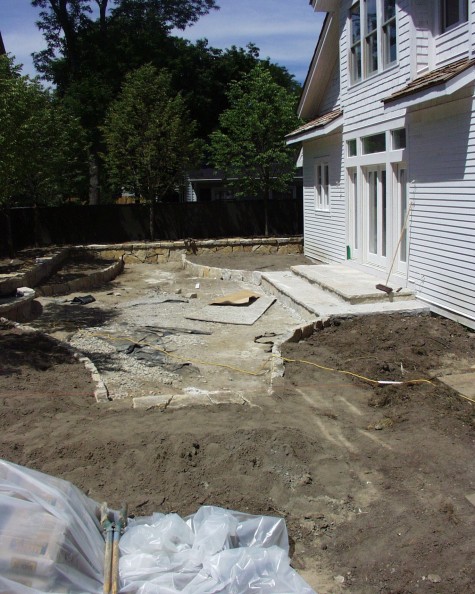 The sixteen inches of plant mix filling these beds would vastly improve the quality and drainage of the soil. The garden would be easy to plant, and weed. The worst thing about weeds-how far they are away from your fingers, and what your back has to do in order to get your fingers where they need to be. An entire tool industry is built around that distance. These gardens would be closer to the hands maintaining them.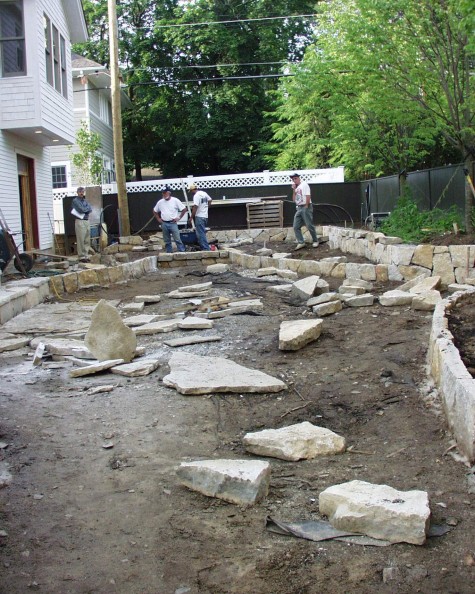
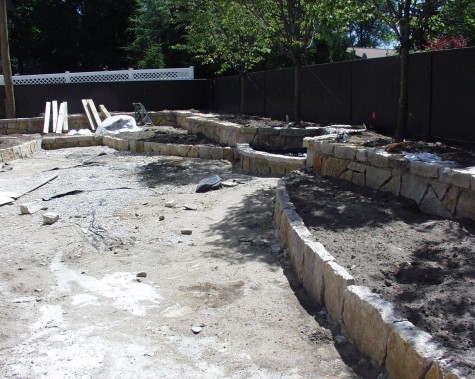
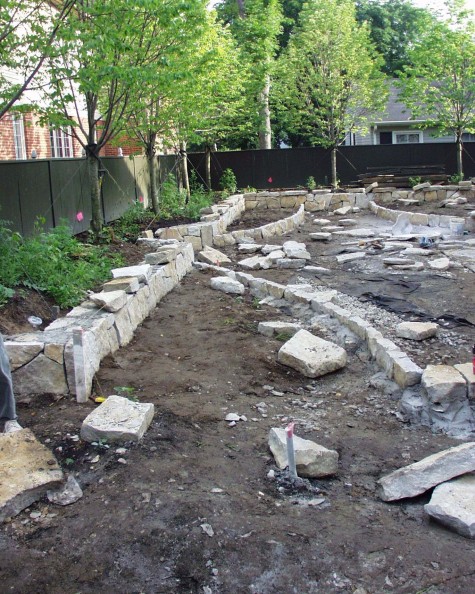 This landscape would eventually have three distinct levels. The change of grade would provide a lot of visual interest for a very small space. Not incidentally, a sunken garden dramatically reduces ambient noise. Earth is the only thing which really blocks sound; no amount of plant material will screen out unwelcome noise. Homes built in close proximity face both audial and visual screening issues. I like living in a neighborhood, but am I enchanted with my neighbor’s kids shrieking or the sound of their lawn mower-no, not so much.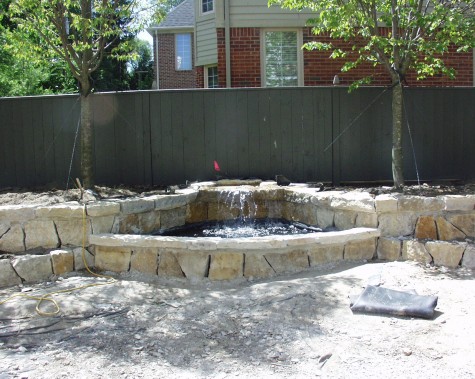
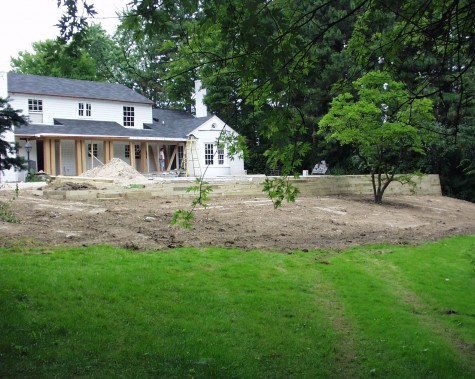
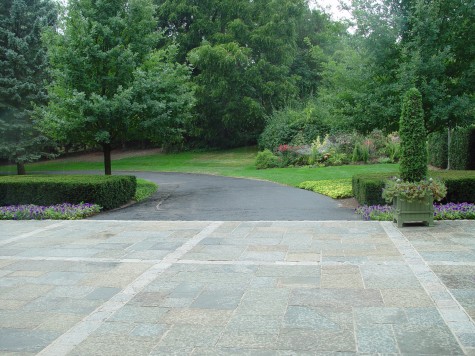
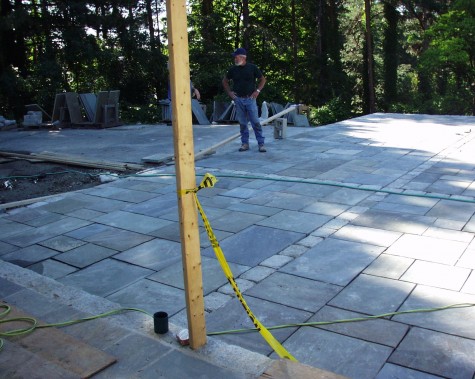 The driveway was equally close to the front door, and ran past the house to the garage. This made for little opportunity for a presentation of the house, and its fourteen foot width did not permit much parking. It seemed appropriate to splurge here. Two inch thick bluestone laid in a classic aschlar pattern, and bordered in granite setts announced the entrance in an elegant and spacious way.
 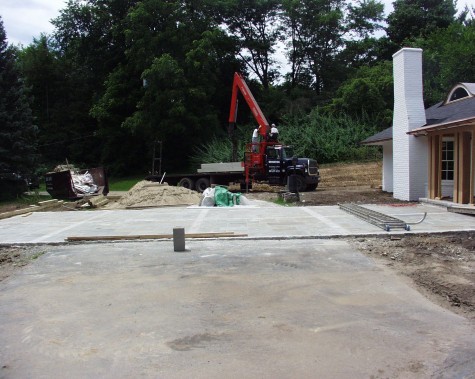 When not in use as a driveway, or for parking, this areafunctioned as a terrace. I have known my clients to host a pre-dinner hour here on a nice night. The asphalt would remain in place on either side. A stone driveway demands expert installation, a service which is well worth the expense.
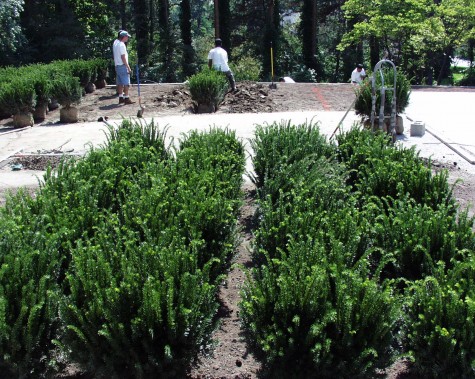 The landscape is simple. Rectangles planted solidly with yews abut four rectangles of pachysandra and matching English Oaks. The triple wide hedge of yews adjacent to the retaining wall provide security for people and vehicles. These masses of yews did have that polka-dot pattern for a few years until they grew in; proper spacing at planting helps to avoid cultural problems later.
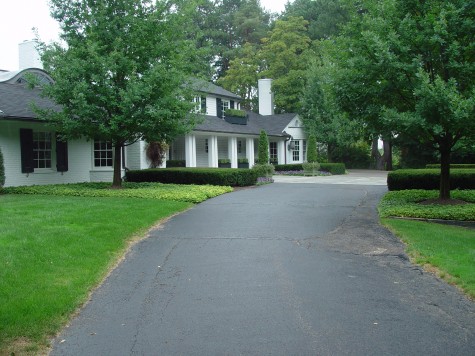 A driveway that runs parallel to the front door needs a landscape statement that signals an imminent entrance. This drivecourt landscape creates the impression that the garden came first, and the drive through second. The English oaks enclose the space, without obstructing the view of the house.
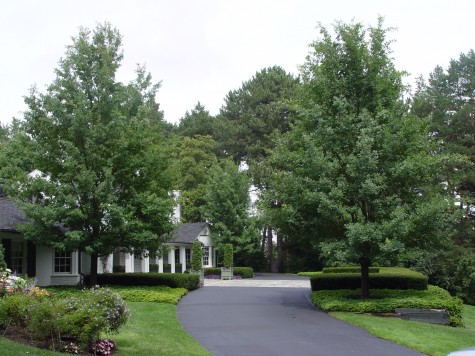 It has been a number of years since this garden was installed. This photograph clearly illustrates what a graceful space has been created from the simple idea of flat ground. Sloped spaces are not particularly sociable or functional spaces. Deciding how you need a space to function, should organize the design to come.
 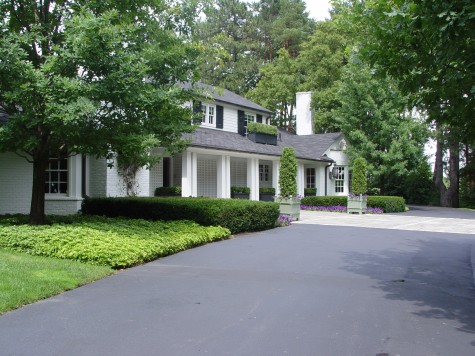 A pair of French orangery boxes from Les Jardin du Roi Soleil define the transition from driveway to walkway. These boxes have been manufactured in this shape, design, and color since ythe 17th century. The legs, corners and hinges are cast iron. Originally, the slatted oak boards and hinged iron permitted the boxes to be opened from the side. A lemon tree that had summered outdoors could be slid out of its box, and stored in the orangery for the winter. How’s that for a little romance?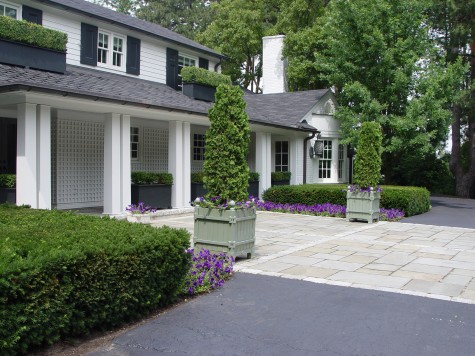

 ll
ll