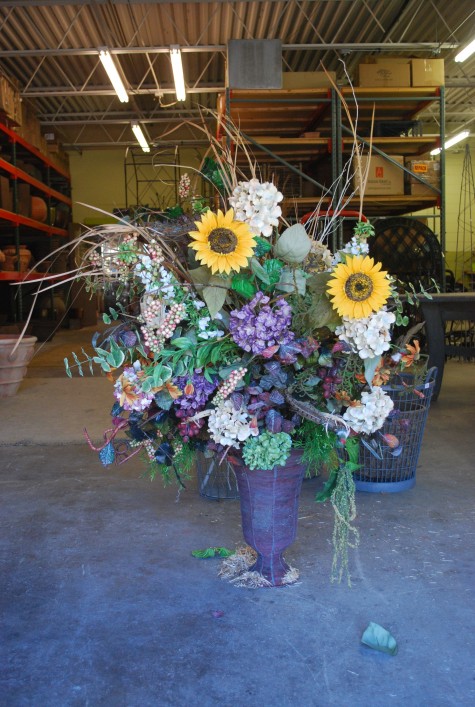
 My first choice of a giant arrangement of flowers and greens is first and foremost about fresh. I would guess most gardeners would agree with this point of view. But a big statement in fresh flowers is ephemeral, and incredibly expensive. A garden that could supply 100 stems of fresh flowers every week-this would be a very large garden. The time it takes to arrange fresh flowers and keep them looking fresh is considerable. I am happy when Buck just buys me a dozen roses at the grocery. Fake roses can be fine too, provided they are arranged with style and wit. This artificial arrangement came to my door just two days ago.
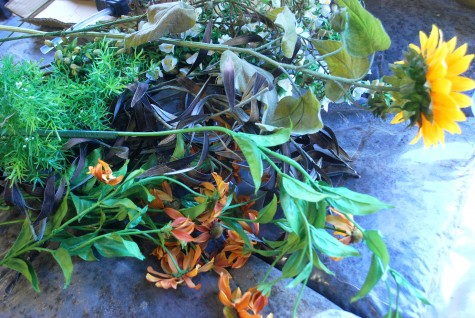 I have not one problem in the world with artificial flowers and greens. They are designed by real people, and manufactured by real people who take their jobs seriously. They are purchased and taken home by real people whose pleasure in the natural world is self evident. If you cannot do fresh flowers, if you have a spot in your heart and home asking for some evidence of the natural world -if you must go with the faux, I have some ideas.
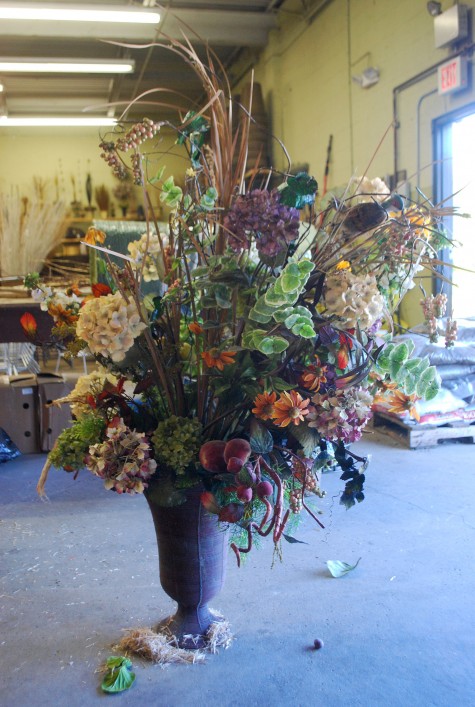 No kidding-this is the flip side of the arrangement in need of an overhaul whose front side is my opening photograph. It looks to have one of everything imaginable. No artificial arrangement benefits from a kitchen sink approach. What goes in your kitchen sink is about discards. What goes in your arrangement is about choices. Choose a few materials that really appeal to you. Choose a few materials that make a strong statement about volume, color, texture, contrast and mass-as you do not have the fresh card to play.
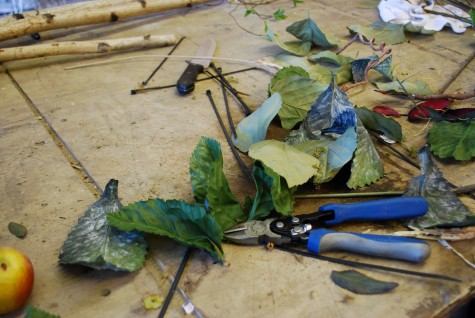 I regularly arrange flowers for weddings and events. I have a gardener’s point of view that governs how and what I put together. Those natural materials do the lion’s share of the work. I can bunch 3, 10, or 100 cut stems. Any three stems fresh cut, any fresh cut fistful of flowers, or truckful of fresh flowers is guaranteed to please. No matter how badly you arrange them, fresh flowers always look beautiful.
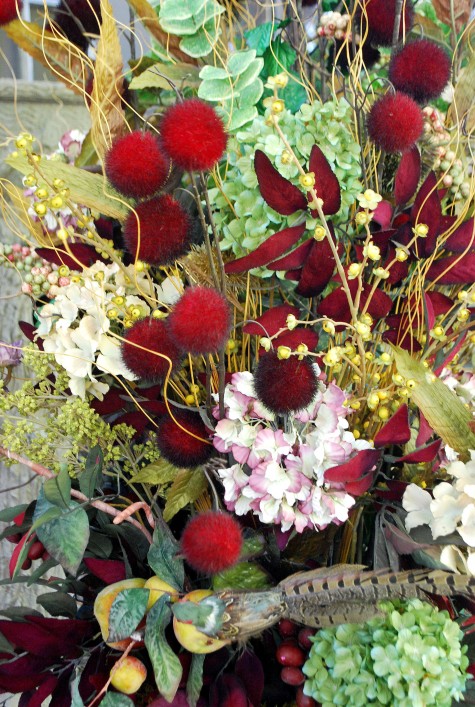 An artificial arrangement is about a visual feast of a completely different sort. The fake flowers and stems available today are incredibly good. However the leaves are incredibly bad-they are a manufacturing afterthought. Loose all the fake leaves, and arrange each stem so that its given star gets good play, and contrasts in color, texture and volume with its neighbor.
 Rob saw fit to purchase box after box of artificial stems featuring red fuzzy balls. Their color and texture-more than interesting. My client’s arrangement-I took it apart. I washed, or otherwise cleaned every stem that I thought might be relevant. I clipped off every offending fake leaf. I planned to cover every plastic stem with some shape of interest.
 The group that I would call gardeners needs a very big tent-should they all plan to meet. Gardening takes many forms, most of which interests me. What interested me here was providing my client with an updated look.
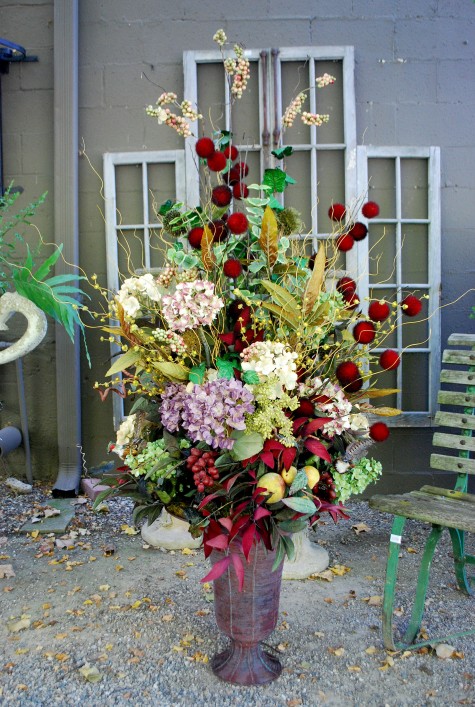
An artificial arrangement need not be dusty looking or poorly planned. You have no obligation to use a stem as it comes out of the box. Figure out what part you like the best. Discard the worst, take apart the rest, and decide what overall shape pleases you. Arrange each element so it looks like you were having fun.
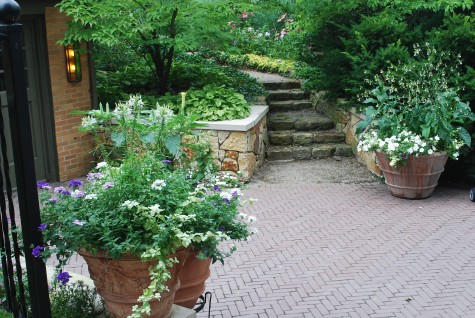
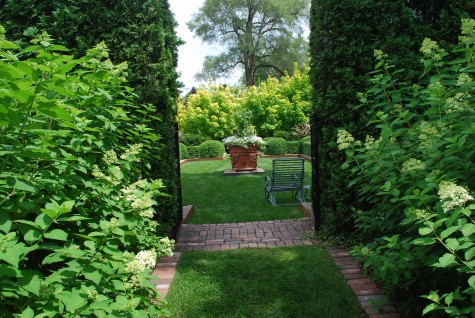
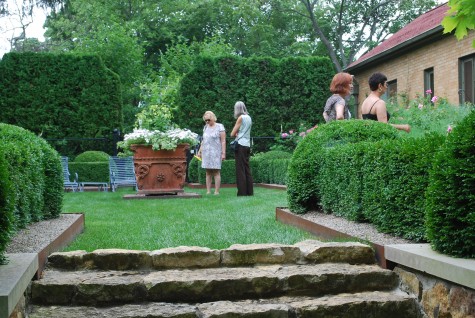

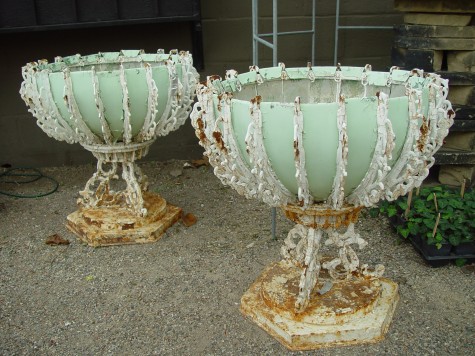
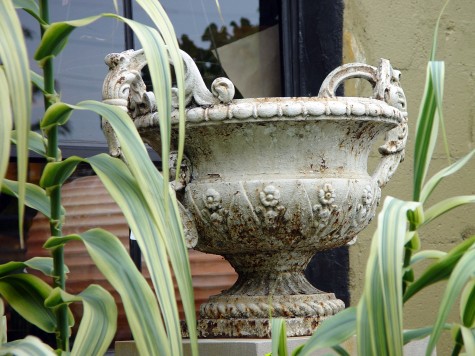 Gardeners make choices based on lots of issues, but most can figure out what appeals to them straight off. Some love old crusty, rusty and well worn antiques; others find that state of gentle disrepair lacks visual punch. Many antique urns have been painted at one time or another; white having been a very popular color. Worn white will either be just the thing, or seem jarring. For others, the prospect of a classical urn leaves them cold-old or new. But if the idea of an urn resonates with you, which you will choose depends on several things.
 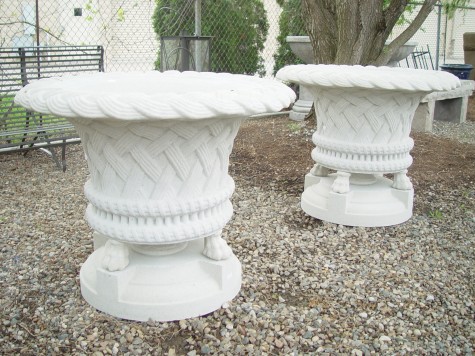 Dry cast limestone urns are usually based on classical handcarved limestone designs dating back hundreds of years. Many of those designs are European in origin. Dry cast limestone is a process by which limestone dust is mixed with a binder, and poured into molds. These reproductions are much more affordable than their antique counterparts. Some old designs would not be available at all, but for a reproduction. On occasion I find a piece I feel I must have, with no placement in mind. But a classical European urn may be very much out of place in front of a Cape Cod home. Now would these elaborately footed urns ring right against the backdrop of my own arts and crafts style home. However, they might be elegant and unexpectedly beautiful in a contemporary setting. The location you have in mind should influence your decision.
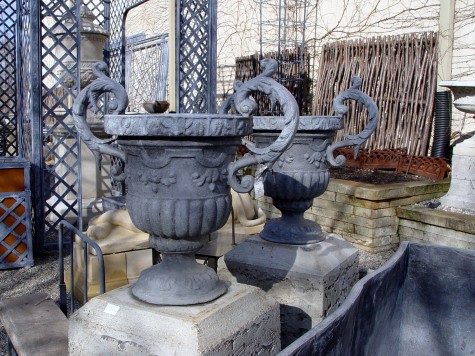 The scale of an urn is an important consideration. Very small urns may need pedestals to set them off properly. If the shape and decoration of an urn is a good bit of what you find appealing, then they need be placed where those things can be easily seen. Small urns have another significant disadvantage. From a small size follows a small planting area; you will need to edit your plant choices. Perhaps of more importance-how easily will you be able to water, and water again, when the weather gets hot? Small pots dry out faster than is easy to keep up with.
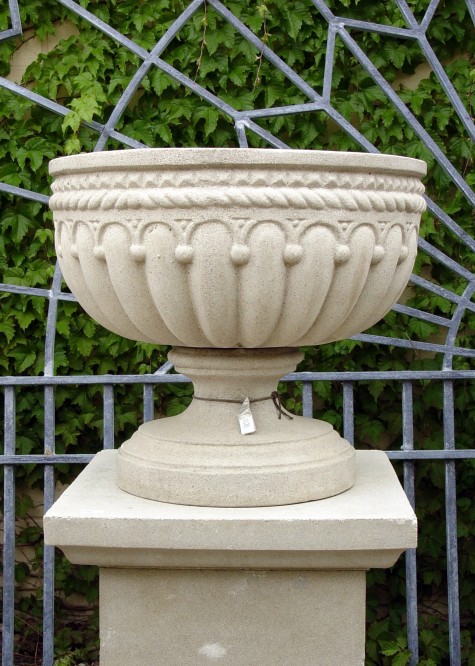 I like urns of a generous size. I have plenty of room to plant-either lots of one thing, or a collection. An urn planted such that in late summer it is a garden bouquet of good size is a pleasure. Watered properly, they retain moisture evenly, over a longer period of time. A container that can wait for me to get there with the hose- this I appreciate. Any urn I plant becomes part of the working garden. A gorgeous urn with a poor planting is a frustration no gardener needs.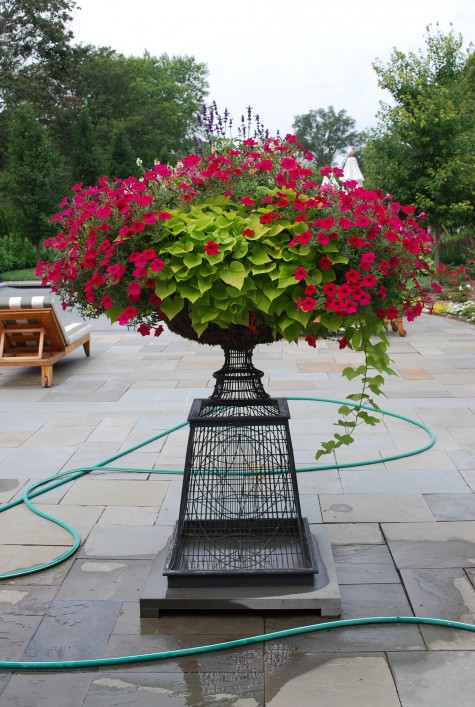
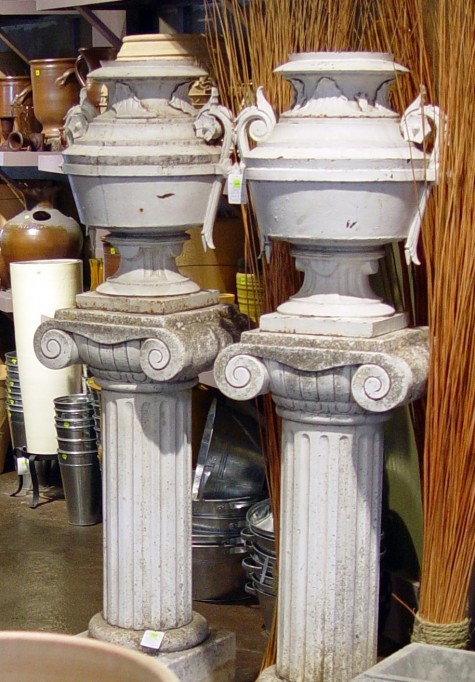 These French art deco style urns have such style and presence one might be inclined not to plant them. The Waterloo Urn I discussed in yesterday’s post is placed out in the open landscape. Unplanted, it could be placed anywhere calling for a sculpture-no need to have water conveniently nearby.
 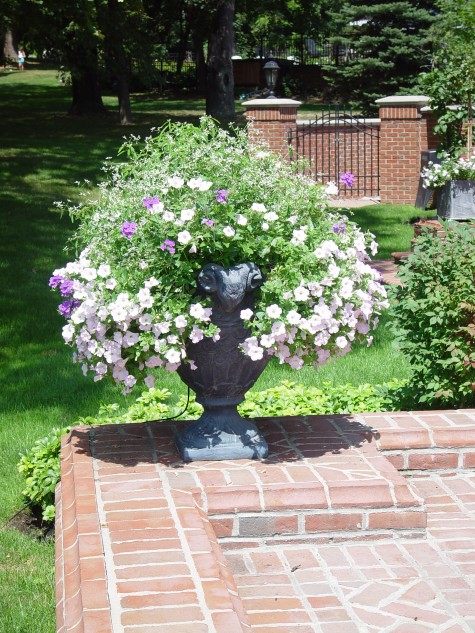 This lead urn is watered via a tube connected to the irrigation system in this yard. In much the same way as greenhouses tube their hanging baskets, or geraniums, these tubes buy a gardener a little time. They are not really a substitue for hand watering, as the coverage can be uneven, too long, or too short. If the tube runs on a nearby irrigation zone, that pot is at the water mercy of whatever else is being primarily watered. I am more than willing to look after my plantings; some automatic irrigation helps me to hedge this pledge. Those days that I come home really late will not need be a crisis. The level of your ability to maintain pot plantings is an important part of the selection process.
 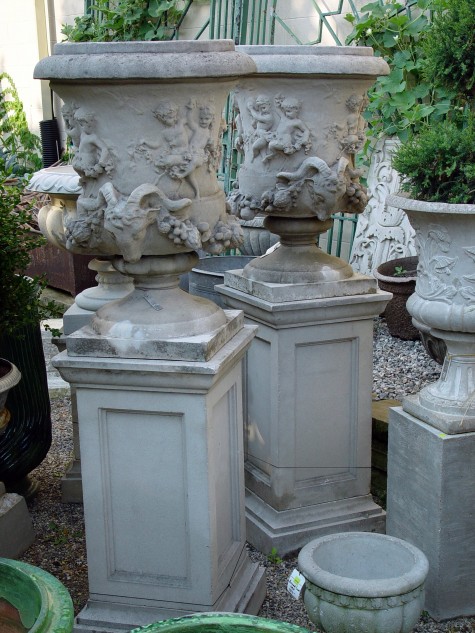 These concrete pots are English made reproductions, but they have that aged look. The surface is such that I would plant the tall, and vase shaped-nothing trailing. Ala some voluminously opulent Flemish flower painting. There is no choosing these pots if the decorative story being told does not greatly appeal-why cover up what so appealed to you in the first place? In this case, the urns and there plantings need to strike a balance, so they look great in relationship to one another.