Tie It All Together

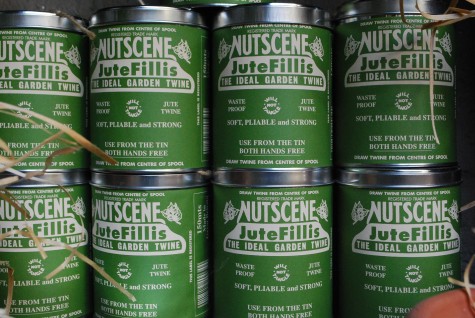
I am a fan of string, twine, thread and rope.  This is a material that helps with no end of chores in the garden.  The English adore twine; Nutscene is a company in England that makes string.  This jute string comes in a can-just like the label says, it is pliable-meaning it will not damage tender stems.  It does eventually deteriorate, but that process is slow.  Pulled from the center of the spool which is contained in a can, there is no tangled mess.  How you can use this jute twine with both hands free baffles me-but I am happy to let that claim pass.  This jute twine is ideal for tying wayward perennial stems to a stout stake, without injuring the plant. 
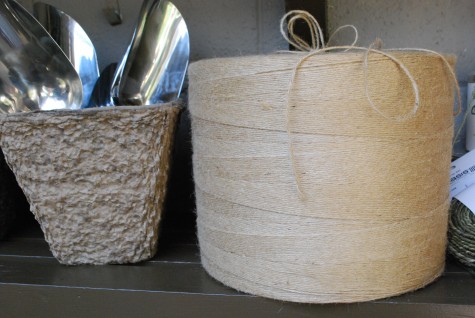
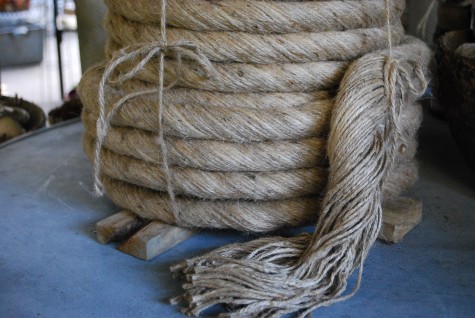
Should you have a need for thousands of yards of jute twine, Nutscene manufactures wheels of string.  Pray I never have a need for this much string.  But I love the look of this spool.  India is the primary source for jute worldwide-the fiber comes from corchorus capsularis, or corchorus olitorius.  They both are tropical annuals, from the linden family.  Burlap, a staple fabric of the landscaping industry, is woven from jute. Used to bind up rootballs, jute burlap eventually rots away, permitting the roots to work their weay into the surrounding soil, and the plant to take hold. It may not be the strongest string on the planet, but it is a natural, readily available, and traditional material appreciated just as much as a strong and well made terra cotta flower pot.
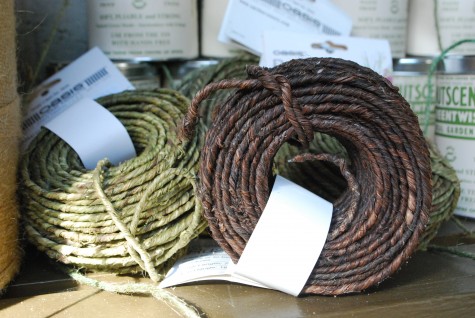
Bark wire is a staple in my tool kit.  I know that wire is the inner layer-I have no idea what fiber is wrapped around that wire.  I am sure it is not bark-it is a rough twine  of some sort.  I do know that when I need some strong restraint, bark wire does the trick.  Should I have a centerpiece wired in a visible way, this is my wired string of choice. 
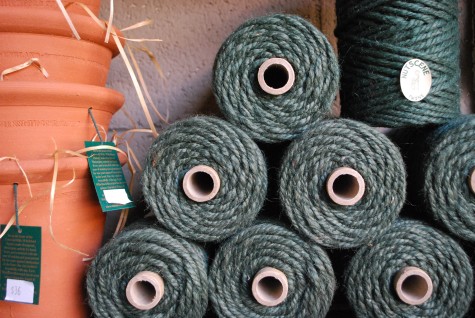
Jute dyed green is a color friendly to the garden.  These spools of widely twisted jute fibers are satisfying to look at.  How would I use them?  You might use this twine to make a fence for peas, or wrap a package.  On a twine binge, I might wrap a pot with it.    
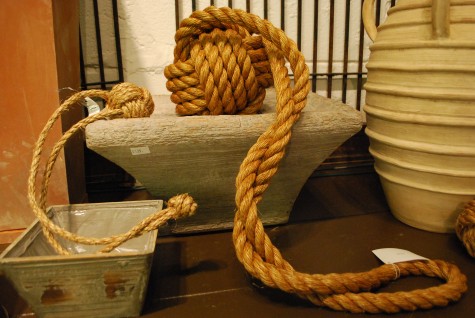
This pair of jute spheres are of vastly different sizes. The large rope wrapped sphere is a celebration of the strength that comes from many strands.  It is also a testament to the maker-it is incredibly difficult to make rope conform to a small or precise shape.  The technical issues aside, these are beautiful objects made from plants.
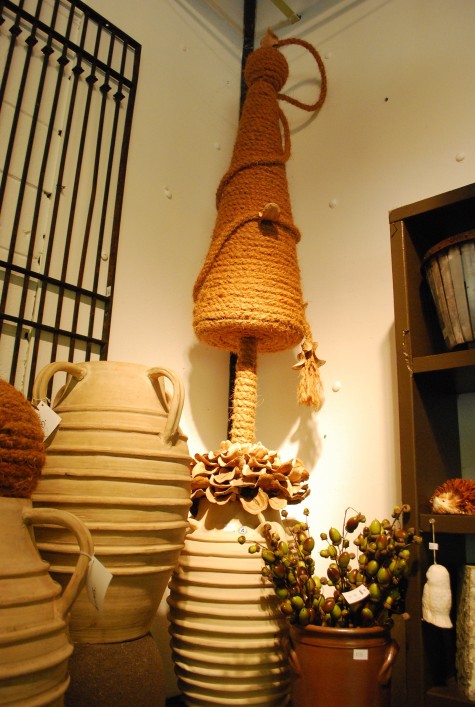
I wrapped this topiary form with its sphere finial in rope made from jute.  I like the look of the horizontal bands of rope in relationship to this french beehive pot fashioned from the natural color of a local clay. This I would call the next best thing to a living plant.  A sculpture from rope in a terra cotta pot brings the garden to mind.  
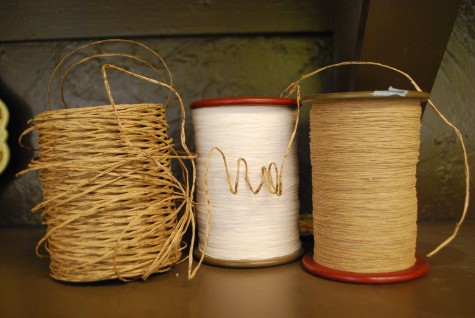
I collect string.  On the left, a spool of wire covered in paper.  In the center, linen thread. On the right, string made from twisted paper.This giant wood spool is covered with a flexible jute rope comprised of many individual strands.  We make bows from this rope.  We hang birdhouses, and light spheres from it.  We use it whole-we divide it up.  We wrap tree trunks for the winter,  and packages with it.  The smell of natural jute is as pleasing as the smell of phlox, roses, or petunias.      
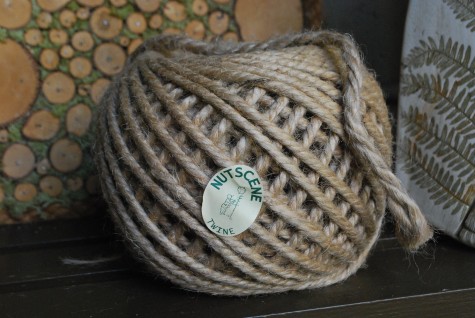
Rob bought at least a hundred balls of natural jute Nutscene twine this past spring.  Most of those balls are gone.  I have no idea how they got used.  I do know they are beautidful objects in their own right.  I had occasion to  use 6 of those spools this past weekend.  
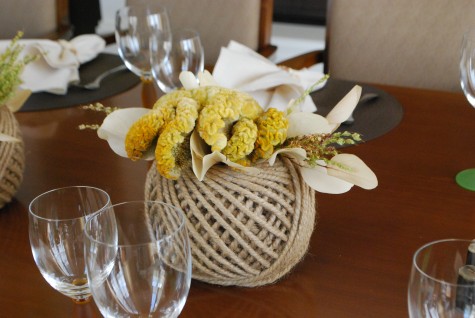
A client having her family for dinner over a holiday needed some centerpieces.  I could not take my eyes off those jute spools.  I worried plenty that she would not appreciate my idea about string spool vases and fall.  I need not have worried. 
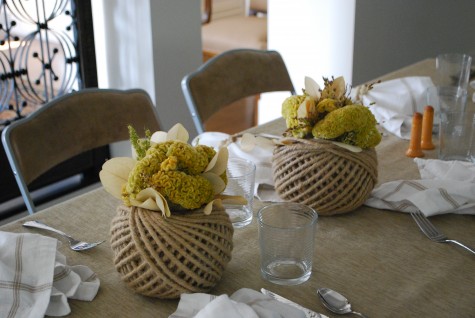
She loved the string vases, the yellow celosia, the bleached leaves, and the green broomcorn bits.
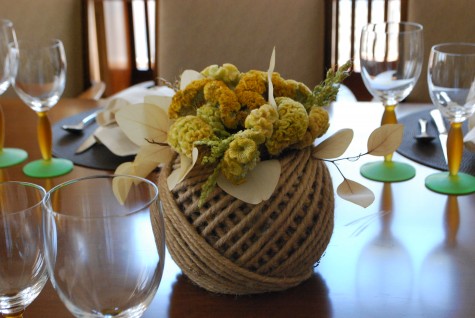
These twine ball vases and their dry materials can stay on the table the entire fall.  Natural materials have a way of fitting-even on the most formally set table. 
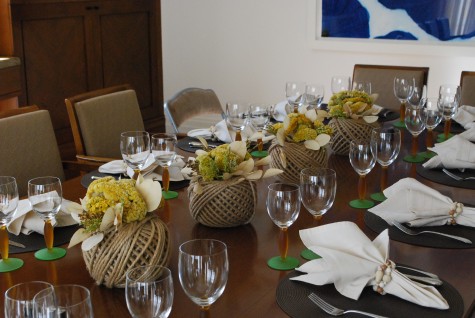

It is amazing what a little twine can tie together.

Garden Cruise Tomorrow

A few years ago this client in Dearborn put her garden on the garden cruise we sponsor every year to benefit the Greening of Detroit. If you are not familiar with the Greening of Detroit, in the past 21 years, they have planted thousands of trees, sponsored hundreds of urban farms, and made respect for the environment a mission.  Our tour raises money for them.   I had been working on her landscape for a good many years, and she was kind enough to agree to share it with others.  I am pleased to say that this year, her son Rich and her son-in-law Jason, have agreed to put their gardens on tour.

They are both young people; one landscape I designed and planted only this past summer.  Jason’s landscape and garden is entirely of his own design and installation-he goes so far as to grow his own flowers from seed under lights in the winter.  The landscapes represent very idividual tastes, and are entirely different.  What I like the most about them both is that young people are growing them.  I visited CB and her garden while I was in Dearborn checking out the tour gardens.  She and I both were struck by how the landscape suddenly seems mature and finished.  The landscape is looked after by Melissa and her crew from M and M flowers-her level of maintenance makes every landscape she tends look great.

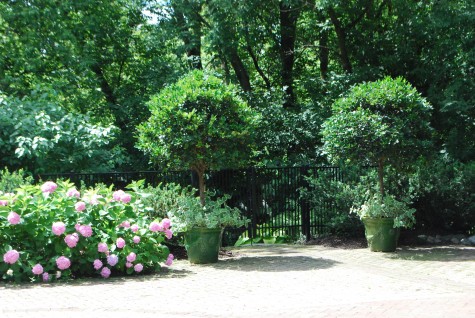
I have wintered these wax leaf privet single ball topiaries in a greenhouse for the past 8 years.  With root pruning in the spring, we have managed to keep them in these glazed French pots for 8 summers.  The hydrangeas were originally planted in the front of the house.  I moved them here to take advantage of a bigger dose of sun.  They seem entirely happy now.  Planting a landscape is just the beginning.  Some things will not do well.  Other things ask for a different spot.  Moving things around is part of an garden experience.  Most everything thing can be better, if you have patience and resolve.  I try to own up to mistakes early on, so the moving is not such an ordeal. 

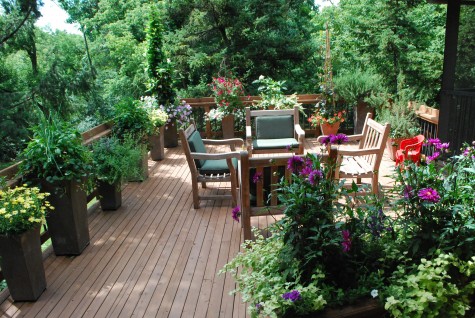
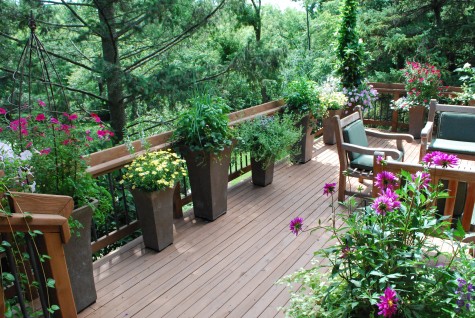
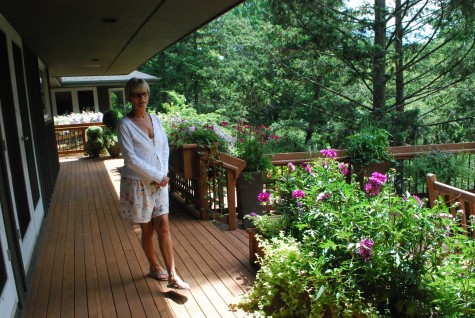
CB’s house is situated on a very steep lot; a deck upstairs spanning the entire barck of the house is her garden in the air.  Lots of containers help to create that garden.  On the far right, an old wild rosemary that spends winters in a greenhouse supplies the kitvchen.  On the left, 3 pots devoted to herbs-mostly basil.  To trail in the basil pots, everbearing strawberries. 

There are never many strawberries, but the idea of it is enchanting, and the texture of the strawberry leaves is great.  Tidal wave petunias, mandevillea and dahlias are thriving in the high heat we have had.

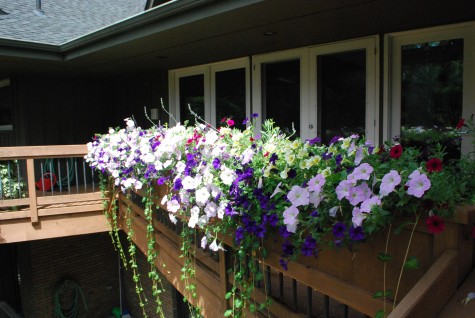
My only addition to the deck was to plan and build a pair of very long planter boxes installed outside the deck rail.  This keeps water and debris from the boxes off the deck surface.  Lavender, purple and yellow petunias are punctuated every so often with dark red violet potunias.  The trailing vinca maculatum will traill almost to the ground by the end of the summer.  There is very little maintenance to them. 

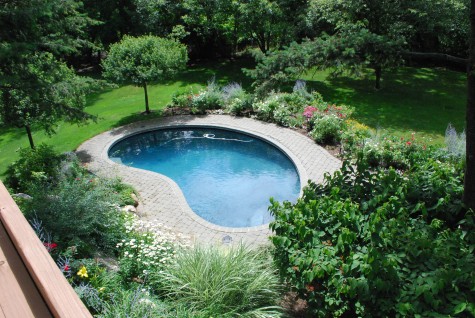
Several large perennial garden enclose the pool.  They have been struglling in recent years; the local deer polulation has exploded.  This year, Melissa installed steel post 4 feet tall all the way around the gardens, and strung them with three rows of fishline.  The deer have not touched a thing all season. I can hardly believe this is working, but it is. The lollipop Coralburst crabapple pictured is one of a pair that were planted in celebration of her son Rich’s wedding years ago.  They have matured beautifully. 

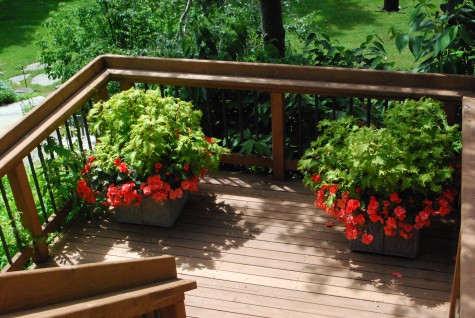
On the landing, two lead boxes with green coleus and orange begonias.  All of the containers have drip irrigation in them, and they stay in place all winter. The taupe colored terra cotta pots are frostproof terra cotta from Italy.  Each pot is elevated on feet, to prevent any water from collecting and freezing underneath.  I always enjoy planting these pots, and I enjoyed even more going back and visiting both the garden and my good friend CB. 

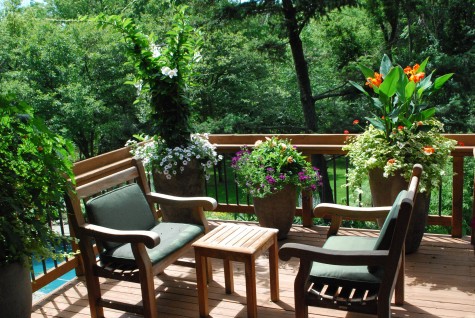
A small deck off the master bedroom is large enough for a pair of comfortable chairs, and 4 large pots.  The branches of some old Norway spruce in the backdround are a reminder of how high up in the air this garden really is. 

CB is an accomplished gardener, but today I am thinking about how much she has nurtured that interest in two young people in her family.   In my estimation, she has accomplished something very important.

Planting For Events

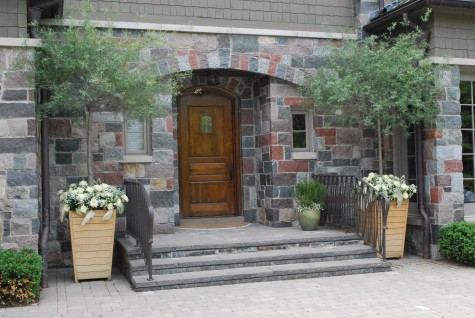
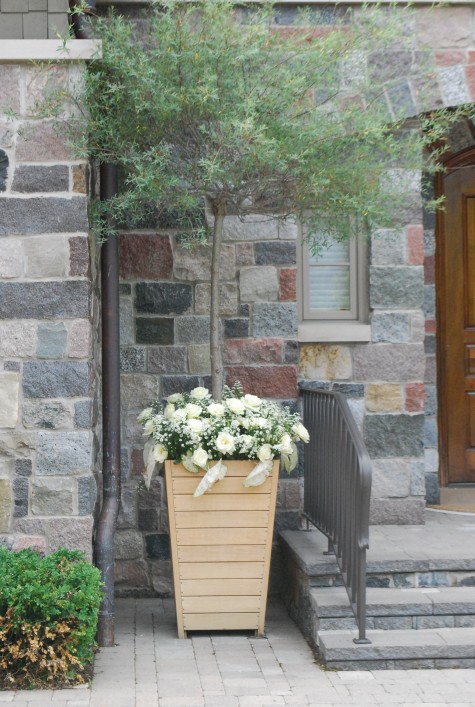
We do plenty out of the ordinary garden plantings- given a special event.  Planning outdoor parties, and timely planting for outdoor parties don’t always go hand in hand.  Whenever a client asks for white tulips blooming for a mid-May outdoor wedding reception, I sigh.  Try as I may, I am no better at predicting when the Maureen tulips will be at their white peak than I am at predicting the outcome of a horse race.  Suffice it to say that I planted hundreds of pots of all kinds of spring flowering bulbs hoping some would be in bloom for our spring fair-not a one bloomed for the fair.  I have also stuck cut white tulips in water tubes into tulip foliage in the ground.  This is not cheating-this is going the distance to make an event visually memorable.  I had 3 weddings scheduled this spring- two on June 4 and and one June 19.  Several clients had graduation parties they planned to hold outside in mid June.  The spring did little to help me out; no end of cold and wet weather kept me from planting until I had no choice but to go ahead, and hope for the best.  Everything seemed to work out fine.  Late May and June is not an optimal time for a garden party in my zone, unless there are a lot of bulbs, and spring flowering annuals and perennials in place.  This client was hosting a wedding reception at home.  The Belgian oak boxes asked for a different kind of planting to celebrate that event.    

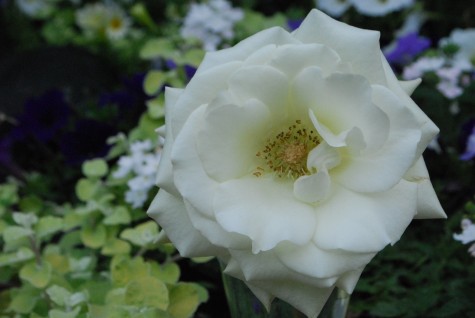
The fact is that no perennial, bulb, or annual planting will perform spot on and perfectly for an event.  I encourage my clients to use cut flowers to add to what is already going on. The florist’s rose known as Hollywood is the best white rose it has ever been my pleasure to use.  Though I order them up from my cut flower supplier, for all the world, they look and open like garden roses.  I order them to arrive several days in advance of the event, so I have time to condition them.  I recut the stems on a slant, and place them in room temperature water in a cool spot.  This encourages them to take up water;  proper conditioning can make cut flowers last much longer.  My plan was to add cut flowers to the annual planting. 

 I had planted the boxes with top grafted willow topiaries, and white caladiums.  Given a wedding reception, I stuffed stems of the roses, and white montecasino into the soil around the caladiums.  The pots looked dressed to the nines.  Hollywood roses last a long time out of water.  If the air temperature is cool, I stick the stems directly into the soil.  If the weather is hot, I may tube the roses.  Floral supply places carry pointed plastic tubes with perforated rubber caps that permit the stem of a flower to be pushed into an individual “vase”.  A rose can drink this small amount of water in a matter of hours, but often that is long enough.  The pointed end of the tube can be poked into the soil.  Once the reception was over, the roses are removed, and the caladiums grow on into the summer.   

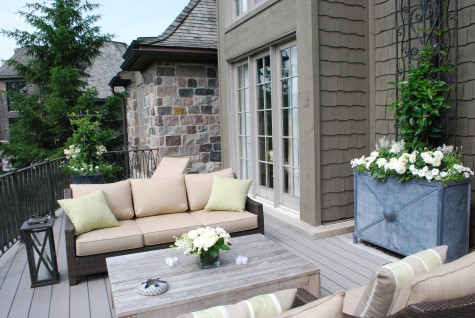
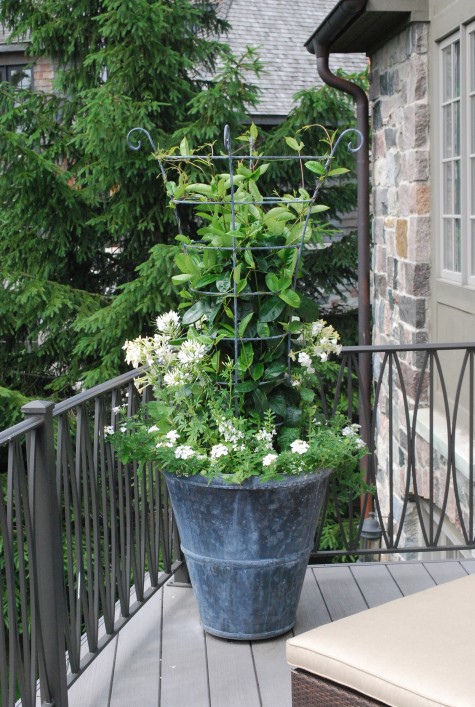
The containers on the balcony were planted with white flowering annuals especially for this event.  A pair of white mandevillea vines were conspicuously green, but mandevillea likes heat to flower.  By June 19, we had had but a few really hot days, and night temperatures in the 50’s. But other plants made a little white statement. 

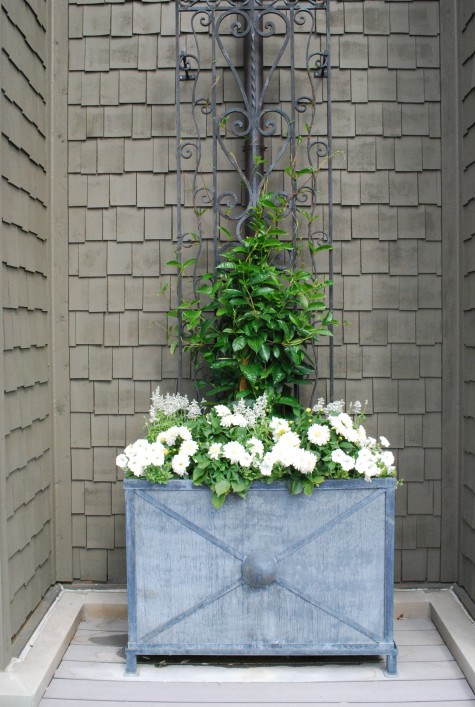
This box with its own antique scrolled iron panel is very friendly to a mandevillea planting.  The niche is warm, and protected from wind.  The vine will have plenty of places to wind around, and grow.  It will climb to the top of this panel in no time.  The placement was somewhat dictated by a giant downspout right in the middle of the wall.  Whomever designed this detail had utility on their mind-and not much else.  But as this balcony does not get any use in the winter,  the container helps to solve a visual problem. 

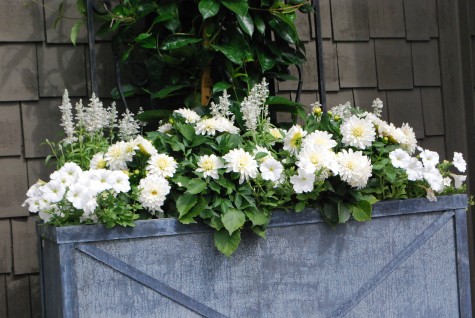
White salvia has never been a favorite.  But the new Cambridge series has more substantial and brighter white flowers.  The white Gallery dahlias have large flowers, as do the white supertunias.  Some white flowers I stay away from.  The blooms on white geraniums are so quickly spoiled by rain.  Plant them if you plan to wait on them regularly.


I have always liked white cleome, but this dwarf version called Spirit white is completely at home in a container.  Soon there will be white angelonia, and lanai white trailing verbena.  In another month, it will be the perfect accompaniment for a garden event.  June the 19th, it looked perfectly fresh and lively.


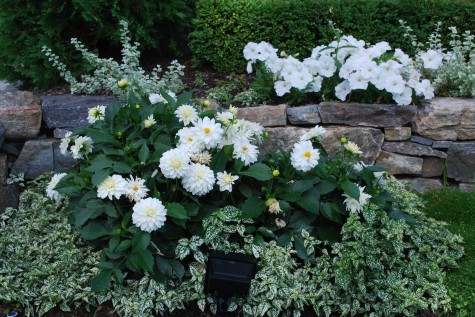
There are lots of great choices in white flowers-everyone has their favorites.  The not so often used white polka dot plant is a great supporting cast plant-it is best in shade.   It looks great with white caladiums. If you want to use it in full sun, as it is planted here with white dahlias, be sure it gets enough water.   Variegated licorice does a similarly wonderful thing for white flowers; its cool blue grey foliage makes white look especially crisp, fresh-and very festive.

Flow Blue

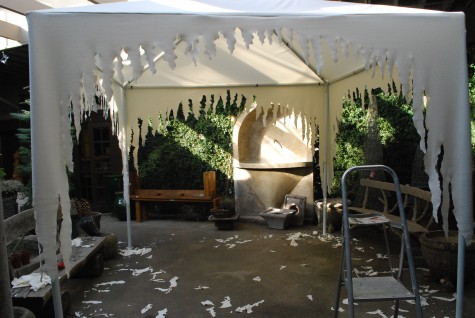
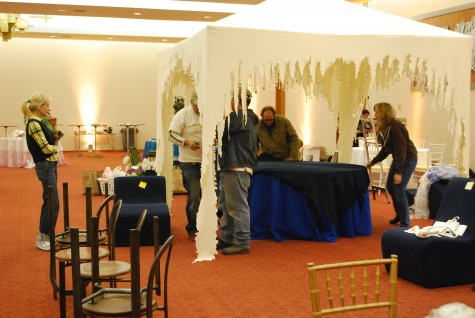
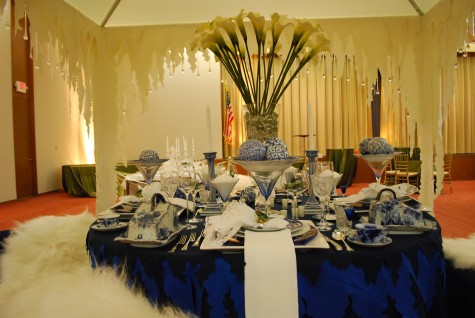
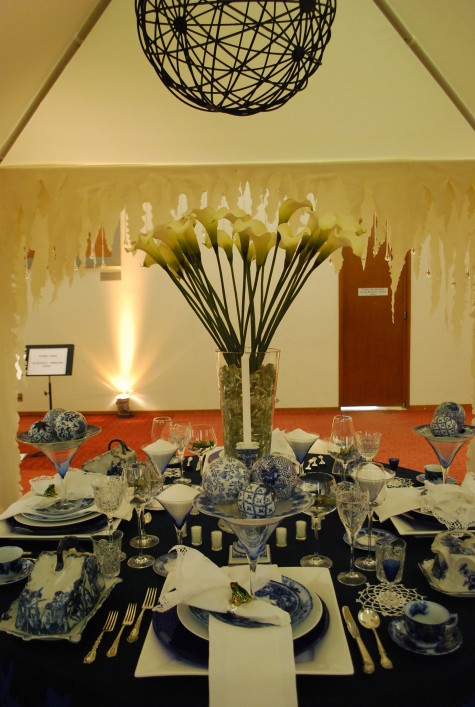
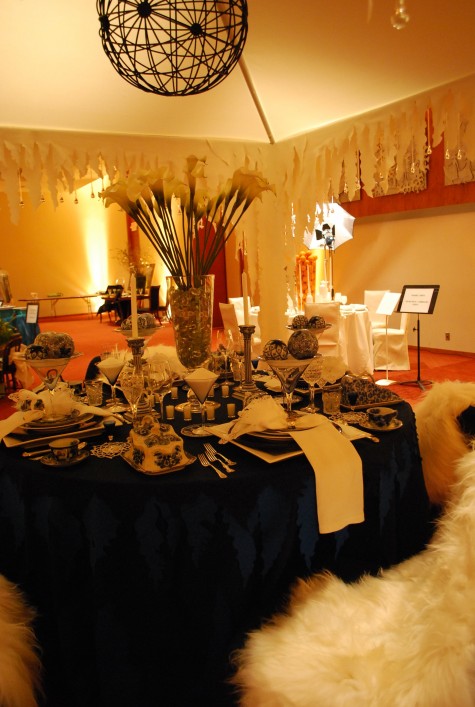
Occasionally there is an opportunity to help a client create a landscape for an event.  In this case, a fundraising event for Temple Bethel involved individual participants and groups setting their own distinctive versions of a Passover Seder table. My client knew three things.  She was interested in using a pavillion she ordinarily kept in her garden to create a room with a walls and a roof that would provide a framework for her table. She also wanted to set the table with her own collection of antique flow blue china.  And she wanted an overall look that would be unexpectedly contemporary.   I immediatey thought of billiard table felt as an appropriate material for the pavillion roof.  It comes in very wide widths, and drapes beautifully.  It would be striking in color, but warm and cozy in feeling-perfectly appropriate for an early March event.  Cutting a series of abstract stalagtite shapes into the edges of the vertical elements of the roof would be a considerable visual departure from a traditional garden awning.  We set the pavillion up in the shop-this made the cutting of the roof fabric much easier.          

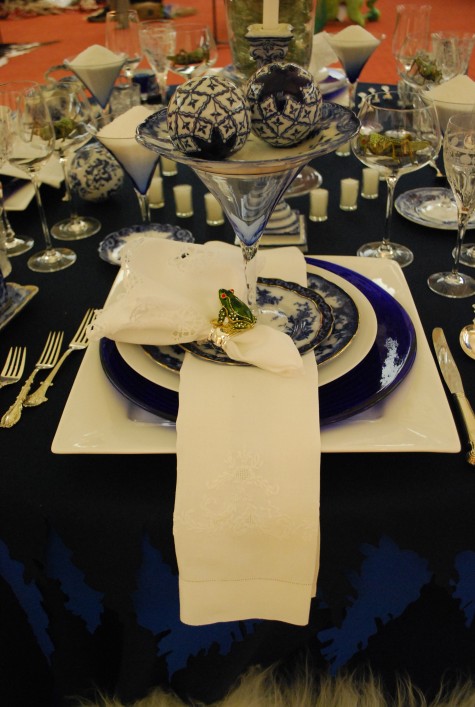
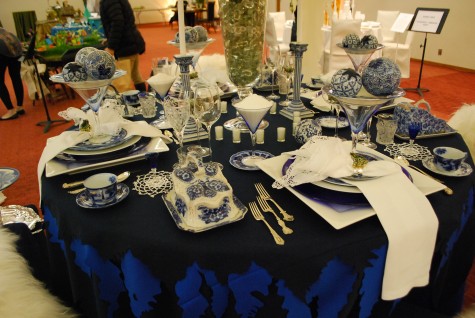
Flow blue china originated with Staffordshire potters in England in the 1820’s.  It is a white porcelain patterned transferware whose deep blue color actually comes from cobalt oxide.  Many of the patterns were Asian in origin.  The china is quite ornate, and delicate-but visually graphic.  We repeated that white and deep cobalt blue palette simply,  with the idea of creating a limited, and more contemporary look.    

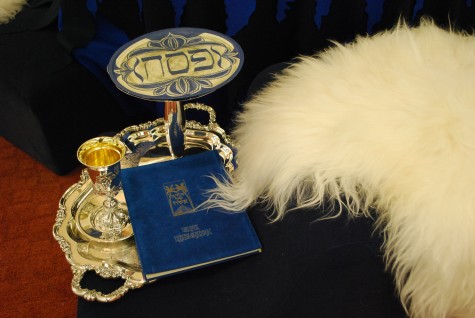
We added white unsheared sheepskin throws to each piece of a suite of mid century modern foam chairs and a chaise covered in a navy blue wool.  These chairs belonged to my client, and clearly reflected her point of view.  The juxtaposition of the traditional elements of the Seder celebration in a decidedly contemporary context provides visual interest.  The table itself was covered in four cloths in two shades of blue, three of which had the same edge treatment as the roof.  

The interior rails of the tent were dressed with multiple pieces of cut felt.  A collection of my client’s glass drops echoed the crystal on the table, and provided a striking contrast to the light absorbing felt.  Once the pavillion was set up with its cover, my client set her table.   

This is a very formal and very important occasion; the china, fine glassware, silver and linens reflects this.  The traditional elements required in a Passover Seder dinner are represented in a graphic way.  A contemporary glass vase of faux calla lilies anchored in glass ice provides some height.  The ruffled edges of the callas recall the cut edges of the roof.  Hung from the roof of the pavillion, a contemporary steel sphere representing the idea of a chandelier whose blue-black finish stands out against the white roof.    

The big gestures come from the hand and eye of my client.  The little and very personal touches- enamelled frog napkin rings, and a ring of elegantly narrow votive candles.   The round and regular shapes of the plates, glassware and flow blue spheres is in strong contrast to the roof fabric.   

People collect all sorts of things, depending on their interests.  What a treat to see a collection so beautifully displayed.  Better yet, a chance to work with a client whose thoughtful attention to detail, and committment to following through was considerable.  The pleasure was all mine. 


The event was to be lit softly; I am sure this added lots to the atmosphere.  Every table I saw was set with the same attention of design and detail-but they were all very different.  Anyone who went last night was in for a treat.  But I had great admiration for this particular space.  Not for what I helped with.  I did help, yes-ok and fine.  But she had an idea, and a committment to bringing her idea to life.  This I greatly admire.