I hear too often from people that their pots peter out in August. There is no need for that, barring your dog unearthing them, or a hailstorm. I usually take my pots apart in November, as I am just plain tired of taking care of them. But here’s my formula for longevity through August and beyond. First off, water, and water properly-which can mean, water even when you don’t feel like it. This means soak your pots, and then let them get dryish before you water again. Secondly, deadhead regularly; do not let you annual flowers go to seed.
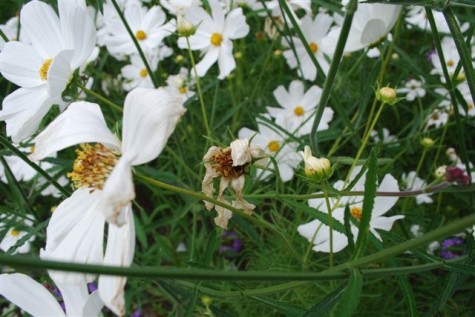
Here’s the biology behind the scenes. Annual plants by definition are plants that grow, flower, and set seed in one season. An annual which has successfully set seed has no biological reason to continue to flower. For those of you who think annuals bloom so the world will be a more beautiful place, here here. These plants flower for the purpose of reproduction-to insure the continuation of the species. If you prevent an annual from setting seed, it will continue to flower. There are plenty of flowers which are sterile, and do not set seed; they are popular for exactly this reason. Trailing verbena, on the other hand, will go out of flower quickly, if it is not deadheaded.
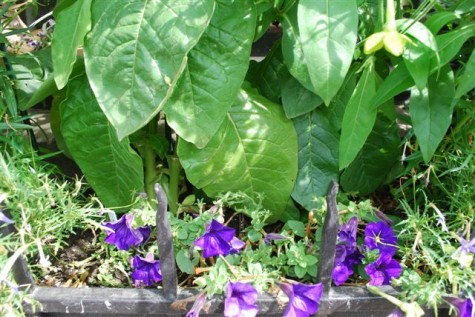 Plants grow in, and the room can get crowded. If the giant leaves of this nicotiana are allowed to shade the petunia, said petunia will pout, and finally give up. Removing leaves, or branches so everyone has a sunny spot, is good group management. A pot or window box is no place for a bully running amok. No one will like the result- least of all, you.
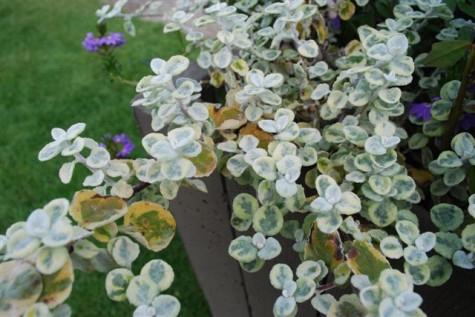 Try not to overwater. Put your finger down into the dirt. If the dirt sticks to you, there is probably enough moisture. Rotting leaves are unsightly. Worse yet, an environment that is too wet is an invitation to every fungus floating by, looking for a good home. Licorice likes dry conditions. Should you have been so bold to plant it next to an annual that loves water and more water, you’ve engineered a situation where individual plants in a community pot have to be watered on different schedules. This is not tough, just time-consuming.
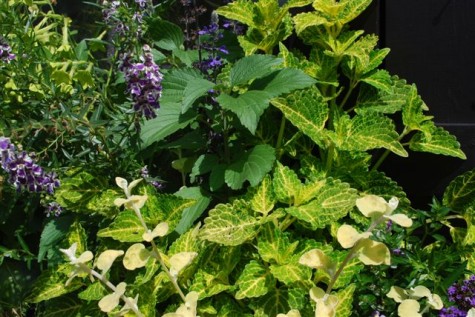 Annuals need pruning, just like shrubs and trees. Pruning the flowers from your coleus plants result in densely growing coleus. Pruning plants at different heights gives everyone breathing room. Once a group of plants are put together in one pot, or one area, they take on a collective life. Sun, water and space have to be shared. And whatever the individual plants, you want an overall shape that looks great.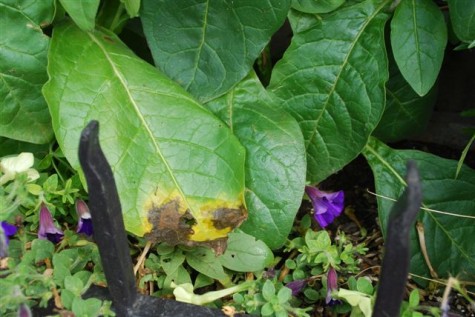
Plants that are healthy resist disease. Healthy means properly watered, fed, pruned and managed. If you do get a fungus, remove the diseased portions as soon as you can. Remove lower leaves in the interiors of your pots to promote good air circulation. Prevention is a lot easier that treatment. Sometimes weather conditions foster disease; I will spray with a fungicide if I have to. Safer’s soap will get rid of some insect pests-the trick is to apply 3 rounds, not one. Spider mites are notoriously difficult to get rid of. I avoid certain types of mandevilleas as they are so prone to them.
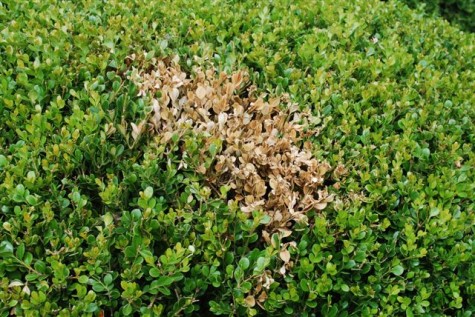 My beloved boxwood hedge was attacked this spring by a fungus called Volutella-I was beside myself over the damage. I had to get an expert to identify it for me; I have never seen this on boxwood before. We cleaned out, and raked up every dead leaf, and pruned out every infected branch with shears that were disinfected after each cut. Next spring I will spray for it. Imagine being a greenhouse grower-where plant illnesses and insects can threaten a livlihood. Most growers that I know practice close inspection of their plants, so they catch problems early. They also feed their plants; strong plants resist trouble. Once every seven to ten days I make sure my pots are thoroughly watered, then I liquid- feed them with a water soluble fertilizer with a big middle number (15-30-15) to encourage good flower production. This acts like a shot of vitamin B-12. Then I hold off watering as long as I can, so the plants take up the nutrients, before they get flushed out by the next round of watering.
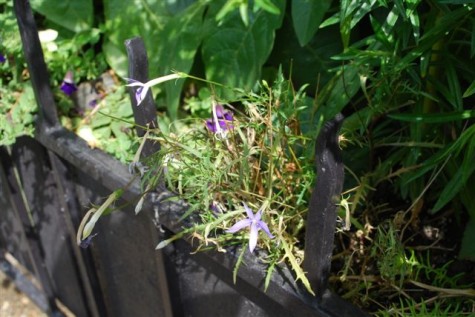
There will be those times when no amount of good growing practices and cultures will result in a good plant. Don’t be afraid to yank something that is clearly beyond rescue. Perfection applies only to diamonds and moments, remember?
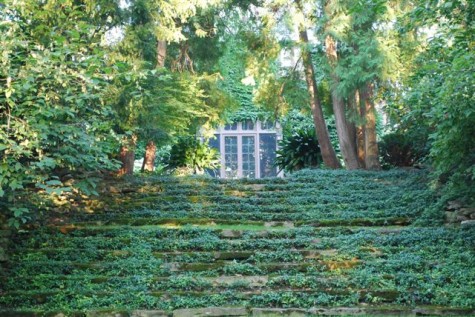 This very old, very lovely, wide flight of stairs was once buried in soil and debris; only the center four feet was still visible and useable. I discovered it by accident, while trying to plant trees and groundcover on either side. Once I explained to my client that another twelve feet of staircase still existed just below the surface, she had me uncover it entirely. We planted the risers with myrtle. This staircase is much more about ornament and architecture, than about going from one level to another. As the lower garden is viewed primarily from the house above, the beauty of these steps is more important than the issue of how to get from here to there.
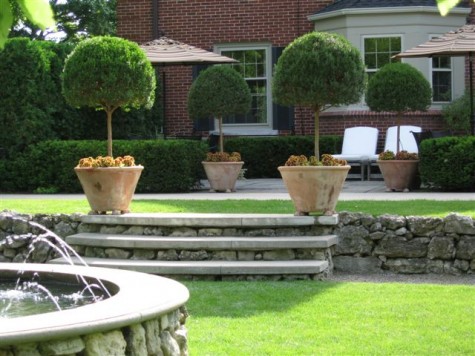 The change of level in a landscape can create interest, announce a new garden room-change things up. This previously sloped garden space was excavated and walled with the stone that had been used to edge the original beds. The steps now necessary to descend to the lower level signal the transition. The treads are shallow, so as not to intrude on the rectangle of grass below. A good height for a step is 7 inches; 8 inches will work, but is just slightly on the steep side. Every step in a flight of stairs needs to be the same height; people instinctively assume this. Note how the gravel in front of the wall, dying into the lower step, makes the maintenance of the lawn plane simple.
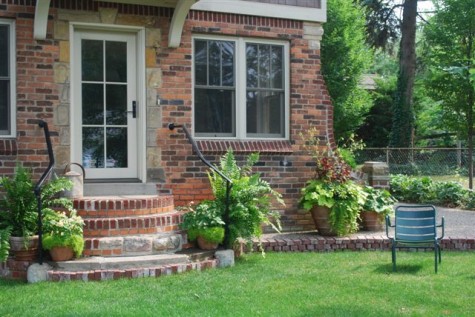
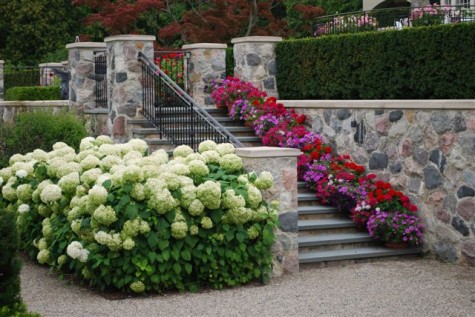 Some changes of level are dramatic, and require a flight of steps, and railings. Any stairs need to be designed first and foremost to allow for safe passage. Each of these steps is marked with its own pot of flowers. The iron railing is as sturdy as it is beautiful. Iron rails allow a garden to remain open to view while providing some security.
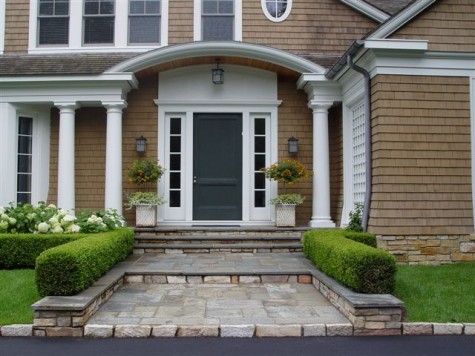 Splitting up steps can be even more friendly to guests. It is far easier to negotiate one or two steps at a time, with a landing in place prior to the next set of steps. These stairs are wider that the door and side windows; this makes for a generous and welcoming approach.
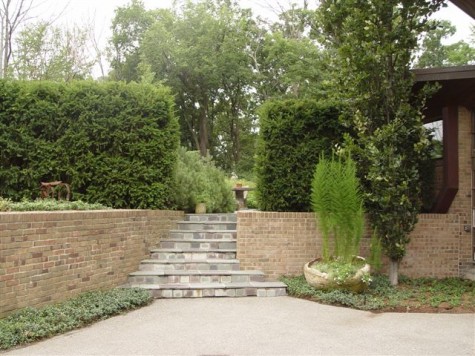 This winding staircase seems to spill out of the confluence of two walls designed and built on the bias. The variation in stair width creates a sense of motion and rhythm which is very pleasing. The wall enclosure makes it possible to climb these stairs with confidence.
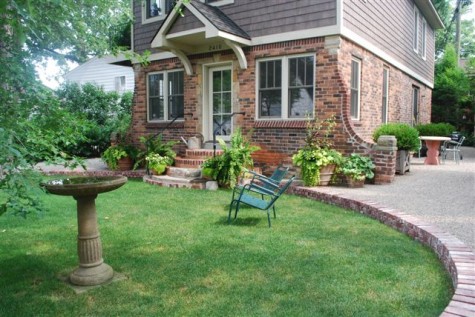
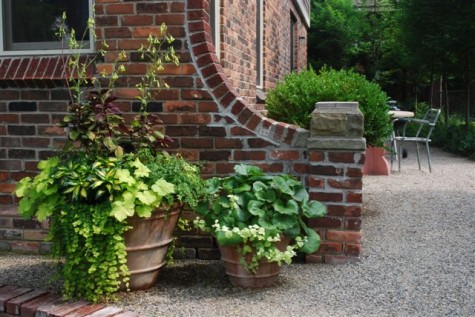
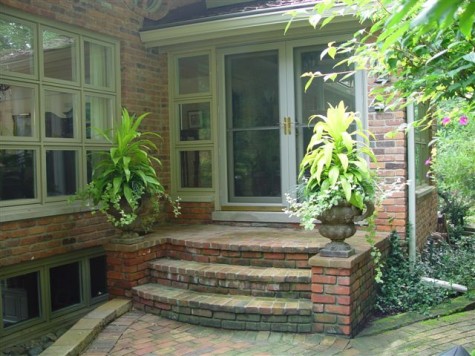 Stairs can vary in their depth. The first stair out of this front door functions as a landing-a comfortable space for greetings, and goodbys. The brick piers and pots are a succesful alternative to railings, which would have seemed so heavy handed here.
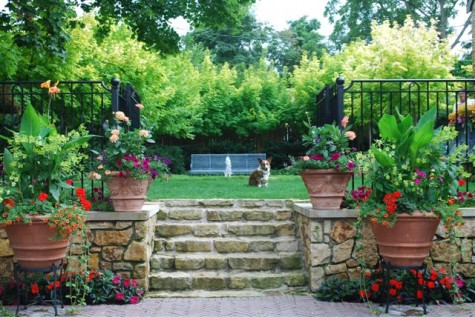 Natural stone frequently has a uneven surface. Planning for a safe ascent and descent is doubly important. The iron fence walls inset from the stairs provide an emergency handhold for anyone loosing their footing.
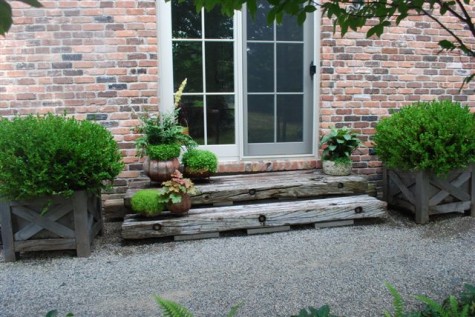
 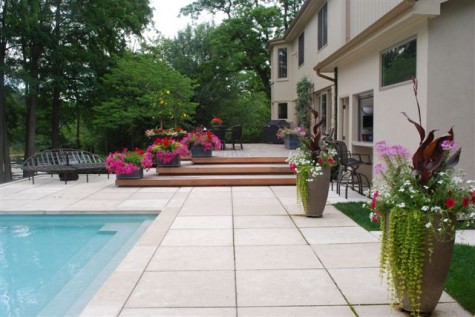 These wood stairs to the upper terrace are very spacious in every dimension. Steps with greater depth are easier to negotiate. Steps to a rear terrace are frequently used while carrying food and drink; it is better to err on the side of too deep, than too shallow. The pots announce the change of level for anyone concentrating more on keeping their tray of food where it belongs, , than watching where they step.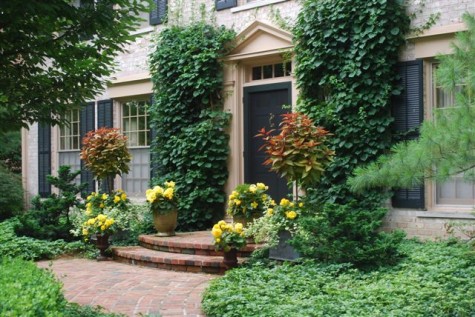
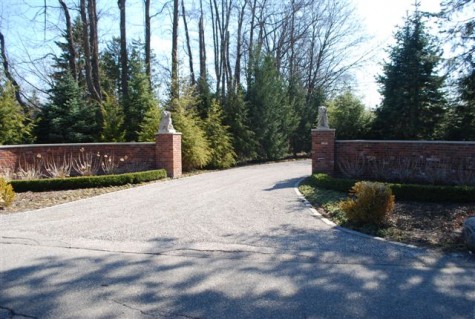
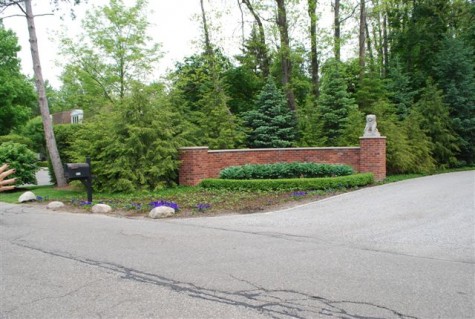
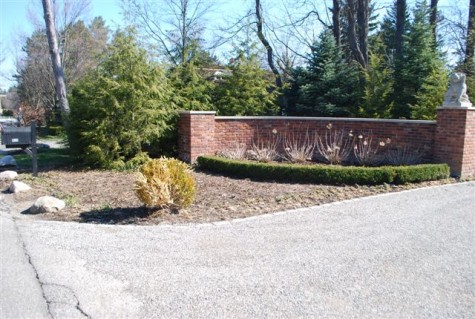 The walls are substantial, and large. They serve to announce the entrance, and enclose the private part of the property from the street. The current placement of the boxwood runs counter to the curve of the wall in a tentative way; the small scale of the boxwood is no match for the heft of the wall. The boxwood placement further chops up a space already bounded on every side by hard surfaces. Oddly enough, the smallest space is planted with hydrangeas and hostas already leaning over the boxwood. The largest space had one lonely boxwood in an ocean of winter burned ivy.
 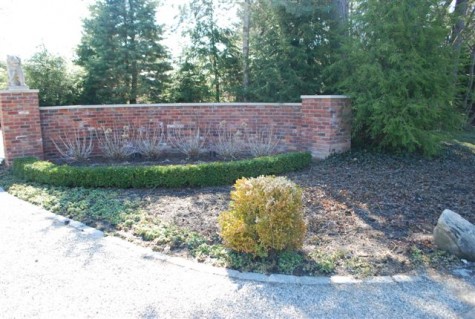 An entrance planting not well-designed can be difficult to maintain. They are a long way from the hose spigot, or the wheelbarrow. They suffer from salt spray, and the carelessly driven delivery truck. How snow gets plowed figures prominently. Good entrance design plans for all the maintenance issues without making a visual issue of them.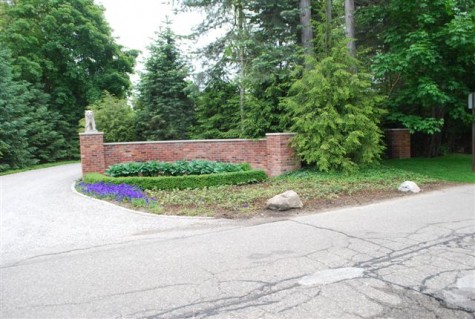
 �
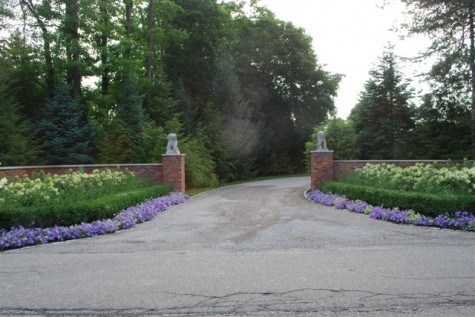
�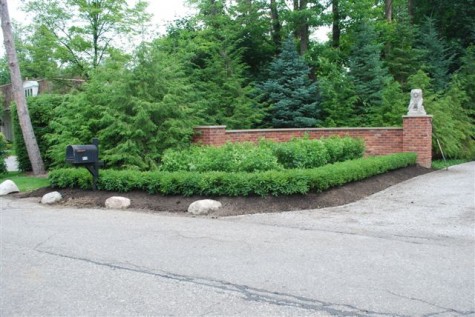 After digging out all of the existing material, we added 8 yards of soil to each side. This allowed me to roll the soil down to the grade of the road and drive. This helps keep vehicles out of the bed. Planting the boxwood at a higher elevation helps keep its foliage out of contact with salt spray from cars. In areas where the speed limits are higher, evergreen material needs distance from the road, or planting heights well above the level of the road.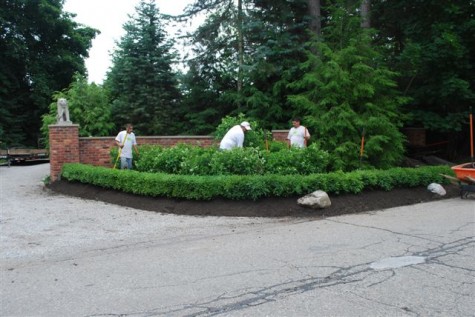
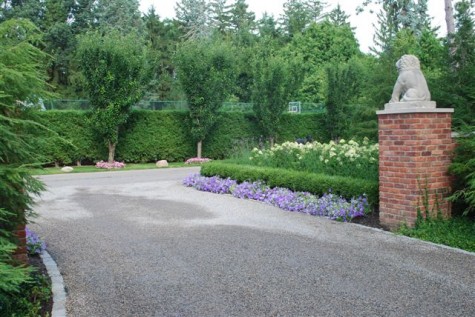 The views of an entrance planting are equally important from the inside. The boxwood is now visible from the inside, and the annuals soften the edge of the road, and describe in a beautifully way the curve to the road.
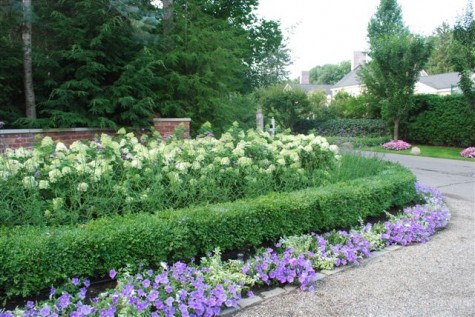 Most of the beds are woody plant material that do not demand every day care beyond watering. The blue sky petunias and variegated licorice thrive on the hot dry roadside. Should any plant material be damaged, or not do well, it will be a small thing to repair, as it is a small area. The curved swath of verbena bonariensis fills the breathing room between the hydrangeas in a light and airy way.
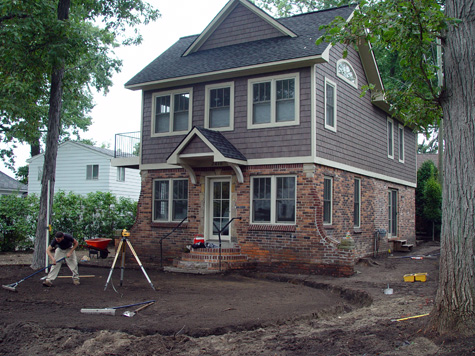
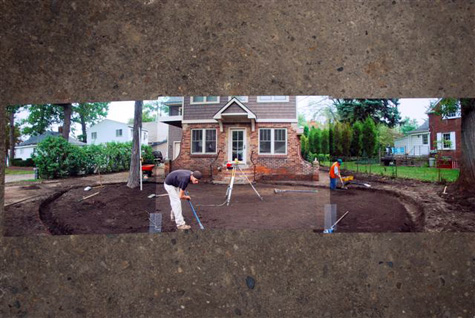
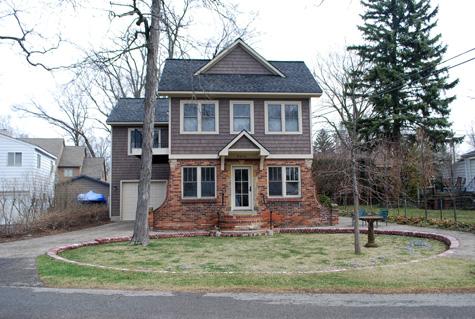
 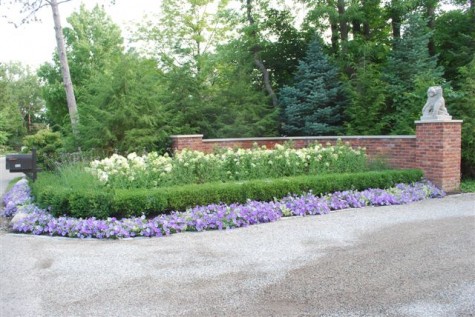 The curve of the landscape, counter to the backdrop of the curve of the wall, is the idea here; all the plantings are geared to express that one thought.
 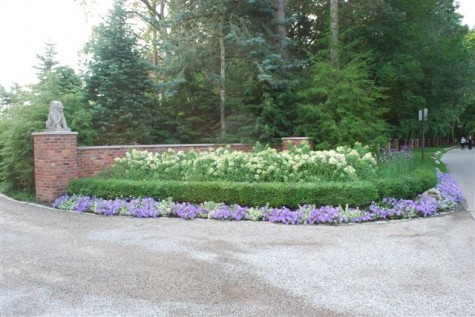 Extending the large open curves beyond the end of the wall makes for a welcoming entrance. It’s clear the property goes on beyond the wall.