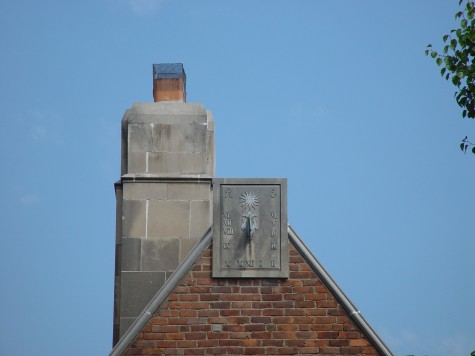
Any and all materials from the earth, or made by some gifted person with in genuity can inspire a garden. Some landscape materials are regionally available, or from a specific time period, or architectural style; this only makes sense. Transporting enough stone to build a wall or a house from Louisiana to Michigan even sounds like the big deal that it is. Some days, after delivering and placing a stone trough, I wonder why I didn’t choose to collect stamps. That our currency-so many pieces of paper- is backed up by who knows how many thousands of tons of gold bars makes perfect sense to me. Good landscapes are designed by people with a wide range of obsessions. The food growing people, the ornamental plant people, the dwarf conifer people, and the hosta aficionados share the pursuit with the stone lovers, the terra cotta collectors, the brick people, the pond people, and so on. This 1920’s English tudor style house is notable for its limestone chimney, and copper trim gone dark with age. The sundial mounted dead center in the peak of the main roof of the house- a sure sign of a builder/gardener with a love for materials.
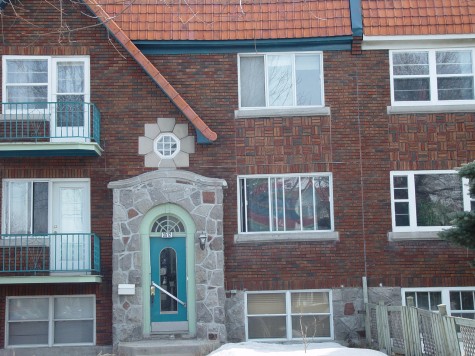
Montreal is such an interesting city-I am especially fond of the old part. This building is a marvel -stone, brick, rock, copper, terra cotta, all put together in someone’s strong idea of beautiful patterns-the sole purpose of which was to keep out the fiercely unfriendly weather. No doubt the original windows gave out, and needed replacing. The new windows-the handiwork of someone inspired by something else other than beautiful materials.
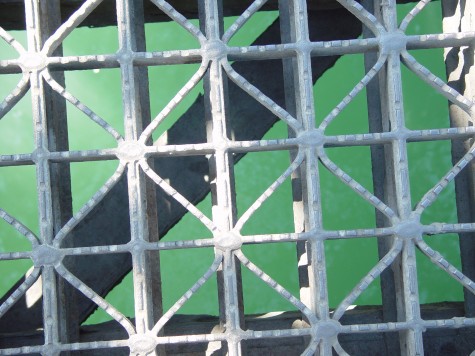 This ironwork is actually the floor of a bridge that traverses the Rouge River to Zug Island in Detroit. Old industrial sites are landscapes of a different sort, but they are remarkable in how the the most utilitarian structures-factories, bridges, water stations and the like- were designed and built with no small attention to an aesthetic sense. This goes back to a time when there were no designers per se, just craftspeople whose work expressed a belief in the beauty of the materials.
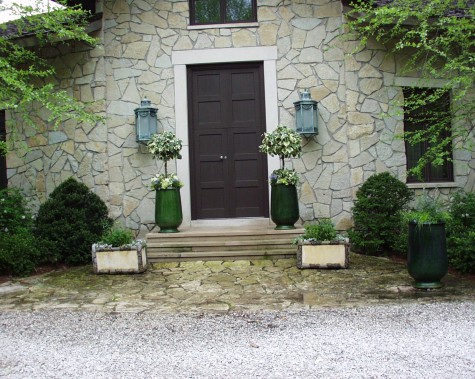 I have admired this stone house designed by Michael Willoughby for a long time. The stone surface you see on the facade is the same stone he used on the ground, and on the interior walls. This irregular flagstone is native to Michigan, and adapts quite well to the modern design of this house. The green glazed French pots bring that landscape green up and onto the entrance porch. The early twentieth century French concrete faux bois boxes refer to the craftsmanship of the stone work.
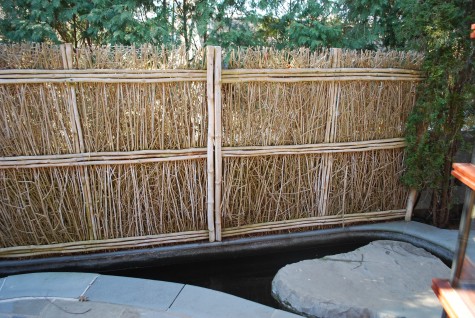 This branch fence functions as screening for a space that had no room for screening plants. Massive rocks set in a koi pond, and a bluestone terrace asked for a lighter more textured companion material. It is entirely possible that this screen is handmade; I have never seen anything quite like it.
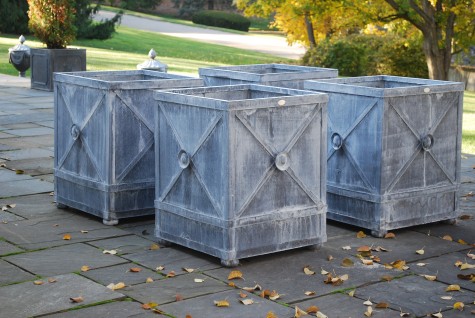 Galvanized and acid washed steel is a favorite material of mine. It has the graceful and dignified look I associate with lead. The white bloom of the finish suggests age.
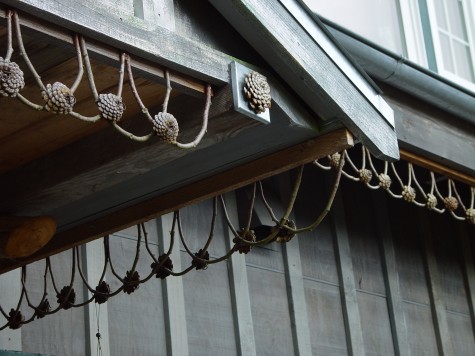
The fascia boards of this home in Washington are decorated with a border of scalloped cedar twigs and pine cone dots. The owner uses these same materials to make baskets, fencing, trellis work, and tassel ornaments for gardens. Her own house and garden has a distinctive appeal, based on the materials fallen from the cedar trees on her property.
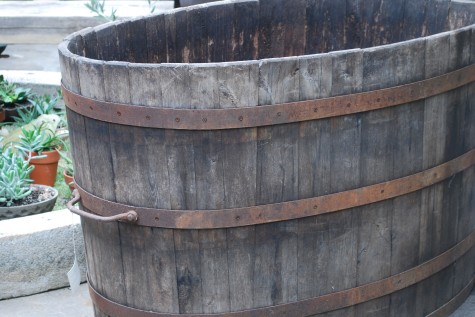
As natural in a garden as stone is wood; this oval French wine barrel will find a new life as a fountain or lotus pond for some gardener who is attracted to beautiful materials. This object could inspire and organize an entire garden space. I could just as easily see it stuffed with grasses, or grapes wound round a trellis. It is perfectly beautiful empty, and waiting.
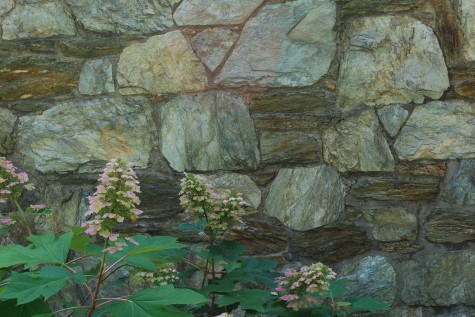
The stone on this home-I had never seen it before, nor since. Though my clients insisted they needed help with design, facing this stone down with hydrangea quercifolia, the oakleaf hydrangea, seemed an inspired choice. The form and subtle coloration of the hydrangea is a beautiful foil to the mass and strong color of the stone. Though there are details to come, they had an instinct about where to go that they trusted-this may better than half the battle.
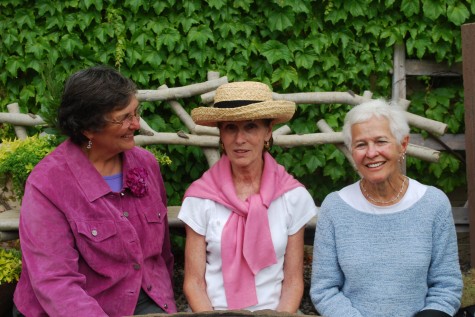 A discussion of space and flow in a garden is not just about one’s eye-it is also about providing clear passage and respite for people you like. How I move in, use, work and relax in my garden is easy for me-I live there. I know the shortcuts. It does not take so much to entertain me-sometimes flopping down on the grass works just fine. As much as I love the solitary aspect of my garden, friends visit. They need places to be, and be comfortable.
 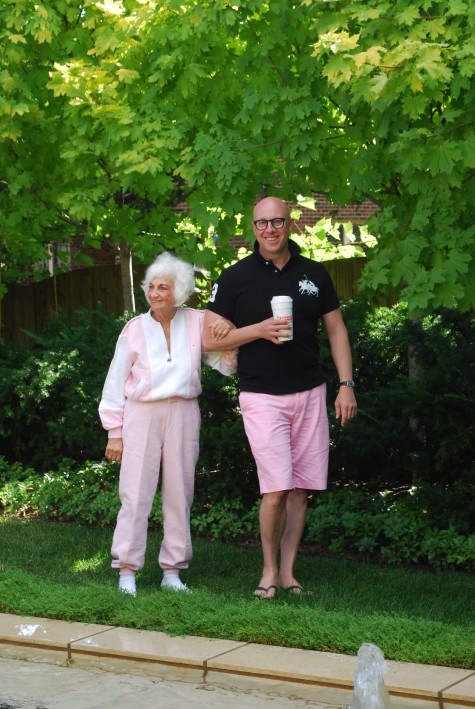 Should you have one friend, or many-should you have older relatives, and a slew of kids, the issues are the same. Should you be interested in company enjoying your garden, planning for them to be there comfortably is important.
 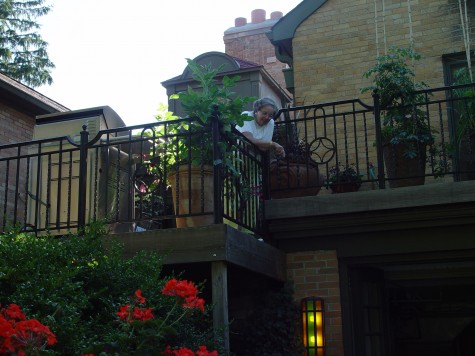 I invite my clients to visit their own home in disguise. Be a guest in your garden for an hour. Where do you park? Can you see the house number? Are you clearly directed to the door? Is the porch large enough for two of you to stand side by side? If there are stairs, are they easy to negotiate? Are the walks and stairs lit in the evening? Your questions will be better than mine-you live there.
 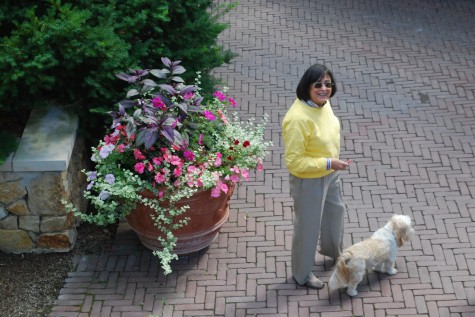 Hard flat surfaces are friendly to people. Slopes and uneven surfaces make people focus their attention on maintaining their balance, instead of enjoying your peonies in bloom. My car park doubles as a terrace when I have company-I put my car in the street.
 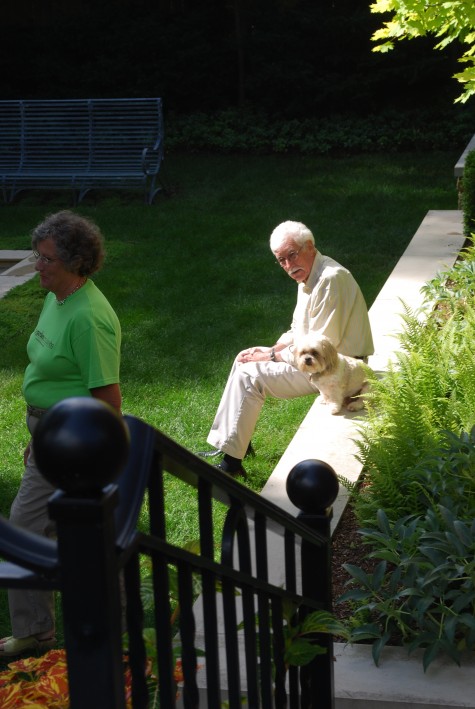 Though my fountain garden has a bench, it also has higher than chair height seat walls. It’s easy to sit down in a number of places; it is equally easy for a number of people to casually congregate as they see fit. Even the little dogs like this.
  My deck terrace is large enough for dining furniture, a few lounge chairs, the barbeque-and my pots. I bring the garden upstairs; some nights I am too tired go into the garden. Wherever people might be in my garden, there are places to sit, to talk, to linger.
 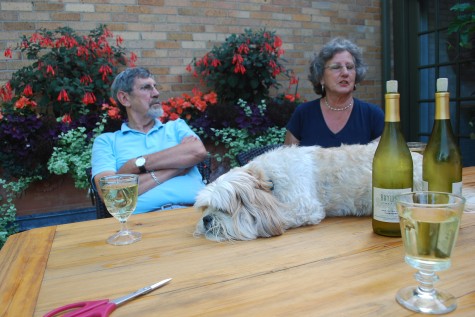 Thomas Church wrote a book entitled “Gardens are for People”. This idea has inspired many a beautiful walkway, bench, pool, terrace, pergola, dining table, croquet lawn-you get the idea. How your friend, or your party of 60 will enter your property, enjoy the garden, have a cocktail and sit down to dinner-this is worth planning for. Sharing a garden is one of the better reasons to own one.

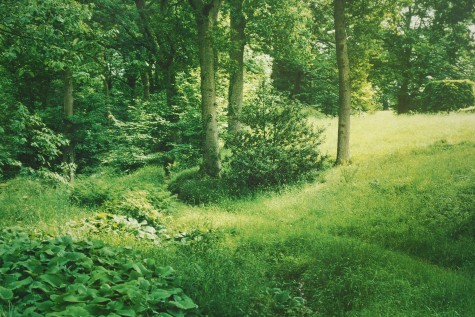
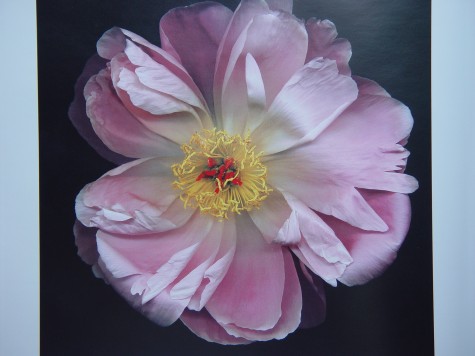
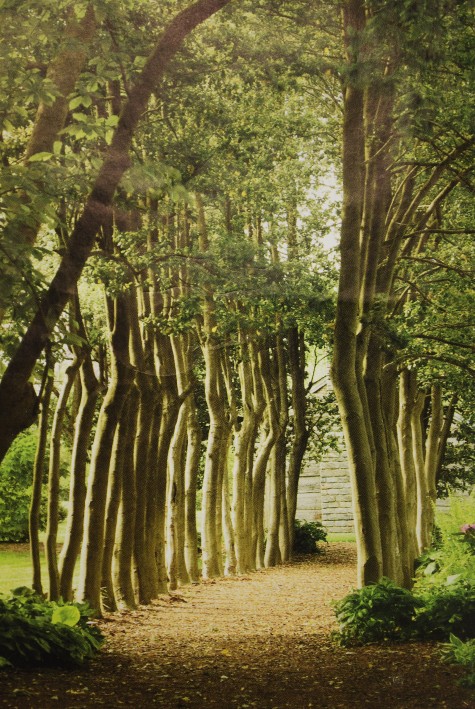 What inspires me in this picture is the story behind it. Yew Dell Gardens is a botanical garden just outside of Louisville Kentucky. Theodore Klein and his wife had a commercial nursery on these 33 acres, growing countless plants here until his death in 1998. The property was purchased, and reinvented as a botanic garden. The above pictured allee is in fact a pair of adjacent nursery rows of American holly, now very old. How the nursery rows became a beautiful landscape feature inspires me. I am keenly interested in the intersection of landscape and agriculture. I am equally interested in how people steward the land entrusted to their care.
 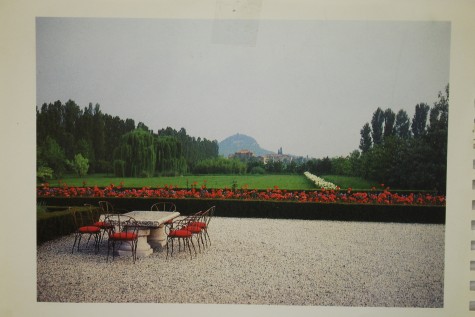 This is an image from an old garden journal which now survives as a collection of images I treasure. The landscape is simple, striking, and very spatially composed. Elements both contemporary and traditional interact in a worthy way. There are so many ways to put the design elements working here to good use.
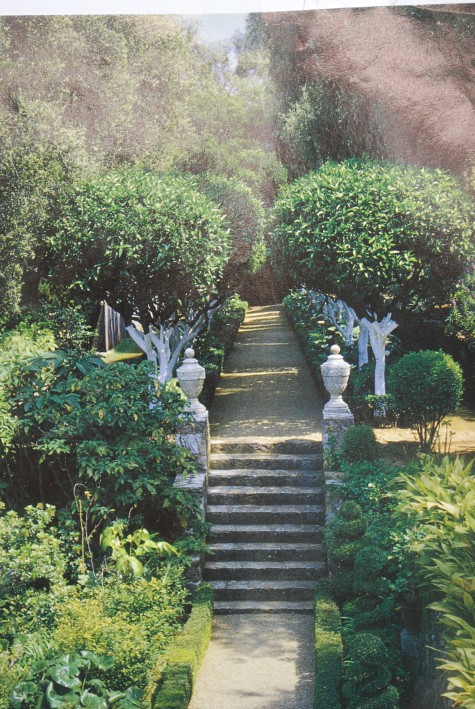 These trees with whitewashed trunks in a garden in the south of France make another reference to agriculture. Fruit trees would sometimes have their trunks whitewashed with a kaolin compound, to deter insects. Kaolin, the same clay which is the basis for face powder, is a benign and useful compound. The visual appearance-gorgeous. I encourage clients to cut and collect any image that gets their attention-even if it is not clear what attracts them. Sooner or later some thread that connects all of them will become clear.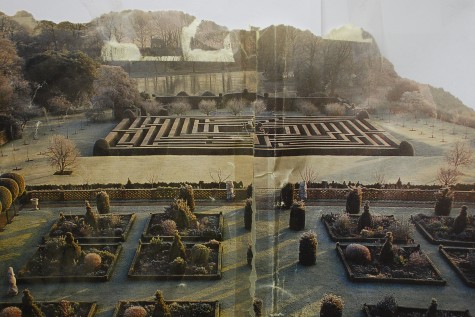
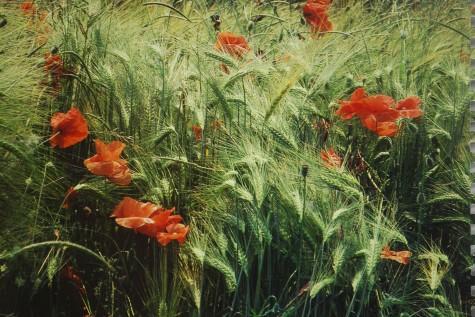
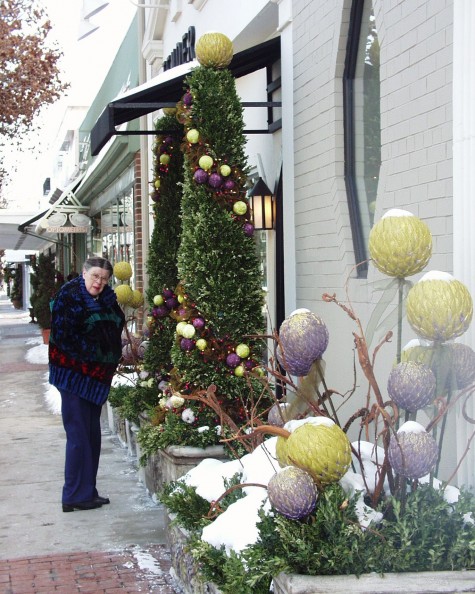
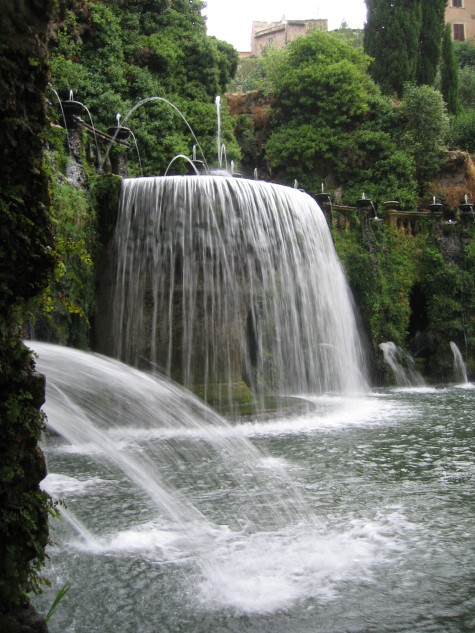
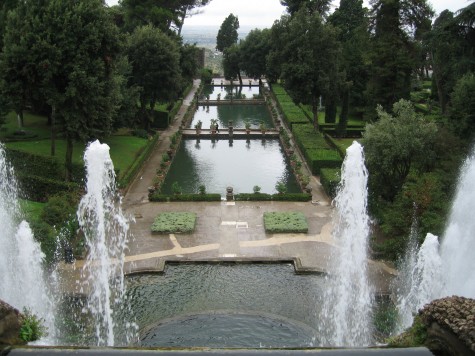 I have only visited this utterly romantic garden via these photographs of Rob’s. I can only imagine, for plenty of reasons, what it must be like to be there. My native topography is flat, and more flat. Only occasionally will a project come along with an unexpected change of grade as a central feature. With the possible exception of Tahquamanon Falls, water like this is not part of my experience. But that does not mean what I see here cannot be part of my vocabulary.
 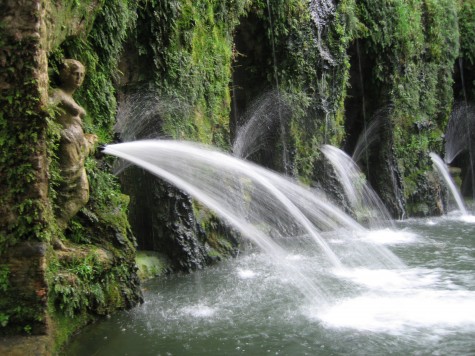 Other people’s gardens can instruct, provoke, and influence the way one thinks about a garden. The idea of fern and moss covered rock can be readily incorporated into any landscape, provided the conditions are right. Proper scale is a relative thing-but I try to err on the side of overscaled. As a friend and mentor once said, who wants to get to the end of their gardenmaking and think they were never bold enough. It’s a good thing in a landscape, to be driven by being bold enough.
 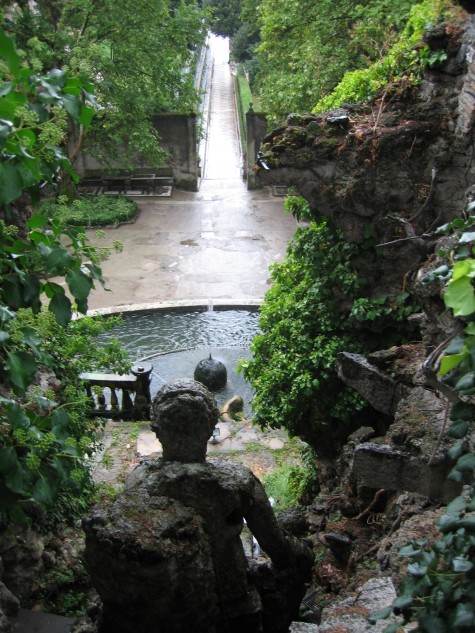 Lots of people own homes several stories high. I have likewise seen more than a few homes with two-story entrances. Then what? A landscape needs to address these features, and views. The beauty of the composition above lies in how it describes and emphasizes great depth, and space. In the foreground is a strong sculpture whose scale I suspect is much over life size. When my eyes go to what the figure in the sculpture must be looking at-the mid-ground fountain pool-its jet seems much smaller than the figure. Smaller in the midground is another way of saying further away. The terrace whose wet surface catches the eye next narrows to a walk. The wide entrance to the walk is clearly marked by tall walls; when the walk disappears from view, it appears much narrower. The end of the walk thus seems very far away. Where the walk leads-a mystery, from this perspective. This photograph is a rectangular flat object-but what it pictures appears to have great depth.
 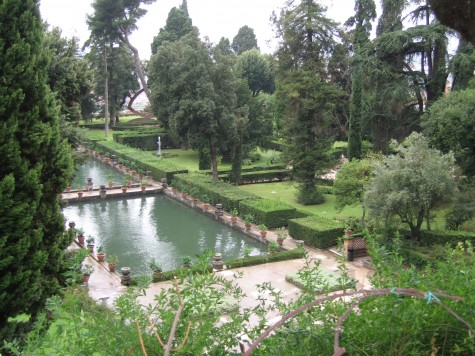 Every gardener knows any move gains importance when it is repeated. Though probably not accurately, I count 42 pots in this photograph. They make much of those rectangles of water, as do the yews in repetition. The shapes of those yews and lawn echo the shapes of the water. Far in the distance at ground level, a glimpse of that shade of blue that best says “I am far away”. That blue dwarf spruce you are thinking of might be at its visual best as far from your view as possible-rather than close up.
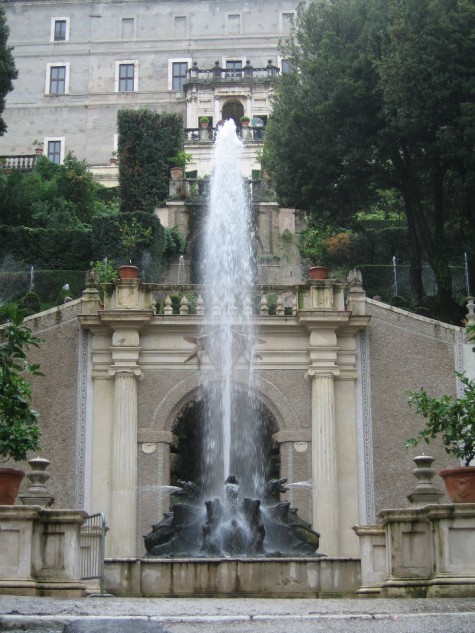 The scale and the height of this fountain jet is right, given the height and scale of the villa. My fountain jets at home will go fifteen feet in the air, should I feel like some big waterworks are in order. Given the size of my house and garden, that fifteen feet reads on the same order as this fountain, just at a different scale.
 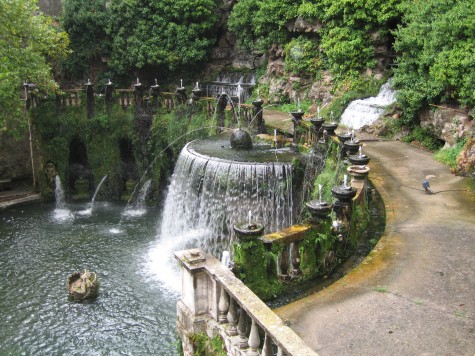 Everything in the architecture, the surfaces and the plantings are in support of this cascading water. There is no visual confusion aboout what exactly is the star of the show. Though elaborate in execution, it is very simple in design. I am quite sure the natural land forms influenced the design as much as any other element. A semi-circular wall of espaliers might make a similar statement on a property with little elevation change.
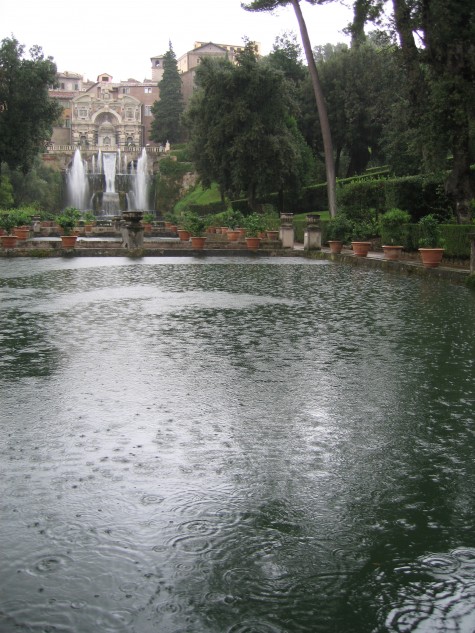 Looking back at the villa and its fountains from ground level, the pools seem immense, as they are close to your eye. The trees and sky are bigger than the villa; they keep it company, naturally. This property is in fact very large. It might be difficult to mask that, but it is a tribute to the designer here, Pirro Ligorio, that every aspect of his composition reinforces the depth and breadth of the space. Villa d’Este aside, it is possible to design such that no matter the size, any property can be visually spatial.