Buck’s Fruits And Vegetables

A Canadian city north of Toronto is in the process of updating its library and landscape.  They have devoted some of their property to the development of a space suitable for a farmer’s market.  I suspect they are interested in the library being a community center of sorts, which will attract lots of visitors-for lots of reasons.  I like this idea.  I do think libraries are very important.  Books tell stories, and teach.  Libraries give anyone, everyone, access to books.  What is written or pictured in books is priceless-they are in a way the sum total of our knowledge and our art.  Farmer’s markets are another community icon-over the growing of fruits, vegetables, and flowers.  Much of the fabric of a family is woven over shared meals.  This is the sum total of our community.  I place as much value on this as I do the works of Shakespeare.  The landscape architect commissioned four steel sculptures which will be placed in the new market area landscape.  He was intrigued by Buck’s strap steel spheres, and wanted sculptures in that manner to represent fruits and vegetables.        
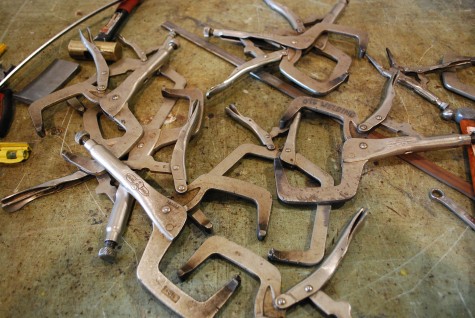
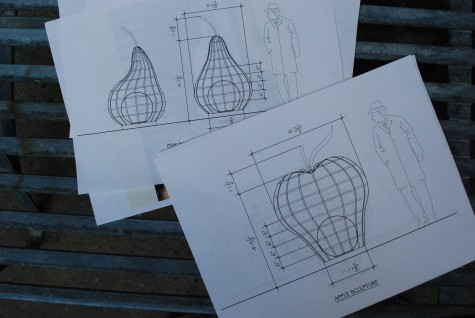
I think Buck must have more clamps than any other artisan on the planet.  When he is welding steel straps to one another, every piece must be clamped into place before he fires up that torch.  Before the clamps came out, he did a series of drawing based on the architect’s specifications.  Once the drawings were approved, he printed the vertical steel ribs on a plotter exactly the size they would be in the finished sculpture.  These drawings were 20 times the size of what comes out of my printer.  The steel could be laid to the paper, and bent in the proper arc.        
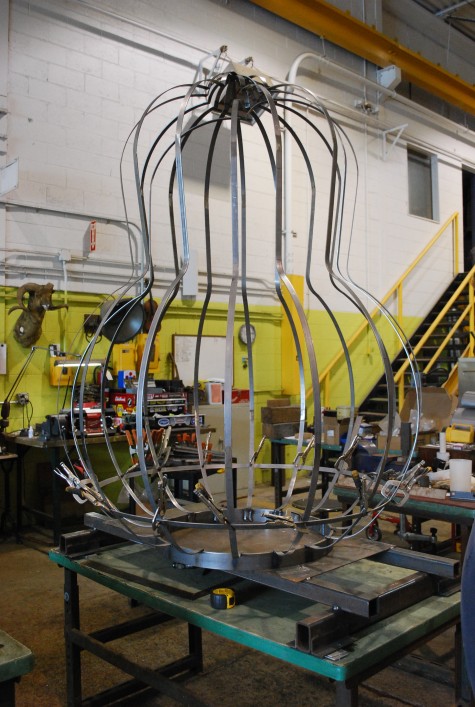
The vertical ribs were bent in a 3-axis vertical roller.  The steel may appear slight in these pictures, but steel is very strong.  It cannot be bent evenly in a prescribed curve without a mechanical slip roller.  Each vertical rib was welded to a 24″ diameter steel base.  The sculptures will be installed over a light fixture which will illuminate the sculptures at night; this base will accomodate that light.    
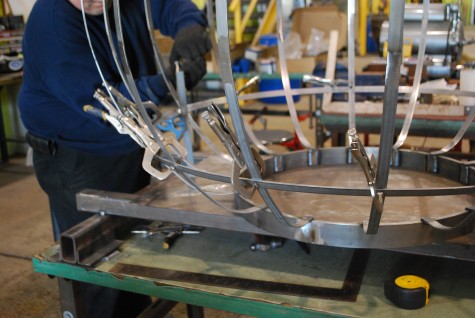
The vertical ribs were bent to exactly match the curves indicated on the drawings.  The hroizontal ribs-now the fabrication gets very difficult.  The horizontal ribs needs to be rolled in circular shapes to start.  But in order for those ribs to lay flat on the vertical ribs, they needed a second rolling. A rolling that expresses the cant. You see how this lowest rib lays flat against the vertical rib-there were multiple steps getting the steel to perfectly mimic this shape.
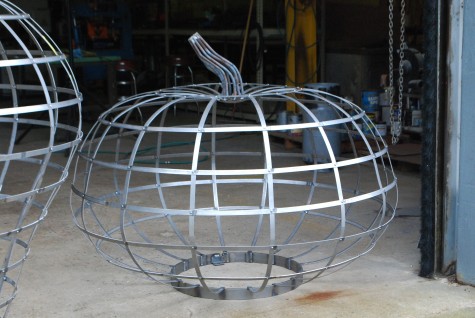
This strap steel pumpkin is a low oval shape, without many clues as to its identity.  Strap steel does not lend itself to delicate gestures.  The curved stem is a signature. 
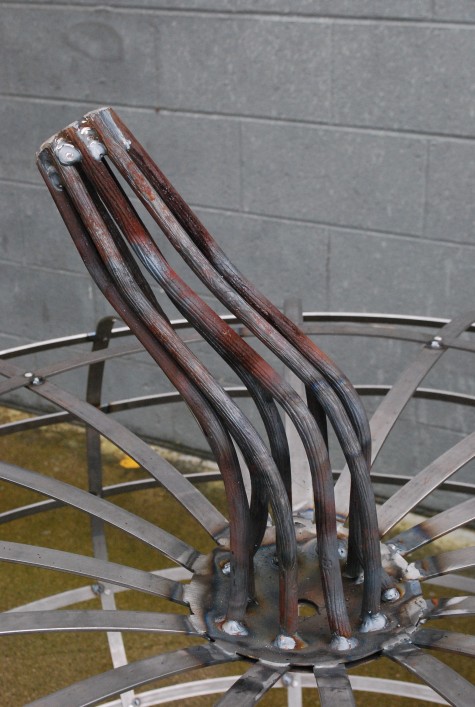
The raw steel shows all of the welds, and the streaks that come from high heat.  The stem is constructed from vineyard bar-steel embossed with the pattern of grape vines. All of the construction marks will disappear, once the piece gets its finish.  Sculpting in steel is exhausting work.  Buck came home plenty of nights to tell that this sculpture was just about to get the best of him.    Every moment is consumed with handled the weight and changing its shape with high heat and electricity.  This stem will make the identity of this sculpture easy.  
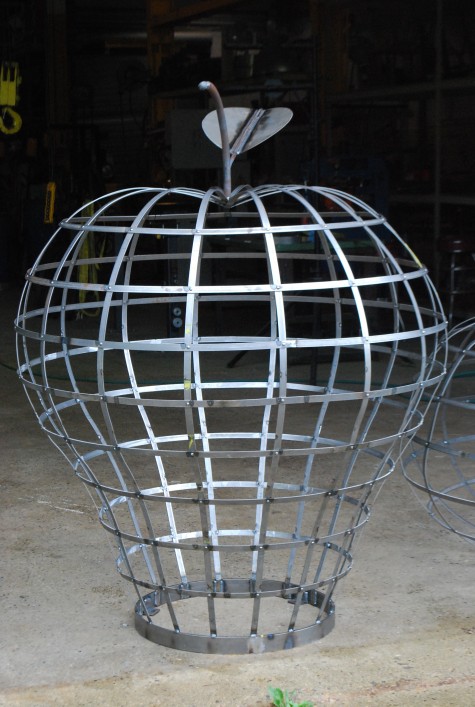
The apple is tall and gracefully curved.  I will confess it reminded me of a hot air balloon-until he attached the stem and leaf.  Poof-apple here. 
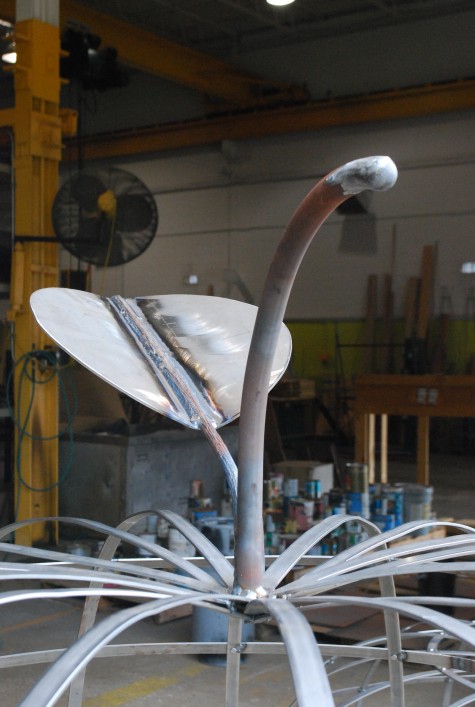
It interests me that these very abstract shapes got a representational identity boost with something so simple as a stem and a leaf.  This part of the sculptures was more about sculpting than recreating a paper based drawing in steel.   
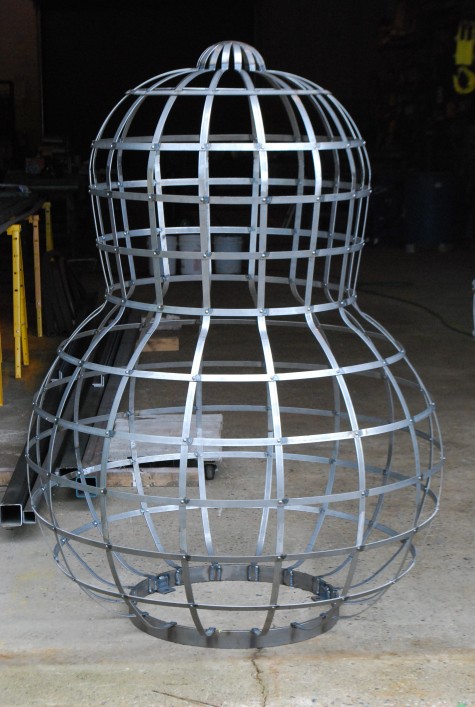
This squash is almost 6 feet tall. Imposing, this.  No stem was called out.  I think it will hold its own just fine.   
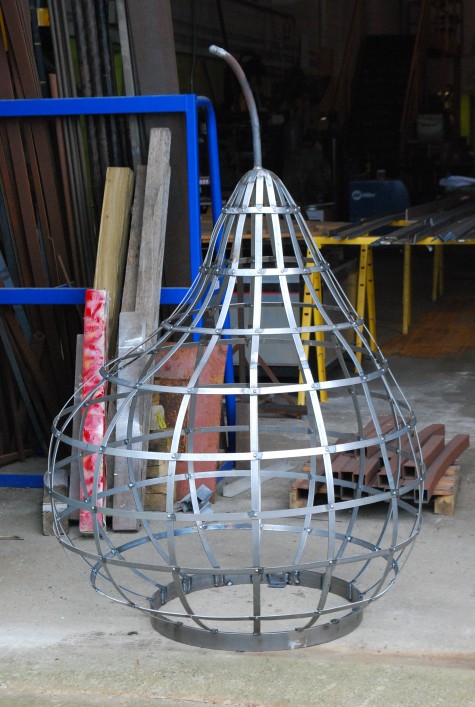
The pear was the bear.  The shape is not in the least bit symmetrical.  At some point, I saw Buck and Dan throw their drawings away, and fabricate by instinct. Drawing this shape may be easy-making it takes a world of time and trouble. I am sympathetic.  There are times that I need to leave the landcape plan in the car, and just dance.   
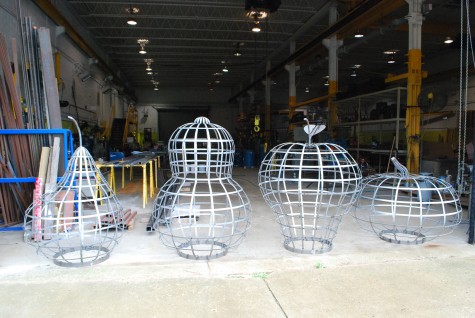
Tomorrow these raw steel sculptures will enter the first phase of finishing.  I promise to post pictures of the final finish, before they are crated and shipped. This is a quick visual on the way to a finished sculpture.  Buck and his group turn out some very fine pieces-yes.
Loud And Clear

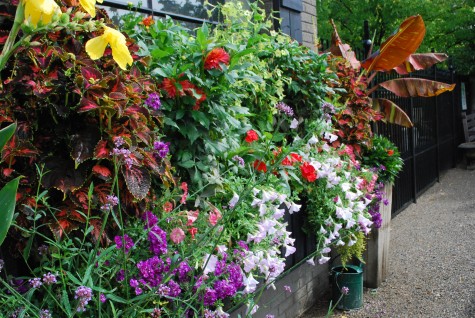
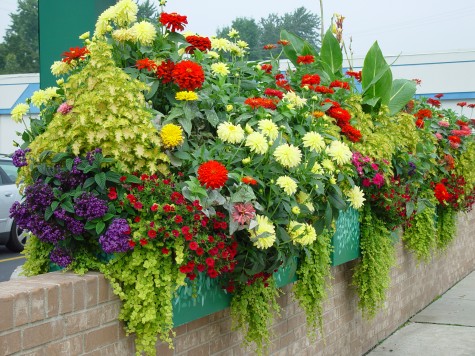
Airy and wispy container plantings are not for everyone.  Furthermore, there are some places that they simply don’t work.  These planter boxes sit on the wall enclosing a parking lot of a restaurant only a median away from a busy four-lane road.  The speed limit is 45mph; the noise is deafening.  In the 2.5 seconds it takes to zip past this wall, there is an impression that will register with even the most garden-deaf driver.  The combination of colors is ebullient, enthusiastic, splashy-friendly.  The boxes are overflowing; the plants all look healthy.  My client takes great care of them-just like she takes care of her restaurant. That message is loud and clear.              


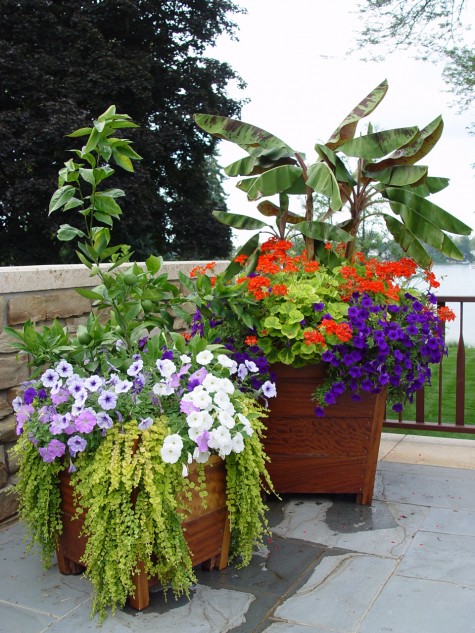
These large Belgian boxes are visual stoppers at the corner of this terrace.  They ask for a robust planting.  Plants with large leaves and substantial size go a long way to capture the eye.  Bananas, calocasias, alocasias, cannas, farfugium, tibouchina grandiflora-there is a long list of tropicals that can easily handle holding down the fort. Vigorously growing plants in bright colors will chime in.  The smaller planting of a lemon tree, and a pastel mix of petunias, though robust,  would be lost without the big backup.       

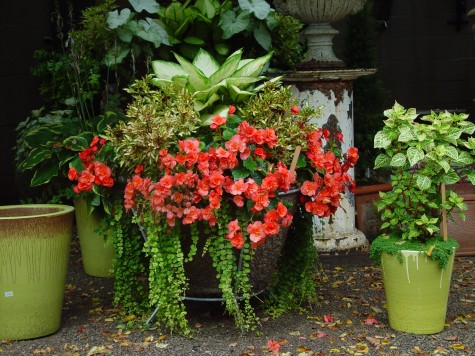
A solidly robust planting has much to do with the choice of plants.  The three plants comprising this pot have grown together in a shape that is dense and low overall. Just try to get by it without looking.  Chartreuse makes every other color pop all the more; creeping jenny is a vigorous perennial that loves some shade, and will grow in a bog. There is nothing subtle or airy about this planting-this is by design.   

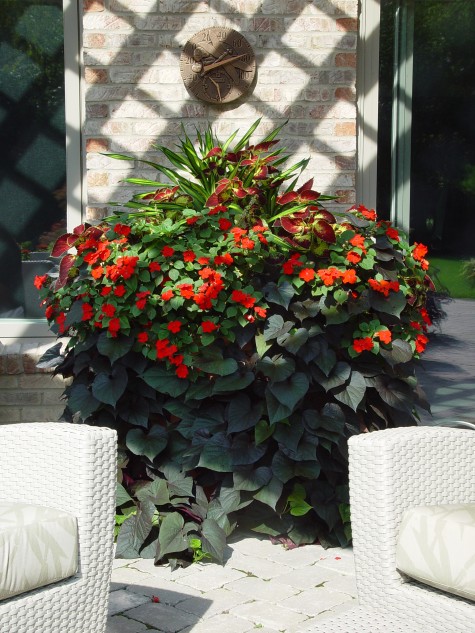
I can say the same for this pot.  It has grown so vigorously that the pot is no longer part of the composition.  Black and red; red and green-these color combinations are dramatic.  The contrast with the off white wicker furniture is all the more dramatic.  This modern furniture is very chunky and overscaled. These two chairs have some planted company that is even larger, and more chunky. The topknot comprised of a dwarf yellow variegated dracaena and a coleus-that look is in no way planned.  Just natural.  

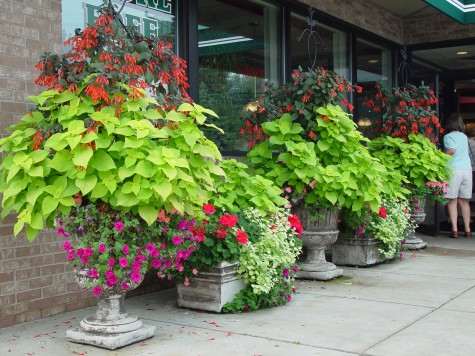
Gartenmeister fuchsia is an upright variety that handles hot weather like a pro. It can grow to a substantial size, and can easily be wintered over.  However, the dark foliage and small tubular dark orange flowers are rather subdued.  A tutu of lime green coleus turns up the heat.  The red geraniums,magenta petunias and lime licorice don’t hurt. This fuchsia is naturally very airy growing; its woody shoots grow every which way. The colues masks all of those wild hairs; these plants grew together densely in a cone shape.  

Big growing plants are accompanied by lot of leaves.  The leaves of the trailing verbena and petunias are barely visible in this picture, but there is no mistaking the coleus and dahlia leaves.  My office is dark, given this window box planting.  Any container design warrants some study.  Do I need this planting to block an untoward view?  Do I want a container to stand out, or integrate into the large landscape? Right now is a very good time to be looking over your container designs; I take notes.    

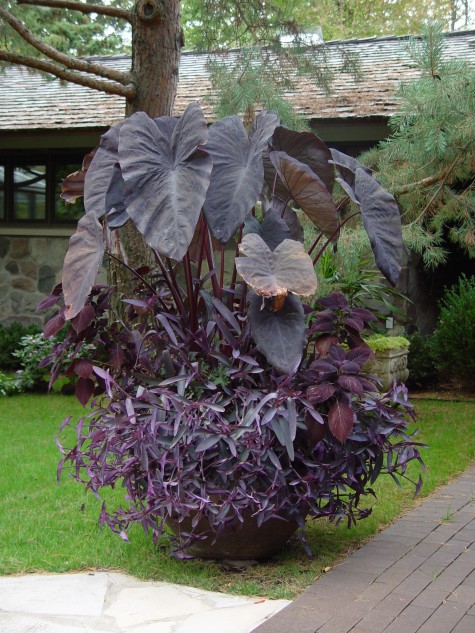
A very large terra cotta pot with a purple chocolate glaze is home to this monochromatic planting. Black calocasia, a purple black leaved coleus, and moses in the cradle, makes a sizeable statement about volume and texture.  Calocasia ia a very obliging tropical, in that it will grow as big as the container into which it is planted.  This planting is the better part of 8 feet tall.  This discussion of texture anf form-loud and clear.

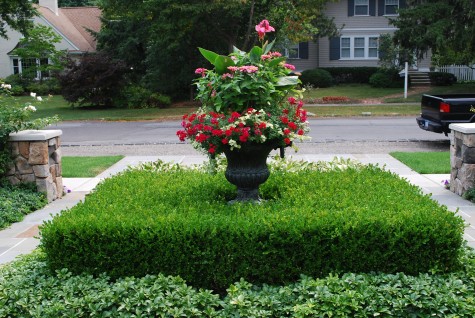
Cannas and zinnias-they both are big growing and leafy.  A skirt of trailing geraniums and lime licorice add lots of color at the base.  A neighbor standing behind this pot on the sidewalk would not be seen.  Sometimes a blocky and solid planting can organize a space-in this case, it presides over a densely growing square of boxwood.  Solid, dense and visually clear-this is how I would describe this spot in the landscape.

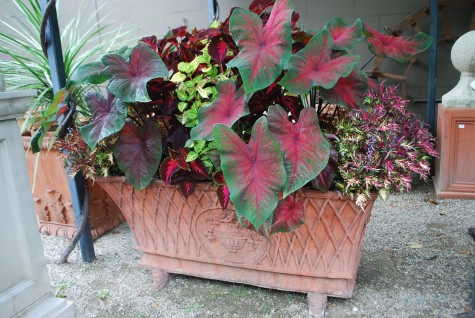
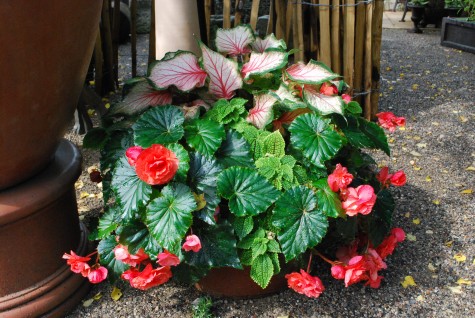
Large leaved caladiums depend on their size and shape to make a statement.  I like how lush a well grown plant looks.  I am leaning towards planting a lot of them next year.  Loud and clear is much about vigor.  I would much rather work to keep a growing fool of a plant in line, than every day have to convince a prima donna of a plant to choose life.  This is a personal preference. Even the subtle and wispy growing plants that I favor are strong growers.  

But back to loud and clear.  On that list of plants that can deliver that for you-big growers, dense growers, robust growers, large leaved plants, large growing plants, brilliantly colored flowers.  Brilliantly colored leaves; leaves with great shape and texture.    It is up to you to put them all together in a way that enchants your eye.

The End Of An Era

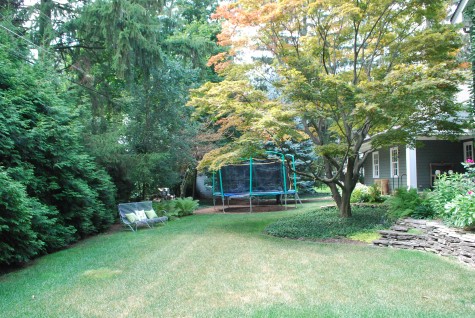
People make changes in their landscapes for lots of reasons.  For some, it may be the end of the trampoline era.  Kids need space to play, and entertain friends.  This need can be the organizing metaphor of a landscape.  I have lots of clients with mini-soccer fields, trampolines, play sets, tree houses, picnic tables, basketball hoops, bike racks, mud rooms, shed sized doll houses, badminton nets, ice rinks-you get the idea.  This client had just accompanied her youngest child to her college orientation.  It was time for a change in the landscape.  She thought a firepit would be a good substitute feature for the trampoline-that part was easy to visualize.   

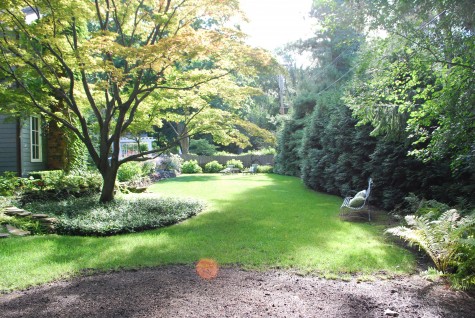
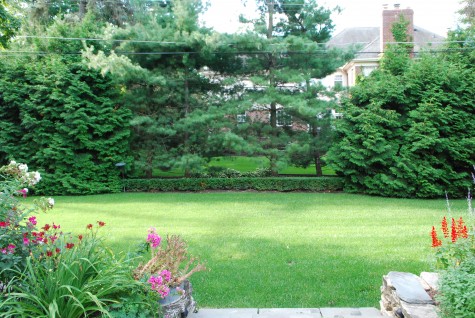
The rear yard was very shallow and long, and dominated by grass.  Even the bed of euonymus under this aging Japanese maple had a big flat spot in its curve out into the yard. She did not want to intrude on any flat grassy space.  This is child friendly.  Old arborvitae hedges screened most of the rear lot line.  Every landscape move was immediately apparent-from one end to the other. 

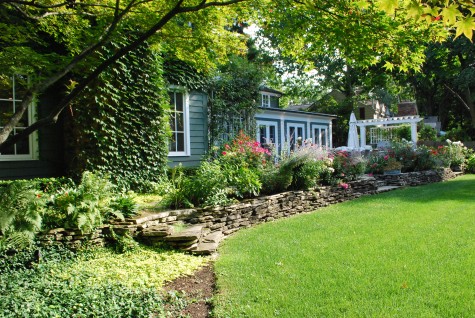
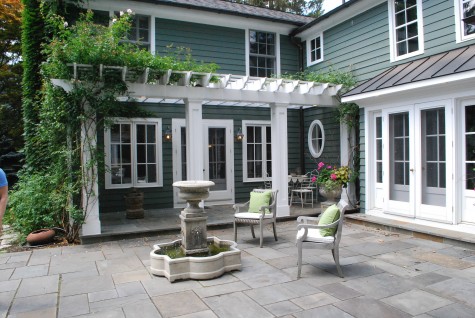
Small perennial borders were planted on top of a series of dry stack stone walls, laid at the grade of a big bluestone terrace.  This places the shasta daisies out of range of the soccer ball, and rightly so.  Lawn ran right up to those walls. A large upper level bluestone terrace set at the grade of the floor of the house provided a place to have guests, and large table, and a built in barbeque.  On this terrace,  a small fountain and fountain pool, set on top of the bluestone.  

The fountain dominated a fairly large space on the terrace, and proved difficult to integrate into a seating area.  A group seated here would be looking into the pedestal of a fountain.  After a resolution of the trampoline issue, where would the fountain look best? This space would be great for a couch, coffee table and chairs-for adult events.  An adult experience of the garden and landscape meant the fountain would need a new home. 

Directly opposite the terrace, a small hedge of boxwood faced down some large and open growing white pines belonging to a neighbor.  Though the stairs did not come off the terrace centered on this space, that was the least of the troubles.  The problem here-a view to no where.  A way too good of a view to a neighboring house.

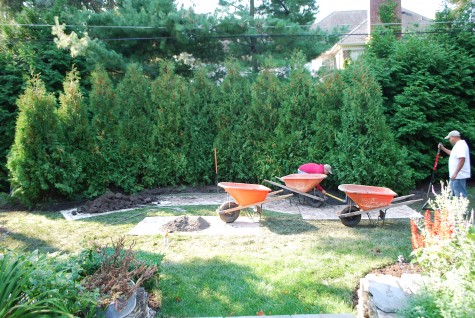
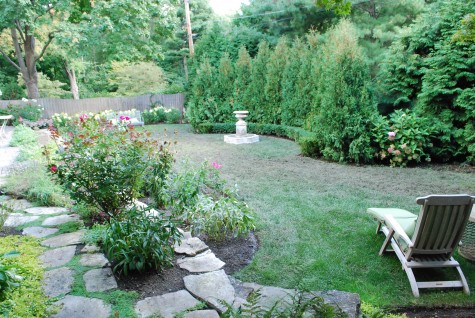
We planted 11 12 foot thuja nigra-these are a match for the existing arborvitaes.  This screened the neighbor’s house from view.  These evergreens were planted in a shallow arc-what need would there be to continue the long straight line of cedars down the lot line?  The idea here-create a space, shelter,  for that fountain.   

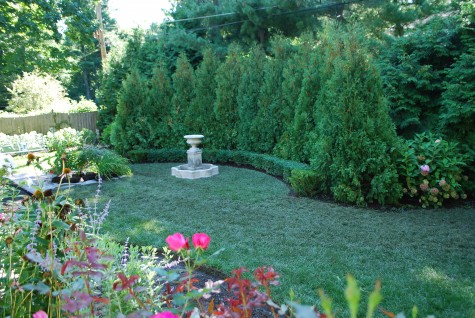
The existing boxwood were dug out, and replanted in front of the arbs.  This gives a very crisp green edge to the cedars.  The fountain and its basin were relocated into the grass.  The gap between the first arb on the arc, and the first arb on the lot line-we filled that with an existing hydrangea.  This landscape is starting to look much more interesting. The fountain looks much stronger, given this placement. 

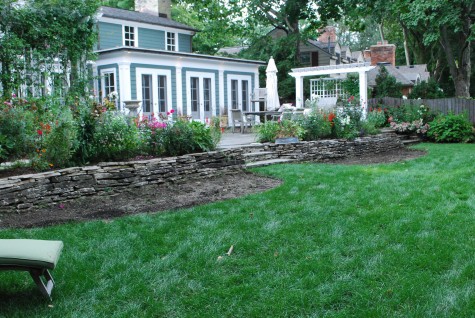
The dry stack stone wall whose function for many years was to keep the kids, dogs, and footballs out of the upper level perennial garden and terrace-we cut curving beds in front of them.  My idea was to link the upper level terrace with the lower level landscape.  This meant I needed to move the very tall, and visually blocking, perennials on the top level, to the ground plane.  This will give my client much more space for her herbs on the top level.  And an integrating view of the lower level landscape.  A clear view to the lower landscape, softened by roses, phlox, coneflower and daylilies would make the lower landscape part of the experience of entertaining on the terrace.

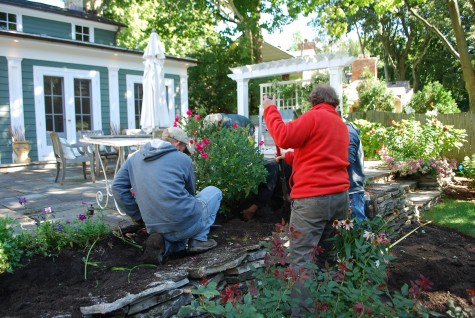
Moving perennials-right now is the perfect time.  The nights are cool, the rains are regular.  We did move some roses-with giant rootballs. Four of us handled the digging, lifting, and resetting of each rose. This will work, or it won’t. If it doesn’t, a new rose is easy to plant.  The other perennials will move easily.  This is the right time.    

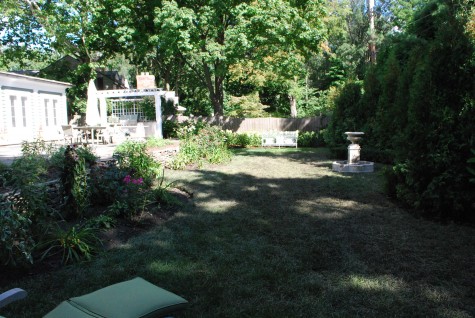
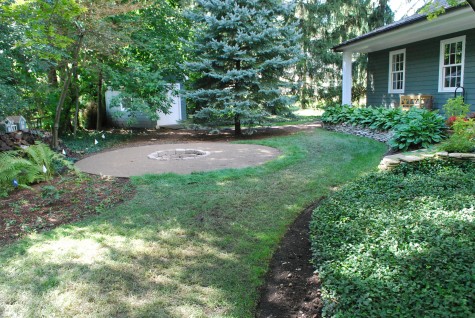
I am sorry for the state of the grass-we have had so much rain.  Even though we put down plywood to travel across the lawn, it has taken a terrible beating.  It will be back thriving within a week or so.  This is an entirely different landscape look.  The lawn has become a generously curving path from one part of the yard to another.  There are distinctly different spaces; rooms, if you will.  The curving beds are a great contrast to the rectilinear overall space.  

This picture is not the best, but it should be clear that the bluestone terrace has become a big part of the greater landscape. 

As for the trampoline-it is gone.  In its place, a firepit surrounded by a decomposed granite terrace.  There are some very good looking curves going on here.  Any landscape can be transformed with a few fresh ideas.  These fresh ideas-straight from my client.  Her request?   A new era, please.

Night Light

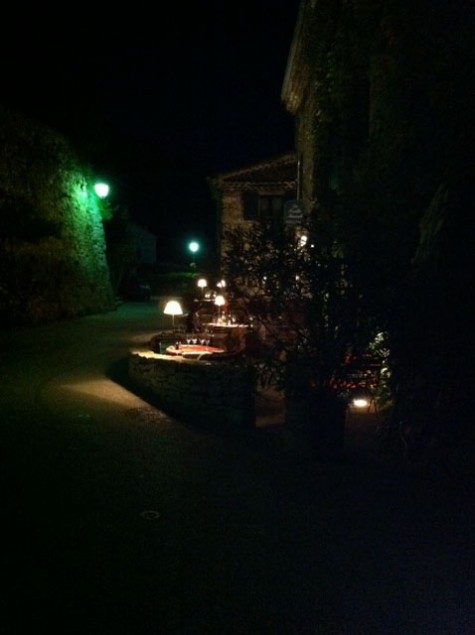
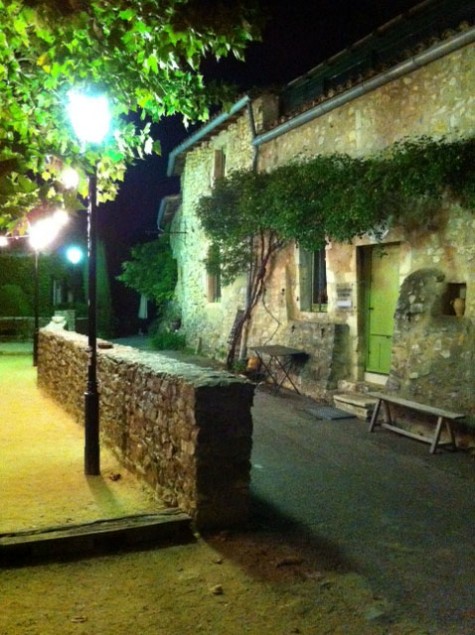
Rob has been putting in some very long days.  He doesn’t quit until the daylight is gone.  He sent me an entire group of pictures about his 9 o’clock dinner hour.  Rural France is not in any way lit like my neighborhood at night.  The light is intense, but just every so often.  The dark is punctuated by the occasional light.  I cannot imagine having dinner outdoors only inches from the road.  Public American landscapes are all about medians, curbs, and most importantly, big spaces.  Big segregated spaces.  Rural French landscapes are about a very close relationship between travel, commerce, farming, neighborhood, and the natural landscape.  It is a small country.  Dinner on the edge of the road-a unique experience.         

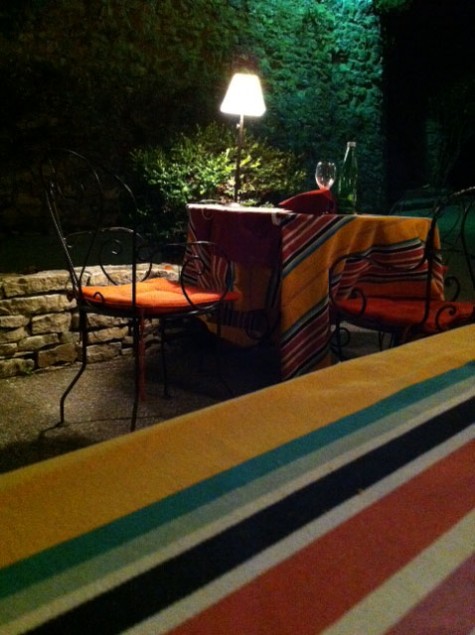
 The lamp illuminating the striped tablecloths-just enough light to make the space cozy.  I have mixed feelings about landscape lighting.  Lighting for safety’s sake is a given.  Stairs, doorways and sidewalks are spaces that get used regularly at night need to be well lit.  Lighting the landscape is so easy to over do. The best light-natural light. Sunny, overcast, early late, stormy-natural light is much about climate and weather.  What comes next is about artifice.  How much artifice is too much, and how much is just right?       

Up lighting gives every element of the landscape a theatrical look-as in the the drawings and paintings Degas did of dancers in the theatre.  Down lighting, expertly done, believably replicates the the light of the moon.  In this picture, all of ther light is coming from the top down, or from the side.  Up lit trees have a very theatrical and unnatural look to them.  I light my pumkins in my pots at Halloween-it gives them an extra measure of holiday creepiness.  At the Christmas holiday, I pull out all the lighting stops.  We have more dark than light, and our natural light is likely to be about grey and overcast.  

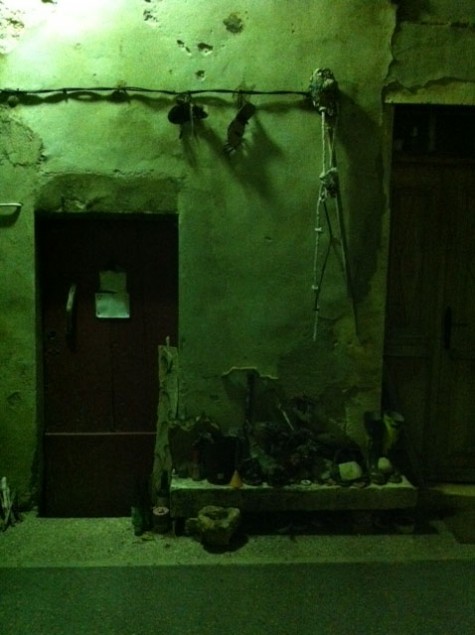
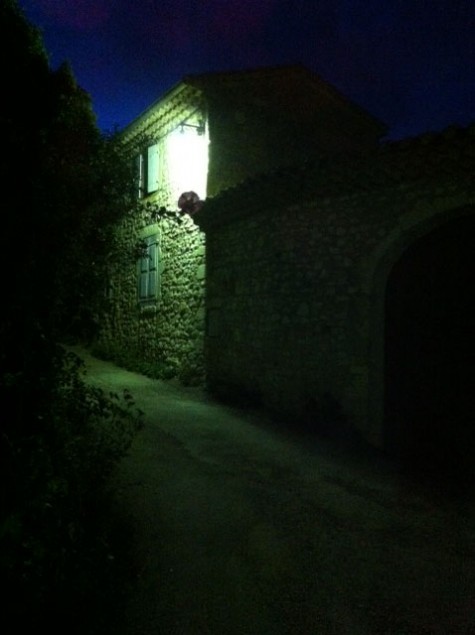
Rob’s pictures are provocative.  Perhaps uneven lighting creates an exciting atmosphere.  Very bright street lighting is about providing safe passage, but has that carnival, rather than theatrical look to it.  Black shapes, and long shadows are visually striking. The CFL’s-or compact flourescents are cool to the point of being cold.  The CFL’s,  in combination with incandescent lighting-the French are doing such innovative work with combining the two.     

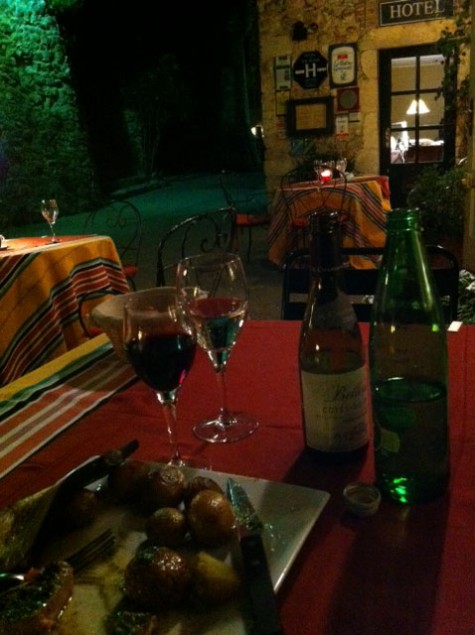
Artificial light is not one bit like the light from the sun.  This is not to say that one source of light is better than another.  Just different.  This lit doorway has a lonely but starkly beautiful look.  This is a landscape experience of a different sort.  Rob has a big interest in lighting.  I am sure I will see the results of this evening in France somewhere is his winter and holiday lighting schemes.   Rob’s late evening in France was as much about the light as the place.  The deserted streets in the evening is much different than in my neighborhood, where there is activity almost all night long.  Every season I vow to spend more time thinking about how a landscape can be beautifully lit.  This is not to say I do not consider the lighting-I have a contractor whose point of view and skill I really like.     

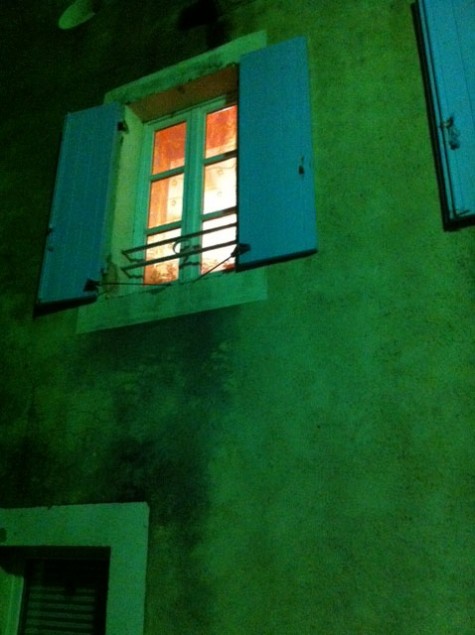
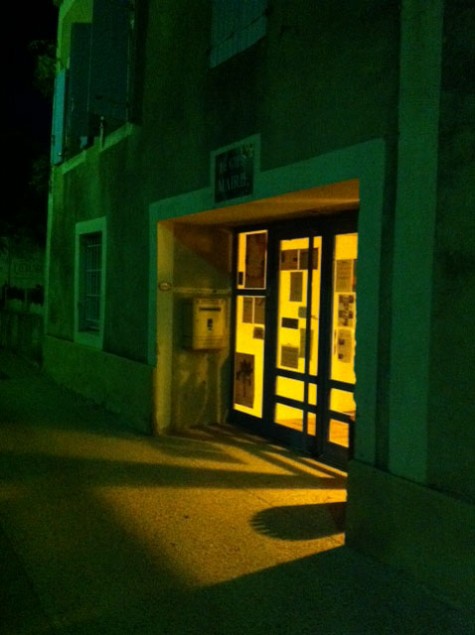
The warm light illuminating this building comes from within.  The green walls appear all the more blue, given the compact fourescent light from the street. The green walls, blue shutters, and orange light-vivid.

This is the mayor’s office.  The warm yellow orange light from the interior spilling out into the street is comforting.  The contrast of light and dark is graphic and moody. 

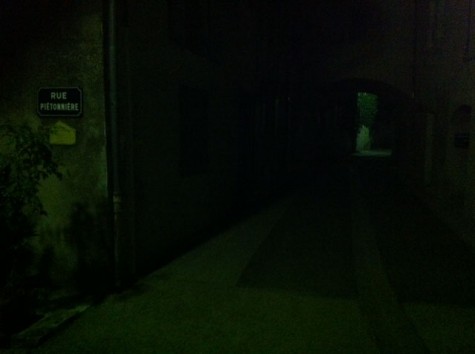
The sign designating the Rue Pietonneire is still visible, even in low light at the end of the day.  Haunting, this.