Breaking Ground


Theodore Roethke is one of America’s most respected poets.  He was born in Saginaw, Michigan in 1908, to German immigrant parents-Otto Roethke and Helen Heubner.  His parents were market gardeners, and owned and operated 25 acres of greenhouses with Theodore’s uncle.  Much of his childhood was spent in those greenhouses.  His second book, “The Lost Son”, contains several of what are known as his greenhouse poems. 
Images and metaphors derived from the natural world are much a part of his writing.  Long before I ever had the conscious idea to design gardens, I treasured his work. I studied early twentieth century poetry in some detail in college.  For whatever reason, many of the lines from his poems have stayed with me.
One phrase I have always liked- “The time comes when the vague life of the mouth no longer suffices…”  I am taking this phrase completely out of the contextural meaning of the poem, but it perfectly expresses that moment when the time for the designing, the discussion, the redesigning, and the additional discussion, comes to an end.  Enough decisions have been made in order for a project to proceed.   
A landscape plan is just so many marks on a page-a drawing.  That drawing has only two dimensions.  It does not really describe the sculpture that will be.  But drawings are critical in a project such as this.  Preceeding the landscape, a pool and poolhouse will be built.  Though my drawing described the physical location, shape and size of the pool, and the location of the poolhouse, that drawing needed lots of details-what materials would be used?  What would the poolhouse look like?  What features would be incorporated?  How many months of the year did the client foresee using it?  Building a pool and poolhouse is a complicated and considerable undertaking, but even the smallest landscape project needs to be thought through.
The integral spa on axis with the rear terrace was agreed upon, but the client wanted a slightly longer and slightly narrower pool.  The architect took my idea for a pair of poolhouses linked by a conservatory structure, and designed the poolhouse.  The general contractor decided with the client how the interior space would be handled.  He needed the poolhouse to be longer, so as to have inside space for the pool equipment.  He favored solar panels to warm the poolhouse early and late in the season.  I integrated these and every other good idea into what became the final landscape plan.  Ideas are one thing.  Building a project requires ideas that work. 

The pool contractor sorted out all of the many details needed to build the pool.  The depths of the water, the steps, the filtration system.  The general contractor oversees the entire project, so construction goes smoothly, and things happen in the right order.  This GC is very low key, and equally good at problem solving-just the person to handle a project like this. 
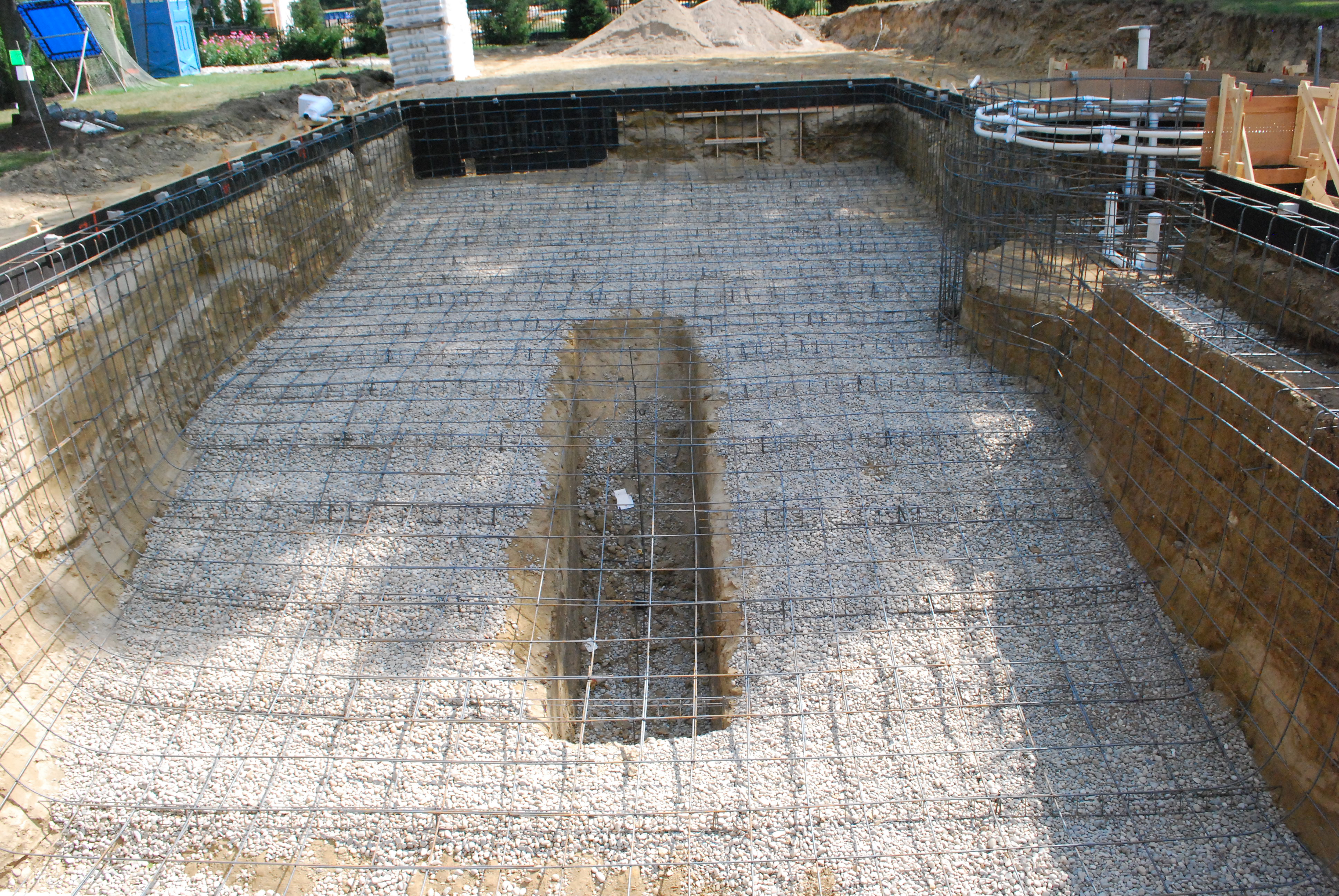
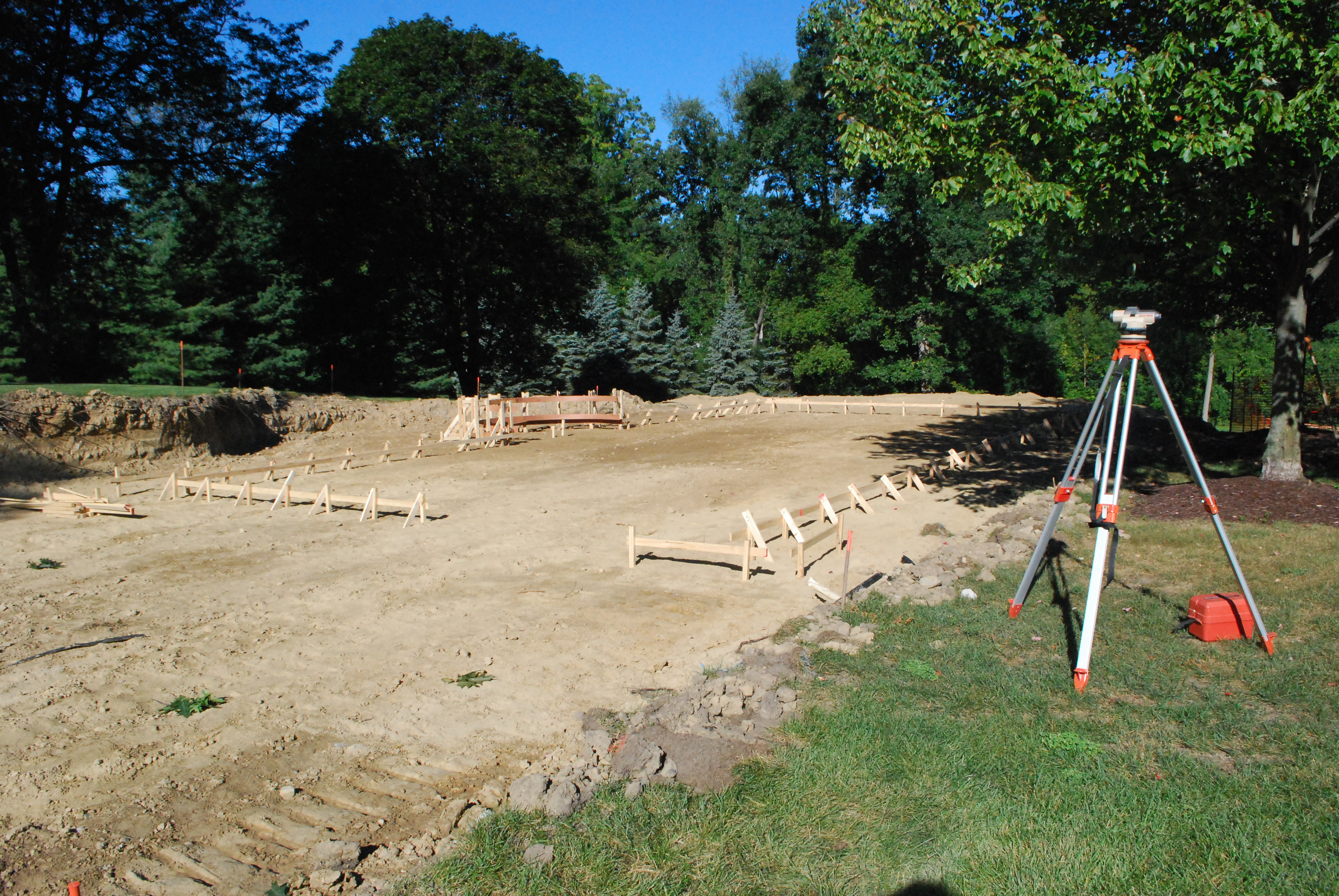
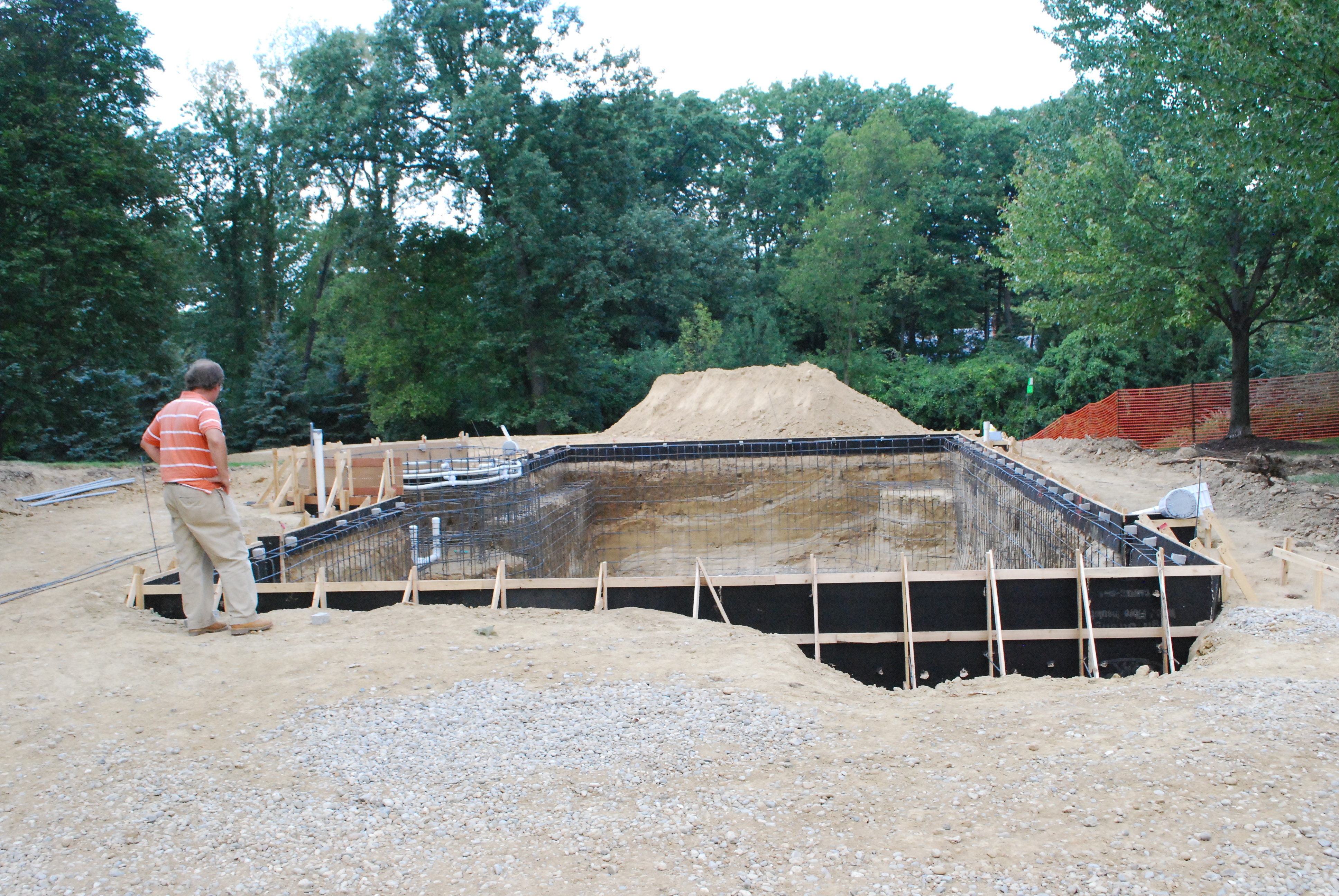
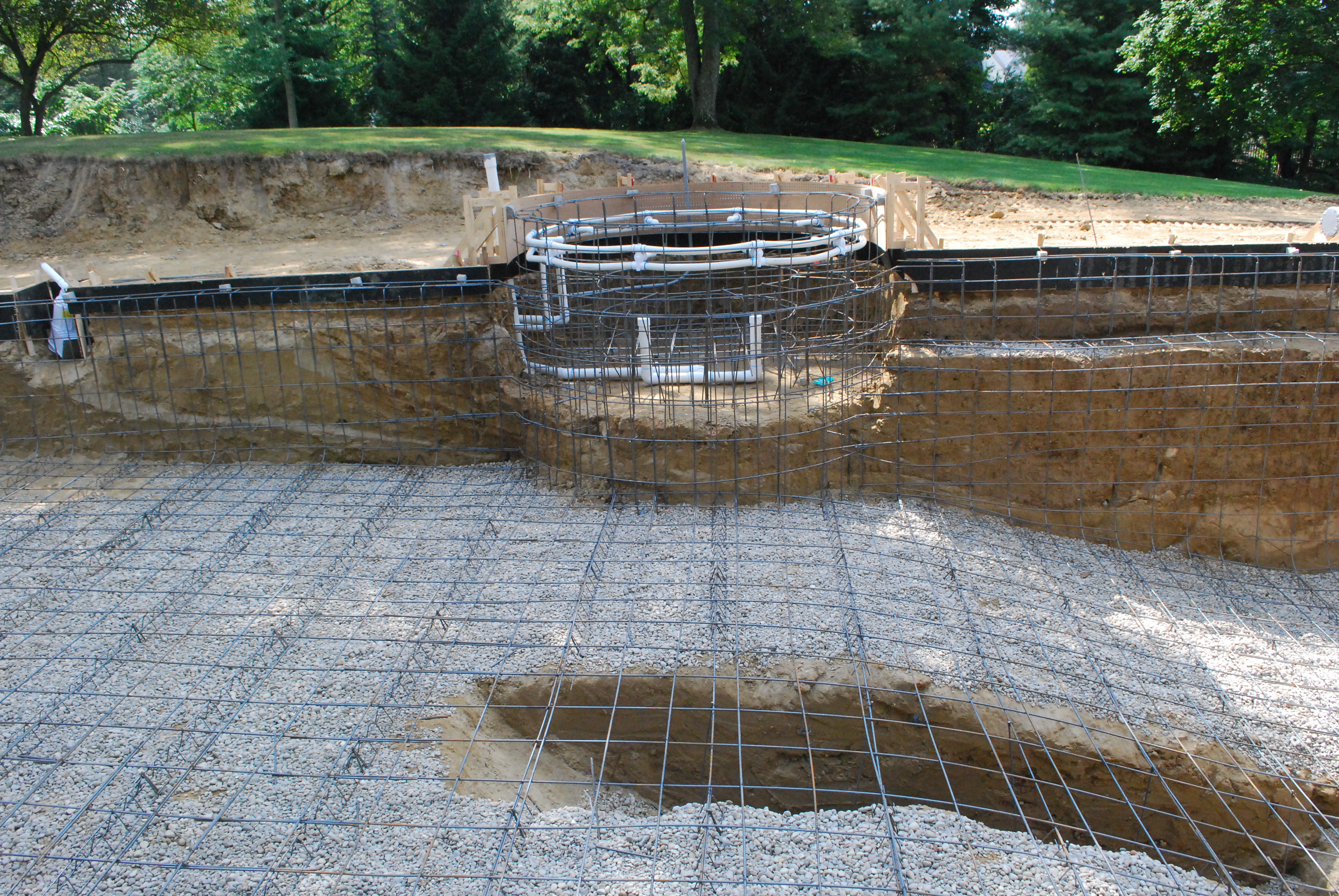
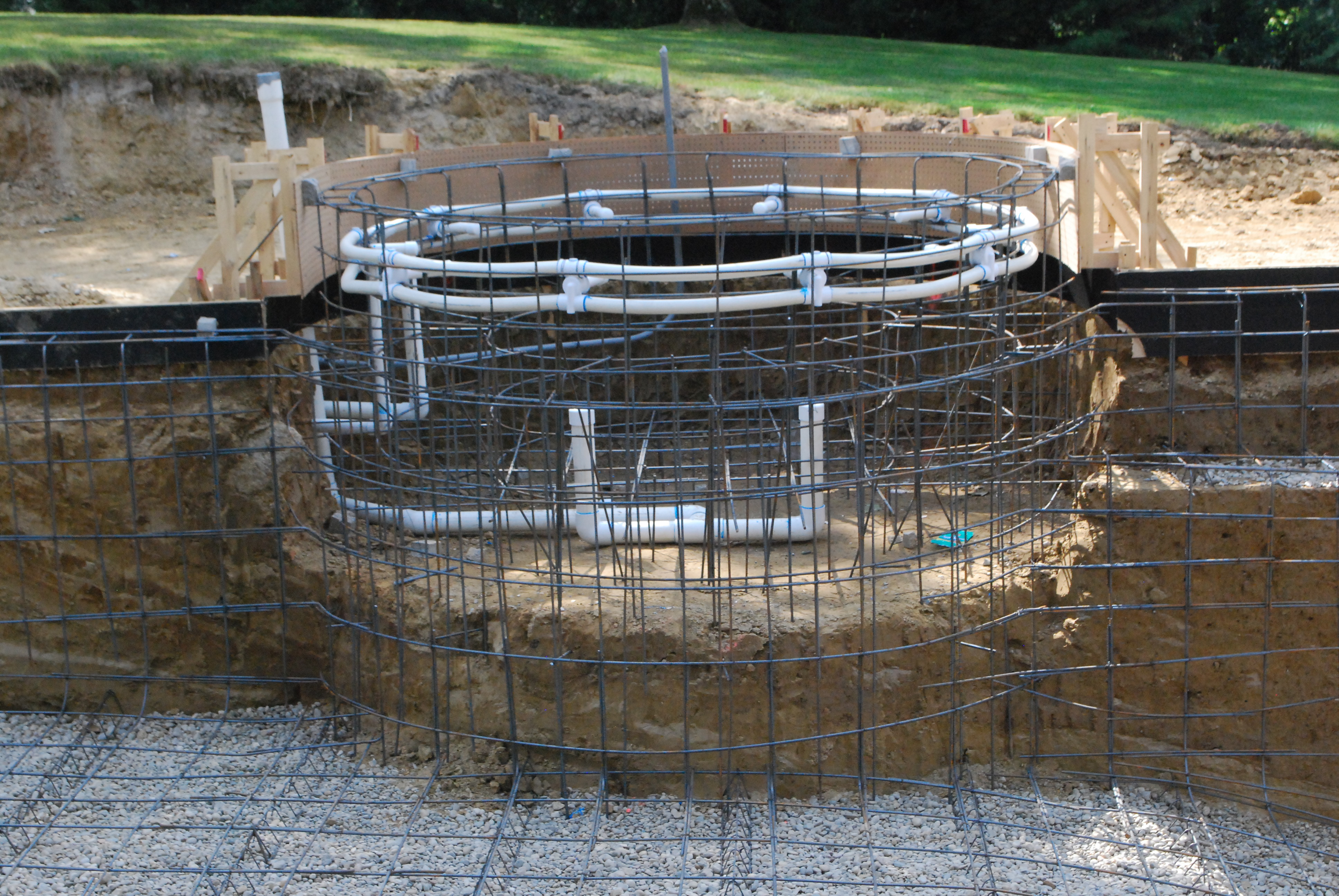
Once a coherent design emerged from the client and all of the design and build people, finish plans were drawn, and submitted for review to the planning board. Once the permit was issued, the pool was dug, and lined with a steel mesh that would reinforce the concrete.  The giant and deep hole you see here, encompassing the steep change of depth of the pool, will be filled with concrete.  This will stabilize the entire underwater structure. A pool needs to stay put.  Any action from the frost that might heave the pool upwards, and crack it-every effort is taken to avoid that. 
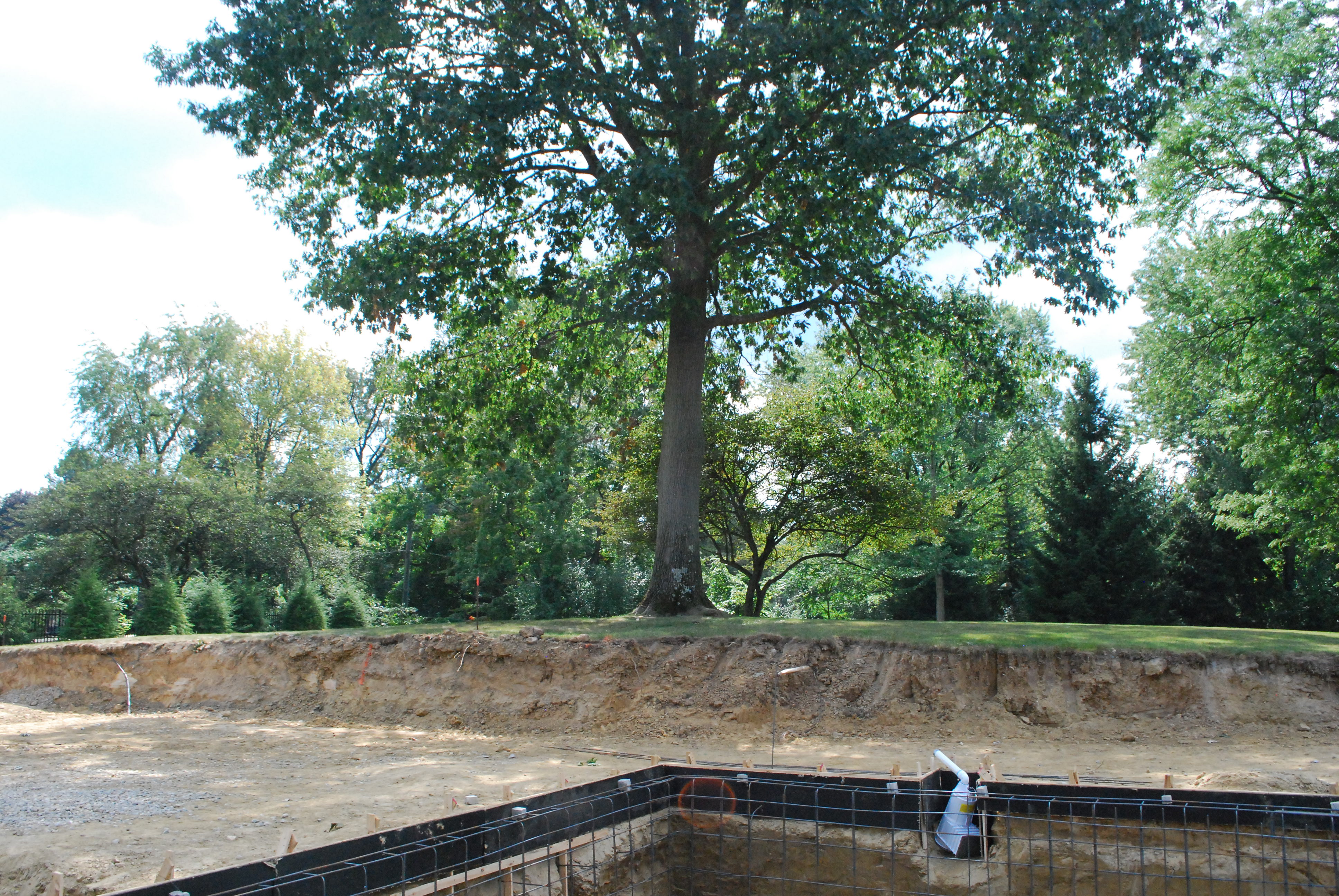
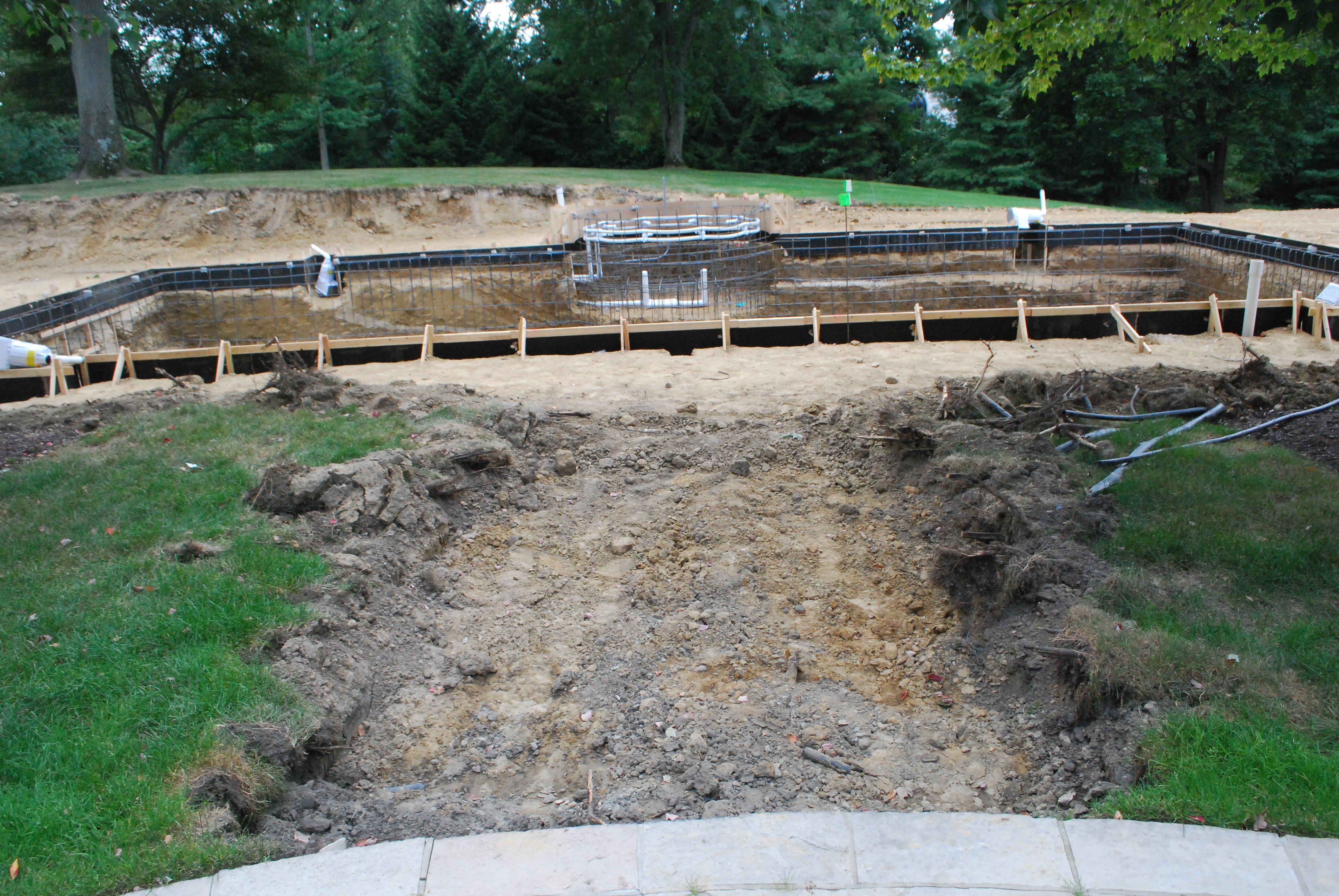
Of primary concern in the initial design-a gorgeous oak of considerable stature.  My clients love this tree.  The pool was sited to avoid any damage to it.  I was relieved to see no roots exposed in the excavation necessary to provide level ground for the pool.  This oak sits on a hill that slopes dramatically down to the house.  Eventually, a stone retaining wall between 3 and 4 feet tall will be built to hold the soil on the oak side.  The pool and surround will be built at the grade of an existing rear terrace.  A drainage plan for both the ground and the wall-a subject of much discussion and planning.  
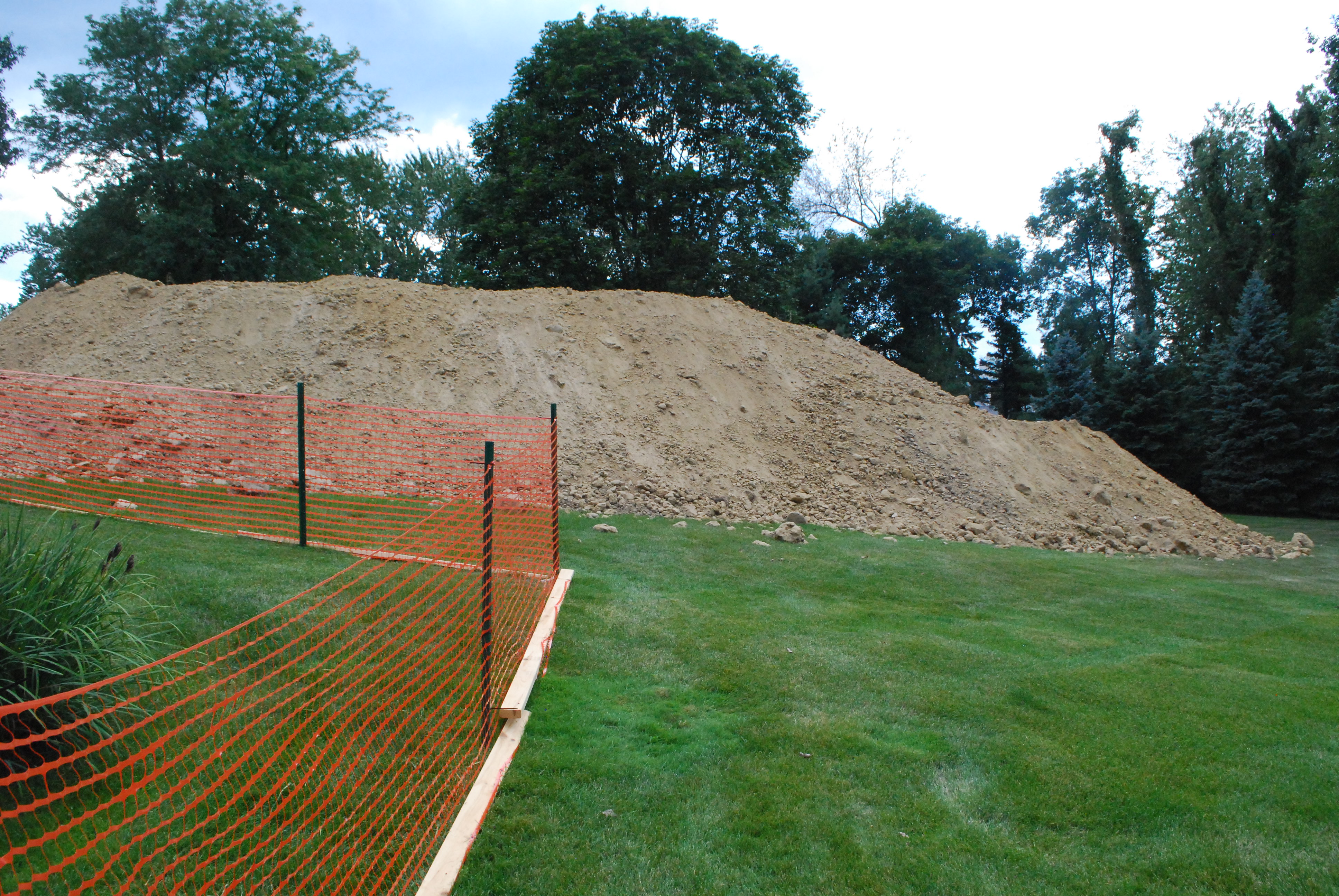
A decision was made to integrate the soil unearthed from the excavation of the pool into the existing property.  Hauling away soil is a time consuming and expensive process.    This is a large property, and I have ideas about where this soil can go.  The drainage work, and grading of this soil is part of the landscape project. 
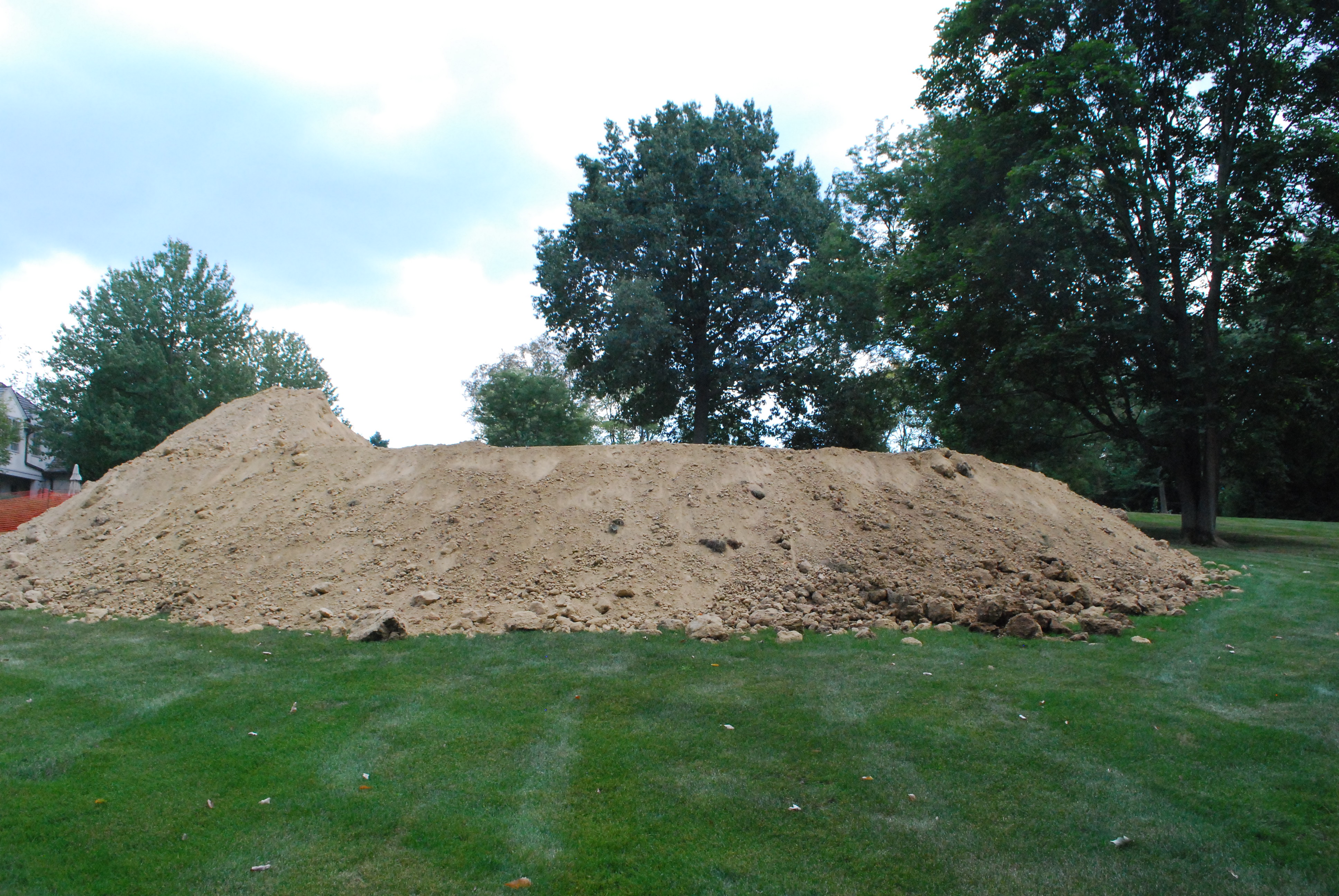
No one could like a gigantic pile of dirt awaiting a sculptural disposition better than I.  I have walked the property at least 5 times, imagining what might be come of it.  I am inclined to leave most of it on this north end of the pool.  The natural grade of the land at the north end of what will be a pool slopes down precipitously.   A large area of level ground there would be ground they can use, enjoy, and garden.  More than likely I will be able to stablilize the soil with a gradual slope down.  Perhaps we will need some retaining on the east side.
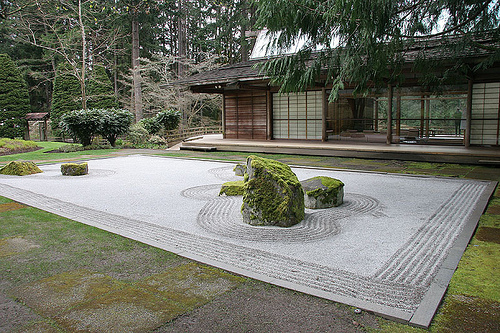
As for Thoedore Roethke,  I was thinking about him the past Friday.  He died in 1963 at the age of 55, at the home of a friend on Baimbridge Island in Washington- a heart attack while he was in the pool.   That pool was subsequently filled in, and today is the rock and sand Zen garden at the Bloedel Reserve.  No where is there any mention of Mr. Roethke, but I would imagine he would approve of a garden in this spot.  There does indeed come a time when the vague life of the mouth no longer suffices.  We broke ground.
 

Growing Topiary Plants

topiary evergreens
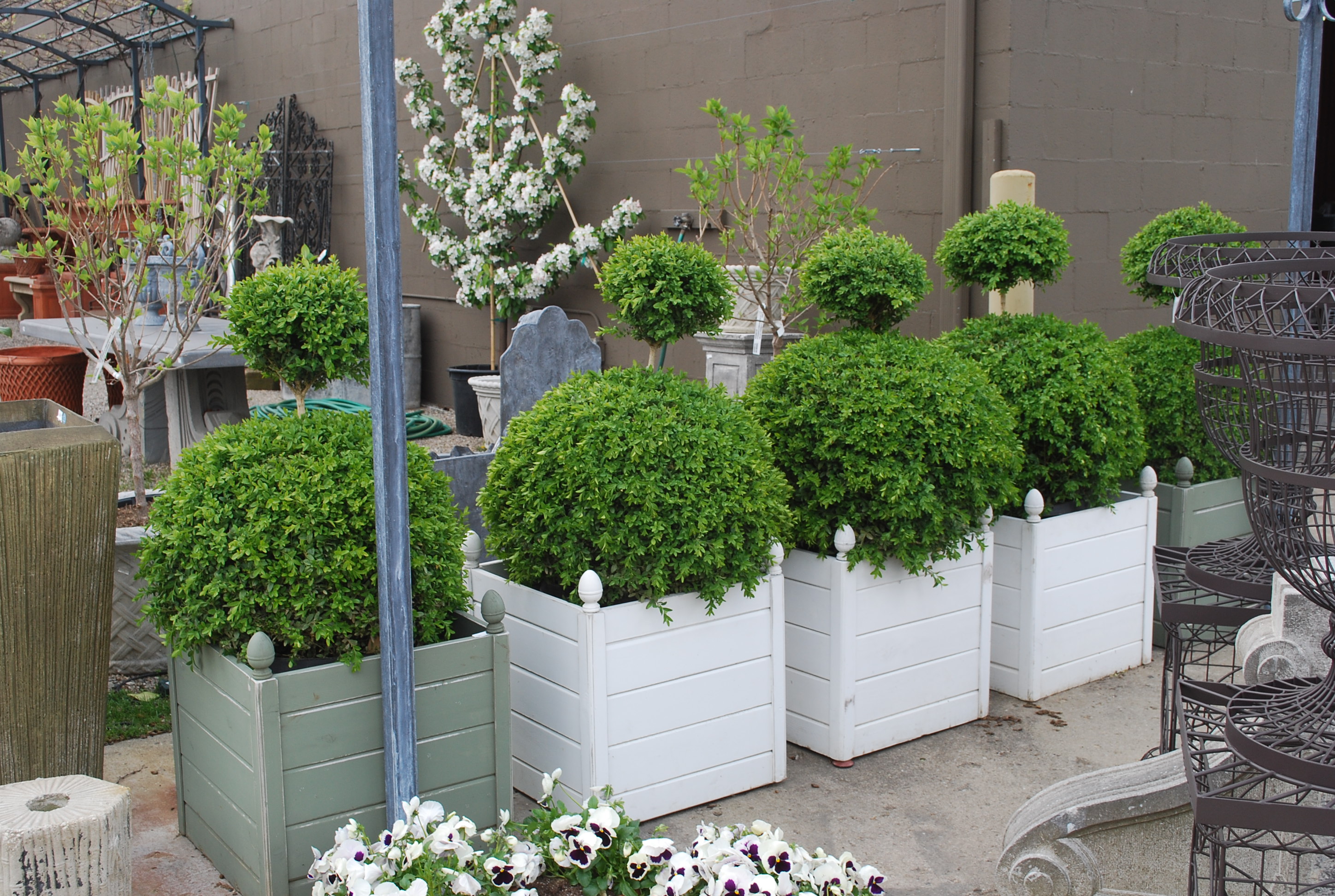
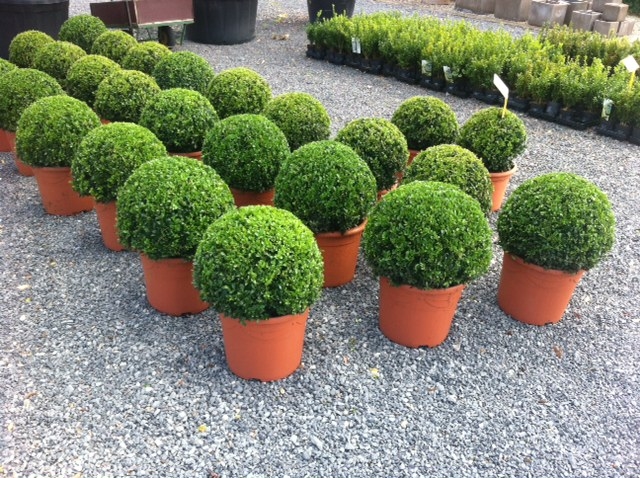
I had so many calls, emails and comments about the topiary nursery in my previous post- wow!  I could thank you for that attention, but it wasn’t me who grew those plants.  It is a very special person with an extraordinary and singular vision.  People with vision-there is always something worthwhile to take from their efforts.  His palette of plants is quite spare.  His patience with the process I call growing is unlimited.  And his ability to prune is superb.  These boxwoods of his in 3 gallon pots are plants that have been given a very good start.  Any gardener could take this pot home, and resolve to grow that boxwood on.       

Another grower we buy from makes a point growing this particular form.  These boxwood with tufted top knots are charming and distinctive.  Anyone willing to take one on, and commit to growing and pruning would in just a few years have a boxwood topiary worth talking about.  To get to this stage, the nursery spends 10 years.  They are happy to hand what they grow off to you.  Are you game?

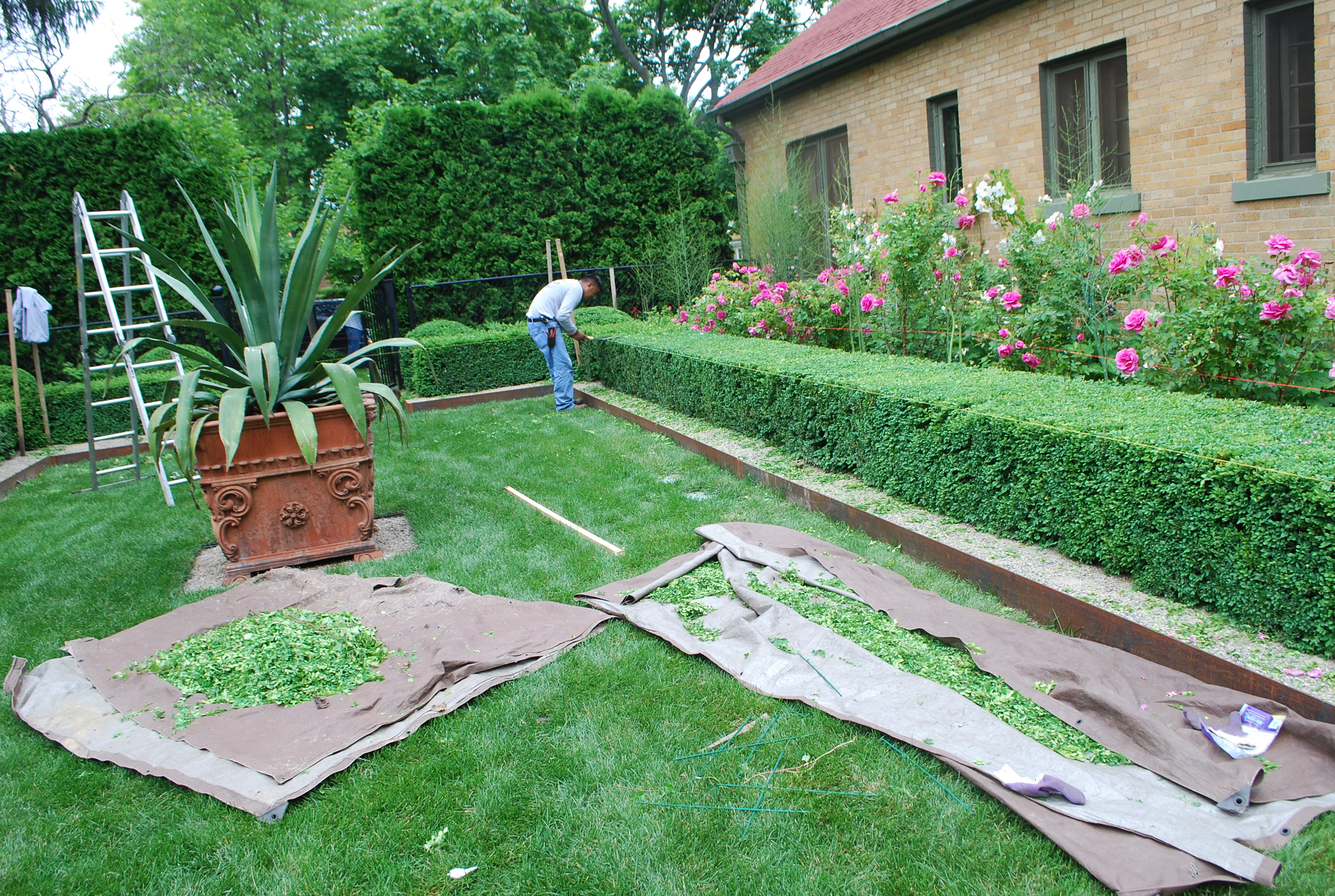
Most of my boxwoods are 21 years old.  7 years old at purchase, and 14 years in the ground.  I water and feed them.  But I would not dream of touching them with a pair of shears.  I am a serviceable pruner-not an inspired one. I am fortunate to have someone in my community who makes a specialty of pruning.  Mindy and her group of 7 takes an entire day to prune my evergreens.  The day they come-the best day of my gardening year.     
boxwood topiary

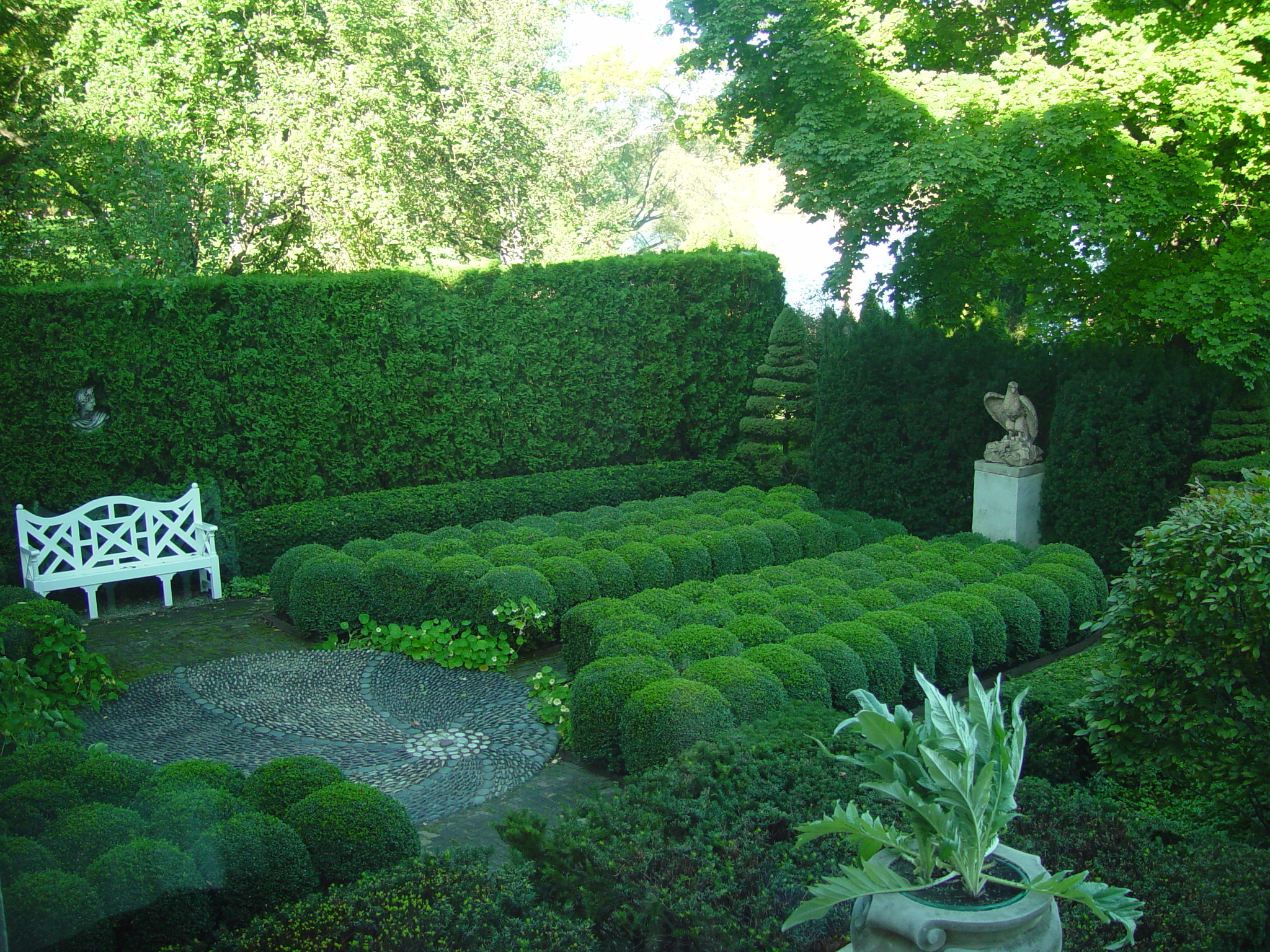
Gorgeous topiary trees and shrubs are first and foremost about the years, and the good care.  The years devoted to growing them on.  Transplanting large topiary material comes with no end of peril.  Transplant shock is routine.  They are very expensive, given how long it has taken to grow them to a subtantial maturity.   Once the plant is in place, the work begins.

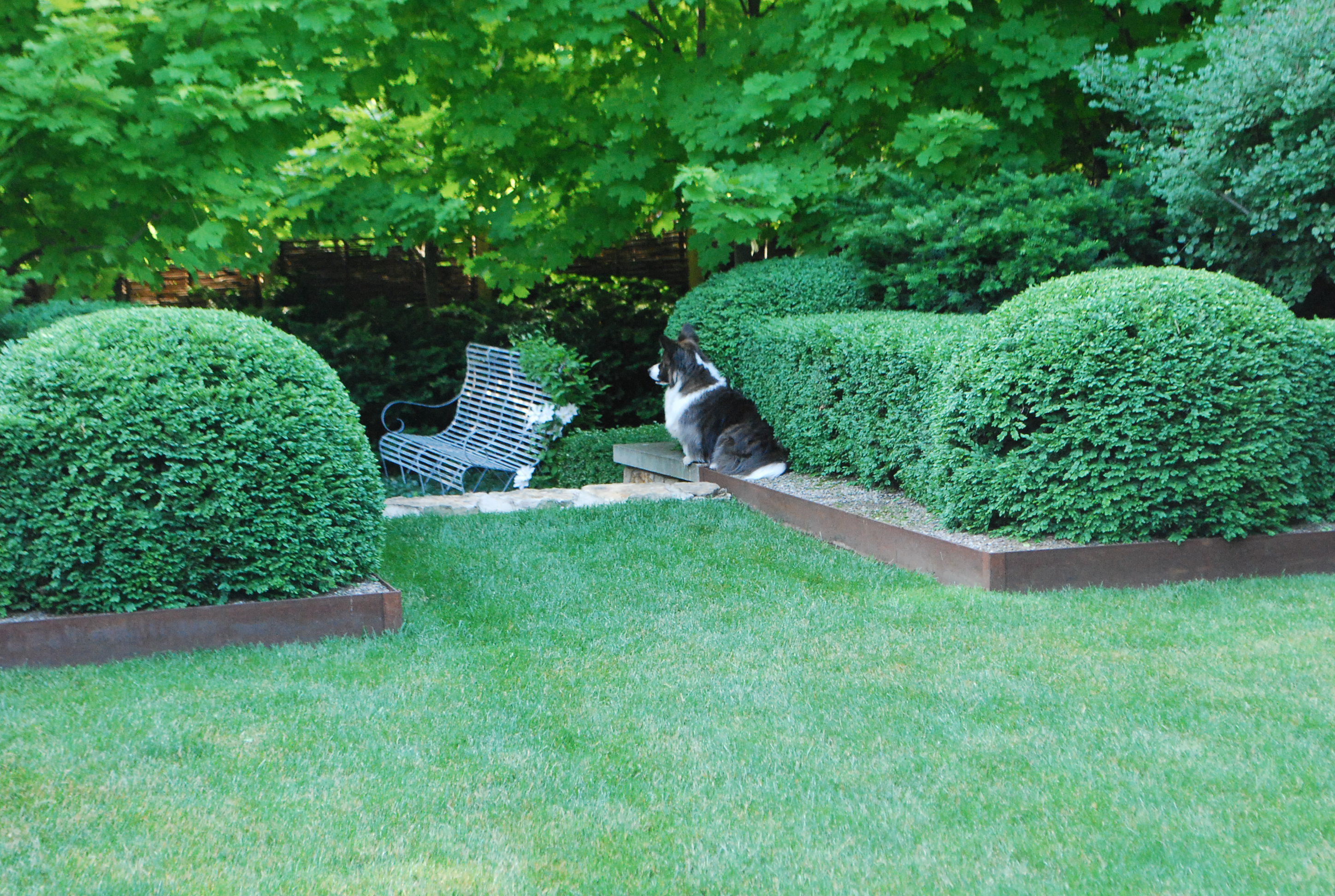
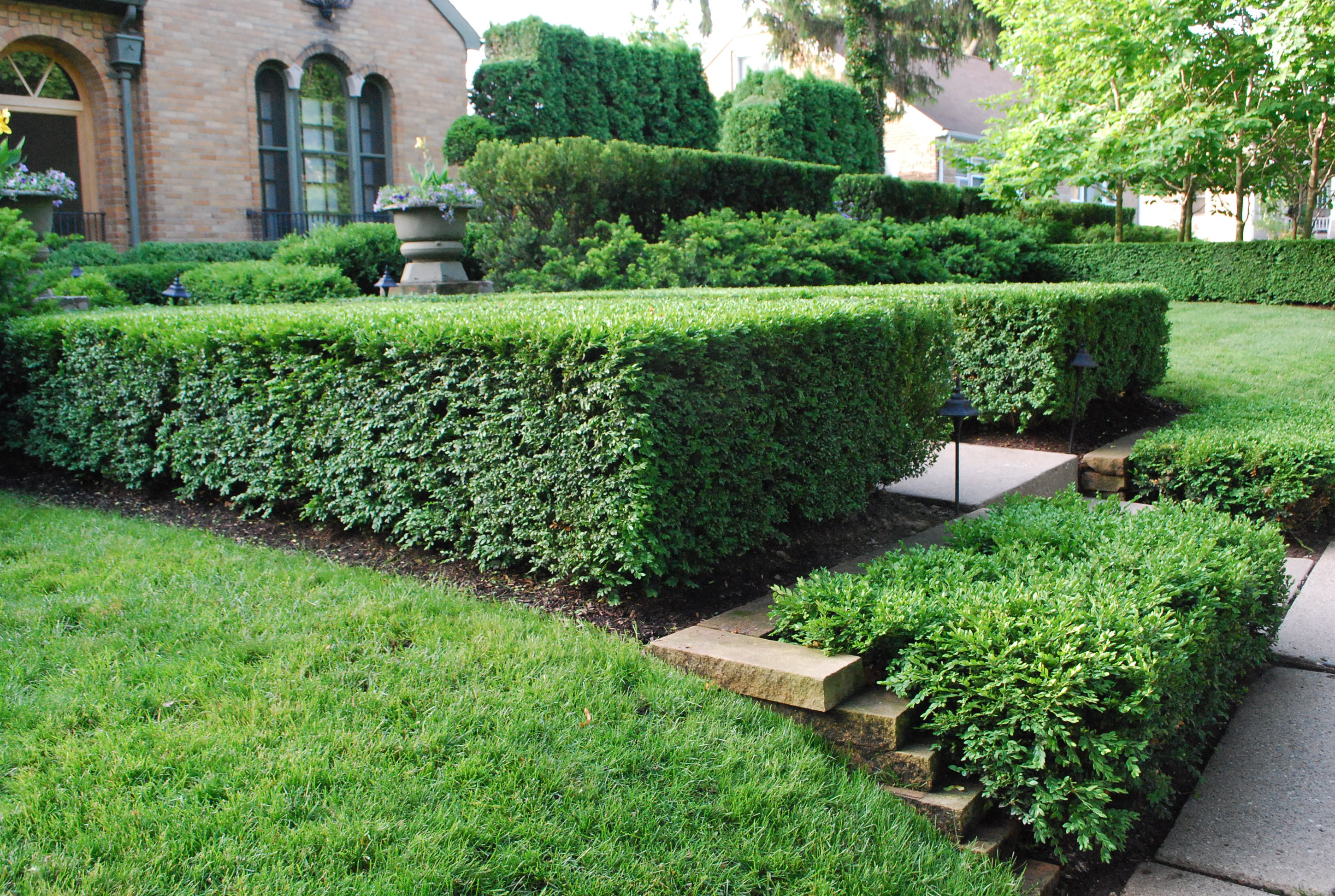
It was many many years ago that I planted this topiary garden.  The first year was no cause to throw a party.  But a client with vision was determined to take relatively small plants, and grow them into plants of note.  She saw to the water, the feeding, and the pruning.  In my zone, in a good year,  boxwood flushes on an average of 6 inches.  Six inches seems like not much, but 6 inches times 10 years-a big flush.  Years later, her plants are gorgeous-gorgeous enough to make any gardener blush. 

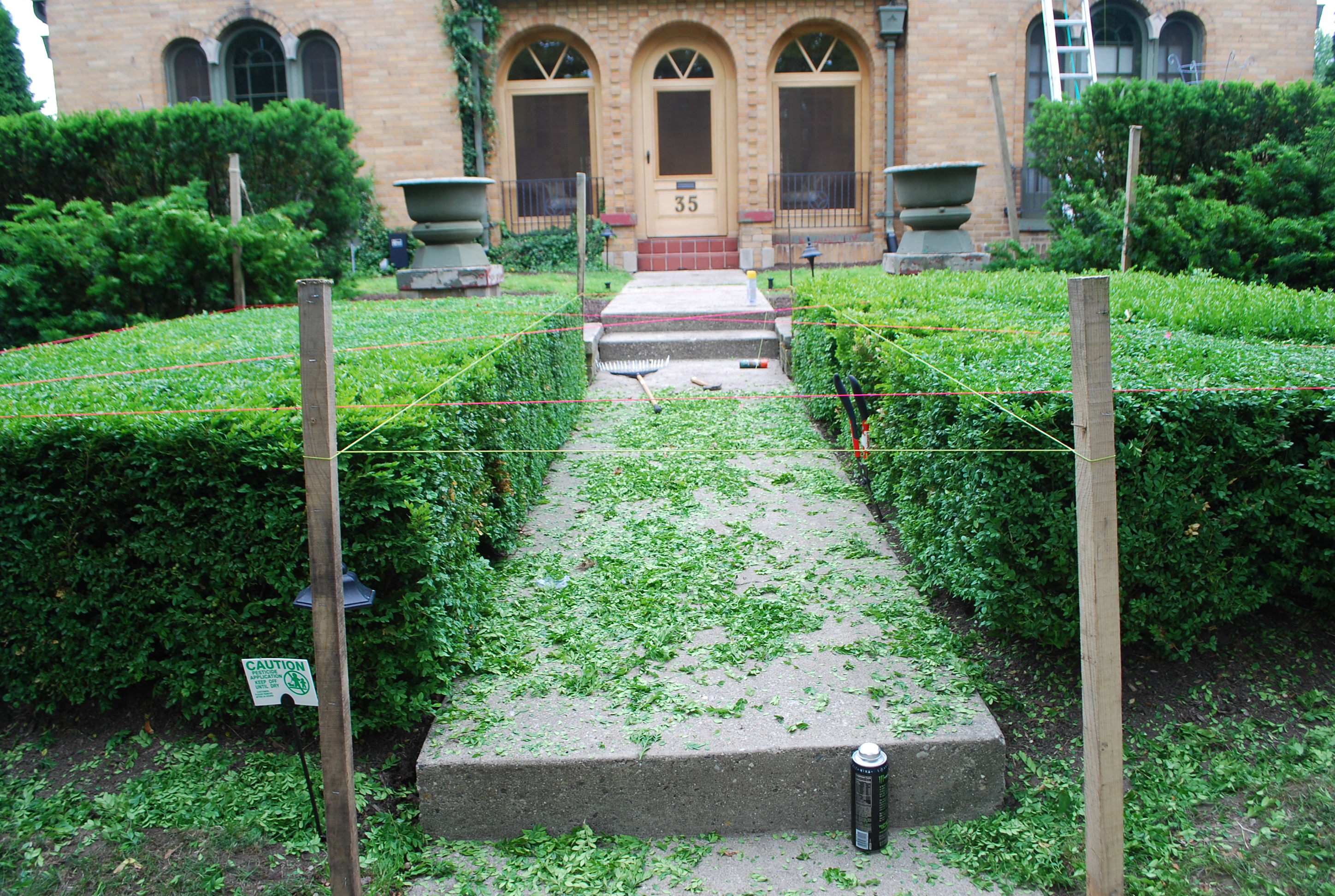
Mindy prunes with a forest of stout stakes, and a network of level lines.  Her group clips with hand shears.  I cannot imagine how many times in the course of a day those shears open and close.  The sound of that work-I cannot describe in words how beautiful this is.  They take the time it takes to do the work properly.    

pruning boxwood

To the last, her crew is entirely modest about their skills.  They focus on the plants.  Any gardener could make it their business to learn how to do this.  Though in my heart I believe she is gifted, I would try to replicate her care, if I needed to.  Great topiary plants are about the relationship between the stalwart start of a plant, and a gardener.  Buy a plant.  Resolve to train it-just how you envision it.       

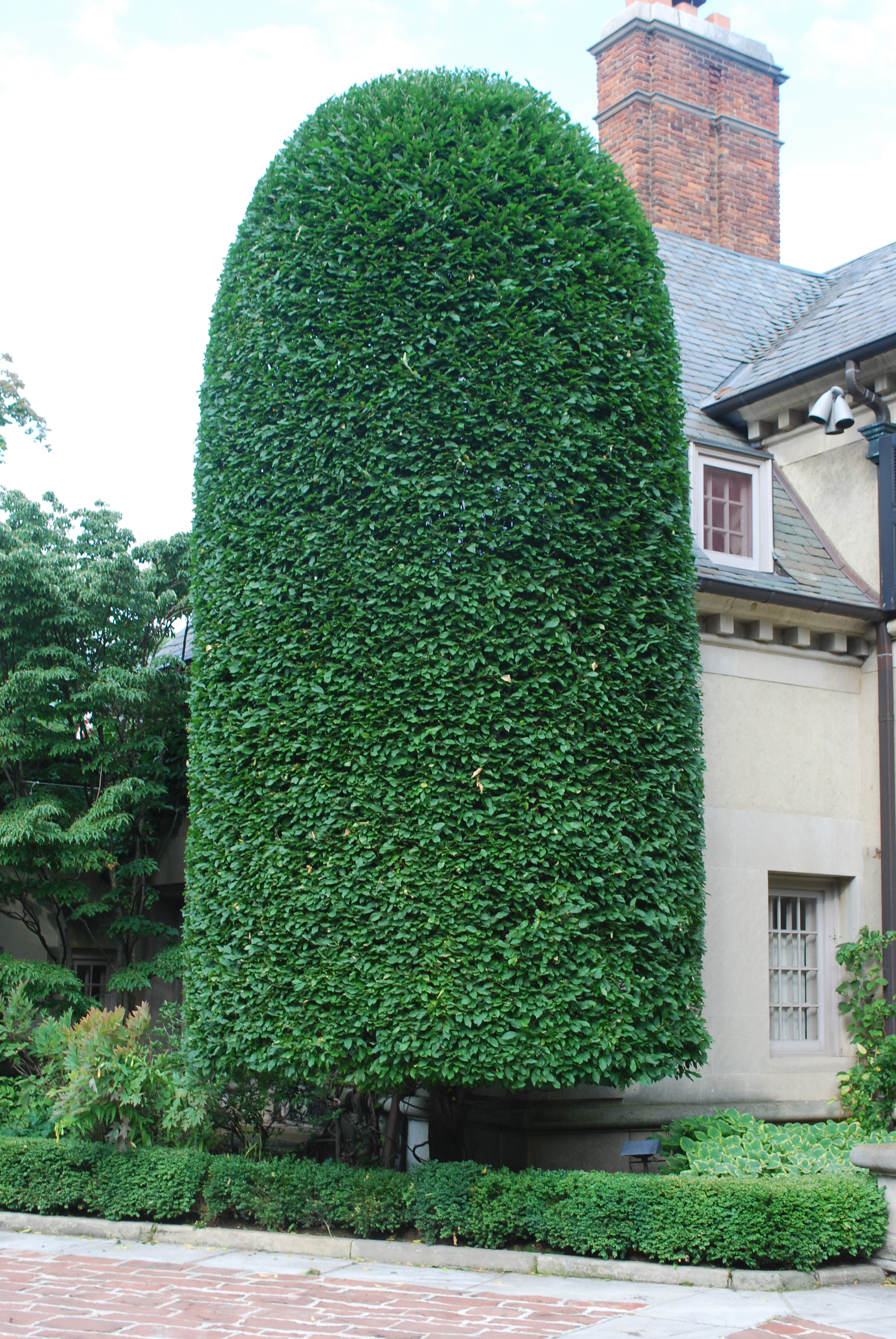
pruning carpinus

I was young, when I planted this tree.  It bore no resemblance to this, the day it went in the ground.  It is as grand and gorgeous a topiary carpinus that has ever been my pleasure to see. It is as beautiful as any topiary tree anyone might see anywhere.  The form of this tree was many years in the making.  The pruning is amazingly precise.  The company who prunes this not only has skilled people, it has big equipment.  What an extraordinary job they do of the pruning.

Mindy looks after this property.  Every hedge is perfectly pruned.  The topiary evergreens not shown in this pictuire are in excess of 20 feet tall.  Did we move plants in to this landscape, full grown?  No.  Beautifully grown, hefty specimens got planted.  Every year she works on establishing the forms.  Every year, they are bigger, and better.

My yew topiaries in these pots are but 3 years old.  The boxwood surround is but 3 years old.  Given another 10 years, we will have something to talk about.  In the meantime, I see to the day to day. I can safely say that the process of growing enriches my gardening life.  I like the dailies perhaps more than the finish.  

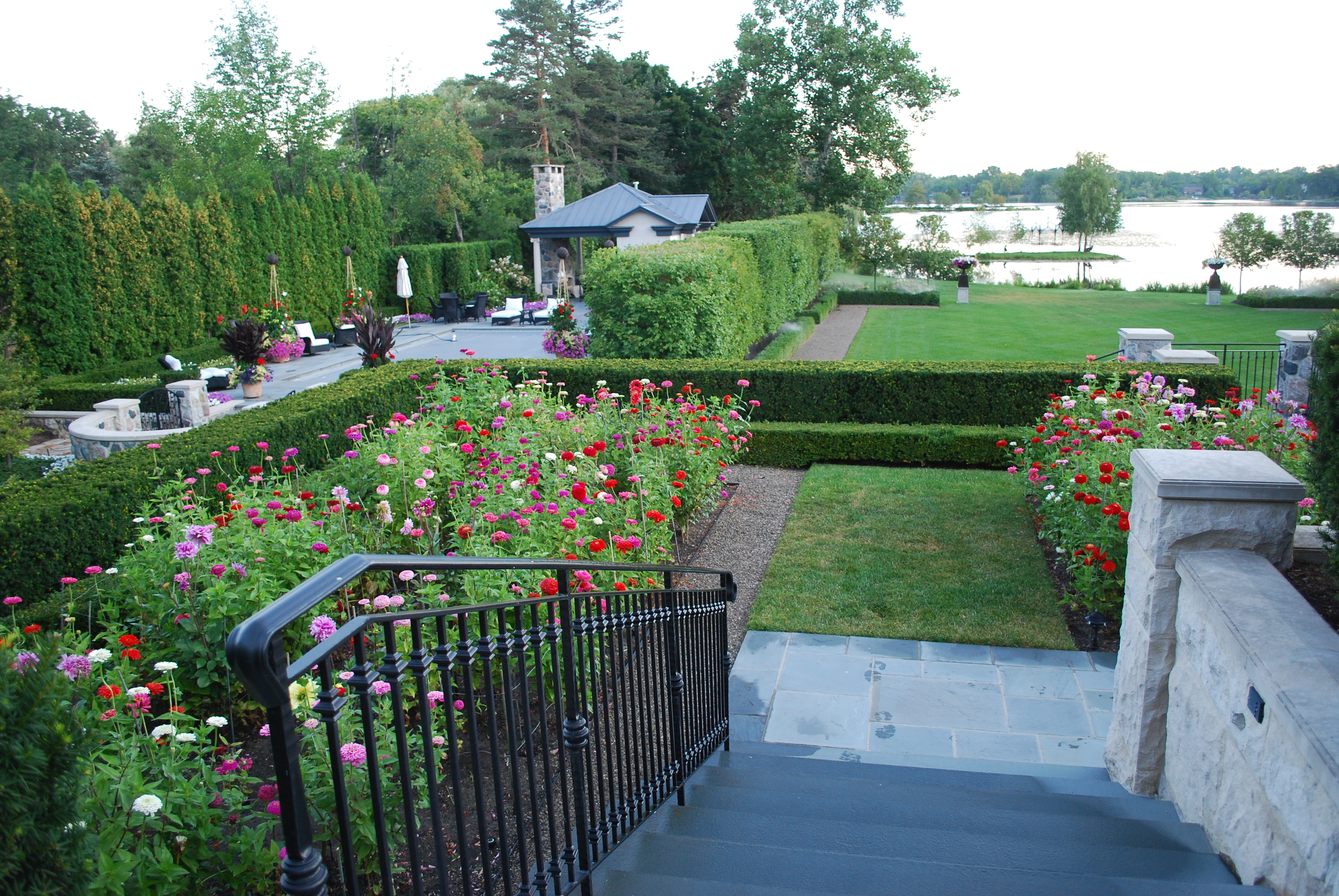
The hedge maples on standard in the back right cewnter side of this landscape-they have been growing on for years.  Every year, that pleached hedge of trees looks better.  One day they will fill in completely from side to side, and front to back.   The land drops from the house to the lake.  The trees nearest the water are much taller than the trees on the near side.  A lvel pleached hedge on sloping ground-years in the making.  The day they fully pass muster-a day to celebrate.  Great gestures in the landscape take time.

This beech arbor is but a few years along.  It will take another 5 years for it to fill out.  My advice to you?  Buy two small beech.  Plant them opposite each other, far enough apart,  where they will be perfect, 15 years from now.  Today is the best day to start to grow a topiary.  Planting small plants does not mean your vision is small.  Planting small plants with an eye to the future-a big vision.

Level with the horizon-is this not beautiful?  It took more than a few years to get here.  I can attest to that, as this is my yard.  Visit your local nursery.  Scrutinize what trees and shrubs might grow into something extraordinary, given your care and some time.  Take the time to source a great pruning company-or make it your business to learn how to prune.  For my clients-I source the best plant material that I can find.  I have no trouble placing those extraordinary plants.  At the same time, I buy those smaller plants that I imagine, given a few years and a lot of care, will prove to be garden makers.  I hold and grow those small plants-waiting for the right and so sparkly client to come along.  Those extraordinary large and full grown plants moved to a new home, I love this process.  Placing those smaller plants- with such a great future ahead of them-even better.

Bold And Beautiful


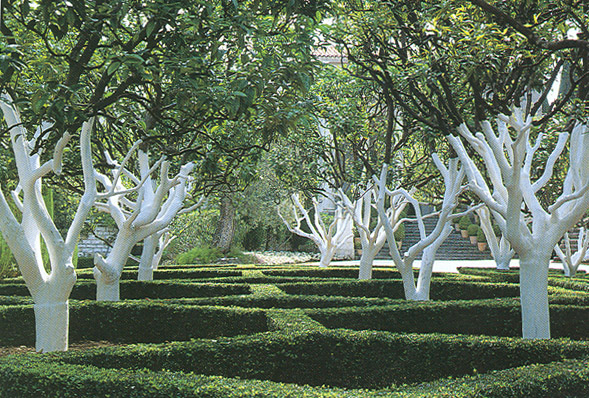
I cut this picture out of a magazine years ago-would that I could say I had designed this.  White washing tree trunks has its roots in agriculture.  Lime wash was used to prevent sunscald on ornamental and fruit trees.  Grape vines were frequently lime washed to discourage fungal problems and pests.  Kaolin, a type of clay used as a base for face powder, would be sprayed on the trunks and undersides of the leaves of fruit trees, though this has proved largely ineffective against insects and disease.  Agriculture aside, the painting of these tree trunks set in a pattern of boxwood is visually arresting-bold.      

I workede for a landscape designer in the 1980’s-Al Goldner.  He once told told me his one regret regarding his career was that he had not been bold enough. As in bold design.  Bold textures.  Bold color.  Bold curves.  Confident moves.  Bold thinking.  I remember this about him more than anything else-his committment to visually striking design. 

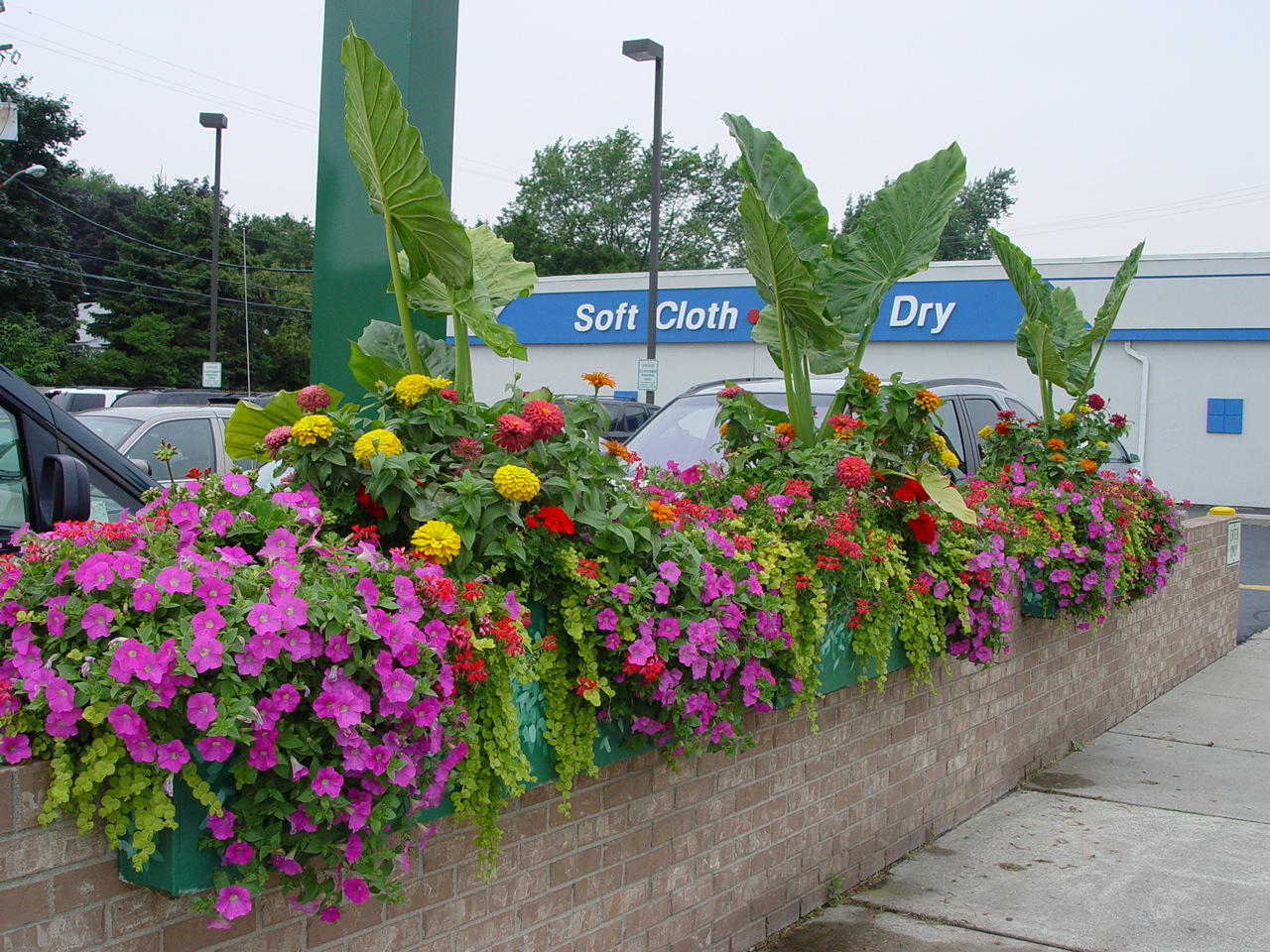
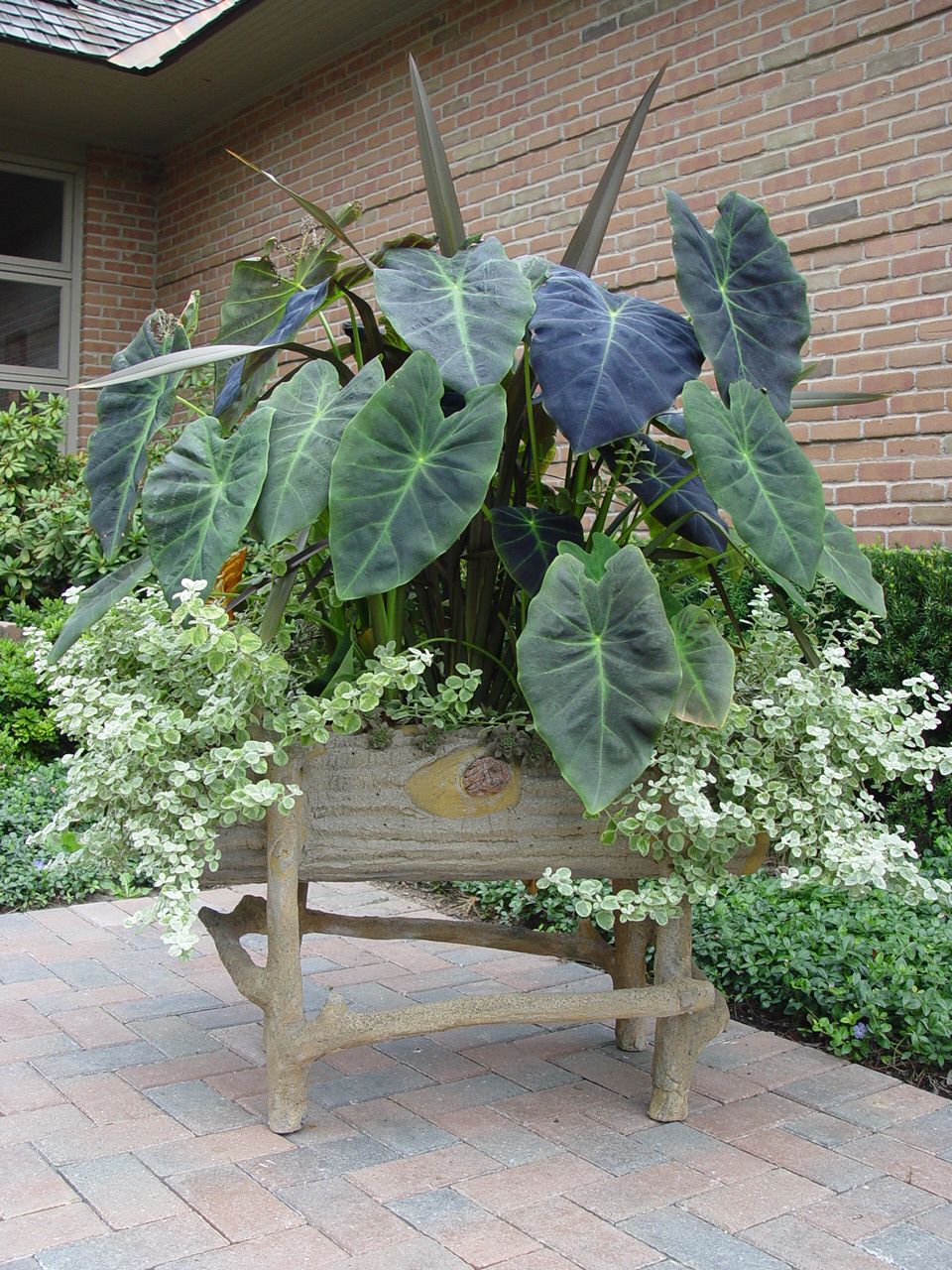
Boldly textured leaves make an emphatic statement.  The calocasia leaves holding forth over the skinny legs of this antique faux bois planter-the invention of my client.  She has an instinct for boldly textured and dramatic containers.  Black calocasia and phormium are plants perfectly capable of a bold visual delivery.  There is nothing subtle about them but for the color. This planting is about bold forms and relationships. 

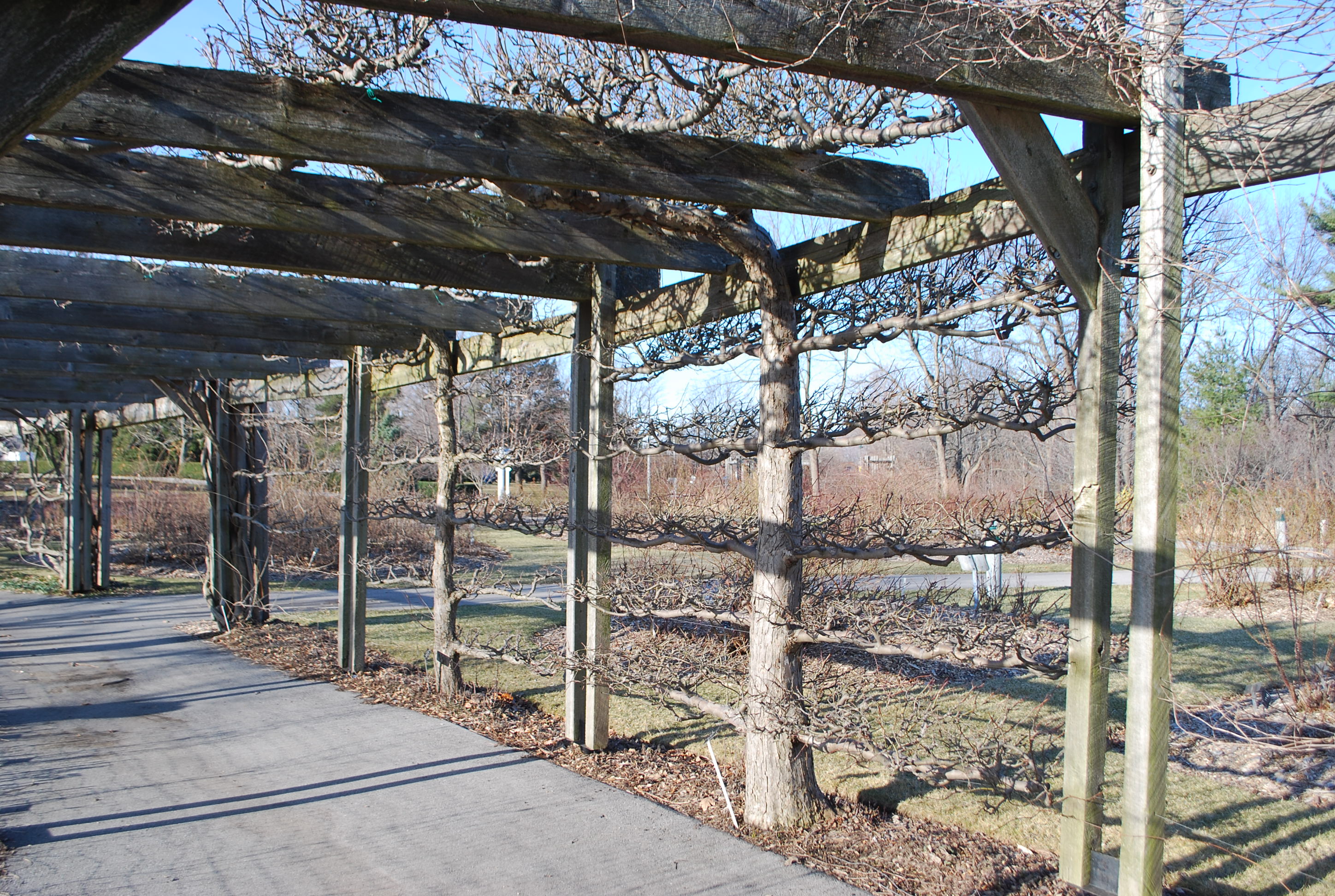
Espaliered trees are a form of growing and pruning that I greatly admire.  What is so bold about these American hornbeams was the idea to bend the leader over at the pergola roof line.  I am sure this shape was established at a very early stage in the lives of these trees.  A bold vision of what would be many years later drove this planting.  By this time the trees probably have no need of the pergola for support and guidance.  One could imagine that the pergola could be removed, and the shape represented entirely by the trees. 

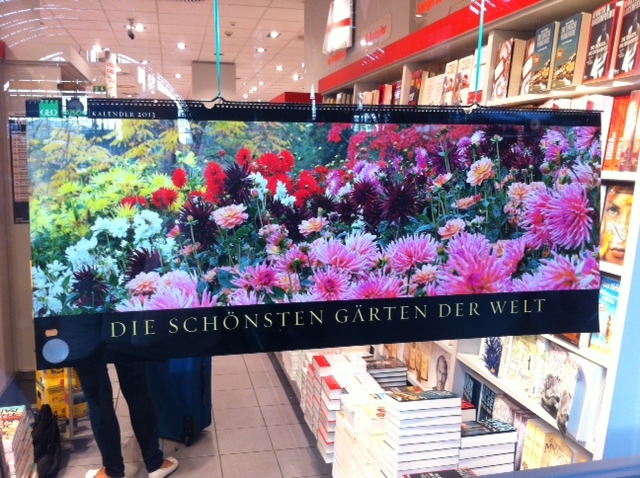
This garden calendar is bold all right.  The size is competely unexpected.  Ordinary plants in unexpectedly small or large sizes attract interest.  An overscaled element in a garden properly done can be a bold gesture. A single big idea makes a bigger impact than many little ideas clamouring for attention.        

 Amaranthus is bold in both form and color.  Small intimate spaces can suddenly acquire a romantic atmosphere with one rose in a small vase.  Big spaces may need bold gestures to create an atmosphere.  A single rose in a large room with many people will seem lukewarm and lackluster. A big part of making a bold statement in a landscape is getting the scale right.        


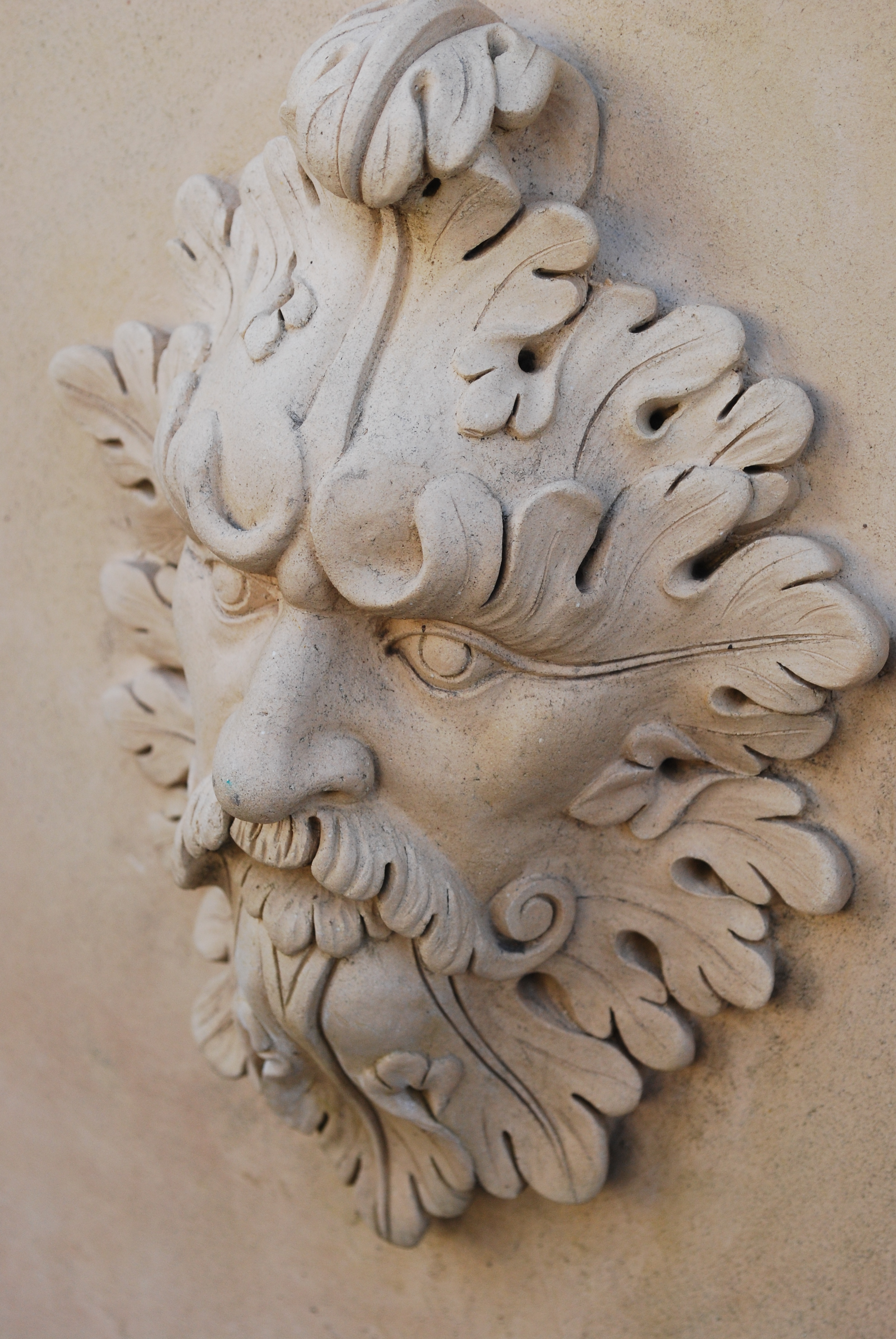
This green man medallion hand cast by Phillip Thomason on one of his modern coadestone boxes is a sculptural marvel.  Phillip Thomason may be is premier pot maker of the 21st century.  His works rarely come to market.  His commissions are many-get in the queue.  This hand made box could easily organize an entire landscape.  The face is boldly modelled; the features are distinct, even from a distance.   

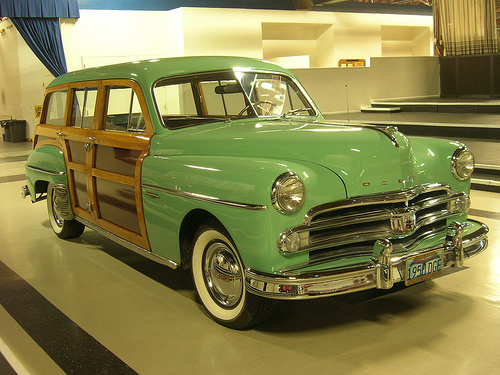
This 1950 Dodge Coronet woodie is as bold as can be.  The shape, the abundance of chrome, the color,  size and the styling-all bold.  It looks big enough to hold enough to hold a decent sized event. Heavy and strong enough to protect its occupants. Automotive designers are not just concerned with safety and efficiency, but great style.  This vintage station wagon-a sculpture on wheels.   

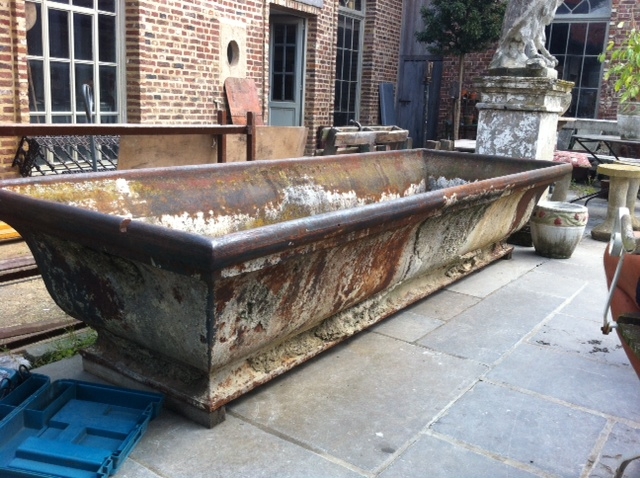
This rare and massive cast iron tank would be a bold addition to a landscape.  It has battleship like proportions, but very graceful lines.  It would come with a very bold price-much more than the original price of the Dodge Coronet pictured above.  Luckily bold design has almost nothing to do with price.  Everyone has seen landscapes that look like they cost a lot of money and have little to show for it.  Will I buy the iron tank?  I am thinking about. 


It was a bold urban planner who made the decision to line this street not far from me with London planes.  What a welcome relief they are from the standard Norway or silver maples. They seem incredibly healthy, given that these giant trees  are constrained on both sides by cement.  The maples in my neighborhood all show signs of stress from girdling roots, not to mention the sidewalk sections that are lifted off grade by their roots.  I would not have thought London planes would make great street trees, but this bold move seems to be working. 


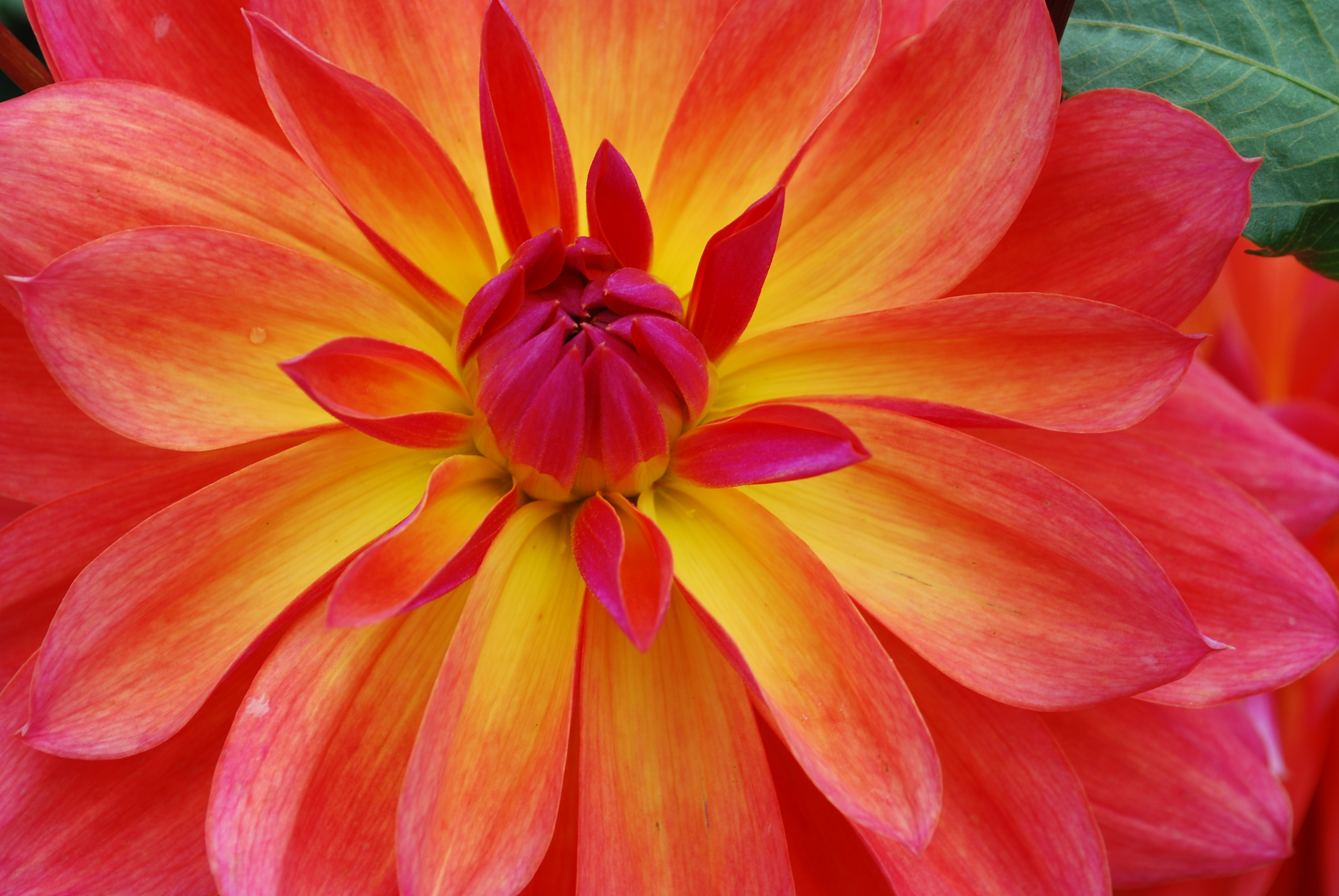
There are plenty of choices, should bold flowers appeal to you.  Dahlias-the showgirls of the flower world.  In that same vein, add in hardy hibiscus, delphiniums, bearded iris, giant alliums and oriental lilies. Bold flowers planted as hedges-very bold.  Someday I will have an opportunity to plant a long thick hedge of hardy hibiscus.      


Topiary evergreens have bold shapes. This simple planting in a lead box, set in a paving arrangement scaled to celebrate that box may not be moving or romantic, but it certainly is handsome.


This pair of white glazed French pots make a spectacularly bold and elegantly formal statement. All of those cut delphiniums in one place took my breath away.  There was no need for any other flowers. 

 dolly tubs

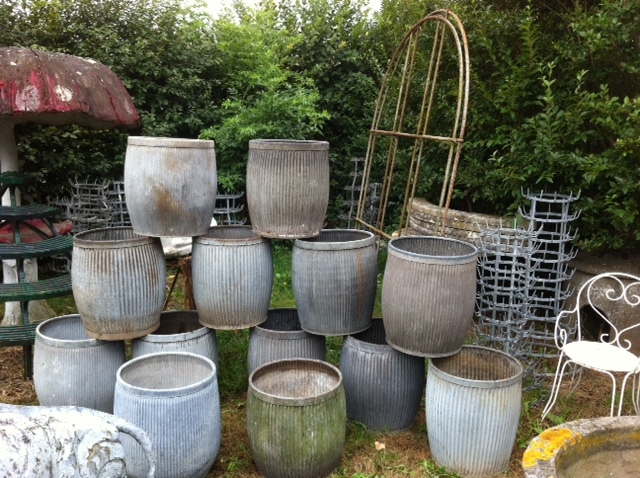
All of these vintage dolly tubs lined up on a terrace with i gallon size chartreuse dawn redwoods, or tomatoes, or dwarf horsetails  in them-every bit as bold as as that embarassment of riches in delphinium.  Bold is as bold does.

One Man’s Garden

galvanized wire bracket

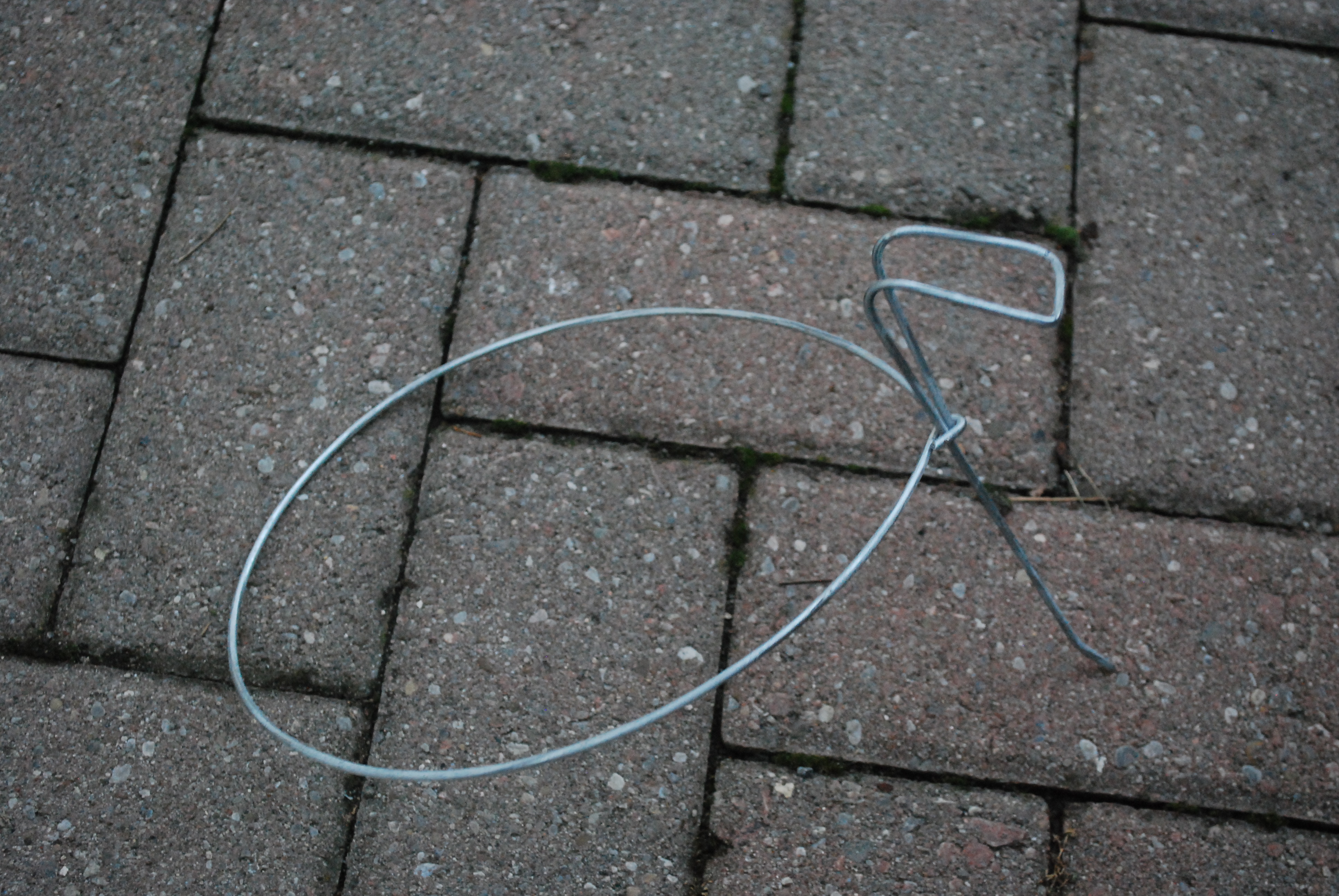
We had dinner over the weekend a the home of a good friend.  Barry Harrison is a design principal with Art-Harrison, a interior design studio well known in my area.  In addition to their interior design practice, they manufacture a line of fine furniture.  Each piece is meticulously hand crafted and carved from fine hardwoods.  Interested to read more?  www.artharrison.net.    Barry is a highly skilled designer, cabinetmaker and wood carver, as evidenced in his own garden.  Years ago Barry spent some time at Ford Motor Company-he could draw an entire headlight assembly for a owner’s manual-free hand.  Think this part through-a freehand drawing of a headlight assembly?  His talents are extraordinary.  As much a designer as he is an artist, one part of Barry’s garden began with this simple part-a galvanized steel hook that would hold clay pots.

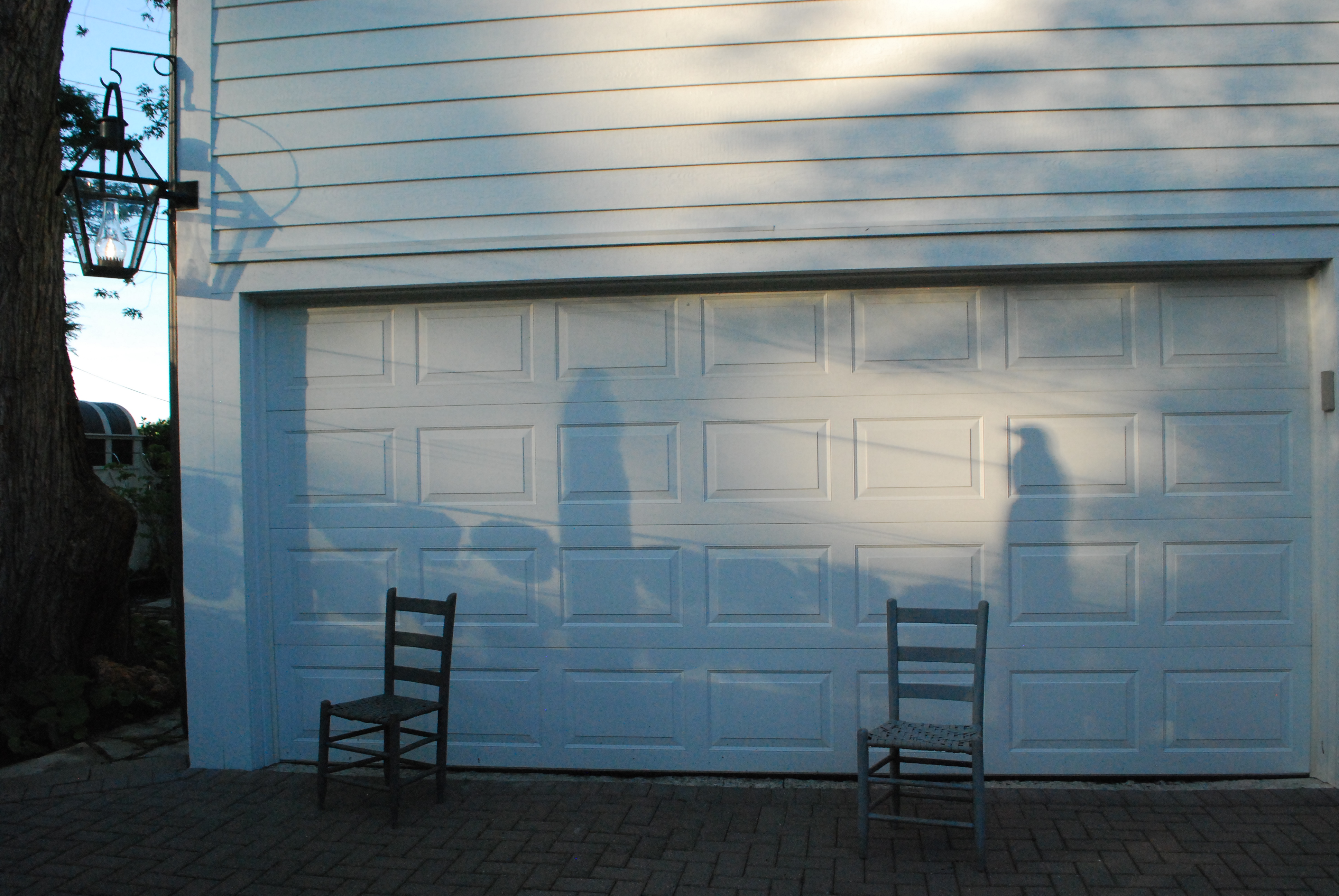
Barry lives in an urban neighborhood on a very small piece of property.  Every gesture he makes has to work-there is no room really for unresolved design.  This corner of his driveway is just a few feet from the garage doors, meaning he visits this spot every day, both going and coming.  The distance from the edge of his drive to the lot line at this back corner is 12 inches at best.  There was no option for screening plants in such a small space, but there was an option for a screen. 

cedar fence posts

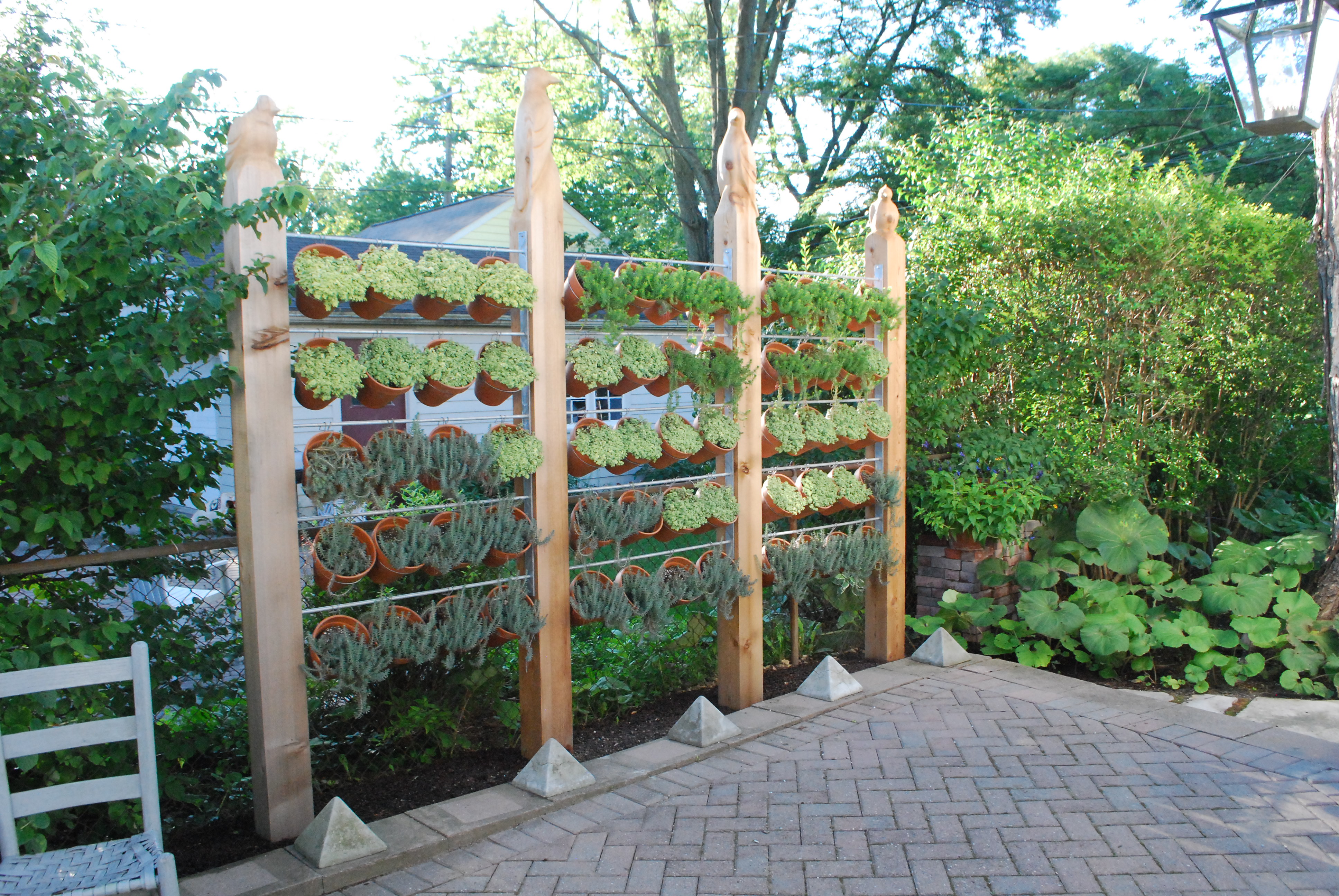
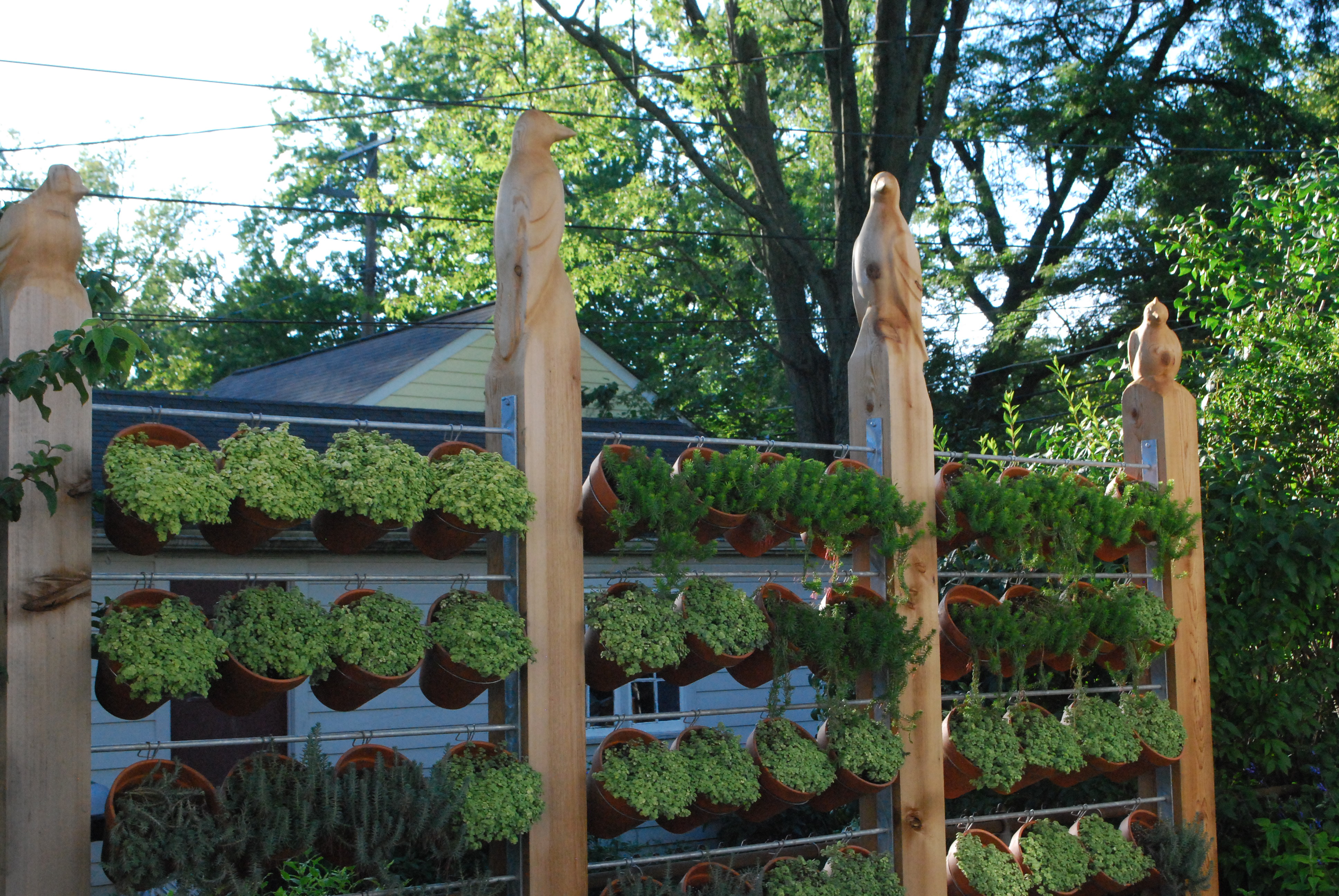
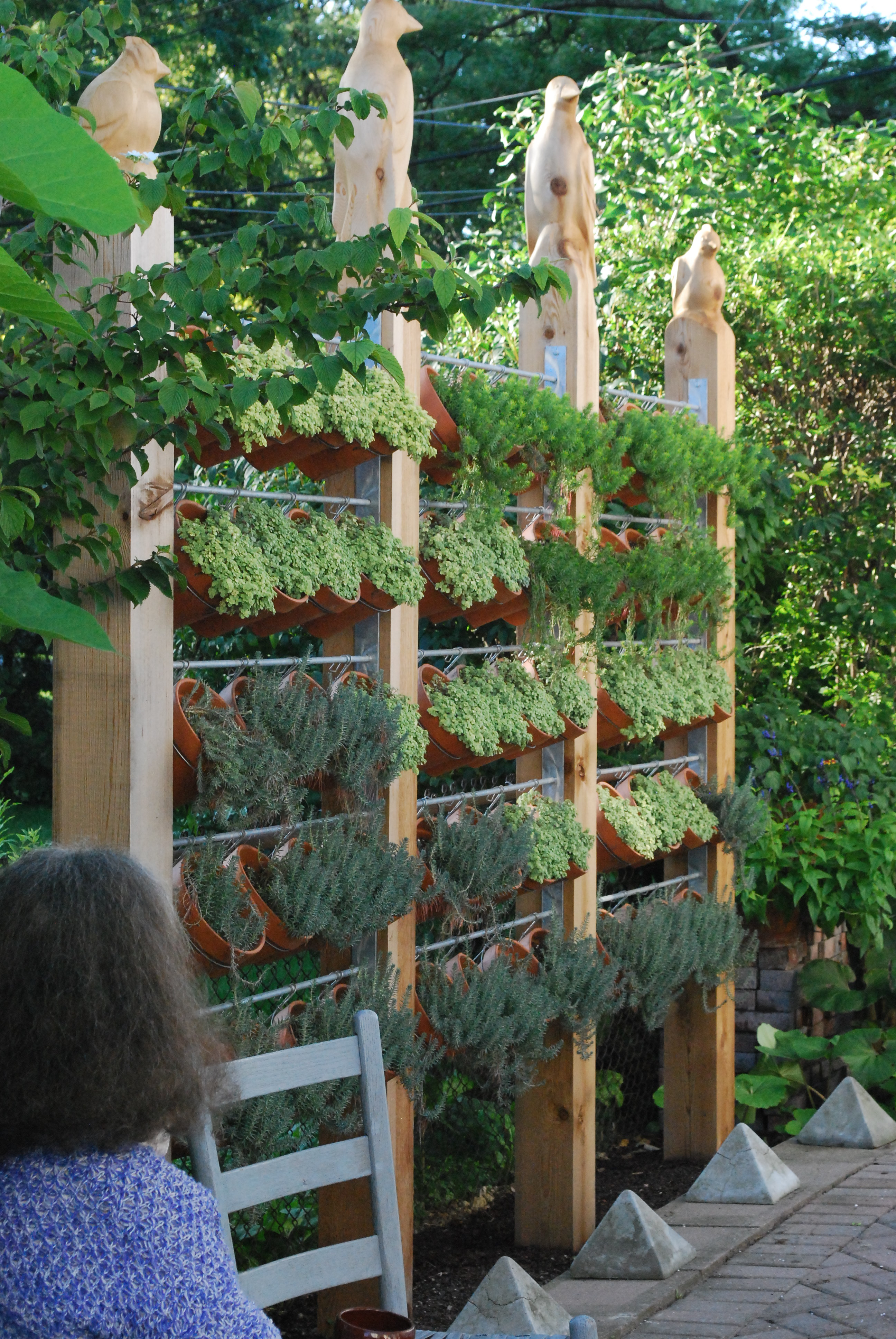
This ingenious green screen began with four cedar posts, the tops of which he carved into a pair of guinea hens, and a pair of ravens.  There was enough space to sink the posts deep into the ground.  He engineered a series of galvanized metal plates and rods, which would hold the galvanized hooks shown the the previous picture.  
The terra cotta pots were planted with succulents, and hung on the galvanized steel rods.  The watering takes some time and attention, but the plants seem to be doing just fine.  He’ll store the pots in his garage, or bury them in leaves for the winter.  I admire this inventive and low tech screening that is also so great looking.  The plants seem to be perfectly happy-spilling out of the downside of each pot.   

His succulent wall is beautifully engineered-and beautiful to look at.  Once he waters the top row, the drain water serves to water the row below, and perhaps the row below that.  Given that the screen is only 6 feet tall, it can easily be handwatered.  The succulents are not asking for much.  


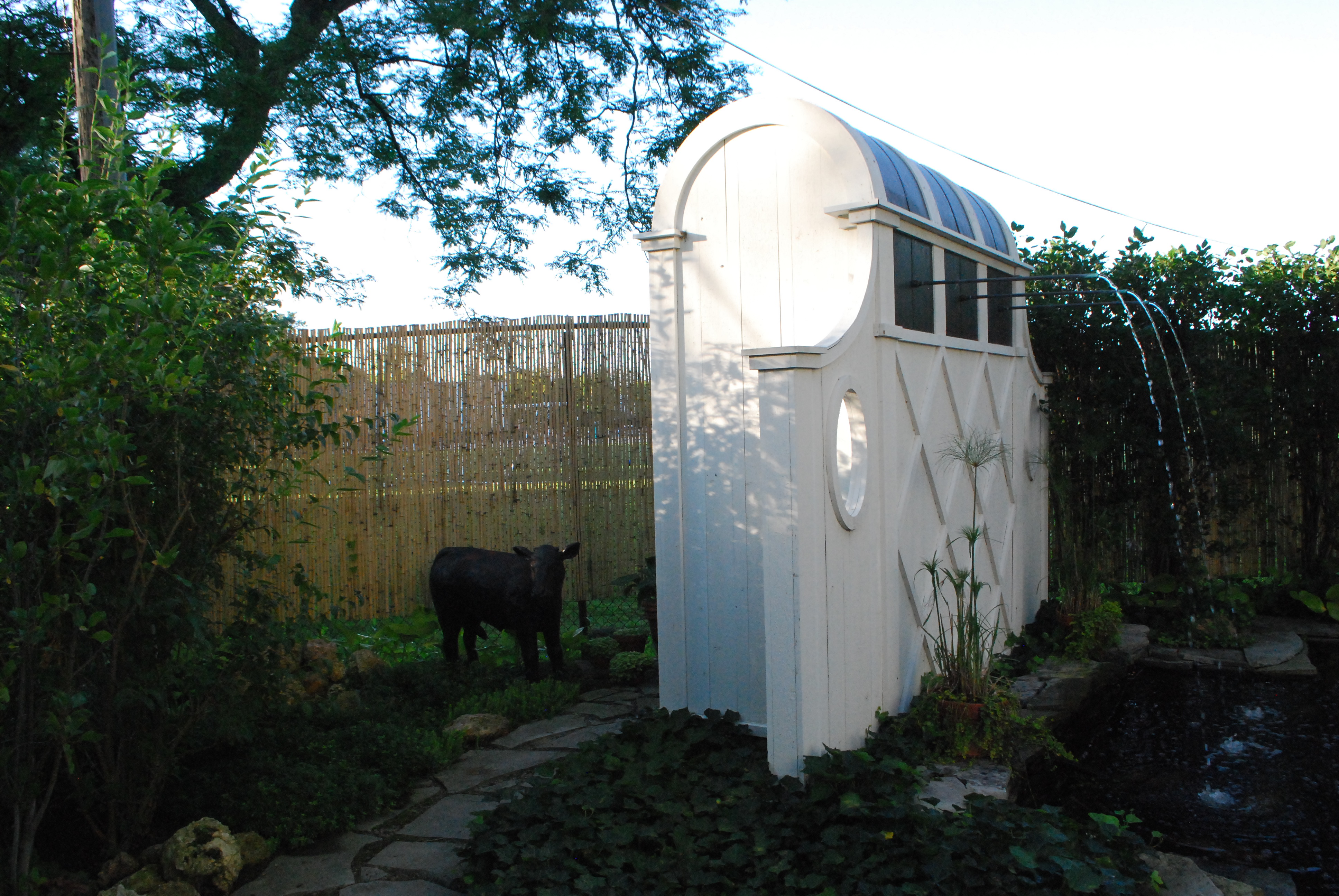
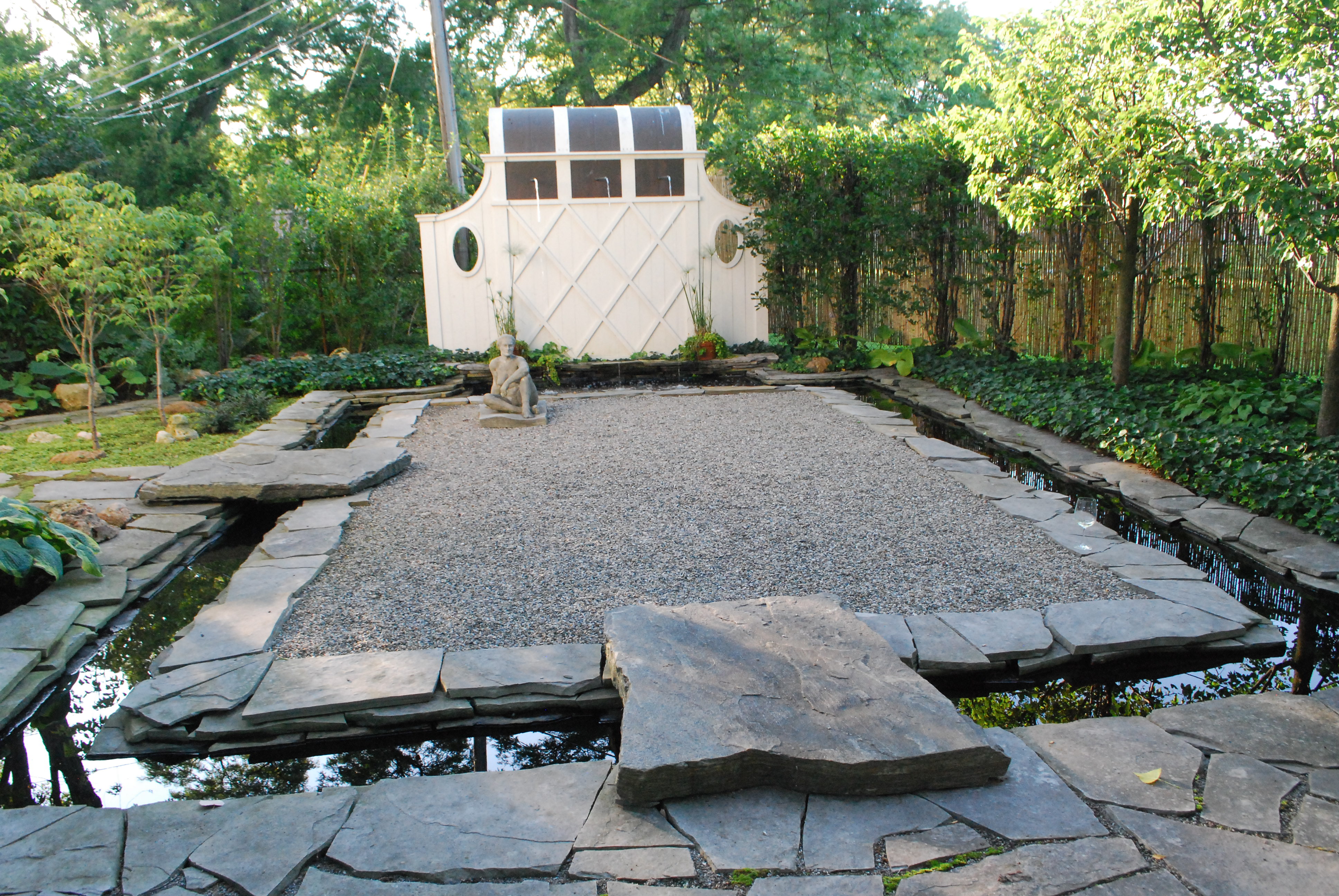
The rear yard is dominated by a gravel terrace, completely surrounded by water.  Though the width of the water is slight, the pool is 24 inches deep on 3 sides, and 36 inches deep at the far end.  This water depth, and the ability to swim in long runs, around and around, keep his koi happy.  Youy would never know that a city park was just the other side of the bamboo screening.  The structure at the far end of the pool serves a dual purpose.  From this side, the wood and copper fountain with copper jets does a great job of aerating the water for the fish.  This large, architecturally striking feature organizes every other element of the landscape.
garden sculpture

A single stone sculpture on the gravel terrace keeps a small space from looking cluttered. Easy maintenance perennials such as baltic ivy, petasites, angelina, creeping jenny and ferns makes the garden easy to look after.  The koi?  Barry has a 220 acre farm in Kentucky-the koi he raises there are cared for by his parents, and shipped to dealers and koi afficianados all over the country.
garden fountains

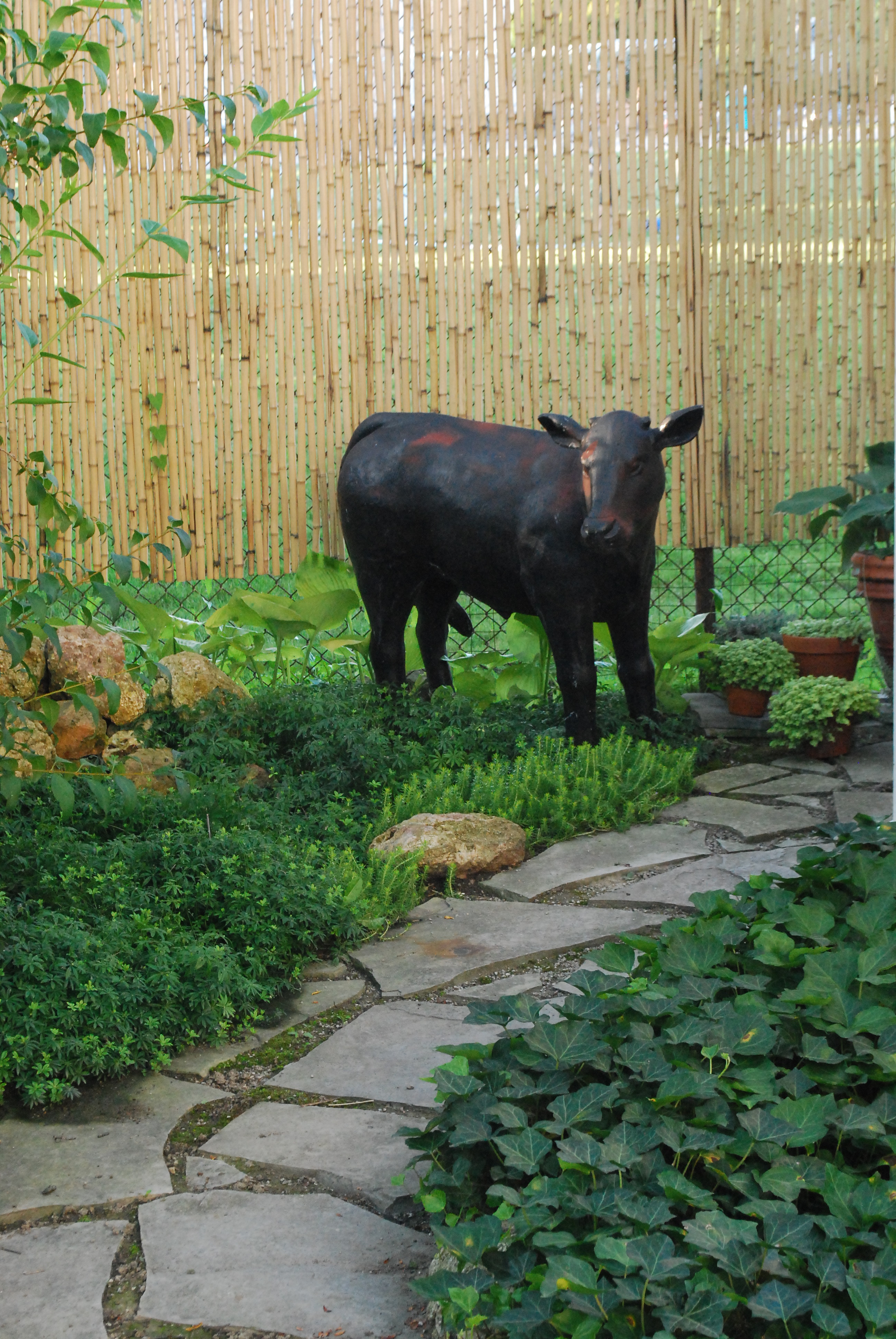
The fountain recirculates the water in the pool.  The placement of this feature on an angle to the corner of the property creates a small niche garden which features a series of pots, and some of Barry’s geode collection.  But the star of the show, at the end of a stone path-a cast iron cow. 

Even the smallest space in a garden can make a big impact.  An inveterate collector of vintage and antique objects, I am sure he spoke for this sculpture without hesitation.  This vignette is almost all of the way to another space-the garden shed.

gardenshed

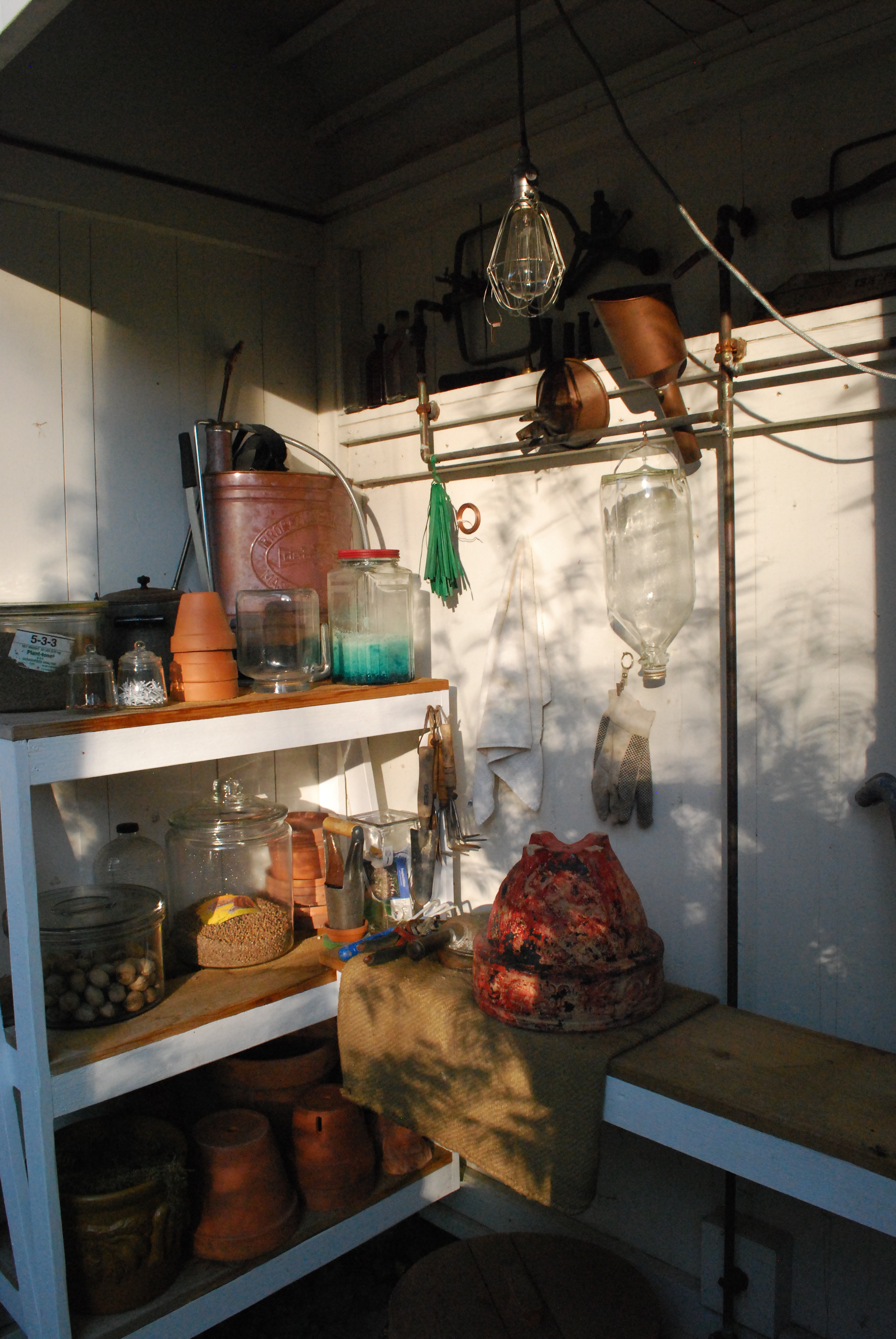
Barry’s  fountain doubles as a garden shed, which holds most of his tools, pots and soil, in addition to the filtration system and fountain assembly.  This very utilitarian space is completely hidden from every vantage point in the rear yard landscape.   

screening an air conditioner

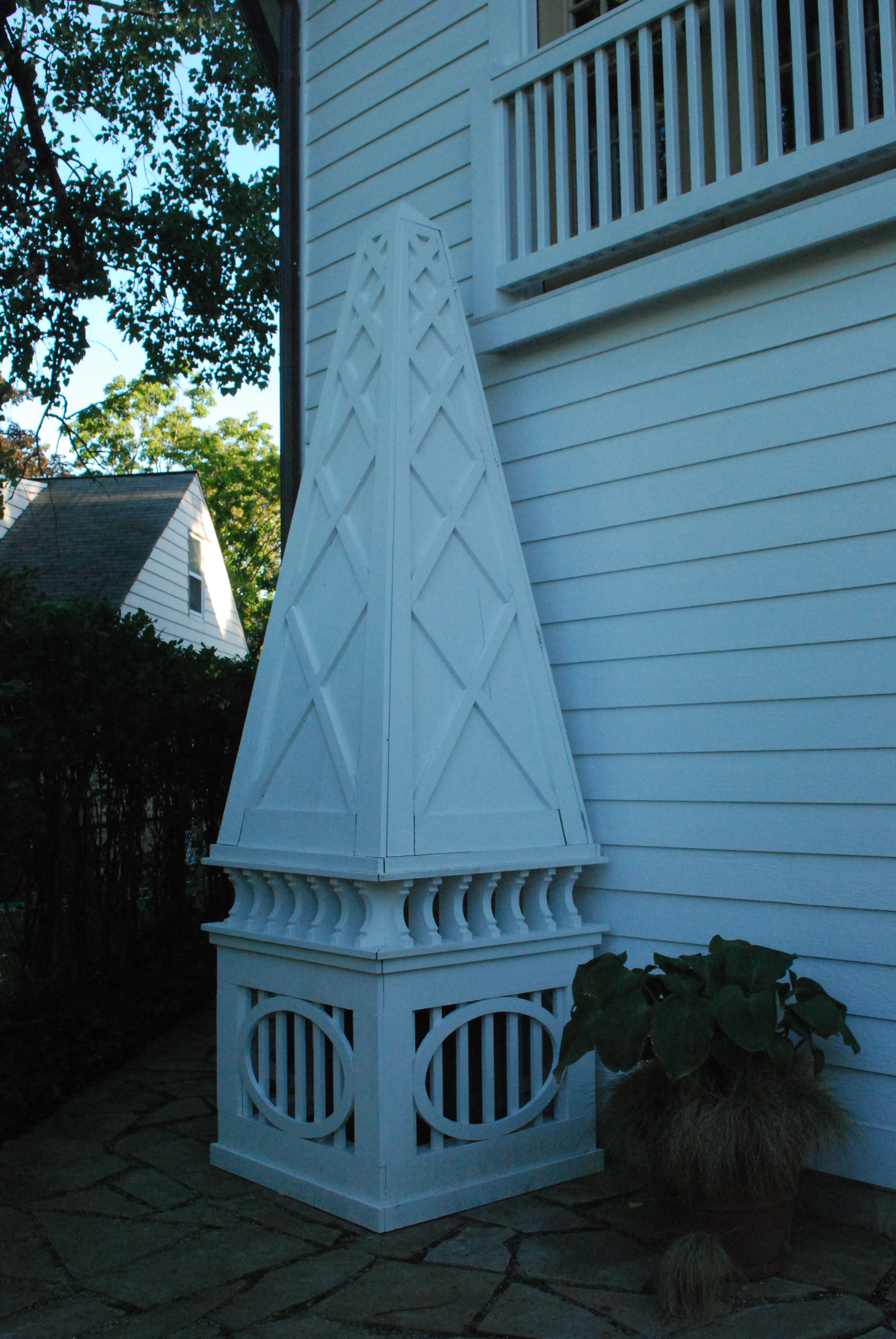
At the opposite end of the garden-the air conditioner.  The air conditioner is under this painted wood obelisk, yes.  One panel is hinged, and folds down, making service a snap. In the top of the obelisk-long handled gardening tools. 

The view out of the back yard-another view of that succulent wall.

evergreens in containers

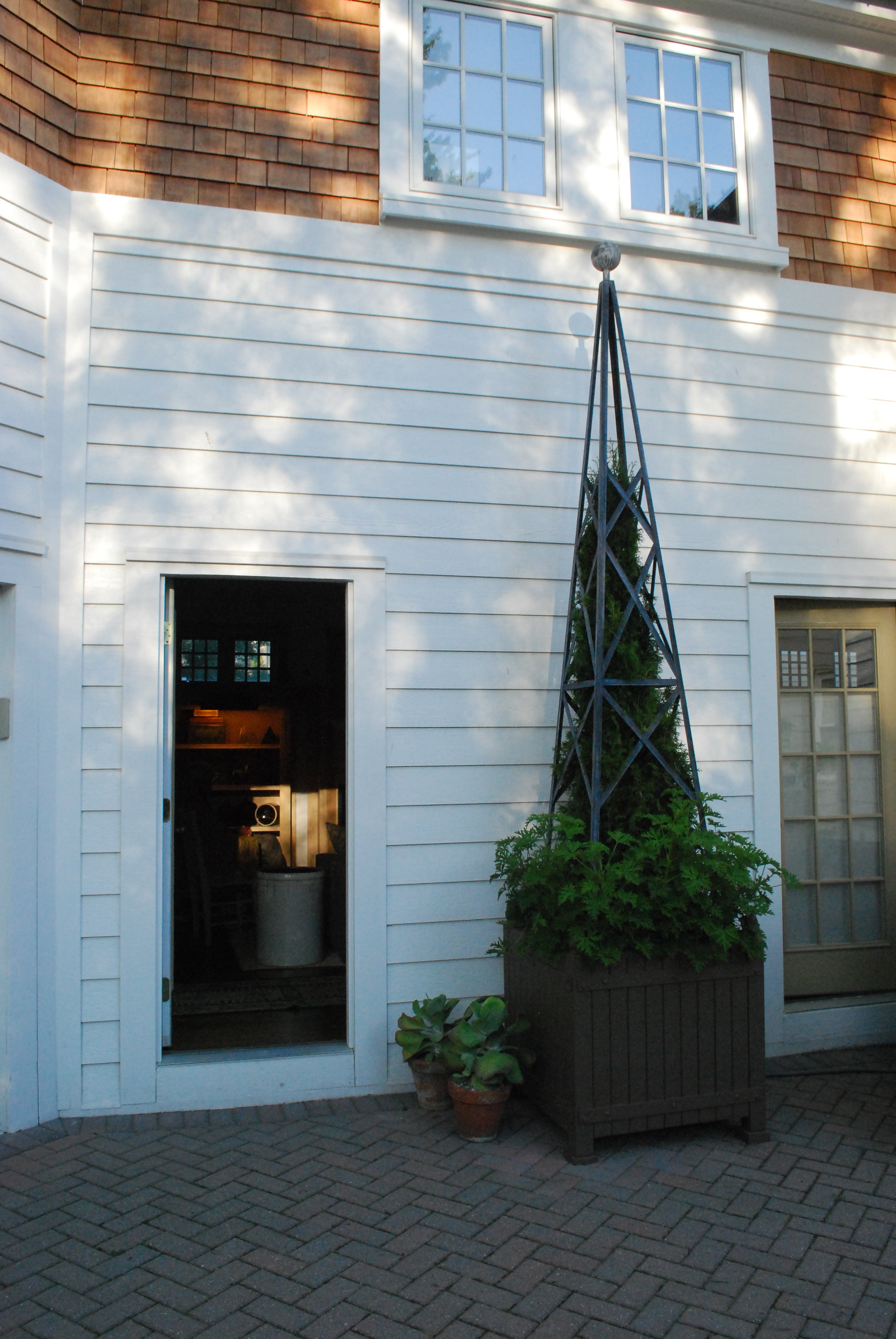
The house and garage meet at an angle in the back, near a pair of doors.  A giant painted oak box with a steel tuteur is the only nod to the garden in a fairly large paved space.  Only Barry would think to faux shrink wrap an arborvitae in plastic, and place the steel tower over it.  Not one branch got broken when the pot was planted.  At some point, the plant will grow through the steel, and be trimmed flat.  Clearly he is fond of making a few big gestures on his small property, rather than lots of little ones.   

There are as many great ideas for a beautiful garden here as I have seen on on properties many times this size.  Unlike a property which is defined by its boundaries, it’s hard to tell where unlimited creativity and imagination of this caliber might decide to go next.