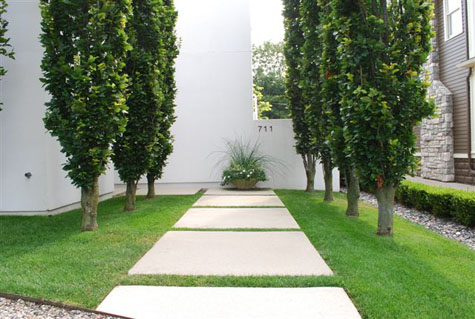
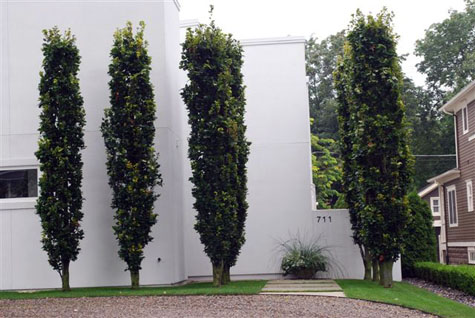
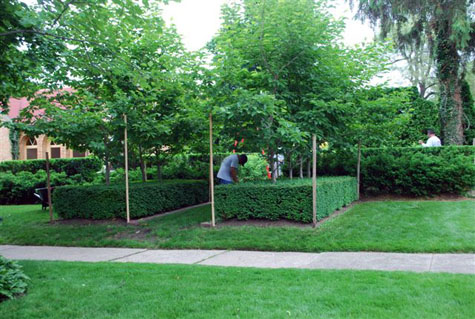
 The ability to prune with true precision is as much about a gift, as it is about the science. The big science concept has to do with being able to establish a line level with the horizon, or perfectly horizontal-and its complementary-those lines exactly perpendicular to the horizon-or vertical. Mindy’s crew sets lots of vertical markers-the stakes in this pictures. They use a level to set those stakes exactly vertical.
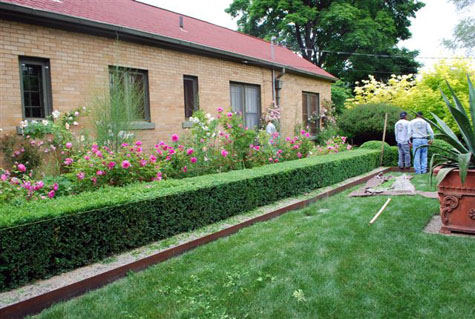 The horizontal plane is determined with a set of lines, or strings. There will be strings everywhere, side to side. But there is plenty of gift involved here too. I perfectly understand the math, but I cannot do this how they do it. Every cut is made with giant, long handled shears-by hand. The clip clip takes 7 people, an entire day; its a slow but sure process that I enjoy watching. Even the sound of the clip clip takes my blood pressure down at least 10 points.
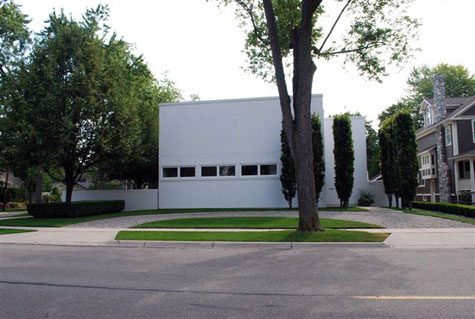
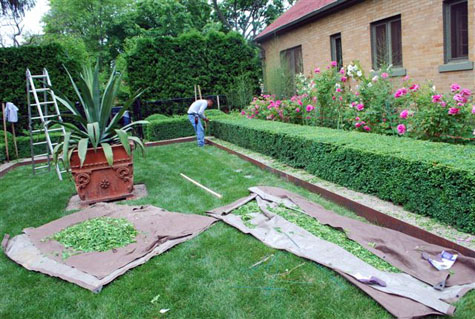 Shape, mass, and volume are very important design elements in landscape. This landscape is entirely geared to the shape, and level of the lawn plane. Every other element has been established, based on that plane. The importance of the lawn plane is accentuated by the wide, overscaled steel edger strip. Where beds and lawn are on the same plane, the edger is invisible; its function is to keep grass out of the planting beds. In this case, the edging is a design element, clearly indicating a change of level. This very geometric change of level provides lots of interest in a very small space. The boxwood pruned into long precise rectangles is a great foil to the sprawling shapes of the roses and perennials.
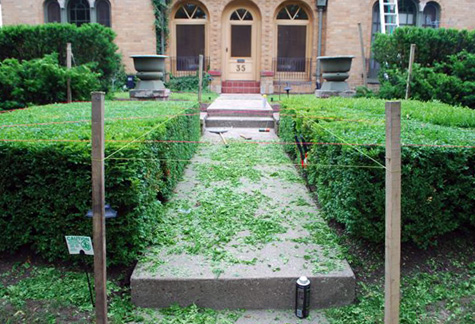 Pruning level with the horizon requires attention to a form that may not exist in the space. The land into which this landscape is planted falls from north to south, and it falls from east to west. To give you an idea of how much drop there is from the south to the north, I measured the height of my Hicks yews. On the southern most end, they are four feet tall, give or take. At the east end of the north side, they are nine feet tall; this is a lot of drop. It was many years, growing those north end yews tall enough to prune. This boxwood is pruned level with the horizon. Pruning with the lay of the land produces an entirely different effect. Level with the horizon gives a landscape a formal and serene aura. As in, on even keel, or level-headed. As my work life is as I have described a big fluid situation, I like the even keel feeling when I am in my garden. This is a choice any gardener makes when designing. What do you want from your space?
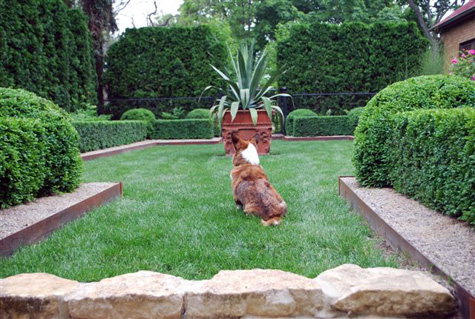 This is my idea of a good place to be.