The Natural Order Of Things


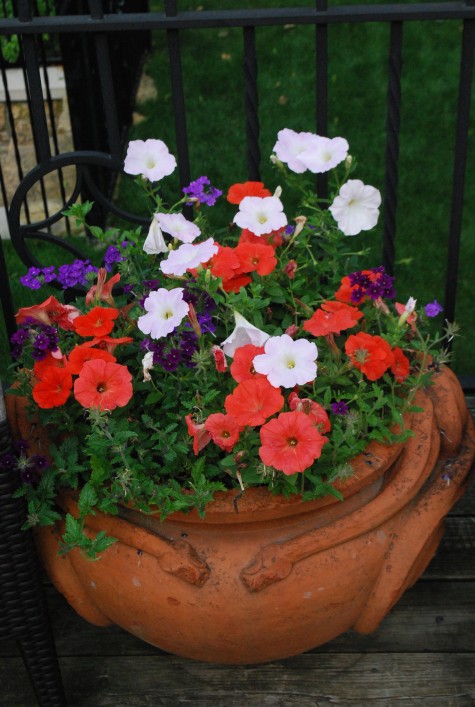
I had a client in the store a few days ago, needing some help with planting a pair of containers.  She told me she needed a thriller, some fillers, and some spillers for her pots.  ???  I was at sea.   This sounded like some popular container composition slang; I asked for an explanation.  The explanation was as follows.   A tall center of interest plant, with some slightly shorter supporting cast plants, and trailing plants to spill over the edges of the pots.  Voila-a perfectly designed and beautiful pot.  Formulas-I instinctively have an aversion to them.  The pot pictured above looks like a mess with no discernible design, but give it a few weeks.  The “spiller” plants are planted in the center.  The “filler” plants are planted on on the edge.  I abide by the natural order of things when I need to.  The seasons change-I get behind that.  The west sun is merciless, unlike the life giving east sun.  The natural order of things apply to natural phenomena.  All else-whatever idea you have, try it out.  Be confident enough to try things out of order.    
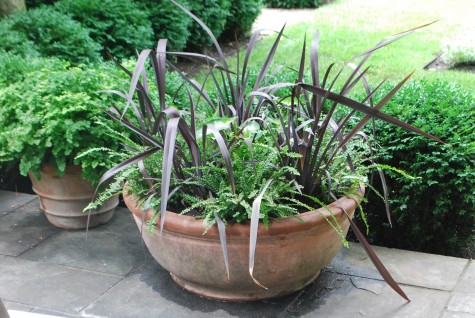
This may be my most favorite container planting of this season. A purple spike may bring the thriller status to mind-I had another idea.  What happens when I plant the thriller plant, in multiples,  in the spiller slot?  We’ll see how this planting matures-but I like the idea that I have dwarf and luminous white and green caladiums in the thriller spot.  The button ferns-they defy categorization.  They do not spill-they are drapy. I promise to take another picture in 6 weeks or so.    
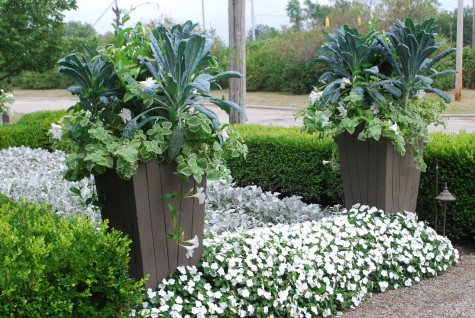
Last year I planted white mandevillea vines in the front of the shop.  No stakes, no trellis.   I let them grow as they would-my thriller became a spiller.   They were beautiful. How they looked encouraged me to be free of an outline about the natural order of things.  Gardens that I see that are free-free from popular sentiment, free from formulas, free from preconcieved notions-are they not so beautiful?  I pin my climbing roses to the wall, and I stake my mandevillea.  I give my clematis a trellis on which to climb.   I follow the rules-mostly.  But there are those times when a preconceived order of things may not be the most interesting solution.
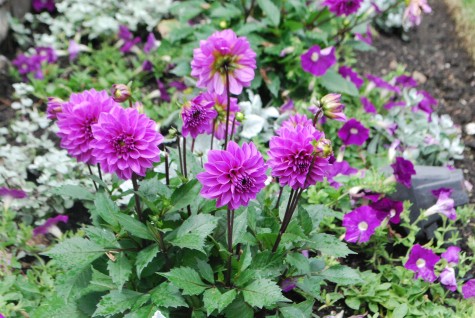
Dahlia Hypnotica Lavender

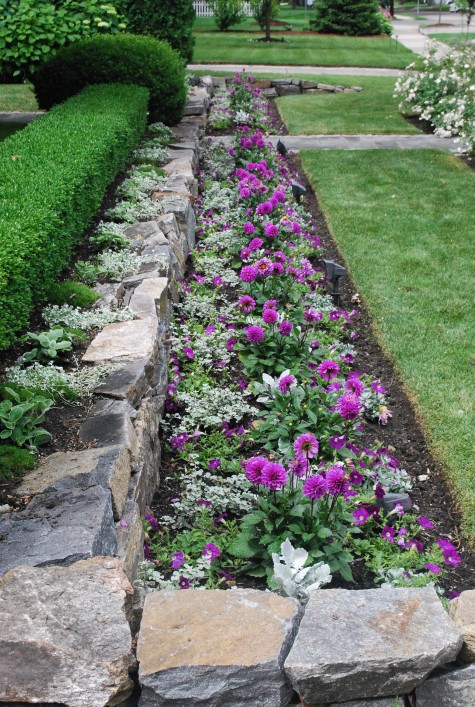
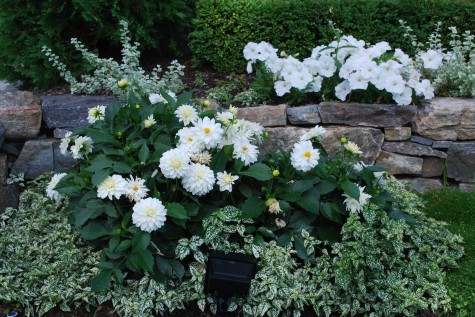
Plenty of fine garden plants have Dutch breeding in their history; the hypnotica series of dahlias is no exception.  I happen to be a fan of dahlias.  I haven’t the patience for the giant varieties, even though their flowers are breathtaking.  The big dahlias-the subject of another essay.    I like the smaller growing dahlia plants that bloom profusely.  I have made a point this annual planting season to try the University series.  Serrated dark foliage is topped with lots of purple or pink cactus form blooms some 4″ across.  They are blooming profusely right now-a month ahead of the big and tall girl dahlias.  When I saw a bench of hypnotica lavender dahlias-so short, and so profusely blooming, I could not take my eyes off that color.  How would you describe it?  Light red/violet?  Another new introduction, whispers petunia, has that same riveting and unforgettable color.  The hypnotica dahilas have become a part of my plant vocabulary. I had a project in need of an inspiration of some sort. The color of this dahlia looked so great, paired with whisper petunias. 

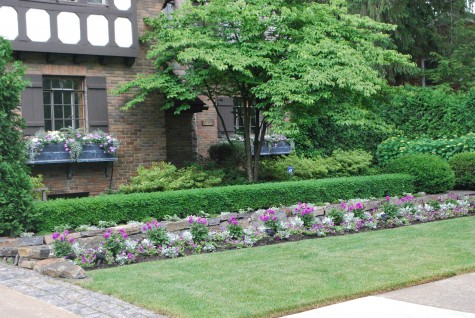
 A client for whom I usually plant a green and white summer garden shifted gears this year.  He was interested in some color; that color, my choice.  His exact words?  Color this year, please.  Riotous, or subtle-your choice.  The moment I got that email, I was wringing my hands.  What would I do? This went on for weeks-that uncertainty. The hypnotica lavender dahlias (my client is a fan and skilled grower of exhibition dahlias) rescued me.  The moment I laid eyes on them, I was off and running.  

These Dutch bred dahlias growing to 18-22 inches tall would organize an entire planting.  I paired that color with grey-do not ask me where that idea came from.  It just seemed like a good idea for a client who usually requests green and white.  Grey and pale red violet-does this not sound good?  The result-both subtle and striking.   

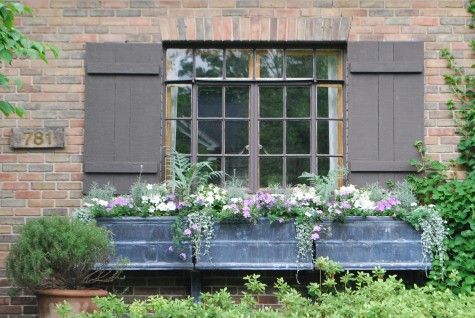
The window boxes feature cardoons as a centerpiece.  The silver grey accompaniment-French lavender, curry plant, and silver dichondra.  A dash of white via some white supertunias, -and a really pale red/violet and white bicolor Lanai trailing verbena known as lavender star-we have an idea taking shape here. 

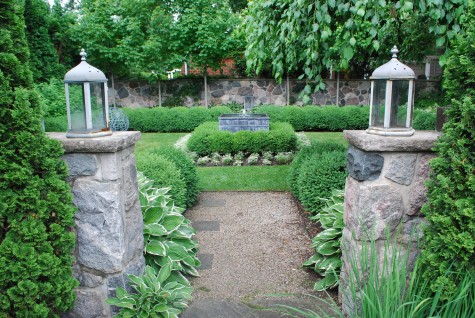
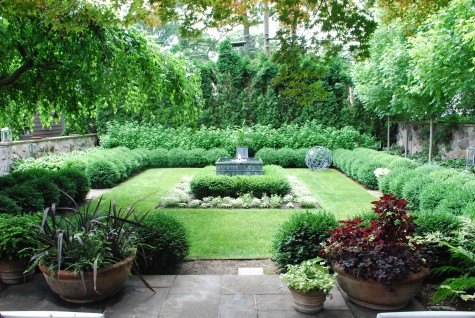
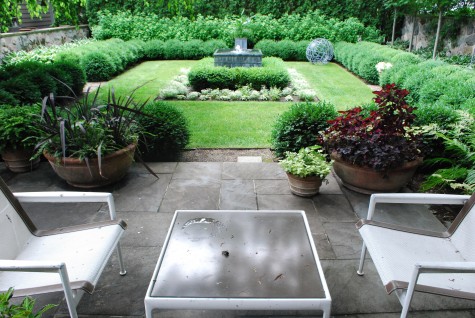
The rear yard is small, but its impact is very big.  Beautiful stone pillars and a gorgeous stone wall-what a gift to have landscape features of this caliber to work with.  I had a mind to keep with green and white scheme, but introduce some purple to the mix. 

Black phormiums, a raspberry coleus topiary, and that dark red violet oxalis made an appearance in the terrace pots. Purple got introduced to the white and green mix.

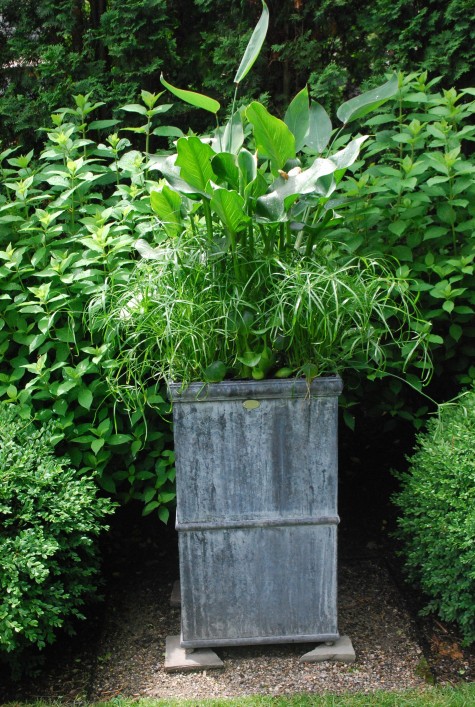
A steel Hudson box beyond the fountain-I went way out there.  I filled the box with bark 2/3rds of the way up from the bottom.  I lined the top third of the container with a heavy duty black plastic garbage bag.  I filled the top third of the container with water, and stuffed it with white callas, a water canna, a few papyrus-and some floating water hyacinths to finish.  This container is looking really good. Stopping up the drainage in a container in a very low tech way-this was my first try at a container water garden without a lot of hoopla.    I love the idea, the look, and the result.    

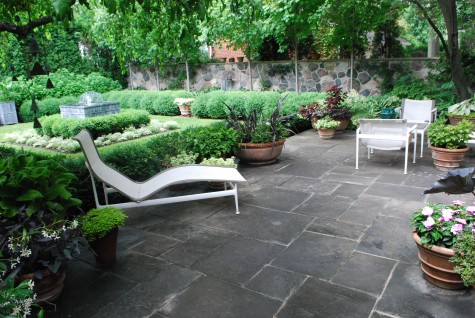
The rear bluestone terrace is a cool and shady haven and a place to gather.  The Richard Schultz furniture is decidedly modern-the landscape and containers are a mix of thoughts and interests both modern and traditional.  There is a lot of color going on here, no matter the shade.  There are a lot of ideas going on here-I would call this garden lively-first and foremost.     

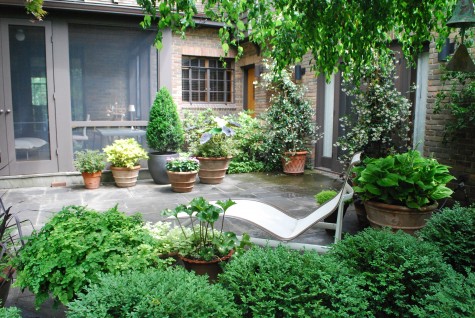
There are a lot of pots on the rear terrace.  Some have cone shaped boxwood.  One has a beautiful large leaf begonia.  One is stuffed with ferns.  Another is filled entirely with Kong green coleus.  Another features white caladiums.  Yet another-a dialogue about white, black, and green.  There are a lot of containers on this terrace-there is ever so much more lively conversation.

I worried myself half crazy about this particular summer planting.  Today, I am so pleased about what turned up and out.  Funny how one great plant can organize an entire summer garden.  Hypnotica dahlias- check them out.

Planting For Events

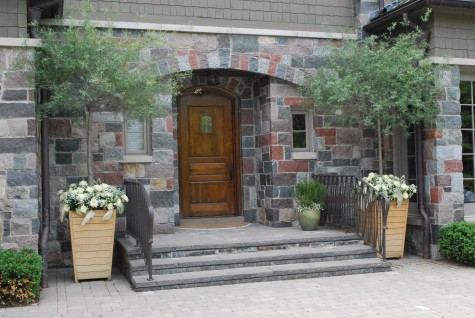
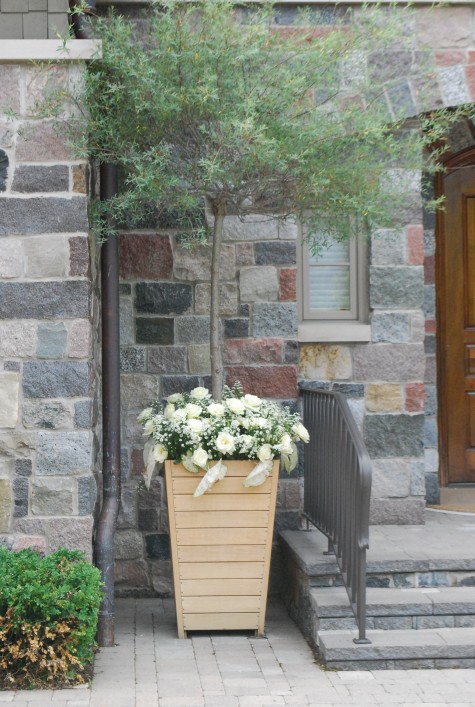
We do plenty out of the ordinary garden plantings- given a special event.  Planning outdoor parties, and timely planting for outdoor parties don’t always go hand in hand.  Whenever a client asks for white tulips blooming for a mid-May outdoor wedding reception, I sigh.  Try as I may, I am no better at predicting when the Maureen tulips will be at their white peak than I am at predicting the outcome of a horse race.  Suffice it to say that I planted hundreds of pots of all kinds of spring flowering bulbs hoping some would be in bloom for our spring fair-not a one bloomed for the fair.  I have also stuck cut white tulips in water tubes into tulip foliage in the ground.  This is not cheating-this is going the distance to make an event visually memorable.  I had 3 weddings scheduled this spring- two on June 4 and and one June 19.  Several clients had graduation parties they planned to hold outside in mid June.  The spring did little to help me out; no end of cold and wet weather kept me from planting until I had no choice but to go ahead, and hope for the best.  Everything seemed to work out fine.  Late May and June is not an optimal time for a garden party in my zone, unless there are a lot of bulbs, and spring flowering annuals and perennials in place.  This client was hosting a wedding reception at home.  The Belgian oak boxes asked for a different kind of planting to celebrate that event.    

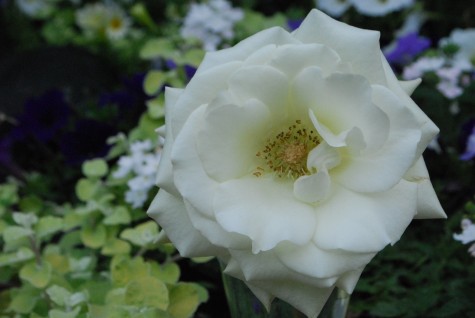
The fact is that no perennial, bulb, or annual planting will perform spot on and perfectly for an event.  I encourage my clients to use cut flowers to add to what is already going on. The florist’s rose known as Hollywood is the best white rose it has ever been my pleasure to use.  Though I order them up from my cut flower supplier, for all the world, they look and open like garden roses.  I order them to arrive several days in advance of the event, so I have time to condition them.  I recut the stems on a slant, and place them in room temperature water in a cool spot.  This encourages them to take up water;  proper conditioning can make cut flowers last much longer.  My plan was to add cut flowers to the annual planting. 

 I had planted the boxes with top grafted willow topiaries, and white caladiums.  Given a wedding reception, I stuffed stems of the roses, and white montecasino into the soil around the caladiums.  The pots looked dressed to the nines.  Hollywood roses last a long time out of water.  If the air temperature is cool, I stick the stems directly into the soil.  If the weather is hot, I may tube the roses.  Floral supply places carry pointed plastic tubes with perforated rubber caps that permit the stem of a flower to be pushed into an individual “vase”.  A rose can drink this small amount of water in a matter of hours, but often that is long enough.  The pointed end of the tube can be poked into the soil.  Once the reception was over, the roses are removed, and the caladiums grow on into the summer.   

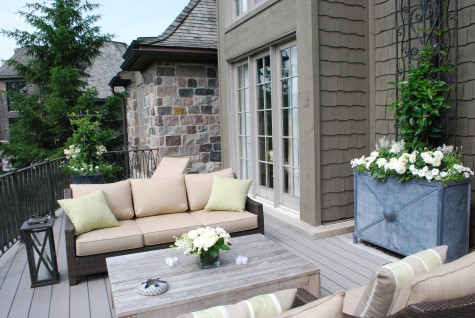
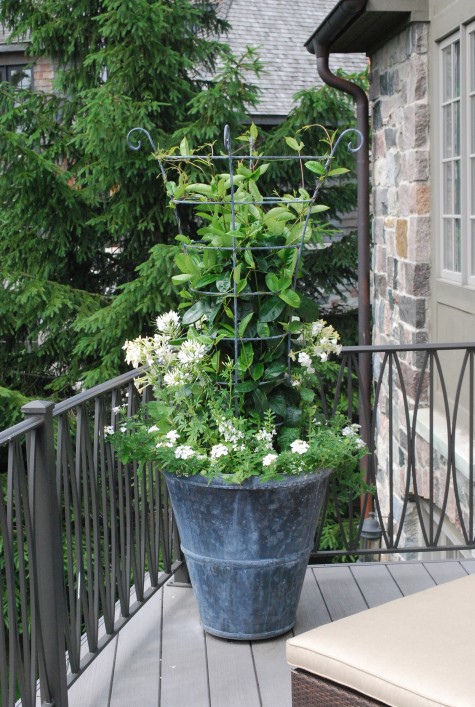
The containers on the balcony were planted with white flowering annuals especially for this event.  A pair of white mandevillea vines were conspicuously green, but mandevillea likes heat to flower.  By June 19, we had had but a few really hot days, and night temperatures in the 50’s. But other plants made a little white statement. 

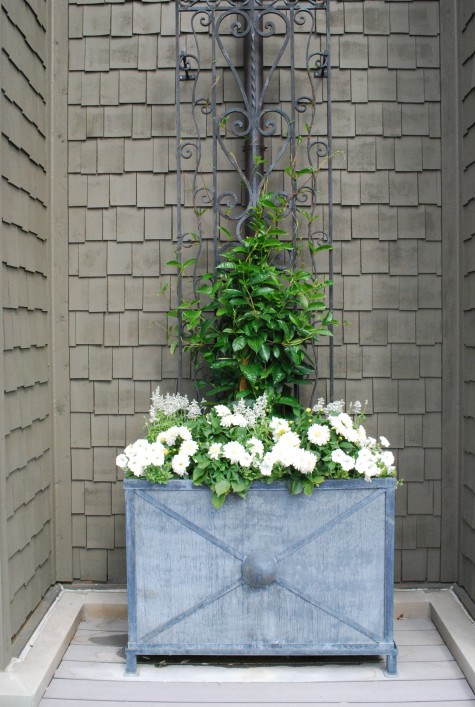
This box with its own antique scrolled iron panel is very friendly to a mandevillea planting.  The niche is warm, and protected from wind.  The vine will have plenty of places to wind around, and grow.  It will climb to the top of this panel in no time.  The placement was somewhat dictated by a giant downspout right in the middle of the wall.  Whomever designed this detail had utility on their mind-and not much else.  But as this balcony does not get any use in the winter,  the container helps to solve a visual problem. 

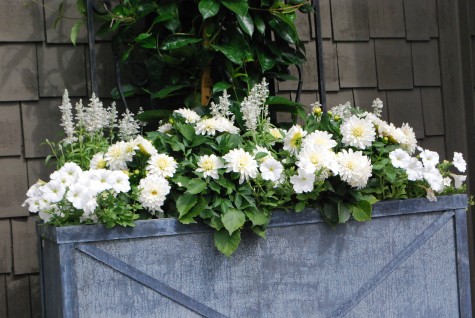
White salvia has never been a favorite.  But the new Cambridge series has more substantial and brighter white flowers.  The white Gallery dahlias have large flowers, as do the white supertunias.  Some white flowers I stay away from.  The blooms on white geraniums are so quickly spoiled by rain.  Plant them if you plan to wait on them regularly.


I have always liked white cleome, but this dwarf version called Spirit white is completely at home in a container.  Soon there will be white angelonia, and lanai white trailing verbena.  In another month, it will be the perfect accompaniment for a garden event.  June the 19th, it looked perfectly fresh and lively.


There are lots of great choices in white flowers-everyone has their favorites.  The not so often used white polka dot plant is a great supporting cast plant-it is best in shade.   It looks great with white caladiums. If you want to use it in full sun, as it is planted here with white dahlias, be sure it gets enough water.   Variegated licorice does a similarly wonderful thing for white flowers; its cool blue grey foliage makes white look especially crisp, fresh-and very festive.

A Deep V


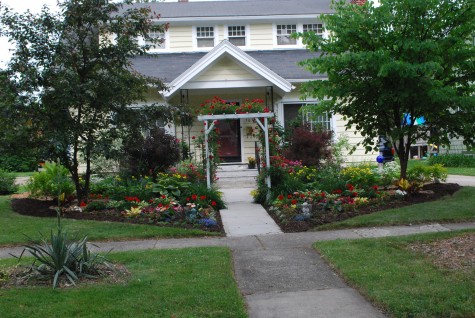
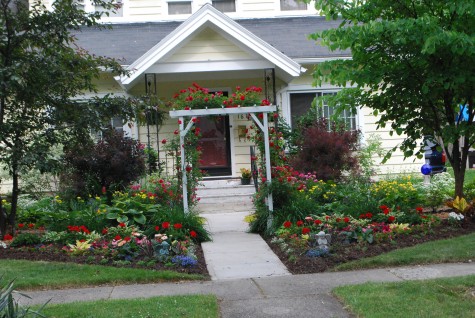
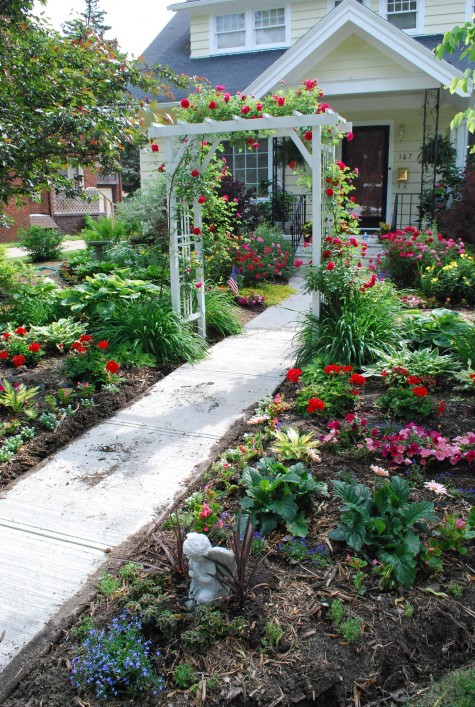
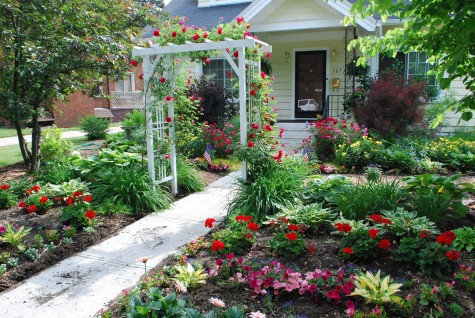
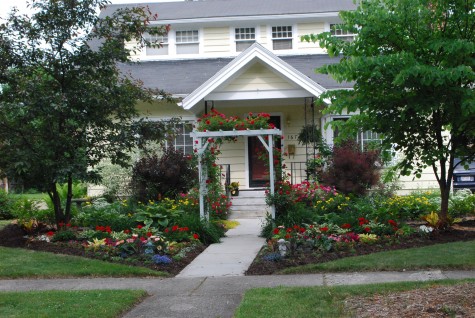
My neighbor down the street has quite the landscape going on.  I stopped by yesterday when I saw she was in the front yard working.  I told her I really liked the garden.  I will say she did not quit edging and weeding while we talked-how like a gardener.  But I do think she was pleased by my interest.  Gardeners are born with the willingness to share gene.  Hers is a small but very striking garden.  Trees and shrubs are entirely symmetrically placed on axis to the front door-as is a wood arbor keeping a pair of red climbing roses aloft.  But the most visually compelling element are the pair of triangular shaped beds that make for a deep V, intersected by the walk to the front door.  

I will say I have never seen landscape beds cut in this shape.  These diagonal lines are very strong and exciting.  The formal geometry of my garden is much more traditionally and quietly laid out in squares and rectangles.  These are bed lines that zoom, zoom. How they looked immediately made me long for a project where I might experiment with this shape. 

The gardens are a mix of perennials and annuals-I see a lot of confidence here in plant choices-it is clearly a collection of those things she likes best. Red flowers are a dominant theme-there are red roses, geraniums, and a pair of continus on either side of the front porch. We did talk a little about it.  She told me that working in the garden was a great stress reliever.  But I could tell she gardened for the sheer joy of it.

It turned out that she was a docent in my garden years ago, when it was on the Pontiac garden tour; we had plenty to talk about.  I do so appreciate that she has turned the better part of her front yard into a garden.  I drive by twice every day, so I can keep up with what is going on.  I told her the neighborhood was lucky to have her.  We have our share of abandoned houses with the grass a foot long; this I hate to see.  


Her garden makes me feel good.