Fall Color

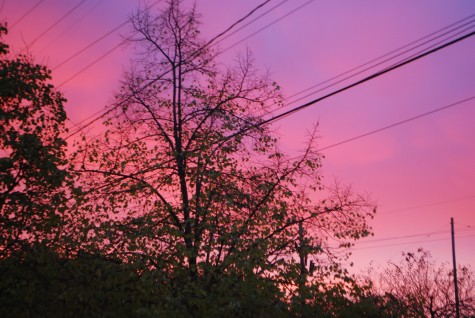
It interests me that the phrase “fall color” brings such specific color to mind.  The color I associate with spring-the yellows of daffodils, and the blues so specific to pansies is quite unlike the color I see in the landscape this time of year.  I got to work just before dawn this morning; the sky at 7:10 am was spectacularly fall-like.  Fall color often refers to the changing of the color of the tree leaves-that final super nova of color before the leaves drop.  Our fall tree leaf color has been next to non-existent this year.  With only 6 days to go to Halloween, we have not yet had a frost.  But there is still plenty of fall color out there. 
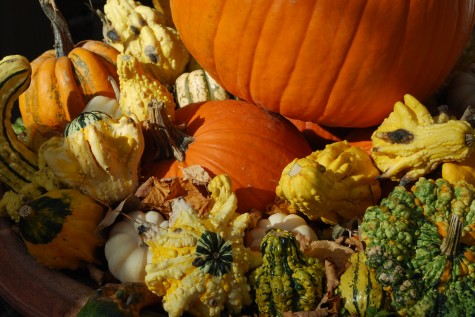
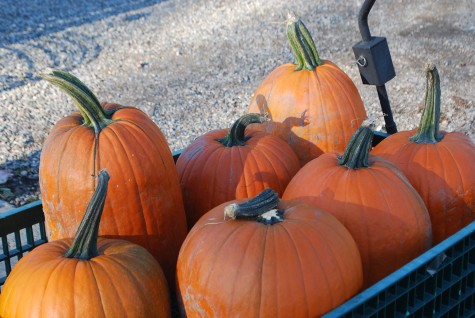
There is plenty of fall color in the landscape.  Every bin of gourds, and every stack of pumpkins at market is brimming with the ripe fruits of the fall harvest.  The creams, yellows, oranges and dark greens are the signature colors of our fall. 
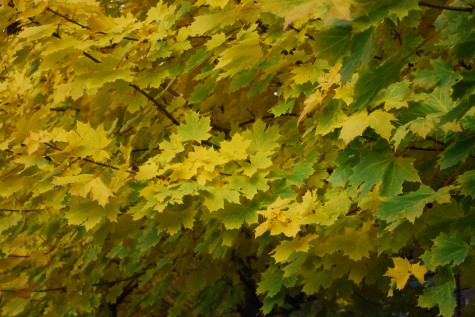
The leaves of my Princeton Gold Maples are still as green as can be.  I took this picture last year, on today’s date.  The fall weather largely initiates and dictates the turning of the leaves.  The leaves on my trees are that special shade of lukewarm faded green that occurs when the fall temperatures stay warm.  It is possible the leaves will brown and drop this year without fanfare.
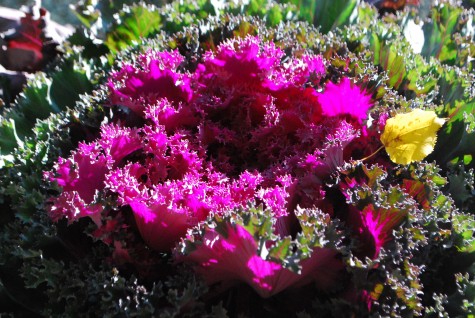
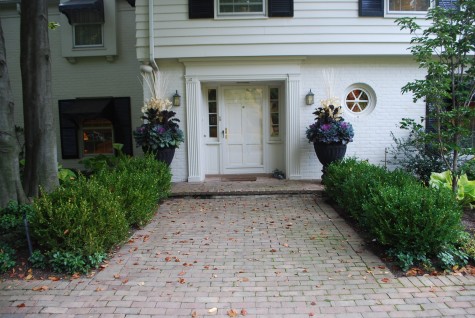
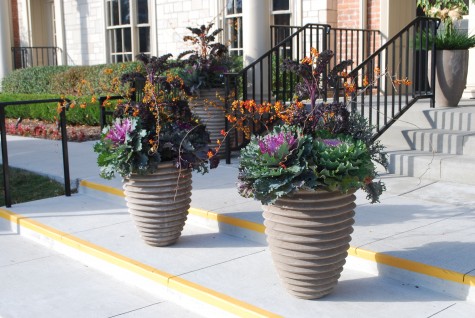
The kales and cabbages have colored up-our night temperatures have been just low enough to have produced this vivid cerise pink.  Fall color is very much influenced by the night temperatures, and the quality of light at this time of year.  That low in the sky light that casts long shadows bring the colors of fall to life. I rarely take photographs in full sun during the summer.  That sun washes out any color.  The fall sun enriches the color of anything it touches.  
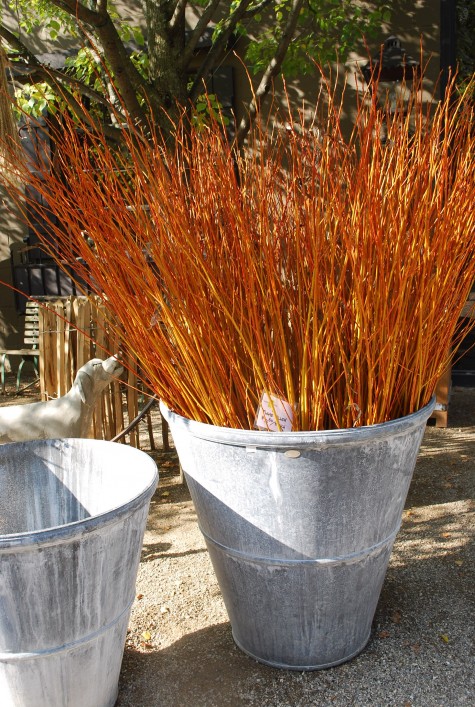
Every year in the fall we get a shipment of flame willow branch bunches.  Their arrival is a sure sign of fall; their fall color is brilliant.  This color mix of orange, yellow and brown turns heads-that includes mine.  It could not be more different than the color of branches in the spring.  I am very glad that I garden in a zone with four distinct seasons.  The change of seasons is a pleasure to this gardener.       
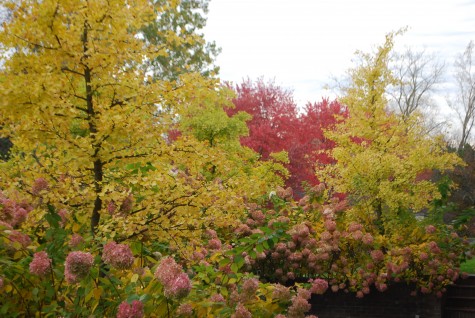
The best fall color I have seen yet-a client with gingkos underplanted with limelight hydrangeas.  The hydrangeas have gone rose pink; the gingko leaves are in that electirc lime green stage just before they yellow, and drop. A gingko drops all of its leaves on the same day.  I am sure this synchronized leaf drop is somewhere on the list of the top 100,000 natural phenomena worth experiencing.  My idea of a perfect day off-a chair waiting for me in the garden, the day the gingko leaves decide to drop.  
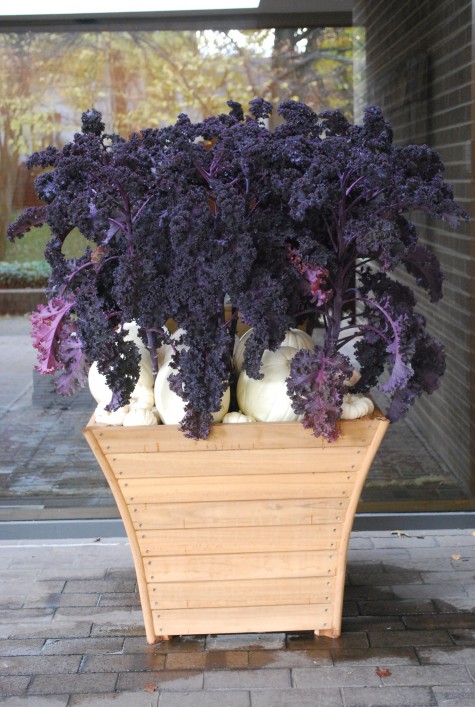
These clients have a big love for that mid century modern aesthetic.  I did their fall pots in black and white-stalky redbor kale, with a top dressing of big and tiny white pumpkins.  This is a most minimal version of our range of fall colors.   
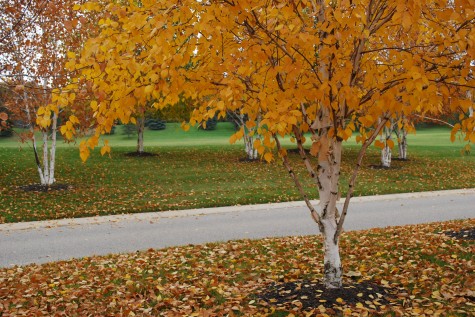
The Himalayan white barked birch-betulus Jacquemontii-is best known for its white bark that emerges and represents at a very early age.  The tawny yellow fall color is equally as beautiful.  Choosing plants for the landscape that have something to say in all of our seasons is a great goal for any gardener.  
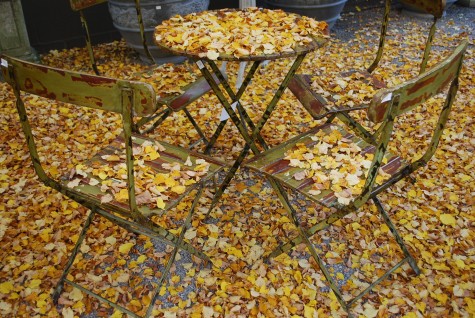
It is not enough to be a gardener. It matters-the appreciation and understanding of the process we call fall- the process we know to be nature’s doing. Great gardeners are naturalists-observers of the natural world.  Fall color is so much more than a well known phrase.  It is one briefly seen phase in the process we gardeners call living.  Luckily, we get some version of it every year around this time.  This bistro table and chairs covered with the falling leaves of the lindens-an eloquent statement about the end of the gardening season.
Apprehension

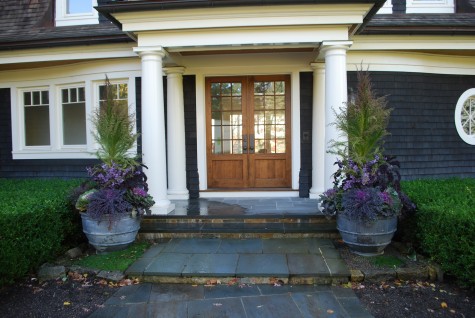
A customer came in today, faulting me for a lack of materials for the Halloween holiday.  It could be she was right.  I have no materials that are overtly aimed at the Halloween holiday.  But I believe a thrillingly scary Halloween display is more about the presentation, than the materials.  Any material can be scary, given the right environment.  This client has small children, and they like their front door pots planted for fall.  6 stems of the elegant feather grass from my roof garden makes for a wildly hairy pair of centerpieces that will look just right Halloween night.  The cabbage and kale will look good until the weather turns bitterly cold.

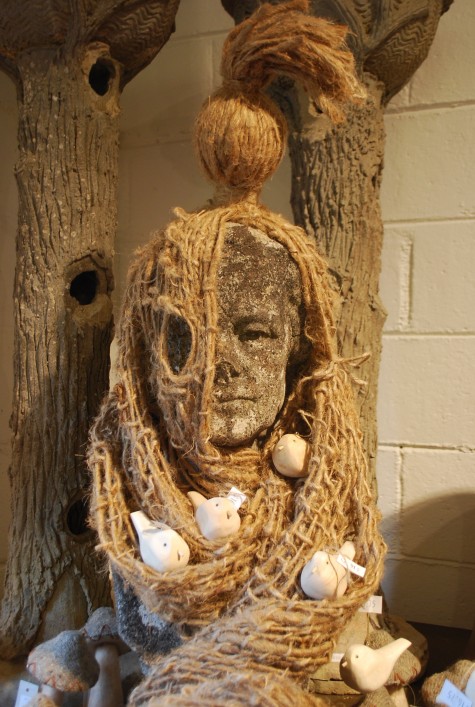
I will confess I am a fan of Halloween.  I do not have kids, but I have better than 300 kids who visit my house Halloween night.  I make my front door landscape as spooky as possible that night-this is part of the fun.  Jenny wrapped this serious antique stone bust in the shop in some open weave burlap erosion mat, and added a little flock of birds.  Ghoulish, isn’t it?  None of the materials are particularly scary-what is scary is what Jenny did with them.  

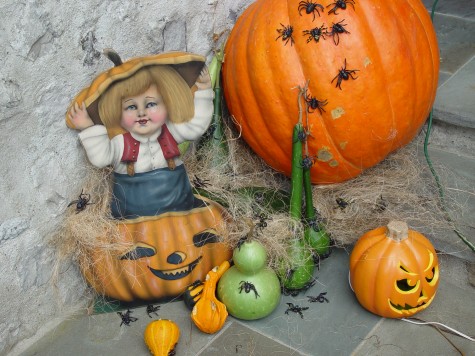
1 spider is tolerable.  3 spiders is manageable.  Hundreds of spiders will elicit dread.  I buy mine by the hundreds from the Oriental Trading Company.  It is the numbers that count.  Whatever you plan for your Halloween display, do lots.  Hundreds of spiders.  A flock of too many blackbirds.  Lots of grinning pumpkins.  Plenty of webs.  These pumpkins have hemp hairdos; packing materials can be a great source for a Halloween display. Should it get wet and soggy, all the better.      

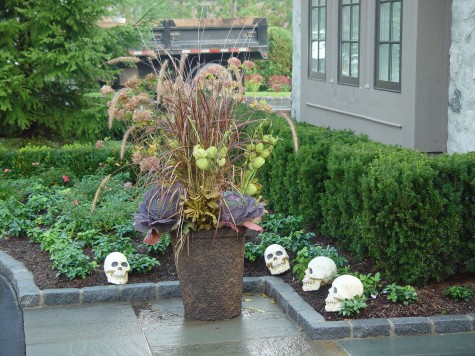
The materials at the farmers market right now are great.  For a Halloween display, I choose the grass, cabbage and cut pods as they look half dead, or from another planet.  This container planting would never satisfy me over the summer, but it is perfectly in tune with the Halloween season.  The plastic skulls are a contribution from the kids.    

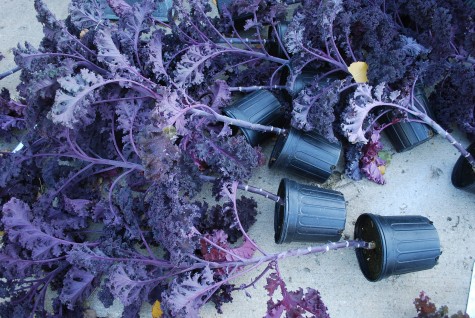
Redbor kale is a dark purple that deepens with colder nights.  We plant plenty of these in fall pots.  Looking to introduce some Halloween apprehension to the mix?  Centerpieces out of vertical, pots of plants laying on the ground, displays askew-horrifying.  My landscape installations aim for square and true. Halloween displays should dispute that idea.  No matter what ordinary materials you have to work with, setting them   off center, up side down, or out of kilter will endow them with a little holiday terror.  Though I do plan to plant these kale that the wind blew over, this is a desolate scene, as is.   

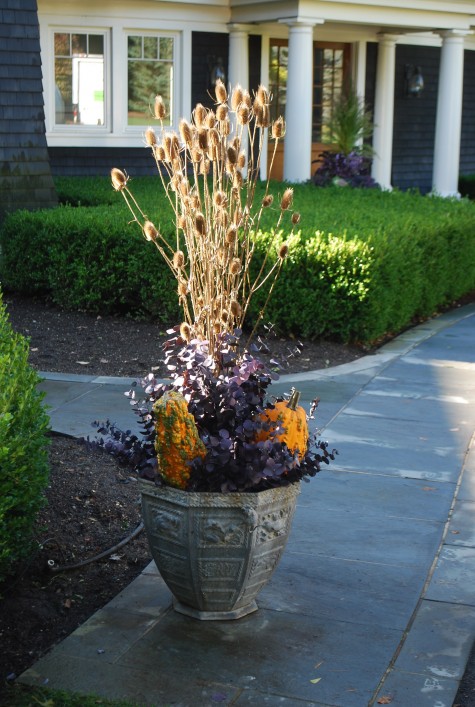
Canadian thistles are a vicious weed- so difficult to eradicate.  That said, I love the seed pods in the fall-as do the goldfinches.  This planting has a dead and prickly centerpiece, some very warty gourds, and some black/ purple eucalyptus-very Halloweenish.   

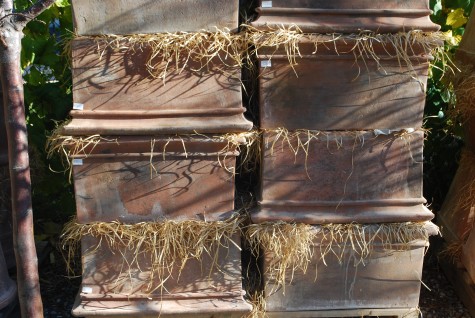
 I stay away from hay bales.  They are messy beyond all belief, unless they are securely bound up.  I like the wood shavings that are known as excelsior for Halloween. These wood shavings stick together.  The look is great. The cleanup is easy.  I like broomcorn much better than cornshocks-their drying seed heads look great on a windy day.   

Pumpkins do not ordinarily scare anyone. The pumpkins and the gourds are the mainstay of the October harvest season, so they are a natural for Halloween.  What makes them creepy is the carving, and the lighting.  I also like long twisting stems.  If I grew my own pumpkins, I would cut them with as much of the vine and dead leaves intact as possible.     

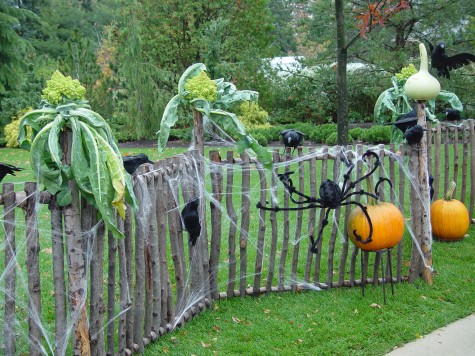
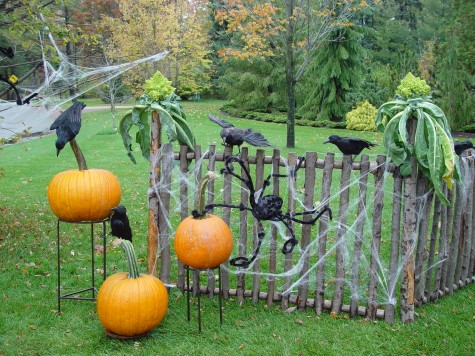
A Halloween display may need a  little structure-these fence panels fashioned from stout branches are a great backdrop, and provide plenty of hanging opportunities. The fence post finials-romanesco broccoli and birdhouse gourds.  I will admit the giant spider, crows and faux webs are especially creepy-these courtesy of my local Halloween store.   

The most ordinary of materials can help bring a Halloween tableau to life.  When it gets dark, the pumpkins and company will appear to be floating-excellent.  A little ghoulishness is great fun.

The Process


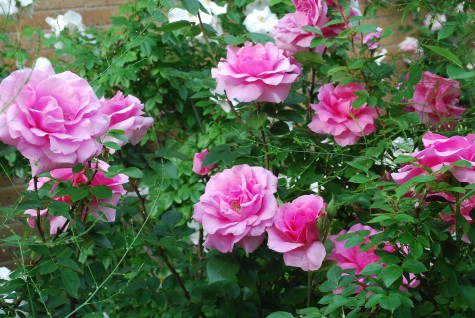
A thriving shrub rose loaded with flowers is one of the best parts of my June garden.  This June I had roses better than any other year I can remember; they were glorious.  The shapes of the fragrant blooms are beautiful.  The foliage was lustrous and healthy.  But the real story of a rose is told over a period of months. 

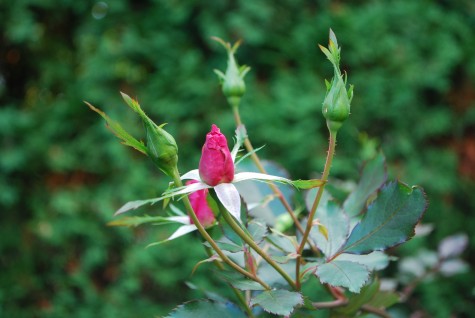
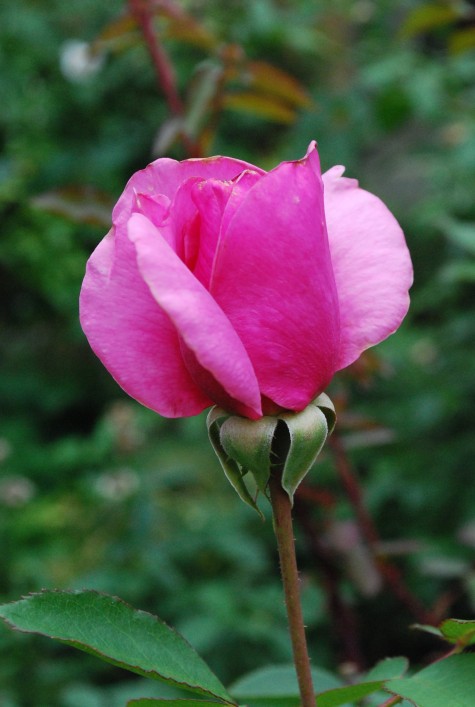
In the spring, warmer temperatures and longer days encourage my roses to send out new shoots.  These new shoots grow, and form leaves.  At a certain point, a point probably determined by day length, the leaves synthesize a certain protein.  Once that protein reaches the tip of a growing shoot, it triggers the genes that govern and initiate blooming.  This is a comic book version of the science, but have you not always loved the look of a rose budding, and wondered why it chose that particular day?  The green casement around the bud is known as the calyx.  It protects the bud from damage and insects prior to the bloom.        

Once the rose bud is ready to open, the five modified leaves that form the calyx open, and lay flat.  Once the bloom begins to open, the calyx folds back over what will become the seed pod.  The tips of those special leaves hug the stem.  This is a beautiful stage.   

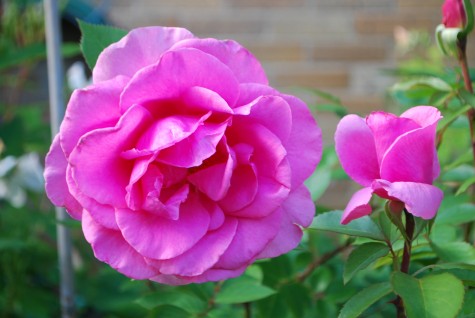
I love garden roses that open wide over a period of days.  This Griffith Buck rose, Earthsong, is stunning when it is loaded with full blown blooms. This rose has my attention, and the attention of any pollinators who happen to be in the area. 

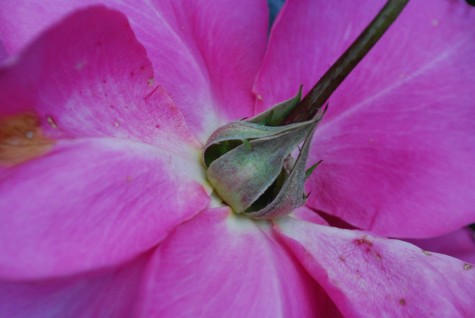
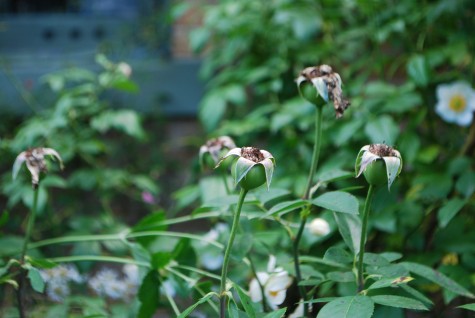
The calyx that once shielded the bud from injury has a new job-protecting the seed that is yet to come.  These leaf forms once so green turn frosty, and mature in this position.  They have a job to do, which just happens to be very beautiful.  The flip side of a rose can be just as beautiful as the front.     

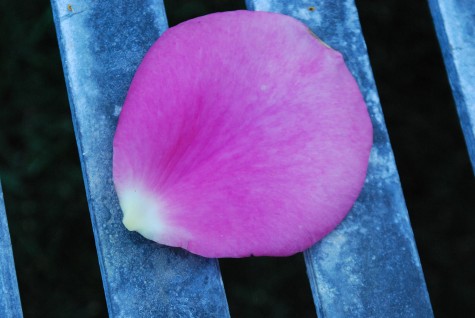
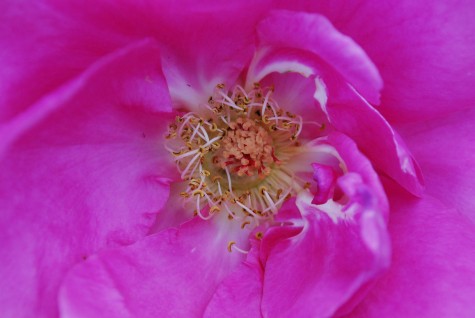
Petals are a modified leaf.  The petals of a rose surround the reproductive part of a flower.  They are brightly colored for one reason; the function of the petals is to attract pollinators.  Gardeners are the lucky visual recipients of that mechanism that produces seed.     

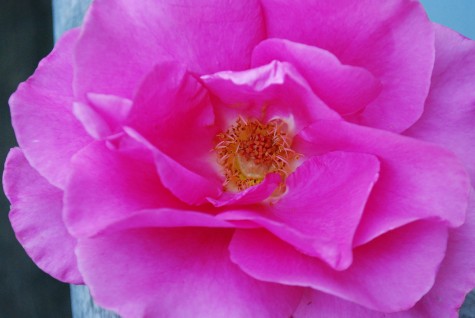
If you were a pollinating insect, this flower would attract your attention, and your visitation.  This Earthsong rose has opened wide and flat enough to signal that pollination season is open.  Some plants can self pollinate-some need to be cross pollinated to trigger the production of seeds.  Knowing how plants have evolved to insure reproduction is part of the marvel that is nature.  This process goes on all summer long with the roses. 

OK, we are at that stage ripe for reproduction.  The male stamens, that outer ring of pollen held aloft on fragile stems, surrounds the female pistil; fertilization, and the eventual production of seeds will insure the continuation of the species.  Sexy this, but also entirely practical.  The mechanism by which species survive has created no end of astonishing stories.    

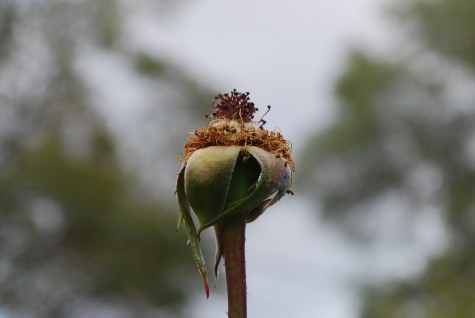
Once pollination has occurred, a seed pod begins to develop.  I do not prune my roses much after the middle of August.  I want the growth to harden off.  My roses go to sleep ever so gradually.  How they slow down over a period of months helps them to endure the winter.  The green calyx bulges out at this stage-it has done its job.  A seed pod is in the process of maturation.

This moment in the cycle of a rose is every bit as beautiful as its first spring gesture.  I follow the entire life cycle of a rose not as a scientist, but as a gardener enchanted by the the process of life.  Anyone who asks me how long my roses bloom-I tell them months.   

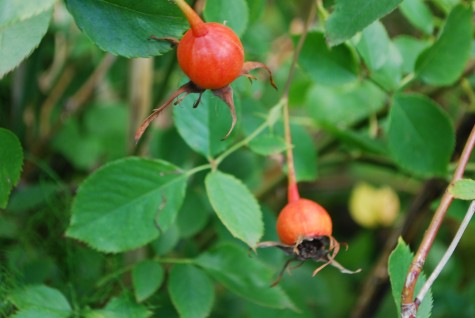
The mature rose hips are bright orange.  From the first buds in late May to this October stage took five months.  Those June blooms are but one part of the seasonal business of the rose.

A Busy Week

We had gusty winds today, sun and stormy clouds alternating, and cool temperatures.  It seems like it rains every fifteen minutes-for days on end.  Our weather is beginning to act like fall.  I am not sorry for this really.  It makes all of the plantings I did this week seem appropriate to the season. 

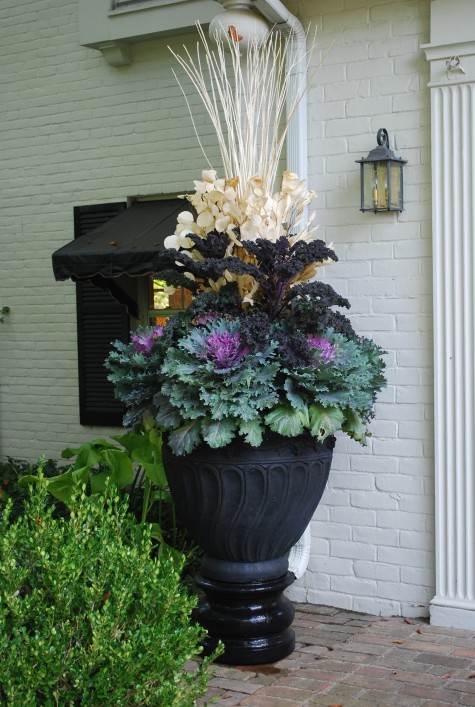
Rob found these great bleached sticks and branches with bleached leaves from a company in Canada-I was keen to try them out.  I was pleasantly surprised by the contrast of light and dark in these planters.  The blond leaves highlight the complex and moody color and texture of these redbor kale.  That tall centerpiece will go on to provide the foundation for an arrangement that will last the winter. 


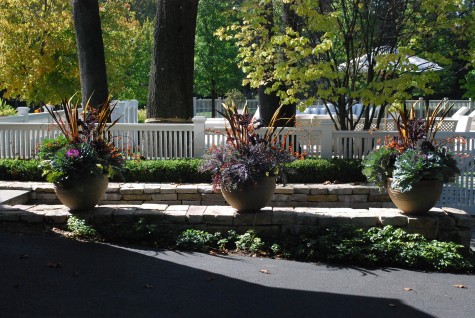
It may be hard to see exactly what materials are in this trio of pots, but how the low in the sky fall light illuminates plants is one of the best parts of fall.  As thick as cabbage and kale leaves are, those leaves transmit light.  There are times when a fall planting captures that light in a beautiful way.  No summer container planting ever has this look.  The long low slanting shadows-a sure sign of fall. 

The creeping jenny from a summer planting was left in this pair of pots.  It will brave the cold until very late. The color is not quite so lime like as it is in the summer, but it still is as green as green can be.  Any summer plant that can handle what fall dishes out, we leave in.  I try to handle the transition from one season to the next as gracefully and simply as possible-why not? 

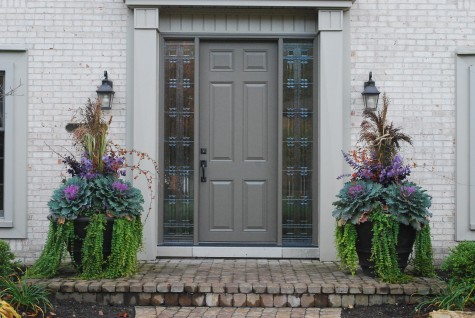
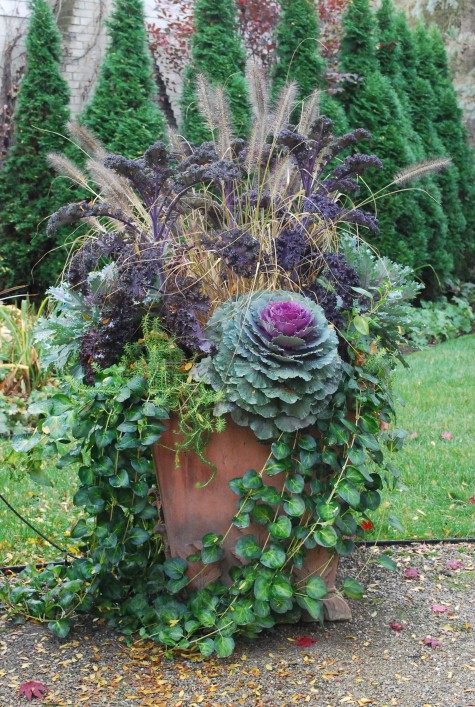
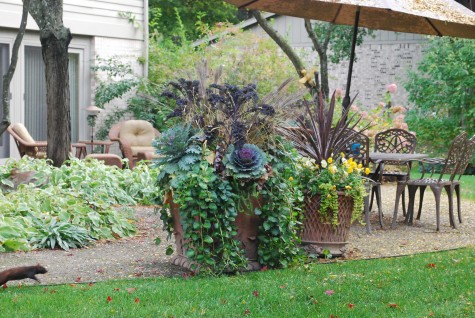
Most pennisetum plumes have lost their their color, and some of their bulk by now, but that feathery texture is a great foil for those giant, silent, and unmoving kale leaves.  This planting has a lot of movement, in spite of those kales and cabbages.  Interesting relationships are vital in creating lively compositions.  This robustly trailing vinca maculatum thrives on this cold; it has been in this planter since May.       

A garden terrace now is much more about the look from inside, than a place to be.  I try to go out every night that I can, and I am not afraid to bundle up. Winter will wander in soon enough.  But I do like a planting that looks great from the street, or the kitchen window.  Some nights now are just too cold for a stay.   I would guess this client has moved inside, but that does not mean they do not want a good view of the out of doors.

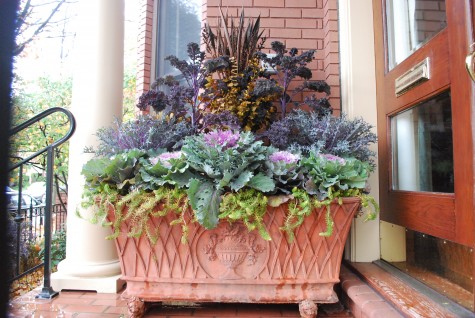
The centerpiece of this rectangular planter is dried bahia spears, and preserved eucalyptus dyed a color I call butterscotch.  The cabbages front and center have turned quite pink, given the cooler weather.  The angelina trailing in the front would easy survive the winter in this planter, were it left there.  Placed just next to the front door, this planting gives a cheery fall hello to anyone who comes to the door.   

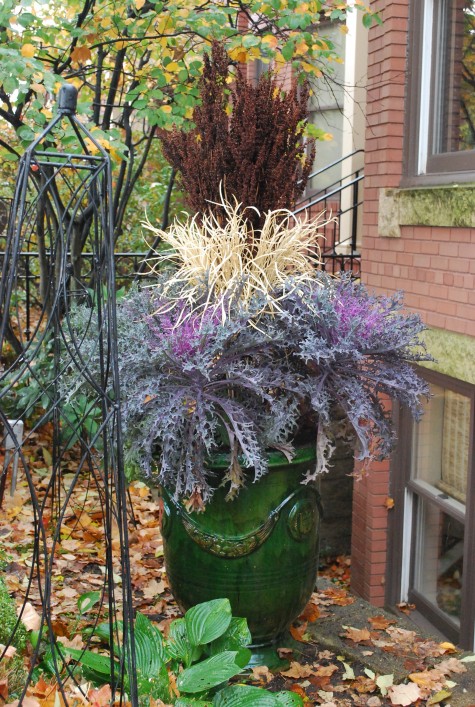
The chocolate centerpiece in this planter is comprised of many stems of a tall weed gone to seed.  I am sorry, but I do not know the name.  Is it dock?  I only know they look sensational in the fall.  Were I interested in having them long term in a pot, I would spray them with Dri-Seal.  But for the fall season, I just bunch them up around a bamboo stake, and set them at a height that looks good to me.  The loose creamy grass-plastic.  They add just enough adrenalin to this planting to make you come back, at the very least, for a second look.

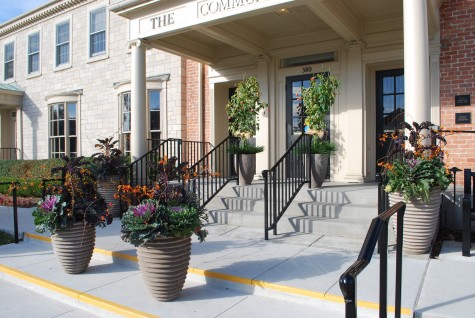
The Community House in Birmingham Michigan hosts an art show and sale for local artists every October.  I may be wrong, but it seems like the Our Town event has gone on 25 years now.  The past two years, we have placed fall pots at the entrance in celebration of their event.  I like how local artists have a yearly chance to show and sell their work.  The intent here is to welcome visitors to the exhibition.   

These contemporary beehive pots from Francesca del Re look great planted for fall.  The theme of their show this year-the garden.  I plan to get there this weekend to see how some 200 artists have interpreted that idea. 

We were busy this week, planting.  We also were making the rounds to all of those clients who have topiaries or tender plants they want wintered in the greenhouse space we have on reserve.  The installation of a landscape for a new house-we are fighting the rain, the mud, the carpenters, plumbers, and  masons.  Business as usual-a very busy week.