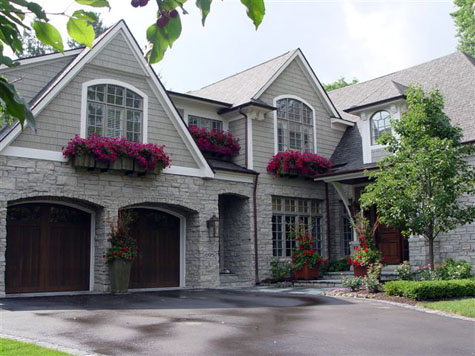
Window boxes have large areas for planting, which can give the impression of annuals in the ground-minus the turning of the dirt, the stooping and the stooping again to weed. They also put the action at eye level. Window boxes on a second story is a striking surprise. Sizing a window box appropriately is the toughest part. Plan carefully, so your boxes thrive.
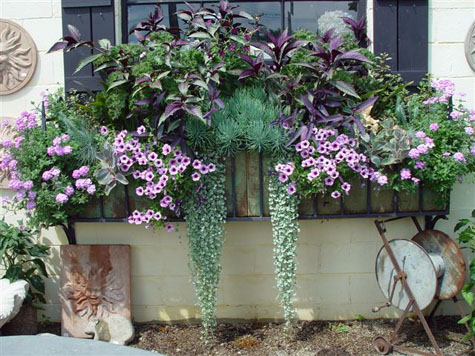
I like window boxes to be sized generously in width. Sizing the box wider than the window puts the visual weight at the bottom, where it should be. A box narrower than the window makes the window look top heavy and oppressive-windows are large dark shapes during the day. �
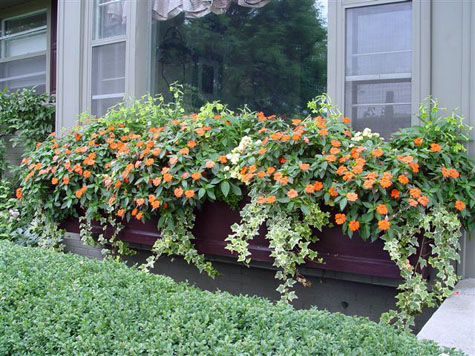
Window boxes are not just for French and English cottage style homes. A sleek contemporary box can compliment the architecture of a modern home. They provide great mass and substance in the horizontal plane. They have the added attraction of views from inside, as well as the outside.
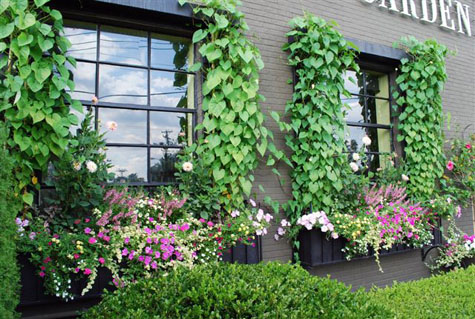
A very wide box invites planting tall annuals, even vines, which serve to frame the window. The large planting space allows you to showcase the relationship between a number of different plants. Boxes have the heart of a whole garden, in a smaller space.
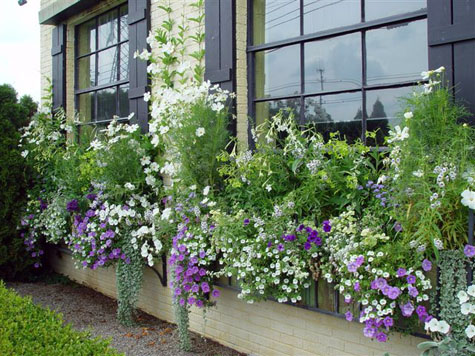
Many ready made window boxes are sized more to be convenient to load into your car, than convenient for good plant growth. Undersized boxes are the devil to keep watered, once the plants have rooted in well. These boxes are 11″ wide and 16″ tall-plenty of room for a soil mass that will retain moisture evenly, and allow for root growth. A window box that is 8″ tall and 10″ long will need succulents, as they do not root deeply, and they are happy in dry soil.
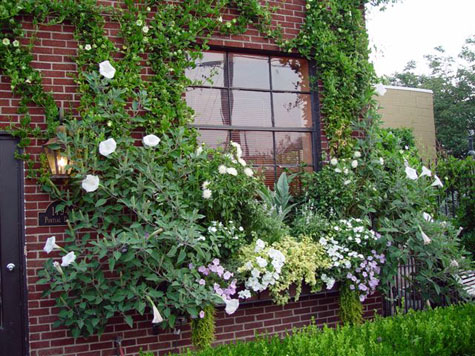
Window boxes have no need to be fancy, especially if your idea of a good one is profuse and spilling over with flowers. Luxuriant-I like the word, and the look. These boxes are made from a simple iron grillwork, and lined with galvanized sheet metal liners. Wood boxes will last much longer, if they have sheet metal liners. Wood that is constantly wet deteriorates quickly.�
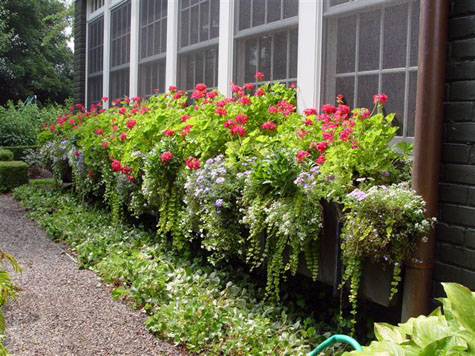
Wet soil is incredibly heavy; be sure the boxes are securely fastened to the wall. The weight issue is somewhat mitigated by the drainage material; I routinely fill the box at least half full with drainage material; bagged bark works well.
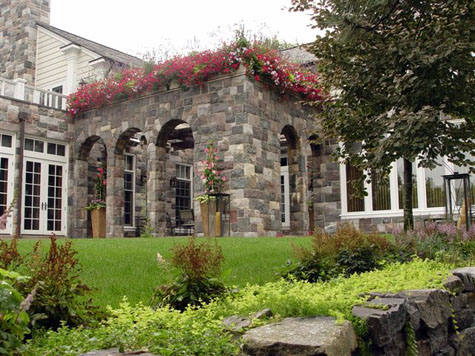
Not all boxes need to be attached to a wall. Boxes can be integrated into a pergola roof, or placed on top of a wall to good effect. Clear irrigation tubes can be run to them. This makes watering simple, as long as you experiment until you know how much time it will take to soak them. A plain sheet metal box will need reinforcement on the interior to prevent the metal walls from bowing out. I sometimes screw treated lumber to the inside to maintain a cleanly rectangular shape.
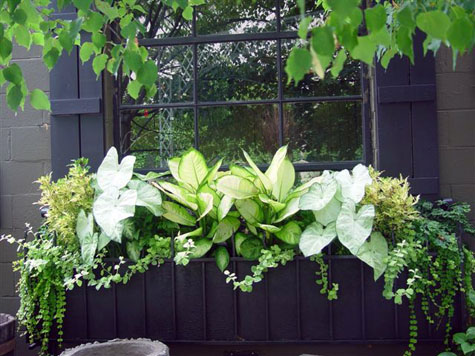
Window boxes are not just for sunny locations. The caladiums, dieffenbachia, and yellow coleus in this box light up a very shady spot. The trailing licorice is surprisingly tolerant of shade.�
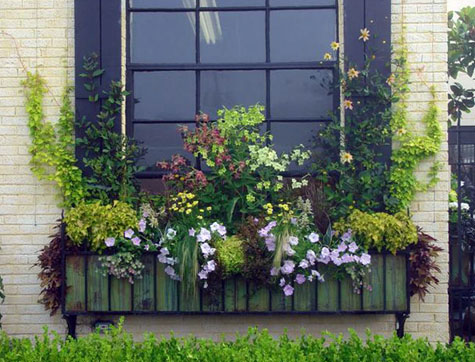
A great window box is rhythmic. Decide if you want the height in the middle, or at the ends. A uniform height is a more contemporary look. The colors of nicotiana-terra cotta, and 2 shades of lime, set the stage for this box. All the supporting cast plants repeat color, or contrast in texture. A lime green variety of hops is growing on wires outside the shutters. Wispy small growing grasses are great in boxes, as they are neither upright nor trailing. If you are after a tall middle, plant the center first, then work to the edges. If you are fond of symmetry, reverse the order of right half on the left.
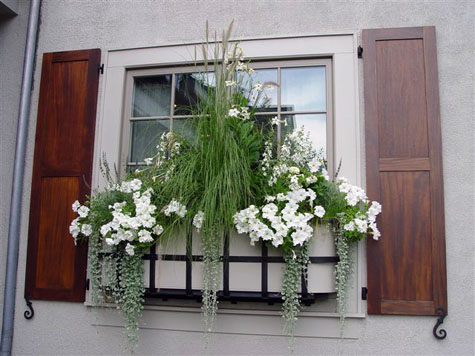
This box, tucked neatly between dark stained shutters, makes the flowers, and shutters the center of attention. This arrangement of a formal box and equally formal shutters, and green and white planting is elegant, but lively. �
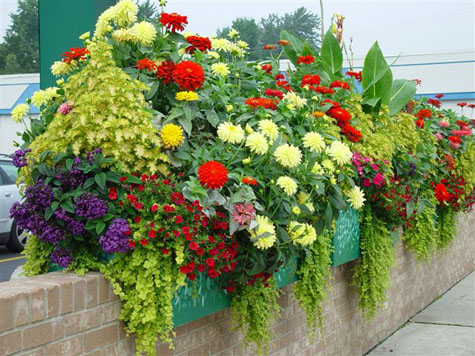
These boxes, specially constructed to sit astride a narrow brick wall, say welcome in a very big way. What a happy improvement over the wall.
The Window Box: A Hybrid Vehicle
Sunday Opinion: Perfection
I have become very interested in gardening in containers in the last 10 years; how enchanting to have the option of ignoring the demands of in ground cultivation. I like composing and planting them, even though I know my notion that I will have control over everything that happens later is an illusion. I choose the composition of the soil, the nutrients, the plants, the location that offers the best light. I can water the pot as a whole, or I can water plants individually. I can introduce plants from South America to those from South Africa, and get them to thrive visually and physically, next to each other. Some containers I might plant with trees, or evergreens, or vegetables; others might have an aura of a roadside meadow. A container might have sculpture, mementoes, a banner-this in additon to the plants. I might use a dead branch as a natural stake for a mandevillea. Some plants are old favorites; some are new to me. Some pots I plant such that grown in, they assume a collective shape quite unlike their individual shapes. Some containers are breathtaking-empty. Knowing when to stop, how to edit-this is an adult skill.
Relative to a plot of land, a container is small. I am less afraid of a small failure than a big one-who isn’t? Thus I try things. I am sure I have planted thousands of pots, and I am ready to plant more. When I was young, I was sure that I would begin at point A, move to B, and shortly therafter, get to Z; voila-perfection. It never occurred to me to wonder what I might do after that triumphant moment. How embarrassing to recall having thought the world revolved around me. In fact, I could learn new things about gardening every day-its a matter of making an effort to listen, and look-not a lack of things I know nothing about. It seems like new things appear to me at a faster rate that they did 30 years ago. I believed that science existed perfect and entire-and therefore perfect understanding was within my reach. The more years I study, and add to my knowledge, the further I seem to be from a definition of the living world beyond its miracle. Now I realize that perfection applies only to diamonds and moments. Not to my ideas, my knowledge, my efforts or my intentions, or my work. I am relieved by this.
How grateful I am there is no best and perfect planting, so I can go on making them.
At a Glance- Spring White
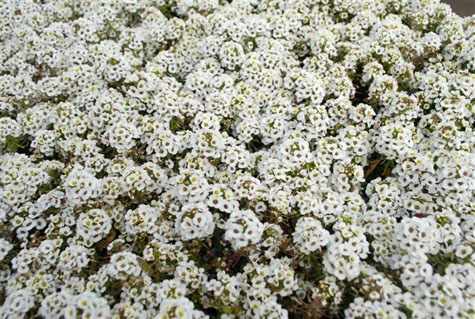
Sweet Alyssum
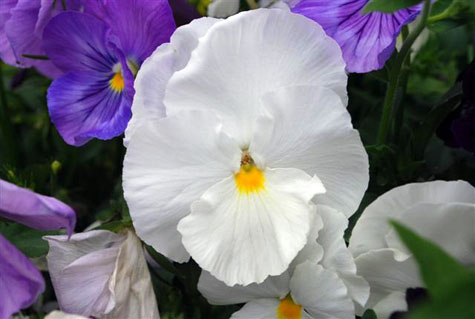
White Pansy
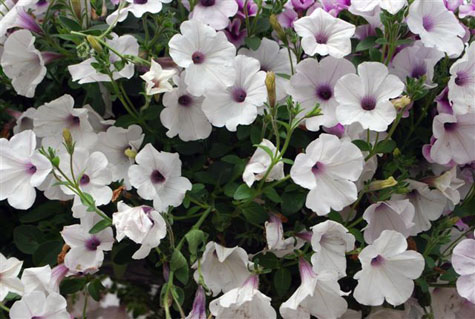
Petunia
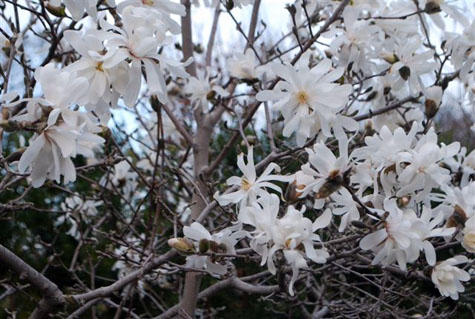
Star Magnolia
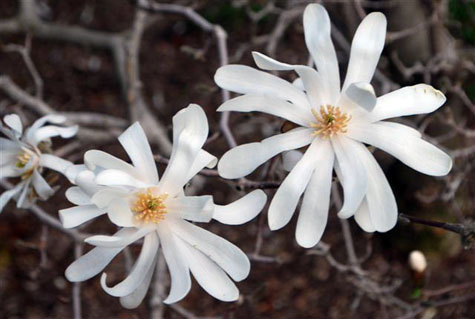
Star Magnolia
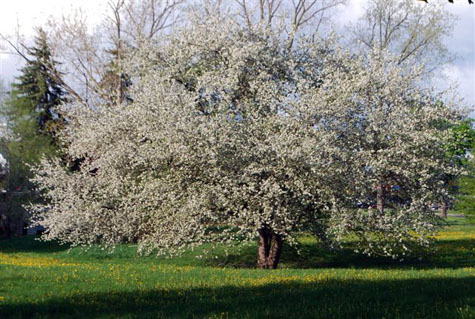
Apple
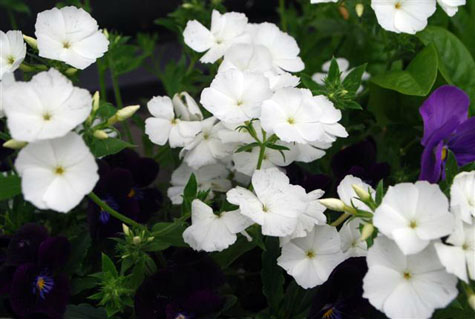
White Annual Phlox
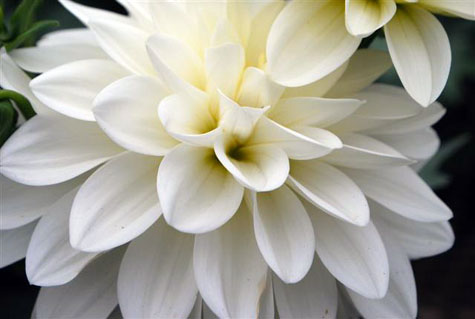
White Dahlia
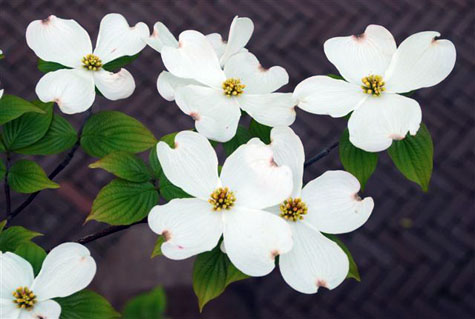
Dogwood
Corgi Run
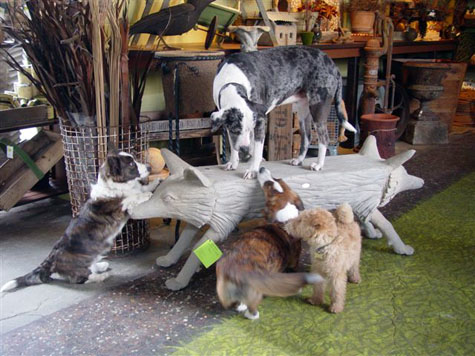
If you have ever been to my store, or my home, it’s easy to figure out that I am a dog in a person suit, and my Cardigan Welsh Corgis are little people in dog suits. The little people have the run of both of my places.

I call my garden Corgi Run-presiding over it is a very fine weathervane-English made of course. It was a birthday present from Rob, whose feelings about dogs are no different than mine.�
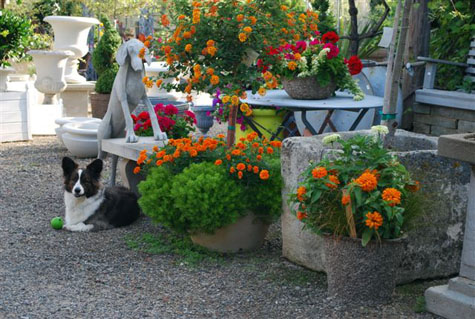
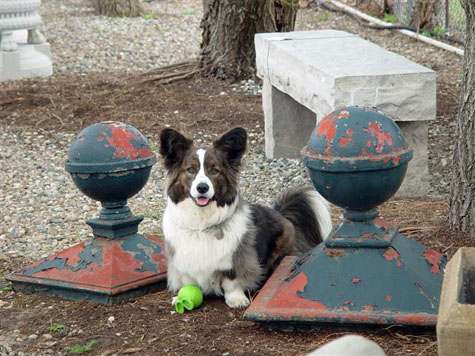
Milo, my dark brindle Corgi, has an unexpectedly big and disarmingly compelling personality. He persuades customers to pitch his beloved balls for him. He is a dog with a lot to say-vocal, is putting it mildly. I am convinced he understands English. He is as relaxed with visitors as he is in front of a camera; I should have named him Hambone. Rob thinks I should buy him a flock of sheep for his birthday this year.
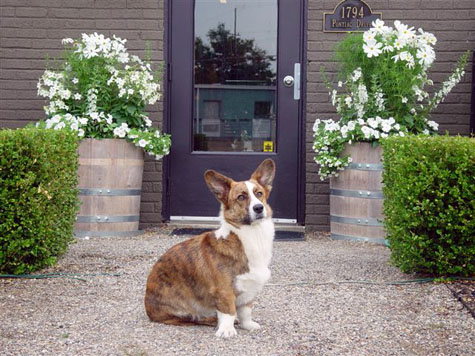
My red brindle corgi Howard, is a dog’s dog. Bred like Milo, for herding cattle and sheep, he herds everyone who comes in until he is sure they are friendly. He is always working. Letting me know when someone comes, patrolling the property. Extremely reserved, even shy, he will let out a blood-curdling howl when startled. I think he is as handsome as Cary Grant, although he abhors having his picture taken.

The pair of them welcome every visitor with their version of a Las Vegas style welcome- a lot of horn and hoopla. They can be a lot of horn and hoopla in a garden, too.
A reader with corgis wrote me recently to ask what I recommended planting in a garden with dogs. I do not think what you plant is nearly as important as where you plant, and at what level. My dogs are creatures of habit-they have their routes. I designed my garden not only to hide their routes, but accommodate them.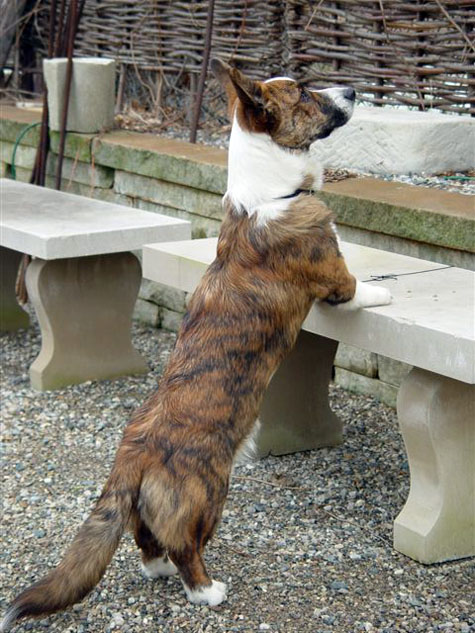

My boxwood hedges have “corgi doors” cut into them, at their level. They love going in one door, and out the other.
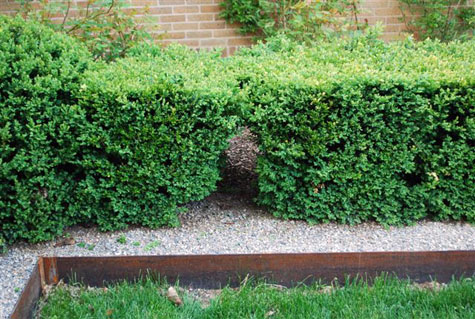
My asparagus is companion planted with roses; they avoid that area altogether. My row of snakeroot has a barked corgi route immediately adjacent. My fountain has a frame of herniaria surrounding it, which acts like a doormat for all the grass clippings and other debris corgis carry around on their feet. They are too short to be any problem to my pots-I feel for gardeners with tall dogs. The many changes of level in my yard are like a obstacle course they never tire of; those stairs also slow them down. They sit under my life size moss cow when it’s raining. I make sure they have room on the deck to observe what’s doing in the neighborhood. Any low groundcover is bound to show Corgi-wear, but after all, it is their garden too. It’s a good look, a garden that looks like someone lives there.
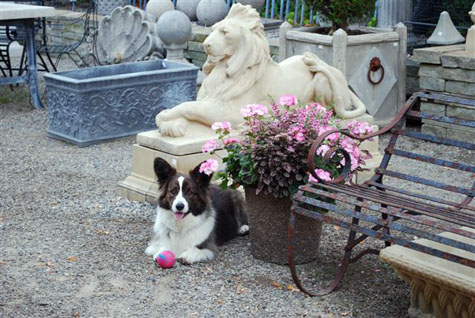
I do not have any kids, except the aforementioned kids. I would never want a garden so precious it had no room for dogs and kids. The small garden space which was all mine as a child no doubt played a part in why I do what I do now.