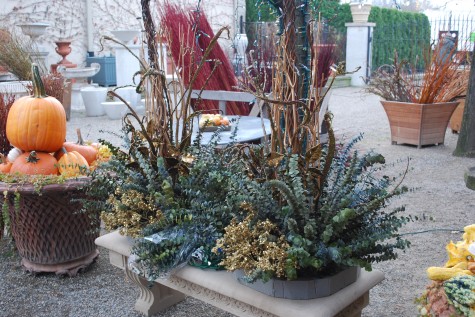
I am never ready for this time of year. Decades of my gardening heartbeat declining predictably- in tandem with the season is to blame-not my age. I have a long history of slowing and closing down.
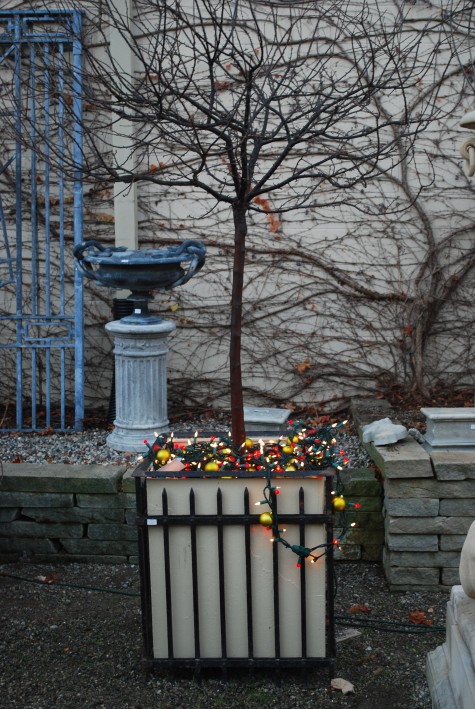
We are everything but slowing down. The transformation from a growing season to a glowing season is lots of work, but, I must admit, great fun. The biggest responsibility from which I am relieved? The “gardens” I do this time of year are momentary, entirely celebratory, and do not require regular watering, feeding, pruning, dividing-or winter protection.
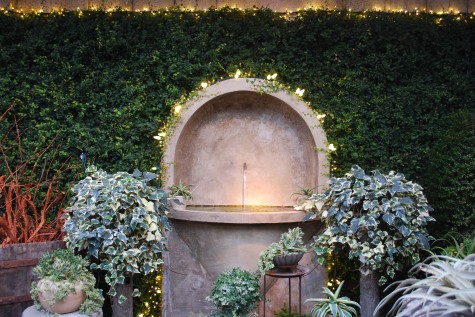
History is just that-history; yes? In fact, my winter and holiday season today is as busy as my spring. I am not sorry for this; I am bemused first, energized second, and eventually chased by it. Why should I be surprised-no one loves the coming of the cold and the dark. All of this festivity warms me up.
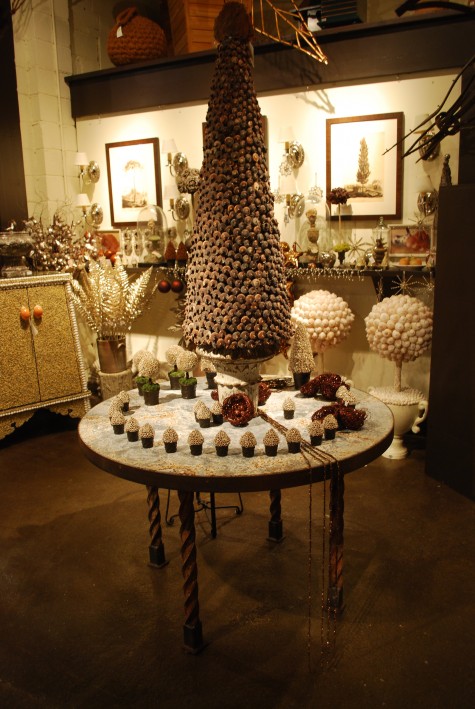
I have company coming tonight-our Thursday night holiday open house we regularly schedule for mid November. Should you ask me now, at 7:34pm this Wednesday night before-am I ready? Not really. I just got done editing my Wednesday post. All of my circuits are jammed; every one of twenty vignettes calls. My office is a wreck, and I have not opened the mail for two days. We are finish grading a project that will get 3500 yards of sod laid tomorrow. If I could just get the empty boxes hauled away, I would feel better; ok, a special events pickup got scheduled.
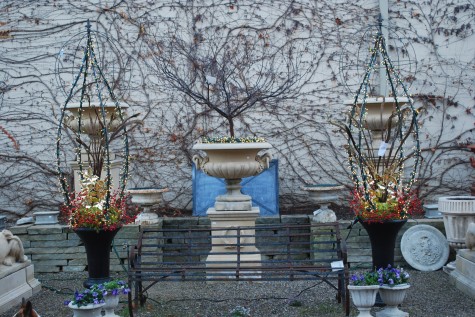
The parking is handled, as is the food, the wine, and the water. My landscape crews have sorted out the electrical issues outdoors. As I write, Rob is redoing all of the lighting in the shop in anticipation of evening guests. The shop is incredibly beautiful at night-this I share just on special occasions.
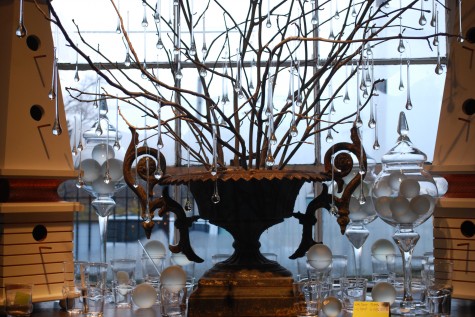
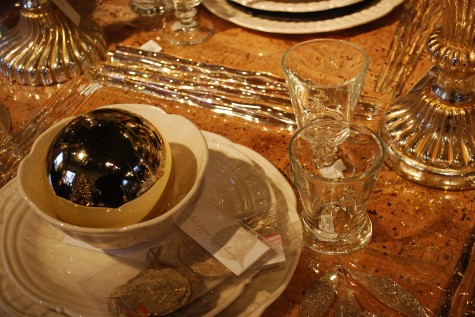
To follow, some photographs of places and spaces in the shop that make my heart pound-like these glass raindrops and spheres. Sparkly.
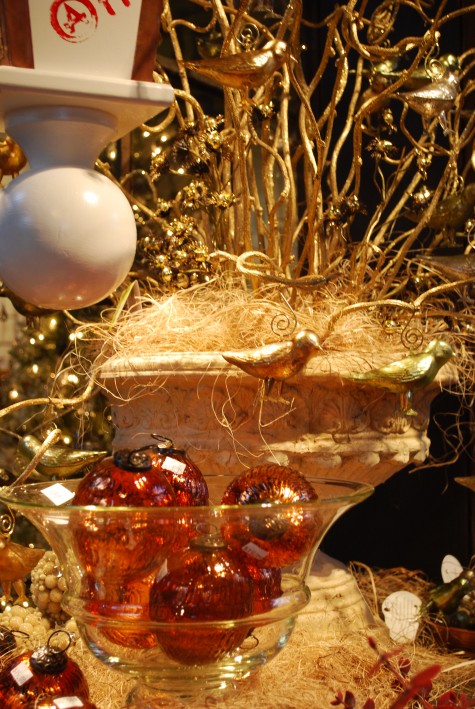 Anything that transmits or intensifies the available light I find hard to resist. Michigan is one of those states with mostly cloudy days in the winter.
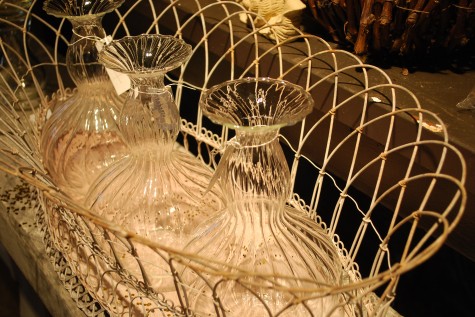
White wirework and ribbed glass-just pretty.
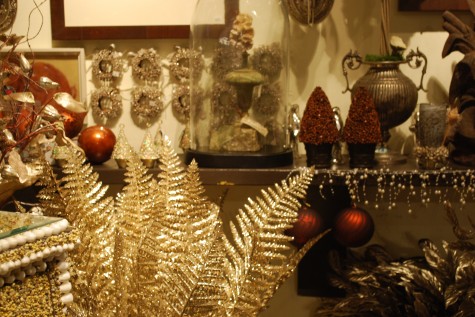
More tomorrow!
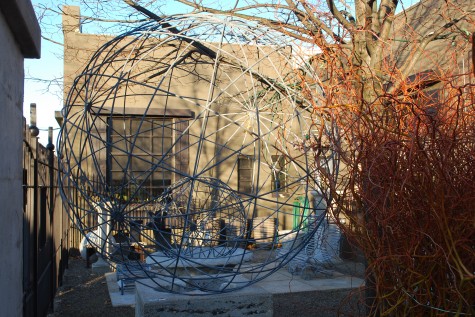 “Tuteur” is that elegant French word for those structures designed to support and make an orderly presentation of a vining plant. Vines are by nature unruly and out of control. Their exuberant habit of growth can be as exhausting to deal with as a recalcitrant two year old. Most plant climbers I find wanting for three things-good looks, thoughtful design, and proper size. Having made a succesful foray into steel wire structures via our spheres, it seemed time to design out the poor looks and clumsy design of what was available, and fabricate some good looking tuteurs I thought would work well.
 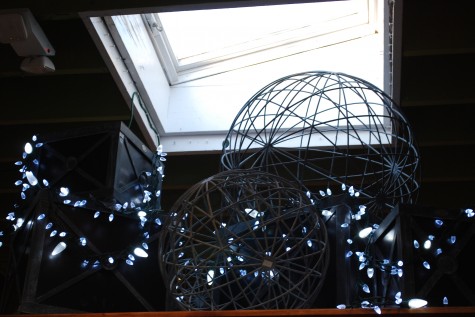 It was my intention from the beginning that a tuteur needed to be beautiful to look at once the garden had gone dormant. They might even be useful in another season. They might be designed with curves friendly to the natural shape of the vines. Those straight sided plant climbers with a curving vine bulging out of them-a bad marriage. And lastly, they need to be sized according to the eventual size of the vine they are meant to support-not to UPS shipping regulations. Some tuteurs have been designed to break down into several pieces-for economy of shipping; these never work.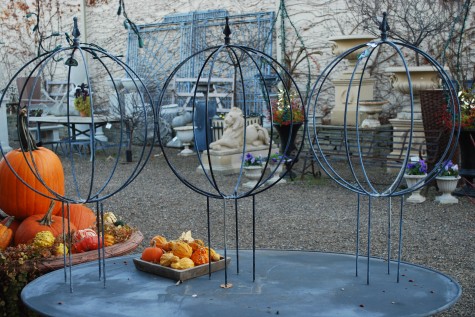
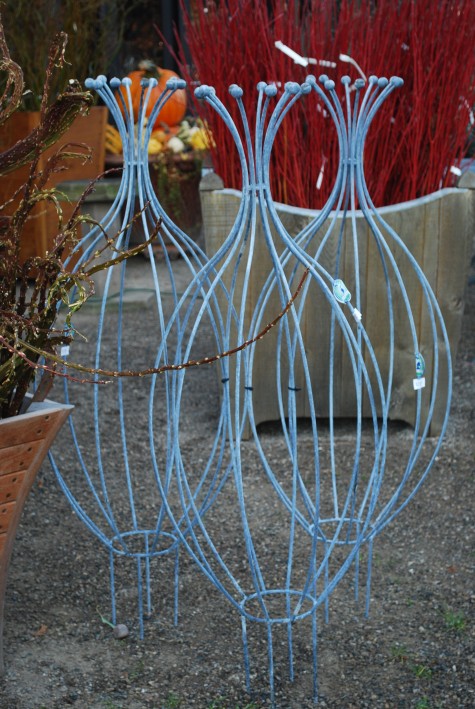 All of our tuteurs make reference to natural forms. Some say these look like onions or shallots; others are reminded of garlic cloves. In any event, we make these forms in three sizes; the size dictates the shape. Not all shapes work scaled up, or scaled down-this I learned from Rob. Sometimes the proportions have to be changed when the size changes. The ball finials at the top make the structure look finished and dressy. They also protect the gardener from a poke in the eye-has not every gardener be stabbed by their plant climbers, stakes and supports at one time or another?
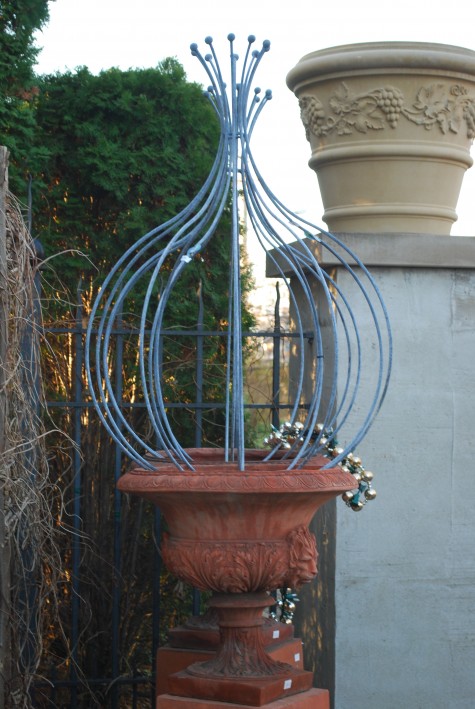 This pair of English concrete pots are all the better for their top dressing. The pots could be planted with ivy growing over one side of the tuteur in the summer-or not. They could be left out all winter empty, and look great. It is a test of a good garden pot presentation-does it represent as well empty, as it does overflowing with flowers?
 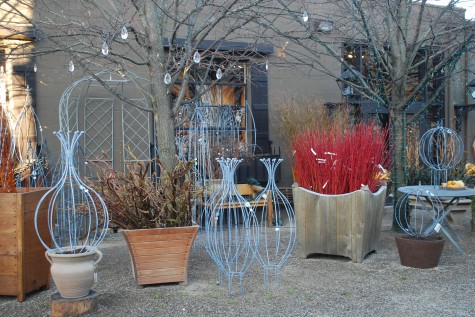 I did not anticipate how very much a part of the winter season these sculptures would prove to be. They look great with greens, berries and other materials from the garden at their base. They make something showy of our off season.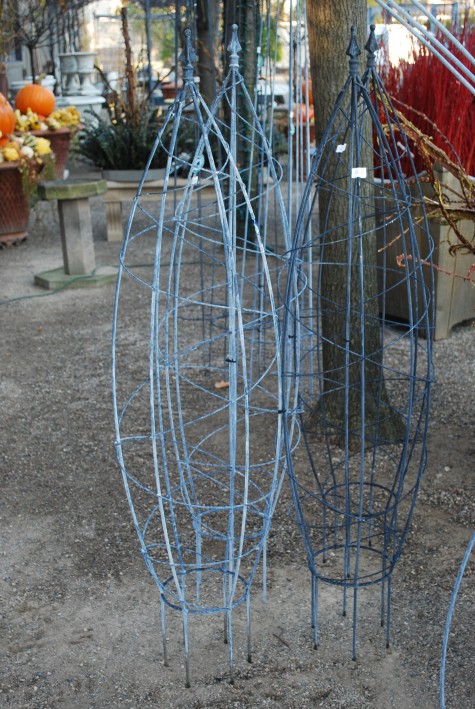
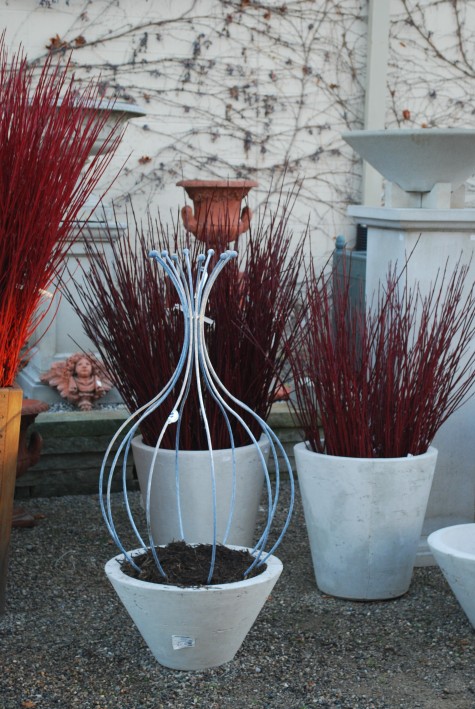 The shapes work in both contemporary and traditional gardens-what a relief to be able to offer a client with contemporary taste, a tuteur that looks like it belongs to them.
 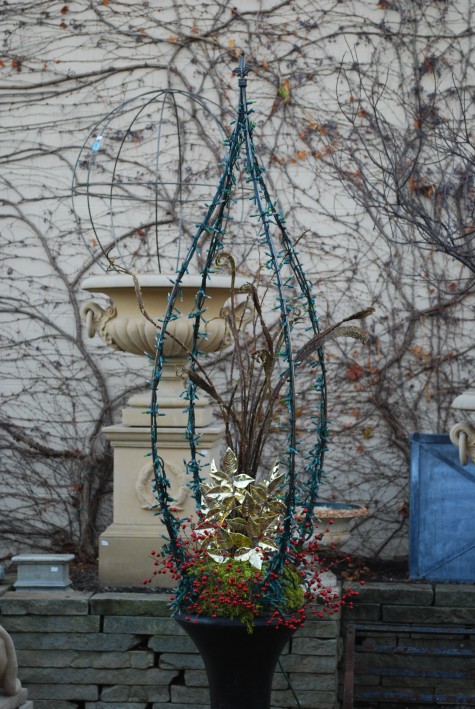 Decorating for the holidays outdoors is a form of gardening, and those strings of lights common to the season are a type of vine. Some tuteurs we design fulfills this purpose. They are very simple in shape, and overscaled such that the lit forms read as topiary at night. It will not be long before it starts getting dark at 4 in the afternoon here-any gesture defiant of the dark, I like.
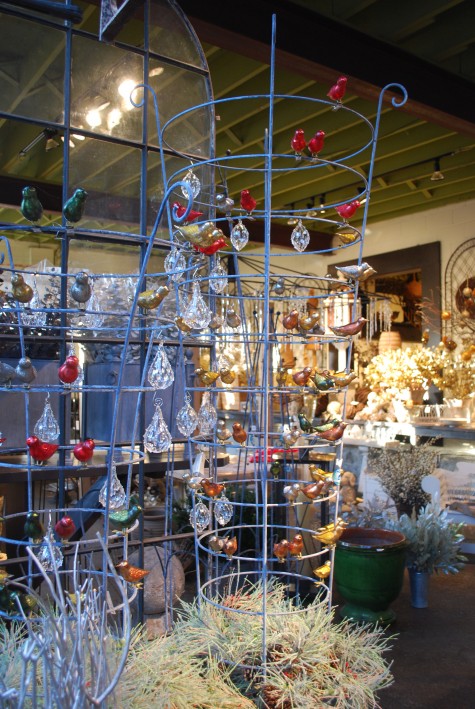 This is my favorite climber, designed after Rob’s hand wrapped galvanized wire tomato cages. The tuteur is much larger at the top than the bottom. My sweet autumn clematis may have 6 stout stems coming out of the ground, but once it gets to 14 feet tall, it is billowing out in every direction; this tuteur handles that. The fern curl detail at the top is a simple reference to the look of an ostrich fern breaking dormancy in the spring; this is a form I never tire of. We make these in a range of sizes. Our individual plant stakes of this design come straight out of the ground or pot, and then gracefully curve out to catch whatever happens to be growing that way. We make them as half rounds that can be snugged up against a wall. In short, we are gardeners, designing for gardeners. In this application, they provide wire perches for a collection of holiday birds.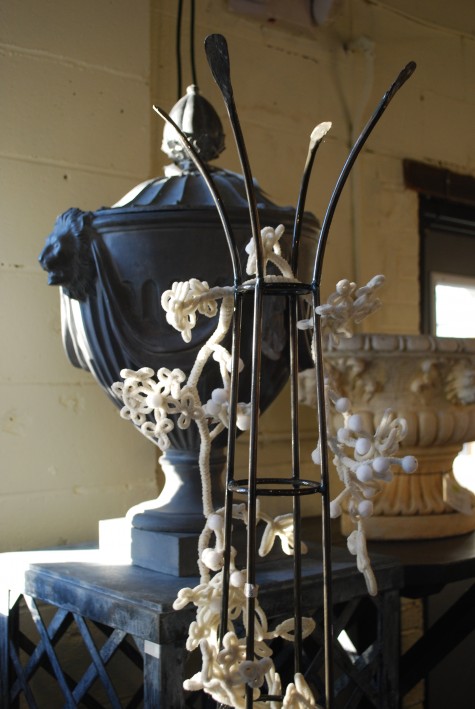
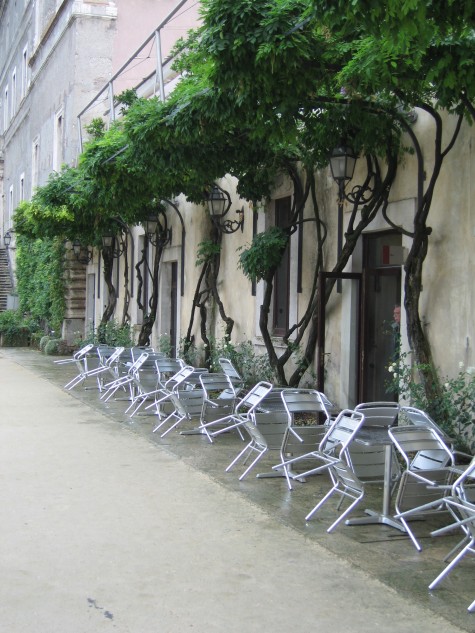 Vining plants have a very special charm. Provided they have secure support, they take up little to no room in a garden. Most of them are energetic growers; this I especially appreciate in a plant. Wisteria gives new meaning to the phrase “willing and able”, but with proper support and ruthless pruning, their sculptural effect in a garden will rival their long and languid racemes of flowers in June. I would only advise that any thought of planting wisteria should be undertaken in tandem with where the iron will come from. Iron support, and iron fisted supervision are must haves. Any other scenario risks waking up to it growing in your bedroom window.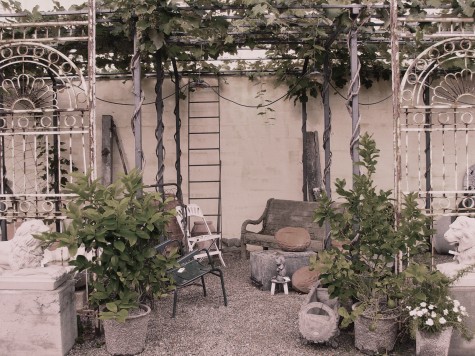
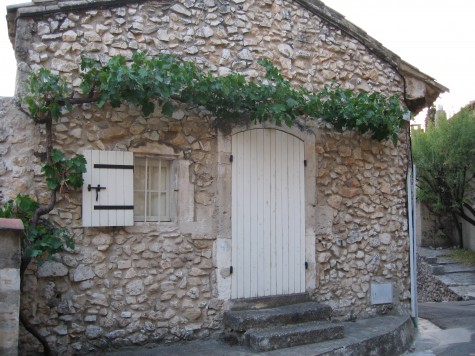 Grapes are like any other vine-lax in habit, and best grown within the confines of a well run dictatorship. They are sterling performers with a good gardener at the helm. But like the willows and dogwoods I discussed yesterday, their strong suit is about the harvest. I will never grow grapes for the table or for wine; I suspect the art and science behind that is considerably more than I imagine or could grasp. But I do value the look and feel of ornament made from materials from the garden.
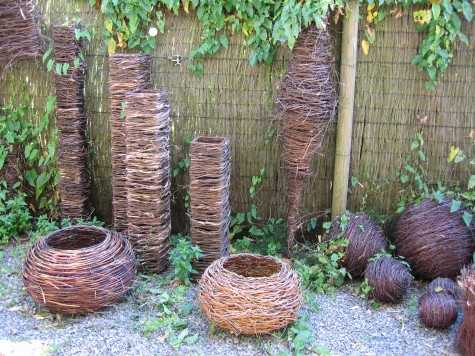 My shop has featured many garden ornaments made from vines and flexible twigs over the years. They never seem to loose their appeal. Those woven over a steel framework have an astonishing long life; they are as beautiful breaking down as they are brand new. Every year I pick up a large French basket from a client planted with a colony of medium sized agaves, amazed that it is still all of a piece. Enamoured as I am of Belgian design both inside and out, these airy, often hairy objects are a beautiful foil to brick, plaster, stone, concrete and iron.
 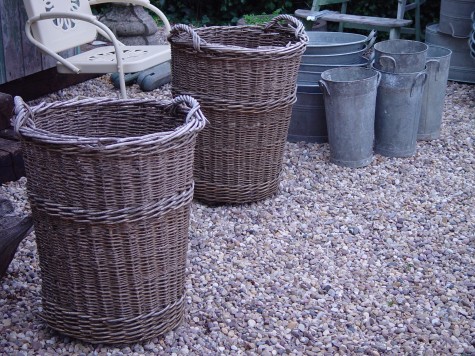 Only in England would you find a business named The English Hurdle and Basket Center. Despite sounding like remedial center for floundering collegians, it actually produces vessels and baskets of great artistry. The graceful shapes belie the skill and strength needed to form them. The artist Serena de la Hey, for whom I have the greatest respect, creates truly inspired sculpture for the garden. My very first purchase for my shop in 1995 was a order for one of her boar sculptures. She is well worth a look;
 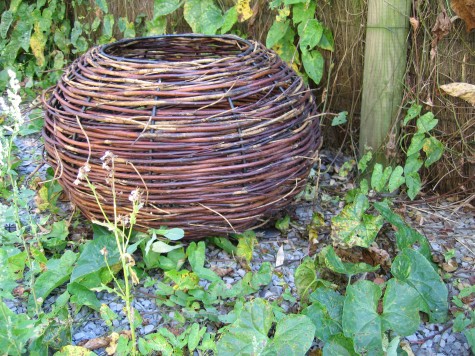 The framework that is visible here makes the object eminently renewable. Though the wood and bark of willow is remarkably resilient to weather, it will eventually deteriorate. I appreciate the chance to renew, redo, and rethink an object; this is a good part of the appeal of twig and branch sculpture.
 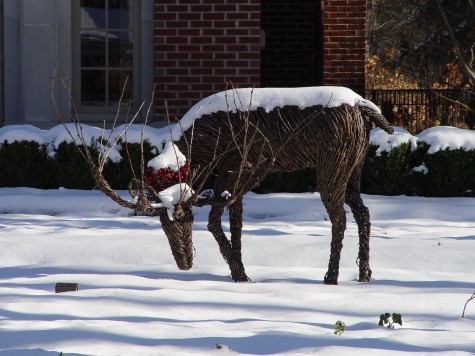 Though this stag looks perfectly at home in my client’s landscape, it is made in California. The metal frame will last a lifetime. The willow is painstakingly woven; the sculpture is heavy and sturdy. Carleen’s life size animal sculptures are enchanting. I have seen enough of them to recognize which of her artisans is responsible for a specific piece. This is grape vine, beautifully rendered.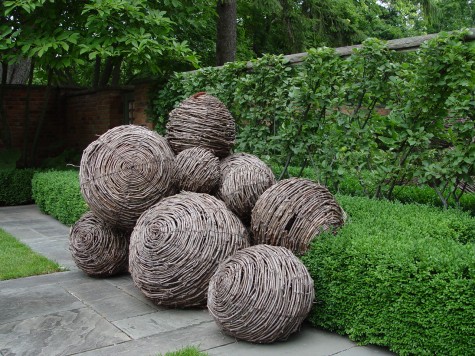
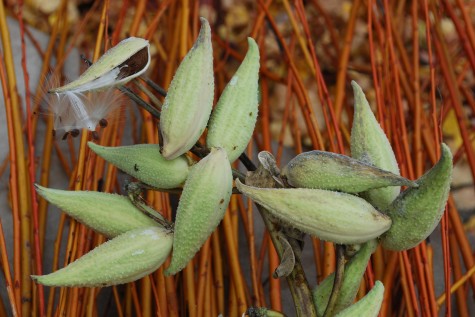
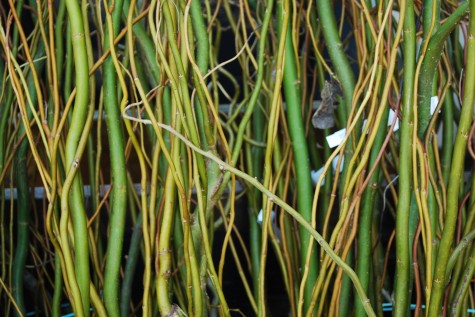
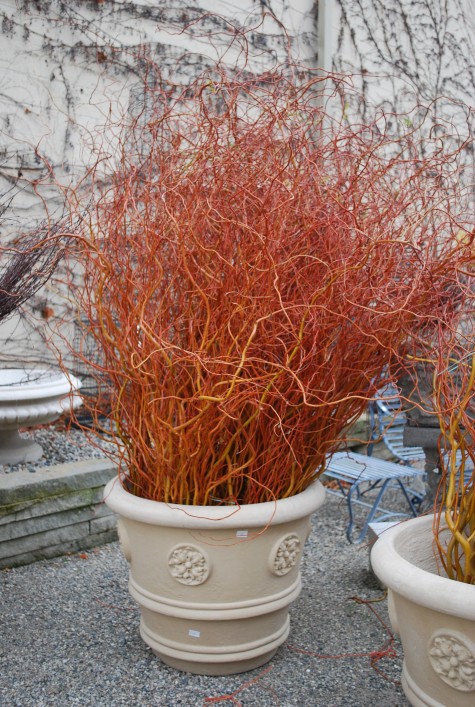
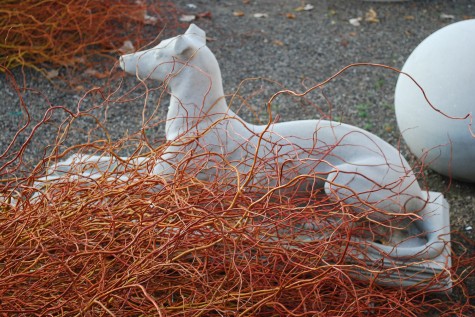 The golden coppery orange is a great foil for the landscape gone to black and white. The fresh branches are limber and pliable. The curly tops can be tied up in a good approximation of a pony tail, or twisted and tied into new shapes not necessarily natural, and perhaps more contemporary.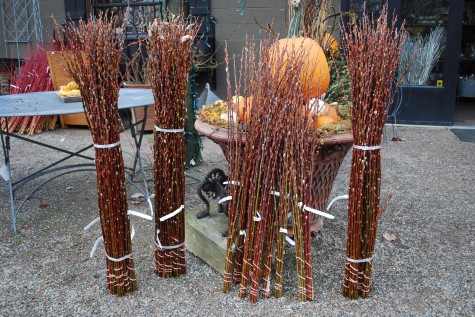
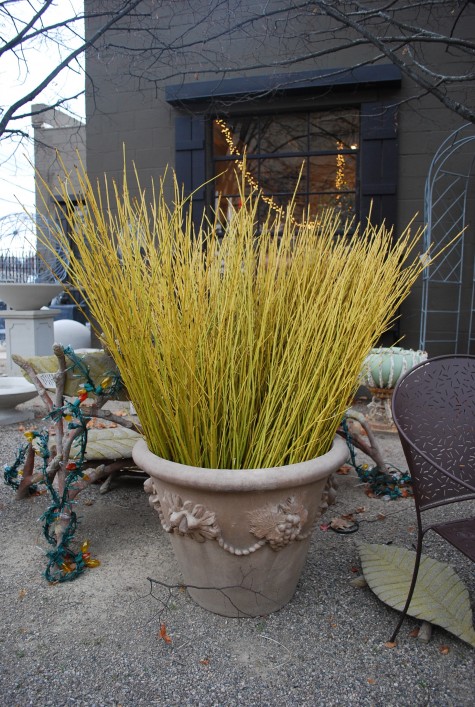 The shrubby dogwoods are every bit as useful as the willows. They also produce the best color on new wood. If you grow these dogwoods in your garden, be sure to prune them down regularly and hard. The old bark of shrubby dogwoods is dull, and invariably scarred by exposure to weather. I rarely see yellow twig dogwood planted any more-plants do go in and out of fashion. This cultivar was specifically bred for color superior to the species- and it delivers.
 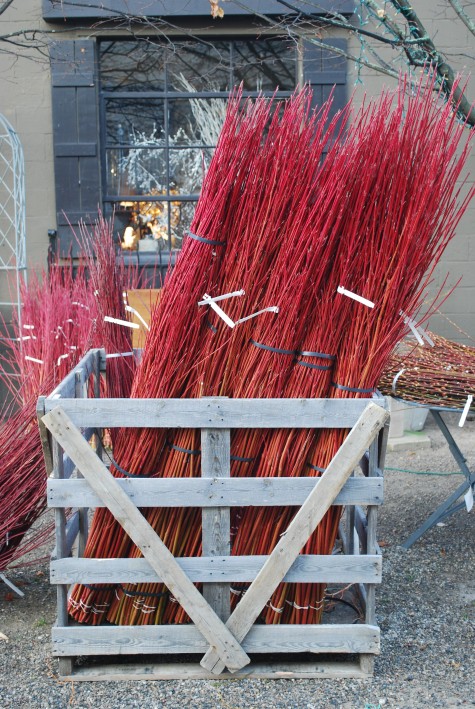 Many cultivars of red twig dogwood are available now. With bark ranging in color from pink-coral to coral, orange red, fire engine scarlet red, and maroon, these twigs make quick work of banishing the winter gardening blues. This cultivar, aptly named “Cardinal” is the brightest red bark I have ever seen. The 1500 stems in this crate makes me wish I could see the entire field from which they were cut-the day the leaves drop. I would bet that view is a perfect gardening moment.
 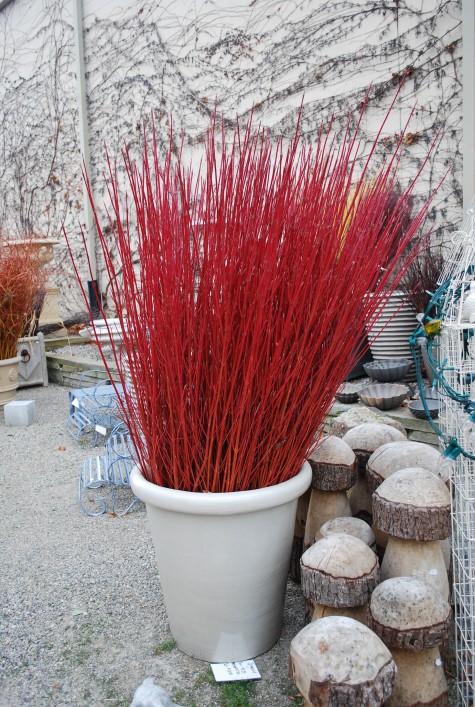 Whatever you might fancy, the dormant garden has plenty to recommend it. The gathering of materials, and the act of decorating for the cold season is an act of Mitchell-esque defiance I can get right behind.