Buck Week

I was remiss in one very important regard concerning the development of the Jackie boxes a few days ago.  They would not have been possible without Buck.  A Saarinen scholar in architecture at Cranbrook Academy of Art in the 70’s, a licensed contractor, and an architect and Director of technical design with Rossetti Architects for years-he agreed to come on at Branch.  He makes it possible for me to make the idea of beautiful objects for gardens a reality.  Though he has lived in Michigan for over 30 years, he is Texas to the bone.  He still has the accent; his southern style language can be better than colorful.  He loves anything that goes fast or makes lots of noise; this makes him a Harley guy.  Outside of this,  he is a very talented CAD designer, and an exactingly precise and formidably talented fabricator. He informs all of my design with a construction process that is solid, durable, true and square. And he is famous with me for having infinite patience,  as I struggle trying to put a good design together. I thought I should take some time to talk about some of the things he has made, and how he makes them. 
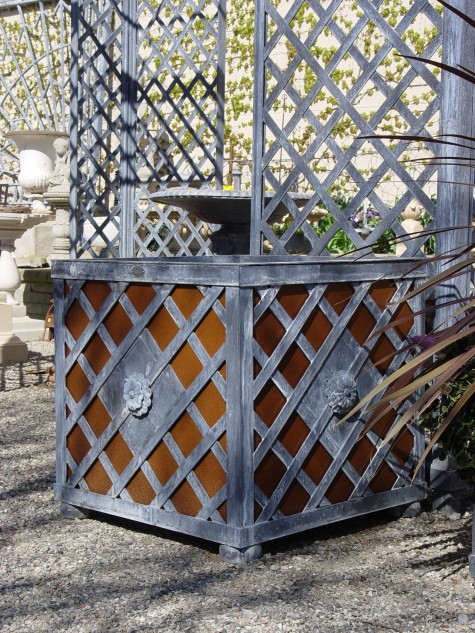
  
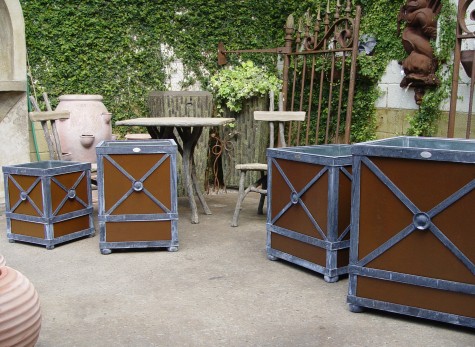
The Jackie box is by no means the only box we manufacture.  This lattice box with a diamond medallion and button is a complex box to make, though the general construction is very much the same as the Jackie box. He contructs the size of the lattice based on the overall size of the box.  The idea is to represent as many complete diamonds as possible, with no awkward shapes on the frame edges.  You can see in this three quarter view that all the partial diamonds match all the way around. The liner in this case is extira board varnished with marine varnish.  I like the contrast between the solid steel diamond, and the open latticework diamonds.  It is a detailed yet elegant box. Best of all, it is so perfectly contructed no one would notice the construction.  Buck has no interest in a slip that shows. 
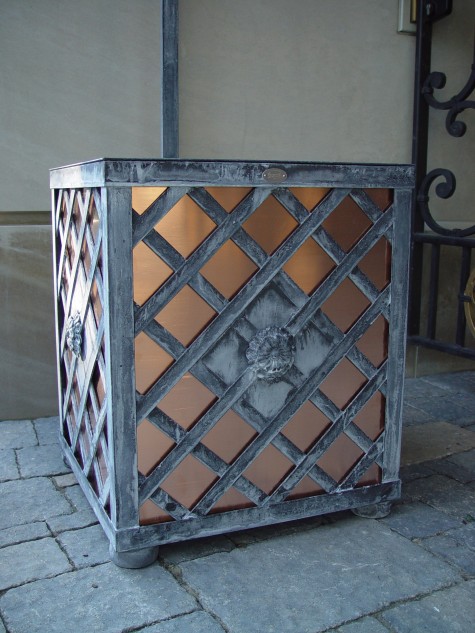
This lattice box, custom made for a client, has a copper liner. The look is much more formal than the extira version, but much the same warm color.  Special request from clients, he handles them like the professional that he is. He personally sees to every detail.  Every box is tig welded-by Buck.  He shepards them through the hot dip galvanizing process.  He acid washes them himself.  Every box we make-made by hand.  
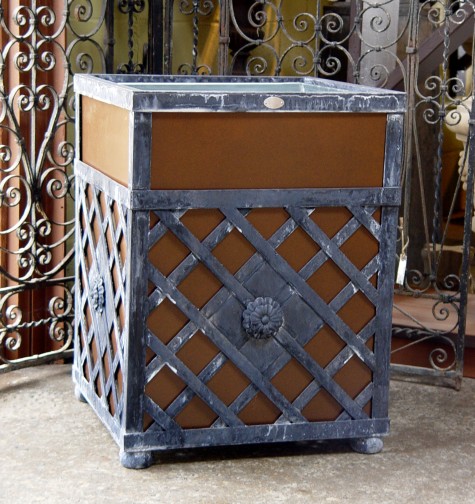
We did make the tall lattice box with the panel at the top; the intricate detail of the lattice welcomes and supports the plain rectangle at the top.  This rectangular shape does a great job of making a considerable statement at the front door. 
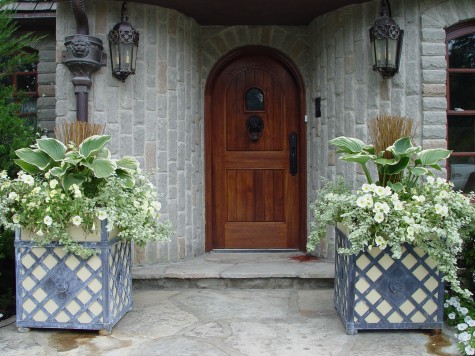
One season a client requested a cream yellow extira board panels.  I followed suit with a planting that celebrated that yellow.  In late fall, the extira boards got a coat of dark chocolate paint.  What made by hand gets you is the ability to update by hand.  This I like.
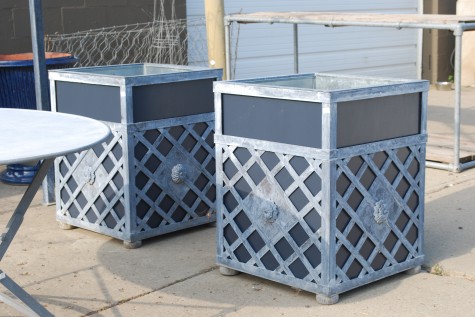
Our tall lattice boxes now sport extira panels in a dark blue grey.  This color so celebrates the color of the acid washed steel. A dark base color lends importance to the variation in the steel finish color.  Acid washing is more than unpredictable.  No matter how many tests we make, each run has its own character.  Should you like the variability of the color of lead, you will like this finish. 
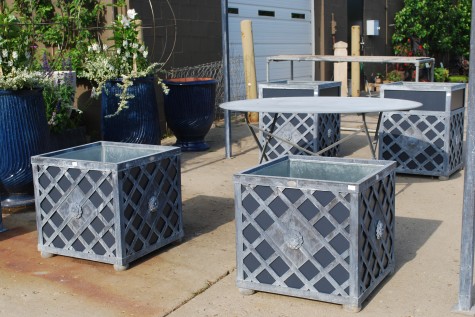

My Jackie box-I hope it is as reserved and beautifully formal as Jackie K.  Buck saw to all of the details.  The lattice box makes much of every gardener’s love of lattice,  and then some.  Every single box we have at the shop comes from Buck’s hands.  This week-I plan to celebrate that.  Buck week.
Sunday Opinion: Blue In The Face

When I was young, I had a dear friend named Margaret Dickson.  We met when I took a job working for Al Goldner at Goldner Walsh in the late 80’s.  She began as a client of Al’s-she went on to hybridize daylilies and plant annuals for him.  They went on to have a very special relationship the likes of which I had never seen before, or since.  I have no plans to discuss that; they have both passed on.  Suffice it to say, how they scooped me up and made it their business to school me-I was lucky.  I planted annuals on Margaret’s crew. That was just the beginning.

Al paid me 16,000.00 a year in 1984, with a 4000.00 bonus at the end of the year.  In 1985, a client of his who refused to pay 4000.00 of her bill-that bill got paid with my bonus.  I ran the crew on that job.  I recall I was more angry about some ill defined blame for some not really legitimate wrong being foisted onto me than I was about the money. The client was enormous maintenance, and astonishingly self centered and thoughtless.  The  shopping, the planting- a sonata in her honor.  She had no comprehension of the amount of work that went into trying to create exactly what she saw in her mind’s eye.  She missed the boat-plain and simple.  Our crime-the garden did not look mature when we finished.  I was taken aback to learn that not all gardens have a gardener in charge. What I learned from this was that some work needs to be accompanied by lots of discussion, so people are not disappointed, or taken by surprise.   Some work requires explanation, teaching-at the beginning, in the middle, and at the end.  When clients ask how long they should water their new boxwood-I say until you are blue in the face. I tell them that if they keep breathing regularly once they fell that blue coming on, they will be able to hold out even longer.  A strong finish is harder than a strong start-but you need both.   

   In retrospect, I think Al knew exactly what he was dealing with in me.  Though I would never dream of making any crew person working for me responsible for a disagreement about a bill, I learned something very important from him.  Relationships are difficult, and complicated.  I might spend my time time raging, or I might spend my time trying to make it all work.  The willingness to live through the blue in the face phase is an important tool I would not want to be without.     What I learned from the two of them about making things grow, and making relationships with clients grow, has stayed with me for a very long time. I feel their collective hands on, between my shoulder blades, encouraging me, every day.  This is my best description of what it means to have a mentor and a teacher. The 4k he nicked me-I got over it.  The money I spent restoring my fountain made my stomach churn-but that particular churning went away as soon as I had water.  The water representing that I come home to every day is what I think about.   

I digress.  This essay is really about Margaret, not money. Once I respectably survived working on her crew, she took me in.  She spent hours telling me everything she knew.  She had me over to not only tour her garden, but hear how she made it, what she chose to plant, and how she maintained it.  Her garden had lush hedges of Japanese painted ferns as a border; this I had never seen.  It was informal and rowdy in appearance-she knew when to stop fussing with plants, and just let them be.  She gave an extraordinary amount of time to me-how I loved her for this.  We became the best of friends.  Much late I weeded her garden when she was very sick and dying.  One day I visited her; she insisted she had seen a grey goose in her garden.  That would have been me.  March 29 of 1995, Margaret died.  Her funeral was held in a makeshift greenhouse on my property in Orchard Lake. I will admit I was so beside myself about loosing her, I was so beside myself about being asked by the family to speak about her, I drank two big glasses of wine at 10:30 am.  I spoke about her-who knows what I said.  I showed up at the appointed hour, and delivered.  I do remember half way through my talk, a big wind swept through, and showered all of us with water droplets from the condensation on plastic tunnel house roof.  I have no doubt it was Margaret, sweeping, brushing all of our collective grief away.  That would be just like her. 

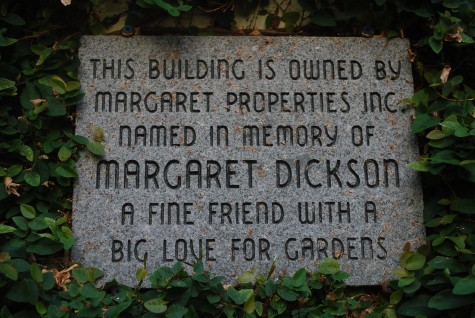
She made me put my name on a garden speakers list; she told me I was able to teach.  If you are able to do, you should, she would say.  She encouraged me to start my own business, and was after me regularly about opening a shop.  I opened Detroit Garden Works one year to the day after she died.  There is a plaque on my greenhouse wall; the company that owns the shop property is called Margaret Properties.  Many years later, I hold close how she taught me to water any situation until I am blue in the face.  Whether it be a client, a job, my own garden, or your garden.  Many thanks, Margaret.

At A Glance: What A Difference The Vase Makes

The Jackie Box

Who knows why I have never posted about my subsidiary company, the Branch Studio, but I will now. Five years ago or better I created a division of Deborah Silver and Company devoted to the creation and manufacture of fine objects for gardens.  A thirteen thousand square foot building houses a wood shop, a kiln, sophisticated welding equipment and all that goes with. a fabrication  studio. It has long been been a dream of mine-to design and manufacture great objects for gardens in a variety of materials.  Designing beautiful and functional objects is not easy.  Each object has a beginning, CAD drawings, a series of prototypes, a tuneup, and a number of revisions; there is an entire evolutionary process that goes on longer than I thought.  And longer still. Most everything can be improved upon, can it not?       

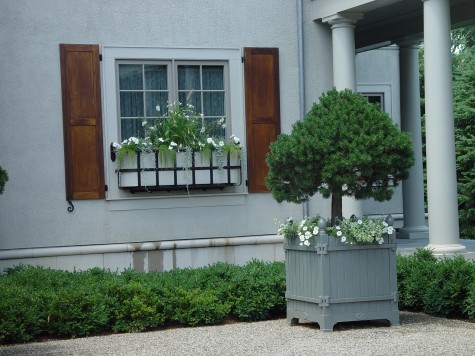
Not surprisingly, the first item on my design agenda-a box.  I have a long standing love affair with the garden box.  Some call them orangery boxes; the first image that comes to my mind are the boxes at Versailles, used to house an enormous collection of citrus trees.  I doubt most people feel their glass of lemonade is a luxury; sophisticated growing and shipping make it possible to buy a lemon for not so much money every day of the year.  But there was a time in northern climates when having oranges available to eat meant growing orange trees and wintering them under glass.  Giant boxes housing citrus trees were a feature at Versailles.  The Versailles box still made by Les Jardins du Roi Soleil-they made my heart pound 20 years ago and still do.  Manufactured of hinged wood panels, and cast iron frames, a fruit tree destined for a winter in the orangery could easily be slid out and moved indoors, while the boxes stayed put outdoors.  I imported and sold plenty of them over the past 15 years.  All my gardening life I have wanted to make beautiful boxes.  For boxwood topiaries, for trees, for citrus, for flowers, for tomatoes.  A well donebox can provide an elegant and generously sized home for a garden.

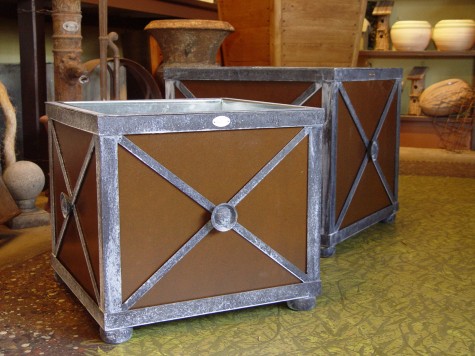
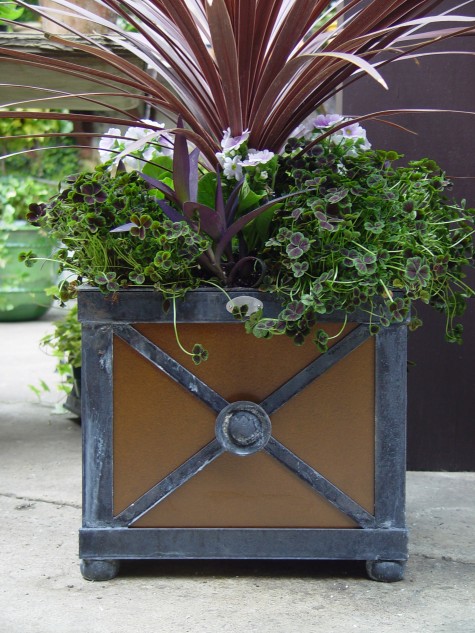
My first box design-the Jackie box.  This classic box with an X detail celebrated by a button of note-inspired by Jackie Kennedy. Her fabulous Oleg Cassini suits featured big buttons I will never forget. I am not the only one who admired her great style. Her suit buttons are so much a part of my history, and so much a part of what I admire about design. These buttons were jewelry integral to the overall design of the suit.  Though I have not one bit of interest in clothes myself, I admired Mr. Cassini’s design work, and the iconic Jackie Kennedy.   My first Jackie boxes had extira board panels-a favorite of sign companies; these panels do not absorb water.  They could be left to weather, be varnished like the panels of a Brownie camera, or painted. 

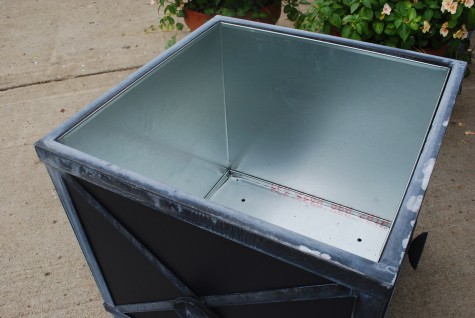
Though weatherproof, each Jackie box has its own galvanized metal liner, and a removeable steel frame sitting on top that provides the illusion of thickness, and finishes the top edge with a wide band of steel.  Welded to the bottom, bun feet know in the metal industry as squashed ball feet. A citrus tree could be lifted out of the box in its galvanized liner, and wintered in a conservatory.


The first variation on the Jackie box-a tall box with a rectangluar panel at the bottom. We also made a series with the panel at the top-but I like this version best. The tall box has a much different feeling than the square. It is no surprise that geometry has visual cache, but shapes have an emotional component as well.  Some squares are pleasingly solid and formal-others can be stodgy-funny that.  Part of the design process was selecting sizes and proportions that are heartstopping, not sleepy.   

I grew up designing objects at the same pace that the Jackie boxes evolved. The brown extira board was certainly durable, but this brown is better on a UPS truck than a planter box.  These painted extira board panels were a reference to the shutter color on the house.  This was the decision of the client, and her interior designer Lucy Earl-it would not have been my call. But I was surprised how much I liked the end result-the colors of the flowers I have chosen have everything to do with the blue of this box; it was much too strong to ignore.  

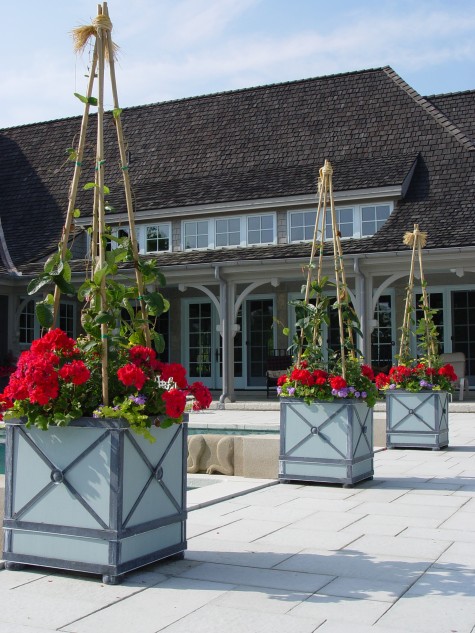
I did however take a cue from those blue extira board panels.  We now paint our boxes for the shop with Porter exterior acrylic paint.  It is amazingly durable.  This color, a darker blue grey than the steel.  The painted extira panel has finally come into its own.    

This small Jackie box was made with steel in smaller widths, and a smaller buttom. Scaling a design up or down requires looking at the dimension and thickness of every component.  Lots of things seem obvious now that were not so obvious at the beginning.    

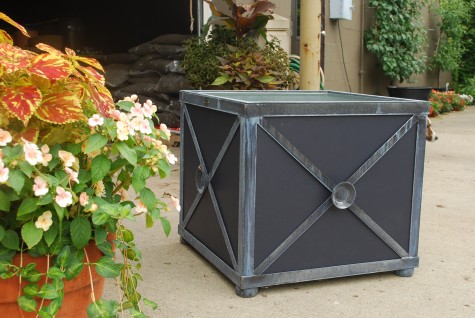
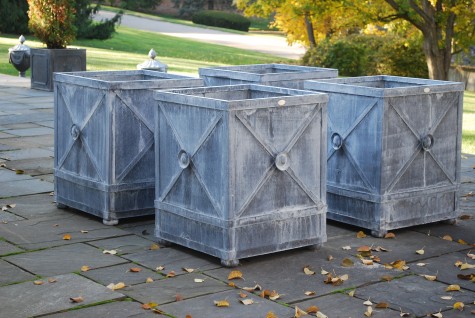
A beautiful box-I have been after that design a good many years.  We are now making the Jackie box with solid steel panels.  I think it is a good looking box.  Given the currently astronomical price of lead, I think this steel and its finish provides a viable and handsome alternative to that classic material.  Judging from the orders we have filled this season for Jackie boxes in a number of sizes and panel options, other people are starting to think so too.  I have a pair of Jackie boxes very close to finish-38″ by 38″ by 30″ tall made with 1/4 inch thick steel-to be planted with flowers.  I cannot wait.