Breathing

Every living thing breathes. Seals, beavers, dolphins, people, birds-and leaves. The act of taking a breath is an elemental description of life.  I know when I have a bad cold, my breathing is obstructed; challenged.  I am ready and able to take on any issue-but key to my energy is my ability to breathe in and out. Plants do the same thing-but in the winter, that rate of transpiration slows down.  A loss of moisture through the leaf cannot be replaced when the ground is frozen.  Plants go dormant in response to this-but the evergreens are still open for business.  Seeing that evergreens get adequate moisture is an important fall job, as I the time will come when moisture loss cannot be replaced. This Michigan winter seems to be settling in early. This thicket of boxwood pictured is enduring considerable cold.  This morning-14 degrees.    
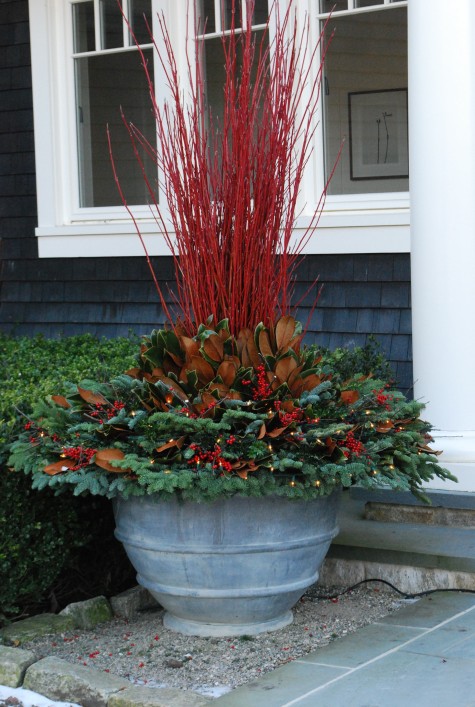
My holiday and winter containers revolve around live materials.  In this instance, Cardinal redtwig dogwood, magnolia stems and leaves, cut noble fir, and Michigan holly-ilex verticillata.  This giant Bulbeck egg cup-lots of materials are asked for. I think we did a great job of answering.  My winter design for this beautful lead egg cup-generous.  But pretty and generous aside, there is a job to be done. Hopefully this composition will stay fresh looking for the winter months to come. 

Michigan holly berries usually fade and rot when the temperatures go below freezing.  Unlesss you have a mind to intervene.  Newly planted evergreens and boxwood-I spray them with an anti-dessiccant late in the season.  Wiltpruf has for years been the anti-dessicant of choice.  This waxy substance slows the loss of moisture from evergreen leaves and needles.  This can help prevent winter burn.     

For the first year, this year, I researched a new anti-dessicant called Vaporguard.  I was impressed that newly transplanted cabbages treated with vaporgard showed no sign of wilt.  I wondered if it might help cut greens and berries to better retain moisture.  This cut Michigan holly, treated with vaporguard, seems to be holding just fine. The magnolia leaves will eventually loose all of their moisture, but they dry beautifully, and hold tight to the stem. 
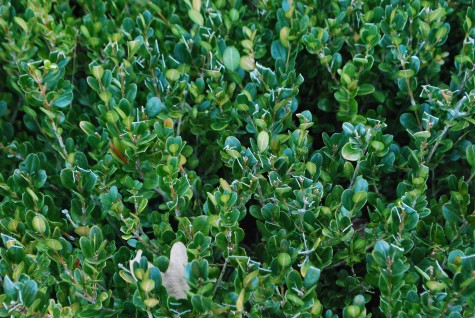
These boxwood are located in a fairly protected location.  The house does a good job of shielding them from winter winds. Though their growth began slowing down in August, how well they winter can be helped by an application of antidessicant.  Even when it is very cold, sun and wind can accelerate the evaporation of moisture from leaves. 
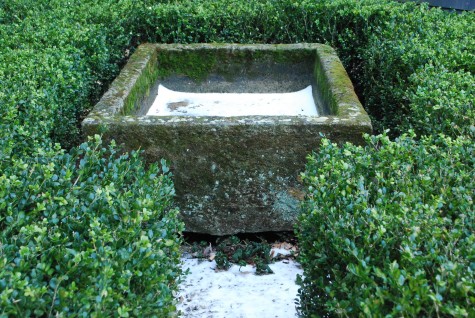
These boxwoods have been sprayed with antidessicant for the winter.  My idea is to protect them however I can. Though these plants have been in the ground four years now, I am never sure what the winter might have in store.  Since they are a major feature in this landscape, I am hoping to avoid widespread trouble in the spring.  


This is the first year I have ever included bunches of Michigan holly in my winter and holiday containers.  The berries seem fine and fresh, and show no signs of dropping from the cold.
Awl In

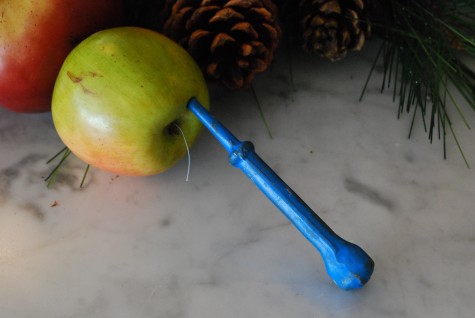
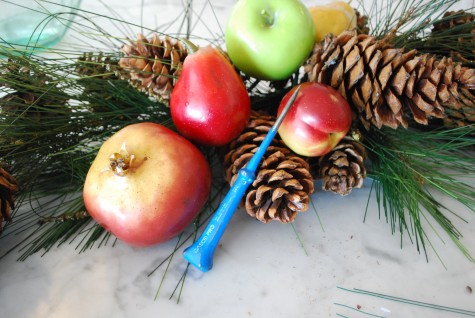
I did mention a few days ago that Buck graced me with a Christmas tool kit full of tools I had never heard of-just last year. I have had occasion this week to make use of one of his choices- a small blue tool called an awl. It makes holes.  Much of what I do at the holiday involves fastening; the ability to make holes can make ther process of attaching one element to another go fast.  My faux fruit is heavy; a solid core has a skin of some rubbery material.  How to fasten it to a banister garland or wreath involved some trial and error.  Awl in hand, I went to work.   

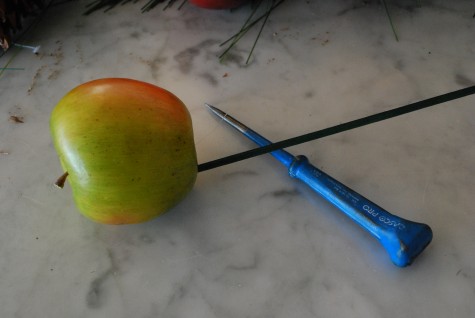
No florist’s pick is strong enough to penetrate the skin of this fruit.  My awl, armed with its long sharpened steel shaft pierced that skin without a problem.  Visualizing where that hole should be punched is not that tough.  I placed the fruit in the position I needed.  Any heavy hard cored, soft shelled thing that needs a hole and a slot substantial enough to attach it to a garland-it made sense to run the awl up the side of the fruit.  I hope I am explaining this clearly.  

I buy 18″ florist’s picks by the bale.  I have no idea what they are made of, but they have the strength of a kitchen skewer.  I was able to insert a length of pick just about the length of the fruit.  This apple is at least as heavy as the real fruit. As my holiday garland will be displayed in the air, I wanted to be sure that faux apples would not be raining down from above. A skewer every bit the length of the heavy fruit-I have leverage. 

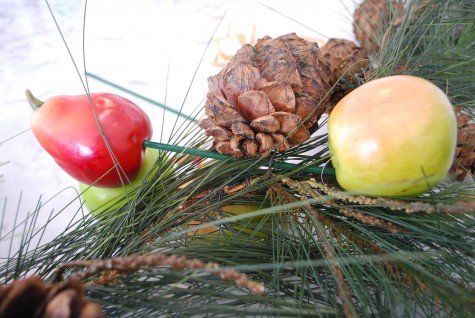
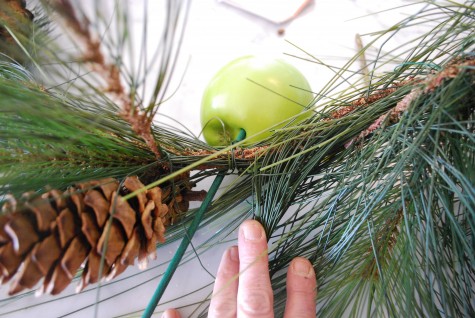
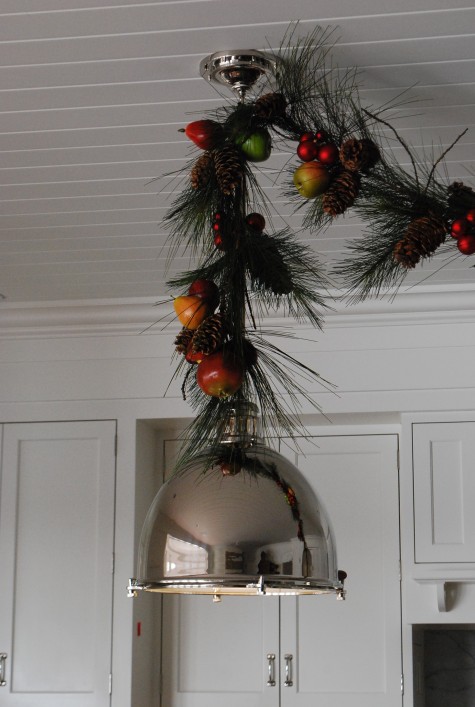
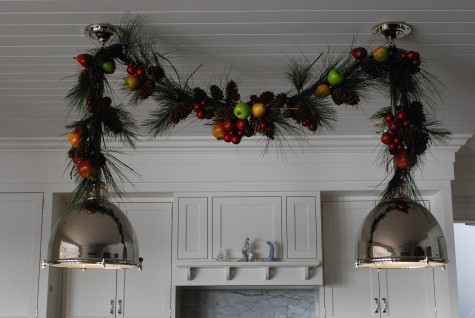
A faux white pine garland wired with large cones is the base of this holiday garland.  The garland is not going on the mantle, or above the front door.  The plan is to hang the garland in the kitchen.  I have made a note to think about this for home.  Buck and I spend a lot of time in the kitchen-on our own or with guests.  Why not decorate it for the holidays?  Hmm.  My florist’s pick-I have a fruit at each end, threaded through the wire of the base garland. A lighter fruit at the top, the heavier apple at the bottom.  Naturally.     

This pick with a fruit at each end still needs to be wired into position.  If you have a place that needs faux garland, pass over the flat plastic cedar fronds.  Faux white pine needles provide great volume up front.  Those bristly needles are sticky happy to capture whatever you might add.  The green floral wire needed to attach ornament to to the garland-a dead ringer for the white pine needles.  I like a construction that isn’t fussy, but looks effortless.  

Once my fruit is secured, picked, and wired in, I need to add a distinctly holiday element.  I am a fan of plain holiday ornaments.  I can be a little more fancy-let’s have those plain holiday balls in a number of different sizes. As in berry clusters.  The matte red surface of these small ornaments makes my picked fruits shine.

The stainless steel lights over the sink take well to a little holiday garland.  Why not?  I have ideas, rules, and much to say about garden and landscape  design-all season long.  Frankly, sometimes I make myself weary.  At the holidays, I like to be less concerned about fine design, and more concerned about the simple pleasure of the season.  My distinct pleasure today-my awl. 


A kitchen ready for the holidays-so swell.

The Holiday Mantel


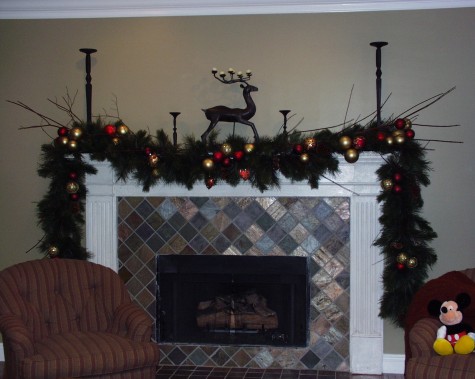
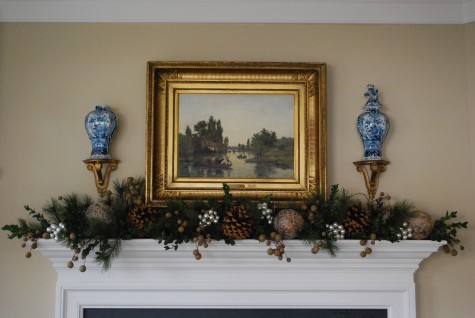
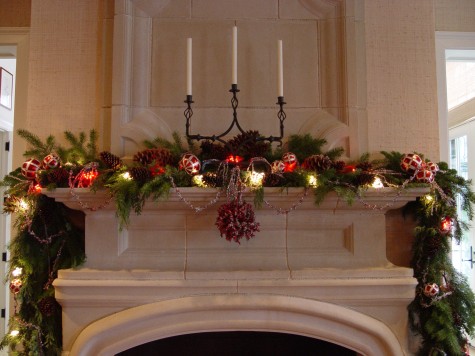
I have no idea where the tradition of decorating a mantel for the holidays came from.  Perhaps people gathering at a cold time around a roaring fireplace made the fireplace mantle visually important.  Everyone knows the chimney is Santa’s portal-why not make it festive?  I do know that the fireplace mantel is an ideal place for collections of all kinds.  Small objects that need an elevated shelf to be seen, objects of personal or family importance-a mantel can be home to all manner of objects that please, or represent a point of view.  My mantel at home changes whenever the mood strikes me.  There are times when it is empty, and times when it is piled high.  But however you treat your mantel at the holidays-formally or traditionally, as in this mantel-there are construction issues.  

A mantel is a very long, and very shallow space.  It is but one shelf-there are no changes of level built in.  A holiday garland whether fresh or faux weighs plenty.  How to keep it on the mantle and off the floor comes first.  In this case, four very heavy bronze candlesticks provide an anchor for the garland.  Not interested in candlesticks on your mantle?  Drive a series of small brads into the wood mantle surface near the wall, or in the wall.  Appalled at the idea of driving nails?  Lead weights, or bricks can anchor your display, and be invisible.    

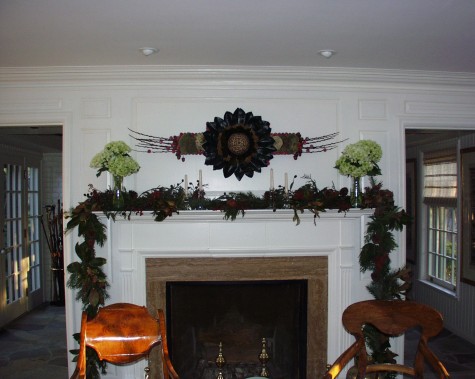
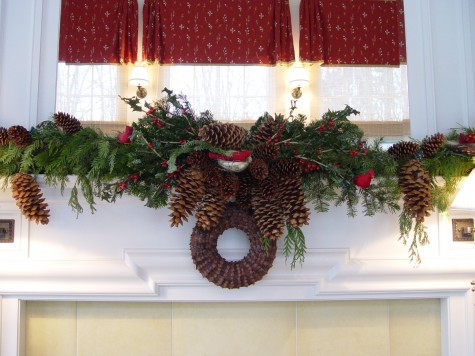
Sometimes a holiday mantel calls for a holiday expression on the wall above it.  I find I focus much more on the white rectangular space above a mantel, than the mantel surface itself.  If there is a print, painting or mirror above that mantel, perhaps it could be included in the mantel treatment.  These clients have a considerable collection of native American art-the magnolia and pussy willow holiday medallion was designed and fabricated in that vein.   


The designer Ann Heath, whom I greatly admire, told me just a few weeks ago that she likes holiday decor on the mantel that does not trail to the floor. A horizontal expression-only. I have this idea under consideration.  This holiday mantel treatment is very formal and low key-much like the room. I did the mantel surface only-no trailers.  The picks and pieces are secured to the mantel via 3 coulter pine cones.  Coulter pine cones, the largest, and most certainly the heaviest of any pine cone on this planet, are the ballast for this display.  Faux white pine picks take easily to cut stems of German boxwood.  Bark ornaments and pearl ball clusters weigh next to nothing-the stiff bristles of the white pine help hold some elements aloft.  My recommendation for mantel decor-build up to some height.  Come out away from the wall.  A mantel decoration may be long and thin, but it should be as three dimensional as you can manage.  

Pine cones look like they belong on the mantel.  They are just one of many of nature’s beautiful objects, but they shine in the winter months.   I collect them from the park next door; I buy them from Oregon, California, and North Carolina.  Their shapes are beautiful-no matter the evergreen from whence they came.  The story and the science of the production of cones-astonishing.  The science aside,what gardener does not recognize them as naturally beautiful objects asking for a holiday home.  The more, the better.   

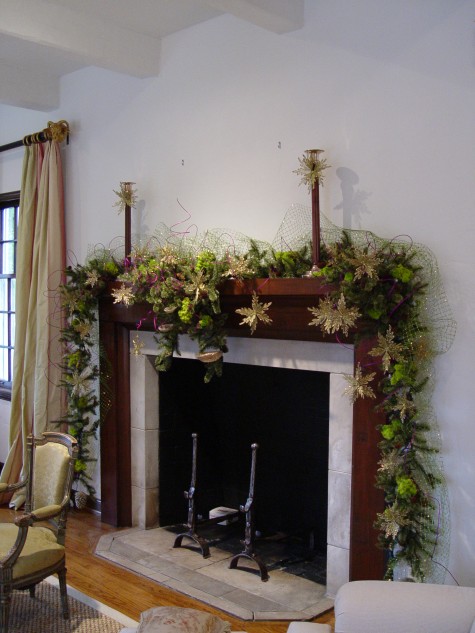
I have in my mind’s eye a mantel overflowing with cones, seed pods, fresh greens, grapevine, bird’s nests just collected once the leaves fell, rose hips, grasses, twigs, bracket fungus-the mantel that is the forest floor.  But there are those who have a different point of view.  Lime green glitter net, lime moss, purple anodized wire-stars from gold wire wesh-this mantel is a smart and sassy holiday dress all my client’s own.  She chose the materials.  From what I know of her, she has a holiday mantel distinctively all her own. I admire the effort anyone takes to express themselves.

Not everyone has a limestone mantel and fireplace surround.  But everyone has a home and hearth worth celebrating.  Get dressed-it’s the holidays.   


No matter how or how much or why you garden, you have something to say all your own.  The holidays are inviting you to speak your peace.  I will be lucky to get the house decorated before Buck and I celebrate our Christmas on Christmas Eve.  But I will give what I have to see that we are ready.  The mantle-what I will do do this year, I have no idea.  No matter-I am looking forward to it.

Sunday Opinion: The Borrowers

In the course of one day, my pruners (labelled with my name) may move from my tool box to my desk, to the work table in the garage to the counter and on to my layout table in the office; I might find them several days later in my purse.  Or in a cardboard box out back.  How is it that this tool travels?  My Joyce Chen shears are small-they vanish from under my nose, and may appear a month later in my junk drawer at home. Later Buck might fish them out of my jeans back pocket. I have a floral supply bureau-it is home to corsage pins, floral tape, wired picks, stephanotis holders, bout tape, and fern pins.  Why do all of these things seem to leave home under their own steam, never to return?  Are they on vacation?  They will reappear at some later date-invariably down the street someplace. 

I have both of my Mom’s 1950’s blond mahogany dressers at the shop-I store my ribbons in it.  I store the bits and pieces I cannot throw away, the embroidery floss, my Mom’s embroidery needles still stored in their pierced paper card, a button box. A collection of rolls double faced satin ribbons-a treasure. I always have lime green on hand.  The red, the fig, the cream white, the purple-I like these too. Narrow velvet ribbons backed in satin, small spools of hand dyed silk ribbon, wired metallic ribbon-four drawers of them.  I use them on occasion for parties, weddings, and events-I did put some of them in the shop for the holidays.  This does not account for the red satin ribbon I saw on a bench in the greenhouse today-how did it get there?

My tool kit was a Christmas present from Buck a few years ago.  Wire clips, utility pruners, a girly hammer, big pliers, needle nose pliers, tweezers, a hole punch, utility shears, a slew of screwdrivers both slotted and Phillips head, a hefty 25 foot tape measure-tools I never knew existed he put in my box.  An addendum to the tool box-a small battery drill and a Dremel tool with all the bells and whistles.  That kit is the home base of a central nervous system that makes it possible for me to transform an idea into an object.  I am certain those tools get up and go out at at night-who knows where they will be in the morning. Gathering up the tools is the first move I make in the morning.

Some projects defy completion without the proper tools at hand.  My Niwashi traditional tool is Japanese designed and made.  Its angled blade makes short work of grubbing out roots and weeds, and turning soil.  After I use it, I wash and wipe the blade clean.  It is my favorite garden tool-how would you know that?  I always know exactly where it is.  It is always where I last saw it-which is where it belongs.  My rubber rake, my spade, my trowel, my five gallon weed bucket-these things might be anywhere.  Who would want them, besides me?  Sooner or later, they hitch a ride home.

My digital camera is one of my most valued tools.  A picture of a pot I want redone for winter, a garden I need weeded and staked, a tree I need lighted-the pictures tell the story better than I could.  Pictures that I print at 7 am I cannot find at nine.  Where do they go?  They might be outside next to a barrel full of redtwig dogwood.  They may be on my layout table.  They may be stuffed into my coat pocket.  Some vanish without a trace-I suspect they just picked up and inexplicably moved to Indiana.  I reprint the pictures.  Some pictures come back to me with the daily job report.  These pictures have absorbed every ounce of water from the wet hands that handled them.  These blurry sheets in the file-Monica deals with them without comment. She has infinitely more dignity and aplomb than I-where were those pictures today?  Clearly not in the truck.  In the bottom of a bucket, under a wet sleeve-on the job.

I make 5 by 7 cards for every job.  The card stock is sturdy.  I tack each card on my cork board.  Should a card come off the board, and travel to garage-trouble.  Those floating cards move in and out of my view-and my grasp. A job card on the loose-this I dread.  Who takes those cards off my board, and tosses them into the atmosphere?  Where did I leave my keys?  I know I was working on a vignette in the shop-where did I set down my coffee cup?  Where did I plant that start of European ginger? Did I plant tulips here-or over there?  Did I not order up a family of handmade life size grapevine deer-where are they?

 Christine Jamieson has worked the weekend shift for me for many years. A Brit through and through, she never blinked when I expressed my exasperation about the disappearance of my Joyce Chen shears.  The borrowers got them-she said.  The borrowers?  Who knew; a series of childrens books by Mary Norton-the first of which was published in 1952-posit the existence of the borrowers.  Little people, unbeknownst to humans, live in the floorboards of the homes of the big people.  They borrow whatever they need to survive, unseen by people of my size.  I like this story.  The borrowers-they must be moving my tools around in the middle of the night. They must need to fix or construct something.  Maybe they are bored, and like seeing me seach 10,000 square feet for a pair of shears.  They provide my life with a little challenge I did not plan on.  What could be better?