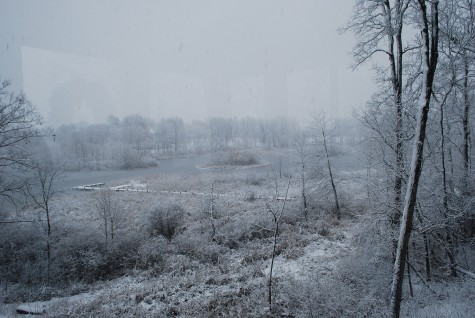
Winter White

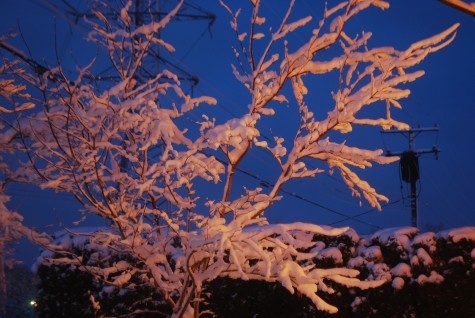
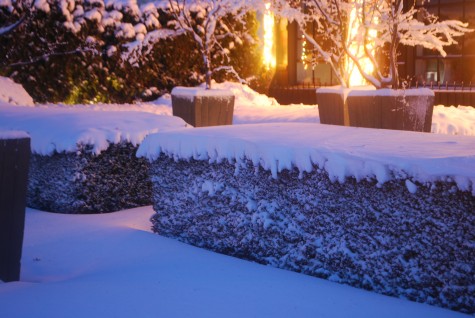
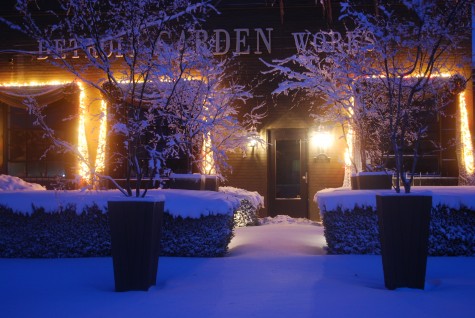
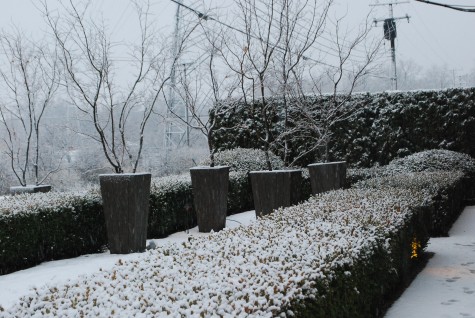
If you live in Michigan, white figures prominently in your winter landscape. On sunny days, this is a blinding white; on gloomy days, a blue/grey white.  Chilly.  White in the spring or summer landscape can be fresh and crisp; this is a white of a different sort.  Our first snow fell fast and hard.  The temperatures were actually above freezing; that snow stuck to everything it touched.    
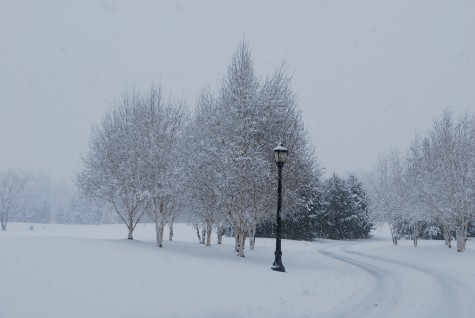

Driving was a challenge, but I am so glad I got to see these Himalayan white barked birch in a winter setting. I landscaped the common areas of this community a good many years ago.  The birch planted in irregular drifts are paired with scotch pine, placed in a similar fashion.  I like these two trees planted together.  The stout long needled evergreens are a beautiful foil for the wispy birch.  A green and white landscape.  This day, the white clearly had the upper hand. 
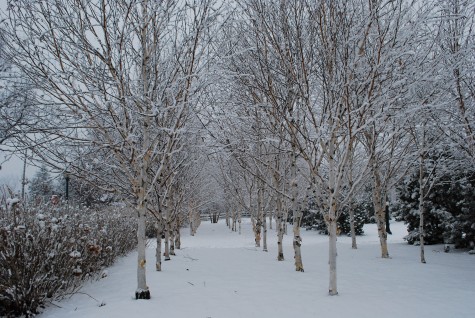
The birch are planted in a large square picture frame around the entrance building-three trees wide.  Planted on 12 foot centers, the lacy branches are beginning to meet overhead. My favorite part of the winter landscape is the ability to see the structure of woody plants.  Though I am unhappy to see burning bush and the like pruned into artificial shapes, the winter look of this style of pruning is interesting.  The overall shapes that many branches make can be be quite striking.     
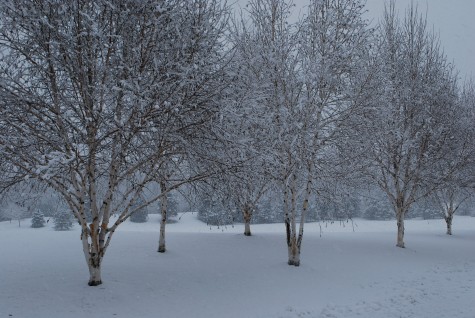
These birch were planted in a loose grove, and left unpruned. The landscape is quietly beautiful on a snowy day. 
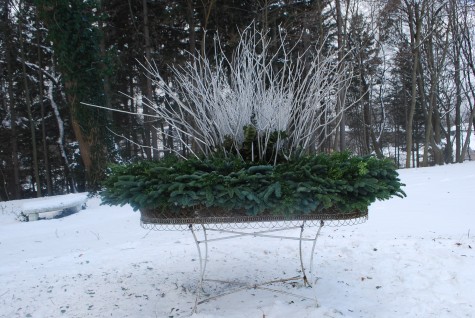
I use lots of birch branches in winter containers.  Their graceful and very twiggy appearance is in sharp contrast to the pole like stems of the willows. I am able to buy them from a farm in their natural state, and as lacquered natural branches.  That shine is useful in some places.  The branches are also available in a variety of colors-including white.  For the holidays, they are available in platinum, silver and gold.  This English antique oval wirework planter is 5 feet long, by about 30 inches wide-large.  A long and dense centerpiece of white birch branches and green eucalyptus was good with the length of the planter, but this composition needed much more in the way of height and scale.    
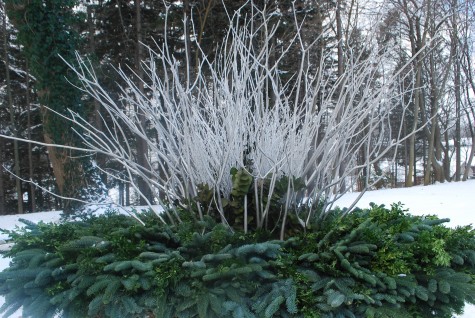
The long smooth branches-silver painted manzanita.  These thick and sculptural branches were individually set around and over the inner centerpiece.  Silver in a snowy setting such as this reads much like white.  A planter of this size benefits from a mix of greens.  Boxwood and noble fir contrast in color and texture.  This mix helps keep the surface of this container lively looking. 
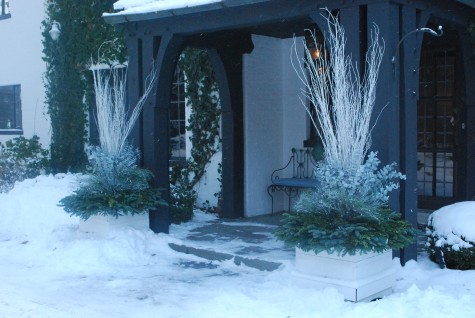
Tall white birch branches and white frosted eucalyptus make a substantial statement in these square white wood boxes.  A layer of faux snowy white pine picks add another layer to the centerpiece.  A wide and low planter asks for some bulk around the middle.  
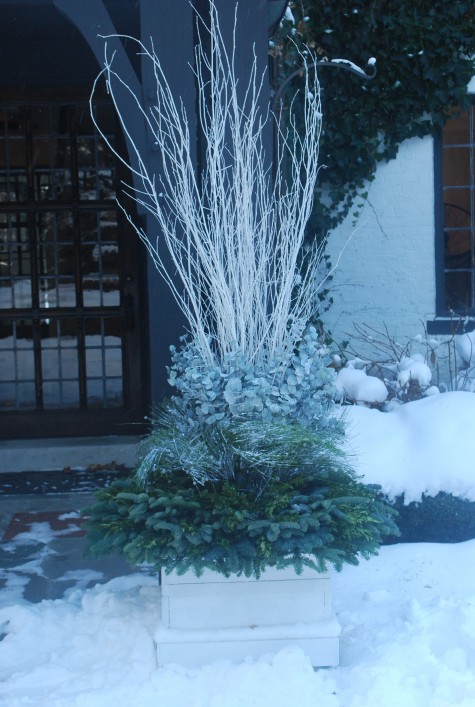
The faux branches have a windswept look that takes readily to a placement outdoors; they are convincing.  Low and layered evergreens in the same mix finish the composition.  Even on a very grey day like today these boxes have a festive winter look.
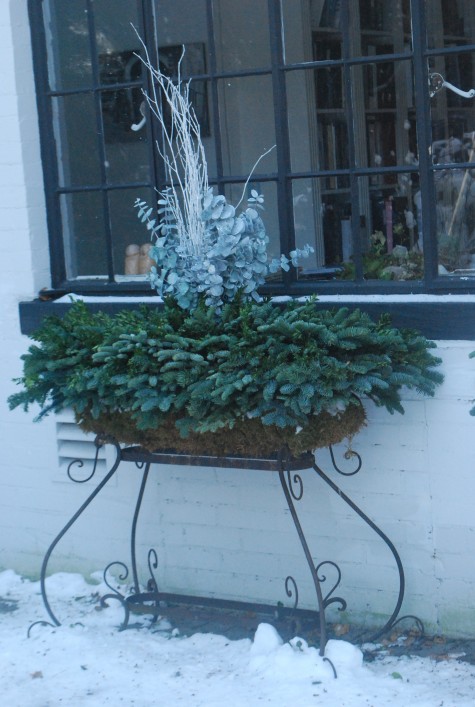

A small wire work planter gets a similar treatment, but in a wispy and scaled down way appropriate to the style and size of the planter. My client likes green and white, summer and winter.    
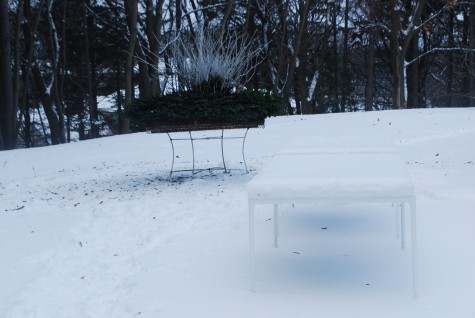

White will be the predominant color of the landscape here for months to come; this white wirework planter needs the green as much as it needs a large scale white element.  The white dining table overed in snow on this terrace- barely visible today.
Deer In The Garden

The idea of sculpture in a garden greatly appeals to me.  Not that I mind museums.  I was taken regularly as a child. If you pushed me, I could describe certain rooms, paintings and sculptures at the Detroit Art Institute fairly accurately.  The medieval sculptures of the saints-my Mom could never figure out why I always wanted to go there first.   As an adult, in my top ten list of most memorable experiences include the Caravaggio exhibition at the Met in NYC in 1985, and the Lucien Freud exhibition at the Met in 2000.  Unforgettable.  These  exhibitions were worth driving to New York to see.

But given my choice, I would prefer to be standing in a meadow over a museum.  In a gully over a gallery.  An art object that keeps me company outdoors-this I really like. I have seen Henry Moore sculptures outdoors in both private and public collections.  In the mid 80’s I lived in New York  just one block from a Richard Serra sculpture-not that it moved me particularly.  But there it was, in the landscape. The lion sculptures outside Tiger stadium delight both the kids and adults that see them.

This is all by way of saying that I have had exposure to fine art in museums, galleries, private homes, and parks.  I happen to believe that fine art is all around me, outdoors. Lots of that-courtesy of nature.  Shopping for a client recently, I parked my car near a row of mature Bradford pears wreathed in nut brown fruit. I had never really looked at that fruit before.  If you are the person that was waving me out of the road that day-I can only say those trees laden with fruit stopped me in my tracks.

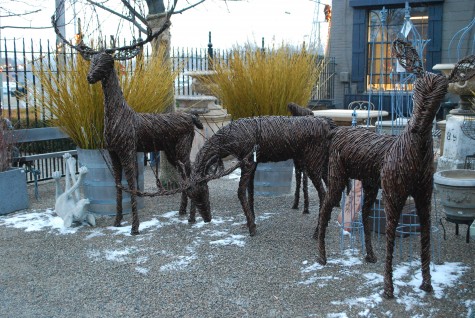
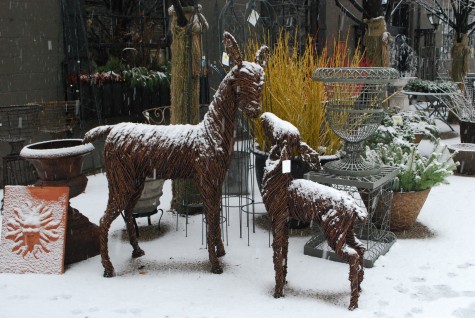
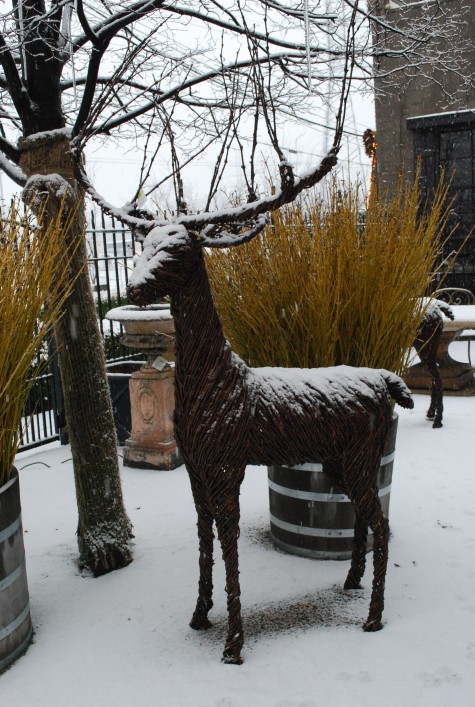
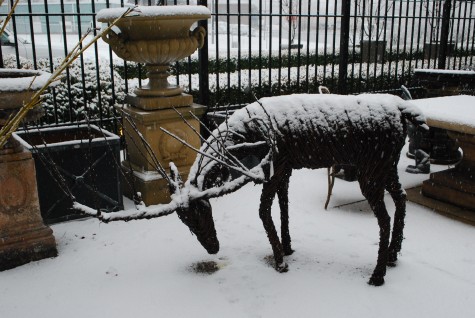
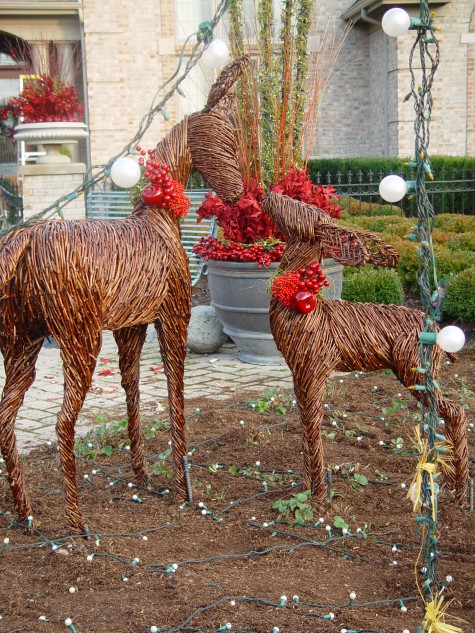
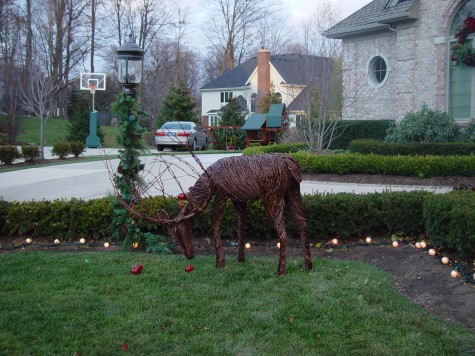
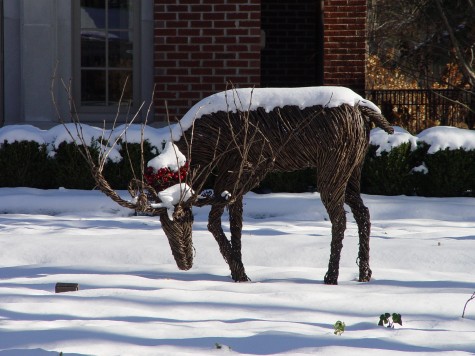
A Henry Moore sculpture is not in my future-no matter.  Sculptures made from grapevine would fit right into my garden.  These life size grapevine deer are made in California-woven over steel armatures.  The standing Buck, the grazing Buck, the doe and the fawn-what garden does not have room for one, or a group of them?  Some may say they are craft-and they are finely crafted.  But I don’t find the need to make that distinction.

Some sculpture might never be at ease in a garden.  But these grapevine deer seem to make themselves right at home.  I suppose that is as much about the material as it is about the subject matter.  Grapevine is a wiry and sturdily independent material.  How this California company manages to make sculpture from rigid welded steel forms and wild vines-astonishing.  Grapes grow independent of your issues, or mine.  Constructing sculpture from  such a willfully uncooperative material cannot be that easy.  No grapevine grows parallel to its neighbor.  These deer sculptures may not be within shouting distance of a Henry Moore sculpture, but they please me.

Sculptures such as these easily accommodate a little holiday decoration.  Each figure is hand made, and assembled by one artist from start to finish.  The grapevine is thoroughly sealed to prevent the vine from deteriorating.  This needs be be repeated once a year.


If I had to have a deer in my garden, this would be my species of choice. If you have an interest in acquiring one or many, we do stick them at Detroit Garden Works.   The Grapevine Deer

In Progress


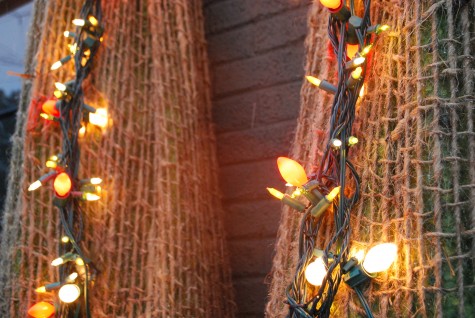
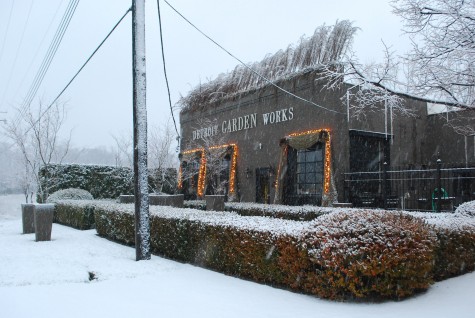
It is great fun for me to outfit the front of the shop for the winter.  I can do the work in bits and pieces.  I can change my mind, or change direction. I do it up as little or as much as I want.  I spend lots of hours at work, so I have time to look at it and think.  It is still dark when I get to work, so I see what it looks like at night.  Though I hate like heck repeating myself, I did drape the windows with burlap again this year-that’s how much I liked the look. Those went up weeks ago, before the winter work rush. 

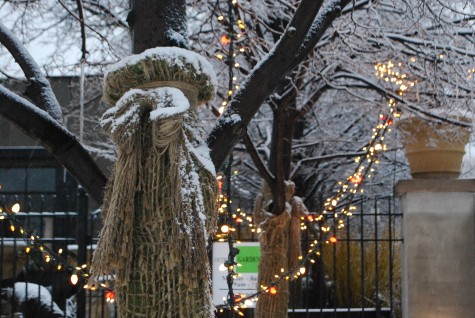
 Jenny and Pam wrapped the trunks of the linden trees.  Given the recent temperatures of 7 and 8 degrees, this not only looks plausible, it looks like a good idea.

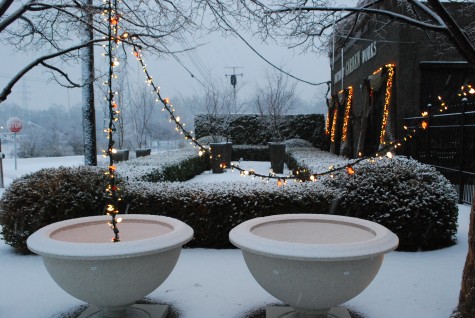
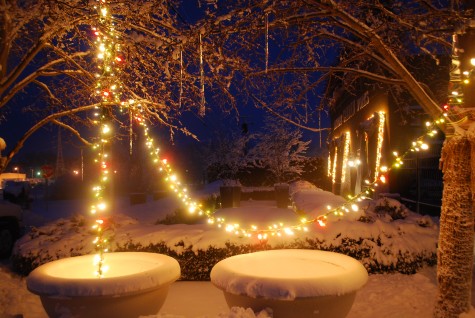
Steve and his crew hung the drapes, and made the light garlands.  What started out as white orange green and gold lights are now white, gold and red.  I seem to be in the mood for red.  Part of that inclination comes from an unexpected source.  A client who purchased a new home was not so thrilled with the 17 trees jammed into a small urban lot. A number of them were Japanese maples, impossible to transplant.  Though I am not a big fan of Acer palmatum, it was hard enough to chop them down, much less pitch them out.  So those tall branches have a home in my 6 pots out front. Red-leaved Japanese maples branches-what can I do to honor them?

This picture should make obvious that any gesture in the landscape needs to be a substantial one.  This looks for all the world like I just barely got going-which is true.  I am thinking a little red would do this scene a world of good.  Red in the landscape tends to read in a very subtle way-so I am also thinking that whatever red I plan to put here needs to be a lot.       


Everything in sight has that bronzy brown hue; even my boxwood goes orangy brown with cold weather. It is beautiful, in a very austere way.  There are months ahead where austere will rule-I am not ready for that yet.    


The lighting adds a lot of color and sparkle, but I did not have a good idea about how to introduce daytime color until a few days ago.  Rob and I have had discussions on and off this season about the problem of berries.  Berries in a winter landscape sound great-but the choices are not so great.  Good looking artificial berries tend to be paper wrapped. This means they are intended for interior use.  All plastic berry stems are not so great looking-unless you are a considerable distance away.  Spraying the winterberry with a strong antidessicant has worked so far for me, but they make a modest red gesture-not a big one. So maybe some berries for all these branches.

These snow covered branches look great, illuminated by the lights on the drapes. I so wish I had gotten some berries on these branches before the snow, but I am sure there is snow to come.  I cannot remember the last time we had snow and very cold temperatures like this so early in December.  It was too cold to work outside yesterday-7 degrees, and very windy.  Temps in the 20’s today will seem like a heatwave.

Nature has done her part to frost all of the basic elements of the landscape with a beautiful and thick layer of snow.  Hopefully I will be able to finish this up today.  


This looked just fine early this morning; I am hoping for better later in the day.

Pattern and Texture

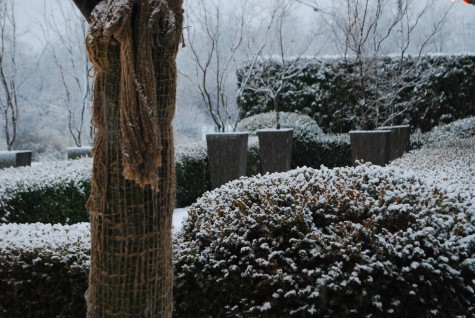
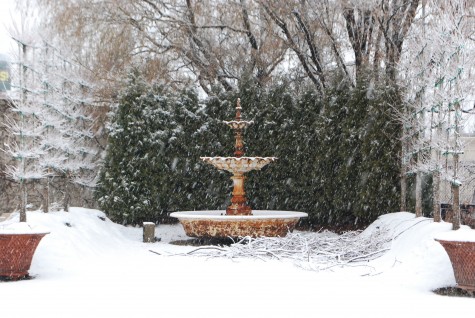
There is nothing like a snowfall to make patterns and textures in the landscape stand out.  Boxwood provides a small and fine texture and a uniform pattern; this picture makes that very clear.  The branching on trees stands out dramatically when those branches are coated with snow.  These brown concrete pots have very smooth surfaces; only the rims catch the snow.  The pots read as a homogeneous shape.  Given the somber colors of a winter landscape, the interest here is all about line, pattern, texture, and mass.  Winter greatly restricts the color palette in the landscape-that change is not all bad.  It makes the other elements of design easier to see.  

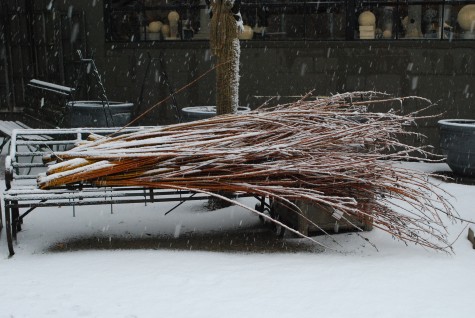
A dusting of snow has collected on the exposed surfaces of these bundles of copper willow.  The bunches provide quite a hairdo for this bench.  Individually, the sticks are quite linear.  The mass of sticks have a curved pattern.  The snow makes clear that anything in a mass reads quite diferently than it does as an individual.  A single plant might be distinguished in its flower or leaf, or stature; a mass of that plant is more about an overall shape, sweep, or drift. 

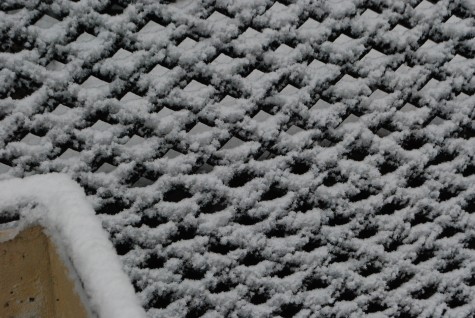
This cast iron grate has a distinctive pattern and a densely complex texture.  Snow makes all the more of that. How snow softens the outlines of hard structures and surfaces is one of the pleasures of the winter landscape.  A snowfall can make the most ordinary landscape look spectacularly beautiful.  It would be more accurate to say that most natural phenomena are spectacularly beautiful-even if I neglect to see it.  The snow turns on the lights.  

We are not buried in snow like other parts of the country, but we did get 6-8 inches.  The snow fell fast, and stuck to everything.  Why does it sometime snow when the temperature is above freezing?  It was 35 degrees here at one point yesterday and snowing like mad; it was 7 degrees when I got to work this morning.  All the wet snow is now frozen in place, so I have had plenty of time to look around.  The pruning pattern on the katsura espaliers can be readily seen; branches that were cut back hard responded by sprouting a number of stick straight branches from a single cut.  The pattern I see on these trees is a very clear explanation of how a branch responds to pruning. A pruning cut issues an invitation to grow.   

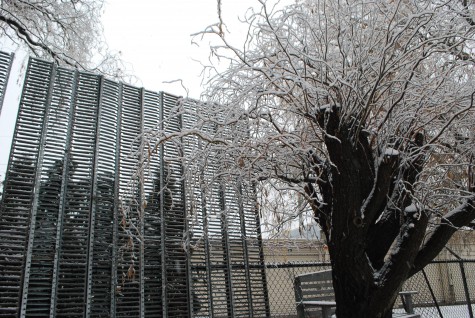
These vintage trench drains have a repetitive and very geometric pattern. They are most clearly a human-generated form.  The wildly curving branches of the pollarded willow are anything human. This idea shocks me some, and interests me a lot. The snow outlines the massive main trunks of the tree. I will loose this pollarded tree sooner rather than later. A high wind several years ago uprooted it.  My efforts to replant it were in vain; the bark is shedding in giant strips, and bracket fungus fruiting bodies have appeared.   

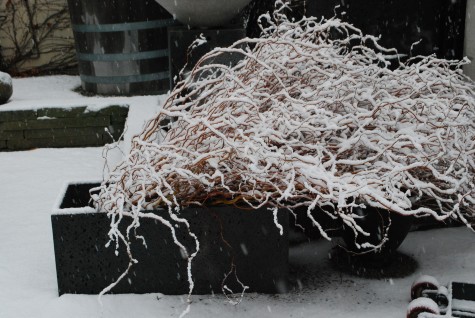
The copper curly willow is very curly. This branching is obscured in the summer by leaves.  I have to admit that this tree looks better in the winter than the summer, and that the pattern is outstanding in the snow.  The most difficult thing about choosing plants for their winter interest is that when that idea strikes home, as in today, nothing can be done about it.  I keep files of photographs of my own garden organized by the month.  I photograph certain key spots from the same angle 12 times a year.  I wish I had started doing this 14 years ago, instead of four.    Nonetheless, these pictures tell me a lot about whether the design and planting is working as well as it could.   

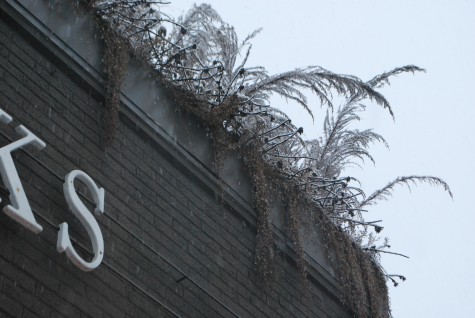
I did not clean out the boxes on the roof this year-the first time ever for that.  The fall and very late fall was a beautiful season for the boxes.  I am not surprised that the elegant feather persisted in its skeletal state, but I am surprised to see so much of the dichondra and plectranthus still holding on.  The pattern and texture provides something moody and textural to see.  The empty box alternative seems much less interesting. 

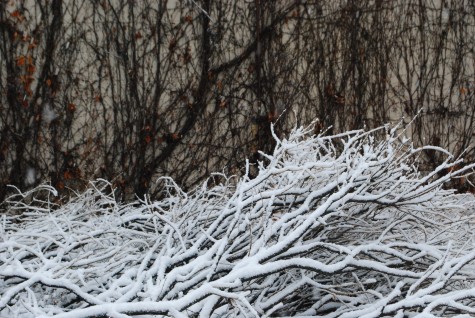
This pile of cut burning bush branches is dramatic covered with snow.  They are all the more dramatic for their accidental placement in front of a concrete wall, covered in the dark stems of boston ivy.  This wall faces the west; I have no idea why there is not one bit of snow on it anywhere-unless the snow was born on wind out of the west. So much pattern and texture-all ruled by a study in light and dark. 


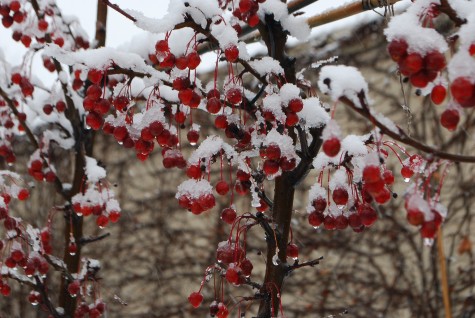
A pair of espaliered crabapples need to come into the garage for the winter.  As soon as the bulk of our winter containers are done, space will open up for them. This is the only plant with color on the entire shop property.  The pattern of the snow on the berries-I am glad I got a chance to see this.