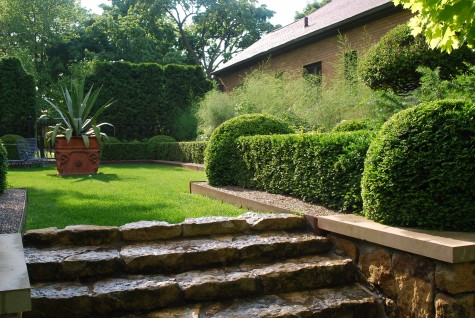
Beloved Boxwood


I can think of few plants that have a better service record than my beloved boxwood.  Properly cared for, they are very long lived.  Old boxwoods have an aura of age which only adds to their beauty.  They demand little, and give much.  Few broadleaved evergreens can tolerate our cold winters.  Though our nurseries are stuffed with blooming Catawbiense hybrid rhododendron in the spring, it is a constant battle to keep them happy and healthy.  They simply like Philadelphia better than Detroit.  Ilex, kalmia and the like suffer here as well.  The boxwood-they thrive.  I plant the very hardy Buxus microphylla hybrid Green Velvet; the winter color is as richly green as the summer.      
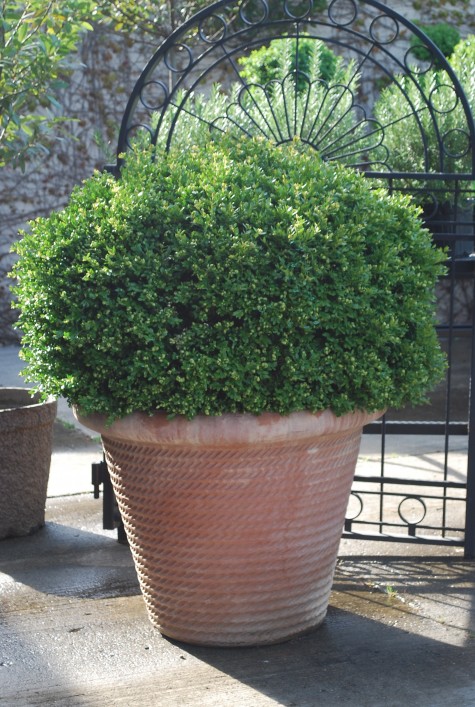
This giant untrimmed ball of buxus microphylla koreana has lived in this French terra cotta pot for 5 years.  We wheel it into the garage for the winter-to protect the pot, not the boxwood.  The garage has neither light nor heat-not a problem.  In March we wheel it back outside for another season.  Boxwood can be quite hardy in pots or windowboxes outdoors all winter; the container needs to be frostproof, and the maintenance thoughtful. The buxus microphylla which forms the hedge outside my shop will take on an orangy-olive color in the winter; this winter color is typical.  The front of the shop is a southern exposure.  The hedge has been there 12 years, and has yet to burn over a winter. Most of the hybrids of boxwood hardy in zone 5 come from this species.
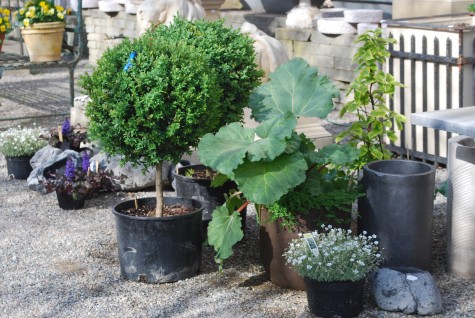
Buxus Sempervirens, commonly called European, or Southern box, is the boxwood variety of my dreams.  Lush and large growing, they adapt easily to any sculptural pruning you might dream up. They can grow to twenty feet tall.   If you have seen the boxwood planted by Beatrix Farrand at Dumbarton Oaks in Washington, you know how a boxwood planting can be sculpture.  Pruned into undulating cloud shapes, this planting is a showstopper.  I have seen this boxwood planted in ground in my zone, but a particularly vicious winter has the power to kill them. They are rated for zones 6-8; this rating means what it says. I therefore recommend using them in pots, and wintering them in an interior space. They only need an unheated space; you want them to go dormant, and only wake up when the worst of the winter is past. 
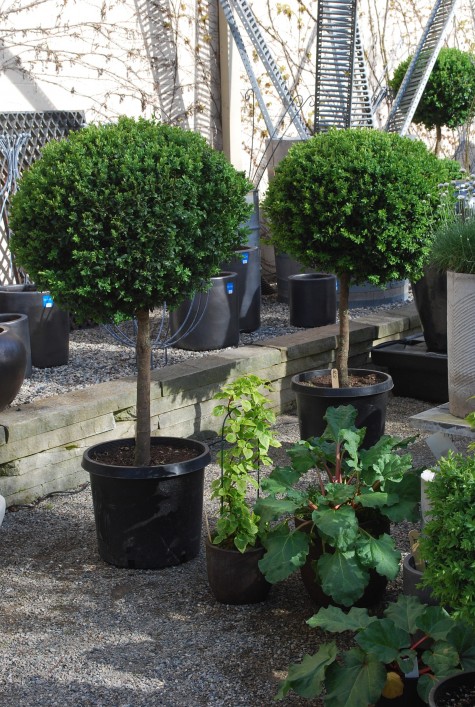
I rarely see boxwood topiary of size grown from a zone 5 hardy boxwood.  Boxwood is a relatively slow grower; it might take 7 years to get a cutting of Buxus Green Velvet” to 24″ tall. Boxwood in general are expensive.  Southern box grows faster in a mild climate, such as the Pacific northwest; they routinely flush growth twice there in a single season. As southern box is a big plant when mature, large scale topiaries such as these are usually grown from this variety.  A topiary this size, with a trunk caliper this large-very pricey.  But priceless in its return.  While it is an investment, your investment will grow and prosper over the years-what gardener could ask for more?   
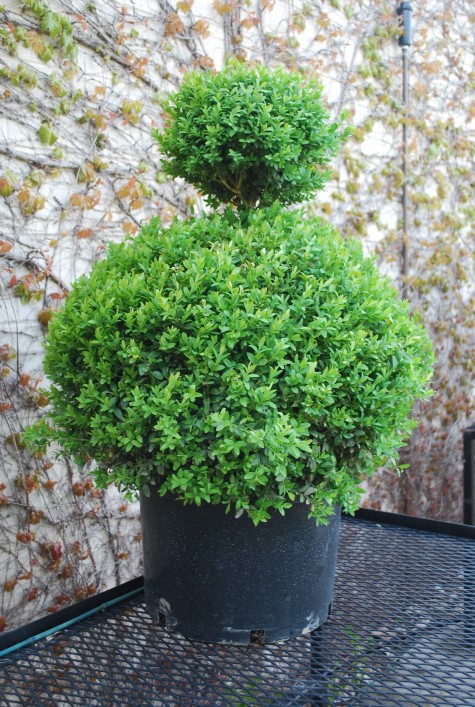
This boxwood sphere with its attendant topknot/hairdo-what a great looking and very special plant.  You might grow topiary boxwood yourself from cuttings-it just takes years.  Any grower of nursery material-how incredibly patient they are. They can see the potential for a decently sized plant in a cutting.  But very large specimen boxwood such as these do not come along so often; most growers like to sell their material in a shorter time frame.  Now and then we will find a grower who has a love for growing unusually large or largely unusual plant material; these growers interest me. 


Boxwood is as happy in a supporting form as it is being the star of the show.  Their tolerance for clipping and shearing makes them an ideal formal evergreen hedging material, when a small hedge is desirable.  These large circular beds beds planted with tulips have a drama that would not be possible with tulips alone.  Their geometry and symmetry is an organizing metaphor for this particular garden.  The loose growing tulips have an excellent visual partner in the boxwood.
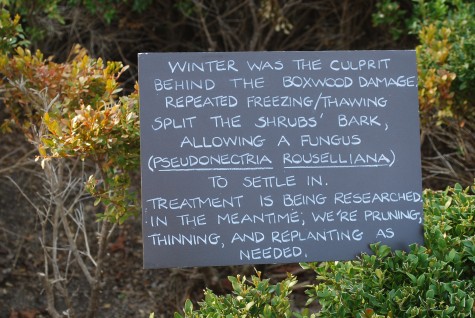
This is not to say boxwood is without its problems. The boxwood at the Chicago Botanic garden suffered terrible damage after last year’s winter-as the sign says. The boxwood in the front of my shop sustained damage much like this. In my case, huge snow loads, as well as freezing and thawing, weighed the plants down such that stems split, and allowed a fungal infection to invade.  Heartbreaking. 
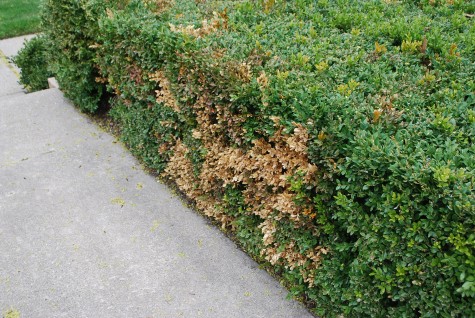
These boxwood in my garden suffered similar damage-but I would not for one moment consider not growing them.  They are beautiful year round.  Gorgeous in growth.  Beautiful in the rain, or with fall leaves dusting their tops.  Beautiful as a topiary or a hedge.  Spectacular in pots.
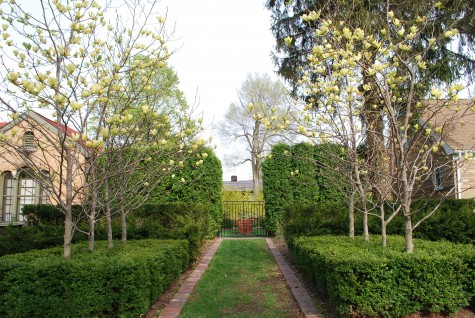

They are a quietly handsome groundcover, under my Yellow Butterflies magnolias.   The day the petals fall to the boxwood-one of my favorite days of the gardening year.
Flowering Trees


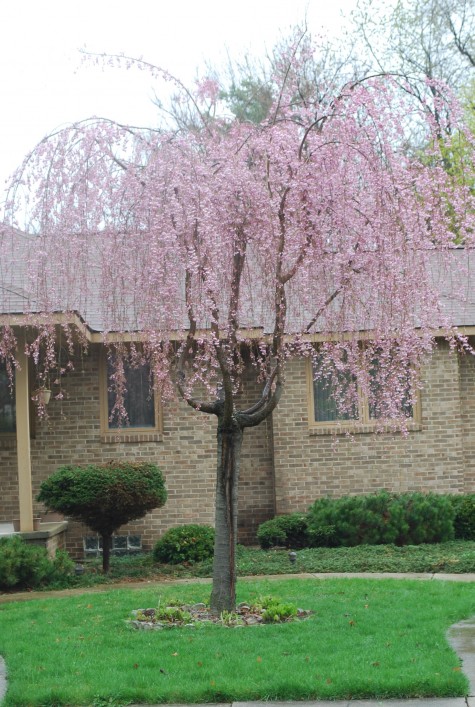
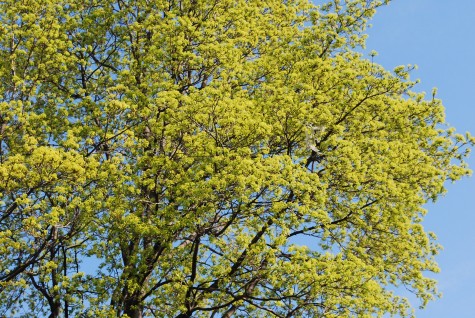
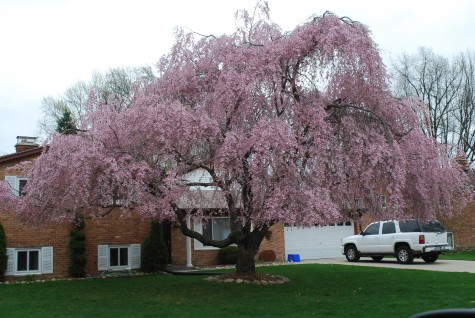
All trees flower; the spent chartreuse blooms from the Norway maples in my neighborhood have begun to blanket the streets like an algal bloom on a pond.  I do so appreciate that vibrant spring green; I feel deserving of it, after my winter. Green flowers seem appropriately dignified, for a tree. But those early and girly pink flowering trees-do we love them? This old weeping cherry-is it beautiful, or is that candy pink ballerina’s tutu too too much?   

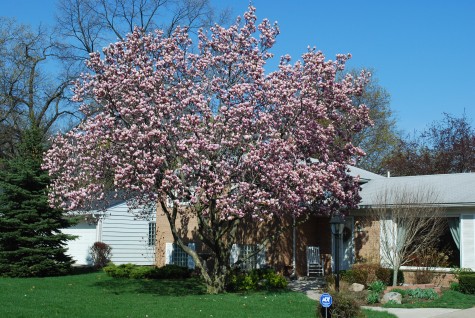
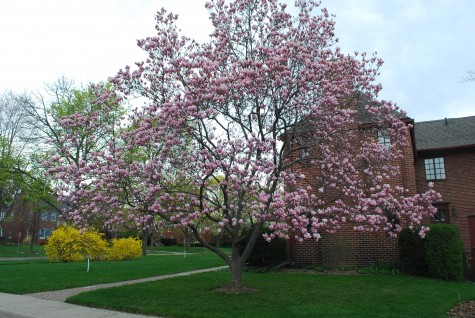
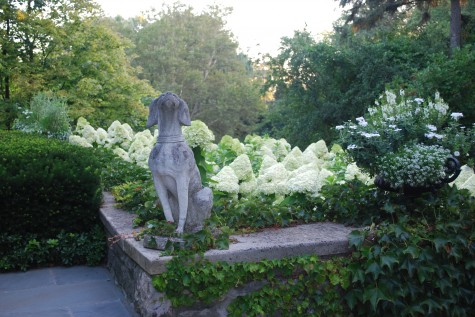
I am very fond of all the magnolias that manage to survive in my zone.  The saucer magnolia has opulently scaled pale pink blooms.  They flop open in a decadent and provocative manner.  The slightest frost stains the pale flowers with rust; the slightest heat finishes the flowers off in moments.  The ground beneath them will be littered with decaying petals-no other tree makes such an ostentatious display in bloom.   It is the Sarah Bernhardt of flowering trees; do I like this?  Whether I do, or not, I like seeing this play, every year.   

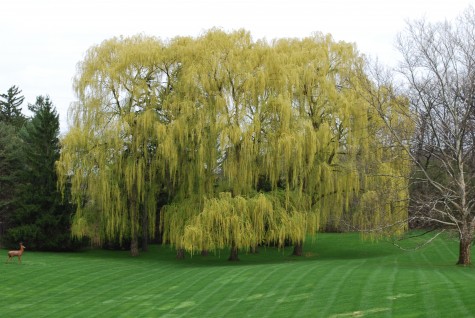
These weeping willows are astonishly dramatic, at the blooming and leafing out stage. This grove is dripping yellow green spring. No small part of how beautiful they look is the large space that was given over to allowing them to be what nature intended.  Willows are perfectly splendid in the spring. 

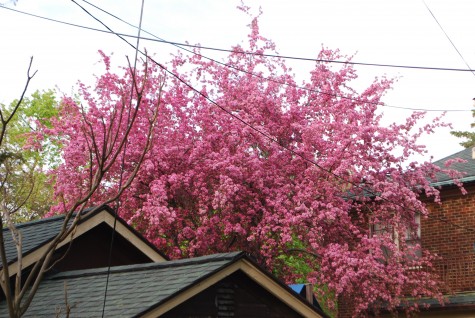
This old crabapple ignites, and lights up the sky behind my neighbor’s garage; it is in full bud right now, ready to burst forth on the scene from my terrace.  I do not even see this tree the entire rest of the year.  The next 10 days, it turns the air pink.  Do I like this?  Would I have this?  Am I happy to have it right now-yes.

Across the street is an old top grafted cherry.  The trunk bark is split open like a weak seam on a tight shirt-who knows whether lightning, scald, or other damage created such a giant wound.  But the tree has put on its frothy petticoat every year I have lived here, despite the fact it gets no care of any kind. Some days I marvel at the contrast of its dainty blooms, and its scarred trunk-other days I cannot bear to look.  Are grafted, weeping and blooming trees an alien nation- born of man’s misguided meddling with nature?  No matter my answer to this question, would I have inherited this tree, I would care for it, and treasure its persistence.  

My big Norway is in its glory right this moment-chartreuse and blue never looked so good.  This stage will be gone, before I have had my visual fill. Some trees are architectural; their branch structure, or bark, or shape, or leaf forms reward the eye of a gardener.  The giant shade trees- their massive dignity have graced streets all across this country. They are able to put a protective roof over a garden in such a graceful way you might not even notice.   The ornamental trees-those smaller trees with odd forms, or showy blooms-they have their day, and their place.  Should you be thinking about trees, try to figure out what you like; I hope you have more success than I.   

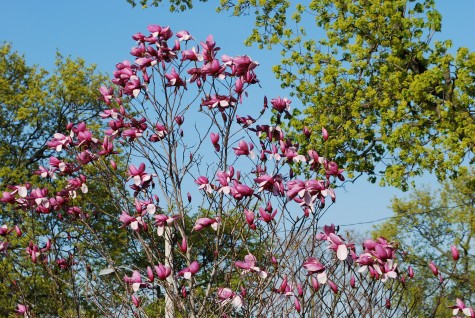
Who are the ornamental trees?  If you like subtly natural, look at the amelanchiers (serviceberries, or shadblow), cornelian cherry, witch hazel, and its relative, parrotia.  If you like the showgirls, go for pink cherries, crabs, and magnolias. Magnolia Jane is small growing and very floriferous. If you blush at that pink, try the Venus dogwoods, snowdrift crabs, apple trees, the magnolias stellata, or the yellow magnolias-Yellow Butterflies, or Elizabeth. Should you live in my zone, visit a nursery right now, and review your choices. Be seduced-this is what spring is all about.


My ornamental tree review, The Galaxy Magnolia Girls, are putting on their show nightly, as long as the cool temperatures last.  I do not plan to miss a single performance.

More On Pruning

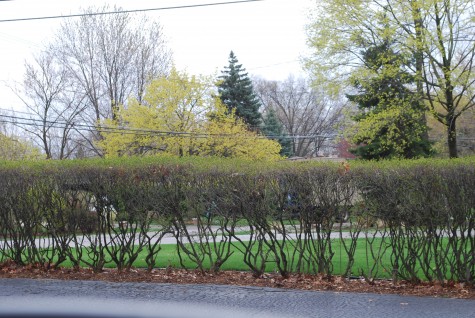
This hedge has everything going wrong.  More than likely, it gets topped every year with an electric hedge clipper.  The work goes fast, and the result makes me cringe.  Repeated cuts into the top layer has resulted in so many branch breaks that the resulting dense top layer of foliage forms an impenatrable barrier to light to the interior of the shrub.  This hedge is mostly sticks, all year round.  Pruning branches individually takes a lot more time, but the time it takes is worth it.  Sometimes I describe pruning as a haircut-specifically, a shag haircut.  The branches on top are short and shaggy; the upper side branches are headed back slightly to allow light to get all the way to the bottom.   

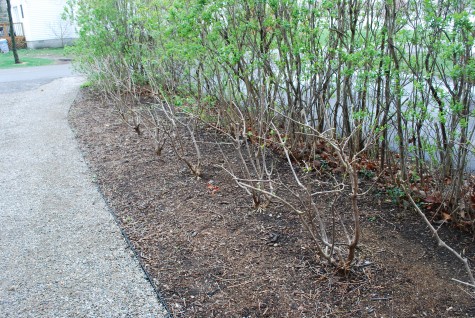
The early season look of this hedge is ample evidence that skirting up a shrub is a bad idea.  In an effort to keep the sides of the shrub perfectly vertical, all those stray side branches have been pruned off. Not so clear from this picture is that the hedge had been planted so close to the driveway that any side branches would impinge on that hard surface.  This hedge in its natural state would be 4 times as wide, and beautiful.  A skirted shrub is all legs, with little tufts of green on the top.  Naturally, carefully consider placement before you plant. 

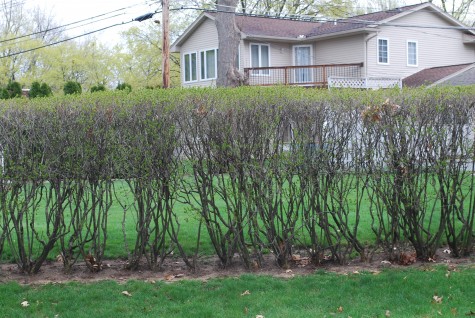
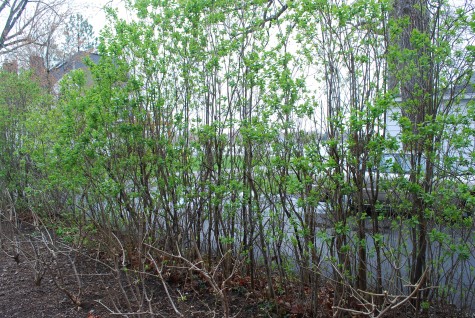
This lilac hedge is wedged between two driveways. There really isn’t room between the drives for any plant that I know of, even though the screen is welcome to both neighboring parties.  To make the best of a bad situation, regularly removing the largest stem to the ground every year will encourage the lilac to sprout from the ground level.  This keeps the green coming from below. This hedge has a decidedly layered look.  A lower layer of green, then a taller layer of sticks, then another layer of green. This striping is very evident in early spring. Its clear these lilaces were pruned across the top, all the same height, on repeated occasions.  Pruning branches irregularly, at all different heights, encourages green all over.  Only a few plants can be pruned into boxes and globes, or balloons.   Balloon bushes are those skirted up stick shrubs with balls of green at the top; they look like a hot air balloon, only not as pretty.  This is a particularly displeasing look, as it bears no remote resemblance to any plant’s real habit of growth.

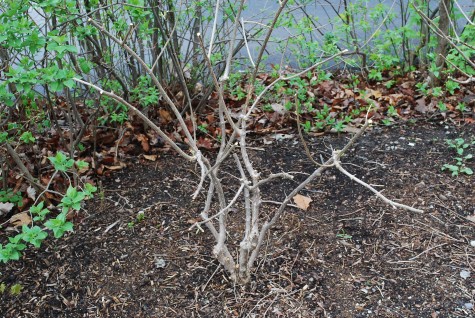
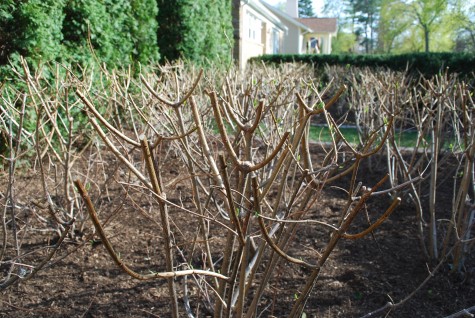
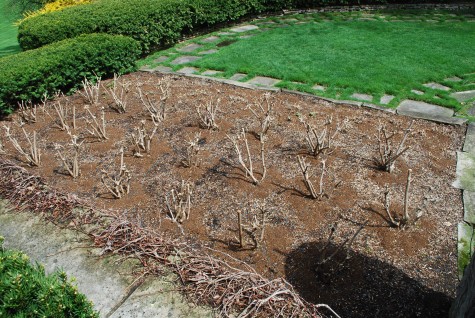
These hydrangeas have been pruned back to a few main trunks.  Though the look is sparse, there is little to fear.  Limelights bloom on new wood.  They do not bloom until July in my zone.  There is plenty of time for this shrub to grow and put out flowers.  Cutting back to these main trunks in the spring keeps the shrb in scale with the allocated space in a natural way.  Letting pruning go for too long only makes your shrub renovation look even more extreme.

Hydrangeas grow fast.  This bleak look lasts for only a short time in the spring.

I prune my own hydrangeas to a roughly symmetrical height, first.  Mine are grown in blocks, not rows; they make a substantial mass when they bloom.  They are also tucked behind a Hicks yew hedge; I need every inch of height I can get out of my hydrangeas so I can see their flowers from the street.  Pruning should be done with a particular end result in mind.  I do not prune my hydrangeas any lower than 30″ overall, as I like their height.  

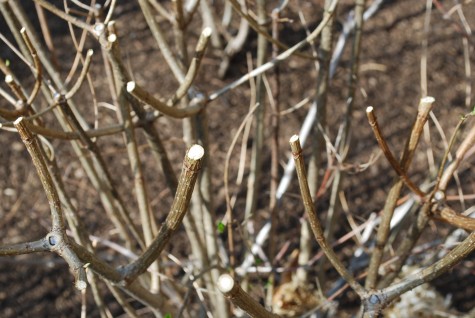
Once I have pruned down to the height I like, I then prune out crossing branches.  I may prune out the center of the shrub if I think it has gotten too dense. I leave the outside branches alone. There might be some vague resemblance to an egg laid on its side, with holes in the top-when I am done pruning.  

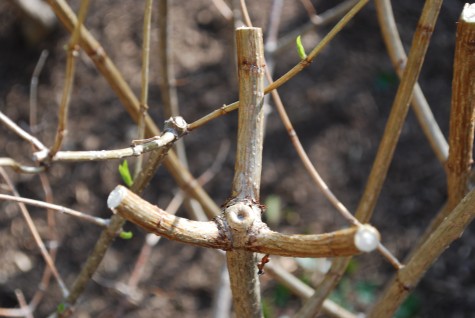
It is easy to see that this single old calloused cut from last spring resulted in three new branches.  Pruning is not the end of something-it is the start of something bigger.  These three branches from last year, located in the center of the shrub, I have pruned back hard. I like to avoid long runs of woody branches-as I do not like hydrangea plants that droop.  A sturdily branched undercarriage makes for a strong and weather tolerant shrub. 

This bed of hydrangeas belongs to a client.  They face down an old stone wall which is but four feet tall. She cuts them back very hard-to within 14 inches of the ground.  She has in mind to keep the flowers at about the same height as the wall.  Pruning hard keeps the eventual plant height in bounds.  


In bounds, but blooming beautifully; this I like.

A Harbinger Of Spring


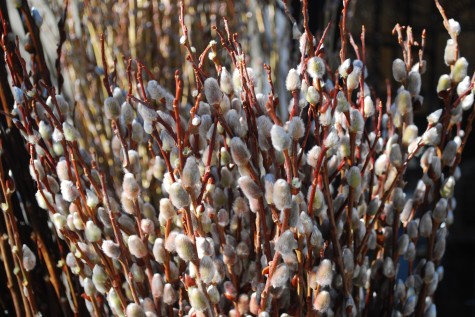
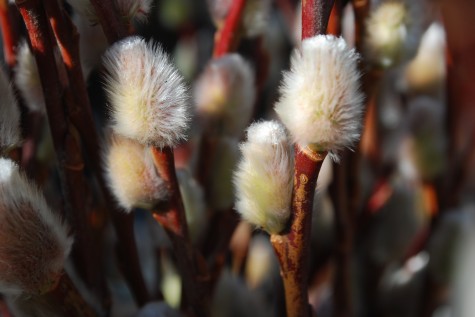
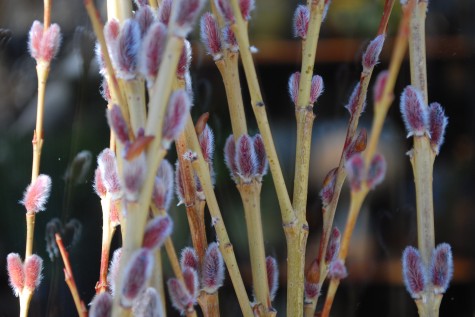
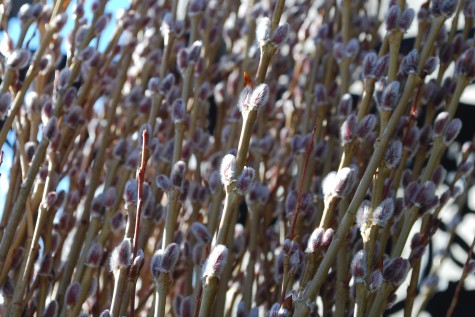
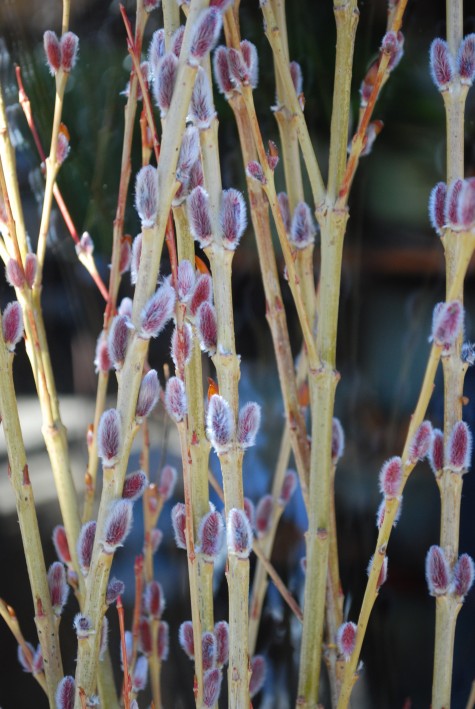
The most amusing event of my week?  Bunches of pussy willows, fully decked out in their silvery fur, arriving via UPS. Maybe it doesn’t take so much to amuse me, but was there not a time when every yard had a gangly overgrown and not so gorgeous salix whose main claim to fame was how they woke up and got going in March-the early fur bird of the garden?  Just about to burst, we all cut branches and brought them inside, as it was still way too cold to stand outside and appreciate this modest but sure sign of spring.  Pussy willow delivered to my door-what has the world come to?

Like its shrubby partner in crime, forsythia, early counts for a lot in my zone.  Some gardeners with foresight may have galanthus  or eranthis popping out of the ground.  Or a hamamelis in bloom. Other warm and urban southern facing walls may be softened by daffoldil leaves springing forth, announcing the imminent change of the season.  But pussy willow holding forth is a sure harbinger of spring.    Do you think you would still love pussy willow branches if they came on in June or July? Sure this is a rhetorical question; timing is everything, yes?  In a past life when I had five acres of land, only two of which were even remotely civilized, I could wade in those wild places and be sure to find pussy willow, forsythia, and rosa multiflora making moves in March.  I could see the sap was rising in the willows; the branches are waking up.  The color was distinctly different-luminous, and alive.

The poplars, whose rustling leaves stage a concert most every summer day, are all branches and trunks in March.  But there will come a time when that grey bark is suffused with with a green welling up from underneath.  There are no stands of popples where I live now. Should I decide to plant a meadow of popples, pussy willow, forsythia, wild roses, bergamot, buffalo grass, centaurea, and willow in the right of way on my urban corner lot, I most likely would be facing some highly irate neighbors. 

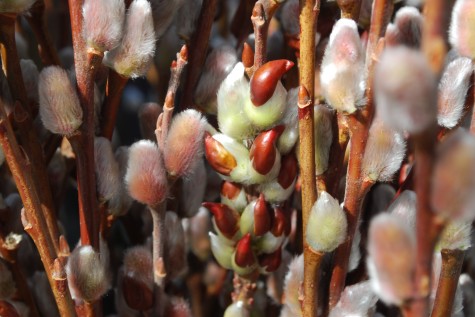
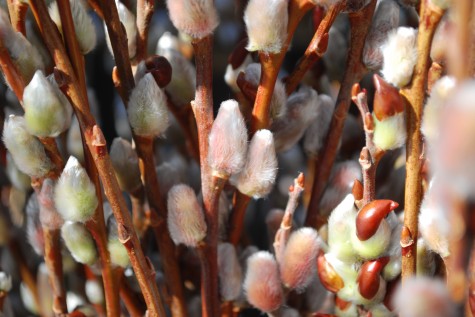
Not everyone shares my idea of beautiful.  Why should they? So  I’ll keep the lawn in the tree row, for now. I have another source of spring from which to draw.  My twigman has made a life of growing specific cultivars whose twigs make the faces of gardeners light up. This salix, which he calls prairie willow, I have never seen before. When I unwrap his long sturdy stems, I am delighted, relieved, beyond all belief.  His pussy willow branches are studded with furry buds, one right after another. 

Do I long for my wild pussy willows-not really.  I never pruned them properly.  The stems had missing teeth-inevitably.  They grew at angles impossible to right.  Though I have no end of nostalgia for what enchanted me 30 years ago, I am perfectly happy what came my way today.  Living and breathing-spring is on its way.

The first harbingers of spring in Michigan-they have a big job.  We gardeners are starved for sun, life, movement.  We are most interested in winter loosening its grip. There are signs from nature that will help that big ache you have.  Mine came in the mail today.