 Once there is a landscape plan in place, there is the matter of the plant count. Determining a plant count has much to do with spacing. I have read much about rules for spacing plants properly for optimal growth, but the issue is more complex than that. For instance, if I am planting pachysandra, and space them at a foot apart, I need one plant per square foot. For 500 square feet, I will need 500 plants, or about 10 48 count flats. If I space them at 6″ apart, I need 4 plants per square foot, or 2000 plants, or about 40 48 count flats. Option A asks for a modest up front investment, but I see a lot of time ahead devoted to weeding, the purchase and spreading of a lot of mulch, and a lot of water thrown on bare ground. I also see a grim looking space for probably 3 years. My solution? Start a groundcover bed small and plant densely. Enlarge it next year, or the following season- only that number of square feet you can plant densely. My mature, healthy beds of pachysandra-individual plants are much less than an inch apart.
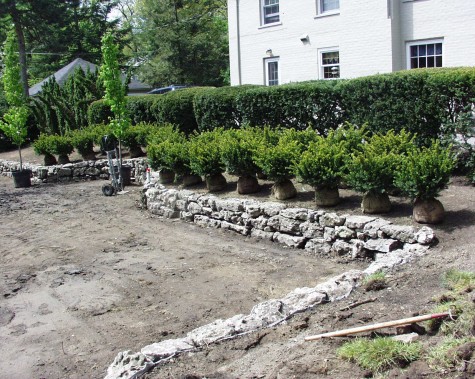 Spacing evergreens has everything to do with the desired outcome. Should I plant a taxus densiformis in the middle of the lawn, and give it 50 years to grow, I will have a single plant of considerable size. A hedge, or a mass of yews is more about a community. Sometimes I look at the distance between the rootballs. The big idea here-everybody has their own subterranean digs. This may mean that the foliage touches.
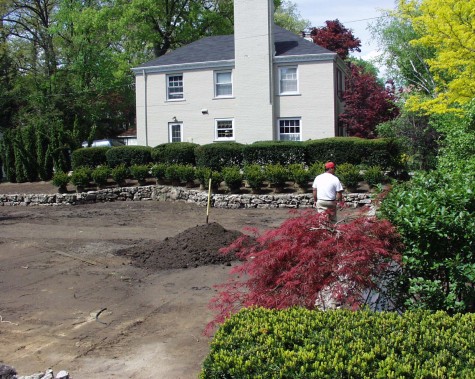 Plants are much more sociable than I. I want my space. I was never so conscious of the need for my own space than after my knee replacement. I was less than stable on my feet, and was not interested in an enthusiastic Golden Retriever broaching my borders. But plenty of plants do well planted in close quarters. They are completely happy to relinquish their individuality, and become a part of a larger community.
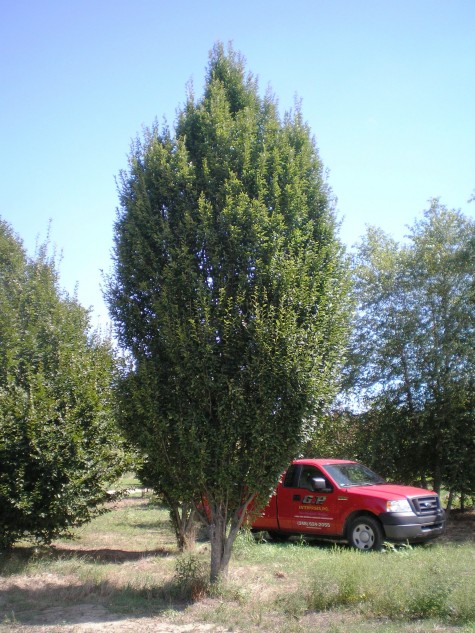
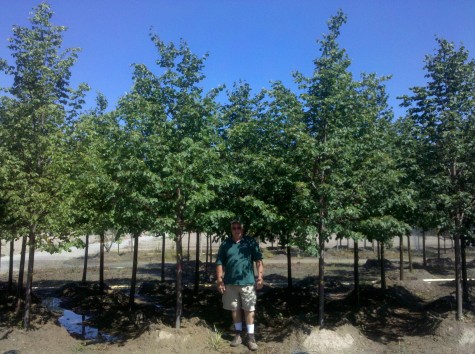
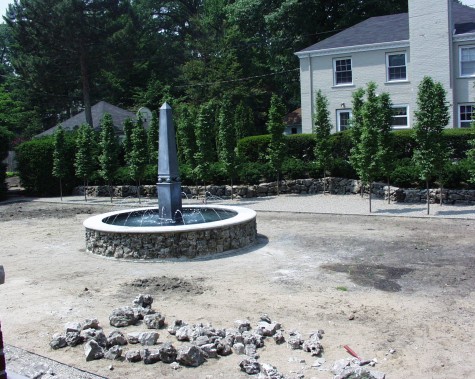
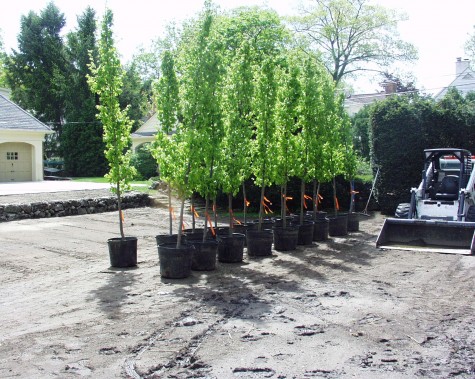 One of my most favorite landscape moments-the arrival of the plants. These 1.5″ caliper fastigiate hornbeams in 25 gallon pots would be planted as if they were the poles of a pergola. Carpinus betulus “Frans Fontaine” is a culitvar of fastigiate hornbeam which is slower and more densely growing than the species. Even so, it will grow 30′-35′ tall, and 15′-18′ wide. I spaced them at 8′ on center, knowing they would grow together. Someday there would be a green roof under which there would be shade.
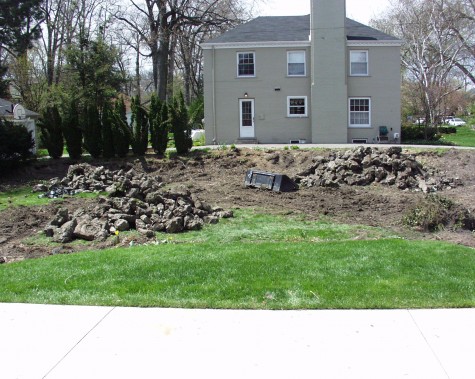
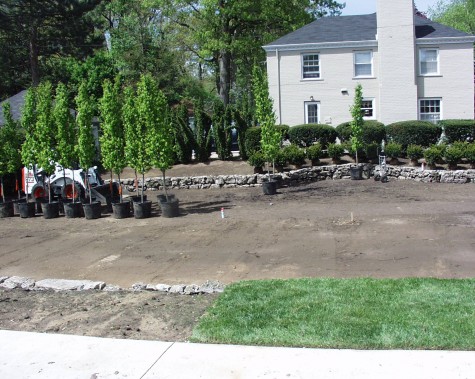 I had other reasons which influenced my spacing. The house next door loomed over this side yard property. Evergreens would have provided year round screening, but they occupy a lot of space at the ground plane. My clients wanted to entertain in this space. Given enough time, and spaced close together, they would eliminate this view of the neighbor.
 Carpinus are also very tolerant of pruning. Decisions about spacing are specific to the species in question. The vast majority of green spaces have not been planted by a person. There are those wild places densely populated by plants. No natural forest or meadow is at equilibrium; some plants are coming on as others are in eclipse. Perhaps a lighting strike will “prune” a giant tree such that new plants can take hold around it. Should you be interested in the exceptions to any gardening rule, visit any wild and untended space.
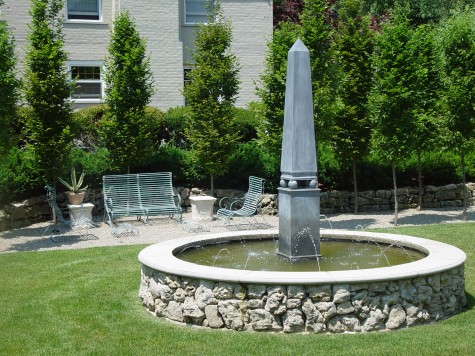
Five years later, the new yews have grown together to make a mass. The topmost row of yews had been transplanted from the front of the house; the new yews will eventually cover their bare lower limbs. It sometimes makes more sense to underplant an old and ungainly shrub rather than tear it out. These big old yews will eventually become part of a simple mass.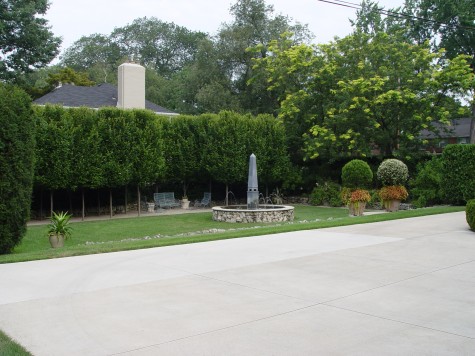 Eight years later, the house next door has all but disappeared. As the carpinus grow taller, they can be selectively pruned on the underside to permit easy passage beneath them.
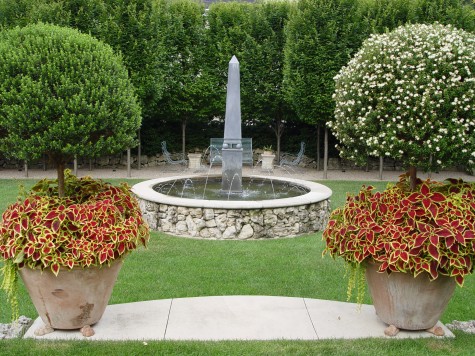
The yews planted behind the carpinus are planted on a gentle slope that rises to the neighboring driveway. Though the shade has become considerable, they are green and well needled from top to bottom. Allowing those densiformis yews to keep their natural shape is in large part responsible for their continuing health. Yews do not respond so well to hard formal pruning. Once all light is blocked to the interior of the shrub by a proliferation of growth on the exterior, those inner branches will go bare. I have begun planting Taxus media Moonii in place of Hicks yews, as their natural growth is much more upright and formal.
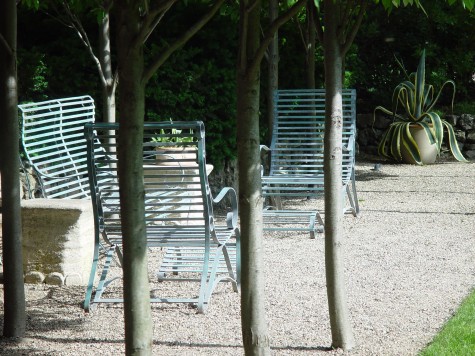
This is a great spot to sit.