Pollarded


I am sure I have written before on the subject of pollarding. Pollarding refers to the practice of cutting back the branches of a tree to within close proximity of the main trunk.  Pollarding originally had much to do with practicality-home fireplaces needed wood to burn-for cooking, and for heat.  Americans are used to the sea from shining sea-endless land.  In Europe, space was precious.  Fuel-even more precious.  Cutting trees back to their main trunks for firewood was not an aesthetic decision-it was a life decision.  In many European countries, pollarded trees enabled large growing trees to thrive in small spaces, along narrow streets.    American gardeners are not used to seeing this type of pruning as our country is vast.  There is rarely need for any American gardener to cut trees back this hard.      
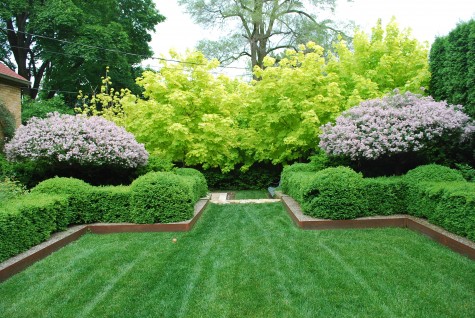
My Palabin lilacs on standard were in place when I bought my house some fifteen years ago.  For the first nine years I lived here, I did nothing to the landscape, save planting some 6 foot arborvitaes and in one moment of garden angst, 100 Hicks yews.  The Palabin lilacs on standard kept growing, despite my neglect.   
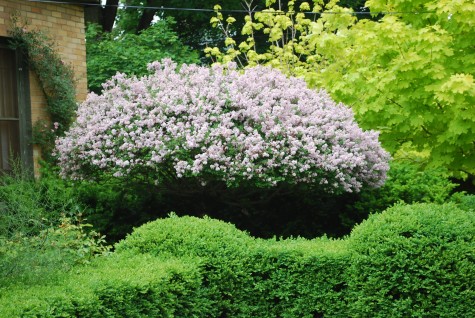
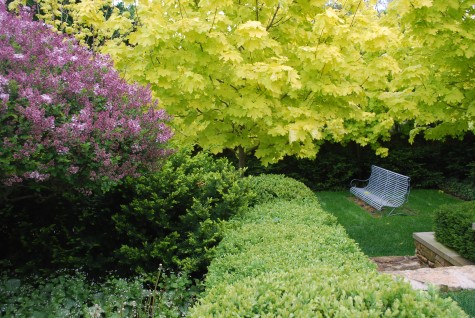
Not that I minded their growing. Every year they put on a show of pale grey violet blooms that made my heart pound.  When they are in season, they are dramatically in season. I plant Palabin lilacs regularly; they deliver much, and ask for little. But having planted a slew of boxwoods, and 11 Princeton Gold maples, the available space for the lilacs-diminishing.   
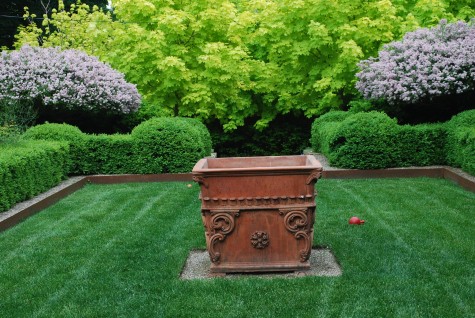

In recent years, I have pruned after their bloom, pruned again-and pruned more.  I wanted a low oval profile-not a ball shape.  In retrospect, I realize that I was bold in my mind, but timid in my pruning.  I posted about pollarded trees, and these lilacs some time ago.  A reader encouraged me to go ahead and cut them back; he was quite sure I needed a push.  He was right-I needed a push.  
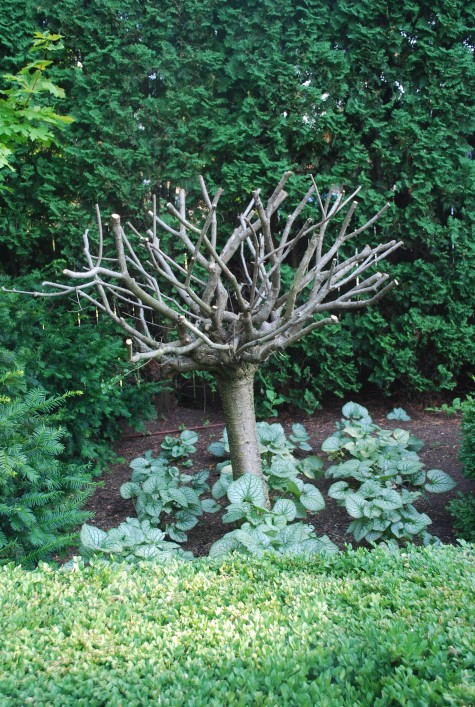
The better part of two weeks ago, I cut these old Palabins back hard.  I have not heard one word from them, to date.  I am sure they are shocked, outraged, and disgusted with me.  I have not seen one bud push forth on these giant stems.  The jury is still out-no doubt. Some times I am spot on with aesthetic decisions, to the betterment my entire property.  Other moves I make that are dicey-all I can do now is wait.   Should you wonder if I am chewing my nails-pretty much.  Should they decide to leaf out around these thick old branches, I will be thrilled.
A Dwarf Conifer Garden

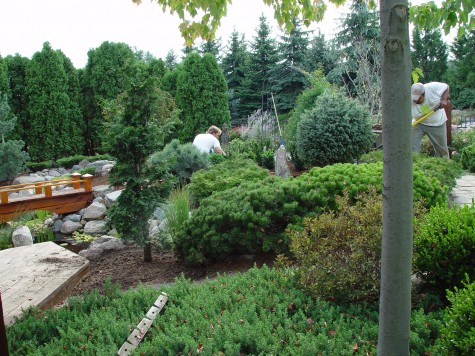
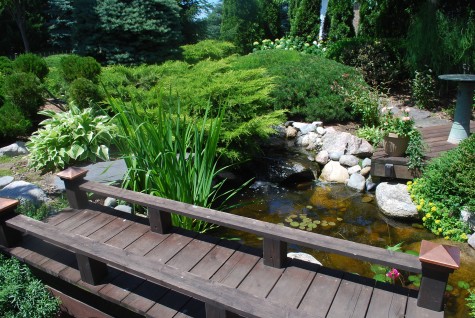
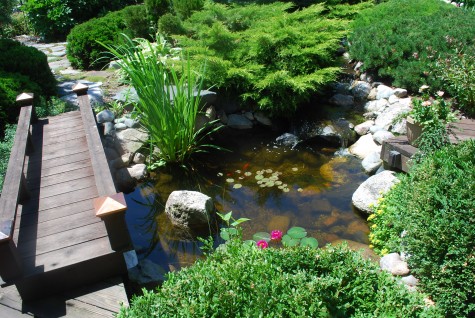
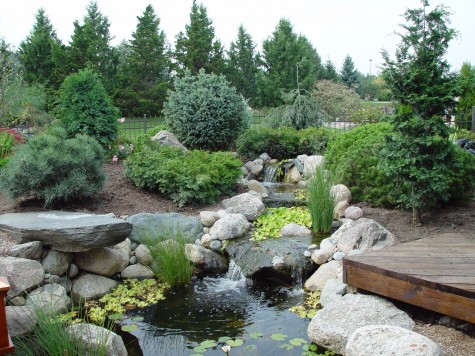
I made my first visit to this garden in 2006.  My clients-serious gardeners.  Ray is first and foremost a rock lover.  He collects little rocks, big rocks, boulders-like I said, he loves rocks.  He built a waterfall and pools in their backyard-I was impressed by his efforts.  Janice-she is a committed science teacher, and horticulturally adept.  She is a player.  The two of them asked me to intervene in their efforts.   In 2007, I planted a group of dwarf conifers for them.   

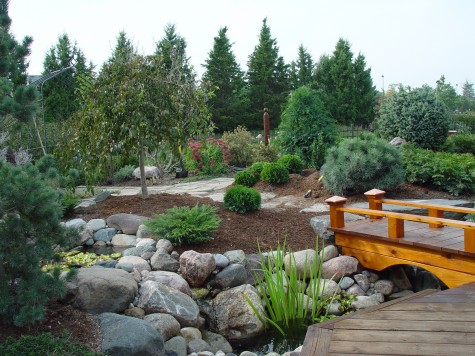
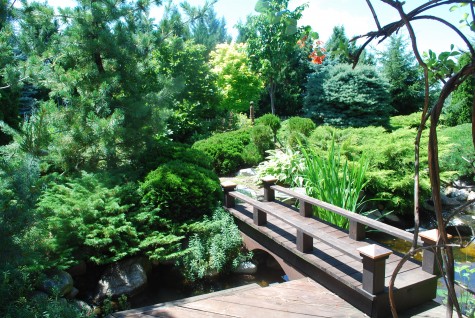
The pond bridge, the waterfall, the pools,the deck, and the perimeter plantings were largely in place when I got there.  I assembled a group of dwarf evergreens I thought would soften Ray’s rocks, and provide year round interest.  They live in a neighborhood; the views to the neighbors-not so good.  They needed a landscape that addressed their sophisticated tastes in plants, that also screened out untoward views. A private garden oriented around interesting and unusual plants.

Proper planting means big spaces in between.  Dwarf conifers grow slowly, but they grow. Some so called dwarf confiers actually attain considerable size when they age. I am by no means an expert on the topic, so I studied up on those evergreens that interested me in terms of shape or needle texture or color.  A few key or central plants, and a supporting cast for each.  The first year-there is lots of bark in evidence. 

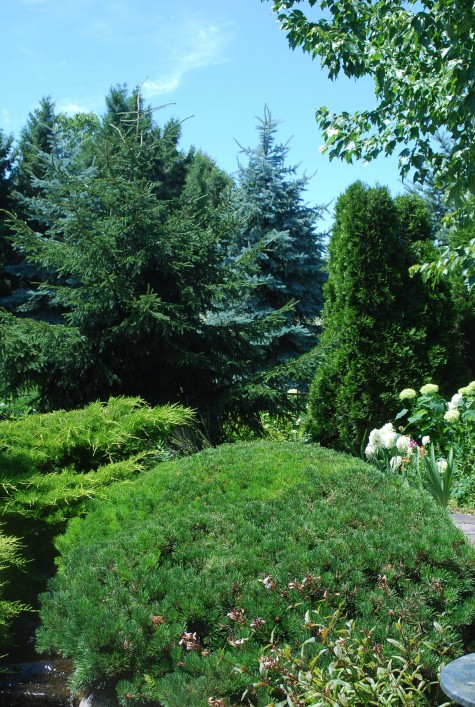
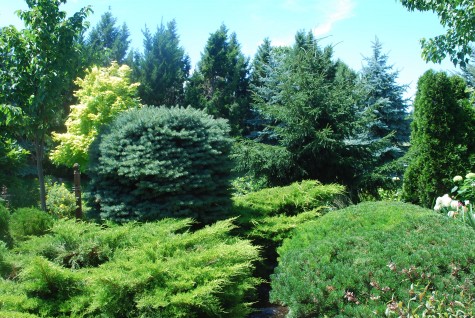
My visit today, some three years later-a different story.  They are great gardeners-every conifer has grown, and looks healthy.  I could barely believe I was visiting the same garden.  Dwarf evergreens of contrasting forms, colors and textures had covered the ground.  It may be tough to spot, but my arrangement of dwarf conifers took into account a view of a blue spruce on a community berm at a distance. Blue evergreens-they look their best far away. Study this picture.  That blue spruce far away adds visual depth to what is a small garden. Placing blue needled evergreens far and away adds great depth to a landscape.  Though this spruce does not belong to them, it is part of their garden view.   

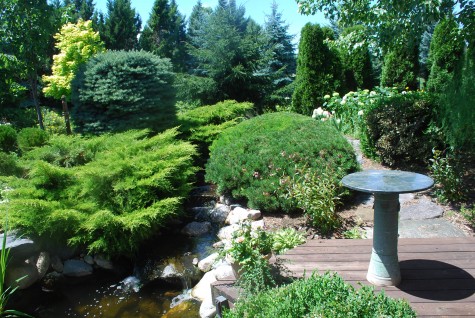
The varying textures and colors of greens are very pleasing to the eye.  I would imagine this garden is lovely with a dusting of snow, or on a rainy day.  The best part of evergreen plants is how weather changes their appearance.  No doubt there will be some sort of weather, every day.  Planning a landscape to take advantage of  all of the seasons is worth the challenge.  A good landscape design takes the predictable growing, the weather, and the unexpected issues into account, and still reads strongly.  How this garden looks today pleases me.     

Ray’s bridge has settled down-it reads as part of a whole now, given its green company.  Goldfish swarm the pool.  There is a water lily blooming.  Most everything I planted is growing vigorously.-no garden is without loss and disappointment.   These clients have an oasis of their own making.  They have done all the work of the watering, the pruning, the feeding, the nurturing-the fussing about.  I spent two days there.  They have done four years worth of work.   

I do not mind visiting some projects, years later, with enchantment on my mind.  My favorite clients-those gardeners that scoop up the idea and the installation-and go on from there.  How I admire those clients who understand what it means to take up the reins, and go on. A Princeton Gold maple planted outside the fence, and as far away as possible, lights up the foreground planting.  It was mrecilessly hot and sunny yesterday, but the look here is lush and refreshing.     

This conifer garden-I would have it.  They have looked after it in such a way that they deserve a prize.    I do my share of the work-but a committed steward is everything to a garden.  Some days I would just as soon give away my garden as have it.  Then I have lucky days.  Yesterday Buck accidentally locked himself out of the house an hour before I got home.  All the watering chores got done.  I was only adrift for one second- I got in the fountain, and had a glass of wine.    

Their garden-beautiful.  I love going back, and seeing a project that has no further need of me.

White Trees


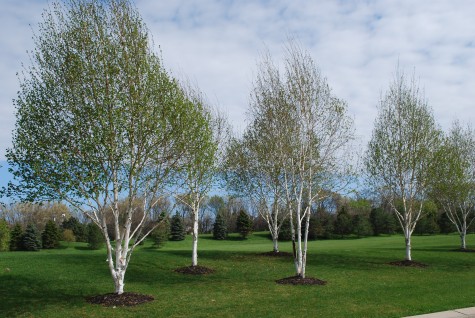
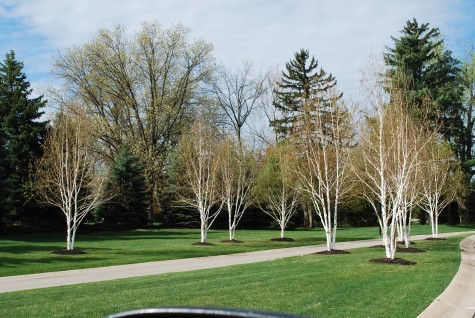
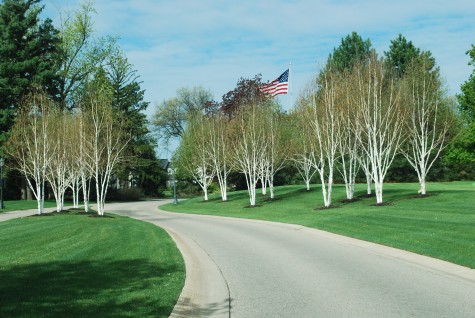
Some years ago I landscaped a gated community in our area.  I put all my visual bets on groves of scotch pine, and Himalayan white-barked birch.  Pinus Sylvestris and Betula Jacquemontii-sounds like an engagement announcement to me.  Both trees like sun, and perfectly drained soil.  The birch likes cool moist soil; a placement in a lawn panel that gets regular water.  The Scotch pine-placed ever so slightly out of range of the overhead irrigation-in drier locations.

Both species are doing just fine, but no doubt the Himalayan is the looker of the pair.  The whitest barked of all the birch, that white bark is evident at a very early age-unlike other species that have to grow up into the white. The striking color of this bark puts it on my dance card of white trees I  like to waltz around with.  Very susceptible to the bronze birch borer, they need care-just like everything else that is so worth the trouble.  

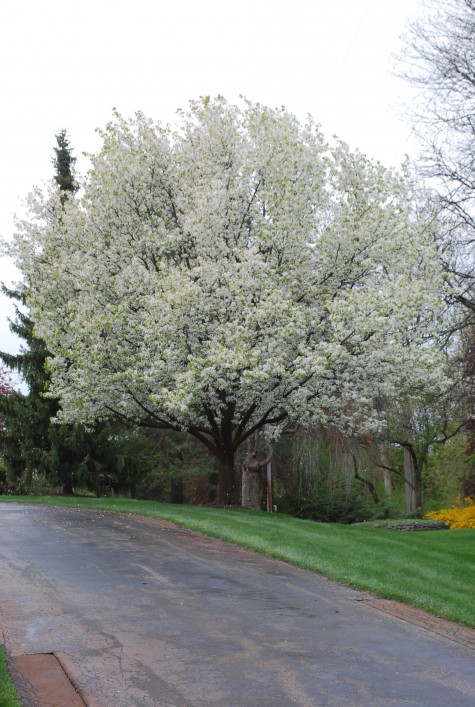
White flowering trees make the spring landscape spectacular.  The magnolias first up, the apples, the Bradford pears, the crabapples-the list of white spring flowering trees is considerable.  They bloom before they have foliage.  Take a minute to think about that phenomena.  Asleep all winter, they burst forth with their show like they have 10 minutes to live. This year the blooming was especially heavy.  I am not a big fan of Bradford pears, but my favorite thing about them is when their topmost branches start to green up, while the rest of the tree is still in bloom.  A gorgeous spring phase.

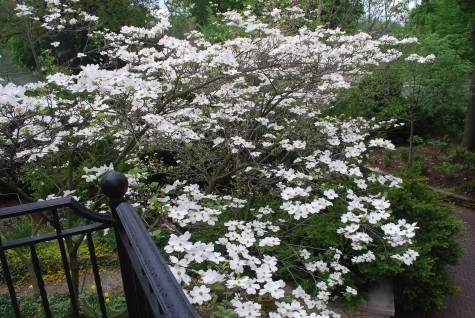
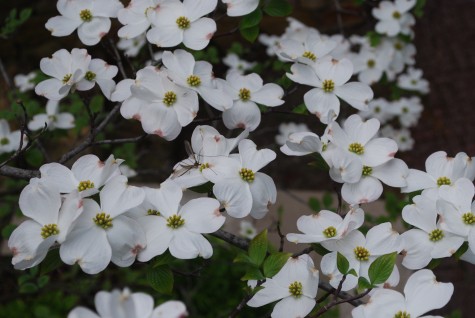
My dogwoods are coming on strong now. Cornus Florida-when they are good, they are excellent, and when they are bad, they are horrid.  I have one tree in the grove with 2 flowers-go figure.  They fade from fungus over the summer. They perpetually look wilted, and unhappy.  But today, I have no complaints.  The flowers keep me coming back for more. 

I have a particular interest in single flowers, for whatever reason.  Bloodroot, white hellebores, dogwood, white annual phlox, white pansies, daisies, Peony Krinkled White, white poppies, Nicotiana alata, Japanese anemones-you get the idea.  White single flowers are especially beautiful.  So simple, elegant, and satisfying to the eye.


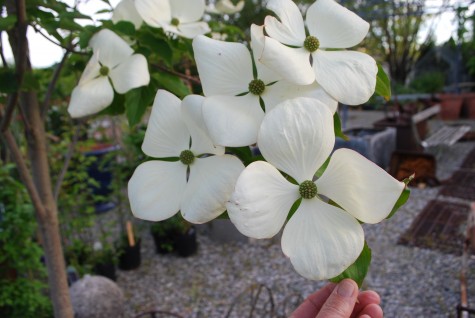
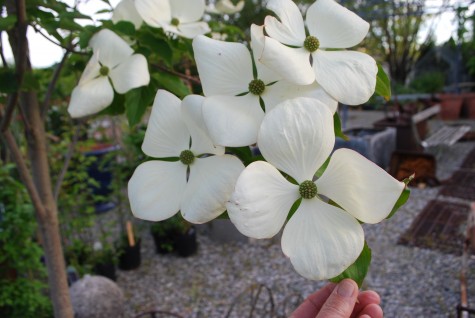
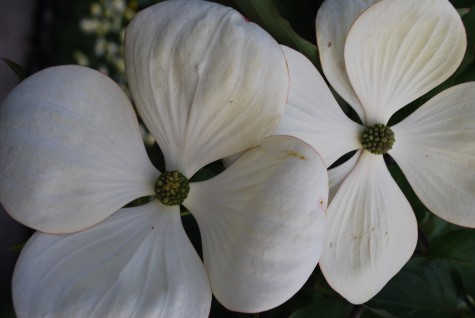
The Venus dogwood is no doubt the most spectacular white flowering tree on the planet.  A cross between the Pacific dogwood, Cornus Nuttalli, and Cornus Kousa, it has the great characteristics of each, in addition to great hardiness, a fast growth rate, and the most spectacular white flowers I have ever seen.  The trees at the shop were in bloom a full month last year, start to finish.


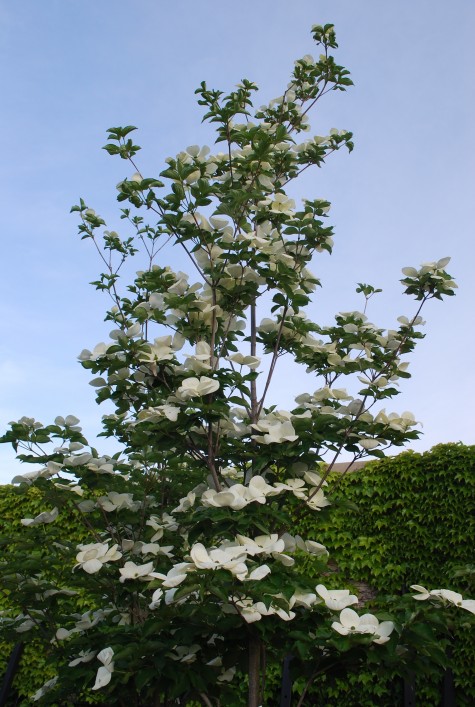
The foliage is large and lush.  They do not fruit to speak of, which doesn’t turn me away from them much.  I like that I can place them in full sun in my zone, and see them thrive.  You can see the size of the trunk in this picture; even an immature tree puts on quite a show.

I typically buy them as 1″ or 1.5″ caliper trees in 25 gallon pots.  This makes it easier for a home gardener to plant them-although  those pots are terrifically heavy.  Even at this early age, each tree will sport upwards of 300 flowers.  Though magnolias can be every bit as willing to bloom, they are fussy about weather conditions.  In a warm year, they may drop their flowers in an instant.

The willingness to grow vigorously and bloom heavily for a long time makes “Venus” my favorite white tree. The trees at the shop are small, and quite green right now; they have inherited that later bloom characteristic from the Kousa parentage.  If you like dogwoods, a Venus will greatly extend the spring bloom season beyond Cornus Florida time. The Venus season is just about to begin.


This was my red white and blue view the other day.

The extraordinary Mr. Phil Savage

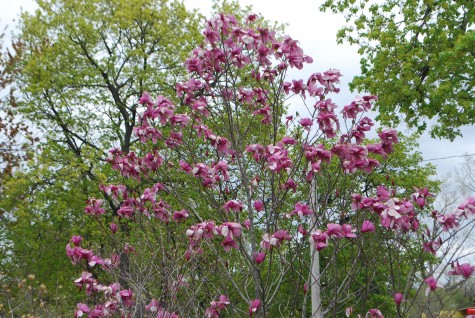
I have a big love for magnolias; I would have any and all of them, if I could.  I admire their big glossy leaves, and pale grey bark.  Most zone 5 hardy magnolias top out at 25 feet; they are a perfect tree for a small property.  Their spring flowers are strikingly large-and simply beautiful.  Some years our spring is so short they might be in bloom only a few days; I do not fault them for this.  Write a protest letter to Ms. Nature-should you have an inclination-but do not expect an answer.  Zone 5 gardeners-we ought to be used to the slings and arrows of outrageous fortune-I am quoting Shakespeare here. No matter how many years in a row I would need to live through a late season killing frost, I would still plant magnolias.  Magnolias are so beautiful in every other regard, I have no problem recommending them.

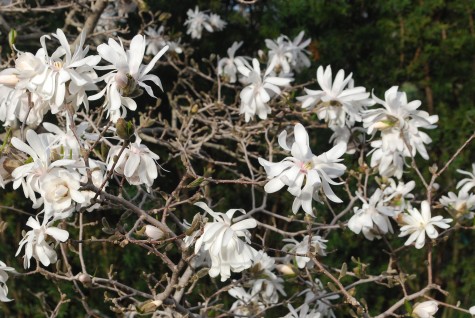
Magnolia Stellata, or star magnolia, and the saucer magnolia, Magnolia Soulangiana, are common to my area. They, and their progeny and hybrids, grace many a spring landscape in my city.  Wada’s Memory, a hybrid of Magnolia Stellata, is a particularly beautiful white cultivar.  Ivory Chalice, bred by Dr Leach from the species Magnolia Denudata, is exceptionally striking in a good year.  It blooms early, and the blooming can be damaged by unexpected cold.  Should you have Ivory Chalice on your property this year, I am sure you are dancing with delight.  Plant this tree if you are a trouper gardener.  Do not plant this tree if you live by your expectations.

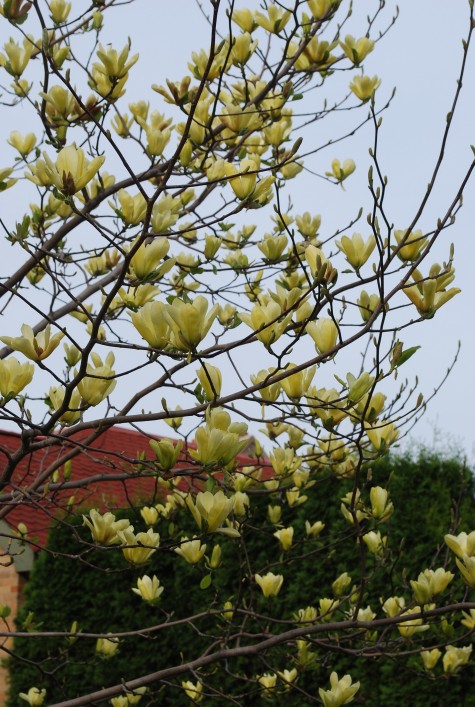
But by far and away, my favorite magnolia is Yellow Butterflies.  Bred by Phil Savage, a world renowned magnolia hybridizer, its fragrant pale yellow flowers are the best part of my spring landscape.   He lived on a large property right on Woodward Avenue in Bloomfield Hills for many years.  I met him in 1987 courtesy of Al Goldner, a noted landscape designer who mentored me for some years.  Al was very interested that any designer first and foremost needed to learn as much as possible about plants.  He was forever hauling his group to see this breeder, or that farm.  It was an education bordering on priceless; I understand that now.

I have no photographs of Phil Savage’s property, but I can describe it.  Magnolias towering at the better part of 50 feet tall were everywhere. Some were white, some were pink.  Others were peach, or yellow, or bordering on orange-colors I had never seen before.  Some trees with trunk calipers approaching 40 or 50 inches-magnolias grafted onto ash tree rootstock. The grafts were giant and incredibly sculptural.  Visiting his property was like visiting another planet. 

Just a few years ago, I visited his property again-courtesy of his niece-a client. He had passed away, and the property was for sale.  She thought I might like to see the magnolias in bloom.  What I saw there took my breath away.  A lifetime devoted to growing trees was in evidence everywhere. Magnolias, and more magnolias.  The size of his trees-like nothing I had ever seen. A giant forest of magnolias-imagine it. Most of these trees have never been introduced into commerce; the scientist and the dreamer had grown trees like I have never seen before or since.  The property is pure magic. 

The property was purchased from the family by a group intending to build a facility for the aged.  His niece was concerned that many of his trees would be felled, destroyed, in that process. I did have GP Enterprises, who successfully moves big trees, look at the property.  So many of the big trees were much too big to be moved. This was not so much comfort for her-she felt her Uncle’s work should be looked after, not cut down.  I was powerless to do anything-this felt so bad.

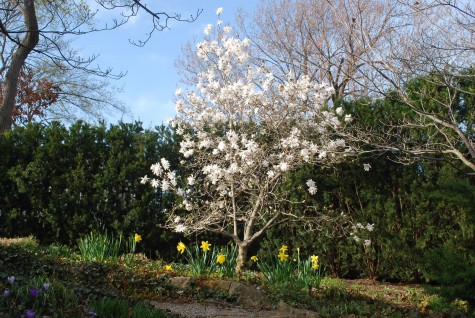
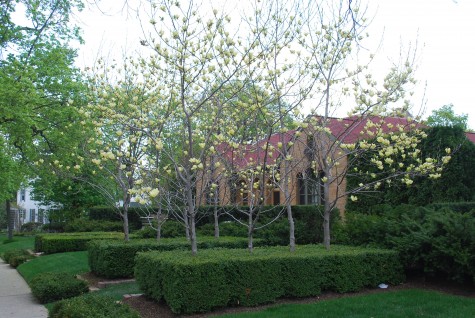
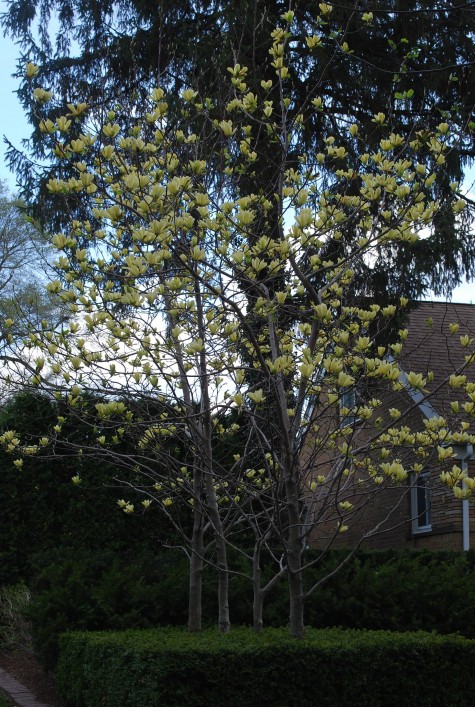
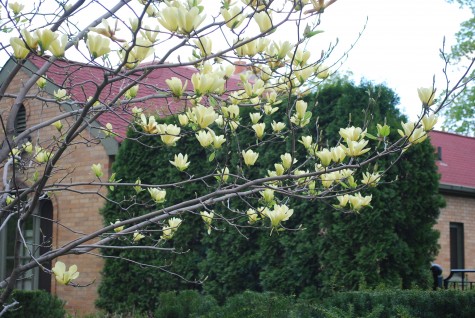
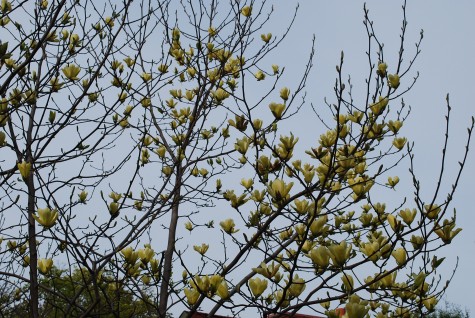
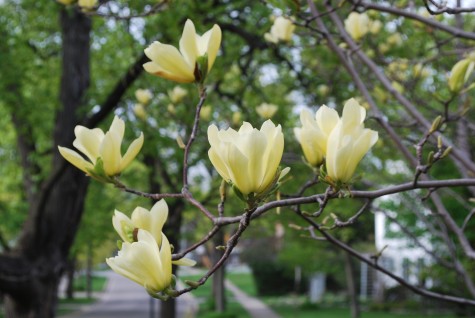
Phil Savage’s most beautiful and well-known cultivar-Butterflies.  This clear pale yellow flowering magnolia -I planted ten of them on either side of a walk to my back yard, and underplanted them with boxwood.  They have been in 6 years now; this spring their blooming is heavy and gorgeous.  A cross between the cucumber magnolia-Magnolia Acuminata, and Magnolia Denudata Sawada’s cream-it is exquisite in bloom, in leaf, in bark, and in habit. Every day for the last week, I pull up in front with the corgis in tow-and get out to take photographs. They lean out the rear window as if to ask-what are you up to?  I am up to trying to capture the color, the shape, the fragrance-all those things that defy recording.  No photograph could possibly do justice to how beautiful they are right now-come by if you can. 

I know I posted a few days ago about how I wish Detroit had a botanic garden, and that in the event I decided for the first time to buy a lottery ticket, and won, I would put that money towards a botanic garden for my city.  I could refine that dream.  The group that bought the property-they have no plans to build over Phil Savage’s magnolias right now; their project is on hold.  If I could, I would write them a check, and wave them off.  I would make a botanic garden-presided over by the most singular and amazing magnolia grove it has ever been my privilege to see.  I have my dreams, yes I do.


Wish me luck.