Placing Trees

Some time ago I voiced the opinion that I was not a big fan of Japanese maples.  I heard back about that in spades. So yes, I will concede that they are beautiful trees with enchanting habit and great bark and leaf color.  But they can be very tough to place beautifully in a landscape.  The red leaved varieties are striking in appearance.  The flip side of striking?  Visually demanding.  A specimen tree is just this-a stand alone special element around which an entire space may be organized.   
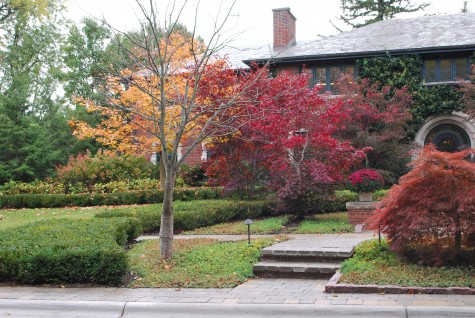
A beautiful specimen tree asks for a placement that reinforces this idea.  If the idea is to feature a particular plant, other elements in the landscape need to take a supporting role.  Of course landscapes can be organized around a series of spaces or rooms, each with their own diva.  In my own landscape, my trees are either hedged, or planted in drifts, as the divas of my landscape are ornaments.  A fountain pool and groups of pots are focal points.  This is by no means the best way to design a landscape.  This is merely what I like.     
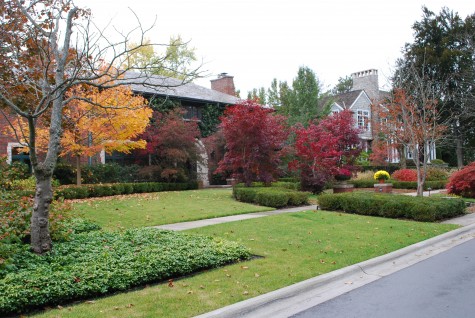
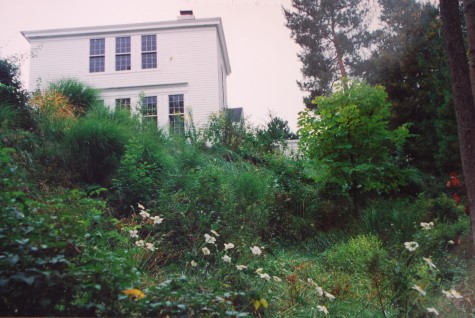
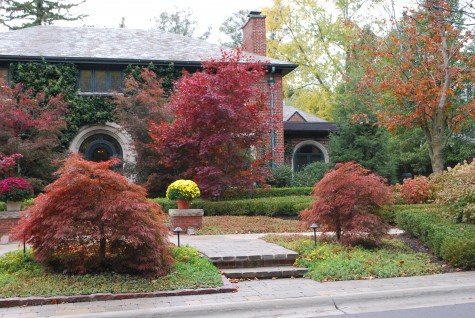
This front yard landscape was home to 9 Japanese maples, representing 5 different cultivars.  When I first saw it last October, some of the maples had black-red leaves.  Some had brown-red leaves.  Others were more clearly red.  In addition, there was a lovely sugar maple, showing yellow fall color in this picture, and 5 additional shade trees.  This made for 15 trees total in the front yard.  Some trees were in poor condition.     
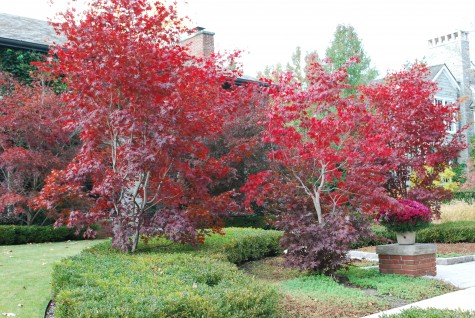
Landscapes in urban neighborhoods are tough to design. They require a judicious hand, and a willingness to edit.  Every landscape gesture needs to be informed by that scarcity of space.  A landscape also needs to work in close concert with that dominant element-the home.  A landscape that respects the architecture will read coherently. There are many voices here struggling to be heard.
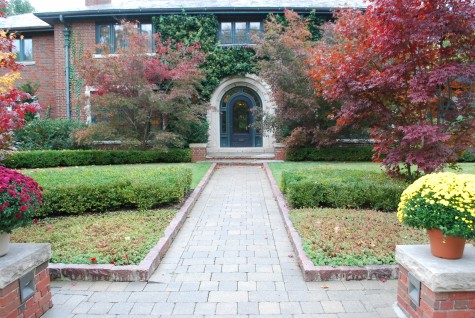
Of course it is easier to see years later how a placement of trees might be wanting.  Hindsight is 20-20.  Imagining the space a tree will occupy at maturity is an art; the best practioner I knew is this regard was Al Goldner.  He fearlessly placed trees in anticipation of what they might become 20 years later-even if the landscape looked too sparse and almost undone to begin with.     
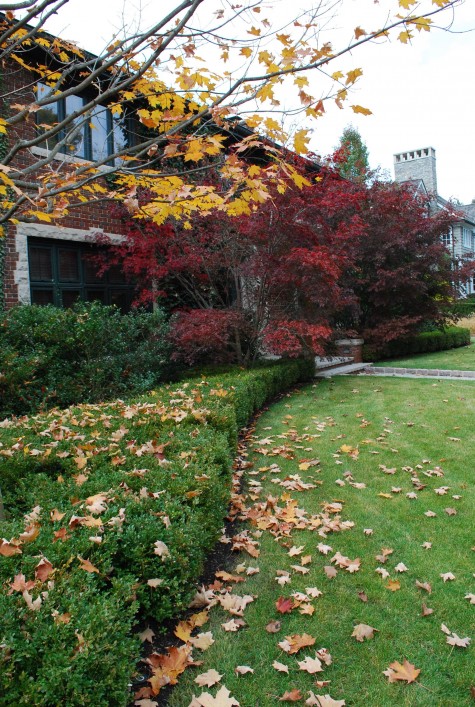
Trees planted very close to the foundation of the house may be lovely the day they go in.  Years later, they can obstruct any view of the architecture they meant originally to celebrate.  It is equally as important to consider the views out from within as it is those views from the street.  Several rooms inside are dark, as the windows are covered by branches of the trees.  These branches are equally obstructing the views out into the landscape.  
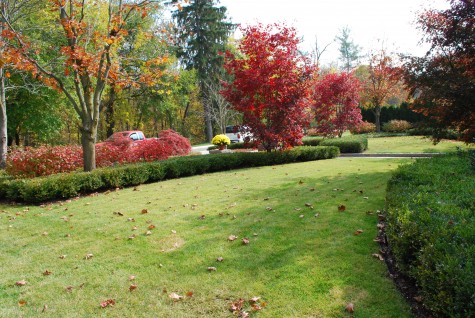
Every landscape has a foreground, a mid ground, and a background space.  Those spaces need to work, no matter the angle of the view.  The Japanese maples might have presented a completely different appearance, had they been pruned differently.  Each had foliage to the ground.  They read visually as giant red shrubs, not small trees with interesting branching, and an airy appearance.  Maintenance is a very important part of a landscape.
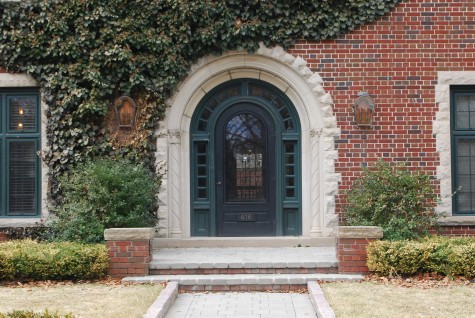
Once the trees were gone, other elements emerged.  A pair of hollies on either side of the front door grew at different rates, and generally suffered from trees planted over them. The boxwood had declined as well.  They have damage from leaf miners; perhaps they were pruned too late in the fall.  There is some work ahead restoring them to good health.   
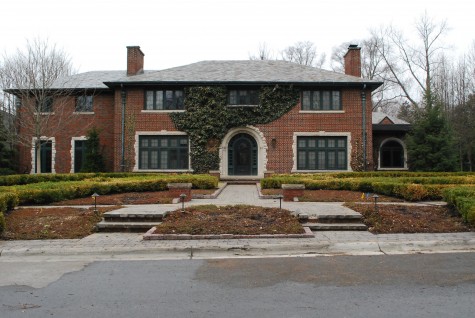

The beautiful sugar maple, and the hemlocks flanking each end of the house are appropriate and friendly to the architecture.  We moved a lot of plants yesterday.  Viburnums, azaleas, hollies, oak leaf hydrangeas, limelight hydrangeas, boxwood and fothergilla.  The renovation of this landscape is underway.
The Grand Hotel Topiary Sculptures

I do not remember what year it was, nor do I remember why, but Rob and I took a trip to New York-it may have been to see the Lucien Freud exhibit at the Met, and eat hot dogs after in Central Park.  On the way, we visited every place in Pennsylvania that we thought might have garden ornament or pots.  We visited Campania in Quakertown; I was unable to convince them to part with a single piece of their vintage Italian terra cotta.  Can you hear me sighing?  Meadowbrook Farm, just north of Philadelphia, was a delight to visit.  J. Liddon Pennock, noted garden designer and plantsman, willed his 25 acre estate and gardens to the Pennsylvania Horticulture Society in 2004.  He kept a small nursery and shop there; I made my first garden ornament purchase ever there.  Eventually we ended up at Longwood Gardens-wow.  I could write for days about that place, but what enchanted me the most were the topiary ivy sculptures.  I bought the book.   

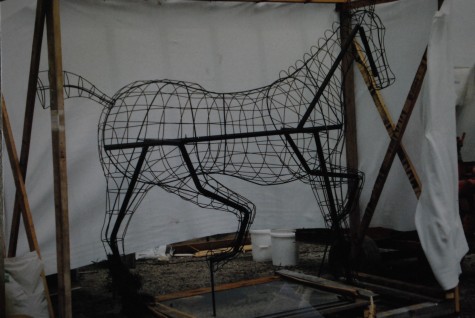
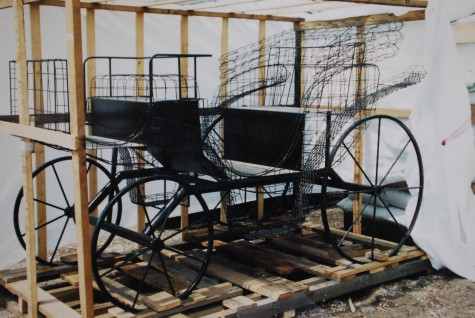
The topiary were not rooted in the ground.  The plants were rooted in every surface of the sculptures. The New Topiary: Imaginative Techniques From Longwood  was a do it yourself topiary stylist’s dream book come true.  Patricia detailed exactly how they were constructed.  The steel frames had been made at the Longwood Manufacturing Corporation (no relation to the gardens) and stuffed with plants at the gardens.  I could not get these sculptures out of my mind.  On the strength of what I saw at Longwood, and what I read in the book, I managed to persuade Grand Hotel to invest in 3 topiary sculptures.  A pair of Hackneys, drawing a carriage, as depicted in their logo.  They agreed.  Some months later, the three steel and wire topiary frames were delivered to me-it was my turn. 

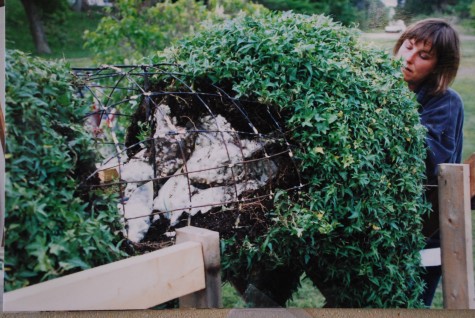
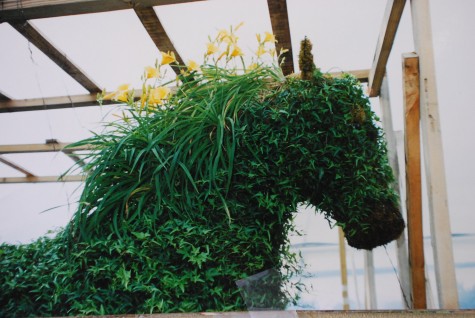
This glimpse of the interior of one of the horses helps tell the story of the construction.  The topiaries were built in horizontal layers, from the hoofs on up. A layer of the frame was covered in a netting of fishing line.  Florists moss was pressed into the fish line.  3 inches of soil came next; individual ivy plants were planted sideways in the breaks between the moss.  The body of the horse-much too large a volume to load up with soil.  The belly of each horse, a collection of styrofoam peanuts packed loosely into individual plastic baggies.  The worst enemy of any topiary built in this way-topiary erosion. The styrofoam interior had to perfectly conform to the available space without any air pockets.  We packed and stuffed, and packed again.  This photograph was taken when I had to repair a horse that had suffered a too rough a ride back to Mackinac Island in the spring.  A large topiary such as this requires a lot of patient work.   

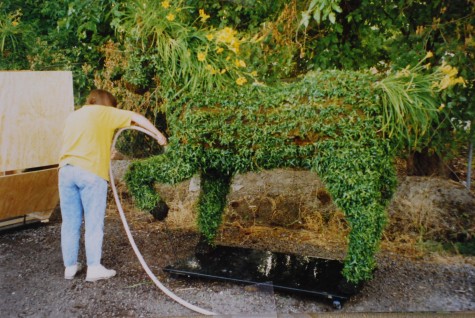
It is easy to see in this picture how the plants were layered horizontally.  Finishing the forms took 400 hours-I remember this-and the countless miles of fishline and boxes of moss.  Truth be told, it was much more than I bargained for.  What it took to make these sculptures road ready-I had no clue; frankly, I grew up with these sculptures. I soaked the sculptures thoroughly before they got packed in their crates.  I would get them back in the fall, and winter them in a makeshift greenhouse I had put up for exactly this purpose.

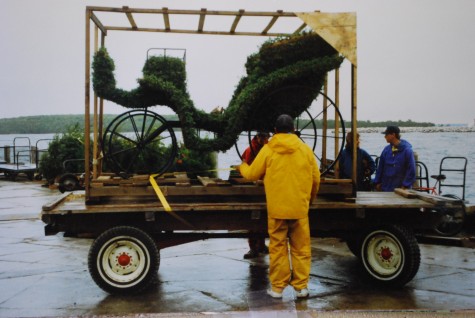
I kept the original crates that the frames came in; Mackinac Island is 340 miles north of where I live. I knew the sculptures would need to travel.  A forklift loaded them on a boat, and offloaded them onto a horse drawn wagon for their trip up the hill.

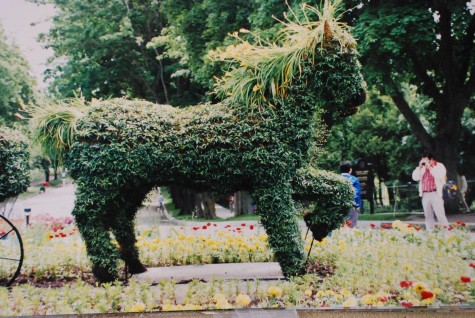
I planted Stella D’Oro daylilies in the manes and tails.  I found glass eyes for the horses from a taxidermy shop.  They were finally ready to be placed in the garden. 

They made quite a statement.  This garden had a focus.  No matter when I visited, someone was taking a picture.  This part felt great.  They made the garden so much more friendly, and personal.  They invited people to interact with the grounds and gardens.

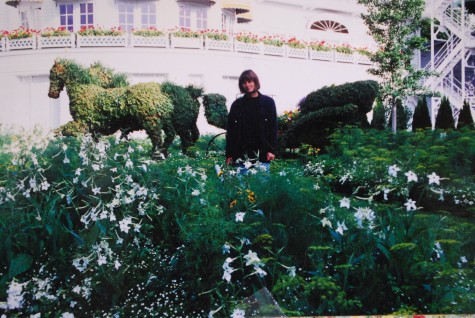
Back then, they were the star attraction in the Triangle garden.  Today they reside in a giant lawn space in the tea gardens.   This particular year, the tea garden was all white, pale yellow, and dilly.  So many dill plants and white nicotiana alata. 


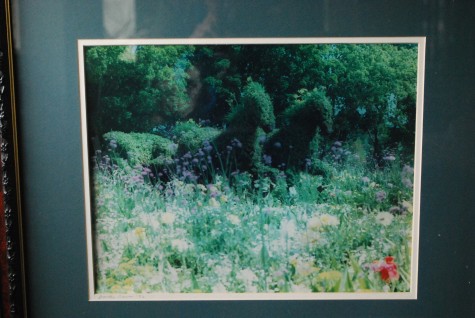
Dorothy Farmer, noted gardener and supervisor of the Cranbrook Gardens auxiliary for so many years took my favorite picture of these sculptures.  She framed a copy of her picture, and gave it to me.  My photograph of her picture is terrible, but perhaps you can discern a little of what felt like magic to me.  The one red canna at the lower right-the odd man out.  She asked me about that.  Every garden I design has one plant that does not fit.  Most times I do it, in acknowledgement of nature.  In this garden this particular year, 1996,  I planted it for the owners of Grand Hotel.  Their interest and committment made a special moment in a garden possible.

Susanne’s Roses


My post earlier today featured the best that there is going on outside here-that best is not so great.  It is still winter where I live.   So I went back into that stack of old pictures and projects looking for something a little less chilly and off-putting.  This landscape and garden I worked on intensively between 1986 and 1994.  A client with a beautiful house on a small piece of land-I cannot remember how we met.  But I do remember that she decided that a garden, and a great garden at that, was just what she wanted.  Though she was always clear about what she liked, she had not so much knowledge.  I not only designed and planted for her-I taught.  She wanted to know everything I knew about wildflowers, perennials, meadows-and most of all, roses.  I had a history with roses, fostered by Al Goldner.  A highly regarded landscape designer with a degree in floriculture-he put up with a young employee (that would be me) who insisted to him in 1985 that tea roses were overbred, disease prone, and marginally hardy prima donnas.  He had the confidence to allow me to order roses of my own choosing for Goldner-Walsh.  I knew he was giving me just enough rope to hang myself.

I placed an order for roses with Hortico in Canada.  I bought antique roses. Climbers.  Rugosas.  Species roses.  And a line of English roses-the David Austin roses. Everything and anything that was not a tea rose.  I vividly remember the day I pulled a company pickup truck full of bareroot roses up to the Canadian/American customs booth-of course they pulled me over.  Who knew I needed a phytosanitary certificate?  I spent hours on a bench next to a man in handcuffs-it was terrifying.  Eventually they let me go.  This was some years before Wayside Gardens began offering David Austin roses.  I potted up just short of a thousand roses, and brought them on.  I learned plenty about them, just taking care of them.  Though I was by no means a rosarian, I had a client who wanted any and all of them.  Susanne.    

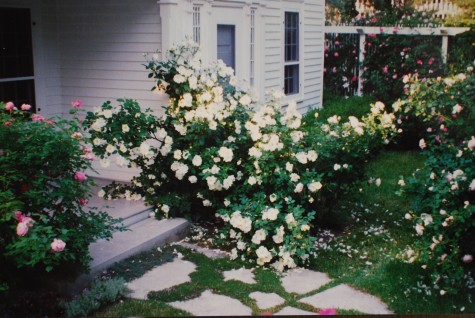
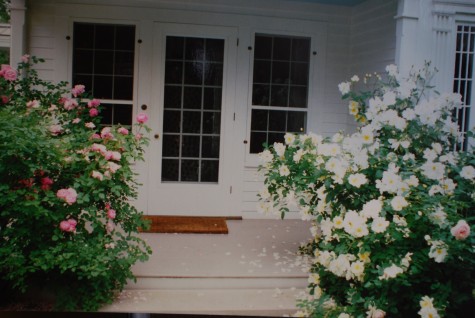
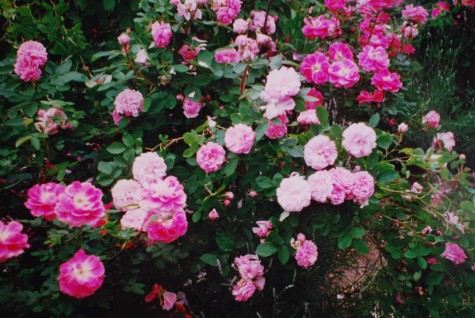
There are those people you meet.  In the course of business.  In the neighborhood.  In the grocery check out line.  They encourage you to be better than you ever thought you could be.  This perfectly describes Susanne.  She lit a fire under me the likes of which happens only rarely.  Some days I would come to plant, armed with hellebore species I had stood on my head to obtain-and she would still be in bed.  I would march right upstairs (I had the run of the house by then) and roust her out.  Years later, her front porch was dwarfed by mature David Austin roses-Mary Rose to the left here, and Heritage, on the right. 

Her rear yard had about 15 feet of flat ground, before the earth dropped precipitously to the Rouge River.  That 15 feet of space-stuffed with roses.  They were lush.  She was lush.  My gardening life had an operatic quality to it, thanks to her.  Her entire property smelled of roses.  We grew roses with perennials.  We grew roses with asparagus, and grasses. We grew roses wherever we could. The we part was important there-the two of us gardened as if we only had 10 minutes to live.

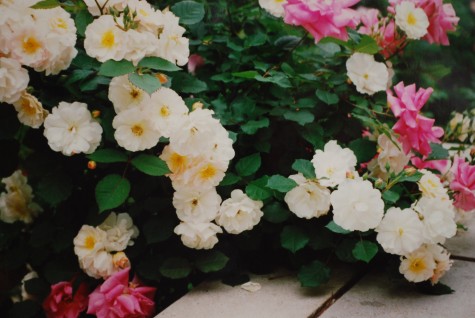
Every walkway, every staircase-redolent with the blossoms, the smell, and the habit of roses.  Not one of them was a tea rose.  I could go over the names and the classifications, but that is not my idea here.  Though we also planted no end of unusual perennials, wildflowers, grasses, trees, espaliers and shrubs, the organizing metaphor of this landscape-for the love of the rose.    

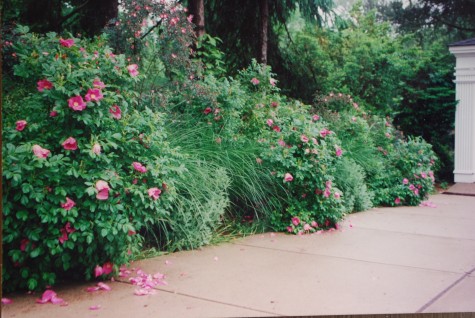
The driveway garden-a mix of Rosa Rugosa Scabrosa, rosa glauca (formerly rosa rubrifolia) miscanthus gracillimus, and artemesia.  Petals on the drive-how I loved this. 

It has been so long ago that I designed and planted this garden, I cannot perfectly recall specific varieties from these old 35mm pictures.  But I do know my knowledge of roses burgeoned.  Susanne wanted to know everything she could about them-from me.  We both learned.

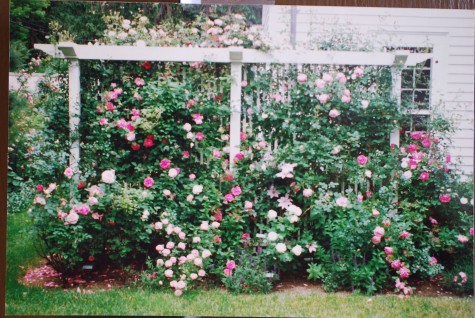
Her architect in Chicago built this rose arbor for her-I planted it.  This picture does little justice to that day some years later when I took this photograph.  Her passion-that’s what I see here.  I forget everything routinely-but I remember this day as if it were yesterday.   


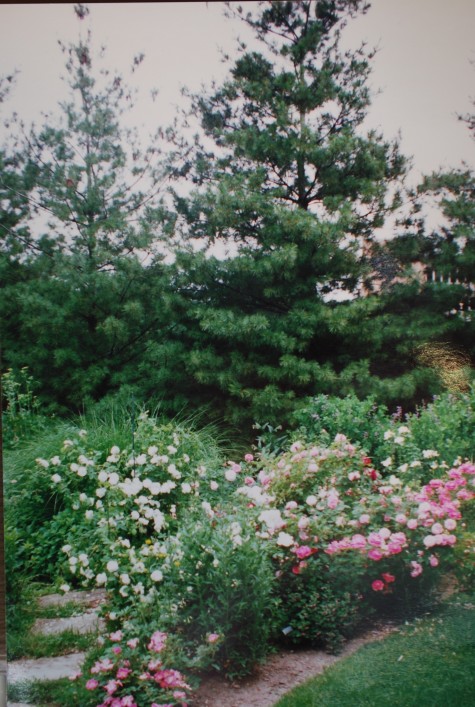
Her home sat on a very small piece of level ground.  The back yard dropped off precipitously to the Rouge River.  I gardened this entire steep slope-species and wild roses, grasses.  Perennials.  Weeds.  The anchoring trees-yellow woods-Cledrastis. This garden on a steep slope about did me in-but it was wildly beautiful.  


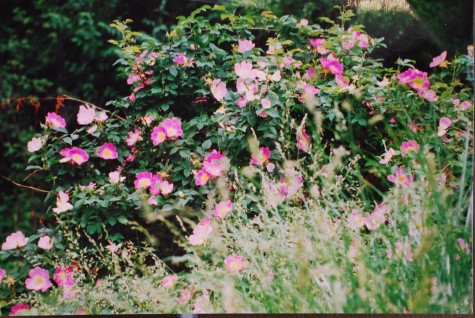
All over that slope-Rosa Complicata. How lucky I was to have met Susanne.  This garden changed my my life.

Pop-Up Structures


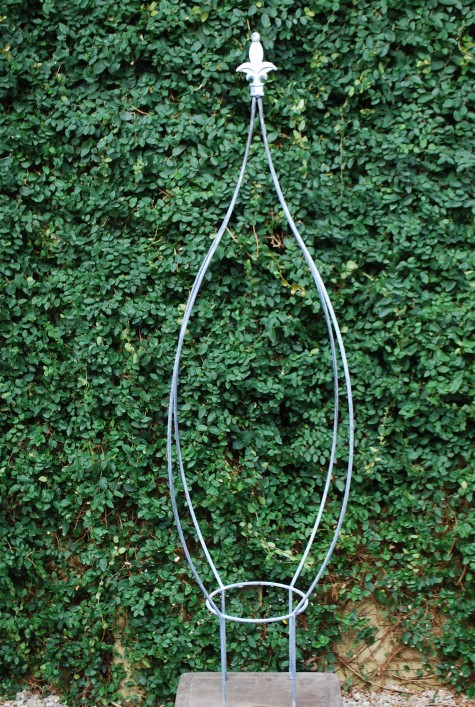
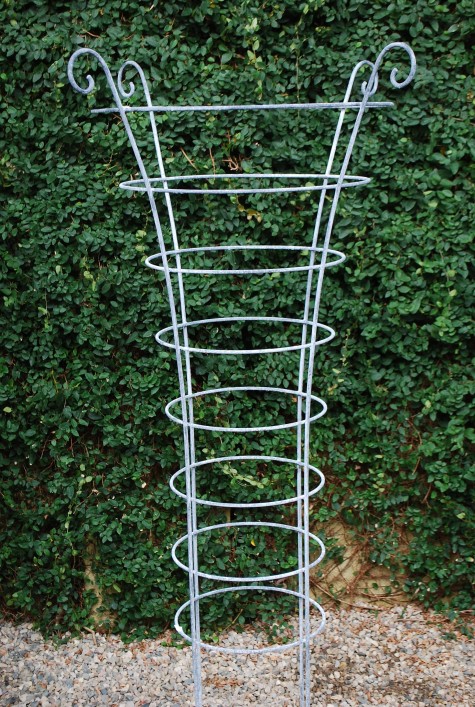
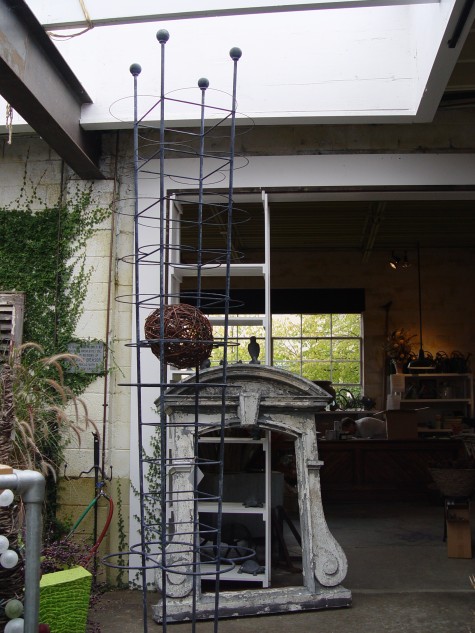
A pergola is a big heavy structural object-not a good candidate for moving around the yard on a whim.  But tuteurs, vine supports, vine towers, and plant climbers can pop up in a garden wherever and whenever you have a mind to use them.  My big complaint with plant climbers-they are invariably too short for the plants I’d like to grow on them.  My climbers have always been homemade-from bamboo.  I can make them as tall as I want. I had a mind some years ago to move on from this.  The size of commercially manufactured tuteurs are dictated by UPS regulation.  They will not ship an object over a certain size.  Motor freighting a plant climber-not one bit cost effective. I hate paying more for shipping than what the object of my affection costs to buy.  Everyone thinks twice before motor freighting.  So I removed the ship issue from my design.  I designed a whole series of plant climbers aimed at my local market.  Should you have access to a pick-up, or are fine with strapping the hatch down on your car, we have big and tall plant climbers.  This particular steel climber-available in regular and giant size.       


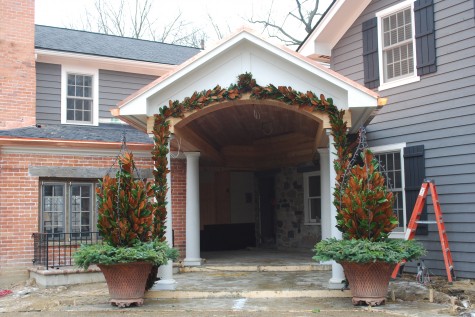
The four ribs of this giant size tuteur leaves lots of space in the middle for  display.  At the holidays, these towers get strung with lights, and outline a topiary of magnolia branches.  Pop-up plant climbers are just as useful in the winter, as they are in the summer.  Simple plant climbers pop up easily, regularly. 

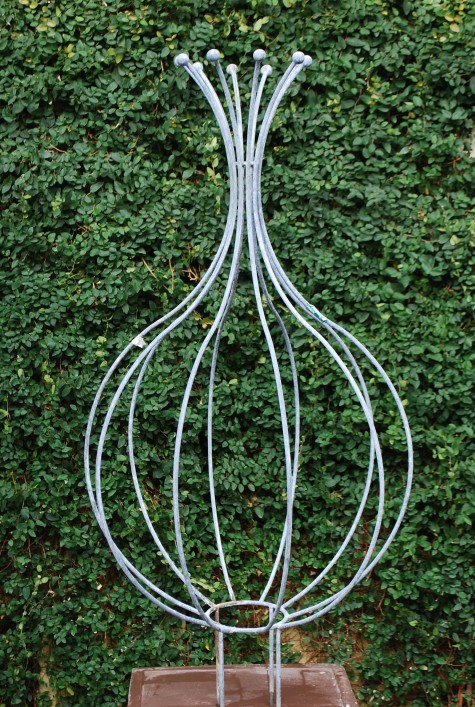
This steel garlic form, finished in our virtually rust free finish, has a graceful shape that holds its own visually-climbing plants or no.  We make them in 3 sizes.  Gardeners pop them into their containers; I like giving them a choice about the size.   

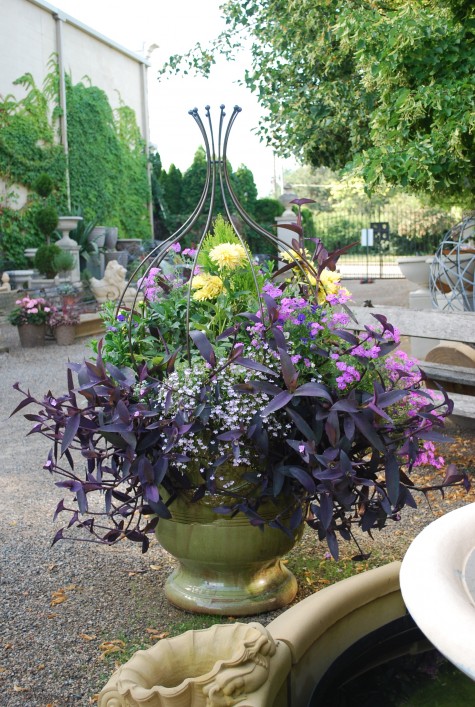
This giant garlic planter never did have a vine planted beneath it.  A yellow dahlia occupies the interior space with a raft of annual phlox. Trailing-lobelia and black Moses in the Cradle.  This spring planting carried on throught the season.  The garlic tuteur is a sculptural element-always in view.  It organizes the plant airspace in a beautiful way.  Imagine this container planting without the tuteur.  Robust yes.  But not nearly as striking as this.   

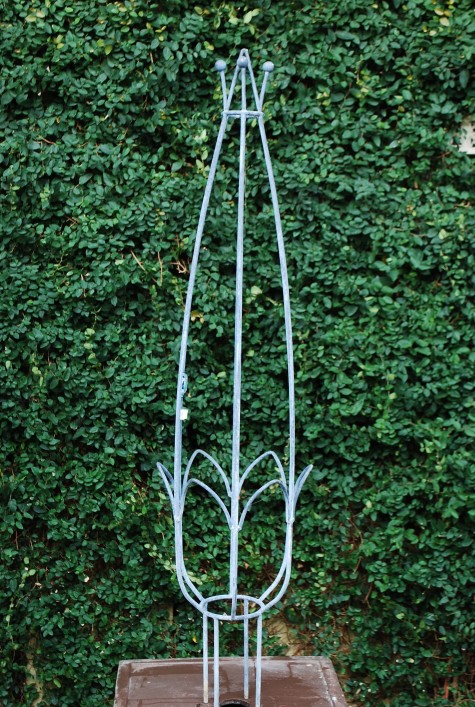
This form was designed by Rob-loosely based on an elongated flower bud. The first year we produced this form, I was too chicken to make the 9′ version.  What was my problem? 

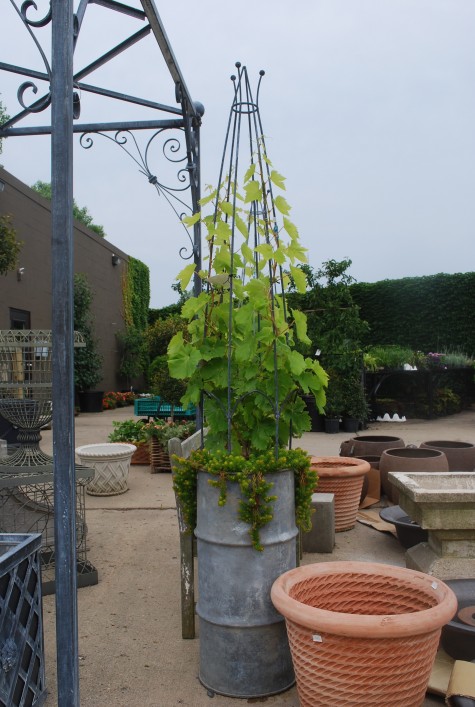
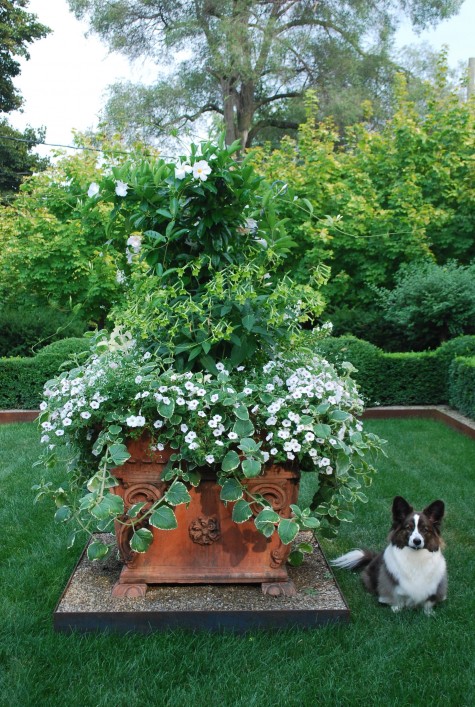
Once a giant form gets outside, and has the sky backing it up, giant seems merely just right. This 9 foot form is larger than its galvanized container-but it works.  Growing grapes in pots?  Were someone to ask me to describe Rob, I would say he lives to grow grapes.  Grapes on pergolas.  Grapes in pots and containers.  This container, designed and planted by him, says it all.  The overscaled bud tuteur makes his idea of a gorgeous container planting a gorgeous reality.

I designed this plant climber wholly based on Rob’s bamboo climbers from the early days.  He would sink 4 very tall bamboo stakes into a container at an outward angle.  He would then wrap galvanized wires in circular little, big, and giant swoops around the bamboo.  Small at the bottom-big at the top.  Most plant climbers I see pay no mind to the habit of a climbing or indeterminate plants.  Plants grow out, up, and out.  This form pays some mind to that.   The top of the plant, spilling over-as in a bower-a plant climber that scoops that up plenty of shoots-well designed.  Plant stakes-they could poke your eye out if you aren’t watching.  None of our climbers have sharp edges.  Every vertical stopper is either curled over ostrich fern style,  or capped in a mini-sphere. 


This steel version of Rob’s classic climber-not visible in late summer.  It is the structure making this container planting suitable for company.  The long flower stalks of the nicotiana alata lime are tied up to it.  The vining mandevillea has otherwise engulfed it.  Not all structure needs to be seen.  But all structures need to be strong, and scaled to handle the job. 


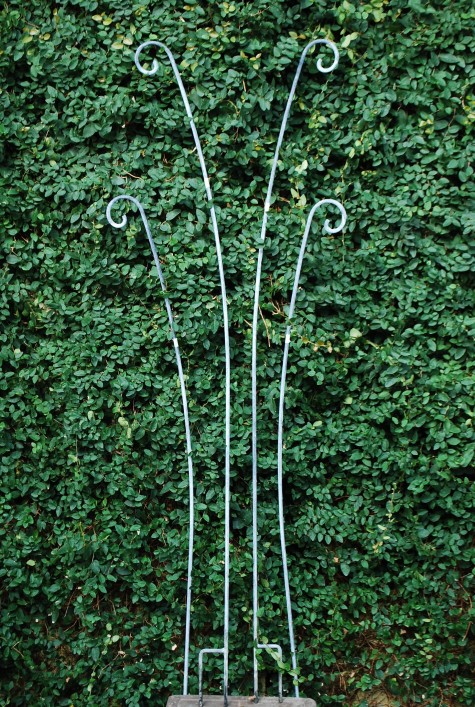
Plant stakes-what is so incredibly unnatural about them?  I understand why gardeners use stout twigs and branches to support their plants.  A natural branch is slight at the bottom, and fans out at the top.  This natural support is great for peonies, and delphiniums.  My 12 peony stems coming out of the ground may be 10 inches in diameter. That same peony plant may be 4′ across at the top.  No straight stake does not do them justice.  My steel stakes come straight out of the ground, and then curve out.  The double prongs at the bottom keep them from moving off course.  


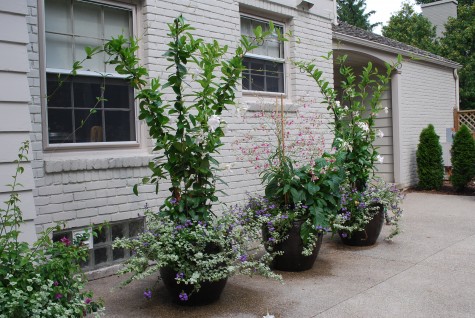
The individual stakes in these containers are much loved by the mandevillea vines climbing them.  The overall shape of these containers- natural and pretty.  The stakes-they might be used with the asparagus next year, or grouped, unplanted, in a perennial bed next year.  Who knows where they might pop up next. 

So many years I staked every climber with bamboo.  These 12′ stakes with their twig ball finials have been in use since 2005.  As much as bamboo stakes are part of my gardening vocabulary, I am pleased to have turned that page. 

Some of our steel tuteurs-they top off a planting in a structural and sculptural way.  Not in a help out a plant climber way. Portable structures can pop up in lots of ways, in lots of gardens.      


This tuteur was Buck’s biggest-fully 14 feet tall.  Small squares and loops at the bottom-giant squares and even bigger loops at the top.  Barbara A bought this pop-up plant tuteur.  What she did with it-I hope someday I will hear.