A Pedestrian Bridge

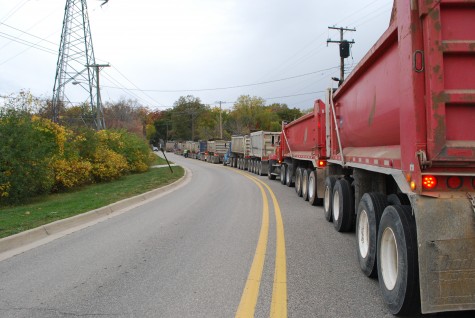
This was the scene on Pontiac Drive at 7am yesterday. Tractor trailer after tractor trailer-every one filled with dirt.  Down the street from us, a bridge is under construction. The bridge will cross over 6 lanes of Telegraph road.  2 spans, totalling 315 feet.  The Clinton River trail system, built primarily over a section of railroad which was closed in 1998, is a pedestrian path friendly to bike riders, runners and walking folk, stretching from from South Lyon to Rochester.  Current users of the trail have to detour around Telegraph some 5 miles before they are able to hook up to it again on the other side. The bridge will link the Sylvan Lake portion of the trail to the Pontiac portion.  
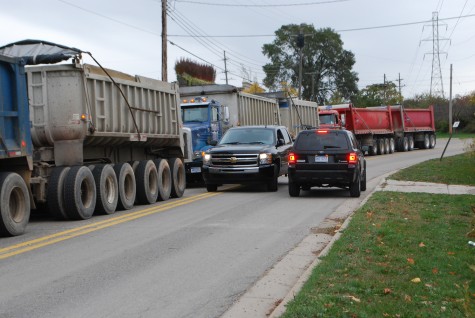

Building the bridge will cost something over 2 million dollars; quite a project.  We have been privy to the pounding and trucking for weeks now. Needless to say, traffic on this sleepy street has been congested. I was mesmerized by the sight of all of those trucks. There s something about earth work that fascinates me.   
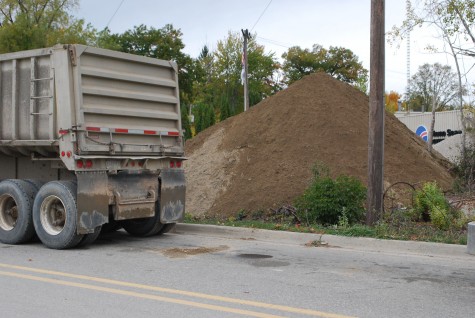
The project is at a stage where they need soil-and lots of it. I had to ask, and was told-each truck hauled in 44 yards of dirt.  By my estimation, close to 900 yards of soil arrived in a two hour period yesterday morning.  You can tell from the photo above the dirt was very sandy. I have no idea how it is being used-the bridge approach is off limits. 
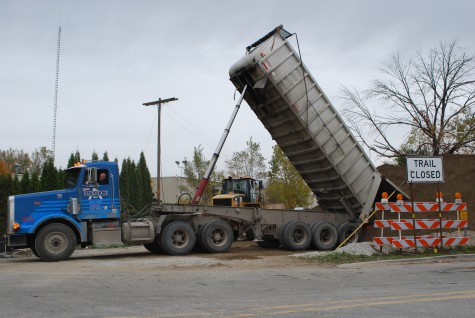
It took about 10 minutes for each trucker to dump one load, detach the trailer, dump the next, and hook the trailer back up.  All the while, another 10 trucks were waiting in line.  One of the drivers told me that once he fires his diesel powered truck up in the morning, it stays running all day.  Apparently it is very hard on the engine to turn them on and off.  
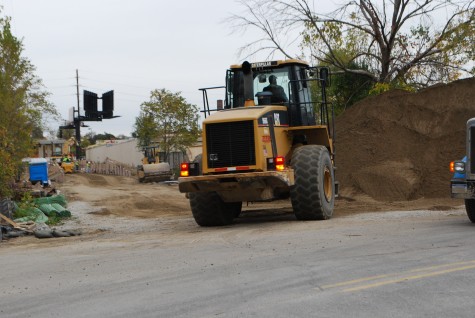
The wheels on this bull dozer are taller than I am. The operator ran loads of dirt from the street down to the Telegraph side of the trail all day long.  When I left work at 6pm, the dozer was still running back and forth.    
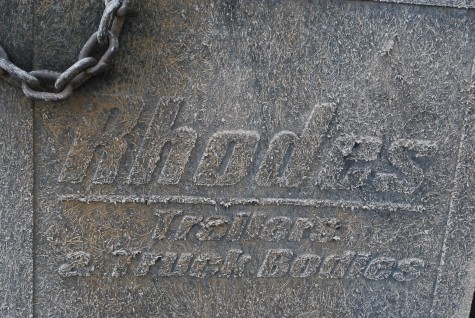
I like everything assciated with the landscape, and that includes the trucks that makes the work possible.  They brought my espaliers to me, under refrigeration, from the west coast. They haul soil, plants people and machines for me.  They deliver the many pallets of soil mix that we have formulated for our container plantings.  Every container that comes from Europe is trucked to the shop for unloading.    

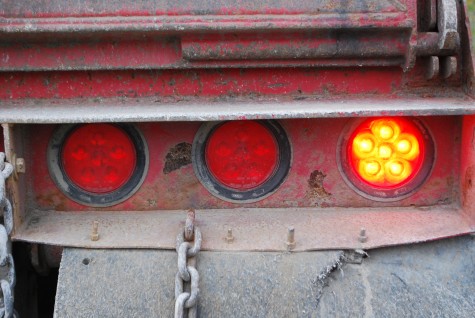
Each one of these trucks has 44 tires.  I cannot imagine the maintenance associated with a vehicle of this size.  No doubt this company has a full time mechanic on staff.  I have gardened in places where vehicles were not permitted.  Even the most simple job took a lot of time.  This in no small part accounts for my great admiration for people who do their own landscaping-and their own trucking.   

I have no idea how long it will be before bikers and walkers can take the bridge over Telegraph, but it seems like it will be a while yet.  I doubt I will ever ride a bike over Telegraph, but it has been an interesting experience to observe a bridge being built.
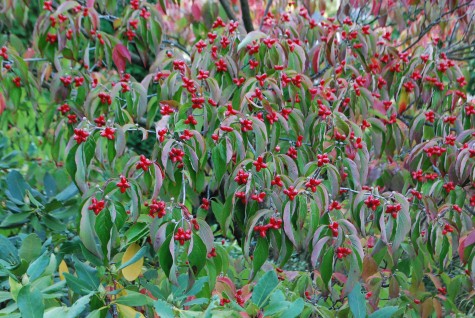
Kousa Dogwoods


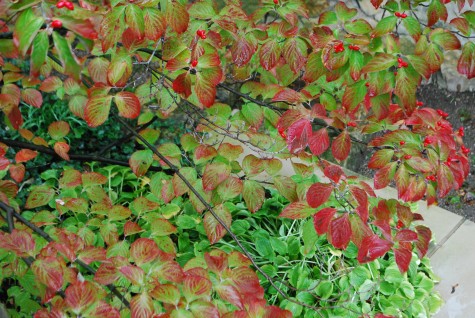
Cornus kousa, or kousa dogwood, has an impressive list of outstanding characteristics.  Since few properties are large enough for an arboretum, choices have to be made. Trees with year round interest draw my attention.  The kousa dogwood has outstanding exfoliating bark when it is of sufficient age.  Like the sycamore or London plane, a old kousa dogwood will randomly shed bark, revealing new bark of a paler color, from underneath.  As a result, an old trunk is multi-colored, and highly textural.  As much as I like bark, I like the kousa dogwood.  This tree furthermore sets brilliant red fruit in September.  That shiny fire engine red is my idea of fall fireworks.  


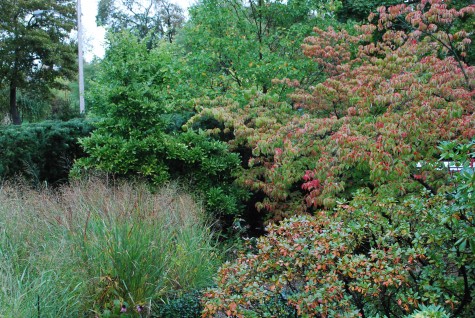
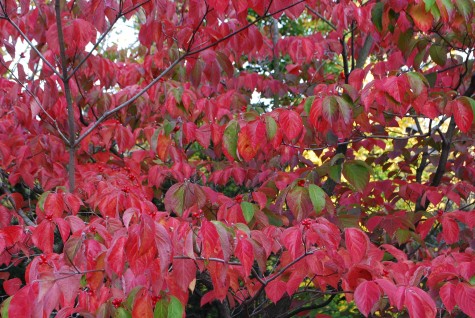
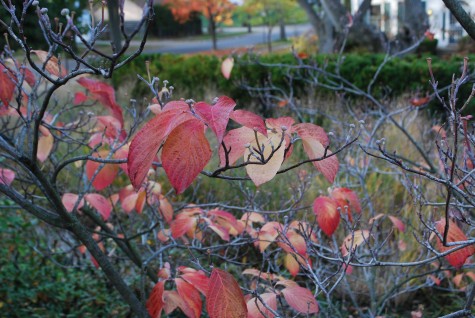
Notice I have made no mention of the beautiful white flowers that mature in my yard in June.  In a good year, those flowers may last 3 weeks; my gardening season lasts 7-8 months. I need more interest than what great flowers provide before I am moved to dig the the hole required to plant a tree.  Even my beloved magnolias whose bloom is so fleeting have great bark and branching, and large luscious leaves all season.  A long season of interest-I look for this. My Kousa dogwoods are next to invisible after they bloom.  You can only spot it in this picture, as the leaves are beginning to turn. 

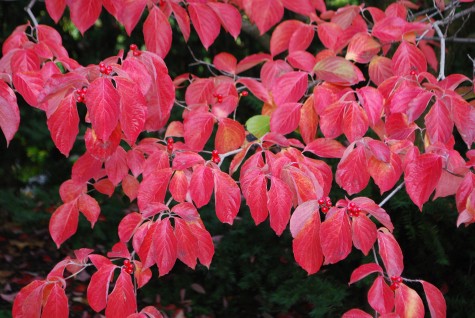
Their green leaves fire up slowly, come the beginning of fall.  The contrast of that red, and that green is riveting.  The shape of the leaves and the pattern of the veins are never more showy than they are in September.  The changing of the guard from the summer foliage to the fall display is an event I follow closely.   

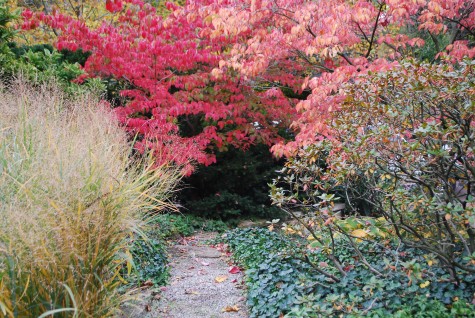
The late September Kousa color is peach; that peach will deepen and mature.  I do not know the science well enough to state the evolution of the color depends on night temperatures that are steadily dropping.  So many times I research my instincts about nature to find out my notions have no basis in fact.  Suffice it to say, the fall color on the kousa changes dramatically over the course of the fall.

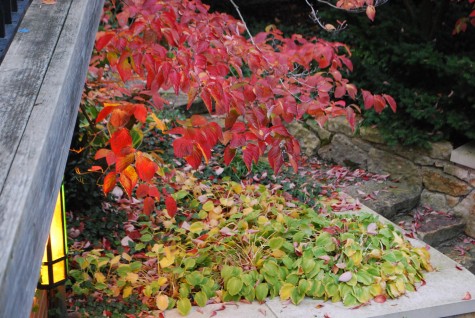
I have four kousa dogwoods on the north side of my house.  All four have grown steadily over the past 15 years.  This kousa planted at the front corner of my Romeo and Juliet balcony has grown such that the branches have come up and over the deck; they are at my eye level now.  One branch of that dogwood grows over the driveway far below.  I never notice that branch until the fall colors up the leaves. The garage lights make those leaves glow an orangy red. 

The vibrant red kousa leaves, underpainted and glowing from inside with that early orangy peach color, are the star of my north side garden show for weeks. The fall is all about the evolution of the leaves.  How they grow and photosynthesize over the summer, then turn, how they fade-how they drop-a gorgeous visual lesson in the process that is nature.  The process I am writing about takes the better part of 3 months.  That three month spectacular leaf turn and drop makes a kousa dogwood a tree I would not do without.
There comes that brief time when the red leaves of my dogwoods are just about as intense as the red fruit. That spectacular fall color is one of many reasons why a Kousa dogwood is worth any gardener’s consideration.  I have considered no end of plants for my own garden, and for the gardens of clients.  Decisions get made; trees get planted and take hold.  A good choice matters much. 

A tree is one of nature’s biggest plants.  I think about every tree I plant, and its location, long and hard-given the space it will occupy, and what conditions on the ground it will influence.  I additionally hope any tree I plant will outlive me. That given, I choose which tree for where with great care.  Today I am delighted to have a foursome of Kousa dogwoods thriving in my garden.  Their fall leaves in color delights me.  The summer season has no end of visual delight.  I have three other seasons besides the summer; I have interest in some off-season delight. 


That congested thicket of red-orange kousa leaves peak, thin, and fall.  Those last few dogwood leaves holding on today speak eloquently to the end of the season.  Consider cornus kousa for your garden.  Should you already have one, consider more.  The fall color-enjoy every bit of it.

At A Glance: A Last Look

Pastoral Landscapes

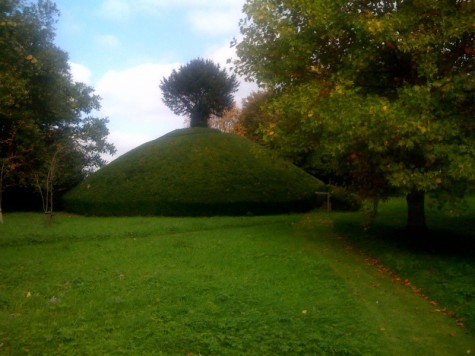
Rob’s shopping trip abroad for Detroit Garden Works is well into its second week.  He has attended some antique faires, as well as visiting dealers specializing in vintage or antique garden ornament.  His route from this country faire to that rural dealer has been dreamy to say the least.  I have gotten scads of pictures.  Many of them have a very painterly quality about them.  Boxwood Hill, with its path to the top looks like a scene from a Tolkien novel-a pastoral landscape fraught with history.  This photograph of surely trimmed boxwood, and a path up to the tree on top set in rough grass is heart stopping-can you imagine seeing this in person?     

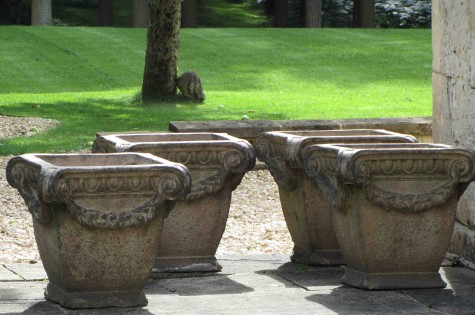
These four terra cotta squares, made at the the Liberty Company in London at the turn of the century, look particularly beautiful displayed against the park like landscape.  These rare signed and stamped pots have a quietly classical and architectural presence that suits me just fine.  They have that chunky and solid English aura about them that rings true.  Any genuine expression I admire.      

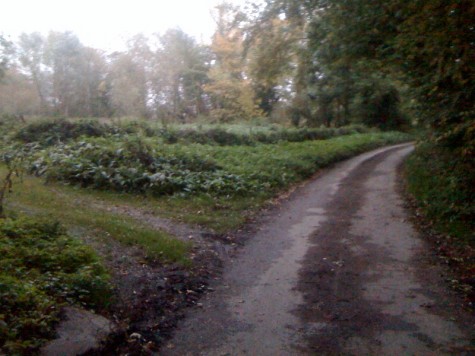
Where Rob was when he took this photograph, I have no idea.  It looks to me like the junction of the road, and the road not taken- made famous by the poem by Robert Frost.  I will have to ask Rob which road he eventually took, as his camera recorded that moment seconds before he made his decision.  There is not a building nor a sign to be seen-striking, that.  This pair of two-tracks; each one holds promise. 


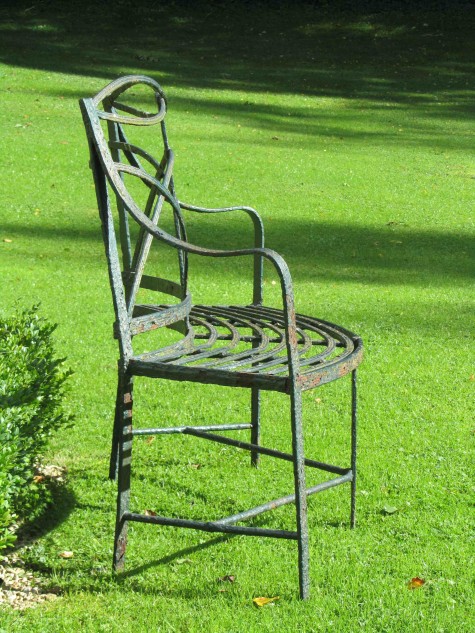
Like this antique curved iron bench or not, the combination of bench, lawn and light is beautiful.   

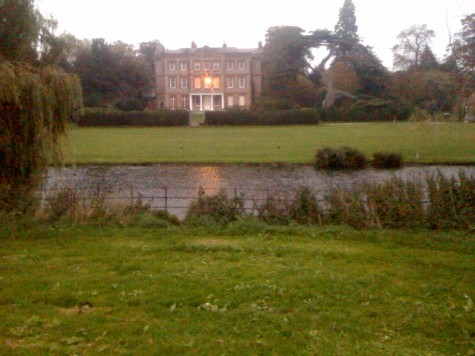
This country house is of a grand scale, but the attendant landscape is seems barely touched by human hands.  Field grass like this-full of all sorts of plants and infrequently cut or grazed is completely unlike what I would call lawn.   The grass adjacent to a wild garden I once had was overrun in the spring with every color of violet imagineable.  I don’t think I knew how good it was until it was gone.  A lawn overrun with violets;  what could be better? 

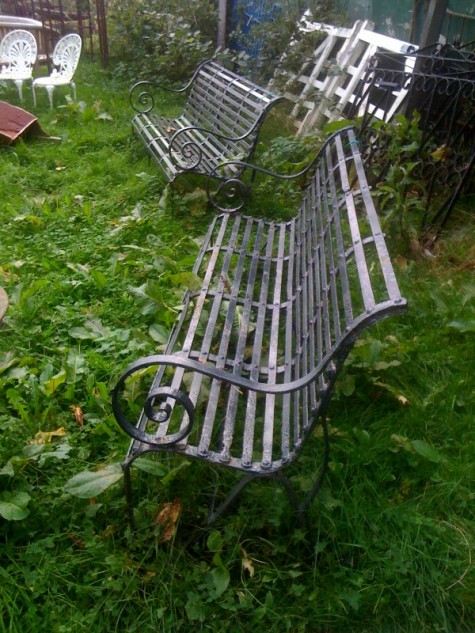
Many of the places that Rob shops have deconstructed landscapes such as this.  The look is lovely, natural and soft. In charming disarray, this landscape has a life of its own, with a minimum of interference from a human hand.  Though some may say this is evidence of neglect or poor housekeeping, I like how this space has been colonized. The natural landscape fringes and grows up onto the benches, gates, chairs, and ironwork-a natural, and beautiful relationship.   


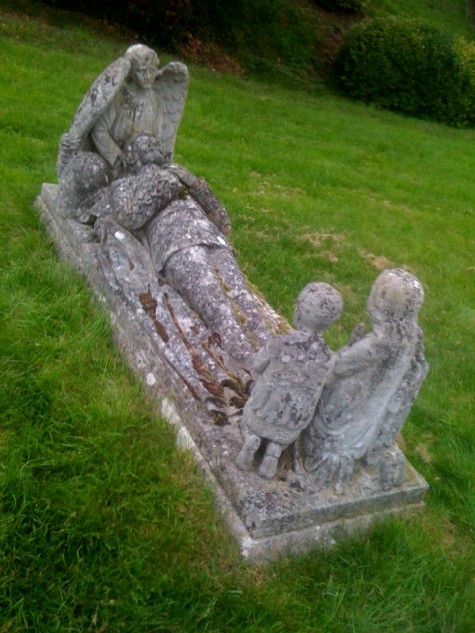
This ancient limestone sculpture in a church yard cemetery is amazing.  The children seem to be praying for the immortal soul of the deceased-already firmly in the hands of an angel.  The expression on the face of the angel-no doubt he takes his job seriously.  Many lichens have grown up and over this old sculpture-not to mention the rough grass.    


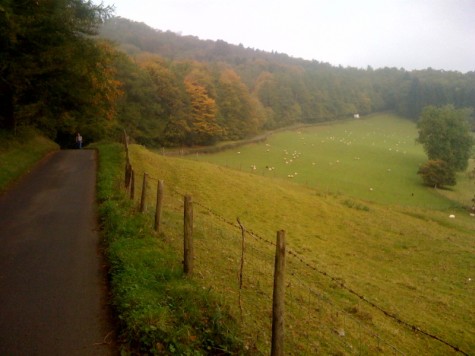
A winding and narrow country lane high on a ridge provides Rob a great view of a herd of sheep, placidly grazing. This is a landscape of a time and place unbeknownst to me. There is eveything to be learned from landscapes that have evolved from agricultural, commerce, country, and community. There are no strident notes.  Nothing contrived, or trying too hard. What is hard- the work of a life. What gets done-a sign of a life well lived.     

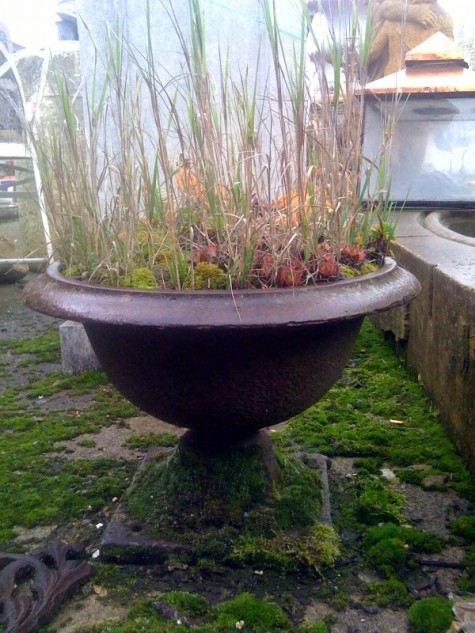
This container may have had some hens and chicks planted in it a long time ago, but what you see here is a container planting gone wild,  and a moss lawn establishing itself-the handiwork of a hand far greater than mine. I cannot really explain why this photograph appeals so much to me, but I doubt I need to.