Hello Yellow

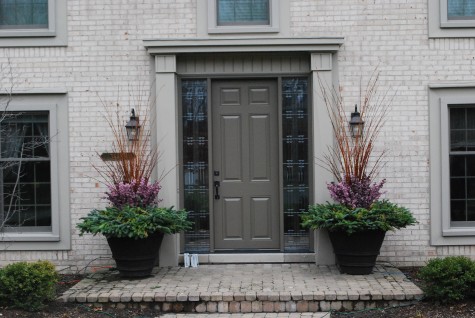
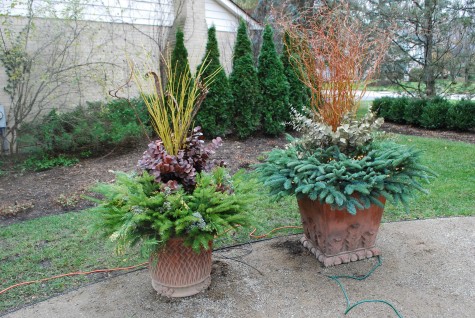
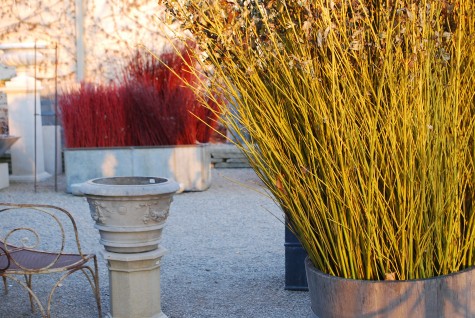
It is no accident that school buses are yellow. Though a school bus is a very large object, that yellow color is what you notice first.  National School Bus Glossy Yellow paint was formulated, and adopted for every school bus on the road in the United States in 1939. The black lettering on a school bus read the best in the early morning pickup hours-against this particular color of yellow.  Yellow twig dogwood branches are just about that bright-set in a winter landscape.
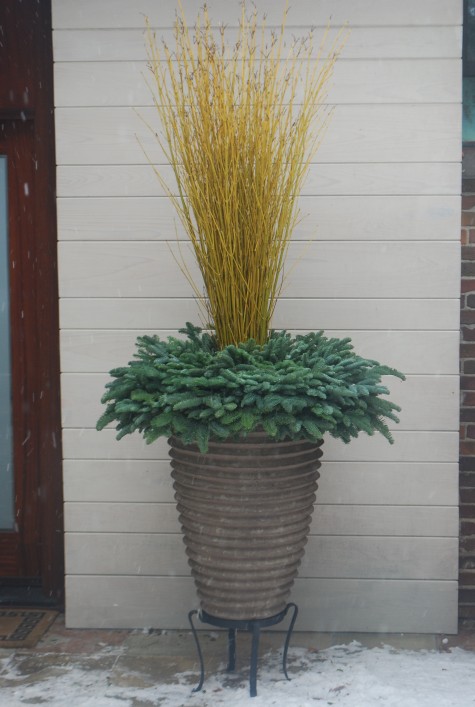
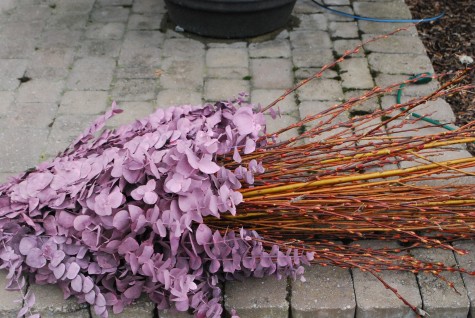
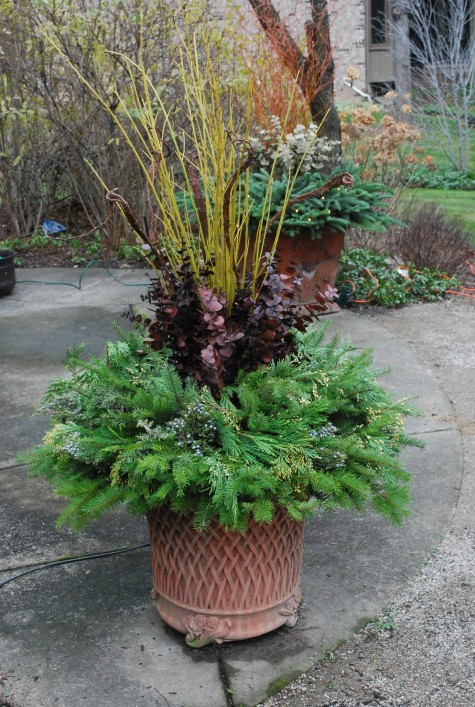
My kitchen is painted a happily intense and rich yellow.  The yellow fall color on gingko trees-extraordinary.  Yellow twig dogwood-the summer plant is nothing to celebrate, but its bare yellow twigs are visually compelling.  A thick bunch of those stiffly vertical twigs say stop, and look at me.  My winters may be grey on grey, but I have a few alternatives.      

This client’s clapboard house is painted grey.  The yellow twig in her pots jump off that grey page. During the summer, I have plenty of yellow; those mostly sunny days happily enrich my garden with a warm yellow light.  The winter brings a blue bruised and very cold light. Michigan ranks right up there with big numbers of grey days in the course of a year. My readers in much colder climates-like Minnesota and Wisconsin and Colorado-how I admire how they deal with their cold winters.  But friends of mine out west say their winters are by and large sunny. This helps so much to make the cold more tolerable. Their yellow comes regularly from the sky. Ours need come from another source.     
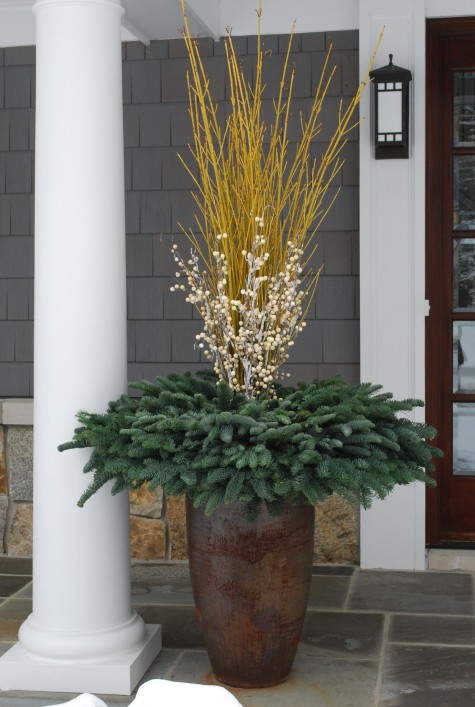
This yellow twig centerpiece has help banishing the winter greys.  The white faux berries brighten and heighten that yellow. The yellow in the stone, the grey clapboard-the grey stone porch surface-the contrasting color combinations here engage the eye in a lively way.Yellow twigs do a great job of backing up a dark element in a pot. These fan willow stems read so much better, given their yellow backdrop.   
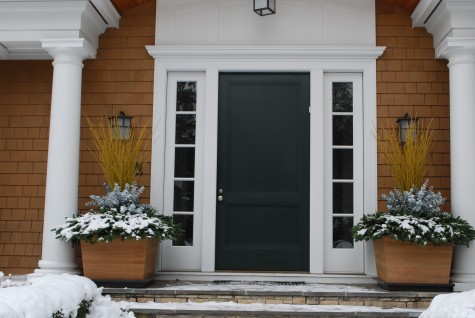
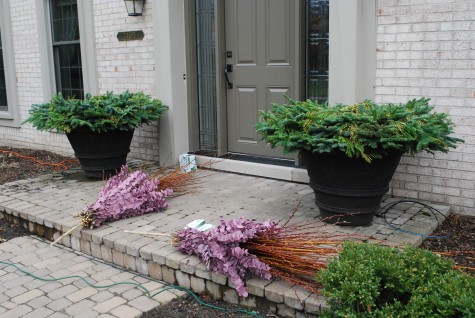
The cinnamon brown siding on this house-beautiful.  A pair of teak pots flanking the front door repeat that color. The bunches of yellow twig, the white frost eucalyptus, and the low greens are just plain pretty to look at. 
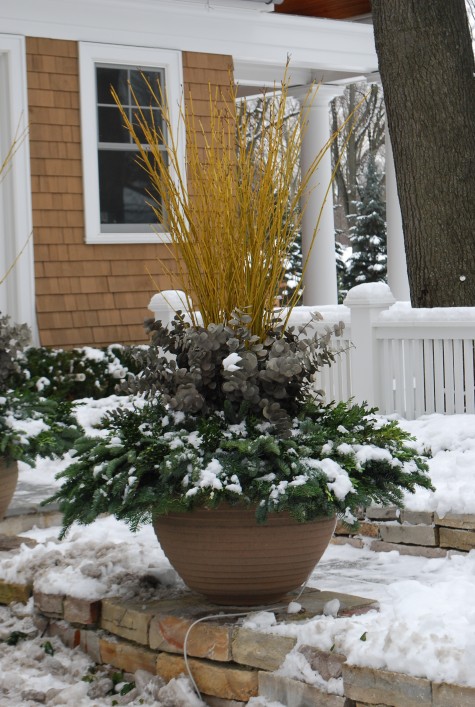
This sage-grey colored eucalyptus is a more unusual color combination, but I chose it as this container is but one of three.  Rowdy color combinations can be a bit too much if repeated in close proximity. 
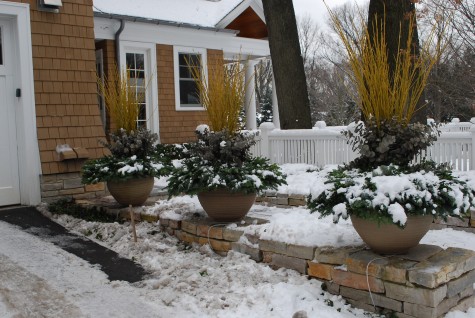

This more subtle composition scheme finds its strength in the repetition.  These pots will look amazingly good yet in April, when I plant these pots for spring.  These pots would be empty, or in storage for 5 months, barring a winter “planting”.
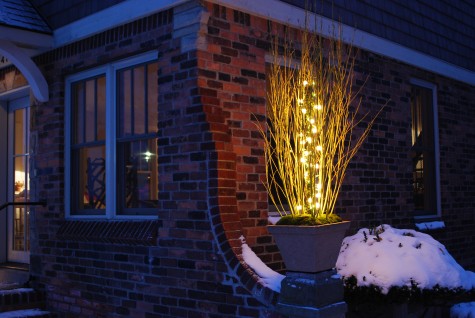
There yellow twig stems are placed in the pot singly, rather that as a bunch.  Space was left in the center for a stout mossed stick that was covered in lights.  The warm C-7 light string brings that yellow to life after hours.  The moss treatment at the bottom is in simple contrast to all the fireworks going on up top.    
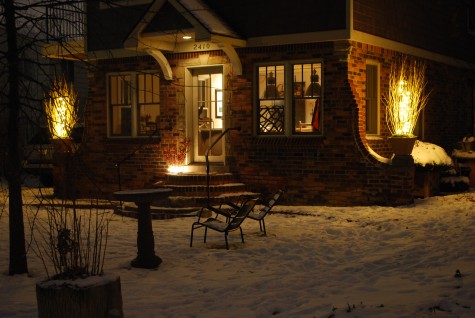

I like these lit yellow twig landscape lighting fixtures.  Handsome.
Deer In The Garden

The idea of sculpture in a garden greatly appeals to me.  Not that I mind museums.  I was taken regularly as a child. If you pushed me, I could describe certain rooms, paintings and sculptures at the Detroit Art Institute fairly accurately.  The medieval sculptures of the saints-my Mom could never figure out why I always wanted to go there first.   As an adult, in my top ten list of most memorable experiences include the Caravaggio exhibition at the Met in NYC in 1985, and the Lucien Freud exhibition at the Met in 2000.  Unforgettable.  These  exhibitions were worth driving to New York to see.

But given my choice, I would prefer to be standing in a meadow over a museum.  In a gully over a gallery.  An art object that keeps me company outdoors-this I really like. I have seen Henry Moore sculptures outdoors in both private and public collections.  In the mid 80’s I lived in New York  just one block from a Richard Serra sculpture-not that it moved me particularly.  But there it was, in the landscape. The lion sculptures outside Tiger stadium delight both the kids and adults that see them.

This is all by way of saying that I have had exposure to fine art in museums, galleries, private homes, and parks.  I happen to believe that fine art is all around me, outdoors. Lots of that-courtesy of nature.  Shopping for a client recently, I parked my car near a row of mature Bradford pears wreathed in nut brown fruit. I had never really looked at that fruit before.  If you are the person that was waving me out of the road that day-I can only say those trees laden with fruit stopped me in my tracks.

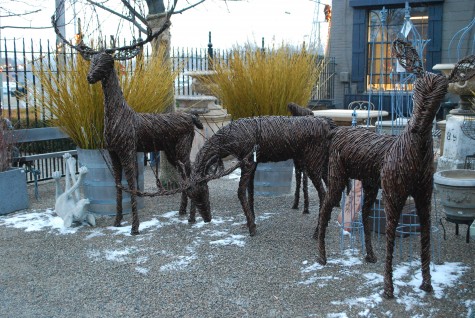
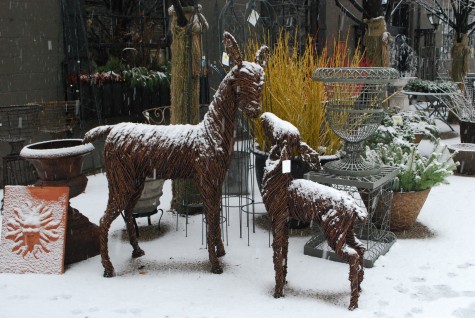
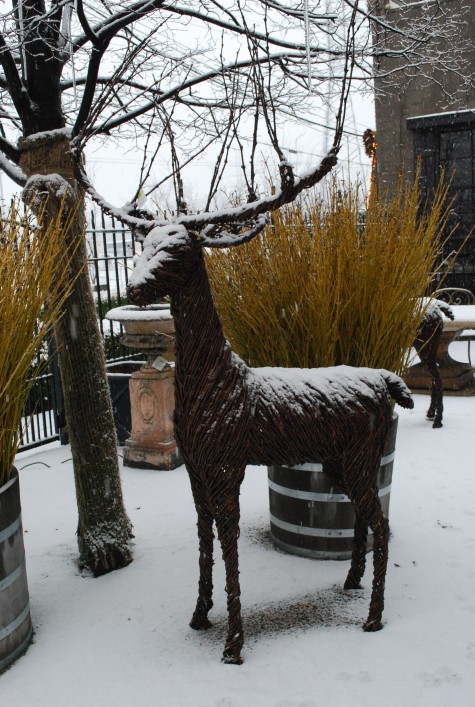
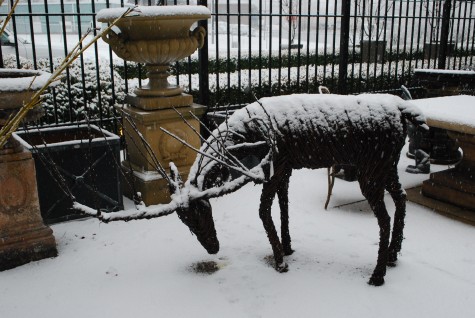
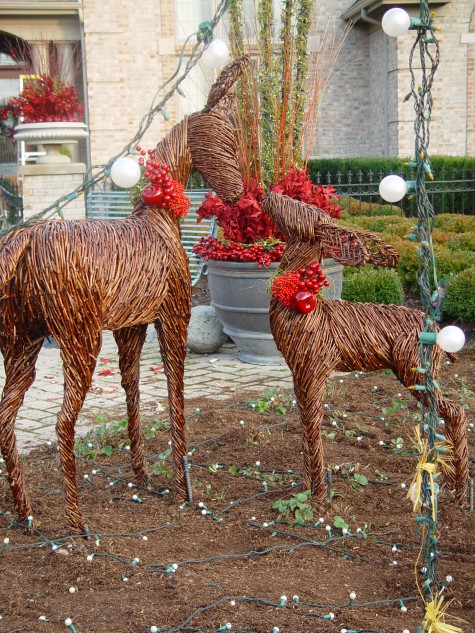
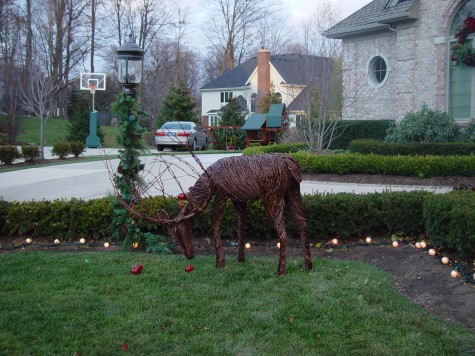
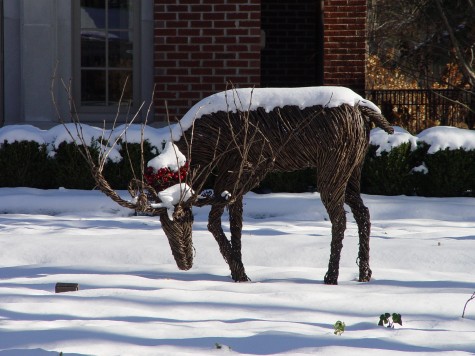
A Henry Moore sculpture is not in my future-no matter.  Sculptures made from grapevine would fit right into my garden.  These life size grapevine deer are made in California-woven over steel armatures.  The standing Buck, the grazing Buck, the doe and the fawn-what garden does not have room for one, or a group of them?  Some may say they are craft-and they are finely crafted.  But I don’t find the need to make that distinction.

Some sculpture might never be at ease in a garden.  But these grapevine deer seem to make themselves right at home.  I suppose that is as much about the material as it is about the subject matter.  Grapevine is a wiry and sturdily independent material.  How this California company manages to make sculpture from rigid welded steel forms and wild vines-astonishing.  Grapes grow independent of your issues, or mine.  Constructing sculpture from  such a willfully uncooperative material cannot be that easy.  No grapevine grows parallel to its neighbor.  These deer sculptures may not be within shouting distance of a Henry Moore sculpture, but they please me.

Sculptures such as these easily accommodate a little holiday decoration.  Each figure is hand made, and assembled by one artist from start to finish.  The grapevine is thoroughly sealed to prevent the vine from deteriorating.  This needs be be repeated once a year.


If I had to have a deer in my garden, this would be my species of choice. If you have an interest in acquiring one or many, we do stick them at Detroit Garden Works.   The Grapevine Deer

Pattern and Texture

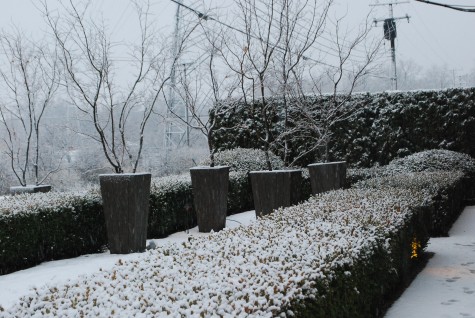
There is nothing like a snowfall to make patterns and textures in the landscape stand out.  Boxwood provides a small and fine texture and a uniform pattern; this picture makes that very clear.  The branching on trees stands out dramatically when those branches are coated with snow.  These brown concrete pots have very smooth surfaces; only the rims catch the snow.  The pots read as a homogeneous shape.  Given the somber colors of a winter landscape, the interest here is all about line, pattern, texture, and mass.  Winter greatly restricts the color palette in the landscape-that change is not all bad.  It makes the other elements of design easier to see.  

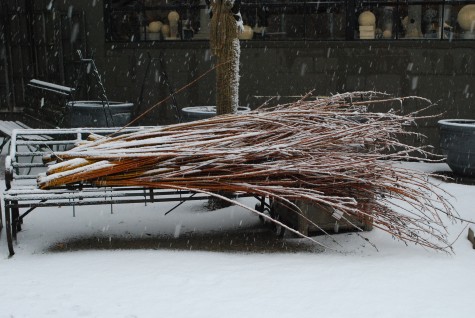
A dusting of snow has collected on the exposed surfaces of these bundles of copper willow.  The bunches provide quite a hairdo for this bench.  Individually, the sticks are quite linear.  The mass of sticks have a curved pattern.  The snow makes clear that anything in a mass reads quite diferently than it does as an individual.  A single plant might be distinguished in its flower or leaf, or stature; a mass of that plant is more about an overall shape, sweep, or drift. 

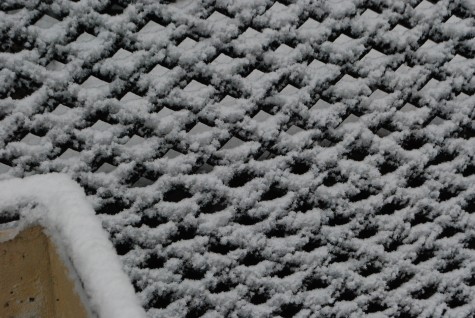
This cast iron grate has a distinctive pattern and a densely complex texture.  Snow makes all the more of that. How snow softens the outlines of hard structures and surfaces is one of the pleasures of the winter landscape.  A snowfall can make the most ordinary landscape look spectacularly beautiful.  It would be more accurate to say that most natural phenomena are spectacularly beautiful-even if I neglect to see it.  The snow turns on the lights.  

We are not buried in snow like other parts of the country, but we did get 6-8 inches.  The snow fell fast, and stuck to everything.  Why does it sometime snow when the temperature is above freezing?  It was 35 degrees here at one point yesterday and snowing like mad; it was 7 degrees when I got to work this morning.  All the wet snow is now frozen in place, so I have had plenty of time to look around.  The pruning pattern on the katsura espaliers can be readily seen; branches that were cut back hard responded by sprouting a number of stick straight branches from a single cut.  The pattern I see on these trees is a very clear explanation of how a branch responds to pruning. A pruning cut issues an invitation to grow.   

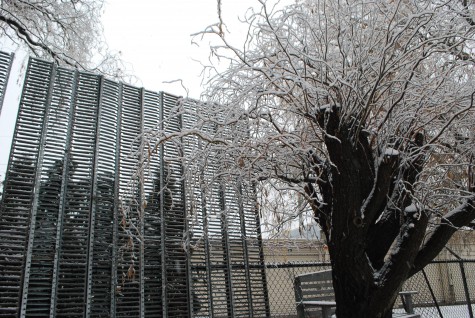
These vintage trench drains have a repetitive and very geometric pattern. They are most clearly a human-generated form.  The wildly curving branches of the pollarded willow are anything human. This idea shocks me some, and interests me a lot. The snow outlines the massive main trunks of the tree. I will loose this pollarded tree sooner rather than later. A high wind several years ago uprooted it.  My efforts to replant it were in vain; the bark is shedding in giant strips, and bracket fungus fruiting bodies have appeared.   

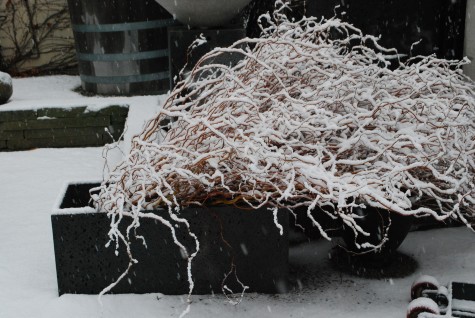
The copper curly willow is very curly. This branching is obscured in the summer by leaves.  I have to admit that this tree looks better in the winter than the summer, and that the pattern is outstanding in the snow.  The most difficult thing about choosing plants for their winter interest is that when that idea strikes home, as in today, nothing can be done about it.  I keep files of photographs of my own garden organized by the month.  I photograph certain key spots from the same angle 12 times a year.  I wish I had started doing this 14 years ago, instead of four.    Nonetheless, these pictures tell me a lot about whether the design and planting is working as well as it could.   

I did not clean out the boxes on the roof this year-the first time ever for that.  The fall and very late fall was a beautiful season for the boxes.  I am not surprised that the elegant feather persisted in its skeletal state, but I am surprised to see so much of the dichondra and plectranthus still holding on.  The pattern and texture provides something moody and textural to see.  The empty box alternative seems much less interesting. 

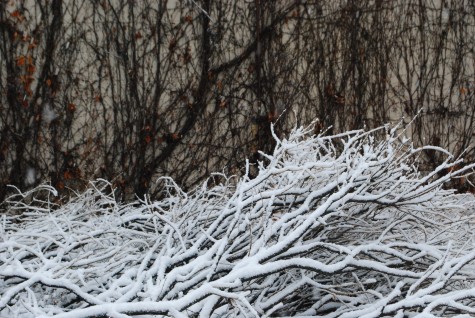
This pile of cut burning bush branches is dramatic covered with snow.  They are all the more dramatic for their accidental placement in front of a concrete wall, covered in the dark stems of boston ivy.  This wall faces the west; I have no idea why there is not one bit of snow on it anywhere-unless the snow was born on wind out of the west. So much pattern and texture-all ruled by a study in light and dark. 


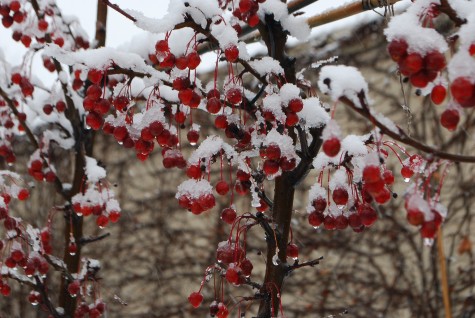
A pair of espaliered crabapples need to come into the garage for the winter.  As soon as the bulk of our winter containers are done, space will open up for them. This is the only plant with color on the entire shop property.  The pattern of the snow on the berries-I am glad I got a chance to see this.

Winter Pots

Our winter greens finally arrived yesterday-today we began “planting” winter pots.  I have clients that cannot bear to have their pots sit empty over the winter-I do not blame them.  In some ways, a winter pot is more difficult to design and plant than a summer one.  Of course the materials are more limited, but the toughest part is determining a proper scale and proportion.  The winter pots do not grow; they cannot be trimmed or groomed into a finished shape.  The shape and scale they have the day they go in will be the shape and scale they have throughout the season. I need to hold that thought from start to finish.    

Most of the construction of what goes in my client’s pots goes on in the garage at the shop.  A warm space makes the construction go faster.  It is tough to clean up and hose down on site now.  In Michigan, the water gets turned off to the outside spigots in anticipation of freezing weather.  I like to leave the mess at home.  I know the diameter of the pots I need to fill-I make a decision about the scale from my notes, photographs, measurements, and memory of the containers, and the space.  This gets me close.    

Proportions that are generous, and of proper scale are pleasing to the eye.  Odd this-I almost never see anything outside that is overscaled to the point of asking for a redo.  I routinely see landscape gestures that are too small.  Plantings that are too small for the containers, pots too small for for the front porch, a single hydrangea when 5 are called for, 1 tree trying to hold down a space meant for a grove.  The proper scale for a winter display-not so easy.    

The construction of winter pots involves several issues.  Design-this comes first. Color, texture, materials, scale-this comes second.  The actual construction is all about a natural look that is invisibly sturdy enough to withstand a Michigan winter-start to finish.  All of the elements of a winter pot designed and constructed in the studio go on to the installation phase on site.  Tall heavy twigs need thorough anchoring. Though you cannot see it, the centerpiece in this pot has bamboo, steel and concrete wire-we like a stand up straight construction that endures.  Every evergreen stem is sharpened at the base-a tight fit means a persistently long lasting fit. We have four to six winter months ahead.  What I do today needs to last.

I really want to talk about the color and the texture here, but the real news-a scale assessment.  Invariably I have to go back, and adjust; almost always, I have a need to add.  The process is simple.  Plan, aim and construct as best you can. Then step back, and look.  I would advise that you look a second time.  Then step back and see. Fill in. The gaps, the underscaled elements-it is all there for the seeing.  The fill in stage-necessary. 

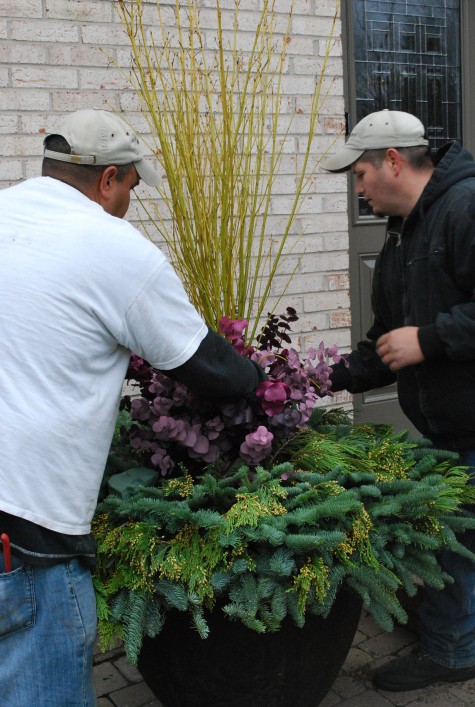
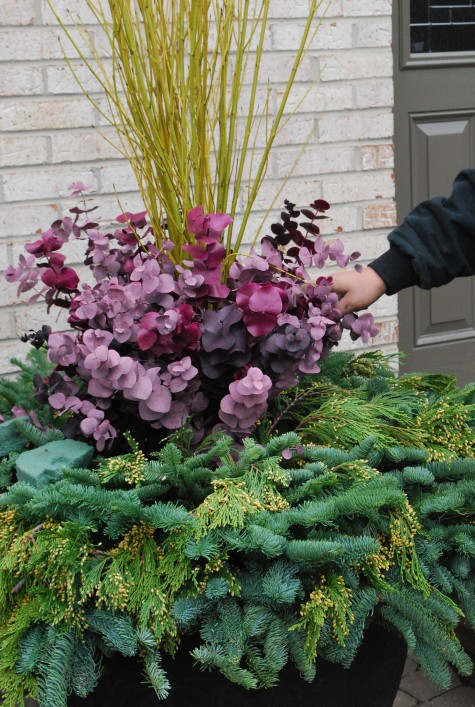
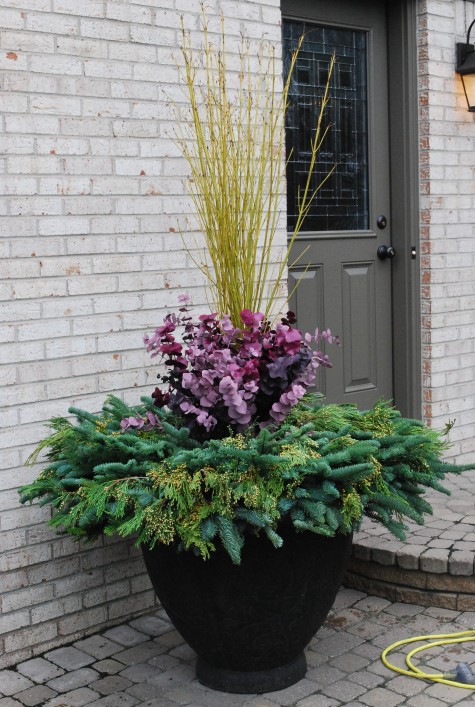
This giant pot needs 2 more bunches of yellow twig dogwood, and two more bunches of preserved eucalyptus-to get the proportions right. I wish I could get everything perfect the first go around, but frankly-I rarely deserve the spot on award.  I usually need to go back.  The big idea here?  Any project worth doing deserves an energy at the end equal to the energy at the start.  Start strong-finish stronger.

The summer pots dressed in their winter outfits-they look good.  Every one of these pots have lights.  For the dark hours.  We hook up, we bury the extension cords-day and night-we have plans.   

I am enchanted by the blue berries of the cut juniper against the brown eucalyptus in this pot.  I so like the effort of a mix of greens.  Douglas fir branches-graceful.  Everything seems to be working here-the basket weave pot, the draping greens way wide-this winter pot has everything going for it.  


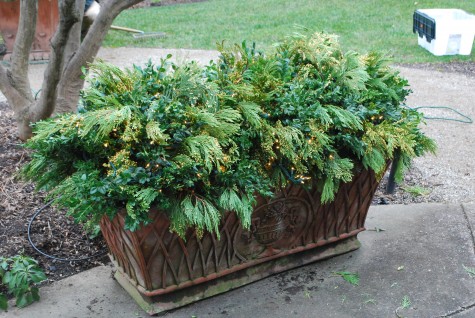
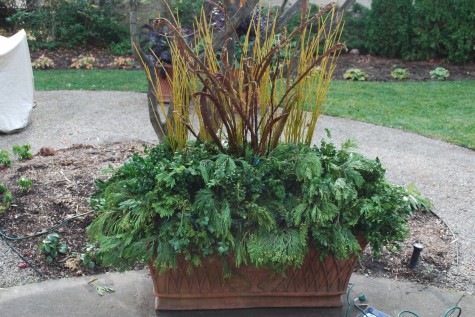
The long rectangle in view from the kitchen-the mixed greens include incense cedar, German boxwood, and southern boxwood.  The effect is soft and swooping. drapy. The garland lights buried in these evergreens will make for some night life. The winter approaching-we are in the process of getting ready.