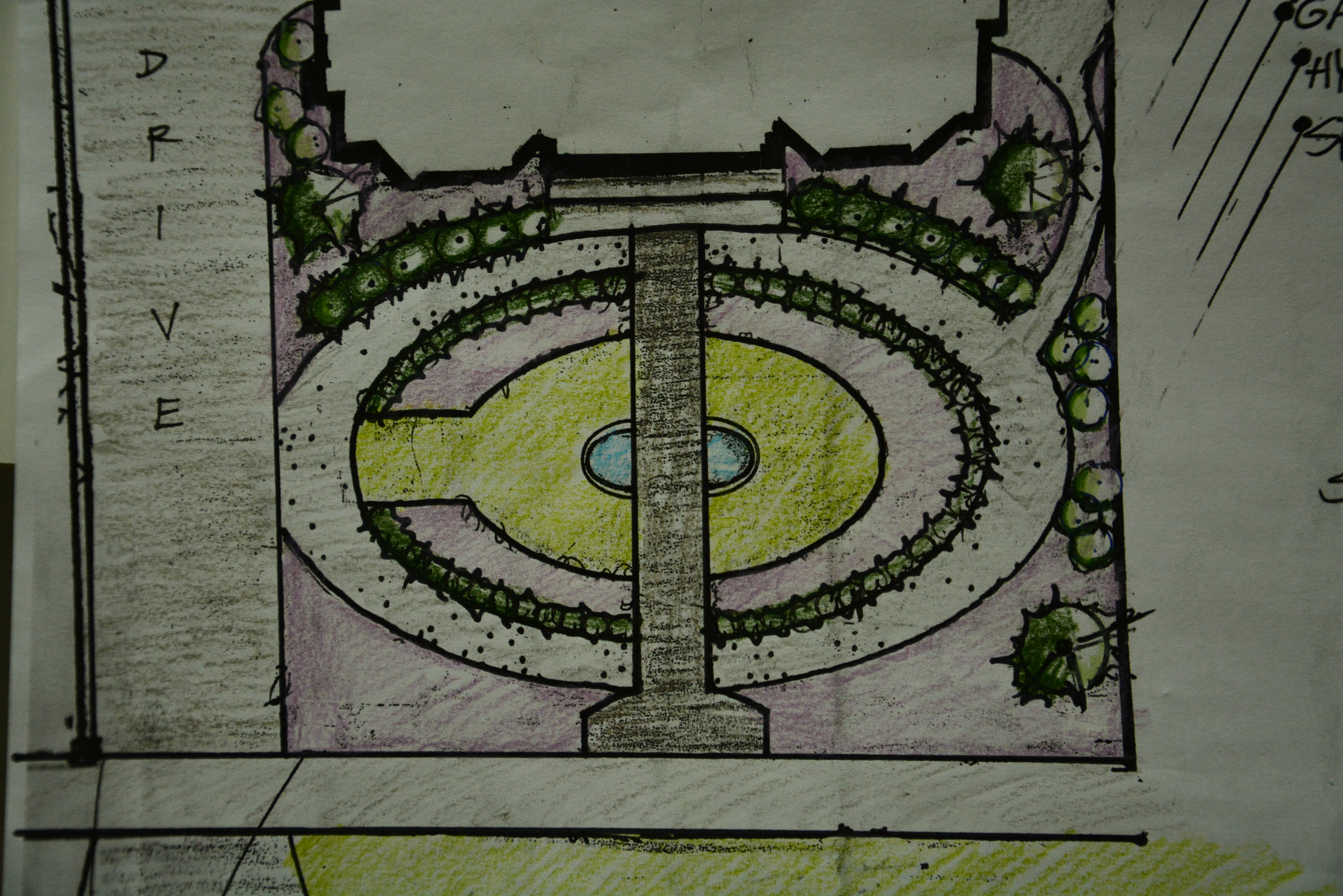
 As Susan Cohan, a very talented and skilled American landscape designer would say, a great landscape design is about making a space work. It works for the client. It works for the plants selected. And it solves problems. No where is that more evident than designing for a very small space. A very small property means every square inch needs to work. This very small front yard needed a decently sized driveway, and a graceful way to get to the front door from both the sidewalk, and the drive. It needed to ground a house that was very tall. It needed to provide a place to watch young children playing on the drive. It needed to provide ongoing visual interest – every bit of which was exposed to the street. It needed to accommodate a client’s interest in a fountain in the front yard.
 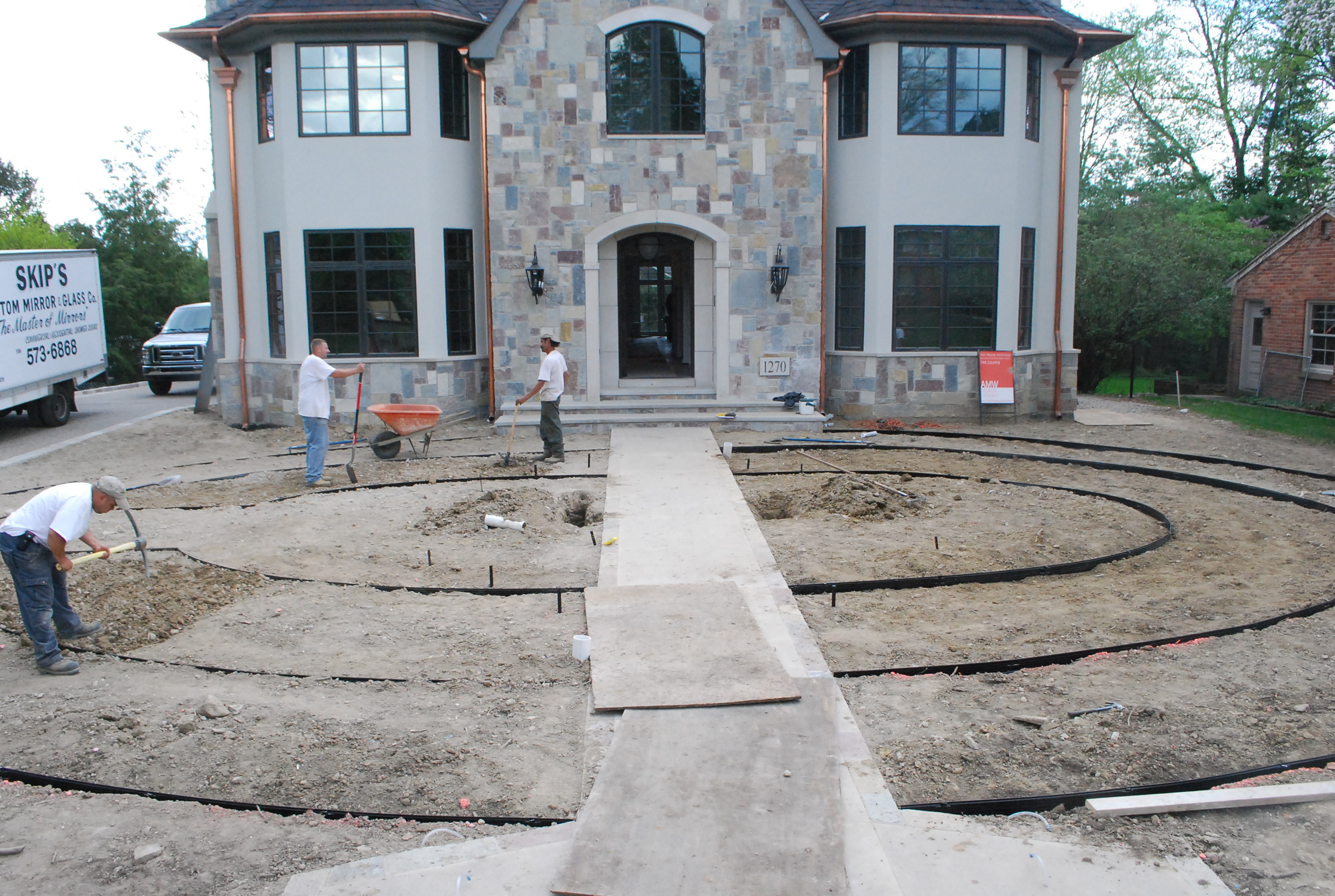 I thought there needed to be a single strong shape which would organize every other element in the landscape. An ellipse seemed a natural choice. The shape of the front yard was a very shallow rectangle. An ellipse would make the most of that natural shape in a more interesting way. An elliptical shape that touched the north side of the driveway, and reached across to the south side would provide a means to reach the front door. It would also permit a way to walk the garden that had no beginning and no end.
 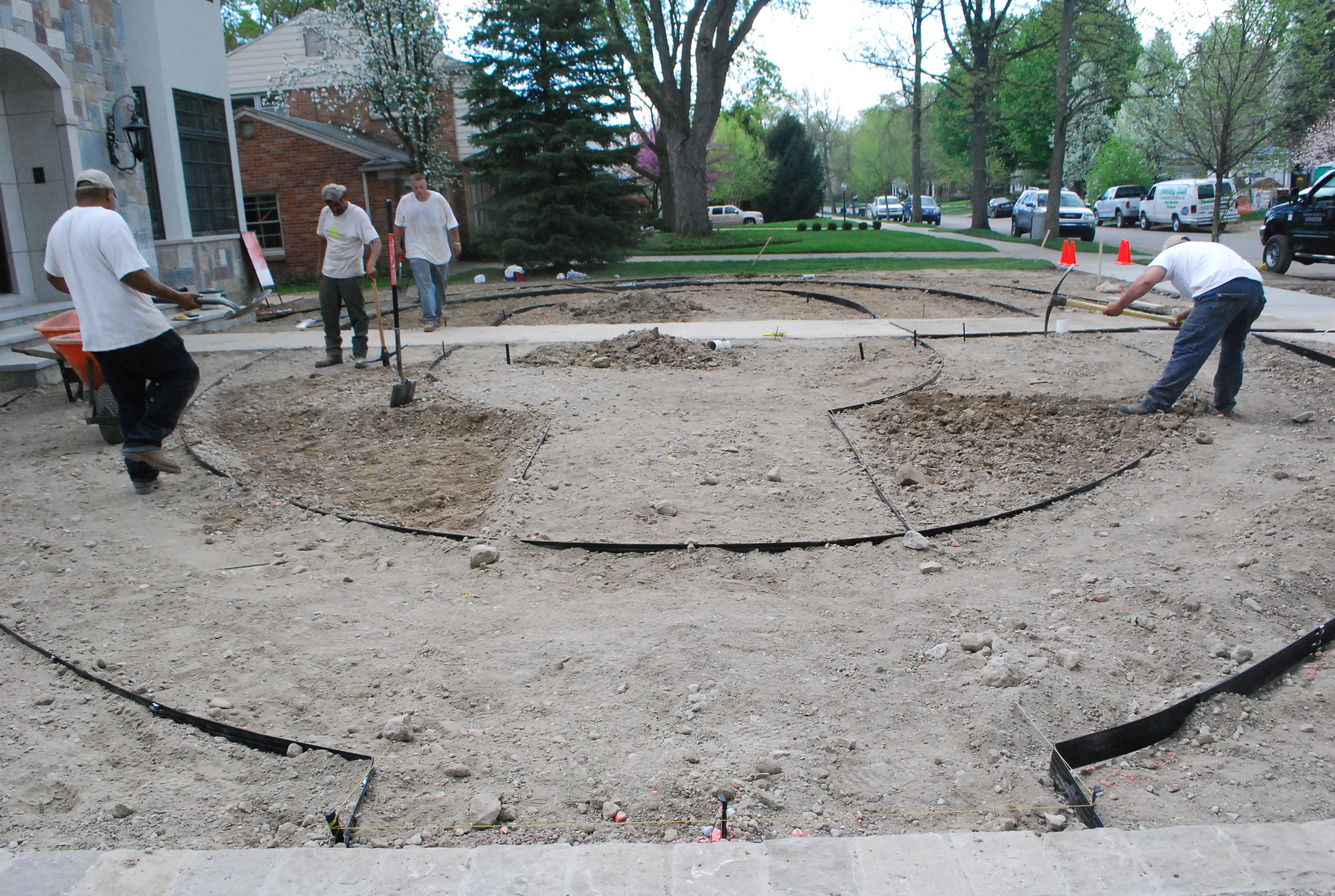 From the driveway, one ring of the ellipse would be a gravel path that would lead to the front door. That path would also encourage walking through the space. The gravel ellipse was wide enough to accommodate a bench, wherever the client might want one. An interior ellipse of grass would make it possible to view the garden, and the fountains from a number of different vantage points.
 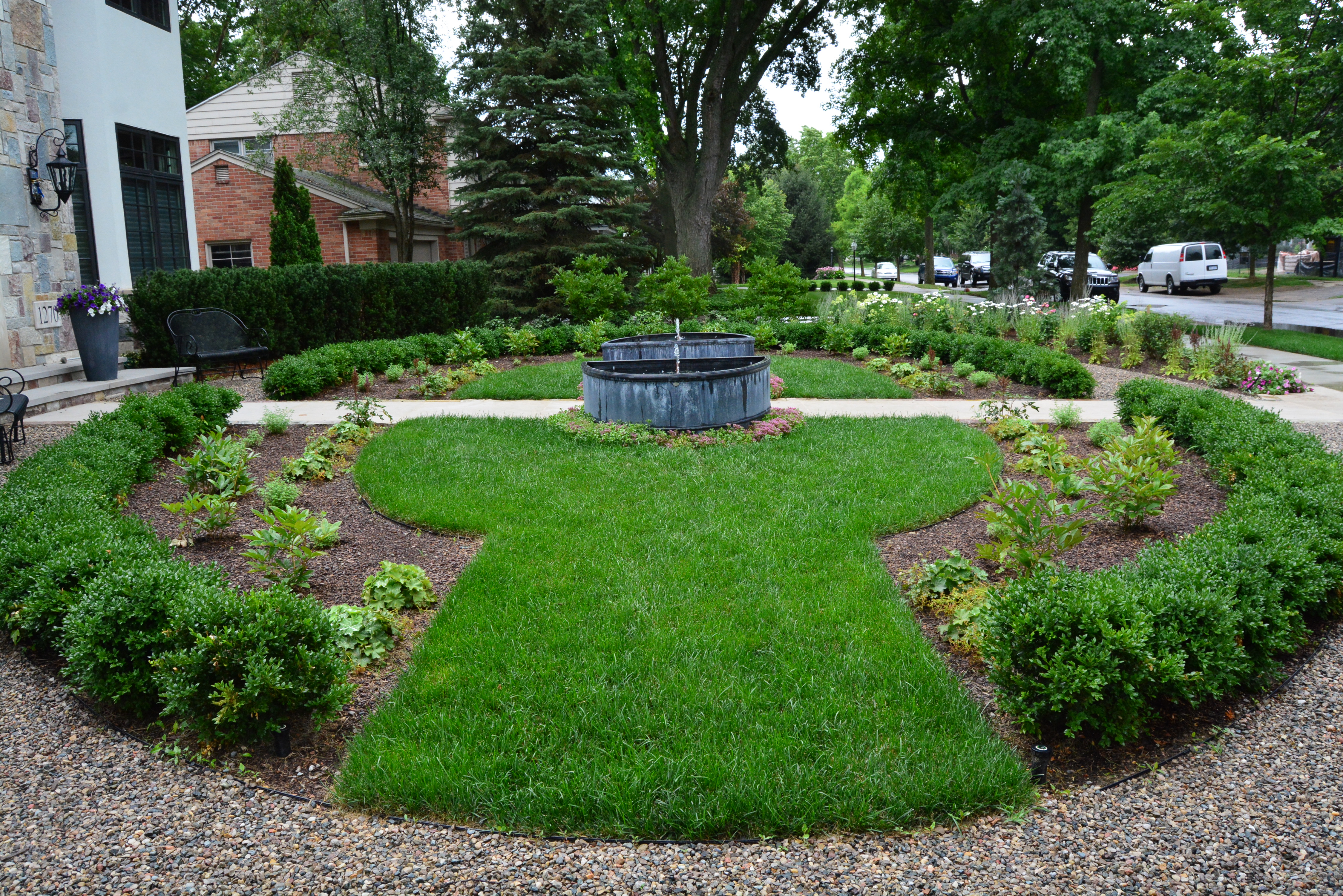 The fountain Buck built was actually a pair of fountains. Each was fabricated as a half-ellipse. Anyone approaching the front door would walk through the fountains. Anyone coming to the front door from the driveway could follow the gravel path, or take the fountain view route. Rows of boxwood and yews matching the curve of the ellipse would give the garden some winter interest. As for the perennial garden, there are but a few plants. The inner ring is a collection of peonies, faced down with alchemilla mollis. Once the peonies mature, they will form a lustrous large leaved interior hedge taller than the boxwood.
 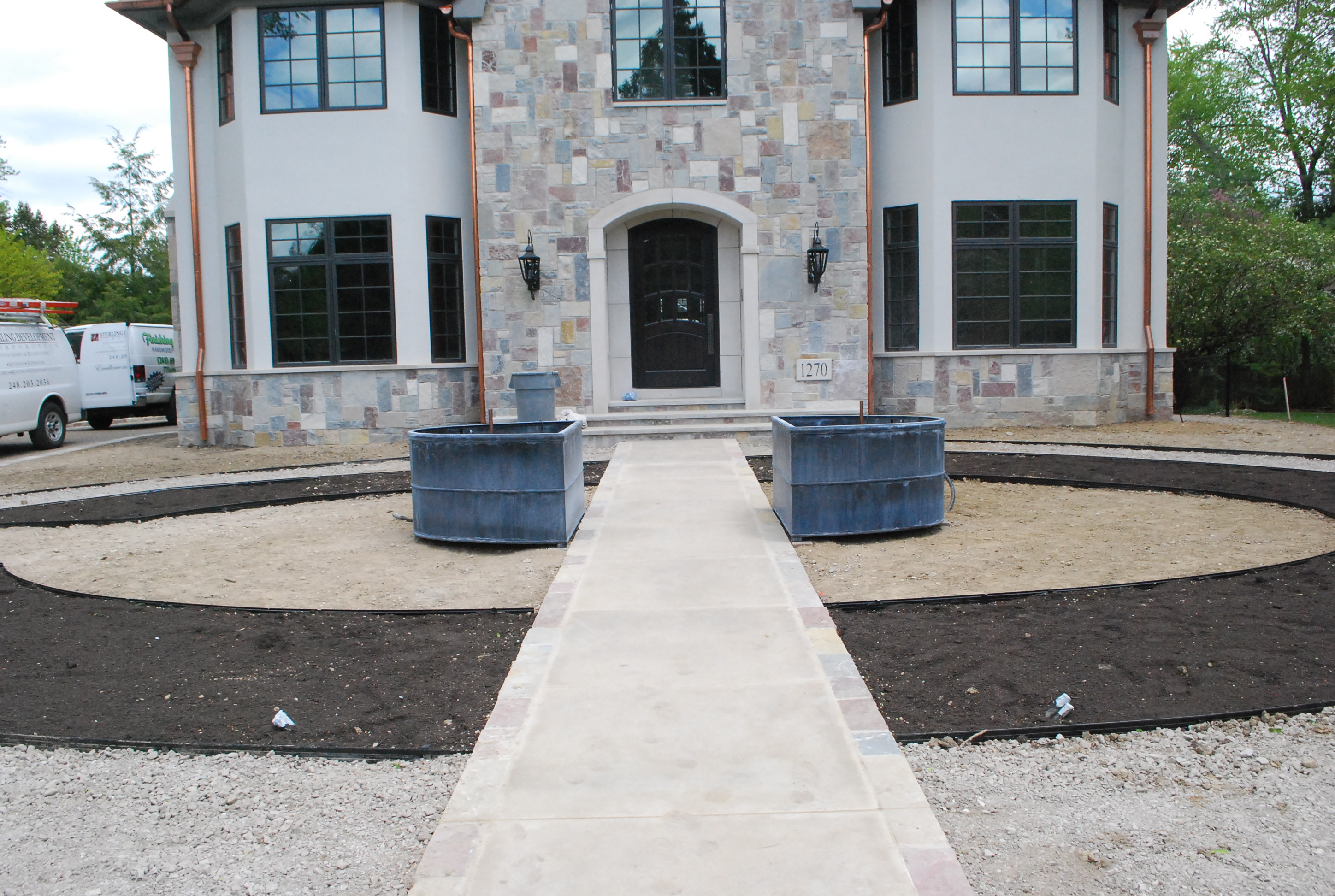 The fountains are the center of interest to the design, and they are front and center. We did eventually move them back off of the sidewalk a bit, just so the space would breathe better. The interior garden would mature at the same height as the fountains. This height was a direct response to the height of the house. I planted yews in the ellipse closest to the house-who would want to block the views from inside out with anything taller? Eventually we would plant a DeGroot Spire arborvitae on either side of the from facade of the house.
 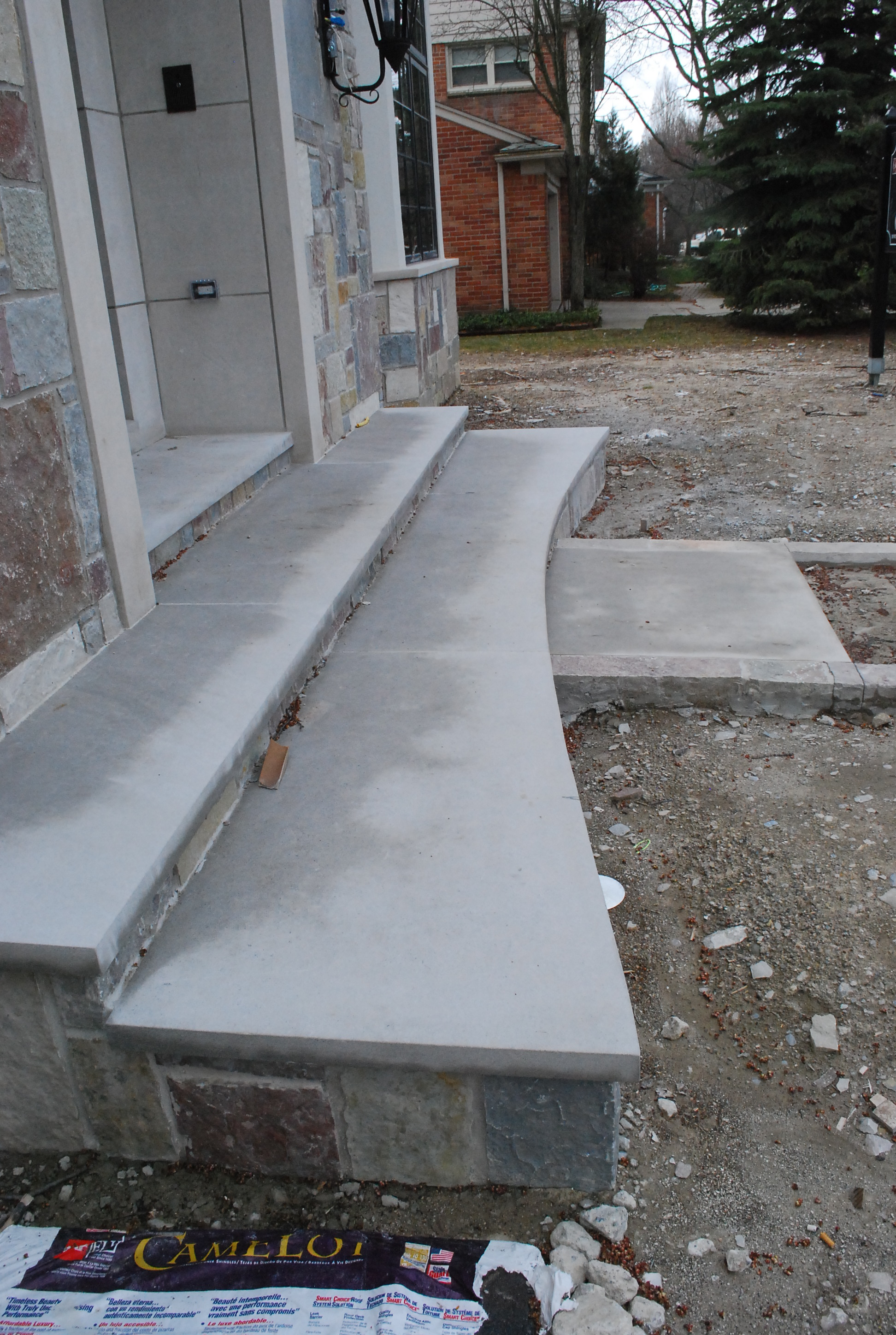 The lower step to the front door needed to describe that ellipse that governed the shape every other landscape element. Scott Albaugh from Albaugh Masonry did a great job of this. In a very small space, the details matter so much. Our shapes were by no means perfect. But they were accurate enough to be convincing. At this stage in the installation, the ellipses read in a graphically strong way. Once the landscape was planted, that shape became much more subtle.
 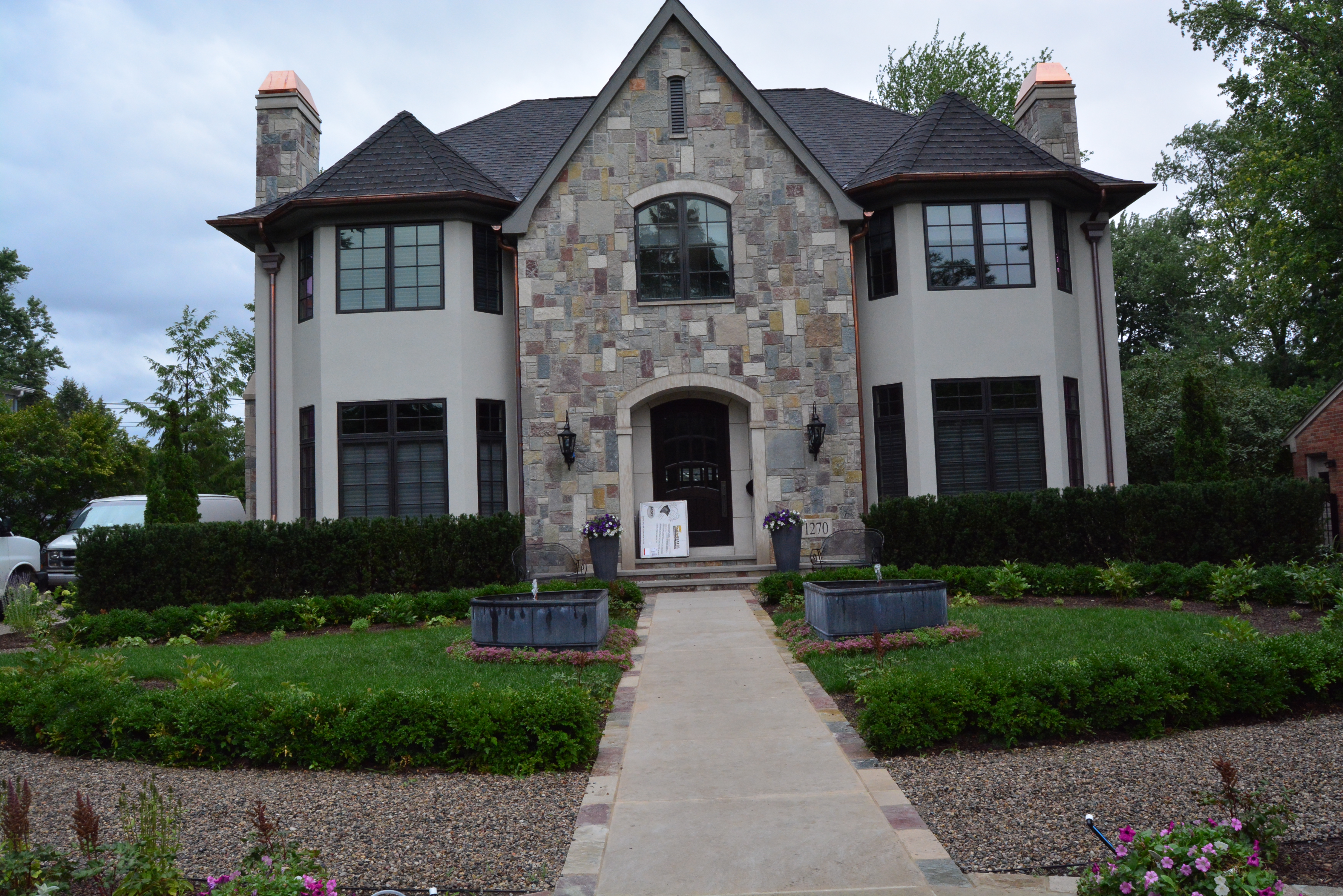 The day a landscape is installed is just that-the first day. Given some time for the plants to mature, that ellipse describing the horizontal ground plane will be softened by the height and the sprawl of the plants.
 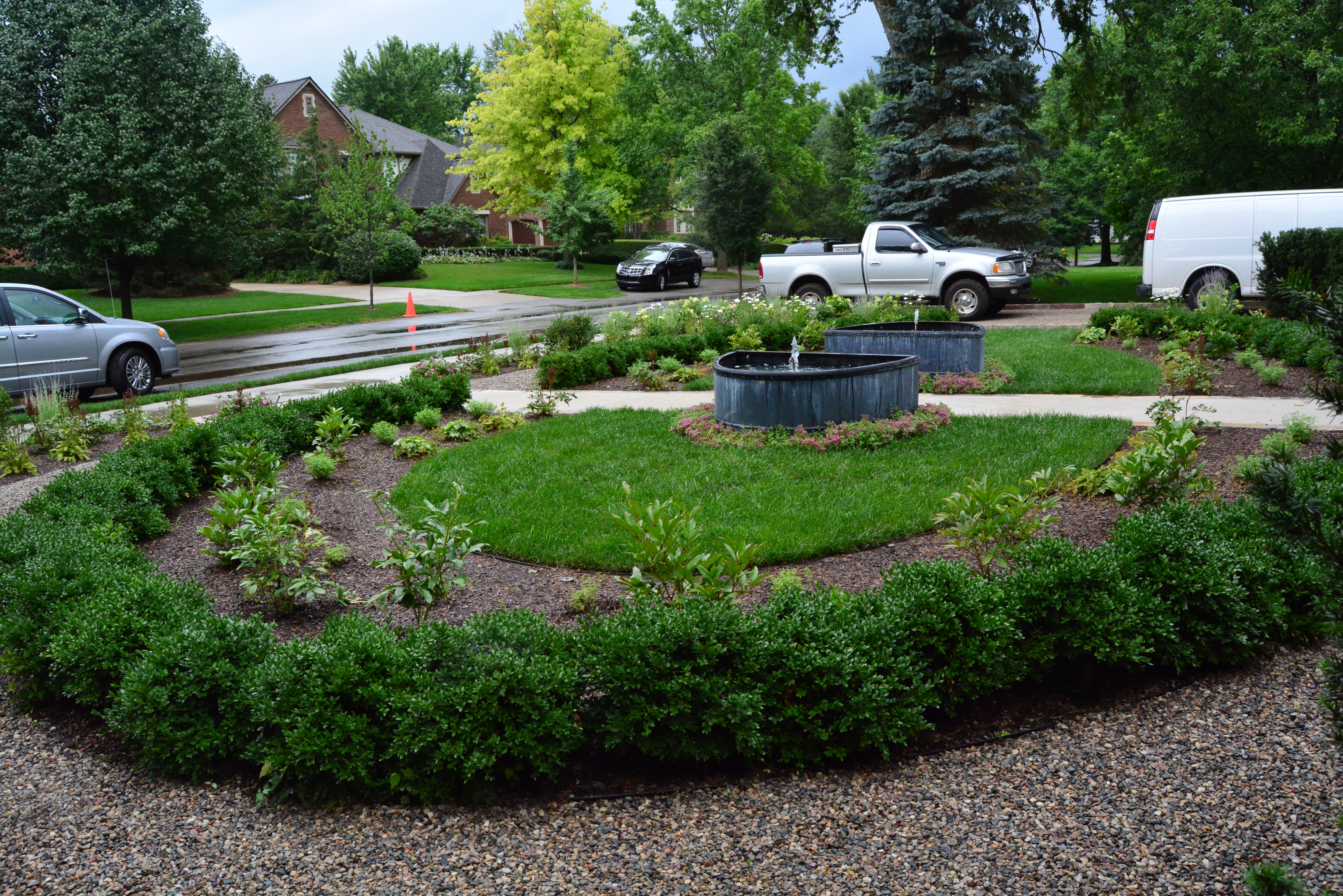 This design looks different from different vantage points. Changing the visual channel is easy; there is a path.
 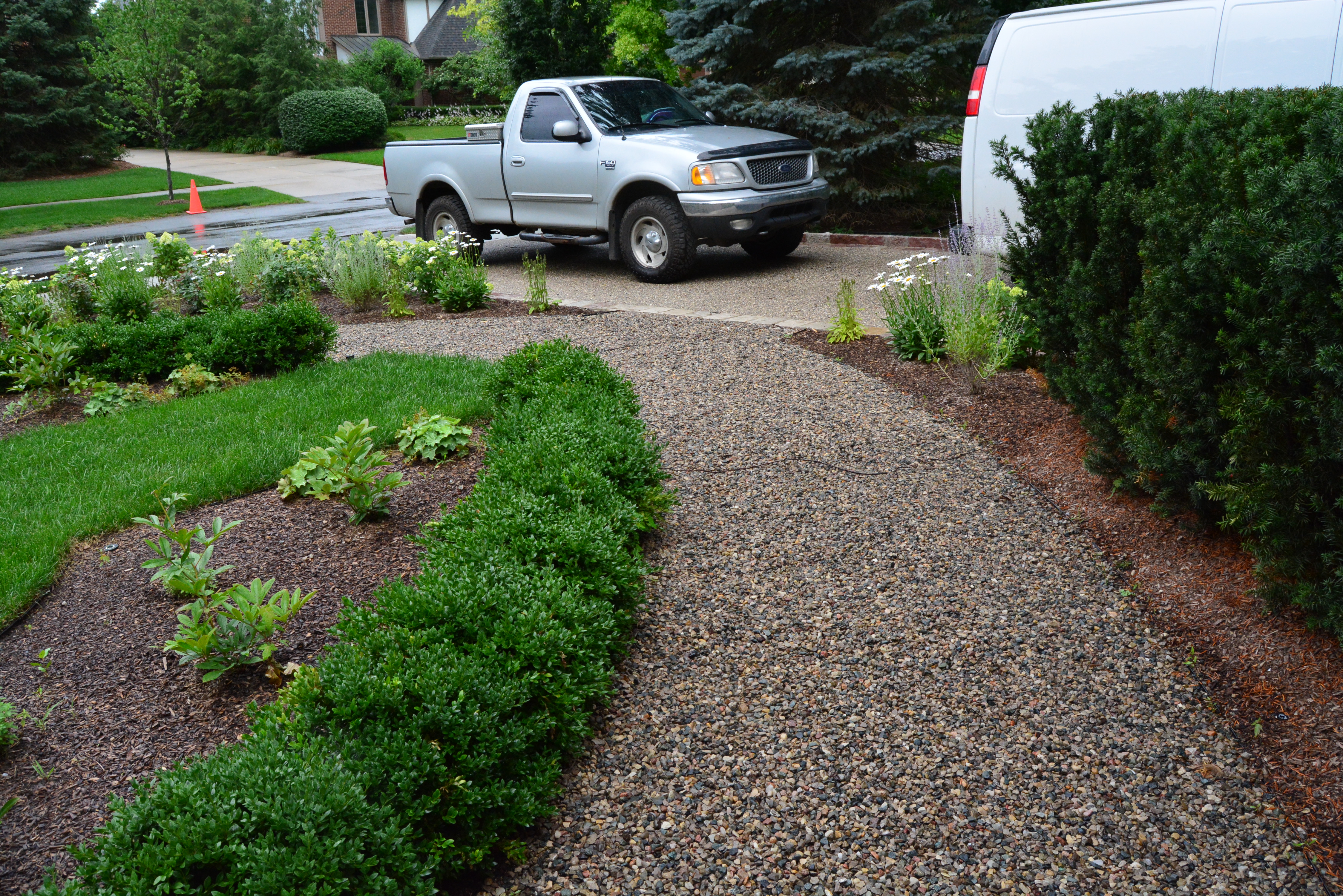 Any guest getting out of the car in the driveway could find their way to the front door. They might take the long way-or the short way, in bad weather. This design is intended to make the garden accessible and friendly to people. Though just about every idea can be seen from the drive or the street, the elliptical path invites a stroll through.
  What can readily be seen now will not always be the case. The outer ring of this garden will mature at a height of 4 to 5 feet. Roses, shasta daisies, Russian sage, Little Lime hydrangeas-the height of these plants will provide a little mystery and privacy to the inner ellipse. The border on the sidewalk-moss phlox and lamb’s ear.
 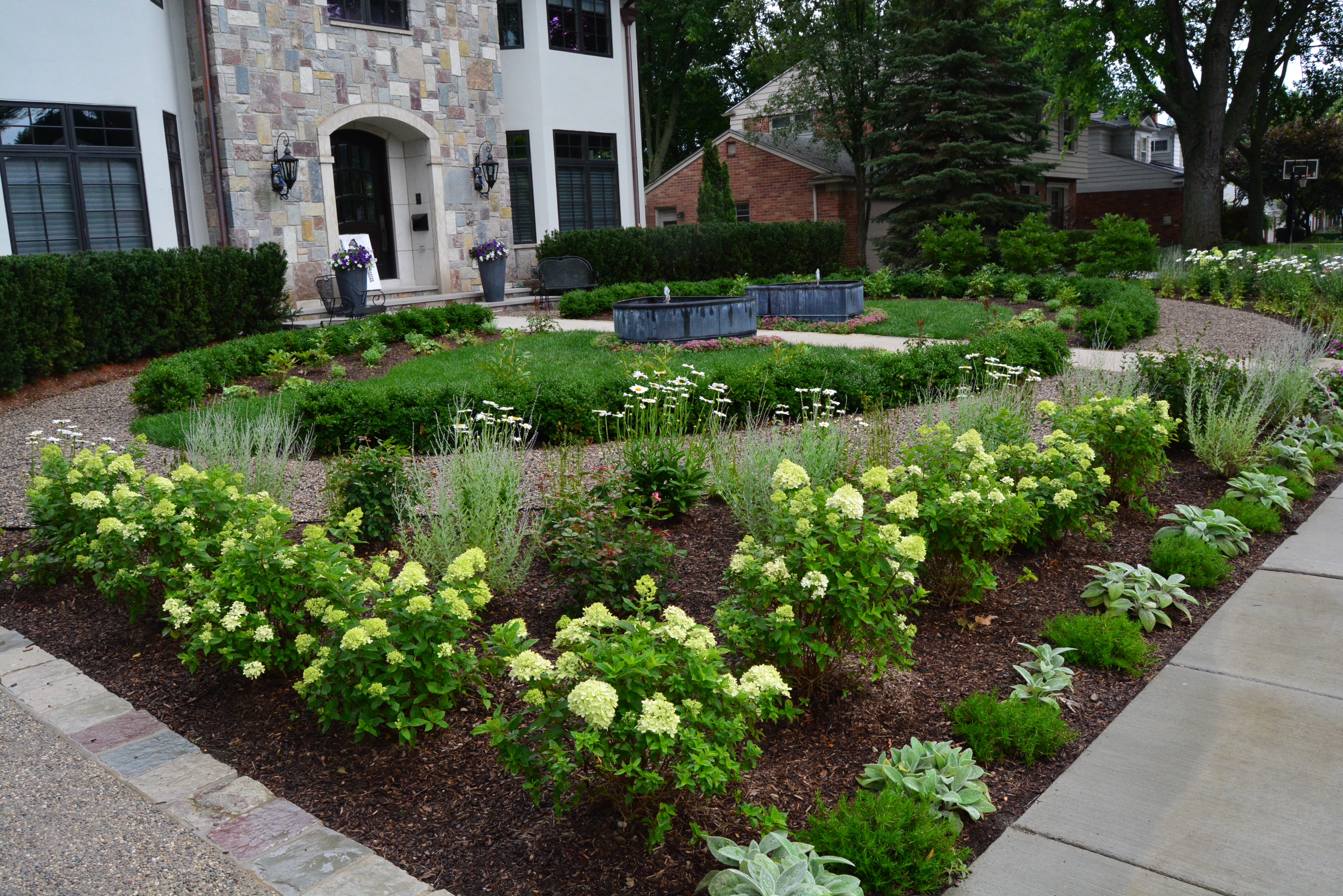 I will be very interested to see this garden when it has a few more years on it. Hopefully it will be a small space that has something interesting going on.
The Shape of Things to Come
Mighty White
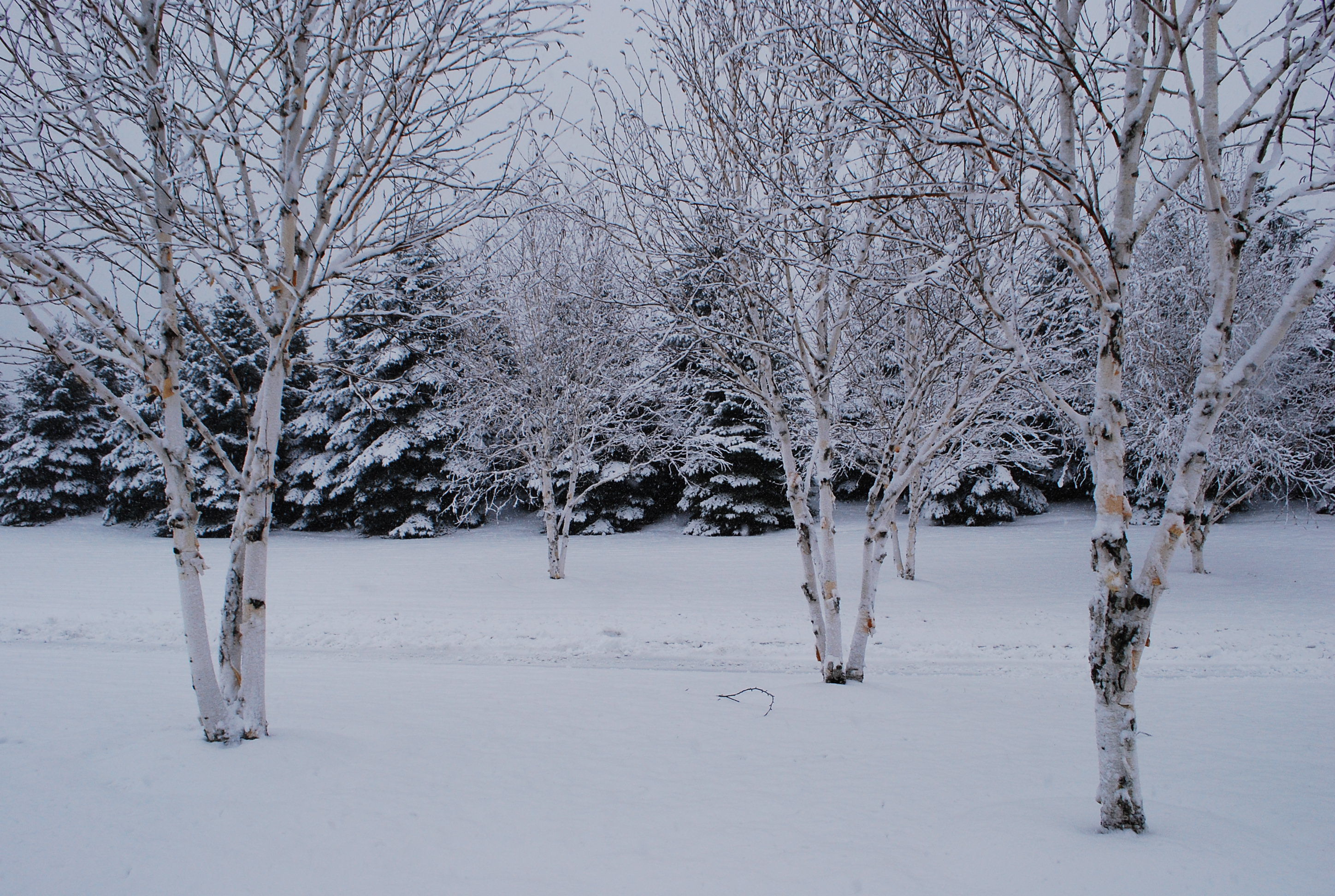 My landscape is mighty white right now. We have already had better than twice the snow we had all season last year, and this is just mid January. I was so surprised that we got another 3 inches of snow yesterday. Have we not had enough? Who thought we needed more than the 16 inches we have already had? OK, I wasn’t so much surprised as weary. The snow has piled up everywhere. The landscape is blurred. The glare from the snow makes everything else some variation of black.. Lots of white, with some black bits. What gardener in my zone isn’t bleary eyed?
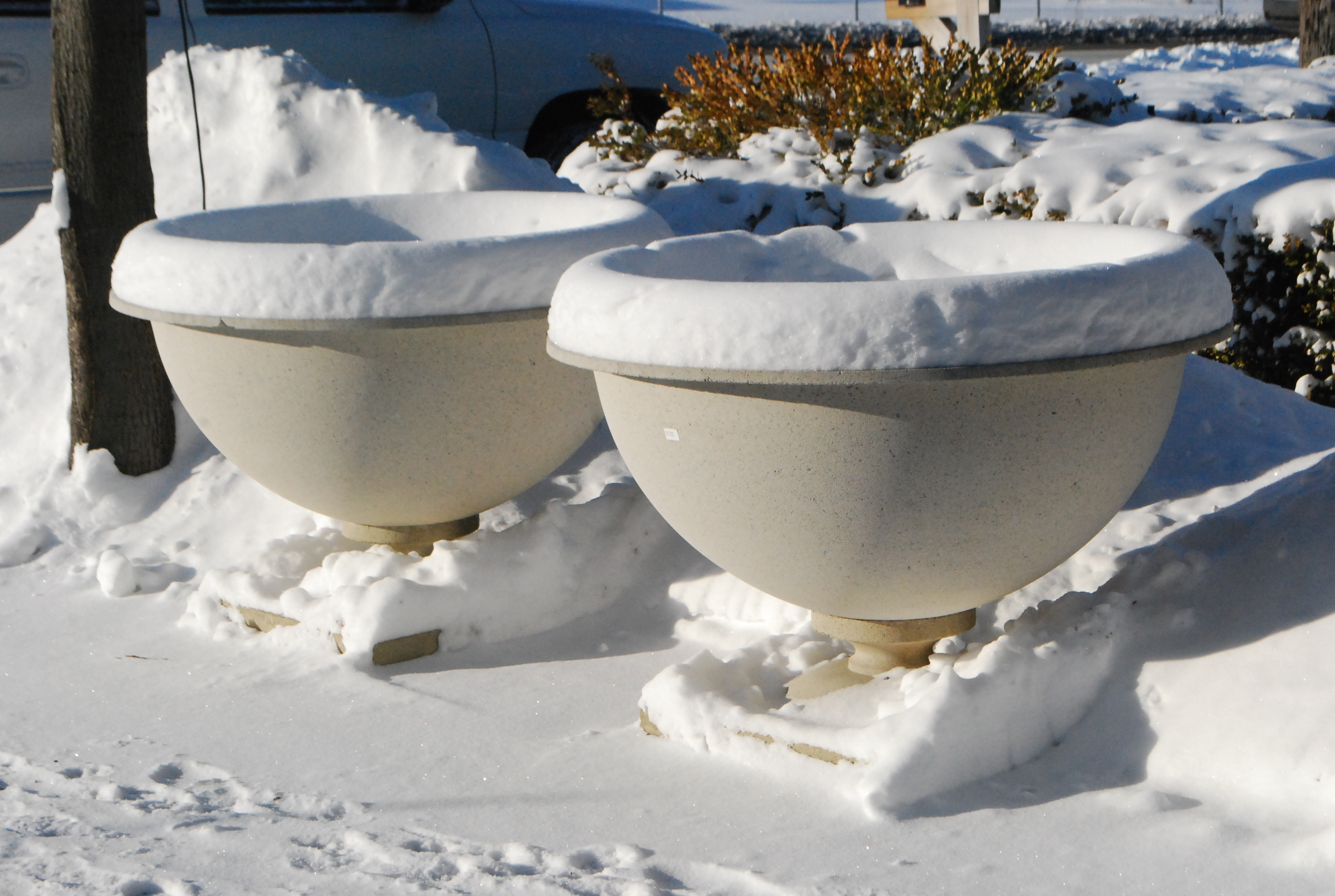 These reproduction cast stone pots made from a well known design by Frank Lloyd Wright are all but buried in snow. The snow silhouette features the rim of the pot. The shape of a mature plant, a garden bed, a tree canopy, a garden path, a terrace, a container – shape is one of many elements of design. A shape is a 2-dimensional visual description of an object. An outline, if you will. Heavy snow makes it easy to see and decide if you like the shapes.
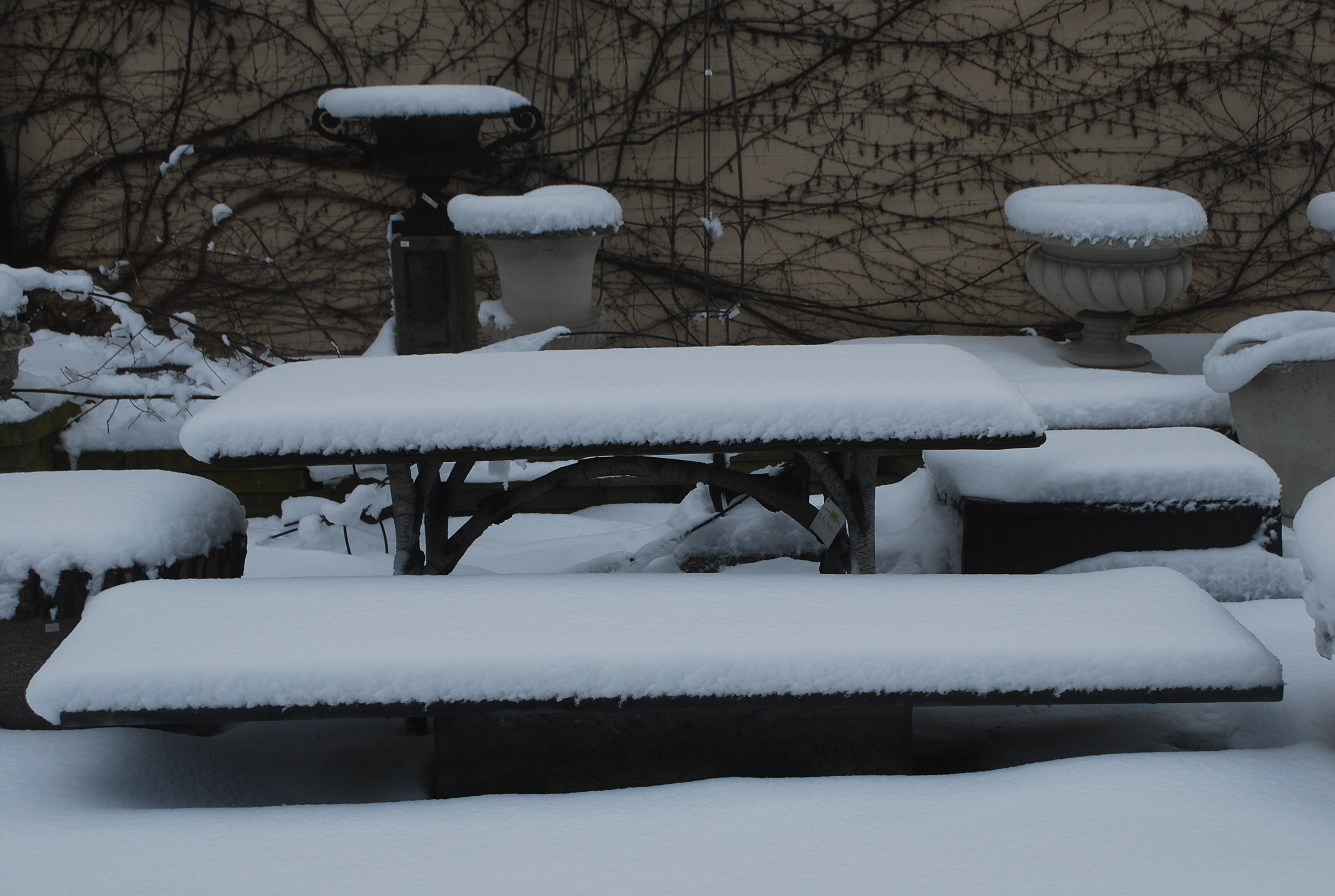 We have mountains of snow and uniformly gray skies. There are only so many ways to tell this story. The better story is about what is missing visually, and how a landscape can be better. As I have watched the snow pile up higher and higher, I realize how much I appreciate the skillful use of color, line, texture, mass, edges, and proportion in a landscape design. This garden table and bench has been reduced to its simplest shape, in black and white.
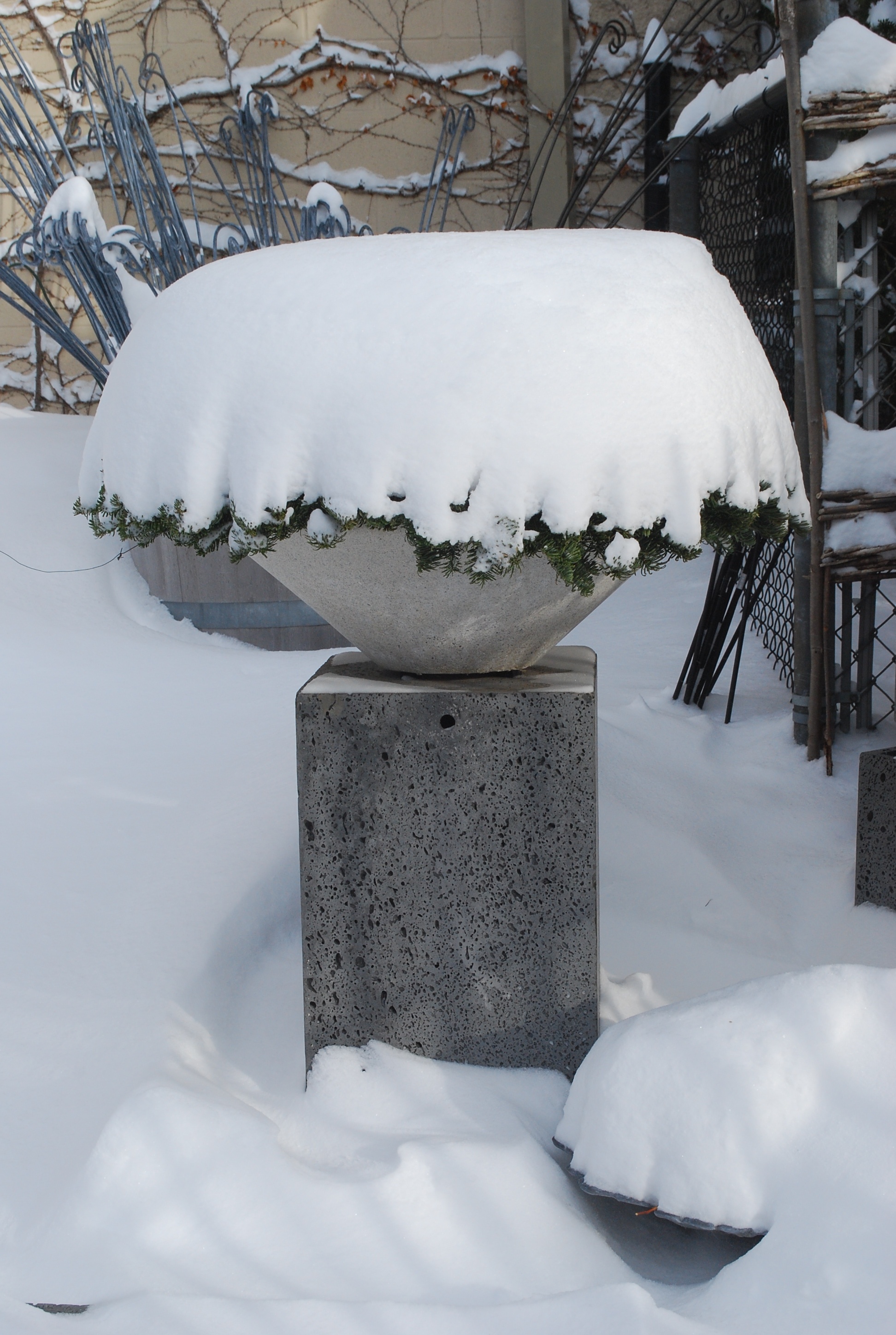 Deep snow has all but obliterated any complex relationships in the landscape. What the snow has not buried are the basic and simple shapes. The very strong and simple relationships. A good design should be evident in every season. In all kinds of weather. There are those gardeners who aim for one season at the expense of all the others, and I respect their choice. It just wouldn’t be my choice. I do believe that good design is all about what is there when there is nothing there to see. The stone pot filled with cut evergreens pictured above has a distinct form and proportion that is described and enhanced by snow.
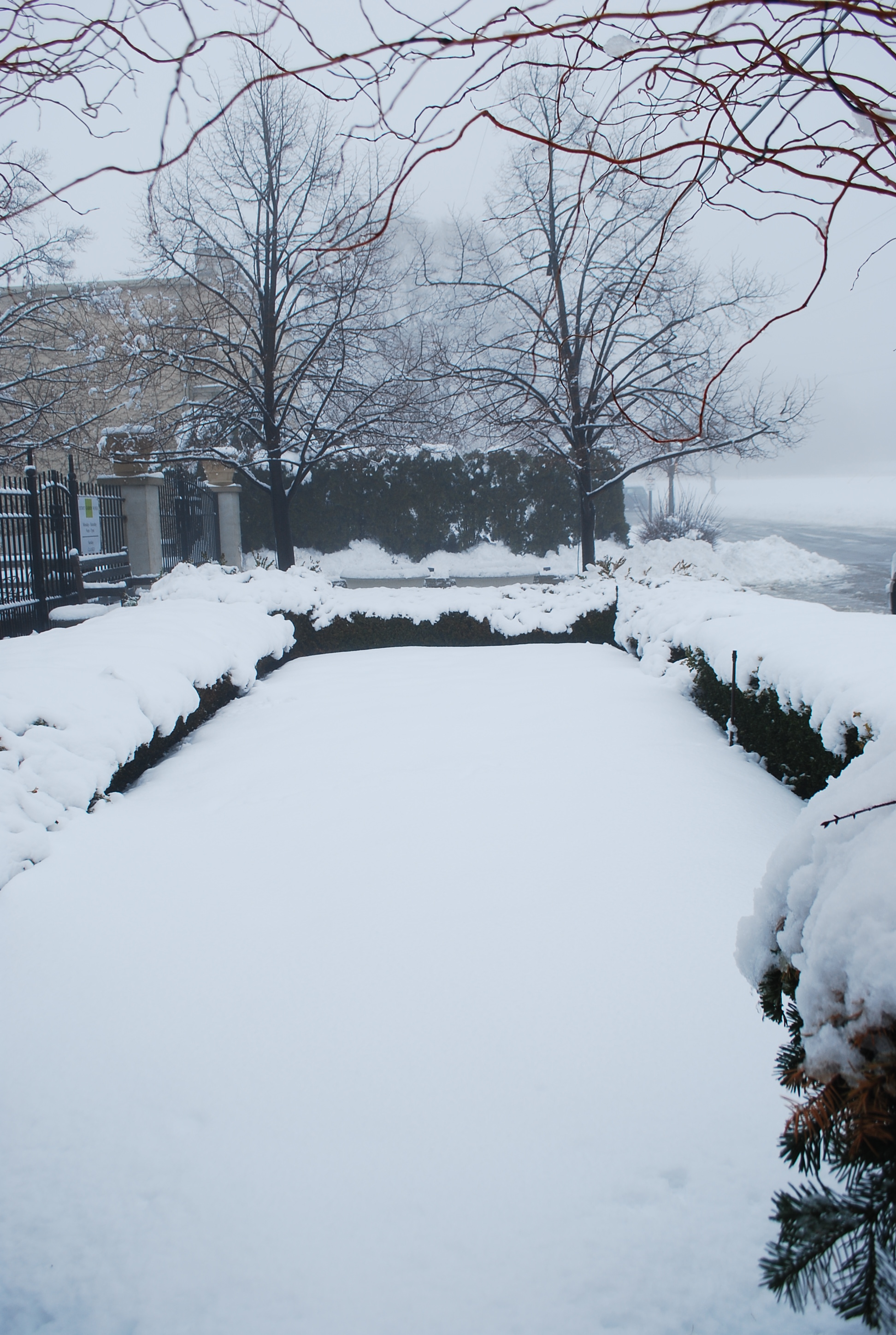 The heavy snow had reduced this landscape to its most elemental gestures. What I still see, given the lack of color and texture, is the form. I would venture to say that a design that does not work in its most austere winter state will work no better flushed out with plants, and clothed in green.
 Good form is a quintessentially important element of good design. A weeping Japanese maple has an overall shape, both a leafy shape, and a twiggy shape. That maple also has a three dimensional structure-that is its form. The successful placement of that maple in the landscape is dependent upon an understanding of its form. Planting small or young trees require an understanding of a form that is yet to be. Forms come with baggage, too. A weeping Japanese maple is so common in suburban front yard landscapes that it asks for an unusual treatment or placement for its form to be truly appreciated. Asparagus means vegetable, which means it gets planted in the vegetable garden. But its form may be perfect for a rose garden, or a container.
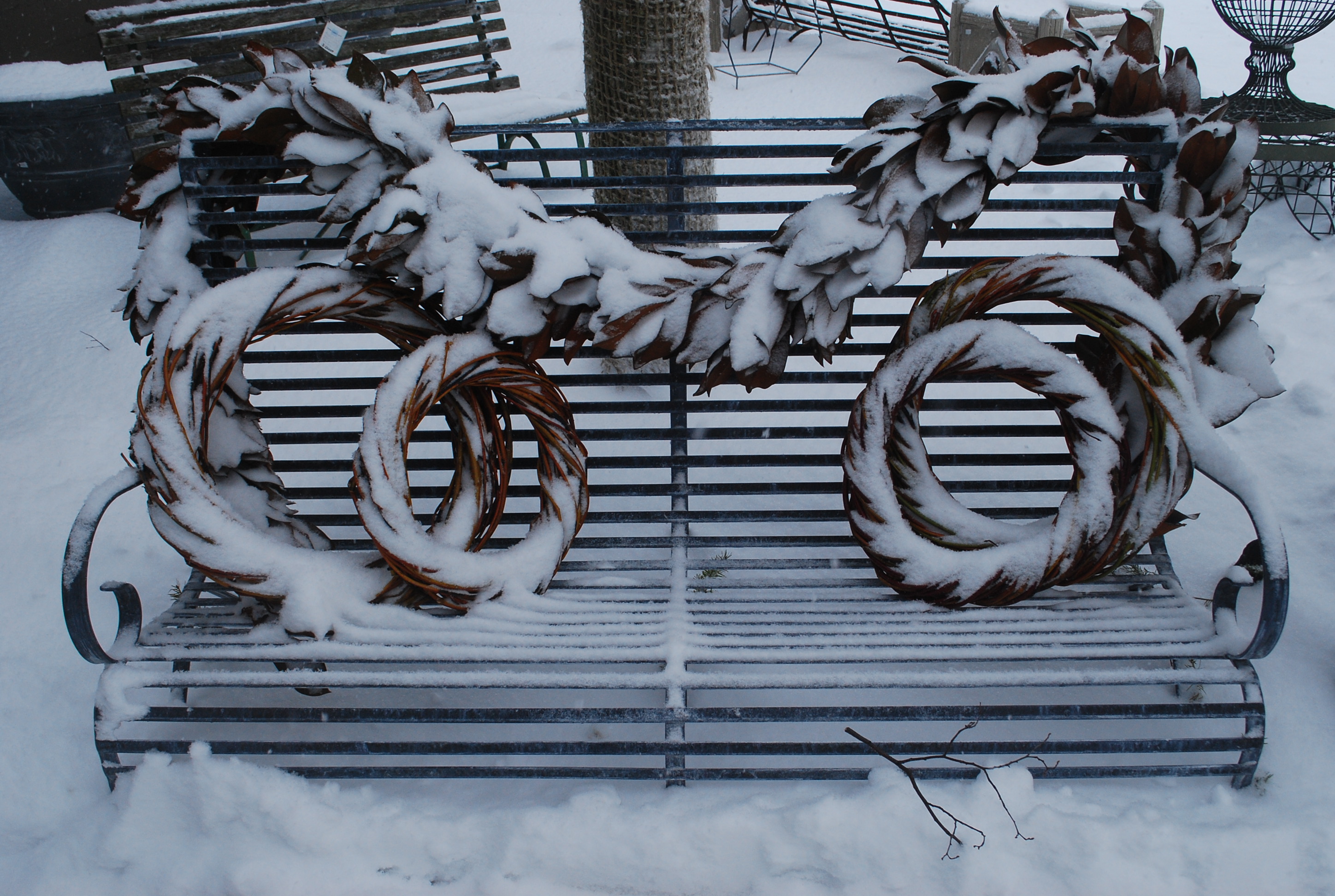 The relationship of one form to another can be incredibly exciting, or sleepy beyond all belief. Some forms are so striking they stay with me for a long time. Years even. The fluid and informally curving form of this magnolia garland is all the more striking visually against the formal and rigid form of this steel bench. The snow is that relationship graphic and clear. Personally unforgettable moments in a landscape usually involve a form which is under some sort of visual discussion via the weather, or the season. Landscape elements that are not up to a year round discussion should be placed accordingly.
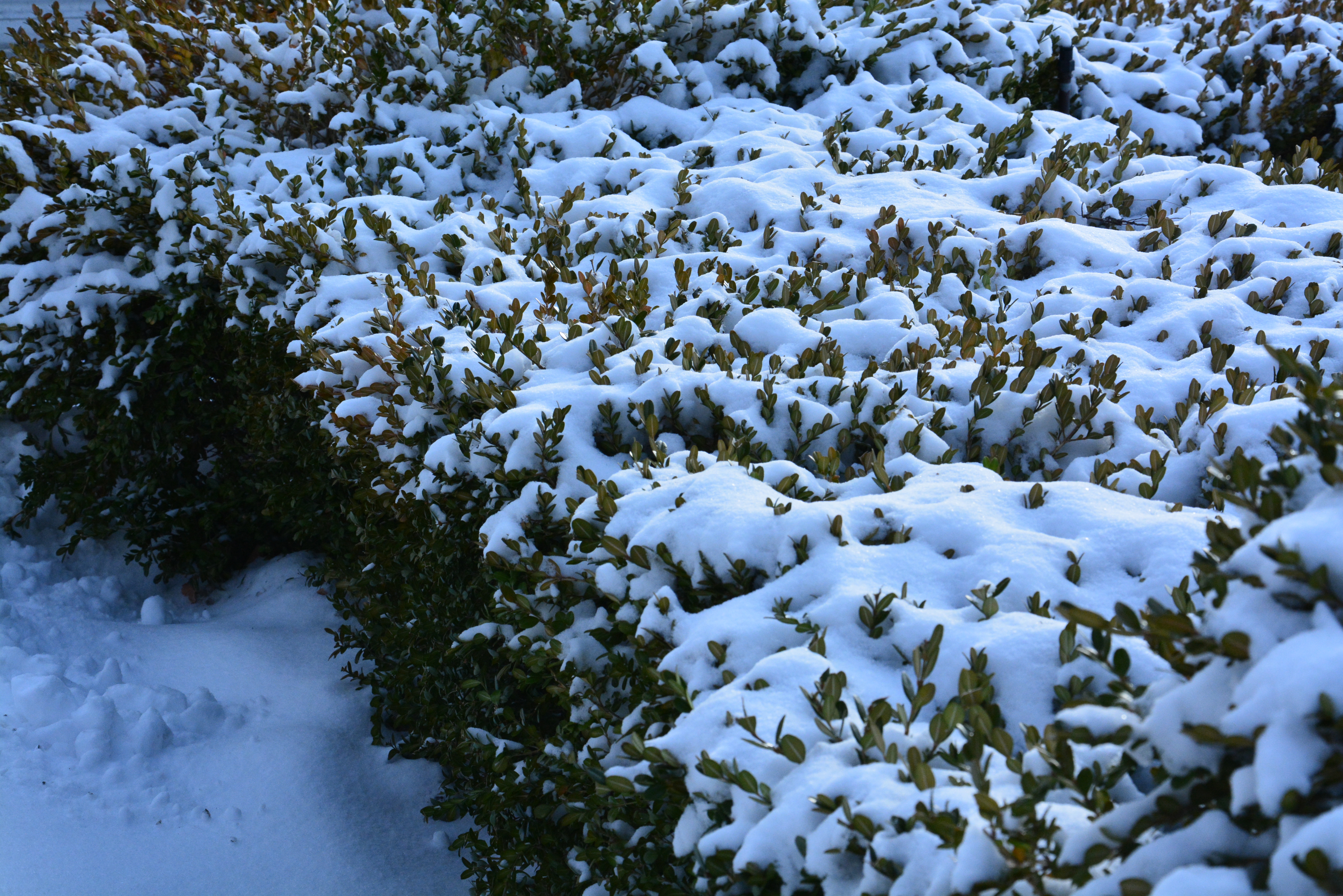 Some forms I do not give a moments notice. Why wouldn’t my clients feel the same way? Whenever I am designing for a client, I always ask what was an unforgettable experience of the landscape. This will tell me a lot about what forms will have meaning for them.
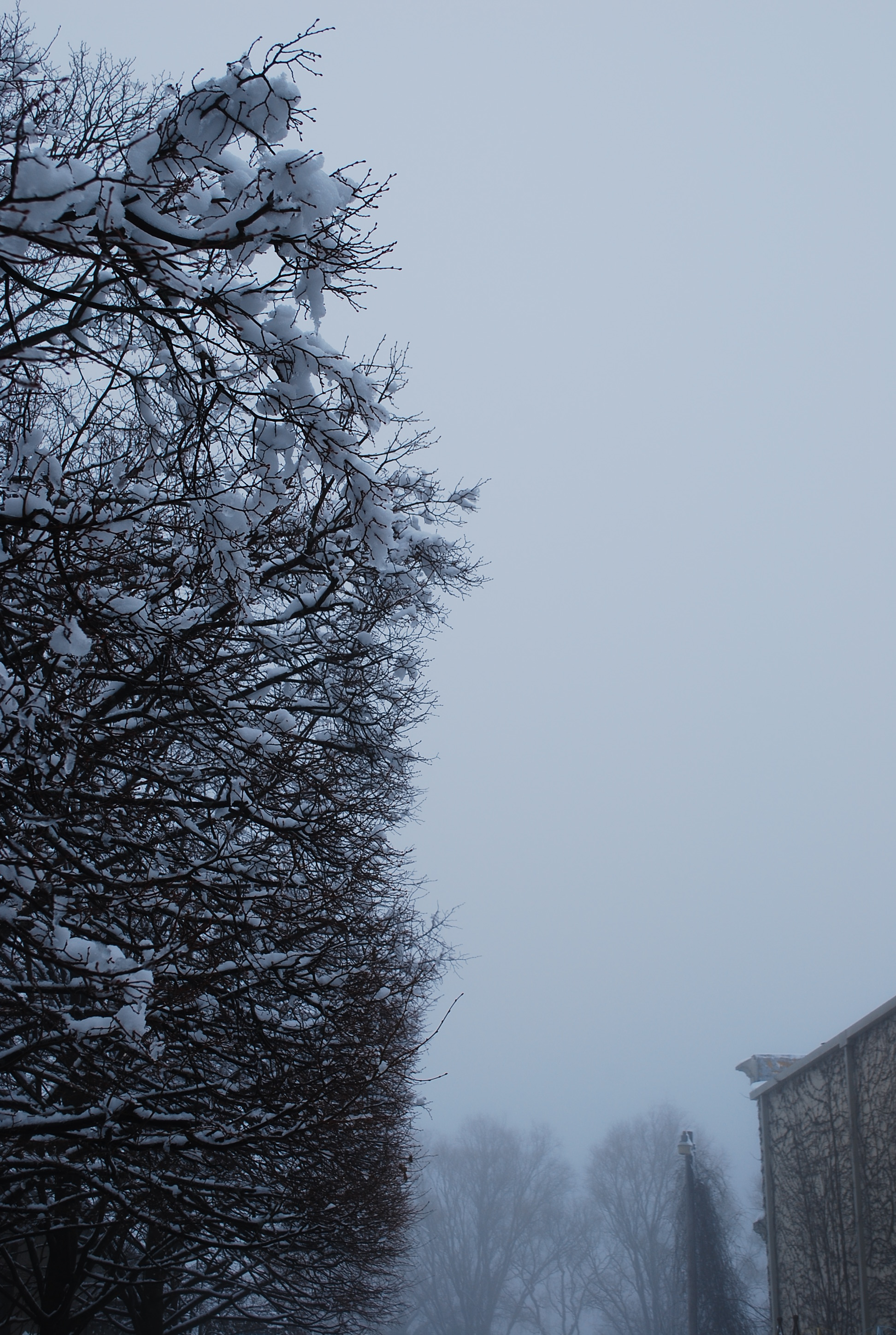 This embarrassment of riches in snow is an experience of the landscape that is making me testy, but it has its virtues.
 Milo thinks this winter’s garden is grand.
Making A Lot Of Little
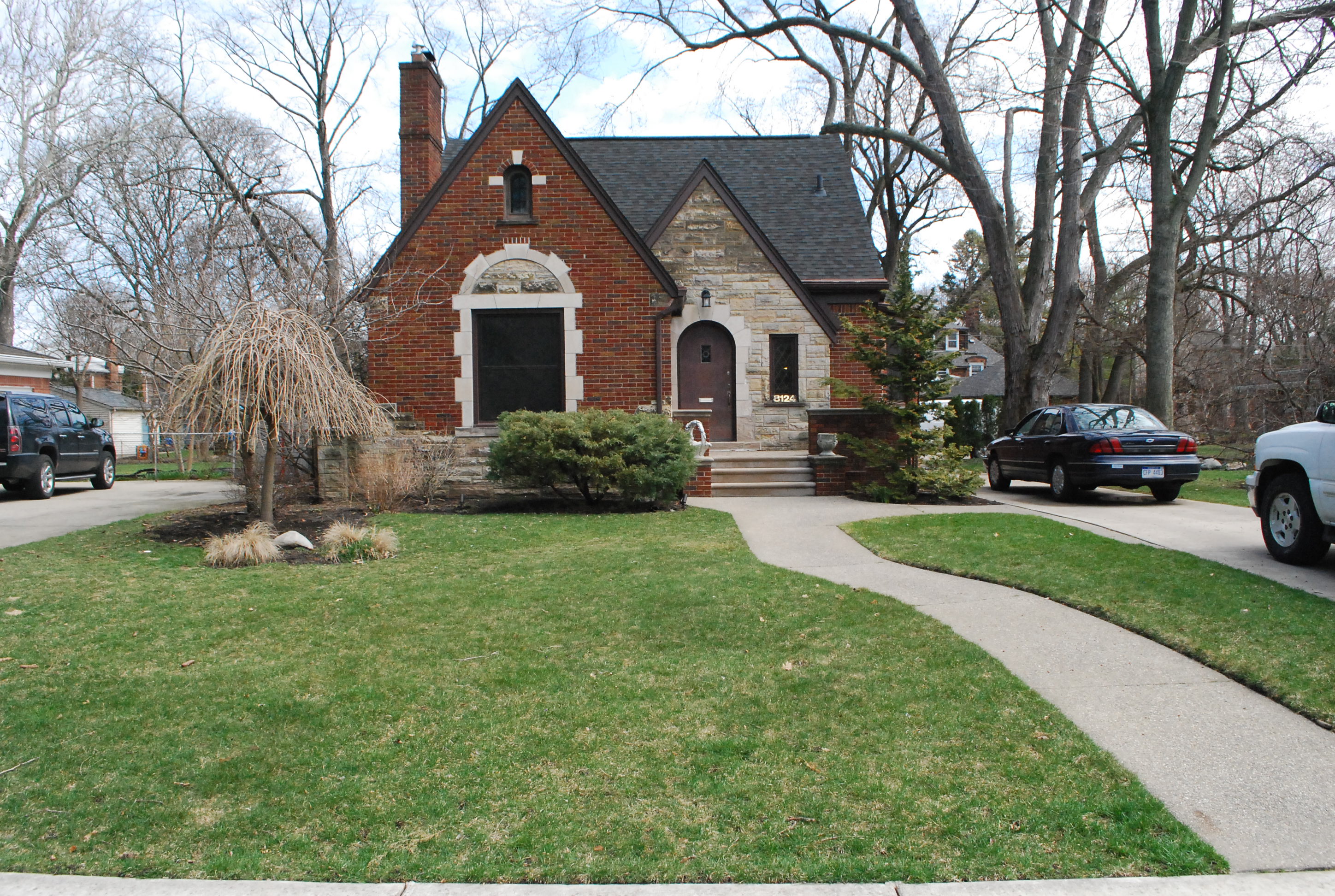 An old client bought a new house. The landscape out front was not so swell-I am sure you can see an overgrown and poorly tended collection of plants that have no relationship to each other. A great landscape needs to respect, enhance, and challenge the space and the architecture. Not to mention the need for an expression that is interesting, and polished. This home was built in the 1920’s. Who knows what landscape might have been planted after the house was finished. I felt really certain that the current landscape was cursory, if not left over, and not so much oriented around the architecture. This is not an unusual. Not everyone is so interested in the landscape, much less good landscape design.
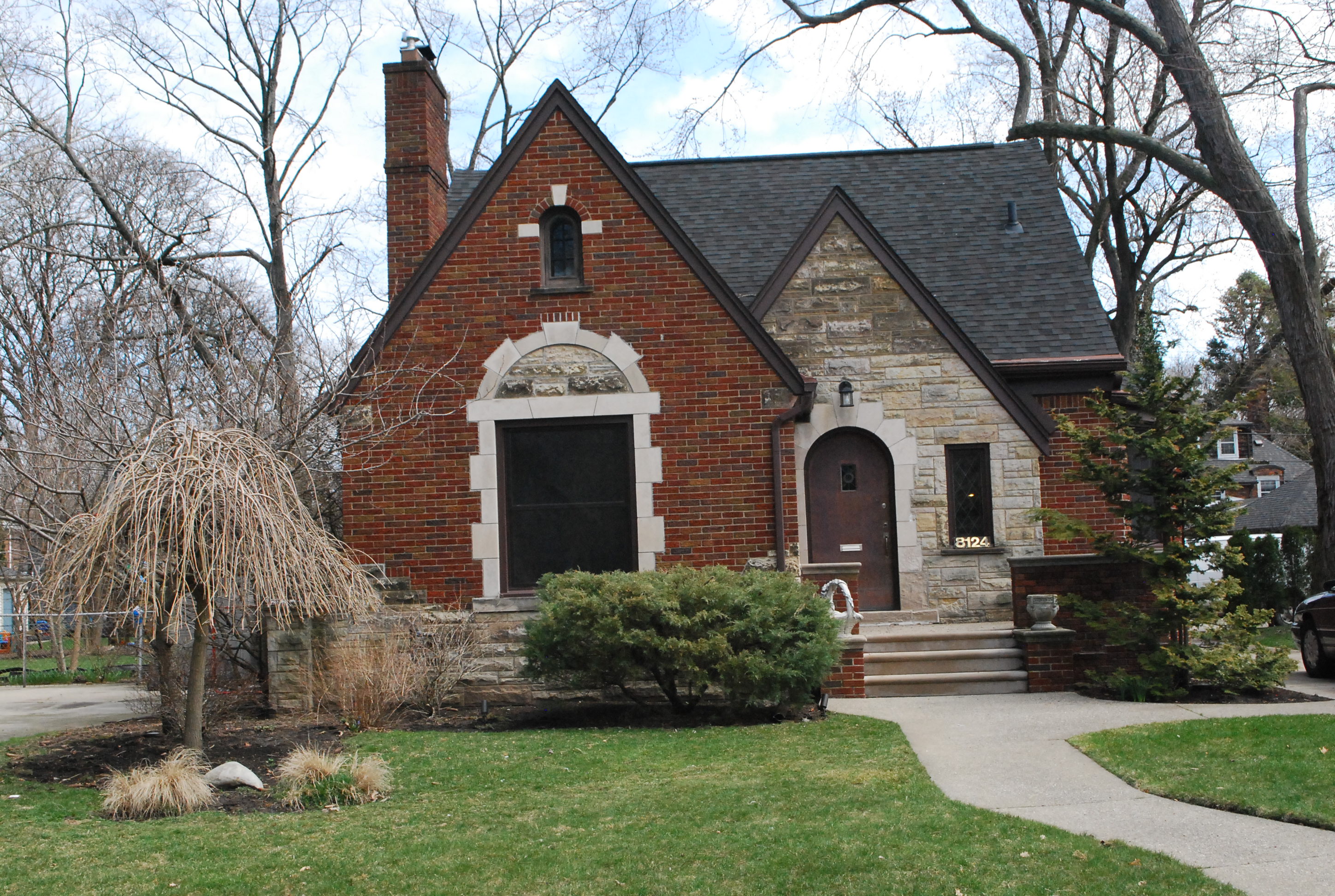
My client, however, was very interested in landscape design. She wanted her new home to have a new landscape. A fresh design. A design that she would delightedly call her own. Delight is a state most everyone can relate to. Landscape delight revolves around a few issues. A home is the largest feature on any plot of ground. The shape, the size, the height, and the style of that architecture should inform the attending landscape. A delightful landscape looks like it belongs to the house and property upon which it is planted. A good landscape resonates with a house and property. That house informing the design does not mean reproducing the landscape design of that period. It only means that any large structure that sits on a property needs to be grounded in a thoughtful and beautiful landscape design, properly proportioned. A good landscape has an idea about house and ground that is delightfully framed and executed. On my first visit, I so loved the house, and all of its features.
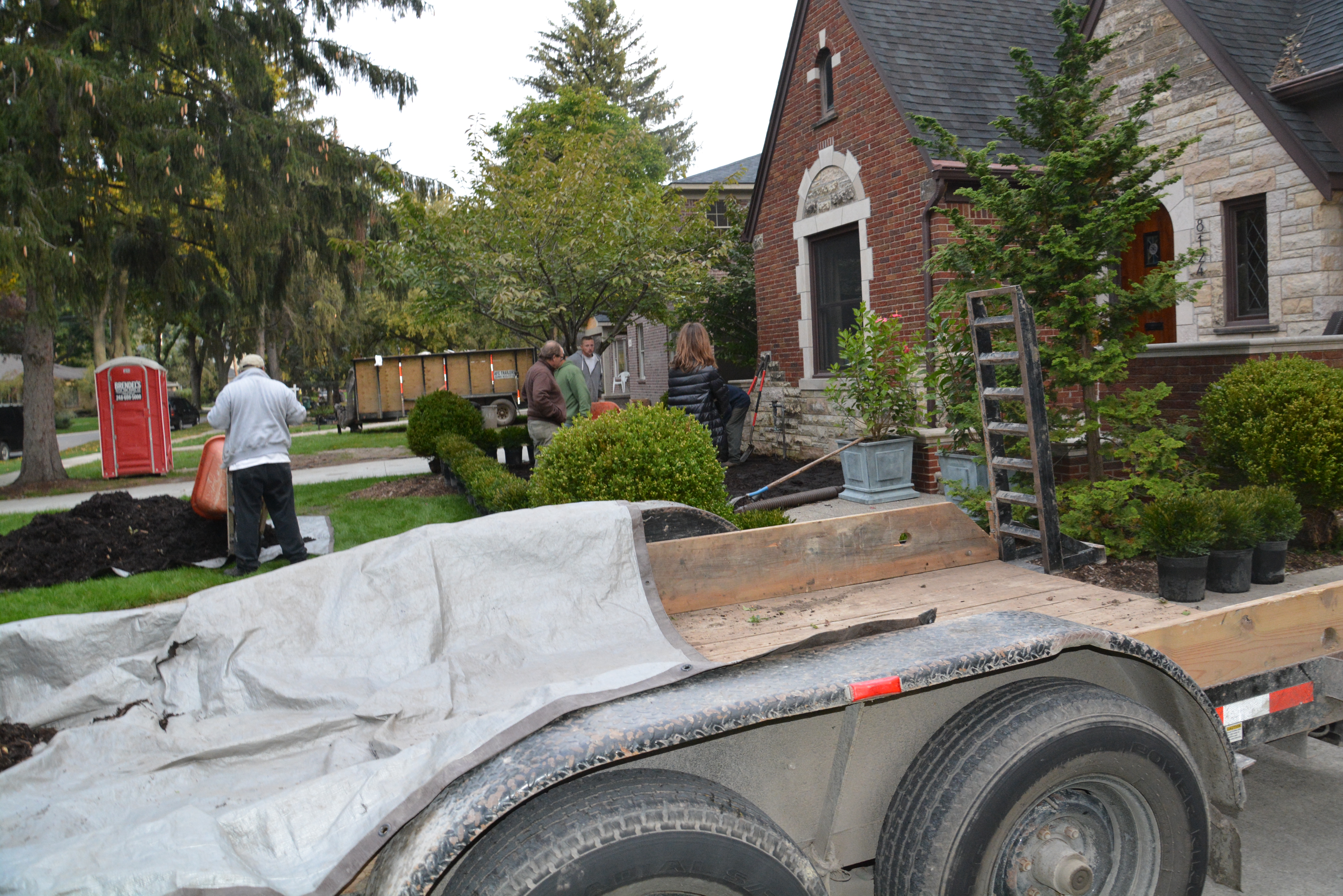
My first installation visit to this property was about eliminating her feeble collection of plants in front, and creating some basic green structure. The cost of implementing this part of the plan would depend in large part on the size of the plants. Great design is not one bit related to the cost of an installation. We can buy and install plants of many different sizes. The design called for green structure that came away from the house, and enclosed the sidewalk to the driveway in a configuration that made visual sense. In other words, a bed of some size. She wanted to make the biggest impact she could within the confines of her budget.
 Great landscape design may be about a moment imagined for the future. Small plants cost less. Big plants cost a lot. Most of the boxwood on this project are 12″ to 15″ tall. We paired lots of those little boxwood with four boxwood of considerable size. Contrast is a very powerful design element. In this case, the contrast in size made the entire installation look more important visually.
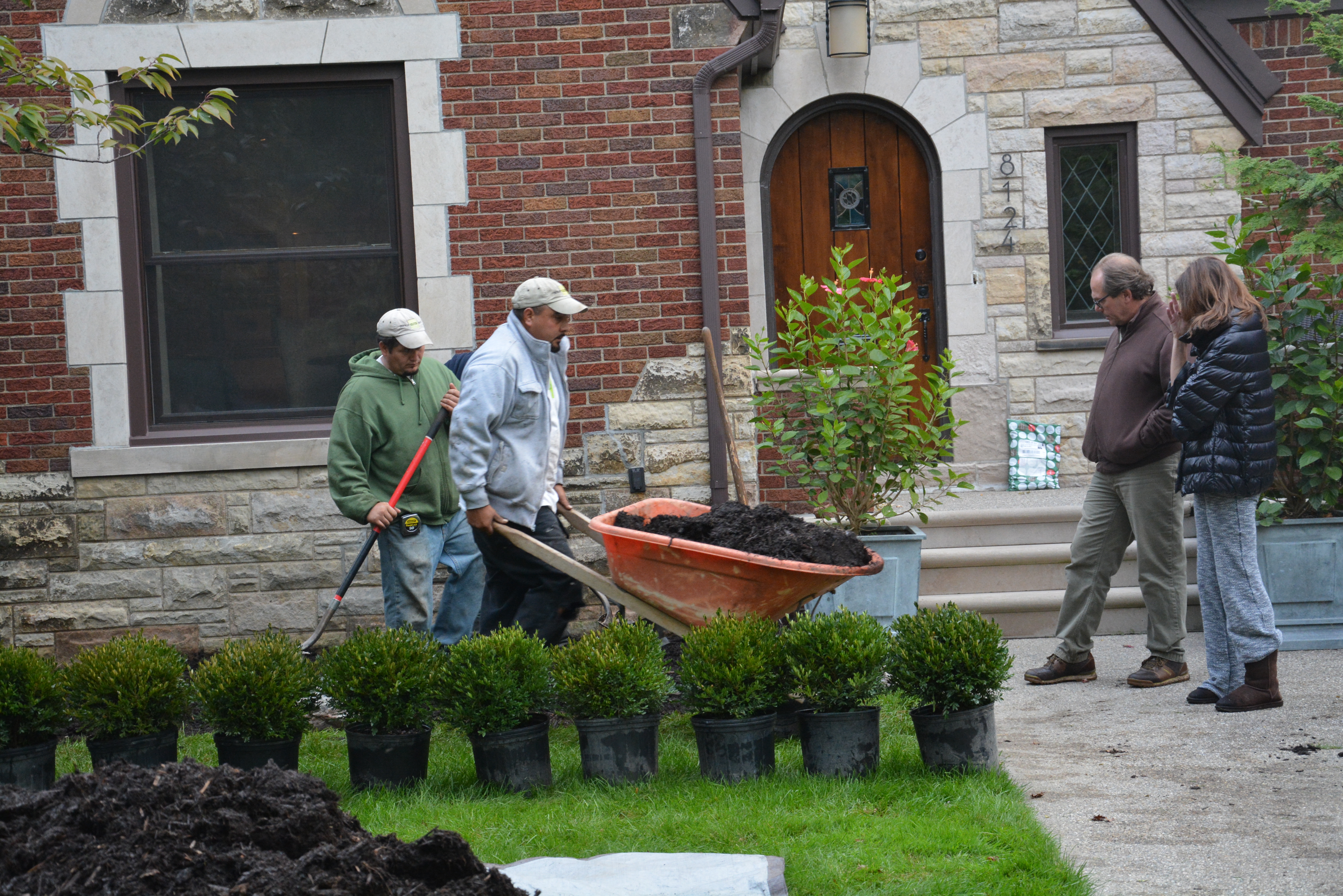
The 15″ Green Gem boxwood are really small. Small enough that they are grown in pots. Small works great, when they are contrasted with companion plants of greater size. 36 inch round Green Gem boxwood spheres are rare, indeed. Splashy. These four big bits would make lots of the smaller bits.
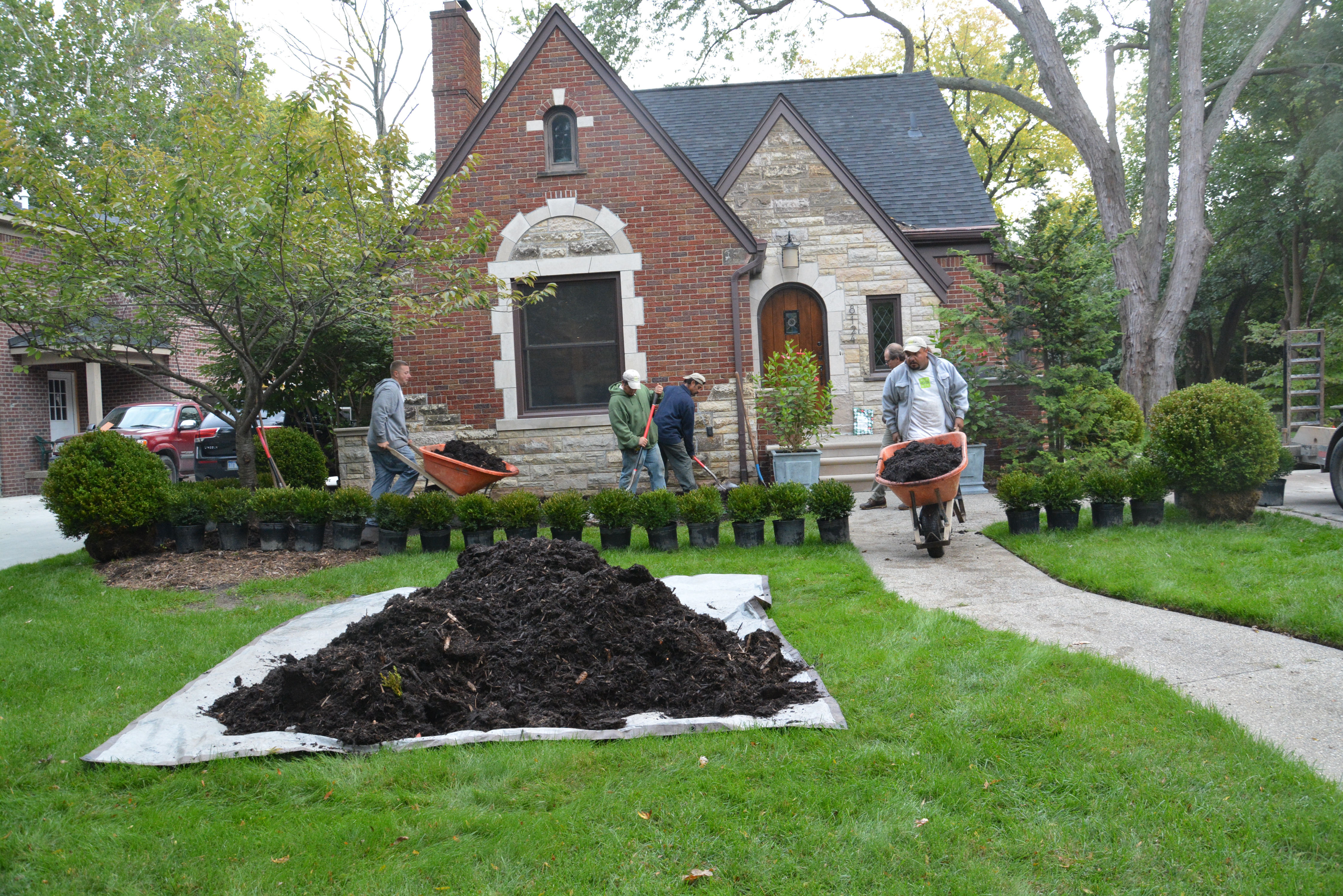 This is the first part of the plan to be installed. Designing with staging in mind involves 2 things. The part has to look finished on its own-not piecemeal. The “part one” also has to be ready and friendly to the next phase, whenever that phase comes along.
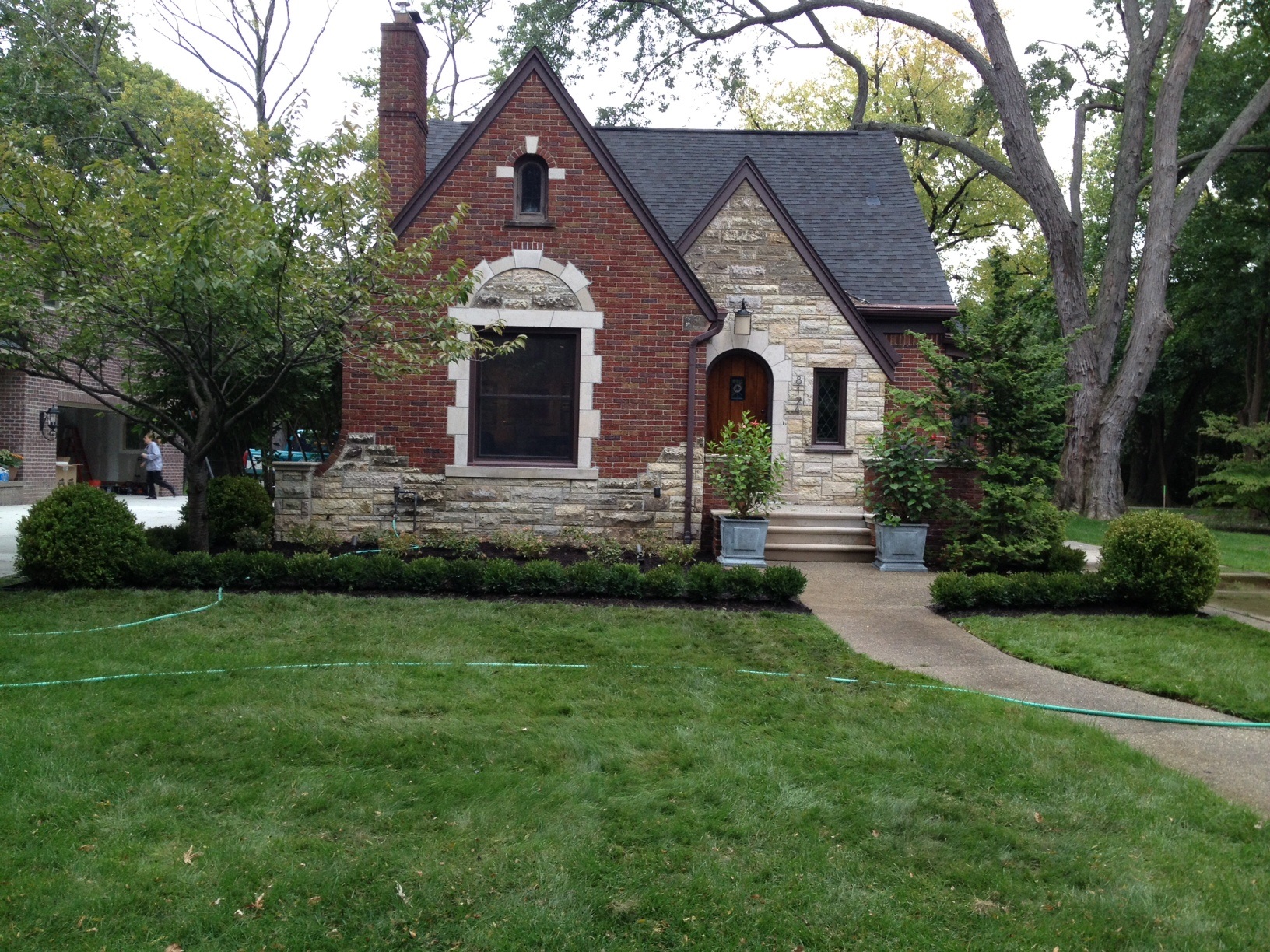 The installation of this boxwood parterre would look fairly routine, but for the larger balls on the four corners. The four boxwood of scale attract attention. Behind the boxwood, several rows of Little Lime hydrangeas.
 What goes between the hydrangeas and the boxwood is under discussion. We probably will not do anything here until the spring, which means there is time to think it through.
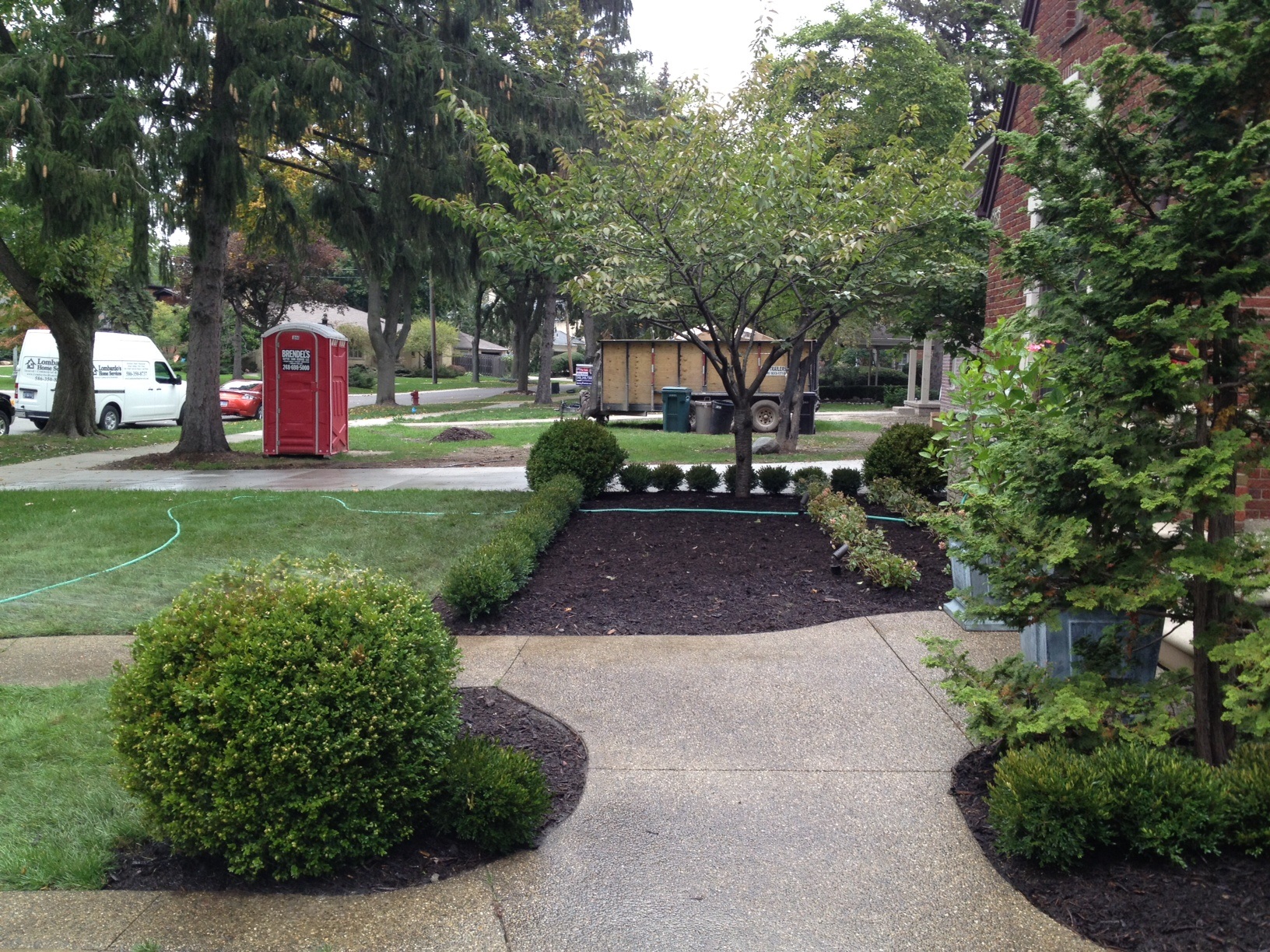 This picture explains the visual logic of the location of the parterre. That space could be handled in lots of interesting ways. It could be lawn, or ground cover, or more boxwood, or a combination of all the aforesaid, or gravel, or? For now, part I is holding its own.
A Topiary Garden
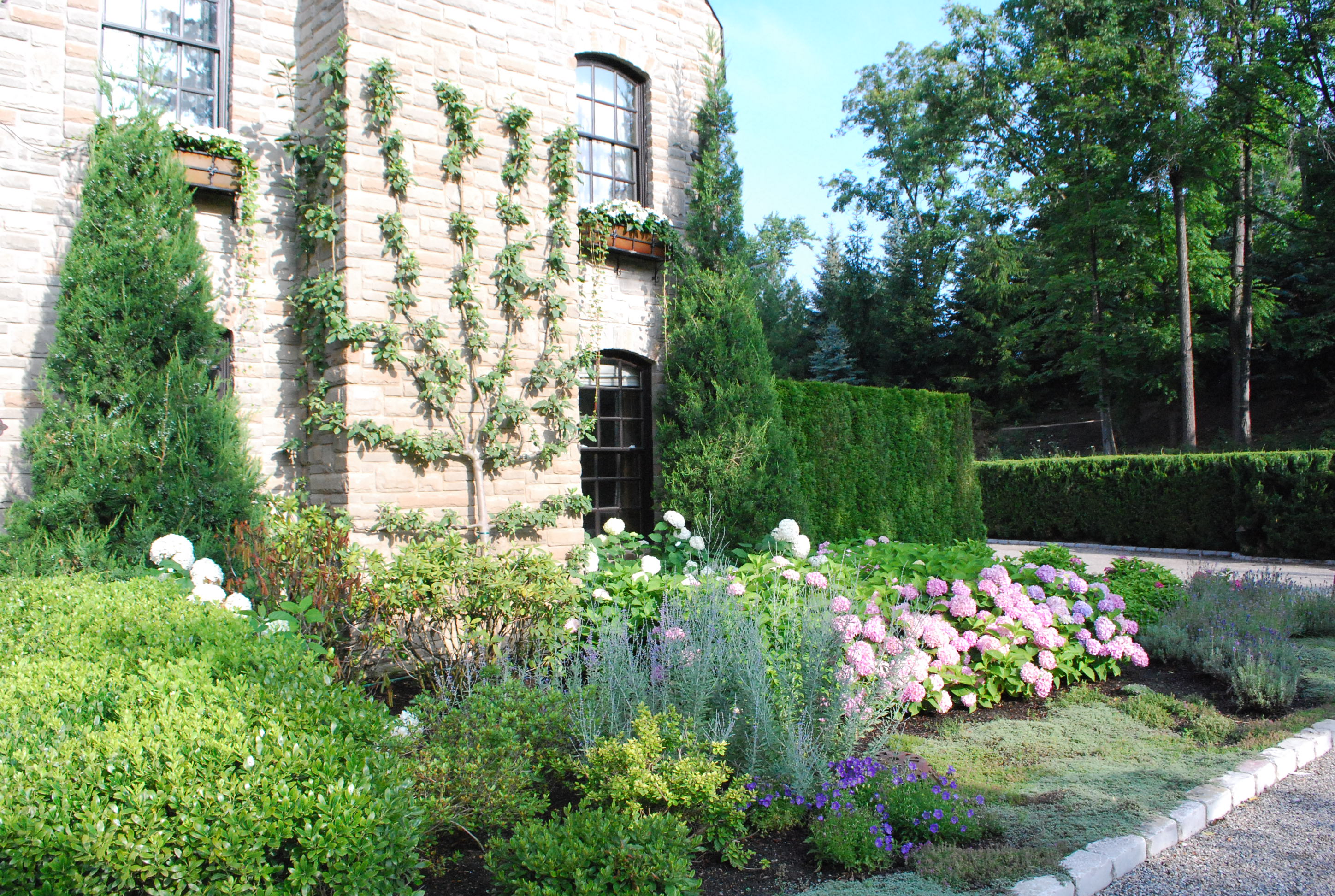 I have been planting pots for this client since 2005. He really enjoys his garden, and I look forward to planting for him every year. As for the landscape, it was not my favorite. A circular drive court was planted round about with ink berry. Over the years, the ink berry died out in patches, and what survived grew leggy. The landscape did have to its credit a number of large arborvitae which had been pruned into shapes, and several espaliers.
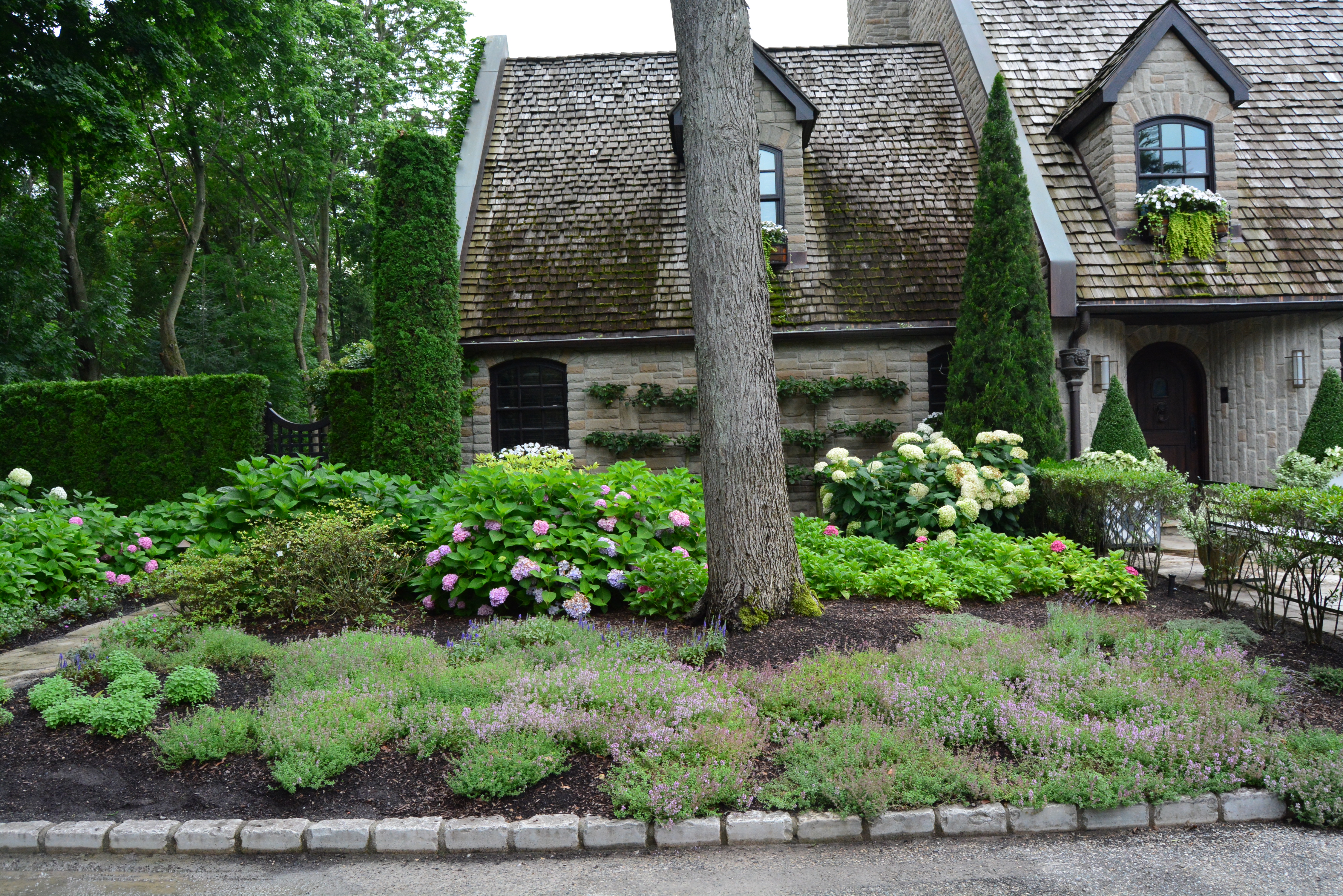 The rest of the landscape was a random mix of hydrangeas that did not bloom much, and perennials which asked for full sun and perfect drainage. The vast majority of the plant material was not happy where it was planted. Moist shade is not a spot that asks for or welcomes thyme. Thyme is very small leaved, and grows but a few inches tall. Placing it in the landscape effectively is all about a good understanding of scale. An old, limbed up, and half dead maple tree was not adding much to the landscape either.
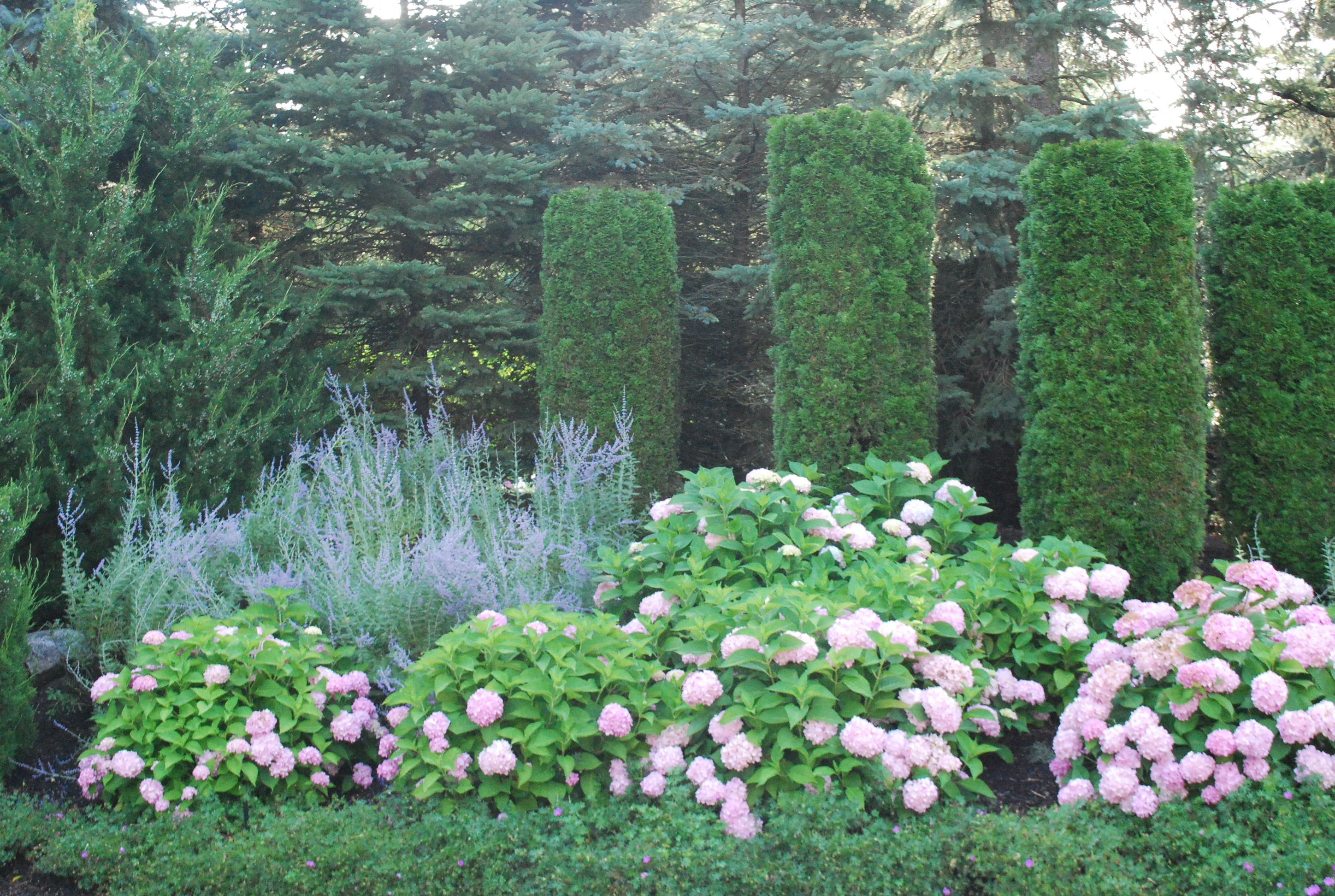 But what was obvious to me was that this client truly enjoyed his topiary plants above all. I respect and enjoy landscapes in which the structured plants are contrasted with a looser garden. In this landscape, the contrast did not seem to work. I so rarely take the time to critique. In general, I think the energy it takes to criticize would be better spent in an effort to suggest a solution, or a better way. I was sure this landscape did not represent what my client loved about landscape-so I persisted. It did take me every bit of 18 months to convince him to redo the landscape.
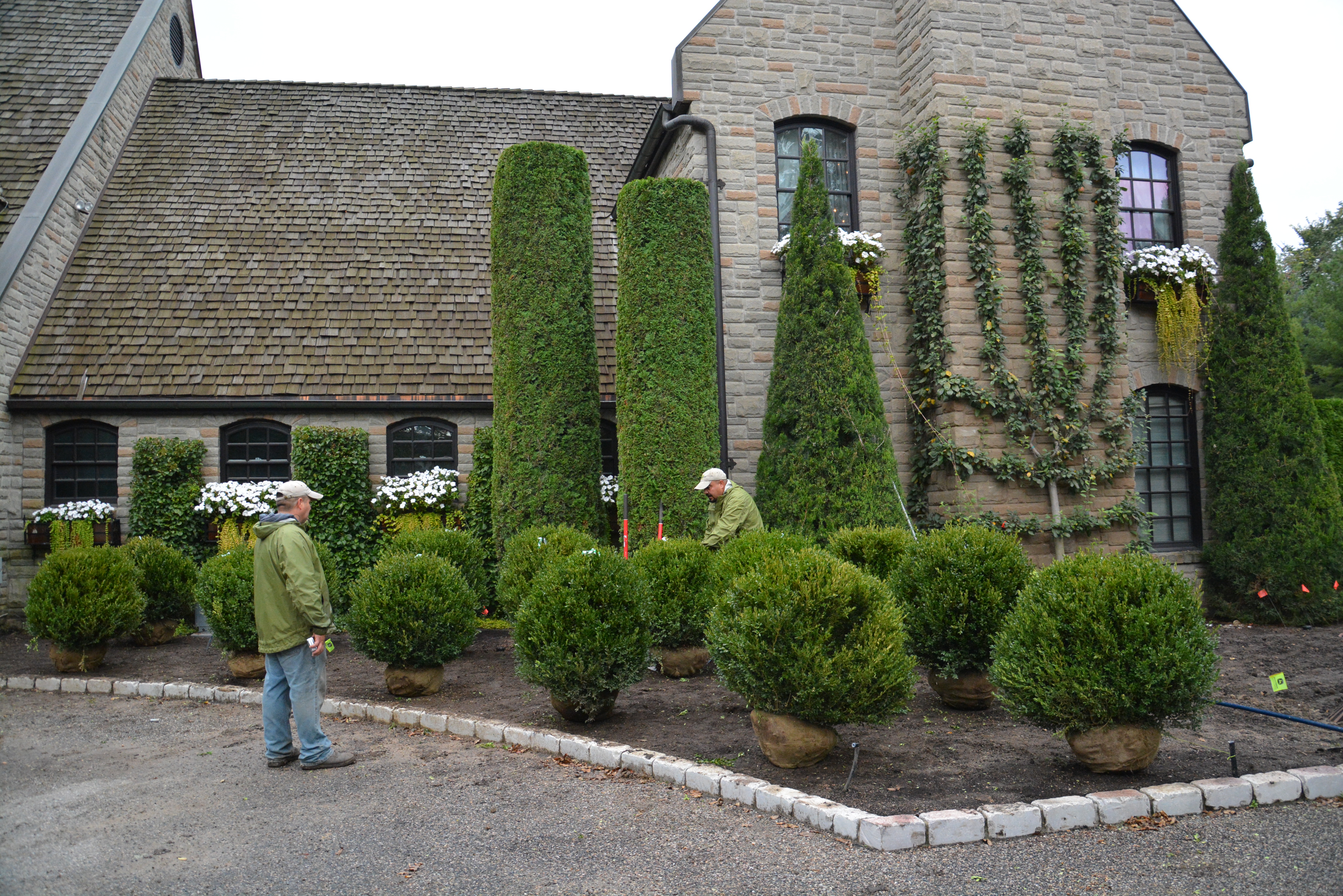 Clients are ready for change when they are ready. This is not unusual. All of us are ready when the moment comes when we are ready. My client made a decision. We moved on that decision. It did take but a half day to rip out the ailing ink berry. Another half day for the pink hydrangeas and company. The shape of these beds made it very difficult to plan a formal design with topiary boxwood. I had 18 months to work out the placement. I was ready.
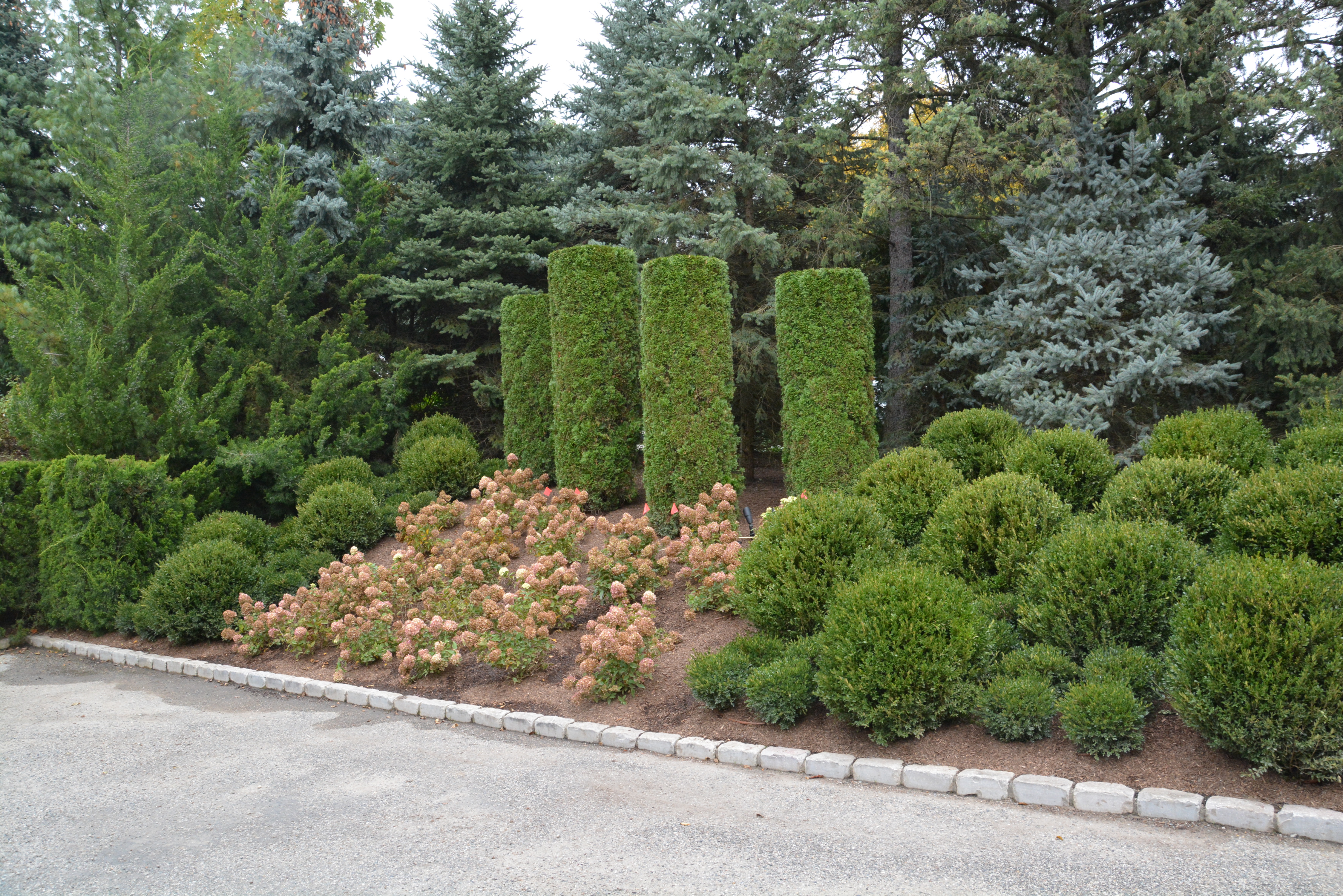 My landscape design is predicated on an arrangement of shapes and only 2 plants. Specimen size 3′ by 3′ Green Gem boxwood, 15″ tall Green Gem boxwood, and Little Lime hydrangeas. My client also has a big interest in contemporary design and art. The house is an interpretation of classic French design. I was after a landscape design that had its roots in classical landscape design, with a nod to a modern aesthetic. I was also interested in the landscape representing my client’s love of topiary.
 A pattern of offset 3′ by 3′ Green Gem boxwood spheres was alternated with blocks of 4 squarely placed 15″ Green Gem boxwood is a pattern that is repeated in stripes perpendicular to the house. The round shapes contrast with the geometric placement. This view down the drive is strong.
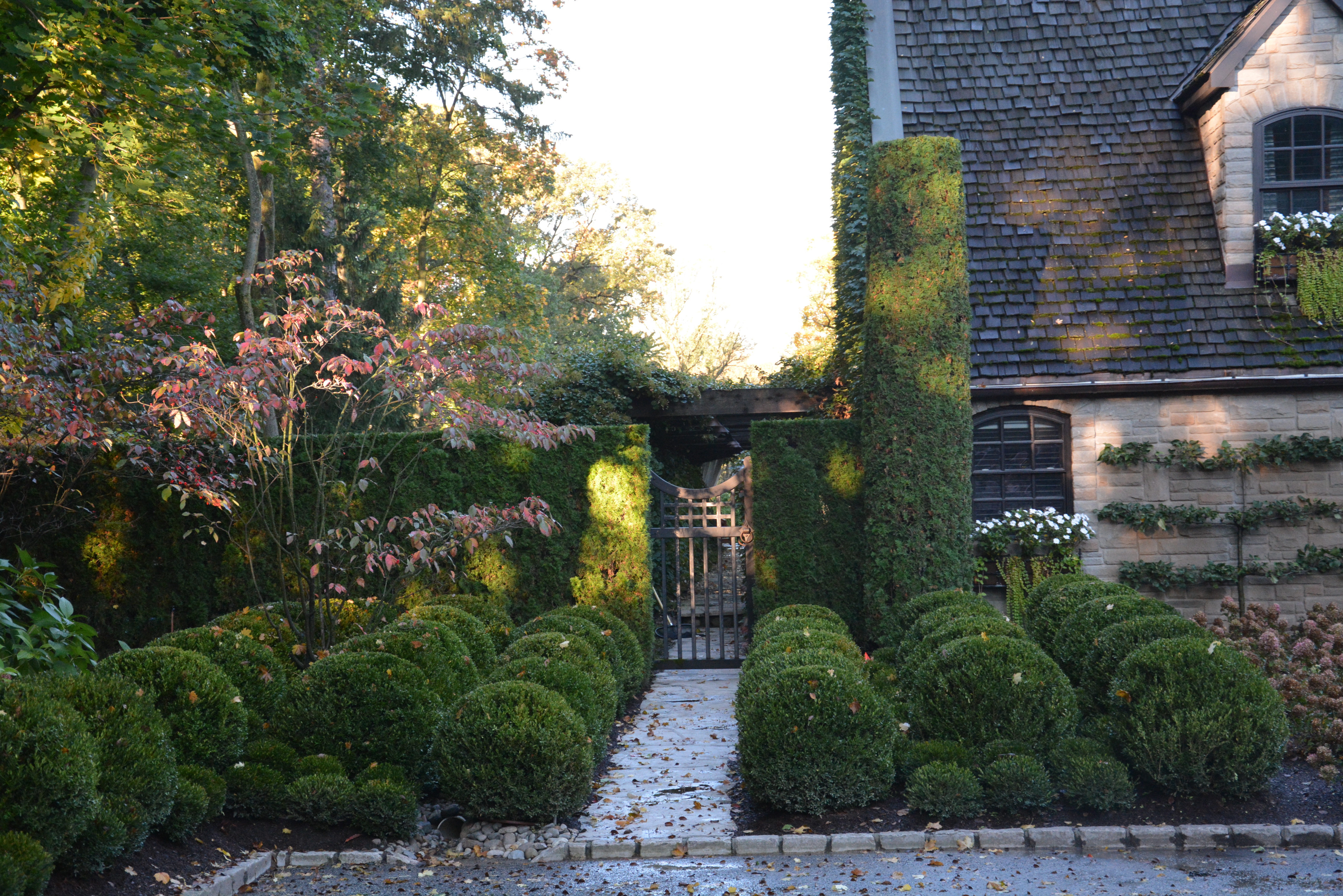 We had drainage issues. I will not bore you with the problems associated with the drop from the street to the driveway plane, and how we handled the water. If you search the above picture, you can see the drain pipe to the left of the boxwood planted on the left side of the walk to the back yard. Providing for proper drainage is essential. Handling the drainage gracefully takes lots of planning and work.
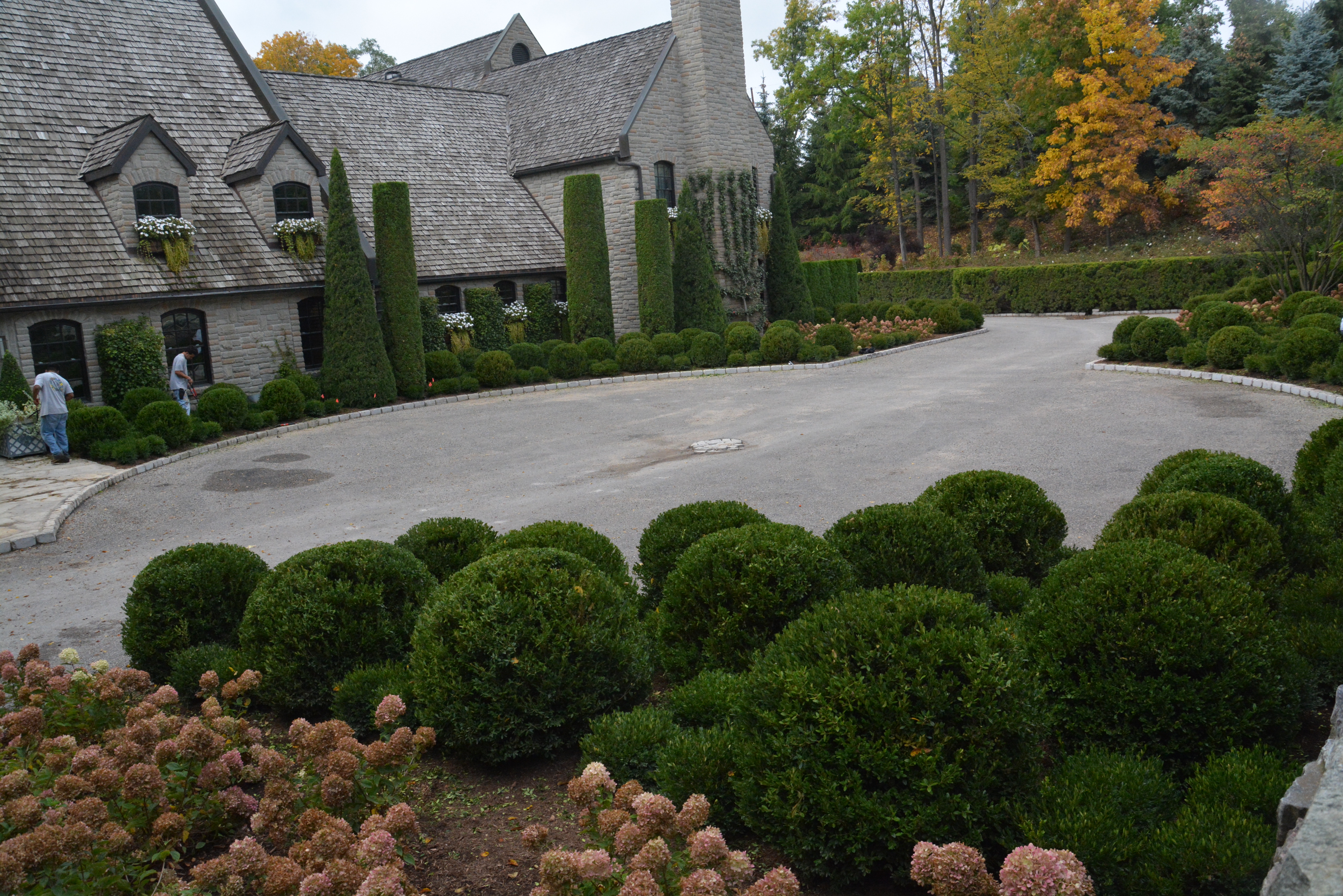 This landscape renovation honored first and foremost my client’s love of topiary evergreens. Secondarily, the landscape renovation reflects his interest in contemporary design. I was so interested that all of the spaces be simple and integrated. The driveway and drivecourt is a much larger space than the landscape spaces. A strong pattern would minimize the visual draw of the drive, and maximize the visual attention to the green spaces. That said, any landscape needs to challenge and enchant. At the end, I feel sure that the reconstruction of this landscape is particular to the taste of my client.
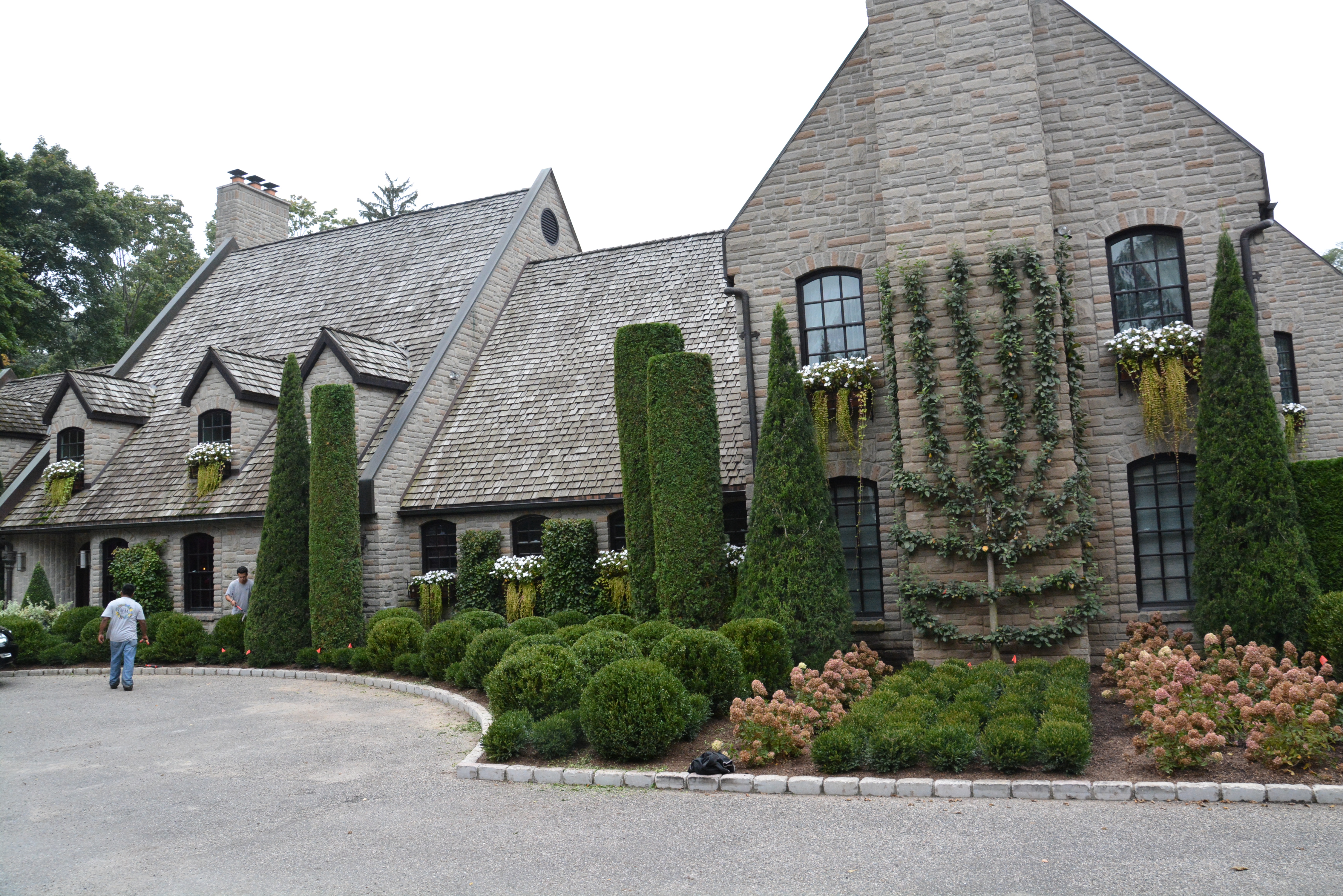 Every client is different. A good landscape designer needs to have the ability to absorb and then design for different. Any gardener who has a mind to design for themselves needs to first and foremost listen to their own voice, then acknowledge the demands of the space, and be bold about a plan.
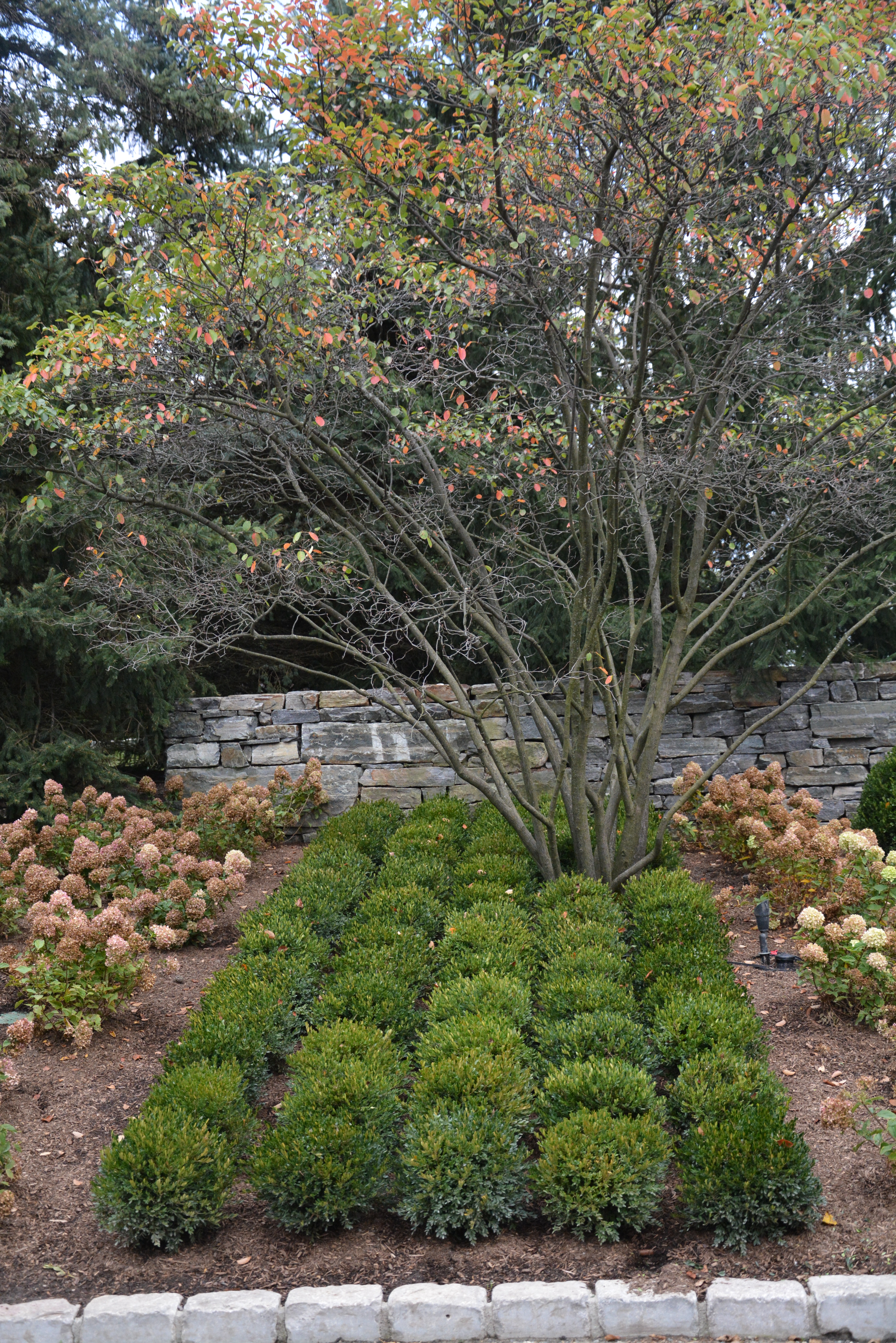 The renovation of this landscape went well. The soil was surprisingly good and easy to work. We dug and planted for 6 straight days.
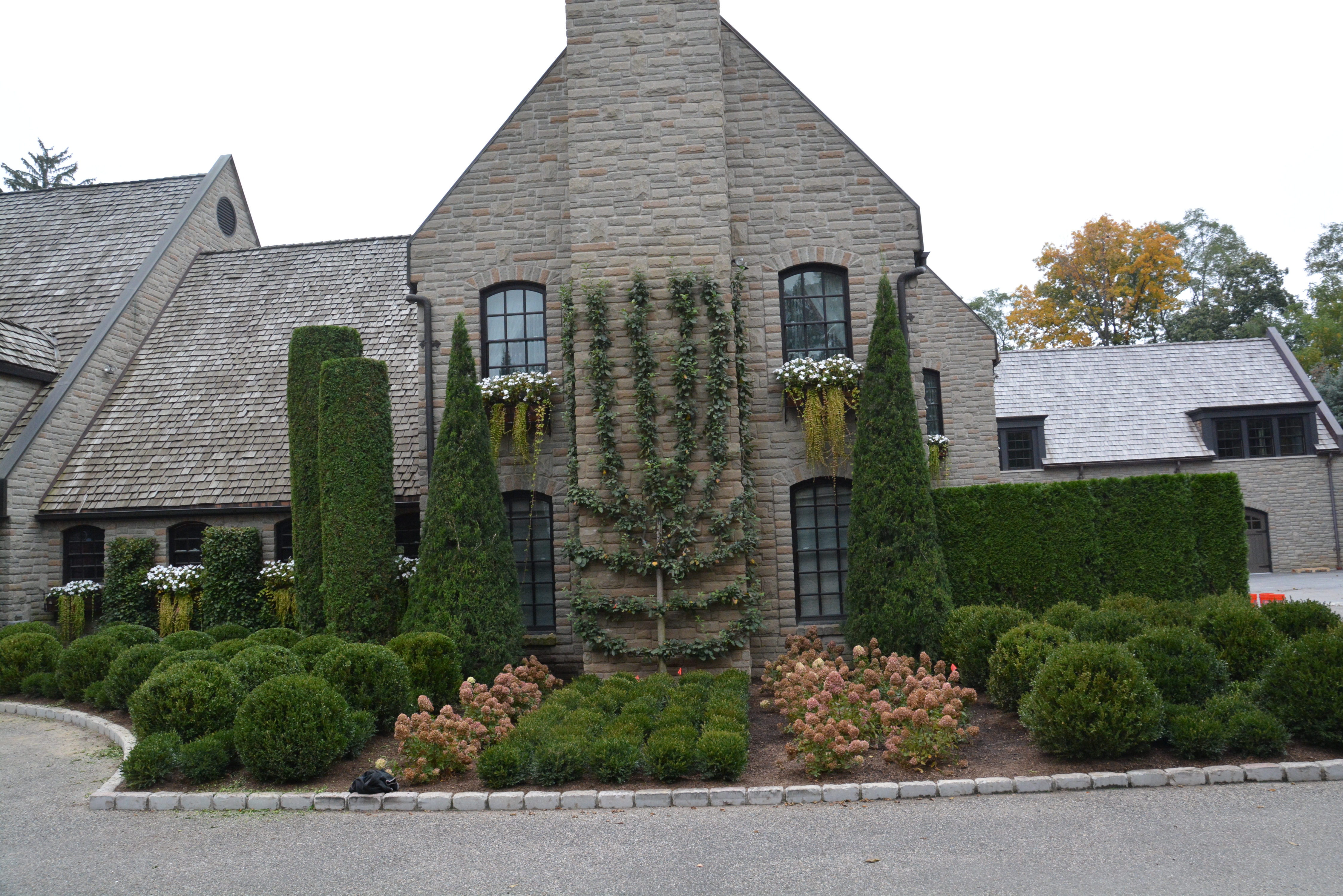 Formal landscape designs have their proponents. Vis a vis this project, I am one of them. I like formal landscapes, when they are appropriate to a site and a client. I like other than formal landscapes, given a specific situation. Redoing a landscape is a big fluid situation-any designer knows this. If you are a gardener who designs for yourself, I could offer this advice. Take the time to figure out what you want first and foremost from your landscape. Next up, dream and scheme. At the last, make a move. As for this landscape-it is all about the beauty of the topiary plants.
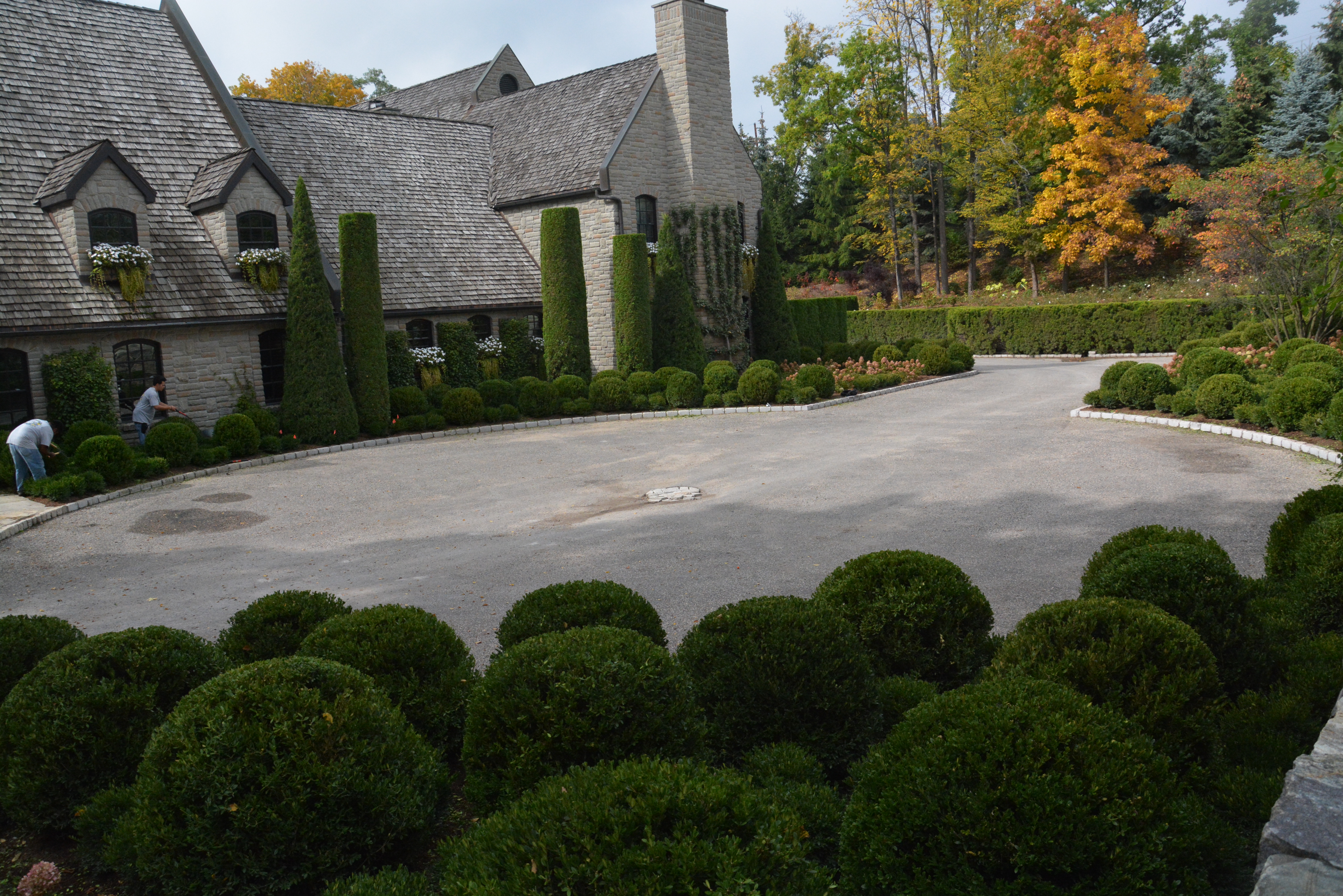 My client likes what we have done. I am pleased with the finish.