In the 1970 novel of the same name, Canadian writer Robertson Davies makes allusions to a character in opera known as the fifth business. I love opera, but know next to nothing about it. But I do know that there is usally two principal characters whose relationship is marked by impossible love or overwhelming angst, (the soprano and the tenor) and two secondary characters who provide either comic relief or aid to the principals-and the fifth business. This male baritone fifth business knows the whole of everyone’s story, and keeps the audience informed what terrible and wrenching event is coming up next. The fifth business has no counterpart; he is the odd man out, the commentator, a story teller.
I have loved all of Robertson Davies writings. How he tells stories is electrifying. When I read his books, I am completely convinced the world he creates is authentic, genuine. His view of the world completely absorbs, and informs me. I am better for having read his books. This may mean that for whatever reason, I am interested how other people see the world. This means people in general, gardeners, artists, composers and writers, imaginary people. Though my memory is not what it used to be, I still remember my earliest imaginary friend, Anthony Bowguidem. I am interested in what other people imagine. I would guess this is key, as I continue to make a career generated from what I imagine.
How does this relate to garden design? I fancy myself the fifth business in a design relationship. I see the property where no one has time to keep it up, though I am hearing that they garden. I meet people whose obligations as parents eclipse what they might want as adults from an outdoor space. I see a Mom with young children asking for play space, when she really means she needs a place for she and her husband to relax and talk, separate from a play space. I meet clients who tell me they like wild gardens, when I see that wild garden they have overwhelms them. I meet clients whose work obligations shock them-they are looking to reestablish some connection to their home and its environment. I meet young people who are looking for a schedule of do it yourself projects.
I like hearing the stories. New to me-I tell my story. I invite clients to see my garden. Its a small property, but I have given plenty of thought to it. I have done it over the past fifteen years, not the past 15 weeks. The plants, the forms-this is a common denominator. Many people’s lives and circumstances are very different than mine, but in the end, the shapes, the plants, the problems-these things we share. What I share with people comes to some good.
I cannot express how shocked I was a year ago to discover that the fifth business was not part of the language of the history of opera. Robertson Davies invented that word, and invented what that word meant. All these years I had supposed I was one of a group of baritones who knew all the stories, who could make better, given my reach, other lives. There is not one bit of history to support my efforts. Given some time and thought, I realized that most everything I do is energized by my imagination.
The energy generated by an active imagination? Good energy.
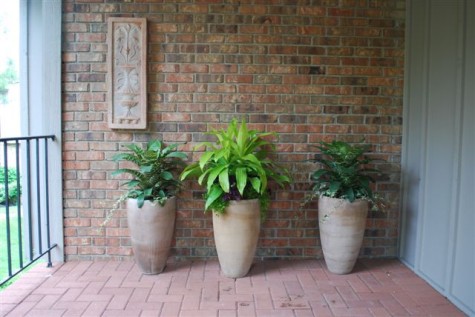
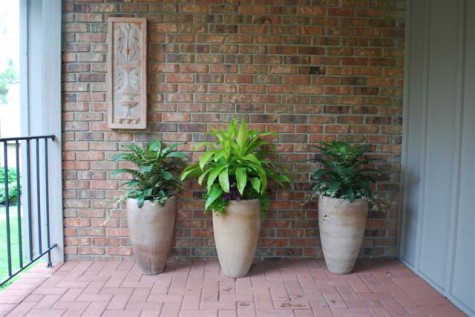
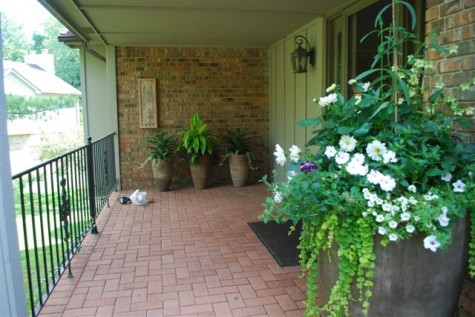 The walk culminates in a covered porch; the front door is at right angles to the walk, and not visible until you are right up there. All of this makes the brick wall they see coming up the walk an important element in their landscape. We started with pots, as there is no ground to plant in; this part looks great. But I thought that wall needed what all walls seem to need-a sculpture, a painting, a mirror?
 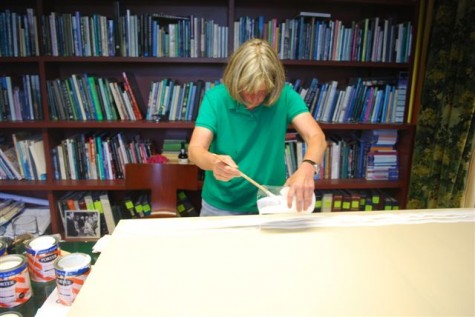 As my clients have quite a collection of art, they were receptive to the idea of a painting. Paintings that survive the weather need to be made of different materials that what an artist ordinarily would choose. I paint on extira board, which is used for making exterior signs. It does not absorb water, nor does it deteriorate outdoors. Porter Paint is a 100% acrylic paint; it is color fast, very tough and hard, and sheds any weather. As this paint is actually exterior house paint, and does not have the body of artist’s colors, I decided I would pour the painting. A beaker was the perfect tool.
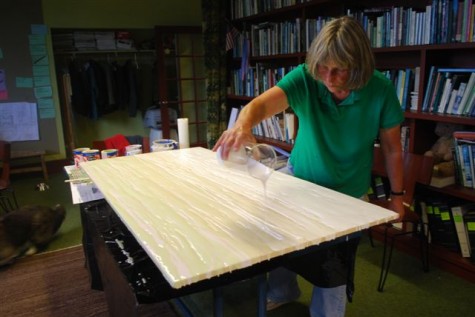 I poured the painting over the course of about 4 hours. Some areas I wanted to blend colors. In other areas, I wanted colors to sit distinctly side by side. All in all, I poured one and a quarter gallons of paint-a big fluid situation, to say the least. I supported the extira board underneath on 8 quart cans of paint, so if the board sagged from the weight of the paint, it would be evenly supported.
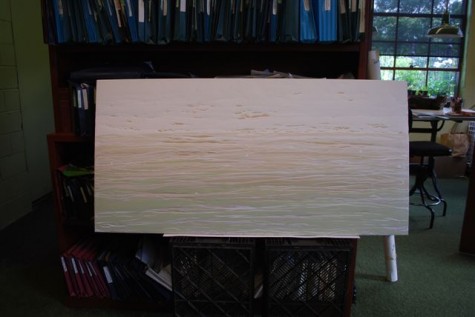 Within 3 days, the surface of the paint had skinned over sufficiently that I could stand it up to take a look. While I was happy with the color and the shapes, I wanted more texture. The painting would be viewed from some distance coming up the walk. The near view, on the porch, would present a different look. I wanted to address both views.
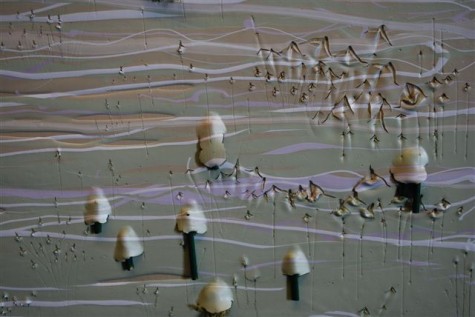 Using a carpenter’s awl, I poked, scratched, lifted up and pushed around that partially dry paint. The areas of paint I lifted off the surface, I stuffed with pieces of bamboo. At this fairly wet stage, I needed to support the paint until it dried. Once the paint was thoroughly dry, I stuffed those shapes with preserved reindeer moss.
 �
�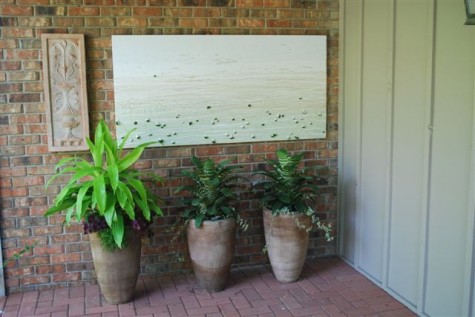 The close view I like. All the elements are different, but they look good together. The Italian terra cotta plaque is so much more important visually than when it had no company.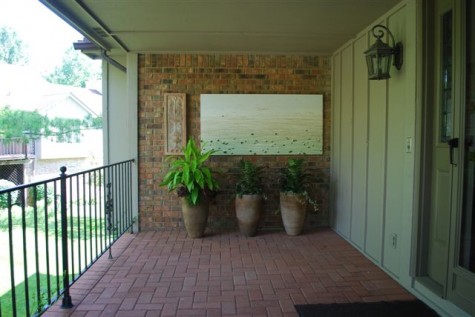
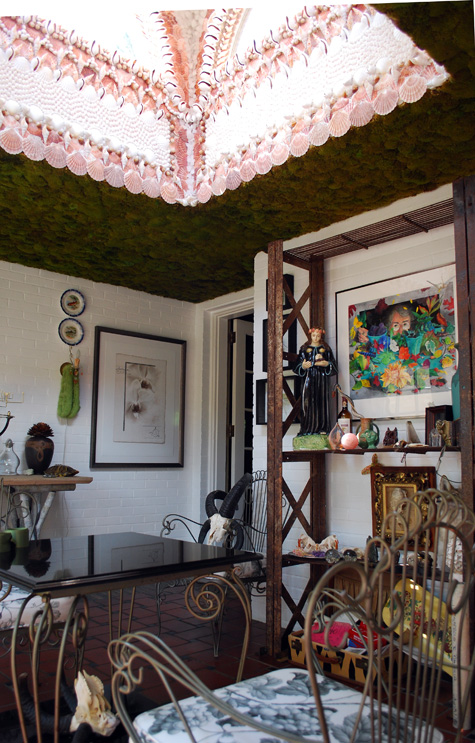
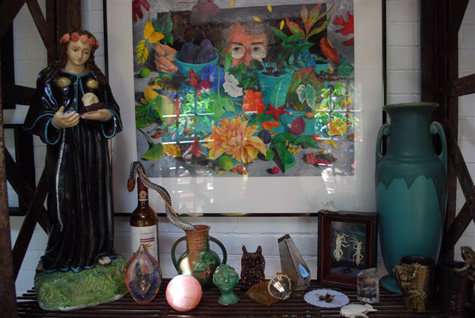
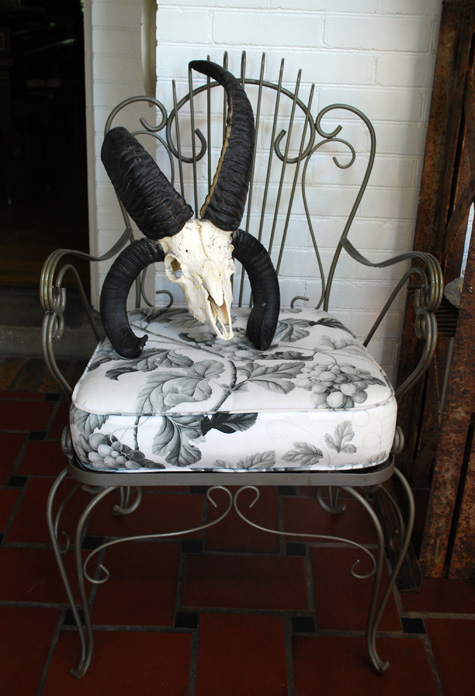
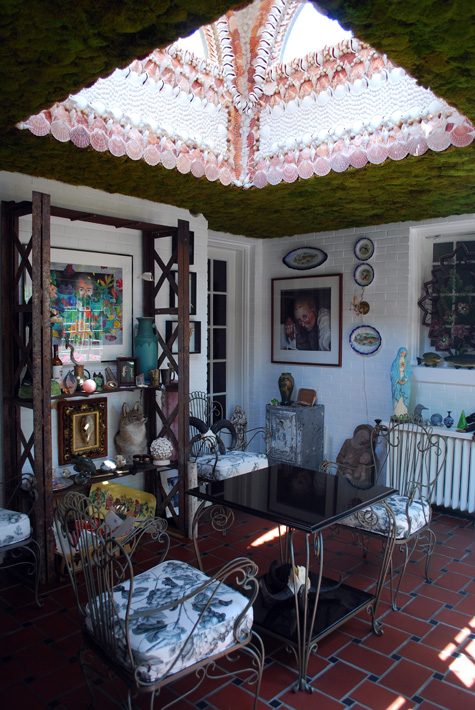 An old French wire garden table and chairs provide seating. A pastel self- portrait I did 30 years ago shares the wall space with specimens of butterflies, bugs and moths. Objects of meaning to me – as in, the clay bust I made of Julius Caesar in the third grade, letters from my Mom while I was in college, a collection of early twentieth century American fish plates-all the quirky things that have held my interest or been significant to me at one time or another, have a home together. The souvenirs of my life. Though the word souvenir now brings to mind postcards or paperweights from some tourist attraction, that was not always the case. The word souvenir, translated literally from the French, means “the act of remembering”, or “that which serves as a reminder”. There are times in my garden when the season or the light or the rain is just right such that memories will come strongly to mind.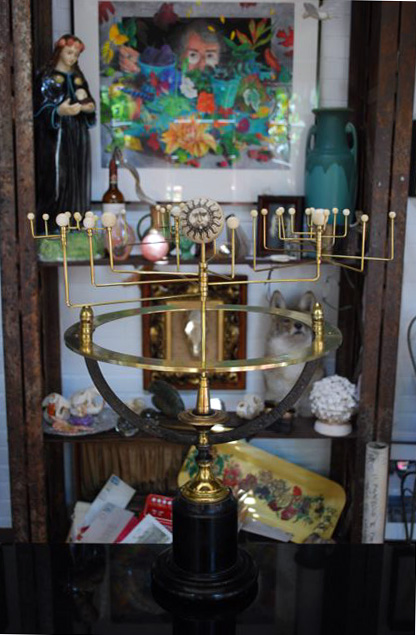
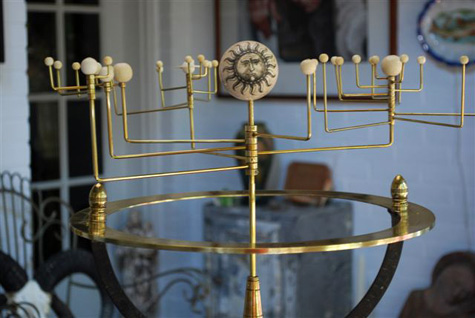 At the time of its making, only seven planets were known. Though it is a beautiful relic from a culture and time vastly different than mine, it is a reminder that one’s world is only as large as one sees to making it.
 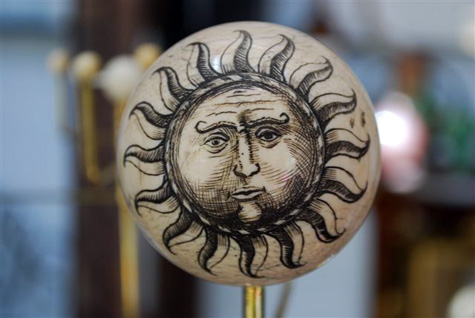 The sun, represented with a human face sporting a wry, quizzical , perhaps world weary expression, is as much a fine piece of art as it is some unknown person’s memory and concept of the natural world.