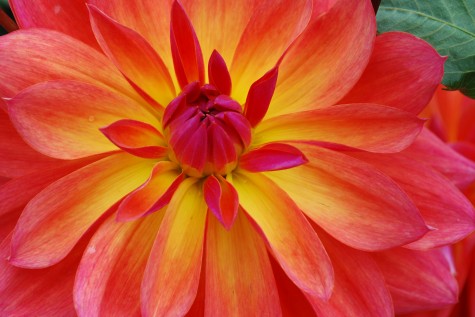
 The cultivation of dahlias brings to mind the famed Longfellow little girl verse. “When she was good/She was very very good/But when she was bad she was horrid”. Even if you give them everything you’ve got in the way of rich soil, good sun, staking, fertilization, good air circulation and your utmost devotion, it may not be enough. You still need the blessing of the patron saint of all sulky, troublesome prima donna garden flowers-whomever she may be. Not that one could ask for that blessing; it must be bestowed. I do have one client for whom they perform on demand. He says its the soil-I say what he manages with them is magic.
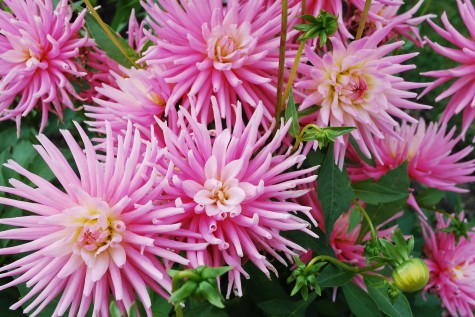
There are lots of reasons not to grow them. Their stems are weak and floppy, and snap off without any provocation; a wind is likely to send them, along with the building of stakes you have erected around them, crashing to the ground. Bugs love them even more than you do. Earwigs set up housekeeping deep in the petals. They can become infested with, and succumb to spider mites in what seems like the blink of an eye. The plants are as awkward and ungainly as a teen-aged tea rose. Some shorter more stocky varieties are shy bloomers-figures. They hate cold weather, and cold weather goes with our gardening territory.
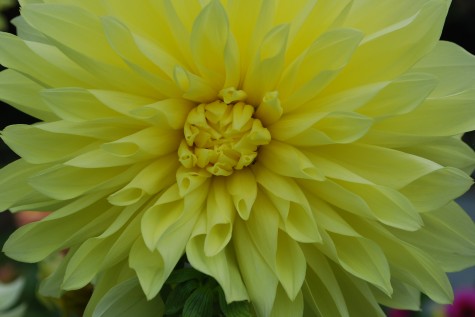 Some sport blooms so large the word vulgar comes to mind. Some “dinnerplate dahlias” have stems so weak the plant perpetually looks like someone spent the last hour giving them a thorough dressing down. Fungus spreads like crazy from the bottom up; I have grown plenty of dahlia stalks with a few anemic and forlorn flowers on top. When I grow them in pots, I face them down with something that has the decency to grow vigorously, and hide those ungainly dahlia legs.
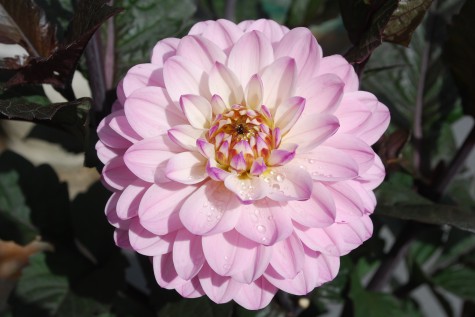 So why do I grow them? In a good year, they are magnificent. Loaded with flowers, they remind me of the 19th century flower paintings of Rachel Ruysch; they are supremely grand. The range of colors and forms is astonishing. This dahlia is a “formal decorative” type. Park Princess has petals shaped like quills; this form is known as a “cactus dahlia”.
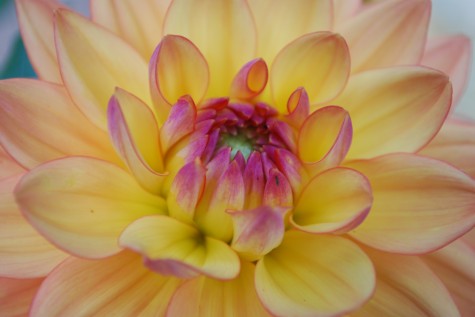
If you have a love of color, dahlias deliver. From pure white to the most audacious orange to carmine, all of the warm colors are represented. The bicolor varieties evolve in appearance over the summer. When temperatures start to cool off in the fall, the contrast in colors seems to intensify. No doubt they are the big brass band of the flower world.
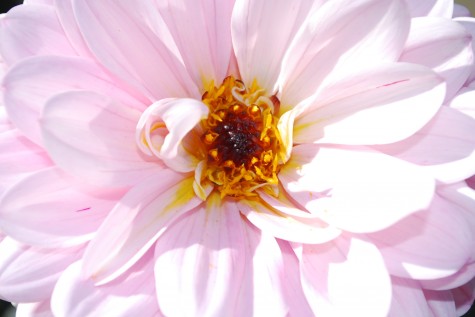 I am looking at these dahlias now as they have been at their peak this first week of October. There is something to recommend about how they last into the fall. They do hate cold weather; the best grown dahlias are those that have spent May and June in a greenhouse. They transition from that museum like setting to the Michigan outdoors poorly. It can take weeks before they loose that insulted look, and take hold.
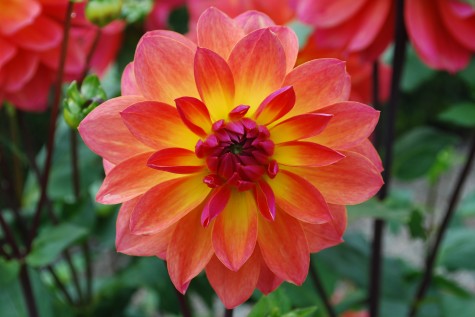 I think a too early planting can set them back such that they never recover. They thrive in that rarefied hothouse atmosphere where wind, bugs, cold soil, and various pathogens are simply not permitted. Dahlias are not great garden plants; they are an event you may wish to attend.
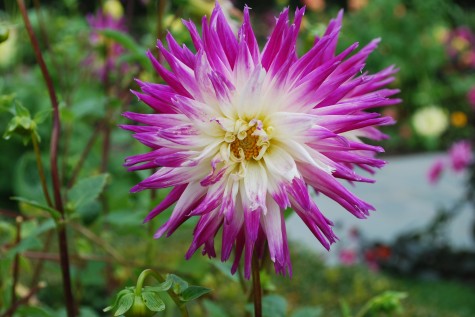 Some of these party girls dress in a way that’s just plain fun to look at. When they are at their overblown best, they make me smile.
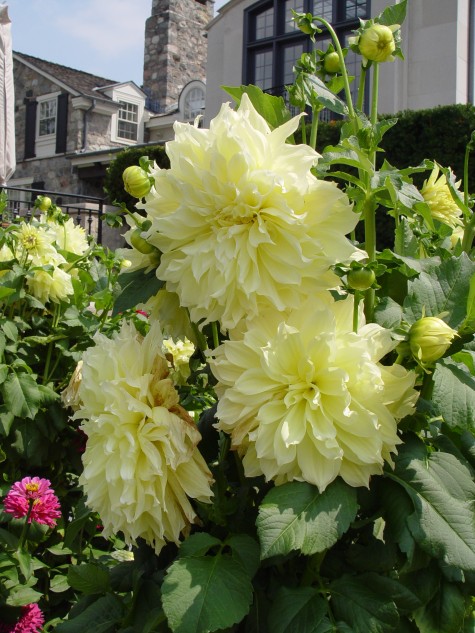
Now is the perfect time to decide if and which you will grow next year. They have put on the most glorious show this season I have ever seen, and I would not mind being treated to that again sometime soon.
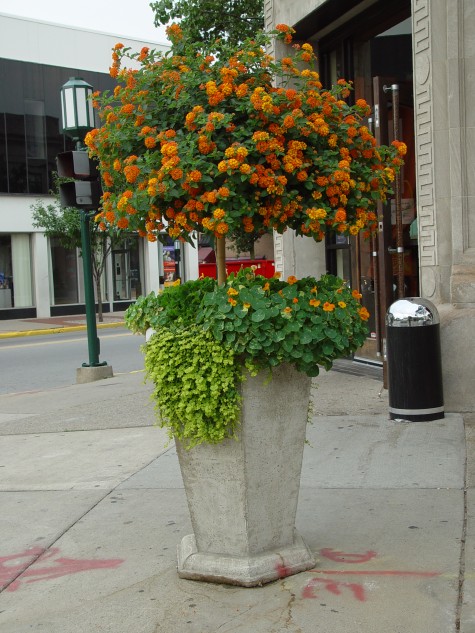 Topiary is the art of pruning, and training a plant to grow in whatever shape you might fancy. Plenty of plant species lend themselves to this kind of treatment. The above pictured lantana is seven years old. It began as a small plant, whose side branches were removed until the primary trunk was about four feet tall. A devoted grower then pinched back the main leader-the first step in the formation of the top. As I like slightly flattened spherical shapes in topiary, we keep the top pruned, and grow the side shoots wide. Lantana flowers profusely in hot weather, it makes a strikingly statuesque topiary plant. In the fall, I cut the head of the plant back by two-thirds,, strip all the remaining leaves off, and stash it in the greenhouse. I strip the leaves off, as lantana is a magnet for whitefly-and they multiply like lightening in a green house environment. What they require is plenty of trouble, but it is glorious in form and flower.
 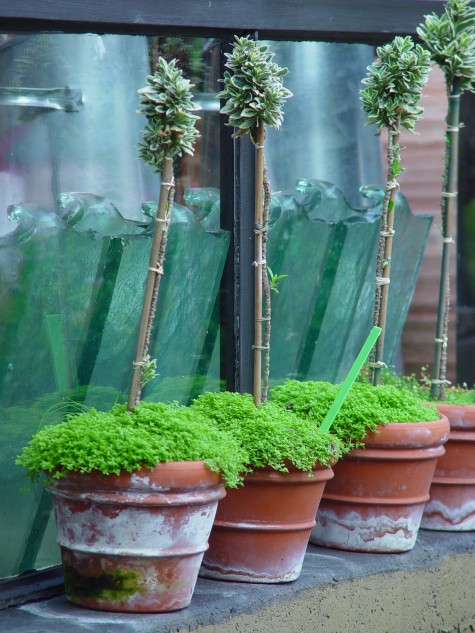 Well grown large topiary plants are expensive. It takes a lot of time to grow them on-sometimes years go by before a plant can be sold. This dwarf variegated euonymus with a batch of leaves atop a stem tells the story. In ten years, this plant will not be much taller-just much stockier, with a full head of leafy branches. As euonymus is a hardy shrub, they like to be wintered in a cool light place.
 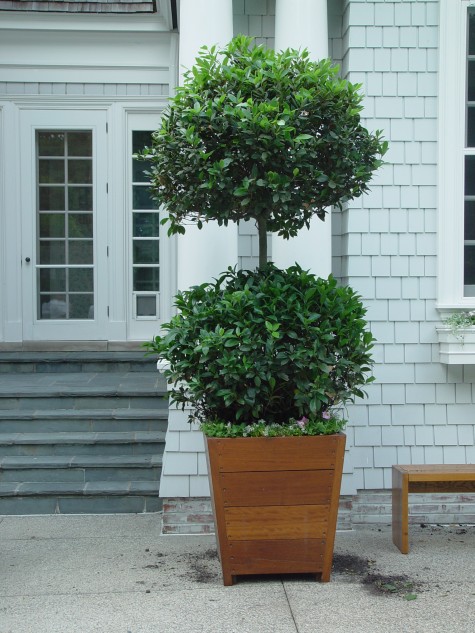 Bay Laurel is not hardy here, unfortunately-so a greenhouse is a necessity in the winter. This plant is 14 years old. This single ball topiary suckered at the base so persistently, I finally just let it grow. The formal shape is easy to keep up; you can see it needs a little haircut right now. There are many kinds of topiary shears available-I like short bladed snips, so I can cut branches without slicing into the leaves. Any leaf that is cut will show that telltale browing on that cut edge within days. �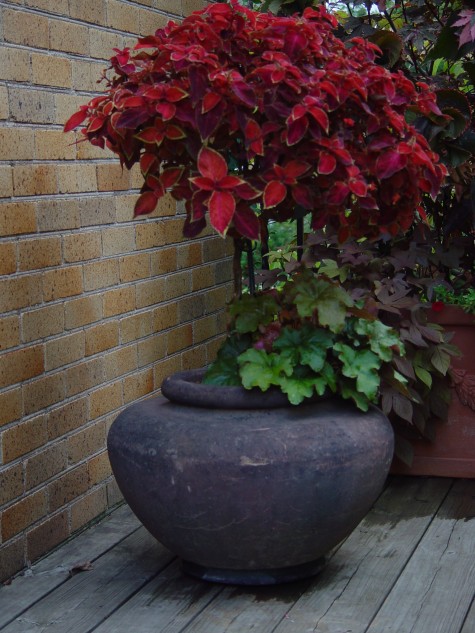
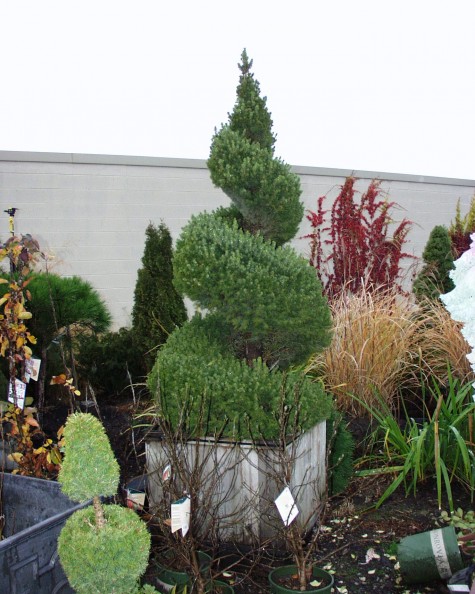
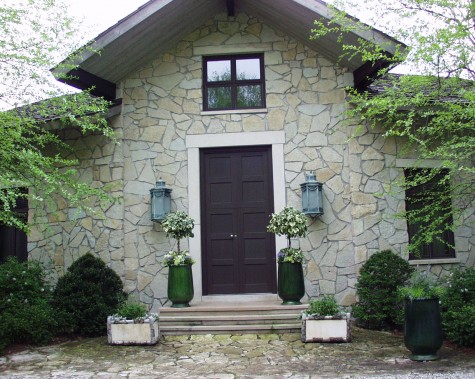 Ivy can be readily be trained over a wire form. This makes it an ideal subject for fast growing. The vines are tied to the form to provide completely coverage, and the vines are clipped as needed. Hedera algeriensis ” Gloire de Marengo”, or variegated Algerian ivy, has large glossy leaves, and a prominent white variegation; old topiaries grown from this plant are striking. A bonus-it is possible to winter ivy topiaries over in the house.
 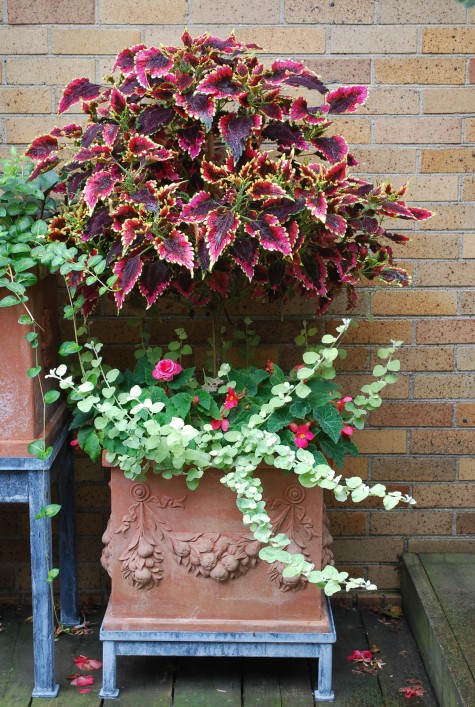 The coleus topiary I let go after two seasons-they seem to loose vigor. The minute you decide to grow a plant in any form which is not its natural form, there will be maintenance problems down the road. Plants tolerate being fooled with by people-they rarely love it. Plants that naturally lend themselves to this treatment are easier to look after.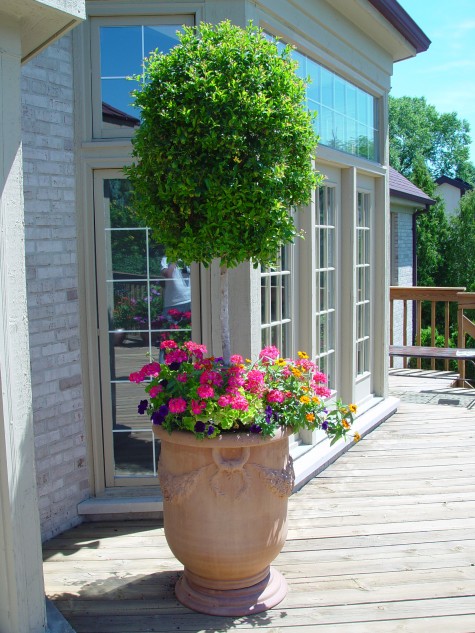
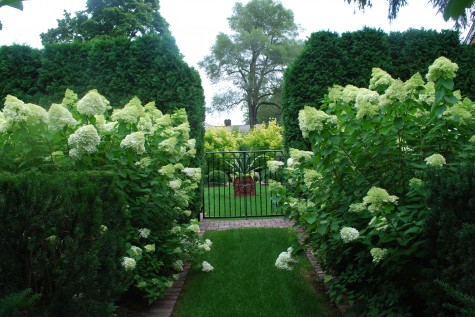
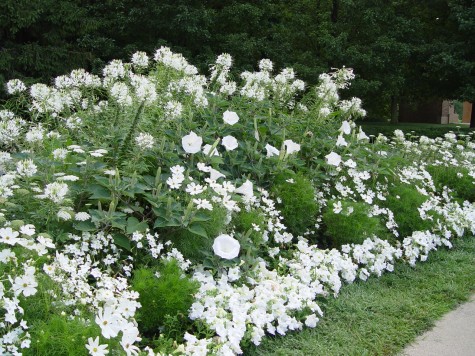
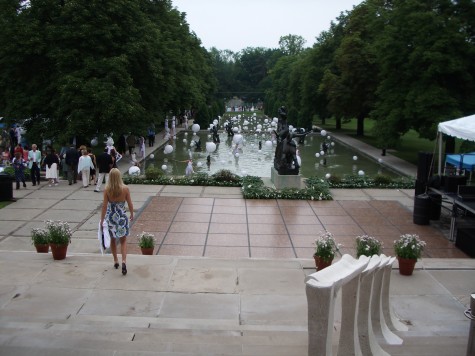
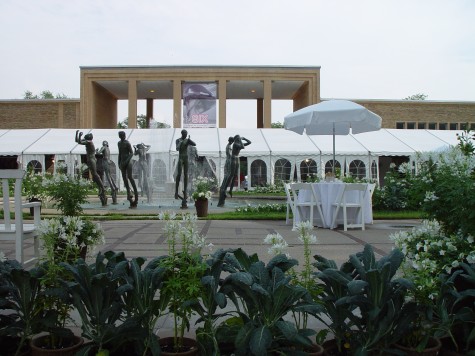 A large tent would be a temporary home to a collection of art destined for auction that evening. Each work was donated by a previous graduate of the academy; this part of the event generated considerable interest and participation. Tables reserved for groups representing the major benefactors for this event were placed in the fountain garden.
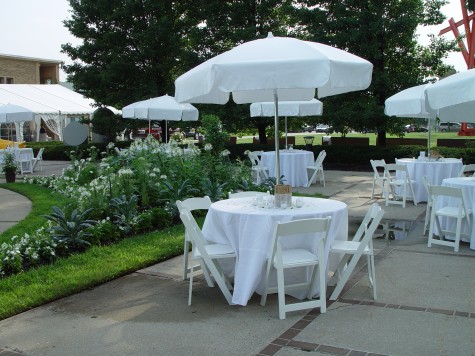 The remnants of puddles you see on the ground in the above picture bring back memories for me; it rained fiercely the afternoon of the event. What I had thought I would have the entire day to accomplish would have to be done in less time. The threat of bad weather makes any garden party all the more exciting to plan and produce-in this case, it was more excitement than I really wanted.
 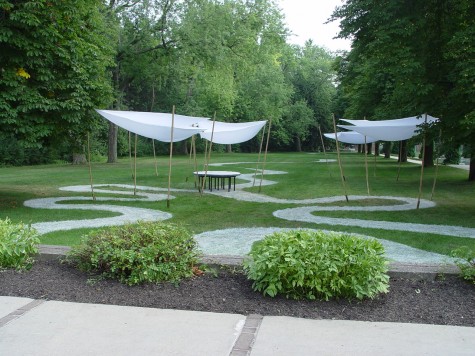 A cocktail reception would be held in a grassy area immediately adjacent to the showpiece of the Cranbrook landscape-the Triton pools. We fashioned simple tents for the hordoerves tables from double layers of white fabric attached to bamboo poles. Steel shoes for the poles were sunk in the ground at an outward angle, stretching the fabric tight and smooth. Nature had another idea in store; the intense downpour changed that flat profile to a graceful swoop. This unexpected contribution from the sky was a good one; I liked the swooping fabric against the curving path. We had painted a rambling path for guests arriving at the Lone Pine entrance to the garden to the reception area, with athletic paint.
 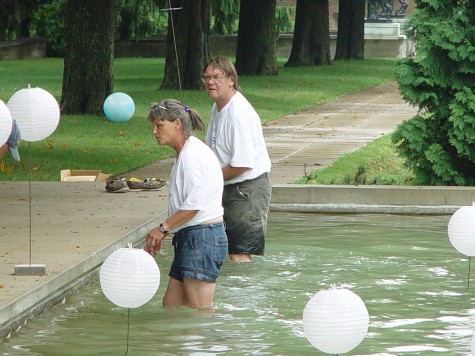 The big gesture? I had the idea to affix paper lanterns to slender steel rods anchored with bricks which would sit on the on the pool bottom. Advance measurements of the water depth enabled us to create the impression that the lanterns were floating on the surface of the water. What fun it was to get in these fountains; I never expected this opportunity to come along. A crew of four of us spent the better part of the afternoon wading in the water.
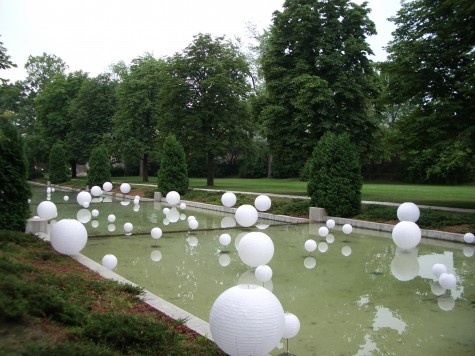 We set up hundred of lanterns of different diameters. Each steel rod had a platform at the top holding a votive candle. As we set the lanterns, we lit the votives rated to burn for ten hours, and hoped no more rain or wind would come our way. I was equally concerned that no water from the pools wick its way onto the paper. I was interested in creating a little moonlight magic, not a wet paper mess.
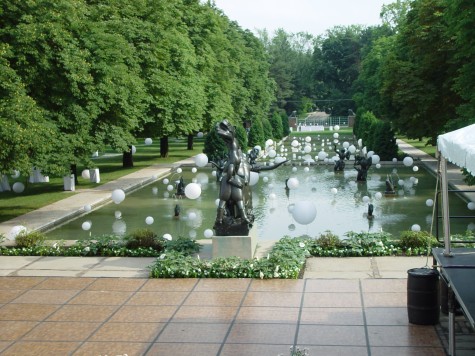 It seemed the rain had cleared off, and we did finish with an hour to spare before guests were due to arrive. The reception would begin at the very far end of the pools, and guests would wind their way uphill.
 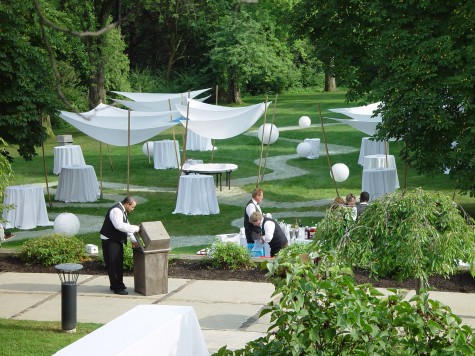 I was happy to have finished my part as the catering staff was setting up. I was on my way home to get dressed; I did not want to miss how all of this would look at night.
 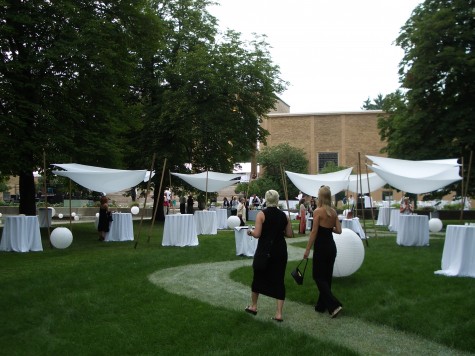 Attending an event gives you the chance to experience it as other people do. There is plenty to be learned from this-what proves awkward, what is not visually strong enough when a space is full of people, what proves to be good that you never gave a moment’s thought to. Any party in a garden will surprise you.